

Exam Code: VCS-278
Exam Name: Administration of Veritas NetBackup 8.1.2
Certification Provider: Veritas
Corresponding Certification: VCS NetBackup
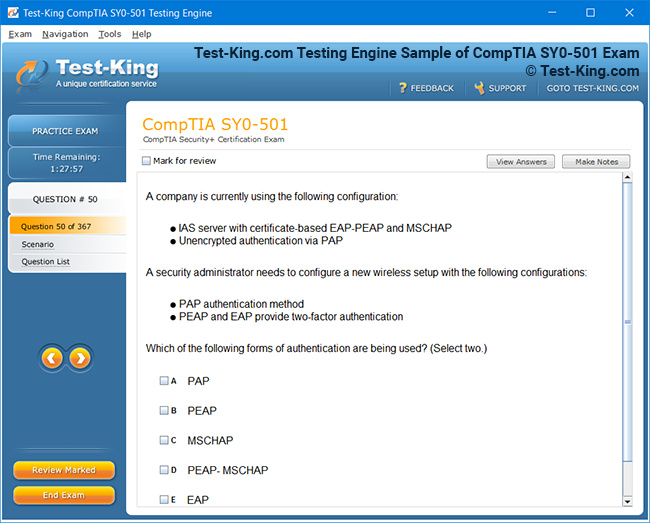
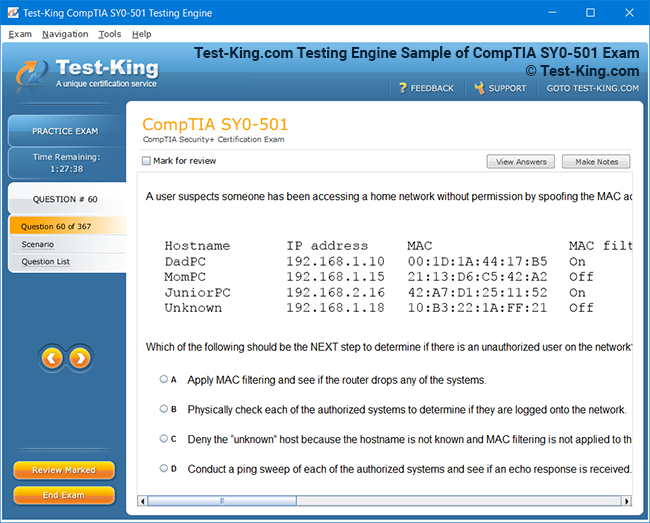
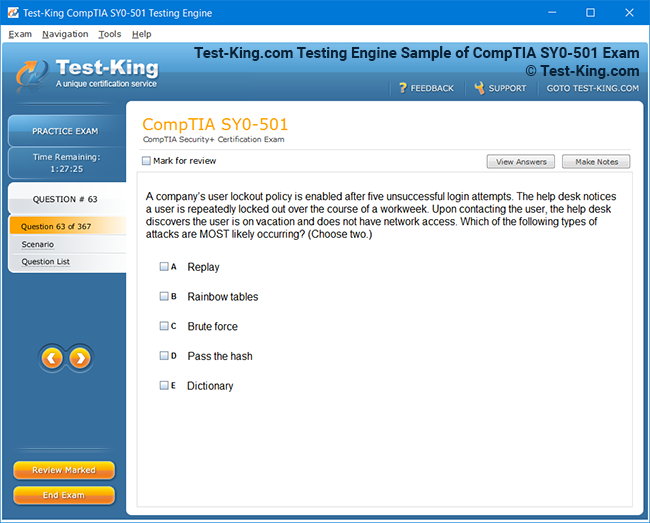
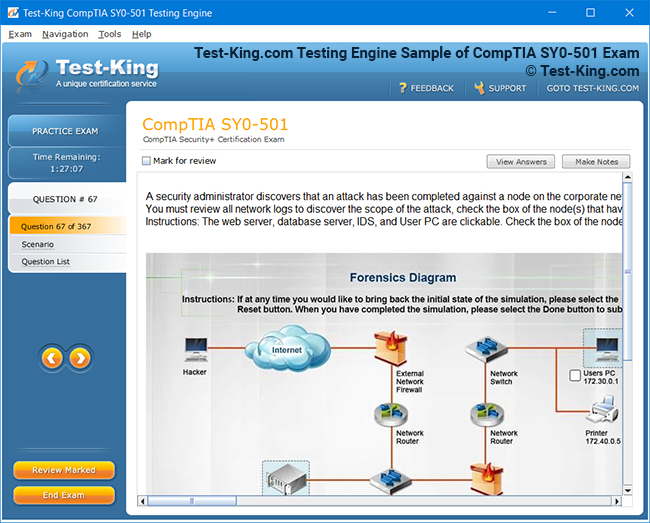
Product Screenshots
Frequently Asked Questions
How can I get the products after purchase?
All products are available for download immediately from your Member's Area. Once you have made the payment, you will be transferred to Member's Area where you can login and download the products you have purchased to your computer.
How long can I use my product? Will it be valid forever?
Test-King products have a validity of 90 days from the date of purchase. This means that any updates to the products, including but not limited to new questions, or updates and changes by our editing team, will be automatically downloaded on to computer to make sure that you get latest exam prep materials during those 90 days.
Can I renew my product if when it's expired?
Yes, when the 90 days of your product validity are over, you have the option of renewing your expired products with a 30% discount. This can be done in your Member's Area.
Please note that you will not be able to use the product after it has expired if you don't renew it.
How often are the questions updated?
We always try to provide the latest pool of questions, Updates in the questions depend on the changes in actual pool of questions by different vendors. As soon as we know about the change in the exam question pool we try our best to update the products as fast as possible.
How many computers I can download Test-King software on?
You can download the Test-King products on the maximum number of 2 (two) computers or devices. If you need to use the software on more than two machines, you can purchase this option separately. Please email support@test-king.com if you need to use more than 5 (five) computers.
What is a PDF Version?
PDF Version is a pdf document of Questions & Answers product. The document file has standart .pdf format, which can be easily read by any pdf reader application like Adobe Acrobat Reader, Foxit Reader, OpenOffice, Google Docs and many others.
Can I purchase PDF Version without the Testing Engine?
PDF Version cannot be purchased separately. It is only available as an add-on to main Question & Answer Testing Engine product.
What operating systems are supported by your Testing Engine software?
Our testing engine is supported by Windows. Andriod and IOS software is currently under development.
Top Veritas Exams
Comprehensive Guide to VCS-278: What to Expect in the Veritas NetBackup 8.1.2 Exam
The VCS-278 exam, known as the Administration of Veritas NetBackup 8.1.2, is a pivotal certification for professionals aiming to establish proficiency in enterprise backup solutions. Candidates seeking this certification are expected to demonstrate not only a thorough understanding of NetBackup architecture but also the practical skills required to manage, troubleshoot, and optimize data protection strategies within complex IT environments. Veritas NetBackup 8.1.2 has evolved with numerous enhancements that require administrators to be conversant with advanced backup methodologies, deduplication techniques, and efficient storage management.
Understanding the Scope and Importance of the Exam
Achieving success in the VCS-278 exam demands a meticulous study approach that integrates theoretical comprehension with hands-on experience. Candidates should be familiar with both the graphical user interface of NetBackup and command-line utilities, understanding the nuances of policy configuration, job scheduling, and backup storage hierarchies. Beyond routine administration, the exam also evaluates knowledge of disaster recovery planning, cross-platform compatibility, and secure backup practices, ensuring candidates are prepared for real-world scenarios.
The VCS-278 certification serves as a benchmark for verifying an administrator’s ability to deploy, manage, and optimize enterprise backup solutions effectively. In the context of an increasingly data-driven world, where business continuity is paramount, the capacity to protect critical information against loss, corruption, or ransomware attacks becomes a highly valued skill. The exam, therefore, is designed not merely as an academic assessment but as a practical demonstration of technical acumen in Veritas NetBackup environments.
Understanding the intricacies of NetBackup architecture is foundational. The system is composed of a central master server, media servers, and clients, each fulfilling specific roles in the backup ecosystem. The master server orchestrates all backup and restore operations, maintains catalogs of backup images, and manages job scheduling. Media servers, on the other hand, handle the movement of data between storage devices and clients. Clients, installed on the machines that require data protection, communicate with both the master and media servers, ensuring that backup jobs are executed seamlessly.
Backup policies form the nucleus of NetBackup administration. Policies define the backup type, schedule, retention period, and storage destination for client data. Administrators must be adept at creating and modifying policies to accommodate varying data volumes, application requirements, and organizational compliance mandates. Additionally, NetBackup offers advanced features such as snapshot integration, incremental and differential backups, and synthetic full backups, all of which are crucial to understanding for exam success.
Job monitoring and reporting constitute another domain of importance. Administrators must be able to track the status of backup jobs, interpret log files, and diagnose errors or failures efficiently. The VCS-278 exam may include scenarios requiring candidates to troubleshoot failed jobs, identify the root cause of issues such as media unavailability or misconfigured policies, and implement corrective measures promptly. Effective monitoring ensures not only operational continuity but also adherence to service-level agreements and regulatory standards.
A critical aspect of the exam involves storage management. Veritas NetBackup 8.1.2 supports diverse storage devices, including disk arrays, tape libraries, and cloud storage, each presenting unique challenges. Administrators need to comprehend storage lifecycle management, deduplication ratios, media multiplexing, and performance optimization techniques. The capacity to balance storage efficiency with backup reliability is a recurring theme in the exam, emphasizing the practical significance of these skills in enterprise environments.
Disaster recovery and business continuity planning are integral to the certification objectives. Candidates must understand how to implement backup strategies that facilitate rapid recovery in the event of system failures, data corruption, or catastrophic incidents. The exam assesses the ability to configure disaster recovery policies, perform system restores, and validate the integrity of backup images. This ensures that certified professionals are capable of safeguarding organizational data against unforeseen disruptions while minimizing downtime.
Security and compliance are also emphasized within the VCS-278 syllabus. Data encryption, access control, and audit logging are core components of secure NetBackup administration. Candidates must be familiar with configuring encryption for data at rest and in transit, managing user roles and permissions, and generating compliance reports. The ability to implement stringent security measures is critical, given the increasing prevalence of cyber threats and regulatory scrutiny surrounding sensitive information.
Operational efficiency is a recurrent theme in the exam. Beyond fundamental administration, candidates are evaluated on their capability to streamline backup processes, optimize resource utilization, and reduce recovery times. Features such as deduplication, snapshot integration, and optimized storage paths are tested to ensure administrators can deliver cost-effective and high-performing backup solutions. Understanding these optimizations is not only essential for passing the exam but also for enhancing the operational resilience of any organization relying on NetBackup.
Practical scenarios may form a significant portion of the VCS-278 exam, where candidates are presented with troubleshooting exercises or system configuration challenges. For instance, a scenario could involve identifying why incremental backups are not completing successfully due to client-side configuration errors or deduplication inconsistencies. Candidates must analyze logs, interpret system messages, and implement the correct solution, reflecting real-world problem-solving capabilities.
Networking and system integration play an important role in the certification. Veritas NetBackup 8.1.2 operates across heterogeneous environments, supporting multiple operating systems and applications. Administrators must understand network configurations, firewall settings, and storage access protocols to ensure seamless data movement. The exam may test this knowledge through questions that require integration of NetBackup with existing infrastructure while maintaining optimal performance and security.
The exam also evaluates knowledge of reporting and analytics. Veritas NetBackup provides comprehensive reporting tools that allow administrators to track backup success rates, storage consumption, and system health. Being able to interpret these reports, generate actionable insights, and propose optimizations demonstrates a deep understanding of both the platform and the operational objectives of enterprise data protection.
Automation is a recurring topic of significance. Veritas NetBackup offers APIs and command-line tools that facilitate automation of repetitive tasks, such as scheduled backups, policy creation, and report generation. Candidates familiar with automating routine operations not only exhibit efficiency but also reduce the likelihood of human error, a factor often tested in VCS-278 scenarios. Understanding how to leverage automation capabilities is thus an essential skill for both exam success and real-world administration.
Backup image management and retention policies form another core area. Administrators must understand how to define retention periods, manage expired images, and perform cleanup operations to prevent storage bloat. The exam evaluates familiarity with retention rules, image expiration, and the consequences of improper lifecycle management. Mastery in this domain ensures that candidates can maintain a balanced storage environment that is both cost-effective and compliant with organizational policies.
In addition to technical knowledge, the exam emphasizes analytical thinking and problem-solving aptitude. Candidates are often presented with hypothetical situations requiring them to devise optimal backup strategies, balance resource constraints, and address potential risks. The ability to synthesize information, predict outcomes, and implement effective solutions is central to demonstrating proficiency in NetBackup administration.
Understanding NetBackup catalog management is essential. The catalog maintains metadata about backup images, client configurations, and job history. Administrators must know how to perform catalog backups, recover catalog databases, and troubleshoot catalog corruption. Proficiency in catalog management ensures that all data recovery operations are reliable and consistent, a topic that can form complex questions on the exam.
Performance tuning is another area covered by the exam. Administrators must be familiar with optimizing job throughput, managing concurrent backup streams, and adjusting server and media server parameters for maximum efficiency. Real-world performance issues often arise due to misconfigured policies, network bottlenecks, or storage limitations, making this a critical skill for candidates to master.
Lastly, understanding patch management and version control is vital. Veritas NetBackup 8.1.2 periodically receives updates that enhance functionality, address vulnerabilities, and improve performance. Administrators must know how to plan and implement upgrades without disrupting backup operations. The exam may include scenarios requiring candidates to identify compatibility issues or plan upgrades in complex, multi-server environments.
Deep Dive into Administration, Configuration, and Advanced Features
Veritas NetBackup 8.1.2 offers an expansive framework for data protection, encompassing sophisticated storage management, diverse backup methodologies, and intricate disaster recovery mechanisms. Administrators preparing for the VCS-278 exam must possess a nuanced understanding of the platform’s architecture, including the interplay between master servers, media servers, and clients, as well as the orchestration of backup and restore operations across heterogeneous environments. Mastering these concepts requires a balance of theoretical knowledge and practical experience, ensuring that candidates can navigate complex real-world scenarios with agility.
Understanding the administration of NetBackup begins with comprehending policy structures. Policies define what data is backed up, when backups occur, and where data is stored. Each policy can be customized with schedules, retention settings, and storage targets, allowing administrators to tailor backup strategies to organizational requirements. Policies may be configured for full, incremental, or differential backups, with advanced options such as synthetic full backups and snapshot integration enhancing efficiency. Exam candidates should be adept at selecting appropriate backup types based on data criticality, recovery objectives, and storage considerations, as these scenarios frequently form the basis of assessment questions.
Media management is another pivotal aspect of NetBackup administration. Media servers handle the transfer of data from clients to storage, and administrators must understand the nuances of device configuration, tape library integration, and disk storage allocation. Managing media effectively involves monitoring device availability, scheduling jobs to avoid conflicts, and ensuring that data flows seamlessly across storage hierarchies. The VCS-278 exam may present hypothetical situations in which misconfigured media servers or storage paths impede backup operations, requiring candidates to diagnose and resolve issues while maintaining operational continuity.
Job monitoring and troubleshooting constitute a significant portion of the examination objectives. Candidates must be proficient in analyzing job logs, interpreting error messages, and implementing corrective measures. For instance, a backup failure may arise from misconfigured client parameters, storage contention, or network interruptions. The ability to systematically investigate issues, identify root causes, and implement solutions demonstrates practical competence. Furthermore, administrators are expected to monitor job performance metrics, optimize throughput, and ensure that backups adhere to organizational service-level agreements.
Deduplication and storage optimization are increasingly central to efficient data protection strategies. NetBackup 8.1.2 provides deduplication technologies that reduce storage consumption and enhance backup performance. Administrators must understand the mechanics of deduplication, including source-side and target-side implementations, as well as considerations such as storage pool allocation and data chunking. The VCS-278 exam may evaluate candidates on their ability to design storage-efficient backup strategies that balance speed, reliability, and resource utilization while accommodating growing data volumes.
Disaster recovery planning is another critical competency. Administrators are expected to design and implement recovery strategies that minimize downtime and ensure data integrity. This includes understanding recovery point objectives, recovery time objectives, and procedures for restoring full systems, applications, or specific data sets. Exam scenarios often involve situations such as catastrophic server failures, corruption of backup images, or partial data loss, requiring candidates to apply methodical recovery procedures while maintaining compliance with organizational policies.
Security and compliance considerations permeate every aspect of NetBackup administration. Data must be protected against unauthorized access, both in transit and at rest. Administrators must configure encryption, manage user roles and permissions, and implement audit logging to track operations. The VCS-278 exam may include situations where an administrator is required to secure sensitive data, enforce access controls, and produce compliance reports, reflecting the growing importance of data governance in enterprise environments.
Automation capabilities enhance both efficiency and reliability in NetBackup environments. Administrators can leverage scheduling, APIs, and command-line utilities to automate routine tasks such as policy creation, backup initiation, and report generation. Automation reduces human error and ensures consistency across repetitive operations. Exam candidates may be presented with scenarios requiring them to automate complex backup workflows or implement scripts to address operational inefficiencies, demonstrating both technical knowledge and practical problem-solving skills.
Monitoring and reporting tools within NetBackup are essential for maintaining oversight of backup operations. Administrators should be capable of interpreting job histories, analyzing performance metrics, and identifying trends that may impact storage utilization or job success rates. The VCS-278 exam may test the candidate’s ability to generate reports that highlight potential bottlenecks, forecast storage requirements, and propose optimizations. Mastery of these tools underscores an administrator’s capability to maintain both operational efficiency and organizational compliance.
Integration with diverse operating systems and applications is a recurring theme in the exam. NetBackup supports heterogeneous environments, requiring administrators to manage backups across Windows, Linux, UNIX, and virtualized platforms. Knowledge of integration points, such as application-aware backups for databases or email systems, is crucial. Candidates must understand how to configure agents, schedules, and storage policies to accommodate various applications while ensuring data consistency and recovery reliability.
Catalog management is fundamental to reliable backup and restore operations. The NetBackup catalog contains metadata about backup images, client configurations, and job histories. Administrators must be able to perform catalog backups, recover catalog databases, and address corruption issues. The VCS-278 exam may present situations where catalog inconsistencies impede backup or recovery, and candidates must demonstrate the ability to restore catalog integrity while minimizing data loss.
Performance tuning is another key area of expertise. Administrators must understand how to optimize job throughput, configure concurrent streams, and balance workloads across media servers. Performance bottlenecks may arise from misconfigured policies, network limitations, or storage constraints, and candidates must be prepared to identify and remediate these issues. The exam may present hypothetical performance scenarios, requiring analytical thinking and an understanding of system behavior under varying loads.
Retention management and image lifecycle policies ensure that storage resources are used efficiently. Administrators must determine appropriate retention periods, implement cleanup procedures, and manage expired backup images. The VCS-278 exam may assess candidates on their ability to create retention strategies that comply with organizational policies and regulatory mandates while maintaining adequate recovery options. Understanding the nuances of retention rules and their operational impact is essential for both exam success and practical administration.
Understanding networking intricacies is critical, as backup operations often traverse complex network environments. Administrators must account for bandwidth limitations, firewall configurations, and network segmentation when designing backup strategies. The exam may include scenarios where network-related issues cause job failures, and candidates must demonstrate the ability to resolve connectivity problems without disrupting ongoing operations. This emphasizes the practical knowledge required to administer backups across geographically dispersed or complex IT infrastructures.
Patch management and version control are integral to maintaining a secure and reliable NetBackup environment. Administrators must plan and implement updates without interrupting critical backup operations. The exam may test the candidate’s ability to identify compatibility issues, sequence updates, and ensure continuity of service during maintenance activities. Keeping the software current while maintaining operational stability is an important skill for any certified professional.
Problem-solving and critical thinking are interwoven throughout the exam. Candidates may face complex scenarios requiring the integration of multiple skills, from storage optimization to security enforcement and recovery planning. These situations test the ability to synthesize information, evaluate alternative solutions, and implement effective strategies. Realistic scenarios help ensure that certification holders can transition smoothly from theoretical understanding to practical administration in enterprise environments.
Advanced features such as snapshot-based backups, cloud integration, and virtual machine protection require nuanced knowledge. Administrators must understand the operational implications, configuration requirements, and performance considerations associated with these capabilities. Exam scenarios may evaluate the candidate’s ability to configure snapshots for rapid recovery, integrate cloud storage into existing backup policies, or protect virtualized environments without compromising performance or consistency.
Candidates are expected to be conversant with troubleshooting complex errors and failures. This includes diagnosing client communication issues, addressing storage or media errors, and resolving policy misconfigurations. Exam questions often present realistic challenges, requiring step-by-step reasoning and a methodical approach. The ability to interpret logs, understand system alerts, and implement corrective measures is a cornerstone of NetBackup administration expertise.
Understanding cross-platform compatibility, disaster recovery orchestration, and secure operational practices ensures that certified professionals are capable of managing backups in diverse and evolving IT landscapes. The VCS-278 exam emphasizes both breadth and depth, testing knowledge of fundamental concepts alongside the ability to implement solutions that maintain data integrity, performance, and compliance across complex environments.
Advanced Administration, Troubleshooting, and Optimization Techniques
Veritas NetBackup 8.1.2 has evolved into a highly sophisticated backup and recovery platform, designed to accommodate the intricate demands of enterprise data protection. Administrators aspiring to pass the VCS-278 exam must cultivate a comprehensive understanding of the system’s architecture, operational dynamics, and advanced functionality. Mastery involves not only grasping the foundational concepts of policies, media management, and job monitoring but also developing the ability to troubleshoot complex failures, optimize storage usage, and integrate diverse environments effectively.
Central to NetBackup administration is the orchestration of backup policies, which dictate the behavior of backup jobs and data retention. Policies may be customized with specific schedules, backup types, and storage targets to meet organizational objectives. Full, incremental, and differential backups each serve distinct purposes, while synthetic full backups and snapshot-based backups provide mechanisms for reducing network load and optimizing storage consumption. Candidates should be adept at evaluating business requirements and selecting appropriate backup strategies to ensure minimal disruption while maintaining data integrity.
Media management and storage configuration constitute another vital competency. Media servers are responsible for transporting data from clients to storage, which may include disk arrays, tape libraries, or cloud storage solutions. Administrators must understand device allocation, storage pool management, and multiplexing techniques, ensuring that resources are utilized efficiently. The VCS-278 exam may present scenarios in which storage misconfigurations, media unavailability, or performance bottlenecks must be diagnosed and rectified, requiring both technical acuity and practical reasoning.
Effective monitoring of backup operations is essential for maintaining service reliability and compliance. Administrators should be able to interpret job logs, identify failure patterns, and apply corrective measures promptly. A common challenge involves incremental backups that fail due to client-side misconfigurations or network interruptions. Candidates are expected to trace the root cause, adjust policy settings, and verify job completion, demonstrating a methodical approach to problem-solving. Understanding how to correlate job statistics with operational metrics enhances both exam performance and real-world operational efficiency.
Deduplication and storage optimization techniques are increasingly significant in contemporary data protection strategies. NetBackup offers source-side and target-side deduplication to reduce redundant data storage, accelerate backup performance, and lower operational costs. Administrators must comprehend deduplication pools, data chunking, and storage efficiency metrics. Exam scenarios often require candidates to design backup strategies that maximize storage utilization without compromising performance, highlighting the interplay between technology and practical administration.
Disaster recovery planning is a crucial focus area for the exam. Administrators must design robust recovery strategies that minimize downtime and ensure the integrity of data in catastrophic scenarios. This includes implementing recovery point objectives, recovery time objectives, and system restore procedures. Candidates may be asked to develop comprehensive recovery plans that encompass full system restores, application-specific recovery, and recovery validation processes. Proficiency in disaster recovery ensures that organizations can maintain business continuity in the face of unforeseen disruptions.
Security measures permeate every aspect of NetBackup administration. Data encryption, user access management, and audit logging are fundamental requirements. Administrators must configure encryption for data at rest and in transit, manage user roles, and generate reports to satisfy compliance requirements. In exam scenarios, candidates might encounter situations requiring them to secure sensitive datasets, implement access restrictions, and demonstrate adherence to regulatory mandates. Understanding these security imperatives is essential for both exam success and practical data stewardship.
Automation is a key facilitator of operational efficiency in NetBackup environments. Scheduling, APIs, and command-line tools enable administrators to automate repetitive tasks, such as policy creation, job execution, and reporting. The ability to implement automation workflows reduces human error and ensures consistency across operations. Candidates may be assessed on their capacity to streamline complex tasks, optimize backup sequences, or deploy scripts that enhance overall system reliability, reflecting the real-world utility of automation skills.
Catalog management is another indispensable element of NetBackup administration. The catalog contains metadata about backup images, job histories, and client configurations. Administrators must know how to perform catalog backups, recover damaged catalogs, and address inconsistencies. Exam scenarios may present catalog corruption or incomplete metadata challenges, requiring candidates to apply systematic recovery techniques. Mastery of catalog management ensures that restore operations are reliable and that data remains accessible under all circumstances.
Performance tuning is critical for maximizing the throughput and efficiency of backup operations. Administrators must understand how to optimize concurrent job streams, allocate resources effectively, and mitigate network or storage bottlenecks. Scenarios in the VCS-278 exam may involve diagnosing performance degradation caused by policy misconfigurations, overloaded media servers, or inadequate network bandwidth. Candidates must demonstrate the ability to analyze system metrics, identify constraints, and implement strategies to restore optimal performance.
Retention management and image lifecycle policies ensure that backup storage is used judiciously. Administrators are responsible for defining retention periods, purging expired backup images, and maintaining compliance with organizational and regulatory standards. Candidates should be able to design retention strategies that balance operational requirements with storage efficiency, prevent unnecessary accumulation of obsolete data, and support long-term recovery objectives. Exam questions often explore scenarios involving conflicting retention policies, requiring thoughtful resolution to maintain system integrity.
Networking and system integration are central to the effective operation of NetBackup in complex environments. Administrators must consider bandwidth, firewall settings, and multi-site connectivity when designing backup strategies. The VCS-278 exam may include network-related troubleshooting scenarios, challenging candidates to resolve connectivity issues that affect backup reliability. Understanding the interaction between NetBackup components and diverse operating systems, virtualized platforms, and application environments is essential for ensuring consistent and dependable data protection.
Advanced features such as snapshot integration, cloud storage support, and virtual machine protection enhance NetBackup’s versatility. Administrators must comprehend configuration nuances, performance considerations, and operational implications associated with these features. Exam scenarios may test the ability to implement snapshot-based backups for rapid recovery, integrate cloud storage into existing backup workflows, or protect virtualized environments while maintaining data consistency. Mastery of these advanced functionalities underscores a candidate’s readiness for complex enterprise deployments.
Troubleshooting complex failures is an essential skill for NetBackup administrators. Problems may include client communication errors, storage device malfunctions, or policy misalignments. Candidates must demonstrate methodical approaches to isolating issues, interpreting log data, and implementing corrective actions. Scenarios may require integrating multiple problem-solving strategies simultaneously, reflecting the multi-faceted challenges encountered in real-world administration.
Understanding cross-platform compatibility and application-aware backups is critical. Administrators must ensure that backups function seamlessly across different operating systems and applications, such as databases or email systems. The VCS-278 exam may present cases requiring configuration of specialized agents or schedules to maintain data integrity and consistency. Candidates must be able to apply best practices to preserve application states, optimize backup windows, and prevent operational disruptions.
Monitoring tools and reporting features play a crucial role in overseeing backup operations. Administrators must interpret metrics, identify trends, and generate insights that inform decision-making. Exam questions may focus on evaluating system health, predicting storage requirements, and optimizing job scheduling. Familiarity with these tools demonstrates the capacity to maintain efficient, compliant, and resilient backup environments.
Patch management and system updates are also examined. Administrators must apply updates strategically to avoid service interruptions while ensuring that security vulnerabilities are mitigated. Candidates may encounter scenarios requiring evaluation of compatibility issues, sequencing of patches, or rollback procedures. Mastery of update processes ensures that the environment remains secure, stable, and aligned with organizational standards.
Critical thinking and analytical reasoning are intertwined throughout the exam. Candidates may be presented with multi-dimensional challenges requiring the integration of storage, security, performance, and recovery considerations. Demonstrating the ability to synthesize information, assess alternative approaches, and implement optimal solutions is central to the VCS-278 certification. Realistic problem-solving exercises ensure that certified professionals can transition from theoretical knowledge to practical, high-stakes administration.
Mastering Configuration, Performance, and Recovery Techniques
Veritas NetBackup 8.1.2 has become an indispensable tool for enterprises seeking comprehensive data protection and efficient recovery mechanisms. Candidates preparing for the VCS-278 exam are expected to possess a profound understanding of the platform, encompassing architecture, configuration, operational dynamics, and advanced administrative features. Achieving mastery requires balancing conceptual knowledge with practical experience, ensuring the ability to manage, troubleshoot, and optimize backup and recovery operations across diverse IT landscapes.
A central aspect of administration is policy configuration, which forms the backbone of effective backup strategies. Policies define the scope of backup operations, scheduling, retention rules, and storage destinations. Understanding the nuances of full, incremental, and differential backups is crucial, while synthetic full backups and snapshot-based backups provide mechanisms for conserving bandwidth and storage. Candidates must be able to select appropriate strategies based on business requirements, recovery objectives, and operational constraints, reflecting real-world demands and exam expectations.
Media server management and storage configuration are equally pivotal. Media servers facilitate the transfer of data between clients and storage devices, which may include disk arrays, tape libraries, or cloud repositories. Administrators must manage storage allocation, media multiplexing, and device availability to ensure uninterrupted operations. The VCS-278 exam may present scenarios in which media misconfigurations, storage limitations, or network constraints impede backups, requiring candidates to diagnose and resolve issues efficiently. Understanding the interplay between storage hierarchies, deduplication, and throughput optimization is critical for exam success.
Monitoring and troubleshooting backup jobs are essential skills. Administrators must analyze job logs, identify error patterns, and apply corrective measures. Common challenges include network interruptions, client misconfigurations, and storage conflicts that result in failed backups. Candidates are expected to systematically trace issues, adjust configurations, and validate job completion. Mastery of monitoring tools and the ability to interpret operational metrics are central to both practical administration and examination scenarios, ensuring that backup environments remain reliable and efficient.
Deduplication and storage optimization techniques are fundamental to modern data protection strategies. NetBackup 8.1.2 supports both source-side and target-side deduplication, which reduces redundant storage and accelerates backup performance. Administrators must comprehend storage pools, deduplication ratios, and the balance between speed and efficiency. Exam scenarios often require the creation of storage-optimized policies that conserve space without compromising recoverability. Understanding these techniques demonstrates the capacity to integrate efficiency with operational reliability.
Disaster recovery planning is a core competency. Administrators must design strategies that minimize downtime and preserve data integrity during catastrophic events. This involves implementing recovery point objectives, recovery time objectives, and systematic restoration procedures for full systems, applications, and specific datasets. Candidates may encounter scenarios involving hardware failures, corrupted backup images, or incomplete restores, requiring them to apply methodical procedures and validate recovery outcomes. Proficiency in disaster recovery planning reflects an understanding of organizational continuity needs.
Security and compliance considerations permeate every layer of NetBackup administration. Administrators must configure encryption, manage access control, and implement audit logging to safeguard data. Data must be protected both at rest and during transit, ensuring that unauthorized access is prevented. Exam questions may require candidates to secure sensitive datasets, enforce user permissions, and generate compliance reports, emphasizing the critical intersection of technical administration and regulatory adherence. Understanding security principles and their operational implementation is essential for professional competency.
Automation enhances efficiency and reduces the likelihood of errors in repetitive tasks. Scheduling, APIs, and command-line utilities allow administrators to automate policy creation, job execution, and reporting. Candidates may face scenarios requiring the automation of complex workflows, demonstrating their ability to implement reliable, consistent processes. Mastery of automation capabilities allows administrators to maintain high operational standards while optimizing resource utilization, a skill that is both exam-relevant and practically valuable.
Catalog management is indispensable for reliable backup and restore operations. The catalog contains metadata about backup images, job history, and client configurations. Administrators must perform catalog backups, recover from corruption, and maintain consistent metadata integrity. The VCS-278 exam may present catalog-related failures, requiring candidates to restore metadata and ensure that backup operations proceed without interruption. A deep understanding of catalog mechanisms ensures that restoration processes remain precise and dependable.
Performance tuning is critical to maximizing backup efficiency. Administrators must optimize job throughput, configure concurrent job streams, and resolve bottlenecks arising from network, storage, or policy constraints. The exam may include scenarios where suboptimal performance must be diagnosed and rectified. Candidates are expected to analyze operational metrics, identify limiting factors, and implement tuning strategies that enhance both speed and reliability. This skill reflects the real-world challenges of managing complex, high-volume backup environments.
Retention policies and image lifecycle management are vital for storage efficiency and compliance. Administrators must define appropriate retention periods, manage expired backups, and prevent unnecessary storage consumption. Candidates may encounter scenarios requiring them to reconcile conflicting retention rules, optimize storage usage, and ensure compliance with organizational or regulatory mandates. Proficiency in retention management is integral to maintaining operational sustainability and ensuring data availability over time.
Networking and cross-platform integration are essential for seamless backup operations. Administrators must account for bandwidth limitations, firewall configurations, and connectivity between distributed sites. The VCS-278 exam may present network-related challenges, requiring candidates to troubleshoot connectivity issues that affect backup reliability. Additionally, integration across heterogeneous operating systems and application environments demands knowledge of specialized agents, scheduling nuances, and configuration parameters, ensuring consistent data protection across all platforms.
Advanced features such as snapshot integration, cloud storage support, and virtual machine protection expand the versatility of NetBackup. Administrators must understand the operational implications, configuration requirements, and performance considerations associated with these capabilities. Exam scenarios may require candidates to implement snapshot-based backups for rapid recovery, integrate cloud storage seamlessly, or protect virtualized environments without compromising data integrity. Mastery of advanced functionalities reflects the candidate’s readiness to manage modern enterprise backup ecosystems.
Troubleshooting complex failures is an essential competency. Issues may stem from client communication errors, misconfigured policies, storage device malfunctions, or network interruptions. Candidates must demonstrate the ability to systematically identify root causes, implement corrective measures, and validate resolution. Exam questions often combine multiple issues, requiring analytical reasoning and the integration of diverse problem-solving techniques to maintain operational continuity.
Understanding application-aware backups and cross-platform compatibility is vital. Administrators must ensure that backups preserve application states, data consistency, and system integrity across operating systems and enterprise applications. The VCS-278 exam may present scenarios in which specialized configurations or agent deployments are required to ensure reliable recovery. Candidates must demonstrate knowledge of best practices, scheduling considerations, and integration strategies that maintain operational efficiency while safeguarding critical data.
Monitoring and reporting are crucial for overseeing backup performance and system health. Administrators must interpret logs, generate meaningful insights, and propose optimization strategies. The exam may include scenarios that require evaluation of backup efficiency, prediction of storage needs, or identification of performance bottlenecks. Proficiency in reporting tools ensures administrators can maintain resilient, compliant, and efficient backup operations.
Patch management and updates are integral to maintaining system security and reliability. Administrators must implement updates strategically to avoid disrupting critical operations while ensuring vulnerabilities are mitigated. Candidates may encounter scenarios where compatibility, sequencing, or rollback procedures are critical to maintaining service continuity. Mastery of these practices demonstrates an understanding of both operational and security imperatives within enterprise backup environments.
Critical thinking and analytical reasoning permeate the VCS-278 exam. Candidates may face complex, multi-dimensional scenarios requiring integration of performance tuning, security management, storage optimization, and disaster recovery planning. Demonstrating the ability to synthesize information, evaluate alternatives, and implement optimal strategies is essential for success. Real-world problem-solving exercises ensure certified professionals can apply knowledge practically while maintaining operational reliability and data integrity.
Expertise in Backup Management, Troubleshooting, and Optimization Strategies
Veritas NetBackup 8.1.2 is a comprehensive enterprise backup and recovery solution designed to meet the demanding requirements of modern data-centric organizations. Professionals preparing for the VCS-278 exam must acquire not only foundational knowledge of backup operations but also an intricate understanding of system administration, troubleshooting, and optimization techniques. Mastery involves blending theoretical insights with practical experience to ensure seamless management of complex IT environments.
Administrators must first grasp the architecture of NetBackup, which comprises a central master server, multiple media servers, and client nodes. The master server orchestrates all backup and restore operations, maintains catalogs, and schedules jobs across the environment. Media servers handle the transport of data from clients to storage, whether disk arrays, tape libraries, or cloud repositories. Clients interact with the master and media servers to initiate backups and facilitate restores. A nuanced comprehension of this interplay is critical for managing large-scale environments efficiently.
Policy configuration lies at the heart of effective NetBackup administration. Policies dictate which data is protected, when backups occur, and where data is stored. Administrators must understand full, incremental, and differential backup types, along with synthetic full backups and snapshot-based methods that conserve bandwidth and storage. Candidates must also consider scheduling nuances, retention rules, and storage allocation to optimize both operational efficiency and recovery capabilities. The VCS-278 exam often tests candidates’ abilities to tailor policies to meet diverse business requirements while maintaining reliability.
Media management is equally crucial for high-performing backup operations. Media servers must be configured to optimize throughput, handle multiple concurrent jobs, and ensure storage devices are utilized efficiently. Administrators need to manage storage pools, multiplex data streams, and troubleshoot media failures or device unavailability. Exam scenarios may present challenges such as tape library malfunctions or disk pool constraints, requiring candidates to apply systematic troubleshooting and resource optimization strategies.
Job monitoring and troubleshooting are central to successful administration. Administrators must be capable of analyzing job logs, identifying error patterns, and applying corrective measures efficiently. Common issues include client-side misconfigurations, network interruptions, and storage contention that result in failed backups. Candidates should develop the ability to methodically trace problems, adjust policy settings, and verify completion to maintain operational continuity. Proficiency in interpreting operational metrics is also essential for making informed decisions regarding system performance.
Deduplication and storage optimization are increasingly important in enterprise environments. NetBackup provides both source-side and target-side deduplication to minimize storage consumption and improve backup efficiency. Administrators must understand deduplication ratios, storage pool allocation, and the balance between speed and data reduction. The exam may present scenarios requiring candidates to implement storage-efficient policies without compromising recoverability, emphasizing the integration of technology with practical administration skills.
Disaster recovery planning is a pivotal component of the exam objectives. Administrators must be able to design strategies that ensure minimal downtime and preserve data integrity in catastrophic scenarios. This includes defining recovery point objectives, recovery time objectives, and systematic restoration procedures for full systems, applications, and specific datasets. Candidates may encounter situations involving hardware failures, corrupted backup images, or partial restores, requiring them to execute methodical recovery procedures and validate the integrity of restored data.
Security and compliance permeate all aspects of NetBackup administration. Data must be protected both in transit and at rest, with encryption implemented and user access meticulously controlled. Administrators must manage roles, permissions, and audit logging to ensure compliance with regulatory standards. Exam scenarios may involve securing sensitive information, enforcing access policies, and generating reports to demonstrate compliance. Understanding the operationalization of security measures is critical for both examination success and real-world administration.
Automation enhances operational efficiency and reduces human error. Scheduling, APIs, and command-line utilities allow repetitive tasks such as policy creation, backup execution, and reporting to be automated. Candidates may be assessed on their ability to implement automation workflows that streamline complex processes, optimize resource utilization, and maintain consistent operational performance. Mastery of automation is essential for administering large-scale environments while maintaining reliability and accuracy.
Catalog management is indispensable for consistent and reliable backup operations. The catalog contains metadata about backup images, job histories, and client configurations. Administrators must be proficient in catalog backups, recovery from corruption, and maintaining metadata integrity. The exam may present scenarios requiring catalog restoration or troubleshooting inconsistencies, emphasizing the importance of meticulous catalog administration to ensure uninterrupted backup and restore capabilities.
Performance tuning is critical for maximizing throughput and operational efficiency. Administrators must understand how to configure concurrent job streams, allocate resources, and optimize system performance. Exam scenarios may present performance bottlenecks caused by misconfigured policies, network limitations, or storage constraints. Candidates must demonstrate the ability to analyze metrics, identify bottlenecks, and implement corrective measures to restore optimal performance. Performance tuning combines technical insight with practical problem-solving to meet enterprise-level demands.
Retention management and image lifecycle strategies ensure that storage is used efficiently while meeting organizational and regulatory requirements. Administrators must define retention periods, manage expired images, and implement cleanup processes to prevent storage bloat. The exam may include scenarios that challenge candidates to reconcile conflicting retention rules or optimize storage usage while ensuring data remains recoverable. Effective retention strategies require both operational foresight and strategic planning.
Networking and system integration are crucial to seamless backup operations. Administrators must account for bandwidth, firewall configurations, and connectivity between multiple sites to prevent disruptions. Candidates may encounter scenarios where network misconfigurations or connectivity issues impede backup reliability. Additionally, integration with heterogeneous operating systems and applications demands familiarity with specialized agents, scheduling intricacies, and configuration parameters. This ensures consistent, reliable backups across diverse environments.
Advanced features such as snapshot integration, cloud storage, and virtual machine protection extend NetBackup’s capabilities. Administrators must understand configuration requirements, performance considerations, and operational implications for these features. Exam scenarios may involve implementing snapshot-based backups for rapid recovery, integrating cloud storage into existing workflows, or protecting virtualized environments while maintaining data integrity. Mastery of these features demonstrates preparedness for complex enterprise deployments.
Troubleshooting complex failures is an essential skill. Administrators must address client communication errors, storage device malfunctions, and policy misconfigurations. Candidates are expected to identify root causes, apply corrective actions, and verify resolution. Exam questions may combine multiple issues, requiring analytical reasoning and the integration of various troubleshooting techniques to maintain continuity and reliability in backup operations.
Application-aware backups and cross-platform compatibility are critical. Administrators must ensure that backup procedures maintain data consistency and integrity across operating systems and enterprise applications. The exam may include scenarios requiring specialized configurations or agent deployments to safeguard data effectively. Candidates must apply best practices to preserve application states, optimize backup windows, and prevent operational disruptions while maintaining compliance with recovery objectives.
Monitoring and reporting provide visibility into system performance and operational health. Administrators must interpret logs, generate insights, and propose optimizations. Exam scenarios may require evaluating backup efficiency, predicting storage needs, or identifying performance bottlenecks. Competence in reporting ensures administrators can maintain efficient, resilient, and compliant backup environments.
Patch management and system updates are essential for security and stability. Administrators must plan updates to avoid disrupting critical operations and ensure vulnerabilities are mitigated. Candidates may encounter scenarios that require evaluating compatibility issues, sequencing updates, or implementing rollback procedures. Mastery of patch management demonstrates the ability to maintain a secure, reliable, and well-functioning backup infrastructure.
Analytical thinking and problem-solving are woven throughout the VCS-278 exam. Candidates may face multifaceted challenges that integrate storage management, security enforcement, performance optimization, and disaster recovery planning. Demonstrating the ability to synthesize information, assess alternative solutions, and implement effective strategies is vital for success. Realistic problem-solving exercises ensure that certified professionals are capable of translating knowledge into practical administration while ensuring operational resilience and data integrity.
Expert Insights into Backup Administration, Optimization, and Recovery Strategies
Veritas NetBackup 8.1.2 is a sophisticated and multifaceted enterprise backup solution designed to address the evolving challenges of data protection, recovery, and compliance in modern IT environments. Candidates preparing for the VCS-278 exam must possess a comprehensive understanding of the platform’s architecture, operational mechanics, and advanced administration features. Mastery requires integrating theoretical knowledge with practical experience, ensuring the ability to manage, optimize, and troubleshoot complex backup and recovery environments.
At the core of effective NetBackup administration is a nuanced comprehension of policies, which dictate backup behavior, retention, and storage allocation. Administrators must understand the distinctions between full, incremental, and differential backups, as well as synthetic full backups and snapshot-based methods that optimize storage utilization and reduce network congestion. Effective policy configuration necessitates an understanding of scheduling intricacies, retention management, and data classification, all of which ensure recoverability, operational efficiency, and adherence to organizational compliance mandates.
Media servers and storage management are fundamental to the seamless operation of backup workflows. Media servers orchestrate the movement of data from clients to storage devices, which may include disk arrays, tape libraries, or cloud repositories. Administrators must optimize storage pools, multiplex data streams, and troubleshoot device errors or performance limitations. Exam scenarios frequently challenge candidates to identify bottlenecks, resolve misconfigurations, and ensure that storage hierarchies are aligned with operational objectives while maintaining high throughput and reliability.
Job monitoring and troubleshooting are indispensable skills. Administrators must analyze job logs, interpret error codes, and implement corrective measures to maintain continuity. Typical challenges include failed incremental backups due to client-side issues, network interruptions, or storage contention. Candidates are expected to systematically diagnose these failures, adjust configurations, and verify job completion to ensure the integrity of backup operations. The ability to correlate metrics with operational performance is a hallmark of effective administration and is emphasized in the VCS-278 exam.
Deduplication and storage optimization techniques play a crucial role in minimizing storage consumption while enhancing efficiency. NetBackup 8.1.2 provides both source-side and target-side deduplication, which necessitates an understanding of storage pools, data chunking, and deduplication ratios. Candidates may be assessed on their ability to design storage-optimized backup strategies that balance performance with resource conservation. Mastery of these techniques demonstrates the ability to implement cost-effective, high-performance solutions for enterprise environments.
Disaster recovery planning is an essential competency. Administrators must create strategies that ensure minimal downtime and maintain data integrity in the event of catastrophic failures. This involves defining recovery point objectives, recovery time objectives, and orchestrating procedures for full system restores, application-specific recovery, and partial data retrieval. Exam scenarios often include hardware failures, corrupted images, or incomplete restores, requiring candidates to apply methodical restoration procedures while validating data integrity. Expertise in disaster recovery ensures organizational resilience and operational continuity.
Security and compliance are foundational to effective NetBackup administration. Administrators must implement encryption for data at rest and in transit, manage user roles and permissions, and enable audit logging to meet regulatory requirements. Exam scenarios may involve securing sensitive datasets, enforcing access restrictions, or generating compliance reports. Understanding the intersection of operational administration and regulatory adherence is critical, as it ensures both data protection and legal compliance within enterprise environments.
Automation enhances operational efficiency and reduces human error. NetBackup supports scheduling, APIs, and command-line utilities that allow repetitive tasks such as policy creation, job execution, and reporting to be automated. Candidates may encounter scenarios that require them to design and implement automated workflows to optimize operational processes, improve consistency, and reduce administrative overhead. Mastery of automation not only enhances efficiency but also ensures that backup environments remain reliable under heavy workloads.
Catalog management is vital for ensuring reliable and consistent backup operations. The catalog stores metadata regarding backup images, client configurations, and job histories. Administrators must perform catalog backups, restore corrupted catalogs, and maintain metadata integrity. Exam scenarios may include catalog corruption or metadata inconsistencies, requiring candidates to restore catalog functionality while maintaining operational continuity. A deep understanding of catalog mechanisms ensures dependable recovery and accurate tracking of backup assets.
Performance tuning is critical for maximizing backup efficiency and minimizing latency. Administrators must optimize concurrent job streams, allocate resources effectively, and identify bottlenecks caused by network, storage, or policy constraints. The VCS-278 exam may present scenarios in which suboptimal performance affects backup throughput, requiring candidates to analyze system metrics, identify limiting factors, and implement corrective actions. Mastery of performance tuning demonstrates the ability to maintain high-efficiency backup operations in complex enterprise environments.
Retention policies and image lifecycle management ensure that storage resources are utilized efficiently while remaining compliant with organizational and regulatory requirements. Administrators must define appropriate retention periods, manage expired backups, and implement cleanup procedures to avoid unnecessary storage consumption. Exam scenarios may challenge candidates to reconcile conflicting retention rules or optimize storage usage while maintaining recovery capability. Proficiency in retention management reflects a strategic approach to sustainable data protection.
Networking and cross-platform integration are critical to seamless backup operations. Administrators must account for bandwidth limitations, firewall configurations, and connectivity between multiple sites to prevent disruption. Integration across heterogeneous environments, including Windows, Linux, UNIX, and virtualized platforms, requires familiarity with specialized agents, scheduling intricacies, and configuration parameters. Candidates may be evaluated on their ability to ensure consistent, reliable backup across diverse operating systems and applications, a skill essential for modern enterprise deployments.
Advanced features such as snapshot integration, cloud storage, and virtual machine protection extend NetBackup’s capabilities and operational flexibility. Administrators must understand configuration requirements, performance implications, and operational consequences for these features. Exam scenarios may involve implementing snapshot-based backups for rapid recovery, integrating cloud storage for long-term retention, or protecting virtualized environments while maintaining data consistency. Mastery of advanced functionalities reflects a candidate’s readiness to manage modern enterprise backup ecosystems effectively.
Troubleshooting complex failures is an indispensable skill. Administrators must diagnose client communication errors, policy misconfigurations, and storage or network malfunctions. Candidates are expected to isolate root causes, implement corrective measures, and verify resolution. Exam scenarios often combine multiple issues, requiring analytical reasoning and an integrated approach to problem-solving. Effective troubleshooting ensures continuity, reliability, and resilience in backup operations.
Application-aware backups and cross-platform compatibility are critical for maintaining operational integrity. Administrators must ensure that backups preserve application states, maintain data consistency, and support reliable recovery across different operating systems and enterprise applications. Candidates may encounter scenarios requiring specialized configurations or agent deployments, emphasizing the importance of aligning backup processes with organizational requirements and recovery objectives.
Monitoring and reporting provide crucial visibility into system performance and operational health. Administrators must interpret logs, generate actionable insights, and propose optimizations to improve efficiency. Exam scenarios may involve evaluating job efficiency, predicting storage needs, or identifying performance bottlenecks. Proficiency in monitoring and reporting enables administrators to maintain resilient, compliant, and high-performing backup environments.
Patch management and system updates are essential for maintaining security and operational stability. Administrators must implement updates strategically to avoid disrupting critical operations while mitigating vulnerabilities. Candidates may face scenarios requiring evaluation of compatibility, sequencing of updates, or rollback procedures. Mastery of patch management demonstrates the ability to maintain a secure, stable, and reliable backup infrastructure.
Analytical thinking and problem-solving are woven throughout the exam objectives. Candidates may be presented with complex scenarios integrating performance optimization, storage management, security enforcement, and disaster recovery planning. Demonstrating the ability to synthesize information, evaluate alternatives, and implement effective solutions is critical. Realistic problem-solving exercises ensure that certified professionals can apply theoretical knowledge in practical, high-stakes environments.
Conclusion
The VCS-278 exam serves as a comprehensive measure of an administrator’s proficiency in managing Veritas NetBackup 8.1.2 environments. Success requires an intricate understanding of backup policies, storage management, disaster recovery, security, automation, catalog administration, performance tuning, and cross-platform integration. Candidates must demonstrate both theoretical knowledge and practical problem-solving skills to navigate complex operational scenarios. Achieving this certification not only validates technical competence but also equips professionals with the expertise to maintain resilient, efficient, and secure enterprise backup infrastructures, ultimately enhancing organizational continuity and data protection strategies.