

Exam Code: TB0-124
Exam Name: TIBCO MDM 8
Certification Provider: Tibco
Corresponding Certification: TCP
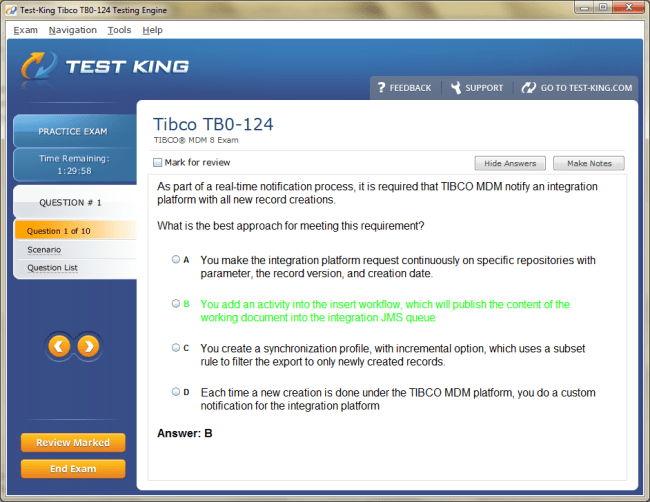
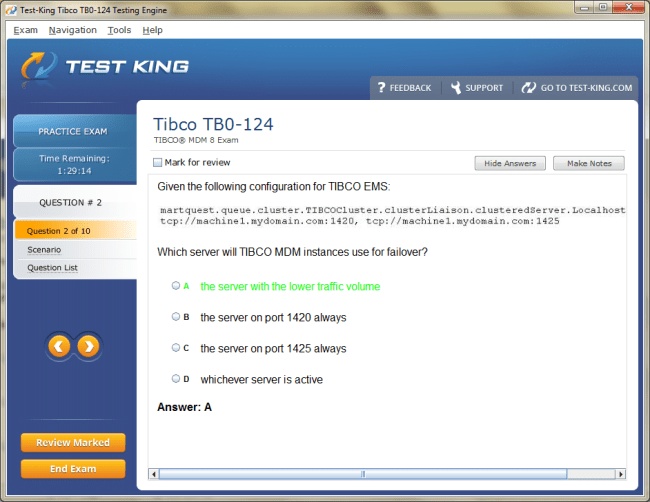
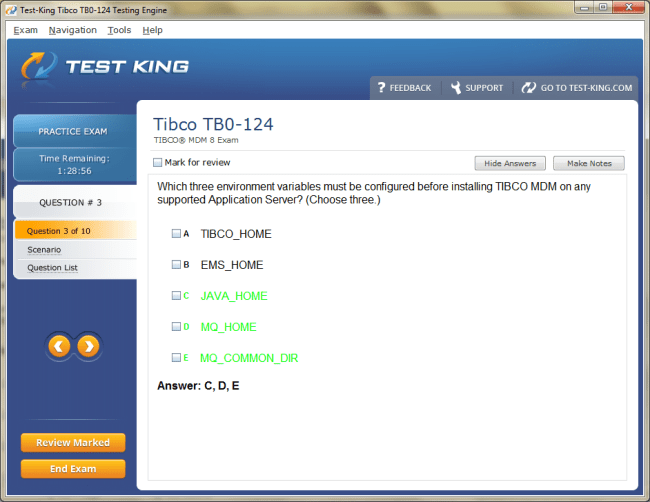
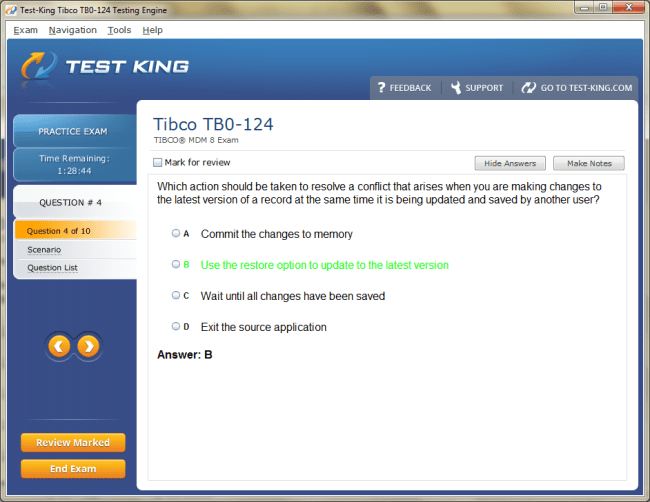
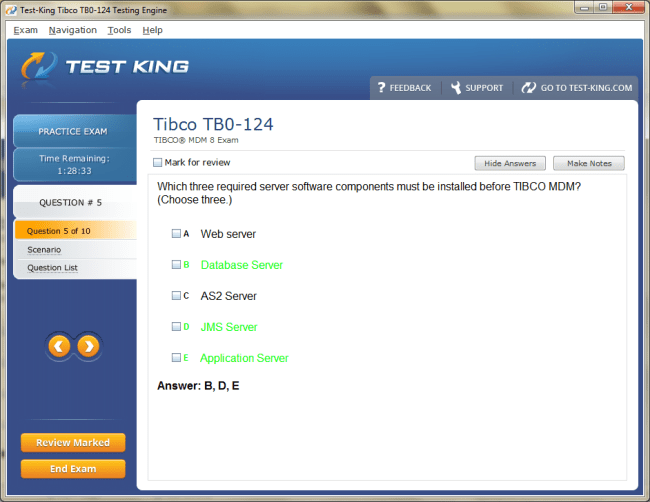
TB0-124 Exam Product Screenshots
Frequently Asked Questions
How can I get the products after purchase?
All products are available for download immediately from your Member's Area. Once you have made the payment, you will be transferred to Member's Area where you can login and download the products you have purchased to your computer.
How long can I use my product? Will it be valid forever?
Test-King products have a validity of 90 days from the date of purchase. This means that any updates to the products, including but not limited to new questions, or updates and changes by our editing team, will be automatically downloaded on to computer to make sure that you get latest exam prep materials during those 90 days.
Can I renew my product if when it's expired?
Yes, when the 90 days of your product validity are over, you have the option of renewing your expired products with a 30% discount. This can be done in your Member's Area.
Please note that you will not be able to use the product after it has expired if you don't renew it.
How often are the questions updated?
We always try to provide the latest pool of questions, Updates in the questions depend on the changes in actual pool of questions by different vendors. As soon as we know about the change in the exam question pool we try our best to update the products as fast as possible.
How many computers I can download Test-King software on?
You can download the Test-King products on the maximum number of 2 (two) computers or devices. If you need to use the software on more than two machines, you can purchase this option separately. Please email support@test-king.com if you need to use more than 5 (five) computers.
What is a PDF Version?
PDF Version is a pdf document of Questions & Answers product. The document file has standart .pdf format, which can be easily read by any pdf reader application like Adobe Acrobat Reader, Foxit Reader, OpenOffice, Google Docs and many others.
Can I purchase PDF Version without the Testing Engine?
PDF Version cannot be purchased separately. It is only available as an add-on to main Question & Answer Testing Engine product.
What operating systems are supported by your Testing Engine software?
Our testing engine is supported by Windows. Andriod and IOS software is currently under development.
Top 10 Skills Tested in the TIBCO MDM 8 (TB0-124) Exam – Key Competencies and Knowledge Areas
The TIBCO MDM 8 exam is designed to evaluate a professional’s comprehensive understanding of master data management principles and practices. Master data management, often abbreviated as MDM, is not simply about storing data but encompasses a holistic approach to maintaining data consistency, accuracy, and availability across various business applications. Candidates are expected to demonstrate a nuanced understanding of master data models, data hierarchies, and the relationships that govern entities within an enterprise system. The exam tests knowledge of how TIBCO MDM 8 facilitates centralized data governance and enforces policies that ensure integrity across multiple business domains. Concepts such as data stewardship, reference data management, and the lifecycle of master data are critical, requiring candidates to articulate scenarios where centralized control prevents data fragmentation or redundancy. Understanding these paradigms not only helps in architecting robust MDM solutions but also prepares professionals to address complex organizational requirements where disparate systems need to harmonize around consistent master data.
Data Modeling and Hierarchies
A significant portion of the exam evaluates a candidate’s proficiency in constructing and interpreting data models within TIBCO MDM 8. Data modeling goes beyond creating simplistic entity definitions; it requires the ability to design comprehensive hierarchies, relationships, and attributes that accurately reflect organizational processes. Candidates must be capable of creating canonical models that represent the real-world business entities, ensuring data consistency across different applications. Knowledge of various hierarchy types, such as parent-child, network, and many-to-many relationships, is essential. Understanding the subtleties of reference hierarchies, survivorship rules, and validation rules allows a practitioner to design models that are not only functional but also resilient to inconsistencies. Additionally, the exam assesses the ability to map source system data to the canonical model, identify anomalies, and implement data cleansing strategies. Candidates must show the aptitude to visualize complex entity relationships and ensure that data alignment promotes seamless integration with downstream systems, ultimately enabling better analytics and decision-making.
Data Governance and Quality Assurance
Data governance forms the backbone of TIBCO MDM 8 implementation, and it is an area heavily tested in the TB0-124 exam. Candidates must comprehend policies and procedures that regulate data usage, enforce accountability, and establish stewardship frameworks. The focus extends to implementing governance workflows, defining roles and responsibilities, and ensuring adherence to compliance requirements. A profound understanding of data quality concepts, such as standardization, deduplication, and validation, is crucial. The exam emphasizes scenarios where data anomalies could disrupt business operations and requires professionals to recommend remedies that enhance accuracy and completeness. Knowledge of validation rules, survivorship rules, and exception handling mechanisms within TIBCO MDM 8 is essential. Candidates should also grasp techniques for profiling data, monitoring quality metrics, and utilizing dashboards to identify trends and anomalies. This skill ensures that enterprises can maintain reliable master data, leading to informed decision-making and operational efficiency.
Integration with Enterprise Systems
The ability to integrate TIBCO MDM 8 with other enterprise systems is a critical competency tested in the exam. Candidates are expected to demonstrate expertise in connecting MDM with ERP systems, CRM applications, and data warehouses. Integration involves understanding various communication protocols, data transformation processes, and the orchestration of data flows between systems. Knowledge of batch versus real-time data synchronization, API utilization, and event-driven architecture is often assessed. Candidates must also illustrate an understanding of how integration strategies impact data governance, latency, and overall system performance. The exam may present scenarios requiring the mapping of external system data to MDM entities or resolving conflicts arising from inconsistent updates. Professionals who can seamlessly bridge MDM with other platforms enable organizations to harness a unified view of critical data assets, facilitating analytics, reporting, and operational excellence.
Workflow and Process Automation
TIBCO MDM 8 provides robust workflow and process automation capabilities, which are evaluated as part of the exam. Candidates need to articulate how workflows can automate data validation, approval, and enrichment processes, reducing manual intervention and error rates. Understanding the lifecycle of master data, including creation, modification, and retirement, is crucial for implementing automated processes effectively. The exam tests the ability to design rules-based workflows that enforce business policies and ensure compliance with organizational standards. Professionals must also demonstrate knowledge of exception handling, escalation mechanisms, and notification systems within automated processes. This competency ensures that organizations can maintain high data quality, operational efficiency, and regulatory adherence while minimizing the risk of human error.
Security and Role Management
Security and role-based access management are critical elements in TIBCO MDM 8, and the TB0-124 exam rigorously evaluates these skills. Candidates should have an in-depth understanding of how to configure user roles, assign permissions, and enforce access controls to protect sensitive master data. The exam assesses knowledge of authentication mechanisms, data encryption, and secure communication protocols. Professionals are expected to understand how to segregate duties, implement approval hierarchies, and maintain audit trails for regulatory compliance. Real-world scenarios often involve defining access at granular levels to ensure that only authorized personnel can modify or view specific datasets. Candidates must demonstrate the ability to balance operational accessibility with robust security measures, ensuring that data remains protected without hindering business processes.
Reporting and Analytics
Proficiency in reporting and analytics within TIBCO MDM 8 is another key skill tested in the exam. Candidates should demonstrate the ability to generate comprehensive reports that provide insights into data quality, system usage, and operational performance. Knowledge of designing dashboards, creating key performance indicators, and monitoring metrics in real-time is evaluated. Professionals are expected to understand how to leverage data hierarchies, aggregations, and filters to deliver actionable insights to stakeholders. The exam may test scenarios requiring identification of anomalies, trends, or compliance deviations through analytical techniques. This skill ensures that organizations can derive maximum value from their master data, supporting strategic initiatives and informed decision-making processes.
Data Stewardship and Collaboration
Data stewardship is a vital competency for maintaining high-quality master data, and candidates must exhibit expertise in this domain. TIBCO MDM 8 enables collaboration among data stewards, allowing them to manage data issues, resolve conflicts, and maintain consistency across systems. The exam evaluates the candidate’s understanding of stewardship responsibilities, workflows, and conflict resolution mechanisms. Professionals should demonstrate the ability to coordinate with business units, IT teams, and governance bodies to enforce standards and policies. This collaborative approach ensures that master data remains accurate, consistent, and aligned with business objectives, minimizing operational risks associated with erroneous or incomplete information.
Performance Optimization and Scalability
Understanding how to optimize the performance of TIBCO MDM 8 systems is essential for large-scale deployments. The exam tests the ability to design data models, workflows, and integrations that maintain system responsiveness under high data volumes. Candidates should be able to identify performance bottlenecks, optimize queries, and implement strategies for efficient data retrieval and processing. Knowledge of indexing, caching, and parallel processing mechanisms within TIBCO MDM 8 is often assessed. Additionally, candidates must demonstrate the ability to design scalable architectures that can accommodate organizational growth, ensuring that MDM solutions continue to meet performance expectations as data complexity and volume increase.
Troubleshooting and Issue Resolution
The ability to troubleshoot and resolve issues within TIBCO MDM 8 is a critical skill that the exam emphasizes. Candidates are expected to identify common challenges, such as data integration conflicts, workflow failures, or data quality anomalies, and recommend appropriate solutions. Understanding diagnostic tools, log analysis, and error handling mechanisms is crucial. Professionals should demonstrate a methodical approach to problem-solving, ensuring that issues are addressed promptly without compromising data integrity. The exam may include scenarios requiring candidates to analyze symptoms, pinpoint root causes, and implement corrective actions effectively, reflecting real-world operational requirements.
Project Implementation and Best Practices
Finally, the exam assesses a candidate’s familiarity with implementing TIBCO MDM 8 projects following industry best practices. This includes planning, requirement gathering, solution design, deployment, and post-implementation support. Professionals should demonstrate the ability to align MDM strategies with business objectives, manage change, and ensure stakeholder engagement throughout the project lifecycle. Understanding the nuances of environment setup, version control, and migration strategies is also important. Candidates are expected to showcase knowledge of practical techniques that optimize project success, minimize risks, and ensure that the MDM solution delivers measurable business value.
Advanced Data Modeling Techniques
Mastery of advanced data modeling techniques is a critical skill for candidates preparing for the TIBCO MDM 8 exam. Beyond the creation of basic entity relationships, professionals must understand complex modeling constructs such as recursive hierarchies, multi-tier relationships, and intricate attribute dependencies. These advanced models ensure that the representation of master data closely mirrors real-world business scenarios, reducing ambiguities and enhancing consistency across enterprise systems. Candidates are expected to understand how to implement reference data models that standardize shared data across multiple domains and how to configure validation and survivorship rules that dictate which records prevail when conflicts occur. Knowledge of canonical models, which act as a uniform schema for integrating diverse source systems, is evaluated, as is the ability to translate raw transactional data into structured master data hierarchies. Exam questions often challenge candidates to illustrate how these models can handle dynamic business requirements while maintaining integrity, requiring both analytical thinking and practical experience.
Data Quality Management
Data quality management is not merely an operational task but a strategic competency in TIBCO MDM 8. Candidates must demonstrate an understanding of techniques to measure, monitor, and improve the accuracy, completeness, and timeliness of data. This involves profiling incoming data to detect anomalies, implementing cleansing routines to correct errors, and applying standardization protocols to harmonize disparate data formats. The exam evaluates how professionals design validation rules, establish exception handling workflows, and deploy automated processes to prevent recurring data quality issues. Additionally, candidates should be able to define data quality metrics and utilize dashboards to monitor trends and detect irregularities that could compromise business operations. Understanding how to enforce stewardship policies ensures that responsibilities for maintaining high-quality data are distributed across business units, fostering a culture of accountability and reducing risks associated with erroneous information.
Workflow Design and Optimization
Proficiency in workflow design within TIBCO MDM 8 is a vital competency tested in the exam. Candidates need to articulate how workflows streamline data governance processes, automate approvals, and enforce data quality rules. Workflows in TIBCO MDM 8 enable organizations to minimize human intervention while ensuring that each step in the master data lifecycle is consistent and auditable. Exam scenarios often explore the configuration of condition-based routing, escalation protocols for exceptions, and notification mechanisms for critical data updates. Understanding how to integrate workflows with data stewardship activities ensures that anomalies are promptly addressed and that master data remains reliable. Professionals are expected to demonstrate the ability to optimize workflow efficiency, reduce latency, and adapt processes to evolving business requirements without compromising governance or compliance standards.
Integration and Interoperability
Integration skills are central to TIBCO MDM 8 expertise. The exam evaluates a candidate’s ability to connect the MDM platform to a variety of enterprise systems, including ERP, CRM, analytics, and data warehousing solutions. Candidates should demonstrate proficiency in orchestrating data flows, transforming data formats, and ensuring synchronization between source and target systems. A clear understanding of batch and real-time processing paradigms, as well as the ability to troubleshoot integration issues, is essential. The exam often presents scenarios in which data conflicts arise due to inconsistent updates across systems, requiring candidates to describe strategies for conflict resolution and reconciliation. Professionals who excel in integration ensure that organizations can maintain a single source of truth, enhancing operational efficiency, reporting accuracy, and analytical insight.
Security, Access Control, and Auditability
Security considerations in TIBCO MDM 8 are pivotal, encompassing both technical configurations and organizational policies. Candidates must understand how to implement role-based access control, configure user authentication, and define permissions to protect sensitive master data. The exam evaluates knowledge of secure communication protocols, data encryption, and audit trails, ensuring compliance with regulatory requirements. Professionals are expected to explain how segregation of duties, approval hierarchies, and audit logging contribute to both operational security and accountability. Real-world scenarios may involve balancing data accessibility for operational teams with stringent security controls to mitigate unauthorized access. Expertise in this area ensures that organizations can maintain data integrity, protect confidential information, and adhere to legal and regulatory standards.
Reporting, Analytics, and Insights
Candidates must demonstrate the ability to generate actionable insights from master data using TIBCO MDM 8 reporting and analytics capabilities. The exam evaluates knowledge of designing dashboards, tracking key performance indicators, and interpreting data trends. Professionals should be able to create visualizations that reveal anomalies, monitor data quality metrics, and support business decision-making. Exam questions often focus on the ability to aggregate data across complex hierarchies, filter results for relevant insights, and provide stakeholders with clear, actionable intelligence. Candidates must articulate how analytics can enhance strategic planning, operational monitoring, and compliance oversight, transforming raw master data into a valuable organizational asset.
Data Stewardship Practices
Effective data stewardship is a core skill required for TB0-124. Candidates should understand the responsibilities of data stewards in maintaining accuracy, consistency, and reliability across systems. The exam evaluates how professionals manage issue resolution, enforce governance policies, and collaborate with business units to uphold data standards. Scenario-based questions often challenge candidates to describe workflows for resolving conflicts, implementing data updates, and maintaining a centralized repository of validated information. Proficiency in stewardship ensures that organizations can sustain high-quality data across multiple domains, supporting reliable operations, analytics, and regulatory compliance. Candidates who master stewardship concepts demonstrate the ability to embed governance seamlessly into everyday processes.
Performance Tuning and Scalability
Ensuring optimal performance and scalability of TIBCO MDM 8 implementations is a critical competency assessed in the exam. Candidates must understand how to design data models, workflows, and integrations that perform efficiently under high-volume operations. Knowledge of indexing, caching, and parallel processing techniques is evaluated, as well as the ability to identify and mitigate performance bottlenecks. Exam scenarios may involve planning for scalability, such as accommodating growing data volumes, expanding user bases, and integrating additional enterprise systems. Professionals must articulate strategies to maintain system responsiveness while ensuring that data quality and governance are not compromised. This skill is essential for large organizations where master data drives critical business processes.
Troubleshooting, Diagnostics, and Problem Resolution
The ability to troubleshoot and resolve issues within TIBCO MDM 8 is emphasized in the TB0-124 exam. Candidates are expected to demonstrate systematic approaches to identifying root causes of data inconsistencies, workflow failures, or integration conflicts. Understanding diagnostic tools, log analysis, and error handling mechanisms is key. Scenario-based questions often require candidates to describe the steps they would take to resolve anomalies, restore data integrity, and prevent recurrence. Professionals with strong problem-resolution skills ensure that the MDM environment remains stable, reliable, and capable of supporting organizational objectives without disruptions.
Implementation Best Practices and Project Execution
Expertise in implementing TIBCO MDM 8 solutions according to best practices is a vital competency for the exam. Candidates must articulate strategies for planning, requirement gathering, environment setup, deployment, and post-implementation support. Knowledge of aligning MDM initiatives with organizational objectives, managing change, and engaging stakeholders throughout the lifecycle is assessed. The exam often presents scenarios in which candidates describe migration strategies, version control practices, and deployment approaches to minimize risks and ensure successful adoption. Professionals who excel in implementation best practices deliver sustainable MDM solutions that provide measurable business value, streamline operations, and enhance data-driven decision-making.
Collaborative Problem-Solving and Cross-Functional Coordination
Collaboration is an intrinsic part of managing master data in complex enterprises. The exam evaluates how candidates work with IT teams, business units, and governance councils to resolve data issues, implement workflows, and enforce policies. Professionals must demonstrate strategies for conflict resolution, consensus-building, and coordinated decision-making. Knowledge of cross-functional communication and project management techniques ensures that MDM initiatives align with broader business objectives. Candidates who excel in collaboration foster a culture of accountability and continuous improvement, enabling organizations to leverage master data as a strategic asset.
Advanced Analytics and Data-Driven Decision-Making
Candidates are expected to showcase how advanced analytics capabilities in TIBCO MDM 8 can influence decision-making processes. This involves understanding data aggregation, trend analysis, anomaly detection, and predictive insights. The exam may present scenarios requiring candidates to interpret analytical outputs to support operational and strategic initiatives. Professionals must demonstrate the ability to translate raw data into actionable recommendations, integrate insights across systems, and ensure that decision-making processes are informed by high-quality, consistent data. This skill underscores the strategic value of MDM and highlights the importance of leveraging technology to drive organizational performance.
Master Data Lifecycle Management
A profound understanding of the master data lifecycle is essential for candidates preparing for the TIBCO MDM 8 exam. Professionals are expected to illustrate how data progresses from creation and enrichment to archiving and retirement, ensuring that each stage is governed by standardized procedures. The exam often tests scenarios where data originates from multiple sources and must undergo cleansing, validation, and harmonization before being integrated into the centralized repository. Candidates should be able to describe mechanisms for detecting duplicates, enforcing data quality rules, and applying survivorship logic to maintain consistency. Additionally, knowledge of audit trails, versioning, and lineage tracking is critical, as these capabilities allow organizations to trace data modifications and ensure accountability. Understanding the lifecycle enables professionals to anticipate challenges, reduce redundancy, and maintain a reliable single source of truth across enterprise systems.
Data Modeling and Entity Relationship Management
TIBCO MDM 8 requires candidates to demonstrate mastery in designing complex data models that accurately represent organizational entities and relationships. This includes the ability to create canonical structures that integrate disparate data sources while maintaining logical coherence. The exam evaluates knowledge of various relationship types, such as hierarchical, networked, and many-to-many associations, and how they impact data integrity. Professionals must articulate how attributes are defined, standardized, and validated, ensuring that data is both consistent and meaningful. Scenarios may involve aligning source data with the canonical model, detecting anomalies, and applying cleansing or transformation rules. Candidates should also understand how entity relationships influence analytics, reporting, and downstream system integration, highlighting the strategic importance of thoughtful data modeling.
Data Governance and Policy Enforcement
Candidates are tested on their ability to establish and maintain robust data governance frameworks. TIBCO MDM 8 provides tools to enforce policies that ensure compliance, accountability, and stewardship across enterprise data domains. The exam assesses knowledge of defining governance workflows, assigning stewardship responsibilities, and implementing exception management processes. Professionals must be able to describe strategies for monitoring adherence to data quality standards, detecting violations, and resolving conflicts. Knowledge of validation rules, data standards, and reference data management is evaluated, along with the ability to design processes that maintain alignment between business objectives and data management practices. Strong governance ensures that data remains accurate, consistent, and reliable, supporting operational efficiency and strategic decision-making.
Data Integration Strategies
Integration of TIBCO MDM 8 with other enterprise applications is a key competency examined in the TB0-124 test. Candidates must demonstrate the ability to orchestrate data flows between source systems, data warehouses, and analytical platforms while preserving accuracy and consistency. Knowledge of batch and real-time processing paradigms, message queues, and API-based communication is often assessed. Professionals are expected to describe strategies for handling conflicts, transformations, and mapping discrepancies that may arise during integration. The exam may present scenarios requiring reconciliation of data from heterogeneous sources, illustrating the candidate’s ability to ensure a unified and accurate representation of critical business information. Effective integration practices enable organizations to leverage MDM as a central repository and facilitate informed decision-making across departments.
Workflow Automation and Process Optimization
TIBCO MDM 8 enables organizations to automate repetitive and governance-related workflows, and candidates must demonstrate proficiency in designing such processes. The exam evaluates knowledge of configuring rules-based workflows for data validation, approval, enrichment, and exception handling. Professionals should be able to articulate strategies for optimizing workflow efficiency, reducing manual intervention, and minimizing errors. Scenario-based questions often involve designing processes that accommodate evolving business requirements while ensuring compliance and data quality. Candidates are expected to explain how workflow automation contributes to operational agility, enables faster data updates, and enhances the reliability of master data across the organization.
Security and Role-Based Access Control
A core competency tested in the TIBCO MDM 8 exam is the ability to implement security measures and role-based access control. Candidates must understand how to assign roles, configure permissions, and enforce policies that protect sensitive master data. Knowledge of authentication mechanisms, audit trails, and secure communication protocols is evaluated. Professionals should be able to describe strategies for segregating duties, establishing approval hierarchies, and tracking modifications to ensure accountability and compliance. The exam often includes scenarios requiring candidates to balance operational accessibility with stringent security requirements, highlighting the importance of maintaining both usability and protection of critical data assets.
Reporting, Metrics, and Analytical Insights
Candidates must demonstrate proficiency in generating meaningful insights from master data using reporting and analytics tools within TIBCO MDM 8. The exam evaluates knowledge of designing dashboards, tracking data quality metrics, and analyzing trends to support decision-making. Professionals should be able to articulate how aggregation, filtering, and visualization of data enable stakeholders to identify anomalies, monitor operational performance, and plan strategically. Scenario-based questions may involve interpreting reports to detect issues, measure governance effectiveness, or evaluate system usage patterns. Mastery of reporting and analytics ensures that organizations can translate raw master data into actionable intelligence that drives operational and strategic outcomes.
Data Stewardship and Collaborative Governance
Effective stewardship practices are critical for maintaining the integrity and reliability of master data. Candidates must demonstrate an understanding of how to coordinate with business units, IT teams, and governance bodies to resolve data discrepancies and enforce standards. The exam assesses knowledge of issue tracking, conflict resolution, and approval processes within collaborative frameworks. Professionals are expected to explain how stewardship responsibilities are distributed, monitored, and executed to maintain high-quality data across all organizational domains. Strong stewardship ensures that MDM systems deliver consistent, accurate, and actionable information, supporting both day-to-day operations and long-term business strategy.
Performance Management and Optimization
Ensuring optimal performance of TIBCO MDM 8 implementations is a key skill for candidates. The exam evaluates knowledge of designing scalable data models, efficient workflows, and streamlined integrations that can handle high-volume operations. Candidates should be able to describe strategies for identifying bottlenecks, optimizing query performance, and implementing caching or parallel processing mechanisms. Scenario-based questions may require solutions for maintaining responsiveness under growing data loads while preserving data integrity and governance standards. Mastery of performance management ensures that MDM platforms remain robust, reliable, and capable of supporting complex enterprise requirements without degradation in speed or quality.
Troubleshooting, Error Handling, and Issue Resolution
The ability to troubleshoot and resolve operational issues is a critical skill tested in TB0-124. Candidates must demonstrate knowledge of diagnostic techniques, log analysis, and systematic problem-solving approaches to identify the root causes of data discrepancies, workflow failures, or integration conflicts. Professionals are expected to articulate steps for correcting anomalies, restoring data accuracy, and preventing recurrence through automated monitoring or preventive measures. Scenario-based questions often simulate real-world challenges, requiring candidates to apply both technical and analytical reasoning to maintain system stability and reliability. Expertise in troubleshooting ensures that the MDM environment consistently supports business processes, analytics, and decision-making without disruption.
Implementation Methodologies and Best Practices
Candidates are evaluated on their understanding of effective implementation strategies for TIBCO MDM 8 solutions. This includes project planning, requirement gathering, environment configuration, deployment, and post-implementation support. Professionals should be able to describe best practices for aligning MDM initiatives with organizational goals, managing change, and engaging stakeholders throughout the project lifecycle. Scenario-based questions may involve migration strategies, version management, and deployment considerations to ensure smooth adoption and minimal operational risk. Mastery of implementation methodologies allows organizations to realize the full value of their MDM investment, delivering reliable data governance, improved operational efficiency, and enhanced analytical capabilities.
Advanced Analytical Techniques and Decision Support
Advanced analytical skills are essential for leveraging TIBCO MDM 8 as a strategic asset. Candidates must demonstrate proficiency in using data hierarchies, aggregation, trend analysis, and anomaly detection to inform business decisions. The exam evaluates the ability to translate raw master data into actionable insights that drive operational improvements and strategic initiatives. Professionals should be able to explain how to integrate analytical outputs across systems, monitor performance metrics, and recommend corrective actions based on insights. Strong analytical capabilities ensure that organizations can capitalize on their master data, transforming it into a competitive advantage that supports efficiency, compliance, and innovation.
Enterprise Data Modeling and Hierarchy Management
A deep comprehension of enterprise data modeling is fundamental for mastering TIBCO MDM 8. Candidates must be able to construct comprehensive models that accurately reflect the complexity of real-world business entities and relationships. This includes handling intricate hierarchies such as multi-level parent-child, many-to-many, and recursive structures that underpin critical organizational operations. The exam often challenges candidates to reconcile data from multiple sources into a canonical model, ensuring consistency and alignment with organizational standards. Professionals are expected to describe approaches to attribute standardization, validation, and the establishment of survivorship rules that determine which records take precedence when discrepancies occur. Mastering these concepts enables the creation of robust and scalable models capable of supporting analytics, reporting, and integration with enterprise systems, ensuring that data remains a reliable foundation for decision-making.
Governance, Stewardship, and Compliance
TIBCO MDM 8 emphasizes the importance of governance, stewardship, and regulatory compliance. Candidates should articulate how governance frameworks ensure data accuracy, integrity, and accountability. The exam evaluates understanding of stewardship roles, workflows, and responsibilities, including issue resolution and enforcement of policies across multiple business units. Professionals must demonstrate the ability to design and implement processes that maintain high-quality data while adhering to internal standards and external regulations. Knowledge of exception handling, validation rules, and reference data management is essential. Candidates may be asked to explain strategies for monitoring compliance, detecting deviations, and instituting corrective measures, ensuring that master data governance supports operational efficiency and mitigates risk across the enterprise.
Integration Architecture and Data Orchestration
Proficiency in integrating TIBCO MDM 8 with diverse enterprise systems is critical for candidates. The exam evaluates knowledge of orchestrating data flows, mapping source data to canonical structures, and resolving conflicts that arise from disparate system inputs. Candidates should understand both batch and real-time data synchronization methodologies, as well as the use of APIs and event-driven architecture for seamless interoperability. Professionals are expected to articulate strategies for maintaining data integrity, minimizing latency, and reconciling differences between source and target systems. Real-world scenarios often require solutions for complex integrations that ensure a unified and accurate representation of organizational master data. Effective integration enables enterprises to derive a consolidated view of critical information, enhancing decision-making, reporting, and operational efficiency.
Workflow Design, Automation, and Process Management
Candidates are expected to demonstrate expertise in designing and optimizing workflows within TIBCO MDM 8. Automated workflows reduce manual intervention, enforce governance, and ensure consistent data quality throughout the master data lifecycle. The exam assesses knowledge of rule-based process design, including conditional routing, approval mechanisms, and exception handling procedures. Professionals must be able to describe strategies for optimizing workflow efficiency, adapting processes to changing business requirements, and ensuring timely resolution of data quality issues. Understanding how automated workflows integrate with stewardship and governance activities is essential, as it enables organizations to maintain high-quality master data while reducing operational complexity and risk.
Security Implementation and Access Control
Security and role-based access control constitute a core competency in TIBCO MDM 8. Candidates must understand how to configure user roles, assign permissions, and enforce policies that safeguard sensitive master data. The exam evaluates knowledge of authentication methods, encryption protocols, and audit logging for tracking data modifications. Professionals should be able to articulate strategies for segregating duties, establishing approval hierarchies, and maintaining compliance with regulatory standards. Scenario-based questions may challenge candidates to balance accessibility with security, ensuring that operational teams can perform their tasks without compromising data protection. Mastery of security practices ensures the confidentiality, integrity, and availability of critical enterprise information.
Data Quality Monitoring and Enhancement
Maintaining high data quality is an indispensable skill tested in the TB0-124 exam. Candidates should demonstrate proficiency in monitoring, measuring, and enhancing the accuracy, completeness, and reliability of master data. This includes profiling data to detect anomalies, implementing cleansing routines, and applying standardization procedures to harmonize disparate inputs. The exam may evaluate knowledge of setting up metrics, dashboards, and alerts to monitor data quality trends and identify deviations. Professionals must be able to describe processes for enforcing data quality policies, ensuring that exceptions are promptly addressed, and maintaining a consistent and trusted dataset for operational and analytical purposes. Strong data quality practices underpin effective governance, reliable reporting, and accurate decision-making across the organization.
Reporting, Metrics, and Decision Support
Candidates must demonstrate the ability to leverage TIBCO MDM 8 for reporting and decision support. The exam assesses knowledge of designing dashboards, creating key performance indicators, and generating reports that provide actionable insights. Professionals should articulate how aggregated, filtered, and visualized data helps detect anomalies, monitor compliance, and support strategic initiatives. Scenario-based questions often require candidates to interpret trends, evaluate the effectiveness of governance policies, and recommend actions based on analytical findings. Mastery in reporting and analytics ensures that stakeholders can access timely and accurate information, enabling informed decision-making and operational oversight.
Data Stewardship Collaboration
Effective data stewardship is a vital skill for maintaining the accuracy and reliability of master data. Candidates are expected to describe how stewardship practices facilitate collaboration among IT teams, business units, and governance councils. This includes managing data issues, resolving conflicts, and enforcing standardization policies. The exam evaluates knowledge of workflows that assign stewardship responsibilities, track progress, and escalate unresolved issues. Professionals must articulate strategies for coordinating activities across organizational boundaries, ensuring that master data remains consistent and trustworthy. Strong stewardship practices support operational efficiency, compliance, and the strategic utilization of enterprise data.
System Performance, Scalability, and Optimization
Optimizing system performance and scalability is a key competency tested in TIBCO MDM 8. Candidates must demonstrate knowledge of techniques for maintaining responsiveness under high-volume operations, including indexing, caching, and parallel processing strategies. The exam evaluates the ability to identify performance bottlenecks, optimize queries, and design data models and workflows that scale efficiently as data complexity grows. Professionals should describe strategies for accommodating increasing data volumes, additional users, and complex integrations while ensuring that governance and data quality standards are maintained. Expertise in performance optimization ensures that MDM platforms remain robust and reliable, supporting enterprise operations and analytics without degradation.
Troubleshooting, Diagnostics, and Problem Resolution
The ability to troubleshoot and resolve issues is a critical skill assessed in TB0-124. Candidates must demonstrate knowledge of diagnostic tools, log analysis, and systematic approaches to identifying root causes of data inconsistencies, workflow failures, or integration conflicts. The exam evaluates the ability to implement corrective actions, prevent recurrence, and maintain operational stability. Professionals are expected to describe strategies for analyzing symptoms, isolating problems, and applying solutions that safeguard data integrity. Scenario-based questions often simulate real-world challenges, requiring candidates to integrate technical and analytical reasoning to ensure continuity of operations and reliability of master data.
Project Execution, Implementation, and Best Practices
Successful implementation of TIBCO MDM 8 requires understanding best practices for project execution. Candidates must articulate strategies for planning, requirement gathering, environment configuration, deployment, and post-implementation support. Knowledge of aligning MDM initiatives with business objectives, managing stakeholder engagement, and mitigating operational risks is essential. The exam evaluates understanding of migration strategies, version control, and deployment methodologies to ensure smooth adoption and minimal disruption. Professionals should describe how to incorporate governance, stewardship, and performance optimization practices throughout the implementation lifecycle, ensuring that MDM solutions deliver long-term value and operational efficiency.
Advanced Analytics and Strategic Insights
Advanced analytics within TIBCO MDM 8 enables organizations to derive strategic insights from master data. Candidates are expected to demonstrate proficiency in trend analysis, anomaly detection, predictive modeling, and data aggregation techniques. The exam assesses the ability to translate analytical outputs into actionable recommendations that support operational improvements and strategic planning. Professionals should describe how to integrate insights across enterprise systems, monitor key metrics, and apply data-driven decision-making principles to enhance performance, compliance, and innovation. Mastery of analytics ensures that organizations can leverage high-quality master data to achieve competitive advantage and optimize business processes.
Enterprise Data Modeling and Complex Hierarchies
Understanding enterprise data modeling is a pivotal skill for TIBCO MDM 8. Candidates are expected to design intricate data structures that accurately depict organizational entities and their interrelationships. This includes handling multi-level parent-child hierarchies, networked associations, and recursive relationships that reflect real-world business operations. The exam often presents scenarios where data from multiple source systems must be reconciled into a canonical model, demanding precision in attribute mapping and standardization. Professionals must also articulate the application of validation rules, survivorship logic, and reference data management to ensure consistency and reduce redundancy. Mastery of these advanced modeling techniques ensures that data is reliable, scalable, and capable of supporting analytics, reporting, and cross-system integration.
Governance, Stewardship, and Policy Enforcement
A critical skill tested in the TB0-124 exam is establishing and maintaining effective governance frameworks. Candidates should demonstrate the ability to design policies and workflows that ensure data accuracy, integrity, and accountability. Understanding the responsibilities of data stewards, monitoring compliance, and enforcing organizational standards are essential competencies. Professionals must describe procedures for exception handling, issue resolution, and coordination with business units to maintain high-quality master data. Scenario-based questions often require explanations of how governance policies align with regulatory requirements and business objectives, illustrating the candidate’s ability to enforce compliance while facilitating operational efficiency.
Data Integration Strategies and Interoperability
Proficiency in data integration is essential for candidates preparing for the TIBCO MDM 8 exam. The platform requires professionals to orchestrate data flows between heterogeneous systems, including ERP, CRM, data warehouses, and analytics platforms. Candidates must articulate methods for mapping source data to canonical structures, resolving conflicts, and maintaining consistency across systems. Knowledge of batch versus real-time processing, API utilization, and event-driven architecture is often evaluated. Scenario-based questions may involve reconciling data inconsistencies, implementing transformation rules, and ensuring synchronization between systems. Effective integration practices enable organizations to maintain a single source of truth, improve operational efficiency, and enhance reporting and analytical capabilities.
Workflow Automation and Process Optimization
Candidates are expected to demonstrate expertise in designing and optimizing workflows that automate governance, validation, and stewardship activities. The TB0-124 exam evaluates knowledge of rule-based routing, exception handling, and conditional process flows. Professionals must articulate strategies to streamline operations, reduce manual intervention, and maintain consistent data quality across the master data lifecycle. Scenarios often present challenges that require designing workflows capable of adapting to changing business requirements while ensuring adherence to governance and compliance standards. Mastery in workflow automation ensures efficient, reliable, and auditable processes that enhance overall data management.
Security Implementation and Role-Based Access Control
A core competency for TIBCO MDM 8 professionals is implementing robust security and access control measures. Candidates should demonstrate understanding of role-based permissions, user authentication, and secure communication protocols. The exam evaluates knowledge of audit trails, segregation of duties, and hierarchical access management. Professionals are expected to explain strategies for balancing operational accessibility with stringent security requirements, ensuring sensitive master data remains protected while enabling business continuity. Scenario-based questions may present challenges that require configuring access rights to prevent unauthorized data modifications or disclosures while maintaining compliance with regulatory standards.
Data Quality Management and Monitoring
Maintaining data quality is a fundamental skill assessed in the TB0-124 exam. Candidates must demonstrate proficiency in measuring, monitoring, and enhancing data accuracy, completeness, and reliability. This includes profiling incoming data to detect anomalies, implementing cleansing routines, and applying standardization protocols to harmonize disparate inputs. Professionals should describe processes for setting up dashboards, metrics, and alerts to monitor data quality trends and enforce governance policies. Scenario-based questions may require solutions for resolving recurring data inconsistencies, ensuring that exceptions are addressed promptly, and maintaining a trusted dataset that supports operational processes and analytical initiatives.
Reporting, Metrics, and Decision Support
Candidates are evaluated on their ability to leverage TIBCO MDM 8 for reporting and analytics to drive informed decision-making. Professionals should demonstrate expertise in designing dashboards, creating key performance indicators, and interpreting trends in master data. Scenario-based questions may involve analyzing aggregated data, identifying anomalies, and providing actionable insights to stakeholders. Candidates must explain how reporting and analytics can support operational monitoring, regulatory compliance, and strategic planning. Proficiency in this domain ensures that enterprises can extract value from high-quality master data, enhancing transparency, accountability, and performance measurement across the organization.
Data Stewardship and Collaborative Practices
Effective data stewardship ensures that master data remains accurate, consistent, and reliable. Candidates must articulate how stewardship workflows enable collaboration between business units, IT teams, and governance councils to resolve conflicts and enforce data standards. The exam evaluates understanding of issue tracking, validation workflows, and escalation mechanisms. Professionals should describe strategies for maintaining accountability, monitoring stewardship activities, and coordinating efforts across organizational boundaries. Mastery of stewardship practices ensures that master data supports operational processes, analytical initiatives, and compliance requirements, fostering a culture of responsibility and precision in data management.
Performance Optimization and Scalability
Ensuring the performance and scalability of TIBCO MDM 8 deployments is a crucial competency. Candidates must demonstrate knowledge of optimizing data models, queries, and workflows to maintain system responsiveness under large-scale operations. The exam assesses strategies for identifying performance bottlenecks, implementing indexing, caching, and parallel processing, and designing architectures that can accommodate growing data volumes and user bases. Professionals should explain methods for balancing performance optimization with data quality, governance, and integration requirements. Expertise in this area ensures that MDM implementations remain robust, reliable, and capable of supporting complex enterprise environments without compromising operational or analytical performance.
Troubleshooting, Diagnostics, and Issue Resolution
Candidates must be adept at diagnosing and resolving operational challenges in TIBCO MDM 8. The exam evaluates knowledge of log analysis, diagnostic tools, and systematic approaches to identifying the root causes of data discrepancies, workflow failures, and integration conflicts. Professionals are expected to describe strategies for corrective action, preventive measures, and maintaining system stability. Scenario-based questions often simulate real-world operational problems, requiring candidates to apply analytical reasoning and technical expertise to restore data integrity and ensure continuous system reliability. Proficiency in troubleshooting is critical to maintaining high-quality master data and uninterrupted enterprise operations.
Implementation, Project Management, and Best Practices
Successful execution of TIBCO MDM 8 initiatives requires knowledge of project management and implementation best practices. Candidates must articulate strategies for planning, requirement gathering, environment configuration, deployment, and post-implementation support. The exam evaluates understanding of aligning MDM objectives with organizational goals, managing stakeholder expectations, and mitigating operational risks. Professionals should describe migration strategies, version control practices, and deployment methodologies that minimize disruption and ensure smooth adoption. Mastery of implementation best practices ensures that MDM solutions deliver long-term business value, operational efficiency, and enhanced governance across the enterprise.
Advanced Analytics and Strategic Utilization
Advanced analytics in TIBCO MDM 8 enables organizations to derive strategic insights and enhance decision-making processes. Candidates must demonstrate expertise in analyzing trends, detecting anomalies, aggregating data across hierarchies, and applying predictive insights. The exam assesses the ability to translate analytical findings into actionable recommendations, supporting operational efficiency, regulatory compliance, and long-term strategic planning. Professionals should articulate methods for integrating insights across enterprise systems and monitoring performance metrics to optimize outcomes. Mastery of advanced analytics ensures that high-quality master data becomes a strategic asset, driving innovation, efficiency, and competitive advantage.
Master Data Lifecycle and Governance
A comprehensive grasp of the master data lifecycle is indispensable for candidates preparing for TIBCO MDM 8. Professionals must demonstrate the ability to manage data from inception through enrichment, validation, integration, and retirement, ensuring governance and consistency throughout. The exam evaluates understanding of processes for detecting duplicates, enforcing survivorship rules, and maintaining audit trails for accountability and traceability. Candidates should articulate mechanisms for handling data from multiple sources, applying validation rules, and resolving anomalies. Governance policies, workflows, and stewardship responsibilities are crucial in ensuring that master data remains accurate, reliable, and aligned with organizational objectives. Knowledge of lifecycle management empowers professionals to design MDM solutions that are resilient, scalable, and capable of supporting enterprise-wide operations and analytics.
Data Modeling and Entity Relationship Complexity
Advanced data modeling skills are central to the TB0-124 exam. Candidates must be able to construct comprehensive models that represent entities, attributes, and relationships within an organization. The exam tests proficiency in handling complex hierarchies, including parent-child, many-to-many, and recursive relationships. Professionals should articulate how canonical models harmonize data from disparate systems and maintain consistency across operational and analytical platforms. Understanding validation, standardization, and attribute dependencies ensures that data is both meaningful and accurate. Scenario-based questions often challenge candidates to reconcile inconsistencies, apply transformations, and enforce governance rules, emphasizing the importance of precision in designing scalable, enterprise-grade data models.
Data Integration and Interoperability
Proficiency in integrating TIBCO MDM 8 with other enterprise systems is a critical competency. Candidates must demonstrate expertise in orchestrating data flows, transforming formats, and synchronizing data across ERP, CRM, and analytical systems. Knowledge of both batch and real-time integration, event-driven architecture, and API utilization is evaluated. Professionals are expected to describe strategies for resolving conflicts, reconciling inconsistencies, and ensuring seamless interoperability across heterogeneous systems. Scenario-based questions often require candidates to ensure data integrity and maintain a single source of truth. Effective integration enables enterprises to consolidate master data, improve reporting accuracy, enhance analytics, and foster informed decision-making.
Workflow Design, Automation, and Efficiency
Candidates are expected to demonstrate mastery in designing workflows that automate governance, validation, and stewardship processes. TIBCO MDM 8 workflows allow organizations to enforce rules, streamline approvals, and manage exceptions with minimal manual intervention. The exam evaluates knowledge of condition-based routing, escalation protocols, and notification systems for timely data updates. Professionals must articulate strategies for optimizing workflows to enhance efficiency, adaptability, and compliance with governance standards. Scenario-based questions may present challenges requiring the design of dynamic workflows that maintain data quality, ensure accountability, and support operational agility.
Security Implementation and Access Control
Role-based security and access control constitute a core competency in TIBCO MDM 8. Candidates must demonstrate expertise in configuring user roles, permissions, and hierarchical access policies to protect sensitive master data. The exam assesses knowledge of authentication, audit logging, and encryption protocols. Professionals are expected to balance accessibility and security, ensuring that authorized personnel can perform necessary tasks without compromising data integrity or regulatory compliance. Scenario-based questions often challenge candidates to implement strategies for segregating duties, managing approval hierarchies, and maintaining auditability. Mastery of security practices ensures confidentiality, integrity, and availability of enterprise-critical information.
Data Quality Monitoring and Enhancement
Maintaining high-quality master data is pivotal for operational success and is heavily tested in the TB0-124 exam. Candidates must demonstrate the ability to monitor, measure, and enhance data accuracy, completeness, and reliability. This includes profiling data to detect anomalies, implementing cleansing routines, and standardizing disparate inputs. Professionals should describe strategies for establishing dashboards, metrics, and alerts to track quality trends and enforce governance policies. Scenario-based questions often require candidates to resolve recurring inconsistencies, mitigate risk, and sustain a reliable dataset that underpins analytics, reporting, and operational efficiency.
Reporting, Analytics, and Strategic Insights
Candidates must demonstrate proficiency in leveraging TIBCO MDM 8 for reporting, analytics, and strategic decision support. The exam evaluates knowledge of creating dashboards, key performance indicators, and comprehensive reports that provide actionable insights. Professionals are expected to articulate how aggregation, filtering, and visualization of master data supports anomaly detection, operational monitoring, and strategic planning. Scenario-based questions may require the interpretation of trends, evaluation of governance effectiveness, and recommendation of corrective actions. Mastery of reporting and analytics ensures that organizations can transform raw master data into actionable intelligence, supporting informed decisions and measurable business outcomes.
Data Stewardship and Collaborative Governance
Effective stewardship is fundamental to sustaining accurate and reliable master data. Candidates must articulate how collaborative stewardship workflows enable coordination among business units, IT teams, and governance councils to resolve conflicts and enforce data standards. The exam evaluates knowledge of issue tracking, approval mechanisms, and escalation processes that ensure accountability. Professionals should describe strategies for monitoring stewardship activities, maintaining compliance, and fostering cross-functional cooperation. Strong stewardship practices guarantee that master data remains trustworthy, facilitating operational efficiency, regulatory adherence, and strategic utilization.
System Performance, Optimization, and Scalability
Ensuring optimal system performance and scalability is critical for large-scale TIBCO MDM 8 deployments. Candidates must demonstrate knowledge of designing data models, workflows, and integrations that maintain responsiveness under high-volume operations. The exam assesses strategies for identifying bottlenecks, optimizing queries, implementing caching, and leveraging parallel processing. Professionals should articulate methods for scaling architectures to accommodate increased data volumes and user activity while preserving governance, quality, and integration standards. Mastery of performance optimization ensures that MDM platforms remain robust, resilient, and capable of supporting complex enterprise environments.
Troubleshooting, Diagnostics, and Issue Resolution
Candidates are expected to demonstrate expertise in diagnosing and resolving operational issues within TIBCO MDM 8. The exam evaluates knowledge of log analysis, diagnostic tools, and systematic approaches to identifying root causes of data inconsistencies, workflow failures, or integration conflicts. Professionals must articulate strategies for corrective action, preventive measures, and maintaining continuity of operations. Scenario-based questions often simulate real-world challenges, requiring analytical and technical proficiency to restore data integrity and system reliability. Competence in troubleshooting ensures uninterrupted business operations and consistent availability of high-quality master data.
Implementation, Project Execution, and Best Practices
Successful implementation of TIBCO MDM 8 requires proficiency in project execution and best practices. Candidates must articulate strategies for requirement gathering, environment configuration, deployment, and post-implementation support. The exam evaluates knowledge of aligning MDM initiatives with organizational objectives, engaging stakeholders, and mitigating operational risks. Professionals should describe migration strategies, version control methodologies, and deployment approaches that minimize disruption and ensure smooth adoption. Mastery in implementation guarantees that MDM solutions provide sustainable business value, operational efficiency, and enhanced governance capabilities.
Advanced Analytics and Decision Support
Advanced analytics is a critical skill for deriving strategic value from master data. Candidates must demonstrate the ability to analyze trends, detect anomalies, aggregate hierarchical data, and generate predictive insights. The exam assesses knowledge of transforming analytical findings into actionable recommendations that support operational efficiency, regulatory compliance, and strategic planning. Professionals should articulate strategies for integrating insights across enterprise systems and monitoring performance metrics to optimize outcomes. Mastery of analytics ensures that high-quality master data becomes a strategic enabler for innovation, efficiency, and competitive advantage.
Conclusion
Achieving certification in TIBCO MDM 8 through the TB0-124 exam requires mastery of a broad spectrum of skills encompassing data modeling, governance, integration, workflow automation, security, data quality, reporting, stewardship, performance optimization, troubleshooting, implementation, and advanced analytics. Candidates must demonstrate the ability to manage complex enterprise data environments while maintaining high standards of accuracy, consistency, and compliance. Proficiency in these competencies ensures that organizations can leverage master data as a strategic asset, enabling informed decision-making, operational efficiency, and competitive advantage. By cultivating expertise across these domains, professionals position themselves to implement, optimize, and sustain robust TIBCO MDM 8 solutions capable of supporting the evolving demands of enterprise data management.