

Exam Code: TB0-118
Exam Name: Architecting Composite Applications and Services with TIBCO
Certification Provider: Tibco
Corresponding Certification: TCP
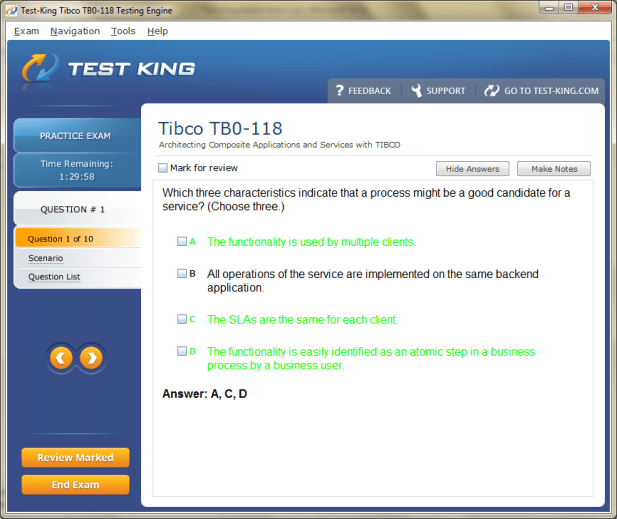
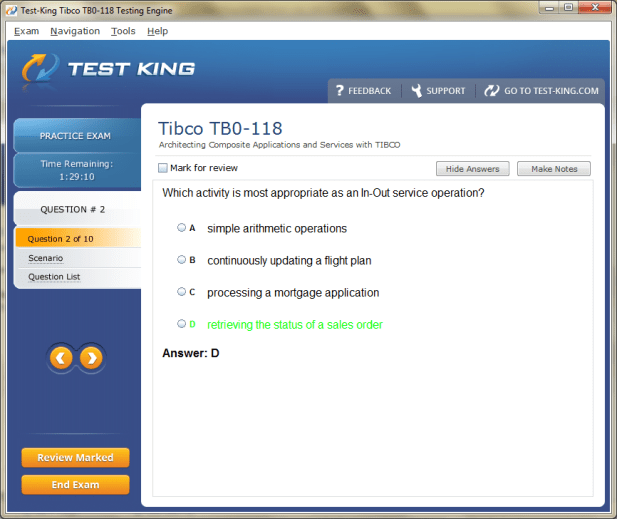
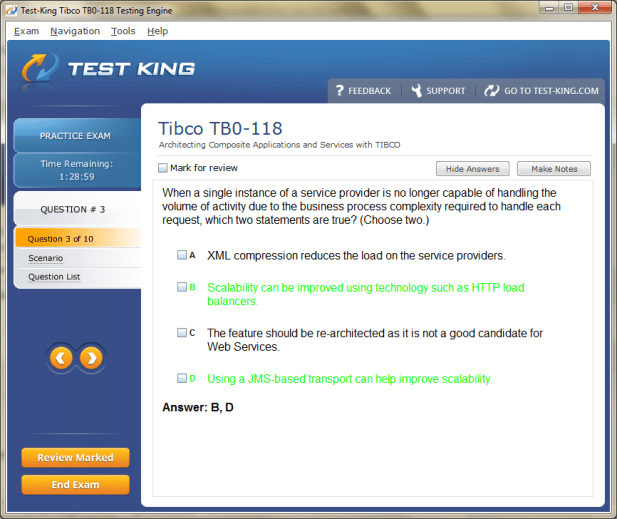
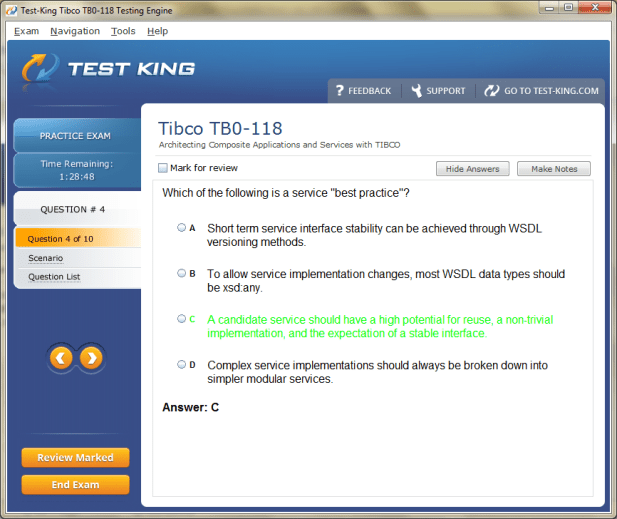
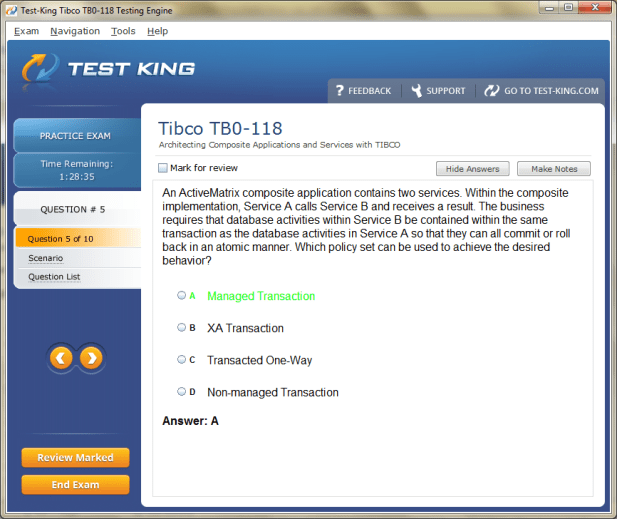
TB0-118 Exam Product Screenshots
Frequently Asked Questions
How can I get the products after purchase?
All products are available for download immediately from your Member's Area. Once you have made the payment, you will be transferred to Member's Area where you can login and download the products you have purchased to your computer.
How long can I use my product? Will it be valid forever?
Test-King products have a validity of 90 days from the date of purchase. This means that any updates to the products, including but not limited to new questions, or updates and changes by our editing team, will be automatically downloaded on to computer to make sure that you get latest exam prep materials during those 90 days.
Can I renew my product if when it's expired?
Yes, when the 90 days of your product validity are over, you have the option of renewing your expired products with a 30% discount. This can be done in your Member's Area.
Please note that you will not be able to use the product after it has expired if you don't renew it.
How often are the questions updated?
We always try to provide the latest pool of questions, Updates in the questions depend on the changes in actual pool of questions by different vendors. As soon as we know about the change in the exam question pool we try our best to update the products as fast as possible.
How many computers I can download Test-King software on?
You can download the Test-King products on the maximum number of 2 (two) computers or devices. If you need to use the software on more than two machines, you can purchase this option separately. Please email support@test-king.com if you need to use more than 5 (five) computers.
What is a PDF Version?
PDF Version is a pdf document of Questions & Answers product. The document file has standart .pdf format, which can be easily read by any pdf reader application like Adobe Acrobat Reader, Foxit Reader, OpenOffice, Google Docs and many others.
Can I purchase PDF Version without the Testing Engine?
PDF Version cannot be purchased separately. It is only available as an add-on to main Question & Answer Testing Engine product.
What operating systems are supported by your Testing Engine software?
Our testing engine is supported by Windows. Andriod and IOS software is currently under development.
Preparing for the TB0-118 Certification Exam: Study Strategy and Key Focus Areas
The TB0-118 certification known as Architecting Composite Applications and Services with TIBCO is considered a significant credential for professionals who engage in designing, integrating, and managing composite solutions within enterprise environments where interoperability, scalability, and modularity are essential. This certification reflects a practitioner’s capability to conceptualize and construct application architectures that operate not as isolated monolithic units but as interlinked and responsive ecosystems of reusable services. In contemporary digital infrastructures, organizations frequently need unified systems that communicate across disparate applications, legacy platforms, cloud environments, distributed data repositories, and real-time services. This certification stands as validation that the professional possesses the insight and technical capacity to handle such complexity with prudence and structural clarity.
Understanding the Purpose, Structure, Knowledge Depth, Conceptual Expectations, and Learning Approach for Mastering Architecting Composite Applications and Services with TIBCO
The emphasis of this examination extends beyond the mechanical usage of tools. It evaluates a deep comprehension of core architectural principles, orchestration logic, messaging paradigms, process synchronization, governance methodologies, and the operational lifecycle of enterprise-scale services. The professional preparing for this certification should cultivate a mindset that values conceptual reasoning, systemic awareness, and the intellectual acuity required to design service-based systems that remain stable under dynamic workloads, evolving business goals, and heterogeneous technological landscapes. It is essential to approach the preparation with patience, reflection, experimentation, and a willingness to engage with both theoretical constructs and practical tooling.
The foundational idea within composite application design revolves around modularity. Instead of building large, singular applications, architects design smaller autonomous services that address specific functions. These services communicate through messaging channels, shared orchestration workflows, and standardized contracts. The benefit of this approach lies in adaptability. When a business requirement shifts or a technology component becomes outdated, only individual service units must be adjusted rather than entire applications. The certification measures whether the candidate can structure such modular interactions coherently to achieve aggregate enterprise outcomes without sacrificing coordination or operational integrity.
The candidate must understand the nature of service oriented design. Services represent functional capabilities that can be reused in multiple contexts. A service in one process might support another business context with little or no modification. This reuse paradigm is central to enterprise efficiency. The architect must identify which units should be isolated services, which units should be orchestrated within processes, how services should communicate, and how to manage their operational lifecycle. These decisions are grounded in architectural comprehension, not just familiarity with TIBCO development interfaces.
A thorough preparation for TB0-118 requires familiarity with various TIBCO products that collectively support composite application development. Technologies such as TIBCO BusinessWorks, Enterprise Messaging Service, ActiveMatrix components, and integration adapters provide the foundation for constructing service orchestration environments. These tools do not function as isolated capabilities; they form interconnected parts of an ecosystem enabling routing, transformation, process execution, durable messaging, queueing, synchronous and asynchronous interaction, and fault tolerance. The candidate must understand how these technologies complement one another to create cohesive enterprise workflows.
The process of mastering the architectural aspects involves recognizing the differences between orchestration and choreography. In an orchestrated environment, processes guide interactions among services, determining how data flows and which operations occur. In contrast, a choreographed environment emphasizes autonomous interactions among services responding to events or messages. Choosing the appropriate mode depends on the structure of the business objective, the expected data interactions, the required synchronization, and the desired flexibility. The exam evaluates whether the candidate can differentiate between these interaction approaches and apply them judiciously to varied scenarios.
One must also develop proficiency with event driven communication. Enterprises often require immediate responsiveness to external triggers, internal business signals, transactional notifications, or real-time status updates. Event driven paradigms enable systems to react fluidly without relying on rigid direct invocation. Messaging systems provide mechanisms such as queues and topics that allow events to reach the consumers that need them. The candidate must understand how message reliability, delivery guarantees, durability, concurrency models, and backpressure management influence system stability. Without competence in these aspects, composite applications may encounter inconsistencies or operational disruptions.
Additionally, the candidate must be prepared to examine performance optimization strategies. Enterprise environments do not operate at static volumes. Data throughput can fluctuate, user demand can surge, services can evolve, and external dependencies may behave unpredictably. Performance tuning involves optimizing orchestrations, refining message routing strategies, adjusting service concurrency levels, utilizing caching layers appropriately, and monitoring process execution metrics. These considerations are not peripheral topics but central capabilities that the certification expects the professional to handle confidently.
Security and governance are also core knowledge areas. Composite applications can involve sensitive data, protected actions, regulatory compliance requirements, and confidential workflows. The candidate must understand how access control policies are enforced, how communication channels are secured, how identity validation is performed, and how auditability is maintained. Governance extends beyond security, encompassing how services are cataloged, versioned, modified, and retired. Maintaining coherence across evolving systems is a crucial discipline that ensures long-term maintainability and reduces operational debt.
The candidate should also understand lifecycle management and monitoring. Enterprise services require continuous observation to ensure that they perform as expected. Monitoring tools allow administrators to trace requests, measure resource utilization, identify latency issues, and detect anomalies. Lifecycle management involves deploying services with minimal disruption, scaling as needed, updating without breaking dependencies, and managing failure recovery. These operational concerns are deeply embedded into the examination framework.
To prepare for the examination effectively, one must approach learning with structured immersion rather than superficial memorization. Begin by developing a conceptual grasp of composite application principles. Read documentation, whitepapers, architectural guidance resources, and real-world implementation discussions. Familiarize yourself with architectural diagrams that illustrate service interactions. Study practical use cases that require integration among enterprise systems. Analyze where orchestration fits into the business logic and where event driven interactions provide a more responsive solution.
Once conceptual understanding is solid, transition to hands-on practice. Construct small workflows using TIBCO BusinessWorks, experiment with messaging setups using EMS, design simple orchestrations, test fault handling, simulate throughput variations, and observe system behavior. The tactile experience of interacting with services, configuring message channels, and debugging unexpected outcomes strengthens intuition. This intuition is crucial for answering scenario-based examination questions that test reasoning rather than repetition.
During preparation, reflect on decision-making rationales. Ask yourself why a particular architectural approach fits a given scenario. Consider alternative integration strategies and identify why some would be less effective. This reflective questioning sharpens analytical thinking and deepens comprehension, enabling confidence during exam evaluation.
Reading and practice alone are insufficient without mental conditioning. Develop the ability to remain calm and composed while analyzing multi-layered challenges. The examination may present problem statements that appear intricate. However, with patience and structured reasoning, the solution becomes evident. Cultivate the habit of breaking complex situations into manageable components. Examine service interactions, communication protocols, orchestration logic, and constraints methodically. This mindset ensures clarity under examination conditions.
One should also avoid common pitfalls during preparation. Do not rely solely on memorizing screen actions or tool configurations. The exam prioritizes architectural reasoning. Another pitfall is ignoring system behavior considerations such as performance trade-offs and fault tolerance. Composite applications exist in real-world environments where disruptions occur. The ability to anticipate and design for resilience is essential.
Through thorough conceptual study, practical experimentation, reflective analysis, and disciplined reasoning, the candidate develops a solid intellectual framework for mastering the examination topics. This approach ensures that learning becomes integrative rather than fragmented, meaningful rather than superficial, durable rather than temporary. The TB0-118 certification ultimately recognizes professionals who can design composite applications that harmonize technical precision, architectural coherence, operational reliability, and strategic foresight.
Deepening Conceptual Mastery, Practical Implementation, Integration Patterns, Orchestration Strategies, and Operational Excellence in Architecting Composite Applications with TIBCO
To achieve mastery in architecting composite applications and services with TIBCO, one must delve beyond foundational knowledge into a nuanced understanding of integration patterns, orchestration strategies, and practical implementation techniques that sustain operational excellence in enterprise environments. The TB0-118 certification assesses not only familiarity with TIBCO tools but also the capacity to reason through complex scenarios, design resilient services, and optimize performance within distributed, heterogeneous systems. This examination demands an amalgamation of theoretical comprehension, hands-on experimentation, and reflective analysis to ensure that candidates can construct solutions that are adaptable, maintainable, and strategically aligned with business objectives.
A pivotal element in preparing for this certification is the assimilation of integration patterns that serve as the blueprint for connecting disparate applications, databases, and services. Enterprise systems often encompass a labyrinth of legacy platforms, cloud-hosted applications, third-party services, and event-driven components. Effective integration requires architects to discern the appropriate method for data exchange, process synchronization, and communication reliability. Patterns such as point-to-point integration, publish-subscribe messaging, service orchestration, mediation, and content-based routing form the structural backbone of composite application design. Each pattern presents trade-offs in complexity, scalability, fault tolerance, and latency, and the candidate must be capable of selecting the most suitable approach for a given business requirement.
Orchestration strategies constitute another core focus area for the examination. Orchestration involves coordinating multiple services to achieve a coherent workflow that aligns with organizational processes. This requires a sophisticated understanding of synchronous and asynchronous interactions, dependency resolution, transaction boundaries, and exception handling. Candidates must internalize the difference between centralized orchestration, where a single process governs the execution of multiple services, and decentralized choreography, where services communicate autonomously through events and message exchanges. Designing optimal orchestration requires balancing process efficiency with flexibility, ensuring that workflows can adapt to evolving business scenarios without compromising reliability.
Practical implementation of composite applications entails a hands-on understanding of TIBCO BusinessWorks and related middleware components. BusinessWorks provides a platform to design, test, and deploy services that encapsulate business logic, handle messaging, and orchestrate workflows. Candidates must be able to construct process definitions, implement service interfaces, configure adapters for diverse endpoints, and manage transformations between varying data formats. Mastery of these capabilities ensures that conceptual designs translate effectively into operational solutions capable of handling real-world demands. Experimentation with error handling, transaction management, and recovery mechanisms is essential to reinforce understanding and foster the ability to anticipate and mitigate potential failures.
Event-driven architecture (EDA) is a prominent consideration in composite application design, particularly in dynamic enterprise environments that require immediate responsiveness. Event-driven paradigms enable services to react to triggers such as system alerts, user actions, or data changes. Candidates must understand how to implement event listeners, configure message queues and topics, and ensure reliable delivery and processing of events. Concepts such as durable subscriptions, message ordering, idempotency, and concurrency control are critical to ensuring that event-driven interactions are robust and maintain system integrity under varying loads.
Another area of focus is the management of service lifecycle and versioning. Composite applications evolve over time as business needs change, new services are introduced, and existing services are updated. Effective lifecycle management involves deploying new versions with minimal disruption, monitoring service health, scaling resources in response to demand, and retiring obsolete services safely. The candidate must understand how to implement version control, maintain backward compatibility, and enforce governance policies to prevent service conflicts or operational inconsistencies. Operational proficiency in these domains is a hallmark of expertise in composite application architecture.
Security considerations form an integral part of architecting services and composite applications. Candidates must be proficient in enforcing authentication and authorization, securing communication channels, and implementing encryption for sensitive data. Governance extends beyond technical security to include compliance with organizational policies, regulatory mandates, and audit requirements. Effective governance ensures that services are cataloged, monitored, and managed systematically, reducing operational risk and enhancing maintainability over time.
Performance optimization remains a critical dimension of preparation. Composite applications must function efficiently under variable loads, and architects must anticipate performance bottlenecks that could compromise user experience or system reliability. Techniques such as load balancing, resource pooling, asynchronous processing, caching strategies, and message throttling are essential for maintaining responsiveness and stability. Candidates should develop the ability to analyze process flows, identify potential latency points, and implement solutions that balance throughput with reliability. Understanding these performance dynamics enables architects to make informed decisions that sustain long-term operational excellence.
Monitoring and observability are intertwined with performance management. Comprehensive monitoring allows architects to detect anomalies, track service utilization, and identify areas for optimization. Metrics such as response time, throughput, error rates, and queue depths provide insight into system health and efficiency. The candidate must be adept at configuring monitoring tools, interpreting data, and taking corrective actions to ensure that composite applications continue to meet service-level expectations. This proactive approach to observability is essential for maintaining high availability and operational confidence.
Effective preparation for the examination also involves scenario-based reasoning. Candidates must be capable of analyzing complex business requirements, evaluating constraints, and selecting the most appropriate design approach. Scenarios may involve integrating multiple systems with varying protocols, designing workflows that handle exceptions gracefully, or implementing security policies across a distributed environment. Engaging in reflective practice, such as reviewing case studies and constructing sample solutions, strengthens the ability to apply knowledge to diverse contexts. This analytical approach is critical to success in a certification exam that tests both technical proficiency and conceptual acumen.
Hands-on experience with TIBCO tools is complemented by theoretical study. Reading documentation, whitepapers, architectural guides, and case studies provides a foundation for understanding best practices, common pitfalls, and the rationale behind design decisions. Knowledge of messaging paradigms, service-oriented architecture principles, and process modeling enhances the candidate’s ability to reason through complex integration challenges. Combining theoretical study with practical experimentation fosters deep understanding and equips candidates to handle unexpected scenarios during the examination.
Developing a structured study plan is advisable. Allocate time to conceptual understanding, hands-on experimentation, performance tuning, security implementation, and governance practices. Integrate reflective analysis, where each design decision is examined for rationale, effectiveness, and potential alternatives. Such an approach ensures that learning is comprehensive, cohesive, and retains applicability to real-world scenarios. Avoid fragmented learning or rote memorization, as the exam emphasizes conceptual reasoning, analytical skill, and the ability to translate knowledge into practical solutions.
Candidates should also cultivate mental agility and resilience. The examination may present intricate scenarios requiring evaluation of multiple variables, dependencies, and trade-offs. Practicing analytical thinking, problem decomposition, and decision justification enhances confidence and clarity under exam conditions. Developing the capacity to navigate complexity, anticipate potential challenges, and reason methodically ensures that responses demonstrate both knowledge and judgment.
Reflecting on integration strategies is particularly valuable. Consider how different patterns affect scalability, fault tolerance, performance, and maintainability. Examine the implications of orchestration choices, event-driven workflows, and service composition decisions. This reflective practice reinforces understanding and prepares candidates for scenario-based questions that probe reasoning rather than procedural recall. The ability to articulate rationale for architectural decisions distinguishes high-performing candidates from those who focus solely on tool usage.
Attention to real-world applicability strengthens preparation. Enterprise systems often encounter unpredictable conditions, varying loads, and evolving requirements. Understanding how to design resilient services that accommodate change, maintain stability, and ensure interoperability is crucial. Candidates should practice constructing workflows that handle exceptions gracefully, maintain transactional integrity, and support versioned service deployment. This practical exposure ensures that learning is grounded in operational reality and enhances readiness for the examination.
By integrating conceptual mastery, practical experimentation, scenario-based reasoning, performance awareness, security understanding, governance comprehension, and reflective analysis, candidates cultivate a holistic perspective on architecting composite applications. This comprehensive preparation ensures that professionals are equipped not only to succeed in the TB0-118 certification exam but also to apply their knowledge effectively in enterprise environments where service composition, orchestration, and integration are critical to business success.
Advanced Techniques, Architectural Patterns, Service Orchestration, Messaging Reliability, Performance Tuning, and Operational Governance in TIBCO Composite Applications
Achieving proficiency in architecting composite applications and services with TIBCO requires an advanced understanding of architectural patterns, orchestration techniques, service integration, messaging reliability, performance optimization, and operational governance. The TB0-118 certification evaluates a professional's capability to conceptualize and implement robust, scalable, and maintainable composite solutions in complex enterprise environments. Preparation involves cultivating both theoretical insight and practical dexterity to handle challenges such as integrating heterogeneous systems, managing asynchronous communication, ensuring high availability, and maintaining security and compliance standards across a distributed architecture. Mastery in this context requires deliberate immersion into real-world scenarios, experimentation with TIBCO middleware, and reflective analysis of architectural trade-offs.
A central aspect of preparation is developing a comprehensive grasp of architectural patterns that guide the design of composite applications. Patterns such as mediation, process orchestration, publish-subscribe messaging, content-based routing, and service aggregation provide structured approaches to solving recurring integration challenges. Understanding the nuances of each pattern, including their impact on scalability, fault tolerance, maintainability, and performance, enables candidates to select appropriate strategies for diverse business requirements. Scenarios presented in the exam often test the ability to apply these patterns thoughtfully, emphasizing situational judgment rather than rote knowledge.
Service orchestration constitutes the backbone of composite application architecture. Orchestration entails coordinating multiple services to execute business processes in a logical and coherent manner. Candidates must be adept at defining workflows that manage synchronous and asynchronous service interactions, transaction boundaries, exception handling, and dependency resolution. A refined understanding of orchestration versus choreography is essential; orchestration centralizes control over service execution, while choreography allows services to interact autonomously based on event triggers. Selecting the correct approach requires evaluating process complexity, service dependencies, performance constraints, and adaptability to evolving business requirements.
Messaging reliability and event-driven design are integral components of effective composite applications. Enterprise systems often rely on messaging channels for inter-service communication, and ensuring the consistency, durability, and integrity of messages is crucial. Concepts such as message queues, topics, durable subscriptions, idempotency, concurrency management, and message sequencing underpin the design of reliable, event-driven architectures. Candidates must understand how to implement these features in TIBCO middleware to maintain system robustness under varying load conditions, network latency, and service failures. Event-driven design enhances responsiveness, allowing applications to react swiftly to business triggers, system events, and user interactions without compromising coordination or consistency.
Performance tuning represents another critical domain of expertise. Composite applications must handle fluctuating workloads while maintaining responsiveness and efficiency. Techniques for optimizing performance include adjusting process concurrency, implementing asynchronous processing, utilizing caching strategies, managing thread pools, optimizing message routing, and balancing resource utilization across distributed components. Candidates should develop the ability to analyze process execution, identify bottlenecks, and implement solutions that maintain throughput while preserving reliability. Performance awareness is not only vital for the examination but also for real-world operational success.
Operational governance encompasses security, monitoring, lifecycle management, and policy enforcement. Candidates must understand how to secure service interfaces, enforce access control, implement encryption, and maintain compliance with regulatory and organizational policies. Governance also involves monitoring service performance, detecting anomalies, managing service versions, and maintaining documentation and catalogs for enterprise oversight. The ability to anticipate potential operational risks, design mitigations, and maintain oversight over evolving services demonstrates maturity in architectural thinking and readiness for enterprise-scale responsibilities.
Hands-on experience with TIBCO BusinessWorks, ActiveMatrix components, and messaging systems is indispensable. Candidates should engage in building sample workflows, configuring adapters, implementing data transformations, and simulating process failures to understand the real-world implications of design decisions. Experimenting with error handling, transaction rollback, and recovery mechanisms reinforces the understanding of service resilience and prepares candidates for scenario-based questions that examine decision-making in dynamic contexts.
Scenario analysis forms a critical part of the preparation strategy. Candidates must evaluate complex business requirements, identify constraints, and determine optimal design approaches. Exam scenarios often involve integration challenges, process orchestration dilemmas, messaging reliability issues, and performance trade-offs. Reflective analysis, where candidates consider alternative strategies, evaluate their pros and cons, and justify architectural decisions, strengthens analytical reasoning and ensures preparedness for the nuanced questions presented during the examination.
Security, though often considered a separate topic, is intricately woven into architectural decisions. Protecting sensitive data, ensuring secure communication, and implementing robust authentication and authorization mechanisms are paramount. Candidates must understand how to integrate security into service design without impeding performance or compromising flexibility. Governance frameworks, policy enforcement, and auditability further enhance the reliability and maintainability of composite applications in enterprise contexts.
The lifecycle of services and composite applications must also be considered. Designing for service evolution requires anticipating version updates, dependency changes, and deprecation of components. Proper lifecycle management ensures that services remain functional, maintainable, and interoperable across different environments. Candidates should be adept at version control, backward compatibility strategies, deployment planning, and operational monitoring to sustain continuous service reliability.
Reflective and iterative practice enhances mastery. Constructing workflows, experimenting with orchestration, configuring messaging channels, simulating failures, and tuning performance metrics fosters a comprehensive understanding of system behavior. This approach transforms theoretical knowledge into applied wisdom, enabling candidates to handle both straightforward and complex scenarios with confidence. Integrating conceptual insights with practical experimentation cultivates the discernment needed for high-stakes examination contexts.
Effective preparation also involves mental conditioning and time management. The examination often presents multifaceted problems requiring careful analysis, prioritization of constraints, and methodical reasoning. Candidates must develop strategies for breaking complex scenarios into manageable components, evaluating trade-offs, and articulating solutions clearly and confidently. Mental agility, reflective thinking, and disciplined study practices enhance the ability to navigate intricate challenges without succumbing to stress or confusion.
To solidify preparation, candidates should explore case studies and real-world implementation examples. Observing how composite applications handle integration across heterogeneous systems, manage service orchestration, respond to events, and sustain operational excellence provides insights into practical decision-making and strategic considerations. Analyzing these examples reinforces understanding of architectural patterns, messaging reliability, performance optimization, and governance, providing a bridge between conceptual theory and applied practice.
Integration patterns, orchestration strategies, messaging reliability, performance tuning, security, governance, and lifecycle management collectively form the pillars of competence for the TB0-118 examination. Mastery in these areas ensures that candidates can design composite applications that are scalable, resilient, and aligned with enterprise objectives. A disciplined approach combining conceptual study, practical experimentation, scenario analysis, reflective practice, and operational insight creates a comprehensive understanding that prepares professionals to meet the challenges of architecting complex service-oriented solutions effectively and confidently.
Mastery of Integration Techniques, Workflow Orchestration, Event-Driven Systems, Security, Monitoring, and Enterprise-Scale Operational Competence with TIBCO Composite Applications
Success in architecting composite applications and services with TIBCO requires a profound and multifaceted understanding of integration techniques, workflow orchestration, event-driven system design, security protocols, monitoring strategies, and operational competence within enterprise-scale environments. The TB0-118 certification evaluates the professional's ability to synthesize conceptual knowledge with practical implementation skills, ensuring that composite solutions are robust, scalable, and maintainable while fulfilling business objectives. Mastery of this examination demands deliberate immersion in both the theoretical and operational dimensions of TIBCO composite application architecture, integrating nuanced reasoning, reflective analysis, and hands-on experimentation to cultivate expertise.
Integration techniques are foundational to building coherent composite applications. In contemporary enterprises, heterogeneous systems including legacy databases, cloud services, external APIs, and departmental applications must communicate seamlessly. Professionals must be capable of selecting appropriate patterns for data exchange, process synchronization, and inter-service communication. Commonly applied patterns include mediation, content-based routing, service orchestration, publish-subscribe messaging, and service aggregation. Each pattern has implications for scalability, fault tolerance, maintainability, and performance. An architect's decision to implement one pattern over another is guided by business context, technical constraints, and operational priorities. Scenario-based questions on the exam test the ability to evaluate these trade-offs effectively, emphasizing reasoning over memorization.
Workflow orchestration is central to achieving coherence in composite applications. Orchestration entails coordinating multiple services to achieve business objectives while handling dependencies, transaction boundaries, exception management, and timing constraints. Synchronous interactions ensure deterministic execution, whereas asynchronous interactions enhance system flexibility and responsiveness. Understanding when to employ centralized orchestration versus decentralized choreography is critical. Centralized orchestration provides structured control over service execution, while choreography allows services to interact autonomously in response to events. Candidates must be able to evaluate workflow complexity, integration requirements, and resilience considerations to determine the optimal approach, balancing performance with maintainability.
Event-driven systems constitute a crucial dimension of composite application design. Enterprises often require immediate responsiveness to triggers such as user interactions, system alerts, transactional updates, or data changes. Implementing event-driven architectures necessitates mastery of messaging channels, durable subscriptions, idempotent processing, concurrency control, and message sequencing. Reliable delivery mechanisms are essential to maintain consistency and integrity across distributed services. Candidates must be capable of designing event-driven workflows that support rapid responsiveness while preserving coordination and operational stability. Event-driven design enhances agility, allowing systems to react dynamically to fluctuating workloads and changing business priorities.
Security is integral to composite application architecture. Professionals must implement robust authentication, authorization, and encryption strategies to protect sensitive data and maintain compliance with regulatory mandates. Security is not a discrete component but an inherent aspect of service design, influencing integration choices, workflow orchestration, and event-handling mechanisms. Governance extends this responsibility, ensuring that services are cataloged, versioned, and monitored for adherence to corporate policies. Professionals must anticipate potential vulnerabilities, design mitigations, and enforce policies to safeguard enterprise assets while maintaining operational efficiency.
Monitoring and observability are essential for maintaining operational competence. Composite applications operate in environments where throughput fluctuates, dependencies evolve, and failures may occur. Comprehensive monitoring enables detection of anomalies, evaluation of performance metrics, and timely interventions to maintain service levels. Metrics such as latency, throughput, error rates, and resource utilization provide actionable insight into system health. Candidates must understand how to configure monitoring tools, interpret data effectively, and implement corrective measures to sustain operational reliability. Observability supports proactive maintenance, ensuring that services remain responsive and efficient under dynamic conditions.
Performance optimization is critical to enterprise-scale success. Composite applications must accommodate variable loads, ensure low latency, and maintain high availability. Techniques such as caching, load balancing, asynchronous processing, concurrency tuning, and message throttling enhance system responsiveness. Professionals must analyze workflow execution, identify bottlenecks, and implement improvements without compromising reliability. Performance awareness informs architectural decisions, guiding the design of services that scale gracefully and maintain consistency across distributed environments.
Lifecycle management is another key competency. Composite applications evolve over time as business needs change, services are updated, and system dependencies shift. Effective lifecycle management entails version control, backward compatibility, controlled deployment, service retirement, and continuous operational monitoring. Professionals must ensure that updates do not disrupt dependent processes and that services remain maintainable and interoperable. This ability to manage service evolution is a hallmark of expertise in composite application architecture.
Hands-on experience with TIBCO BusinessWorks, ActiveMatrix components, and messaging systems is indispensable for examination readiness. Candidates should construct workflows, configure adapters, implement transformations, simulate failures, and observe system behavior under varying conditions. Experimentation with orchestration, messaging reliability, and fault tolerance fosters intuitive understanding of service interactions and operational dynamics. This practical engagement transforms theoretical knowledge into actionable competence, preparing candidates to respond effectively to complex scenarios presented in the examination.
Scenario-based reasoning underpins the TB0-118 examination. Candidates must analyze multifaceted business requirements, evaluate constraints, and select optimal architectural strategies. Scenarios may involve integrating multiple systems with differing protocols, orchestrating workflows under performance and security constraints, handling asynchronous messaging, or mitigating operational risks. Reflective practice, such as considering alternative approaches and evaluating their implications, enhances analytical skills and strengthens decision-making. This reasoning-centered preparation ensures candidates can demonstrate both conceptual understanding and practical proficiency.
Reflective and iterative practice is essential for reinforcing knowledge and skill. Building workflows, simulating events, configuring messaging, and optimizing performance enables candidates to internalize system behavior and understand the consequences of architectural choices. Repeated experimentation fosters resilience, problem-solving aptitude, and a nuanced appreciation of trade-offs inherent in composite application design. Integrating reflection with hands-on engagement ensures that candidates approach examination challenges with clarity, precision, and confidence.
Preparation for TB0-118 demands a holistic approach that integrates integration techniques, workflow orchestration, event-driven systems, security, monitoring, performance optimization, and lifecycle management. By combining conceptual study with practical experimentation, reflective analysis, scenario evaluation, and operational insight, candidates cultivate the intellectual agility and technical proficiency required to design, implement, and maintain enterprise-grade composite applications. Mastery of these domains equips professionals to respond adeptly to the challenges of architecting complex service-oriented solutions, ensuring both examination success and real-world effectiveness.
Mastery of Composite Application Design, Service Integration, Orchestration, Event-Driven Architecture, Security, Monitoring, Performance, and Governance with TIBCO
Achieving expertise in architecting composite applications and services with TIBCO demands a synthesis of deep conceptual understanding, practical implementation skills, and operational foresight. The TB0-118 certification evaluates a professional’s ability to design scalable, maintainable, and resilient solutions within complex enterprise environments. Success in this examination requires proficiency in integration techniques, workflow orchestration, event-driven architecture, security implementation, monitoring, performance tuning, and governance practices. Candidates must cultivate both theoretical comprehension and hands-on dexterity, enabling them to address diverse scenarios with clarity and confidence while ensuring that composite applications align with business objectives and operational constraints.
A foundational competency involves understanding the principles and patterns of integration that underpin composite application design. Enterprises typically rely on a mosaic of legacy systems, cloud-hosted services, third-party applications, and real-time data streams. Effectively integrating these components requires architects to select suitable patterns, such as mediation, content-based routing, process orchestration, publish-subscribe messaging, and service aggregation. Each pattern has implications for scalability, maintainability, fault tolerance, and performance, and the architect must assess trade-offs in the context of business goals and technical limitations. The TB0-118 examination emphasizes scenario-based reasoning, requiring candidates to analyze complex requirements and determine which integration strategy offers the most effective solution while maintaining operational integrity.
Workflow orchestration is central to ensuring coherence and efficiency in composite applications. Orchestration involves the coordination of multiple services to achieve defined business outcomes, encompassing synchronous and asynchronous interactions, transaction management, exception handling, and dependency resolution. Professionals must discern when to employ centralized orchestration, which provides structured control over execution, versus decentralized choreography, where services interact autonomously in response to events. Selecting the optimal orchestration approach necessitates careful evaluation of workflow complexity, inter-service dependencies, system constraints, and the desired balance between flexibility and reliability.
Event-driven architecture represents a critical dimension of composite application design, especially for systems requiring rapid responsiveness. Enterprise applications must often react to triggers such as user actions, system alerts, transactional updates, or data changes. Designing event-driven workflows requires mastery of messaging channels, durable subscriptions, idempotent processing, concurrency management, and message sequencing. Reliable event delivery ensures system consistency and operational stability, while enabling real-time responsiveness and adaptability. Candidates must understand how to implement these mechanisms within TIBCO environments to maintain the integrity and robustness of services under variable workloads and dynamic conditions.
Security and governance are integral to the architecture of composite applications. Professionals must implement authentication, authorization, encryption, and policy enforcement strategies to protect sensitive data, maintain compliance, and mitigate operational risk. Governance extends beyond security, encompassing service versioning, lifecycle management, cataloging, and policy adherence. Understanding the interplay between security and service orchestration ensures that solutions are both secure and efficient, allowing enterprise systems to evolve without introducing vulnerabilities or operational inefficiencies. Mastery of security considerations in design decisions reflects the candidate’s ability to integrate protective measures seamlessly into operational workflows.
Performance optimization is another essential competency for candidates preparing for the TB0-118 examination. Composite applications must accommodate fluctuating workloads, maintain low latency, and ensure high availability. Techniques such as caching, asynchronous processing, load balancing, concurrency tuning, and message throttling are vital for sustaining system responsiveness and stability. Candidates must develop the skill to analyze process execution, identify bottlenecks, and implement corrective measures that enhance throughput while preserving reliability. Performance-conscious design decisions are critical both for examination success and for operational effectiveness in enterprise contexts.
Monitoring and observability support operational excellence by providing insights into system health, performance, and reliability. Metrics such as response time, throughput, error rates, and resource utilization allow professionals to detect anomalies, diagnose issues, and implement corrective actions proactively. Effective monitoring ensures that composite applications remain resilient and responsive under variable conditions, enabling architects to maintain service levels, anticipate potential failures, and optimize workflows. Candidates should develop proficiency in configuring monitoring tools, interpreting metrics, and correlating performance data with architectural decisions.
Lifecycle management is critical for sustaining the evolution and reliability of composite applications. Enterprise systems undergo continuous changes as services are updated, dependencies shift, and business requirements evolve. Managing this lifecycle involves version control, backward compatibility, controlled deployment, decommissioning of obsolete services, and ongoing monitoring. Professionals must ensure that updates do not disrupt dependent processes, maintaining both operational continuity and interoperability. Mastery of lifecycle management demonstrates the candidate’s capacity to plan for long-term maintainability and scalability of composite solutions.
Hands-on experience with TIBCO BusinessWorks, ActiveMatrix components, and messaging systems is essential for reinforcing theoretical knowledge. Candidates should engage in constructing workflows, configuring adapters, implementing data transformations, simulating failures, and testing event-driven interactions. Experimentation with orchestration, messaging reliability, fault tolerance, and performance optimization enhances intuition and understanding of real-world system behavior. This experiential learning bridges conceptual insights with practical competence, enabling candidates to handle scenario-based examination questions confidently and effectively.
Scenario-based reasoning is a focal point of the TB0-118 examination. Candidates are required to analyze complex integration requirements, evaluate constraints, and select optimal architectural strategies. Scenarios may involve integrating heterogeneous systems, orchestrating workflows under performance and security constraints, implementing event-driven interactions, or managing operational risks. Reflective practice, involving the evaluation of alternative strategies and the consideration of trade-offs, strengthens analytical skills and fosters sound decision-making. The examination emphasizes the ability to reason critically and apply knowledge to real-world challenges rather than relying solely on procedural recall.
Preparation also requires mental discipline, structured study, and iterative practice. Candidates should develop study plans that integrate conceptual study, practical experimentation, scenario analysis, and performance evaluation. Reflective practice, where candidates assess the rationale for design choices and explore alternative solutions, enhances understanding and reinforces learning. Repeated exposure to complex workflows, event handling, messaging scenarios, and performance tuning consolidates knowledge and builds confidence, ensuring that candidates are equipped to approach the examination with clarity and competence.
In addition, exploring real-world case studies and enterprise implementation examples provides valuable context. Understanding how composite applications handle integration, orchestration, event-driven processing, performance challenges, and governance in operational environments deepens comprehension and enhances the ability to apply theoretical knowledge effectively. Analyzing these examples supports the development of a holistic perspective, integrating architectural principles, operational practices, and strategic reasoning.
The convergence of integration patterns, workflow orchestration, event-driven architecture, security, monitoring, performance optimization, and lifecycle management forms the core competency for the TB0-118 certification. By combining conceptual understanding with practical application, scenario analysis, reflective reasoning, and operational insight, candidates cultivate the expertise required to design and manage complex service-oriented solutions that meet enterprise objectives. This comprehensive preparation ensures both examination success and the capability to implement robust, scalable, and resilient composite applications in real-world environments.
The structured study approach, combining theoretical depth with hands-on practice, reflective analysis, and scenario-based problem solving, equips candidates with the mental agility, technical proficiency, and architectural acumen necessary to excel in the TB0-118 certification examination. Mastery of these domains empowers professionals to deliver composite solutions that are strategically aligned, operationally efficient, resilient, and capable of adapting to evolving business landscapes, ensuring enduring success both in the certification and in practical enterprise applications.
Conclusion
The TB0-118 certification serves as both a validation of professional competence and a framework for enhancing skills critical to modern enterprise architecture. Candidates who invest in comprehensive preparation encompassing integration techniques, orchestration strategies, event-driven system design, security and governance, monitoring and performance optimization, and lifecycle management are positioned not only to pass the examination but also to contribute meaningfully to enterprise initiatives that rely on robust, maintainable, and adaptable composite applications. Through sustained effort, disciplined study, and practical experimentation, professionals gain the confidence, insight, and expertise required to navigate the complexities of TIBCO-based composite architectures and deliver solutions that embody excellence, reliability, and strategic value.