

Exam Code: TB0-122
Exam Name: TIBCO BusinessEvents 5
Certification Provider: Tibco
Corresponding Certification: TCP
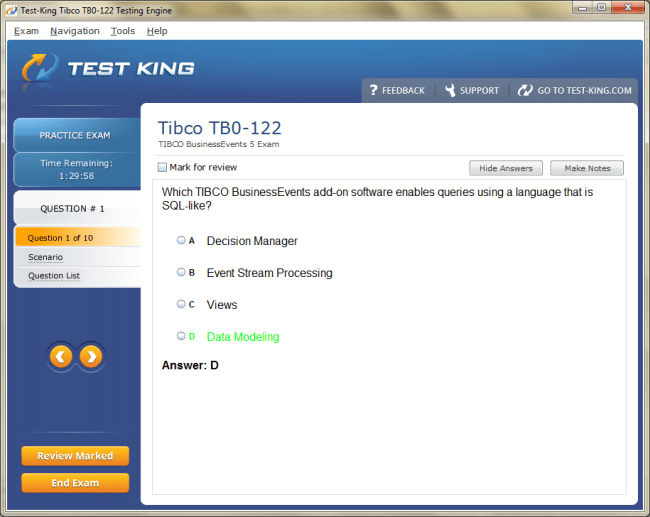
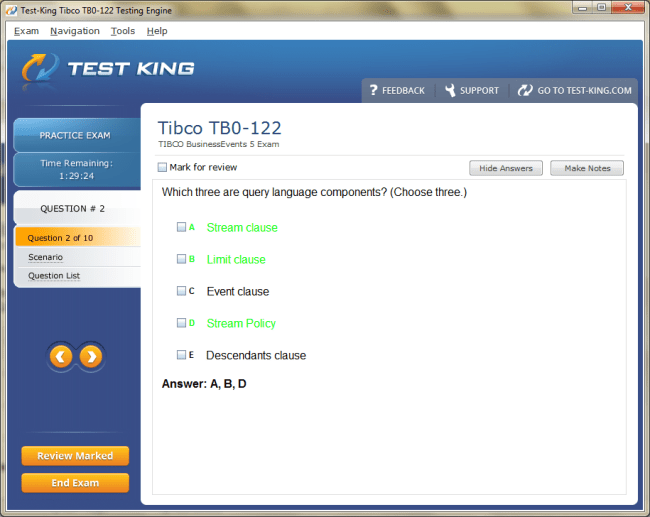
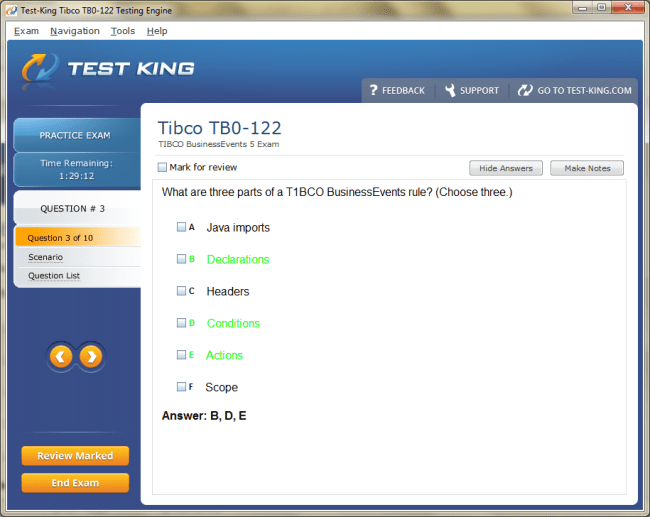
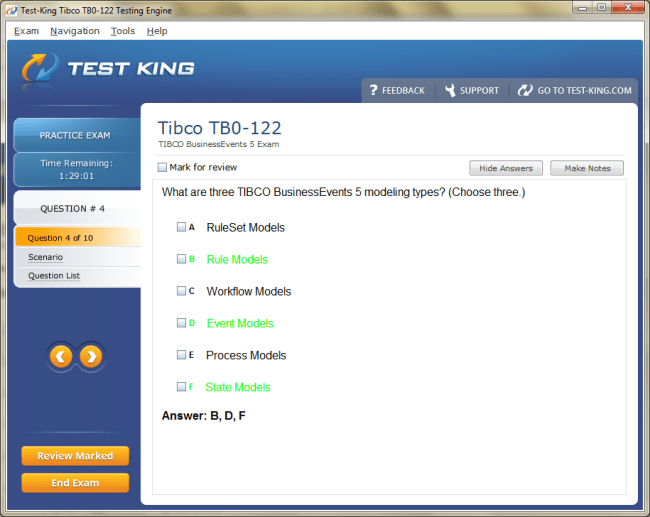
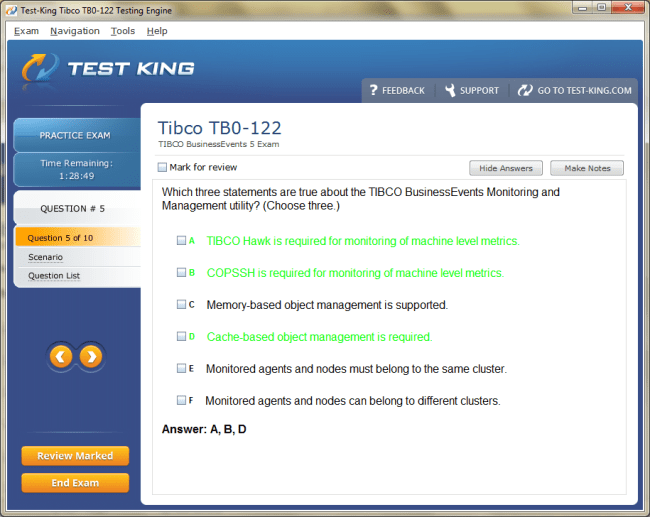
TB0-122 Exam Product Screenshots
Frequently Asked Questions
How can I get the products after purchase?
All products are available for download immediately from your Member's Area. Once you have made the payment, you will be transferred to Member's Area where you can login and download the products you have purchased to your computer.
How long can I use my product? Will it be valid forever?
Test-King products have a validity of 90 days from the date of purchase. This means that any updates to the products, including but not limited to new questions, or updates and changes by our editing team, will be automatically downloaded on to computer to make sure that you get latest exam prep materials during those 90 days.
Can I renew my product if when it's expired?
Yes, when the 90 days of your product validity are over, you have the option of renewing your expired products with a 30% discount. This can be done in your Member's Area.
Please note that you will not be able to use the product after it has expired if you don't renew it.
How often are the questions updated?
We always try to provide the latest pool of questions, Updates in the questions depend on the changes in actual pool of questions by different vendors. As soon as we know about the change in the exam question pool we try our best to update the products as fast as possible.
How many computers I can download Test-King software on?
You can download the Test-King products on the maximum number of 2 (two) computers or devices. If you need to use the software on more than two machines, you can purchase this option separately. Please email support@test-king.com if you need to use more than 5 (five) computers.
What is a PDF Version?
PDF Version is a pdf document of Questions & Answers product. The document file has standart .pdf format, which can be easily read by any pdf reader application like Adobe Acrobat Reader, Foxit Reader, OpenOffice, Google Docs and many others.
Can I purchase PDF Version without the Testing Engine?
PDF Version cannot be purchased separately. It is only available as an add-on to main Question & Answer Testing Engine product.
What operating systems are supported by your Testing Engine software?
Our testing engine is supported by Windows. Andriod and IOS software is currently under development.
Understanding TIBCO BusinessEvents 5 Architecture for TB0-122 Exam
TIBCO BusinessEvents 5 is a sophisticated platform designed to facilitate real-time decision-making and complex event processing within enterprises. The architecture is meticulously crafted to support event-driven operations, enabling organizations to respond to rapidly changing business conditions with precision. At its core, BusinessEvents employs a multi-layered architecture that orchestrates events, rules, and agents to create a dynamic and responsive ecosystem. Understanding this architecture is critical for candidates preparing for the TB0-122 examination, as the exam focuses heavily on how these components interact to deliver business value.
Exploring the Foundations of TIBCO BusinessEvents 5
The architecture can be best understood by considering the flow of information through its various components. Events, which are essentially representations of significant business occurrences, act as the primary stimuli within the system. These events can originate from external systems, sensors, applications, or user inputs. Upon arrival, the events are processed by the event processing engine, which applies a set of predefined business rules and decision logic to determine the appropriate response. This capability transforms raw data into actionable insights almost instantaneously, a feature that distinguishes TIBCO BusinessEvents from conventional transactional systems.
Agents within BusinessEvents serve as autonomous entities that monitor specific conditions, execute rules, and trigger actions based on event occurrences. Each agent is configured to handle particular types of events or data patterns, and collectively, they form a mesh of responsive nodes capable of executing complex business logic. The interaction between agents and events enables the system to manage high volumes of data with minimal latency, which is crucial for sectors such as financial services, telecommunications, and supply chain management. Moreover, these agents are highly configurable, allowing organizations to tailor their behavior to unique business scenarios without altering the core engine, which ensures maintainability and scalability.
Event rules are central to the BusinessEvents framework. These rules define the criteria under which events are evaluated and the actions that should be executed in response. A single event may trigger multiple rules simultaneously, creating a cascading effect where the outcome of one evaluation can influence subsequent decisions. This rule-driven approach empowers organizations to implement complex decision-making frameworks that are adaptive and resilient. Within the TB0-122 exam context, understanding the relationship between events, rules, and agents is paramount, as questions often explore the intricacies of how these components collaborate to achieve business objectives.
The concept of temporal reasoning is also integral to BusinessEvents architecture. Temporal reasoning allows the system to analyze patterns of events over time, rather than evaluating events in isolation. This capability is particularly useful in scenarios where the timing or sequence of events influences business decisions. For example, detecting fraudulent transactions requires the system to recognize suspicious patterns across multiple events occurring within a specified timeframe. Temporal rules and windows provide the mechanism to capture such patterns, ensuring that the system can act proactively rather than reactively. Mastery of temporal constructs is often tested in TB0-122, highlighting the need for a nuanced understanding of time-based event processing.
Data modeling within TIBCO BusinessEvents is another critical aspect of its architecture. The platform employs an object-oriented approach to define events, agents, and rules, enabling a structured representation of complex business entities and relationships. Events are typically modeled as objects containing attributes that capture essential information, while agents encapsulate behaviors and decision logic. This structured modeling facilitates clarity, reusability, and consistency across the system, allowing developers and analysts to manage complexity effectively. Additionally, the platform supports inheritance and polymorphism in event and agent definitions, which adds a layer of flexibility in designing adaptive business solutions. TB0-122 candidates must grasp these modeling concepts to comprehend how events and agents are instantiated, managed, and leveraged within the platform.
Integration capabilities further enhance the utility of BusinessEvents architecture. The platform is designed to interface seamlessly with other TIBCO products, databases, messaging systems, and enterprise applications. These integrations ensure that events can be sourced from diverse channels and that responses can be propagated to the appropriate systems in real-time. The messaging layer in particular acts as the conduit for event flow, supporting asynchronous communication that decouples event producers from consumers. This decoupling is instrumental in achieving high scalability and resilience, allowing the system to handle surges in event volume without degradation in performance. Candidates preparing for TB0-122 should be familiar with integration patterns and how they contribute to the overall architecture and operational efficiency.
Monitoring and management are embedded in the architecture to ensure operational integrity and continuous optimization. The platform provides comprehensive dashboards, logging mechanisms, and diagnostic tools that enable administrators to track event processing, rule execution, and agent behavior. These capabilities not only support troubleshooting and performance tuning but also facilitate compliance and auditing, which are essential in regulated industries. Understanding how monitoring interacts with event processing and rule execution is an aspect that the TB0-122 exam evaluates, as practical knowledge of system observability is crucial for real-world deployment.
A unique feature of BusinessEvents is its support for complex event patterns and hierarchical event processing. Events can be correlated across multiple dimensions, enabling the system to recognize composite events derived from simpler occurrences. For instance, a supply chain disruption may be identified not from a single event but from a pattern of delayed shipments, inventory shortages, and transportation anomalies. The ability to define and detect such composite events enhances situational awareness and strategic decision-making. Exam questions in TB0-122 often probe understanding of event correlation and the methods to implement these patterns effectively within the platform.
Security and access control are integral considerations in the architecture. BusinessEvents incorporates role-based access control, ensuring that only authorized agents, users, or services can interact with sensitive event data or execute critical rules. This granular control preserves data confidentiality, integrity, and accountability, which are vital in environments handling financial transactions, personal information, or operational intelligence. For exam candidates, knowledge of security features and their configuration provides a practical perspective on how BusinessEvents maintains robust governance over event-driven processes.
Performance optimization in TIBCO BusinessEvents revolves around efficient event handling, rule evaluation, and agent execution. Techniques such as event filtering, prioritization, and batch processing are employed to minimize latency and maximize throughput. The architecture is designed to leverage in-memory processing and parallel execution, which enables the system to scale horizontally and accommodate high event volumes. Understanding performance tuning strategies, including best practices for rule design and agent deployment, is essential for TB0-122 aspirants seeking to demonstrate proficiency in real-world scenarios.
In sum, the architecture of TIBCO BusinessEvents 5 is a blend of event-driven logic, agent orchestration, rule-based evaluation, temporal reasoning, and robust integration. Its design philosophy emphasizes responsiveness, scalability, and adaptability, equipping enterprises with the tools to make instantaneous and informed decisions. For candidates preparing for TB0-122, a thorough comprehension of these architectural elements—how events flow through the system, how agents and rules interact, and how temporal and composite events are handled—is indispensable. Mastery of these concepts not only aids in exam success but also lays a foundation for practical application in enterprise environments where BusinessEvents drives operational excellence and strategic insight.
Delving into Agents, Rules, and Event Correlation
TIBCO BusinessEvents 5 provides a framework where agents, rules, and event correlation mechanisms coalesce to create an intricate yet agile environment capable of managing complex business scenarios. Agents, in the context of BusinessEvents, are autonomous entities that monitor the continuous stream of incoming events and execute predefined actions based on business logic. Each agent operates as a sentinel, evaluating events according to its assigned scope and conditions. The architecture allows for multiple agents to coexist, each with distinct responsibilities, while maintaining seamless inter-agent communication. Understanding this dynamic is essential for TB0-122 candidates, as the exam emphasizes the operational orchestration and configuration of agents in real-time scenarios.
Agents can be configured to track specific event types, evaluate data against sophisticated conditions, and initiate follow-up actions autonomously. This capability transforms the platform into a proactive system capable of detecting opportunities and threats before human intervention is required. Agents also possess the capability to maintain state, allowing them to remember prior events, user interactions, or system conditions. This statefulness is pivotal for processing temporal sequences and recognizing recurring patterns, which are common considerations in fraud detection, inventory management, and network monitoring. In TB0-122, candidates must comprehend how agent state and scope influence the decision-making process and event propagation across the system.
Rules in BusinessEvents form the decision-making nucleus of the architecture. They are expressed as conditions that define how the system should respond to specific events or combinations of events. A single rule can reference multiple event attributes, enabling nuanced assessments that consider complex interdependencies. For instance, a rule may trigger an alert only when a specific threshold is breached under particular temporal conditions. Such precision allows enterprises to avoid false positives while ensuring critical events receive immediate attention. The architecture is designed so that rules can be added, modified, or disabled without halting the processing engine, facilitating continuous adaptation to evolving business needs. For TB0-122 aspirants, mastering the intricacies of rule design, evaluation order, and the interactions with agents is vital for both the exam and practical implementation.
Event correlation is a sophisticated mechanism in TIBCO BusinessEvents that allows the platform to detect patterns and relationships among disparate events. The system can aggregate events from multiple sources, evaluate their temporal and logical relationships, and generate composite events that represent higher-order business phenomena. For example, in a supply chain context, delayed shipments, inventory shortages, and fluctuating demand might be correlated to predict potential delivery failures. This correlation transforms raw data into actionable intelligence, enabling predictive and prescriptive responses. Candidates for TB0-122 need to grasp how to define correlation patterns, apply temporal windows, and use event attributes effectively to create meaningful and reliable composite events.
Temporal constructs are fundamental to correlation, as they allow rules and agents to evaluate sequences and patterns over defined intervals. The platform supports a range of temporal operators, enabling nuanced assessments of event timing, order, and frequency. For example, detecting fraudulent transactions often requires monitoring multiple related events within a constrained time window to identify anomalous behavior. Temporal rules can specify that an event should only trigger an action if another event has occurred previously or if a certain pattern repeats within a given timeframe. This temporal reasoning elevates BusinessEvents from a reactive engine to a predictive and strategic tool. Understanding temporal mechanisms is critical for TB0-122 candidates, as the exam tests both conceptual knowledge and practical scenarios involving timed event sequences.
Event attributes play a crucial role in both rules evaluation and correlation. Attributes represent the data points that define the characteristics of an event. These can range from simple elements, such as a transaction amount or user ID, to complex structures encapsulating multiple interrelated data fields. Attributes are not static; they can be transformed, mapped, and derived dynamically during event processing, allowing the system to adapt to evolving business contexts. For exam purposes, understanding how attributes influence decision logic, rule outcomes, and agent actions is paramount, as many TB0-122 questions focus on attribute-level manipulations and their implications on overall system behavior.
The interaction between agents and rules forms a feedback loop that ensures business logic is executed consistently and efficiently. Agents evaluate incoming events against applicable rules, and when conditions are met, they trigger actions that may modify the state of other agents, generate new events, or invoke external processes. This cyclical interaction is fundamental to event-driven architecture, as it allows for continuous monitoring, assessment, and response without manual intervention. For candidates, comprehending this loop is crucial, as it illustrates how BusinessEvents maintains a synchronized and responsive environment capable of handling complex enterprise operations.
BusinessEvents supports hierarchical agent structures, allowing for layered decision-making and delegation of responsibilities. Higher-level agents can oversee groups of lower-level agents, aggregating their outputs and making strategic decisions based on collective intelligence. This hierarchy is particularly valuable in large-scale deployments, where different agents handle specific domains, and coordination is required to maintain system coherence. The architecture ensures that hierarchical interactions do not compromise performance, as agents operate asynchronously and are optimized for parallel execution. TB0-122 aspirants must be aware of how hierarchical agents are designed, deployed, and interact with rules and events to achieve scalable and maintainable solutions.
The platform’s integration capabilities extend agent and rule functionality beyond the confines of the BusinessEvents engine. Agents can communicate with external systems, databases, and messaging infrastructures, allowing events to be sourced from a wide variety of channels. This flexibility ensures that BusinessEvents can operate within heterogeneous enterprise ecosystems, providing a cohesive and unified decision-making framework. Integration also facilitates automated responses, where actions triggered by rules or agents can propagate to external systems, initiate workflows, or update critical data repositories. Understanding integration mechanisms and patterns is a key aspect for TB0-122 candidates, as questions often explore how events are ingested, correlated, and propagated across the enterprise landscape.
Complex event patterns can be configured to capture intricate relationships and dependencies among multiple events. These patterns allow the system to recognize scenarios that are not evident from individual events, enhancing situational awareness and decision-making accuracy. For instance, a financial institution may detect potential fraud by recognizing a sequence of transactions across accounts, locations, and time zones that collectively indicate suspicious activity. Configuring these patterns requires a deep understanding of event attributes, temporal reasoning, and correlation strategies. TB0-122 emphasizes the importance of designing reliable patterns that minimize false positives while maximizing responsiveness.
Monitoring and diagnostics are embedded in the architecture to ensure optimal performance and operational visibility. BusinessEvents provides tools to track agent activity, rule execution, and event flow, offering insights into system behavior and potential bottlenecks. Monitoring supports proactive maintenance, performance tuning, and troubleshooting, which are essential in high-stakes environments such as banking, telecommunications, and logistics. Candidates should understand how monitoring complements agent and rule operations, ensuring that the system operates efficiently and maintains accuracy under heavy workloads.
Performance optimization in the platform relies on the careful design of agents, rules, and event processing workflows. Techniques such as prioritization of events, selective filtering, and efficient pattern matching are employed to reduce processing latency. BusinessEvents is optimized for in-memory processing, enabling rapid evaluation of large volumes of events and rules. Scalability is achieved through distributed agent deployment and parallel execution, allowing the system to handle peaks in event volume without degradation. TB0-122 candidates should be familiar with performance considerations, as the exam includes scenarios that test knowledge of efficient configuration and deployment strategies.
Security and access control are tightly woven into agent and rule execution. Role-based access ensures that only authorized entities can trigger rules, modify agents, or interact with sensitive events. This security framework preserves data integrity and confidentiality while enabling complex event processing to continue uninterrupted. Understanding the interplay of security policies with agents and rules is vital for candidates, as real-world deployments demand a balance between accessibility and protection.
Data modeling within agents and rules allows for structured and consistent event handling. Events are represented as objects with attributes that can be dynamically manipulated to reflect changing business conditions. Agents encapsulate behaviors and rules, creating a modular and reusable design. This approach enhances maintainability, reduces complexity, and ensures that the system can evolve without requiring extensive redevelopment. Candidates for TB0-122 need to comprehend how data modeling affects rule execution, agent behavior, and the overall event processing pipeline.
In essence, agents, rules, and event correlation mechanisms form the backbone of TIBCO BusinessEvents 5 architecture. Their interaction creates a responsive, intelligent system capable of processing complex events and executing business logic with precision and speed. For TB0-122 aspirants, mastering these concepts, understanding temporal reasoning, and designing efficient agent-rule networks are critical steps toward exam success and real-world application. The platform’s architecture is a testament to the power of event-driven intelligence, providing enterprises with the ability to anticipate, respond, and act decisively in an ever-changing business environment.
Harnessing Event-Driven Architecture and Temporal Analysis
TIBCO BusinessEvents 5 embodies the principles of event-driven architecture, which serves as the cornerstone for real-time decision-making and adaptive business logic. The platform’s event-driven paradigm allows systems to react instantaneously to significant occurrences, transforming incoming data streams into actionable insights. Within this architecture, events act as catalysts, prompting agents to evaluate conditions, apply rules, and generate responses without requiring manual intervention. This autonomy enables enterprises to operate with unprecedented agility, ensuring that decisions are timely and contextually relevant. For candidates preparing for the TB0-122 exam, a comprehensive understanding of how events drive processes is fundamental, as it underpins both conceptual knowledge and practical applications.
Event-driven processes within BusinessEvents rely on the seamless interplay between event ingestion, rule evaluation, and agent execution. Events can originate from diverse sources, including enterprise applications, databases, user interactions, or IoT sensors. Once ingested, each event is assessed according to its attributes, relevance, and potential impact on the system’s state. This evaluation triggers a sequence of rule-based actions that can involve updating internal states, generating notifications, or initiating further events. The architecture ensures that events are processed with minimal latency, allowing businesses to maintain situational awareness and respond proactively to dynamic conditions. TB0-122 candidates must appreciate the lifecycle of an event from ingestion to response, including the nuances of event prioritization and routing.
Temporal reasoning in BusinessEvents adds a critical dimension to event-driven processes. Unlike simple event evaluation, temporal reasoning considers the sequence, frequency, and timing of events, allowing the system to recognize patterns and trends that unfold over time. For instance, a sudden increase in user activity combined with unusual transaction patterns may indicate potential security threats. Temporal rules enable agents to detect such anomalies by evaluating multiple events within defined time windows, ensuring that decisions are informed by context rather than isolated occurrences. Mastery of temporal constructs is essential for TB0-122 aspirants, as the exam tests both the conceptual framework and practical implementation of time-sensitive event logic.
Time-based event evaluation leverages constructs such as sliding windows, intervals, and triggers. Sliding windows allow agents to monitor continuous streams of events, maintaining a rolling view of recent activity to detect emergent patterns. Intervals define specific periods during which events are aggregated or analyzed, providing clarity on trends and deviations. Triggers initiate actions when temporal conditions are met, ensuring that responses occur promptly and accurately. This sophisticated approach allows BusinessEvents to handle high-velocity data streams while maintaining precision in decision-making. Understanding the application and configuration of these temporal mechanisms is critical for TB0-122 candidates, particularly in scenarios involving fraud detection, operational risk management, or supply chain monitoring.
Composite event creation is another crucial aspect of event-driven architecture. BusinessEvents enables the aggregation of multiple related events into a single higher-order event, reflecting complex business phenomena that cannot be discerned from individual events alone. For example, detecting system failures may require correlating minor alerts from different subsystems to form a composite event indicating a larger issue. This capability enhances situational awareness, allowing enterprises to identify and respond to multifaceted problems with greater efficiency. TB0-122 candidates must understand how to define composite events, specify correlation criteria, and ensure accurate representation of business conditions in aggregated data.
Event correlation involves establishing relationships between events based on their attributes, timing, or contextual relevance. This mechanism is central to detecting patterns, anomalies, and predictive trends. For example, in a logistics scenario, delays in shipment, inventory shortages, and transportation disruptions may be correlated to predict potential supply chain bottlenecks. The architecture supports sophisticated correlation strategies, including one-to-many, many-to-one, and many-to-many mappings between events, enabling complex interdependencies to be recognized and acted upon. Candidates preparing for TB0-122 must be adept at defining correlation patterns, managing event dependencies, and leveraging temporal constructs to optimize system responsiveness.
Rules within TIBCO BusinessEvents play a pivotal role in shaping event-driven behavior. Each rule specifies conditions under which an event or combination of events should trigger a particular response. Rules can reference event attributes, agent states, or external data, creating highly flexible decision logic capable of handling intricate business scenarios. The evaluation of rules is optimized to ensure rapid decision-making, even under high event volumes. Additionally, the architecture allows for concurrent rule execution, enabling multiple conditions to be assessed simultaneously without conflict. Understanding rule evaluation order, precedence, and conflict resolution is a critical skill for TB0-122 aspirants, as the exam frequently tests the ability to design rules that operate effectively in complex event environments.
Agents serve as the operational backbone of event-driven processes, acting as vigilant entities that monitor event streams, execute rules, and maintain state information. Each agent can be tailored to specific business functions, allowing for modular and scalable design. Agents interact with events and rules in a continuous feedback loop, dynamically adjusting behavior based on incoming data and temporal patterns. This autonomy allows the system to operate with minimal human intervention, responding to business conditions in real-time. TB0-122 candidates need to understand agent configuration, state management, and inter-agent communication, as these concepts are fundamental to creating resilient and adaptive event-driven solutions.
Data modeling is a vital component that underlies event-driven processes and temporal reasoning. Events are represented as structured objects containing attributes that capture essential information, while agents encapsulate behaviors and state. This object-oriented modeling ensures consistency, reusability, and clarity, facilitating the development of complex solutions without sacrificing maintainability. Additionally, the platform supports dynamic transformation and derivation of attributes during processing, enabling adaptive responses to evolving business conditions. Candidates for TB0-122 should comprehend how data modeling affects rule execution, agent interactions, and composite event generation, as these factors directly influence the effectiveness of event-driven workflows.
Integration with external systems enhances the scope and applicability of event-driven processes. BusinessEvents can consume events from various sources, including messaging queues, databases, web services, and enterprise applications. This integration ensures that the platform operates as a central hub for real-time decision-making, aggregating data from multiple channels and coordinating responses across the enterprise ecosystem. Actions triggered by rules and agents can also propagate to external systems, initiating workflows, updating records, or sending alerts. Understanding integration patterns and their implications on event processing is crucial for TB0-122 aspirants, as the exam evaluates both architectural knowledge and practical implementation skills.
Performance optimization is deeply intertwined with event-driven processes and temporal reasoning. Efficient event handling, rule evaluation, and agent execution are essential for maintaining responsiveness under high-volume workloads. Techniques such as event filtering, prioritization, and batch processing reduce latency and ensure that critical events are processed first. The platform leverages in-memory processing and parallel execution to maximize throughput and minimize delays. Candidates should understand performance tuning strategies, including best practices for rule design, agent configuration, and temporal window management, as these are often tested in TB0-122 scenarios.
Security and governance are seamlessly incorporated into event-driven processes. Role-based access control ensures that only authorized agents, users, or services can interact with sensitive events or modify rules. This framework preserves data confidentiality, integrity, and accountability while enabling complex processing to continue unhindered. TB0-122 candidates must be aware of how security policies influence event evaluation, agent execution, and composite event creation, as real-world deployments demand a balance between accessibility and protection.
Monitoring and observability complement event-driven architecture by providing visibility into event flows, rule execution, and agent performance. BusinessEvents offers diagnostic tools and dashboards that allow administrators to track activity, identify anomalies, and fine-tune performance. This monitoring capability ensures that event-driven processes operate reliably, and that potential bottlenecks or misconfigurations can be addressed proactively. Understanding the interplay between monitoring, event processing, and temporal reasoning is essential for TB0-122 aspirants, as the exam often explores real-world operational scenarios.
In addition to standard event processing, BusinessEvents supports sophisticated pattern recognition and anomaly detection. Temporal analysis, composite event generation, and correlation strategies combine to detect unusual patterns or emerging trends. For example, in financial services, temporal patterns of transactions across multiple accounts can reveal fraudulent activity, while in logistics, correlated delays across shipments can predict potential supply chain disruptions. TB0-122 candidates must understand how to configure these mechanisms, optimize detection accuracy, and manage false positives to maintain operational efficiency.
Event prioritization and scheduling are advanced features that further enhance event-driven processes. By assigning priority levels to events, BusinessEvents ensures that critical occurrences are processed first, maintaining responsiveness and minimizing risk. Scheduling allows events to be evaluated or triggered at specific times or under defined conditions, supporting proactive decision-making and long-term strategic planning. Candidates should be adept at configuring prioritization and scheduling to optimize system performance and responsiveness, as these concepts are integral to both exam scenarios and practical implementations.
The interplay between event-driven architecture, temporal reasoning, and composite event design exemplifies the sophistication of TIBCO BusinessEvents 5. These capabilities allow enterprises to move beyond reactive operations, providing predictive and adaptive intelligence that informs strategic and operational decisions. For TB0-122 aspirants, mastering these interrelated concepts is essential, as they form the foundation of the exam’s technical objectives and real-world applications.
Leveraging Integration, Observability, and Efficient Execution
TIBCO BusinessEvents 5 provides a highly extensible platform that excels not only in event processing and rule execution but also in seamless integration with external systems. Integration patterns form the backbone of enterprise-wide connectivity, allowing BusinessEvents to consume and propagate events across diverse technological landscapes. By interfacing with messaging systems, databases, web services, and other TIBCO components, the platform transforms into a cohesive decision-making hub that unifies real-time insights with operational execution. For candidates preparing for the TB0-122 exam, understanding these integration mechanisms is critical, as the exam often evaluates the ability to design workflows that connect disparate systems while maintaining performance and reliability.
Event ingestion is the first step in integration, where data from multiple sources enters the BusinessEvents engine. This can include streaming data from applications, transactional data from databases, sensor feeds from IoT devices, or messages from enterprise messaging systems. The architecture ensures that incoming events are normalized, enriched, and mapped to internal data models, allowing agents and rules to process them consistently. Integration also enables events to be correlated across multiple domains, providing a comprehensive understanding of enterprise operations. Candidates must grasp how data flows from external sources into the platform, including the significance of event transformation, filtering, and mapping.
Propagation of events to external systems is equally important. BusinessEvents allows agents and rules to trigger actions that update databases, invoke web services, send messages, or initiate workflows in other applications. This outbound integration ensures that real-time insights are not confined to the platform but are operationalized throughout the enterprise ecosystem. Understanding the design and implementation of such integration patterns is essential for TB0-122 aspirants, as practical scenarios often involve orchestrating events across multiple systems to achieve business objectives.
Monitoring and observability are vital for ensuring that integrated event-driven processes operate as intended. BusinessEvents offers comprehensive dashboards, logging mechanisms, and diagnostic tools that provide visibility into event flows, agent activity, and rule execution. These monitoring capabilities enable administrators to detect anomalies, track performance metrics, and troubleshoot issues efficiently. Real-time dashboards offer insights into system health, event processing rates, and agent behavior, supporting proactive maintenance and continuous optimization. TB0-122 candidates must understand the significance of observability, including how monitoring supports operational reliability and aids in identifying bottlenecks or misconfigurations.
Diagnostic tools allow users to analyze the processing of individual events, track the evaluation of rules, and examine agent states. This granular visibility is invaluable in complex deployments where multiple agents and rules operate concurrently. By tracing events through the system, administrators can verify correctness, assess latency, and refine rules or agent configurations to improve responsiveness. For exam preparation, understanding diagnostic capabilities ensures that candidates can conceptualize how monitoring and troubleshooting are integrated into enterprise-scale deployments.
Performance optimization is intrinsically tied to integration and monitoring. Efficient execution relies on minimizing latency, maximizing throughput, and ensuring that agents and rules operate effectively under varying workloads. Techniques such as event filtering, prioritization, and batching are employed to reduce processing overhead. For example, critical events can be flagged for immediate evaluation, while less urgent events are processed in batches to conserve resources. BusinessEvents also leverages in-memory processing and parallel execution to support high volumes of events with minimal delay. Candidates preparing for TB0-122 must understand how these strategies improve system responsiveness and maintain operational stability.
Scalability is an essential consideration in high-volume environments. The platform supports distributed deployment, allowing agents to operate across multiple nodes to balance load and prevent bottlenecks. Integration with enterprise messaging systems enables asynchronous processing, decoupling event producers from consumers and enhancing system resilience. TB0-122 aspirants should comprehend how distributed architectures, coupled with event-driven design, ensure that the platform can handle surges in data volume without degradation of performance.
Resource management plays a crucial role in maintaining optimal system performance. BusinessEvents allows for the allocation of processing threads, memory, and storage resources to agents and rules based on priority or operational requirements. By managing resources efficiently, the platform minimizes contention, reduces latency, and ensures consistent performance. For TB0-122 candidates, understanding resource management strategies is important for configuring environments that maintain responsiveness under dynamic workloads.
Data integrity and consistency are maintained through rigorous integration and monitoring mechanisms. Events processed by BusinessEvents can trigger updates to multiple systems, and mechanisms such as transaction management, idempotent processing, and error handling ensure that these updates are accurate and reliable. Agents are capable of detecting failures, retrying operations, and logging discrepancies to support auditing and compliance. Exam aspirants must be aware of how data consistency is preserved across integrated systems, as TB0-122 evaluates practical understanding of fault-tolerant event processing.
Error handling and recovery are integrated into the architecture to ensure continuity of operations. BusinessEvents allows agents to detect and respond to processing errors, whether they arise from malformed events, system failures, or integration issues. Automated recovery strategies, including retries, alternative workflows, and escalation procedures, ensure that business processes remain uninterrupted. Candidates should understand how to implement robust error-handling mechanisms, as exam scenarios often include questions on maintaining reliability in complex, integrated deployments.
Advanced integration patterns include event-driven orchestration, event enrichment, and conditional propagation. Event-driven orchestration allows multiple events to be sequenced and evaluated collectively, supporting complex business logic that spans multiple domains. Event enrichment enhances raw events with additional context or derived attributes, enabling more sophisticated rule evaluations. Conditional propagation ensures that only relevant events are transmitted to external systems, optimizing performance and reducing unnecessary data flow. TB0-122 aspirants should be proficient in designing these patterns to create intelligent, efficient, and scalable workflows.
Security and compliance are critical in integrated environments. BusinessEvents supports role-based access, ensuring that only authorized agents, users, or services can interact with sensitive events or modify processing logic. Integration with secure messaging systems and encrypted data channels ensures that information transmitted between systems remains confidential and tamper-proof. Candidates must understand the interplay between security policies and system integration, as exam scenarios often involve configuring secure event flows and maintaining compliance with enterprise standards.
Performance tuning requires a deep understanding of the interplay between agents, rules, and event flows. Optimizing rule evaluation involves structuring conditions efficiently, minimizing unnecessary computations, and prioritizing critical logic. Agent configuration can influence throughput, as parameters such as state persistence, temporal reasoning windows, and event subscription patterns affect responsiveness. For TB0-122 aspirants, knowledge of performance tuning strategies is essential, as it demonstrates the ability to deploy BusinessEvents solutions that are both robust and efficient.
Temporal optimization is particularly significant when handling high-frequency events. BusinessEvents allows for intelligent management of sliding windows, intervals, and triggers to ensure that events are evaluated accurately and efficiently. By configuring temporal parameters appropriately, the system can maintain responsiveness without overburdening processing resources. Candidates should be familiar with how temporal optimization impacts both rule execution and agent behavior, as this is a recurring topic in TB0-122 scenarios.
Monitoring performance involves more than just tracking event processing rates. Comprehensive observability includes analyzing rule execution times, agent response latencies, and integration throughput. By examining these metrics, administrators can identify bottlenecks, optimize resource allocation, and adjust configurations to enhance overall system efficiency. TB0-122 candidates must understand the full spectrum of performance monitoring, as practical exam questions often involve diagnosing inefficiencies and recommending optimization strategies.
Load balancing is an integral component of scalable event-driven architectures. BusinessEvents can distribute agents across nodes, balancing processing demands and ensuring that no single node becomes a bottleneck. This distribution not only enhances throughput but also provides fault tolerance, as workloads can be shifted seamlessly in case of node failures. Candidates preparing for TB0-122 should be able to articulate the principles of load balancing, including its impact on integration, event propagation, and rule execution.
Observability extends to error detection and alerting mechanisms. By monitoring for exceptions, failed integrations, or delayed event processing, administrators can proactively address issues before they escalate into critical failures. Alerting systems notify relevant personnel, allowing for immediate intervention and maintaining continuity of operations. Understanding observability in conjunction with integration and performance optimization is essential for TB0-122 aspirants, as it reflects practical enterprise deployment requirements.
The interplay of integration, monitoring, and performance optimization ensures that TIBCO BusinessEvents operates as a resilient, adaptive, and efficient platform. By mastering these concepts, TB0-122 candidates gain the ability to design, deploy, and maintain complex event-driven solutions that deliver timely insights and drive business outcomes. Integration patterns facilitate connectivity and data flow, monitoring ensures transparency and reliability, and performance optimization guarantees responsiveness under demanding conditions. Together, these capabilities form a sophisticated ecosystem capable of supporting enterprise-scale decision-making and operational excellence.
Mastering Rule Execution, Agent Coordination, and Complex Event Timing
TIBCO BusinessEvents 5 provides a robust and intricate framework for orchestrating business logic, coordinating autonomous agents, and implementing temporal patterns that capture complex sequences of events. Understanding these mechanisms is critical for TB0-122 aspirants, as the exam emphasizes the ability to design, configure, and manage solutions that respond dynamically to evolving business conditions. Rule management, agent orchestration, and temporal pattern implementation form the core of advanced event-driven architecture, enabling enterprises to operate with agility, predictive insight, and operational intelligence.
Rule management is fundamental to the execution of business logic in BusinessEvents. Rules define the conditions under which events trigger actions, encapsulating decision-making logic in a declarative manner. Advanced rule management involves not only defining conditions but also structuring them for efficiency, prioritizing execution, and resolving conflicts between overlapping or competing rules. For example, in a financial system, one rule may flag suspicious transactions based on amount thresholds while another assesses frequency and location. Proper management ensures that both rules are evaluated without conflict, and the correct sequence of actions is executed. TB0-122 candidates must understand the intricacies of rule dependency, execution order, and conflict resolution, as these concepts are essential for building reliable and predictable solutions.
Rule evaluation strategies are critical for optimizing performance. BusinessEvents allows rules to be grouped into modules, enabling modular management and reuse across different agents or event types. Grouping also facilitates incremental evaluation, where only relevant rules are processed when an event occurs, reducing computational overhead and improving latency. Temporal conditions within rules further refine evaluation by restricting the applicability to certain time windows or event sequences. Mastery of these strategies ensures that candidates can design rule sets that are both comprehensive and efficient, reflecting real-world enterprise requirements.
Agent orchestration represents the coordination of multiple autonomous entities within BusinessEvents. Agents are capable of monitoring streams of events, evaluating rules, maintaining state, and triggering actions. Orchestration involves defining relationships among agents, managing communication, and ensuring that their collective behavior aligns with business objectives. Higher-level agents can supervise subordinate agents, aggregating their outputs, enforcing policies, and making strategic decisions based on collective intelligence. This hierarchical orchestration supports scalable deployments and ensures coherent behavior across the enterprise. TB0-122 aspirants must grasp how agents interact, communicate, and collaborate to implement complex event-driven workflows.
Agents maintain state to enable temporal reasoning and pattern recognition. State management allows agents to remember prior events, cumulative calculations, or contextual information necessary for advanced rule evaluation. This statefulness is particularly important for detecting anomalies, monitoring trends, and correlating events that occur over extended periods. For instance, an agent tracking inventory levels might accumulate data over multiple shipments to identify recurring shortages, triggering replenishment actions before critical thresholds are breached. Understanding state management and its implications for agent behavior is critical for candidates preparing for TB0-122, as practical scenarios often revolve around continuous monitoring and adaptive response.
Temporal pattern implementation is an essential capability of BusinessEvents, enabling the system to recognize sequences, frequencies, and durations of events. Temporal rules allow agents to detect patterns that are not apparent from individual occurrences, providing predictive and prescriptive insights. Sliding windows, intervals, and triggers are used to define temporal constraints, ensuring that events are analyzed within relevant contexts. For example, detecting fraudulent activity may require observing a sequence of transactions within a specific time window, combining both frequency and timing criteria to trigger alerts. TB0-122 aspirants must understand how to configure these temporal constructs effectively to capture meaningful patterns without generating excessive false positives.
Composite events are often created as part of temporal pattern implementation. BusinessEvents allows multiple events to be aggregated into a higher-order representation that reflects complex business phenomena. These composite events enable agents to act on trends, dependencies, or emergent situations rather than isolated incidents. For example, a logistics system may generate a composite event indicating a potential delivery failure by correlating shipment delays, inventory shortages, and transportation anomalies. Understanding how to define and manage composite events is critical for TB0-122, as the exam tests the ability to design event-driven solutions that handle multifaceted business conditions.
Conflict resolution among rules and agents is a key aspect of advanced orchestration. When multiple rules or agents respond to overlapping events, mechanisms must be in place to determine execution order, precedence, and priority. BusinessEvents provides strategies for conflict resolution, including rule salience, agent hierarchies, and temporal evaluation. By applying these strategies, the system ensures consistent and predictable outcomes even in complex and high-volume environments. TB0-122 candidates must be able to articulate conflict resolution mechanisms and their practical application to ensure correct behavior across interdependent agents and rules.
Event correlation in conjunction with temporal patterns allows for nuanced detection of business phenomena. Correlation strategies involve linking events based on shared attributes, temporal proximity, or logical relationships. This enables agents to recognize patterns, trends, and dependencies that would otherwise remain obscured. For example, in a telecommunications network, dropped calls, latency spikes, and signaling errors may be correlated to predict network outages, enabling proactive mitigation. Understanding correlation principles, temporal constraints, and attribute mapping is critical for TB0-122 aspirants to demonstrate proficiency in advanced event-driven architectures.
Performance optimization is closely tied to rule management, agent orchestration, and temporal pattern implementation. Efficient evaluation of rules, stateful agent execution, and timely pattern detection are essential to maintaining low latency and high throughput. Techniques such as selective event filtering, rule grouping, prioritization, and parallel agent execution contribute to optimized system performance. Additionally, temporal window management ensures that only relevant events are evaluated, reducing computational overhead and improving responsiveness. Candidates preparing for TB0-122 must understand these optimization strategies to ensure the deployment of scalable and high-performing solutions.
Integration with external systems further enhances advanced rule and agent capabilities. BusinessEvents allows agents to ingest data from various sources, propagate events, and synchronize with enterprise applications. This integration ensures that rule execution and agent actions are informed by comprehensive, real-time information, enhancing decision quality and responsiveness. Furthermore, external interactions must be managed to maintain performance, consistency, and security, requiring careful orchestration and monitoring. TB0-122 aspirants should be familiar with integration patterns and their implications for rule and agent behavior.
Observability is an essential component of advanced orchestration. Monitoring tools provide visibility into agent states, rule execution, event flows, and temporal pattern evaluations. This insight allows administrators to verify correctness, identify bottlenecks, and refine configurations for optimal performance. Detailed logging supports auditability and troubleshooting, ensuring that complex workflows operate reliably. Understanding observability mechanisms and how they complement rule management and agent orchestration is vital for TB0-122 candidates, as exam questions frequently assess practical deployment knowledge.
Error handling and fault tolerance are integral to advanced orchestration. BusinessEvents allows agents to detect failures, retry operations, and escalate exceptions based on predefined policies. These mechanisms ensure continuity of operations, even under adverse conditions or high event volumes. Candidates must understand how error handling interacts with rule execution, temporal patterns, and agent state management to maintain system reliability and integrity. This knowledge is crucial for TB0-122 aspirants who may encounter scenarios requiring robust and resilient event-driven solutions.
Data modeling underpins rule execution, agent orchestration, and temporal pattern implementation. Events are represented as structured objects with attributes that can be dynamically manipulated, transformed, or enriched. Agents encapsulate behaviors and state, while rules define logic based on event attributes and conditions. This structured approach ensures consistency, maintainability, and clarity in complex deployments. Candidates must understand how data modeling influences temporal reasoning, event correlation, and composite event generation to design effective solutions for TB0-122 scenarios.
Security and governance are intertwined with advanced orchestration. Role-based access control ensures that only authorized agents, users, or services can modify rules, manipulate agent state, or access sensitive event data. Secure interactions with external systems preserve data integrity and confidentiality, supporting compliance and operational reliability. Understanding security implications for rule execution, agent orchestration, and temporal pattern handling is essential for TB0-122 aspirants, as enterprise deployments require robust protection and governance.
Temporal optimization, state management, and composite event handling collectively contribute to the agility and intelligence of BusinessEvents 5. By mastering these concepts, candidates can implement solutions that detect subtle trends, respond proactively, and execute business logic with precision. The platform’s architecture allows for modularity, scalability, and adaptability, enabling organizations to maintain situational awareness and act decisively in dynamic environments. TB0-122 aspirants must be able to design and configure agents, rules, and temporal patterns that operate efficiently, accurately, and cohesively, demonstrating both technical acumen and practical application.
Advanced debugging and diagnostics support the fine-tuning of complex orchestrations. By tracing event flows, rule evaluations, and agent interactions, administrators can verify system behavior, identify inefficiencies, and adjust configurations to optimize performance. This capability is particularly valuable in high-volume or multi-agent deployments, where understanding the interplay of multiple rules and temporal patterns is critical for ensuring correctness and efficiency. TB0-122 candidates should be proficient in leveraging diagnostics to analyze and improve advanced event-driven architectures.
In essence, advanced rule management, agent orchestration, and temporal pattern implementation form the backbone of sophisticated event-driven solutions in TIBCO BusinessEvents 5. Mastery of these areas enables enterprises to operate with predictive insight, operational agility, and strategic intelligence. For TB0-122 aspirants, a deep understanding of these mechanisms, combined with practical skills in configuration, optimization, and monitoring, is essential to succeed both on the exam and in real-world deployments. The platform’s capabilities empower organizations to detect complex patterns, respond to events dynamically, and execute business logic with precision and efficiency.
Ensuring Robust and Resilient Event-Driven Solutions
TIBCO BusinessEvents 5 is engineered to support enterprise-grade deployments that demand scalability, fault tolerance, and operational reliability. Understanding these capabilities is essential for TB0-122 aspirants, as the exam evaluates both theoretical knowledge and practical application of event-driven architecture principles in complex environments. Scalability, fault tolerance, and deployment strategies ensure that event processing, rule execution, and agent orchestration operate seamlessly under variable loads, providing uninterrupted service and timely decision-making.
Scalability in BusinessEvents involves the ability to handle increasing volumes of events, rules, and agents without compromising performance. The platform achieves horizontal scalability by distributing agents and event processing across multiple nodes in a clustered environment. Each node operates autonomously while maintaining synchronized communication, allowing workloads to be balanced dynamically. This distribution ensures that high event rates do not overwhelm the system and that processing remains efficient even during peak periods. For TB0-122 candidates, understanding the principles of horizontal and vertical scaling, resource allocation, and node coordination is fundamental for designing solutions that meet enterprise demands.
Agents are the cornerstone of scalable architectures. Each agent can process events independently, execute rules, and maintain state information. By deploying multiple agents across nodes, the system achieves parallelism and load distribution. Agents can also operate hierarchically, where higher-level agents supervise subordinate agents, aggregate outputs, and implement strategic decisions. This orchestration enables the platform to handle complex workflows while preserving coherence and consistency. Candidates preparing for TB0-122 must be proficient in configuring agent hierarchies, state management, and inter-agent communication to ensure scalability and responsiveness.
Fault tolerance is critical to maintaining operational continuity. BusinessEvents incorporates multiple mechanisms to detect failures, recover gracefully, and prevent data loss. Nodes within a cluster can detect unresponsive peers and redistribute workloads automatically, ensuring uninterrupted event processing. Agents can persist state information, allowing them to resume operations without loss of context following failures. Additionally, rule evaluation and event handling are designed to be idempotent, enabling safe retries in case of transient errors. TB0-122 aspirants must understand these fault tolerance strategies, including node recovery, state persistence, and transactional integrity, as they are vital for resilient enterprise deployments.
Temporal pattern handling plays a pivotal role in maintaining both scalability and fault tolerance. The system must manage time-sensitive event sequences accurately, even under high load or during recovery scenarios. Sliding windows, intervals, and triggers must be maintained with precision to ensure that composite events and correlated patterns reflect actual business conditions. This requires robust state management, efficient resource utilization, and coordinated agent execution. Candidates should be adept at configuring temporal parameters to support high-volume processing and resilient pattern detection, aligning with TB0-122 objectives.
Integration with enterprise systems is a cornerstone of deployment strategy. BusinessEvents can consume events from messaging systems, databases, and applications, as well as propagate outcomes to external workflows. Ensuring reliable integration at scale involves managing asynchronous messaging, event queues, and transactional consistency. Event filtering, prioritization, and routing optimize the flow of data, preventing overload and ensuring that critical events are processed first. TB0-122 aspirants must comprehend integration patterns, synchronization mechanisms, and their impact on system performance and reliability.
Resource management is essential for scalable and fault-tolerant deployments. Memory, processing threads, and storage must be allocated judiciously to agents, event queues, and rule execution pipelines. BusinessEvents allows administrators to tune resource allocation based on workload, priority, and agent configuration. Efficient resource utilization reduces latency, prevents bottlenecks, and ensures consistent throughput. Candidates preparing for TB0-122 should understand the relationship between resource allocation, system architecture, and operational performance to design deployments that remain responsive under variable conditions.
Monitoring and observability underpin scalable and resilient operations. Dashboards, diagnostic tools, and logging mechanisms provide visibility into agent activity, rule execution, event flows, and temporal pattern evaluation. Real-time monitoring enables administrators to detect anomalies, identify performance degradation, and optimize resource utilization proactively. Observability also supports troubleshooting and auditing, ensuring that deployments maintain both operational reliability and compliance. TB0-122 aspirants must be familiar with monitoring capabilities, including how they enhance fault tolerance, scalability, and overall system health.
Performance optimization complements scalability and fault tolerance. BusinessEvents supports in-memory processing, parallel rule evaluation, and event prioritization to ensure rapid response times. Temporal patterns are managed efficiently, reducing the computational overhead of sliding windows, triggers, and intervals. Optimized agent deployment, modular rule grouping, and selective event evaluation contribute to overall system responsiveness. Candidates should be adept at applying performance tuning strategies to maintain low latency and high throughput in complex deployments, reflecting the practical knowledge tested in TB0-122.
Security and governance are integral to enterprise deployment. BusinessEvents supports role-based access control, ensuring that only authorized agents, users, or services can interact with sensitive events or modify critical rules. Integration with secure messaging and encrypted communication channels ensures confidentiality and integrity of data across nodes. Compliance with enterprise security policies is maintained even under distributed, high-volume operations. TB0-122 aspirants must understand the interplay between security, agent orchestration, and integration to ensure that scalable deployments remain secure and auditable.
Error handling and recovery mechanisms enhance fault tolerance. Agents and rules are designed to detect anomalies, retry failed operations, and escalate issues according to predefined policies. The system supports automated failover, state recovery, and idempotent processing to maintain continuity and prevent data inconsistencies. For example, in financial transactions, failed event processing must be retried without duplicating outcomes, preserving transactional integrity. Understanding these mechanisms is essential for TB0-122 candidates, as exam scenarios often test practical knowledge of resilient and fault-tolerant architectures.
Composite event management at scale requires careful orchestration. Multiple agents may contribute to the generation of higher-order events that reflect complex patterns across distributed sources. Ensuring accuracy and timeliness of composite events involves precise temporal reasoning, state synchronization, and efficient communication among agents. Candidates must understand how composite events are constructed, evaluated, and propagated in a distributed environment, aligning with TB0-122 exam objectives.
Deployment strategies encompass both operational efficiency and maintainability. BusinessEvents supports modular configurations, allowing components such as agents, rules, and temporal patterns to be deployed incrementally. This modularity facilitates updates, reduces downtime, and enables targeted optimization of specific components. Continuous integration and deployment pipelines can be leveraged to maintain enterprise-grade solutions with minimal disruption. TB0-122 aspirants should be adept at designing deployment strategies that balance scalability, fault tolerance, and operational agility.
Load balancing is essential for maintaining high performance under variable workloads. By distributing agents and event processing across multiple nodes, BusinessEvents ensures that no single node becomes a bottleneck. Load balancing enhances both throughput and fault tolerance, as workloads can be reallocated dynamically in response to node failures or changing conditions. Candidates must understand how load balancing interacts with agent orchestration, rule evaluation, and temporal pattern management to sustain enterprise-scale deployments.
Observability extends to analyzing event processing efficiency, rule execution times, and agent performance. By leveraging detailed monitoring, administrators can detect slowdowns, optimize resource allocation, and adjust configurations for maximum responsiveness. Observability also supports predictive maintenance, allowing proactive measures to prevent failures or performance degradation. TB0-122 candidates must grasp the full spectrum of observability capabilities to demonstrate expertise in managing large-scale, resilient deployments.
Advanced debugging capabilities support the fine-tuning of deployments. By tracing event propagation, rule execution, and agent interactions, administrators can identify inefficiencies, misconfigurations, or inconsistencies. This facilitates continuous optimization and ensures that high-volume, distributed environments operate reliably. Understanding debugging and diagnostic tools is essential for TB0-122 aspirants to ensure that practical implementations meet performance and reliability requirements.
Performance tuning involves evaluating the interplay between agents, rules, and temporal patterns. Optimizing rule execution, managing agent states efficiently, and prioritizing critical events ensures low latency and high throughput. Temporal windows, triggers, and intervals must be configured to balance accuracy with processing efficiency. Candidates should be proficient in applying these tuning strategies to maintain responsiveness and operational reliability in complex deployments, aligning with TB0-122 objectives.
Integration resilience is a key factor for fault-tolerant deployments. Agents must handle intermittent failures in external systems, ensure transactional consistency, and manage retries without duplication. Event propagation and communication must be robust to prevent data loss or inconsistencies. Candidates preparing for TB0-122 should understand how integration strategies, fault tolerance mechanisms, and monitoring work together to maintain seamless operations.
Conclusion
In TIBCO BusinessEvents 5 provides a comprehensive platform for scalable, fault-tolerant, and enterprise-ready event-driven solutions. Mastery of agent orchestration, rule management, temporal pattern implementation, integration strategies, and performance optimization is essential for both the TB0-122 exam and practical enterprise deployment. The platform’s architecture allows organizations to process high volumes of events, maintain operational continuity, and respond proactively to complex business scenarios. By understanding scalability, fault tolerance, and deployment best practices, candidates gain the expertise to design resilient, efficient, and intelligent solutions that drive real-time decision-making and operational excellence across diverse industries.