

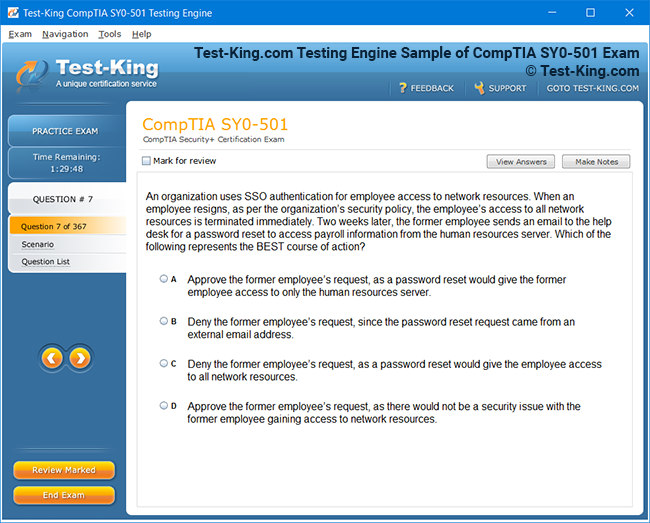
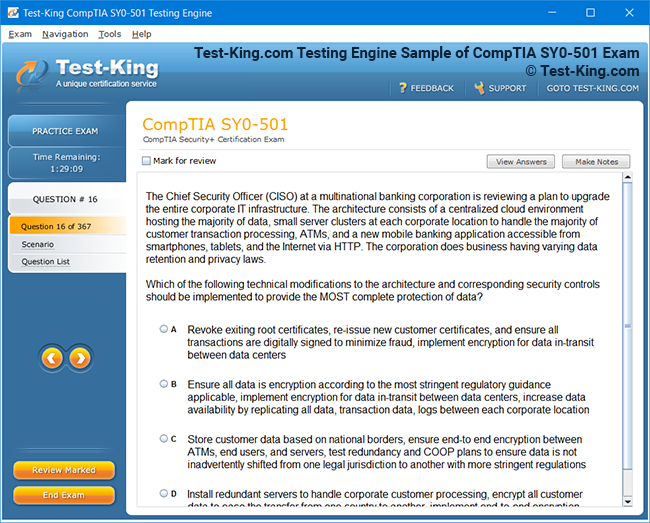
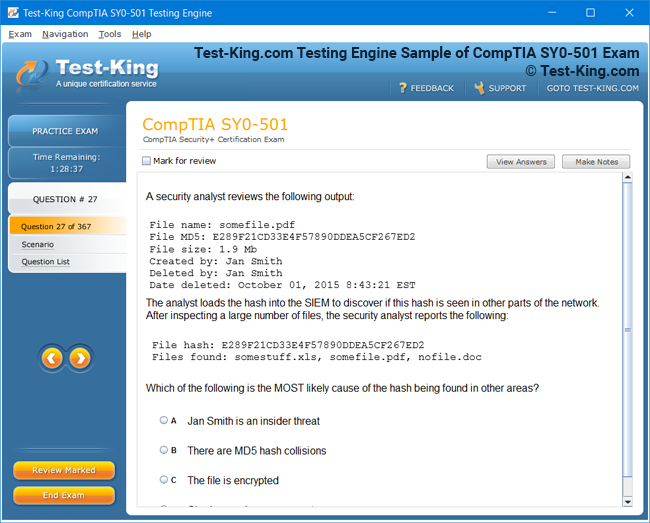
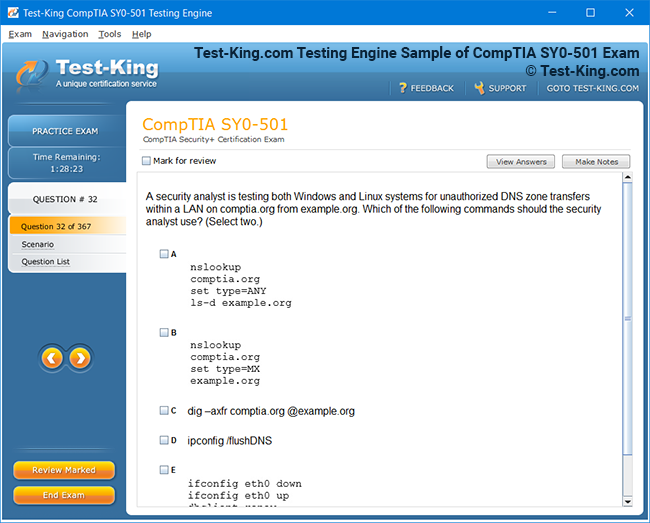
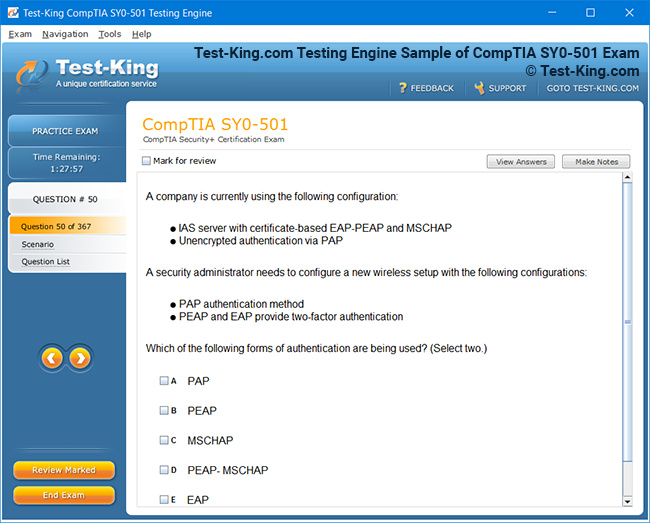
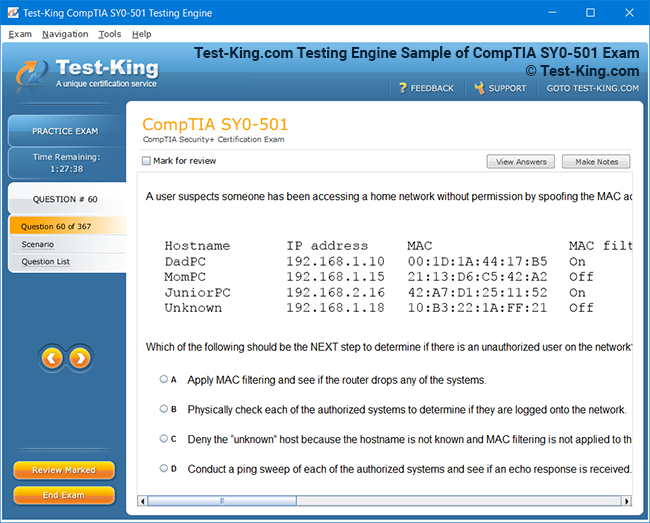
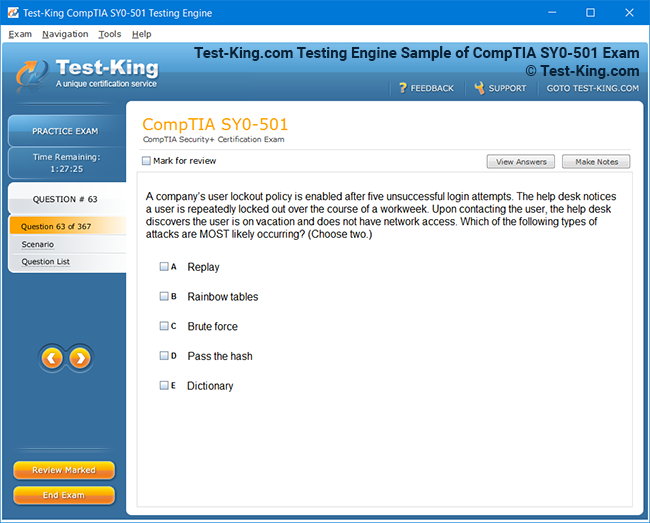
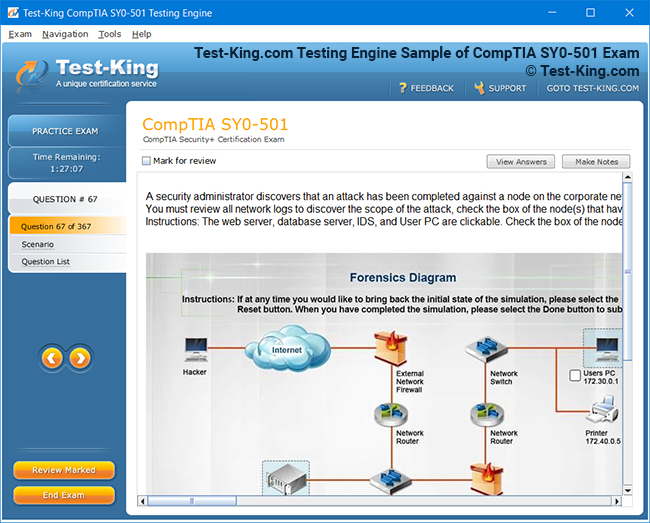
Product Screenshots
Frequently Asked Questions
How can I get the products after purchase?
All products are available for download immediately from your Member's Area. Once you have made the payment, you will be transferred to Member's Area where you can login and download the products you have purchased to your computer.
How long can I use my product? Will it be valid forever?
Test-King products have a validity of 90 days from the date of purchase. This means that any updates to the products, including but not limited to new questions, or updates and changes by our editing team, will be automatically downloaded on to computer to make sure that you get latest exam prep materials during those 90 days.
Can I renew my product if when it's expired?
Yes, when the 90 days of your product validity are over, you have the option of renewing your expired products with a 30% discount. This can be done in your Member's Area.
Please note that you will not be able to use the product after it has expired if you don't renew it.
How often are the questions updated?
We always try to provide the latest pool of questions, Updates in the questions depend on the changes in actual pool of questions by different vendors. As soon as we know about the change in the exam question pool we try our best to update the products as fast as possible.
How many computers I can download Test-King software on?
You can download the Test-King products on the maximum number of 2 (two) computers or devices. If you need to use the software on more than two machines, you can purchase this option separately. Please email support@test-king.com if you need to use more than 5 (five) computers.
What is a PDF Version?
PDF Version is a pdf document of Questions & Answers product. The document file has standart .pdf format, which can be easily read by any pdf reader application like Adobe Acrobat Reader, Foxit Reader, OpenOffice, Google Docs and many others.
Can I purchase PDF Version without the Testing Engine?
PDF Version cannot be purchased separately. It is only available as an add-on to main Question & Answer Testing Engine product.
What operating systems are supported by your Testing Engine software?
Our testing engine is supported by Windows. Andriod and IOS software is currently under development.
Top Tips for Passing the TCP - Tibco Sportfire Exam
The TCP - Tibco Spotfire exam is a meticulous assessment designed to evaluate a candidate's comprehension of Spotfire functionalities and analytical capabilities. Unlike conventional assessments that test only theoretical knowledge, this examination delves into practical application and scenario-based problem-solving. Understanding the exam's architecture is pivotal, as it enables aspirants to allocate time effectively and approach study resources with precision. The exam is structured to gauge expertise in data visualization, analytical workflows, information link creation, and interactive dashboards. Recognizing the weightage of each module allows a candidate to prioritize topics that carry higher complexity or greater emphasis in real-world applications.
Understanding the Exam Structure and Syllabus
The syllabus encompasses several key domains. The first is data manipulation, which includes the ingestion of diverse datasets, transformation, cleaning, and integration within Spotfire's environment. This requires familiarity with both structured and semi-structured data sources, such as Excel sheets, relational databases, and cloud repositories. Understanding data wrangling techniques is essential, as it forms the foundation for building meaningful visualizations. Candidates should cultivate proficiency in applying calculated columns, hierarchical data grouping, and aggregations to derive insights efficiently.
Another crucial domain is visualization design and customization. The exam tests the ability to create interactive charts, graphs, and dashboards that convey information lucidly. It is important to not only master the default visualization templates but also explore customization capabilities, including conditional formatting, color palettes, and filtering mechanisms. The objective is to ensure that users can transform raw data into compelling narratives that aid decision-making. The capacity to select the most appropriate visualization type for a specific data set, such as scatter plots for correlation analysis or bar charts for comparative metrics, is critical.
Analytical workflows constitute another significant segment of the examination. These workflows enable analysts to construct stepwise transformations and predictive models within the Spotfire ecosystem. Candidates are often required to demonstrate the ability to automate data pipelines, apply statistical functions, and create scripts for enhanced analytical operations. Familiarity with Spotfire’s in-built analytical tools, as well as integration with external statistical software, enhances performance during the exam. Being conversant with common pitfalls in workflow design, such as redundant data processing or inefficient transformations, can help in navigating complex scenarios.
Information links and data connections form a vital portion of the TCP - Tibco Spotfire assessment. This involves establishing robust links between Spotfire and external data sources while ensuring data integrity and real-time updates. The exam evaluates a candidate's knowledge of connection types, authentication protocols, and best practices for linking multiple datasets. Understanding the nuances of live versus cached data, and how each impacts dashboard performance, is an often-overlooked yet critical aspect that can influence exam performance significantly.
Effective Study Strategies
Crafting a study strategy for this certification requires more than rote memorization; it demands analytical thinking and contextual understanding. One effective approach is to structure study time around practice-oriented learning. Candidates should allocate periods for exploring Spotfire dashboards, experimenting with data visualizations, and troubleshooting hypothetical scenarios. Engaging actively with the platform fosters a deeper understanding of its intricacies, which is often tested in nuanced exam questions.
Integrating resources such as official documentation, tutorials, and online forums can provide supplementary insights that are not apparent through self-study alone. Detailed walkthroughs of complex tasks, particularly those involving advanced visualizations or data transformations, can illuminate techniques that streamline problem-solving during the examination. Additionally, reviewing past examination patterns and sample questions helps in internalizing the types of queries commonly posed and the reasoning expected for each.
Time management is another critical element of preparation. Candidates should simulate the examination environment by setting strict time limits while attempting practice exercises. This not only improves efficiency but also enhances cognitive endurance, ensuring that one can maintain focus and precision throughout the actual test. Recognizing time-intensive tasks, such as scripting or constructing multi-layered dashboards, allows aspirants to plan their approach methodically.
An often underestimated strategy is collaborative learning. Engaging with peers or mentors who have undergone the certification can provide perspectives that enrich one’s understanding. Discussion about intricate features or alternative problem-solving techniques often uncovers subtle functionalities that may otherwise be overlooked. Moreover, articulating one’s thought process during collaborative sessions reinforces memory retention and conceptual clarity.
Common Pitfalls to Avoid
Success in the TCP - Tibco Spotfire exam is as much about avoiding mistakes as it is about acquiring knowledge. One frequent pitfall is superficial familiarity with the software. Candidates may navigate dashboards comfortably but lack a deep understanding of underlying data manipulation or analytical functions. The examination tends to emphasize practical proficiency, and relying solely on theoretical knowledge can result in errors when confronted with complex, scenario-based questions.
Another common misstep is underestimating data preparation challenges. Many aspirants focus extensively on visualization techniques but overlook the critical step of data cleaning and transformation. Ignoring inconsistencies, missing values, or improper data types can propagate errors throughout visualizations and analytical workflows. Therefore, cultivating meticulous attention to data integrity is indispensable for both exam success and real-world applications.
Overlooking advanced analytical features is another trap that candidates frequently encounter. Spotfire offers an extensive suite of statistical tools, calculated expressions, and predictive modeling capabilities. Candidates who do not explore these advanced features may struggle when questions demand innovative approaches or sophisticated solutions. Emphasizing a balance between foundational skills and advanced functionalities is crucial for comprehensive preparation.
Cognitive biases also play a subtle role in exam performance. Candidates may rely on familiar strategies or default visualization choices even when they are suboptimal for a particular scenario. This heuristic-driven approach can lead to misinterpretation of data or inefficient workflow design. Developing a mindset that critically evaluates each question and explores multiple approaches can mitigate such biases.
Enhancing Practical Skills
A robust preparation plan emphasizes hands-on experience. Immersing oneself in the Spotfire environment, creating custom dashboards, experimenting with various chart types, and connecting disparate data sources builds an intuitive understanding of the platform. Candidates should challenge themselves with datasets of increasing complexity, simulating real-world problems that require analytical reasoning, data integration, and visual storytelling.
Familiarity with interactive features, such as filtering, marking, and drill-down capabilities, strengthens one’s ability to construct dashboards that provide granular insights. Experimenting with dynamic visualizations, such as heat maps and trend lines, helps in understanding how to represent patterns effectively. Developing these practical skills ensures that candidates can translate theoretical knowledge into actionable solutions during the examination.
Integrating predictive analytics within dashboards is another avenue to enhance practical expertise. Spotfire allows for regression analysis, clustering, and forecasting directly within visualizations. Candidates who engage with these features develop a nuanced understanding of how to extract insights beyond descriptive statistics. Applying these analytical techniques to real datasets fosters problem-solving acumen that is often tested in scenario-based exam questions.
Utilizing Resources and Tools
A variety of resources are available to aspirants aiming to succeed in the TCP - Tibco Spotfire exam. Official documentation provides comprehensive coverage of platform functionalities, guiding candidates through step-by-step processes for tasks ranging from data connection to dashboard creation. Tutorials and webinars supplement this knowledge, often demonstrating practical applications that align with exam expectations.
Online communities and forums offer another layer of support. Engaging with professionals who actively use Spotfire can reveal unconventional solutions and shortcuts that enhance efficiency. Participating in discussions about data visualization strategies or workflow optimization exposes candidates to diverse perspectives, which can be invaluable during preparation.
In addition, practice assessments serve as a rehearsal for the actual exam. Simulating exam conditions, identifying weak areas, and iteratively refining techniques fosters confidence and mastery. Candidates should approach practice tests not just as evaluation tools but as learning experiences, analyzing mistakes and understanding the rationale behind correct solutions.
Deep Dive into Data Transformation and Integration
A fundamental aspect of excelling in the TCP - Tibco Spotfire exam lies in the candidate’s ability to handle data transformation and integration with finesse. Spotfire is not merely a visualization tool; it is a sophisticated platform that allows intricate manipulation of diverse datasets. Understanding how to clean, normalize, and merge data from multiple sources is essential. Candidates must be comfortable working with Excel sheets, relational databases, and cloud-based repositories, as well as handling semi-structured datasets such as JSON or XML formats. The examination frequently presents scenarios where raw data contains inconsistencies or missing values, testing the candidate’s ability to employ calculated columns, aggregation techniques, and derived expressions to produce coherent datasets.
Integration of disparate data sources requires not only technical skills but also analytical foresight. Spotfire’s information links and connection features enable seamless linkage of multiple datasets while preserving data integrity. Candidates must understand the nuances of live data connections versus cached data, knowing how each impacts performance and update frequency. Data blending techniques, including inner joins, outer joins, and union operations, are often subtly embedded within scenario-based questions, necessitating a robust understanding of relational logic and dependency mapping.
Advanced transformations, such as pivoting, unpivoting, and hierarchical structuring, often appear in practical tasks within the exam. Candidates must be adept at employing these transformations to restructure data for effective visualization or analytical modeling. This requires an anticipatory mindset, envisioning how data flows through dashboards and anticipating potential analytical pitfalls. Mastery of these concepts ensures that even the most convoluted datasets can be manipulated efficiently, allowing clear and insightful visualization construction.
Constructing Interactive Dashboards
Beyond data handling, the creation of interactive dashboards constitutes a significant portion of practical assessment. Spotfire dashboards are designed to translate raw data into actionable insights, and their effectiveness depends on the candidate’s ability to combine visualization principles with technical execution. A common scenario involves a dataset rich with metrics but devoid of interpretive clarity. In such cases, candidates must apply filters, selectors, and dynamic markings to create a dashboard that allows end-users to explore patterns intuitively.
Visualization design is not merely aesthetic; it is an exercise in cognitive clarity. Candidates should consider principles such as color contrast, hierarchy of information, and appropriate chart selection to ensure the narrative conveyed by the data is unambiguous. Spotfire supports a wide array of visualization types, including scatter plots for correlation analysis, line charts for trend examination, heat maps for density distribution, and bar charts for comparative metrics. Effective candidates recognize which visualization best communicates a given dataset and utilize features such as calculated expressions and conditional formatting to augment interpretive power.
Interactivity extends further through the deployment of tooltips, drill-downs, and cross-filtering. A dashboard that responds dynamically to user inputs demonstrates a sophisticated understanding of analytical storytelling. The TCP - Tibco Spotfire exam often assesses this capability by presenting complex datasets requiring layered visualizations and interlinked components. Candidates must anticipate user exploration paths, ensuring that interactions between charts, tables, and visual filters remain coherent and informative.
Analytical Workflows and Automation
Another critical dimension of preparation involves constructing analytical workflows that automate repetitive processes and enable predictive analysis. Spotfire allows for sequential data transformations, statistical modeling, and algorithmic calculations within an integrated environment. Candidates are expected to demonstrate familiarity with workflow design, including the identification of dependencies, optimization of transformations, and minimization of redundant steps.
Automating analytical pipelines not only enhances efficiency but also reduces the potential for errors during data processing. A common examination scenario may require candidates to transform raw inputs, apply calculated measures, and generate visual outputs without manual intervention. Understanding the execution order, data caching mechanisms, and script integration options enables candidates to create workflows that are both robust and efficient. Knowledge of advanced expressions, conditional calculations, and function chaining is often tested through scenario-based questions that measure practical problem-solving skills rather than rote memorization.
Integration with predictive analytics tools is an extension of workflow proficiency. Spotfire offers native support for regression models, clustering, and forecasting techniques. Candidates who explore these functionalities develop the ability to anticipate trends and perform forward-looking analysis within dashboards. Applying these analytical techniques to simulated business scenarios not only strengthens understanding but also prepares aspirants for the nuanced questions often embedded within the examination.
Leveraging Calculated Columns and Expressions
Calculated columns and expressions form the backbone of many data transformations and analytical tasks in Spotfire. Mastery of these tools allows candidates to derive new metrics, manipulate text and numeric fields, and implement logical conditions that enhance analytical depth. During the exam, candidates frequently encounter datasets requiring the creation of composite measures or dynamic metrics to answer complex analytical queries.
Expressions can range from simple arithmetic operations to intricate conditional logic involving multiple fields. Candidates must recognize opportunities to use expressions efficiently, avoiding cumbersome workarounds while ensuring accuracy. Functions for string manipulation, date and time calculations, and aggregation play a pivotal role in real-world applications, as well as in examination scenarios that simulate business reporting challenges.
A nuanced understanding of calculated columns extends to performance considerations. Creating excessive or inefficient expressions can slow down dashboards and compromise interactivity. The examination may subtly test awareness of such issues by presenting large datasets where optimization decisions impact response time. Demonstrating the ability to balance functionality and efficiency reflects advanced mastery of the platform.
Optimizing Data Connections and Security
Handling data connections effectively is indispensable for both exam success and professional practice. Spotfire supports multiple connection types, including database connectors, file imports, and web services. Candidates must comprehend how to configure these connections, manage authentication protocols, and ensure consistent data retrieval. Exam scenarios may involve linking multiple sources, resolving conflicts, or implementing real-time data updates to mimic business intelligence workflows.
Data security considerations are equally critical. Candidates must demonstrate awareness of access controls, user permissions, and sensitive data handling within Spotfire. The exam may include questions that require configuring information links in a way that preserves confidentiality while enabling necessary data exploration. Understanding best practices in data governance, including version control, auditing, and secure sharing, reinforces both exam preparedness and practical competence.
Utilizing Advanced Visualization Techniques
The capacity to implement advanced visualization techniques distinguishes proficient candidates from those with only superficial knowledge. Spotfire provides tools for creating multi-layered charts, combined plots, and custom visualizations that reveal complex patterns. Scenario-based questions often assess the candidate’s ability to synthesize data into compelling visual narratives. For example, combining temporal and categorical data in a single dashboard may require synchronized axes, custom color schemes, and interactive filters that enhance interpretability.
Advanced visualizations also include conditional formatting based on thresholds, dynamic annotations, and calculated color gradients to emphasize key trends. Candidates who practice these techniques gain the ability to create dashboards that are both analytically rigorous and aesthetically coherent. The examination rewards candidates who can demonstrate creative yet precise visualization approaches, translating raw datasets into actionable insights with clarity and sophistication.
Mastering Data Analysis and Statistical Functions
Excellence in the TCP - Tibco Spotfire exam demands a profound grasp of data analysis methodologies and statistical functions embedded within the platform. Candidates are often required to extract meaningful insights from intricate datasets, discerning patterns, anomalies, and correlations that may not be immediately apparent. Spotfire provides a robust suite of statistical tools, ranging from basic descriptive statistics to advanced predictive modeling. Competence in employing mean, median, standard deviation, and variance calculations is foundational, yet the examination frequently extends into more sophisticated applications such as correlation coefficients, regression analysis, and clustering algorithms.
Understanding the nuances of these statistical functions allows candidates to interpret results with precision. For example, discerning the difference between linear and logistic regression within a business context ensures accurate scenario modeling. Similarly, recognizing when to apply hierarchical clustering as opposed to k-means clustering demonstrates analytical sophistication. Candidates who cultivate the ability to translate statistical outputs into actionable narratives gain a distinct advantage, as the exam emphasizes practical application over theoretical memorization.
Moreover, Spotfire enables dynamic statistical calculations through calculated columns and expressions. Candidates must be adept at constructing conditional statements, implementing nested functions, and leveraging expressions that interact with multiple data fields. This capability allows for flexible analytical exploration, accommodating evolving datasets and complex business scenarios. The examination often incorporates scenario-based questions that require candidates to design custom metrics or predictive indicators, reflecting real-world analytical challenges.
Enhancing Dashboard Performance and Efficiency
Constructing visually compelling dashboards is only part of the challenge; optimizing performance is equally vital. Spotfire dashboards that are sluggish or unresponsive can obscure insights and compromise analytical integrity. Candidates should understand strategies for streamlining dashboards, including minimizing the number of complex calculated columns, using caching judiciously, and consolidating redundant data tables. The examination may assess awareness of these optimization techniques through scenarios involving large, multi-source datasets where performance considerations influence the quality of analytical outputs.
Efficient dashboards also necessitate thoughtful interaction design. Utilizing filters, marking, and dynamic linking in a manner that preserves responsiveness is crucial. Advanced candidates recognize how user interactions can trigger recalculations or filter propagation, and they implement design solutions that mitigate latency. These skills not only enhance the examination performance but also mirror best practices in professional Spotfire deployments where end-user experience is paramount.
Leveraging Predictive Analytics and Modeling
Predictive analytics forms an increasingly significant component of the TCP - Tibco Spotfire exam. The platform’s capabilities extend beyond static visualization, allowing candidates to forecast trends, identify clusters, and assess potential outcomes based on historical data. Mastery of predictive modeling involves understanding underlying statistical principles, selecting appropriate algorithms, and interpreting model outputs with discernment.
Candidates often encounter scenarios where they must create regression models to predict sales, customer behavior, or operational performance. Applying time series forecasting to anticipate trends or employing clustering techniques to segment data requires both analytical acumen and practical familiarity with Spotfire tools. The ability to integrate predictive insights into dashboards enhances their strategic value, reflecting an understanding of how analytical foresight supports decision-making in business contexts.
Furthermore, integrating predictive modeling with calculated expressions and interactive visualizations allows for adaptive dashboards that respond to evolving data inputs. Candidates who practice this integration develop a nuanced approach to data storytelling, transforming raw data into actionable intelligence that is both predictive and descriptive.
Handling Complex Data Structures
Datasets encountered in the TCP - Tibco Spotfire exam often feature intricate structures, including nested hierarchies, multi-level categorical data, and time-based dimensions. Candidates must demonstrate proficiency in navigating these complexities, restructuring data for optimal analysis, and ensuring that visualizations accurately reflect underlying relationships. Spotfire’s pivoting and unpivoting functions, hierarchical grouping, and aggregation capabilities are essential tools for managing such data.
Understanding hierarchical structures is particularly important for generating multi-level visualizations and dashboards. Candidates must be able to group and summarize data at different levels, allowing end-users to drill down from broad overviews to granular details. The examination may test this ability by presenting datasets with multiple dimensions, requiring analytical reasoning to structure and visualize information coherently.
Time-based data introduces additional challenges, as temporal analysis often necessitates date parsing, period aggregation, and trend evaluation. Spotfire provides functions for manipulating dates, creating rolling averages, and comparing metrics across intervals. Candidates who master these techniques are better equipped to answer questions involving performance trends, seasonality, or predictive forecasting.
Applying Conditional Formatting and Advanced Visual Features
The TCP - Tibco Spotfire exam frequently evaluates the candidate’s ability to enhance dashboards through conditional formatting and advanced visual features. Conditional formatting allows data points to be emphasized based on thresholds, highlighting key patterns or anomalies. Candidates must understand how to apply color gradients, symbols, or text indicators to communicate information effectively without overwhelming the viewer.
Advanced visualization features extend to dynamic labeling, custom tooltips, and multi-layered charts. Candidates who practice these techniques develop the ability to present complex relationships clearly. Scenario-based questions may challenge aspirants to implement dashboards that adapt based on user selection, filter criteria, or calculated metrics. Demonstrating this level of interactivity requires both technical proficiency and an appreciation for visual clarity and interpretive coherence.
Implementing Data Security and Governance Practices
An often-overlooked aspect of Spotfire proficiency involves data security and governance. The exam may assess understanding of user roles, access controls, and information link permissions. Candidates must ensure that sensitive information is accessible only to authorized users while maintaining analytical functionality. Configuring secure connections to external databases, implementing authentication protocols, and managing data permissions are critical competencies.
Governance practices extend to version control, auditing, and reproducibility. Spotfire dashboards must be designed to ensure that changes are traceable, workflows are replicable, and analytical outputs remain consistent over time. Candidates who internalize these principles demonstrate readiness for professional environments where compliance and reliability are as important as analytical insight.
Integrating External Tools and Enhancements
Spotfire’s versatility is further demonstrated through integration with external tools and custom enhancements. The platform allows incorporation of R, Python, and other scripting environments to extend analytical capabilities. Candidates who explore these integrations gain the ability to perform complex statistical analysis, automate repetitive processes, and implement custom visualizations beyond default functionalities.
Scenario-based questions in the exam may simulate real-world analytical challenges, requiring candidates to combine Spotfire’s native functions with external scripts. This integration reflects modern business intelligence workflows, where hybrid analytical environments are common. Developing competence in leveraging these capabilities not only enhances examination performance but also equips candidates with a competitive advantage in practical applications.
Advanced Data Manipulation and Transformation Techniques
Excellence in the TCP - Tibco Spotfire exam necessitates not only familiarity with fundamental data handling but also an intricate understanding of advanced data manipulation. Spotfire allows candidates to transform datasets in myriad ways, ensuring that information is both accurate and analytically potent. Candidates are often confronted with data that requires cleansing, normalization, or restructuring before it can be used for insightful visualization. Skills in applying calculated columns, derived expressions, hierarchical grouping, and pivoting are indispensable, particularly when handling datasets from multiple sources such as relational databases, CSV files, and cloud repositories. The examination tests the capacity to apply these transformations efficiently, highlighting both the technical acumen and analytical foresight of the candidate.
Merging disparate datasets into coherent structures is another crucial skill. Spotfire’s information link functionality allows integration across multiple sources, requiring candidates to comprehend join types, relationship hierarchies, and data consistency measures. Candidates who grasp the subtle distinctions between inner joins, outer joins, and union operations are better positioned to navigate complex scenarios presented in the examination. Mastery of these techniques ensures that analytical outcomes remain robust and reliable, which is often reflected in scenario-based questions demanding both precision and creativity.
Advanced transformation techniques, such as unpivoting nested data, constructing multi-level hierarchies, and applying aggregated calculations, are frequently assessed. Candidates must anticipate how these manipulations impact subsequent visualization or analytical tasks. Developing an anticipatory mindset enables candidates to streamline workflows and create dashboards that reveal insights without unnecessary computational overhead. This balance between complexity management and analytical clarity is a hallmark of proficient Spotfire users.
Designing Sophisticated and Interactive Dashboards
Beyond data transformation, creating interactive dashboards is a cornerstone of the TCP - Tibco Spotfire exam. Dashboards must not only present data but also facilitate exploration, allowing users to uncover patterns and trends intuitively. Candidates are expected to apply filters, selectors, and dynamic markings to enhance usability while maintaining analytical rigor. The ability to construct dashboards that are both visually compelling and cognitively clear often differentiates successful candidates.
Visualization design extends to the thoughtful selection of chart types and interactive elements. Spotfire supports a broad spectrum of visualizations, including scatter plots for correlation detection, line graphs for trend assessment, bar charts for categorical comparisons, and heat maps for density analysis. Candidates must understand which visualization best communicates the intended analytical message and how to enhance interpretability using calculated expressions, dynamic labeling, and conditional formatting. Scenario-based examination questions often simulate real-world decision-making contexts, challenging candidates to balance aesthetics, clarity, and functional insight.
Interactivity within dashboards is a critical component. Effective use of drill-downs, cross-filtering, and synchronized selections ensures that end-users can explore data without confusion. Candidates must anticipate user behavior and design dashboards that adapt seamlessly to various interaction patterns. The examination may present complex, multi-dimensional datasets requiring layered visualizations and interlinked components, testing both technical proficiency and strategic analytical thinking.
Mastery of Analytical Workflows and Automation
Constructing analytical workflows in Spotfire is a skill that underpins advanced preparation for the TCP - Tibco Spotfire exam. Workflows allow for the automation of repetitive tasks, the sequencing of transformations, and the integration of predictive modeling within dashboards. Candidates are expected to design workflows that are both efficient and resilient, minimizing redundant calculations while ensuring analytical accuracy.
Automating data pipelines enhances performance and reduces the potential for error. Examination scenarios frequently require candidates to ingest raw data, apply transformations, and produce analytical outputs without manual intervention. Understanding execution order, data caching, and conditional processing is essential for creating workflows that respond dynamically to input changes. Advanced expressions, conditional calculations, and function chaining enable the design of workflows capable of handling diverse and evolving datasets, reflecting real-world business intelligence challenges.
Integration of predictive analytics within workflows is an additional layer of sophistication. Spotfire supports regression models, clustering algorithms, and forecasting techniques that can be embedded directly into dashboards. Candidates who explore these capabilities develop the ability to anticipate trends, segment datasets, and provide actionable insights. Applying predictive analysis in interactive dashboards enhances both analytical depth and examination performance, as scenario-based questions often measure practical implementation skills alongside theoretical knowledge.
Utilizing Calculated Columns, Expressions, and Conditional Logic
Calculated columns and expressions form a fundamental toolset for advanced Spotfire analysis. Candidates are expected to leverage these tools to create dynamic metrics, manipulate textual and numeric data, and implement logical conditions that enhance analytical outcomes. The examination often tests the ability to design calculated fields that respond to evolving datasets, ensuring accurate and contextually relevant analysis.
Expressions can involve simple arithmetic, nested functions, or complex conditional logic. Proficiency in string manipulation, date arithmetic, and aggregations is essential for handling multi-faceted analytical challenges. Candidates must recognize opportunities to optimize expressions for efficiency, particularly when working with large datasets. Excessive or inefficient calculations can impede dashboard performance, and the examination may subtly test candidates’ awareness of these optimization considerations.
Conditional logic extends beyond calculated columns into visualization and dashboard behavior. Candidates who master threshold-based formatting, dynamic annotations, and rule-driven chart modifications demonstrate the capacity to enhance interpretability and highlight key trends. Scenario-based questions often simulate situations requiring candidates to apply conditional logic to emphasize anomalies, highlight critical metrics, or adapt dashboards to user selections dynamically.
Optimizing Data Connections, Security, and Governance
Effective management of data connections is crucial for both examination success and professional practice. Spotfire supports multiple connection types, including database connectors, file imports, and web-based sources. Candidates must understand authentication protocols, connection configurations, and the implications of live versus cached data. Examination questions may present scenarios involving multiple sources, necessitating strategic linkage and error-free integration to ensure data integrity.
Security and governance considerations are increasingly important. Candidates are expected to implement access controls, configure information link permissions, and ensure that sensitive data remains protected while maintaining analytical functionality. Understanding best practices for user roles, version control, and auditability enhances both examination preparedness and real-world applicability. Candidates who internalize these principles demonstrate readiness for professional environments where compliance, security, and reproducibility are paramount.
Governance practices also extend to workflow design, ensuring that transformations and analyses are traceable, reproducible, and aligned with organizational standards. Spotfire dashboards must be designed to facilitate updates and modifications without compromising historical accuracy, reflecting a professional approach to analytical management.
Advanced Visualization Techniques and Analytical Storytelling
The TCP - Tibco Spotfire exam frequently evaluates advanced visualization capabilities. Candidates must demonstrate the ability to combine multiple data dimensions into coherent visual narratives, employing multi-layered charts, synchronized axes, and custom annotations to convey insights effectively. Visualization is both a technical and creative exercise, requiring awareness of cognitive principles, color theory, and the hierarchy of information.
Candidates should leverage conditional formatting, interactive labeling, and dynamic tooltips to enhance interpretability. Scenario-based questions often present datasets requiring multi-faceted visualizations that allow users to explore trends, correlations, and anomalies. Mastery of these techniques enables candidates to construct dashboards that not only display information but also tell compelling analytical stories, bridging the gap between raw data and actionable insights.
Integration of predictive analytics, calculated metrics, and interactive elements within dashboards further elevates their sophistication. Candidates who practice these combinations develop a nuanced understanding of how to communicate complex insights clearly, a skill that is frequently assessed through scenario-driven examination questions.
Mastering Complex Data Workflows
Preparation for the TCP - Tibco Spotfire exam necessitates a profound understanding of complex data workflows that extend beyond basic ingestion and visualization. Candidates are often confronted with datasets that are irregular, multi-dimensional, and sourced from heterogeneous repositories. Spotfire allows analysts to design sophisticated workflows that sequence multiple transformations, perform data cleansing, and create metrics that drive analytical insights. Mastery of these workflows requires familiarity with calculated columns, hierarchical aggregations, and advanced expressions that manipulate both numeric and textual data.
Candidates are expected to anticipate potential bottlenecks in data processing, such as redundant transformations or inefficient joins, and optimize workflows accordingly. Scenario-based examination questions often present multi-step challenges where the output of one transformation serves as the input for subsequent operations. Understanding execution order, caching mechanisms, and conditional processing is essential to ensure that dashboards remain accurate, responsive, and analytically robust.
Data integration is a critical component of workflow mastery. Spotfire enables the blending of datasets from relational databases, Excel files, and cloud-based repositories, each with distinct structures and formatting. Candidates must demonstrate proficiency in managing relational joins, union operations, and hierarchical linking to produce coherent datasets ready for visualization. The ability to handle nested data, temporal dimensions, and multi-level categories is often assessed, requiring a meticulous approach to structuring information and anticipating analytical requirements.
Advanced Dashboard Construction and Interactivity
Creating dashboards that are both visually compelling and functionally interactive is another pillar of preparation. Spotfire dashboards must allow end-users to explore datasets intuitively while maintaining analytical clarity. Candidates are expected to utilize interactive elements such as filters, markings, and selectors that enable dynamic exploration. The examination often includes scenarios where dashboards must combine multiple visualizations into a cohesive narrative, requiring candidates to plan layouts, synchronize interactions, and ensure responsiveness.
Visualization selection is a nuanced skill. Scatter plots, line charts, bar graphs, and heat maps each serve specific analytical purposes, and candidates must discern which visualization type best communicates underlying trends or patterns. Integrating calculated expressions, conditional formatting, and dynamic annotations enhances interpretability and emphasizes critical metrics. The exam may present complex business scenarios demanding dashboards that respond to varying user inputs and highlight anomalies or trends dynamically.
Interactivity extends to drill-downs, cross-filtering, and synchronized visual components. Candidates who master these techniques can create dashboards that allow granular exploration of data without overwhelming the user. The ability to anticipate end-user behavior and design responsive dashboards reflects both technical acumen and strategic analytical thinking, qualities that the TCP - Tibco Spotfire exam evaluates rigorously.
Leveraging Predictive Analytics and Statistical Tools
The TCP - Tibco Spotfire exam frequently assesses a candidate’s proficiency in predictive analytics and statistical modeling. Spotfire provides tools for regression analysis, clustering, forecasting, and other advanced analytical techniques. Candidates must understand when to apply each method, how to configure models, and how to interpret outputs in the context of real-world business scenarios.
Predictive modeling often intersects with workflow automation and dashboard interactivity. For example, candidates may be required to forecast sales trends or customer behaviors and present these insights within an interactive dashboard. This integration necessitates a thorough understanding of model assumptions, validation techniques, and the potential impact of outliers or missing data. Scenario-based questions often require candidates to construct models that provide actionable insights while maintaining analytical rigor.
Statistical proficiency also includes descriptive analysis, hypothesis testing, and correlation assessment. Spotfire’s native functions allow for dynamic computation of these metrics, and candidates are expected to apply them effectively to datasets of varying complexity. Understanding the relationship between statistical outputs and visual representation ensures that insights are communicated clearly and persuasively.
Optimizing Performance and Efficiency in Spotfire
Efficient dashboards and workflows are critical for both examination performance and professional application. Candidates must be aware of factors that influence performance, including excessive calculated columns, large dataset sizes, and complex interactivity. Spotfire provides caching mechanisms, aggregation strategies, and workflow optimization techniques that candidates must leverage to maintain responsiveness.
The TCP - Tibco Spotfire exam may present large-scale datasets with multiple dependencies, testing the candidate’s ability to balance analytical depth with system performance. Optimization involves minimizing redundancy, applying selective transformations, and configuring dashboards to process only necessary data. Candidates who understand these principles are better equipped to design analytical solutions that are both robust and efficient.
Performance optimization also extends to predictive modeling and statistical calculations. Applying these analyses to large datasets without careful consideration can lead to slow dashboards or delayed outputs. Candidates who practice efficient expression design, workflow sequencing, and data management develop the skills to deliver high-quality analytical solutions under time constraints.
Utilizing Calculated Columns, Expressions, and Conditional Formatting
Calculated columns and expressions are indispensable tools for transforming data and deriving insights. Candidates must be able to construct complex expressions that combine multiple fields, apply conditional logic, and produce dynamic metrics. The examination often evaluates the ability to create calculated measures that respond to evolving datasets, ensuring accurate and meaningful analysis.
Conditional formatting enhances visual comprehension by emphasizing key metrics or anomalies. Spotfire supports threshold-based color gradients, dynamic symbols, and textual annotations that highlight significant trends. Candidates must understand how to implement these features without cluttering dashboards or impairing interactivity. Scenario-based questions often require dashboards that adapt visually to changing conditions, reflecting real-world analytical needs.
Advanced use of expressions includes text manipulation, date calculations, nested logical functions, and aggregation across dimensions. Mastery of these techniques enables candidates to handle diverse analytical challenges efficiently. Candidates who integrate calculated columns, conditional logic, and dynamic expressions into their workflows demonstrate a level of proficiency that is often pivotal for examination success.
Ensuring Data Security, Governance, and Best Practices
Data security and governance are increasingly important in professional Spotfire applications and are evaluated indirectly in the TCP - Tibco Spotfire exam. Candidates must understand authentication protocols, access control mechanisms, and permissions configuration. Ensuring that sensitive information is accessible only to authorized users while maintaining analytical functionality reflects both technical competency and professional integrity.
Governance practices extend to workflow reproducibility, version control, and auditing. Spotfire dashboards and analytical workflows must allow for traceable changes, consistent outputs, and adherence to organizational standards. Candidates who internalize these principles develop a disciplined approach to data management, ensuring that insights remain reliable and actionable. Scenario-based examination questions may test awareness of these considerations by presenting multi-user environments or datasets requiring controlled access.
Integrating External Analytical Tools and Enhancements
Spotfire’s analytical capabilities are enhanced through integration with external tools such as R and Python. Candidates who explore these integrations gain the ability to perform complex statistical modeling, automate processes, and implement custom visualizations that extend beyond the platform’s default functionalities. The examination may include tasks that simulate real-world scenarios where Spotfire’s native features are augmented with external scripts, reflecting contemporary business intelligence workflows.
Integration of external analytical tools also enables candidates to perform advanced simulations, predictive modeling, and custom calculations that are difficult to achieve using standard functions alone. Proficiency in leveraging these integrations demonstrates a holistic understanding of data analysis, workflow design, and visualization, which is highly valued in both the examination and professional contexts.
Advanced Analytical Techniques and Data Interpretation
Success in the TCP - Tibco Spotfire exam requires a profound understanding of both analytical principles and the practical application of Spotfire’s capabilities. Candidates are expected to interpret complex datasets and derive actionable insights, often under scenarios that simulate real-world challenges. Data analysis within Spotfire goes beyond surface-level visualization; it involves discerning patterns, anomalies, and correlations that might not be immediately apparent. Skills in statistical computation, clustering, regression analysis, and predictive modeling are crucial. Candidates must understand how to apply these techniques within interactive dashboards, transforming raw information into comprehensible narratives for decision-makers.
Handling datasets with varying complexity is integral to advanced analysis. Multi-dimensional, hierarchical, or time-based data often requires meticulous restructuring using calculated columns, expressions, and aggregations. Candidates must anticipate how transformations affect subsequent visualizations and analytical workflows, ensuring that every metric retains accuracy and relevance. The examination frequently tests this capacity through scenario-driven questions where candidates must cleanse, merge, and interpret data while maintaining both clarity and analytical rigor.
Constructing Dynamic and Interactive Dashboards
Dashboards in Spotfire are the medium through which data insights are communicated, making interactivity an essential skill. Candidates must design dashboards that allow end-users to explore data intuitively while ensuring analytical fidelity. The use of interactive filters, markings, selectors, and synchronized visual elements is vital to constructing dynamic dashboards that respond effectively to user inputs. Examination scenarios often involve multi-layered dashboards, requiring candidates to manage interactions across multiple visualizations without compromising responsiveness or interpretability.
Selection of appropriate visualization types is pivotal. Scatter plots, line charts, bar graphs, heat maps, and combination charts each serve unique analytical purposes. Candidates are expected to match visualization types with the nature of the data and the analytical objective, enhancing comprehension while maintaining aesthetic clarity. Integrating calculated expressions, conditional formatting, and dynamic labels further ensures that dashboards communicate key insights efficiently. Scenario-based questions may test candidates’ abilities to implement these elements cohesively, reflecting real-world decision-making environments.
Interactivity extends beyond visual elements to include drill-downs, cross-filtering, and cascading actions that provide granular exploration. Candidates who master these techniques can create dashboards that reveal hidden insights while maintaining simplicity for the end-user. Designing dashboards with anticipated interaction patterns in mind demonstrates both strategic foresight and technical expertise, qualities that are assessed throughout the examination.
Optimizing Workflows and Analytical Processes
Workflows in Spotfire enable the automation of data transformations, predictive modeling, and analytical processes. Candidates are expected to construct workflows that are efficient, resilient, and scalable. The examination often tests the ability to sequence transformations accurately, apply conditional logic, and manage dependencies to ensure that the output remains consistent and reliable. Understanding workflow execution, caching mechanisms, and potential bottlenecks is crucial for both examination performance and professional practice.
Complex workflows often involve integration of multiple datasets, multi-step transformations, and advanced expressions. Candidates must anticipate interactions between different workflow components, ensuring that each transformation aligns with analytical objectives. Automation not only enhances efficiency but also reduces the risk of error in repetitive or large-scale data processing tasks. Scenario-based questions frequently evaluate a candidate’s capacity to design workflows that deliver accurate and actionable results under dynamic conditions.
Predictive analytics can also be incorporated into workflows. Regression models, clustering techniques, and forecasting methods are often embedded within dashboards to provide actionable foresight. Candidates who understand how to integrate these predictive components into interactive visualizations gain an advantage, as the exam often tests not only technical execution but also the ability to translate analytical insights into practical decision-making tools.
Utilizing Calculated Columns, Expressions, and Conditional Logic
Calculated columns and expressions are central to Spotfire’s analytical capabilities. Candidates are expected to construct expressions that manipulate data, implement conditional logic, and derive new metrics that respond dynamically to evolving datasets. The TCP - Tibco Spotfire exam frequently presents questions requiring complex combinations of arithmetic operations, logical conditions, and nested functions across multiple fields.
Conditional formatting enhances dashboard clarity by visually emphasizing trends, anomalies, or thresholds. Candidates must know how to implement color gradients, dynamic symbols, and textual cues without overcrowding dashboards or impairing interactivity. Scenario-based questions often require dashboards that adapt visually to changing inputs, demonstrating proficiency in both technical implementation and analytical storytelling.
Expressions extend to text manipulation, date calculations, aggregation, and hierarchical data analysis. Candidates who master these techniques can handle intricate analytical challenges efficiently, ensuring that dashboards convey accurate, contextually relevant information. Proficiency in these areas reflects a comprehensive understanding of Spotfire’s data manipulation and visualization capabilities.
Ensuring Data Security, Governance, and Best Practices
Data security and governance are vital considerations for both exam preparation and professional practice. Candidates are expected to implement access controls, configure permissions, and ensure that sensitive information remains secure while analytical functionality is preserved. Understanding authentication protocols, information link permissions, and user role management is essential for creating compliant, reliable dashboards.
Governance extends to reproducibility, version control, and auditability. Spotfire dashboards and workflows must allow for traceable changes, consistent outputs, and adherence to organizational standards. Candidates who internalize these principles demonstrate a disciplined approach to data management, ensuring that insights are reliable and actionable. Scenario-based examination questions may simulate multi-user environments or datasets requiring controlled access, testing candidates’ ability to apply security and governance principles effectively.
Integrating External Tools and Enhancements
Spotfire’s flexibility is enhanced through integration with external analytical tools such as R and Python. Candidates who explore these integrations gain the ability to perform advanced statistical analysis, automate processes, and develop custom visualizations beyond default capabilities. Examination scenarios often involve tasks that require combining native Spotfire functions with external scripts, reflecting modern business intelligence practices.
Integration with external tools allows for advanced simulations, predictive modeling, and customized data manipulation. Candidates who practice these combinations can approach scenario-based questions with a broader analytical toolkit, enhancing both performance in the exam and applicability in professional contexts. Mastery of these integrations demonstrates comprehensive analytical capability and adaptability.
Conclusion
Success in the TCP - Tibco Spotfire exam hinges on a combination of technical proficiency, analytical reasoning, and practical application. Candidates must excel in data transformation, workflow optimization, predictive analytics, interactive dashboard construction, calculated expressions, and data governance. Mastery of these skills ensures not only examination success but also the ability to derive actionable insights in real-world business environments. Developing advanced analytical techniques, integrating external tools, and designing dashboards with clarity and interactivity prepares candidates to meet the rigorous demands of the certification. A strategic, hands-on approach to preparation, coupled with scenario-based practice, fosters confidence, precision, and adaptability, enabling candidates to navigate the TCP - Tibco Spotfire exam with expertise and poise.