

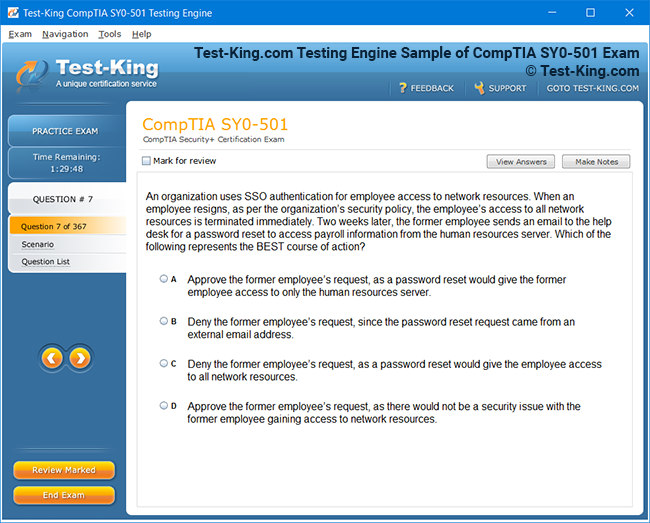
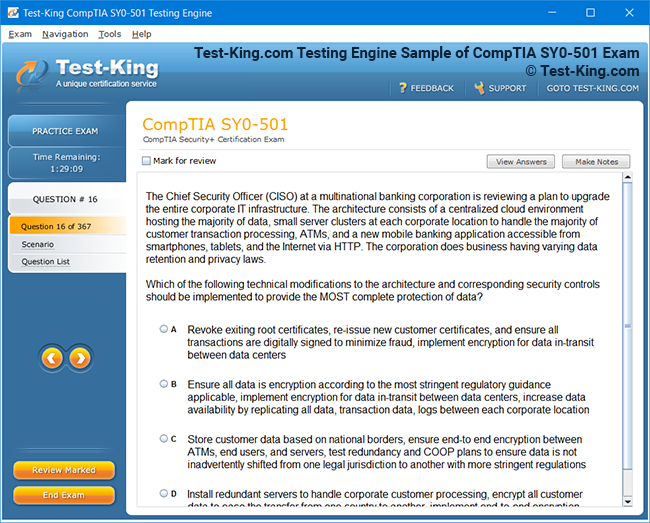
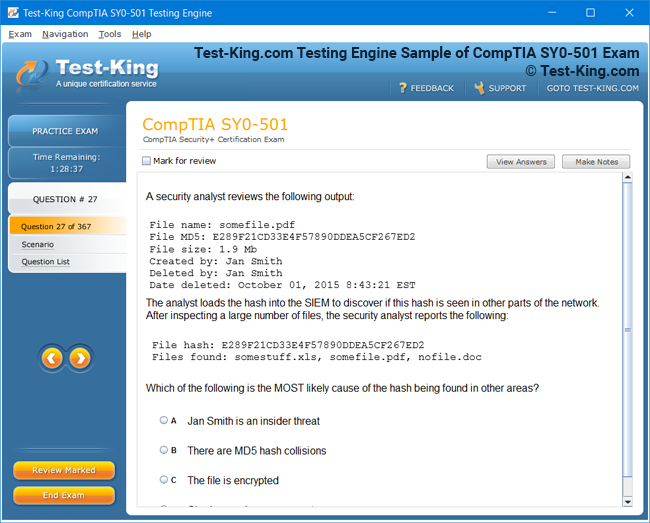
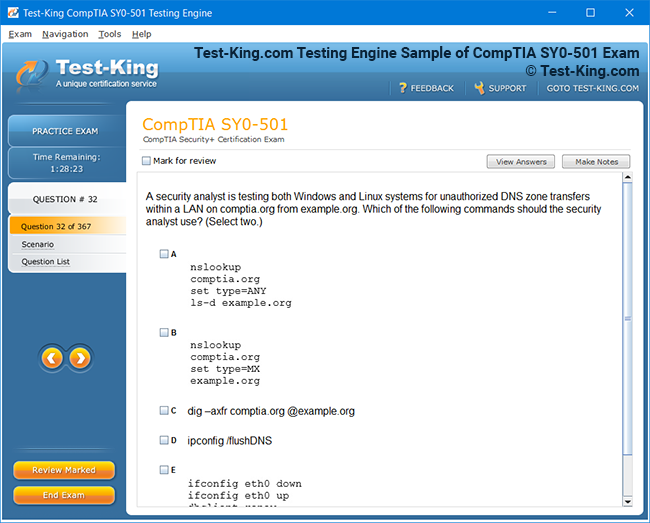
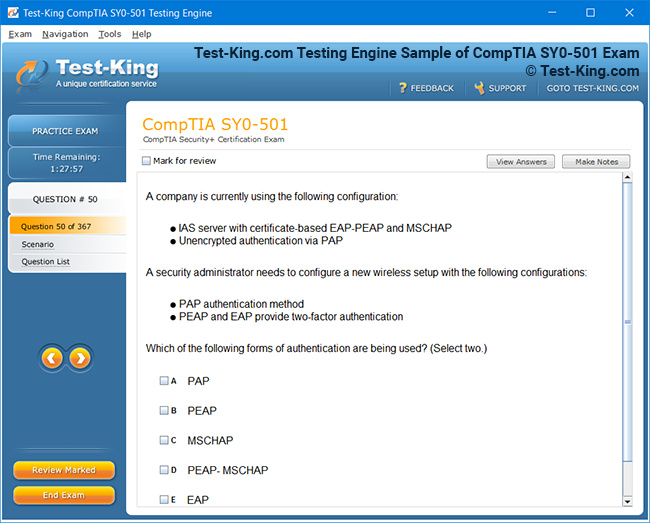
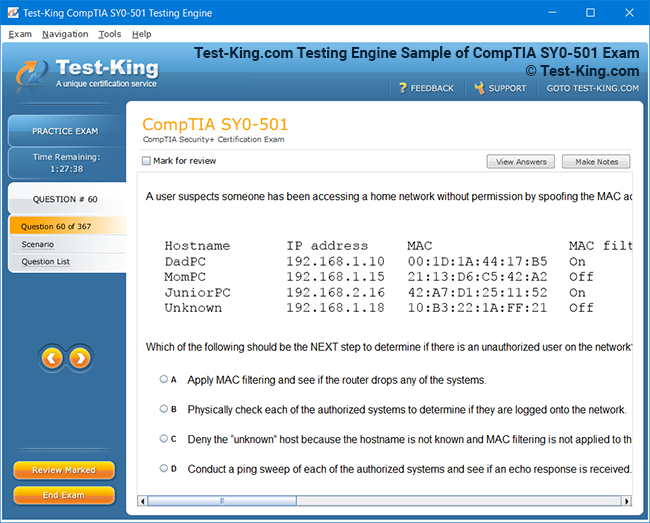
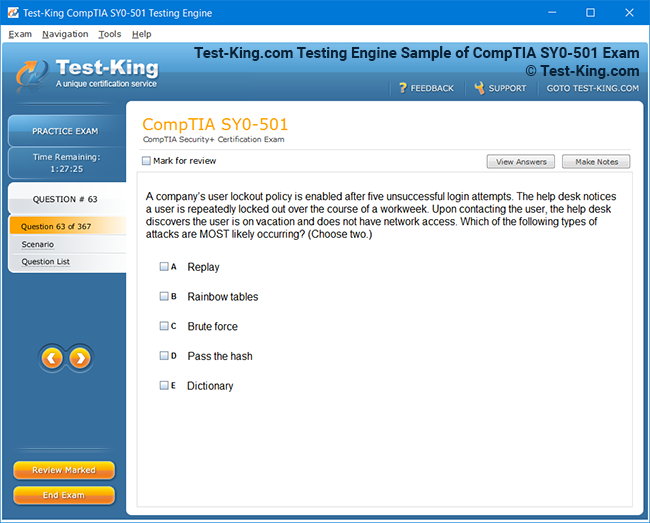
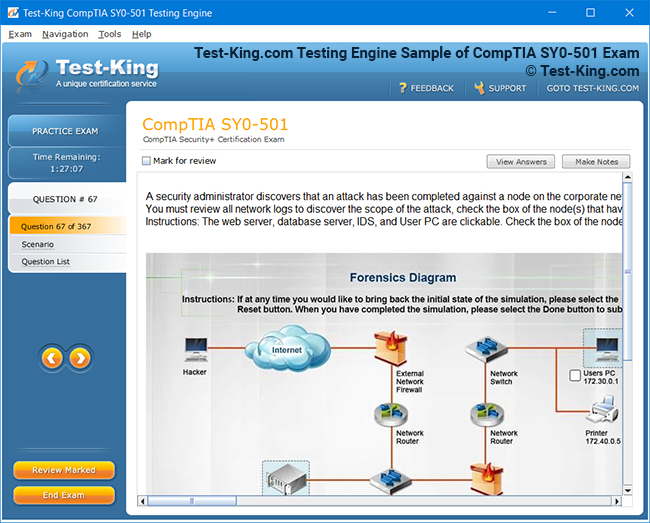
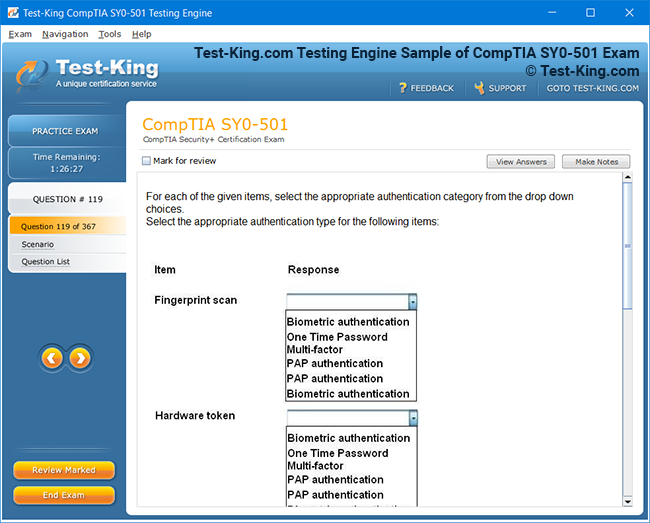
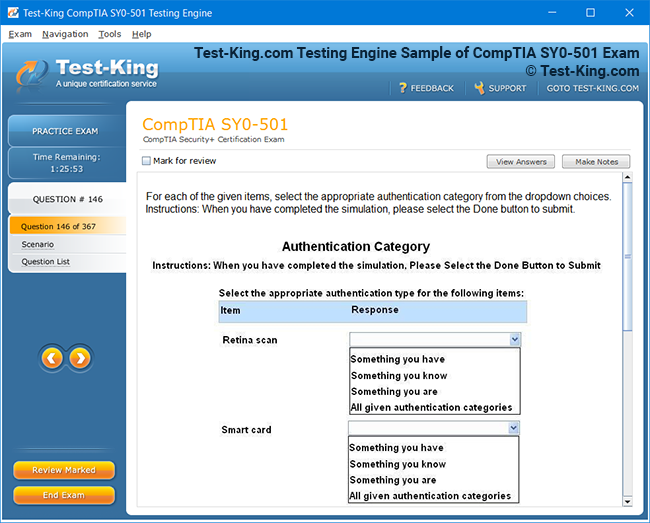
Product Screenshots
Frequently Asked Questions
How can I get the products after purchase?
All products are available for download immediately from your Member's Area. Once you have made the payment, you will be transferred to Member's Area where you can login and download the products you have purchased to your computer.
How long can I use my product? Will it be valid forever?
Test-King products have a validity of 90 days from the date of purchase. This means that any updates to the products, including but not limited to new questions, or updates and changes by our editing team, will be automatically downloaded on to computer to make sure that you get latest exam prep materials during those 90 days.
Can I renew my product if when it's expired?
Yes, when the 90 days of your product validity are over, you have the option of renewing your expired products with a 30% discount. This can be done in your Member's Area.
Please note that you will not be able to use the product after it has expired if you don't renew it.
How often are the questions updated?
We always try to provide the latest pool of questions, Updates in the questions depend on the changes in actual pool of questions by different vendors. As soon as we know about the change in the exam question pool we try our best to update the products as fast as possible.
How many computers I can download Test-King software on?
You can download the Test-King products on the maximum number of 2 (two) computers or devices. If you need to use the software on more than two machines, you can purchase this option separately. Please email support@test-king.com if you need to use more than 5 (five) computers.
What is a PDF Version?
PDF Version is a pdf document of Questions & Answers product. The document file has standart .pdf format, which can be easily read by any pdf reader application like Adobe Acrobat Reader, Foxit Reader, OpenOffice, Google Docs and many others.
Can I purchase PDF Version without the Testing Engine?
PDF Version cannot be purchased separately. It is only available as an add-on to main Question & Answer Testing Engine product.
What operating systems are supported by your Testing Engine software?
Our testing engine is supported by Windows. Andriod and IOS software is currently under development.
Top PEOPLECERT Exams
Key Skills Tested in the AIOps Foundation (AIOF) Exam – A Breakdown of Essential Knowledge Areas for Success
The AIOps Foundation exam is designed to assess a candidate’s grasp of the burgeoning domain of artificial intelligence for IT operations. At its core, the exam evaluates an individual’s ability to understand the integration of machine learning, data analytics, and automation in modern IT ecosystems. Candidates are expected to demonstrate proficiency in recognizing patterns within vast datasets, identifying anomalies, and leveraging predictive insights to streamline operational workflows. Understanding the foundational concepts begins with comprehending the architecture of AIOps platforms, including data ingestion pipelines, event correlation mechanisms, and the deployment of intelligent automation tools.
Understanding the Fundamentals of AIOps
A critical skill examined is the understanding of how AIOps transforms traditional IT operations into a proactive and predictive model. Candidates must be familiar with the variety of data sources, ranging from log files and performance metrics to application telemetry and configuration changes. Equally important is the ability to discern which data is actionable versus informational, as this distinction directly influences decision-making in automated incident management. Mastery of these fundamentals allows professionals to translate raw data into meaningful insights, thereby facilitating faster response times and improved system reliability.
Data Collection and Integration
A prominent area of focus in the exam is the collection and integration of operational data. Candidates are evaluated on their knowledge of data acquisition methods and their ability to consolidate information from disparate sources into a cohesive analytical framework. It is essential to understand not only the technical mechanisms of data collection but also the implications of data quality, timeliness, and completeness. The efficacy of AIOps solutions is heavily reliant on the integrity of the input data; inaccurate or incomplete datasets can lead to erroneous predictions and suboptimal automation outcomes.
Integration extends beyond mere aggregation. AIOps practitioners must comprehend how to harmonize structured and unstructured data, reconcile conflicting information, and implement normalization strategies that render the data analyzable. This requires familiarity with advanced data processing techniques and the capability to configure pipelines that handle high-velocity and high-volume streams efficiently. The exam also probes the candidate’s awareness of data governance principles, including compliance, privacy, and security considerations, which are vital when managing sensitive operational data across organizational boundaries.
Event Correlation and Pattern Recognition
Another essential knowledge area is event correlation and pattern recognition. Candidates must be capable of understanding how AIOps platforms detect patterns within complex datasets and how they correlate multiple events to identify root causes of incidents. This skill is critical for minimizing alert fatigue, a common challenge in traditional monitoring systems, where operators are inundated with repetitive or low-value notifications.
Exam questions often explore scenarios in which candidates must determine the relationships between seemingly unrelated events and infer actionable insights. This necessitates an understanding of statistical methods, anomaly detection algorithms, and machine learning models that underpin automated correlation processes. By identifying patterns and linking events across different layers of the IT environment, professionals can proactively prevent service degradation and optimize resource utilization. It also emphasizes the importance of recognizing latent variables, subtle correlations, and temporal dependencies, which often hide the true source of operational disruptions.
Predictive Analytics and Machine Learning in IT Operations
A significant portion of the exam focuses on the application of predictive analytics and machine learning within the context of IT operations. Candidates must demonstrate a conceptual understanding of how predictive models are constructed, trained, and validated. This includes familiarity with supervised and unsupervised learning approaches, regression techniques, clustering, and classification methods that facilitate the anticipation of potential system failures or performance bottlenecks.
It is not merely the theoretical understanding of these models that is tested but also the practical implications of implementing them within operational workflows. Candidates should grasp how predictive insights can drive automated remediation, optimize resource allocation, and improve service continuity. Moreover, there is an emphasis on understanding the limitations of machine learning algorithms, including overfitting, bias, and interpretability challenges. Professionals must be able to assess model performance critically and ensure that automation decisions are both reliable and auditable.
Automation and Intelligent Remediation
The AIOps Foundation exam examines a candidate’s knowledge of automation frameworks and their application to incident management and operational efficiency. Candidates are expected to understand how intelligent remediation processes can be orchestrated using automated playbooks, integrating predictive insights with workflow automation. This requires comprehension of rule-based automation, decision trees, and self-healing mechanisms that reduce human intervention while maintaining system integrity.
Questions may present scenarios where automated responses must be triggered based on threshold conditions, anomaly detection, or predictive alerts. Candidates need to be able to evaluate when manual intervention is necessary versus when automation can safely resolve issues autonomously. Furthermore, understanding the balance between human oversight and machine-driven action is crucial, as excessive automation without adequate monitoring can lead to unintended consequences. The exam underscores the importance of designing automation strategies that are resilient, adaptable, and aligned with business objectives.
Observability, Monitoring, and Continuous Improvement
Finally, the exam tests candidates on their understanding of observability principles and continuous improvement in IT operations. Observability goes beyond monitoring by enabling professionals to infer the internal state of systems based on external outputs, metrics, and logs. Candidates must be adept at defining key performance indicators, establishing dashboards, and employing visualization techniques that provide actionable insights.
Continuous improvement involves leveraging the insights generated by AIOps platforms to refine processes, enhance service reliability, and optimize operational efficiency over time. This includes analyzing historical trends, learning from past incidents, and adjusting predictive models and automation strategies to better respond to evolving system behaviors. Candidates are expected to appreciate the cyclical nature of operational optimization, where data-driven decisions lead to iterative enhancements, thereby creating a more resilient and intelligent IT environment.
Leveraging Data Analytics for Enhanced IT Operations
The AIOps Foundation exam places considerable emphasis on a candidate’s ability to harness data analytics for the optimization of IT operations. Understanding the nuanced interplay between diverse datasets, operational metrics, and machine learning outputs is paramount. Professionals are expected to translate streams of real-time telemetry into meaningful insights that inform decision-making and remedial actions. This involves mastering statistical techniques for anomaly detection, trend analysis, and forecasting, all of which are indispensable for anticipating potential disruptions in complex IT environments.
Candidates must exhibit the capability to distinguish between signal and noise within operational data, recognizing patterns that are predictive of system degradation or failure. This requires a keen analytical acumen, coupled with the ability to synthesize information from disparate sources such as logs, application performance data, and configuration changes. The exam evaluates how well candidates understand the intricacies of multivariate analysis and correlation methodologies, which underpin the identification of latent issues that may not be immediately apparent from isolated metrics.
Event Management and Incident Analysis
A fundamental component of AIOps proficiency involves the management of events and incidents through intelligent systems. Candidates are assessed on their ability to analyze sequences of events, prioritize incidents based on impact, and orchestrate automated responses. The skill of triaging multiple concurrent alerts, often generated at high velocity, is critical for maintaining system reliability and operational continuity.
In practical scenarios, professionals must comprehend how event correlation engines link seemingly unrelated occurrences to pinpoint the root cause of complex incidents. This necessitates familiarity with temporal analysis, dependency mapping, and causal inference techniques. Candidates are also expected to understand how predictive insights can preemptively trigger mitigative actions, thereby reducing mean time to resolution. The exam examines the ability to implement frameworks that ensure operational anomalies are addressed efficiently, with minimal disruption to business services.
Understanding IT Operations Context
AIOps does not exist in isolation; it is deeply interwoven with the broader IT operations landscape. Candidates must demonstrate an understanding of the operational context, including infrastructure, applications, networks, and service management processes. This holistic perspective enables the translation of data-driven insights into actionable strategies that enhance service delivery and system resilience.
Exam questions often require the evaluation of scenarios where operational context influences decision-making. For instance, an alert originating from a high-priority service may necessitate an immediate automated response, whereas a similar alert from a less critical system may be deferred for further analysis. Professionals must balance the immediacy of action with the reliability of data-driven insights, ensuring that automation aligns with organizational priorities and operational policies.
Automation Strategy and Orchestration
Automation is a cornerstone of AIOps, and candidates are tested on their understanding of how to design, implement, and optimize automated workflows. This encompasses the creation of intelligent playbooks, configuration of event-driven responses, and integration of machine learning outputs into remediation processes. Effective automation strategies reduce operational overhead, enhance responsiveness, and minimize human error.
Exam scenarios may involve orchestrating complex sequences of automated actions that span multiple systems and applications. Candidates must evaluate the appropriateness of different automation techniques, taking into account factors such as system criticality, potential risks, and business impact. The ability to design adaptive automation workflows that respond dynamically to evolving operational conditions is a key skill assessed in the AIOps Foundation exam.
Machine Learning Model Application and Validation
Candidates must exhibit comprehension of how machine learning models are applied within IT operations, including their construction, deployment, and ongoing validation. This involves understanding how supervised and unsupervised learning algorithms can predict incidents, detect anomalies, and optimize resource allocation. Equally important is recognizing the limitations of these models, such as bias, overfitting, and interpretability challenges.
The exam tests the ability to critically assess model performance, ensuring predictions are accurate, timely, and actionable. Professionals are expected to understand the importance of continuous model retraining using updated datasets, maintaining relevance as operational conditions evolve. A rigorous analytical mindset, combined with practical insight into the deployment of predictive models, is essential for transforming theoretical knowledge into operational efficacy.
Observability and Feedback Loops
Observability is a critical competency in AIOps, and candidates are evaluated on their ability to implement comprehensive monitoring and feedback mechanisms. This involves defining relevant metrics, configuring telemetry collection, and analyzing system outputs to infer internal states. Effective observability enables proactive identification of potential issues, enhancing system reliability and facilitating informed decision-making.
Feedback loops are integral to continuous improvement in IT operations. Candidates must understand how insights derived from operational analytics feed back into automation workflows, predictive models, and decision-making frameworks. This cyclical approach ensures that systems evolve to become more resilient over time, with lessons from past incidents informing future operational strategies. The ability to implement and interpret feedback loops demonstrates both analytical proficiency and a strategic perspective on IT operations management.
Risk Assessment and Compliance Considerations
AIOps professionals must navigate the complex landscape of risk management and regulatory compliance. Candidates are tested on their ability to evaluate operational risks associated with automation, predictive analytics, and data handling. This includes identifying potential points of failure, assessing the impact of predictive or automated interventions, and implementing safeguards to prevent unintended consequences.
Compliance considerations also play a crucial role, particularly in environments where sensitive data is processed or regulatory standards must be upheld. Candidates must demonstrate awareness of best practices for data governance, privacy, and security, ensuring that AIOps implementations adhere to organizational policies and external regulations. The ability to integrate risk assessment and compliance measures into operational workflows reflects a mature understanding of the responsibilities associated with advanced IT operations management.
Real-World Scenario Analysis
The exam frequently incorporates practical scenario analysis, requiring candidates to apply theoretical knowledge to complex operational situations. Professionals must demonstrate the ability to synthesize data from multiple sources, identify causal relationships, and recommend appropriate interventions. This involves evaluating trade-offs, prioritizing actions based on impact, and justifying decisions in the context of operational objectives.
Scenario-based questions test both analytical and strategic thinking. Candidates are expected to anticipate potential downstream effects of automated actions, understand the implications of predictive insights, and align responses with organizational goals. This holistic approach emphasizes the integration of technical proficiency, analytical rigor, and operational awareness, reflecting the multifaceted nature of AIOps expertise.
Continuous Monitoring and Performance Optimization
Continuous monitoring is fundamental to maintaining high-performing IT systems, and the exam evaluates a candidate’s ability to implement monitoring frameworks that support proactive operations. This involves selecting appropriate metrics, configuring data collection mechanisms, and employing analytical techniques to detect deviations from expected behavior.
Performance optimization extends beyond issue detection, requiring professionals to leverage insights for resource allocation, system tuning, and capacity planning. Candidates must understand how iterative analysis and adaptive strategies contribute to the ongoing refinement of operational processes. The integration of predictive analytics, automation, and observability creates a dynamic environment where performance is continuously evaluated and improved.
Advanced Data Interpretation and Correlation Techniques
The AIOps Foundation exam assesses the ability of candidates to interpret and correlate complex datasets in real-time operational environments. Professionals are expected to demonstrate proficiency in identifying patterns, anomalies, and causal relationships among multiple streams of telemetry data, log files, and application performance indicators. This analytical skill is crucial for predicting incidents before they escalate, allowing proactive intervention and the minimization of service disruption.
A candidate must understand the nuances of multivariate correlation, which involves linking different types of metrics and events to uncover hidden dependencies. This requires familiarity with both temporal and spatial relationships within data, enabling the identification of trends that may not be immediately apparent. The exam evaluates the capacity to synthesize these insights, discerning actionable intelligence from noise, and applying it in scenarios that replicate real-world operational challenges.
Anomaly Detection and Predictive Insights
A core focus of the exam is anomaly detection and the application of predictive analytics. Candidates are required to understand the methodologies for recognizing deviations from expected behavior, whether in infrastructure performance, network traffic, or application throughput. Anomalies may indicate underlying faults, performance bottlenecks, or impending system failures, and the ability to detect them early is a pivotal skill.
Predictive insights, derived from historical and real-time data, empower IT professionals to anticipate issues and implement corrective actions proactively. Candidates must be able to explain how predictive models, including regression analysis, clustering, and classification algorithms, contribute to operational foresight. The exam may present scenarios in which candidates analyze patterns, predict potential outages, and determine appropriate automated or manual remediation actions.
Event Noise Reduction and Alert Management
Candidates are assessed on their proficiency in distinguishing critical events from low-value or repetitive alerts. High volumes of alerts, if unfiltered, can overwhelm operational teams and obscure genuine incidents. Professionals must understand the principles of event noise reduction, including aggregation, deduplication, and prioritization techniques, to ensure that attention is focused on high-impact situations.
The ability to manage alerts effectively is closely tied to event correlation. Candidates must demonstrate competence in linking related events across various systems and applications to form a coherent understanding of operational health. This reduces unnecessary escalations, streamlines incident response, and enhances the overall efficiency of IT operations.
Integration of Machine Learning in Operational Workflows
Machine learning integration is a critical skill evaluated in the exam. Candidates should demonstrate an understanding of how machine learning models are embedded within operational workflows to detect anomalies, predict trends, and trigger automated responses. This includes knowledge of model training, validation, and deployment processes, as well as monitoring model performance over time.
Professionals must appreciate the balance between automated intelligence and human oversight. The exam may explore scenarios in which automated recommendations are provided based on model predictions, and candidates must determine the appropriateness of executing these actions autonomously. Understanding potential pitfalls, such as bias, overfitting, and misinterpretation of model outputs, is essential for responsible application of machine learning in IT operations.
Incident Response and Intelligent Remediation
AIOps professionals are expected to orchestrate intelligent remediation processes that minimize downtime and ensure business continuity. The exam evaluates the ability to design workflows where predictive insights and automated actions converge to resolve incidents efficiently. Candidates should understand how to configure event-driven responses, trigger self-healing mechanisms, and apply decision logic that prioritizes critical systems and services.
Incident response skills also encompass the assessment of automated actions' efficacy. Candidates must demonstrate the ability to monitor outcomes, adjust parameters, and refine remediation strategies to improve reliability. This dynamic approach ensures that operational processes evolve to handle increasingly complex and interconnected IT environments.
Observability, Telemetry, and Metrics Interpretation
A thorough understanding of observability principles is vital for the AIOps Foundation exam. Candidates must demonstrate the ability to collect, analyze, and interpret telemetry from diverse sources, including logs, metrics, and traces. Observability extends beyond mere monitoring; it enables professionals to infer the internal state of systems, understand interdependencies, and predict potential disruptions.
Effective use of metrics involves selecting key performance indicators, establishing baselines, and identifying deviations that warrant investigation. Candidates are tested on their ability to translate raw telemetry into actionable intelligence, prioritize operational responses, and leverage insights to guide strategic improvements. The integration of observability data with automation and predictive analytics forms a comprehensive operational intelligence framework.
Root Cause Analysis and Dependency Mapping
The exam emphasizes root cause analysis and the ability to map dependencies across complex IT environments. Candidates must be able to dissect incidents, trace contributing factors, and identify the primary source of operational anomalies. This skill requires analytical rigor, attention to detail, and an understanding of the interrelationships among applications, infrastructure, and services.
Dependency mapping is closely linked to root cause analysis. Professionals must recognize how changes or failures in one component may cascade across the environment, affecting multiple services. The exam assesses the candidate’s capability to visualize these dependencies, apply analytical reasoning, and recommend interventions that address the underlying causes rather than merely treating symptoms.
Automation Governance and Risk Management
AIOps candidates must demonstrate awareness of automation governance and risk management principles. Implementing automated workflows and predictive interventions carries inherent risks, including unintended disruptions, compliance violations, and operational inconsistencies. Professionals are evaluated on their ability to design safeguards, implement monitoring, and establish protocols that ensure automated actions are reliable, auditable, and aligned with organizational objectives.
Risk management in automation involves assessing the impact of potential failures, configuring fail-safes, and defining escalation pathways. Candidates must understand how to maintain a balance between operational efficiency and control, ensuring that automation enhances system resilience without introducing new vulnerabilities.
Continuous Learning and Feedback Implementation
The exam examines the candidate’s understanding of continuous learning and feedback mechanisms within IT operations. Operational intelligence evolves through iterative cycles of monitoring, analysis, and refinement. Professionals must demonstrate the ability to implement feedback loops that inform predictive models, adjust automation strategies, and enhance decision-making processes.
This competency requires the ability to analyze past incidents, extract lessons, and incorporate insights into future operations. Candidates are expected to articulate how data-driven feedback informs continuous improvement, contributing to more resilient, efficient, and adaptive IT environments.
Scenario-Based Problem Solving
Practical scenario analysis is an integral component of the AIOps Foundation exam. Candidates are required to apply analytical skills, operational knowledge, and predictive insights to resolve complex situations. This involves evaluating multiple variables, anticipating downstream effects, and selecting interventions that maximize system stability and business continuity.
Scenario-based problem solving emphasizes the application of integrated skills, including data interpretation, anomaly detection, automation orchestration, and risk assessment. Candidates must demonstrate a holistic understanding of operational dynamics and the ability to synthesize insights into actionable strategies that mitigate impact and optimize performance.
Comprehensive Understanding of AIOps Ecosystem
The AIOps Foundation exam evaluates a candidate’s comprehensive understanding of the operational ecosystem where artificial intelligence intersects with IT management. Candidates must demonstrate a firm grasp of how data flows through complex IT infrastructures, how various analytical and automation tools interact, and how predictive insights can enhance operational efficiency. This knowledge encompasses the recognition of critical data sources, understanding their significance, and being able to interpret their behavior to inform strategic operational decisions.
A strong candidate is capable of identifying the intricacies of both structured and unstructured datasets, realizing how system logs, application performance metrics, network telemetry, and configuration changes collectively contribute to a holistic view of IT health. The ability to synthesize this information requires not only technical knowledge but also analytical acuity and a strategic mindset. Understanding the interdependencies across infrastructure layers is fundamental, as it allows for the identification of subtle indicators of emerging incidents or performance degradation.
Data Ingestion and Normalization Techniques
The examination assesses a professional’s skill in managing large volumes of heterogeneous data. Candidates should understand how to implement efficient data ingestion pipelines that consolidate disparate data streams into a unified analytical environment. This involves familiarity with real-time data processing, batch processing, and hybrid models that ensure high-velocity data is captured and made actionable without loss of fidelity.
Normalization of data is equally critical. Professionals are expected to demonstrate knowledge of how to reconcile inconsistencies, remove redundancy, and structure datasets to facilitate analytical processes. The exam evaluates the candidate’s capacity to implement normalization strategies that preserve the integrity of insights while enabling predictive modeling and correlation analysis. Effective data management forms the backbone of successful operational intelligence initiatives, as it ensures that subsequent analytical and automation tasks are based on reliable information.
Event Correlation and Impact Analysis
Event correlation forms a significant focus of the exam, requiring candidates to discern relationships between multiple operational events. Professionals must be adept at linking seemingly isolated occurrences to uncover root causes and prevent cascading failures. This skill is essential for reducing alert fatigue and ensuring that incident response efforts are concentrated on high-priority issues.
Impact analysis is intertwined with event correlation. Candidates are expected to evaluate the potential effects of incidents on critical services, applications, and infrastructure components. This involves assessing dependencies, prioritizing actions based on business impact, and orchestrating interventions that mitigate risks while maintaining operational continuity. The ability to combine correlation techniques with impact evaluation ensures that interventions are both timely and effective.
Predictive Analytics and Modeling
A core component of the AIOps Foundation exam is the application of predictive analytics to IT operations. Candidates must understand how historical and real-time data can be analyzed to anticipate incidents, forecast resource requirements, and optimize system performance. This includes familiarity with various modeling approaches such as regression analysis, clustering, and anomaly detection algorithms, all of which contribute to proactive operational management.
Professionals are expected to demonstrate insight into the deployment and validation of predictive models, ensuring that they produce reliable and actionable outcomes. The exam may present scenarios where candidates must evaluate model predictions, identify potential inaccuracies, and determine appropriate corrective actions. Understanding the strengths and limitations of predictive analytics ensures that operational decisions are informed, balanced, and resilient to uncertainty.
Automation Orchestration and Intelligent Remediation
Candidates must exhibit proficiency in automation orchestration, integrating predictive insights with workflow execution to resolve incidents efficiently. This includes knowledge of rule-based automation, event-driven triggers, and self-healing mechanisms designed to minimize human intervention while maintaining system stability. Professionals are expected to design automation strategies that are adaptive, context-aware, and aligned with organizational priorities.
Intelligent remediation encompasses the monitoring and refinement of automated actions to ensure they achieve intended outcomes. Candidates must demonstrate the ability to evaluate automation efficacy, adjust parameters, and implement improvements based on observed performance. The exam tests how well candidates can orchestrate complex sequences of automated responses, balancing speed, accuracy, and risk management to enhance operational reliability.
Observability and Performance Monitoring
Observability is a critical aspect of AIOps proficiency, and candidates are assessed on their ability to implement monitoring strategies that provide deep insight into system behavior. This involves collecting, analyzing, and interpreting metrics, logs, and traces to infer the internal state of IT components. Effective observability enables proactive detection of anomalies, guiding timely interventions and performance optimization.
Candidates should be able to define relevant metrics, establish baselines, and identify deviations that warrant attention. The integration of observability with predictive analytics and automation ensures that operational intelligence is both actionable and adaptive. Professionals are expected to demonstrate the ability to transform raw telemetry into insights that drive continuous improvement and system resilience.
Root Cause Identification and Dependency Analysis
The exam evaluates candidates on their competence in root cause identification and dependency analysis. This requires the ability to trace incidents back to their origin, identify contributing factors, and understand how dependencies influence the propagation of issues across systems. Professionals must demonstrate analytical rigor and a systematic approach to uncovering the underlying causes of operational anomalies.
Dependency analysis enables candidates to visualize and comprehend the interconnected nature of IT environments. By mapping relationships between applications, infrastructure components, and services, professionals can anticipate the impact of failures, plan remediation strategies, and implement preventive measures. The exam emphasizes the application of these skills in realistic operational scenarios, testing both analytical acumen and strategic insight.
Risk Mitigation and Compliance Integration
AIOps practitioners must integrate risk mitigation and compliance considerations into operational processes. Candidates are tested on their ability to evaluate potential risks associated with predictive actions, automated workflows, and operational interventions. This includes identifying vulnerabilities, assessing the probability and impact of failures, and implementing safeguards to minimize disruptions.
Compliance awareness is also crucial, particularly when handling sensitive data or operating within regulated environments. Professionals must demonstrate knowledge of best practices for data governance, privacy, and security, ensuring that operational decisions and automated actions adhere to organizational and regulatory standards. The ability to integrate risk assessment and compliance measures reflects a mature approach to IT operations management.
Continuous Improvement and Feedback Loops
The exam examines the candidate’s understanding of continuous improvement principles within the AIOps framework. Operational intelligence evolves through iterative analysis, monitoring, and adaptation. Professionals must demonstrate the ability to establish feedback loops that inform predictive models, refine automation strategies, and enhance decision-making processes.
This competency requires analyzing past incidents, extracting lessons, and implementing enhancements that strengthen system resilience and efficiency. Candidates are expected to articulate how feedback-driven improvements contribute to adaptive IT operations, creating an environment where learning from operational data drives tangible performance gains.
Scenario-Based Analytical Reasoning
Practical scenario-based reasoning is a vital aspect of the exam. Candidates are required to apply analytical techniques, predictive insights, and operational knowledge to complex situations. This involves evaluating multiple variables, anticipating downstream consequences, and selecting interventions that optimize system stability and business continuity.
Scenario analysis tests integrated competencies, including anomaly detection, automation orchestration, root cause identification, and performance monitoring. Candidates must demonstrate the ability to synthesize insights from diverse data sources, prioritize interventions, and implement strategies that balance speed, accuracy, and risk mitigation, reflecting the multifaceted nature of AIOps expertise.
Mastering Data-Driven Operational Insights
The AIOps Foundation exam assesses a professional’s ability to translate voluminous operational data into actionable intelligence that informs decision-making across IT environments. Candidates must demonstrate expertise in identifying patterns, correlations, and anomalies in datasets spanning infrastructure logs, application performance metrics, and network telemetry. This analytical acuity enables IT professionals to preempt potential incidents, optimize system performance, and ensure business continuity.
Understanding how to harness both structured and unstructured data is essential. Structured datasets, such as performance metrics and configuration records, provide measurable insights, while unstructured data, like logs and textual alerts, often contain latent indicators of operational anomalies. Candidates are expected to integrate these disparate datasets, reconciling inconsistencies and eliminating noise, to produce coherent analytical outputs. The ability to synthesize data into predictive insights reflects an advanced level of operational intelligence.
Event Prioritization and Noise Filtering
An essential competency evaluated in the exam is the ability to distinguish critical operational events from non-essential alerts. High volumes of events in dynamic IT environments can overwhelm operators and obscure important issues. Candidates must demonstrate proficiency in applying noise filtering techniques, such as deduplication, aggregation, and event prioritization, to ensure that attention is focused on incidents with the greatest business impact.
Event correlation is closely linked to noise management. Candidates are assessed on their ability to relate multiple events across infrastructure, application, and network layers to identify causal relationships. This skill reduces alert fatigue, accelerates root cause analysis, and enhances operational efficiency. Effective event management ensures that resources are allocated strategically, enabling proactive interventions before service degradation occurs.
Predictive Analytics for Proactive Operations
A core aspect of the AIOps Foundation exam is the application of predictive analytics to anticipate incidents and optimize resource utilization. Candidates must understand the underlying methodologies of regression analysis, clustering, anomaly detection, and classification algorithms, and how these techniques are applied in IT operations. Predictive analytics transforms historical and real-time data into foresight, enabling professionals to mitigate risks before they escalate into critical issues.
The exam tests the ability to evaluate the accuracy and relevance of predictive models, ensuring that insights are reliable and actionable. Professionals must recognize the limitations of machine learning, including bias, overfitting, and interpretability challenges, and adjust models or remediation strategies accordingly. Applying predictive insights effectively requires balancing automated actions with human judgment, ensuring that interventions are both efficient and safe.
Automation Strategies and Self-Healing Systems
Candidates are expected to demonstrate expertise in designing automation workflows that integrate predictive insights with operational execution. Automation strategies may include event-driven triggers, rule-based remediation, and self-healing mechanisms capable of resolving incidents without manual intervention. Professionals must understand how to configure these workflows to respond dynamically to operational conditions, optimizing system resilience and performance.
Intelligent remediation requires monitoring the outcomes of automated actions and refining processes to enhance reliability. The exam evaluates the candidate’s ability to implement adaptive automation, ensuring that responses remain effective as operational environments evolve. Balancing the benefits of automation with potential risks, including unintended disruptions, is a critical skill that reflects a deep understanding of operational orchestration and governance.
Observability and Telemetry Analysis
Observability is a fundamental competency tested in the exam. Candidates must demonstrate proficiency in collecting, analyzing, and interpreting telemetry data from diverse sources to infer system behavior and detect anomalies. Observability extends beyond monitoring, allowing professionals to comprehend internal system states and interdependencies through external metrics, logs, and traces.
Effective use of observability requires selecting appropriate key performance indicators, establishing baselines, and identifying deviations that warrant attention. Candidates must also integrate insights from telemetry into predictive models and automation workflows, ensuring that operational intelligence is actionable and adaptive. This skill enables proactive management of IT environments, reducing downtime and improving service reliability.
Root Cause Investigation and Dependency Mapping
The exam assesses a candidate’s ability to conduct root cause investigations and map dependencies across complex IT infrastructures. Professionals must identify the origin of incidents, analyze contributing factors, and understand how interdependencies propagate failures across systems and services. This analytical skill is critical for ensuring targeted interventions and preventing recurring issues.
Dependency mapping provides visibility into the intricate relationships among applications, infrastructure, and services. Candidates are expected to understand how changes or failures in one component may impact multiple systems, and how to prioritize remediation based on criticality and business impact. The ability to perform comprehensive root cause analysis reflects both analytical rigor and strategic foresight in operational management.
Risk Assessment and Compliance Integration
AIOps professionals must integrate risk assessment and compliance considerations into operational strategies. Candidates are evaluated on their ability to identify vulnerabilities, assess potential impacts, and implement safeguards that minimize operational and regulatory risks. This includes evaluating predictive actions, automated workflows, and remediation strategies to ensure that interventions do not introduce unintended disruptions.
Compliance is a critical factor, particularly in regulated industries or environments handling sensitive data. Candidates must demonstrate awareness of governance frameworks, privacy requirements, and security protocols, ensuring that all operational decisions adhere to organizational policies and external regulations. Integrating risk and compliance measures enhances system reliability, maintains trust, and supports sustainable operational practices.
Continuous Feedback and Adaptive Learning
The exam emphasizes the importance of continuous feedback and adaptive learning within IT operations. Candidates must demonstrate the ability to establish feedback loops that inform predictive models, refine automation processes, and guide operational decision-making. This iterative approach ensures that operational strategies evolve in response to emerging patterns, system behavior changes, and past incident analysis.
Professionals are expected to analyze outcomes of automated interventions, assess model accuracy, and incorporate lessons learned into future workflows. Continuous feedback mechanisms facilitate proactive improvements, enabling systems to adapt dynamically while maintaining high reliability and performance. This competency highlights the integration of analytical insight, predictive foresight, and operational agility.
Scenario-Based Analytical Decision-Making
Practical scenario-based reasoning is a vital skill assessed in the exam. Candidates must synthesize knowledge of anomaly detection, predictive analytics, automation orchestration, and observability to resolve complex operational challenges. This involves evaluating multiple variables, anticipating cascading effects, and selecting interventions that maintain service continuity and optimize resource utilization.
Scenario analysis underscores the application of integrated skills, including root cause identification, event correlation, and risk assessment. Candidates must demonstrate the ability to prioritize actions, implement adaptive workflows, and balance efficiency with caution. Mastery of scenario-based decision-making reflects a comprehensive understanding of operational intelligence and AIOps expertise.
Enhancing Operational Intelligence Through Data Analysis
The AIOps Foundation exam evaluates a professional’s ability to extract actionable intelligence from vast volumes of operational data. Candidates must demonstrate expertise in identifying patterns, anomalies, and correlations across diverse datasets, including infrastructure logs, application performance indicators, network telemetry, and configuration records. This analytical ability is vital for anticipating incidents, optimizing resource utilization, and ensuring continuous service delivery.
Understanding the distinction between structured and unstructured data is essential. Structured data, such as numeric metrics and configuration tables, provides measurable insights, whereas unstructured data, including logs, alerts, and textual records, often contains latent signals indicating emerging problems. Candidates are expected to synthesize these datasets to generate predictive insights, recognizing subtle deviations from expected behavior that may signal impending operational challenges. Mastery of this skill requires not only analytical acumen but also a strategic understanding of system interdependencies.
Event Correlation and Noise Management
A critical aspect of AIOps proficiency involves correlating multiple operational events to discern their significance and impact. Candidates must demonstrate the ability to link seemingly unrelated incidents across infrastructure, applications, and networks to uncover root causes and prevent cascading failures. Effective event correlation reduces alert fatigue, streamlines incident response, and ensures that attention is focused on high-priority issues.
Noise management is equally important. High volumes of alerts can obscure critical events, leading to delayed interventions or overlooked failures. Professionals must apply techniques such as aggregation, deduplication, and prioritization to filter low-value notifications while retaining important signals. The ability to balance sensitivity and specificity in event monitoring ensures that operational teams can respond promptly to meaningful anomalies without being overwhelmed by irrelevant data.
Predictive Analytics and Model Application
Predictive analytics is a central skill evaluated in the exam, requiring candidates to understand how historical and real-time data inform future operational behavior. Techniques such as regression analysis, clustering, and classification are applied to anticipate system failures, performance bottlenecks, and resource demands. Candidates must grasp how these models are trained, validated, and deployed to generate actionable predictions that enhance operational efficiency.
The exam also emphasizes the importance of evaluating model reliability and interpretability. Candidates are expected to identify potential biases, recognize overfitting, and assess the applicability of predictive outputs in diverse operational contexts. Applying predictive analytics effectively involves integrating model insights with decision-making processes, ensuring that automated or manual interventions are timely, accurate, and aligned with business objectives.
Automation Orchestration and Intelligent Remediation
Automation is a cornerstone of AIOps, and candidates are assessed on their ability to design, implement, and optimize automated workflows that integrate predictive insights with operational actions. This includes configuring event-driven triggers, rule-based remediation, and self-healing systems capable of resolving incidents autonomously. Professionals must understand how to balance automation with human oversight to maintain system reliability and minimize unintended consequences.
Intelligent remediation involves monitoring automated processes, analyzing their outcomes, and refining workflows to improve effectiveness. Candidates must demonstrate the capacity to evaluate automation efficacy, adjust parameters, and ensure that corrective actions align with operational priorities. The integration of predictive analytics with automation orchestrates a proactive operational environment that reduces downtime and enhances system resilience.
Observability and Telemetry Interpretation
Observability is a vital competency in AIOps, and candidates must demonstrate proficiency in collecting, analyzing, and interpreting telemetry data. Effective observability allows professionals to infer internal system states from external metrics, logs, and traces. This capability is critical for identifying anomalies, understanding system interdependencies, and guiding proactive operational decisions.
Candidates are expected to define relevant performance indicators, establish baselines, and detect deviations that signal potential operational issues. The exam emphasizes how observability data informs predictive models and automation workflows, creating a cohesive operational intelligence framework. Professionals must demonstrate the ability to translate raw telemetry into actionable insights that support both immediate remediation and long-term optimization.
Root Cause Analysis and Dependency Mapping
Root cause analysis and dependency mapping are core skills tested in the exam. Candidates must identify the origins of incidents, trace contributing factors, and understand how dependencies propagate failures across complex IT environments. Analytical rigor and a methodical approach are essential for pinpointing primary causes rather than merely addressing symptoms.
Dependency mapping enables professionals to visualize interrelationships among applications, infrastructure components, and services. Candidates must understand how changes or failures in one area can affect multiple systems and how to prioritize remediation based on business impact. Effective root cause analysis and dependency mapping are crucial for minimizing downtime, optimizing system performance, and preventing recurring incidents.
Risk Assessment and Compliance Integration
Candidates must exhibit competence in integrating risk assessment and compliance considerations into operational workflows. Evaluating potential risks associated with predictive actions, automation, and incident response is essential for maintaining operational stability. Professionals must identify vulnerabilities, anticipate potential failures, and implement safeguards to mitigate risks while ensuring continuity of critical services.
Compliance is an integral component of AIOps proficiency. Candidates are expected to demonstrate awareness of governance frameworks, privacy regulations, and security standards, ensuring that operational decisions and automated workflows adhere to organizational and regulatory requirements. Effective integration of risk management and compliance safeguards reinforces operational resilience and supports sustainable IT practices.
Continuous Improvement and Adaptive Feedback
The exam evaluates candidates’ understanding of continuous improvement and adaptive feedback mechanisms in IT operations. Operational intelligence evolves through iterative cycles of analysis, monitoring, and refinement. Professionals must establish feedback loops that inform predictive models, enhance automation strategies, and guide operational decision-making processes.
Candidates are expected to analyze the outcomes of automated interventions, assess predictive model performance, and incorporate lessons learned into future workflows. Continuous feedback drives adaptive operations, enabling systems to respond dynamically to evolving conditions while maintaining high levels of reliability, efficiency, and resilience.
Scenario-Based Operational Decision-Making
Scenario-based reasoning is a critical aspect of the exam, testing a candidate’s ability to apply analytical skills, predictive insights, and automation knowledge to complex operational challenges. Candidates must evaluate multiple variables, anticipate cascading effects, and select interventions that maximize system stability and optimize resource utilization.
This competency requires integrating anomaly detection, event correlation, root cause analysis, predictive modeling, and automation orchestration. Candidates must demonstrate the ability to prioritize actions, implement adaptive workflows, and balance operational efficiency with risk management. Mastery of scenario-based decision-making reflects comprehensive expertise in AIOps and operational intelligence.
Conclusion
The AIOps Foundation exam tests a broad spectrum of skills essential for modern IT operations, encompassing data analysis, predictive modeling, automation orchestration, observability, root cause analysis, and risk management. Candidates are expected to integrate these competencies into cohesive operational strategies that enhance system reliability, optimize resource allocation, and anticipate potential disruptions. Mastery of these skills not only enables professionals to perform effectively in dynamic IT environments but also positions them to drive continuous improvement and operational innovation. By combining analytical acumen, predictive foresight, and adaptive decision-making, certified professionals demonstrate the capability to transform IT operations into a proactive, resilient, and intelligent ecosystem.