

Exam Code: AND-401
Exam Name: Android Application Development
Certification Provider: AndroidATC
Corresponding Certifications: Android Certified Application Developer, Android Certified Application Engineer, Android Certified Trainer
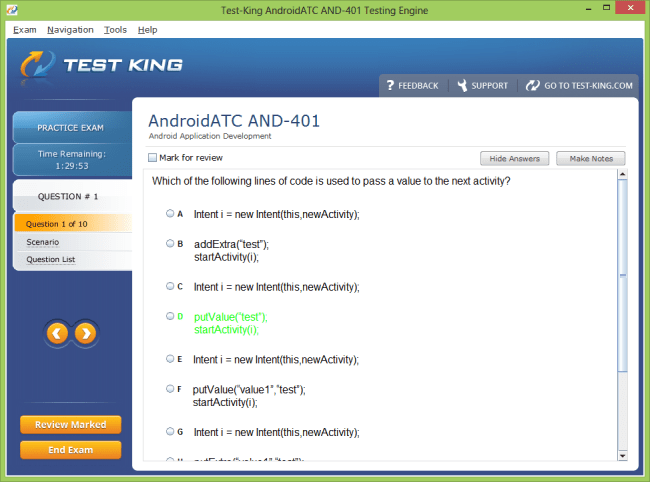
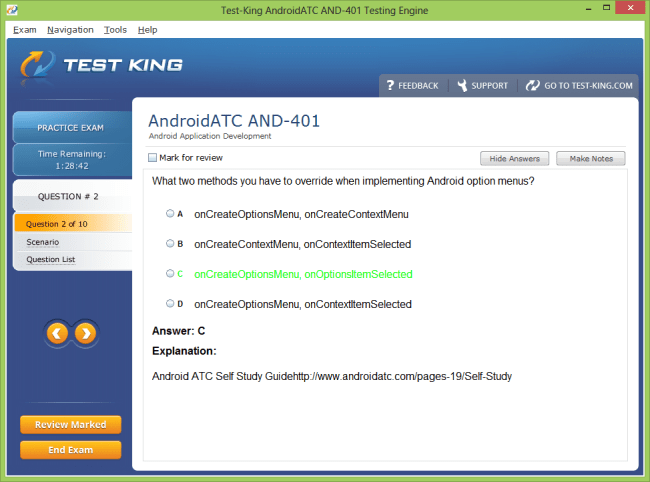
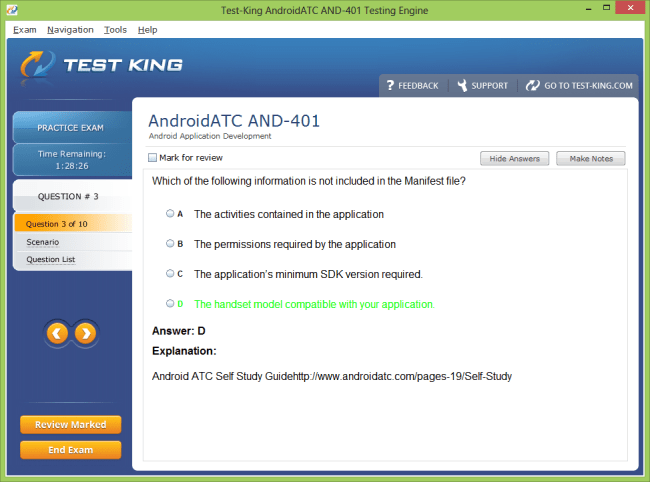
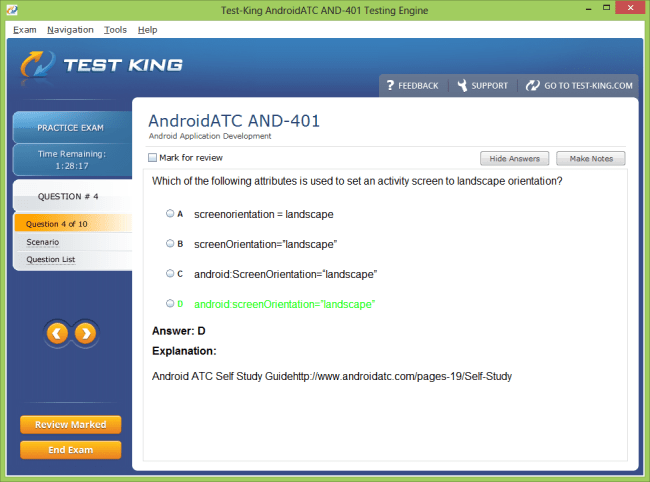
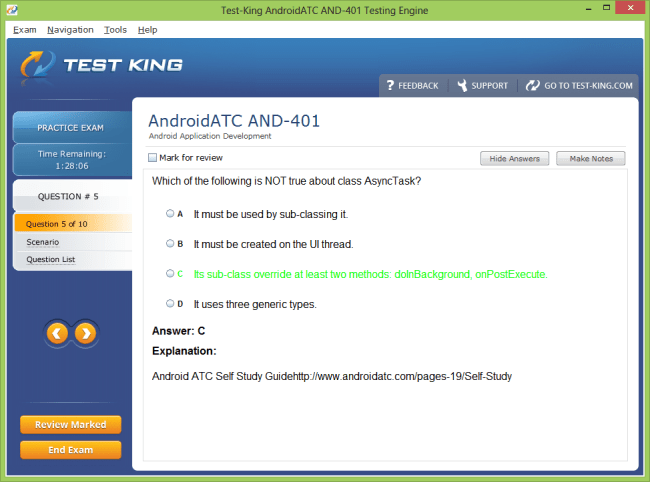
AND-401 Exam Product Screenshots
Frequently Asked Questions
How can I get the products after purchase?
All products are available for download immediately from your Member's Area. Once you have made the payment, you will be transferred to Member's Area where you can login and download the products you have purchased to your computer.
How long can I use my product? Will it be valid forever?
Test-King products have a validity of 90 days from the date of purchase. This means that any updates to the products, including but not limited to new questions, or updates and changes by our editing team, will be automatically downloaded on to computer to make sure that you get latest exam prep materials during those 90 days.
Can I renew my product if when it's expired?
Yes, when the 90 days of your product validity are over, you have the option of renewing your expired products with a 30% discount. This can be done in your Member's Area.
Please note that you will not be able to use the product after it has expired if you don't renew it.
How often are the questions updated?
We always try to provide the latest pool of questions, Updates in the questions depend on the changes in actual pool of questions by different vendors. As soon as we know about the change in the exam question pool we try our best to update the products as fast as possible.
How many computers I can download Test-King software on?
You can download the Test-King products on the maximum number of 2 (two) computers or devices. If you need to use the software on more than two machines, you can purchase this option separately. Please email support@test-king.com if you need to use more than 5 (five) computers.
What is a PDF Version?
PDF Version is a pdf document of Questions & Answers product. The document file has standart .pdf format, which can be easily read by any pdf reader application like Adobe Acrobat Reader, Foxit Reader, OpenOffice, Google Docs and many others.
Can I purchase PDF Version without the Testing Engine?
PDF Version cannot be purchased separately. It is only available as an add-on to main Question & Answer Testing Engine product.
What operating systems are supported by your Testing Engine software?
Our testing engine is supported by Windows. Andriod and IOS software is currently under development.
Exam Code AND-401 Explained: What You Need to Know Before Taking the AndroidATC Exam
The AND-401 certification from AndroidATC represents a definitive benchmark for developers who aspire to master Android application development. It is designed to evaluate not just the theoretical knowledge of the candidate, but their practical prowess in creating, deploying, and optimizing applications for the Android ecosystem. This certification has gained prominence because it ensures that developers are equipped with both foundational and advanced skills necessary for contemporary mobile development. The exam measures competencies in key areas such as user interface design, data management, event handling, and the integration of APIs and external libraries into robust applications.
Understanding the AND-401 Certification
Candidates preparing for the AND-401 exam often encounter a variety of topics that require both meticulous understanding and hands-on practice. Among the fundamental skills tested is the ability to structure Android applications efficiently, following best practices for performance and maintainability. Knowledge of the Android activity lifecycle, fragment management, and navigation paradigms forms a core aspect of the examination. Developers are expected to demonstrate fluency in creating layouts using XML, applying styles, themes, and understanding how resource management affects application behavior across devices with different screen sizes and densities.
Data persistence is another critical facet of the AND-401 assessment. Candidates must be conversant with SQLite databases, shared preferences, and file storage mechanisms to ensure that applications can retain and manage user data reliably. Additionally, the exam explores the ability to implement content providers and interact with the device's native data repositories, which enhances application interoperability and data security. These topics are supplemented by evaluations of network communication, encompassing both synchronous and asynchronous API requests, JSON parsing, and the incorporation of third-party libraries to streamline development processes.
Event-driven programming forms a substantial portion of the assessment, reflecting the interactive nature of mobile applications. Developers must demonstrate the ability to handle user inputs, respond to gestures, and manage asynchronous tasks without compromising application responsiveness. Mastery over threading, handlers, and background services is vital to ensure applications remain fluid and efficient under varied operational scenarios. Furthermore, candidates are expected to exhibit an understanding of broadcast receivers and notifications, which enable applications to remain communicative with the user even when operating in the background.
Security considerations are an integral aspect of Android application development and are examined in the AND-401 test. Candidates must comprehend permission models, secure data handling, and authentication mechanisms to safeguard sensitive information. Familiarity with modern encryption practices and secure API usage is essential, as applications increasingly interact with remote servers and cloud-based services. Additionally, developers are assessed on their understanding of common vulnerabilities and mitigation strategies, including the principles of secure coding and adherence to platform security guidelines.
Preparing for the Examination
Preparation for the AND-401 exam necessitates a disciplined approach combining theoretical study and practical application. Candidates are advised to utilize official study materials, which offer detailed insights into the exam objectives, providing both conceptual frameworks and practical examples. Complementing these resources with hands-on experimentation ensures that learners internalize the concepts and can translate them into functional code. Creating small-scale projects that implement various aspects of the Android framework—such as database interactions, custom views, and service management—enhances familiarity with real-world development challenges and cultivates problem-solving agility.
Time management is another crucial element of preparation. The breadth of topics requires a structured study plan that allocates sufficient focus to each domain, ensuring that both strengths and weaknesses are addressed. Developing a schedule that balances learning new concepts with revisiting previously studied material reinforces knowledge retention and builds confidence. Simulated practice exams can also be invaluable, as they provide insight into the question format, pacing requirements, and the type of problem-solving expected by the evaluators.
Developers should also pay attention to the evolving nature of the Android platform. The AND-401 exam emphasizes contemporary tools, libraries, and development paradigms, reflecting the industry's shift toward modular, maintainable, and performance-conscious application design. Staying updated with platform releases, framework enhancements, and new APIs allows candidates to approach the exam with a modern perspective, ensuring that their knowledge aligns with current industry standards. Participating in developer forums, workshops, and collaborative projects can further enhance understanding, as exposure to diverse coding styles and problem-solving approaches broadens conceptual clarity.
Exam Structure and Content
The AND-401 exam is structured to assess multiple facets of Android application development through scenario-based questions, coding exercises, and conceptual assessments. Candidates can expect questions that examine the creation of user interfaces, implementation of navigation components, management of data persistence, and integration with web services. The test evaluates not just the ability to recall information but the capacity to apply knowledge effectively under constraints, reflecting real-world development conditions.
A key area of focus is the lifecycle management of applications. Questions often require understanding the interaction between activities and fragments, proper use of intents, and handling configuration changes to maintain state consistency. Developers must also demonstrate awareness of performance optimization techniques, including efficient memory usage, caching strategies, and resource management, which are critical to delivering responsive and scalable applications.
Integration with external services forms another substantial component of the exam. Candidates may encounter scenarios involving RESTful API consumption, JSON parsing, network error handling, and asynchronous task management. These tasks test the ability to combine multiple components into cohesive applications that perform reliably under varying conditions. Moreover, familiarity with testing methodologies, including unit testing, instrumentation tests, and automated UI testing, ensures that applications meet quality standards and remain maintainable throughout the development lifecycle.
The exam also emphasizes modern design principles and user experience considerations. Developers are expected to apply material design concepts, implement adaptive layouts, and ensure accessibility compliance, making applications usable by a diverse audience. Knowledge of animation frameworks, transitions, and responsive UI patterns contributes to creating visually engaging and intuitive interfaces. Candidates must balance aesthetic considerations with functional efficiency, demonstrating a holistic understanding of application development.
Practical Skills and Tools
Success in the AND-401 exam relies heavily on practical proficiency. Developers must be adept at using Android Studio, the primary integrated development environment for the platform. Mastery over its features, including debugging tools, layout inspectors, performance analyzers, and code refactoring utilities, enhances productivity and facilitates error resolution. Command over Gradle build configurations, dependency management, and version control integration is also essential, as these tools underpin efficient project management and deployment practices.
Familiarity with modern libraries and frameworks further strengthens practical capabilities. Tools for image loading, networking, and asynchronous operations streamline development and reduce boilerplate code, allowing developers to focus on application logic and user experience. Understanding lifecycle-aware components, ViewModel architecture, and data binding techniques ensures that applications are modular, testable, and maintainable. Additionally, knowledge of reactive programming paradigms provides a robust approach to handling asynchronous data streams and event-driven workflows.
Developers preparing for AND-401 are encouraged to cultivate debugging and problem-solving skills. Real-world applications often present complex scenarios requiring careful analysis, identification of root causes, and strategic resolution. Practicing these skills through iterative project development enhances the ability to troubleshoot efficiently and fosters confidence when confronting exam challenges. Peer code reviews, collaborative development, and engagement with the wider Android developer community offer opportunities to refine coding style, optimize performance, and adopt industry best practices.
Exam Readiness and Mindset
Approaching the AND-401 exam requires not only technical competence but also strategic mindset. Confidence, focus, and a methodical approach to problem-solving significantly impact performance. Candidates should prioritize understanding over rote memorization, recognizing that conceptual clarity enables flexible application of knowledge in varied scenarios. Practicing time management during simulations helps maintain composure under exam conditions, ensuring that each question is approached systematically and efficiently.
Cultivating a mindset oriented toward continuous improvement is equally important. Android development is a dynamic field, and the ability to learn from mistakes, adapt to new information, and integrate emerging practices enhances both exam performance and long-term professional growth. Candidates who approach preparation with curiosity, diligence, and resilience are better positioned to succeed in the AND-401 examination and to leverage the certification as a springboard for advanced career opportunities in mobile application development.
Core Concepts and Application Architecture
The AND-401 certification examines a developer’s ability to comprehend and implement the foundational and advanced concepts of Android application development. Central to this is a firm grasp of the architecture of Android applications. Every application is composed of components such as activities, fragments, services, content providers, and broadcast receivers, each serving a distinct role within the ecosystem. Activities represent user interfaces and manage user interactions, while fragments provide modularity, enabling developers to design flexible layouts that adapt to various screen sizes. Services operate in the background, performing long-running operations without direct user interaction, and broadcast receivers facilitate communication between the system and applications by responding to system-wide events or notifications. Content providers manage shared data and enable interoperability across applications.
Understanding the Android application lifecycle is pivotal for efficient and maintainable app development. Developers must be adept at handling the creation, pausing, resuming, and destruction of activities and fragments. Mastery of lifecycle callbacks ensures that applications manage resources efficiently, maintain state consistency, and provide a seamless user experience. Additionally, effective handling of configuration changes, such as screen rotations or language changes, is tested in the AND-401 exam, highlighting the importance of robust design practices and thoughtful resource management.
Application architecture also encompasses data flow, modularity, and separation of concerns. Employing design patterns such as Model-View-ViewModel (MVVM) or Repository patterns enhances maintainability, testability, and readability of code. These patterns allow developers to segregate user interface logic from data management, leading to a cleaner and more scalable codebase. A strong understanding of architecture components, such as ViewModels, LiveData, and Room persistence library, equips candidates to build applications that are resilient, adaptable, and consistent with modern development paradigms.
User Interface Design and Interaction
User interface design is a critical component of the AND-401 examination, as applications must deliver engaging, intuitive, and accessible experiences. Candidates are expected to demonstrate proficiency in constructing layouts using XML, applying material design principles, and implementing adaptive components that respond to diverse devices. Mastery of views, widgets, and custom components allows developers to create visually cohesive and functional interfaces. Developers must also integrate interactive elements such as buttons, lists, input fields, and menus, ensuring that every user action produces the intended response.
Event handling is an integral aspect of user interface development. Applications rely on the proper management of gestures, touch events, and input interactions to create fluid and responsive experiences. Candidates are tested on their ability to attach listeners, respond to changes, and manage asynchronous events without degrading performance. Additionally, the use of animation frameworks, transitions, and dynamic UI updates contributes to a polished experience, reflecting attention to both aesthetics and functionality.
Accessibility and localization are further aspects that enhance usability. Applications must accommodate users with diverse abilities, employing content descriptions, focus navigation, and scalable text for screen readers. Localization ensures that applications remain globally relevant by supporting multiple languages and regional formatting conventions. These considerations align with the AND-401 objective of producing applications that are inclusive, culturally sensitive, and professionally crafted.
Data Persistence and Management
Managing data efficiently is central to Android application development and is rigorously evaluated in the AND-401 exam. Developers must understand various persistence mechanisms, including SQLite databases, shared preferences, and file storage. SQLite allows structured storage and complex queries, enabling applications to handle large datasets reliably. Shared preferences provide a lightweight solution for storing simple key-value pairs, suitable for user settings or small configuration data. File storage facilitates management of larger data files, including images, documents, or cached content.
Candidates are also expected to implement content providers for data sharing between applications. This requires familiarity with URIs, query execution, and permission handling to ensure data security and integrity. Mastery of Room, a modern database library, is emphasized for its integration with architecture components, enabling efficient management of relational data while reducing boilerplate code. Developers must also understand best practices for data caching, synchronization with remote servers, and handling offline scenarios, which contribute to application reliability and performance.
Network communication forms a complementary skill set. Candidates must demonstrate proficiency in using HTTP requests, parsing JSON or XML responses, and handling errors gracefully. The ability to manage asynchronous calls, background tasks, and API integrations ensures that applications remain responsive while interacting with external data sources. Modern libraries and tools, such as Retrofit or Volley, streamline these tasks, and knowledge of their correct implementation is essential for passing the AND-401 evaluation.
Application Performance and Optimization
The AND-401 examination assesses a developer’s ability to create applications that are both efficient and scalable. Performance optimization involves careful resource management, memory utilization, and responsiveness. Candidates must demonstrate awareness of common pitfalls, such as memory leaks, inefficient layouts, and excessive background processing, and apply strategies to mitigate these issues. Techniques such as view recycling, lazy loading, caching, and asynchronous operations contribute to smoother and faster applications.
Threading and concurrency management are also tested, requiring developers to balance background operations with the main UI thread. Proper use of handlers, AsyncTasks, coroutines, or other threading mechanisms prevents UI freezes and ensures that applications remain reactive. Understanding garbage collection, profiling tools, and memory analyzers further equips candidates to diagnose bottlenecks and improve application behavior. By optimizing performance, developers create applications that not only meet functional requirements but also provide an exceptional user experience.
Security is intrinsically linked to application design and is evaluated in tandem with performance considerations. Candidates must implement secure authentication methods, encryption of sensitive data, and adherence to Android’s permission model. Knowledge of secure communication practices, protection against injection attacks, and proper handling of user data aligns with industry standards, reflecting the AND-401 emphasis on producing reliable and trustworthy applications.
Testing, Debugging, and Deployment
Testing and debugging are critical competencies in the AND-401 exam. Candidates are expected to validate the correctness, reliability, and usability of applications through comprehensive testing strategies. Unit testing ensures that individual components function as intended, while instrumentation and UI tests verify application behavior in realistic conditions. Automated testing frameworks enable developers to maintain quality and detect regressions efficiently.
Debugging proficiency involves using tools to inspect runtime behavior, trace errors, and identify performance issues. Android Studio provides integrated utilities for breakpoint management, log analysis, memory inspection, and layout debugging. Candidates must demonstrate the ability to resolve complex issues, optimize code, and maintain a stable development environment. These skills directly influence application quality and are essential for exam success.
Deployment knowledge forms the final aspect of the AND-401 exam preparation. Developers must understand the process of packaging applications, signing APKs, and distributing apps through official channels. Awareness of versioning, compatibility considerations, and update management ensures that applications reach users effectively and maintain ongoing functionality. Mastery of deployment processes reflects the holistic approach of the AND-401 exam, which evaluates both development and operational competence.
Leveraging Tools and Libraries
Efficient Android development relies on familiarity with development tools and libraries. Android Studio remains the cornerstone environment, offering code completion, project templates, debugging utilities, and performance analyzers. Developers must be comfortable navigating its interface, configuring projects, and integrating external libraries to enhance productivity.
Third-party libraries facilitate common tasks such as image loading, network communication, data binding, and reactive programming. Understanding how to integrate these libraries correctly, manage dependencies, and optimize performance is essential for building professional-grade applications. Lifecycle-aware components, architecture libraries, and reactive frameworks empower developers to construct modular, maintainable, and adaptive applications.
Engagement with the broader developer community also enhances proficiency. Accessing forums, tutorials, workshops, and collaborative projects provides exposure to best practices, emerging tools, and innovative solutions. This dynamic interaction with the Android ecosystem equips candidates with insights that go beyond theoretical knowledge, fostering practical competence and readiness for the AND-401 examination.
Advanced Concepts and Integration Techniques
The AND-401 certification evaluates a developer’s mastery over both foundational principles and advanced practices of Android application development. A crucial aspect of the examination is the ability to integrate multiple components seamlessly to build cohesive applications. Developers are expected to demonstrate expertise in activities, fragments, services, content providers, and broadcast receivers, understanding how these elements interact to form scalable and maintainable software. Activities manage user-facing screens, while fragments enable modularity and adaptive layouts, allowing applications to respond gracefully to varied screen sizes and orientations. Services operate unobtrusively in the background to handle prolonged or asynchronous operations, and broadcast receivers facilitate communication between the system and applications. Content providers serve as intermediaries for data sharing, ensuring security and interoperability between applications.
Lifecycle management remains a central tenet of AND-401 evaluation. Developers must handle the creation, pausing, resuming, and destruction of activities and fragments with precision. Proper implementation of lifecycle callbacks ensures efficient resource management, state retention, and a seamless user experience. Additionally, handling configuration changes, such as device rotations or changes in locale, without disrupting application flow, exemplifies mastery over robust design practices. Understanding these mechanisms enables developers to construct resilient applications capable of operating reliably under diverse conditions.
Application architecture and design patterns form a significant component of the exam. Employing strategies such as Model-View-ViewModel (MVVM), Repository patterns, and dependency injection enhances code modularity, testability, and maintainability. Architecture components like ViewModels, LiveData, and Room database integration streamline data management and state preservation, allowing developers to focus on business logic without sacrificing structural clarity. These principles align with contemporary Android development practices, emphasizing scalability, adaptability, and long-term maintainability.
User Interface and Interaction Design
The examination places considerable emphasis on user interface design and interaction. Developers are required to build engaging, intuitive, and accessible applications that adhere to material design principles. Proficiency in XML-based layout construction, theming, styling, and adaptive design ensures consistency across devices. Understanding of interactive components, including buttons, lists, forms, and custom views, enables developers to create seamless and responsive user experiences.
Event handling is an integral aspect of application interactivity. Candidates are expected to manage touch events, gestures, and asynchronous tasks effectively, ensuring that applications remain responsive under varying operational conditions. Animation frameworks, transitions, and dynamic updates contribute to a refined interface, balancing aesthetic appeal with functional performance. Accessibility considerations, such as content descriptions, scalable text, and navigation aids for screen readers, are also evaluated, reflecting the AND-401’s focus on inclusive application development. Localization further enhances usability, enabling applications to reach a global audience by supporting multiple languages and regional conventions.
Data Management and Network Communication
Data persistence and management are vital for Android applications, and the AND-401 examination assesses a developer’s proficiency in this area. Candidates must implement SQLite databases, shared preferences, and file storage solutions effectively. SQLite facilitates structured data storage and complex querying, while shared preferences provide lightweight key-value storage for configuration and user preferences. File storage accommodates larger data sets, including images and documents, supporting both internal and external storage mechanisms.
Content providers enable controlled sharing of data between applications, requiring developers to manage URIs, query execution, and permissions securely. Modern practices involve using Room for database management, integrating seamlessly with architecture components to enhance code efficiency and maintainability. Proper handling of caching, synchronization with remote servers, and offline scenarios ensures reliability and performance across network conditions.
Network communication forms an essential part of the AND-401 assessment. Candidates must demonstrate knowledge of HTTP requests, RESTful API integration, JSON or XML parsing, and error management. Asynchronous task handling, background processing, and network resilience strategies ensure that applications remain responsive while interacting with external services. Mastery over these areas equips developers to build robust, scalable, and data-driven applications suitable for professional deployment.
Performance Optimization and Security
Performance optimization is a core competency evaluated in the AND-401 exam. Developers must create applications that are resource-efficient, responsive, and capable of handling varying workloads. Techniques such as memory management, view recycling, lazy loading, and caching improve performance and user experience. Efficient use of threading and concurrency ensures that background tasks do not interfere with the user interface, maintaining fluid and responsive application behavior. Tools for profiling, memory analysis, and performance monitoring aid in identifying and mitigating bottlenecks.
Security considerations are intrinsically linked to application design. Candidates must implement secure authentication, data encryption, and proper permission handling. Awareness of potential vulnerabilities, secure coding practices, and adherence to platform security guidelines is essential. Applications must protect user data during both storage and transmission, utilizing contemporary encryption methods and secure API communication. By integrating security with performance optimization, developers demonstrate a comprehensive understanding of professional application development standards.
Testing, Debugging, and Deployment Practices
Testing and debugging are indispensable for quality assurance in Android development. The AND-401 exam evaluates a candidate’s ability to conduct unit tests, UI tests, and instrumentation tests to ensure correctness and reliability. Automated testing frameworks help maintain application quality, detect regressions, and streamline development workflows.
Debugging proficiency involves using integrated tools to inspect runtime behavior, identify errors, and optimize performance. Android Studio provides utilities for breakpoint management, log analysis, memory inspection, and layout debugging, all of which developers must utilize effectively. Candidates are expected to troubleshoot complex issues, refine code, and maintain application stability throughout the development lifecycle.
Deployment knowledge is also critical. Candidates must understand application packaging, signing, versioning, and distribution through official channels. Awareness of compatibility requirements, update management, and user feedback integration ensures that applications reach the intended audience efficiently and maintain ongoing functionality. Mastery over deployment processes underscores the AND-401 exam’s holistic approach to assessing both development and operational capabilities.
Leveraging Tools, Libraries, and Community Resources
Proficiency with development tools and libraries enhances efficiency and quality in Android application development. Android Studio, as the primary environment, provides code completion, templates, debugging tools, and performance analyzers that streamline development. Developers must navigate its interface confidently, manage project dependencies, and integrate libraries to reduce repetitive coding tasks.
Modern libraries support image loading, network operations, reactive programming, and data binding, enabling developers to build scalable and maintainable applications. Lifecycle-aware components, architecture libraries, and modular frameworks foster adherence to best practices while simplifying complex development tasks. Engagement with the wider Android developer community, including forums, tutorials, collaborative projects, and workshops, further expands practical knowledge and provides insights into evolving trends, tools, and techniques. This combination of tool proficiency, library utilization, and community engagement equips candidates to excel in both the AND-401 examination and professional development contexts.
Mastering Application Development Practices
The AND-401 certification examines a developer’s ability to craft applications that are both efficient and resilient within the Android ecosystem. Central to this is a thorough understanding of application components, including activities, fragments, services, broadcast receivers, and content providers. Activities serve as user-facing interfaces, while fragments introduce modularity, allowing flexible adaptation to various screen sizes and orientations. Services operate in the background, executing prolonged tasks without interrupting the user experience, and broadcast receivers facilitate system-wide communication. Content providers enable secure data sharing across applications, ensuring interoperability and data integrity.
A deep comprehension of the application lifecycle is essential for the exam. Developers must skillfully manage the creation, resumption, pausing, and destruction of components, ensuring consistent behavior and efficient resource utilization. Handling configuration changes such as device rotations or locale adjustments without disrupting application state exemplifies mastery over robust design practices. Candidates are also evaluated on their ability to integrate multiple components seamlessly, creating cohesive applications that maintain stability under diverse scenarios.
Application architecture forms a critical element of the AND-401 exam. Implementing design patterns such as Model-View-ViewModel and Repository structures enhances modularity, testability, and maintainability. Architecture components, including ViewModels, LiveData, and the Room database, allow developers to manage data and state efficiently while minimizing boilerplate code. Dependency injection further strengthens modularity and decouples components, contributing to scalable, maintainable, and professional-grade applications. Understanding these architectural principles ensures developers can build software that aligns with contemporary Android development standards.
User Interface Design and Interactive Elements
User interface design is a pivotal aspect of the AND-401 assessment. Developers must create interfaces that are intuitive, engaging, and accessible, adhering to material design guidelines and adaptive layout principles. Mastery over XML layouts, styling, and theming ensures consistency across devices, while custom views and widgets provide flexibility for unique application requirements. Proper implementation of interactive elements such as forms, buttons, lists, and menus enhances the responsiveness and usability of applications.
Event-driven programming underpins interactive applications. Candidates are expected to manage touch gestures, input events, and asynchronous operations efficiently to maintain fluid responsiveness. Incorporating animations, transitions, and dynamic updates refines the interface, balancing visual appeal with operational performance. Accessibility considerations, including scalable text, content descriptions, and navigation aids, ensure that applications cater to users with diverse abilities. Localization enhances global usability, allowing applications to support multiple languages and cultural conventions seamlessly.
Data Handling and Persistence
Data management constitutes a major focus of the AND-401 exam. Developers must employ SQLite databases, shared preferences, and file storage to maintain application state and handle user information reliably. SQLite supports structured queries and complex relational data, while shared preferences provide lightweight storage for simple key-value pairs, ideal for configuration or user settings. File storage accommodates larger datasets such as images, documents, and cached resources, allowing applications to function effectively across varying conditions.
Content providers facilitate controlled sharing of data between applications, necessitating knowledge of URIs, queries, and permission handling. Modern practices often incorporate Room for database management, which integrates with architecture components to provide a clean, maintainable approach to persistent storage. Candidates must also handle caching strategies, synchronization with remote servers, and offline capabilities to maintain application functionality under diverse network conditions. Network communication is equally essential, requiring proficiency in HTTP requests, RESTful API integration, JSON parsing, and error handling. Asynchronous management of network tasks ensures responsiveness while providing seamless access to remote data.
Performance Optimization and Security Measures
Performance optimization is evaluated rigorously in the AND-401 examination. Developers must ensure that applications are resource-efficient, responsive, and capable of handling concurrent operations without compromising user experience. Techniques such as lazy loading, caching, view recycling, and efficient memory management improve responsiveness and scalability. Proper threading and concurrency control ensures background operations do not hinder the main UI thread, preserving fluid interaction. Profiling tools, memory analyzers, and performance monitoring assist in diagnosing bottlenecks and optimizing execution.
Security remains a core consideration throughout application design. Developers must implement secure authentication, data encryption, and correct permission handling to protect sensitive information. Awareness of vulnerabilities, adherence to secure coding standards, and compliance with platform security guidelines is critical. Ensuring secure communication, storage, and authentication practices demonstrates a holistic understanding of professional application development and aligns with the expectations of the AND-401 exam.
Testing, Debugging, and Deployment Strategies
Testing and debugging are vital components of Android development. The AND-401 exam evaluates a candidate’s ability to validate the functionality, reliability, and usability of applications. Unit tests confirm individual component correctness, while UI and instrumentation tests assess behavior in real-world scenarios. Automated testing facilitates ongoing quality assurance, enabling detection of regressions and maintenance of consistent application performance.
Debugging proficiency requires use of integrated development tools to monitor runtime behavior, trace issues, and optimize code performance. Android Studio provides utilities for breakpoint management, log inspection, memory analysis, and layout debugging, all essential for resolving complex problems effectively. Candidates must demonstrate the ability to address performance issues, refine logic, and maintain stability throughout the application lifecycle.
Deployment knowledge is also assessed, encompassing application packaging, signing, versioning, and distribution. Developers must understand compatibility considerations, update mechanisms, and effective distribution strategies to ensure applications reach users reliably. Mastery of these practices ensures that applications function correctly across devices, maintain usability, and meet professional deployment standards.
Tools, Libraries, and Community Engagement
Proficiency with development tools and libraries is indispensable for AND-401 candidates. Android Studio offers comprehensive support for project management, code completion, debugging, and performance analysis. Developers must navigate its environment efficiently, integrate dependencies, and utilize tools to optimize workflow.
Modern libraries enhance functionality, enabling efficient image loading, network handling, reactive programming, and data binding. Lifecycle-aware components, architecture libraries, and modular frameworks promote maintainable, scalable, and adaptive applications. Engagement with the Android developer community—through forums, collaborative projects, tutorials, and workshops—provides exposure to emerging practices, innovative solutions, and professional insights. Leveraging these resources strengthens practical knowledge, aligns development practices with industry trends, and reinforces readiness for the AND-401 examination.
Developing Expertise in Android Components
The AND-401 certification examines a developer’s ability to integrate and manipulate core Android components effectively, demonstrating both conceptual knowledge and practical skill. Central to this is a thorough understanding of activities, fragments, services, broadcast receivers, and content providers. Activities form the user-facing interface, managing interactions and navigation. Fragments enable modular design, allowing flexible layouts that adjust to various screen sizes and orientations without sacrificing consistency. Services operate independently of the user interface, managing long-running operations such as network requests, background calculations, or media playback. Broadcast receivers respond to system-wide or application-specific events, facilitating communication across the Android environment. Content providers manage access to structured data, ensuring secure sharing between applications while maintaining data integrity.
Mastery over the lifecycle of these components is a crucial aspect of the AND-401 examination. Developers must manage the creation, resumption, pausing, and destruction of components efficiently, ensuring applications maintain state and responsiveness under varying conditions. Handling configuration changes, including orientation shifts, locale changes, or resource adjustments, tests a developer’s ability to create robust, adaptive applications. Integration of these elements in a cohesive and maintainable manner reflects proficiency in professional Android development practices.
User Interface Construction and Interaction
The user interface is a critical focus of the AND-401 exam, requiring developers to create intuitive, engaging, and adaptive experiences. Proficiency in XML-based layouts, material design principles, and theming ensures consistent presentation across devices. Developers must skillfully implement interactive components such as buttons, input fields, lists, and menus while maintaining responsiveness. Custom views and dynamic elements enhance visual appeal and usability, contributing to a polished and professional application experience.
Event-driven programming underpins all user interaction. Developers must handle gestures, touch events, and asynchronous tasks effectively, preventing UI lag and ensuring fluid responsiveness. Animations, transitions, and dynamic updates refine the interface, balancing aesthetic considerations with functional performance. Accessibility and localization are essential aspects of user experience, requiring developers to design applications that accommodate diverse abilities and support multiple languages, ensuring global reach and inclusive usability.
Data Persistence and Network Integration
Data management is a cornerstone of Android development, and the AND-401 exam evaluates proficiency in this domain. Developers must implement persistent storage using SQLite databases, shared preferences, and file storage. SQLite supports complex relational data and structured queries, while shared preferences provide lightweight key-value storage for settings or small configuration data. File storage accommodates larger datasets such as images, documents, and cached resources, supporting application reliability in various environments.
Content providers facilitate controlled data sharing between applications, requiring secure handling of URIs, queries, and permissions. Modern database solutions like Room integrate seamlessly with architecture components, offering maintainable and efficient storage solutions. Candidates are expected to implement caching strategies, data synchronization with remote servers, and offline access, ensuring uninterrupted application functionality. Network communication knowledge is essential, including HTTP requests, RESTful API integration, JSON parsing, and error handling. Managing asynchronous network tasks without impacting UI responsiveness demonstrates practical competency in professional development scenarios.
Performance Enhancement and Security Considerations
Optimizing performance is critical for professional Android applications. Candidates must ensure efficient memory usage, responsive interfaces, and minimal resource consumption. Techniques such as lazy loading, caching, view recycling, and thread management enhance application fluidity. Understanding threading, coroutines, and background task handling prevents UI blockage, supporting smooth user experiences. Profiling tools, memory analyzers, and performance monitoring aid in detecting bottlenecks and improving application efficiency.
Security is intertwined with performance and usability. Developers must implement secure authentication, encryption of sensitive data, and adherence to Android’s permission model. Awareness of common vulnerabilities, secure coding practices, and adherence to platform security guidelines ensure applications protect user data effectively. Secure network communication, proper handling of credentials, and mitigation of injection attacks reflect the professional standards expected for AND-401 certification.
Testing, Debugging, and Deployment Practices
Testing and debugging are integral for ensuring application stability and reliability. Candidates must conduct unit tests, UI tests, and instrumentation tests to verify functionality, performance, and user interaction correctness. Automated testing reduces regression risk and provides ongoing quality assurance.
Debugging proficiency is essential, involving analysis of runtime behavior, identification of logical or performance issues, and effective resolution. Android Studio offers tools for breakpoint management, log inspection, memory analysis, and layout debugging, which developers must use efficiently. Candidates should demonstrate the ability to troubleshoot complex problems, optimize execution, and maintain consistent application performance across multiple environments.
Deployment knowledge completes the professional competency for AND-401. Developers must understand application packaging, signing, versioning, and distribution through official platforms. Awareness of compatibility requirements, update management, and distribution strategies ensures applications reach users effectively and maintain functionality post-deployment. Mastery over these practices signifies readiness for professional Android development and demonstrates alignment with AND-401 standards.
Leveraging Development Tools, Libraries, and Communities
Competency with development tools and libraries enhances efficiency and application quality. Android Studio remains the primary environment, providing code completion, project templates, debugging utilities, and performance analysis tools. Developers must navigate its interface proficiently, manage dependencies, and integrate libraries effectively to reduce redundant coding efforts.
Modern libraries facilitate image loading, network communication, reactive programming, and data binding, enabling developers to create maintainable and adaptive applications. Lifecycle-aware components, modular frameworks, and architecture libraries foster scalability and maintainability, reflecting best practices in professional development. Engagement with developer communities through forums, collaborative projects, tutorials, and workshops offers exposure to emerging tools, techniques, and practical problem-solving strategies. Leveraging these resources strengthens practical knowledge and readiness for the AND-401 exam, bridging theoretical understanding with real-world development experience.
Advanced Practices and Professional Competencies
The AND-401 certification evaluates a developer’s mastery over the intricate dimensions of Android application development, combining practical skills with theoretical comprehension. Central to the examination is the ability to manipulate core components such as activities, fragments, services, broadcast receivers, and content providers. Activities manage user-facing interfaces and orchestrate navigation, while fragments provide modularity and flexibility in layouts, supporting responsive designs across diverse device configurations. Services operate in the background, executing long-running tasks such as network operations, media playback, or computations without interfering with user experience. Broadcast receivers facilitate communication between the system and applications, responding to global or localized events, while content providers manage structured data access, enabling secure sharing and maintaining data integrity.
Lifecycle management remains pivotal, requiring developers to orchestrate creation, resumption, pausing, and destruction of components with precision. Handling configuration changes, including device orientation, locale adjustments, or resource variations, tests a developer’s ability to produce resilient, adaptive applications. Integration of multiple components in a cohesive manner demonstrates proficiency in designing maintainable and scalable software. Candidates are also expected to employ modern design patterns, such as Model-View-ViewModel and Repository architecture, alongside dependency injection, to achieve clean, modular, and testable codebases. Utilization of architecture components like ViewModels, LiveData, and Room databases supports efficient state management, synchronization, and persistent storage while reducing boilerplate complexity.
Interface Design, Interaction, and Accessibility
User interface design is a cornerstone of the AND-401 examination. Developers must create interfaces that are intuitive, visually appealing, and adaptive to various screen sizes. XML-based layout design, styling, and material design principles ensure consistency and professionalism in visual presentation. Interactive components, including buttons, input fields, menus, and lists, must be implemented with attention to responsiveness and fluidity. Custom views and dynamic elements enhance the user experience, supporting complex interactions and visual feedback.
Event handling is central to interactivity, requiring candidates to manage gestures, touch events, and asynchronous operations efficiently. Animations, transitions, and real-time UI updates refine the interface, balancing aesthetic presentation with functional performance. Accessibility is emphasized, requiring developers to design applications for users with diverse abilities by incorporating content descriptions, scalable text, focus navigation, and screen reader compatibility. Localization further broadens usability, enabling support for multiple languages, regional formats, and culturally sensitive content, reflecting the global nature of contemporary Android applications.
Data Management and Networking
Data persistence and management are critical components of professional Android development. Candidates must implement storage solutions such as SQLite databases, shared preferences, and file storage. SQLite provides structured relational storage with support for complex queries, shared preferences offer lightweight configuration storage, and file storage accommodates larger assets such as images, videos, and cached data. Content providers enable secure data sharing across applications, requiring careful management of URIs, queries, and permission policies. Modern practices often involve using Room database integration for simplified, maintainable, and efficient data handling.
Network communication forms a complementary skill set, encompassing HTTP requests, RESTful API consumption, JSON parsing, error handling, and asynchronous data management. Developers are expected to ensure network resilience, proper task scheduling, and efficient background processing to maintain a responsive user experience while interacting with remote resources. Caching strategies, offline handling, and synchronization with servers demonstrate the candidate’s ability to build robust applications capable of operating under varying network conditions.
Performance Optimization and Security
Application performance is a key criterion of the AND-401 exam. Developers must produce resource-efficient applications that maintain responsiveness under heavy workloads. Techniques such as view recycling, lazy loading, caching, and optimized memory management improve application fluidity. Threading and concurrency management ensure background operations do not compromise the UI thread, maintaining smooth interactivity. Profiling tools, memory analyzers, and performance monitors assist in identifying and resolving bottlenecks, enhancing both user experience and operational stability.
Security is integral to modern Android development. Candidates must implement secure authentication, data encryption, proper permission handling, and safeguard sensitive information. Awareness of potential vulnerabilities, adherence to secure coding practices, and compliance with platform security standards are essential. Applications must protect data both in transit and at rest, employing secure network communication, credential management, and mitigations against injection attacks or unauthorized access. Integrating security considerations with performance optimization reflects a professional approach to Android application development.
Testing, Debugging, and Deployment
Testing and debugging are vital for ensuring application reliability and quality. Candidates must employ unit tests, instrumentation tests, and UI tests to validate functionality, performance, and user interaction. Automated testing reduces regression risk and provides ongoing assurance of code quality.
Debugging expertise involves identifying runtime issues, tracing logic errors, and optimizing performance using integrated development tools. Android Studio’s capabilities, such as breakpoints, log inspection, memory analysis, and layout debugging, enable developers to resolve issues efficiently. Candidates are expected to troubleshoot complex scenarios, refine code, and maintain application stability across devices and environments.
Deployment knowledge is also essential. Developers must understand packaging, signing, versioning, and distribution of applications. Consideration of device compatibility, update mechanisms, and distribution channels ensures that applications are accessible to users while maintaining functionality and integrity. Mastery of these practices demonstrates readiness for professional application development and alignment with AND-401 certification expectations.
Tools, Libraries, and Community Engagement
Proficiency with development tools and libraries enhances efficiency and application quality. Android Studio offers comprehensive support for project management, code assistance, debugging, and performance analysis. Developers must navigate its interface confidently, manage dependencies, and integrate external libraries effectively to reduce redundant work.
Libraries that facilitate image loading, network handling, reactive programming, and data binding are essential for scalable, maintainable applications. Lifecycle-aware components, modular frameworks, and architecture libraries foster clean and adaptive development. Engagement with developer communities through forums, collaborative projects, tutorials, and workshops provides exposure to new tools, techniques, and practical problem-solving strategies. Leveraging these resources strengthens competence, bridges theoretical knowledge with real-world application, and enhances readiness for the AND-401 exam and professional development in Android application engineering.
Conclusion
The AND-401 certification embodies a comprehensive evaluation of both theoretical understanding and practical expertise in Android application development. By mastering core components, lifecycle management, user interface design, data persistence, network communication, performance optimization, security practices, testing, debugging, and deployment, candidates demonstrate their capability to build professional-grade applications. Proficiency with development tools, libraries, and community resources further reinforces this competence. Achieving AND-401 certification not only validates technical skills but also positions developers for advanced opportunities in the competitive landscape of mobile application development, enabling them to deliver robust, secure, and high-performance Android applications that meet modern industry standards.