
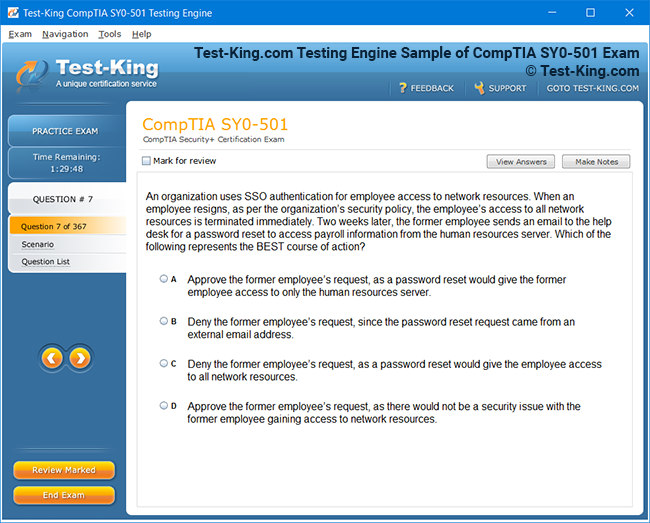
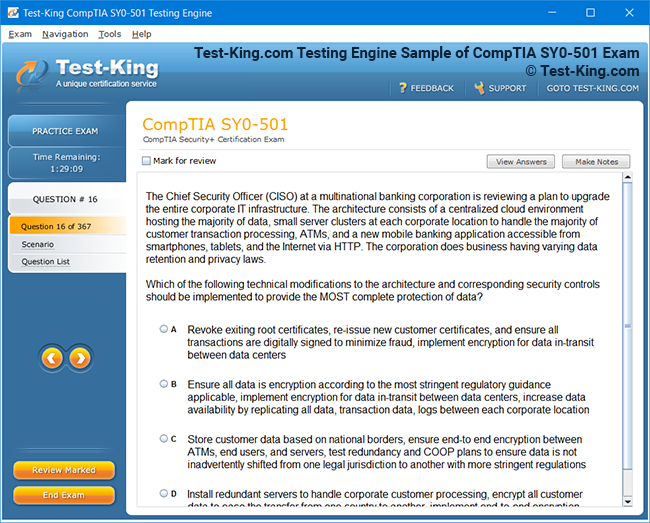
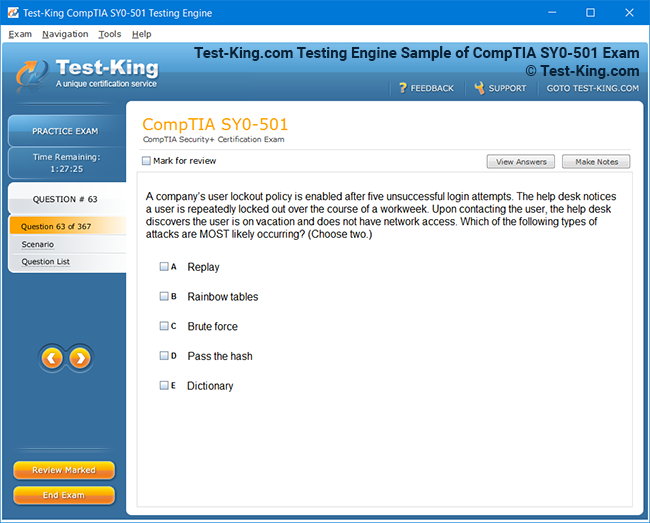
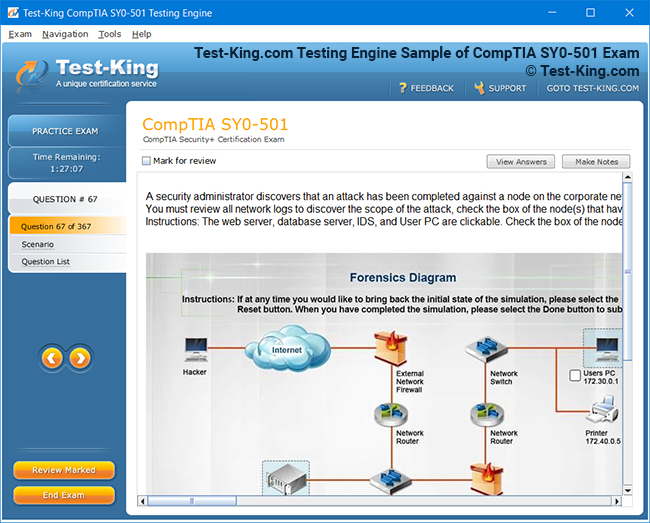
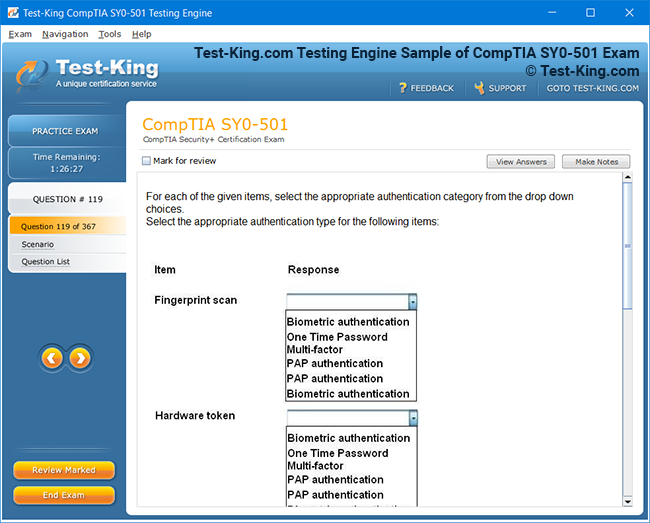
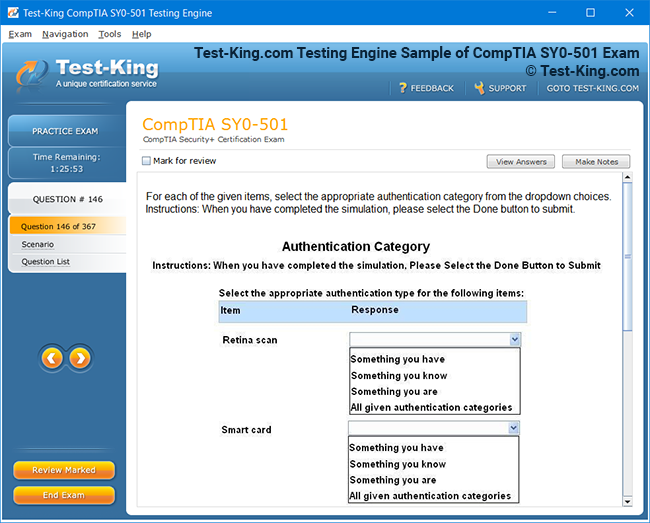
Product Screenshots
Frequently Asked Questions
How can I get the products after purchase?
All products are available for download immediately from your Member's Area. Once you have made the payment, you will be transferred to Member's Area where you can login and download the products you have purchased to your computer.
How long can I use my product? Will it be valid forever?
Test-King products have a validity of 90 days from the date of purchase. This means that any updates to the products, including but not limited to new questions, or updates and changes by our editing team, will be automatically downloaded on to computer to make sure that you get latest exam prep materials during those 90 days.
Can I renew my product if when it's expired?
Yes, when the 90 days of your product validity are over, you have the option of renewing your expired products with a 30% discount. This can be done in your Member's Area.
Please note that you will not be able to use the product after it has expired if you don't renew it.
How often are the questions updated?
We always try to provide the latest pool of questions, Updates in the questions depend on the changes in actual pool of questions by different vendors. As soon as we know about the change in the exam question pool we try our best to update the products as fast as possible.
How many computers I can download Test-King software on?
You can download the Test-King products on the maximum number of 2 (two) computers or devices. If you need to use the software on more than two machines, you can purchase this option separately. Please email support@test-king.com if you need to use more than 5 (five) computers.
What is a PDF Version?
PDF Version is a pdf document of Questions & Answers product. The document file has standart .pdf format, which can be easily read by any pdf reader application like Adobe Acrobat Reader, Foxit Reader, OpenOffice, Google Docs and many others.
Can I purchase PDF Version without the Testing Engine?
PDF Version cannot be purchased separately. It is only available as an add-on to main Question & Answer Testing Engine product.
What operating systems are supported by your Testing Engine software?
Our testing engine is supported by Windows. Andriod and IOS software is currently under development.
Top AICPA Exams
Top Study Strategies for Passing the AICPA CPA AUD Exam on Your First Attempt
The AICPA CPA Auditing and Attestation Exam stands as one of the most intricate assessments in the journey toward becoming a licensed CPA. Unlike other sections of the CPA examination, the AUD exam demands not only comprehension of auditing standards but also the capacity to apply them in complex scenarios that mimic real-world engagements. Candidates often confront an amalgam of multiple-choice questions, task-based simulations, and written communication exercises, each designed to gauge analytical acumen, attention to detail, and professional judgment. Success in this exam is contingent upon cultivating a profound familiarity with the framework of auditing principles, including engagement planning, risk assessment, internal controls evaluation, and audit reporting. Understanding these components and their interconnections is essential for approaching questions with confidence and precision.
Understanding the Structure and Expectations of the AUD Exam
The AUD exam evaluates the candidate's ability to identify errors, assess financial statements, and apply professional standards in varying contexts. Each question often intertwines multiple audit concepts, challenging examinees to synthesize information rather than simply recall isolated facts. This intricate interplay requires not only mastery of the underlying material but also an understanding of how these elements manifest in practical auditing scenarios. Recognizing the nuances of auditing standards, such as the distinctions between substantive procedures and tests of controls or the implications of material misstatements, provides a critical advantage for those striving to excel on their first attempt.
Developing a Strategic Study Plan
The cornerstone of a successful approach to the AUD exam is a meticulously structured study plan. Unlike haphazard review sessions or last-minute cramming, a strategic plan allocates time based on topic complexity, individual strengths, and historical exam emphasis. Candidates are encouraged to map out their preparation across several months, incorporating periods of focused learning interspersed with review and practice testing. Time management in this context is not merely about dividing hours evenly but about prioritizing high-weighted topics, such as risk assessment and audit evidence, while ensuring no area is neglected.
An effective study plan also incorporates deliberate exposure to multiple-choice questions and simulations, as these formats demand distinct analytical skills. Multiple-choice questions often test the candidate's ability to identify subtle misstatements or evaluate auditor responsibilities in hypothetical scenarios, while simulations replicate the audit process, requiring integration of diverse concepts into coherent decision-making. By alternating between these approaches, candidates can build both confidence and versatility, enabling them to navigate the multifaceted challenges of the AUD exam.
The inclusion of structured review intervals is paramount. Research into cognitive retention demonstrates that spaced repetition enhances long-term memory and reduces the likelihood of forgetting critical concepts. Allocating specific days for revisiting previously studied material ensures that the principles of auditing, attestation standards, and professional ethics remain fresh and readily accessible during the exam. In practice, this means revisiting risk assessment procedures, internal control testing methods, and reporting guidelines periodically rather than confining review to the days immediately preceding the examination.
Time Management During Study and Examination
Time management extends beyond study planning and into the execution of the exam itself. Many candidates struggle not with knowledge deficits but with the allocation of time across diverse question types. The AUD exam demands careful pacing; complex simulations may consume substantial time if approached without a systematic method. To counteract this, examinees benefit from segmenting questions into manageable components, addressing easier multiple-choice questions first to secure points and then allocating sufficient attention to intricate simulations.
During preparation, timed practice sessions serve a dual purpose. They familiarize candidates with the pressure of the actual exam environment and reveal personal tendencies in pacing. Some examinees may spend excessive time on challenging questions, leaving insufficient minutes for remaining items, while others may rush through simulations without fully considering subtleties. By practicing under timed conditions, candidates develop an instinctive sense of when to move on and when to invest additional effort, enhancing efficiency without compromising accuracy.
Mastering Multiple-Choice Questions
Multiple-choice questions form a substantial portion of the AUD exam and necessitate more than rote memorization. Effective handling of these items relies on analytical thinking, pattern recognition, and critical judgment. Candidates must often evaluate scenarios involving financial misstatements, auditor responsibilities, or ethical dilemmas, discerning the best course of action from several plausible options. A systematic approach involves first identifying the key elements of the question, assessing the implications of each choice, and then selecting the response that aligns most closely with professional auditing standards.
Common challenges include subtle wording differences that alter the intended meaning or distractors that appear correct at first glance. Recognizing these traps requires familiarity with terminology and concepts, as well as a disciplined methodology for interpreting the question stem. Practice questions, when analyzed rigorously, not only reinforce technical knowledge but also cultivate an intuition for the question patterns typically employed by the AICPA. Annotating explanations and reviewing rationales for incorrect answers provides insight into recurring pitfalls and strengthens reasoning abilities, which are indispensable for the actual examination.
Approaching Task-Based Simulations
Task-based simulations are designed to replicate the auditing process and test a candidate's ability to integrate knowledge into realistic scenarios. These exercises often present financial statements, audit evidence, or procedural documentation, asking candidates to identify errors, propose corrective actions, or draft responses consistent with professional standards. Unlike multiple-choice questions, simulations require an organized thought process, meticulous attention to detail, and the capacity to synthesize information from multiple sources.
Preparation for simulations benefits from practicing with sample cases that mirror the complexity and scope of the exam. Candidates should simulate the audit workflow, beginning with planning and risk assessment, proceeding through testing of internal controls, evaluating substantive evidence, and concluding with reporting decisions. Developing templates for analysis, note-taking, and response formatting can enhance efficiency during the actual exam. Additionally, reviewing previous simulations and understanding the rationale behind correct answers fosters a deeper comprehension of audit procedures and the logical frameworks expected by the AICPA.
Enhancing Written Communication Skills
The written communication component of the AUD exam presents a distinct challenge, as it evaluates not only technical knowledge but also clarity, conciseness, and professional articulation. Candidates must convey complex audit findings, justify decisions, and provide recommendations in a manner consistent with professional standards. Effective written responses demonstrate structured thinking, precise language, and an ability to prioritize critical information while maintaining adherence to auditing conventions.
To cultivate these skills, candidates can practice drafting audit memos or reports based on sample scenarios. Attention to grammar, organization, and the logical progression of arguments is essential. Reviewing exemplar responses and internalizing the structure of effective communication enhances the ability to produce coherent narratives under time constraints. Moreover, frequent practice instills confidence, reducing cognitive load during the actual examination and enabling candidates to focus on analytical accuracy rather than stylistic concerns.
Integrating Review Techniques and Knowledge Reinforcement
Review is the fulcrum upon which successful AUD exam preparation pivots. An effective review strategy encompasses multiple dimensions: revisiting key concepts, reinforcing procedural knowledge, and identifying gaps in understanding. Candidates benefit from cyclical reviews that interweave theoretical study, question practice, and simulation exercises. Such an integrative approach ensures that knowledge is not compartmentalized but interconnected, mirroring the integrated thinking required in actual auditing practice.
Incorporating self-assessment tools enhances this process. Periodic evaluations, whether through mock exams or targeted quizzes, allow candidates to monitor progress, adapt study methods, and focus on areas of relative weakness. Analysis of incorrect responses provides insight into misunderstanding or misapplication of auditing principles, enabling iterative improvement. This dynamic approach transforms preparation into a deliberate, reflective practice rather than a passive accumulation of information.
Psychological Readiness and Exam Resilience
A dimension often underestimated in AUD preparation is psychological readiness. The exam's length, complexity, and high stakes can engender stress, anxiety, or overconfidence. Developing resilience involves cultivating habits that balance mental acuity with emotional stability. Techniques such as structured study schedules, timed practice, mindfulness exercises, and adequate rest contribute to optimal cognitive function and reduce susceptibility to fatigue or distraction.
Confidence is reinforced through mastery and familiarity. Engaging consistently with practice questions, simulations, and written exercises builds a sense of preparedness. Candidates who internalize the rhythm and expectations of the exam approach each question with composure, able to dissect complex scenarios with clarity and precision. Mental rehearsal of audit processes, visualization of workflows, and reflection on past successes further fortify psychological readiness, ensuring that analytical skills are deployed effectively under exam conditions.
Leveraging Resources for Comprehensive Preparation
A critical component of preparation is the judicious selection of study resources. Comprehensive review materials, including authoritative guides, practice questions, simulation cases, and explanatory commentaries, serve as the backbone of a candidate’s study regimen. The quality of these resources directly influences comprehension, retention, and application of auditing standards. Candidates benefit from cross-referencing multiple sources to resolve ambiguities and deepen understanding of complex topics.
Supplementing traditional materials with forums, study groups, or mentorship enhances learning. Engaging with peers or experienced auditors provides alternative perspectives, practical insights, and clarification of nuanced concepts. Discussion of challenging scenarios, exploration of real-world audit cases, and collaborative problem-solving cultivate higher-order thinking, bridging the gap between theoretical knowledge and applied expertise.
Strengthening Core Audit Knowledge
Success in the AICPA CPA Auditing and Attestation Exam depends profoundly on a candidate's mastery of fundamental audit concepts. Candidates are expected to demonstrate a nuanced understanding of auditing standards, attestation engagements, internal controls, and financial reporting frameworks. The exam evaluates the ability to discern subtle misstatements, assess risk factors, and apply professional judgment in complex audit scenarios. Developing a firm grasp of these concepts requires more than passive reading; it involves actively engaging with material, analyzing case studies, and relating theoretical knowledge to practical applications.
Candidates often encounter challenges when attempting to apply standards in multi-layered scenarios that combine internal control assessments, risk evaluation, and substantive testing. The intricacy of such questions lies in recognizing how different audit elements interact and affect overall conclusions. By reviewing comprehensive auditing guides and reflecting on hypothetical engagements, examinees can cultivate a mental map of processes and workflows, which becomes invaluable during the timed pressure of the exam. Understanding the hierarchy of audit objectives, the prioritization of procedures, and the implications of varying risk levels fosters clarity and precision in answering questions.
Developing an Analytical Approach to Question Interpretation
A critical strategy for excelling in the AUD exam is the ability to dissect questions analytically. Many candidates falter not due to a lack of knowledge but because they misinterpret the core requirements of a question. Developing a methodical approach begins with identifying key elements, distinguishing relevant information from extraneous details, and determining the audit principle or standard being tested. Recognizing patterns, such as the presentation of misstatement scenarios or ethical dilemmas, allows candidates to anticipate the logical structure of potential answers.
Analytical proficiency extends to simulations, where candidates must integrate multiple strands of information. For instance, a simulation may present control weaknesses, financial discrepancies, and management assertions simultaneously. The candidate's task is to connect these elements to assess the potential effect on the audit opinion and recommend corrective measures. By practicing such integrative analysis, examinees refine the ability to prioritize evidence, evaluate risk factors, and formulate responses that align with professional auditing standards.
Enhancing Time Management Skills During Preparation
Time management constitutes a pivotal aspect of both preparation and exam execution. With the AUD exam encompassing diverse question types, candidates must allocate time judiciously, balancing the demands of multiple-choice questions, simulations, and written communication tasks. Crafting a study schedule that segments preparation into focused intervals for theory, practice questions, and review sessions enhances retention while minimizing fatigue.
Timed practice exercises mimic the intensity of the actual exam and cultivate a sense of pacing. For instance, dedicating specific blocks to simulations, followed by rapid-fire multiple-choice questions, trains the mind to switch between analytical depth and swift reasoning. Candidates who neglect this discipline often find themselves disproportionately focused on difficult items, leaving insufficient time for completing other tasks. The disciplined allocation of time ensures comprehensive coverage of the exam content while reinforcing confidence and reducing anxiety.
Mastering Multiple-Choice Techniques
Multiple-choice questions, which form a significant portion of the AUD exam, require a balance of recall, comprehension, and analytical reasoning. Candidates must examine scenarios critically, identifying discrepancies, evaluating auditor responsibilities, and applying standards accurately. Rather than guessing or relying solely on memorization, a methodical approach involves reading each question thoroughly, isolating critical elements, and mentally mapping potential outcomes before considering answer choices.
Subtle distinctions in wording often differentiate correct answers from plausible distractors. Candidates are encouraged to annotate their thought process during practice exercises, noting why certain options are invalid and how professional standards guide the appropriate response. Repeated exposure to varied question styles cultivates an intuitive sense of common traps and recurring themes, ultimately enhancing precision and speed during the actual exam. Integrating question review with theory reinforcement strengthens both conceptual understanding and practical problem-solving abilities.
Approaching Task-Based Simulations with Precision
Task-based simulations demand a high level of synthesis and judgment, requiring candidates to apply multiple audit concepts in cohesive, practical scenarios. These exercises often present financial records, internal control reports, and engagement documentation, asking the candidate to identify errors, assess risk, and recommend corrective actions consistent with professional standards. Successful navigation of simulations depends on the ability to organize information logically, prioritize critical elements, and articulate conclusions clearly.
Preparation for simulations benefits from structured practice. Candidates should emulate the audit process by reviewing planning procedures, conducting risk assessments, performing substantive testing, and formulating reporting decisions. Employing a systematic approach during practice sessions enhances efficiency and ensures consistency in responses. Furthermore, reflecting on errors made during practice simulations promotes deeper understanding, encouraging candidates to anticipate pitfalls and develop strategies to address similar challenges during the actual examination.
Integrating Review Methods for Long-Term Retention
Effective preparation necessitates a robust review system that reinforces comprehension and aids in retention. Spaced repetition, the practice of revisiting concepts periodically, strengthens memory and mitigates the effects of cognitive decay. Candidates can cycle through key topics such as engagement planning, audit evidence evaluation, and reporting standards, ensuring that foundational principles remain readily accessible under exam conditions.
In addition to reviewing theoretical concepts, integrating question practice into review sessions consolidates knowledge. Analyzing both correct and incorrect responses fosters critical reflection, helping candidates identify gaps in understanding and correct misconceptions. This iterative approach, blending theory, application, and assessment, mirrors the cognitive demands of the AUD exam itself, promoting agility in thought and adaptability in approach.
Strengthening Written Communication Capabilities
The written communication component evaluates not only technical acumen but also the ability to convey complex audit findings in a professional, organized manner. Candidates must present analyses, recommendations, and conclusions with clarity, conciseness, and adherence to professional conventions. Strong writing skills amplify the effectiveness of technical knowledge, allowing candidates to communicate reasoning, identify key issues, and demonstrate analytical rigor.
Practicing written responses through exercises that simulate audit memos or reports enhances familiarity with expected formats and structures. Emphasizing logical progression, prioritization of information, and precise terminology cultivates a confident, polished writing style. Frequent practice reduces cognitive load during the exam, enabling candidates to focus on analytical accuracy and professional judgment rather than stylistic concerns.
Building Psychological Resilience and Exam Readiness
Examination preparedness extends beyond technical knowledge to include psychological resilience. The AUD exam, with its extensive coverage and high stakes, can generate stress and performance pressure. Candidates benefit from cultivating habits that enhance mental stamina, such as structured study schedules, adequate rest, mindfulness practices, and strategic breaks during study sessions. Mental preparedness complements technical proficiency, allowing candidates to perform under pressure while maintaining focus and composure.
Confidence grows through consistent engagement with practice exercises, simulations, and review. By internalizing both the content and the format of the exam, candidates develop an intuitive sense of the reasoning processes required. Visualization techniques, such as mentally rehearsing audit procedures or walking through potential scenarios, reinforce preparedness and facilitate smoother cognitive processing during the actual examination. This synergy between knowledge and psychological readiness is essential for achieving optimal performance on the first attempt.
Leveraging High-Quality Study Resources
The selection of study materials profoundly influences the depth and efficiency of preparation. Comprehensive guides, practice questions, simulation cases, and explanatory commentaries provide a multifaceted understanding of audit principles. High-quality resources enable candidates to navigate complex topics, clarify ambiguities, and bridge the gap between theoretical knowledge and applied practice.
In addition to traditional resources, interactive forums, study groups, and mentorship opportunities can enhance learning. Discussing challenging scenarios with peers or experienced auditors exposes candidates to alternative perspectives, practical insights, and nuanced interpretations of standards. Collaborative exploration and dialogue reinforce comprehension, expand analytical capabilities, and provide a valuable support network that complements individual study efforts.
Deepening Comprehension of Auditing Standards
The AICPA CPA Auditing and Attestation Exam challenges candidates to navigate a sophisticated framework of auditing standards and attestation principles. Mastery of these concepts requires a thorough understanding of both the technical rules and the rationale behind them. For instance, familiarity with generally accepted auditing standards, risk assessment procedures, and internal control evaluation allows candidates to anticipate how standards are applied in practical scenarios. This comprehension is not solely theoretical; it demands the ability to translate abstract rules into actionable judgments when confronted with multifaceted audit cases.
Candidates are often tested on their ability to assess the reliability of financial information and identify areas of material misstatement. Understanding the hierarchy of audit procedures—from planning and risk assessment to substantive testing and final reporting—is crucial. Each stage of the audit process carries implications for the overall opinion and the documentation required. Developing a coherent mental framework for these procedures equips candidates to approach simulations and multiple-choice questions with clarity and precision, reducing the cognitive load during high-pressure examination conditions.
Crafting an Efficient Study Schedule
The foundation of effective preparation lies in a disciplined study schedule that balances conceptual learning, application, and review. Candidates should allocate time based on the weight of each topic in the AUD exam and their individual strengths and weaknesses. Heavily weighted areas, such as engagement planning, audit evidence, and attestation responsibilities, merit extended focus, while topics with lesser emphasis still require adequate reinforcement to ensure comprehensive coverage.
Structured study periods should incorporate intervals for active recall, problem-solving, and scenario-based analysis. Active recall strengthens retention by compelling candidates to retrieve information from memory rather than passively reviewing notes. Scenario-based exercises, including simulations and case studies, reinforce the application of standards, while periodic review consolidates understanding. This integrated approach fosters mastery and builds confidence, creating a foundation for consistent performance across all types of exam questions.
Analytical Strategies for Multiple-Choice Questions
Multiple-choice questions constitute a significant portion of the AUD exam, often requiring nuanced reasoning rather than simple factual recall. Candidates benefit from developing a systematic approach to interpret questions accurately. This involves identifying the key facts presented, understanding the underlying audit or attestation principle, and evaluating each answer choice against professional standards. Distinguishing relevant information from distractors is critical, as many questions include plausible options that test the candidate's analytical rigor and attention to detail.
Frequent practice with multiple-choice items cultivates familiarity with common question patterns and the subtleties of language employed by the AICPA. Annotating reasoning for both correct and incorrect responses enhances comprehension and reveals recurring traps or misunderstandings. By integrating this analytical method into regular study sessions, candidates improve both accuracy and speed, ensuring they can navigate the breadth of questions efficiently during the exam.
Approaching Task-Based Simulations with Structured Thinking
Task-based simulations simulate the workflow of real-world auditing engagements, requiring candidates to integrate knowledge, assess evidence, and formulate professional judgments. These exercises demand a structured approach, beginning with careful reading and organization of information, followed by prioritization of issues based on materiality and risk. Candidates must evaluate financial data, internal control reports, and engagement documentation to determine appropriate audit procedures and responses.
Effective practice includes emulating the audit process in a systematic manner: initiating planning considerations, performing risk assessments, evaluating controls, conducting substantive testing, and concluding with reporting decisions. Repetition of these exercises builds procedural fluency, enabling candidates to approach simulations methodically. Reflection on errors and alternative strategies strengthens judgment, ensuring that responses align with professional standards and that candidates can adapt to variations in question presentation.
Enhancing Written Communication for Audit Scenarios
The written communication portion of the AUD exam examines a candidate’s ability to convey complex audit findings succinctly and professionally. Responses must articulate analytical reasoning, highlight significant findings, and justify recommendations in accordance with auditing standards. Effective written communication demonstrates clarity, organization, and the ability to prioritize information relevant to the engagement.
Candidates can enhance their skills by drafting sample audit reports, memos, or attestation summaries, emphasizing logical flow and precision of language. Reviewing exemplary responses and integrating constructive feedback fosters improvement. Through repeated practice, candidates develop a confident writing style that allows them to communicate technical information clearly while maintaining adherence to professional conventions. This proficiency reduces cognitive stress during the exam and ensures that responses reflect both analytical depth and professionalism.
Integrating Review and Practice for Retention
Review is indispensable for solidifying knowledge and ensuring long-term retention. Spaced repetition and cyclical review strategies reinforce understanding of key topics such as engagement planning, evidence evaluation, and audit reporting. Revisiting previously studied material at regular intervals allows candidates to consolidate memory, identify areas requiring reinforcement, and maintain fluency across all domains tested in the exam.
Combining review with active practice strengthens the connection between theory and application. Analyzing practice questions and simulations repeatedly enhances problem-solving skills and exposes recurring patterns in exam content. Candidates who engage in reflective practice—examining mistakes and understanding the reasoning behind correct answers—develop adaptive strategies for new and unfamiliar scenarios, enhancing their preparedness for the varied demands of the AUD exam.
Time Management During the Exam
Efficient time management during the AUD exam is as critical as preparation. With multiple-choice questions, simulations, and written communication tasks, candidates must allocate their efforts strategically. Addressing questions that can be completed quickly first ensures the accumulation of points, while complex simulations may require focused, uninterrupted attention. Developing an instinctive sense of timing through practice exercises allows candidates to balance thoroughness with efficiency.
Timed practice sessions also reveal personal pacing tendencies, highlighting areas where candidates may spend disproportionate time or rush through critical questions. By refining these habits before the exam, candidates increase their likelihood of completing all tasks without compromising accuracy. This disciplined approach to time management minimizes anxiety and enhances overall performance, allowing candidates to apply their knowledge effectively under exam conditions.
Psychological Preparedness and Exam Confidence
The psychological dimension of preparation cannot be underestimated. The AUD exam’s extensive coverage and high stakes can generate stress, potentially impairing cognitive performance. Cultivating resilience through structured study routines, mindfulness practices, and strategic breaks enhances focus and mental endurance. Familiarity with the exam format and repeated engagement with practice questions bolster confidence, allowing candidates to approach each question with composure and clarity.
Visualization techniques, such as mentally simulating audit processes or walking through potential question scenarios, reinforce preparedness and facilitate fluid decision-making during the exam. Confidence develops from consistent practice and a thorough understanding of the material, enabling candidates to navigate complex questions with analytical precision. Psychological readiness complements technical mastery, forming a synergistic foundation for success on the first attempt.
Leveraging Comprehensive Study Materials
The selection of high-quality study materials is crucial for effective preparation. Comprehensive guides, simulation cases, practice questions, and explanatory commentaries provide a multidimensional understanding of auditing standards and procedures. Utilizing authoritative resources ensures clarity, resolves ambiguities, and strengthens the ability to apply knowledge in varied contexts.
In addition, interactive learning platforms, study groups, and mentorship offer alternative perspectives and practical insights. Discussing challenging audit scenarios with peers or experienced professionals deepens comprehension and fosters critical thinking. This collaborative dimension enriches individual study efforts, exposing candidates to diverse interpretations and approaches that enhance adaptability and analytical agility, ultimately improving performance on the AUD exam.
Strengthening Conceptual Understanding of Auditing and Attestation
Success in the AICPA CPA Auditing and Attestation Exam hinges upon a deep and comprehensive understanding of auditing standards, attestation engagements, and the interrelation of accounting principles with professional judgment. Candidates are expected to navigate complex audit scenarios that require more than superficial knowledge, demanding analytical thinking, attention to detail, and the ability to apply standards in practical, real-world contexts. The exam frequently presents situations that intertwine risk assessment, internal control evaluation, substantive testing, and reporting requirements, challenging candidates to synthesize information rather than simply recall isolated concepts.
Grasping the logic behind auditing procedures enhances both comprehension and application. Understanding why certain tests are performed, how risk influences audit planning, and the implications of errors or misstatements allows candidates to reason through simulations and multiple-choice questions effectively. This conceptual clarity fosters confidence, enabling examinees to approach even the most intricate scenarios with systematic thinking and professional judgment.
Designing a Cohesive Study Approach
A deliberate and structured study approach is essential for mastering the AUD exam content. Candidates benefit from mapping out a study schedule that prioritizes high-weighted topics, such as engagement planning, audit evidence, and attestation responsibilities, while ensuring all areas are adequately addressed. Allocating sufficient time for both theoretical study and practical application promotes retention and strengthens analytical capabilities.
Integrating diverse learning methods—reading authoritative guides, solving multiple-choice questions, and completing task-based simulations—reinforces knowledge from multiple angles. Each method addresses a distinct aspect of cognitive processing: comprehension, application, and problem-solving. By alternating between these activities, candidates build flexibility and adaptability, allowing them to navigate the varying demands of the AUD exam efficiently.
Analytical Techniques for Multiple-Choice Questions
Multiple-choice questions often challenge candidates not through difficulty alone but through nuanced wording and subtle distinctions. Developing analytical techniques for approaching these items is crucial. A systematic method involves identifying key facts in the question, isolating relevant information, recognizing the audit standard or principle being tested, and mentally mapping potential outcomes before evaluating answer choices.
Practice is critical for cultivating proficiency in this approach. Frequent exposure to varied question types helps candidates recognize recurring patterns, anticipate common traps, and refine their reasoning strategies. Annotating the rationale for correct and incorrect answers enhances understanding and promotes higher-order thinking, allowing candidates to navigate complex questions with both accuracy and efficiency.
Handling Task-Based Simulations with Precision
Task-based simulations replicate authentic audit engagements, requiring candidates to integrate multiple concepts and apply professional judgment. These exercises present financial statements, control documentation, and procedural information, demanding an organized response that reflects audit standards. Candidates must prioritize issues, evaluate risk, and recommend appropriate procedures or conclusions based on the evidence presented.
Structured practice is invaluable for mastering simulations. Candidates should emulate the audit workflow, beginning with engagement planning, proceeding through risk assessment, control testing, and substantive procedures, and concluding with documentation and reporting. Repeated practice strengthens analytical fluency, builds procedural consistency, and reduces cognitive strain during the examination. Reflecting on mistakes and alternative strategies further enhances judgment and adaptability, equipping candidates to handle unexpected complexities.
Refining Written Communication Skills
The written communication component assesses the ability to convey complex audit and attestation findings in a coherent, professional manner. Candidates are expected to articulate reasoning, justify decisions, and provide recommendations aligned with professional standards. Clear, concise, and organized writing enhances the effectiveness of analytical insights, demonstrating both technical mastery and professional competency.
To develop proficiency, candidates can draft audit memos, engagement summaries, or attestation reports based on sample scenarios. Focusing on logical flow, prioritization of key points, and precise terminology fosters clarity. Reviewing exemplary responses and integrating feedback cultivates a confident writing style, allowing candidates to convey technical information efficiently and accurately during the exam. Repeated practice reduces cognitive load, freeing mental resources to focus on analysis rather than formulating responses under pressure.
Integrating Review Strategies for Retention
Review is the fulcrum of successful preparation. Employing strategies such as spaced repetition, cyclical review, and interleaving topics strengthens memory retention and ensures long-term mastery. Revisiting core topics—such as engagement planning, audit evidence evaluation, risk assessment, and reporting procedures—reinforces comprehension and promotes confidence in applying concepts to diverse scenarios.
Combining review with practice enhances cognitive integration. Analyzing multiple-choice questions, task-based simulations, and written exercises repeatedly helps candidates internalize the application of standards, recognize patterns in exam content, and identify areas needing reinforcement. This dynamic interplay of study and assessment fosters adaptive thinking, equipping candidates to approach unfamiliar questions with methodical reasoning and precision.
Time Management and Exam Strategy
Time management during both preparation and the exam is essential. With a mix of multiple-choice questions, simulations, and written tasks, candidates must allocate time strategically to maximize efficiency and performance. During study, timed practice sessions cultivate a sense of pacing, allowing candidates to balance accuracy with speed. In the examination, prioritizing easier questions first secures points, while reserving adequate time for complex simulations and written responses ensures thoroughness.
Timed practice also identifies tendencies to spend disproportionate attention on certain items or to rush through others. By honing timing skills, candidates develop a rhythm that allows them to navigate the exam systematically, minimizing stress and avoiding incomplete responses. This disciplined approach reinforces confidence and enhances overall performance, enabling candidates to demonstrate their knowledge effectively under exam conditions.
Cultivating Psychological Readiness
The AUD exam’s rigor demands not only technical competence but also psychological resilience. Stress, fatigue, and performance anxiety can impede cognitive function, undermining careful reasoning. Candidates benefit from structured study routines that incorporate mental breaks, mindfulness exercises, and restorative activities to maintain focus and cognitive stamina. Familiarity with exam format and repeated engagement with practice materials build confidence, allowing candidates to approach each question with composure.
Visualization and mental rehearsal further strengthen psychological readiness. By mentally simulating audit procedures, decision-making sequences, and scenario evaluations, candidates create a cognitive map that reduces uncertainty during the exam. Confidence develops through repeated exposure, consistent practice, and mastery of content, enabling candidates to navigate complex, time-pressured tasks with clarity, analytical rigor, and professional judgment.
Leveraging Resources for Comprehensive Preparation
Selecting high-quality study resources is instrumental in preparing for the AUD exam. Comprehensive guides, practice questions, simulations, and commentaries provide multidimensional understanding of auditing standards and their application. Authoritative resources resolve ambiguities, reinforce learning, and enhance the ability to integrate knowledge across diverse topics.
Engaging with interactive learning platforms, study groups, or mentorship opportunities further enriches preparation. Collaborative discussion of audit scenarios, alternative approaches, and nuanced interpretations of standards expands analytical capability and adaptability. Exposure to multiple perspectives cultivates critical thinking, enhances problem-solving skills, and equips candidates with strategies to tackle the full spectrum of challenges presented in the AICPA CPA Auditing and Attestation Exam.
Deepening Mastery of Audit Principles and Attestation Concepts
Excellence in the AICPA CPA Auditing and Attestation Exam requires a profound comprehension of auditing principles, attestation standards, and the nuanced interconnections between them. Candidates are expected to apply their knowledge to complex scenarios, identifying misstatements, evaluating risk, and formulating judgments in alignment with professional guidelines. The exam often presents intricate cases that weave together engagement planning, substantive procedures, internal control testing, and reporting, demanding analytical reasoning rather than rote memorization.
Understanding the purpose behind auditing procedures is essential for effective application. Candidates must grasp why certain tests are conducted, how risk assessment informs audit planning, and the implications of deficiencies or errors on the auditor’s opinion. Conceptual clarity allows examinees to navigate multiple-choice questions, task-based simulations, and written communications with confidence, fostering precision and minimizing cognitive strain under the time constraints of the examination.
Structuring an Effective Study Framework
A structured and methodical study framework forms the backbone of successful preparation. Candidates should organize their preparation around topic weight, personal strengths, and areas requiring reinforcement. High-emphasis topics such as engagement planning, audit evidence evaluation, and attestation procedures warrant extended study, while ensuring less prominent topics are also reviewed to guarantee comprehensive coverage.
Incorporating diverse learning methods—textual study, practical exercises, scenario-based questions, and simulations—reinforces knowledge across multiple cognitive dimensions. Textual study deepens theoretical understanding, practice questions enhance analytical reasoning, and simulations provide applied problem-solving experience. Alternating these approaches maintains engagement, strengthens retention, and builds adaptability, equipping candidates to tackle the variety of challenges posed by the AUD exam.
Enhancing Analytical Skills for Multiple-Choice Questions
Multiple-choice questions demand meticulous interpretation, as subtle variations in wording can shift the intended meaning. Candidates should develop analytical skills to parse question stems, identify key facts, recognize the audit or attestation principle being tested, and mentally assess each answer option against professional standards. This structured approach reduces errors and increases accuracy while improving time efficiency.
Regular practice with multiple-choice questions cultivates familiarity with common question structures, recurring themes, and potential distractors. Annotating the reasoning behind correct and incorrect responses strengthens comprehension and reinforces problem-solving strategies. By consistently applying this analytical method, candidates enhance their ability to navigate complex scenarios effectively, ensuring preparedness for the diversity of questions encountered on the exam.
Navigating Task-Based Simulations with Cohesive Thinking
Task-based simulations replicate authentic audit workflows, requiring candidates to synthesize information, evaluate evidence, and apply professional judgment. These exercises present financial statements, internal control reports, and procedural documentation, challenging candidates to identify errors, assess risk, and recommend appropriate actions in alignment with auditing standards.
Structured practice for simulations includes emulating the full audit process: initiating planning procedures, performing risk assessments, evaluating internal controls, executing substantive testing, and documenting reporting decisions. Repetition fosters procedural fluency, ensuring responses are logical, coherent, and consistent with professional guidelines. Reflecting on errors during practice strengthens judgment and adaptability, equipping candidates to handle novel or complex scenarios during the actual examination.
Refining Written Communication Proficiency
Written communication evaluates the ability to convey audit findings, reasoning, and recommendations clearly and professionally. Candidates must demonstrate organization, clarity, and adherence to auditing conventions while articulating analytical insights. Strong written communication amplifies the impact of technical knowledge, ensuring that reasoning is understood and conclusions are supported effectively.
To develop proficiency, candidates should practice drafting audit memos, attestation summaries, or engagement reports, emphasizing logical structure, prioritization of critical information, and precise terminology. Reviewing exemplary responses and incorporating constructive feedback fosters improvement and instills confidence. Repeated practice reduces cognitive load during the exam, allowing candidates to focus on analytical accuracy and application rather than stylistic concerns.
Integrating Review and Reinforcement Strategies
Effective review is central to retaining knowledge and achieving success. Spaced repetition, cyclical review, and interleaving topics strengthen memory retention and reinforce understanding of key areas such as engagement planning, risk assessment, substantive procedures, and reporting obligations. Revisiting previously studied material at regular intervals consolidates learning and ensures readiness to apply knowledge under exam conditions.
Combining review with practice enhances cognitive integration. Regularly analyzing multiple-choice questions, simulations, and written exercises promotes the internalization of standards, identifies areas needing reinforcement, and develops adaptive problem-solving skills. This iterative approach transforms preparation from passive study into deliberate, reflective practice, allowing candidates to approach unfamiliar questions methodically and confidently.
Managing Time During Preparation and Examination
Time management is essential both during study and on the exam itself. The AUD exam includes multiple-choice questions, simulations, and written tasks, requiring candidates to allocate their efforts strategically. Timed practice exercises cultivate pacing skills, allowing candidates to balance thorough analysis with efficient completion. During the exam, prioritizing manageable questions first ensures accumulation of points, while reserving adequate time for complex tasks prevents incomplete responses.
Timed practice also highlights tendencies to overcommit to certain questions or rush through others. Adjusting pacing strategies during preparation ensures that candidates develop a rhythm that maximizes efficiency and accuracy. Effective time management reduces stress, enhances confidence, and allows candidates to deploy their knowledge and analytical skills optimally throughout the examination.
Building Psychological Readiness and Resilience
Psychological preparedness is a critical, yet often overlooked, component of AUD exam success. The exam’s length, scope, and high stakes can induce stress, fatigue, or anxiety, which may impair analytical performance. Candidates benefit from cultivating resilience through structured study routines, mindfulness practices, strategic rest, and mental rehearsal of audit processes. Familiarity with exam format and repeated engagement with practice exercises reinforces confidence and reduces cognitive strain under pressure.
Visualization techniques, such as mentally simulating audit workflows or scenario evaluations, foster readiness by creating a cognitive map of expected challenges. Confidence develops through consistent practice, mastery of content, and experiential familiarity with exam question types. This synergy between technical knowledge and psychological preparedness enables candidates to navigate complex, time-pressured tasks with clarity, analytical rigor, and professional judgment.
Utilizing High-Quality Study Materials
Selecting and leveraging comprehensive study resources is fundamental to effective preparation. Authoritative guides, simulation exercises, practice questions, and detailed commentaries provide multidimensional understanding of auditing and attestation principles. Quality materials clarify ambiguities, reinforce learning, and enhance the ability to synthesize information across diverse scenarios.
Engaging in collaborative learning—through study groups, mentorship, or discussion forums—adds depth to preparation. Interacting with peers or experienced auditors exposes candidates to alternative perspectives, practical insights, and nuanced interpretations of standards. This multidimensional engagement fosters critical thinking, hones problem-solving skills, and prepares candidates to tackle the full spectrum of challenges presented in the AICPA CPA Auditing and Attestation Exam.
Consolidating Advanced Audit Knowledge and Attestation Practices
Exemplary performance on the AICPA CPA Auditing and Attestation Exam requires a sophisticated understanding of auditing standards, attestation principles, and the interplay between these concepts in practical scenarios. Candidates are expected to evaluate complex engagements, detect subtle misstatements, and exercise professional judgment in line with authoritative guidance. The exam presents multifaceted situations that combine engagement planning, risk assessment, internal control evaluation, substantive procedures, and reporting obligations, challenging examinees to integrate theory and practice seamlessly.
Deep comprehension extends beyond mere procedural familiarity. Candidates must appreciate the rationale behind audit techniques, the consequences of deficiencies, and the significance of auditor responsibilities within attestation engagements. This cognitive clarity equips examinees to approach multiple-choice questions, task-based simulations, and written communication exercises with confidence and precision, fostering both speed and accuracy under time constraints.
Crafting a Comprehensive Study Plan
A methodical study plan is the cornerstone of effective AUD exam preparation. Candidates should structure study time to emphasize high-weighted topics such as engagement planning, audit evidence evaluation, and attestation responsibilities, while ensuring coverage of all tested areas. Incorporating a balance of theoretical study, practical exercises, and review activities enhances retention and comprehension.
Diverse study methods—reading detailed guides, completing multiple-choice questions, and practicing task-based simulations—reinforce learning from multiple angles. Textual study strengthens conceptual understanding, practice questions cultivate analytical reasoning, and simulations provide applied experience, allowing candidates to replicate real-world audit scenarios. This integrated approach fosters adaptability, enabling candidates to manage the diverse challenges presented by the exam effectively.
Analytical Techniques for Multiple-Choice Questions
Multiple-choice questions require meticulous interpretation and critical reasoning. Subtle distinctions in language or scenario context can significantly alter the correct response. Candidates should approach these questions systematically, identifying relevant facts, recognizing the auditing or attestation principles being tested, and mentally mapping potential outcomes prior to evaluating answer options.
Regular practice enhances familiarity with question patterns, common traps, and thematic repetitions. Annotating reasoning for correct and incorrect responses promotes reflective learning and strengthens analytical capabilities. Through repeated exposure and deliberate practice, candidates cultivate a disciplined approach that maximizes accuracy and efficiency during the exam.
Navigating Task-Based Simulations with Structured Reasoning
Task-based simulations replicate real-world auditing and attestation workflows, requiring candidates to analyze data, evaluate internal controls, assess risk, and formulate conclusions consistent with professional standards. Simulations integrate multiple concepts simultaneously, challenging candidates to prioritize issues, manage evidence, and recommend appropriate actions.
Effective preparation involves emulating the audit process, starting with planning, progressing through risk assessment and substantive procedures, and concluding with reporting. Repetition of simulations fosters procedural fluency, enabling candidates to respond logically, consistently, and efficiently under exam conditions. Reflecting on mistakes and considering alternative approaches further strengthens judgment and adaptability, preparing candidates for unforeseen scenarios in the examination.
Refining Written Communication Proficiency
The written communication component evaluates the candidate’s ability to convey complex audit and attestation findings clearly, logically, and professionally. Responses must demonstrate coherent reasoning, prioritize key information, and adhere to professional standards. Strong written communication ensures that analytical insights are understood and that conclusions are presented with authority and precision.
Developing this skill involves drafting sample memos, reports, or summaries based on realistic audit scenarios. Emphasizing logical flow, clarity, and precise terminology enhances readability and professional tone. Reviewing high-quality exemplars and incorporating feedback further refines the candidate’s writing style, ensuring confidence and competence during the examination. Repeated practice reduces cognitive load, allowing focus on analytical reasoning rather than structural or stylistic concerns.
Integrating Review and Reinforcement Methods
Effective review is fundamental to mastering the AUD exam content. Spaced repetition, cyclical revisiting of topics, and interleaving concepts strengthen memory retention and consolidate understanding. Candidates should focus on engagement planning, audit evidence evaluation, risk assessment, internal control analysis, and reporting obligations, ensuring readiness to apply knowledge under time-constrained conditions.
Combining review with practice activities enhances comprehension and application. Analyzing multiple-choice questions, task-based simulations, and written exercises repeatedly reinforces standards, highlights areas for improvement, and fosters adaptive problem-solving skills. This iterative process transforms preparation into deliberate, reflective practice, equipping candidates to approach unfamiliar or complex scenarios methodically and confidently.
Time Management Strategies for Preparation and Examination
Time management is a critical determinant of success. Candidates must allocate study hours effectively, balancing focus on challenging topics with review of foundational areas. Timed practice sessions during preparation develop pacing skills, ensuring that candidates can address multiple-choice questions, simulations, and written tasks efficiently. During the exam, strategic allocation of time—addressing straightforward questions first and reserving adequate attention for complex simulations—optimizes performance.
Timed exercises also reveal individual pacing tendencies, enabling candidates to adjust strategies to avoid over-investing in particular questions or rushing through others. Mastering time management minimizes stress, fosters confidence, and ensures thorough completion of the exam, allowing candidates to demonstrate knowledge and analytical skills fully.
Cultivating Psychological Resilience
Psychological readiness is as important as technical knowledge. The AUD exam’s rigorous scope can induce stress, fatigue, and performance anxiety, potentially affecting cognitive performance. Candidates should cultivate resilience through structured routines, mindfulness practices, restorative breaks, and mental rehearsal of audit procedures. Familiarity with the exam format and repeated practice builds confidence, reduces anxiety, and enhances focus under pressure.
Visualization techniques, such as mentally simulating audit processes or hypothetical scenarios, reinforce cognitive mapping and preparedness. Confidence grows from repeated engagement with content, mastery of standards, and exposure to exam-like conditions, allowing candidates to navigate complex, time-constrained tasks with composure, analytical acuity, and professional judgment.
Leveraging Comprehensive Study Resources
High-quality study materials are indispensable for effective preparation. Authoritative guides, practice questions, simulations, and detailed commentaries provide multidimensional understanding of auditing and attestation standards. These resources clarify ambiguities, reinforce concepts, and enhance the ability to integrate knowledge across topics.
Collaborative learning through study groups, mentorship, or discussion forums provides further enrichment. Engaging with peers or experienced auditors offers practical insights, alternative approaches, and nuanced interpretations of standards. Exposure to multiple perspectives cultivates critical thinking, sharpens problem-solving skills, and prepares candidates to tackle diverse challenges presented in the AICPA CPA Auditing and Attestation Exam.
Conclusion
Mastering the AICPA CPA Auditing and Attestation Exam on the first attempt requires a synthesis of technical knowledge, analytical reasoning, time management, and psychological resilience. Candidates who develop a structured study plan, integrate diverse learning methods, practice multiple-choice questions and simulations rigorously, and refine written communication skills create a strong foundation for success. Consistent review and reinforcement, combined with strategic time allocation and mental preparedness, equip candidates to navigate the exam confidently. Leveraging authoritative study resources and collaborative learning further enhances readiness, allowing candidates to apply auditing and attestation principles with precision, professionalism, and judgment. By adhering to these strategies and maintaining disciplined, reflective practice, candidates maximize their potential to achieve success on this challenging and critical examination.