

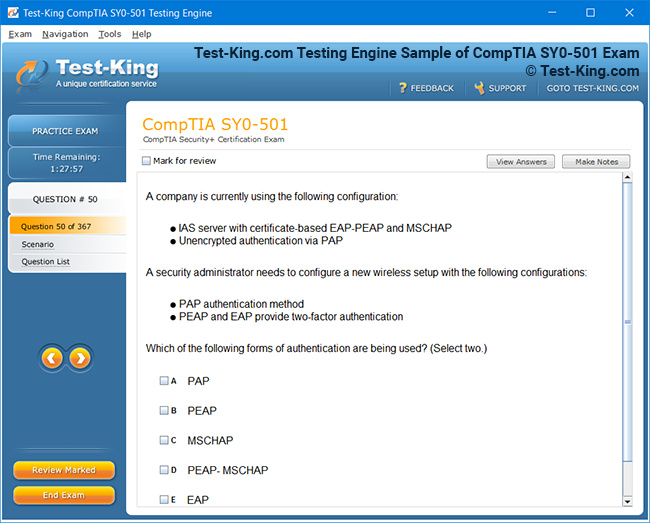
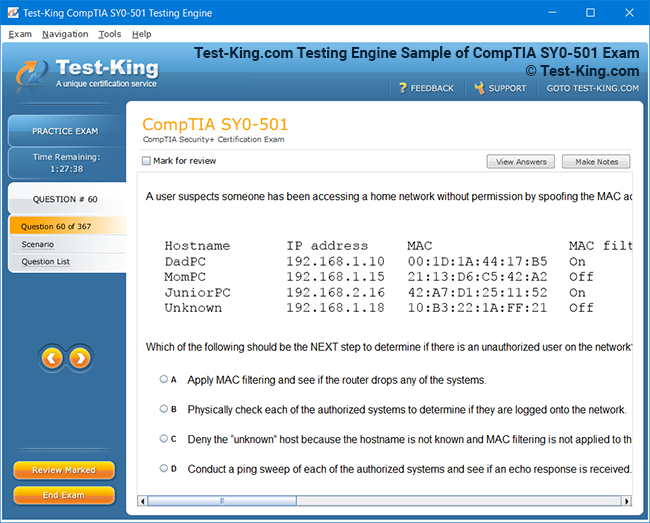
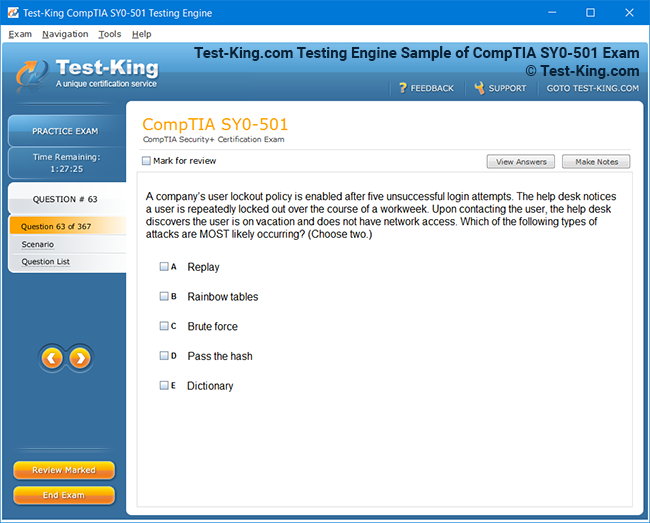
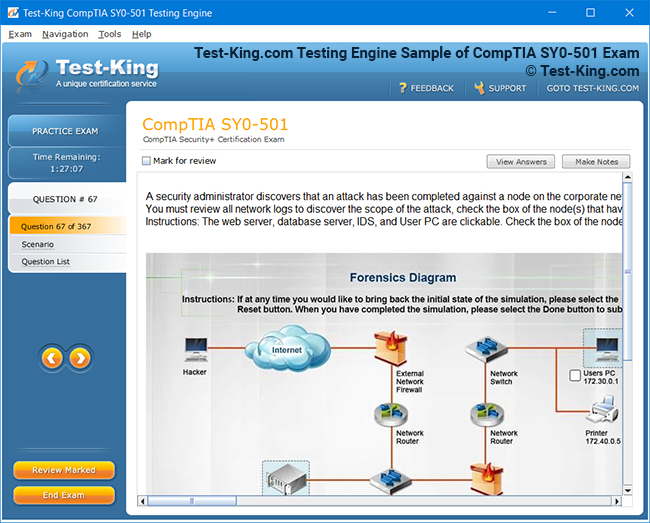
Product Screenshots
Frequently Asked Questions
How can I get the products after purchase?
All products are available for download immediately from your Member's Area. Once you have made the payment, you will be transferred to Member's Area where you can login and download the products you have purchased to your computer.
How long can I use my product? Will it be valid forever?
Test-King products have a validity of 90 days from the date of purchase. This means that any updates to the products, including but not limited to new questions, or updates and changes by our editing team, will be automatically downloaded on to computer to make sure that you get latest exam prep materials during those 90 days.
Can I renew my product if when it's expired?
Yes, when the 90 days of your product validity are over, you have the option of renewing your expired products with a 30% discount. This can be done in your Member's Area.
Please note that you will not be able to use the product after it has expired if you don't renew it.
How often are the questions updated?
We always try to provide the latest pool of questions, Updates in the questions depend on the changes in actual pool of questions by different vendors. As soon as we know about the change in the exam question pool we try our best to update the products as fast as possible.
How many computers I can download Test-King software on?
You can download the Test-King products on the maximum number of 2 (two) computers or devices. If you need to use the software on more than two machines, you can purchase this option separately. Please email support@test-king.com if you need to use more than 5 (five) computers.
What is a PDF Version?
PDF Version is a pdf document of Questions & Answers product. The document file has standart .pdf format, which can be easily read by any pdf reader application like Adobe Acrobat Reader, Foxit Reader, OpenOffice, Google Docs and many others.
Can I purchase PDF Version without the Testing Engine?
PDF Version cannot be purchased separately. It is only available as an add-on to main Question & Answer Testing Engine product.
What operating systems are supported by your Testing Engine software?
Our testing engine is supported by Windows. Andriod and IOS software is currently under development.
Top Blue Prism Exams
Blue Prism DEV01 Exam Preparation: Tips, Tricks, and Resources
Embarking on the journey to become a certified Blue Prism Developer necessitates a meticulous understanding of both the tool and its underlying philosophy. The Blue Prism DEV01 exam evaluates not merely superficial familiarity but a candidate’s aptitude in designing, building, and maintaining robotic process automation workflows that adhere to enterprise standards. To navigate this labyrinthine process, one must first grasp the core tenets of Blue Prism, including its architectural components, control room functions, and object-oriented process design.
Understanding the Blue Prism Developer Certification
The Blue Prism platform relies on the synergy between process and object layers, and a developer’s proficiency hinges on mastering this interplay. The process layer serves as the orchestrator, guiding the execution of automated tasks, whereas the object layer provides reusable components interfacing with diverse applications. Understanding the subtleties of exception handling within these layers is paramount, as the exam often tests the ability to anticipate, capture, and resolve unforeseen errors efficiently. A developer well-versed in these nuances exhibits not only technical competence but also strategic foresight, which distinguishes a proficient candidate from a novice.
Additionally, the examination assesses comprehension of environment variables and system settings, emphasizing the importance of a structured and scalable automation strategy. Aspiring candidates should familiarize themselves with work queues, the lifecycle of a digital workforce, and the mechanisms for logging and auditing actions. These elements, while seemingly procedural, reveal deeper insights into designing resilient and maintainable automation solutions.
Essential Skills and Knowledge Areas
To excel in the Blue Prism DEV01 examination, candidates must cultivate a versatile skill set encompassing both practical abilities and theoretical understanding. A pivotal domain involves the creation of business objects and process flows that efficiently mimic human interactions with software systems. This requires meticulous attention to detail, an understanding of UI element recognition, and the capability to navigate complex workflows without superfluous steps.
Another significant facet pertains to exception management, a recurrent theme in both the exam and real-world applications. Proficiency in identifying potential points of failure, implementing retry mechanisms, and ensuring graceful degradation of processes is indispensable. It is also crucial to comprehend the principles of multi-environment deployment, where processes developed in a development environment are migrated seamlessly to test and production environments, maintaining consistency and integrity.
A nuanced understanding of Blue Prism’s security model is equally critical. Candidates should be well-acquainted with user roles, credentials management, and access control measures that safeguard sensitive data while enabling smooth automation. This knowledge is frequently examined through scenario-based questions, requiring the application of best practices rather than rote memorization. Furthermore, familiarity with process optimization techniques, including minimizing redundant steps, enhancing execution efficiency, and leveraging caching strategies, can provide a strategic advantage during the exam.
Exam Preparation Strategies
Effective preparation for the Blue Prism DEV01 examination extends beyond rote study; it necessitates a holistic approach combining structured learning, hands-on practice, and strategic review. A foundational step involves immersing oneself in the official Blue Prism documentation, which offers detailed explanations of features, functionalities, and architectural concepts. This resource provides both a theoretical framework and practical insights, enabling candidates to internalize key concepts in a coherent and systematic manner.
Simultaneously, engaging with virtual labs and sandbox environments facilitates experiential learning, reinforcing theoretical knowledge through tangible application. Practicing the creation of complex process flows, debugging intricate automation scripts, and configuring work queues under varying scenarios fosters confidence and reduces exam-day anxiety. It is particularly beneficial to simulate real-world problems, such as handling multiple exceptions in parallel processes, as this mirrors the type of questions often presented in the examination.
Time management is another critical aspect of preparation. Allocating dedicated periods for studying different knowledge domains ensures balanced coverage of all essential areas, from process design to environment configuration. Incorporating periodic self-assessment through mock exams or practice questions helps identify weak points, allowing targeted remediation. Candidates should focus on the quality of practice rather than mere quantity, emphasizing understanding of underlying principles over superficial memorization.
Additionally, engaging with online communities and forums dedicated to Blue Prism development can provide valuable insights and alternative perspectives. These platforms often share nuanced challenges, rare problem-solving techniques, and experiential tips that are not readily available in official documentation. Networking with fellow aspirants or certified professionals can also motivate sustained preparation and provide pragmatic advice on navigating common pitfalls.
Common Challenges and How to Overcome Them
Candidates often encounter several recurring challenges when preparing for the Blue Prism DEV01 examination. One prevalent difficulty is mastering the intricate nuances of object and process interactions. Novices may underestimate the importance of clean, modular design, resulting in convoluted processes that are prone to errors. Overcoming this requires disciplined practice, emphasizing modular construction, reusable components, and systematic testing at each stage.
Another frequent obstacle is managing exception scenarios. While basic exception handling may seem straightforward, complex processes often involve nested or concurrent exceptions, which can be challenging to simulate without extensive practice. To address this, candidates should engage in deliberate experimentation, intentionally introducing anomalies in test environments and observing how the system responds. This cultivates a deeper understanding of Blue Prism’s error management capabilities and prepares candidates for scenario-based questions in the examination.
Time pressure is an additional challenge, particularly for those less accustomed to structured problem-solving under constraints. Developing a methodical approach to workflow construction, coupled with familiarity with commonly tested concepts, mitigates this issue. Regular timed exercises can help internalize an efficient sequence for analyzing problems, designing solutions, and validating outcomes, enhancing both speed and accuracy.
Lastly, the expansive breadth of the examination content can overwhelm candidates if approached haphazardly. To circumvent this, constructing a structured study plan that delineates priorities, integrates continuous review, and balances theoretical study with practical application is essential. Strategic focus on high-yield topics, supplemented by immersive practice, ensures comprehensive preparation without unnecessary cognitive fatigue.
Recommended Resources and Learning Aids
A curated selection of resources can significantly bolster exam readiness. Beyond the official documentation, several e-learning platforms offer structured courses that elucidate Blue Prism concepts through interactive modules, real-world case studies, and step-by-step demonstrations. These platforms often incorporate assessments at the end of each module, enabling incremental evaluation of comprehension and skill acquisition.
Supplementary reading materials, including advanced tutorials, workflow optimization guides, and practitioner blogs, provide diverse perspectives and nuanced insights. These resources can introduce rare techniques, unconventional approaches, and illustrative examples that enhance conceptual clarity. Candidates are encouraged to maintain a repository of notes, consolidating critical points, recurring patterns, and strategic tips for rapid revision prior to the exam.
In addition, leveraging visual aids, such as process diagrams and flowcharts, aids in conceptual retention. Translating textual knowledge into visual representations reinforces understanding of process logic, dependencies, and exception pathways. Collaborative study sessions, whether virtual or in-person, allow candidates to exchange interpretations, troubleshoot ambiguous scenarios, and cultivate analytical dexterity. Such interactions often reveal alternative solutions and foster adaptive thinking, both of which are invaluable during the examination.
Practical experience remains the most potent resource. Regular engagement with Blue Prism environments, experimentation with automation of diverse tasks, and iterative refinement of workflows create a robust foundation for success. This hands-on exposure embeds procedural memory, hones troubleshooting skills, and equips candidates with the agility to address novel scenarios presented in the exam.
Tips and Tricks for Effective Exam Day Performance
Success in the Blue Prism DEV01 examination is as much a function of preparation as it is of strategy on the day of the exam. A structured approach begins with familiarization with the exam interface, types of questions, and time allocation. Understanding the format reduces cognitive load, enabling candidates to focus on problem-solving rather than navigation. Prioritizing questions based on confidence levels ensures that easier tasks are completed first, preserving time for more intricate scenarios.
Maintaining mental clarity and composure is paramount. Techniques such as brief mindfulness exercises, deep breathing, and strategic pacing can alleviate anxiety, enhance concentration, and optimize cognitive performance. It is also advisable to maintain a clear workspace, minimize distractions, and have all necessary resources readily accessible, fostering an environment conducive to focused engagement.
When confronted with complex scenarios, candidates should adopt a methodical approach: dissect the problem into constituent parts, identify dependencies, anticipate potential exceptions, and construct the workflow incrementally. Avoiding hasty assumptions and verifying each step reduces errors and increases the likelihood of achieving accurate outcomes. Additionally, judicious use of available tools, such as built-in validation and debugging features, ensures alignment with best practices and demonstrates procedural rigor.
Finally, reflective analysis of practice sessions prior to the exam instills confidence. Reviewing previously encountered challenges, understanding recurring mistakes, and internalizing effective solutions creates a repository of experiential knowledge. This mental catalog enables rapid recall, adaptive problem-solving, and a sense of preparedness that is critical for navigating the rigorous demands of the Blue Prism DEV01 examination.
Deep Dive into Blue Prism Architecture
Understanding the architectural framework of Blue Prism is indispensable for a successful exam outcome. The platform relies on a multi-layered infrastructure that seamlessly orchestrates process automation, integrating application interaction, control mechanisms, and data management. Mastery of the underlying components, including the process layer, object layer, runtime resources, and control room, is crucial for designing scalable and resilient automation solutions.
Candidates should pay particular attention to the runtime resource, which executes the automated processes. Each resource functions as a virtual robot, capable of handling multiple concurrent tasks. Knowing how these resources interact with work queues and process priorities is essential, as exam questions often assess the ability to manage multiple workflows efficiently. Moreover, comprehension of the database layer, which stores logs, session information, and configuration data, enhances the ability to troubleshoot complex scenarios and ensure reliable execution.
The platform’s architecture is reinforced by security and governance protocols. Understanding how credentials, user roles, and access permissions integrate with automated workflows provides insights into safeguarding sensitive information. Familiarity with the exception management framework further allows candidates to anticipate and mitigate potential errors, a skill that is frequently tested through situational questions in the exam.
Mastering Process Design and Optimization
Designing effective Blue Prism processes demands meticulous planning, logical sequencing, and foresight into potential anomalies. A well-structured process not only executes efficiently but also anticipates errors and accommodates unexpected conditions. Candidates should focus on constructing modular, reusable components that can be deployed across multiple workflows, demonstrating both efficiency and adaptability.
Optimizing process flows involves minimizing redundancy, streamlining decision paths, and utilizing effective looping mechanisms. The intelligent application of collections and data items enhances the capability to manage large datasets, while calculated use of decision stages ensures dynamic, context-sensitive behavior. Emphasis should also be placed on clean and meaningful naming conventions for processes, objects, and data items, as clarity facilitates both debugging and collaboration.
Exception handling constitutes a cornerstone of process design. By incorporating recovery and retry mechanisms, developers ensure that processes can recover gracefully from unexpected conditions. Scenarios such as missing elements, timeouts, or unexpected application responses require thoughtful implementation of exception blocks, as exam questions often simulate real-world contingencies to assess a candidate’s problem-solving acumen.
Work Queues and Advanced Data Management
Work queues play a pivotal role in orchestrating automated tasks, particularly in high-volume environments. Candidates must understand how to enqueue, dequeue, and manage work items with precision. Effective use of work queues enhances process efficiency, ensures load balancing across runtime resources, and supports robust error recovery strategies.
Managing data within Blue Prism extends beyond simple storage. Candidates are expected to handle complex data structures, including collections, data items, and environment variables, ensuring data integrity throughout the process lifecycle. Understanding how to manipulate, filter, and aggregate data effectively is crucial, as it underpins decision-making within automated workflows. Additionally, knowledge of auditing, logging, and tracking mechanisms allows developers to maintain accountability, trace execution history, and debug anomalies with confidence.
Real-World Scenario Simulation
Practical application and scenario-based training are indispensable for mastering Blue Prism processes. Candidates should simulate real-world automation challenges, such as integrating with multiple applications, handling simultaneous exceptions, and managing interdependent processes. These exercises cultivate adaptive thinking, reinforce theoretical knowledge, and develop problem-solving strategies that are directly applicable to the examination.
For instance, candidates may encounter situations where data extraction from a legacy system fails intermittently. Designing a process that retries the extraction, logs failures, and escalates persistent errors exemplifies the type of practical knowledge the exam seeks. Similarly, automating customer onboarding or invoice processing in a controlled environment allows developers to explore nuances in process design, exception handling, and optimization.
Leveraging Object Studio for Effective Automation
Object Studio serves as the backbone for creating reusable components in Blue Prism. Mastery of this environment enables developers to encapsulate interactions with external applications, standardize actions, and simplify maintenance. Understanding the principles of application modelling, element identification, and action stage configuration is critical for constructing reliable business objects.
Candidates should also focus on debugging strategies within Object Studio, including step-through execution, breakpoints, and log analysis. Developing proficiency in these techniques enhances the ability to identify and resolve issues efficiently. The interplay between Object Studio and Process Studio is central to creating cohesive automation solutions, and the examination often evaluates the candidate’s understanding of how these components interact to deliver scalable automation.
Best Practices for Development and Maintenance
Adhering to best practices in Blue Prism development ensures not only exam readiness but also real-world effectiveness. Structured naming conventions, modular process design, comprehensive exception handling, and thorough documentation are fundamental principles. Candidates should emphasize building processes that are intuitive, maintainable, and adaptable to evolving business requirements.
Maintenance considerations include the ability to modify existing workflows without introducing errors, managing version control, and implementing regression testing. Understanding these aspects demonstrates an appreciation for long-term process sustainability, a quality that distinguishes proficient developers. Additionally, candidates should cultivate an awareness of resource allocation, concurrency management, and performance optimization, as these are recurring themes in practical scenarios and examination questions.
Exam Preparation Techniques and Resources
Effective preparation combines theoretical study with hands-on practice and strategic review. Engaging with official Blue Prism documentation provides foundational knowledge of architecture, process design, and best practices. Complementing this with interactive tutorials, video demonstrations, and immersive e-learning platforms reinforces comprehension through applied learning.
Candidates benefit from maintaining a structured study regimen, allocating dedicated time to explore process design, object creation, exception handling, and data management. Incorporating mock exams and practice workflows simulates examination conditions, enabling candidates to refine problem-solving strategies, improve speed, and identify areas requiring additional attention. Collaborative learning, including peer discussions and participation in online forums, exposes candidates to diverse perspectives, uncommon techniques, and practical solutions that enrich understanding and reinforce knowledge retention.
Strategic Approaches to Complex Questions
Encountering intricate questions in the Blue Prism DEV01 exam necessitates a methodical and analytical approach. Candidates should first deconstruct the problem, identifying dependencies, potential exceptions, and data flow requirements. By segmenting complex scenarios into manageable components, candidates can approach each element systematically, ensuring comprehensive coverage and reducing the likelihood of oversight.
Scenario-based questions often assess the candidate’s ability to integrate multiple concepts, such as combining exception handling with work queue management or optimizing process performance while maintaining robust security controls. Developing mental frameworks for evaluating such questions enhances adaptability, reinforces conceptual understanding, and fosters confidence during the examination. Emphasis should be placed on logical reasoning, attention to detail, and the anticipation of edge cases, as these qualities are frequently tested.
Tips for Maintaining Consistency and Focus
Sustained focus and consistency are essential for both preparation and examination performance. Candidates should cultivate disciplined study habits, balancing theoretical exploration with extensive practical exercises. Mindful pacing, regular reflection, and iterative review of challenging topics contribute to deeper comprehension and retention.
Practical exercises should be varied in scope and complexity, encompassing both straightforward automation tasks and intricate workflows. Reflecting on errors, analyzing alternative solutions, and iteratively refining processes cultivates resilience and problem-solving dexterity. Additionally, leveraging visual aids, mental maps, and conceptual diagrams enhances cognitive retention, enabling candidates to navigate complex scenarios with clarity and precision.
Enhancing Problem-Solving Skills through Realistic Simulations
Simulating realistic automation environments accelerates the development of advanced problem-solving skills. Candidates should experiment with multi-application processes, concurrent workflow execution, and dynamic exception handling. These simulations build confidence, foster adaptability, and reinforce knowledge acquired through study.
Practicing scenario-based exercises, such as handling asynchronous data inputs or integrating with external APIs, develops analytical acuity and operational foresight. By repeatedly exposing oneself to challenging conditions, candidates cultivate an intuitive understanding of process dynamics, enabling rapid identification of optimal solutions during the examination. This hands-on experience bridges the gap between theoretical knowledge and practical application, enhancing readiness and self-assurance.
Advanced Understanding of Blue Prism Components
The Blue Prism platform thrives on the integration of multiple components that collectively enable the seamless automation of enterprise tasks. A comprehensive understanding of the process layer, object layer, and runtime resources is indispensable for candidates aspiring to excel in the examination. Each component operates synergistically, and proficiency lies not only in knowing their individual functions but also in appreciating the nuanced interactions among them.
The process layer serves as the operational blueprint, dictating the sequence and logic of automated tasks. Designing processes with precision involves mapping each step methodically, anticipating exceptions, and ensuring that workflow logic remains coherent under all conditions. The object layer complements this by providing reusable building blocks for interacting with diverse applications, encapsulating the complexity of application interfaces while enabling modularity and maintainability. Runtime resources execute these processes, dynamically managing concurrent workloads, prioritizing tasks, and reporting status to the control room for monitoring and intervention. Understanding the intricacies of these interactions ensures that automation is not only functional but resilient and adaptable to evolving business demands.
Mastering Exception Handling and Recovery Mechanisms
Exception handling is a cornerstone of Blue Prism development, and the examination rigorously tests candidates’ abilities to design robust mechanisms for error detection and recovery. Effective exception handling requires anticipating potential points of failure and implementing strategies to maintain process continuity under unforeseen conditions.
Candidates should focus on categorizing exceptions, distinguishing between recoverable and non-recoverable errors, and implementing appropriate handling measures for each. Utilizing retry mechanisms, recovery blocks, and logging practices ensures that processes can continue executing without disruption while preserving data integrity. For example, a process encountering a missing data element can be configured to log the error, attempt automatic correction, and escalate unresolved issues. Understanding these strategies demonstrates both technical competence and foresight, qualities that the examination seeks to assess.
Optimizing Workflows for Efficiency
Efficiency in workflow design is a critical determinant of both real-world automation performance and exam success. Streamlined processes reduce redundancy, minimize processing time, and enhance system stability. Candidates should employ structured techniques for analyzing workflow complexity, identifying bottlenecks, and optimizing decision paths.
Collections and data items should be leveraged strategically to handle complex data sets, while decision stages must be designed to reflect logical contingencies accurately. Emphasis should be placed on clean and consistent naming conventions, facilitating easier debugging, maintenance, and collaboration. Optimization also extends to resource allocation, ensuring that runtime resources are utilized effectively without overloading any single component. Candidates familiar with these principles can approach examination questions that test scenario optimization with confidence and precision.
Practical Application through Scenario Simulation
Practical simulation of real-world scenarios enhances conceptual understanding and prepares candidates for the examination’s situational challenges. Candidates should engage in exercises that replicate business processes, incorporating multiple application interfaces, data transformations, and exception handling pathways.
For instance, automating the process of customer account creation across multiple platforms may involve extracting information from a web portal, updating an internal database, and sending confirmation notifications via email. Each stage must be designed to handle potential failures gracefully, ensure data integrity, and provide traceability. These simulations foster critical thinking, reinforce theoretical knowledge, and develop the problem-solving agility necessary for navigating complex examination scenarios.
Leveraging Object Studio for Reusable Components
Object Studio is the fulcrum of reusable component development within Blue Prism, and proficiency in this environment is essential for both examination and real-world practice. Creating business objects involves modeling application interactions, configuring action stages, and managing element recognition with precision.
Candidates should focus on structuring objects to maximize reusability and minimize maintenance overhead. Debugging strategies within Object Studio, including step-through execution and breakpoint analysis, enable developers to identify issues rapidly and implement corrections efficiently. Integrating Object Studio components with Process Studio workflows exemplifies a systematic approach to building scalable, maintainable, and reliable automation solutions, a key competency assessed during the examination.
Data Management and Work Queue Strategies
Effective data management underpins successful automation. Candidates must be adept at manipulating collections, data items, and environment variables, ensuring that data flows seamlessly throughout processes. Work queues serve as the organizational backbone for managing high-volume automation tasks, enabling prioritization, load balancing, and error recovery.
Understanding the nuances of enqueueing, dequeuing, and processing work items enhances process efficiency and reliability. Logging and audit mechanisms provide transparency, facilitate troubleshooting, and support compliance requirements. Candidates proficient in these strategies can construct processes that handle complex data and workload scenarios with robustness and precision, aligning with the expectations of the examination.
Exam Preparation Techniques and Structured Practice
Achieving excellence in the Blue Prism DEV01 examination necessitates a structured and disciplined preparation approach. Candidates should combine theoretical study with extensive hands-on practice, ensuring that conceptual understanding is reinforced through application. Official documentation provides the foundational knowledge required to navigate architectural, design, and operational aspects of the platform. Complementing this with immersive tutorials, interactive exercises, and practice workflows fosters experiential learning and cognitive retention.
Time management during preparation is critical. Allocating focused study sessions to distinct knowledge domains, followed by iterative review and self-assessment, ensures balanced coverage and strengthens areas of weakness. Mock exams and practice workflows simulate examination conditions, enabling candidates to refine problem-solving strategies, enhance execution speed, and develop confidence. Collaborative engagement through peer discussions, online forums, and mentorship further enriches the learning experience, exposing candidates to diverse approaches and uncommon problem-solving techniques.
Handling Complex Scenarios with Analytical Precision
Examination questions frequently present complex scenarios that require the integration of multiple Blue Prism concepts. Candidates should approach these systematically, deconstructing each scenario into discrete components, identifying dependencies, anticipating potential exceptions, and constructing logical workflows.
Scenario-based questions may involve multi-application interactions, concurrent process execution, and dynamic exception handling. Developing mental frameworks to assess these situations promotes analytical rigor, encourages strategic thinking, and reduces cognitive overload during the examination. Candidates should practice applying structured reasoning, leveraging reusable components, and optimizing process flows to address intricate challenges effectively.
Developing Adaptive Problem-Solving Skills
Adaptive problem-solving is a hallmark of proficient Blue Prism developers. Candidates should cultivate the ability to respond flexibly to unforeseen challenges, drawing upon both theoretical knowledge and practical experience. Engaging with diverse automation tasks, experimenting with complex workflows, and iteratively refining processes strengthens cognitive agility and operational foresight.
Exercises involving real-time error handling, multi-step decision-making, and integration with external systems enhance resilience and develop a nuanced understanding of process dynamics. Repeated exposure to challenging scenarios builds confidence, sharpens analytical skills, and equips candidates with the capacity to devise optimal solutions under examination constraints.
Enhancing Focus and Cognitive Retention
Sustaining focus and retaining complex information are critical during both preparation and examination. Candidates should employ techniques that support deep concentration, such as structured study intervals, active recall, and visualization of process flows. Mapping theoretical concepts to practical simulations reinforces understanding and promotes long-term retention.
Regular reflection on mistakes, iterative problem-solving, and adaptive learning approaches strengthen cognitive resilience. Leveraging conceptual diagrams, mental models, and associative memory techniques enables candidates to navigate complex workflows and scenario-based questions with clarity, precision, and confidence.
Leveraging Resources for Exam Readiness
A diverse array of learning resources can significantly enhance exam preparedness. Official Blue Prism documentation provides detailed guidance on platform architecture, process design, exception handling, and best practices. Supplementary resources, including e-learning platforms, tutorials, and practitioner blogs, offer alternative perspectives, practical tips, and illustrative examples that deepen understanding.
Engaging with online communities, discussion forums, and peer groups exposes candidates to uncommon techniques, rare problem-solving strategies, and experiential insights that are difficult to acquire through solitary study. Maintaining organized notes, compiling critical tips, and documenting lessons learned from practical exercises ensures that knowledge is readily accessible during final preparation stages.
Strategic Approaches for Exam Day Performance
Examination performance hinges not only on knowledge but also on strategic execution. Candidates should familiarize themselves with the exam interface, types of questions, and timing constraints. Prioritizing questions based on familiarity and confidence ensures efficient use of time, while systematic evaluation of complex scenarios promotes accuracy and thoroughness.
Maintaining composure, pacing effectively, and employing structured reasoning are crucial for managing cognitive load. Candidates should approach each problem methodically, breaking it down into manageable components, anticipating exceptions, and constructing logical workflows. Leveraging prior practice, reflective analysis, and iterative review enables candidates to navigate challenges with precision, adaptability, and assurance.
Comprehensive Knowledge of Blue Prism Environment
The Blue Prism platform embodies a sophisticated framework for robotic process automation, necessitating a nuanced understanding of its environment for effective implementation and exam success. The platform comprises multiple integral components, including process and object layers, runtime resources, control room functionalities, and database integration, each contributing to seamless automation. Mastery involves recognizing the interplay among these elements and leveraging them to design resilient, scalable, and efficient workflows.
Candidates must appreciate the runtime resource’s dynamic capabilities, as these virtual robots execute processes while managing concurrent workloads. Understanding their orchestration, task allocation, and interaction with work queues is essential, as exam scenarios frequently evaluate candidates on their ability to optimize resource utilization. Familiarity with the control room and session management allows for monitoring, intervention, and auditing, enabling developers to maintain process integrity and compliance. This knowledge is foundational for both theoretical questions and scenario-based problems presented in the examination.
Strategic Process Design Principles
Designing robust processes is central to Blue Prism development, emphasizing both structural clarity and functional efficiency. Processes should be modular, encapsulating distinct functionalities while promoting reuse across multiple workflows. Candidates should meticulously plan the sequence of operations, integrating decision points, data manipulation stages, and exception handling mechanisms to ensure reliability under varied conditions.
Optimizing process efficiency involves eliminating redundancies, simplifying loops, and applying logical decision structures judiciously. Strategic use of collections and data items facilitates handling complex datasets, while well-defined decision stages enable adaptive process behavior. Naming conventions and documentation practices are equally critical, as they enhance readability, maintainability, and collaboration among development teams. These considerations are routinely tested in the examination through scenario-based questions that assess both design acumen and operational foresight.
Mastery of Object Studio for Reusable Components
Object Studio provides the foundation for creating reusable business objects that encapsulate interactions with external applications. Proficiency in this environment requires understanding element recognition, action stage configuration, and application modeling. Candidates should focus on designing objects that are modular, maintainable, and capable of seamless integration with process workflows.
Debugging within Object Studio, including step-through execution, breakpoints, and log analysis, enables developers to identify issues rapidly and implement corrective measures. A thorough grasp of the synergy between Object Studio and Process Studio ensures cohesive workflow construction, supporting scalability and reducing the likelihood of errors. Examination scenarios frequently challenge candidates to demonstrate this mastery through practical problem-solving exercises that integrate multiple objects into coherent process flows.
Effective Exception Handling and Error Recovery
Exception management represents a critical component of both real-world automation and the examination. Candidates must anticipate potential failures, categorize exceptions, and implement appropriate recovery mechanisms. These strategies include retry logic, recovery blocks, and detailed logging to maintain process continuity and ensure data integrity.
Handling nested or concurrent exceptions requires careful planning and practice, as complex scenarios often introduce cascading errors that must be mitigated without disrupting overall workflow execution. Candidates should also consider escalation procedures, alerting mechanisms, and fallback strategies to manage persistent failures. Mastery of these techniques is essential, as examination questions frequently present realistic scenarios where effective exception management determines the success of the solution.
Optimizing Work Queues and Data Handling
Work queues serve as the structural backbone for managing high-volume automation tasks, ensuring balanced distribution of workloads across runtime resources. Candidates must understand the intricacies of enqueuing, dequeuing, and managing work items, prioritizing tasks, and maintaining error resilience. Efficient queue management contributes significantly to process reliability and operational efficiency.
Data handling within Blue Prism extends beyond mere storage. Collections, data items, and environment variables must be manipulated accurately to maintain integrity and support dynamic decision-making. Logging, auditing, and tracking mechanisms provide transparency, facilitate troubleshooting, and satisfy compliance requirements. Proficiency in these areas enables candidates to construct robust processes capable of managing complex datasets and orchestrating high-volume workflows with precision.
Practical Scenario-Based Training
Engaging with realistic automation scenarios is invaluable for reinforcing theoretical knowledge and developing practical problem-solving skills. Candidates should simulate diverse business processes, incorporating multi-application interactions, concurrent execution paths, and dynamic exception handling. These exercises cultivate adaptability, critical thinking, and operational dexterity.
For example, automating order processing might involve extracting data from emails, updating internal systems, and generating notifications. Each step must be carefully constructed to handle errors, ensure data accuracy, and provide traceable logs. Scenario-based practice fosters an intuitive understanding of workflow logic, exception handling, and optimization strategies, preparing candidates to tackle complex questions presented in the examination.
Advanced Process Optimization Techniques
Optimizing processes is crucial for both efficiency and examination performance. Candidates should evaluate workflows for redundancy, performance bottlenecks, and resource allocation inefficiencies. Strategic application of looping mechanisms, decision logic, and data handling techniques enhances execution speed and reduces potential errors.
Optimization extends to concurrency management, ensuring that runtime resources operate at maximum efficiency without conflicts. Incorporating reusable components, modular design, and streamlined exception handling contributes to scalable and maintainable automation solutions. Examination scenarios often test these capabilities, presenting complex workflows where candidates must identify inefficiencies and propose refined solutions that maintain robustness and reliability.
Leveraging Resources and Study Strategies
A combination of official documentation, e-learning platforms, tutorials, and practical exercises forms the backbone of effective exam preparation. Candidates should study the architectural foundations, process and object design principles, exception handling strategies, and optimization techniques extensively.
Structured practice is essential, encompassing hands-on exercises that replicate realistic business processes. Mock exams and timed workflows help refine problem-solving speed and accuracy while highlighting areas requiring further focus. Collaborative engagement with peers, online communities, and professional forums introduces alternative perspectives, rare techniques, and experiential insights that enrich understanding. Maintaining detailed notes, organizing study materials, and documenting lessons from practical exercises enables efficient revision and reinforces cognitive retention.
Strategic Approaches to Complex Examination Scenarios
Examination questions frequently involve intricate scenarios requiring the integration of multiple Blue Prism concepts. Candidates should approach these methodically, breaking down problems into manageable components, analyzing dependencies, anticipating exceptions, and constructing logical workflows.
Scenario-based questions may involve multi-application interactions, concurrent processes, dynamic decision-making, and exception handling. Developing analytical frameworks and systematic reasoning enhances the ability to address such challenges efficiently. Candidates should focus on logical sequencing, resource management, and process optimization to produce solutions that are both correct and efficient, demonstrating comprehensive mastery of the platform.
Enhancing Problem-Solving and Critical Thinking
Adaptive problem-solving and critical thinking are essential for navigating the complex landscape of Blue Prism development. Candidates should cultivate flexibility in responding to unforeseen challenges, drawing upon both theoretical understanding and practical experience.
Exercises involving real-time error handling, multi-step decision-making, and integration with diverse applications develop analytical acuity and operational foresight. Repeated exposure to challenging scenarios reinforces procedural memory, sharpens judgment, and equips candidates with the capacity to devise optimal solutions under examination constraints. These skills are invaluable for both the examination and real-world automation projects, bridging the gap between conceptual knowledge and practical application.
Maintaining Focus and Cognitive Resilience
Sustained focus, cognitive resilience, and mental clarity are critical for successful examination performance. Candidates should employ techniques such as structured study intervals, active recall, visualization of process flows, and iterative reflection to reinforce understanding and retention.
Regularly revisiting complex topics, analyzing mistakes, and refining approaches cultivates intellectual agility and problem-solving confidence. Leveraging conceptual diagrams, mental frameworks, and associative memory strategies supports clarity in navigating complex workflows and scenario-based questions. These practices ensure that candidates can perform methodically, accurately, and efficiently under examination conditions.
In-Depth Understanding of Blue Prism Architecture
The Blue Prism platform represents a sophisticated framework for robotic process automation, where each component contributes to seamless task execution. Mastery of the process layer, object layer, runtime resources, and control room functionalities is essential for designing scalable and resilient automation workflows. Candidates must understand the interrelationships among these elements, appreciating how each contributes to process orchestration, error handling, and resource management.
Runtime resources execute processes dynamically, managing concurrent workloads and reporting status to the control room. Understanding task allocation, session management, and logging mechanisms enables candidates to monitor, troubleshoot, and optimize performance effectively. The database layer, which stores logs, session details, and configuration settings, forms the backbone of traceability, ensuring that workflows can be audited and analyzed for efficiency and compliance. Mastery of this architecture allows candidates to anticipate complex scenarios and address them with strategic precision during the examination.
Effective Process Design and Optimization
Robust process design is a critical determinant of success in the Blue Prism DEV01 examination. Candidates must develop workflows that are modular, reusable, and adaptable to varying business requirements. Each process should be planned meticulously, with clearly defined data flow, decision points, and exception handling mechanisms.
Optimizing processes involves minimizing redundant steps, streamlining decision logic, and leveraging collections and data items efficiently. Loops should be constructed to maximize performance while avoiding unnecessary iterations. Candidates should also maintain clean naming conventions and thorough documentation, which facilitate debugging, collaboration, and long-term maintainability. Practical exercises in process optimization provide a dual benefit: they reinforce theoretical knowledge and cultivate the analytical agility necessary for scenario-based examination questions.
Mastery of Object Studio and Reusable Components
Object Studio forms the foundation for creating reusable components that interact with external applications. Proficiency requires understanding element recognition, action stage configuration, and application modeling techniques. Candidates should design objects to be modular, maintainable, and easily integrable with process workflows, emphasizing clarity and scalability.
Debugging strategies within Object Studio, including step-through execution, breakpoint analysis, and log inspection, are essential for identifying and resolving issues efficiently. The integration of Object Studio components with Process Studio workflows exemplifies a cohesive approach to automation, ensuring that complex processes remain reliable and manageable. Examination questions often test the ability to apply these concepts in practical scenarios, highlighting the importance of hands-on experience and systematic design thinking.
Exception Handling and Error Recovery Strategies
Exception management is central to both practical automation and examination readiness. Candidates must anticipate points of failure, classify exceptions, and implement appropriate recovery mechanisms. These may include retry logic, recovery blocks, and detailed logging to maintain process continuity and preserve data integrity.
Handling nested or concurrent exceptions presents additional challenges, as errors in one process stage can propagate and affect subsequent operations. Candidates should develop strategies for escalation, alerting, and fallback to ensure that processes remain robust even under unexpected conditions. Realistic practice scenarios, such as simulating intermittent application failures or missing data elements, cultivate the problem-solving skills necessary to address complex examination questions effectively.
Advanced Work Queue and Data Management Techniques
Work queues serve as the structural backbone for managing high-volume automation tasks. Candidates must understand the intricacies of enqueuing, dequeuing, and prioritizing work items, ensuring balanced workloads across runtime resources and maintaining resilience against failures.
Data management extends beyond storage and retrieval, encompassing the manipulation of collections, data items, and environment variables. Accurate handling of data ensures that processes make reliable decisions, maintain integrity, and support dynamic logic. Logging and auditing mechanisms provide transparency and traceability, supporting compliance and enabling troubleshooting. Candidates proficient in these techniques are well-prepared to handle high-complexity scenarios presented during the examination.
Practical Scenario-Based Exercises
Engaging in realistic scenario-based exercises reinforces theoretical knowledge and cultivates practical problem-solving skills. Candidates should simulate diverse business processes, including multi-application interactions, concurrent execution paths, and dynamic exception handling.
For example, automating invoice processing may involve extracting data from emails, updating ERP systems, and sending notifications. Each step requires careful design to handle errors, ensure data integrity, and provide traceable logs. Scenario-based exercises develop intuitive understanding, reinforce workflow logic, and prepare candidates to approach examination questions with confidence, precision, and analytical acumen.
Optimization of Processes for Performance
Optimizing processes is vital for efficiency and examination success. Candidates should evaluate workflows for redundancies, bottlenecks, and inefficient resource allocation. Loops, decision logic, and data manipulation strategies should be streamlined to enhance execution speed and reduce errors.
Concurrency management ensures that runtime resources operate at optimal capacity without conflicts. Modular design, reusable components, and robust exception handling contribute to scalable and maintainable automation solutions. Examination questions often challenge candidates to refine complex workflows for performance while maintaining robustness, making familiarity with optimization techniques crucial for achieving high scores.
Resource Utilization and Study Strategies
Effective exam preparation combines theoretical study, hands-on practice, and structured review. Official documentation provides foundational knowledge of Blue Prism architecture, process design, exception handling, and optimization principles. Supplementary resources, including tutorials, e-learning platforms, and practitioner blogs, offer alternative perspectives, practical tips, and illustrative examples that deepen understanding.
Structured practice includes timed exercises, mock examinations, and complex workflow simulations. These activities improve problem-solving speed, accuracy, and familiarity with examination scenarios. Collaborative learning, including discussions with peers, online communities, and professional networks, exposes candidates to uncommon techniques and experiential insights. Maintaining organized notes and documenting lessons learned from practice exercises ensures efficient revision and reinforces cognitive retention.
Handling Complex Examination Scenarios
Examination scenarios often integrate multiple Blue Prism concepts, challenging candidates to apply knowledge holistically. Methodical problem decomposition, identification of dependencies, anticipation of exceptions, and construction of logical workflows are critical strategies for success.
Scenario-based questions may involve multi-application processes, concurrent execution paths, dynamic decision-making, and advanced exception handling. Developing analytical frameworks and structured reasoning enhances a candidate’s ability to navigate these challenges efficiently. Emphasis should be placed on logical sequencing, resource management, and optimization techniques to produce accurate, robust, and efficient solutions, demonstrating comprehensive mastery of the platform.
Enhancing Critical Thinking and Problem-Solving Skills
Critical thinking and adaptive problem-solving are essential for both examination and real-world automation. Candidates should cultivate flexibility, drawing upon theoretical understanding and practical experience to address novel challenges.
Exercises involving real-time error handling, multi-step decision-making, and integration with external systems enhance analytical skills and operational foresight. Repeated exposure to challenging scenarios strengthens procedural memory, sharpens judgment, and equips candidates to devise optimal solutions under examination constraints. These capabilities ensure that candidates are prepared for both the conceptual and practical demands of the Blue Prism DEV01 exam.
Maintaining Focus, Retention, and Cognitive Agility
Sustaining focus and retaining complex information are critical during preparation and examination. Structured study intervals, active recall techniques, visualization of process flows, and iterative reflection reinforce understanding and long-term retention.
Regular review of challenging topics, analysis of mistakes, and refinement of problem-solving approaches build intellectual agility and confidence. Conceptual diagrams, mental frameworks, and associative memory strategies enhance clarity when navigating intricate workflows and scenario-based questions. These practices ensure candidates can perform methodically, accurately, and efficiently under examination conditions.
Conclusion
Success in the Blue Prism DEV01 examination requires a harmonious blend of theoretical knowledge, practical expertise, and strategic execution. Candidates who develop mastery over process and object layers, exception handling, work queues, data management, and optimization techniques are well-positioned to tackle both scenario-based and conceptual questions effectively.
Structured preparation, hands-on practice, realistic simulations, and engagement with diverse resources enhance understanding, retention, and confidence. By cultivating critical thinking, adaptive problem-solving skills, and cognitive resilience, candidates can navigate complex examination scenarios with precision and assurance. Ultimately, a disciplined, comprehensive, and strategic approach ensures not only examination success but also prepares candidates for the demands of professional Blue Prism development in real-world enterprise environments.