

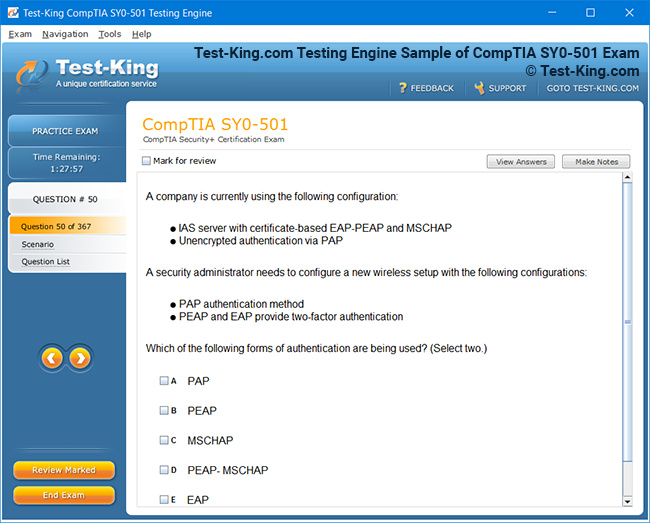
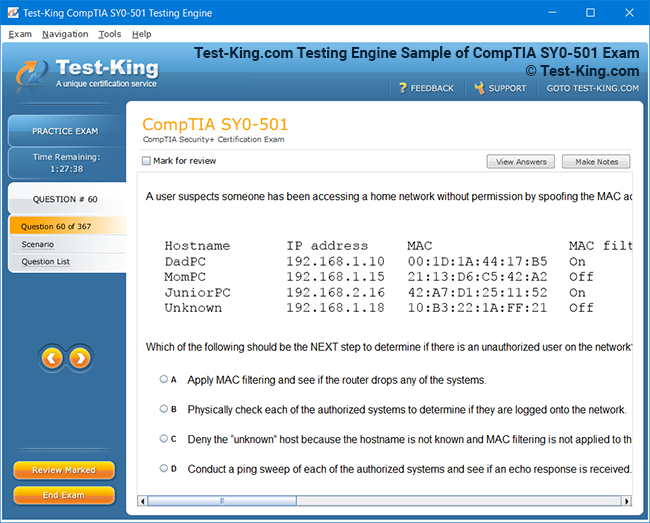
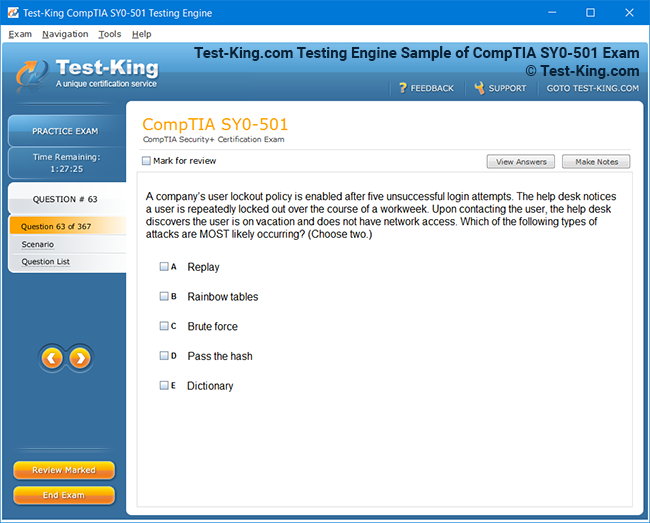
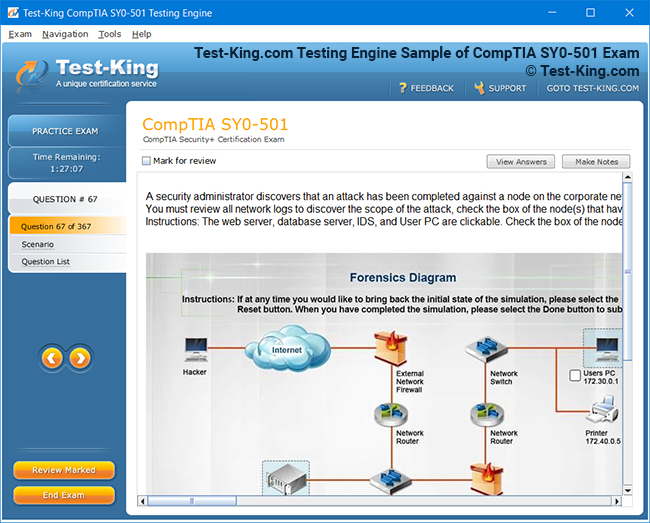
Product Screenshots
Frequently Asked Questions
How can I get the products after purchase?
All products are available for download immediately from your Member's Area. Once you have made the payment, you will be transferred to Member's Area where you can login and download the products you have purchased to your computer.
How long can I use my product? Will it be valid forever?
Test-King products have a validity of 90 days from the date of purchase. This means that any updates to the products, including but not limited to new questions, or updates and changes by our editing team, will be automatically downloaded on to computer to make sure that you get latest exam prep materials during those 90 days.
Can I renew my product if when it's expired?
Yes, when the 90 days of your product validity are over, you have the option of renewing your expired products with a 30% discount. This can be done in your Member's Area.
Please note that you will not be able to use the product after it has expired if you don't renew it.
How often are the questions updated?
We always try to provide the latest pool of questions, Updates in the questions depend on the changes in actual pool of questions by different vendors. As soon as we know about the change in the exam question pool we try our best to update the products as fast as possible.
How many computers I can download Test-King software on?
You can download the Test-King products on the maximum number of 2 (two) computers or devices. If you need to use the software on more than two machines, you can purchase this option separately. Please email support@test-king.com if you need to use more than 5 (five) computers.
What is a PDF Version?
PDF Version is a pdf document of Questions & Answers product. The document file has standart .pdf format, which can be easily read by any pdf reader application like Adobe Acrobat Reader, Foxit Reader, OpenOffice, Google Docs and many others.
Can I purchase PDF Version without the Testing Engine?
PDF Version cannot be purchased separately. It is only available as an add-on to main Question & Answer Testing Engine product.
What operating systems are supported by your Testing Engine software?
Our testing engine is supported by Windows. Andriod and IOS software is currently under development.
Top Nutanix Exams
- NCP-MCI v7.5 - Nutanix Certified Professional - Multicloud Infrastructure v7.5
- NCP-MCI v6.10 - Nutanix Certified Professional - Multicloud Infrastructure v6.10
- NCA v6.10 - Nutanix Certified Associate v6.10
- NCP-MCA v6.10 - Nutanix Certified Professional - Multicloud Automation v6.10
- NCS-Core 6.8 - Nutanix Certified Services - Core (NCS-Core) 6.8
- NCP-CN v6.10 - Nutanix Certified Professional - Cloud Native v6.10
- NCP-CI-AWS v6.7 - Nutanix Certified Professional - Cloud Integration - AWS v6.7
- NCA - Nutanix Certified Associate
Comprehensive Guide to the Nutanix Certified Associate v6.10 Exam
The Nutanix Certified Associate v6.10 exam is an esteemed credential that validates foundational knowledge and practical skills in managing Nutanix environments. Designed for individuals beginning their journey with hyperconverged infrastructure, the exam serves as a gateway to understanding the intricacies of Nutanix solutions and architecture. Candidates who pursue this certification demonstrate their capability to navigate complex virtualized environments, manage storage, and orchestrate network configurations effectively. The examination encompasses both theoretical concepts and practical scenarios, ensuring that candidates are not only acquainted with the terminologies but also adept at deploying and troubleshooting Nutanix clusters.
Understanding the Nutanix Certified Associate v6.10 Exam
Eligibility for the exam is inclusive, welcoming IT professionals with a range of experiences, from those familiar with virtualization principles to those new to Nutanix systems. The certification does not mandate prior Nutanix certification, though familiarity with virtualization concepts, cloud architecture, and enterprise IT infrastructure will provide a distinct advantage. The exam framework is structured to assess the candidate's understanding of core concepts, operational procedures, and management tools. A meticulous study of system architecture, cluster operations, storage management, and foundational networking is imperative to achieve proficiency.
Exam Objectives and Knowledge Areas
The exam evaluates multiple domains essential for managing a Nutanix environment. One of the primary areas is the architecture of hyperconverged infrastructure, emphasizing how Nutanix integrates storage, compute, and networking into a cohesive solution. Candidates are expected to grasp the distributed nature of clusters, how nodes interact, and the mechanisms behind data resiliency and redundancy. Another critical domain includes practical operations such as cluster expansion, node addition, and configuring storage containers to optimize performance and efficiency. Understanding storage tiers, compression, deduplication, and data locality is fundamental for effective resource management.
Networking comprehension forms a significant portion of the exam. Candidates must understand virtual network design, VLAN configuration, IP assignment, and network redundancy principles. In addition, familiarity with virtual machine management, including creation, migration, snapshot management, and performance monitoring, is crucial. The Nutanix Prism interface, a central management tool, is an integral component of the exam objectives. Candidates should demonstrate proficiency in navigating Prism dashboards, interpreting performance metrics, and executing administrative tasks. Security and compliance, while foundational, are also evaluated, emphasizing role-based access controls, authentication mechanisms, and audit logging.
Exam Structure and Format
The Nutanix Certified Associate v6.10 exam is designed to be challenging yet attainable with diligent preparation. It typically comprises multiple-choice questions, scenario-based queries, and situational judgment items that evaluate applied knowledge rather than rote memorization. Each question is crafted to simulate real-world operational challenges, requiring candidates to analyze scenarios and select the most appropriate course of action. The exam duration is sufficient to address each domain thoroughly, providing candidates with an opportunity to demonstrate their mastery across all knowledge areas.
Scoring is objective, with each question weighted according to its complexity and relevance to practical operations. Candidates must demonstrate competency across core domains, including cluster management, virtual machine operations, storage configuration, and networking fundamentals. The examination environment emphasizes problem-solving and critical thinking, compelling candidates to apply their knowledge in scenarios that closely mirror enterprise environments. This approach ensures that certified individuals are not merely familiar with theoretical concepts but are also prepared to manage, troubleshoot, and optimize Nutanix infrastructures in professional settings.
Recommended Study and Preparation Strategies
Effective preparation for the NCA v6.10 exam involves a combination of conceptual learning, hands-on practice, and scenario analysis. A structured study plan should encompass the exploration of Nutanix documentation, training modules, and community resources. Detailed examination of cluster architecture, storage constructs, and virtualization principles provides a robust foundation. Candidates should focus on understanding the rationale behind operational procedures, not just their execution, as this enhances the ability to navigate complex problem scenarios during the exam.
Hands-on experience is invaluable. Simulating cluster deployments, configuring storage containers, and managing virtual machines allows candidates to internalize concepts and reinforce learning. Practice with Prism interface dashboards, performance monitoring tools, and network configurations cultivates familiarity with operational workflows. Engaging in scenario-based exercises, such as responding to hypothetical failures or optimizing resource allocation, sharpens analytical skills and ensures preparedness for situational questions. Additionally, joining online forums and study groups exposes candidates to diverse perspectives, rare operational challenges, and nuanced solutions that may not be covered in official study materials.
Exam Day Insights and Strategies
Approaching the exam with a composed mindset is crucial. Familiarity with the question format, time management, and scenario analysis techniques enhances performance. Candidates should read each question meticulously, paying attention to subtle nuances that differentiate superficially similar options. Eliminating obviously incorrect choices before deliberating on the remaining options optimizes time and reduces cognitive load. It is equally important to maintain consistent pacing, allocating sufficient time to address all questions without rushing or lingering excessively on particularly challenging items.
The ability to connect theoretical knowledge with practical applications is often the differentiator in achieving a high score. Candidates are encouraged to visualize operational scenarios, mentally simulating cluster expansions, storage provisioning, and network adjustments to arrive at informed decisions. Attention to detail, logical deduction, and methodical problem-solving are indispensable during the examination. Understanding the intent behind each question, rather than focusing solely on keywords, ensures accurate interpretation and appropriate responses.
Career Implications and Value
Attaining the Nutanix Certified Associate v6.10 certification signals to employers and peers that the individual possesses a comprehensive understanding of hyperconverged infrastructure fundamentals and Nutanix operations. Certified professionals are better positioned to undertake responsibilities in virtualized environments, contribute to infrastructure optimization projects, and participate in strategic planning of enterprise IT resources. The credential enhances credibility, fosters career growth, and opens pathways to advanced certifications and specialized roles within the Nutanix ecosystem.
The NCA v6.10 certification is particularly valuable for roles such as cloud administrators, systems engineers, virtualization specialists, and IT infrastructure consultants. Beyond technical competency, the credential also reflects a commitment to continuous learning, adaptability to evolving technologies, and proficiency in managing complex digital ecosystems. Organizations increasingly rely on certified professionals to implement best practices, optimize system performance, and maintain resilient infrastructures, reinforcing the practical significance of the certification.
Deep Dive into Cluster Architecture and Components
The Nutanix Certified Associate v6.10 exam requires an intricate understanding of hyperconverged infrastructure and the distributed nature of Nutanix clusters. At the core of this architecture are nodes that work in unison to provide resilient and scalable computing resources. Each node integrates storage, compute, and networking capabilities, allowing for seamless orchestration across the cluster. The distributed file system, a critical component, ensures data redundancy and availability, leveraging replication and erasure coding techniques to safeguard against failures. Candidates are expected to comprehend how data locality affects performance, where frequently accessed data is maintained closer to the compute resources to reduce latency and optimize throughput.
Cluster operations involve node addition, maintenance, and recovery processes that demand precision and understanding of underlying mechanisms. Nodes communicate through a resilient network fabric, and their status is continuously monitored for anomalies. Any disruption triggers automatic remediation protocols, ensuring minimal impact on workloads. Understanding the role of the metadata layer in indexing and tracking virtual machine operations is fundamental, as it provides the cluster with the ability to locate data efficiently and maintain consistency across distributed nodes.
Storage Management and Optimization
Storage is a pivotal component of the Nutanix ecosystem, and the exam places considerable emphasis on storage configuration and management. Nutanix leverages a storage abstraction layer that enables administrators to create containers, which serve as logical pools of storage that can be allocated to virtual machines. These containers facilitate policy-driven management, allowing for the enforcement of quality-of-service parameters and performance optimization. Candidates must understand the nuances of storage tiers, where hot, warm, and cold data are segregated based on access frequency, and how this impacts overall cluster performance.
Data services such as deduplication, compression, and erasure coding are instrumental in achieving efficiency. Deduplication reduces redundancy, while compression minimizes storage footprint without compromising data integrity. Erasure coding provides an alternative to traditional replication by distributing parity information across multiple nodes, achieving fault tolerance with reduced overhead. Candidates are expected to recognize scenarios where one technique is preferable over another, balancing storage efficiency with performance and resilience considerations. Understanding the interplay between storage policies, virtual machine requirements, and workload patterns is essential for effective cluster management.
Networking Fundamentals and Virtualization
The networking domain is equally critical in preparing for the NCA v6.10 exam. Candidates must grasp how virtual networks interface with physical infrastructure, facilitating communication between nodes and external networks. VLAN configuration, IP addressing, and network redundancy principles form the foundation of this knowledge. Nutanix networks are designed to be self-healing, ensuring that failures in one path do not compromise connectivity. This architecture emphasizes the importance of understanding redundancy mechanisms, spanning tree protocols, and link aggregation techniques.
Virtualization concepts are interwoven with networking principles. The creation, migration, and management of virtual machines demand an understanding of resource allocation, network segmentation, and performance tuning. Snapshots and clones provide mechanisms for data protection and rapid provisioning, and candidates should comprehend their implications on storage and compute resources. The exam evaluates the ability to connect theoretical knowledge with practical application, requiring candidates to visualize network flows, simulate virtual machine deployments, and anticipate performance bottlenecks.
Navigating the Prism Management Interface
Prism, the central management tool in Nutanix environments, is a recurring focus in the certification objectives. Candidates must be adept at navigating dashboards, interpreting metrics, and performing administrative tasks through this interface. Prism provides a holistic view of cluster health, highlighting performance anomalies, storage utilization, and network activity. Administrators can perform node operations, monitor virtual machine workloads, and configure policies from a unified interface, streamlining operational efficiency.
Proficiency with Prism extends to interpreting complex analytics and generating actionable insights. Historical performance data, predictive analysis, and alerting mechanisms allow administrators to proactively address potential issues before they impact workloads. Candidates are encouraged to practice performing routine administrative tasks, such as software upgrades, cluster expansions, and policy enforcement, to ensure familiarity with interface workflows and expedite operational decision-making. Understanding the interconnection between Prism dashboards and the underlying cluster architecture reinforces the candidate’s ability to translate interface observations into effective administrative actions.
Security and Compliance Considerations
Security is an indispensable element of managing Nutanix environments, and the exam emphasizes role-based access controls, authentication mechanisms, and auditing capabilities. Candidates should comprehend how to define user roles with precise privileges, ensuring that administrative tasks are distributed according to organizational policy. Authentication can integrate with external identity providers, enhancing security and simplifying access management across enterprise environments.
Compliance requires meticulous monitoring of audit logs and adherence to organizational policies. Nutanix clusters provide mechanisms for tracking changes, monitoring access, and ensuring that configuration modifications align with established security standards. Candidates are expected to understand how these mechanisms interact with operational workflows, enabling them to anticipate and mitigate potential security risks. Knowledge of encryption, secure communication protocols, and data-at-rest protection further equips candidates to manage sensitive workloads with confidence.
Practical Scenarios and Troubleshooting
The NCA v6.10 exam emphasizes applied knowledge, and candidates should be prepared for scenarios that simulate real-world challenges. Troubleshooting skills are critical, as operational anomalies can arise from misconfigurations, hardware failures, or resource contention. Effective troubleshooting begins with understanding the interdependencies between storage, compute, and network components. Candidates must be capable of analyzing logs, interpreting Prism metrics, and isolating the root cause of performance degradation or operational failures.
Scenario-based questions may involve cluster expansion planning, virtual machine migration, or storage container adjustments to accommodate changing workloads. Candidates are encouraged to practice these scenarios in lab environments, developing the ability to respond swiftly and accurately to dynamic operational conditions. Analytical reasoning, attention to detail, and familiarity with cluster behavior under various conditions are pivotal in demonstrating mastery. Understanding common pitfalls, such as network misconfigurations or resource overcommitment, equips candidates to devise effective solutions during the exam.
Study Techniques and Resource Utilization
Effective preparation combines theoretical understanding with hands-on experience. Studying Nutanix documentation, training modules, and community forums provides foundational knowledge and exposes candidates to diverse operational scenarios. Hands-on labs, whether through virtual environments or test clusters, cultivate practical skills and reinforce theoretical concepts. Candidates should focus on critical areas such as cluster configuration, storage management, network setup, and virtual machine operations, ensuring a comprehensive grasp of the exam objectives.
Engaging with peers, participating in discussion forums, and sharing problem-solving techniques enrich the learning process. Exposure to rare operational challenges, uncommon troubleshooting scenarios, and nuanced administrative tasks fosters a deeper understanding of Nutanix environments. Practice questions and simulated exams allow candidates to evaluate their preparedness, identify knowledge gaps, and refine problem-solving strategies. A disciplined and structured approach to preparation, emphasizing both conceptual clarity and practical application, enhances confidence and performance on the day of the exam.
Cluster Deployment and Operational Insights
Achieving mastery in the Nutanix Certified Associate v6.10 exam demands a comprehensive understanding of cluster deployment and operational workflows. Nutanix clusters comprise multiple nodes that cohesively provide compute, storage, and networking resources. Each node functions autonomously while contributing to the distributed architecture, ensuring resiliency and fault tolerance. Candidates should grasp how nodes interact via a resilient network fabric and how the distributed file system orchestrates data storage, replication, and access across the cluster.
Deployment begins with careful planning of cluster topology, including considerations for node placement, network segmentation, and storage configuration. Candidates must comprehend the implications of different topologies on performance, redundancy, and maintenance. The ability to simulate cluster expansion, add new nodes, and redistribute workloads is critical, as operational scenarios often require scaling resources efficiently without downtime. Understanding the orchestration of tasks such as software upgrades, node replacement, and cluster health verification ensures candidates are prepared to manage real-world deployments.
Storage Architecture and Data Management
Storage management is a pivotal aspect of the NCA v6.10 examination. Nutanix employs a storage virtualization layer that abstracts physical disks into logical storage containers. These containers allow administrators to allocate resources dynamically and enforce policies that balance performance and efficiency. Candidates should be adept at configuring storage tiers, understanding the behavior of hot, warm, and cold data, and implementing policies that optimize throughput while minimizing latency.
Data efficiency features such as compression, deduplication, and erasure coding are integral to cluster operations. Deduplication reduces redundant data, compression minimizes storage footprint, and erasure coding disperses parity information across nodes to maintain data integrity with minimal overhead. Candidates must recognize how these techniques affect cluster performance and be capable of selecting the appropriate configuration for varying workloads. Additionally, understanding how snapshots and clones impact storage consumption and performance allows administrators to manage resources proactively.
Networking Architecture and Virtualization Essentials
Networking knowledge forms a cornerstone of the Nutanix Certified Associate v6.10 exam. Candidates should understand how virtual networks interface with physical infrastructure, ensuring seamless communication between nodes and external systems. Key concepts include IP addressing, VLAN configuration, link aggregation, and network redundancy strategies. Nutanix networks are designed to be resilient, mitigating the impact of hardware or link failures while maintaining connectivity across the cluster.
Virtual machine operations rely heavily on networking configurations, requiring candidates to understand how VMs are deployed, migrated, and managed within the virtualized environment. Snapshots, cloning, and resource allocation depend on both network and storage awareness. Candidates must visualize traffic flows, anticipate potential bottlenecks, and apply optimization techniques that enhance both performance and reliability. Scenario-based understanding of networking challenges, such as misconfigured VLANs or network saturation, prepares candidates to handle real-world complexities during the exam.
Prism Interface and Administrative Mastery
Proficiency in Prism, the central management tool for Nutanix environments, is essential for candidates. Prism provides comprehensive visibility into cluster health, performance metrics, and operational workflows. Administrators can monitor virtual machine activity, manage storage and compute resources, and execute tasks such as software upgrades or policy enforcement. Candidates should be able to navigate dashboards intuitively, interpret complex analytics, and translate observations into actionable operational decisions.
Prism also enables predictive insights and historical trend analysis, allowing administrators to anticipate resource bottlenecks or potential failures. The interface integrates alerting mechanisms and audit logs, supporting both proactive management and compliance adherence. Candidates are encouraged to practice routine tasks in Prism, such as creating storage containers, migrating workloads, and enforcing security policies, to develop fluency in administrative workflows and reduce cognitive load during operational decision-making.
Security and Role-Based Access Control
Security principles are woven throughout Nutanix operations and are an integral part of the exam. Candidates should understand role-based access control, authentication mechanisms, and auditing practices to ensure secure and compliant environments. Assigning precise privileges based on job roles minimizes risk while enabling efficient operations. Integration with external identity providers and multi-factor authentication enhances security and simplifies enterprise-wide access management.
Auditing and monitoring mechanisms provide insights into user activity, system modifications, and potential anomalies. Candidates must comprehend how these controls interact with operational procedures, allowing them to anticipate security risks and enforce best practices. Encryption of data in transit and at rest, coupled with secure communication protocols, fortifies the environment against unauthorized access while maintaining performance integrity. Understanding these principles is crucial for effective management of sensitive workloads in both production and testing environments.
Troubleshooting and Analytical Problem Solving
The Nutanix Certified Associate v6.10 exam evaluates a candidate’s ability to troubleshoot complex scenarios. Problems may arise from misconfigurations, hardware failures, or performance anomalies, requiring methodical analysis. Candidates must be capable of interpreting Prism metrics, analyzing logs, and isolating the root cause of issues. Understanding interdependencies between compute, storage, and network components allows for efficient diagnosis and resolution.
Scenario-based questions may present operational challenges, such as cluster expansion planning, VM migration under load, or storage reallocation. Candidates should mentally simulate these situations, anticipate bottlenecks, and apply problem-solving techniques to achieve optimal outcomes. Familiarity with common pitfalls, including resource overcommitment, network misconfigurations, and storage saturation, enhances readiness. Analytical reasoning and structured troubleshooting methodologies are vital for achieving proficiency and demonstrating applied knowledge.
Study Strategies and Practical Preparation
Success in the NCA v6.10 exam relies on a blend of theoretical understanding and hands-on practice. Candidates are encouraged to immerse themselves in official Nutanix documentation, training modules, and community discussions to gain comprehensive insights. Practice labs and virtual environments allow for the simulation of cluster deployments, storage management, and VM operations. These exercises reinforce theoretical concepts and foster operational confidence.
Engaging in collaborative learning environments, such as discussion forums or study groups, exposes candidates to uncommon scenarios and diverse troubleshooting techniques. Simulated exams and practice questions enable self-assessment, identification of knowledge gaps, and refinement of strategies. A disciplined approach, emphasizing both conceptual clarity and applied skills, ensures candidates are well-prepared to navigate complex questions and operational scenarios effectively.
Understanding Distributed Cluster Operations
The Nutanix Certified Associate v6.10 exam requires a profound understanding of distributed cluster operations, which form the cornerstone of hyperconverged infrastructure. Each node within the cluster contributes compute, storage, and networking resources, collaborating seamlessly to provide high availability and resilience. The distributed file system orchestrates data placement and replication, ensuring that workloads are protected against failures while maintaining optimal performance. Candidates should grasp the nuances of data locality, where frequently accessed information is kept closer to the computing resources, reducing latency and improving throughput.
Operational procedures include the addition of nodes, rebalancing workloads, and orchestrating cluster upgrades. Understanding the sequence and dependencies of these tasks is critical, as improper execution can lead to performance degradation or operational anomalies. Candidates should visualize scenarios where multiple operations occur simultaneously, such as node replacement during high workload periods, to develop a mental framework for anticipating and mitigating potential issues. The interplay between nodes, storage controllers, and metadata layers forms the basis for efficient cluster operations, and a strong grasp of these concepts is essential for both the exam and practical deployments.
Storage Management and Data Efficiency Techniques
Storage is a fundamental focus of the NCA v6.10 examination. Nutanix abstracts physical disks into logical storage containers, enabling dynamic allocation and policy-driven management. Candidates must comprehend storage tiers and their impact on performance, recognizing how hot, warm, and cold data tiers optimize resource utilization. Data services such as deduplication, compression, and erasure coding enhance efficiency while preserving data integrity. Deduplication eliminates redundant data, compression reduces storage footprint, and erasure coding distributes parity information across nodes, providing fault tolerance with minimal overhead.
Practical understanding of snapshots, clones, and replication policies is crucial. Snapshots provide point-in-time recovery, while clones allow rapid provisioning of virtual machines without duplicating data unnecessarily. Candidates should be able to analyze how these operations affect storage consumption and cluster performance, making informed decisions that balance efficiency and operational requirements. A sophisticated understanding of storage policies, workload patterns, and data placement strategies is essential to navigate complex scenarios effectively during the exam.
Networking Architecture and Virtual Machine Connectivity
Networking forms an integral part of Nutanix environments, and the NCA v6.10 exam emphasizes both foundational and applied knowledge in this domain. Candidates should understand how virtual networks interface with physical infrastructure, facilitating seamless communication between nodes and external systems. Concepts such as IP addressing, VLAN configuration, link aggregation, and redundancy are crucial for maintaining cluster connectivity and performance. Nutanix networks are designed to be self-healing, ensuring that single points of failure do not disrupt operations.
Virtual machine deployment and management are heavily reliant on network configurations. Understanding traffic flows, resource allocation, and network segmentation is necessary for optimizing performance and maintaining stability. Candidates must be capable of analyzing potential bottlenecks, troubleshooting misconfigurations, and applying best practices to ensure reliable connectivity. Scenario-based exercises, such as planning network adjustments during cluster expansion or VM migration, reinforce applied skills and enhance readiness for real-world operational challenges.
Prism Interface Proficiency and Administrative Workflows
Prism is the central management interface for Nutanix clusters, providing comprehensive visibility into cluster health, performance metrics, and operational workflows. Candidates should demonstrate fluency in navigating dashboards, interpreting complex analytics, and executing administrative tasks efficiently. Prism enables administrators to monitor virtual machine workloads, manage storage and compute resources, and perform maintenance activities such as software upgrades or policy enforcement.
A critical aspect of Prism proficiency is the ability to translate metrics into actionable decisions. Historical performance trends, predictive analytics, and alerting mechanisms allow administrators to anticipate potential issues and implement preventive measures. Familiarity with Prism workflows, including storage container creation, VM migration, and policy configuration, is essential for efficient cluster management. Candidates should practice these tasks to develop operational confidence and reduce cognitive load during both the exam and real-world deployments.
Security and Compliance Management
Security principles are deeply embedded in Nutanix operations and are an essential component of the exam. Candidates must understand role-based access control, authentication mechanisms, and auditing practices to ensure secure and compliant environments. Assigning granular privileges based on job functions reduces risk while allowing operational flexibility. Integration with external identity providers and the use of multi-factor authentication enhance security and simplify access management across enterprise environments.
Monitoring and auditing provide visibility into user activities, system changes, and potential anomalies. Candidates should comprehend how these mechanisms support both operational efficiency and compliance requirements. Encryption for data in transit and at rest, coupled with secure communication protocols, ensures the protection of sensitive workloads while maintaining system performance. Understanding how security controls interact with day-to-day operations enables administrators to enforce best practices and maintain a resilient environment.
Troubleshooting and Operational Scenario Analysis
The NCA v6.10 exam evaluates the candidate’s ability to troubleshoot complex scenarios, requiring analytical thinking and a methodical approach. Operational challenges may arise from misconfigurations, hardware failures, or unexpected performance issues. Candidates should be able to interpret Prism metrics, analyze logs, and isolate the root cause of anomalies effectively. A thorough understanding of interdependencies between compute, storage, and network components is essential for efficient problem resolution.
Scenario-based questions often involve real-world situations such as cluster expansion, virtual machine migration under load, or storage reallocation to meet changing demands. Candidates should mentally simulate these scenarios, anticipate bottlenecks, and apply logical troubleshooting steps to restore optimal operations. Familiarity with common pitfalls, including resource overcommitment, network misconfigurations, and storage saturation, enhances readiness and demonstrates practical competency.
Preparation Strategies and Knowledge Consolidation
Success in the Nutanix Certified Associate v6.10 exam hinges on a balance of conceptual understanding and hands-on practice. Candidates should engage deeply with official documentation, training modules, and community discussions to acquire a comprehensive knowledge base. Simulated lab environments provide opportunities to practice cluster deployments, storage management, and virtual machine operations, reinforcing theoretical learning.
Collaborative study and discussion forums offer exposure to uncommon scenarios and diverse troubleshooting techniques, broadening the candidate’s operational perspective. Practice exams and scenario exercises enable self-assessment, identification of knowledge gaps, and refinement of strategies. A disciplined, structured approach that integrates conceptual clarity with applied experience ensures readiness to address complex questions and operational challenges effectively.
Cluster Design and Operational Efficiency
The Nutanix Certified Associate v6.10 exam emphasizes a deep comprehension of cluster design and operational efficiency. At the core of Nutanix hyperconverged infrastructure lies the cluster, a distributed system composed of nodes that collectively manage compute, storage, and network resources. Each node functions autonomously yet synergizes with others to maintain high availability, fault tolerance, and seamless scalability. Candidates are expected to understand the mechanisms of data distribution, replication, and locality, where frequently accessed data is strategically stored closer to compute resources to optimize performance and minimize latency.
Operational tasks include adding nodes, rebalancing workloads, performing maintenance, and executing software upgrades. Knowledge of the dependencies and sequencing of these tasks is crucial to prevent performance degradation or operational anomalies. Candidates should visualize scenarios involving multiple concurrent operations, such as node replacement during high workload periods, to develop practical problem-solving skills. Understanding the interaction between nodes, storage controllers, and metadata layers allows for efficient monitoring, troubleshooting, and optimization of cluster operations in real-world deployments.
Storage Infrastructure and Policy Management
Storage management is central to Nutanix operations, and the exam requires mastery over both conceptual and applied knowledge. Nutanix abstracts physical storage devices into logical storage containers, which facilitate dynamic allocation of resources and policy-driven management. Candidates must understand the impact of storage tiers—hot, warm, and cold—on performance and efficiency. Policies govern data placement, quality of service, and replication, ensuring that workloads receive appropriate levels of performance and protection.
Advanced data efficiency techniques, including deduplication, compression, and erasure coding, are vital for maintaining optimal storage utilization. Deduplication removes redundant data, compression reduces the storage footprint, and erasure coding distributes parity information across nodes to provide fault tolerance with minimal overhead. Candidates are expected to understand the operational implications of snapshots and clones, which allow rapid provisioning and point-in-time recovery without significantly impacting storage consumption. Proficiency in balancing efficiency, performance, and resilience is essential for practical cluster management and exam success.
Networking Fundamentals and Virtual Machine Operations
Networking forms a critical pillar of Nutanix cluster operations. Candidates should grasp how virtual networks interface with physical infrastructure, enabling communication between nodes, virtual machines, and external networks. Core concepts include IP addressing, VLAN configuration, link aggregation, and redundancy protocols that ensure uninterrupted connectivity even in the event of component failures. Nutanix networks are designed to be resilient, automatically rerouting traffic to maintain operational continuity.
Virtual machine operations are intricately tied to networking. Candidates must understand deployment, migration, and management workflows, as well as how snapshots, cloning, and resource allocation affect both network performance and stability. Scenario-based exercises, such as adjusting network configurations during cluster expansion or migrating workloads under load, provide practical insight into real-world challenges. A deep understanding of traffic flows, potential bottlenecks, and best practices for resource optimization ensures candidates can navigate complex operational environments.
Prism Interface Proficiency and Administrative Excellence
Proficiency in the Prism management interface is a recurring focus of the NCA v6.10 examination. Prism provides comprehensive visibility into cluster health, performance metrics, and operational workflows. Administrators can monitor virtual machine workloads, manage storage and compute resources, and perform routine tasks such as software upgrades and policy enforcement. Candidates must demonstrate fluency in navigating dashboards, interpreting analytics, and translating insights into actionable operational decisions.
The ability to leverage Prism for predictive insights and trend analysis enhances operational efficiency. Historical performance data and alerting mechanisms allow administrators to anticipate resource bottlenecks and preemptively address potential issues. Candidates should practice routine administrative workflows, including storage container creation, VM migration, and security policy enforcement, to develop familiarity and operational confidence. A nuanced understanding of how Prism visualizations correlate with underlying cluster architecture reinforces applied knowledge and strengthens problem-solving capabilities.
Security, Compliance, and Risk Mitigation
Security and compliance are integral to managing Nutanix clusters. Candidates must understand role-based access control, authentication mechanisms, and auditing practices to ensure that environments remain secure and compliant. Assigning precise privileges based on responsibilities reduces operational risk while maintaining workflow efficiency. Integration with external identity providers and multi-factor authentication enhances security and simplifies enterprise-wide access management.
Monitoring, auditing, and logging provide continuous insight into user activity and system changes. Candidates must understand how these mechanisms support operational integrity and regulatory compliance. Encryption of data in transit and at rest, combined with secure communication protocols, ensures sensitive workloads are protected without sacrificing performance. Knowledge of these principles allows administrators to implement best practices and maintain a resilient and secure infrastructure while meeting organizational policies.
Troubleshooting and Scenario-Based Problem Solving
The NCA v6.10 exam evaluates candidates on their ability to troubleshoot complex operational scenarios. Problems may arise from misconfigurations, hardware failures, or performance degradation, requiring systematic analysis and resolution. Candidates should be adept at interpreting Prism metrics, reviewing logs, and isolating root causes efficiently. Understanding interdependencies between compute, storage, and networking components is essential for accurate diagnosis.
Scenario-based exercises often simulate real-world challenges, including cluster expansion planning, virtual machine migration under load, or reallocating storage to accommodate changing workloads. Candidates should mentally rehearse these scenarios, anticipate potential bottlenecks, and apply structured problem-solving techniques. Familiarity with common pitfalls, such as resource overcommitment, network misconfigurations, and storage saturation, enhances operational readiness. Analytical reasoning and a methodical approach are key to demonstrating applied knowledge and achieving proficiency in both the exam and practical deployments.
Preparation Strategies and Applied Knowledge
Success in the Nutanix Certified Associate v6.10 exam requires a combination of conceptual mastery and hands-on experience. Candidates are encouraged to utilize official documentation, training modules, and community resources to develop a comprehensive understanding of cluster architecture, storage management, networking, and virtual machine operations. Hands-on labs enable the simulation of cluster deployments, storage allocation, and administrative workflows, reinforcing theoretical concepts.
Collaborative learning through discussion forums or study groups exposes candidates to rare operational scenarios and diverse problem-solving techniques. Practice exams and scenario-based exercises help assess readiness, identify knowledge gaps, and refine strategies for effective problem resolution. A structured approach that emphasizes both conceptual clarity and practical application ensures that candidates are well-prepared to handle complex questions, troubleshoot real-world issues, and excel in the examination environment.
Advanced Cluster Management and Operational Excellence
The Nutanix Certified Associate v6.10 exam requires a sophisticated understanding of cluster management, emphasizing both theoretical knowledge and practical application. Nutanix clusters consist of multiple nodes that collectively deliver compute, storage, and networking capabilities. Each node operates autonomously while contributing to the overall resiliency and performance of the cluster. Candidates should comprehend the intricate interplay between nodes, storage controllers, and metadata services that enables high availability, rapid fault recovery, and efficient resource utilization.
Deployment and expansion of clusters require careful orchestration. Candidates must be capable of planning node additions, balancing workloads, and ensuring data consistency throughout the cluster. The distributed architecture relies on continuous monitoring, automated healing, and intelligent data placement to maintain operational continuity. Understanding the sequence of administrative operations, such as software upgrades or node replacements, is critical to prevent inadvertent disruptions. Visualization of operational scenarios, including concurrent migrations or resource reallocations, enhances problem-solving aptitude and prepares candidates for real-world challenges.
Storage Architecture, Policies, and Optimization
Storage remains a central element in the Nutanix ecosystem. Nutanix abstracts physical devices into logical storage containers, allowing dynamic resource allocation and policy-driven management. Candidates must understand storage tiers, including hot, warm, and cold data, and the influence of these tiers on performance and efficiency. Storage policies govern replication, quality of service, and placement strategies, ensuring that workloads receive appropriate resources based on operational priorities.
Advanced data services, including deduplication, compression, and erasure coding, are essential for maintaining optimal storage utilization. Deduplication eliminates redundant data, compression reduces storage footprint, and erasure coding distributes parity across nodes to achieve fault tolerance efficiently. Candidates should also understand the operational implications of snapshots and clones, which provide point-in-time recovery and rapid provisioning without unnecessarily consuming resources. Mastery of storage policies, combined with an awareness of workload patterns, enables candidates to optimize cluster performance and resilience.
Networking Design and Virtual Machine Connectivity
Networking forms a critical dimension of Nutanix clusters, connecting nodes, virtual machines, and external systems seamlessly. Candidates should comprehend IP addressing, VLAN configuration, link aggregation, and redundancy protocols. Nutanix networks are designed for resiliency, automatically rerouting traffic in response to failures to maintain continuity and performance. Understanding the dependencies between virtual machines and network configurations is essential for operational efficiency and stability.
Virtual machine operations rely on careful management of network and storage resources. Candidates must understand deployment, migration, and resource allocation workflows, and how these affect overall system performance. Scenario-based questions often involve planning network adjustments during cluster expansion or troubleshooting connectivity issues during workload migration. Visualizing network flows, anticipating bottlenecks, and applying optimization techniques are crucial skills for both the exam and real-world cluster administration.
Prism Interface and Administrative Proficiency
Prism serves as the central management interface for Nutanix environments, providing holistic visibility into cluster operations, performance metrics, and administrative workflows. Candidates should demonstrate fluency in navigating dashboards, interpreting analytical data, and performing routine tasks such as creating storage containers, migrating virtual machines, and enforcing security policies. Prism allows administrators to monitor historical trends, anticipate potential bottlenecks, and respond to alerts proactively.
Proficiency in Prism enables candidates to translate performance insights into actionable decisions. Predictive analytics, alerting mechanisms, and resource utilization dashboards support both proactive management and reactive troubleshooting. Familiarity with administrative workflows reduces cognitive load and enhances operational efficiency, allowing candidates to manage complex environments with confidence. Practical exercises in Prism reinforce learning and cultivate the ability to handle real-world operational scenarios with precision and agility.
Security, Compliance, and Risk Mitigation
Security and compliance form integral components of the NCA v6.10 exam. Candidates must understand role-based access control, authentication mechanisms, and audit logging to ensure secure and compliant environments. Assigning precise privileges based on responsibilities minimizes risk while supporting operational efficiency. Integration with external identity providers and multi-factor authentication enhances security and simplifies enterprise-wide access management.
Auditing and monitoring provide visibility into user activity, system modifications, and potential anomalies. Candidates should comprehend how these mechanisms support operational integrity and regulatory compliance. Encryption of data in transit and at rest, combined with secure communication protocols, ensures sensitive workloads remain protected while maintaining performance standards. Understanding how security practices interweave with day-to-day operations allows administrators to implement best practices and uphold a resilient infrastructure.
Troubleshooting, Scenario Analysis, and Applied Knowledge
Troubleshooting is a core component of the Nutanix Certified Associate v6.10 exam, requiring analytical thinking and systematic problem-solving. Candidates must be capable of diagnosing issues arising from misconfigurations, hardware failures, or performance degradation. Interpretation of Prism metrics, log analysis, and understanding interdependencies between compute, storage, and networking components are essential for accurate root cause identification.
Scenario-based exercises often simulate real-world operational challenges, such as migrating workloads under high load, expanding storage, or reallocating virtual machines to optimize performance. Candidates should mentally rehearse these situations, anticipate potential complications, and apply structured problem-solving techniques. Familiarity with common operational pitfalls, including resource overcommitment, network misconfigurations, and storage bottlenecks, strengthens practical competence. Analytical reasoning, operational foresight, and methodical troubleshooting underpin both exam success and effective real-world management.
Exam Preparation and Resource Optimization
Preparation for the NCA v6.10 exam requires a strategic combination of conceptual study and hands-on practice. Candidates should immerse themselves in official Nutanix documentation, training modules, and community discussions to gain a comprehensive understanding of cluster architecture, storage management, networking, and virtual machine operations. Hands-on lab exercises provide opportunities to simulate deployment, administrative workflows, and troubleshooting scenarios, reinforcing theoretical knowledge with practical experience.
Collaborative learning, including participation in discussion forums or study groups, exposes candidates to uncommon operational scenarios, diverse problem-solving techniques, and nuanced administrative strategies. Practice exams and scenario exercises allow for self-assessment, identification of knowledge gaps, and refinement of problem-solving approaches. A disciplined and methodical approach to preparation, integrating both conceptual clarity and applied expertise, ensures candidates are thoroughly equipped to navigate complex questions and operational challenges during the examination.
Conclusion
The Nutanix Certified Associate v6.10 exam represents a pivotal credential for IT professionals seeking mastery in hyperconverged infrastructure and Nutanix solutions. Success in this exam requires a nuanced understanding of cluster architecture, storage management, networking, security, and practical administrative workflows. Candidates must not only grasp theoretical concepts but also develop applied skills through scenario-based practice, troubleshooting, and hands-on exercises.
Achieving certification validates proficiency in managing resilient, efficient, and secure Nutanix environments, demonstrating readiness to handle real-world operational challenges. Beyond technical competence, the credential signifies a commitment to continuous learning, adaptability to evolving technologies, and the ability to optimize complex enterprise infrastructures. With diligent preparation, strategic study, and practical experience, candidates can excel in the NCA v6.10 exam and leverage the credential to advance their careers within virtualization, cloud computing, and enterprise IT management.