

Exam Code: NSE6_FAC-6.4
Exam Name: Fortinet NSE 6 - FortiAuthenticator 6.4
Certification Provider: Fortinet
Corresponding Certification: NSE6
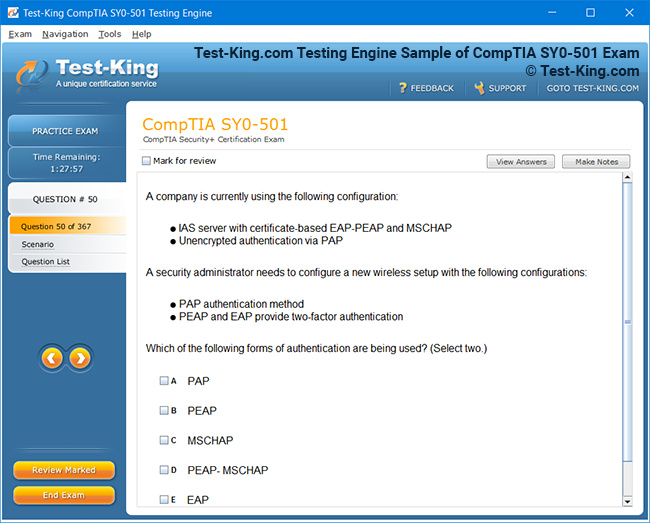
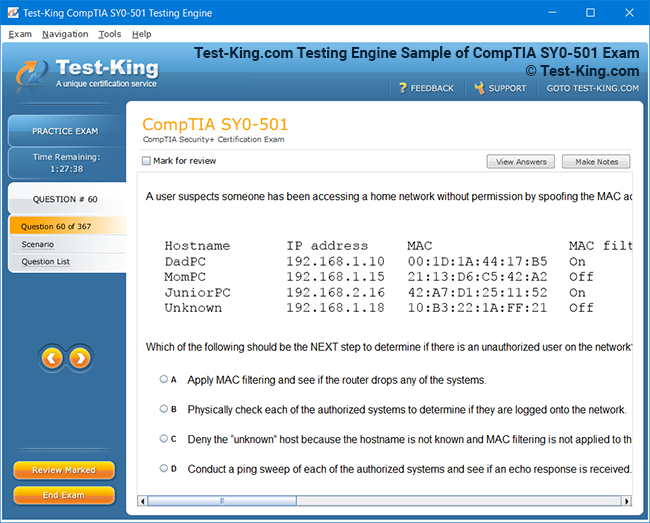
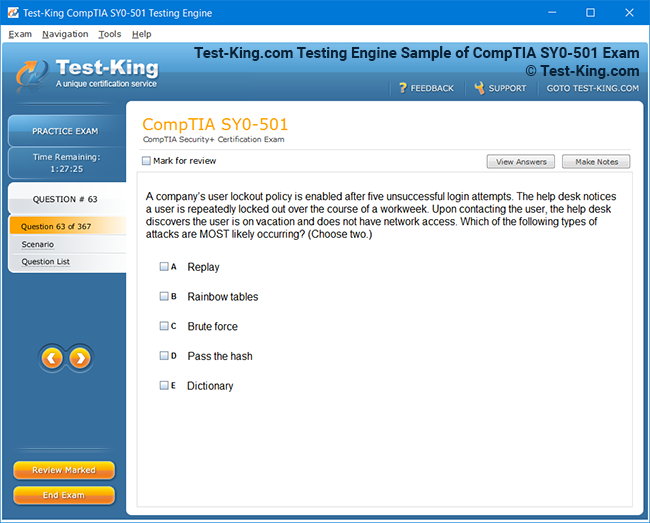
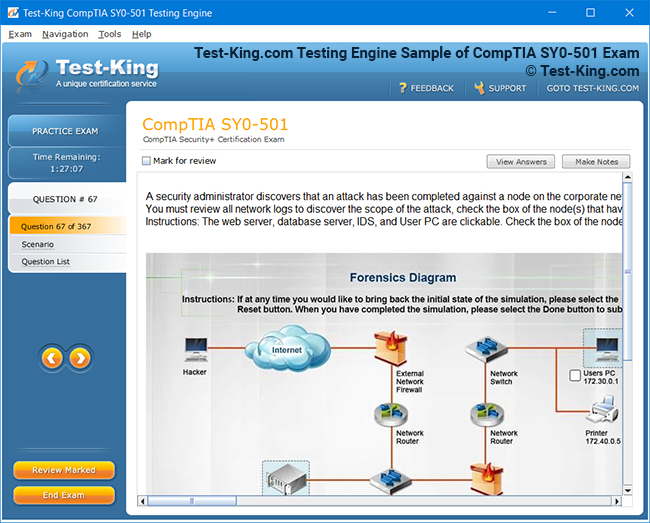
Product Screenshots
Frequently Asked Questions
How can I get the products after purchase?
All products are available for download immediately from your Member's Area. Once you have made the payment, you will be transferred to Member's Area where you can login and download the products you have purchased to your computer.
How long can I use my product? Will it be valid forever?
Test-King products have a validity of 90 days from the date of purchase. This means that any updates to the products, including but not limited to new questions, or updates and changes by our editing team, will be automatically downloaded on to computer to make sure that you get latest exam prep materials during those 90 days.
Can I renew my product if when it's expired?
Yes, when the 90 days of your product validity are over, you have the option of renewing your expired products with a 30% discount. This can be done in your Member's Area.
Please note that you will not be able to use the product after it has expired if you don't renew it.
How often are the questions updated?
We always try to provide the latest pool of questions, Updates in the questions depend on the changes in actual pool of questions by different vendors. As soon as we know about the change in the exam question pool we try our best to update the products as fast as possible.
How many computers I can download Test-King software on?
You can download the Test-King products on the maximum number of 2 (two) computers or devices. If you need to use the software on more than two machines, you can purchase this option separately. Please email support@test-king.com if you need to use more than 5 (five) computers.
What is a PDF Version?
PDF Version is a pdf document of Questions & Answers product. The document file has standart .pdf format, which can be easily read by any pdf reader application like Adobe Acrobat Reader, Foxit Reader, OpenOffice, Google Docs and many others.
Can I purchase PDF Version without the Testing Engine?
PDF Version cannot be purchased separately. It is only available as an add-on to main Question & Answer Testing Engine product.
What operating systems are supported by your Testing Engine software?
Our testing engine is supported by Windows. Andriod and IOS software is currently under development.
Top Fortinet Exams
- NSE4_FGT_AD-7.6 - Fortinet NSE 4 - FortiOS 7.6 Administrator
- NSE7_FSN_AR-7.6 - Fortinet NSE 7 - Secure Networking 7.6 Architect
- NSE5_FSW_AD-7.6 - Fortinet NSE 5 - FortiSwitch 7.6 Administrator
- FCP_FGT_AD-7.6 - FCP - FortiGate 7.6 Administrator
- FCP_FMG_AD-7.6 - Fortinet NSE 5 - FortiManager 7.6 Administrator
- FCP_FAZ_AN-7.6 - Fortinet NSE 5 - FortiAnalyzer 7.6 Analyst
- NSE5_SSE_AD-7.6 - Fortinet NSE 5 - FortiSASE and SD-WAN 7.6 Core Administrator
- NSE7_SSE_AR-26 - Fortinet NSE 7 - FortiSASE 26 Architect
- FCP_FCT_AD-7.4 - Fortinet NSE 6 - FortiClient EMS 7.4 Administrator
- NSE6_FSM_AN-7.4 - Fortinet NSE 6 - FortiSIEM 7.4 Analyst
- FCSS_EFW_AD-7.6 - NSE 7 - Enterprise Firewall 7.6 Administrator
- NSE5_FWB_AD-8.0 - Fortinet NSE 5 - FortiWeb 8.0 Administrator
- NSE7_SOC_AR-7.6 - Fortinet NSE 7 - Security Operations 7.6 Architect
- NSE6_OTS_AR-7.6 - Fortinet NSE 6 - OT Security 7.6 Architect
- NSE6_SDW_AD-7.6 - Fortinet NSE 6 - SD-WAN 7.6 Enterprise Administrator
- NSE5_FNC_AD-7.6 - Fortinet NSE 5 - FortiNAC-F 7.6 Administrator
- FCSS_SDW_AR-7.6 - FCSS - SD-WAN 7.6 Architect
- NSE6_EDR_AD-7.0 - Fortinet NSE 6 - FortiEDR 7.0 Administrator
- FCSS_CDS_AR-7.6 - FCSS - Public Cloud Security 7.6 Architect
- NSE4_FGT-7.0 - Fortinet NSE 4 - FortiOS 7.0
- NSE6_FNC_AD-7.6 - Fortinet NSE 6 - FortiNAC-F 7.6 Administrator
- NSE7_SSE_AD-25 - Fortinet NSE 7 - FortiSASE 25 Enterprise Administrator
- FCSS_SASE_AD-25 - FCSS - FortiSASE 25 Administrator
- NSE8_812 - Fortinet NSE 8 Written Exam
- NSE6_FML-7.2 - Fortinet NSE 6 - FortiMail 7.2
- FCSS_NST_SE-7.6 - Fortinet NSE 6 - Network Security 7.6 Support Engineer
- FCP_FGT_AD-7.4 - FCP - FortiGate 7.4 Administrator
- FCP_FAZ_AD-7.4 - FCP - FortiAnalyzer 7.4 Administrator
- FCP_FMG_AD-7.4 - FCP - FortiManager 7.4 Administrator
- FCP_FML_AD-7.4 - FCP - FortiMail 7.4 Administrator
- FCP_FWF_AD-7.4 - FCP - Secure Wireless LAN 7.4 Administrator
- FCSS_LED_AR-7.6 - Fortinet NSE 6 - LAN Edge 7.6 Architect
- NSE6_FNC-8.5 - Fortinet NSE 6 - FortiNAC 8.5
Common Mistakes to Avoid When Preparing for the NSE6_FAC-6.4 Exam
The Fortinet NSE6_FAC-6.4 certification is not a superficial test of memorization or isolated product knowledge; it is a precise and demanding evaluation of an individual’s ability to administer, configure, and secure authentication frameworks within FortiAuthenticator 6.4 environments. Many candidates falter early because they underestimate the scope of this exam, perceiving it as an auxiliary assessment rather than a high-stakes, intermediate-level qualification within the Fortinet NSE 6 hierarchy. This misconception leads to a fragmented study approach where candidates emphasize superficial memorization over conceptual comprehension. Understanding FortiAuthenticator as a dynamic component of a multi-layered Fortinet Security Fabric is indispensable. It is not merely a product but a pivotal authentication gateway enabling identity management, certificate handling, and multi-factor verification across distributed infrastructures. Those who fail to conceptualize this holistic role often struggle to correlate configuration parameters with enterprise-level authentication strategies.
Misinterpreting the Nature of the NSE6_FAC-6.4 Certification
Candidates frequently misconstrue the exam’s focus on FortiAuthenticator as limited to standalone deployments. In reality, the NSE6_FAC-6.4 exam assesses one’s capacity to integrate FortiAuthenticator with broader Fortinet ecosystem components, including FortiGate, FortiToken, and LDAP or RADIUS servers. The evaluative design expects proficiency in interoperability, policy orchestration, and error mitigation across diverse identity environments. This is not merely about following configuration wizards but understanding the underlying logic that governs authentication tokens, user group synchronization, and certificate authority mechanisms. A superficial understanding of interface screens or command syntax often collapses under the scrutiny of scenario-driven questions that demand insight into why a particular setting or attribute is used rather than how to enable it.
Overlooking the Official Fortinet Documentation and Technical Guides
A recurrent oversight among examinees lies in the disregard for Fortinet’s official documentation ecosystem. The FortiAuthenticator Administration Guide, Release Notes, and CLI Reference are not peripheral documents; they represent the canonical foundation for comprehension of operational nuances. Some aspirants depend excessively on third-party blogs, outdated dumps, or informal video tutorials that recycle obsolete terminology. Fortinet revises interface layouts, authentication algorithms, and directory integration workflows between minor revisions, and those ignoring these subtle changes expose themselves to obsolescent knowledge. The official documents elucidate the minutiae of deployment scenarios, configuration hierarchies, and feature constraints that no unofficial source can reliably replicate.
Studying these materials cultivates a granular understanding of how FortiAuthenticator 6.4 interacts with external identity sources and policy engines. For example, the subtleties of certificate enrollment protocols, token provisioning, or SAML-based federation are not uniformly described in community resources. Candidates must internalize these elements as operational sequences rather than rote definitions. The capacity to visualize a FortiAuthenticator topology, from initial registration of devices to the propagation of identity attributes through Fortinet Security Fabric, distinguishes a proficient candidate from a superficial one. The documentation also clarifies implicit behaviors such as fallback authentication chains, captive portal logic, and system diagnostics, which are frequently tested in scenario-based exam questions.
Misjudging the Practical Configuration Requirements
Another fundamental misstep arises when candidates focus exclusively on theoretical concepts without applying them in a real or simulated environment. The NSE6_FAC-6.4 exam expects operational dexterity—the ability to configure FortiAuthenticator 6.4 accurately under constraint-driven conditions. Many candidates avoid installing a virtual instance due to perceived complexity or resource limitations, but this abstention undermines their preparation. The hands-on experience reveals the true intricacy of authentication synchronization, the nuances of certificate authority configuration, and the responsiveness of RADIUS client mappings. Only by experimenting with these configurations can a professional appreciate the correlation between GUI elements and CLI diagnostics.
When candidates neglect practical configuration exercises, they fail to internalize the cause-and-effect dynamics of misconfiguration. The exam frequently simulates situations where an administrator must troubleshoot login failures, token mismatches, or misaligned user group policies. Without actual exposure to such environments, the theoretical knowledge remains static and disconnected from applied context. Moreover, Fortinet’s authentication mechanisms evolve, introducing enhanced cryptographic algorithms and federated identity support, demanding candidates to test these functions empirically rather than depend on outdated tutorials. Familiarity with FortiAuthenticator’s behavior under network latency, LDAP timeouts, or token verification delays cannot be acquired through static reading alone. This kind of kinesthetic learning fortifies comprehension and sharpens diagnostic intuition.
Neglecting Interdependencies within Fortinet Security Fabric
An often underappreciated aspect of NSE6_FAC-6.4 preparation is recognizing FortiAuthenticator as an integral organ of the broader Fortinet Security Fabric. Many examinees study FortiAuthenticator in isolation, disregarding its symbiotic relationships with FortiGate firewalls, FortiAnalyzer logging systems, and FortiToken authentication devices. This isolationist perspective leads to misinterpretation of questions that involve cross-component communication or policy synchronization. The exam tests one’s fluency in interpreting authentication transactions across multiple Fortinet products, understanding how session data propagates, and how certificate-based trust anchors are established.
A holistic understanding allows candidates to discern how FortiAuthenticator handles user identification and certificate distribution when a FortiGate device requests authentication validation. It also involves grasping how FortiAnalyzer integrates log events related to identity-based authentication for post-event analysis. Ignoring these integrations means forfeiting a significant portion of conceptual readiness because the Fortinet ecosystem thrives on interconnectivity. The essence of FortiAuthenticator’s role lies in centralized authentication and audit consistency across distributed security controls. Those unfamiliar with the mechanisms of Security Fabric connectors, Fortinet Single Sign-On (FSSO) agents, or API-driven synchronization risk confusion when faced with multi-tiered authentication scenarios during the examination.
Furthermore, FortiAuthenticator’s ability to integrate with third-party ecosystems such as Microsoft Active Directory, RADIUS servers, or SAML identity providers is central to its enterprise appeal. The exam often incorporates scenarios that require correlating external identity data with Fortinet’s internal user repositories. Failing to explore these interactions through practice renders one vulnerable to conceptual gaps that become evident in applied questions. A comprehensive understanding of how identity attributes traverse through FortiGate, FortiAnalyzer, and FortiAuthenticator contexts can greatly enhance problem-solving accuracy. This synergy exemplifies Fortinet’s architectural philosophy of cohesive and intelligent threat response.
Mismanaging Time and Study Scope during Preparation
Effective time management represents another domain where candidates falter. The NSE6_FAC-6.4 exam encompasses extensive subject matter—authentication processes, certificate authority operations, token management, network integration, and troubleshooting. Attempting to master all areas simultaneously without a methodical schedule leads to cognitive saturation and fragmented retention. Many examinees attempt to rush through multiple topics under the impression that broad exposure will compensate for depth. This diffusion of effort results in superficial familiarity devoid of analytical depth, a fatal flaw when confronted with scenario-based questions requiring multi-step reasoning.
An efficient preparation plan demands prioritization of high-weight areas according to the official Fortinet exam outline. Each domain warrants incremental deep dives supported by active recall practices and simulation exercises. Candidates who rely solely on passive reading or video lectures neglect the retention benefits of hands-on experimentation. Allocating daily study intervals focused on configuration practice, followed by reflective review, ensures mental reinforcement. Another subtle yet significant aspect involves reviewing release notes and change logs for FortiAuthenticator 6.4, which often highlight deprecated functions or interface transitions. Neglecting these updates can lead to conceptual dissonance between what a candidate learns and what the exam expects.
Many professionals underestimate the importance of testing under timed conditions. The real exam’s temporal constraints demand swift comprehension and efficient execution. Practicing with mock assessments not only familiarizes candidates with question phrasing but also conditions them to manage stress-induced cognitive compression. A common pitfall involves overinvesting in a single topic while ignoring other interlinked concepts. For instance, focusing entirely on token provisioning without understanding how user group synchronization affects token validation yields partial knowledge. Mastery requires cognitive balance—each concept reinforcing another in an interdependent matrix. An organized schedule and disciplined review cycle counteract the entropy that undermines unstructured preparation.
Overreliance on Dumps and Unverified Resources
One of the most detrimental behaviors among candidates preparing for the NSE6_FAC-6.4 exam is dependence on unauthorized dumps or pirated question banks. While these resources promise convenience, they propagate inaccuracies and foster a counterproductive mindset that prioritizes answer memorization over conceptual mastery. Fortinet periodically updates question banks and modifies configurations to align with the latest software releases. Thus, content derived from obsolete exams introduces misconceptions that impair understanding. Moreover, this reliance erodes the analytical rigor necessary for a cybersecurity professional responsible for managing real-world authentication systems.
Authentic preparation necessitates immersion in verified study resources, such as Fortinet’s NSE Training Institute materials and official labs. These platforms cultivate an evidence-based learning environment where concepts are contextualized through operational relevance. Engaging with simulated exercises, whitepapers, and case studies develops diagnostic insight—something unattainable through passive memorization of question-answer pairs. Exam dumps create a deceptive sense of readiness that collapses during situational analysis tasks. The Fortinet NSE6_FAC-6.4 exam emphasizes applied reasoning, expecting candidates to deduce outcomes from configuration logs, interpret authentication traces, and identify systemic inconsistencies. Such analytical agility can only be achieved through authentic comprehension.
Another subtle danger of relying on illicit materials is the erosion of ethical responsibility, a quality paramount in the cybersecurity domain. Professionals certified through superficial means compromise the credibility of the Fortinet certification community. Beyond ethical implications, those who neglect authentic study methodologies remain ill-equipped to handle real operational contingencies post-certification. The NSE6_FAC-6.4 exam serves as a validation mechanism for one’s capacity to safeguard identity infrastructures. A candidate who bypasses legitimate learning deprives themselves of the intellectual scaffolding needed to administer FortiAuthenticator in production environments. True expertise emerges from iterative exploration, troubleshooting, and contextual analysis of authentication architecture.
Ignoring the Analytical Framework Behind Authentication Protocols
The pursuit of the Fortinet NSE6_FAC-6.4 certification often lures candidates into a procedural mindset, where they memorize interface navigation paths and configuration sequences without assimilating the deeper analytical framework that underpins FortiAuthenticator 6.4’s authentication protocols. This is a critical miscalculation. Fortinet’s exam is designed not to reward memorized clicks but to evaluate one’s understanding of how authentication processes behave under specific infrastructural and policy conditions. Candidates who approach the subject from a surface level often find themselves unable to interpret situational questions that involve the interaction between RADIUS, LDAP, SAML, and certificate-based authentication.
FortiAuthenticator 6.4 is built around a sophisticated orchestration of these protocols, ensuring secure and context-aware identity verification. When professionals disregard the conceptual integrity of each protocol—its handshake process, encryption mechanisms, and role in identity propagation—they reduce their comprehension to rote procedures. The NSE6_FAC-6.4 exam evaluates one’s grasp of how authentication attributes traverse through Fortinet Security Fabric nodes, how FortiGate interacts with FortiAuthenticator to validate user credentials, and how token-based verification is synchronized. Failing to understand these mechanisms leads to analytical paralysis during complex scenario-based questions, where a subtle parameter difference determines whether authentication succeeds or fails.
Moreover, FortiAuthenticator’s adaptive authentication framework uses elements such as identity-based routing, multi-factor evaluation, and role-based access differentiation. Neglecting these structural concepts impedes the ability to diagnose misconfigurations. For example, if a user group is not propagated correctly from Active Directory to FortiAuthenticator, an administrator must discern whether the fault lies within directory binding, schema mapping, or user filter syntax. This level of analysis cannot be acquired through mechanical memorization; it demands a cognitive synthesis of system logic. Hence, one of the gravest mistakes is failing to cultivate an architectural understanding of FortiAuthenticator’s operational core, which is precisely what distinguishes certified professionals from mere technicians.
Candidates must also interpret authentication logs as analytical instruments. These logs chronicle the transaction lifecycle, from the initial access request through RADIUS attribute exchanges to the final permit or deny outcome. Overlooking the interpretive value of such logs is a critical lapse, as the exam frequently integrates log snippets into its questions. A professional who can deconstruct these entries can deduce not only the technical failure point but also its procedural antecedent. This reflective capacity epitomizes the practical acumen Fortinet seeks to certify.
Disregarding System Diagnostics and Performance Evaluation
Another prevalent error in preparing for the NSE6_FAC-6.4 exam is underestimating the significance of system diagnostics and performance evaluation tools embedded within FortiAuthenticator. These mechanisms, such as packet captures, debug commands, and event monitoring, are not mere troubleshooting conveniences—they are foundational to network forensics and operational resilience. The exam implicitly measures a candidate’s ability to interpret these diagnostic outputs and translate them into actionable insights. Many examinees confine their preparation to the configuration interface, ignoring how FortiAuthenticator communicates system health, replication states, and latency conditions through its diagnostic features.
In a production environment, performance degradation or misaligned synchronization can compromise the integrity of authentication services. The exam mirrors these real-world contingencies through scenario-driven questions requiring professionals to isolate the source of degradation, whether it arises from faulty network topology, misconfigured redundancy, or overburdened logging processes. The candidate who has never explored FortiAuthenticator’s diagnostic dashboard lacks the experiential awareness to analyze such cases effectively.
Performance metrics extend beyond simple throughput evaluation; they encapsulate session concurrency, token validation latency, and certificate processing efficiency. FortiAuthenticator’s architectural stability depends on the seamless orchestration of these components, particularly in large enterprise deployments where thousands of concurrent authentications may occur. Neglecting to study how FortiAuthenticator allocates processing resources or manages certificate caching can lead to knowledge voids that become fatal in the exam setting.
Additionally, system diagnostics provide invaluable insight into high-availability configurations. In multi-node environments, replication fidelity between primary and secondary FortiAuthenticator units must be scrutinized. Candidates who do not test these replication dynamics or understand synchronization sequences may struggle when confronted with exam scenarios describing partial replication or identity drift. Recognizing the relationship between system metrics and authentication consistency is indispensable. The exam expects participants to interpret telemetry data and make deductive assessments about underlying systemic issues.
Ignoring such analytical practice often results in an inability to comprehend the cause-and-effect relationship between system behavior and authentication outcomes. FortiAuthenticator is not a static appliance but a responsive authentication nucleus whose operational health directly influences the efficacy of network access control. Hence, preparation should encompass not only configuration mastery but also diagnostic literacy—a discipline that merges technical intuition with procedural clarity.
Overlooking Security Policies and Compliance Context
A subtle yet consequential oversight during NSE6_FAC-6.4 exam preparation involves disregarding the compliance-driven nature of FortiAuthenticator deployment. Candidates often immerse themselves in technical configurations while neglecting the policy frameworks and regulatory standards that influence those configurations. The Fortinet certification does not solely test how to implement authentication; it evaluates whether the implementation aligns with security best practices, privacy mandates, and organizational compliance policies.
FortiAuthenticator’s strength lies in its ability to enforce identity assurance while respecting constraints imposed by standards such as ISO 27001, GDPR, and PCI DSS. Examinees who treat security policies as peripheral topics risk misunderstanding configuration decisions that stem from these compliance imperatives. For instance, certificate lifecycles, token expiry parameters, and password policy definitions often adhere to specific regulatory prescriptions. The exam questions may embed such contextual cues, requiring candidates to choose the configuration that satisfies both functional and compliance requirements.
Ignoring this broader compliance perspective also leads to flawed understanding of FortiAuthenticator’s audit and logging features. The logging subsystem not only serves operational troubleshooting but also ensures forensic accountability. Professionals must understand how logs should be retained, exported, and analyzed in adherence with retention and privacy regulations. Failure to internalize this compliance-driven purpose renders an administrator ill-prepared for exam questions that probe the governance aspects of authentication architecture.
Furthermore, FortiAuthenticator interacts with FortiAnalyzer for centralized reporting and policy auditing. Candidates unfamiliar with this relationship may misinterpret exam questions that explore data retention, audit correlation, and log integrity verification. A cybersecurity professional must recognize that authentication is not an isolated technical activity but a policy-enforced process situated within the enterprise’s regulatory fabric. The exam measures not just technical fluency but ethical and procedural discernment.
Misunderstanding Certificate Authority Integration
Another recurring deficiency among candidates is a superficial comprehension of certificate authority integration within FortiAuthenticator 6.4. Certificates are the cryptographic backbone of identity assurance, providing non-repudiation and encrypted verification across network transactions. Many examinees treat certificates as administrative formalities rather than cryptographic instruments that authenticate both user and system identity. The Fortinet NSE6_FAC-6.4 exam interrogates one’s ability to implement, manage, and troubleshoot internal and external certificate authorities, including subordinate CA structures and certificate revocation processes.
FortiAuthenticator can operate as an internal certificate authority or integrate with external CAs. The complexity of this configuration often intimidates candidates who fail to appreciate its architectural implications. For example, understanding how FortiAuthenticator issues, signs, and distributes certificates to devices within Fortinet Security Fabric is crucial. The exam frequently introduces scenarios where expired certificates, mismatched chains, or invalid trust anchors cause authentication failures. Without practical exposure to certificate enrollment, signing requests, or CRL management, candidates cannot accurately interpret such problem statements.
Moreover, the handling of OCSP (Online Certificate Status Protocol) and CRL (Certificate Revocation List) configurations demands precise comprehension. The synchronization of these elements ensures that invalid or compromised certificates do not undermine system trust. Many candidates overlook these topics, assuming they are peripheral to day-to-day configuration. However, the NSE6_FAC-6.4 exam intentionally embeds questions requiring knowledge of certificate propagation and validation across distributed environments.
Additionally, candidates must understand how FortiAuthenticator interacts with FortiGate and FortiClient during certificate-based authentication. A misconfigured CA chain can interrupt SSL VPN access or hinder captive portal authentication. Professionals should develop the aptitude to diagnose certificate mismatches by interpreting system logs and understanding the hierarchical structure of trust anchors. Overlooking this aspect indicates a narrow preparation scope, which often results in incomplete comprehension during practical and theoretical examination components.
Neglecting Token Management and Multi-Factor Authentication Dynamics
Multi-factor authentication (MFA) represents the linchpin of FortiAuthenticator’s security framework. Yet, many examinees disregard the subtleties of token management, treating it as a rudimentary configuration rather than a nuanced security mechanism. The Fortinet NSE6_FAC-6.4 exam examines the intricacies of token provisioning, synchronization, and validation across Fortinet devices. Professionals must understand how hardware and software tokens are issued, activated, and associated with user accounts.
A prevalent mistake involves neglecting token lifecycle management. Tokens possess distinct phases: enrollment, activation, synchronization, and expiration. Overlooking these stages can lead to failures in authentication or policy enforcement. The exam evaluates the candidate’s ability to correlate token status with user authentication outcomes. For instance, a desynchronized token generates authentication discrepancies that must be diagnosed through event logs or token validation reports. Those who have never managed tokens in a live or simulated environment often fail to interpret such conditions during the test.
In addition, FortiAuthenticator 6.4 supports multiple token types, including FortiToken Mobile, FortiToken Cloud, and hardware-based devices. Understanding the integration process between these token sources and FortiAuthenticator is essential. The authentication workflow involves backend validation, time-based synchronization, and sometimes cloud connectivity. Ignoring these processes diminishes analytical acuity, leaving candidates unable to resolve multi-factor issues under exam conditions.
Another overlooked aspect is policy granularity. MFA can be enforced globally, per user group, or based on specific service access points such as VPN or captive portals. Failing to study how FortiAuthenticator prioritizes these policies leads to conceptual confusion when multiple authentication methods overlap. The exam challenges candidates to determine which policy supersedes another when both are active. Professionals must interpret such questions by recalling real-world precedence logic observed during configuration experiments.
Token management also introduces operational dependencies with FortiGate and FortiToken Cloud services. When cloud synchronization fails, an administrator must discern whether the issue lies within token provisioning, connectivity, or service authorization. These analytical distinctions define the depth of understanding Fortinet expects from certified engineers. Neglecting token synchronization details reflects an incomplete appreciation of FortiAuthenticator’s multi-layered architecture and reduces one’s readiness for advanced identity management scenarios.
Inadequate Preparation for Troubleshooting Scenarios
Perhaps the most pronounced shortcoming among candidates is the lack of comprehensive troubleshooting practice. The NSE6_FAC-6.4 exam thrives on evaluating how professionals approach malfunction, not merely configuration success. Troubleshooting requires a fusion of observation, deduction, and procedural testing—qualities cultivated only through deliberate practice. Many candidates limit their preparation to functional configurations without intentionally breaking systems to analyze the consequences. This avoidance deprives them of the experiential wisdom necessary to diagnose issues under time pressure.
Troubleshooting FortiAuthenticator 6.4 involves analyzing logs, tracing packet exchanges, and reviewing authentication sequences. Candidates must familiarize themselves with system behavior under adverse conditions, such as directory unavailability, expired tokens, or mismatched authentication realms. Each of these failures generates distinct log patterns that, when interpreted correctly, lead to resolution. The exam evaluates this interpretive ability by presenting ambiguous symptoms requiring analytical reasoning.
In addition, troubleshooting extends to understanding dependencies between Fortinet products. For instance, a failed user login may originate not from FortiAuthenticator but from misconfigured firewall authentication rules within FortiGate. Recognizing these interdependencies is essential to holistic problem-solving. Candidates who isolate their understanding to FortiAuthenticator alone cannot accurately trace multi-component issues, which constitute a considerable portion of real-world and exam-based scenarios.
Furthermore, FortiAuthenticator includes mechanisms for system recovery and configuration rollback. Understanding how backup restoration and configuration synchronization work across clustered environments enhances diagnostic agility. The exam may test knowledge of system resilience strategies or configuration versioning to evaluate operational readiness. Professionals who neglect such study areas demonstrate limited situational awareness, an undesirable trait for any network security specialist.
Another critical aspect is interpreting command-line diagnostics. While FortiAuthenticator offers an intuitive graphical interface, certain advanced diagnostics and log traces can only be accessed through CLI commands. Familiarity with these commands, their output structure, and their diagnostic implications provides a decisive advantage. Candidates who avoid the CLI due to discomfort or perceived complexity restrict themselves to partial system visibility, impairing their analytical reach.
Effective troubleshooting is not an act of mechanical repetition but a disciplined form of technical reasoning. It involves correlating symptoms, isolating causative factors, and formulating targeted remediation. The NSE6_FAC-6.4 exam recognizes this ability as the hallmark of a true Fortinet specialist. Candidates must therefore cultivate a reflective, investigative mindset—one capable of transforming raw diagnostic data into coherent insight. Ignoring this preparatory domain is perhaps the most consequential misstep for any professional aspiring to achieve Fortinet certification excellence.
Misinterpreting FortiAuthenticator Architecture and Its Operational Context
Among the multitude of errors that manifest during preparation for the Fortinet NSE6_FAC-6.4 exam, none are as consequential as the failure to internalize the full architectural identity of FortiAuthenticator 6.4. The device is not merely a repository of user credentials; it is the nucleus of identity intelligence within the Fortinet Security Fabric. Candidates frequently enter their preparation journey perceiving FortiAuthenticator as an adjunct component rather than a central orchestrator of identity verification and certificate management. This misconception perpetuates a truncated study approach that focuses on interface familiarity rather than architectural comprehension.
FortiAuthenticator operates as a fusion of identity governance, certificate authority, and authentication gateway. Its functional responsibilities are distributed across user provisioning, directory integration, token synchronization, and policy-based access enforcement. Understanding this convergence requires examining how FortiAuthenticator interacts with FortiGate firewalls, FortiAnalyzer for log correlation, and FortiToken for multi-factor validation. Candidates who isolate their study to graphical configurations without appreciating these interactions develop a compartmentalized understanding that disintegrates when they encounter scenario-based exam questions.
The Fortinet NSE6_FAC-6.4 assessment is meticulously engineered to evaluate this systemic awareness. Each question implicitly demands an understanding of the relationship between architectural layers: the user database, the authentication policy engine, and the network enforcement point. A candidate must be able to visualize data flow as an interconnected sequence, from credential submission through token validation, RADIUS response, and session authorization. Lacking this architectural literacy leads to analytical dissonance. For example, an administrator might misinterpret an authentication failure as a misconfiguration of user groups when in reality it originates from a certificate chain trust anomaly or an unresponsive directory binding.
Another dimension of architectural misunderstanding stems from ignoring the distributed deployment models of FortiAuthenticator. In high-availability environments, synchronization of configuration and identity databases across clustered nodes ensures resilience. Many candidates fail to study replication behavior, session handover, and failover response times. The exam often embeds such concepts subtly, presenting scenarios that test a professional’s ability to determine which node assumes responsibility when a synchronization interruption occurs. Without experiencing or simulating these events, an examinee can only speculate rather than analyze, leading to misjudged conclusions.
FortiAuthenticator’s architectural sophistication also lies in its capacity to serve as an intermediary between external identity providers and internal Fortinet devices. Candidates must therefore grasp concepts of federation, SAML assertions, and cross-domain authentication. The integration of federated identity mechanisms represents the growing trend in enterprise authentication, and Fortinet expects certified professionals to demonstrate fluency in these standards. Overlooking the role of FortiAuthenticator as a federation bridge is a profound mistake that undermines exam performance and professional competence alike.
Misalignment Between Study Practices and Real-World Application
A recurring deficiency in NSE6_FAC-6.4 exam preparation arises from the disconnect between academic study and operational realism. Many aspirants confine their learning to textual descriptions or online demonstrations, neglecting the experimental rigor of deploying and testing FortiAuthenticator configurations in controlled environments. The result is an imbalance between theoretical recall and procedural instinct. The Fortinet certification evaluates not only knowledge but the ability to apply that knowledge under constrained conditions, reflecting authentic enterprise challenges.
Candidates who rely exclusively on documentation or passive media frequently exhibit a superficial grasp of contextual logic. For instance, reading about RADIUS authentication may help identify parameters in an interface, but without actual configuration of a RADIUS client and server relationship, one cannot perceive how request attributes, vendor-specific codes, or response timers behave. The examination incorporates questions that replicate such operational contingencies, requiring precise recognition of system interactions.
Realistic application also sharpens diagnostic reasoning. When a professional builds a virtual FortiAuthenticator instance and deliberately introduces misconfigurations, they begin to comprehend causality within the authentication lifecycle. They recognize the symptomatic correlation between a misaligned group filter and an authentication denial, between certificate expiration and failed TLS negotiation, or between network latency and delayed token validation. This experiential learning fortifies mental agility, equipping candidates to deconstruct complex exam problems with analytical precision.
The absence of such applied practice engenders cognitive fragility. When confronted with intricate configurations described in the test, candidates without real experience resort to guesswork. This behavior not only jeopardizes examination success but also undermines the integrity of their professional capabilities. Fortinet’s objective with the NSE6_FAC-6.4 certification is to validate practical expertise—an assurance to organizations that the certified individual can operate FortiAuthenticator in real-world conditions. Thus, preparation must transcend theoretical absorption and evolve into operational simulation.
Another facet of this misalignment is the neglect of FortiAuthenticator’s version-specific features. Fortinet’s incremental updates frequently introduce refined mechanisms, enhanced interfaces, and new configuration capabilities. Those who prepare using outdated study materials fail to reconcile discrepancies between legacy features and current interfaces. For example, authentication rule hierarchies, certificate authority menu structures, and token provisioning workflows have undergone nuanced transformations in FortiAuthenticator 6.4. Candidates unaware of these changes risk confusion during the exam when confronted with unfamiliar terminologies or revised system behaviors.
Insufficient Mastery of Identity Synchronization and Directory Integration
A major conceptual chasm observed among examinees lies in the superficial treatment of identity synchronization and directory integration. FortiAuthenticator’s capability to harmonize identity data across LDAP, RADIUS, and Active Directory sources underpins its role as an enterprise authentication hub. The NSE6_FAC-6.4 exam probes a candidate’s understanding of synchronization parameters, binding methodologies, and replication latency. Professionals who overlook these intricacies are often unable to decipher questions related to user propagation failures or group membership inconsistencies.
Directory integration requires more than just configuring IP addresses and credentials. It demands comprehension of schema mapping, distinguished names, and attribute filtration. Many candidates erroneously assume that successful connectivity tests equate to complete synchronization. In practice, directory structures are complex, containing nested groups, dynamic objects, and hierarchical attributes. FortiAuthenticator must navigate these constructs to accurately reflect user hierarchies. Understanding how synchronization intervals, search filters, and replication events interact ensures operational consistency.
Moreover, the exam expects awareness of FortiAuthenticator’s synchronization diagnostics. Candidates should be able to interpret logs that reveal partial synchronization or credential verification anomalies. Without firsthand familiarity with these diagnostic tools, they may misidentify the source of an issue. The difference between a binding error and an authentication failure rooted in schema incompatibility is subtle but critical. A professional with authentic operational exposure can distinguish these nuances quickly.
Another layer of directory integration complexity emerges when multiple identity sources coexist. FortiAuthenticator supports simultaneous connections to diverse directories, each serving distinct organizational units. Configuring these with appropriate precedence rules and failover logic is essential for maintaining authentication reliability. The exam’s situational questions often challenge candidates to determine which source will authenticate a given user based on predefined rules. Overlooking these hierarchical configurations during study leaves examinees ill-equipped to answer such nuanced questions.
Identity synchronization also extends into certificate-based user mapping. FortiAuthenticator can correlate digital certificates with user identities, enabling secure authentication without password dependency. Candidates who ignore this hybrid mapping process misunderstand the fundamental flexibility of the system. The ability to connect certificate attributes to directory entries enhances both security and automation—a concept that resonates through the NSE6_FAC-6.4 assessment’s architecture-oriented design.
Underestimating Policy Construction and Access Enforcement
Another frequent preparation error stems from the underappreciation of policy construction and access enforcement mechanisms within FortiAuthenticator 6.4. The appliance functions as an intermediary policy decision point, evaluating authentication requests against defined rules before granting access to network resources. Candidates often memorize configuration steps without understanding the logic that governs policy evaluation sequences. This superficial learning produces disorientation when exam scenarios depict overlapping or conditional rules.
Effective policy creation demands awareness of matching criteria, precedence order, and contextual enforcement parameters. FortiAuthenticator evaluates requests using attributes such as source, service, and user group membership. When multiple policies overlap, the system’s rule evaluation logic determines which policy prevails. Understanding this precedence hierarchy is essential, as it reflects the decision-making architecture embedded within FortiAuthenticator’s authentication engine. Many exam questions are designed to test whether a candidate can anticipate which rule applies given a specific combination of variables.
Policy misinterpretation often arises from a failure to visualize user access flow. A professional must conceptualize how an authentication request originates from a client, traverses network enforcement devices such as FortiGate, and reaches FortiAuthenticator’s policy engine. Each intermediary device contributes contextual data that influences policy selection. For example, an authentication request initiated via VPN may invoke a different rule set than one generated through a captive portal. Exam questions frequently exploit this contextual variance, demanding nuanced understanding of service-specific policy application.
Another neglected topic is the dynamic nature of FortiAuthenticator’s policy enforcement in multi-domain environments. Large enterprises often employ domain segmentation for administrative or security purposes. FortiAuthenticator can maintain separate policy sets for each domain, yet candidates rarely explore this capability in their study sessions. The NSE6_FAC-6.4 exam expects familiarity with this configuration, particularly in scenarios involving federated identity domains or delegated administration. Without such understanding, examinees misinterpret cross-domain authentication outcomes, leading to erroneous conclusions during analysis-based questions.
Furthermore, FortiAuthenticator’s access policies integrate seamlessly with FortiGate’s firewall policies, creating an interdependent enforcement ecosystem. Misunderstanding this relationship represents a critical lapse in preparation. FortiGate enforces access based on authentication feedback provided by FortiAuthenticator, forming a continuous trust chain between identity validation and access control. When candidates fail to study this dependency, they cannot explain why certain access requests are denied despite successful authentication—a conceptual blind spot that becomes detrimental during examination.
Disregarding the Strategic Role of Logs and Audit Trails
In the realm of cybersecurity, visibility equates to control. FortiAuthenticator’s logging and audit capabilities are not mere administrative features; they are instruments of forensic clarity and compliance validation. Yet many candidates trivialize their importance during exam preparation, perceiving them as supplementary details rather than integral components of authentication architecture. The Fortinet NSE6_FAC-6.4 exam, however, deliberately incorporates log interpretation challenges to assess analytical depth.
Logs in FortiAuthenticator chronicle the life cycle of every authentication event, configuration change, and system notification. Understanding how to interpret these records allows a professional to reconstruct user behavior, validate access patterns, and diagnose systemic anomalies. Neglecting this knowledge weakens one’s diagnostic literacy. Exam questions often present fragments of logs that the candidate must analyze to infer the root cause of an authentication issue. Without familiarity with log syntax and timestamp correlation, even technically adept individuals may falter.
Audit trails also serve a governance purpose. FortiAuthenticator’s compliance mechanisms require traceability of administrative actions. The system records who changed configurations, when, and under what circumstances. These logs form part of the security assurance fabric that aligns FortiAuthenticator deployments with enterprise governance frameworks. Candidates who ignore the audit dimension overlook an entire stratum of functionality that the exam explicitly evaluates.
Furthermore, log management intersects with FortiAnalyzer integration. FortiAuthenticator can export logs for centralized storage, correlation, and visualization. This interconnection allows security teams to identify anomalies across distributed Fortinet devices. The exam may present questions that demand comprehension of this workflow, especially in contexts where authentication logs must be correlated with network intrusion or access control data. Candidates must recognize the operational synergy between these platforms to answer such questions accurately.
Additionally, professionals preparing for the exam must explore how log retention policies influence system performance and compliance posture. Excessive retention without adequate archival strategies can deplete storage resources and degrade performance. Conversely, premature log purging can violate retention mandates. Understanding this equilibrium is essential for demonstrating mature operational judgment. FortiAuthenticator administrators must know how to balance forensic readiness with resource optimization—a theme that resonates throughout the Fortinet certification design.
Inadequate Familiarity with Real-Time Monitoring and Alert Management
Real-time monitoring represents the cognitive forefront of network authentication management. Yet many NSE6_FAC-6.4 candidates underestimate its importance, focusing primarily on static configurations. FortiAuthenticator 6.4 incorporates an intricate system of monitoring dashboards and alert mechanisms that convey system health, authentication trends, and policy deviations. Ignoring these features diminishes situational awareness and leaves examinees vulnerable to questions that probe operational readiness.
Real-time monitoring extends beyond viewing dashboards; it involves interpreting metrics such as concurrent session counts, token utilization rates, and authentication response times. These parameters provide a dynamic reflection of network identity activity. Candidates must develop the ability to deduce performance irregularities from such data. For instance, a sudden spike in failed authentications could indicate a directory synchronization issue, a misconfigured policy, or a brute-force attempt. Without familiarity with real-time indicators, one cannot differentiate between operational malfunction and malicious activity.
FortiAuthenticator’s alerting framework enables proactive response to anomalies. Configuring and understanding alert thresholds, notification channels, and escalation mechanisms are vital components of operational management. The exam may test these principles indirectly by presenting situations where administrators must identify or interpret alerts triggered under specific conditions. Candidates who neglect alert configuration studies often misread these questions, interpreting them as unrelated to authentication, when in reality they are integral to maintaining system reliability and security.
Another dimension of monitoring involves SNMP and syslog integration. FortiAuthenticator can transmit performance metrics and event notifications to external monitoring systems. Candidates should understand how these integrations contribute to centralized network observability. The Fortinet ecosystem thrives on cohesion; thus, knowledge of how FortiAuthenticator disseminates data to monitoring platforms exemplifies a candidate’s mastery of holistic network visibility.
Monitoring is not a passive endeavor but an act of vigilance that requires technical intuition and contextual understanding. When candidates disregard this domain, they compromise not only their examination performance but their future capacity to administer FortiAuthenticator environments effectively. The NSE6_FAC-6.4 exam acknowledges this operational truth, embedding monitoring-related elements to differentiate seasoned practitioners from theoretical learners.
Misunderstanding Authentication Workflow and Policy Correlation
A profound misunderstanding that often impedes candidates preparing for the Fortinet NSE6_FAC-6.4 exam is the failure to fully grasp the authentication workflow within FortiAuthenticator 6.4 and how it correlates to policy enforcement across a Fortinet Security Fabric. Authentication in FortiAuthenticator is not a singular event but a multi-layered transaction involving user identification, policy validation, and authorization propagation. Many individuals approach the topic as if authentication were an isolated request-and-response mechanism. In reality, it is a structured dialogue between systems that negotiate identity legitimacy, verify cryptographic assertions, and enforce contextual access restrictions.
To excel in this certification, a candidate must perceive the authentication lifecycle as a sequential orchestration that binds client identity, authentication tokens, and security policies into a synchronized exchange. When users submit credentials, FortiAuthenticator acts as an intermediary, verifying their legitimacy through LDAP, RADIUS, or certificate-based protocols. It then communicates authorization outcomes to FortiGate or other Fortinet devices that apply enforcement logic. Those who overlook this symbiosis misinterpret exam questions that reference complex integrations, such as when FortiAuthenticator operates as both a RADIUS server and a SAML identity provider within the same topology.
In practice, policy correlation plays a decisive role in determining access behavior. Each authentication request is evaluated not just against user identity but also the contextual conditions of the request—source device, network zone, or access medium. Candidates frequently ignore these nuances during preparation. For instance, they might know how to create a policy for VPN access but fail to comprehend how concurrent policies for captive portal access or administrative login could overlap. The exam tests this understanding through questions requiring deduction of which rule applies when multiple conditions coexist. Only those who internalize the precedence hierarchy and conditional evaluation process can answer such scenarios with confidence.
FortiAuthenticator also provides an adaptive authentication framework, dynamically adjusting the authentication path based on policy rules. When an access request triggers specific attributes or risk factors, the system can invoke additional authentication steps or token verifications. Neglecting to study this adaptive logic leads to analytical blind spots. A candidate may misinterpret why FortiAuthenticator enforces multifactor authentication for one service but not another, when the differentiation lies in the policy construct itself. Understanding these conditional evaluations requires hands-on familiarity with authentication rules, not mere theoretical reading.
Furthermore, candidates frequently underestimate the importance of understanding how policies interact with external identity sources. When FortiAuthenticator synchronizes user groups from Active Directory or imports organizational units from LDAP, the inherited attributes influence policy enforcement. For instance, a user belonging to multiple groups may match several policies simultaneously, and FortiAuthenticator must determine precedence based on internal logic. The NSE6_FAC-6.4 exam frequently presents such conditions in abstract form, expecting candidates to anticipate behavior without direct configuration access. A shallow comprehension of group mapping logic results in confusion when confronted with such abstract test cases.
A deeper analytical error lies in neglecting to map the authentication workflow across different Fortinet devices. A candidate should envision how authentication data traverses from a FortiGate firewall to FortiAuthenticator, then possibly to an external identity provider, before the access decision is enforced back at the gateway. This understanding underpins Fortinet’s security fabric philosophy, where information does not remain localized but circulates securely across interconnected systems. The inability to trace this circulation demonstrates a conceptual deficiency that the exam inevitably exposes.
Neglecting Federation Technologies and Single Sign-On Integration
In an increasingly federated digital landscape, FortiAuthenticator 6.4 serves as a bridge for identity federation, enabling single sign-on across diverse applications and domains. A critical error many candidates make is undervaluing the complexity of SAML, OAuth, and other identity federation protocols integrated within FortiAuthenticator. The exam’s sophistication resides in its expectation that professionals comprehend both the mechanical configuration and the theoretical principles underpinning these standards. Those who treat federation merely as an optional feature overlook a major portion of the knowledge domain evaluated in the certification.
FortiAuthenticator’s federation capabilities revolve around establishing trust relationships between identity providers and service providers. Through SAML assertions, it enables users to authenticate once and gain access to multiple systems without re-entering credentials. Candidates who fail to grasp the cryptographic exchange, including how assertions are signed, validated, and expired, find themselves perplexed when the exam introduces questions about trust anchors, metadata import, or certificate mismatches. Understanding the sequence of authentication events in a federated context requires studying both the technical configuration and the theoretical logic of identity federation.
Another common oversight involves the handling of SSO tokens and session lifetimes. FortiAuthenticator manages these tokens as transient credentials that represent authenticated identities across multiple services. A misconfiguration in token validity or clock synchronization can cause premature expirations or replay vulnerabilities. The NSE6_FAC-6.4 exam may subtly test whether candidates understand the consequences of such misconfigurations through scenario-driven questions. Without practical familiarity with token validation logs or session trace analysis, candidates are likely to misjudge the system’s behavior.
Moreover, federation extends beyond SAML into modern protocols such as OAuth and OpenID Connect. FortiAuthenticator can act as an authorization server in OAuth-based deployments, issuing access tokens to client applications. Candidates who have not experimented with these configurations risk missing conceptual nuances that differentiate authentication from authorization—a common source of confusion in identity management. The exam’s complexity often lies in discerning these distinctions, requiring the candidate to identify whether FortiAuthenticator is acting as an identity provider, an authorization server, or both.
Single sign-on also implies integration with enterprise applications such as email systems, cloud management portals, and internal web dashboards. These integrations often depend on metadata exchange and certificate validation. Understanding how FortiAuthenticator publishes and consumes metadata files, maintains trust anchors, and enforces signature validation is indispensable. Many candidates ignore this domain entirely, presuming it peripheral to the core exam. In truth, federation-related topics constitute a significant portion of the evaluation because they demonstrate the candidate’s grasp of identity orchestration across heterogeneous environments.
Disregarding Cryptographic Foundations and Key Management
The cryptographic foundation of FortiAuthenticator 6.4 underlies every authentication, federation, and certificate function it performs. Candidates who neglect to study cryptographic principles inadvertently weaken their entire preparation. The NSE6_FAC-6.4 exam does not expect cryptography expertise at a mathematical level but assumes candidates comprehend encryption purpose, key exchange, and certificate validation fundamentals. Many professionals, however, treat these concepts as auxiliary theory, failing to realize that mismanaged cryptography often causes operational failures in authentication workflows.
FortiAuthenticator employs cryptography through multiple mechanisms: SSL/TLS for secure communications, digital certificates for identity verification, and key pairs for signing and encryption operations. Understanding the purpose and hierarchy of these cryptographic elements is paramount. The exam may challenge a candidate’s comprehension by presenting issues such as certificate revocation, expired trust anchors, or incorrect certificate chain installations. Without a conceptual grounding in cryptographic trust, such questions become speculative rather than analytical.
Key management within FortiAuthenticator extends into certificate authority operations. As an internal CA, it issues and manages certificates for users and devices across the Security Fabric. Candidates often overlook how key lifetimes, renewal policies, and revocation lists influence authentication continuity. When a certificate expires or is revoked, FortiAuthenticator must communicate this change to dependent systems. Those unfamiliar with revocation mechanisms such as CRL and OCSP cannot accurately interpret related exam questions.
Another neglected area is the handling of private keys and their protection. FortiAuthenticator enforces access control for key material to prevent unauthorized extraction. Candidates must understand these mechanisms conceptually, including how password-protected key stores and hardware security modules can be utilized. The exam does not test command syntax but measures conceptual awareness—whether a professional understands why cryptographic hygiene is essential for sustaining authentication integrity.
Furthermore, cryptography directly influences federation and token mechanisms. When FortiAuthenticator issues a SAML assertion, it signs it using a private key. The receiving entity validates the signature against a trusted public key. Any desynchronization between these keys results in failed federation. Recognizing this interdependence is crucial for both exam success and real-world administration. Those who view cryptography as an abstract theory disconnected from FortiAuthenticator’s operation exhibit a knowledge gap inconsistent with Fortinet’s professional standards.
Inadequate Preparation for Multi-Device and Cloud Integrations
The Fortinet ecosystem thrives on interoperability. FortiAuthenticator 6.4 does not operate in isolation; it interacts continuously with FortiGate, FortiAnalyzer, FortiToken Cloud, and external cloud identity providers. Many candidates underestimate the necessity of mastering these integrations. The NSE6_FAC-6.4 exam reflects Fortinet’s philosophy that a security fabric functions as a cohesive architecture rather than a collection of independent products. Ignoring this principle leads to misinterpretation of questions involving multi-device communication or authentication delegation.
One of the most prevalent integration points lies between FortiAuthenticator and FortiGate. FortiGate can delegate user authentication to FortiAuthenticator through RADIUS or FSSO protocols. Understanding how these two components synchronize user sessions, propagate authentication results, and enforce identity-based firewall rules is critical. Candidates often fail to differentiate between explicit authentication and single sign-on synchronization. This conceptual confusion leads to errors when interpreting exam scenarios that describe partial authentication propagation or delayed session updates.
Integration with FortiAnalyzer is equally significant. FortiAuthenticator exports authentication logs and events to FortiAnalyzer for centralized reporting and compliance tracking. A professional must comprehend how log export mechanisms function, what data is transmitted, and how to verify synchronization. Neglecting this integration limits one’s understanding of forensic visibility—a core value of Fortinet’s security fabric. The exam may test this indirectly by describing scenarios where authentication records are missing in FortiAnalyzer, prompting candidates to deduce the root cause based on configuration principles.
FortiToken Cloud integration introduces another layer of complexity. Candidates must understand the bidirectional communication between FortiAuthenticator and the cloud service for token provisioning, activation, and validation. Misinterpreting how token registration or synchronization operates leads to flawed assumptions about multi-factor authentication failures. Fortinet’s exam framework emphasizes practical comprehension of these interactions rather than superficial recognition of configuration fields.
Moreover, FortiAuthenticator’s adaptability to external identity systems, including Microsoft Azure AD, Google Workspace, and third-party RADIUS servers, broadens its operational domain. Candidates often limit their study to internal Fortinet configurations, ignoring the subtleties of federating with cloud-based directories. In doing so, they deprive themselves of the contextual understanding necessary to analyze hybrid authentication ecosystems. The exam challenges this oversight through scenarios depicting hybrid identity architectures where cloud and on-premises systems coexist.
Underestimating Backup Strategies and High Availability Dynamics
Reliability and redundancy underpin FortiAuthenticator’s design philosophy, yet many candidates neglect the study of backup, restoration, and high-availability configurations. The NSE6_FAC-6.4 exam scrutinizes an individual’s understanding of resilience engineering within authentication environments. Professionals who prepare solely around configuration tasks miss the strategic depth of maintaining system continuity under duress.
FortiAuthenticator supports high-availability clustering, enabling synchronization of configuration and user data between primary and secondary units. Misunderstanding the behavior of these clusters leads to confusion when interpreting exam scenarios describing failover events or replication delays. Candidates must understand synchronization intervals, database replication mechanisms, and role transitions. Without this knowledge, they cannot accurately determine which device will assume authority during a system disruption.
Backup strategies extend beyond configuration exports. Administrators must consider the preservation of certificates, tokens, and user databases. These elements require secure storage and periodic validation to ensure restoration integrity. The exam may embed questions about recovery behavior after data corruption or loss, requiring candidates to identify which backup types retain the necessary authentication data for full restoration. Those who study only surface-level configuration neglect these operational contingencies, weakening their examination readiness.
Moreover, FortiAuthenticator’s resilience relies on network-level redundancy. Cluster nodes must maintain consistent connectivity and time synchronization to avoid data drift. A professional must recognize how latency, asymmetric routing, or misaligned time sources affect replication stability. These operational realities influence exam scenarios where candidates must evaluate log timestamps or determine causes of replication inconsistency.
High availability also interacts with licensing and token synchronization. When FortiAuthenticator operates in a clustered environment, token databases and licenses must replicate seamlessly. A misalignment can render certain tokens inactive after failover. Candidates who overlook these dependencies cannot fully explain multi-node authentication behavior. The Fortinet exam deliberately weaves such dependencies into its situational design to measure operational comprehension rather than memorization.
Understanding resilience principles further requires appreciating the relationship between configuration backups and compliance expectations. Organizations rely on regular backups to demonstrate adherence to governance frameworks. FortiAuthenticator administrators must implement consistent backup schedules and secure archival methods to protect sensitive data. The exam may implicitly test this knowledge by describing compliance-driven backup policies. Recognizing these underlying governance motivations enhances the analytical depth of exam responses.
Misinterpreting Troubleshooting Logic and Diagnostic Methodology
A recurring challenge among candidates preparing for the Fortinet NSE6_FAC-6.4 certification is the inability to approach troubleshooting and diagnostics in a structured, analytical manner. The FortiAuthenticator 6.4 platform demands not only the capacity to configure authentication parameters but also the ability to discern malfunction origins through systematic observation. Many individuals mistakenly assume that troubleshooting merely involves identifying misconfigurations or verifying credentials. However, the diagnostic dimension extends far beyond such simplistic evaluations, requiring a disciplined comprehension of event sequences, log hierarchies, and authentication flow analytics that govern Fortinet’s identity ecosystem.
FortiAuthenticator 6.4 possesses an intricate event-logging framework designed to record authentication transactions, synchronization activities, token validations, and administrative operations. Candidates who neglect to study the architecture of these logs deprive themselves of a core skill the NSE6_FAC-6.4 exam evaluates. Understanding log categories—system events, RADIUS transactions, SAML assertions, and certificate operations—allows one to isolate anomalies efficiently. A superficial reader might identify failed authentications without correlating them to root causes such as time desynchronization, misaligned user mappings, or invalid certificate chains. In a professional context, such diagnostic superficiality could result in prolonged downtime or authentication outages, and the exam deliberately simulates these contexts to measure practical discernment.
FortiAuthenticator’s diagnostic methodology hinges on the precise interpretation of its event messages. For instance, when dealing with multifactor authentication errors, a candidate must distinguish between token provisioning issues and cryptographic mismatches between FortiToken devices and backend verification engines. Many candidates make the mistake of treating all failures as homogeneous, resorting to configuration resets rather than interpreting log semantics. The examination probes for this conceptual maturity by presenting scenarios that require reasoning through layered dependencies. True expertise involves the ability to read a diagnostic trace, understand each handshake in the authentication dialogue, and identify the inflection point of failure.
Another frequent mistake is overlooking packet-level analysis. While the certification does not expect mastery of packet capture tools, it implicitly assumes the candidate understands how FortiAuthenticator interfaces with external systems during authentication exchange. Network packet inspection provides insight into negotiation failures during RADIUS or SAML transactions. Candidates who disregard this layer of visibility misjudge the systemic origin of authentication breakdowns. For example, an error interpreted as a user credential problem might, in fact, stem from a failed handshake due to a mismatched cipher suite or certificate trust violation. Only those who comprehend the multi-tiered interplay between transport security and application-layer protocols can correctly analyze such discrepancies.
The diagnostic process also involves recognizing behavioral deviations rather than merely error codes. FortiAuthenticator logs may indicate successful authentication while underlying attributes fail to propagate correctly to FortiGate devices. Such subtle failures often arise from misconfigured FSSO agents or mismatched user group attributes. Candidates who memorize procedures without understanding behavioral baselines will find themselves disoriented when confronted with performance anomalies. Fortinet’s evaluative framework prioritizes this diagnostic reasoning, as real-world administrators must identify anomalies not through explicit alerts but through nuanced observation of systemic behavior.
Equally important is the comprehension of synchronization diagnostics between FortiAuthenticator and external directories such as Active Directory or LDAP. Many candidates underestimate the frequency and complexity of synchronization errors. FortiAuthenticator depends on consistent schema mappings and secure bindings to replicate user data accurately. A single alteration in directory attributes, network permissions, or encryption parameters can disrupt synchronization. The exam assesses whether candidates recognize the implications of such disruptions, particularly how they manifest in authentication failures or group mismatches. Those who treat synchronization as a passive process rather than an active operational link misread both logs and outcomes.
Another diagnostic domain frequently misunderstood involves certificate management and trust validation. When FortiAuthenticator operates as a certificate authority, it issues and validates certificates across multiple trust domains. Problems arise when administrators fail to maintain certificate chains or revocation lists. Candidates preparing for the NSE6_FAC-6.4 exam often skip the study of certificate diagnostics, assuming that such issues are peripheral. In reality, many authentication failures originate from invalid or expired certificates, mismatched subject attributes, or improper key usage flags. Understanding how FortiAuthenticator detects and reports these conditions is a critical part of the troubleshooting logic assessed in the exam.
Moreover, FortiAuthenticator’s system health monitoring requires a holistic understanding of CPU utilization, database health, and service responsiveness. The NSE6_FAC-6.4 evaluation may indirectly measure awareness of these elements through performance-based scenarios. Candidates unacquainted with resource monitoring concepts may incorrectly attribute delays to network factors rather than internal service degradation. The ability to interpret these subtle indicators is what differentiates a competent administrator from one reliant on superficial metrics.
An additional misstep is disregarding the interdependence of authentication protocols during diagnostics. FortiAuthenticator can operate simultaneously as a RADIUS server, LDAP proxy, SAML identity provider, and certificate authority. Failures in one protocol often cascade into another. For example, an LDAP timeout may cause RADIUS authentication to fail, which subsequently disrupts token validation. Professionals who view each protocol in isolation fail to grasp this domino effect. The exam, through scenario questions, tests a candidate’s ability to identify such causal chains without direct access to devices.
A profound yet subtle area of misunderstanding lies in how FortiAuthenticator handles clock synchronization. Authentication systems rely heavily on synchronized time sources to validate tokens, certificates, and session expirations. Minor clock skews can cause widespread authentication anomalies, especially in environments using one-time passwords or SAML assertions with time-sensitive tokens. Candidates who disregard this foundational concept misinterpret authentication rejections that appear random but are, in fact, deterministic. Fortinet’s examination often embeds such nuances in situational queries that require candidates to reason about temporal dependencies.
Furthermore, candidates frequently mismanage the process of isolating configuration drift. Over time, incremental configuration changes accumulate, diverging from intended operational baselines. FortiAuthenticator includes tools for configuration auditing, allowing administrators to compare versions and detect anomalies. However, candidates who fail to leverage this understanding cannot interpret exam scenarios where authentication discrepancies arise from silent configuration drift rather than explicit misconfiguration. Recognizing the implications of incremental changes is fundamental to diagnosing persistent authentication issues in large-scale deployments.
Many professionals also misjudge the relevance of diagnostic logs from adjacent Fortinet devices. When authentication failures occur on FortiGate or FortiAnalyzer, the fault might originate from FortiAuthenticator’s responses or token delays. Understanding this reciprocal relationship is crucial. The exam evaluates whether candidates can interpret logs not in isolation but as distributed indicators across the Fortinet Security Fabric. Analytical reasoning that correlates multiple log sources is indispensable for mastering FortiAuthenticator’s diagnostic landscape.
In addition to event-based analysis, candidates must appreciate the procedural aspect of troubleshooting. Effective diagnostics follow a progression—identification, hypothesis, verification, and remediation. The examination contextually tests this cognitive sequence. When a candidate jumps directly to configuration modifications without logical verification, they demonstrate procedural immaturity. The ideal approach involves hypothesis testing, such as validating authentication against alternate user credentials, checking directory bindings, or reproducing the anomaly in controlled conditions. This disciplined methodology mirrors Fortinet’s operational ethos of deterministic troubleshooting.
A critical and often disregarded dimension of the NSE6_FAC-6.4 exam is the ability to synthesize multiple diagnostic indicators into a cohesive interpretation. FortiAuthenticator’s logs, status dashboards, and CLI outputs are not isolated fragments but complementary narratives describing system behavior. Professionals must learn to interpret these narratives collectively. A discrepancy between GUI and CLI logs may indicate synchronization latency; a delay in token validation logs could correlate with cryptographic processing overhead. The candidate’s task is to perceive these correlations intuitively. Failure to develop this integrative reasoning results in fragmented understanding and inconsistent diagnostic accuracy.
Another recurrent error in preparation lies in underestimating the importance of documentation during troubleshooting. Fortinet’s official documentation, including release notes and configuration guides, often contains references to known issues, log message definitions, and diagnostic tips. Candidates who dismiss these resources miss critical insights into how FortiAuthenticator reports anomalies. During the exam, such documentation-based knowledge becomes invaluable for interpreting ambiguous problem statements. The ability to connect a symptom to an underlying condition, as described in official materials, demonstrates depth of study and professional diligence.
FortiAuthenticator’s behavior under network constraints also constitutes a significant diagnostic consideration. In distributed environments, authentication requests may traverse multiple network segments, encountering latency or packet loss. Candidates often overlook how such conditions influence timeout thresholds and retry intervals. Understanding these dependencies equips professionals to interpret scenarios where authentication intermittently fails. The NSE6_FAC-6.4 exam reflects real-world complexities by embedding latency-driven anomalies into question structures, expecting candidates to reason through timing and protocol negotiation subtleties.
Additionally, token synchronization errors represent a distinctive domain of troubleshooting complexity. When FortiToken devices generate codes based on time-based algorithms, synchronization with FortiAuthenticator’s internal clock becomes paramount. Candidates who treat token failures as isolated incidents fail to recognize systemic synchronization discrepancies. Diagnosing such anomalies requires recognizing patterns across users, time intervals, and token batches. The exam’s analytical demands mirror this reality, emphasizing pattern recognition as a diagnostic competence.
Another subtle but important misinterpretation involves how FortiAuthenticator handles user group memberships during directory synchronization. Group membership information dictates policy application and access control enforcement. Misconfigured or outdated mappings can cause authentication inconsistencies even when credentials are valid. Candidates who have not practiced synchronization diagnostics fail to understand how attribute inheritance and group nesting affect policy resolution. The examination tests this implicitly by describing environments where users authenticate successfully but receive incorrect access permissions. The correct analytical response depends on understanding group synchronization hierarchies.
Furthermore, professionals frequently underestimate the diagnostic impact of firmware updates. FortiAuthenticator’s firmware revisions occasionally modify authentication behavior, introduce new protocols, or deprecate legacy features. Candidates who rely on outdated study material or fail to review release notes risk misinterpreting the behavior of newer system builds. The exam’s alignment with the latest stable release ensures that knowledge must remain contemporaneous. Recognizing firmware-specific changes to log structures, event identifiers, or token verification processes can distinguish accurate answers from plausible but outdated assumptions.
FortiAuthenticator’s capacity for integration with third-party authentication servers adds yet another diagnostic dimension. When acting as a proxy to an external RADIUS or LDAP system, it inherits the complexity of that upstream architecture. Misunderstanding where responsibility transitions between systems leads to diagnostic confusion. The exam’s multi-layered questions may intentionally blur this boundary, compelling candidates to identify whether the root cause lies within FortiAuthenticator or the external server. Only a thorough conceptual map of these communication pathways enables correct inference.
In some cases, diagnostic acuity also involves interpreting behavior during partial outages. For instance, when one node in a high-availability pair fails, authentication requests may still be processed but logs might appear inconsistent. Professionals must understand how FortiAuthenticator prioritizes replication during failover and how transient desynchronization manifests in user experience. This situational awareness forms part of the evaluative criteria, testing whether candidates can reason under degraded conditions without defaulting to simplistic assumptions.
Finally, one of the rare yet significant pitfalls in troubleshooting preparation is the neglect of holistic system context. Authentication failures are rarely isolated technical incidents; they are symptomatic manifestations of architectural imbalances. A truly proficient FortiAuthenticator administrator understands how design principles, configuration hygiene, and network dynamics converge to produce operational behavior. The exam assesses this depth of reasoning by presenting composite problems requiring cross-domain understanding—authentication, networking, cryptography, and user management all interwoven. Those who compartmentalize their learning cannot perceive this structural coherence, thereby compromising both examination performance and professional capability.
The study of troubleshooting within FortiAuthenticator 6.4 should therefore be immersive and iterative. Candidates must cultivate a mindset of diagnostic anticipation—predicting how and why anomalies may arise rather than reacting post-factum. Each configuration, policy adjustment, or integration introduces potential vectors of failure. Mastery arises from recognizing these vectors and rehearsing mitigation strategies. The NSE6_FAC-6.4 exam is less a measure of memorized knowledge than of interpretive intelligence—the ability to read FortiAuthenticator’s operational language fluently and respond with informed precision. Those who approach it with mechanical repetition rather than analytical engagement will inevitably encounter conceptual dissonance.
Misalignment Between Theoretical Understanding and Operational Implementation
Among the more intricate misjudgments encountered by candidates aspiring to succeed in the Fortinet NSE6_FAC-6.4 certification lies the divergence between theoretical comprehension and operational pragmatism. The FortiAuthenticator 6.4 platform, being both architecturally layered and procedurally dynamic, requires not merely retention of configuration principles but an interpretive capacity to translate knowledge into operational efficacy. Many professionals, even those experienced with Fortinet’s ecosystem, falter when asked to reconcile conceptual authentication frameworks with their tangible deployment realities. This discrepancy exposes a deeper educational malaise: the inability to contextualize theory within live infrastructural behavior.
The NSE6_FAC-6.4 evaluation is not confined to conceptual abstractions or GUI recognition; it tests how fluently a candidate can navigate the interstitial logic of FortiAuthenticator—its role within the Fortinet Security Fabric, its communication with directory services, its handling of tokens, and its orchestration of certificates and authentication requests. Candidates often approach their preparation with compartmentalized learning, memorizing definitions of RADIUS attributes, SAML assertions, or LDAP schemas without comprehending their sequential interrelation in real-world workflows. When faced with an exam scenario describing hybrid environments or faulted communication sequences, such fragmented understanding yields incoherent reasoning.
A critical dimension often misunderstood pertains to user identity propagation across multiple domains. FortiAuthenticator acts as a centralized authentication authority that not only validates credentials but also conveys identity attributes through various Fortinet and third-party systems. The authentication flow involves multiple transitions, and each must maintain contextual integrity. The misinterpretation of attribute translation, such as distinguishing between primary credentials and secondary identity tokens, can disrupt an entire authentication chain. In the exam’s analytical scenarios, this deficiency is revealed when candidates cannot deduce the root cause of cross-domain authentication anomalies.
Equally problematic is the oversight of environmental parameters that affect system behavior. FortiAuthenticator does not operate in isolation; its performance depends on factors such as DNS resolution, certificate validity, time synchronization, and network topology. Candidates who fail to consider these dependencies often interpret failures as internal misconfigurations when, in fact, they are environmental artifacts. This distinction between internal fault and external constraint defines the maturity of a network authentication administrator. The examination tests this understanding indirectly, embedding subtle references to infrastructural interplay that only a well-practiced observer can decipher.
Another substantial oversight arises from neglecting the procedural alignment of policy logic. FortiAuthenticator’s policies govern authentication responses based on conditions derived from user attributes, network segments, or device identities. Candidates frequently memorize the procedural steps to create policies yet fail to internalize their conditional architecture. This superficial preparation causes confusion when overlapping or hierarchical policies are presented in exam questions. The system evaluates policies sequentially, and understanding this precedence is vital for accurate diagnostic reasoning. Misinterpreting how multiple policy objects interact can lead to erroneous conclusions both in exam scenarios and practical deployments.
FortiAuthenticator also integrates with external entities such as RADIUS clients, LDAP directories, and SAML service providers. Each integration introduces nuances in protocol negotiation, encryption handling, and trust relationships. Candidates who rely purely on theoretical resources may comprehend the procedural steps for connecting these systems but lack insight into their behavioral subtleties. The Fortinet NSE6_FAC-6.4 exam demands that one not only recognizes configuration menus but also comprehends why a specific method is employed. For example, understanding why certain attributes must be mapped manually when connecting to legacy directory servers, or how RADIUS attribute translation affects policy outcomes, represents the type of depth expected in advanced certification.
A frequently neglected concept during preparation is the FortiAuthenticator event lifecycle. Each authentication request triggers a series of logs, responses, and correlated actions. These events can cascade across multiple Fortinet devices, producing a distributed record of the authentication process. Candidates who fail to study this lifecycle holistically misread cause-and-effect relationships in both exam scenarios and operational contexts. The capacity to correlate authentication attempts with system logs, diagnostic traces, and event identifiers represents the analytical fluency that Fortinet expects from a certified professional.
Furthermore, many examinees disregard the intrinsic relationship between authentication performance and system resource optimization. FortiAuthenticator, while robust, is susceptible to performance bottlenecks if token validation, logging, and certificate verification occur simultaneously under heavy load. Understanding system tuning parameters—log retention, cache management, and authentication request prioritization—forms an unspoken yet crucial part of advanced readiness. The exam measures awareness of these operational intricacies through scenarios describing degraded performance or delayed authentication responses. A professional who understands the underlying mechanisms of concurrency control and resource allocation can readily infer solutions.
Another subtle yet decisive misconception involves the assumption that all authentication events are synchronous and deterministic. In practice, asynchronous processes—such as certificate validation through external OCSP responders or token verification via FortiToken Cloud—introduce delays and transient states. A candidate unacquainted with asynchronous behavior may interpret temporary authentication denials as misconfigurations. The exam capitalizes on this oversight by presenting such borderline conditions, demanding that the candidate discern timing-related transients from genuine configuration errors. This nuance distinguishes superficial comprehension from expert intuition.
Moreover, FortiAuthenticator 6.4’s diagnostic and reporting architecture introduces additional complexity. Understanding how the system aggregates events, stores logs, and exports data to FortiAnalyzer or syslog servers determines the administrator’s ability to maintain visibility and compliance. The exam expects candidates to know how logging frequency, data retention policies, and reporting mechanisms affect system transparency. Neglecting to study these interactions reflects a lack of operational realism, as visibility forms the foundation of any security fabric’s integrity.
In addition, one of the most recurrent mistakes made by professionals preparing for the NSE6_FAC-6.4 exam is failing to appreciate how authentication aligns with regulatory compliance. Identity verification and certificate management intersect directly with standards such as ISO 27001, GDPR, and industry-specific data protection frameworks. Candidates who isolate FortiAuthenticator’s technical aspects from its compliance implications demonstrate incomplete understanding. The exam, while not explicitly regulatory, indirectly tests this awareness through scenarios involving certificate lifecycle control, auditing trails, and token provisioning traceability. Mastery of these dimensions signals not only exam readiness but professional maturity in cybersecurity governance.
Operational readiness also entails mastering FortiAuthenticator’s backup and high-availability constructs. While many candidates learn the procedural aspects of configuring clusters, few internalize how replication intervals, data consistency, and token synchronization affect real-time authentication behavior. The exam emphasizes resilience not as a mechanical function but as a conceptual framework encompassing continuity, reliability, and fault recovery. Understanding how FortiAuthenticator ensures redundancy of critical data, such as user credentials and certificate keys, becomes a core differentiator between cursory learners and capable practitioners.
A further aspect that candidates often neglect pertains to adaptive authentication and contextual access. FortiAuthenticator’s evolution in version 6.4 includes mechanisms for context-sensitive policies that adjust authentication requirements based on risk or user profile. Ignoring this functionality leads to a truncated understanding of Fortinet’s holistic identity strategy. Adaptive authentication, when configured properly, enhances security granularity by requiring stronger verification for high-risk logins or unfamiliar devices. The exam integrates such concepts subtly, expecting the examinee to infer the policy mechanism responsible for the described behavior. Without having studied adaptive access, a candidate may misconstrue the rationale behind dynamic token invocation or contextual re-authentication prompts.
The conceptual misunderstanding extends further into Fortinet’s token ecosystem. Many candidates perceive FortiToken devices merely as add-on components rather than integral extensions of the authentication fabric. The synchronization between FortiAuthenticator and FortiToken Cloud depends on precisely defined cryptographic exchanges and clock alignment. Misunderstanding this synchronization results in flawed interpretations of token lifecycle management. When the exam presents cases of failed token registration or inconsistent validation, only those with firsthand comprehension of the cryptographic underpinnings and provisioning sequence can reason effectively.
An additional and frequently underestimated domain involves FortiAuthenticator’s certificate authority capabilities. Acting as both a root and subordinate CA, FortiAuthenticator issues and manages certificates for internal and external entities. Many candidates bypass this domain, assuming that certificate management belongs solely to network administrators or separate PKI systems. In reality, certificate services within FortiAuthenticator directly influence authentication reliability and encryption assurance. The exam probes this knowledge through questions that assess understanding of certificate chains, revocation procedures, and cross-signed authorities. A candidate who cannot articulate why a revoked certificate remains trusted in a specific scenario exposes conceptual deficiencies in certificate propagation and cache behavior.
Moreover, synchronization between FortiAuthenticator and external identity stores introduces a layer of abstraction that challenges even experienced administrators. Identity synchronization is not a singular event but a continual process governed by scheduled tasks, attribute mappings, and schema integrity. The exam evaluates comprehension of how inconsistencies in synchronization cadence lead to partial or outdated user records. Professionals who memorize synchronization procedures without conceptualizing directory architecture cannot diagnose the root cause of user mismatch errors. A comprehensive understanding of attribute inheritance, binding contexts, and directory filtering logic becomes indispensable.
Candidates also tend to underestimate the role of FortiAuthenticator in broader automation and orchestration ecosystems. Through its REST APIs and event-driven triggers, FortiAuthenticator can interact with external management systems to automate user provisioning or certificate distribution. Although automation itself may seem beyond the exam’s immediate scope, understanding its presence in FortiAuthenticator’s architecture reinforces conceptual completeness. The NSE6_FAC-6.4 certification expects professionals to understand how automation integrates with authentication to create scalable, responsive infrastructures. Failing to appreciate this interconnectedness demonstrates a narrow operational mindset inconsistent with Fortinet’s systems-thinking approach.
FortiAuthenticator’s robustness is equally dependent on monitoring and proactive diagnostics. Candidates who rely solely on post-incident troubleshooting overlook the preventive aspects of system management. Monitoring CPU utilization, log storage, synchronization intervals, and event latency provides predictive insights into impending issues. The exam embeds such reasoning within performance-related scenarios that challenge candidates to identify preemptive mitigation steps rather than reactive solutions. Mastery of FortiAuthenticator therefore requires a dual cognitive mode—predictive vigilance and analytical response—both of which the certification implicitly measures.
Another pervasive misconception lies in viewing the exam purely as a validation of product familiarity. The Fortinet NSE6_FAC-6.4 certification represents more than an operational badge; it signifies professional dexterity in managing authentication integrity across complex environments. Candidates who approach preparation as a memorization exercise without cultivating systemic intuition fail to meet this intellectual threshold. Fortinet’s evaluation philosophy emphasizes conceptual endurance—the ability to sustain coherent reasoning under pressure. This quality distinguishes competent practitioners from those reliant on procedural memory.
Furthermore, professionals preparing for this exam must appreciate FortiAuthenticator’s contribution to the Security Fabric’s intelligence flow. Identity awareness enriches threat analytics, enabling correlated insights across devices. A candidate unaware of how FortiAuthenticator’s identity data influences FortiGate’s firewall decisions or FortiAnalyzer’s reporting analytics lacks holistic comprehension. The examination rewards those who can articulate this symbiosis conceptually, recognizing identity not as a discrete function but as a foundational signal for network-wide threat correlation.
The preparation process itself becomes an evaluative reflection of an individual’s methodological discipline. Successful candidates adopt a cyclical learning pattern—study, simulate, analyze, and refine—mirroring Fortinet’s own iterative approach to system hardening. Many aspirants, however, adopt linear strategies, consuming material once without practical reinforcement. This approach leads to transient recall and fragile reasoning. Immersive repetition, particularly through hands-on virtual labs and configuration emulation, consolidates conceptual retention. The FortiAuthenticator platform rewards experiential learning; theoretical fluency alone is insufficient to grasp the subtleties of identity orchestration, token sequencing, and certificate propagation.
A distinct but often unspoken misjudgment concerns neglecting the ethical dimension of certification. In cybersecurity, competence without integrity constitutes risk. The temptation to rely on unauthorized study materials or leaked question repositories compromises both personal credibility and the certification’s integrity. The NSE6_FAC-6.4 exam embodies Fortinet’s trust-based ethos—proficiency validated through authentic learning, not replication. Candidates who circumvent legitimate preparation avenues fail to internalize the professional ethos that underpins all secure authentication practices. Understanding ethics as a structural pillar of cybersecurity professionalism reinforces one’s sense of accountability and precision.
The exam’s design encourages a mindset that blends technical mastery with situational adaptability. It challenges candidates to synthesize cryptographic theory, system integration, and policy logic within simulated constraints. The individuals who succeed exhibit not rote memorization but cognitive elasticity—the ability to derive inferences from incomplete information. FortiAuthenticator, as an authentication nucleus, mirrors this intellectual demand: its operations depend on dynamic negotiation and contextual evaluation. Those preparing for the exam must therefore internalize adaptability as a study principle, rehearsing not only known scenarios but also variants of unforeseen conditions.
Conclusion
Mastering the Fortinet NSE6_FAC-6.4 certification transcends the mere acquisition of procedural knowledge. It demands an integrated understanding of FortiAuthenticator 6.4’s operational essence—its authentication logic, cryptographic underpinnings, directory interactions, and systemic relationships across the Fortinet Security Fabric. The most recurrent errors among candidates stem from cognitive dissonance: separating configuration from comprehension, theory from execution, and memorization from reasoning. True proficiency emerges from harmonizing these elements into a cohesive mental model that mirrors Fortinet’s architectural coherence.
To avoid the pitfalls that derail many aspirants, professionals must cultivate analytical depth, operational intuition, and ethical rigor. Authentic preparation means engaging directly with FortiAuthenticator’s environment, experimenting with its configurations, and analyzing its behaviors across diverse conditions. The candidate who approaches the exam as an exploration of system intelligence—rather than a mechanical checklist—will naturally develop the interpretive acumen Fortinet’s assessment seeks to validate. In essence, the path to mastering the NSE6_FAC-6.4 exam lies not in accumulation but in assimilation: absorbing FortiAuthenticator’s architecture until reasoning, diagnosis, and execution converge seamlessly within one’s professional consciousness.