Exam Code: SD0-302
Exam Name: Service Desk Manager Qualification
Certification Provider: SDI
Corresponding Certification: Service Desk Manager
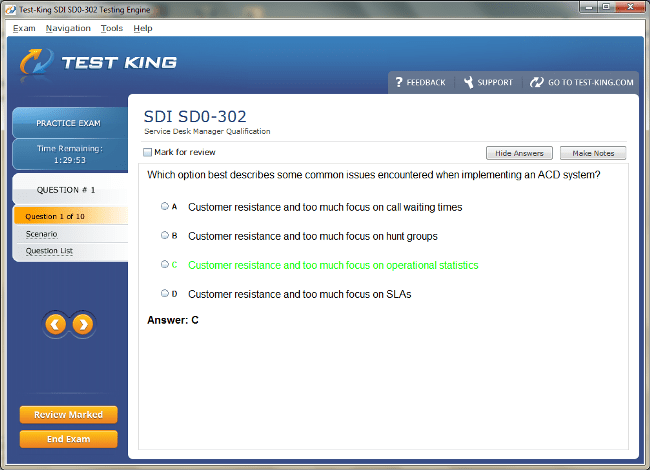
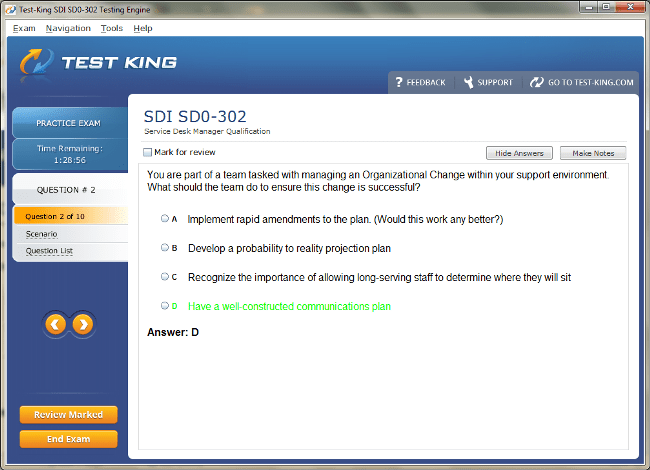
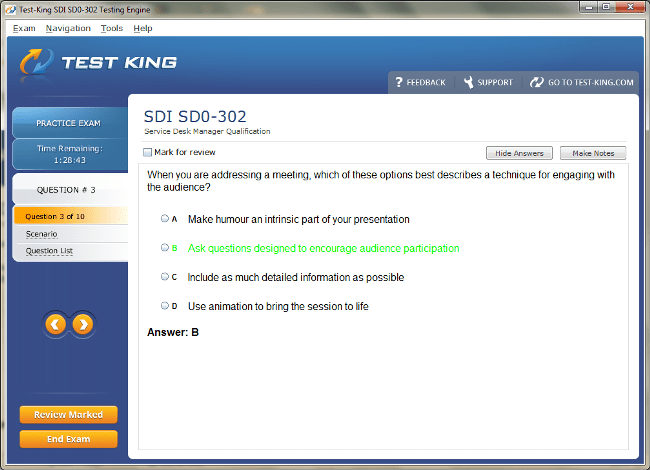
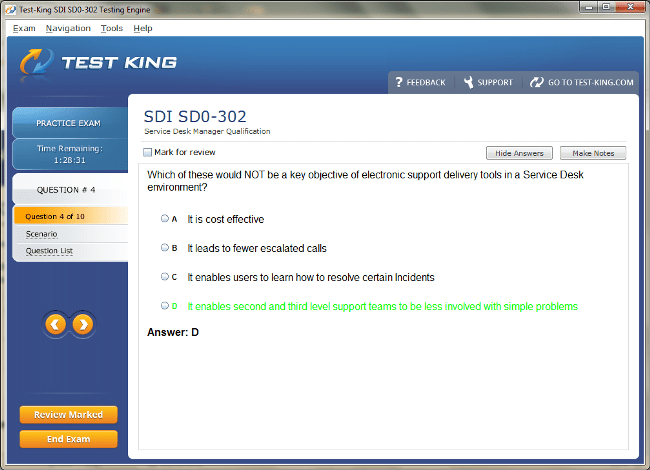
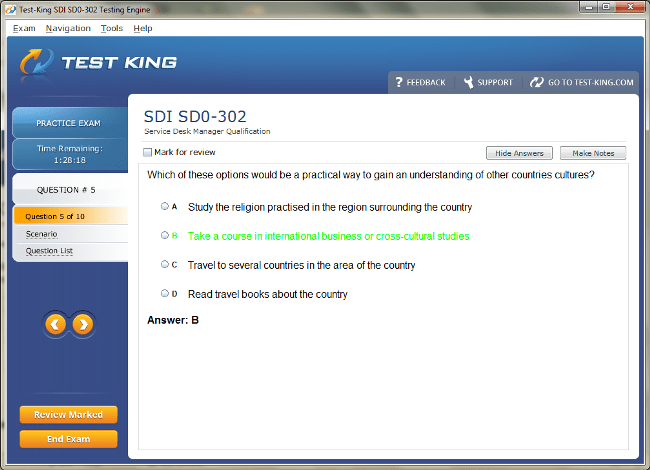
SD0-302 Exam Product Screenshots
Frequently Asked Questions
How can I get the products after purchase?
All products are available for download immediately from your Member's Area. Once you have made the payment, you will be transferred to Member's Area where you can login and download the products you have purchased to your computer.
How long can I use my product? Will it be valid forever?
Test-King products have a validity of 90 days from the date of purchase. This means that any updates to the products, including but not limited to new questions, or updates and changes by our editing team, will be automatically downloaded on to computer to make sure that you get latest exam prep materials during those 90 days.
Can I renew my product if when it's expired?
Yes, when the 90 days of your product validity are over, you have the option of renewing your expired products with a 30% discount. This can be done in your Member's Area.
Please note that you will not be able to use the product after it has expired if you don't renew it.
How often are the questions updated?
We always try to provide the latest pool of questions, Updates in the questions depend on the changes in actual pool of questions by different vendors. As soon as we know about the change in the exam question pool we try our best to update the products as fast as possible.
How many computers I can download Test-King software on?
You can download the Test-King products on the maximum number of 2 (two) computers or devices. If you need to use the software on more than two machines, you can purchase this option separately. Please email support@test-king.com if you need to use more than 5 (five) computers.
What is a PDF Version?
PDF Version is a pdf document of Questions & Answers product. The document file has standart .pdf format, which can be easily read by any pdf reader application like Adobe Acrobat Reader, Foxit Reader, OpenOffice, Google Docs and many others.
Can I purchase PDF Version without the Testing Engine?
PDF Version cannot be purchased separately. It is only available as an add-on to main Question & Answer Testing Engine product.
What operating systems are supported by your Testing Engine software?
Our testing engine is supported by Windows. Andriod and IOS software is currently under development.
Mastering the SD0-302 Exam: Your Path to Becoming a Certified Service Desk Manager
The SD0-302 Service Desk Manager Qualification, governed by the Service Desk Institute (SDI), represents one of the most esteemed certifications in the landscape of IT service management and operational leadership. It is a benchmark that validates an individual’s capacity to lead, motivate, and transform service desk operations into strategic assets that deliver measurable business value. The exam, designed for those aspiring to advance beyond technical proficiency, measures the managerial, analytical, and interpersonal skills necessary to sustain service excellence in complex environments.
At its core, the SD0-302 qualification emphasizes that the service desk is not merely a troubleshooting entity—it is the beating heart of user experience, communication, and technological continuity. As organizations evolve toward digital transformation, the ability to manage service delivery, customer relations, and team performance cohesively has become indispensable. This is precisely the realm where a certified Service Desk Manager distinguishes themselves through structured methodologies, data-driven decision-making, and empathetic leadership.
Understanding the SD0-302 Qualification and Its Role in Modern IT Leadership
To master this qualification, one must delve beyond memorization and instead cultivate a refined understanding of service management principles, business alignment, and human dynamics within IT ecosystems. The SD0-302 curriculum blends conceptual knowledge with pragmatic application, covering themes such as service culture, quality assurance, leadership dynamics, performance metrics, and continuous improvement. Each area contributes to shaping a leader who not only maintains operational stability but also envisions innovative pathways to enhance organizational capability.
A candidate preparing for the SD0-302 must internalize that leadership in service management is multi-dimensional. It requires balancing technology and humanity, precision and empathy, governance and adaptability. The exam framework tests not only one’s theoretical grasp but also the ability to contextualize knowledge into realistic workplace scenarios. The certified professional becomes an architect of service excellence, capable of interpreting user needs, fostering productive teams, and implementing processes that uphold the integrity and resilience of IT services.
The qualification underscores the importance of aligning service operations with business objectives. In many organizations, the service desk is the first touchpoint for users experiencing challenges or requesting assistance. The manager, therefore, becomes the intermediary between technical teams and business stakeholders, translating organizational strategy into actionable service objectives. This demands not only fluency in ITIL-based principles but also an awareness of financial management, risk mitigation, and customer satisfaction dynamics.
Mastery of the SD0-302 content involves an in-depth exploration of service desk structures and their maturity levels. A well-organized service desk operates on defined procedures, clear accountability, and measurable standards. Candidates must learn to evaluate performance indicators such as incident response times, resolution rates, customer satisfaction scores, and operational costs. Yet, the emphasis is not solely on numerical analysis; it also lies in interpreting these figures to identify patterns, anticipate problems, and initiate enhancements that refine user experience.
In the examination context, understanding quality management is crucial. The service desk’s output must adhere to benchmarks of consistency, timeliness, and accuracy. However, the true essence of quality lies in the perception of users and their trust in the support process. The SD0-302 qualification cultivates a mindset where quality transcends compliance—it becomes a cultural phenomenon that permeates every interaction and procedure. The manager must nurture this culture, ensuring that every team member embodies professionalism, empathy, and accountability.
Leadership within the service desk domain is distinct because it merges technical oversight with emotional intelligence. A service desk manager is expected to guide teams through challenges, maintain morale, and foster collaboration. Effective communication stands as the linchpin of this responsibility. Candidates must exhibit proficiency in managing conflicts, delivering feedback, conducting appraisals, and coordinating interdepartmental collaboration. The SD0-302 qualification therefore nurtures the art of dialogue, ensuring that leaders can articulate goals, mediate tensions, and inspire collective progress.
Furthermore, this certification instills the principles of strategic management. Candidates are encouraged to perceive the service desk not as a cost center but as a value generator. Through strategic planning, process optimization, and stakeholder engagement, the service desk can contribute directly to productivity and innovation. This transformation begins with a well-structured vision and measurable objectives aligned with enterprise goals. The exam tests one’s ability to conceptualize such strategies and implement them through pragmatic, sustainable actions.
The role of metrics and analytics in this context cannot be overstated. The SD0-302 emphasizes data-driven management, urging leaders to harness performance data as a foundation for informed decisions. Metrics reveal operational strengths and weaknesses, but interpretation requires discernment and contextual understanding. The adept manager learns to balance quantitative data with qualitative insights derived from user feedback, team sentiment, and service trends. By doing so, they cultivate a holistic perspective that guides continual improvement initiatives.
Preparation for the SD0-302 demands disciplined study, experiential learning, and reflective thinking. Candidates should analyze past experiences within service management to draw connections between theory and practice. Many of the exam’s scenarios are designed to assess situational judgment—how a leader would act under specific organizational pressures or dilemmas. Therefore, developing a nuanced understanding of ethical considerations, decision frameworks, and prioritization strategies is invaluable.
An essential dimension of this qualification lies in the exploration of service culture. Service culture defines the behavioral norms, communication style, and ethos of the team. The SDI framework teaches that culture influences every facet of service delivery—from first contact resolution to long-term customer loyalty. A manager aspiring to achieve certification must learn to shape and sustain a culture rooted in respect, innovation, and responsiveness. This often entails redefining internal processes to ensure that employees feel valued and empowered to deliver their best.
Change management also plays a pivotal role in mastering the SD0-302 material. The modern IT environment is characterized by perpetual evolution—new technologies, evolving expectations, and dynamic workflows. A service desk manager must not only adapt to change but also lead others through it with foresight and composure. Understanding how to manage resistance, communicate change rationales, and ensure seamless transitions forms a significant portion of the learning journey.
While technical proficiency remains a baseline requirement, the qualification elevates the candidate’s focus toward governance, innovation, and sustainability. Governance encompasses the design of policies, frameworks, and accountability mechanisms that guarantee service integrity. Innovation involves exploring tools, automation, and methodologies that enhance efficiency. Sustainability requires ensuring that processes are adaptable, resilient, and future-proof. Collectively, these attributes define the modern service desk manager’s role in a volatile digital economy.
Training for the SD0-302 examination typically integrates theory with interactive workshops, case studies, and reflective exercises. The candidate is guided to assess real-world service desk operations, identify bottlenecks, and propose solutions using SDI-aligned principles. This experiential learning approach ensures that theoretical understanding is internalized through application. Learners are encouraged to question traditional hierarchies, challenge inefficiencies, and propose service improvements that align with strategic goals.
Another distinctive element of this qualification is its focus on stakeholder management. The service desk manager interacts with diverse groups—users, technical teams, vendors, and executives. Navigating these relationships requires diplomacy, analytical acumen, and trust-building. The SD0-302 framework underscores that successful managers act as ambassadors of communication, ensuring transparency between operational layers and the business hierarchy. Mastery in this domain enhances the organization’s credibility and cohesion.
The examination itself is rigorous, requiring candidates to demonstrate both breadth and depth of knowledge. It tests comprehension of service management theory, analytical reasoning, and leadership application. However, the goal is not rote memorization but evidence of understanding—how principles are integrated into authentic managerial contexts. Those who succeed in the SD0-302 exam are not merely certified; they are recognized as transformational leaders capable of aligning service excellence with enterprise ambition.
Moreover, the qualification’s impact extends beyond certification. It fosters a mindset of perpetual improvement and professional maturity. A certified Service Desk Manager becomes a catalyst for cultural evolution within the organization, driving initiatives that enhance collaboration, efficiency, and satisfaction. This transformation resonates through every service interaction, creating a ripple effect that strengthens the organization’s reputation and stability.
The SDI’s philosophy behind this qualification is rooted in empowerment and accountability. Candidates are trained to think systemically, appreciating how processes interconnect and influence outcomes. They learn that every procedural adjustment, every communication channel, and every analytical report contributes to the holistic performance of the service desk. This integrative perspective differentiates the certified manager from operational supervisors who focus solely on daily task execution.
Continuous professional development forms an implicit expectation for anyone pursuing this path. The IT service landscape is fluid, shaped by technological disruption and changing consumer behaviors. A proficient service desk manager embraces lifelong learning, remaining attuned to industry trends, emerging frameworks, and evolving best practices. The SD0-302 qualification is thus not an endpoint but a gateway to sustained professional refinement.
The ethical dimension of service management also occupies an integral space in the curriculum. Integrity, confidentiality, and fairness underpin every managerial decision. Candidates are expected to embody values that reinforce trust and accountability, both internally and externally. Upholding ethical standards ensures that service operations remain transparent and equitable, which in turn enhances customer confidence and organizational reputation.
Emotional intelligence is another pillar of success for the aspiring Service Desk Manager. Beyond technical and procedural acumen, the SD0-302 qualification emphasizes the ability to perceive and respond to human emotions constructively. Effective leaders foster psychological safety within their teams, encouraging open dialogue and mutual respect. This sensitivity contributes to team cohesion and productivity, ultimately improving service delivery outcomes.
As candidates progress through their preparation journey, they must develop resilience and strategic patience. The learning path is demanding, encompassing diverse domains such as leadership psychology, business alignment, service quality, and process improvement. Consistent study schedules, engagement with peer groups, and reflection on real-life case studies reinforce comprehension. The candidate who approaches learning as a cumulative, immersive experience rather than an examination hurdle is far more likely to excel.
In practical terms, aspiring professionals should focus on understanding the interdependence between people, process, and technology. A high-performing service desk thrives on this triad. The manager’s role is to ensure harmony—enabling technology to empower people, guiding processes to sustain quality, and nurturing people to maximize efficiency. The SD0-302 qualification reinforces this triadic vision, ensuring that certified professionals emerge as holistic leaders rather than specialized technicians.
Furthermore, aspirants must learn to measure and articulate success in quantifiable terms. Whether it is through service level agreements, performance benchmarks, or cost-efficiency ratios, the ability to communicate results convincingly is crucial. This competency enhances managerial credibility and supports the justification of resources, investments, or process changes before higher management.
Equally vital is the appreciation of diversity within teams and user bases. Service desk environments encompass a spectrum of personalities, skills, and expectations. The certified manager learns to harmonize these differences, leveraging diversity as a source of creativity and resilience. By cultivating inclusivity and empathy, they ensure that the service environment becomes not only efficient but also humane.
Lastly, mastering the SD0-302 qualification entails developing a visionary mindset. The certified professional looks beyond immediate operational metrics to envision the long-term trajectory of the service desk. They assess emerging technologies such as AI-driven support, predictive analytics, and knowledge automation not as disruptions but as opportunities. They orchestrate the convergence of innovation and tradition, ensuring that the service desk evolves as a strategic partner within the enterprise ecosystem.
Through this comprehensive approach, the SD0-302 Service Desk Manager Qualification becomes more than an academic pursuit—it becomes an odyssey toward mastery, leadership, and transformative impact. Those who embrace its philosophy internalize a legacy of continuous improvement, intellectual rigor, and unwavering dedication to service excellence, thereby embodying the highest standards of the profession.
Deepening Expertise in Leadership, Service Strategy, and Operational Excellence
The SD0-302 Service Desk Manager Qualification by the Service Desk Institute represents a profound journey into the art and science of managing service operations that transcend mere technical resolution. It is a credential that embodies mastery in organizational leadership, customer experience optimization, and sustainable service delivery. To excel in this qualification, aspirants must deepen their comprehension of how strategic leadership, cohesive teamwork, and service innovation harmonize to create an environment of perpetual improvement. The SD0-302 exam does not simply assess memory—it evaluates the candidate’s ability to analyze complex scenarios, interpret user-centric challenges, and devise systematic solutions that align with organizational objectives.
The essence of effective service desk management lies in orchestrating people, processes, and technologies to work in symphonic alignment. A leader who aspires to succeed in the SD0-302 qualification must begin by cultivating a lucid understanding of organizational purpose. The service desk is not an isolated department; it is an integral component of the business’s operational ecosystem. It influences productivity, morale, and customer loyalty. This awareness compels the service desk manager to function as both a strategist and a facilitator—someone who comprehends the macro-level vision while ensuring micro-level precision in every transaction.
The qualification underscores the concept of transformational leadership, where the manager guides the team not through authority but through inspiration and clarity of vision. Transformational leaders nurture intrinsic motivation within their teams, encouraging them to pursue excellence voluntarily rather than through compulsion. This leadership approach breeds ownership, accountability, and a sense of belonging, which collectively enhance the overall service culture. The SD0-302 framework encourages candidates to internalize this principle and apply it within their managerial contexts.
Understanding human behavior is central to mastering this qualification. The service desk operates at the intersection of human emotions and technological complexity. Users reaching out for support may be under pressure, confused, or frustrated. The manager’s task is to instill empathy throughout the team, ensuring that each interaction is handled with professionalism and composure. Emotional intelligence becomes a decisive factor here. Managers who possess the ability to sense team morale, recognize stress triggers, and cultivate resilience can sustain performance even in high-pressure circumstances.
Equally essential is the comprehension of service strategy. The SD0-302 exam expects candidates to grasp the nuances of aligning service objectives with business goals. Service strategy involves understanding how every incident handled, every query resolved, and every process improved contributes to the overarching vision of the organization. A robust strategy outlines not only what the service desk does but why it does it. This strategic clarity transforms routine operations into purposeful actions. Candidates must be adept at formulating strategies that balance operational efficiency with customer-centric outcomes.
Within this framework, resource management becomes a critical competency. The service desk manager must optimize both human and technological resources to achieve desired outcomes without redundancy or burnout. Workforce planning involves analyzing workload patterns, identifying peak demand periods, and scheduling team members in a way that maximizes both productivity and well-being. Similarly, technological resources such as ticketing systems, knowledge bases, and communication tools must be managed to ensure smooth workflows. The candidate must demonstrate a sophisticated understanding of how to harmonize these assets to achieve consistent service quality.
The SD0-302 qualification further explores the importance of service quality management. Quality is not a static concept; it evolves with user expectations, technological advancements, and organizational priorities. The certified manager learns to establish measurable standards of service and evaluate them regularly through performance metrics and feedback loops. These metrics are not viewed merely as numerical indicators but as narratives that reveal user sentiment, efficiency patterns, and improvement opportunities. The ability to interpret this data with discernment and translate it into actionable strategies is a hallmark of a capable service desk leader.
A deep dive into the principles of continual improvement forms another cornerstone of this qualification. The SD0-302 framework teaches that excellence is not a destination but an ongoing pursuit. Managers are encouraged to adopt methodologies that promote iterative progress, such as root cause analysis and process reengineering. By fostering a culture of curiosity and adaptability, the service desk evolves into a dynamic function that anticipates issues rather than merely reacting to them. This proactive mindset not only enhances performance but also builds credibility within the organization.
One of the most pivotal elements examined in the SD0-302 curriculum is customer relationship management. A successful service desk manager recognizes that every interaction with a user is an opportunity to reinforce trust and satisfaction. Managing these relationships demands active listening, transparent communication, and timely resolution. The manager must ensure that policies and procedures are not rigid constraints but flexible frameworks that support the user experience. By humanizing service delivery, the manager transforms the desk from a transactional help point into a valued business partner.
Equally vital is the role of communication within and beyond the team. Effective communication is the lifeblood of service management. The certified professional must be capable of articulating ideas clearly, delegating responsibilities effectively, and conveying performance insights to senior stakeholders. Within the team, communication fosters cohesion and reduces ambiguity. Between departments, it promotes collaboration and prevents operational silos. During crises, it ensures that everyone remains informed, aligned, and focused. The SD0-302 exam assesses how well candidates can use communication as a leadership instrument to harmonize team dynamics and drive performance.
Decision-making is another area of profound emphasis. The service desk manager constantly faces situations requiring prompt yet thoughtful decisions—ranging from resource allocation to conflict resolution. The SD0-302 qualification expects candidates to demonstrate structured decision-making processes that integrate analytical reasoning, ethical judgment, and contextual awareness. A decision may resolve an immediate issue but simultaneously influence long-term outcomes; thus, candidates are evaluated on their ability to consider both short-term and strategic consequences.
The service desk also operates as a bridge between technology providers and business users. This intermediary role demands diplomacy and technical fluency. The certified manager must interpret technical jargon for non-technical audiences while translating business needs into operational requirements for IT teams. This dual fluency allows the service desk to maintain coherence between different layers of the organization, ensuring that expectations are met and misunderstandings minimized.
In addition, the SD0-302 qualification emphasizes the importance of performance management and staff development. A thriving service desk is built on the strengths of its people. The manager’s responsibility extends beyond supervision to nurturing talent and cultivating future leaders. This involves conducting performance appraisals, setting developmental goals, and offering constructive feedback. A supportive environment that values learning and recognition fosters loyalty and engagement, reducing turnover and enhancing service stability. Candidates preparing for the SD0-302 must understand the intricacies of motivating diverse personalities and leveraging individual strengths for collective success.
Risk management forms another crucial component of this qualification. Every service operation is exposed to potential disruptions—whether technological, procedural, or human. The service desk manager must be vigilant in identifying, assessing, and mitigating risks before they escalate into crises. This includes designing contingency plans, ensuring data security, and maintaining compliance with organizational and legal standards. A proactive approach to risk management not only safeguards service continuity but also demonstrates leadership foresight.
An often-underestimated dimension of this qualification lies in knowledge management. Knowledge is the backbone of efficient service delivery. It enables faster resolution times, consistent responses, and informed decision-making. The manager must establish systems for capturing, organizing, and updating knowledge so that team members can access accurate information effortlessly. This repository becomes a living asset that grows with the organization’s experience. The SD0-302 exam requires candidates to understand how knowledge management integrates with training, documentation, and service innovation.
A well-rounded preparation for the SD0-302 also entails mastering the principles of change management. In an era of relentless technological advancement, change is inevitable. Whether it involves software upgrades, process revisions, or structural reorganizations, the service desk manager must guide their team through transitions with composure and confidence. Change management encompasses communication planning, stakeholder engagement, and post-implementation review. The candidate must exhibit an understanding of how to balance stability with transformation while minimizing resistance and disruption.
Service reporting and analysis form an additional layer of managerial responsibility. Reports provide visibility into performance, trends, and challenges. They serve as evidence for decision-making and resource justification. However, reporting is not about volume but about relevance. The certified manager learns to present data that tells a coherent story—one that informs, persuades, and inspires action. This skill distinguishes proficient leaders who understand that information without interpretation holds little value.
The SD0-302 qualification also delves into the psychology of teamwork. A service desk’s success hinges on synergy among its members. The manager must ensure that collaboration prevails over competition, that roles are clearly defined, and that accountability is balanced with autonomy. Understanding group dynamics helps prevent conflict, sustain motivation, and encourage innovation. By cultivating an atmosphere of mutual trust, the manager transforms the team into a cohesive entity capable of achieving extraordinary results even under duress.
Technological proficiency remains a foundational expectation, though it is never the central focus. The SDI framework insists that true leadership transcends technical mastery; it resides in the ability to leverage technology strategically. Automation tools, artificial intelligence, and digital analytics are enablers of productivity, not substitutes for human judgment. The certified manager learns to integrate these technologies thoughtfully—enhancing efficiency without eroding the human essence of service interaction.
The qualification also touches upon the financial dimension of service management. Budgets, cost control, and return on investment are integral to managerial accountability. The candidate must be capable of balancing expenditure with value delivery. This involves understanding cost structures, identifying inefficiencies, and presenting compelling cases for investment in technology or personnel. Financial literacy in this context empowers the manager to make informed, sustainable decisions that benefit both the service desk and the broader organization.
Another profound aspect of mastering the SD0-302 qualification is understanding organizational culture and its influence on service performance. Culture shapes attitudes, behaviors, and decision-making patterns. A toxic culture breeds apathy and turnover, while a constructive one fuels innovation and loyalty. The manager’s role is to consciously shape culture through consistent communication, recognition, and ethical modeling. They must embody the values they wish to see reflected across the team. The exam assesses how candidates interpret cultural cues and implement strategies that reinforce positive behavioral norms.
Conflict resolution is a vital interpersonal skill evaluated within the SD0-302 framework. Conflicts, if mismanaged, can erode morale and efficiency. The manager must learn to mediate disputes objectively, focusing on facts rather than emotions. Active listening, empathy, and fairness form the triad of effective conflict resolution. Candidates must be able to demonstrate how these principles can restore harmony and reinforce team cohesion.
Service innovation, too, finds a place within the SD0-302 curriculum. Innovation is not limited to technological breakthroughs; it includes reimagining processes, enhancing communication, and redesigning workflows. The manager must encourage a mindset where team members feel empowered to propose ideas and experiment with improvements. A culture that rewards innovation nurtures adaptability and keeps the service desk aligned with evolving user needs.
To prepare for the SD0-302 examination effectively, candidates must adopt an immersive approach that integrates study with experiential reflection. Engaging with real-life service desk environments, analyzing operational reports, and participating in peer discussions enrich understanding. The goal is not merely to pass the exam but to emerge as a professional capable of transforming service operations through insight and integrity.
Ultimately, the SD0-302 Service Desk Manager Qualification is a testament to holistic leadership. It amalgamates technical proficiency with human wisdom, operational discipline with strategic agility, and individual achievement with collective purpose. Those who internalize its principles evolve into custodians of service excellence—leaders who balance empathy with efficiency and vision with execution. Their influence extends far beyond their immediate teams, shaping the organizational ethos and defining the future trajectory of service management itself.
Building Strategic Intelligence and Transformational Capacity in Service Desk Management
The SD0-302 Service Desk Manager Qualification from the Service Desk Institute represents a profound exploration of leadership, organizational psychology, and service innovation. It moves beyond conventional notions of IT support to cultivate professionals who possess both analytical acuity and emotional depth. This qualification transforms an individual into a catalyst of operational excellence, capable of integrating people, processes, and technology into a harmonious ecosystem that drives consistent value creation. To excel in this prestigious certification, one must internalize a complex interplay of strategic awareness, adaptive thinking, and interpersonal sensitivity. The SD0-302 exam serves as a mirror reflecting the managerial maturity of a candidate—their readiness to orchestrate transformation, uphold governance, and navigate the intricate dynamics of modern service environments.
At the heart of the SD0-302 framework lies an unwavering emphasis on strategic intelligence. A certified Service Desk Manager must not only understand how services are delivered but also why they are structured in particular ways. This requires a panoramic comprehension of the organization’s objectives, constraints, and evolving priorities. Strategic intelligence encompasses foresight—the ability to anticipate challenges before they arise—and adaptability, the competence to recalibrate strategies in response to shifting circumstances. It enables the manager to operate not as a passive participant but as a proactive architect of service excellence. Candidates preparing for this qualification must therefore cultivate an analytical mindset capable of decoding patterns, predicting trends, and translating data into actionable foresight.
The role of leadership in this domain transcends hierarchical control; it is deeply relational and visionary. The SD0-302 curriculum positions leadership as the linchpin of service management maturity. The modern Service Desk Manager must inspire through example, nurture psychological safety, and instill a shared sense of purpose. This calls for the synthesis of empathy and decisiveness. Empathy ensures that people feel understood, while decisiveness assures that direction is never ambiguous. Leadership in this context becomes a symphony of persuasion, integrity, and endurance. The certified professional learns to guide the team through turbulence, resolve conflicts with equanimity, and champion innovation without alienating stability.
The SD0-302 qualification demands that candidates grasp the multidimensional nature of service delivery. Service management extends beyond resolving incidents—it involves maintaining a delicate equilibrium between operational efficiency, user satisfaction, and business alignment. The Service Desk Manager operates as both a guardian of continuity and an enabler of progress. This duality requires intellectual dexterity. On one hand, the manager must safeguard standardized processes and compliance. On the other, they must promote flexibility to accommodate unique user scenarios and emerging technologies. Achieving this balance necessitates a structured approach underpinned by meticulous governance frameworks, yet tempered with the humanistic understanding that every interaction carries emotional weight.
The architecture of a high-performing service desk is constructed on well-defined processes that are continuously refined. Within the SD0-302 framework, process optimization is a recurring theme. Candidates are expected to master the ability to map workflows, identify redundancies, and eliminate inefficiencies that hinder service responsiveness. The refinement of processes is not purely mechanical; it is a creative act guided by critical thinking. Every procedural revision must enhance the speed, accuracy, and satisfaction associated with service delivery. Continuous improvement methodologies, such as root cause analysis and feedback-driven evolution, are embedded within the qualification’s philosophy. These methods empower managers to ensure that operational adjustments translate into tangible performance uplift.
The Service Desk Manager must also develop mastery in knowledge dissemination. The SD0-302 qualification highlights that knowledge management forms the nucleus of sustainable service excellence. Knowledge, when effectively captured and shared, becomes the lifeblood of an agile organization. Candidates are taught to construct robust repositories that evolve dynamically—repositories where lessons learned, procedural updates, and innovative insights converge. The efficient circulation of this knowledge reduces redundancy, accelerates resolution times, and strengthens organizational memory. This competency transforms the service desk from a reactive hub into a learning organism that continuously adapts to the flux of business demands.
Emotional intelligence, while often perceived as intangible, is a decisive determinant of managerial success within the SD0-302 framework. The certification encourages managers to develop an intuitive awareness of human behavior. Understanding the emotional undercurrents within teams allows the manager to preempt conflict, sustain motivation, and reinforce cohesion. Emotional intelligence extends beyond interpersonal relations; it permeates customer interaction as well. A service desk professional who demonstrates empathy, patience, and clarity can transform a frustrated user into a loyal advocate. This emotional dexterity complements technical competence, creating a service experience that feels authentic and reliable.
A crucial domain within the SD0-302 curriculum is performance measurement and evaluation. Metrics are the compass by which a service desk navigates its operational journey. Candidates must learn to design performance indicators that reflect not just efficiency but also effectiveness. Incident resolution time, first-contact resolution rate, and user satisfaction scores are important, but they gain real meaning only when interpreted contextually. The service desk manager’s skill lies in transforming raw data into narratives that reveal systemic strengths and weaknesses. These insights become the foundation for informed decision-making. Mastery in this realm entails not only statistical fluency but also interpretive intelligence—the capacity to read between the numbers.
The SD0-302 also emphasizes governance and compliance. A well-governed service desk functions within defined boundaries that ensure consistency, accountability, and transparency. Governance does not stifle creativity; rather, it provides the structure within which innovation can flourish responsibly. Candidates must comprehend frameworks related to risk management, policy formulation, and ethical standards. This includes understanding how to document procedures, audit activities, and maintain adherence to both internal and external regulations. Compliance is not simply about avoiding penalties—it is about cultivating credibility. Organizations entrust service desk managers who uphold governance because they embody reliability and foresight.
Communication, though often underestimated, forms the sinews of service management. The SD0-302 qualification underscores the necessity of precision, empathy, and adaptability in communication. The certified manager must articulate ideas persuasively to diverse audiences, from technical staff to executive leaders. This involves tailoring tone, vocabulary, and message structure according to the listener’s perspective. In high-pressure scenarios, communication becomes a stabilizing force that maintains clarity amid uncertainty. Candidates must therefore develop an articulate voice capable of commanding attention without intimidation, and conveying authority without arrogance.
The SD0-302 also introduces the imperative of stakeholder management. The Service Desk Manager functions at the intersection of multiple interest groups—users, technicians, vendors, and executives. Each group carries distinct expectations and communication styles. Success depends on the manager’s ability to mediate among these parties with diplomatic finesse. Stakeholder engagement is a continuous process of expectation alignment, trust-building, and transparent reporting. The manager must recognize that perception shapes reputation; thus, every interaction contributes to how the service desk is viewed within the organization. Proficiency in stakeholder management elevates the service desk’s status from a functional unit to a strategic collaborator.
Resource allocation and optimization are pivotal in achieving operational harmony. The SD0-302 qualification trains candidates to manage resources with prudence and foresight. This encompasses scheduling personnel to match workload rhythms, ensuring adequate technological tools are available, and balancing cost constraints with service expectations. Resource optimization is an act of equilibrium—too much allocation leads to waste, while too little invites burnout. The certified manager must develop a sensitivity to patterns in demand and design resource models that are both scalable and sustainable.
Risk management is another domain that underscores the maturity of a Service Desk Manager. In the digital era, risks arise not only from technological vulnerabilities but also from procedural lapses and human error. The SD0-302 qualification guides candidates to approach risk as a continuous spectrum rather than an isolated event. Identifying early warning signals, assessing potential impacts, and instituting mitigation measures are fundamental to preserving service continuity. A proactive manager develops contingency frameworks that safeguard the organization’s resilience. The presence of a well-prepared risk strategy reassures stakeholders that the service desk operates with foresight and professionalism.
The discipline of change management is deeply intertwined with service desk leadership. Every organization evolves, and with evolution comes transformation in processes, systems, and expectations. The SD0-302 curriculum expects candidates to master the science of managing change while minimizing resistance. This involves preparing teams psychologically, communicating rationale transparently, and maintaining engagement throughout the transition. The ability to convert disruption into opportunity defines the hallmark of a mature manager. Candidates must internalize that change is not a temporary inconvenience but a permanent feature of progress.
Financial stewardship forms an often-overlooked but vital component of the SD0-302 qualification. Service desk operations incur costs, yet they also generate quantifiable value through enhanced productivity and customer satisfaction. The manager must therefore cultivate financial literacy—understanding budgeting principles, cost-benefit analysis, and return on investment evaluation. A certified professional should be able to justify expenditures through tangible performance outcomes and efficiency gains. This financial acumen positions the manager as a credible contributor to organizational strategy rather than a passive budget recipient.
Cultural intelligence constitutes another dimension of managerial sophistication emphasized in this qualification. Organizations are multicultural ecosystems, comprising individuals with diverse backgrounds, beliefs, and communication styles. The Service Desk Manager must demonstrate sensitivity to these differences and leverage diversity as a strength. By cultivating inclusivity, the manager fosters innovation, as diverse perspectives often yield more creative solutions. The SD0-302 framework reinforces the idea that an inclusive culture is not only ethically sound but also operationally advantageous. It enhances collaboration, reduces conflict, and amplifies collective intelligence.
The examination also requires candidates to exhibit mastery in problem-solving methodologies. Complex service environments often present multifaceted challenges that demand structured reasoning. Candidates are expected to approach problems through systematic frameworks—identifying root causes, analyzing dependencies, and evaluating alternative solutions. Creativity complements logic in this process. Innovative problem-solving involves the ability to reframe issues, challenge assumptions, and experiment with unconventional ideas while remaining grounded in practicality. The hallmark of an effective manager is not the absence of problems but the ability to transform them into opportunities for refinement.
The SD0-302 qualification acknowledges that service desks function as both reactive and proactive entities. While incident resolution remains a core responsibility, anticipation of future issues distinguishes exceptional managers. Predictive analysis, trend observation, and user feedback interpretation allow the manager to identify emerging pain points before they escalate. This anticipatory competence positions the service desk as a guardian of organizational stability. Proactive management nurtures trust, as users perceive the service desk not as a crisis response unit but as a strategic enabler of reliability.
Service reporting and analytical communication play a central role in managerial transparency. The SD0-302 framework teaches candidates to present complex data in formats that inform and persuade decision-makers. Reports must be concise yet comprehensive, analytical yet comprehensible. They must narrate the story behind performance trends and propose remedial or enhancement actions. The ability to communicate analytical insights with clarity and persuasion elevates the manager’s credibility, transforming numbers into narratives that shape strategic choices.
Another critical element of mastery is the nurturing of innovation within the service desk. Innovation is not confined to technological upgrades; it includes reimagining processes, redefining metrics, and reconfiguring user engagement models. The manager must create an environment where curiosity thrives and experimentation is encouraged. Fear of failure stifles creativity, whereas psychological safety liberates it. The SD0-302 qualification teaches candidates that innovation is the offspring of inquiry and courage—the courage to challenge convention and the inquiry to refine discovery into implementation.
The ethical foundation of service desk management permeates every managerial decision. Ethical leadership ensures fairness, confidentiality, and transparency in all dealings. The SD0-302 framework places significant weight on integrity because ethical lapses can dismantle trust faster than technical failures. The candidate must demonstrate understanding of ethical dilemmas, such as balancing confidentiality with accountability, or prioritizing resources under constraints. A manager who leads ethically commands respect, nurtures loyalty, and upholds the reputation of the organization as a principled entity.
The qualification also requires insight into talent development and succession planning. The service desk’s sustainability depends on its people. The manager must identify potential leaders within the team, mentor them, and provide opportunities for growth. Succession planning ensures that organizational knowledge and expertise are preserved even when key individuals transition. Investing in people is not an act of benevolence but a strategic necessity. The SD0-302 qualification reinforces that the most enduring legacy of leadership is the cultivation of future leaders.
In the digital age, technological awareness is indispensable for effective service management. Automation, artificial intelligence, and analytics have redefined the contours of service delivery. The SD0-302 framework expects candidates to comprehend these technologies not as replacements for human interaction but as instruments of empowerment. Automation accelerates routine tasks, AI enhances decision support, and analytics deepen understanding of user behavior. The certified manager integrates these tools judiciously, ensuring that technology amplifies human capacity rather than eclipsing it.
A candidate pursuing mastery must also develop resilience—a psychological attribute that sustains leadership during adversity. Service environments are inherently volatile, subject to unexpected outages, user dissatisfaction, and operational disruptions. Resilience enables the manager to remain composed, objective, and solution-oriented amidst chaos. This stability radiates to the team, reinforcing collective confidence. The SD0-302 qualification implicitly evaluates this trait through scenario-based assessments where candidates must demonstrate calm judgment and adaptive thinking.
Ultimately, the SD0-302 Service Desk Manager Qualification is an odyssey into the essence of leadership and service transformation. It demands intellectual rigor, emotional balance, and strategic imagination. Through this qualification, the individual evolves from a practitioner into a visionary—someone capable of transcending daily constraints to architect enduring systems of excellence. The service desk, under such leadership, becomes not merely a function but a philosophy—a living embodiment of reliability, empathy, and continuous improvement that defines the future of IT service management.
Advanced Strategies for Service Excellence and Organizational Mastery
The path toward becoming a proficient and certified Service Desk Manager is a journey that demands depth, reflection, and a refined understanding of how technology and human engagement coalesce to shape organizational effectiveness. The SD0-302 certification represents more than a professional milestone; it symbolizes a comprehensive transformation in perspective, shifting from operational task management to strategic leadership. At this stage, aspirants begin to master the nuances of service improvement, customer value delivery, and leadership competence required to create a harmonized service environment within evolving digital ecosystems.
A Service Desk Manager is entrusted with the stewardship of service operations, ensuring that the mechanisms of support are efficient, empathetic, and in alignment with business priorities. This responsibility extends beyond traditional management, demanding an aptitude for continuous enhancement, meticulous analysis, and the foresight to anticipate and address issues before they become disruptions. The SD0-302 examination expects candidates to possess not only the theoretical understanding of service management frameworks but also the ability to apply them dynamically within real-world environments marked by complexity and unpredictability.
Central to mastering this qualification is a deep comprehension of service improvement planning. Improvement does not manifest from chance but arises from deliberate evaluation and informed decision-making. The Service Desk Manager must understand how to interpret performance metrics, translate analytical insights into meaningful initiatives, and foster a culture of excellence that permeates the entire service function. Metrics such as response time, first contact resolution, incident recurrence, and customer satisfaction ratings provide a quantitative foundation for identifying inefficiencies. However, the true artistry lies in transforming these numbers into actionable strategies that elevate the service experience.
Within this context, communication and collaboration serve as essential tools for organizational cohesion. The manager functions as the central conduit through which information, expectations, and aspirations flow. They must refine the ability to articulate complex technical issues in a way that resonates with non-technical stakeholders while simultaneously ensuring that their team comprehends and internalizes the strategic objectives of the organization. This bilateral communication ensures synergy between service desk operations and the broader business vision, minimizing misunderstandings and fostering shared accountability.
The SD0-302 curriculum emphasizes that service improvement is not merely about rectifying existing inefficiencies but involves an ongoing cycle of innovation and adaptation. Managers must remain attuned to technological advancements, evolving customer expectations, and internal changes that influence service delivery. By conducting regular service reviews, analyzing feedback loops, and benchmarking performance against industry standards, they ensure that the service desk remains both competitive and relevant. This proactive stance differentiates an exceptional Service Desk Manager from one who merely reacts to circumstances.
Another profound dimension of managerial competence lies in cultivating a resilient and motivated team. The service desk operates as a human interface, where empathy, patience, and composure are constantly tested. The manager must recognize the emotional and psychological challenges that accompany high-pressure environments and design mechanisms that preserve morale and productivity. Training, mentorship, and acknowledgment of achievements are crucial levers in building an engaged workforce. Encouraging autonomy while maintaining accountability nurtures a culture of empowerment, where employees feel invested in the success of their service function.
Leadership in the service environment transcends positional authority. It is expressed through credibility, consistency, and emotional intelligence. The SD0-302 framework teaches that effective leaders lead not by command but by example, setting behavioral and ethical standards that others aspire to emulate. They must possess the emotional acuity to sense team dynamics, mediate conflicts, and create a supportive environment conducive to growth and collaboration. Leadership development, therefore, is a continuous process of self-awareness and adaptive learning, grounded in both technical acumen and interpersonal finesse.
Strategic alignment remains an anchor of service management excellence. The Service Desk Manager must ensure that the objectives of the service desk align seamlessly with the strategic ambitions of the enterprise. This alignment requires a profound understanding of organizational goals, business processes, and the customer journey. It is not sufficient for the service desk to function efficiently in isolation; it must contribute to the overarching mission by enhancing productivity, enabling innovation, and strengthening the customer relationship. Through this lens, service delivery transforms from a reactive support function into a proactive business enabler.
A vital concept emphasized within SD0-302 is the use of Key Performance Indicators as instruments of governance and motivation. However, the misuse of metrics can be counterproductive if they are interpreted without context or if they encourage behaviors that compromise service quality. For instance, an overemphasis on reducing call times may inadvertently discourage agents from engaging meaningfully with customers. Therefore, managers must employ a balanced approach, combining quantitative indicators with qualitative assessments to form a holistic view of performance. This nuanced evaluation ensures that the service desk operates efficiently without sacrificing empathy or thoroughness.
Incident and problem management processes form another cornerstone of the qualification. Candidates are expected to understand how to design workflows that minimize service disruptions, reduce incident recurrence, and facilitate swift restoration of normal operations. The distinction between incident management and problem management lies in their scope: while incidents address immediate restoration, problems seek to eliminate root causes. A skilled manager integrates both processes harmoniously, ensuring that lessons learned from problem analysis are applied to prevent future incidents. This synthesis of reactive and proactive management enhances operational resilience and reliability.
Change management, as explored within the certification, demands that managers oversee transitions without jeopardizing stability. The introduction of new technologies, tools, or processes must be orchestrated with precision, balancing innovation with risk control. Clear communication, stakeholder involvement, and rigorous testing form the triad of successful change management. The Service Desk Manager’s role is to act as both facilitator and guardian, ensuring that transitions deliver value without compromising user experience or business continuity.
Furthermore, capacity and availability management represent the analytical facets of service optimization. The manager must forecast demand, evaluate resource utilization, and ensure that the service infrastructure is capable of meeting operational requirements. This demands both statistical literacy and strategic insight. A failure to anticipate capacity constraints can lead to service degradation, while overprovisioning can waste valuable resources. The art lies in achieving equilibrium—allocating resources optimally while maintaining flexibility to adapt to fluctuations in demand.
Customer relationship management remains at the heart of service excellence. A Service Desk Manager must internalize that each interaction represents an opportunity to reinforce trust and demonstrate organizational reliability. Building rapport with customers, understanding their evolving expectations, and incorporating their feedback into service enhancements creates a cycle of continuous improvement. By fostering open channels of communication and transparency, managers can preempt dissatisfaction and transform complaints into opportunities for refinement.
The SD0-302 framework also underscores the importance of risk management in service operations. Risks, whether technological, procedural, or human, can disrupt service delivery and erode organizational credibility. The manager must identify potential vulnerabilities, assess their likelihood and impact, and design mitigation strategies. This anticipatory mindset ensures preparedness for contingencies and reinforces the service desk’s resilience. A mature risk management culture instills confidence among stakeholders and strengthens the organization’s ability to navigate uncertainty.
An integral part of mastering the Service Desk Manager role involves financial stewardship. Budget management requires the ability to justify expenditures, evaluate cost-benefit trade-offs, and align financial decisions with strategic imperatives. A manager adept in financial literacy can articulate how service investments translate into business value. They can also negotiate effectively for resources by demonstrating the measurable returns of service improvements. This financial acumen complements technical and managerial expertise, forming the triad of holistic leadership.
The certification further encourages aspirants to adopt a visionary mindset—one that transcends immediate operational concerns to envisage long-term service evolution. Emerging technologies such as artificial intelligence, automation, and predictive analytics are redefining the service landscape. A forward-thinking manager explores how these innovations can enhance efficiency without diminishing the human dimension of support. They must also anticipate the ethical and cultural implications of technological integration, ensuring that automation serves to augment, not replace, human empathy and judgment.
Cultural intelligence plays a decisive role in global service environments. As organizations expand across geographical and linguistic boundaries, the Service Desk Manager must adapt to diverse cultural contexts and communication styles. Sensitivity to cultural differences enhances collaboration, minimizes misunderstandings, and fosters inclusivity. The manager’s ability to lead multicultural teams with grace and adaptability becomes a critical determinant of global service success.
The SD0-302 qualification highlights the dynamic interplay between process discipline and creative problem-solving. While adherence to standardized frameworks ensures consistency, the manager must also exercise discretion and flexibility when confronted with novel challenges. This equilibrium between structure and adaptability defines the maturity of a service leader. Through reflective practice, experiential learning, and continuous education, managers refine their ability to make judicious decisions in complex scenarios.
In essence, mastering the SD0-302 exam requires an amalgamation of technical knowledge, managerial dexterity, and human-centered leadership. It calls for an intellectual curiosity that drives continuous improvement, a strategic vision that aligns service outcomes with business ambitions, and an empathetic spirit that values both employees and customers. The Service Desk Manager stands as the nexus between people and technology, harmonizing efficiency with compassion to create an enduring legacy of excellence within the organization.
Cultivating Leadership Acumen and Service Transformation within IT Environments
Embarking on the advanced stage of mastering the SD0-302 certification journey requires a profound comprehension of leadership artistry and organizational transformation within modern service environments. This qualification, provided by the Service Desk Institute, goes beyond traditional managerial paradigms. It molds individuals into orchestrators of operational harmony, cultivators of human potential, and strategic architects of service excellence. To thrive within this domain, one must internalize not only the frameworks and methodologies of IT service management but also the intricate interplay between culture, performance, and innovation.
Leadership within a service desk environment is not a static designation; it is a living discipline that evolves through introspection, observation, and adaptive mastery. The certified Service Desk Manager is tasked with aligning the functional efficiency of the support infrastructure with the overarching aspirations of the enterprise. This equilibrium demands both analytical intellect and emotional depth. It is a role that merges the rational rigor of process governance with the intuitive empathy of human leadership. The SD0-302 qualification encapsulates this duality—an equilibrium between technical proficiency and humane guidance.
A Service Desk Manager’s most compelling challenge lies in sculpting a team capable of sustaining both excellence and resilience. The workforce under this leadership umbrella is diverse, multifaceted, and perpetually under the strain of expectation. To nurture such a collective, the manager must instill an ethos of shared accountability, transparency, and empowerment. This can only be achieved through deliberate engagement—communicating vision with clarity, providing actionable feedback, and recognizing contributions with authenticity. When individuals perceive their efforts as meaningful and interconnected with a greater mission, performance flourishes, and organizational coherence strengthens.
Emotional intelligence thus emerges as an indispensable competency for every aspiring leader in this field. It governs one’s ability to perceive, interpret, and respond to emotional undercurrents that shape interpersonal dynamics within the workplace. A leader who masters emotional regulation can diffuse conflict, inspire trust, and guide their team through turbulent operational climates with composure. The SD0-302 framework accentuates the significance of this human dimension, emphasizing that technical expertise alone cannot sustain high-performing teams without empathy as its foundation.
Equally vital to mastering the art of service management is the ability to influence without coercion. Persuasion, diplomacy, and integrity form the trinity of authentic leadership influence. The Service Desk Manager must communicate purpose in a manner that resonates with diverse stakeholders—from frontline agents to executive leaders. Such influence stems not from hierarchical power but from the credibility built through consistency, ethical behavior, and demonstrated competence. By embodying these virtues, the manager evolves into a trusted advisor within the organization, bridging operational realities with strategic ambitions.
The SD0-302 exam evaluates not merely one’s cognitive knowledge of frameworks such as incident management, problem resolution, or service level optimization but one’s capacity to orchestrate them within volatile, real-world contexts. In practice, this involves refining workflows, anticipating disruptions, and balancing resources under competing constraints. The Service Desk Manager becomes a vigilant custodian of equilibrium—ensuring that performance targets are met without compromising morale or ethical integrity.
A critical dimension of such mastery lies in the creation of service improvement blueprints. These structured, long-term plans chart the trajectory of service maturity, detailing how incremental enhancements can culminate in transformative outcomes. Constructing such a blueprint necessitates the analysis of empirical data, interpretation of customer sentiment, and articulation of measurable objectives. However, beyond analytical precision lies the art of prioritization—determining which improvements yield the greatest value relative to organizational capacity and risk tolerance.
The examination’s emphasis on continual service improvement mirrors the realities of a rapidly evolving IT landscape. Static processes are incompatible with modern enterprises that thrive on agility and innovation. Thus, the Service Desk Manager must embrace a cyclical philosophy of evaluation, experimentation, and refinement. Regular reviews, retrospectives, and service audits help maintain relevance while reinforcing the culture of perpetual evolution. In such an ecosystem, complacency is an adversary, and curiosity becomes the most treasured attribute.
One cannot underestimate the importance of stakeholder engagement in this orchestration. Service management functions as a nexus of cross-departmental dependencies, requiring the manager to navigate varying expectations, priorities, and communication styles. The ability to synthesize these disparate interests into a cohesive service strategy defines the leader’s diplomatic prowess. Building strong stakeholder alliances fosters mutual understanding and mitigates resistance to change. Effective engagement also ensures that service delivery aligns seamlessly with broader business objectives, reinforcing the value proposition of the service desk.
Equally significant is the stewardship of knowledge. A service desk thrives when information flows unhindered, when solutions are documented with precision, and when learning is shared transparently across teams. The Service Desk Manager must champion the development of a knowledge management culture where collective intelligence replaces individual dependency. The establishment of a knowledge repository transforms isolated experiences into institutional wisdom, ensuring continuity and accelerating problem resolution. When knowledge is democratized, the organization’s adaptability magnifies exponentially.
Another intellectual pillar within the SD0-302 framework revolves around governance and compliance. A mature service organization functions within an ecosystem of accountability, ensuring that every process aligns with regulatory requirements and ethical norms. Governance frameworks provide the scaffolding for consistency, traceability, and integrity across all operational activities. The Service Desk Manager must interpret these frameworks not as bureaucratic hindrances but as enablers of trust and reliability. Adherence to compliance standards fortifies credibility and instills confidence among both customers and internal stakeholders.
Performance measurement, as explored within the certification, forms the empirical heart of managerial oversight. Key metrics serve as navigational instruments, guiding decision-making and revealing latent inefficiencies. Yet, the wisdom lies not in the metrics themselves but in their interpretation. Data must be contextualized, trends must be discerned, and anomalies must be explored with curiosity rather than punitive intent. A discerning manager perceives metrics as narratives—stories about people, processes, and outcomes—allowing them to diagnose root causes and design interventions that are both precise and humane.
Another dimension that defines a mature Service Desk Manager is adaptability in the face of technological metamorphosis. The service landscape is continually reshaped by automation, artificial intelligence, and digital self-service. The challenge lies in harmonizing these innovations with human sensibility. Automation should not erode empathy but amplify it by liberating personnel from repetitive tasks, enabling them to focus on higher-value interactions. Leaders must possess the discernment to deploy technology as a catalyst for empowerment rather than as an instrument of alienation. The SD0-302 qualification encourages this equilibrium, recognizing that the future of service management will depend on leaders who can balance human intuition with digital precision.
Financial governance further reinforces the strategic acumen of the Service Desk Manager. Resource allocation, budgeting, and cost optimization require an analytical lens coupled with business intelligence. A financially astute manager interprets expenditures through the prism of value creation. They can articulate the tangible returns of investments in staff training, tool upgrades, or process redesigns. By quantifying service impact in economic terms, the manager bridges the perennial gap between technical operations and executive decision-making.
Organizational culture represents another intangible yet decisive determinant of service success. The Service Desk Manager functions as both custodian and catalyst of culture. Through daily interactions, feedback rituals, and recognition practices, they shape the behavioral fabric of the workplace. A culture rooted in mutual respect, curiosity, and accountability becomes the fertile ground upon which excellence grows. Managers must be vigilant in countering cynicism, fostering inclusivity, and promoting the psychological safety required for authentic dialogue and innovation.
Moreover, customer experience transcends procedural satisfaction; it encompasses the emotional residue left after every interaction. Each inquiry, resolution, or escalation contributes to a composite perception of reliability and care. The Service Desk Manager must instill within their teams the awareness that service delivery is not a transaction but a relationship. By embedding empathy into service protocols and reinforcing active listening, managers ensure that every customer feels acknowledged and valued. This emotional resonance becomes the cornerstone of loyalty and long-term engagement.
The SD0-302 framework also explores crisis management—an area where leadership authenticity is tested most acutely. Whether the disruption stems from system outages, data breaches, or organizational restructuring, the Service Desk Manager must act as the axis of composure. Crisis leadership entails rapid assessment, transparent communication, and decisive coordination. It is in such moments that the equilibrium between logic and empathy becomes paramount. The manager must maintain operational control while simultaneously sustaining team morale and stakeholder confidence. Such mastery reflects not only professional competence but moral fortitude.
As organizations evolve toward digital ecosystems, the boundaries of traditional service management blur. The Service Desk Manager must expand their purview beyond incident resolution to encompass holistic experience management. This entails integrating service delivery with analytics, automation, and customer behavior modeling. By anticipating user needs before they manifest, service desks can shift from reactive responders to proactive enablers. The SD0-302 curriculum encourages this forward-looking orientation, recognizing that the hallmark of a mature service organization lies in its capacity for anticipation and innovation.
Another sophisticated competency is strategic communication—an ability to articulate insights with clarity and persuasion across diverse audiences. Whether presenting to executive boards, collaborating with vendors, or mentoring staff, the Service Desk Manager must adjust their rhetoric to the listener’s context. This agility in expression fosters credibility and accelerates consensus. Language becomes an instrument of alignment, weaving together disparate perspectives into a unified vision for service excellence.
Finally, the evolution of a Service Desk Manager culminates in self-mastery. Continuous reflection, self-assessment, and professional growth underpin the journey of leadership development. The SD0-302 qualification encourages candidates to cultivate a reflective discipline—periodically evaluating their decisions, biases, and outcomes. This introspective practice sharpens judgment and deepens authenticity. A manager who leads with self-awareness not only commands respect but also inspires imitation, perpetuating a lineage of thoughtful leadership across the enterprise.
Mastering this advanced domain of service management thus requires the fusion of intellect, empathy, and strategic foresight. The SD0-302 certification serves as both a compass and a crucible, guiding aspirants toward a holistic understanding of service leadership while testing their ability to adapt, innovate, and inspire. The Service Desk Manager emerges not merely as an operational overseer but as a transformational force—an individual capable of harmonizing technology, people, and purpose into a symphony of enduring excellence.
Integrating Strategic Vision, Human Dynamics, and Service Innovation for Sustained Excellence
The final exploration into mastering the SD0-302 certification journey embodies the synthesis of every concept, discipline, and leadership attribute that defines the modern Service Desk Manager. This qualification, governed by the Service Desk Institute, serves not merely as a credential but as a transformative framework for cultivating excellence in service leadership. At this level, aspirants must merge technical expertise, organizational insight, and empathetic intelligence to command an ecosystem where technology and humanity intersect with precision. The Service Desk Manager, equipped with this mastery, becomes the linchpin of organizational stability, guiding both people and processes toward coherence, agility, and customer satisfaction.
The SD0-302 qualification expects candidates to grasp the interdependent nature of strategic leadership, operational governance, and continuous improvement. To lead effectively in today’s service-driven landscape, a manager must function simultaneously as strategist, mentor, analyst, and diplomat. Each role demands a unique blend of attributes—strategic foresight, emotional awareness, analytical acumen, and communicative finesse. This multidimensional competence ensures that the service desk not only delivers technical solutions but also reinforces trust, loyalty, and value across the organization.
At its essence, the SD0-302 framework challenges the conventional perception of the service desk as a reactive support mechanism. Instead, it redefines it as a proactive, value-creating entity that enhances business agility and strengthens enterprise resilience. This evolution requires an unwavering commitment to aligning service goals with business objectives. The Service Desk Manager must internalize the organization’s strategic mission, interpret its operational demands, and translate them into actionable service outcomes. This alignment ensures that every resource allocation, process refinement, and customer interaction contributes to the collective success of the enterprise.
Understanding and interpreting organizational culture becomes fundamental in this transformative pursuit. The service desk, being a microcosm of the wider organization, reflects its cultural norms, communication patterns, and leadership ethos. Therefore, cultivating a culture of openness, collaboration, and continuous learning is indispensable. A manager’s ability to shape this culture—through behavioral modeling, transparent communication, and empowerment—determines the long-term sustainability of service excellence. A culture rooted in trust and respect encourages initiative, nurtures creativity, and fortifies resilience in the face of uncertainty.
Performance management, as explored throughout the SD0-302 syllabus, remains the cornerstone of effective leadership. The Service Desk Manager must master the delicate art of measuring performance without dehumanizing it. Metrics such as resolution times, customer satisfaction ratings, and service availability are important indicators of operational health. Yet, these numerical markers must be interpreted with discernment and context. A purely statistical perspective risks overlooking the qualitative essence of service—the empathy, patience, and commitment exhibited by team members. Therefore, effective managers adopt a balanced methodology, combining quantitative analysis with qualitative evaluation to create a holistic understanding of team performance and customer experience.
The management of customer relationships stands at the intersection of technical proficiency and human empathy. Every interaction between the service desk and a user represents a moment of truth—a chance to reaffirm organizational credibility. The Service Desk Manager’s role is to ensure that these interactions are governed by professionalism, courtesy, and clarity. This is achieved through comprehensive training, structured communication frameworks, and consistent reinforcement of service values. By embedding empathy into every engagement, managers can transform routine transactions into meaningful exchanges that build long-term trust and satisfaction.
In parallel, service improvement initiatives form the backbone of operational evolution. The concept of continual improvement demands more than incremental refinement; it requires systemic transformation. The manager must constantly evaluate the efficiency of workflows, the relevance of processes, and the scalability of technologies. Improvement activities may include process redesign, automation of repetitive tasks, or introduction of advanced knowledge management systems. Yet, each enhancement must be driven by data-informed insights rather than conjecture. Analytical tools, customer feedback, and performance audits collectively guide the prioritization of initiatives that yield the highest value.
The ability to manage change effectively is another pillar of service leadership within the SD0-302 framework. Change is inevitable within technological environments, whether it arises from system upgrades, organizational restructuring, or new compliance mandates. However, the success of change depends on the manager’s capacity to lead it with transparency and foresight. Employees must understand not only what is changing but why it is necessary and how it benefits them and the organization. By communicating purpose and providing adequate support during transitions, the Service Desk Manager mitigates resistance and fosters enthusiasm for innovation.
Service continuity planning adds another layer of managerial sophistication. In an age where digital dependency has become universal, even minor service disruptions can have significant repercussions. Managers must anticipate potential risks, design contingency strategies, and ensure that recovery procedures are meticulously documented and tested. A robust continuity plan preserves operational stability during crises, allowing the organization to maintain productivity and customer trust even amid adversity. The service desk, in this regard, becomes the custodian of business resilience, ensuring that critical functions remain uninterrupted regardless of unforeseen circumstances.
Technology integration has emerged as a defining competency for the contemporary Service Desk Manager. Automation tools, artificial intelligence, and self-service portals have redefined the contours of service delivery. The manager’s challenge lies in harnessing these innovations without diluting the human essence of support. Artificial intelligence can expedite ticket triage, suggest resolutions, and analyze trends, but human discernment remains irreplaceable in managing complex emotional or contextual situations. The SD0-302 qualification emphasizes this balance—leveraging digital advancements as amplifiers of efficiency rather than replacements for empathy.
Knowledge management, as reiterated in this certification, represents a pivotal aspect of organizational intelligence. The service desk operates as a repository of experiential learning, where every incident resolved or problem identified contributes to collective knowledge. Capturing this wisdom systematically ensures that insights are preserved and accessible to future agents, reducing redundancy and accelerating resolution. A culture that values documentation, sharing, and learning transforms the service desk into a dynamic learning organism—constantly evolving, adapting, and refining its expertise.
Financial stewardship remains a critical measure of managerial maturity. Every decision—from tool procurement to staffing—carries fiscal implications. The Service Desk Manager must justify expenditures through a demonstrable return on investment, articulating how investments in training, technology, or process enhancements translate into tangible business benefits. This financial literacy fosters credibility with senior leadership and reinforces the perception of the service desk as a strategic contributor rather than a cost center.
Another domain of mastery lies in risk management and governance. Risk, whether operational, technological, or reputational, must be identified, assessed, and mitigated before it escalates into disruption. The manager’s ability to foresee vulnerabilities and implement preventive controls defines the resilience of the service function. Governance structures, such as policy frameworks and compliance audits, provide the scaffolding for consistency and accountability. By adhering to governance principles, the Service Desk Manager ensures that service operations maintain integrity, transparency, and reliability across all dimensions.
The modern Service Desk Manager must also cultivate cross-functional collaboration. As organizations increasingly adopt hybrid and globalized models, interdepartmental synergy becomes indispensable. Collaboration between IT, operations, human resources, and finance enhances the service ecosystem by breaking silos and facilitating holistic problem-solving. The manager acts as a liaison—translating technical language into business relevance and fostering partnerships that drive organizational coherence.
An often-overlooked yet essential dimension of this qualification involves ethical leadership. Ethics govern every decision, from handling sensitive data to managing personnel conflicts. The Service Desk Manager must uphold fairness, honesty, and confidentiality while making decisions that impact both customers and employees. Ethical leadership builds organizational integrity and inspires trust among stakeholders. This moral compass ensures that service excellence is achieved not at the expense of people or principles but in alignment with them.
The art of communication remains central to managerial success. The ability to convey information with clarity, persuasion, and empathy underpins every interaction—from executive briefings to team meetings. Effective communication transcends linguistic precision; it embodies emotional resonance and strategic timing. A manager who communicates with authenticity cultivates loyalty, mitigates misunderstandings, and amplifies collective motivation. The SD0-302 framework recognizes communication as both a managerial tool and a leadership philosophy.
Employee engagement constitutes the emotional infrastructure of high-performing service desks. Motivation does not stem solely from remuneration but from recognition, purpose, and belonging. The Service Desk Manager must design mechanisms that celebrate accomplishments, nurture potential, and encourage innovation. Engagement initiatives such as mentorship programs, career development opportunities, and peer recognition systems instill a sense of ownership and pride among team members. Engaged employees not only perform better but also become advocates of the organizational vision.
In contemporary enterprises, the convergence of data analytics and service management offers new avenues for insight. Managers who can interpret data effectively gain a predictive advantage—identifying emerging trends, anticipating customer needs, and preempting issues before they escalate. Analytical intelligence transforms the service desk from a reactive entity into a foresighted advisor. By integrating data visualization, performance dashboards, and trend analysis into routine management, leaders enhance transparency and foster a culture of informed decision-making.
Sustainability and social responsibility have also permeated modern service philosophies. The Service Desk Manager must align operations with the organization’s environmental and ethical commitments. Reducing waste, optimizing resource usage, and promoting diversity and inclusion reflect an evolved managerial consciousness. This holistic approach extends beyond efficiency; it represents the organization’s contribution to a sustainable and equitable digital ecosystem.
In advanced practice, the manager’s role evolves into that of a change catalyst—an individual who not only implements but envisions transformation. This involves identifying latent opportunities within the service ecosystem and inspiring innovation across all levels. Creative problem-solving, design thinking, and experimental leadership become essential instruments in this pursuit. A Service Desk Manager who encourages experimentation and tolerates intelligent failure fosters an environment of innovation where new ideas can flourish without fear.
Leadership maturity, ultimately, is measured by the ability to build future leaders. The Service Desk Manager must invest in talent development, mentoring emerging professionals, and preparing them to assume greater responsibilities. Leadership succession ensures the continuity of excellence and the preservation of institutional wisdom. By empowering others, the manager perpetuates a legacy of growth, adaptability, and ethical leadership.
Conclusion
Mastering the SD0-302 certification signifies the culmination of a transformative journey—one that transcends procedural knowledge and reaches into the realm of visionary leadership. The Service Desk Manager emerges as a multifaceted professional—strategist, mentor, innovator, and guardian of service integrity. Through a profound understanding of organizational dynamics, technological integration, and human psychology, this individual harmonizes the operational rhythm of the enterprise with its strategic heartbeat.
The SD0-302 qualification encapsulates the philosophy that true service excellence is an ongoing evolution. It demands introspection, curiosity, and a steadfast commitment to improvement. Those who earn this certification embody the synthesis of intelligence and empathy, structure and creativity, discipline and inspiration. They understand that success in service management is not measured solely by metrics but by the enduring impact they create within people, processes, and purpose.
In mastering the intricacies of service leadership, the certified Service Desk Manager becomes an agent of transformation—a steward of both technological precision and human dignity. Through this fusion, they shape organizations capable of thriving amid disruption, delivering not just service but significance in every interaction.