

Exam Code: TB0-111
Exam Name: TIBCO Rendezvous 8
Certification Provider: Tibco
Corresponding Certification: TCP
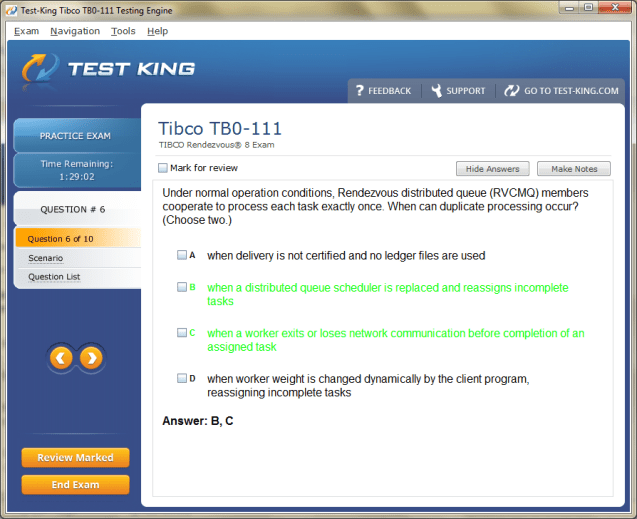
TB0-111 Exam Product Screenshots
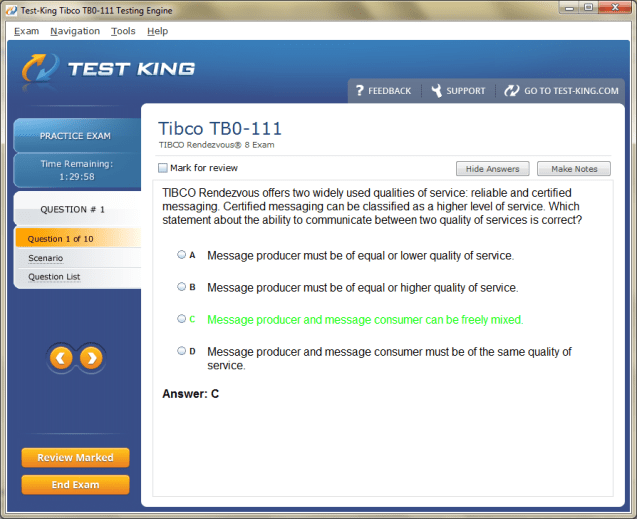
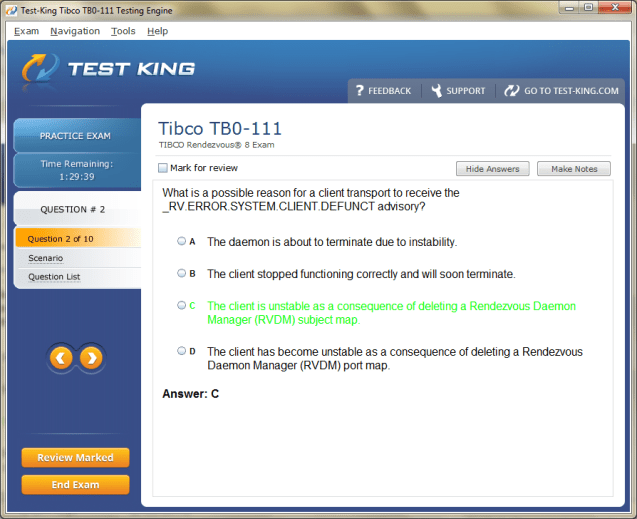
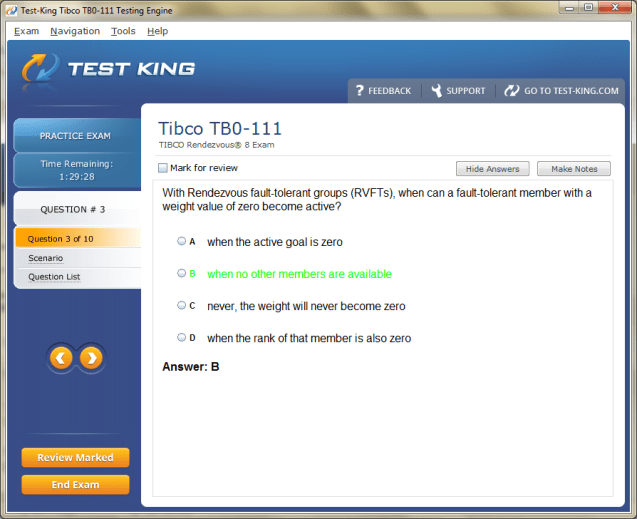
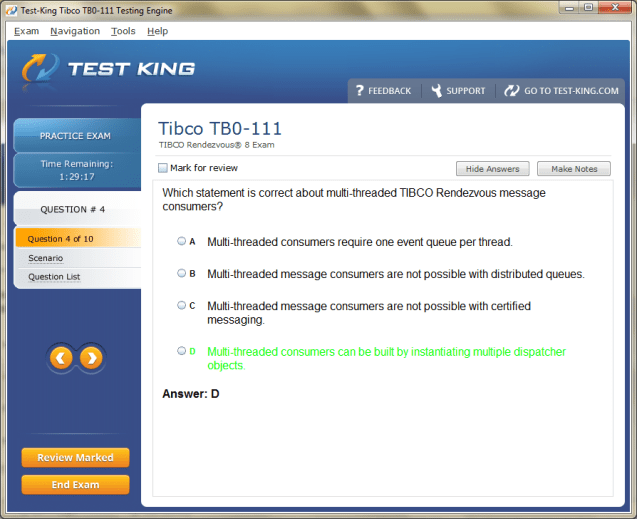
Frequently Asked Questions
How can I get the products after purchase?
All products are available for download immediately from your Member's Area. Once you have made the payment, you will be transferred to Member's Area where you can login and download the products you have purchased to your computer.
How long can I use my product? Will it be valid forever?
Test-King products have a validity of 90 days from the date of purchase. This means that any updates to the products, including but not limited to new questions, or updates and changes by our editing team, will be automatically downloaded on to computer to make sure that you get latest exam prep materials during those 90 days.
Can I renew my product if when it's expired?
Yes, when the 90 days of your product validity are over, you have the option of renewing your expired products with a 30% discount. This can be done in your Member's Area.
Please note that you will not be able to use the product after it has expired if you don't renew it.
How often are the questions updated?
We always try to provide the latest pool of questions, Updates in the questions depend on the changes in actual pool of questions by different vendors. As soon as we know about the change in the exam question pool we try our best to update the products as fast as possible.
How many computers I can download Test-King software on?
You can download the Test-King products on the maximum number of 2 (two) computers or devices. If you need to use the software on more than two machines, you can purchase this option separately. Please email support@test-king.com if you need to use more than 5 (five) computers.
What is a PDF Version?
PDF Version is a pdf document of Questions & Answers product. The document file has standart .pdf format, which can be easily read by any pdf reader application like Adobe Acrobat Reader, Foxit Reader, OpenOffice, Google Docs and many others.
Can I purchase PDF Version without the Testing Engine?
PDF Version cannot be purchased separately. It is only available as an add-on to main Question & Answer Testing Engine product.
What operating systems are supported by your Testing Engine software?
Our testing engine is supported by Windows. Andriod and IOS software is currently under development.
TB0-111 Exam Preparation Guide: TIBCO Rendezvous 8 Foundations
TIBCO Rendezvous 8 stands as a robust distributed messaging platform designed for environments where rapid communication, dependability, and seamless interaction across diverse applications are essential. The TB0-111 certification evaluates the learner’s ability to comprehend the architecture, operational behavior, message distribution concepts, configuration approaches, and the underlying communication fabric that sustains message flow across interconnected systems. Developing profound familiarity with these core elements allows one to approach implementation challenges with analytical clarity and technical sophistication. This preparation demands a thorough immersion in both conceptual understanding and practical reasoning, ensuring the learner can decipher messaging patterns, interpret architectural decisions, and anticipate how systems behave under differing loads and networking conditions.
Understanding Purpose, Scope, and Architecture
In enterprise domains, especially where high-frequency updates and synchronized exchanges are vital, messaging frameworks must operate with minimal latency while supporting flexible expansion. TIBCO Rendezvous enables asynchronous communication, allowing software components to communicate without maintaining direct awareness of one another’s identity. This separation cultivates modularity, scalability, and sustainability in evolving business environments. A trading platform that handles dynamic stock values, for instance, cannot afford delays or communication congestion. In such ecosystems, messages must traverse instantly, and application modules must remain loosely bonded so they can be enhanced, replaced, scaled, or migrated without disrupting existing functionality. TIBCO Rendezvous achieves this through a communication fabric shaped around subjects, transports, and daemons that coordinate seamless message movement.
The essence of subject-based communication lies in the categorization of messages by symbolic identifiers rather than addressing nodes directly. Applications dispatch messages to a subject, and recipients that have expressed interest in that subject will receive them. This enables natural organization of information. Messages can be grouped according to theme, source, precision level, function, or domain. For instance, a transportation system monitoring global shipment data could classify messages by region, terminal, vehicle identifier, or cargo classification. Once these categories are established, subscribers may request only the subset of data they require. This approach eliminates redundant data handling and preserves bandwidth, enabling systems to remain responsive even under heavy load.
The architecture of Rendezvous is deeply interconnected with the underlying network transport. The platform frequently operates atop multicast networking, which sends a single message to multiple receivers simultaneously. Multicast is inherently efficient in high-distribution communication because it avoids repeated message duplication for each recipient. A single broadcast can reach thousands of listeners without escalating network strain. However, successful multicast implementation requires that the underlying network infrastructure supports it. Routers, switches, and firewalls must be configured to manage multicast traffic flows correctly, and network engineering teams must understand traffic boundaries, routing domains, and containment strategies to prevent unnecessary congestion.
Within every host participating in Rendezvous communication exists a routing daemon responsible for message distribution on that system. The routing daemon manages local transports and serves as an intermediary between sending applications and the network. When an application sends a message on a given subject, the daemon ensures that the message is conveyed to interested recipients on that system and across the network. When an application subscribes to a subject, the daemon informs the network that the host is interested in traffic related to that subject. This decentralized architecture removes the reliance on a single central server or message broker, thereby circumventing the bottlenecks typically associated with centralized messaging systems. Instead, message distribution is shared across daemons operating collectively, leading to enhanced scalability and reduced single points of failure.
For environments requiring stringent delivery guarantees, additional daemons may be introduced to support reliability and certification. Certified messaging ensures that messages are tracked, remembered, and retransmitted when necessary. In systems where transaction integrity, regulatory compliance, or sequential operations are involved, loss of a single message can cascade into severe inconsistencies. Certified messaging layers introduce acknowledgement mechanisms and message store records, enabling senders and receivers to verify delivery success even when network disruptions or temporary node failures occur. During TB0-111 exam preparation, understanding which messaging mode aligns with specific operational scenarios is crucial. Performance-focused deployments might choose non-certified messaging for its speed, while mission-critical processes may require certified messaging to uphold data consistency.
The subject hierarchy itself can and should be planned meticulously. A poorly designed subject structure can lead to message flooding, inefficient filtering, and unnecessary processing overhead. Organizing subjects according to logical taxonomy helps maintain clarity, reduce processing burdens, and scale message distribution smoothly. Consider a global financial institution monitoring multi-national market feeds. If all updates are published on a single overarching subject, subscribers that require only a fraction of the information would still be forced to receive and discard excessive messages. Instead, a structured approach to subjects ensures that message flow is tailored to interest. Designing these hierarchies demands thoughtful analysis of business workflow, data granularity, subscriber behavior, and future system evolution.
Multicast network topology plays a significant role in Rendezvous performance. Administrators must identify how many multicast groups are necessary, which network zones require separation, and how bandwidth will be allocated. Messages traveling across network boundaries may need bridging mechanisms that replicate traffic across transport layers. When multicast is not available or undesirable due to security or network restrictions, alternative transports, such as point-to-point or hybrid arrangements, may be configured. For TB0-111 exam preparation, one must recognize that network conditions shape architectural decisions. Knowing how Rendezvous behaves in different network contexts forms one of the exam’s key analytical expectations.
Because Rendezvous operates through decentralized message routing rather than centralized control, failure patterns can differ from platforms that rely on central servers. When a daemon fails, message flow may be disrupted on that host but not across the entire system. When multicast delivery experiences packet loss, subscribers may miss messages unless reliability strategies are implemented. Exam proficiency requires recognizing how failure affects system behavior and predicting appropriate mitigation strategies. For instance, environments with known intermittent connectivity might employ certified messaging to guarantee final delivery, while fast streaming environments may accept occasional message loss in favor of minimal delay.
Studying effectively for the TB0-111 exam requires developing a deep and internalized understanding of how Rendezvous components interact rather than memorizing isolated definitions. Begin with conceptual mastery of distributed communication principles. Study how subjects enable decoupled message flow. Examine how daemons manage local and network-level communication. Practice visualizing message flow in real-time, imagining how messages propagate from one system to another. When studying multicast networking, do not simply recall that multicast is one-to-many; instead, consider how traffic replicates across network segments and how routers determine whether to propagate traffic to downstream domains.
To reinforce comprehension, one may reflect upon analogies drawn from distributed information exchange outside computing. Imagine a town hall where news is announced in open space. Everyone who cares to hear a particular type of news listens for the corresponding crier’s signal. Those uninterested in the current proclamation tune it out. This resembles subject-based subscription. If the town grows into a metropolis, they may designate different criers to announce news in different neighborhoods to prevent congestion. This is akin to subdividing subjects for scalability. Should certain announcements require proof that every intended listener has acknowledged receipt, messengers are dispatched individually to confirm the communication was received, akin to certified messaging.
Exam preparation is strengthened further by thinking through realistic deployment environments. Consider a logistics platform where a fleet of vehicles transmit updates about route status. Each vehicle may send periodic status messages, which are consumed by a centralized monitoring application. Under normal conditions, data may flow smoothly through multicast. But if the monitoring application must guarantee it has every piece of data for compliance auditing, certified messaging layers must be incorporated, ensuring that even if network communications are disrupted, data will eventually synchronize. Understanding this reasoning fluently equips a candidate to address scenario-based exam questions.
Network performance considerations also play a significant role. High-throughput environments often require tuning message sizes, daemon queue limits, buffer capacities, and multicast group allocations. Congested networks introduce latency that disrupts message flow. Exam awareness in this area requires a blend of technical understanding and systematic reasoning. One must determine when to isolate high-frequency subjects into separate multicast groups, how to distribute load among multiple daemons, and how to structure message payloads for minimal overhead. This type of refined thinking emerges from iterative study rather than rote memorization.
Another essential dimension of TB0-111 preparation involves recognizing how Rendezvous aligns with broader integration frameworks. Many organizations operate multiple messaging frameworks simultaneously. Rendezvous may work alongside JMS systems, REST services, database-driven event pipelines, or cloud-based streaming platforms. Each system carries a different philosophical approach to communication. Rendezvous is optimized for high-speed event propagation, decentralized control, and flexible subject organization. Appreciating how these characteristics integrate with or complement alternative platforms contributes to architectural maturity.
Practical reasoning is crucial when approaching exam scenarios that describe complex organizational demands. Suppose a multinational enterprise wishes to synchronize transaction data between trading desks located in several geographic financial hubs. Latency must remain extraordinarily low, and message loss could produce disastrous discrepancies. However, network routing across continents introduces unpredictable link performance. The candidate must determine how to blend multicast-based dissemination with certified messaging safeguards, ensuring that when network interruptions occur, missed messages are recovered later. This requires integration of technical knowledge and judgement.
While studying, it is helpful to read or attempt to mentally reconstruct the operational steps involved in message sending, receiving, routing, and acknowledgment. When an application sends a message, the message is handed to the daemon, which determines whether the message should be forwarded locally or transmitted onto a network transport. When a message arrives from the network, the daemon checks which local applications have subscribed to the subject and forwards the message appropriately. In certified messaging scenarios, the daemon also updates internal records and may negotiate retransmission requests. Visualizing this flow allows the internal logic of Rendezvous to become intuitive, rather than abstract.
Learning in this way develops a deep familiarity that forms the core of successful TB0-111 exam performance. Even when encountered with unfamiliar scenario wording, one who has mastered the conceptual and architectural principles will be able to derive answers instinctively by reasoning through message flow, subject patterns, daemon responsibilities, and reliability trade-offs. The goal is not merely to collect knowledge but to cultivate an instinctive sense for how distributed messaging architectures behave in real environments.
When engaging in exam practice, focus on comprehension rather than speed. Examine why correct answers are correct, but also why incorrect answers fail. For instance, selecting a non-certified messaging configuration for a context requiring absolute delivery reliability may seem tempting if speed is mentioned, but the reasoning demands that reliability must take precedence. Similarly, employing multicast in a network environment lacking multicast routing support would yield nonfunctional communication. These are not trivial distinctions; they represent the heart of distributed messaging system design choices.
Through consistent study, reflective analysis, and an inquisitive mindset, the learner gradually acquires the intellectual frameworks needed to engage with Rendezvous confidently. As these ideas crystallize, the ability to apply them in dynamic architectural evaluations strengthens. At that point, TB0-111 certification becomes a natural progression from comprehension into formal validation of expertise.
Exploring Rendezvous Messaging Dynamics and Performance Considerations
TIBCO Rendezvous 8 delivers a sophisticated messaging ecosystem built to accommodate high-performance, low-latency, and reliable communication across distributed applications. Understanding the intricacies of its messaging models, communication flows, and transport configuration is essential for mastering TB0-111 exam objectives. The platform operates on principles that combine asynchronous messaging, subject-based publish/subscribe mechanisms, and flexible transport layers. Each concept interweaves with others to create an architecture capable of scaling across enterprise and global infrastructures while maintaining efficiency, reliability, and fault tolerance.
The publish/subscribe model in Rendezvous serves as the foundation of its messaging strategy. Applications produce messages targeted to specific subjects, and subscribers receive only the messages that correspond to their declared interest. Subjects can be arranged hierarchically, offering refined granularity. This hierarchy enables a single topic string to encapsulate multiple related categories, allowing selective dissemination of information. Effective subject design is crucial because it influences the system’s throughput, latency, and maintainability. Improper subject structuring can lead to network congestion, redundant processing, and subscriber overload. When studying for TB0-111, candidates must internalize how subjects determine message routing behavior and the implications of hierarchical organization for both performance and operational clarity.
TIBCO Rendezvous supports multiple messaging modes, each providing a distinct balance between speed, reliability, and transactional assurance. Standard messaging prioritizes low-latency delivery and is suitable for scenarios where occasional message loss is acceptable, such as monitoring data streams or non-critical event propagation. Certified messaging, on the other hand, guarantees message delivery even in the presence of network failures, host crashes, or temporary disruptions. Certified messages are tracked and acknowledged, with retransmission mechanisms ensuring consistency and completeness. The exam evaluates the ability to choose the appropriate mode based on business requirements, network conditions, and application criticality. Understanding these modes in context rather than in isolation ensures a sophisticated approach to messaging design.
Communication within Rendezvous is mediated by daemons, particularly the routing daemon, which exists locally on each participating host. These daemons serve as intermediaries between applications and the network, managing both incoming and outgoing messages. When an application publishes a message, the daemon determines whether to forward it to local subscribers or transmit it across the network. Conversely, when messages arrive from the network, the daemon identifies which local applications have subscribed to the relevant subjects and delivers messages accordingly. This decentralized distribution mechanism eliminates dependency on a central server, allowing the system to scale horizontally and adapt dynamically to changing network and application topologies.
Transport configuration is a critical determinant of performance and reliability. Rendezvous typically utilizes multicast networking to broadcast messages efficiently to multiple recipients. A single message can be delivered to numerous subscribers without creating multiple copies, significantly reducing network load. However, successful multicast deployment requires that underlying network infrastructure, including routers and switches, properly support multicast traffic. In environments where multicast is restricted or unavailable, alternative transports, such as point-to-point or hybrid configurations, must be utilized. TB0-111 preparation demands familiarity with these transport types and the ability to analyze scenarios to determine the optimal messaging strategy for given network conditions.
The hierarchical organization of subjects interacts closely with transport configurations. In high-volume environments, isolating specific subjects into separate multicast groups can prevent congestion and ensure predictable delivery performance. Conversely, combining multiple related subjects into a single multicast group may reduce the complexity of configuration but risks overloading subscribers with irrelevant messages. The ability to design subject hierarchies that align with transport capacities is a recurring theme in TB0-111 exam questions. Candidates must consider message frequency, subscriber distribution, and network topology when determining the ideal balance between granularity and efficiency.
Reliable delivery and fault tolerance extend beyond the choice between standard and certified messaging. Even within certified messaging, the system employs acknowledgments and message state tracking to ensure consistency. If a subscriber or network segment temporarily fails, the routing daemon manages retransmissions to guarantee that all intended recipients eventually receive the messages. Understanding the interplay between daemons, message storage, and retransmission mechanisms is critical. Scenario-based exam questions often describe disruptions or failures and require candidates to identify how the system maintains integrity, highlighting the importance of practical reasoning alongside conceptual knowledge.
Performance tuning is another essential dimension of TB0-111 exam mastery. Administrators and developers must consider factors such as buffer sizes, daemon queue limits, network latency, message payload sizing, and subject distribution. High-throughput environments can benefit from careful partitioning of subjects into multiple multicast groups to reduce packet collisions and avoid network congestion. Similarly, daemons must be configured to handle expected message volumes efficiently without dropping messages or introducing delays. Understanding these parameters and their interrelationships allows candidates to reason through performance optimization challenges effectively.
In complex deployments, multiple daemons may collaborate to maintain message flow across large and geographically distributed networks. These daemons communicate among themselves to propagate subscription information, forward messages, and manage certified delivery states. Candidates should understand how daemons coordinate to maintain synchronization and redundancy across the messaging fabric. This includes awareness of how failures in one node affect local versus global message propagation and the mechanisms by which the system ensures continuity of communication. Exam questions frequently test the ability to deduce system behavior under such conditions, requiring both conceptual clarity and analytical judgment.
The interplay between application logic and messaging configuration is another area of focus. Applications must not only publish and subscribe correctly but also be designed to handle message arrival patterns, latency variability, and potential duplication in certified messaging contexts. Understanding the impact of message bursts, subscriber processing speed, and transport limitations equips candidates to predict system behavior under realistic operational pressures. TB0-111 exam scenarios often simulate these conditions, assessing whether the candidate can align application design with the messaging infrastructure effectively.
Security considerations also influence messaging design. Although TIBCO Rendezvous is optimized for performance, enterprises often require encryption, authentication, and access control to protect sensitive data. Understanding how security mechanisms interact with transport layers and message propagation, particularly in multicast environments, is critical. Candidates must recognize the trade-offs between security enforcement and messaging efficiency, as well as the implications for system scalability and reliability. Exam questions may present scenarios in which network restrictions or security policies necessitate adjustments to standard messaging configurations.
Practical preparation involves analyzing hypothetical deployments and identifying the optimal combination of subjects, daemons, transports, and messaging modes. Candidates benefit from mentally simulating message flows, predicting how subjects propagate, and visualizing daemon interactions under varying network conditions. Scenarios may involve geographic distribution, variable subscriber numbers, high-frequency updates, or constrained networks. Reasoning through these situations builds an intuitive grasp of the platform’s operational logic, enhancing both exam performance and real-world implementation skills.
Study strategies include iterative engagement with conceptual material and scenario-based problem solving. Repeatedly reviewing subject hierarchies, transport configurations, and daemon responsibilities helps internalize the relationships among components. Attempting mental exercises, such as predicting the behavior of certified messaging under partial network failure, strengthens comprehension. Additionally, reflecting on real-world applications, such as financial systems, transportation networks, or industrial monitoring platforms, provides context that transforms abstract knowledge into practical expertise.
Mastery also requires understanding trade-offs inherent in design decisions. For instance, selecting certified messaging for all subjects ensures complete delivery but may introduce latency and increased resource consumption. Conversely, using standard messaging exclusively maximizes speed but risks occasional data loss. Candidates must weigh business priorities, operational constraints, and network realities when determining configurations. The TB0-111 exam often tests the ability to reason through these trade-offs rather than memorizing configurations, emphasizing analytical capability and conceptual fluency.
Visualization techniques are particularly effective in developing exam readiness. Imagining messages flowing through daemons, multicast groups, and hierarchical subjects allows candidates to anticipate behavior in complex deployments. Mental diagrams of network topologies, subscription distributions, and message propagation sequences enhance understanding. When encountering scenario-based questions on the exam, this internalized visualization allows rapid and confident reasoning, reducing the reliance on rote memorization and supporting informed judgment under time constraints.
High-volume messaging environments introduce additional complexity. When thousands of messages traverse a network simultaneously, even minor inefficiencies in subject organization or transport configuration can result in bottlenecks. Candidates must recognize strategies to mitigate congestion, such as isolating high-frequency subjects, adjusting daemon processing priorities, and tuning message payloads. Understanding these considerations is essential for both real-world system design and TB0-111 examination success.
Effective preparation combines conceptual understanding, scenario analysis, and performance reasoning. Candidates should repeatedly study the roles of subjects, daemons, and transport layers, internalize their interactions, and practice predicting system behavior under variable conditions. Engaging with hypothetical environments, such as global monitoring systems, high-speed trading networks, or industrial IoT frameworks, strengthens both knowledge retention and practical intuition. This layered approach cultivates mastery, ensuring the candidate can navigate both straightforward and complex TB0-111 exam scenarios with confidence.
By integrating detailed comprehension of messaging models, communication flows, transport configurations, and performance considerations, candidates cultivate a holistic understanding of TIBCO Rendezvous. This knowledge forms the foundation for approaching the TB0-111 exam strategically, enabling analysis of practical scenarios, evaluation of trade-offs, and deployment of efficient, reliable messaging solutions across distributed systems. Mastery of these concepts fosters not only exam readiness but also professional aptitude in designing and managing sophisticated messaging architectures.
Deep Dive into TIBCO Rendezvous Operational Mechanisms
TIBCO Rendezvous 8 presents a distributed messaging framework where daemons, reliability models, and advanced configuration parameters form the core of operational efficacy. Preparing for the TB0-111 exam requires an intricate understanding of these mechanisms, including how daemons facilitate communication, how messaging reliability is achieved, and how configuration choices affect performance and fault tolerance. Mastery of these concepts is not only critical for exam success but also foundational for implementing high-performance, resilient messaging systems in enterprise and global environments.
The routing daemon is the cornerstone of Rendezvous communication. Present on each host that participates in the messaging fabric, it orchestrates both outbound and inbound message flows. When an application publishes a message, the routing daemon examines the destination subjects, evaluates which local applications are subscribed, and determines whether the message should be propagated over the network. Similarly, when messages arrive from other hosts, the daemon identifies the relevant local subscribers and delivers messages in an efficient and timely manner. The decentralized nature of daemons eliminates dependency on a centralized broker, allowing horizontal scaling and reducing single points of failure.
Reliability in Rendezvous messaging can be categorized into standard and certified delivery modes. Standard messaging prioritizes speed and low latency, delivering messages in a best-effort manner. This mode is suitable for applications that tolerate occasional loss, such as streaming sensor data or non-critical monitoring feeds. Certified messaging, conversely, guarantees that each message reaches all intended recipients, even in the presence of network failures, host crashes, or temporary disruptions. Certified messages involve acknowledgement mechanisms, retransmissions, and message state tracking, ensuring that critical information is never lost. TB0-111 candidates must be able to determine the appropriate delivery model based on operational priorities and business requirements.
The configuration of daemons is pivotal to achieving reliable performance. Each daemon maintains queues to buffer incoming and outgoing messages, monitors transport connections, and manages subscriptions. Proper tuning of queue sizes, buffer capacities, and thread allocations directly affects message throughput and latency. In high-volume environments, misconfigured daemons can become bottlenecks, resulting in delayed delivery or message loss. Understanding the interplay between daemon settings and system performance is a recurrent theme in TB0-111 examinations.
Transport configuration also heavily influences message propagation. Rendezvous commonly utilizes multicast networking to deliver messages efficiently to multiple recipients. A single message sent via multicast can reach numerous subscribers without duplicating network traffic, conserving bandwidth and reducing latency. However, multicast implementation requires careful alignment with network infrastructure. Routers and switches must support multicast, and administrators must configure transport parameters such as group addresses, ports, and network interfaces. In scenarios where multicast is unavailable or impractical, unicast or hybrid transports may be deployed, necessitating careful planning to maintain delivery efficiency and reliability.
Subject hierarchies, in conjunction with transport configurations, determine message dissemination patterns. Hierarchical subjects allow applications to subscribe to specific categories while filtering out irrelevant information. For example, a manufacturing monitoring system might organize subjects by plant, production line, and equipment type. This structure ensures that subscribers receive only the messages pertinent to their role, reducing processing overhead and network congestion. When designing subject hierarchies, candidates must consider message frequency, subscriber distribution, and potential growth to ensure scalability and maintainability.
Certified messaging introduces additional operational considerations. The routing daemon tracks message delivery, records acknowledgements, and manages retransmissions if necessary. This mechanism ensures that messages are not lost even under adverse network conditions. Administrators must configure message storage, acknowledgement timeouts, and retry intervals to balance performance and reliability. Understanding the internal workings of certified messaging, including how daemons communicate to maintain delivery state, is critical for TB0-111 exam readiness.
Failure handling is a significant aspect of Rendezvous architecture. Since the system relies on decentralized daemons, local failures do not necessarily disrupt global message flow. However, messages destined for the affected host may experience temporary delays. Certified messaging compensates for such failures by retransmitting messages once the host recovers. Candidates must recognize how different failure scenarios, such as daemon crashes, network partitioning, or packet loss, affect message propagation and how reliability mechanisms mitigate these risks.
Performance tuning encompasses several dimensions. Queue sizes, buffer capacities, thread allocations, and transport settings must be calibrated according to anticipated message volume and system complexity. High-frequency messaging environments require careful partitioning of subjects into separate multicast groups to prevent congestion. Additionally, daemon configurations should match processing capacity with message throughput requirements to avoid bottlenecks. The TB0-111 exam often tests the ability to reason through performance tuning strategies, emphasizing analytical thinking over rote memorization.
Security and access control introduce another layer of configuration complexity. Sensitive data must be protected during transmission, necessitating encryption and authentication measures. Security policies may influence transport choices, subject visibility, and subscriber access, potentially affecting performance and reliability. Candidates must understand how to balance security requirements with operational efficiency, ensuring that messaging systems remain both protected and responsive.
Advanced deployment scenarios often involve integrating Rendezvous with other messaging frameworks or enterprise systems. This may include coordinating with JMS-based brokers, REST services, database-driven event streams, or cloud-native messaging platforms. Understanding the comparative strengths of Rendezvous, such as low-latency multicast and decentralized daemons, enables candidates to architect hybrid systems that leverage the best attributes of multiple platforms. Exam questions may present complex deployment scenarios, requiring candidates to evaluate configuration options, predict system behavior, and recommend optimal strategies.
Practical preparation involves mentally simulating message flows across distributed environments. Consider a scenario where multiple applications publish high-frequency updates across a global network. Messages traverse daemons, multicast transports, and subject hierarchies to reach interested subscribers. If one transport path experiences congestion, the routing daemon must reroute or buffer messages appropriately. Certified messaging ensures that critical updates are eventually delivered. Visualizing these interactions allows candidates to internalize system behavior, making scenario-based exam questions more approachable and intuitive.
Scenario analysis also requires understanding trade-offs between performance, reliability, and resource consumption. For instance, deploying certified messaging across all subjects maximizes reliability but increases latency and system load. Conversely, limiting certified delivery to mission-critical subjects balances performance with reliability. TB0-111 questions frequently present such trade-offs, requiring candidates to reason through system priorities, operational requirements, and network constraints.
Daemons also coordinate subscription propagation across the network. When a new subscriber expresses interest in a subject, daemons communicate this information to relevant nodes to ensure messages reach the intended audience. Understanding how subscription propagation interacts with message flow, transport configuration, and subject hierarchies is essential for accurate exam reasoning. Candidates must recognize how changes in subscriber patterns affect message distribution, network traffic, and overall system behavior.
High-throughput environments introduce additional complexity in message management. Buffering strategies, message batching, and queue prioritization help maintain performance under load. Candidates should consider how these mechanisms interact with daemon processing, transport constraints, and subject hierarchies. The ability to reason through high-volume scenarios is critical for TB0-111 exam success, as questions often describe environments where message spikes, network latency, or failures challenge system stability.
Exam preparation benefits from iterative study and scenario-based exercises. Reviewing daemon functions, reliability models, transport options, and subject organization repeatedly reinforces conceptual understanding. Simulating complex messaging environments in the mind or through diagrams aids in visualizing interactions, predicting outcomes, and internalizing operational logic. Candidates who can mentally trace message flows, evaluate configuration trade-offs, and anticipate system behavior develop a deep, intuitive grasp of Rendezvous that extends beyond memorization.
Understanding the dynamic interplay between applications, daemons, transports, and subjects equips candidates to handle nuanced TB0-111 scenarios. Applications must be designed to accommodate message bursts, variable latency, and potential duplication in certified messaging contexts. Recognizing how these application-level considerations interact with underlying messaging infrastructure is crucial for both exam performance and practical system design.
Reliability mechanisms must be contextualized within operational priorities. For example, financial transaction systems require certified messaging to ensure integrity, while monitoring systems may tolerate occasional message loss in favor of speed. Understanding these contextual requirements allows candidates to recommend appropriate configurations and predict system behavior under varying conditions. The exam frequently tests this judgment by presenting situational questions that require aligning messaging modes with business objectives and technical constraints.
Performance tuning and advanced configuration require meticulous attention to detail. Daemon queue capacities, message buffer sizes, transport settings, subject partitioning, and network routing all contribute to overall system efficiency. Candidates must learn to anticipate how adjustments in one area affect others, balancing throughput, latency, reliability, and resource consumption. This analytical approach is central to mastering the TB0-111 exam, as it mirrors real-world deployment challenges.
Visualization remains a powerful study tool. Mentally tracing messages from publisher to subscriber, observing how daemons mediate flow, and considering the impact of network failures enhances comprehension. Candidates can simulate certification acknowledgements, transport disruptions, and subject-based filtering to predict outcomes and refine reasoning. These mental exercises cultivate a nuanced understanding of Rendezvous behavior that is both exam-relevant and professionally valuable.
Scenario reasoning further involves examining network constraints. Not all environments support multicast efficiently, and some may impose security restrictions or bandwidth limitations. In such cases, candidates must consider alternative transport strategies, evaluate subject groupings, and anticipate potential latency or message loss. TB0-111 questions often probe these decision-making skills, requiring analysis of operational realities and application requirements rather than rote recall.
The integration of reliability, performance, and advanced configuration knowledge prepares candidates to handle complex enterprise deployments. By understanding how daemons, subjects, transports, and messaging modes interact, one can design systems that maintain efficiency, ensure data integrity, and adapt to evolving business needs. Continuous study, scenario-based exercises, and analytical reasoning cultivate the depth of comprehension necessary for TB0-111 mastery, enabling confident navigation of both exam challenges and professional implementation tasks.
Advanced Operational Techniques and Performance Enhancement
TIBCO Rendezvous 8 provides a sophisticated messaging environment where troubleshooting, monitoring, and optimization are essential to maintaining high availability, low latency, and reliable communication across distributed applications. Mastery of these operational dimensions is critical for TB0-111 exam success and practical proficiency in deploying messaging infrastructures in complex enterprises. This entails understanding diagnostic techniques, performance monitoring tools, system behavior under load, and strategies to optimize throughput while ensuring data integrity and fault tolerance.
Effective troubleshooting begins with a clear understanding of how messages traverse the Rendezvous architecture. When a message is published, the local routing daemon assesses the destination subjects, identifies subscribers, and forwards the message either locally or across the network. If messages are not received, it is important to trace the flow from the publisher through the daemon, across transports, and to the subscribers. Common causes of delivery issues include misconfigured subject hierarchies, transport failures, daemon crashes, or network restrictions. TB0-111 candidates must be able to identify these potential bottlenecks and articulate the reasoning for diagnosing specific issues within a messaging environment.
Monitoring message flows is integral to ensuring system reliability. Rendezvous provides tools and interfaces to observe message rates, daemon activity, and transport efficiency. Real-time monitoring allows administrators to detect anomalies such as message backlogs, subscription discrepancies, or transport saturation. By continuously observing these metrics, one can preemptively address performance degradation before it impacts critical business operations. For the exam, candidates should understand how monitoring aligns with troubleshooting strategies, as scenario-based questions often require interpretation of system behavior under varying conditions.
Optimizing message delivery involves careful configuration of daemons, transports, and subject structures. Daemons maintain queues for incoming and outgoing messages, and their capacity directly influences throughput. Buffer sizes, thread allocations, and processing priorities must be tuned to accommodate expected message volumes and patterns. Multicast transport efficiency can be maximized by assigning appropriate group addresses and separating high-frequency subjects into distinct multicast groups. This prevents congestion, reduces latency, and ensures that critical messages reach all subscribers promptly. Understanding these configuration strategies is essential for TB0-111 preparation.
Certified messaging introduces additional considerations for optimization. While certified delivery ensures complete message propagation, it can introduce latency and consume more system resources due to acknowledgment tracking and retransmission. Candidates must weigh the importance of message integrity against performance requirements, selecting certified messaging only where necessary to balance system efficiency with reliability. This reasoning reflects both exam expectations and real-world deployment decision-making.
Failure detection and recovery form a critical dimension of advanced operational management. Since Rendezvous employs decentralized daemons, local failures typically affect only the host in question. However, subscribers may temporarily miss messages, and the routing daemon must manage retransmissions when certified messaging is employed. Understanding these mechanisms allows candidates to anticipate how the system behaves under network partitioning, daemon crashes, or intermittent transport disruptions. The TB0-111 exam frequently evaluates the ability to reason through these fault scenarios and determine the most effective mitigation strategies.
Load management is an essential aspect of optimization. High-frequency message streams or large numbers of subscribers can strain both daemons and network transports. Candidates should understand techniques to partition subjects, balance message distribution, and prevent queue overflows. This includes analyzing the expected message rate per subject, distributing high-volume subjects across multiple multicast groups, and configuring daemons to handle peak traffic efficiently. Mastery of these concepts enables one to maintain high performance while minimizing the risk of message loss or delayed delivery.
Security considerations impact both troubleshooting and optimization. Sensitive messages may require encryption, authentication, or access control, which can introduce latency and influence transport selection. Candidates should understand the trade-offs between security enforcement and system performance, particularly in environments where multicast may be restricted or where subject access must be tightly controlled. Exam questions often present scenarios where security policies necessitate configuration adjustments, testing the candidate’s ability to integrate operational requirements with performance considerations.
Analyzing message propagation in complex networks is a critical skill. For example, in a global financial system, messages from a central publishing node may traverse multiple routing daemons and network domains before reaching geographically dispersed subscribers. Delays, packet loss, or misrouted messages can have significant operational consequences. Understanding how daemons coordinate, how subscriptions propagate, and how transports deliver messages allows candidates to anticipate potential bottlenecks and design remediation strategies. This analytical reasoning is central to both TB0-111 exam success and effective operational management.
Monitoring tools should be employed not only for reactive troubleshooting but also for proactive performance optimization. By observing message rates, queue lengths, and acknowledgment latency, administrators can identify emerging issues before they escalate. Pattern recognition, such as recurring spikes in message traffic or frequent retransmissions in certified messaging, informs adjustments to configuration parameters, subject hierarchies, and transport strategies. This continuous feedback loop between monitoring and configuration underpins resilient and efficient messaging operations.
Scenario analysis forms a key component of exam preparation. Candidates are often presented with network conditions, message patterns, or subscriber behaviors and must recommend optimal configurations. For instance, a high-volume stock trading system may require multicast for efficiency, partitioned subjects for clarity, and selective use of certified messaging to ensure transactional integrity. Candidates must reason through the implications of each configuration choice, balancing performance, reliability, and resource utilization. This type of analysis cultivates both conceptual mastery and practical decision-making skills.
Daemon coordination under failure conditions illustrates the robustness of Rendezvous. When a routing daemon becomes unavailable, local message delivery is interrupted, but global system continuity is maintained. Certified messaging ensures that messages missed during downtime are retransmitted, preserving integrity. Understanding how multiple daemons interact to propagate subscription information, maintain acknowledgment state, and reroute messages is crucial for exam scenarios involving network failures, host crashes, or intermittent connectivity. Candidates must visualize these interactions and anticipate system behavior under stress conditions.
Performance tuning in high-throughput environments is multifaceted. Administrators must balance queue capacities, thread allocation, buffer sizing, and transport parameters to match expected message volumes. Multicast efficiency can be enhanced by grouping subjects logically and separating high-frequency topics to prevent packet collisions. Additionally, tuning daemon processing priorities ensures timely message delivery without overwhelming system resources. Candidates should understand how these factors interrelate, as exam questions often require predicting performance outcomes based on specific configuration choices.
Integration with other enterprise systems introduces additional complexity. TIBCO Rendezvous may coexist with JMS brokers, REST services, database-driven event streams, or cloud-based messaging platforms. Candidates must understand the characteristics of Rendezvous, including low-latency multicast, decentralized daemons, and hierarchical subject organization, to design complementary integrations. Exam scenarios may describe hybrid environments, requiring candidates to evaluate configurations that maintain efficiency, reliability, and data integrity across diverse platforms.
Understanding the dynamic interaction between messaging modes, transport types, and system load is critical. High-volume or mission-critical applications may require selective certified messaging, partitioned subjects, and dedicated multicast groups. Conversely, lower-priority messaging can utilize standard delivery and shared transport channels. TB0-111 exam questions often present such scenarios, challenging candidates to recommend configurations that balance performance, reliability, and resource consumption while anticipating operational constraints.
Visualization techniques are powerful tools for exam preparation. Mentally tracing messages from publisher to subscriber, observing daemon coordination, and anticipating the impact of network or host failures reinforces understanding of the system’s operational logic. Candidates can simulate certified message acknowledgments, transport congestion, and subject-based filtering to predict outcomes and refine reasoning. This approach cultivates intuitive comprehension, enabling confident navigation of complex exam scenarios.
Analyzing high-frequency environments requires attention to buffer management, message batching, and daemon queue prioritization. Candidates should recognize how these mechanisms influence message flow, latency, and system responsiveness. Scenario-based exam questions often describe conditions of sustained high load or unpredictable traffic spikes, evaluating the candidate’s ability to maintain operational efficiency and message integrity through judicious configuration and monitoring practices.
Security and compliance considerations must also be integrated into operational strategies. Encryption, authentication, and access control can influence transport choice, message propagation, and subscriber behavior. Candidates must understand how security policies interact with subject hierarchies, daemon coordination, and transport configuration, ensuring that messaging systems remain both secure and performant. TB0-111 exam scenarios frequently test this integrated reasoning, requiring candidates to balance multiple operational priorities simultaneously.
Continuous monitoring, iterative configuration adjustment, and scenario analysis build a comprehensive understanding of TIBCO Rendezvous operational dynamics. By internalizing how daemons mediate message flow, how subjects structure communication, and how transports deliver data efficiently, candidates cultivate the analytical skills needed for TB0-111 examination. This mastery extends beyond theoretical knowledge, equipping candidates to design, troubleshoot, and optimize distributed messaging environments effectively in real-world enterprise deployments.
High availability, low latency, and fault tolerance are achieved through the interplay of routing daemons, reliable messaging modes, and transport configuration. Candidates must understand how these elements interact to maintain message integrity under diverse operational conditions. Scenario-based practice, including high-volume, geographically distributed, and security-constrained environments, reinforces conceptual understanding and develops practical intuition. This integrated approach ensures that candidates can reason through complex exam questions and anticipate system behavior under dynamic operational conditions.
Integrating Knowledge for Effective Messaging Operations
TIBCO Rendezvous 8 provides a versatile and high-performance messaging infrastructure, capable of supporting complex, distributed applications where low latency, reliability, and scalability are paramount. Effective preparation for the TB0-111 exam requires not only theoretical comprehension but also the ability to apply operational principles in practical scenarios, troubleshoot system anomalies, and optimize messaging performance across diverse enterprise environments. By focusing on practical applications, candidates can bridge the gap between conceptual understanding and real-world deployment skills.
In operational environments, message propagation depends on the seamless interaction between publishers, routing daemons, transports, and subscribers. When an application publishes a message, the local routing daemon evaluates the subject hierarchy, identifies local subscribers, and determines whether to forward the message across the network. Subscribers receive messages that match their declared interest, and in the case of certified messaging, acknowledgments are tracked and retransmissions managed to guarantee delivery. Effective exam preparation requires understanding each step in this flow, recognizing where failures may occur, and knowing how configuration choices influence overall behavior.
Troubleshooting in Rendezvous requires a methodical approach. Common issues may arise from misconfigured subjects, overloaded daemons, transport failures, or network restrictions. To diagnose message delivery problems, candidates must trace the message path from publisher to subscriber, analyzing daemon activity, subscription propagation, and transport functionality. Understanding the relationships between these components enables one to identify bottlenecks, anticipate potential failures, and implement corrective actions. TB0-111 exam scenarios frequently present complex deployments, challenging candidates to apply analytical reasoning to resolve delivery issues effectively.
Monitoring tools are essential for maintaining operational stability. By observing message rates, queue lengths, and daemon performance, administrators can detect emerging issues before they impact system functionality. Real-time monitoring of certified messaging provides insight into acknowledgment latency and retransmission frequency, helping optimize resource allocation and improve reliability. Continuous monitoring also informs subject hierarchy adjustments, transport configurations, and performance tuning, allowing the messaging infrastructure to adapt dynamically to changing operational conditions. Exam questions often test the ability to interpret monitoring data and recommend adjustments to maintain efficiency and reliability.
Performance optimization is closely intertwined with daemon configuration, subject design, and transport selection. Daemons maintain queues for incoming and outgoing messages, and buffer sizes, thread allocations, and processing priorities directly affect throughput and latency. In high-volume environments, separating subjects into distinct multicast groups can prevent congestion, reduce latency, and ensure critical messages reach all subscribers promptly. Optimizing multicast parameters, such as group addresses and network interfaces, further enhances delivery efficiency. Candidates must understand these mechanisms and their interdependencies to reason effectively through exam scenarios and practical deployments.
Reliable messaging requires careful management of certified delivery. While standard messaging prioritizes speed and low latency, certified messaging ensures all messages are delivered, even in the event of network or host failures. This involves acknowledgment tracking, message storage, and retransmission mechanisms managed by routing daemons. Understanding the trade-offs between performance and reliability is critical. In environments where critical financial, industrial, or operational data must never be lost, certified messaging is indispensable, whereas in scenarios prioritizing speed over completeness, standard messaging may be preferable.
High-throughput environments introduce unique challenges that require careful planning. Message batching, queue prioritization, and buffer management help maintain stability during spikes in traffic. By anticipating peak loads, administrators can configure daemons and transports to handle bursts without compromising latency or integrity. Partitioning high-frequency subjects across multiple multicast groups ensures that message propagation remains efficient and avoids collisions. Candidates preparing for TB0-111 must internalize these strategies, as exam questions often describe complex, high-volume operational scenarios.
Network considerations are pivotal in determining optimal configuration. Multicast offers efficient one-to-many delivery but requires network support, including router and switch configuration. In constrained networks or environments lacking multicast, alternative transports, such as unicast or hybrid configurations, must be considered. Candidates must understand how transport choice interacts with subject hierarchies, message volumes, and system reliability to select configurations that maintain performance while adhering to network constraints.
Security adds another layer of complexity. Encryption, authentication, and access control can influence message delivery, transport selection, and system performance. Understanding the impact of security measures on latency, throughput, and operational efficiency is essential. Exam scenarios may involve environments with stringent compliance requirements, testing candidates’ ability to balance security with performance and reliability while maintaining accurate message propagation.
Integration with other enterprise systems is a common operational consideration. TIBCO Rendezvous often coexists with JMS brokers, REST services, database-driven event streams, or cloud messaging platforms. Candidates should appreciate the unique advantages of Rendezvous, including low-latency multicast, hierarchical subjects, and decentralized daemons, to design complementary architectures. Practical scenarios may require reasoning through hybrid deployments, evaluating trade-offs between messaging modes, transport efficiency, and system reliability.
Visualization techniques enhance understanding of complex deployments. Mentally tracing messages from publisher through daemons and transports to subscribers allows candidates to anticipate system behavior under diverse conditions, including network delays, daemon failures, or high message volumes. Scenario-based practice enables recognition of potential bottlenecks, application of certified messaging strategies, and implementation of subject hierarchy optimizations to maintain performance and reliability.
Scenario reasoning also includes managing application-level considerations. Applications must handle message bursts, latency variability, and potential duplication in certified messaging contexts. Understanding how application behavior interacts with underlying messaging infrastructure ensures end-to-end reliability and performance. TB0-111 exam questions often test the candidate’s ability to align application logic with operational principles, requiring thoughtful analysis of message flow, subscription management, and transport characteristics.
Performance tuning involves a holistic view of the messaging environment. Adjustments to daemon queues, thread allocations, buffer sizes, transport parameters, and subject groupings collectively influence system efficiency. Candidates should be able to predict the impact of configuration changes on message latency, throughput, and reliability, considering trade-offs between performance and guaranteed delivery. High-frequency or mission-critical environments particularly benefit from strategic subject partitioning and careful multicast group assignments to avoid congestion and maximize throughput.
Failure handling is integral to resilient messaging. Decentralized daemons ensure that local failures do not compromise global message flow, while certified messaging guarantees eventual delivery despite temporary disruptions. Candidates must understand how daemons coordinate acknowledgments, propagate subscription information, and manage retransmissions to maintain system integrity. Exam scenarios often present network partitions, node failures, or intermittent connectivity, requiring candidates to reason through mitigation strategies that preserve operational continuity.
Integration of monitoring, troubleshooting, and optimization forms the foundation of practical expertise. Continuous observation of message flows, queue utilization, acknowledgment latency, and transport efficiency informs configuration adjustments, ensuring the messaging environment remains responsive and reliable. Candidates who develop the ability to interpret operational metrics, diagnose issues, and implement performance enhancements are well-prepared for both the TB0-111 exam and real-world deployments.
Security and compliance considerations must be embedded in operational strategy. Candidates should anticipate the impact of encryption, authentication, and access control on message delivery, transport efficiency, and system behavior. Balancing operational performance with secure communication ensures that messaging infrastructures meet both technical and regulatory requirements, a frequent focus in exam scenarios.
By integrating theoretical knowledge, practical reasoning, and scenario-based analysis, candidates develop a comprehensive understanding of TIBCO Rendezvous operations. Mastery of routing daemon behavior, subject hierarchies, transport configuration, messaging modes, monitoring techniques, and optimization strategies equips candidates to troubleshoot, enhance, and sustain high-performance messaging systems effectively. This integrated approach fosters both exam success and the professional capability to manage complex, distributed messaging architectures with confidence.
Conclusion
In preparation for the TB0-111 exam necessitates a deep understanding of TIBCO Rendezvous 8 across conceptual, operational, and practical dimensions. Candidates must master message flow, daemon coordination, subject organization, transport configuration, reliability mechanisms, performance optimization, troubleshooting, and security considerations. By studying theoretical principles, visualizing message propagation, analyzing practical scenarios, and reasoning through configuration trade-offs, learners develop the analytical skills required to address complex operational challenges. This comprehensive approach ensures readiness for TB0-111 certification while cultivating the expertise necessary to implement, monitor, and optimize distributed messaging systems in diverse enterprise environments.