

Exam Code: TB0-121
Exam Name: TIBCO ActiveMatrix BPM Solution Design
Certification Provider: Tibco
Corresponding Certification: TCP
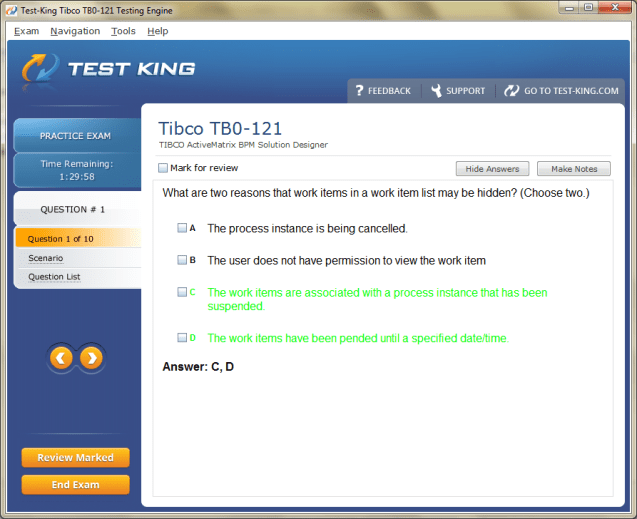
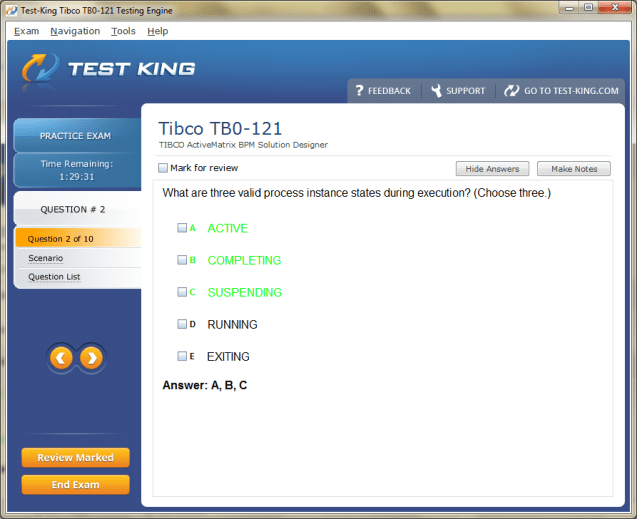
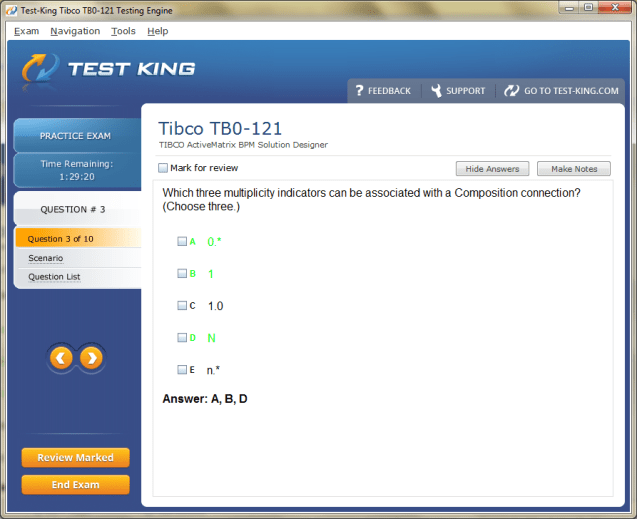
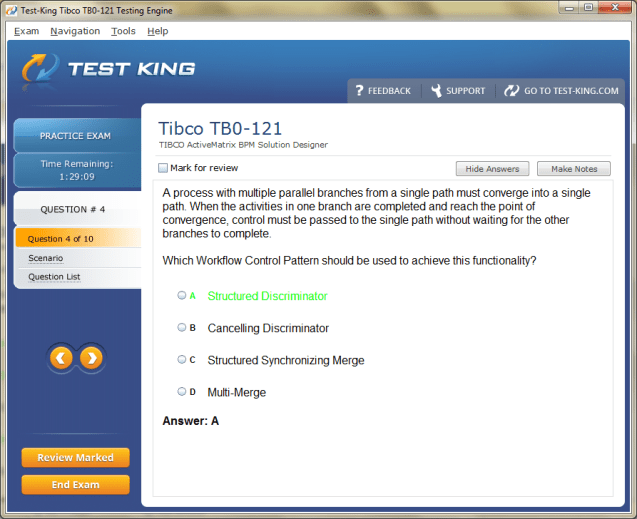
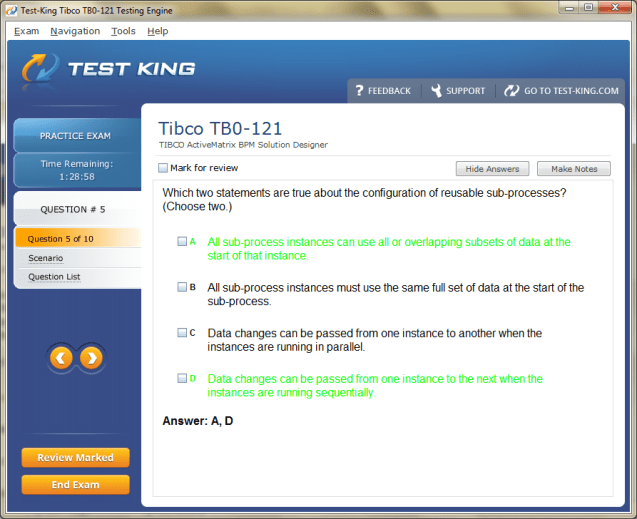
TB0-121 Exam Product Screenshots
Frequently Asked Questions
How can I get the products after purchase?
All products are available for download immediately from your Member's Area. Once you have made the payment, you will be transferred to Member's Area where you can login and download the products you have purchased to your computer.
How long can I use my product? Will it be valid forever?
Test-King products have a validity of 90 days from the date of purchase. This means that any updates to the products, including but not limited to new questions, or updates and changes by our editing team, will be automatically downloaded on to computer to make sure that you get latest exam prep materials during those 90 days.
Can I renew my product if when it's expired?
Yes, when the 90 days of your product validity are over, you have the option of renewing your expired products with a 30% discount. This can be done in your Member's Area.
Please note that you will not be able to use the product after it has expired if you don't renew it.
How often are the questions updated?
We always try to provide the latest pool of questions, Updates in the questions depend on the changes in actual pool of questions by different vendors. As soon as we know about the change in the exam question pool we try our best to update the products as fast as possible.
How many computers I can download Test-King software on?
You can download the Test-King products on the maximum number of 2 (two) computers or devices. If you need to use the software on more than two machines, you can purchase this option separately. Please email support@test-king.com if you need to use more than 5 (five) computers.
What is a PDF Version?
PDF Version is a pdf document of Questions & Answers product. The document file has standart .pdf format, which can be easily read by any pdf reader application like Adobe Acrobat Reader, Foxit Reader, OpenOffice, Google Docs and many others.
Can I purchase PDF Version without the Testing Engine?
PDF Version cannot be purchased separately. It is only available as an add-on to main Question & Answer Testing Engine product.
What operating systems are supported by your Testing Engine software?
Our testing engine is supported by Windows. Andriod and IOS software is currently under development.
TB0-121 : Understanding the Exam Core Architecture of TIBCO ActiveMatrix BPM
TIBCO ActiveMatrix BPM embodies a sophisticated and multifaceted architecture designed to orchestrate enterprise business processes with precision, scalability, and adaptability. At its essence, this platform is constructed to bridge the gap between complex organizational operations and the automation of workflows while accommodating human decision-making. Unlike traditional systems that merely execute static sequences of tasks, ActiveMatrix BPM integrates process modeling, runtime execution, organizational structures, and service orchestration into a harmonious ecosystem that can evolve alongside business requirements. Its architecture is both methodical and elegant, providing a framework where modularity, performance, and reliability converge to enable seamless process automation.
The conceptual foundation of ActiveMatrix BPM revolves around enabling organizations to design, deploy, and monitor processes in a manner that is resilient yet flexible. Central to this is the understanding that business processes are inherently dynamic; they shift due to regulatory changes, market fluctuations, or operational priorities. The architecture acknowledges this reality by decoupling process design from execution, allowing modifications in workflows without disrupting ongoing operations. This decoupling is realized through a layered and modular approach, where each component has a distinct responsibility but interacts coherently with the entire system.
The platform’s architecture is underpinned by a layered paradigm that separates responsibilities into distinct functional domains. The uppermost layer focuses on business modeling and user interaction, serving as the interface where process designers articulate workflow logic, assign roles, and visualize task sequences. This layer is crucial for translating organizational intentions into executable models. It allows the encapsulation of complex business logic into discrete, manageable units and promotes clarity in process documentation and simulation. This modeling environment supports the creation of both structured and adaptive processes, facilitating human-centric workflows alongside automated system-driven activities.
Beneath this layer lies the orchestration and integration domain, which forms the connective tissue of the platform. Here, the system enables interaction between disparate enterprise applications, web services, messaging systems, and databases. It provides mechanisms to invoke external services, handle asynchronous messaging, and transform data formats to ensure interoperability. This layer ensures that processes are not isolated silos but part of a broader, interconnected ecosystem where information flows seamlessly, and tasks are coordinated across systems. Integration capabilities are crucial for enterprises that rely on heterogeneous technology stacks, allowing them to preserve legacy investments while advancing process automation.
At the foundational level is the execution environment, which embodies the runtime engine responsible for the actual orchestration of process instances. The process engine interprets workflow definitions, manages task allocation, monitors progress, and enforces business rules dynamically. Each process instance is tracked meticulously, with runtime data persisted to support auditability, analytics, and fault recovery. The execution environment is designed to support high concurrency, enabling multiple process instances to operate simultaneously without performance degradation. This is particularly important for organizations with high transaction volumes or complex workflows requiring coordination among multiple participants and services.
A critical element of ActiveMatrix BPM is its organizational modeling capability, which allows processes to reflect real-world hierarchies and role-based responsibilities. Instead of statically assigning tasks to individuals, the system defines roles, capabilities, and groups, dynamically routing work based on availability, skills, or pre-established rules. This dynamic allocation fosters operational resilience, enabling organizations to adapt to workforce changes, skill reassignment, or workload redistribution without necessitating redesign of workflows. It mirrors the fluidity of real enterprise environments, where work often flows across multiple teams and departments.
Service containers constitute another vital component of the architecture. These encapsulated environments host the services that participate in process execution, isolating them for stability and scalability. By deploying functionality within service containers, enterprises gain the ability to scale specific capabilities independently, optimize resource utilization, and ensure reliable execution. For instance, a process requiring intensive data transformation can be supported by multiple containers dedicated to this function, ensuring that other system services remain unaffected. The containerized approach also facilitates deployment in distributed, hybrid, or cloud-based infrastructures, enhancing system robustness and flexibility.
Within processes, business objects serve as the vessels of data, encapsulating attributes and relationships relevant to specific workflow instances. These objects allow consistent representation and manipulation of business data, ensuring that information exchanged between activities maintains integrity and context. Designing business objects that closely model real-world entities—such as customer accounts, service requests, or transactional records—simplifies process implementation and reduces the need for extensive data transformation. Business objects also support versioning and reuse across multiple workflows, fostering efficiency and standardization.
The runtime environment orchestrates interactions between these components, ensuring that tasks are executed in accordance with defined rules and organizational policies. When a process instance is initiated, the runtime environment determines task sequencing, allocates work to appropriate roles, monitors deadlines, and captures status updates. The system provides detailed tracking, enabling organizations to observe process progress, identify bottlenecks, and analyze execution patterns. This transparency is instrumental for continuous process improvement, allowing organizations to fine-tune performance, enhance resource utilization, and maintain compliance with operational standards.
ActiveMatrix BPM also emphasizes human-centric workflow, recognizing that automation alone cannot address all business decision points. While system tasks proceed autonomously, human tasks require user interaction through worklists and task forms. Users are presented with pending tasks, contextual information, deadlines, and escalation mechanisms, allowing them to act decisively without needing insight into the underlying architecture. This balance between automation and human judgment ensures that processes remain agile while preserving organizational control over critical decisions.
Performance, reliability, and scalability are embedded into the architectural ethos. The system is engineered to manage high workloads through distributed execution and load balancing, ensuring that individual components do not become points of congestion. Horizontal scalability allows organizations to add additional execution nodes or service containers as demand increases, without restructuring the entire architecture. Reliability is reinforced through data persistence, transactional integrity, and failover strategies, ensuring that tasks are not lost or corrupted in the event of system interruptions. These principles are fundamental for organizations seeking continuous availability and dependable process execution.
The architecture also supports extensibility and customization. By providing well-defined interfaces and modular components, enterprises can introduce new services, integrate third-party systems, or extend process logic without disturbing the existing workflow ecosystem. This adaptability is essential in environments characterized by rapid technological evolution or shifting business priorities. The platform’s modularity ensures that such extensions are manageable, maintainable, and do not compromise system stability.
Monitoring and analytics are integral to the architecture, offering insights into process performance and operational effectiveness. The system captures execution metrics, task completion times, exception occurrences, and workflow paths, which can then be analyzed to optimize processes, enhance productivity, or improve compliance. These capabilities provide a feedback loop that aligns operational execution with strategic objectives, enabling informed decisions about process refinement, resource allocation, or system enhancement.
The combination of modular service containers, business objects, dynamic organizational models, and a robust runtime environment establishes a resilient architecture that meets the dual demands of flexibility and control. By understanding the interrelationships among these components, organizations can design workflows that not only automate routine tasks but also support complex, adaptive, and knowledge-driven processes. The architecture facilitates collaboration, coordination, and transparency across departments and systems, creating an environment where business logic, operational execution, and human judgment are integrated seamlessly.
Security and governance are woven into the architectural framework, ensuring that process execution adheres to enterprise policies, compliance requirements, and access controls. Authentication, authorization, and role-based permissions govern who can initiate processes, view tasks, or modify workflows. Auditing mechanisms capture changes, decisions, and user activity, providing accountability and traceability across the entire BPM ecosystem. These safeguards are crucial for organizations operating in regulated industries or those managing sensitive data.
The interplay of these elements creates a holistic and adaptive BPM platform. By leveraging layered architecture, modular services, organizational modeling, human-centric workflows, and runtime orchestration, ActiveMatrix BPM provides a robust foundation for enterprise process management. Organizations are empowered to translate strategic objectives into executable workflows, manage operational complexities with agility, and maintain continuous alignment between business intent and system execution. The architecture serves not merely as a technical infrastructure but as an enabler of business transformation, capable of accommodating both current requirements and future evolution.
Advanced Process Modeling and Runtime Orchestration in TIBCO ActiveMatrix BPM
TIBCO ActiveMatrix BPM transcends conventional business process management by offering a sophisticated environment for designing, executing, and refining enterprise workflows. The platform’s strength lies in its ability to convert conceptual business processes into executable instances that interact seamlessly with organizational structures, external systems, and human participants. At its core, ActiveMatrix BPM facilitates the translation of abstract business logic into concrete operations, leveraging runtime orchestration, dynamic role assignment, and structured service integration. Understanding how processes are modeled and executed within this architecture is crucial for realizing the full potential of the platform, particularly in complex, high-volume, or adaptive enterprise environments.
The process modeling framework of ActiveMatrix BPM is predicated upon clarity, precision, and adaptability. Designers can create workflows using a combination of graphical modeling tools and pre-defined process elements, establishing sequences, decision points, and parallel task flows. Every activity, event, or gateway is represented in a manner that mirrors real-world business operations, allowing stakeholders to visualize end-to-end process execution. The modeling environment supports both structured and unstructured processes, accommodating highly procedural workflows alongside more adaptive, case-driven scenarios. This flexibility ensures that processes are not constrained by rigid templates but can evolve in response to operational realities.
At the heart of this modeling framework are business objects, which encapsulate the data manipulated throughout the process. Each business object defines attributes, relationships, and constraints, providing a consistent representation of critical information such as customer records, transactional data, or service requests. By linking process tasks to business objects, designers can ensure data integrity, reduce redundancy, and facilitate interoperability across workflows. Business objects serve as the common language between the process engine, service containers, and organizational participants, allowing information to flow seamlessly and reliably.
The runtime orchestration capabilities of ActiveMatrix BPM complement this modeling environment by ensuring that process instances are executed according to defined logic while adapting dynamically to real-time conditions. When a workflow is initiated, the runtime environment interprets the process definition, instantiates the associated business objects, and orchestrates the sequence of activities. Task routing is determined by a combination of role-based assignments, eligibility criteria, and organizational hierarchies, allowing work to be allocated dynamically according to availability, skill sets, and workload balancing. This approach mirrors the fluidity of actual organizational operations, where responsibilities shift and priorities fluctuate in response to internal and external factors.
Service containers play a pivotal role in runtime orchestration, hosting the modular components that execute specific tasks or business logic. By isolating services within containers, the platform ensures stability, fault tolerance, and scalability. Each container can manage a particular type of operation, such as data transformation, messaging, or integration with external applications, allowing processes to leverage distributed computing resources efficiently. This modular deployment also enables organizations to scale individual services independently, optimizing performance without disrupting the overall workflow execution.
The integration layer of ActiveMatrix BPM further enhances process execution by enabling seamless interaction with external systems. The platform supports a wide array of connectivity mechanisms, including web services, messaging protocols, and database interfaces, allowing workflows to exchange information with enterprise applications in real time. This integration ensures that processes are not confined to internal operations but can orchestrate activities across multiple systems, departments, and even geographic regions. By embedding integration capabilities within the process model, the platform allows designers to construct workflows that reflect complex enterprise realities, maintaining continuity and consistency across diverse technological environments.
Dynamic organizational modeling is another cornerstone of runtime orchestration. Instead of statically assigning tasks to individuals, the system defines roles, responsibilities, and work groups, dynamically mapping tasks to eligible participants based on business rules and operational conditions. This approach accommodates changes in staffing, skill sets, or workload distribution, allowing processes to remain uninterrupted despite fluctuations in resource availability. Role-based task allocation also enhances accountability and governance, as responsibilities are clearly delineated while retaining flexibility to adapt to real-world conditions.
Human interaction is seamlessly integrated into the runtime environment, acknowledging that automation alone cannot address every decision point within a process. Users access worklists and task interfaces that present pending activities, contextual data, and process instructions, allowing informed decision-making without requiring awareness of the underlying architecture. Escalation rules, deadlines, and exception handling mechanisms are embedded within the workflow, ensuring that tasks are completed efficiently and consistently. This human-centric design balances the benefits of automation with the necessity for discretion, judgment, and situational awareness in business operations.
Performance and reliability are fundamental considerations within ActiveMatrix BPM’s orchestration. The platform supports high concurrency, enabling multiple process instances to execute simultaneously without contention or degradation. Distributed execution across service containers and nodes ensures that workload is balanced and resources are optimized, maintaining responsiveness even under heavy operational demand. Fault tolerance mechanisms, such as process persistence, transactional integrity, and failover strategies, safeguard against data loss and execution errors, ensuring that business operations remain continuous and dependable.
Monitoring and analytics are intrinsic to runtime orchestration, providing visibility into process execution, resource utilization, and operational efficiency. The system captures metrics such as task completion times, exception occurrences, and process path variations, allowing organizations to evaluate workflow performance and identify opportunities for improvement. This feedback loop enables iterative refinement of process models, adjustment of business rules, and optimization of resource allocation, ensuring that process execution evolves in alignment with strategic objectives.
Adaptive workflows are supported through event-driven orchestration, where processes respond dynamically to internal triggers, external signals, or changing business conditions. The runtime environment can adjust task sequencing, trigger subprocesses, or reroute work based on real-time events, allowing processes to remain flexible without compromising governance or data integrity. This capability is essential for enterprises facing rapidly changing markets, unpredictable customer demands, or complex operational interdependencies.
The architecture also supports the orchestration of nested and collaborative processes, where multiple workflows interact or converge to achieve a collective outcome. Subprocesses can be invoked, coordinated, and monitored independently while contributing to overarching business objectives. Collaboration between processes, service containers, and organizational participants is managed transparently, maintaining consistency, traceability, and accountability across all interacting workflows. This nested orchestration enables the creation of sophisticated, multi-layered business solutions that reflect real-world operational complexity.
Security and compliance are integrated into the orchestration environment. Authentication, authorization, and role-based permissions govern access to processes, tasks, and data, ensuring that only authorized personnel can perform critical actions. Auditing captures every interaction, decision, and change within the process ecosystem, providing a robust trail for compliance, governance, and operational transparency. By embedding these safeguards, ActiveMatrix BPM ensures that runtime execution aligns with organizational policies and regulatory requirements.
Extensibility is a key attribute of runtime orchestration. Organizations can introduce new services, integrate additional applications, or extend process logic without disrupting existing workflows. The modular architecture facilitates maintenance and evolution, allowing processes to adapt to emerging business needs or technological advancements. This ensures that the platform remains relevant and valuable as organizational complexity and operational demands grow.
Data-driven decision-making is reinforced through the orchestration of process analytics. By capturing execution data, monitoring performance, and analyzing workflow paths, organizations can derive actionable insights to enhance efficiency, reduce bottlenecks, and improve service delivery. The interplay between business objects, process execution, and runtime monitoring creates a feedback mechanism that supports continuous improvement and operational intelligence. This analytical perspective ensures that process management is not merely reactive but informed, strategic, and proactive.
The integration of service containers, runtime orchestration, dynamic organizational modeling, and human-centric workflows enables a cohesive and resilient BPM environment. The platform allows enterprises to model complex processes accurately, execute them reliably, and adapt them dynamically to changing conditions. This integrated approach ensures that business objectives are realized efficiently, operational risks are mitigated, and organizational agility is preserved. By aligning process execution with enterprise strategy, ActiveMatrix BPM provides a foundation for sustainable operational excellence, facilitating both tactical efficiency and strategic growth.
Service Containers and Business Object Orchestration in TIBCO ActiveMatrix BPM
TIBCO ActiveMatrix BPM is designed to orchestrate enterprise processes with precision, resilience, and adaptability, and its architecture emphasizes modularity and structured execution. Central to this design are service containers and business objects, which collectively enable organizations to model, execute, and refine complex workflows. Service containers serve as isolated environments that host specific functionalities, ensuring reliability, scalability, and operational efficiency, while business objects encapsulate critical data, maintaining integrity and consistency across processes. Understanding how these components interact provides insights into the sophisticated orchestration capabilities of the platform.
Service containers function as encapsulated environments where services operate independently, providing a controlled and manageable runtime for executing specific business logic. Each container hosts a set of services that may range from data transformation and messaging to interaction with external applications. This encapsulation ensures that failures or performance issues within one container do not propagate throughout the system, enhancing fault tolerance and operational stability. Organizations can deploy containers strategically to align with process requirements, balancing workloads and optimizing resource allocation. This modular approach allows enterprise processes to scale horizontally, where additional containers can be introduced without affecting existing workflows, ensuring continuity and resilience.
The orchestration of business objects within ActiveMatrix BPM complements the service container architecture by enabling structured data management across process workflows. Business objects represent entities such as customer records, transactional items, or service requests, encapsulating their attributes and relationships. They function as the primary medium through which process activities exchange information, providing consistency and reliability. When a process instance is initiated, relevant business objects are instantiated and associated with specific tasks. These objects persist throughout the process lifecycle, ensuring that all operations have access to accurate and complete data, and enabling seamless integration with external systems. The design of business objects allows reuse across multiple workflows, reducing redundancy and promoting standardization in process design.
Service containers and business objects work in tandem to facilitate dynamic runtime orchestration. When a process task requires computation, data transformation, or external interaction, the runtime environment directs the request to the appropriate service container. The container executes the task while maintaining isolation from other processes, ensuring stability and preventing conflicts. Meanwhile, business objects provide the necessary context and data, allowing tasks to operate on well-defined entities rather than arbitrary datasets. This combination of modular execution and structured data management ensures that workflows remain coherent, predictable, and adaptable under varying operational conditions.
The deployment and management of service containers require careful consideration of process complexity, resource utilization, and operational priorities. Containers can be distributed across multiple nodes or environments to optimize performance and reduce latency, especially in enterprises with geographically dispersed operations. Each container may be scaled independently, allowing organizations to allocate resources efficiently according to workload intensity. This flexibility is crucial for high-volume processes where specific tasks, such as data-intensive transformations or messaging operations, demand greater computational capacity. By isolating services within containers, the platform reduces the risk of performance bottlenecks, ensuring that critical workflows continue uninterrupted even under substantial load.
Business object orchestration extends beyond simple data encapsulation; it also governs interactions between multiple tasks, processes, and containers. Business objects maintain state information, track changes, and facilitate communication between activities. When a subprocess is invoked or a parallel task executes, the associated business objects ensure that data consistency is maintained and that each task operates with the most current information. This orchestration enables complex, multi-step processes to be executed reliably, even when interactions span multiple containers, organizational roles, or external systems.
The dynamic interaction between service containers and business objects is further enhanced by runtime governance mechanisms. ActiveMatrix BPM includes capabilities for monitoring process execution, detecting anomalies, and applying corrective actions. Containers provide metrics on resource utilization, task performance, and execution status, while business objects provide visibility into data flows and state changes. Together, these mechanisms allow organizations to maintain operational control, optimize performance, and ensure compliance with organizational policies. By continuously monitoring and orchestrating both services and data, the platform supports proactive management and iterative improvement of business processes.
Human-centric workflows are integrated seamlessly into this architecture, acknowledging that certain decisions and tasks require human judgment. Worklists, task forms, and contextual data are presented to users through unified interfaces, allowing them to interact with business objects and complete tasks within the runtime environment. The orchestration of service containers ensures that user interactions are supported reliably, with notifications, escalations, and deadlines managed automatically. This design balances automation with human intervention, providing flexibility while preserving accountability and operational coherence.
Service containers also enable the modular extension of BPM capabilities. Organizations can introduce new services, integrate third-party applications, or extend business logic without affecting existing workflows. By encapsulating additional functionalities within containers, the platform maintains stability while enhancing adaptability. Containers can host specialized services for data enrichment, decision logic, analytics, or integration with emerging technologies, allowing enterprises to evolve their process ecosystem without extensive redevelopment. This extensibility ensures that ActiveMatrix BPM remains relevant and capable in dynamic business environments.
The interaction between containers and business objects supports parallelism and concurrency in process execution. Multiple process instances can execute simultaneously, with containers handling tasks independently and business objects maintaining data integrity. Parallel execution is particularly important for high-throughput operations, enabling organizations to manage large volumes of transactions, approvals, or service requests efficiently. The platform coordinates these concurrent activities transparently, ensuring that dependencies, sequencing, and data consistency are preserved, even under complex operational scenarios.
Security and compliance are embedded within the orchestration of containers and business objects. Role-based access, authentication, and authorization mechanisms govern who can interact with processes, tasks, and data. Business objects carry access policies that ensure sensitive information is protected, while containers enforce execution-level controls to prevent unauthorized actions. Auditing and logging capture every interaction with processes, containers, and business objects, providing traceability and accountability for regulatory and governance requirements. This integrated security model ensures that operational flexibility does not compromise organizational or regulatory obligations.
The combination of service containers and business object orchestration enables adaptive workflows that can respond to changing business conditions. Event-driven triggers, conditional logic, and exception handling allow processes to adjust in real time, rerouting tasks, invoking subprocesses, or recalculating outcomes based on current data. Containers execute these adjustments reliably, while business objects maintain consistency and context. This adaptability ensures that enterprise processes remain robust and responsive, capable of accommodating unforeseen events, operational shifts, or strategic changes without disruption.
Monitoring and analytics enhance the orchestration capabilities of ActiveMatrix BPM by providing actionable insights into process performance and operational efficiency. Metrics related to task execution, container performance, and business object utilization can be analyzed to identify bottlenecks, inefficiencies, or optimization opportunities. This data-driven approach allows organizations to refine workflows, reallocate resources, and enhance service quality continuously. By integrating monitoring into both service containers and business object management, the platform ensures that operational intelligence is embedded within the process execution environment.
The modular design of containers and business objects also facilitates collaboration across organizational boundaries. Multiple departments, teams, or external partners can participate in workflows, with containers providing isolated execution environments and business objects ensuring data consistency. This collaborative orchestration supports complex, multi-stakeholder processes such as procurement, customer service, or compliance management, where interactions span internal and external entities. The architecture enables these processes to operate efficiently and transparently, maintaining alignment with business objectives while accommodating diverse operational needs.
Scalability remains a key attribute of the platform, as the orchestration of containers and business objects allows organizations to expand their process capabilities incrementally. New containers can be introduced to manage additional workloads, and business objects can be extended to capture evolving data requirements. This approach enables organizations to scale horizontally, adapting to growth in transactions, services, or operational complexity without compromising performance or stability. The platform’s architecture ensures that scalability is achieved in a controlled and predictable manner, preserving reliability and process integrity.
Integration with external systems is facilitated through service containers, which provide the mechanisms for invoking external services, exchanging messages, and transforming data formats. Business objects serve as intermediaries, ensuring that information received from external sources is correctly mapped and validated before being processed within workflows. This tight integration allows enterprises to leverage legacy systems, cloud applications, and partner platforms, creating a cohesive operational ecosystem where processes extend seamlessly beyond organizational boundaries.
The orchestration of business objects and service containers also supports iterative improvement of workflows. By analyzing runtime data, monitoring task execution, and evaluating container performance, organizations can refine process models, optimize resource allocation, and enhance overall efficiency. The platform provides the tools to implement these improvements without interrupting ongoing operations, allowing processes to evolve continuously in response to operational insights, business priorities, or market demands.
The architecture encourages reuse and standardization through the careful design of containers and business objects. Containers encapsulate reusable services, while business objects define standardized data entities that can be shared across workflows. This approach reduces redundancy, simplifies maintenance, and promotes consistency across enterprise processes. Organizations can develop libraries of containers and business objects that support multiple workflows, accelerating deployment and reducing the complexity of process development.
Service containers and business object orchestration also enable advanced scenarios such as conditional routing, exception handling, and adaptive task allocation. The runtime environment can evaluate business object attributes, apply rules, and direct tasks dynamically to the appropriate containers or users. This capability ensures that processes respond intelligently to operational variations, prioritizing critical tasks, escalating exceptions, and maintaining workflow continuity. By combining intelligent orchestration with modular execution, ActiveMatrix BPM provides a platform capable of handling intricate, high-stakes enterprise processes reliably.
Organizational Modeling and Human-Centric Workflow Management in TIBCO ActiveMatrix BPM
TIBCO ActiveMatrix BPM provides a highly adaptive environment for managing complex business processes, integrating organizational modeling, human-centric workflows, and runtime orchestration to deliver cohesive and efficient process execution. At the heart of this platform lies a sophisticated organizational modeling framework that mirrors real-world enterprise structures, allowing tasks to be assigned dynamically, responsibilities to be delineated with precision, and processes to adapt seamlessly to evolving operational conditions. The architecture of ActiveMatrix BPM harmonizes technical execution with human interaction, enabling enterprises to achieve a balance between automation, control, and flexibility. Understanding the interplay between organizational models and human workflow management is essential for designing and executing processes that align with strategic objectives while maintaining operational fluidity.
Organizational modeling in ActiveMatrix BPM serves as the blueprint for mapping enterprise roles, hierarchies, responsibilities, and work distribution. Instead of statically assigning tasks to individuals, the platform employs dynamic role-based allocation, where work is routed to eligible participants based on skills, availability, and business rules. This model captures the intricacies of modern organizational structures, including departments, teams, positions, and reporting lines, allowing workflows to reflect both operational realities and governance requirements. By simulating organizational behavior within the process design environment, enterprises can ensure that process execution aligns with business objectives, optimizes resource utilization, and maintains accountability.
Human-centric workflow management is intricately linked to organizational modeling, providing interfaces and mechanisms for users to interact with process tasks effectively. Worklists, task forms, and dashboards present pending activities, contextual information, and process instructions, enabling participants to perform their duties with clarity and efficiency. Notifications, escalations, and deadlines are embedded within workflows, guiding users through task completion while maintaining adherence to business rules. This integration ensures that human judgment and discretion are applied where necessary, complementing automated execution and enhancing decision-making quality.
The orchestration of human tasks within ActiveMatrix BPM leverages both role-based allocation and dynamic process routing. When a process instance is initiated, tasks are assigned to participants according to eligibility criteria defined in the organizational model. This may include skill sets, availability schedules, workload distribution, or predefined priorities. The system can also accommodate substitutions, delegations, and escalations, ensuring that workflows continue without interruption even when personnel change or unexpected operational conditions arise. By dynamically adapting task assignments, the platform maintains continuity, accountability, and operational efficiency while reflecting real-world organizational behavior.
Business objects and data management play a crucial role in supporting human-centric workflows. Each task is associated with relevant business objects that encapsulate the information needed for decision-making and task completion. These objects maintain attributes, relationships, and state information, ensuring consistency and accuracy throughout the process lifecycle. Users interact with business objects through intuitive interfaces, enabling them to review, update, or approve information as part of the workflow. This design bridges the gap between process automation and human cognition, allowing participants to engage with the process meaningfully without requiring knowledge of the underlying technical architecture.
The runtime environment in ActiveMatrix BPM orchestrates interactions between human tasks, automated processes, and service containers. When a user completes a task, the system evaluates the outcome, applies business rules, and determines subsequent actions, which may include triggering automated tasks, invoking subprocesses, or rerouting work to other participants. This orchestration ensures that workflows progress smoothly, tasks are completed in the correct sequence, and process objectives are achieved efficiently. By coordinating human and system activities, the platform delivers a unified operational experience that integrates judgment, automation, and organizational policy.
Dynamic process adaptation is a key characteristic of human-centric workflow management. The platform can respond to changes in operational conditions, organizational structures, or business rules in real time, adjusting task assignments, priorities, and routing paths accordingly. Event-driven triggers, conditional logic, and exception handling mechanisms allow workflows to adapt intelligently, maintaining continuity and operational efficiency even under fluctuating circumstances. This adaptability is critical for enterprises operating in volatile markets, high-demand service environments, or regulatory contexts where agility and responsiveness are essential.
Monitoring and analytics are embedded into the organizational and human workflow framework, providing visibility into task execution, resource utilization, and process efficiency. Metrics such as task completion times, user performance, workload distribution, and process deviations can be analyzed to identify bottlenecks, optimize assignments, and enhance productivity. By linking analytics to organizational models and human workflows, enterprises gain actionable insights that support process improvement, informed decision-making, and strategic alignment. This feedback loop ensures that human-centric workflows evolve continuously, responding to operational insights, organizational shifts, and business priorities.
The integration of service containers within human-centric workflows further enhances operational reliability and scalability. Automated tasks, system interactions, and data transformations are executed within isolated containers, ensuring stability and performance even as human participants engage with other parts of the process. This separation of concerns allows enterprises to scale resources efficiently, manage high-volume operations, and maintain consistent execution quality. Human tasks are coordinated with these containers to ensure that dependencies, sequencing, and business rules are enforced seamlessly across automated and manual activities.
Security and governance are intrinsic to the orchestration of human-centric workflows. Role-based access, authentication, and authorization mechanisms ensure that users can only interact with tasks and data for which they are permitted, while auditing captures all actions, decisions, and modifications. Organizational modeling enforces compliance with reporting lines, approval hierarchies, and operational policies, embedding governance directly into process execution. This integration ensures that flexibility and adaptability do not compromise security, accountability, or regulatory compliance, providing a controlled environment for both human and system interactions.
Collaboration across teams and departments is facilitated by the combination of organizational modeling and human-centric workflow management. Tasks can be routed across multiple workgroups, departments, or locations while maintaining data integrity and process coherence. Business objects serve as the central reference for information exchange, while service containers ensure reliable execution of supporting automated activities. This collaborative orchestration enables complex, multi-stakeholder processes such as case management, customer service workflows, or cross-department approvals to operate efficiently, transparently, and consistently.
Extensibility is another important aspect of human-centric workflow management. Organizations can introduce new roles, redefine responsibilities, or expand task interfaces without disrupting existing processes. The modular architecture allows for incremental enhancements, such as additional approval steps, new workgroups, or revised escalation rules. Business objects can be extended to accommodate new data requirements, and service containers can host additional automated tasks, allowing workflows to evolve in parallel with organizational growth and operational demands. This adaptability ensures that processes remain aligned with evolving business strategies and workforce dynamics.
The orchestration of tasks, business objects, and service containers supports concurrency and parallelism within human-centric workflows. Multiple participants can engage in different tasks simultaneously, while automated activities execute in parallel within containers. This concurrency is managed transparently by the runtime environment, ensuring that dependencies, sequencing, and data consistency are maintained. Parallel execution enables organizations to handle high transaction volumes, multi-step approvals, or complex operational scenarios efficiently, preserving both productivity and quality.
Event-driven workflows further enhance the responsiveness of human-centric process management. Triggers based on external events, system updates, or organizational conditions can initiate, reroute, or modify tasks in real time. Business objects provide the necessary context for decision-making, while service containers execute automated responses or calculations. This capability allows enterprises to maintain operational agility, respond to unforeseen circumstances, and capitalize on emerging opportunities without compromising workflow integrity or governance.
The interplay between human judgment and automated orchestration is central to achieving operational excellence in ActiveMatrix BPM. While service containers execute repetitive, high-volume, or data-intensive tasks, human participants apply critical reasoning, decision-making, and discretion where necessary. Organizational modeling ensures that roles, responsibilities, and accountability are clear, while the runtime environment coordinates interactions to maintain process continuity. This balance between automation and human insight enables enterprises to execute complex workflows efficiently, reliably, and adaptively.
Monitoring and reporting mechanisms provide continuous visibility into the performance of human-centric workflows. Insights derived from task completion rates, participant performance, workload distribution, and process exceptions allow organizations to refine workflows, optimize resource allocation, and enhance decision-making quality. By integrating monitoring into both organizational modeling and workflow execution, enterprises gain a comprehensive understanding of operational performance, enabling continuous improvement and strategic alignment.
The combination of dynamic organizational models, human-centric workflow management, business object orchestration, and service container execution creates a robust environment for enterprise process automation. The architecture enables processes to reflect real-world organizational behavior, incorporate human judgment, and execute efficiently across automated and manual tasks. By embedding adaptability, scalability, and governance into this framework, ActiveMatrix BPM provides enterprises with a platform capable of sustaining complex operations, responding to change, and supporting strategic objectives through sophisticated process orchestration.
Advanced Optimization and Performance Management in TIBCO ActiveMatrix BPM
TIBCO ActiveMatrix BPM offers a sophisticated environment for orchestrating enterprise processes, blending automation, human-centric workflows, and dynamic organizational modeling into a cohesive and scalable platform. One of the most critical aspects of leveraging this platform is the optimization of process execution and performance management. By carefully tuning runtime orchestration, monitoring workflow performance, and refining service container deployment, organizations can achieve high efficiency, reliability, and responsiveness. The architecture of ActiveMatrix BPM is designed to provide visibility, control, and adaptability, allowing enterprises to execute complex business processes seamlessly while continuously improving operational effectiveness.
Optimization in ActiveMatrix BPM begins with the careful analysis and design of workflows. Process designers utilize a combination of graphical modeling tools and pre-defined process elements to create efficient task sequences, decision flows, and parallel operations. Each activity is mapped in relation to business objects and organizational roles, ensuring that dependencies, resource utilization, and task execution order are optimized. By modeling workflows with precision, organizations can minimize redundancies, reduce bottlenecks, and enhance the clarity of process execution. This meticulous design forms the foundation for high-performance process orchestration.
Service containers play a pivotal role in performance management by providing isolated environments for executing specific tasks or services. Each container hosts a defined set of functions, such as data transformation, system integration, or messaging operations, and operates independently to prevent interference from other processes. This modularization allows organizations to scale workloads efficiently, distributing high-volume or resource-intensive tasks across multiple containers. By monitoring container performance, administrators can identify underutilized resources, optimize load distribution, and ensure that critical processes maintain consistent execution times. Containers also provide resilience by isolating failures and supporting failover mechanisms, ensuring that operational continuity is preserved even under stress.
Business objects serve as the backbone of process data management and are integral to performance optimization. They encapsulate the attributes, relationships, and states of entities manipulated within workflows, ensuring that tasks operate on accurate and consistent information. Optimizing business objects involves defining them to be reusable across multiple processes, minimizing duplication, and ensuring data integrity. Efficiently designed business objects allow processes to execute faster, reduce transformation overhead, and enhance interoperability between different tasks, service containers, and external systems. By aligning business objects with workflow requirements, enterprises can achieve more streamlined process execution and reduce potential errors or delays.
Runtime orchestration is a central element of performance management in ActiveMatrix BPM. The runtime environment monitors task execution, evaluates process dependencies, and applies business rules dynamically. By tracking the progress of each process instance, administrators can identify bottlenecks, detect delayed or stalled tasks, and implement corrective actions. Dynamic routing, conditional task allocation, and event-driven triggers enhance adaptability, allowing workflows to respond intelligently to changes in operational conditions, resource availability, or business priorities. This intelligent orchestration ensures that workflows remain efficient and agile while adhering to organizational policies and operational constraints.
Human-centric workflows are optimized through effective organizational modeling and task allocation. By dynamically mapping tasks to roles based on skills, availability, and workload, the platform ensures that human participants engage in tasks where they are most effective. Worklists, notifications, and escalation mechanisms guide users, enhancing task completion rates and minimizing delays. The runtime environment coordinates human tasks with automated processes, maintaining synchronization and consistency across the entire workflow. Monitoring user performance and workload distribution provides insights for reassigning responsibilities, improving efficiency, and enhancing overall process throughput.
Monitoring and analytics are essential components of performance management, providing the data needed to identify inefficiencies, optimize workflows, and refine process design. ActiveMatrix BPM captures execution metrics such as task completion times, container utilization, exception occurrences, and business object interactions. By analyzing these metrics, organizations can pinpoint performance gaps, predict resource requirements, and implement targeted improvements. Advanced reporting tools allow process administrators to visualize workflow performance, detect recurring issues, and make data-driven decisions for optimizing process execution. This continuous feedback loop ensures that processes evolve and adapt to operational demands while maintaining high standards of performance.
Event-driven orchestration further enhances optimization by allowing processes to respond dynamically to internal or external triggers. Tasks can be rerouted, escalated, or modified in real time based on process events, business object attributes, or operational conditions. This adaptability reduces downtime, ensures timely completion of critical activities, and maintains the flow of operations under fluctuating circumstances. By combining event-driven triggers with service container execution and business object management, organizations can achieve a highly responsive and resilient process ecosystem.
Load balancing and scalability are critical considerations for optimizing ActiveMatrix BPM in high-volume environments. Service containers can be distributed across multiple nodes or servers, allowing resource-intensive tasks to be executed in parallel. The platform supports horizontal scaling, where additional containers or nodes can be introduced seamlessly to accommodate increased workload. Monitoring container performance and adjusting resource allocation ensures that processes remain responsive and reliable, even under peak demand conditions. This scalability enables enterprises to maintain operational continuity, meet service-level agreements, and manage complex workflows efficiently.
Security and governance also intersect with performance optimization. Role-based access, authentication, and authorization mechanisms protect sensitive tasks and data while enabling efficient execution by authorized participants. Auditing and logging provide transparency into workflow operations, helping administrators detect anomalies, identify potential inefficiencies, and ensure compliance with regulatory requirements. By embedding security and governance into performance management, organizations can optimize workflows without compromising accountability or operational integrity.
The integration of automated analytics with workflow execution enhances predictive performance management. By analyzing historical metrics and identifying patterns, the platform can anticipate resource constraints, potential delays, or recurring bottlenecks. Predictive insights allow administrators to implement proactive measures, such as redistributing workloads, adjusting container deployment, or redesigning process paths. This foresight reduces downtime, minimizes operational disruptions, and ensures that workflows remain efficient even under changing business conditions.
Process refinement and continuous improvement are supported by the modular architecture of service containers and business objects. New containers can be deployed to manage emerging tasks, and business objects can be extended or redefined to capture additional attributes or relationships. Workflows can be adjusted incrementally, allowing organizations to test enhancements, implement best practices, and scale operations without disrupting existing processes. This iterative approach to optimization ensures that processes remain aligned with evolving business strategies, technological innovations, and operational requirements.
Collaboration across teams and departments is facilitated by optimized human-centric workflows and organizational modeling. Tasks can be routed to multiple participants or workgroups, with service containers managing supporting automated activities and business objects ensuring data consistency. Optimized workflows enable efficient coordination between departments, external partners, and cross-functional teams, reducing delays, minimizing errors, and enhancing overall process efficiency. This collaborative optimization ensures that complex, multi-stakeholder processes operate smoothly, transparently, and in alignment with business objectives.
Event monitoring, exception handling, and adaptive routing are central to managing performance in real time. The platform can detect stalled tasks, resource constraints, or unexpected events and adjust workflows dynamically. Business objects provide contextual information to guide decisions, while service containers execute supporting tasks reliably. This adaptive approach ensures that workflows continue without disruption, maintaining operational efficiency and responsiveness to real-world challenges.
By leveraging the combination of service containers, business objects, runtime orchestration, and human-centric workflows, ActiveMatrix BPM delivers a comprehensive performance optimization framework. Enterprises can monitor, analyze, and refine processes continuously, balancing automation with human judgment, scaling operations efficiently, and adapting to changing conditions. The platform’s architecture supports both tactical execution and strategic improvement, enabling organizations to achieve operational excellence while maintaining agility and control.
Conclusion
The optimization and performance management capabilities of TIBCO ActiveMatrix BPM provide organizations with the tools to execute complex workflows reliably, efficiently, and adaptively. By integrating service containers, business object orchestration, human-centric workflow management, and runtime monitoring, the platform enables enterprises to streamline operations, enhance resource utilization, and respond dynamically to operational changes. Continuous analysis, predictive insights, and iterative process refinement ensure that workflows evolve in alignment with organizational objectives, technological advancements, and market demands. Ultimately, ActiveMatrix BPM offers a robust framework for achieving operational excellence, maintaining strategic agility, and delivering measurable business value through advanced process orchestration and optimization.