

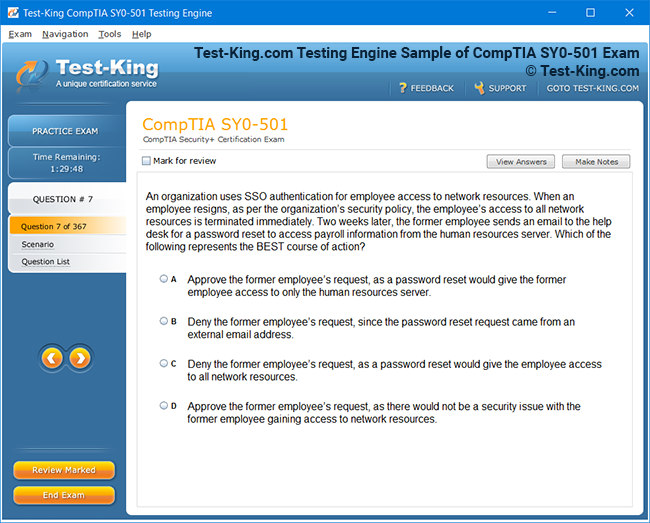
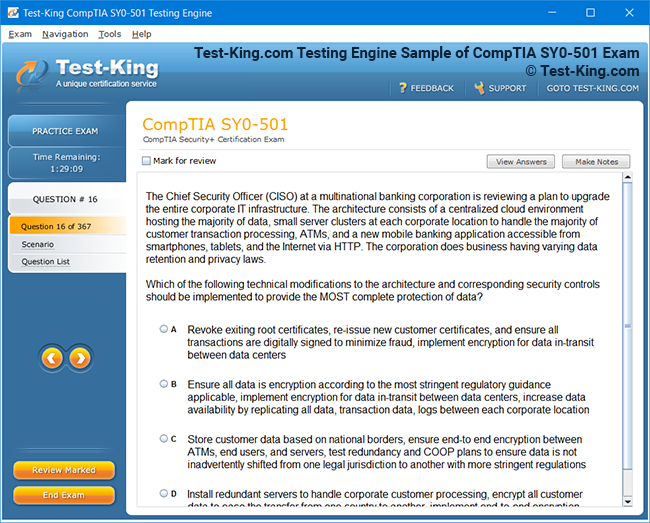
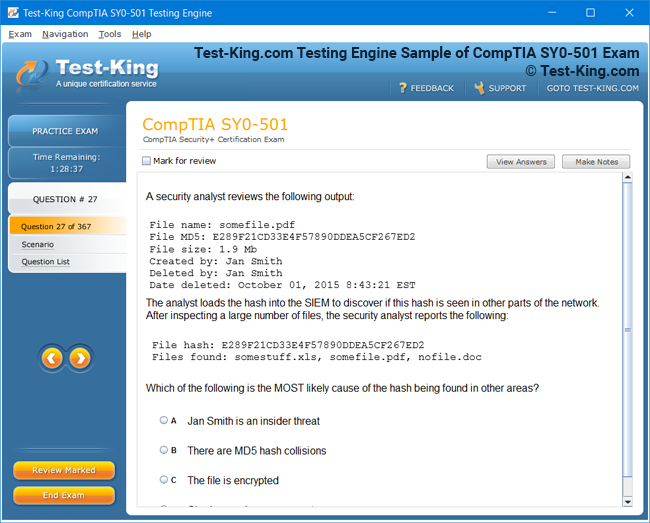
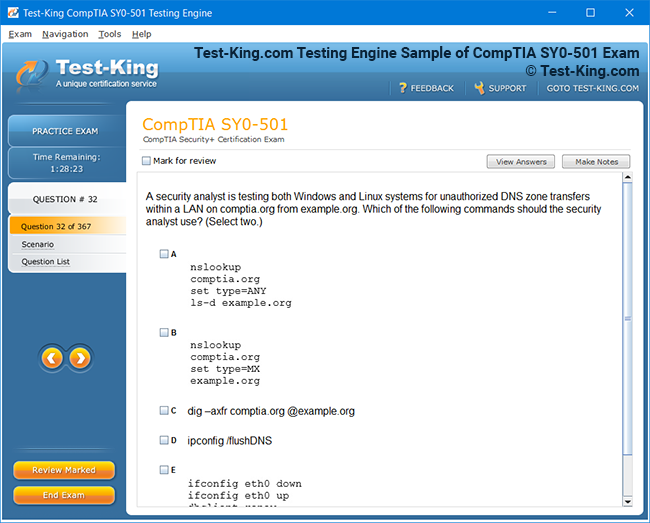
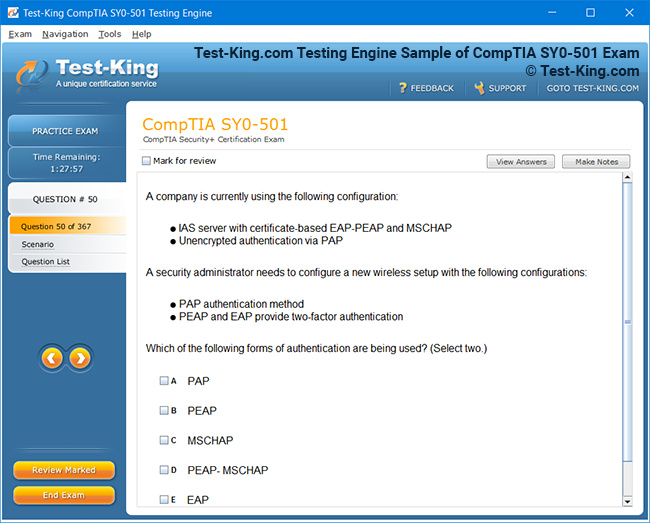
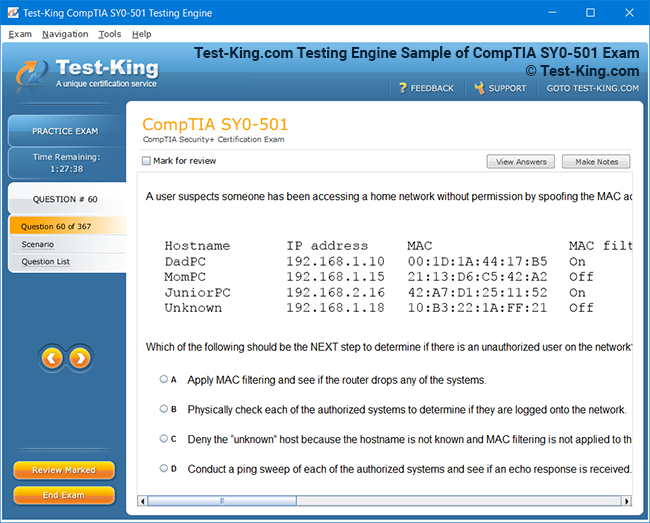
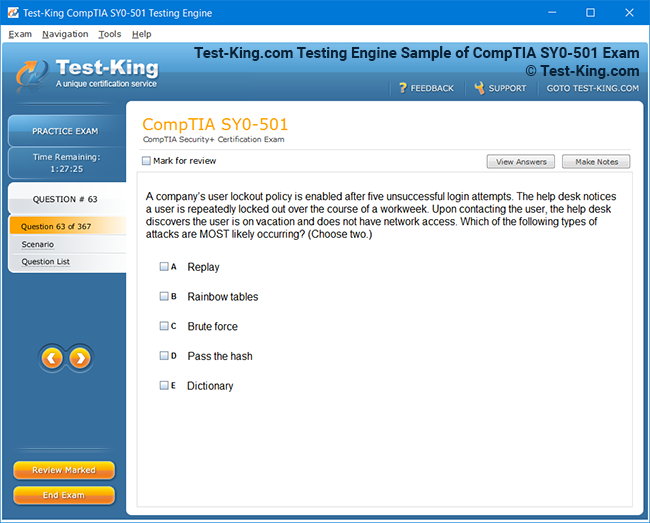
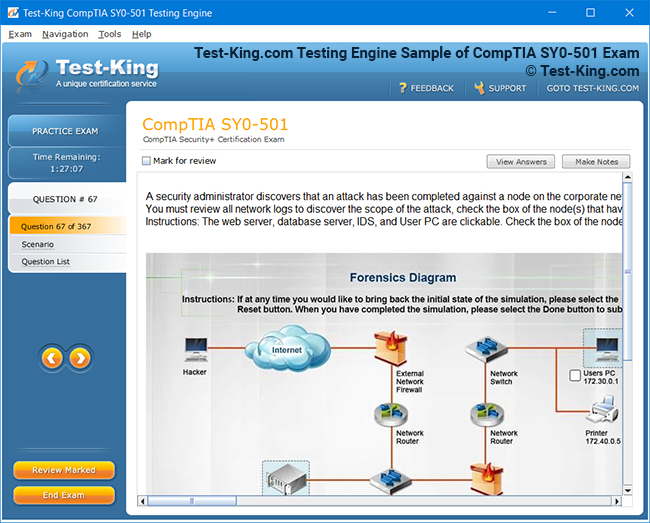
Product Screenshots
Frequently Asked Questions
How can I get the products after purchase?
All products are available for download immediately from your Member's Area. Once you have made the payment, you will be transferred to Member's Area where you can login and download the products you have purchased to your computer.
How long can I use my product? Will it be valid forever?
Test-King products have a validity of 90 days from the date of purchase. This means that any updates to the products, including but not limited to new questions, or updates and changes by our editing team, will be automatically downloaded on to computer to make sure that you get latest exam prep materials during those 90 days.
Can I renew my product if when it's expired?
Yes, when the 90 days of your product validity are over, you have the option of renewing your expired products with a 30% discount. This can be done in your Member's Area.
Please note that you will not be able to use the product after it has expired if you don't renew it.
How often are the questions updated?
We always try to provide the latest pool of questions, Updates in the questions depend on the changes in actual pool of questions by different vendors. As soon as we know about the change in the exam question pool we try our best to update the products as fast as possible.
How many computers I can download Test-King software on?
You can download the Test-King products on the maximum number of 2 (two) computers or devices. If you need to use the software on more than two machines, you can purchase this option separately. Please email support@test-king.com if you need to use more than 5 (five) computers.
What is a PDF Version?
PDF Version is a pdf document of Questions & Answers product. The document file has standart .pdf format, which can be easily read by any pdf reader application like Adobe Acrobat Reader, Foxit Reader, OpenOffice, Google Docs and many others.
Can I purchase PDF Version without the Testing Engine?
PDF Version cannot be purchased separately. It is only available as an add-on to main Question & Answer Testing Engine product.
What operating systems are supported by your Testing Engine software?
Our testing engine is supported by Windows. Andriod and IOS software is currently under development.
Top Tableau Exams
Understanding the Tableau Certified Consultant TCC-C01 Exam Structure and Objectives
The Tableau Certified Consultant TCC-C01 evaluation is shaped to validate not only technical virtuosity with Tableau Desktop, Tableau Server, and Tableau Cloud interfaces, but also the refined cognitive abilities needed to translate complex data landscapes into lucid analytical stories. The individual seeking recognition through this credential is expected to demonstrate mastery over data interpretation, dashboard craftsmanship, interpretive reasoning, user collaboration methods, system performance awareness, structured communication, and strategic analytical planning. The world of modern analytics does not merely rely on mechanistic chart creation or simple configurations. It requires someone who can perceive invisible trends, illuminate subtle patterns, and discover meaning within labyrinthine data constructs that organizations acquire from transactional systems, marketing funnels, operational frameworks, and digital behavior metrics. The TCC-C01 credential affirms readiness for such responsibilities.
Deep Exploration of Exam Structure and Objectives
To understand the nature of this evaluation, one must internalize the role identity of a Tableau Certified Consultant. This role is not confined to producing aesthetically pleasing dashboards. It demands deeper intellectual contribution. A consultant navigates business inquiries, refines ambiguous needs, designs appropriate data models, ensures efficient extract strategies, leads collaboration meetings with data owners, and articulates insights in ways that influence decisions. This role holds a place between analytics execution and business strategy, functioning as a mediator between raw information and executive reasoning. Therefore, the TCC-C01 evaluation structure reflects these real obligations, ensuring the candidate is measured across cognitive analysis, communication accuracy, visualization knowledge, and enterprise deployment comprehension.
The TCC-C01 evaluation includes multiple forms of assessment such as scenario-based decision reasoning, multiple-choice analytical reasoning evaluation, conceptual understanding validation, and practical design thinking. While a typical technical test might evaluate direct command usage, this evaluation is oriented toward judgment. It tests whether the candidate can discern correct visualization types for varied datasets, determine where data joins will create granularity misalignments, recognize when live connections are contextually inferior to optimized extracts, and decide how to configure filtering hierarchies for scalable dashboard performance. This is not an environment where memorization ensures success. The evaluation rewards analytical poise, conceptual clarity, and narrative coherence.
One fundamental theme within the evaluation is data modeling. The candidate must understand how dimensions and measures interact, how relationships differ from joins, how blending changes query logic, and how aggregation levels influence visual output. A candidate who fails to understand these constructs will build dashboards that misrepresent trends or distort numerical meaning. Tableau encourages clarity of granularity. The consultant must verify whether the data grain in one source aligns harmoniously with another. If not, improper detail levels may cause duplication of rows, miscalculated sums, or misleading average values. The evaluation challenges the candidate to think critically about these realities and demonstrate that understanding through scenario responses.
Another important concentration involves data preparation. Tableau often relies on external preparation systems such as Tableau Prep, SQL transformations, or cleansing procedures conducted before data reaches the visualization layer. A consultant must understand when to perform calculations within the data source as opposed to computing results inside the visualization environment. This also influences performance. If heavy computations occur repeatedly at the visualization layer, dashboards may become slow, frustrating end users and reducing adoption. The evaluation aims to confirm that the candidate knows how to maintain elegance, efficiency, and scalability through deliberate data preparation strategy.
The evaluation also examines the craft of dashboard design. Consulting requires the ability to shape a narrative. A dashboard is not merely a collage of charts. It must present a journey where the audience perceives the metric story effortlessly. A consultant must understand the influence of white space, visual emphasis through alignment and size hierarchy, the role of interactive filters, the psychological effect of color relationships, and the importance of intuitive navigation. The evaluation may include prompts describing a stakeholder’s difficulty in interpreting an existing dashboard. The candidate must propose improvements, explaining why certain enhancements lead to clearer interpretation or reduced cognitive strain. This ability to articulate reasoning distinguishes a consultant from a simple visual technician.
Stakeholder communication is another anchor of the evaluation. Many tasks in consulting are not performed in isolation. The consultant must work alongside executives, analysts, engineers, financial controllers, marketing strategists, and operational managers. Each group has distinct vocabularies, expectations, and comprehension speeds. A consultant must articulate insights in a manner that resonates with each audience without overwhelming them with excessive detail or technical jargon. The evaluation will test whether the candidate can bridge these conversational worlds with precision and empathy. The candidate must understand how to translate dashboard interactions into business interpretation. A visualization is only useful when its meaning is understood. Therefore, communication is central.
The evaluation also incorporates knowledge of deployment and governance considerations. Tableau environments in enterprises must preserve secure access control, reliable data refresh patterns, efficient publishing practices, standardized data source certification, user role management, and audit-ready transparency. The consultant must understand how Tableau Server and Tableau Cloud handle authentication, content permissioning, extract scheduling, and system performance monitoring. There is also emphasis on knowledge of Tableau Blueprint principles that guide enterprise-wide analytics cultivation. The evaluation ensures that the candidate understands how governance supports consistent analytical trust across an organization.
To illustrate how scenario reasoning works within the evaluation, consider a hypothetical dialogue converted into narrative exposition. A manufacturing organization experiences frequent delays in dashboard refresh times. Users complain that their daily operational dashboards take too long to load during morning review sessions. Internal teams assume the issue is caused by data volume, yet the consultant must investigate with structured analysis. The consultant inspects the underlying queries and notices that the dashboard uses multiple live connections to remote warehouse systems with fluctuating network throughput. Additionally, several custom calculated fields apply row-level computations repeatedly for millions of records. The consultant proposes converting specific datasets into optimized extracts refreshed during off-peak hours and moving repeated expressions into calculated columns inside the data source. Furthermore, the consultant suggests reorganizing the dashboard layout to minimize unnecessary filters and removed unused fields from the data model. These improvements increase refresh speed and enhance user engagement. This kind of scenario appears in the evaluation in descriptive form, requiring the candidate to choose the most suitable adjustment approach.
In another narrative example, imagine a retail firm wishes to understand regional sales performance fluctuations. Their current visualization shows aggregated total revenue by region but fails to reveal product category variation. The consultant understands that storytelling must reveal layered meaning. The consultant restructures the analysis by introducing product category filters, hierarchical drill paths, and parameter controls that allow business leaders to move between regional and category views seamlessly. This elevates insight precision and fosters exploratory curiosity. The evaluation tests whether the candidate can recognize when to enhance visual depth while maintaining clarity.
The evaluation also tests adaptability. Consulting requires responding to unexpected data behavior, delayed stakeholder feedback, shifting organizational priorities, and evolving system infrastructure. A consultant must remain calm, composed, and inventive when encountering unforeseen challenges. If a data warehouse schema changes unexpectedly, the consultant must reestablish calculations, adjust joins, or redesign dashboards while maintaining composure and direction. The evaluation includes prompts that simulate ambiguity to verify this behavioral readiness.
Furthermore, the evaluation gauges ethical reasoning and data responsibility awareness. Consultants must ensure data confidentiality, respect governance rules, and prevent accidental exposure of sensitive metrics. Tableau environments require structured permissions, embedded credential choices, and secure publishing workflows. The consultant must avoid creating public dashboards containing private information. The evaluation ensures the candidate understands how to manage these responsibilities with care.
The evaluation also expects the candidate to demonstrate maturity in performance optimization. A dashboard must load quickly, respond smoothly, and provide a frictionless exploration experience. If a visualization is slow, the consultant must identify whether the cause lies in query logic, excessive extracted fields, too many quick filters, inefficient calculations, high-cardinality fields, image-heavy layouts, or inefficient design arrangement. Performance tuning is a strategic discipline involving measurement, diagnosis, and adjustment. The evaluation tests these thought processes thoroughly.
There is also emphasis on Tableau ecosystem awareness. The consultant must understand how Tableau interacts with external systems such as relational databases, cloud warehouses, APIs, spreadsheets, flat files, operational feed sources, and enterprise authentication frameworks. The candidate must understand how to choose connection strategies that balance stability, throughput, latency tolerance, and refresh consistency. The evaluation challenges the candidate to determine appropriate choices based on scenario constraints.
Within this comprehensive evaluation structure, an essential characteristic emerges: the consultant must think holistically. An effective consultant perceives data not simply as numbers but as reflections of behavior, performance, change, and progress. Dashboards convey stories of human decisions, system actions, and operational dynamics. The consultant’s role is to translate these abstract relationships into visible meaning. The evaluation reflects this philosophy by assessing the candidate’s interpretive depth, conceptual synthesis ability, and storytelling awareness.
The individual preparing to excel in this evaluation benefits from immersive practice with real business data, not merely demonstration samples. Observing authentic organizational challenges strengthens the ability to diagnose misalignment between visual designs and stakeholder expectations. Constructing dashboards for hypothetical business narratives enhances narrative visualization thinking. Exploring large datasets strengthens performance awareness. Collaborating with peers improves the communication dimension that the evaluation values. The evaluation rewards disciplined study, reflective practice, experiential learning, and iterative improvement.
The Tableau Certified Consultant TCC-C01 evaluation stands as a distinctive milestone in the analytics domain because it validates the fusion of technical talent and business reasoning. It respects both craft and intellect. It demands the capacity to understand data deeply, transform it responsibly, present it elegantly, and communicate its meaning with clarity and strategic resonance. It asks the candidate to think beyond charts and see the world of business storytelling.
In-Depth Exploration of Consultant Knowledge and Applied Analytical Mastery
The Tableau Certified Consultant TCC-C01 evaluation is designed to measure how deeply a candidate can integrate technical proficiency, analytical judgment, data communication finesse, and advisory awareness into a unified professional identity. The role of a consultant in analytics is far more expansive than operating visual tools. It requires cognitive agility, conceptual clarity, narrative reasoning, attentive listening, strategic articulation, stakeholder empathy, and systemic awareness of data environments. The professional who holds this credential must not only know how to build visualizations with Tableau products, but also understand how to derive meaning from datasets, how to communicate insights to disparate audiences, and how to influence organizational decisions constructively.
A consultant must first understand how data representation affects the mind. Human interpretation of information is influenced by layout, spacing, context, relational cues, color contrast, and narrative direction. A professional who constructs dashboards must be aware of perceptual psychology. It is not enough to present numbers. The consultant must ensure that the viewer sees the intended story without confusion or cognitive strain. Different audiences require different visual densities. Executive audiences often prefer high-level summaries showing directional trends, key performance indicators, and strategic patterns. Operational managers prefer detailed metrics that align with their decision cycles. Analysts may prefer granular drill-down paths with flexible dimensional exploration. The consultant must consider each audience’s perceptual needs and tailor the visual composition accordingly.
The Tableau Certified Consultant must also demonstrate fluency in data modeling. Organizations store data in various forms including transactional systems, star schemas, flat files, operational data lakes, third-party analytics platforms, and CRM repositories. These sources differ in granularity, update frequency, structural coherence, relational dependencies, and semantic clarity. The consultant must determine how to harmonize these diverse structures into unified analytical representations. This requires knowledge of relationships, join logic, union patterns, field cardinality, aggregation behavior, and data integrity validation. A consultant must recognize when multiple data sources cannot be combined without distorting results. Understanding grain alignment is essential. If one dataset records sales per individual transaction while another records monthly summarized performance, the consultant must synchronize the aggregation level before combining. If not addressed, the visualization may inflate, suppress, or misalign numerical patterns in ways that mislead decision-makers.
Another essential competency involves data preparation strategy. Data rarely arrives in pristine condition. It may contain null values, irregular date formats, inconsistent categorical labels, duplicated entries, misaligned field names, and structural anomalies. A consultant must evaluate whether transformations should happen before or after the data enters the visualization environment. In some cases, complex calculations are more efficient when performed at the database layer where computational engines are optimized. In other cases, quick transformations are easier to manage within Tableau or through external preparation tools. The consultant must evaluate the trade-offs between flexibility, maintainability, transparency, and performance. This involves understanding computational pushdown behavior, extract engine capabilities, and efficiency considerations. If computational load is mismanaged, dashboards may exhibit slow responsiveness, causing users to distrust the analytical environment.
Consultants must also demonstrate mastery in dashboard performance optimization. Performance is influenced not only by data volume but also by how queries are constructed, how many fields are included in the model, how filters are configured, how calculations are structured, and how interactive elements are layered. The consultant must analyze load behaviors, run performance recording diagnostics, and examine the query plans that Tableau generates. They must identify when high-cardinality fields reduce rendering speed, when blended sources trigger multiple queries, when nested calculations create repetitive re-evaluation overhead, and when excessive quick filters overwhelm the underlying query engine. The consultant must know how to simplify visual structures, replace heavy calculations with precomputed values, restrict unnecessary dimensional expansions, and implement user-driven interactivity in a way that reduces backend strain. This performance awareness is a crucial element in the evaluation because real business users often disengage when performance is sluggish.
The consultant’s work also requires fluent stakeholder communication. When working with business leaders, the consultant must engage in dialogues rather than assumptions. They must ask clarifying questions that reveal what decisions the stakeholder wants to make based on the visualization. If the consultant does not understand the intended decision outcome, the visualization may serve as decoration rather than as a decision-making tool. The consultant listens carefully, rephrases requirements back to the stakeholder in their own words, and verifies mutual understanding. In this way, the consultant ensures alignment. The TCC-C01 evaluation assesses this skill by presenting ambiguous requirement contexts. The candidate must infer how to clarify objectives and produce insights that satisfy actual organizational needs rather than superficial display requirements.
The consultant must also understand narrative structure. A dashboard must tell a story. The story begins with context, progresses through developing relationships among variables, reveals insights, and concludes with directional interpretation. The consultant must design the dashboard such that the viewer’s eye naturally follows an informative sequence. Positioning of elements influences perception. Placing summary indicators at the top can provide an immediate sense of overall direction. Supporting breakdowns can follow beneath, offering more detailed interpretation. Interactive filters should be placed where the user naturally looks for control. Tooltips can enhance discovery without overwhelming the main screen. Colors must be used to convey meaning rather than decoration. Color intensity should reflect magnitude or category distinction. If colors are used arbitrarily, meaning becomes obscured. The consultant must appreciate the delicate balance between visual elegance and interpretive clarity.
Another central ability measured in the evaluation is the consultant’s capacity to diagnose analytical inaccuracies. A dataset may appear complete, yet inconsistencies may lurk beneath the surface. For example, missing data may create misleading dips in trend lines. Improper joins may inflate or deflate aggregated values. Incorrect date parsing may shift values into erroneous periods. Duplication of dimension fields may create overcounting of unique items. The consultant must perform validation checks. They must compare expected values against known business controls, verify consistency of counts across source systems, and question unusual patterns rather than assume accuracy. The consultant must detect anomalies, investigate causes, and either correct errors or annotate them for stakeholder awareness. This diligence represents analytical integrity and professional responsibility.
The consultant must also maintain adaptability when encountering evolving organizational contexts. Business environments are fluid. Data systems may be updated, warehouse schemas may be altered, operational priorities may shift, user needs may evolve, and performance expectations may change. The consultant must be prepared to redesign dashboards, reconfigure data models, adjust metric logic, or restructure interactivity. Adaptability signifies that the consultant understands the long-term lifecycle of analytics solutions. Dashboards are not static one-time creations. They evolve with the organization. The consultant must design systems with future modification in mind. This includes modular calculation design, clear field naming conventions, transparent filtering logic, and structured documentation. The evaluation checks whether the candidate recognizes these forward-looking design principles.
The consultant must also understand the governance environment in which Tableau operates. Enterprise analytics involves data stewardship, security permissions, credential management, content organization, and standardized workflows. The consultant must determine who should have access to certain dashboards, which data sources are certified, how extracts should be scheduled, how projects should be organized, and how published content should be monitored. The consultant must also know how to onboard new users, support usage adoption, and encourage data literacy across organizational teams. Tableau governance ensures that analytics is used responsibly and consistently. The evaluation tests understanding of role-based access controls, content hierarchy logic, data source publishing methods, and administrative oversight practices.
In addition to governance, the consultant must have a refined awareness of Tableau ecosystem integration. Tableau does not exist in isolation. It interacts with numerous external systems including cloud data warehouses, on-premises relational systems, spreadsheet repositories, enterprise APIs, and web analytics feeds. The consultant must evaluate latency trade-offs, connectivity stability, query throughput capacity, and refresh predictability. Certain environments benefit from using live connections for real-time insights. Others benefit from extracts for performance reliability. The consultant must know how to make these determinations based on organizational context. The evaluation tests recognition of optimal connectivity strategies.
An additional component of consultant competency involves training and enablement. Tableau consultants often guide users in adopting dashboards, learning navigation controls, understanding interactive filtering, interpreting metrics, and developing confidence with exploratory analytics. The consultant must explain concepts patiently, answer questions thoughtfully, and encourage curiosity. Training requires clarity, empathy, repetition, and supportive feedback. The consultant must also recognize different learning styles. Some users prefer visual demonstration. Others prefer step-by-step instruction. Others prefer exploratory self-learning with guidance available on request. The evaluation recognizes that the ability to enable others is essential to sustaining long-term value from analytics investments.
The Tableau Certified Consultant must also possess emotional intelligence. Analytics consulting involves dynamic collaboration environments where strategic conversations may contain pressure, urgency, disagreement, or uncertainty. The consultant must remain composed, respectful, observant, and grounded. They must handle conflicts with diplomacy, guide conversations gently, and maintain focus on problem-solving rather than defensiveness. Emotional intelligence influences client trust, which influences adoption success. A technically proficient consultant without interpersonal skill may create friction. A consultant with balanced interpersonal presence fosters clarity and confidence. The evaluation indirectly acknowledges this by asking scenario questions that require perspective-taking and expectation management.
The consultant must also be capable of synthesizing complex insights into clear business implications. It is not enough to say that a metric increased or decreased. The consultant must interpret why the change occurred, how it relates to business processes, what patterns may persist, and what actions stakeholders may consider. This interpretive capacity transforms data into decision support. For example, if sales improved in a region, the consultant might determine whether the increase resulted from promotional campaigns, seasonal demand shifts, supply chain improvements, or salesforce performance adjustments. The consultant must explore relationships within the data to identify causal contributors. The evaluation measures how well the candidate can identify meaningful narrative explanations rather than superficial descriptions.
The consultant must also recognize cultural and organizational dynamics. Different organizations interpret data differently. Some may value precise forecasting accuracy, while others rely on directional trend interpretation. Some environments promote autonomous data exploration, while others require controlled distribution of information. The consultant must adapt communication style and analytical presentation style to match organizational culture. Flexibility in approach allows the consultant to remain effective across varied contexts. The evaluation acknowledges this adaptability requirement by offering scenario prompts without explicit procedural guidance, requiring the candidate to infer sensible context-based responses.
In essence, the advanced competencies required for the Tableau Certified Consultant TCC-C01 evaluation encompass an intricate blend of data mastery, narrative clarity, execution precision, interpersonal acumen, strategic reasoning, systemic awareness, and thoughtful adaptability. The consultant stands not only as a constructor of dashboards but as a translator of organizational reality into visual comprehension. The role requires both artistry and analytical discipline. The evaluation recognizes that the consultant must bring intellect, empathy, technique, imagination, and integrity to the task of illuminating meaning from data.
Detailed Exploration of Real-World Analytical Execution and Consultancy Practice
The recognition of Tableau Certified Consultant TCC-C01 is ultimately grounded in how a professional applies analytical knowledge and visualization mastery to real business contexts. The value of a consultant emerges not simply from constructing dashboards, but from the ability to transform ambiguous data requirements into structured insight experiences that inform decisions. The consultant must interpret the operational environment, analyze the data sources available, determine the most effective modeling approach, design interactive elements that enrich comprehension, guide stakeholders in interpretation, ensure stable performance, and maintain governance discipline. These demands require a synthesis of technical capability and advisory intellect, making the role one that requires both precision and empathy.
A consultant encounters business stakeholders who may express requirements in informal or incomplete language. Rarely do organizations present data requests in fully structured analytic terms. Instead, stakeholders may describe challenges as feelings of uncertainty, fragments of performance concerns, or narrative statements that hint at underlying data patterns. The consultant must listen to these expressions with attentiveness, identify the core analytical questions hiding inside the language, and translate them into measurable metrics and visual constructs. This translation is a key skill tested within the TCC-C01 evaluation, because it reflects the capacity to turn vague business desires into coherent analytical form.
Another dimension of practical application involves navigating diverse data environments. Organizations store data in relational databases, cloud warehouses, transactional logs, spreadsheets, CRM platforms, ERP systems, operational tools, and ad hoc manual repositories. These systems differ in structure, latency, reliability, granularity, and meaning. The consultant must evaluate data accessibility, determine the most efficient connection architecture, and identify whether live data feeds or extracts better serve the intended dashboard usage patterns. For example, if a dashboard supports executive scorecarding where values are reviewed periodically rather than continuously, extracts may offer greater performance and reliability. On the other hand, if a dashboard supports real-time operational monitoring, live connections may become the logical path. This decision-making process requires an understanding of data frequency, network stability, system load patterns, and user interaction rhythms.
Practical work in consulting requires awareness of the narrative arc required to construct dashboards that communicate cleanly. Visualizations must convey meaning rather than clutter. A consultant must evaluate whether to use bar charts, line graphs, scatter plots, heat maps, bullet charts, or treemaps based on the nature of the relationship being illustrated. Trend analysis benefits from line structures due to temporal readability. Category comparisons benefit from bars due to clarity of difference. Proportion displays benefit from treemaps or stacked bars due to spatial interpretation efficiency. However, the consultant must avoid unnecessary embellishments. The visual form should enhance comprehension, not distract. The consultant must understand visual cognition principles such as preattentive processing, which describes how the human eye notices shape, color difference, and spatial distribution before conscious interpretation. A strong consultant designs dashboards to leverage these cognitive elements so the viewer sees meaning as effortlessly as possible.
Interactivity is an important dimension within real analytical usage. A dashboard must allow users to explore additional questions rather than remain confined to a fixed narrative. Filters, parameters, drill paths, and highlight actions allow users to move through the insight landscape freely. However, interactive elements must be purposeful. Too many controls can overwhelm the user and obscure clarity. The consultant must determine which controls serve meaningful exploration and which introduce confusion. A well-designed interactive environment allows viewers to adjust perspectives without feeling lost or disoriented. The placement of filters must align with natural visual scanning habits so that users can easily discover how to refine information. The consultant’s objective is to provide thoughtful freedom rather than unbounded complexity.
Performance remains an ever-present consideration in practical consultant work. Even the most elegantly designed dashboard loses impact if slow responsiveness interferes with user engagement. Performance optimization requires structured diagnostic ability. The consultant must monitor query performance, evaluate the effect of large extracts, identify high-cardinality fields, and rationalize calculations. For instance, a field containing highly unique identifiers may slow rendering when used in visualization roles because the system must process excessive unique values. The consultant must decide when to replace such fields with grouped logical categories or summary identifiers. Similarly, calculations that reference row-level operations for large datasets may cause heavy query workloads. The consultant may shift such calculations to the database layer where greater computational efficiency exists. Extract filters may reduce dataset load to only required segments of data rather than processing entire warehouses. Each choice reflects strategic judgment, which forms a core competency evaluated within the TCC-C01 assessment.
Data validation is an essential responsibility of the consultant. Data seldom arrives in flawless condition. The consultant must inspect for logical consistency. If a trend shows an unexpected spike or decline, the consultant does not assume meaning but investigates whether the pattern results from missing data, processing delay, new operational behavior, or business policy shift. If regional sales appear drastically imbalanced, the consultant verifies whether the metric definitions align. If a visualization shows inconsistent category values, the consultant traces back to source definitions to confirm whether naming conventions align. Analytical integrity demands caution before interpretation. Organizations depend on data as evidence for strategic decision-making. The consultant must protect the organization from drawing incorrect conclusions by ensuring the data’s representation reflects reality. The TCC-C01 evaluation tests awareness of this responsibility by presenting narrative scenarios where the candidate must decide whether to refine data preparation, adjust definitions, or annotate limitations.
Another aspect of consultant work involves documentation and communication. A dashboard without explanation may confuse new users. The consultant must include clear labels, descriptive titles, intuitive legend placement, informative tooltips, and concise explanatory text when necessary. Documentation outside the dashboard may include guide materials that explain how to interact with filters, what each metric represents, and how to interpret directional changes. Communication must be clear, unambiguous, and non-technical when speaking with non-technical audiences. A consultant who explains insights with unnecessary technical terminology risks alienating stakeholders. However, communication must not oversimplify in a way that misrepresents nuance. The consultant must find balance, expressing meaning precisely while remaining approachable.
The consultant must also be skilled in managing client expectations. Organizations often expect rapid output or attempt to expand project scope without acknowledging the data preparation effort required. The consultant must maintain professional boundaries while remaining cooperative and solution-oriented. This requires the ability to articulate effort implications, outline timelines, and explain why certain requests require additional data relationships, new calculations, or broader governance decisions. Communicating these realities with empathy prevents misunderstandings and maintains trust. The evaluation includes scenario-based reasoning requiring the candidate to choose responses that demonstrate maturity in expectation management.
There are also instances where stakeholders may request visual changes that contradict analytical clarity. For example, a stakeholder may request pie charts to represent complex hierarchical comparisons because of familiarity rather than interpretive value. The consultant must be able to gently guide the stakeholder toward a more appropriate structure. The consultant explains why certain visualization forms obscure relationships and offers alternatives that maintain interpretive meaning while satisfying aesthetic or familiarity preferences. This guidance must be thoughtful rather than dismissive. The consultant does not impose design decisions but provides reasoned explanation that supports shared understanding.
Responsibility for stewardship also extends into governance and administrative awareness. In multi-user environments, dashboards and data sources must be managed responsibly. The consultant must ensure that content is published into appropriate project spaces, that naming conventions support discoverability, and that permissions prevent unauthorized access to confidential information. Data source certification ensures that analysts and decision-makers can trust the data they are working with. Without governance discipline, dashboards may proliferate without consistency, causing confusion and conflict between differing versions of metrics. The consultant must understand how to maintain a coherent analytical ecosystem. The TCC-C01 evaluation includes conceptual questions that require awareness of governance, permissioning, scheduling, content structuring, and system oversight behaviors.
Practical consultant work also intersects with organizational change management. The introduction of dashboards alters how decisions are made. In some organizations, decisions previously made through intuition become grounded in performance evidence. This shift may cause discomfort or resistance if not managed carefully. The consultant must support adoption through training, demonstration, conversation, and encouragement. This does not mean forcing change. It means guiding stakeholders toward confidence in analytical systems. When users feel empowered and competent using dashboards, adoption accelerates. When dashboards feel intimidating or confusing, resistance grows. The consultant must recognize emotional and psychological dimensions of change. The evaluation acknowledges these dynamics through scenario prompts that require thoughtful interpretation of user adaptation behaviors.
Another example of practical application involves integrating dashboards into operational workflows. A dashboard has greatest impact when embedded into daily review routines, performance meetings, and strategic planning cycles. The consultant must understand how the dashboard will be used in real operational time. For example, a supply chain dashboard used for daily operational planning requires real-time data and clear threshold alerts. A finance dashboard used for quarterly evaluation requires historical context and trend patterns. A marketing dashboard used to analyze campaign performance requires normalization of seasonal variation. The consultant must design structures tailored to the rhythm in which the dashboard will be engaged. This practical alignment of dashboard function with organizational routine is a key determinant of effectiveness.
It is also important to recognize that data insights do not exist in isolation. Insights exist within the context of interdependent business dynamics. For example, a decline in sales may relate to pricing adjustments, competitive influence, supply constraints, marketing visibility, distribution timing, or economic factors. The consultant must think systemically. When designing dashboards, the consultant incorporates supporting metrics that help stakeholders explore potential causes. The consultant must identify which relationships are meaningful to decision interpretation. This practical reasoning is part of the real-world consultancy skillset measured in the evaluation.
The consultant also handles ambiguity. Data does not always provide definitive answers. Sometimes patterns are unclear. Sometimes contradictory signals appear. The consultant must maintain intellectual humility, recognizing when additional investigation is required. The consultant may recommend supplementary data sources, operational interviews, or analytic deep dives to clarify uncertainty. The consultant does not force interpretation where clarity does not exist. Careful reasoning preserves credibility and guides the organization responsibly.
Imagination also plays a role. While analytics is grounded in evidence, insight formation requires curiosity. The consultant must be able to look at a dataset and ask questions no one else thought to ask. They must consider what patterns might exist beneath the surface. They explore correlations, segment behaviors, temporal variations, geographic influences, and categorical distinctions. Curiosity motivates exploration. Exploration reveals insight. Insight informs strategy. The consultant cultivates this curiosity intentionally.
Throughout practical application, the consultant balances structure and creativity. Data modeling and performance optimization require structure. Dashboard design and narrative formation require creativity. Communication requires empathy. Stakeholder management requires patience. Governance requires discipline. Analytical interpretation requires reasoning. The consultant integrates these attributes to form a cohesive professional practice.
In real-world engagements, consulting is a continuous dialogue with data and with people. Data whispers patterns waiting to be interpreted. People express needs waiting to be translated. The consultant stands between them, shaping meaning from complexity. The TCC-C01 evaluation seeks to validate whether the candidate can operate at this intersection with stability, clarity, adaptability, and intelligence.
Integrative Practices for Client-Focused Dashboard Design, Analysis, and Advisory Work
The Tableau Certified Consultant TCC-C01 exam evaluates the ability to handle real consultancy-driven analytics scenarios, where understanding data is only one dimension and guiding organizations toward informed decision-making is the larger aim. The individual appearing for this certification is expected to move beyond the duties of a routine dashboard builder and instead function as a strategic problem solver who can listen, assess, configure, optimize, and advise. This means the candidate should be able to handle technical proficiency, analytical interpretation, organizational communication, project orchestration, data management, and stakeholder navigation with equal ease. The exam seeks to evaluate a mindset rather than the ability to recall isolated concepts, focusing on how one behaves in an actual analytics consulting environment.
A Tableau consultant must be able to work with clients who possess diverse backgrounds and varying levels of analytical maturity. Some may not understand data visualization at all, while others may be highly seasoned with specific expectations about what they want to see. The consultant is responsible for aligning these expectations with what the data can genuinely reveal. If a dataset is incomplete, inconsistent, or poorly maintained, the consultant must tactfully highlight the limitations while simultaneously providing pathways to remediation. The TCC-C01 evaluation reflects these real scenarios where the candidate interacts indirectly through task prompts that replicate typical communications, decision requirements, and deliverable obligations.
There is a large emphasis on ensuring that the consultant recognizes business context rather than merely technical precision. For example, a dashboard that is visually stunning but misaligned with business objectives reveals a failure to understand requirements. On the contrary, a plain dashboard that delivers sharply relevant insights would reflect strong consulting acumen. The exam therefore places the candidate in situations where analytical storytelling must take precedence over flashy visuals, and where clarity of interpretation outweighs decorative presentation. The consultant must frame insights in language that aligns with managerial decision-making, ensuring that every chart displayed is purposeful and tied to a business question.
Working with complex datasets is another underlying expectation. The Tableau consultant frequently deals with data sources that originate from disparate systems, including relational databases, cloud platforms, spreadsheets maintained by different departments, and third-party applications. These datasets rarely arrive in perfect structure. The candidate must demonstrate understanding of blending, joining, unioning, aggregating, filtering, and transforming with awareness of performance ramifications. If a dataset grows large due to transactional systems, the consultant is expected to recommend extracts or performance tuning approaches. The exam environment replicates such decisions, requiring candidates to make choices rather than simply follow procedural steps.
Performance optimization is also given paramount relevance. A dashboard may technically be correct, yet perform sluggishly due to inefficient calculations, unnecessary detail levels, unindexed sources, or thoughtless filter application. The consultant must know how to re-engineer data models, restructure calculations, reduce granularity, or recommend warehouse-level transformations. The exam places scenarios where the candidate must identify sources of inefficiency and suggest actionable remedies. This resembles real consulting dynamics, where clients often blame software tools for slow dashboards, but the actual issue lies in design and data logic.
Another important aspect involves communication with stakeholders. The consultant must learn to ask clarifying questions, identify implicit assumptions, and restate requirements in clear form. The exam scenarios simulate this by requiring interpretation of requirements that are intentionally vague or incomplete. The candidate must infer priorities, resolve contradictions, and design solutions that fulfill explicit and implied needs. The ability to listen quietly before presenting solutions is implied in the consultancy mindset evaluated by the TCC-C01 assessment.
Analytical storytelling forms the narrative backbone of the consultant’s role. The capability to turn numeric complexity into understandable meaning requires understanding cognitive perception, human behavioral interpretation, and narrative structuring. A consultant must know when to use comparison over aggregation, when to simplify scale, and when to highlight anomalies instead of general patterns. The exam silently tests this by presenting business scenarios where certain metrics matter more than others, and the candidate must determine which details to emphasize. The consultant should avoid overwhelming the viewer with useless granularity while ensuring no critical insight is omitted.
Working with clients also means navigating political and emotional aspects of organizational data culture. Sometimes departments disagree on definitions of metrics, sometimes leadership prefers certain interpretations even when the data contradicts their assumptions, and sometimes system changes introduce confusion. The consultant must be able to mediate gently but firmly, explaining data objectively without imposing personal judgments. The TCC-C01 evaluation integrates questions that require understanding the difference between providing insight and dictating decisions. The consultant’s responsibility is to enlighten, not enforce.
Another subtle dimension of the exam relates to documentation and reproducibility. A consultant cannot build a dashboard that only they understand. It must be structured so others can maintain it in their absence. This requires consistent naming, logical organization, clear hierarchies, and meaningful data model descriptions. The exam expects candidates to demonstrate awareness of maintainability principles rather than creating one-off solutions. A dashboard becomes part of a workplace ecosystem, not an isolated artifact created for a temporary need.
Working with Tableau Server or Tableau Cloud is also essential. Consultants must publish workbooks, manage access permissions, implement certification workflows, monitor usage, and integrate dashboards into business workflows. The TCC-C01 exam assesses the ability to manage deployment considerations, optimize refresh schedules, and address user adoption challenges. The candidate must understand how to guide clients through the process of embedding dashboards into daily work habits, ensuring that analytics becomes habitual rather than occasional.
The consultant also needs situational awareness of varying industries. Whether handling financial analytics, supply chain optimization, retail forecasting, healthcare performance metrics, or marketing attribution, the logic of analysis changes with context. The exam does not focus on industry specifics but requires awareness of universal analytical thinking that translates across sectors. This means focusing on identifying objectives, determining success metrics, identifying relationships between data factors, and aligning what the dashboard communicates with real strategic outcomes.
Ethical awareness forms another significant aspect. Data may contain sensitive or confidential elements. The consultant must protect privacy, ensure compliance with data governance rules, and prevent misuse of insights. The exam tests subtle awareness of this responsibility by including interpretive prompts requiring sensitivity to data security.
The Tableau consultant must also maintain adaptability. Analytics requirements evolve. Business intelligence solutions shift. New datasets become available. Executive priorities change. The consultant must learn to adopt a dynamic approach where dashboards are living systems, continuously refined and expanded. The exam assesses adaptability by presenting evolving scenario elements during tasks.
Finally, the persona of the Tableau Certified Consultant reflects balanced expertise across technical data manipulation, aesthetic visualization design, business reasoning, communication diplomacy, and advisory leadership. The TCC-C01 exam replicates real consulting situations requiring not just knowledge but holistic judgment. The candidate must show composure, clarity, and pragmatic intelligence in developing solutions that are purposeful, comprehensible, and strategically aligned.
This broad landscape of responsibilities encapsulates the central objective of the Tableau Certified Consultant exam: to certify individuals who can translate raw data into meaningful organizational guidance while functioning as communicators, advisors, and problem solvers. It is a demonstration of professional maturity, analytical elegance, and practical wisdom shaped through understanding not only how to use Tableau, but how to use it to elevate business intelligence at every level.
Harmonizing Client Expectations, Analytical Interpretation, Advisory Guidance, and Data Storytelling
The Tableau Certified Consultant TCC-C01 evaluation emphasizes the consultant’s ability to collaborate with stakeholders, interpret their spoken and unspoken needs, translate complex data into meaningful insights, and communicate recommendations in a clear and persuasive manner. This is not merely a test of building dashboards or understanding Tableau features, but rather a reflection of how effectively one assumes the role of a trusted advisor capable of influencing strategic decisions. The consultant becomes a cognitive bridge between raw data and organizational action, guiding business leaders, operational teams, and technical groups toward clarity in decision-making.
A consultant working with stakeholders must develop acute listening skills. Requirements are rarely communicated in perfect detail. Often, stakeholders articulate what they think they want rather than what they actually require to solve their business challenges. A leader may request a dashboard that shows quarterly revenue trends, but the underlying need may be to understand market behavior, customer loyalty, or operational bottlenecks. The consultant must distill the implicit from the explicit, discerning the real problem even if it is not directly voiced. This listening must be patient, non-judgmental, and focused on understanding priorities, constraints, anxieties, and motivations.
Stakeholder collaboration also involves an awareness of business context. The consultant must recognize the environment in which decisions occur. An analytics solution that works well for a retail organization may not translate effectively to a hospital administration or a financial institution. The context shapes what metrics matter, how data is interpreted, and what outcomes are valued. The consultant should immerse themselves in the industry and organizational culture, understanding how performance is measured, how success is defined, and how decisions are made. Without cultural and contextual sensitivity, even a technically flawless dashboard may fail to gain acceptance.
Clear communication is vitally important. Stakeholders may have little background in data visualization or analytics principles. The consultant must translate analytical logic into accessible language without resorting to obscure jargon or complex formulaic reasoning. When stakeholders understand not just what a chart shows but why it matters, they become empowered to make informed decisions. This form of communication requires clarity of expression, simplicity of structure, and purposeful message framing, enabling insights to resonate at both cognitive and emotional levels.
Visual communication must also be anchored in narrative coherence. A dashboard is not merely a collection of charts placed side by side; it is a purposeful narrative that moves the viewer toward understanding. Every chart must support the central analytical message. Too many charts create noise and confusion, while too few may leave the interpretation incomplete. The Tableau Certified Consultant is expected to arrange visuals in a logical sequence, often moving from overview to specific detail, from general pattern to anomaly, from historical pattern to predictive suggestion. The flow of the dashboard mirrors the intellectual journey of interpretation.
The consultant must also be prepared to handle stakeholder disagreements. In many organizations, different departments rely on their own data definitions and reporting conventions, leading to conflicts in interpretation. For instance, marketing may define revenue from the perspective of campaign success, while finance may define it based on final booked sales. When stakeholders dispute metrics, the consultant must mediate diplomatically, showing how definitions influence outcomes and guiding groups toward alignment. This requires patience, interpersonal finesse, and the ability to explain data logic neutrally without implying judgment or favoritism.
Negotiation skills also play a vital role. Stakeholders may request features or requirements that are unrealistic given the structure of available data, technical limitations, or timeline constraints. The consultant must balance responsiveness with practicality. Instead of outright rejecting a request, the consultant should explain what is possible immediately, what might require additional data preparation, and what would be more effective if reimagined. The aim is to preserve trust while guiding stakeholders toward decisions that enhance clarity and utility.
Adaptability is another critical trait evaluated during the exam. Real-world analytics projects rarely proceed in a straight path. Requirements evolve, priorities shift, new insights emerge mid-way, and sometimes the client realizes their initial assumptions were incorrect. The consultant must remain composed and flexible under such fluid circumstances. A willingness to refine, revise, and reframe without resistance demonstrates maturity. The Tableau Certified Consultant is expected to show comfort in adjusting dashboard layout, measurement focus, or data granularity based on stakeholder feedback, while maintaining methodological integrity.
The consultant must also be skilled in presenting insights to groups of differing analytical sophistication. When presenting to executives, the message should focus on strategic implications, key indicators, risks, and opportunities. Complex technical detail is unnecessary and may even be counterproductive. Conversely, when presenting to analysts or data teams, deeper discussion around methods, data preparation, and validation may be necessary. The consultant adjusts tone, framing, and depth based on the audience. The exam scenarios simulate these shifts by presenting tasks that require different communication approaches.
It is also necessary for the consultant to understand that analytics is not purely objective. Even though data is factual, the selection of what is shown and how it is framed influences interpretation. The consultant must exercise ethical responsibility in ensuring that insights are represented accurately without distortion. When anomalies appear, they must be explored thoughtfully rather than sensationalized. When trends are ambiguous, the uncertainty must be acknowledged rather than concealed. This integrity forms the foundation of professional credibility.
Storytelling in analytics is a refined art. A well-crafted narrative ties together context, data, interpretation, and recommended action. It answers not just what happened, but why it happened and what should be done. The consultant does not merely reveal information but shapes understanding. This shaping requires identifying the most relevant elements of the data story: key drivers of performance, emerging risks, comparative baselines, and future implications. A narrative that lacks direction leaves the audience uncertain; a narrative that is overly prescriptive risks alienating the decision-maker. The Tableau consultant balances interpretation with open pathways for deliberation.
Empathy plays a profound role in stakeholder collaboration. Data often touches aspects of performance evaluation, strategic planning, and resource distribution. These themes may evoke defensiveness or insecurity among individuals or departments. A consultant who lacks empathy may inadvertently create resistance. Empathy enables the consultant to engage with stakeholders constructively, acknowledging their pressures and working with their concerns rather than dismissing them. When stakeholders feel respected and understood, they are more willing to embrace insights even when those insights challenge their assumptions.
Time and pacing also matter. Stakeholders sometimes need gradual exposure to complex insights. Presenting too much at once may overwhelm or cause disengagement. The consultant must judge how quickly to move from conceptual explanation to detailed exploration. Pausing for comprehension and inviting questions fosters shared understanding. The TCC-C01 exam examines this pacing indirectly by presenting problem contexts that require thoughtful interpretation rather than rushed solution delivery.
Documentation forms part of collaboration practice. Stakeholders must be able to understand how dashboards were built, what data sources are used, how calculations were derived, and what assumptions underlie interpretations. Clear documentation ensures that the solution remains sustainable long after handover. It also serves as a safeguard against misinterpretation or misuse. The consultant must make documentation readable, logically structured, and accessible for future reference, reflecting a respect for continuity in organizational analytics maturity.
Working with stakeholders in varied hierarchical positions also requires awareness of decision influence patterns. Executives may approve strategic directions, but middle managers may determine implementation and operational behavior. The consultant must communicate with both levels in ways that reinforce alignment. This requires skill in linking high-level objectives with operational metrics. If strategic goals and operational metrics diverge, organizational confusion ensues. The consultant helps maintain alignment through precise articulation of how dashboards deliver business value at different levels of decision-making.
Finally, collaboration with stakeholders is anchored in building trust. Trust is cultivated through reliable execution, transparency, respect, patience, clarity, and genuine investment in the stakeholder’s success. When stakeholders perceive the consultant as a partner rather than a tool expert, they share more openly, ask deeper questions, and embrace insights more fully. Trust converts data from mere numbers into transformative knowledge. The TCC-C01 exam seeks to evaluate whether the candidate embodies the mindset necessary to create this trust: a mindset rooted in clarity, empathy, precision, analytical grace, and advisory maturity.
Therefore, mastering stakeholder collaboration is not a peripheral requirement for the Tableau Certified Consultant, but the central essence of the role. It distinguishes the consultant from the dashboard technician, defining the consultant as a guide, a communicator, a sense-maker, and a steward of organizational intelligence.
Sustaining Analytical Excellence, Continuous Learning, Real-World Application, and Ethical Data Leadership
Developing a lasting and mature professional identity as a Tableau Certified Consultant requires a deep commitment to continuous learning, organizational awareness, client empathy, analytical refinement, and thoughtful stewardship of data-driven insight. The certification is not the endpoint but the commencement of a broader journey where knowledge evolves in response to new technology, shifting business priorities, stakeholder expectations, and changing data landscapes. The Tableau Certified Consultant must cultivate an attitude of intellectual curiosity, professional poise, ethical grounding, adaptive communication, and measured strategic reasoning. This journey moves beyond mastering techniques into becoming a thoughtful interpreter of business intelligence, a guide who illuminates complexities rather than compounding them.
A consultant who desires to strengthen their capabilities must first embrace a habitual relationship with learning. The world of analytics evolves continuously, influenced by advancements in artificial intelligence, cloud infrastructures, evolving data governance frameworks, and dynamic visualization methodologies. A consultant who remains static risks becoming obsolete. Continuous learning may come through formal courses, reading industry publications, observing real organizational workflows, studying case analyses, experimenting with new visualization techniques, and engaging with peer communities. This is not simply an act of gathering more knowledge but a way to maintain agility in thinking.
Understanding industry trends offers another layer of development. Different sectors prioritize different measurements of success. In healthcare, patient outcomes and operational efficiency tend to dominate. In finance, precision, regulatory compliance, and temporal sensitivity are critical. In retail, customer behavior, stock movement, and demand forecasting shape decisions. The consultant must be attuned to these varying expectations. Industry-specific awareness allows a consultant to ask relevant questions, shape dashboards meaningfully, and recommend improvements that resonate with stakeholders’ lived contexts. Without understanding the domain in which data originates, interpretation becomes mechanical rather than insightful.
Adopting a research-minded attitude plays an essential role. Consultants often encounter novel challenges where existing methods do not perfectly apply. Research involves formulating questions, exploring patterns, experimenting with visualization approaches, validating assumptions with careful reasoning, and recognizing when additional data is necessary. The consultant who approaches challenges as opportunities for inquiry rather than obstacles demonstrates resilience, creativity, and intellectual maturity. These qualities reflect the deeper objective of the Tableau Certified Consultant exam, which aims to measure more than technique; it evaluates the quality of thought.
Emotional intelligence also contributes significantly to long-term success. A consultant frequently engages with individuals who may feel pressured, uncertain, or defensive when confronted with data that contradicts expectations or reveals inefficiencies. Emotional intelligence allows the consultant to guide discussions without causing stakeholders to feel judged. The consultant listens, empathizes, acknowledges complexities, and helps stakeholders move forward constructively. This requires patience, humility, and the ability to read subtle interpersonal cues. In analytics consulting, data is never separate from human dynamics.
Learning to handle ambiguity is another necessary strength. Data is rarely perfect. Inconsistencies emerge from missing fields, outdated values, fragmented systems, and human error in data entry. Instead of treating ambiguity as a blockage, a consultant navigates it with grace. This may involve clarifying assumptions, recommending data quality improvements, documenting limitations, or advising on strategies to refine future data collection. The consultant accepts that absolute precision is not always possible, and instead focuses on deriving meaning responsibly from what is available.
Ethical reasoning forms a central part of stewardship in analytics. Data reveals insights about people, operations, strategies, and organizational relationships. This power must be exercised judiciously. Ethical reasoning includes protecting privacy, avoiding misleading interpretations, preventing misrepresentation of outcomes, and acknowledging uncertainty. It also includes resisting pressure to shape insights in ways that distort truth. A consultant’s reputation is built on integrity. The Tableau Certified Consultant exam subtly evaluates whether the candidate exhibits an awareness of these ethical implications by embedding interpretive judgment tasks that require restraint and honesty.
Communication remains one of the most essential ongoing professional skills. Communication is not only about how insights are presented but about how discussions are initiated, how disagreements are resolved, and how collaborative decisions are guided. Clear articulation helps stakeholders trust the consultant’s reasoning. Structured explanation allows complex analytical concepts to be understood. Encouraging dialogue allows others to share insights that may refine understanding. The consultant becomes a facilitator of shared interpretation rather than a lecturer. By fostering shared understanding, the consultant promotes alignment and unity.
Maturity in visualization comes through experience and reflection. Early analysts sometimes focus excessively on aesthetic appeal or replicating designs seen elsewhere without understanding purpose. With experience, the consultant learns to design visualizations that are functional, intuitive, and strategically aligned. Minimalism often proves more powerful than complexity. A carefully chosen visualization that emphasizes the correct metric or pattern can communicate more effectively than a dashboard crowded with charts. The Tableau Certified Consultant develops an instinct for when to show detail and when to simplify, when to highlight anomalies and when to illustrate general patterns.
Working with large organizations introduces layers of complexity such as change management, data governance, departmental boundaries, and hierarchical communication. The consultant must understand how analytics initiatives fit into organizational evolution. Some organizations are still developing data literacy, while others expect sophisticated predictive modeling. By recognizing organizational maturity levels, the consultant adjusts approach, pacing, and implementation scope. This flexibility reveals professionalism and strategic foresight.
Documentation, training, and knowledge transfer ensure that dashboards remain useful beyond the consultant’s involvement. A dashboard that requires the consultant to explain every feature repeatedly is not sustainable. Good documentation clarifies purpose, methodology, measures, filters, and data source structure. Training sessions empower stakeholders to use dashboards confidently and independently. Long-term adoption depends not on the dashboard alone but on the stakeholder’s comfort with exploration. The consultant succeeds when users feel ownership of the insights.
Reflective practice contributes to growth. After a project concludes, the consultant benefits from reviewing what worked well, what could have gone differently, and how communication, design, or analysis might improve. Reflection transforms experience into insight, allowing skills to mature. Reflection also nurtures humility, recognizing that expertise is not fixed but continually evolving through learning, practice, and awareness.
Collaboration with peer professionals further strengthens development. Engaging in exchanges with fellow analysts, attending community discussions, exploring forums, and observing alternative approaches helps expand perspective. Collaboration also helps avoid analytical insularity. Exposure to different methodologies encourages innovation and critical analysis of established habits. The consultant grows when surrounded by diverse viewpoints and thoughtful debate.
Developing leadership capability elevates the consultant’s role beyond creating dashboards. Leadership includes guiding analytic strategy, influencing organizational culture, mentoring analysts, shaping data literacy programs, and fostering environments where insight drives decisions. Leadership in analytics is less about authority and more about clarity, empathy, reasoning, and vision. The Tableau Certified Consultant acts as a steward of meaningful data use across the organization.
Conclusion
The journey of the Tableau Certified Consultant TCC-C01 is one of continuous refinement, thoughtful engagement, ethical responsibility, and steady growth. Mastery is not defined solely by tool capability but by the consultant’s capacity to listen deeply, reason clearly, design wisely, communicate meaningfully, and advise responsibly. The individual who pursues ongoing learning, cultivates emotional intelligence, strengthens storytelling ability, adapts to complexity, and approaches data with integrity evolves into a trusted analytical guide. This journey shapes not just technical capabilities but professional character, establishing the consultant as a valued contributor to informed organizational decision-making and sustainable intelligence development.