

Exam Code: 050-720
Exam Name: SUSE Certified Linux Administrator 11
Certification Provider: Novell
Corresponding Certification: CLA 11
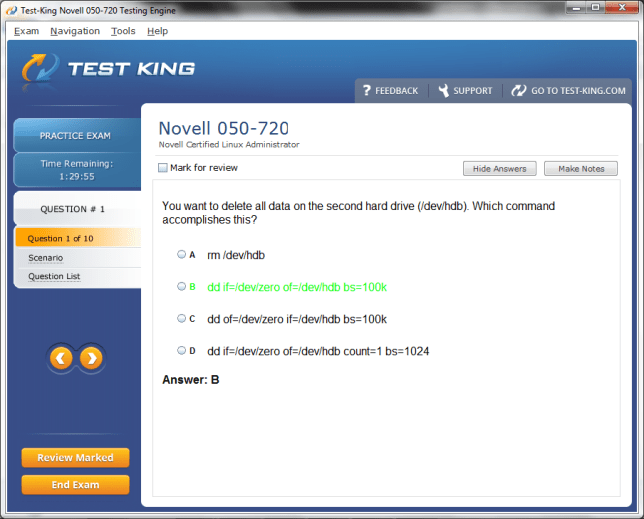
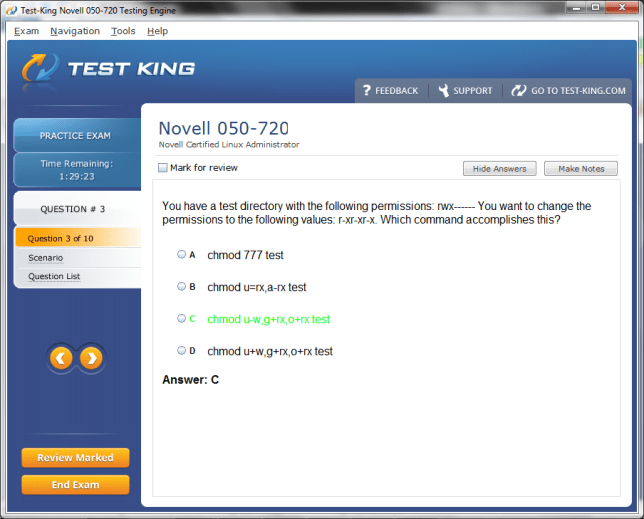
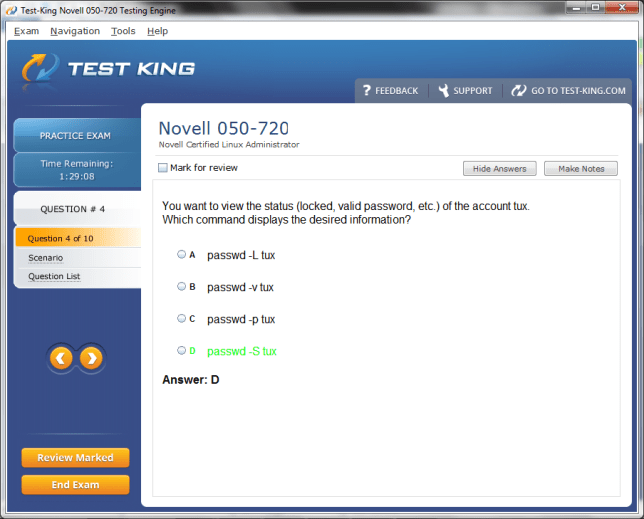
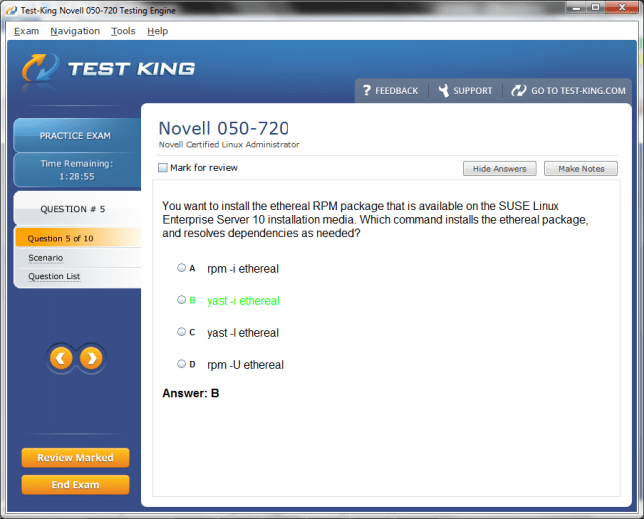
050-720 Exam Product Screenshots

Frequently Asked Questions
How can I get the products after purchase?
All products are available for download immediately from your Member's Area. Once you have made the payment, you will be transferred to Member's Area where you can login and download the products you have purchased to your computer.
How long can I use my product? Will it be valid forever?
Test-King products have a validity of 90 days from the date of purchase. This means that any updates to the products, including but not limited to new questions, or updates and changes by our editing team, will be automatically downloaded on to computer to make sure that you get latest exam prep materials during those 90 days.
Can I renew my product if when it's expired?
Yes, when the 90 days of your product validity are over, you have the option of renewing your expired products with a 30% discount. This can be done in your Member's Area.
Please note that you will not be able to use the product after it has expired if you don't renew it.
How often are the questions updated?
We always try to provide the latest pool of questions, Updates in the questions depend on the changes in actual pool of questions by different vendors. As soon as we know about the change in the exam question pool we try our best to update the products as fast as possible.
How many computers I can download Test-King software on?
You can download the Test-King products on the maximum number of 2 (two) computers or devices. If you need to use the software on more than two machines, you can purchase this option separately. Please email support@test-king.com if you need to use more than 5 (five) computers.
What is a PDF Version?
PDF Version is a pdf document of Questions & Answers product. The document file has standart .pdf format, which can be easily read by any pdf reader application like Adobe Acrobat Reader, Foxit Reader, OpenOffice, Google Docs and many others.
Can I purchase PDF Version without the Testing Engine?
PDF Version cannot be purchased separately. It is only available as an add-on to main Question & Answer Testing Engine product.
What operating systems are supported by your Testing Engine software?
Our testing engine is supported by Windows. Andriod and IOS software is currently under development.
Comprehensive Guide to Passing the SUSE Certified Linux Administrator 11 Exam (050-720)
The SUSE Certified Linux Administrator 11 examination, designated by the code 050-720, is a distinguished credential offered by Novell for professionals seeking to demonstrate their expertise in administering SUSE Linux Enterprise Server environments. Attaining this certification signifies a thorough grasp of Linux system fundamentals, network configuration, user and group management, storage administration, and essential security practices. For IT professionals navigating the ever-evolving landscape of open-source systems, this certification provides both credibility and enhanced career prospects.
Understanding the SUSE Certified Linux Administrator 11 Certification
The examination is meticulously designed to assess both theoretical knowledge and practical skills. Unlike conventional tests that rely solely on memorization, the SUSE Certified Linux Administrator 11 exam emphasizes real-world applications of Linux concepts. Candidates are expected to configure servers, troubleshoot errors, manage resources efficiently, and optimize system performance. Such practical proficiency is critical for organizations relying on SUSE Linux for mission-critical operations.
System Installation and Configuration
One of the primary domains tested in the 050-720 exam is the installation and configuration of SUSE Linux systems. Understanding the nuances of the installation process is essential. This encompasses selecting appropriate installation media, partitioning storage devices effectively, configuring software repositories, and performing both graphical and text-based installations. Candidates must also be adept at handling bootloaders, kernel parameters, and system services to ensure a stable and efficient system setup.
During the installation process, professionals often encounter challenges that require meticulous attention to detail. For instance, configuring logical volumes correctly can prevent future storage bottlenecks. Additionally, managing network interfaces during installation ensures seamless connectivity post-deployment. Knowledge of configuring hostname resolution, firewall rules, and initial security policies forms the bedrock of a competent Linux administrator.
User and Group Management
Efficient administration of users and groups is a fundamental competency tested in the SUSE Certified Linux Administrator 11 exam. Administrators must understand how to create, modify, and delete user accounts while enforcing password policies and access controls. Group management, including the assignment of primary and secondary groups, is crucial for maintaining organized permission structures and minimizing security vulnerabilities.
A nuanced aspect of user management is understanding file and directory permissions. Administrators need to manage read, write, and execute permissions judiciously, ensuring users have only the necessary access to perform their tasks. Beyond basic permissions, candidates must be proficient with Access Control Lists, which allow more granular permission settings for files and directories. This layered approach to security enhances the resilience of SUSE Linux systems against unauthorized access.
Package and Software Management
The 050-720 exam extensively evaluates knowledge of package and software management within SUSE Linux environments. Administrators must be adept at using the native package management tools to install, update, and remove software. This includes understanding dependencies, resolving conflicts, and maintaining system stability during package upgrades.
Beyond mere installation, proficiency involves configuring repositories to optimize software availability and security. For instance, administrators often need to manage local mirrors of repositories for environments with restricted internet access. This not only expedites software deployment but also reduces exposure to potential vulnerabilities. Additionally, knowledge of patch management strategies and automated update mechanisms ensures that systems remain resilient against emerging threats.
System Services and Process Management
A vital portion of the SUSE Certified Linux Administrator 11 exam focuses on managing system services and processes. Candidates must understand how to start, stop, enable, and disable services both manually and automatically during boot. This includes familiarity with the systemd init system and its service management tools. Effective management of services contributes to optimized system performance and reliability.
Process monitoring is another integral component of system administration. Administrators should be capable of identifying resource-intensive processes, adjusting priorities, and terminating unresponsive applications. Knowledge of process hierarchies, background execution, and job control is essential to maintain stability in multi-user environments. By mastering these skills, candidates demonstrate the ability to prevent system slowdowns and ensure uninterrupted service delivery.
Storage Management and Filesystem Administration
The exam tests candidates on storage management and filesystem administration, a critical skill set for sustaining enterprise environments. Administrators must be familiar with creating, resizing, and formatting partitions, as well as managing Logical Volume Management configurations. Proficiency in mounting and unmounting filesystems, verifying integrity, and implementing quotas ensures both performance and data security.
SUSE Linux administrators are also expected to handle networked storage solutions and advanced filesystem features such as snapshots and journaling. Knowledge of automating backups, monitoring disk usage, and recovering from storage failures is indispensable. These capabilities ensure that administrators can maintain data integrity and availability under all circumstances.
Networking and Remote Access
Networking is an indispensable domain for any Linux administrator, and the 050-720 examination places significant emphasis on configuring and troubleshooting network services. Candidates must demonstrate competence in assigning IP addresses, configuring DNS resolution, setting up routing, and managing firewall rules. Understanding both IPv4 and IPv6 protocols is essential for modern enterprise networks.
Remote access tools, such as Secure Shell and virtual private networking configurations, are also pivotal. Administrators must secure remote connections, manage keys, and ensure that authentication mechanisms are robust. Knowledge of troubleshooting network connectivity issues, including interface diagnostics and packet analysis, allows administrators to maintain uninterrupted communication between servers and clients.
Security and System Hardening
A key aspect of the SUSE Certified Linux Administrator 11 exam revolves around system security and hardening practices. Candidates are expected to implement authentication mechanisms, manage user privileges carefully, and enforce password policies. Regular auditing of system logs and monitoring security alerts helps administrators detect potential breaches promptly.
Security extends to configuring firewalls, controlling access to services, and applying patches and updates promptly. Advanced security measures, such as SELinux enforcement and encryption of sensitive data, further fortify systems against unauthorized intrusion. The ability to balance security with usability is a hallmark of proficient SUSE Linux administrators.
Troubleshooting and Maintenance
Troubleshooting skills are indispensable for success in the 050-720 exam. Candidates must diagnose issues related to hardware, software, networking, and storage, and apply systematic approaches to resolve them. Understanding error logs, system messages, and diagnostic tools allows administrators to pinpoint issues efficiently.
Routine system maintenance, including scheduled backups, log rotation, performance tuning, and monitoring, is equally critical. Administrators should anticipate potential problems, implement preventive measures, and maintain detailed documentation of system changes. This proactive approach reduces downtime and enhances reliability.
Exam Strategy and Preparation
Success in the SUSE Certified Linux Administrator 11 exam requires more than technical knowledge; strategic preparation is essential. Candidates are advised to engage in hands-on practice, simulate real-world scenarios, and study previous exam objectives meticulously. Time management during the examination, careful reading of questions, and methodical troubleshooting approaches can significantly enhance performance.
A comprehensive preparation plan should integrate study of official documentation, practical lab exercises, and review of frequently encountered problems. Joining study groups or forums can provide additional insights, clarify doubts, and expose candidates to diverse problem-solving methods. Regular self-assessment ensures that weaknesses are identified and addressed before the examination.
Advanced System Administration Techniques
Proficiency in administering SUSE Linux Enterprise Server environments extends far beyond basic installation and configuration. The SUSE Certified Linux Administrator 11 exam evaluates candidates on their ability to maintain complex systems, manage resources judiciously, and implement advanced operational strategies. A seasoned administrator not only configures servers but anticipates potential issues, optimizes performance, and maintains resilience across multi-user and multi-service environments. Understanding advanced administrative practices is crucial for sustaining enterprise-level systems and achieving certification excellence.
Resource management is a nuanced discipline that requires vigilance and foresight. Administrators must monitor CPU usage, memory allocation, and disk I/O patterns, adjusting priorities and allocating resources where they are most needed. Tools and utilities provide insights into system performance, allowing for real-time adjustments that prevent bottlenecks and maintain service continuity. The ability to interpret performance metrics and correlate them with system behavior is indicative of a proficient SUSE Linux administrator.
File Systems and Advanced Storage Management
SUSE Linux environments demand a sophisticated understanding of storage architectures and file system management. Beyond creating and mounting partitions, administrators must implement robust strategies for data integrity, redundancy, and performance optimization. Logical Volume Management, for instance, allows dynamic resizing of storage pools, enabling administrators to accommodate growing data requirements without disrupting system availability.
Advanced file systems offer features such as journaling, snapshots, and quotas, which are integral to enterprise operations. Administrators must understand how to configure snapshots to capture system states for backup or recovery purposes, ensuring minimal downtime during maintenance activities. Monitoring disk health, implementing redundancy through mirroring or RAID configurations, and planning storage hierarchies are essential for sustaining both performance and data security.
Networking and Service Integration
Networking forms the backbone of enterprise Linux systems, and the SUSE Certified Linux Administrator 11 exam rigorously tests this domain. Administrators must configure and maintain IP addresses, subnets, gateways, and DNS settings while ensuring that firewall rules align with organizational security policies. Understanding routing principles, network troubleshooting, and packet flow analysis is critical for maintaining robust connectivity.
Integration of services such as DHCP, NFS, and Samba requires careful planning to ensure seamless communication between servers and clients. Configuring shared directories, managing access permissions, and monitoring network activity are fundamental tasks that administrators perform daily. Additionally, securing remote access through SSH and VPN implementations allows administrators to maintain control over systems while minimizing exposure to potential threats.
Package Management and System Updates
Maintaining an up-to-date SUSE Linux environment is paramount for security, stability, and performance. The examination evaluates candidates’ mastery of software and package management tools, emphasizing the need for careful repository configuration, dependency resolution, and systematic deployment of updates. Administrators must ensure that installed software aligns with system requirements and that updates do not disrupt running services.
Automating updates and patching processes enhances efficiency while reducing human error. Administrators should develop strategies to schedule updates during low-usage periods, ensuring minimal impact on users. Additionally, maintaining a local repository can provide a controlled environment for testing and deploying updates across multiple systems. This approach enhances reliability and safeguards against unexpected conflicts or incompatibilities during critical updates.
Security and Compliance Measures
Security is a continual concern in enterprise Linux environments. The SUSE Certified Linux Administrator 11 exam tests knowledge of system hardening, access control, and compliance practices. Administrators must implement authentication mechanisms, manage user privileges, enforce password policies, and monitor access logs to detect anomalies. A secure system requires vigilance, proactive auditing, and adherence to best practices in both configuration and maintenance.
Advanced security measures include configuring SELinux or AppArmor profiles to enforce mandatory access control, implementing encryption for sensitive data, and managing firewall rules that balance security with operational requirements. Security also encompasses auditing and monitoring, ensuring that any unauthorized activity is detected promptly. The ability to configure alerts, analyze logs, and respond to security incidents is essential for maintaining the integrity and availability of SUSE Linux systems.
Troubleshooting and Diagnostics
Troubleshooting complex SUSE Linux environments requires analytical thinking, systematic processes, and familiarity with diagnostic tools. The examination challenges candidates to resolve issues involving hardware, software, networking, and storage. Administrators must interpret system logs, monitor processes, and apply corrective actions to restore normal operations efficiently.
Diagnosing performance bottlenecks involves analyzing CPU usage patterns, memory allocation, disk I/O, and network throughput. Administrators may need to adjust process priorities, terminate unresponsive services, or reallocate resources to maintain optimal performance. Effective troubleshooting also demands anticipation; administrators should maintain comprehensive documentation of system configurations and prior issues to streamline resolution during unforeseen incidents.
Expert Techniques for SUSE Linux Administration
Mastery of SUSE Linux administration encompasses a sophisticated understanding of both fundamental operations and nuanced configurations that enable enterprise systems to operate seamlessly. The SUSE Certified Linux Administrator 11 exam tests a candidate’s ability to apply this expertise practically, ensuring the reliable deployment, management, and optimization of Linux servers in complex environments. A successful administrator is not only proficient with commands and configurations but also anticipates potential disruptions, implements preventive measures, and sustains operational continuity under demanding conditions.
Resource optimization forms the cornerstone of effective system administration. Administrators are expected to manage CPU cycles, memory allocation, disk throughput, and network bandwidth efficiently. The use of monitoring tools allows for granular inspection of system performance metrics, enabling proactive intervention before resource contention escalates. By interpreting trends and correlating them with workloads, administrators ensure that SUSE Linux servers maintain their responsiveness and reliability even under unpredictable load surges.
Advanced Storage Solutions and File System Techniques
Beyond conventional storage management, SUSE Linux environments demand proficiency in advanced techniques such as Logical Volume Management, snapshot creation, and RAID configurations. Administrators must navigate the intricacies of volume resizing, filesystem expansion, and redundancy strategies to maintain high availability and performance. These techniques provide flexibility for evolving data requirements, ensuring that storage infrastructures remain robust and adaptable.
Snapshot mechanisms serve as invaluable tools for preserving system states, allowing administrators to revert to previous configurations during updates, maintenance, or unexpected failures. Journaling filesystems enhance data integrity by logging changes before committing them to storage, reducing the risk of corruption. Administrators must also implement quota management to control user consumption and prevent a single user or process from monopolizing storage resources, thereby safeguarding system stability.
Network Configuration and Optimization
SUSE Linux administration requires mastery of networking protocols and service integration. Administrators must configure IP addressing, routing tables, and DNS settings while ensuring that firewall configurations conform to organizational security policies. Effective network management demands understanding the behavior of both IPv4 and IPv6 protocols and the ability to troubleshoot complex connectivity issues.
Service integration encompasses deployment and monitoring of services such as NFS, Samba, and DHCP. Administrators are expected to configure shared resources, control access permissions, and maintain seamless inter-server communication. Remote access security through SSH and VPN is essential for both administrative convenience and safeguarding against unauthorized access. Continuous monitoring of network traffic and service availability ensures that the enterprise infrastructure operates without interruption.
Software Management and Maintenance
The management of software packages in SUSE Linux environments extends beyond installation and updates. Administrators must ensure compatibility across various packages, resolve dependency conflicts, and deploy updates in a manner that maintains operational integrity. Repository configuration is a critical component, enabling controlled access to trusted software sources while minimizing the risk of vulnerabilities.
Patch management requires careful planning to avoid service disruption. Administrators often employ automation to streamline updates, perform pre-deployment testing, and schedule maintenance during low-demand periods. Maintaining local mirrors of repositories provides additional control, allowing administrators to validate updates before applying them to production systems. Such diligence ensures that systems remain secure, stable, and optimized for enterprise workloads.
System Security and Compliance
Security in SUSE Linux is a multifaceted responsibility encompassing authentication, access control, auditing, and proactive threat mitigation. Administrators must configure user privileges, enforce password policies, and monitor system activity for anomalies. Compliance with organizational policies and industry standards ensures that systems withstand both internal and external threats.
Advanced security practices involve configuring SELinux or AppArmor for mandatory access control, encrypting sensitive files, and controlling service access through firewalls. Monitoring log files and implementing automated alerts allows administrators to respond swiftly to suspicious activity. The strategic combination of preventative and reactive security measures ensures that SUSE Linux servers remain resilient against attacks, unauthorized access, and inadvertent misconfigurations.
Troubleshooting and Diagnostic Techniques
Expert troubleshooting requires analytical precision, methodical evaluation, and familiarity with diagnostic utilities. Administrators must address challenges related to hardware failures, service disruptions, network outages, and storage inconsistencies. Interpreting system logs, analyzing process behavior, and applying corrective measures efficiently are essential skills for maintaining uptime and performance.
Resource contention issues are diagnosed by examining CPU usage, memory allocation, I/O operations, and network throughput. Adjustments such as redistributing workloads, terminating nonessential processes, and optimizing configurations prevent performance degradation. Maintaining documentation of system changes and prior incidents streamlines the diagnostic process, enabling administrators to anticipate recurring issues and implement preventive solutions proactively.
Automation Strategies
Automation is central to advanced Linux administration, reducing human error and improving operational efficiency. Routine administrative tasks such as backups, user management, system monitoring, and patch deployment can be automated through scripting. This allows administrators to maintain consistent configurations across multiple systems and focus on higher-level operational planning.
Custom scripts enable administrators to implement tailored solutions, monitor system performance, and enforce organizational policies. Automated alerts can detect unusual behavior, while batch operations simplify repetitive tasks, such as user onboarding or service configuration. Automation demonstrates mastery of SUSE Linux administration by combining technical knowledge with operational pragmatism, ensuring both reliability and efficiency.
Mastering Enterprise SUSE Linux Administration
Expertise in SUSE Linux administration requires a holistic understanding of system operations, configuration, and proactive management strategies that ensure enterprise environments remain efficient, secure, and resilient. The SUSE Certified Linux Administrator 11 exam evaluates candidates on their ability to implement best practices, troubleshoot complex issues, and optimize both performance and security in production systems. Acquiring these skills demands not only familiarity with commands and utilities but also an appreciation for the underlying principles that govern Linux behavior and interactions.
Resource orchestration is an essential competency. Administrators must monitor CPU cycles, memory allocation, disk activity, and network throughput while making real-time adjustments to prevent bottlenecks. Advanced monitoring techniques allow administrators to detect subtle anomalies and optimize workloads before they escalate into operational disruptions. This proactive approach enhances the reliability and responsiveness of SUSE Linux servers, particularly in environments with high concurrency or mission-critical applications.
Advanced File System Management and Storage Techniques
Beyond standard storage management, SUSE Linux administration entails proficiency in advanced strategies such as Logical Volume Management, snapshots, RAID configurations, and journaling file systems. Administrators must handle volume resizing, filesystem expansion, and redundancy mechanisms to ensure both scalability and reliability. Snapshots provide the ability to capture system states for recovery, maintenance, or testing, enabling minimal disruption during critical updates.
Effective storage management also involves meticulous planning for quotas and access control to prevent resource exhaustion. Administrators monitor disk usage patterns, optimize allocation, and implement replication strategies to safeguard data integrity. Redundant configurations, coupled with journaling and backup solutions, create a resilient storage ecosystem capable of withstanding both hardware and software failures while maintaining high availability.
Networking and Connectivity Optimization
Networking remains a pivotal element of SUSE Linux administration. Administrators must configure IP addressing, routing tables, gateways, DNS resolution, and firewall rules, ensuring compliance with organizational policies. Understanding both IPv4 and IPv6 protocols is essential for designing and maintaining modern networks. Troubleshooting connectivity issues, analyzing packet flows, and monitoring traffic patterns are crucial for sustaining uninterrupted communication between servers, clients, and remote systems.
Service integration further demands expertise in configuring networked resources such as NFS, Samba, and DHCP. Administrators manage shared directories, control permissions, and maintain seamless interoperability across systems. Secure remote access via SSH and VPN ensures administrators can perform critical operations while mitigating exposure to unauthorized intrusion. Continuous monitoring and adaptive optimization preserve both performance and security in complex networking environments.
Software Lifecycle and Package Management
Managing software on SUSE Linux systems requires more than installation; it encompasses dependency resolution, update deployment, and repository configuration. Administrators must maintain system stability while deploying new packages, ensuring that updates do not disrupt critical services. Effective software management also involves evaluating package compatibility, resolving conflicts, and maintaining a controlled environment for testing updates before production deployment.
Automated patch management enhances reliability and efficiency. By scheduling updates during periods of low usage and employing local mirrors for repository management, administrators reduce operational risk. Automation also facilitates the enforcement of compliance policies, ensuring that systems remain secure and consistent across enterprise deployments. Diligent management of software and packages reflects a mature understanding of SUSE Linux operational standards.
Security Enforcement and Hardening Techniques
Security is an omnipresent concern in enterprise Linux environments. The SUSE Certified Linux Administrator 11 exam assesses candidates on their ability to implement robust security measures, monitor activity, and respond to potential threats. Administrators enforce user authentication protocols, manage privileges, and implement password policies while continuously auditing system logs to detect anomalies.
Advanced measures include configuring SELinux or AppArmor for mandatory access control, encrypting sensitive data, and securing network services with firewalls. Administrators monitor access patterns, analyze suspicious behavior, and implement preemptive strategies to prevent breaches. By combining preventive measures with reactive responses, SUSE Linux administrators create resilient systems capable of resisting both internal misconfigurations and external attacks.
Troubleshooting Complex Systems
Troubleshooting in SUSE Linux environments involves a meticulous and methodical approach. Administrators address challenges related to hardware failures, service disruptions, network outages, and storage inconsistencies. Diagnostic tools and log analysis enable rapid identification of root causes, while corrective actions restore stability and performance.
Performance issues are often diagnosed by examining CPU load, memory utilization, disk I/O, and network throughput. Adjustments may include redistributing workloads, terminating nonessential processes, or reconfiguring system parameters. Maintaining detailed documentation of system changes, previous incidents, and troubleshooting steps allows administrators to anticipate recurring problems and implement preventive measures efficiently.
Expert-Level SUSE Linux Administration and Optimization
Advanced proficiency in SUSE Linux administration involves not only understanding fundamental operations but also mastering optimization techniques, resource orchestration, and proactive maintenance strategies that keep enterprise environments robust and reliable. The SUSE Certified Linux Administrator 11 exam tests a candidate’s ability to execute complex system configurations, troubleshoot intricate issues, and maintain operational continuity in environments with multiple users, services, and interdependent systems. Competent administrators integrate theoretical knowledge with practical skill, ensuring that SUSE Linux servers perform optimally under varying loads and operational conditions.
Resource management is critical for maintaining system stability. Administrators monitor CPU utilization, memory consumption, disk throughput, and network traffic, applying real-time adjustments to prevent contention. Advanced monitoring and analytical techniques allow administrators to detect subtle anomalies before they manifest as performance bottlenecks. Understanding workload distribution, process prioritization, and system tuning ensures that the environment remains responsive, secure, and scalable.
Storage Architecture and Advanced Filesystem Management
SUSE Linux administrators are expected to implement sophisticated storage solutions that go beyond traditional partitioning. Logical Volume Management enables dynamic resizing of storage pools, providing flexibility to accommodate evolving data requirements. Administrators also implement RAID configurations, journaling filesystems, snapshots, and quotas to maintain data integrity, redundancy, and performance. Snapshots allow restoration of previous system states during maintenance, updates, or unexpected failures, minimizing downtime and preserving business continuity.
Monitoring disk usage and enforcing quotas prevent individual users or processes from monopolizing storage resources, thereby safeguarding the stability of critical systems. Administrators strategically plan storage hierarchies, implement replication strategies, and conduct regular integrity checks to ensure reliable access to data. By mastering these techniques, SUSE Linux professionals demonstrate the ability to maintain scalable, high-performance storage infrastructures suitable for enterprise environments.
Network Management and Service Configuration
Networking constitutes the lifeblood of enterprise Linux systems. Administrators must configure IP addressing, routing tables, gateways, DNS settings, and firewall policies in accordance with organizational standards. Understanding IPv4 and IPv6 protocols, network topologies, and routing principles is essential for sustaining robust connectivity. Troubleshooting connectivity issues, analyzing packet flows, and monitoring service availability are vital skills for maintaining uninterrupted operations.
Service configuration encompasses NFS, Samba, DHCP, and other networked services. Administrators manage shared resources, enforce access permissions, and monitor performance metrics to ensure seamless interoperability between servers and clients. Securing remote access via SSH and VPN enables administrators to perform critical operations safely. Continuous monitoring and adjustment of network parameters allow administrators to maintain optimal performance and security across complex, multi-node environments.
Software Lifecycle Management
Software management on SUSE Linux extends beyond installation and removal. Administrators must resolve dependencies, ensure package compatibility, and deploy updates with minimal disruption to production systems. Repository management and configuration provide controlled access to software sources while maintaining security. Automated patching strategies facilitate timely updates, reduce human error, and preserve system stability.
Maintaining local mirrors and testing updates in controlled environments further enhance operational reliability. Administrators also manage the lifecycle of applications by monitoring version compliance, verifying integrity, and addressing conflicts before they escalate. Effective software lifecycle management demonstrates a comprehensive understanding of both system stability and enterprise operational requirements.
Security and System Hardening
System security in SUSE Linux environments requires a multi-layered approach encompassing authentication, access control, auditing, encryption, and proactive monitoring. Administrators enforce password policies, manage user privileges, and continuously monitor logs for anomalies. Security measures extend to network services, filesystem permissions, and process controls to prevent unauthorized access and mitigate risks.
Advanced techniques include configuring SELinux or AppArmor for mandatory access control, encrypting sensitive data, implementing firewalls, and auditing system activities. Administrators must respond promptly to security incidents, analyze root causes, and adapt policies to evolving threats. Proactive security management ensures the resilience and integrity of enterprise systems, reducing the likelihood of breaches or operational disruptions.
Troubleshooting and Performance Optimization
Effective troubleshooting requires analytical precision and methodical processes. Administrators identify and resolve issues related to hardware failures, software conflicts, network outages, and storage inconsistencies. Tools and diagnostics aid in rapid problem identification, while corrective actions restore system stability and operational continuity.
Performance optimization involves monitoring CPU, memory, disk, and network metrics, adjusting process priorities, redistributing workloads, and tuning system parameters. Administrators anticipate potential bottlenecks, implement preventive measures, and ensure that critical applications maintain responsiveness even under peak loads. Maintaining detailed documentation of troubleshooting procedures enhances efficiency and enables replication of successful solutions in similar scenarios.
Automation and Script-Based Management
Automation is a cornerstone of advanced SUSE Linux administration. Administrators use scripts to perform repetitive tasks, enforce policies, and maintain consistency across multiple systems. Routine operations such as user management, software updates, backups, and monitoring are streamlined through automation, improving efficiency and reliability.
Custom scripts provide tailored solutions for specific operational needs. Monitoring scripts can detect anomalies, batch operations can configure multiple systems simultaneously, and automated notifications alert administrators to potential issues. Effective automation demonstrates not only technical skill but also strategic operational thinking, reducing human error while ensuring consistency and compliance across enterprise environments.
Mastering Advanced SUSE Linux Administration
Achieving proficiency in SUSE Linux administration requires an intricate understanding of system architecture, performance optimization, security protocols, and practical operational skills. The SUSE Certified Linux Administrator 11 exam assesses candidates on their ability to manage enterprise Linux environments efficiently, ensuring high availability, stability, and scalability. Advanced administrators anticipate operational challenges, implement preventive measures, and apply nuanced configurations to maintain resilient systems in diverse workloads and networked environments.
Resource orchestration is vital for seamless operation. Administrators must continuously monitor CPU usage, memory allocation, disk I/O, and network bandwidth, adjusting resource distribution dynamically. Analytical monitoring allows early detection of potential bottlenecks, enabling preemptive corrective measures. Strategic workload allocation and performance tuning ensure responsiveness, even in high-demand enterprise contexts, reflecting the deep operational expertise expected of SUSE Linux administrators.
Advanced Storage and Filesystem Strategies
Managing storage in SUSE Linux involves more than partitioning disks. Administrators implement Logical Volume Management to create flexible storage pools, allowing dynamic resizing of volumes as system requirements evolve. Advanced storage strategies, including RAID configurations, snapshots, journaling filesystems, and redundancy measures, safeguard data integrity and system performance. Snapshots enable restoration to previous states during updates or failures, minimizing downtime and supporting business continuity.
Monitoring disk utilization, enforcing quotas, and balancing storage allocation across users and applications prevent resource exhaustion. Administrators implement replication strategies and conduct routine integrity checks to ensure reliable access to critical data. Mastery of these techniques is essential for enterprise systems where scalability, availability, and fault tolerance are paramount.
Network Configuration and Optimization
Networking is the circulatory system of SUSE Linux environments. Administrators configure IP addresses, subnets, gateways, DNS, and firewall rules, ensuring compliance with organizational standards. Understanding both IPv4 and IPv6 protocols, routing principles, and network topologies enables seamless communication between servers, clients, and remote systems. Troubleshooting connectivity issues and monitoring network traffic are key competencies for maintaining operational continuity.
Integration of network services such as NFS, Samba, DHCP, and domain management requires careful planning, configuration, and performance oversight. Secure remote administration through SSH and VPN ensures that administrators can manage systems without compromising security. Monitoring and adjusting network parameters dynamically maintains both efficiency and resilience, particularly in multi-node or geographically distributed deployments.
Software Lifecycle and Patch Management
Administrators must navigate software deployment and maintenance with precision. Package management extends beyond installation, requiring resolution of dependencies, verification of compatibility, and careful deployment to prevent service interruptions. Repository management ensures access to trusted software sources, while local mirrors facilitate controlled testing and deployment of updates.
Automated patching improves operational consistency, reduces manual errors, and maintains compliance with security standards. Scheduling updates during low-usage periods and pre-testing in controlled environments minimizes risk to production systems. Effective software lifecycle management demonstrates a combination of technical knowledge and operational foresight, crucial for the responsibilities of a certified SUSE Linux administrator.
Security and System Hardening
Security is a continuous priority in SUSE Linux administration. Administrators implement robust authentication, access control, encryption, and auditing mechanisms to protect systems from unauthorized access and data compromise. Enforcing password policies, managing privileges, and monitoring system logs are foundational tasks that reinforce security.
Advanced measures include deploying SELinux or AppArmor for mandatory access control, encrypting sensitive data, configuring firewalls, and auditing user activity. Administrators proactively identify vulnerabilities, respond to incidents, and refine security policies to maintain resilience against evolving threats. The combination of preventive and reactive security practices ensures both integrity and availability of enterprise systems.
Troubleshooting and Performance Analysis
Troubleshooting complex SUSE Linux environments requires analytical precision, systematic evaluation, and familiarity with diagnostic tools. Administrators address hardware failures, service interruptions, network anomalies, and storage inconsistencies. Log analysis, process monitoring, and corrective actions restore system stability efficiently, reducing downtime and operational disruption.
Performance analysis involves continuous monitoring of CPU, memory, disk, and network metrics. Administrators optimize workloads, tune system parameters, and redistribute resources to maintain responsiveness. Anticipating bottlenecks, implementing preventive measures, and documenting troubleshooting processes enable administrators to manage recurring issues effectively, reinforcing both reliability and operational competence.
Automation and Scripting
Automation enhances efficiency, consistency, and scalability in SUSE Linux administration. Administrators employ scripts to execute repetitive tasks, enforce policies, and maintain uniform configurations across multiple systems. Routine tasks such as user management, backups, monitoring, and patch deployment benefit from automation, minimizing manual intervention and errors.
Custom scripts allow administrators to develop tailored solutions for complex operational challenges. Automated monitoring alerts detect anomalies, batch operations configure multiple systems simultaneously, and error notifications provide real-time awareness of system states. Effective automation demonstrates mastery of both technical and strategic aspects of enterprise Linux management, enhancing operational resilience and efficiency.
Conclusion
Attaining the SUSE Certified Linux Administrator 11 credential requires a comprehensive understanding of Linux system architecture, resource management, network configuration, storage strategies, security enforcement, troubleshooting, and automation. Candidates must combine theoretical knowledge with practical expertise, demonstrating the ability to configure, optimize, and secure enterprise SUSE Linux environments.
Mastery of advanced storage management, network services, software lifecycle administration, and system security ensures that administrators can maintain high availability, performance, and resilience across diverse operational contexts. Troubleshooting and performance monitoring equip administrators to address issues proactively, while automation and scripting streamline routine tasks and enhance operational consistency.
The 050-720 examination evaluates not only familiarity with Linux commands and utilities but also the capacity to apply concepts in real-world scenarios, reflecting the demands of enterprise environments. Success in this certification validates an administrator’s skill, enhancing professional credibility and opening opportunities for advanced roles in system administration, network management, and IT operations. Achieving this credential signifies readiness to manage complex SUSE Linux systems confidently, ensuring reliability, security, and efficiency at an enterprise scale.