

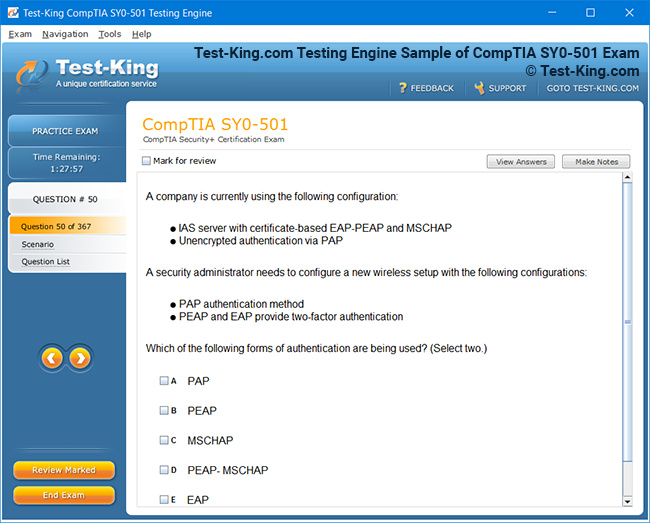
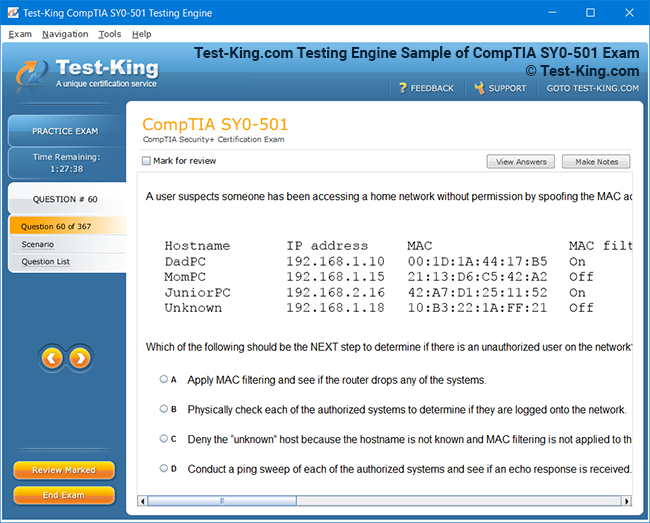
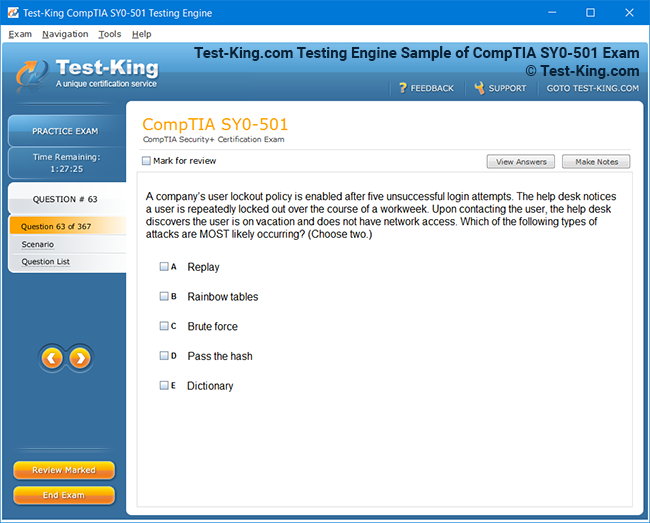
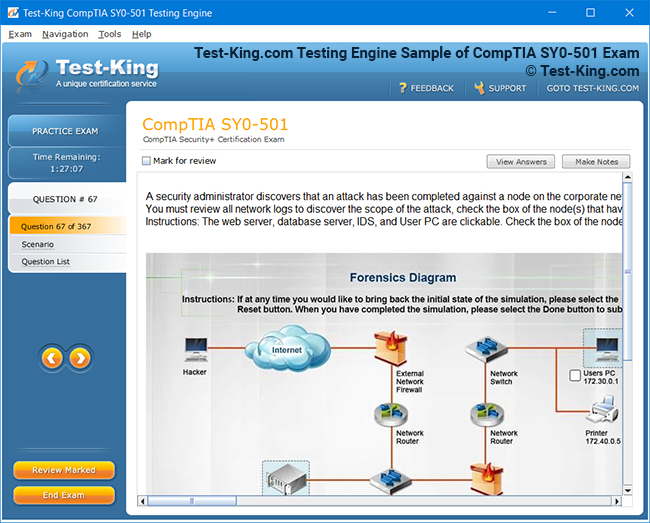
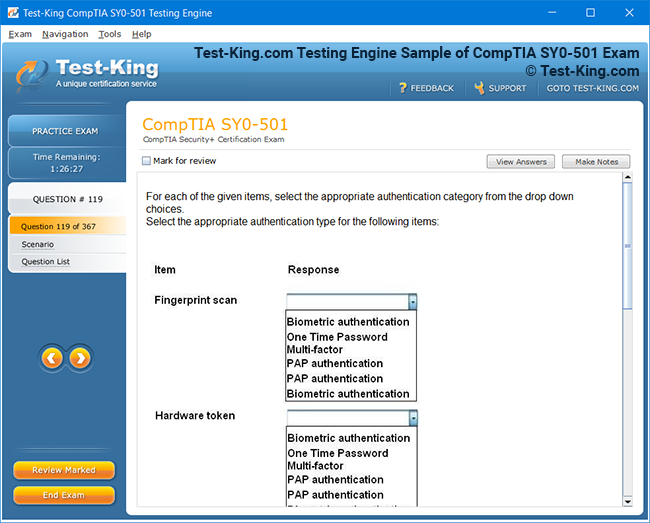
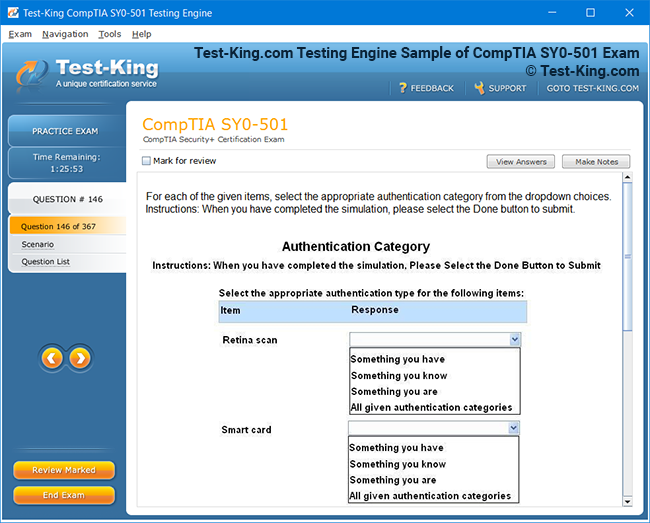
Product Screenshots
Frequently Asked Questions
How can I get the products after purchase?
All products are available for download immediately from your Member's Area. Once you have made the payment, you will be transferred to Member's Area where you can login and download the products you have purchased to your computer.
How long can I use my product? Will it be valid forever?
Test-King products have a validity of 90 days from the date of purchase. This means that any updates to the products, including but not limited to new questions, or updates and changes by our editing team, will be automatically downloaded on to computer to make sure that you get latest exam prep materials during those 90 days.
Can I renew my product if when it's expired?
Yes, when the 90 days of your product validity are over, you have the option of renewing your expired products with a 30% discount. This can be done in your Member's Area.
Please note that you will not be able to use the product after it has expired if you don't renew it.
How often are the questions updated?
We always try to provide the latest pool of questions, Updates in the questions depend on the changes in actual pool of questions by different vendors. As soon as we know about the change in the exam question pool we try our best to update the products as fast as possible.
How many computers I can download Test-King software on?
You can download the Test-King products on the maximum number of 2 (two) computers or devices. If you need to use the software on more than two machines, you can purchase this option separately. Please email support@test-king.com if you need to use more than 5 (five) computers.
What is a PDF Version?
PDF Version is a pdf document of Questions & Answers product. The document file has standart .pdf format, which can be easily read by any pdf reader application like Adobe Acrobat Reader, Foxit Reader, OpenOffice, Google Docs and many others.
Can I purchase PDF Version without the Testing Engine?
PDF Version cannot be purchased separately. It is only available as an add-on to main Question & Answer Testing Engine product.
What operating systems are supported by your Testing Engine software?
Our testing engine is supported by Windows. Andriod and IOS software is currently under development.
Top Nokia Exams
- 4A0-D01 - Nokia Data Center Fabric Fundamentals
- 4A0-100 - Nokia IP Networks and Services Fundamentals
- 4A0-C03 - Nokia NRS II Composite: IS-IS version
- 4A0-104 - Nokia Services Architecture
- 4A0-112 - Nokia IS-IS Routing Protocol
- 4A0-D03 - Nokia SR Linux EVPN and Data Center Interconnect
- 4A0-102 - Nokia Border Gateway Protocol
- 4A0-103 - Nokia Multiprotocol Label Switching
- 4A0-107 - Nokia Quality of Service
- 4A0-114 - Nokia Border Gateway Protocol Fundamentals for Services
- 4A0-AI1 - Nokia NSP IP Network Automation Professional Composite Exam
- 4A0-205 - Nokia Optical Networking Fundamentals
- 4A0-115 - Nokia Ethernet Virtual Private Network Services
Comprehensive Guide to Passing the Nokia Mobility Manager 4A0-M03 Exam
The Nokia Mobility Manager 4A0-M03 exam is a distinguished credential designed for professionals aiming to validate their expertise in managing and optimizing mobility networks using Nokia solutions. This exam assesses a candidate’s ability to configure, troubleshoot, and monitor mobile network components efficiently, ensuring seamless connectivity and operational excellence. Candidates who pursue this certification are expected to demonstrate proficiency in mobility management concepts, network configuration techniques, and practical deployment scenarios that mirror real-world conditions.
Understanding the Nokia Mobility Manager Exam
Unlike other generic certifications, the 4A0-M03 exam demands an intricate understanding of Nokia’s mobility ecosystem, requiring aspirants to amalgamate theoretical knowledge with practical acumen. The exam evaluates skills in areas such as subscriber management, network security, policy configuration, and performance monitoring. It is crucial to internalize these concepts and practice them in a simulated environment to build confidence and accuracy before attempting the exam.
Key Topics and Knowledge Areas
One of the foremost elements in preparing for the Nokia Mobility Manager exam is identifying and comprehending the key domains it covers. These encompass mobility network architecture, subscriber lifecycle management, access control policies, and fault diagnosis. Familiarity with core network elements, radio access network integration, and traffic optimization strategies is indispensable. Candidates should focus on understanding how mobility management frameworks interact with other network services and the implications of misconfigurations on overall network performance.
Practical experience in administering subscriber databases, configuring policy rules, and interpreting network metrics forms the backbone of exam readiness. Mastery over Nokia’s network tools and management interfaces allows candidates to navigate complex network topologies and resolve operational anomalies effectively. Recognizing the interplay between mobility components and the subscriber experience is another critical facet, as the exam often emphasizes scenario-based problem-solving.
Study Techniques and Preparation Strategies
Effective preparation for the 4A0-M03 exam requires a structured and methodical approach. First, candidates should immerse themselves in the official documentation provided by Nokia, which includes configuration manuals, troubleshooting guides, and deployment references. These resources offer comprehensive insights into mobility manager functionalities, network protocols, and configuration best practices. Supplementing official guides with online forums and study communities can provide additional perspectives and clarify challenging concepts.
A deliberate strategy involves breaking down the exam syllabus into digestible modules, focusing on one topic at a time while reinforcing knowledge through practical exercises. Hands-on labs, simulations, and practice scenarios allow candidates to apply theoretical understanding to tangible network situations. Repeated exposure to configuration tasks, policy implementations, and subscriber management processes strengthens recall and reduces the likelihood of errors during the actual exam.
Time management is another crucial aspect of preparation. Allocating dedicated study hours daily while integrating review sessions ensures that candidates maintain steady progress. Active learning techniques, such as summarizing topics in one’s own words or teaching concepts to peers, enhance retention and deepen comprehension. Practicing under timed conditions can also acclimate candidates to the pressure and pacing of the actual examination environment.
Common Challenges and How to Address Them
Aspirants often encounter challenges when preparing for the Nokia Mobility Manager exam, particularly in areas involving complex network interactions and troubleshooting scenarios. One prevalent difficulty is understanding the nuanced behavior of mobility protocols and their impact on subscriber experience. Without hands-on practice, these concepts can seem abstract and difficult to apply. To mitigate this, candidates should engage in extensive lab exercises and real-world simulations, observing how configuration changes influence network performance and subscriber connectivity.
Another common obstacle is interpreting network metrics and logs accurately. The exam frequently tests the ability to diagnose faults based on limited information, requiring analytical thinking and methodical investigation. Developing a systematic approach to problem-solving, such as isolating variables, verifying configurations, and cross-referencing documentation, can significantly improve accuracy in these tasks.
Retention of detailed configuration parameters and policy settings also poses a challenge. Regular review sessions, flashcards, and mnemonic devices can aid in memorization, while consistent practice ensures that the knowledge remains readily accessible during the exam. Emphasizing conceptual understanding over rote memorization allows candidates to adapt their knowledge to unforeseen questions and scenarios.
Recommended Resources and Tools
To build a robust foundation for the 4A0-M03 exam, candidates should leverage a combination of official and supplementary resources. Nokia’s technical documentation serves as the primary reference, offering detailed explanations of mobility manager components, deployment strategies, and operational procedures. Supplementary materials, such as online tutorials, video demonstrations, and discussion forums, provide practical insights and alternative perspectives that enhance understanding.
Virtual labs and network simulators are invaluable tools for translating theoretical knowledge into practical skills. They allow candidates to configure networks, deploy policies, and monitor performance without the constraints of a physical lab environment. Experimenting with different network topologies and troubleshooting exercises reinforces understanding and builds confidence in handling real-world scenarios.
Additionally, review of past exam experiences shared by certified professionals can reveal common pitfalls and effective approaches. While the exam evolves over time, understanding the recurring themes and frequently tested concepts helps candidates focus their preparation efficiently. Integrating these resources into a consistent study plan maximizes retention and ensures comprehensive readiness.
Practical Tips for Exam Day
On the day of the exam, candidates should approach the test with clarity and composure. Familiarity with the exam format, time allocation, and question types reduces anxiety and allows for focused problem-solving. Reviewing key concepts, network diagrams, and configuration scenarios immediately prior to the exam can reinforce confidence.
During the exam, careful reading of questions and methodical elimination of improbable answers improves accuracy. For scenario-based questions, visualizing the network layout and applying logical troubleshooting steps can guide candidates toward correct solutions. Maintaining steady pacing, prioritizing easier questions first, and revisiting more complex items ensures effective time management.
Attention to detail is paramount, as subtle misconfigurations or overlooked parameters can influence outcomes significantly. Candidates should trust their preparation, apply practiced strategies, and remain mindful of the underlying principles governing mobility network management.
Mastering Mobility Management Concepts
Achieving proficiency in the Nokia Mobility Manager 4A0-M03 exam requires an intimate grasp of mobility management concepts that govern subscriber connectivity and network orchestration. Mobility management encompasses the administration of subscriber sessions, policy enforcement, network access control, and real-time monitoring of network performance. Candidates must understand the mechanisms behind session initiation, handover processes between radio access nodes, and the impact of latency or packet loss on subscriber experience. Grasping these intricacies enables candidates to troubleshoot complex scenarios and optimize network efficiency.
The exam also emphasizes the symbiosis between mobility manager modules and other network entities, such as the core network, subscriber databases, and traffic routing systems. A comprehensive understanding of these interactions allows candidates to predict outcomes of configuration changes and maintain operational stability. Practical exposure to mobility management workflows reinforces theoretical knowledge, ensuring aspirants can execute tasks with precision under exam conditions.
Subscriber Lifecycle Management and Policy Configuration
A core domain of the 4A0-M03 exam involves subscriber lifecycle management, which includes registration, authentication, authorization, and session termination. Candidates should be adept at managing subscriber profiles, enforcing policies that govern bandwidth allocation, and implementing security measures to protect user data. The exam often tests the ability to diagnose issues arising from incorrect policy applications or misaligned subscriber configurations.
Policy configuration is another critical area, requiring candidates to define rules that govern network behavior under varying conditions. Understanding the hierarchy of policies, precedence rules, and conflict resolution strategies is essential. Practical exercises involving the creation, modification, and validation of policies provide candidates with the confidence to handle nuanced questions effectively. The ability to link policies to specific subscriber groups, traffic types, or network conditions demonstrates mastery of the exam’s expectations.
Troubleshooting and Fault Diagnosis Techniques
Troubleshooting forms a substantial portion of the Nokia Mobility Manager exam, where candidates are presented with scenarios involving network degradation, failed subscriber sessions, or abnormal traffic patterns. Developing a methodical approach to fault diagnosis is critical. This involves isolating variables, verifying configurations across multiple nodes, analyzing logs, and correlating system alerts with observed behavior. A systematic investigation prevents oversight and allows accurate identification of root causes.
Exam scenarios often simulate real-world conditions where multiple faults coexist, requiring analytical thinking and prioritization. Candidates should practice diagnosing issues in controlled lab environments, experimenting with diverse configurations, and observing the resulting network behavior. Familiarity with diagnostic tools and performance monitoring interfaces enhances speed and accuracy during the exam. Additionally, understanding the relationships between mobility management components and subscriber experience facilitates intuitive problem-solving.
Network Optimization and Performance Monitoring
Optimizing network performance is a vital competency for the 4A0-M03 exam. Candidates must grasp strategies for balancing traffic load, reducing latency, and enhancing subscriber throughput. Techniques such as dynamic policy adjustment, resource allocation, and proactive monitoring allow administrators to maintain high-quality service levels. Knowledge of network KPIs, performance thresholds, and anomaly detection methods is crucial for both the exam and practical deployments.
Monitoring subscriber activity, traffic patterns, and node performance forms the basis of proactive network management. Candidates should become adept at interpreting graphs, alerts, and statistical outputs to anticipate potential issues. Practical exercises involving the adjustment of policies based on real-time metrics help consolidate understanding and prepare aspirants for scenario-based questions. The ability to correlate performance data with configuration changes distinguishes proficient candidates from those with superficial knowledge.
Hands-On Practice and Lab Exercises
Practical application of theoretical knowledge is indispensable for exam readiness. Setting up virtual labs, simulating subscriber sessions, and configuring policy rules allows candidates to internalize concepts and refine operational skills. Hands-on experience with Nokia Mobility Manager interfaces, configuration templates, and monitoring dashboards equips candidates to respond accurately and efficiently during the exam.
Repeated exposure to troubleshooting exercises, scenario simulations, and performance monitoring tasks reinforces comprehension and builds confidence. Candidates are encouraged to document their observations, experiment with alternative configurations, and understand the implications of each change on the network. This active engagement with the system fosters intuitive understanding, reducing reliance on memorization and enhancing adaptive problem-solving abilities.
Exam Strategy and Time Management
Effective time management is critical when approaching the Nokia Mobility Manager 4A0-M03 exam. Candidates should familiarize themselves with the exam structure, types of questions, and scoring patterns. Allocating time to review easier questions first, reserving more complex scenarios for subsequent analysis, ensures balanced pacing. Practicing under timed conditions simulates the pressure of the actual exam and builds endurance for sustained concentration.
A strategic approach involves reading questions carefully, visualizing network scenarios, and systematically eliminating improbable answers. Candidates should focus on logical deduction, applying foundational principles of mobility management to reach solutions. Remaining calm and methodical during challenging questions preserves accuracy and minimizes errors. Integrating exam strategy with thorough preparation and practical experience enhances overall performance.
Utilizing Supplementary Resources
In addition to official documentation, candidates can leverage various supplementary resources to enrich preparation. Online forums, discussion groups, and technical blogs provide alternative explanations, real-world insights, and practical tips that complement official guides. Video demonstrations of mobility management configurations and troubleshooting exercises allow candidates to visualize processes that may otherwise seem abstract.
Engaging with peers, participating in study communities, and discussing complex scenarios fosters deeper understanding. Exposure to diverse perspectives and problem-solving approaches equips candidates to handle unconventional questions. Virtual labs and simulators remain critical tools for translating theoretical knowledge into operational competence, allowing repeated practice without physical network constraints.
Deepening Understanding of Mobility Management Architecture
The Nokia Mobility Manager 4A0-M03 exam requires candidates to possess an in-depth understanding of the mobility management architecture that orchestrates subscriber connectivity and network performance. Mobility management encompasses multiple interdependent components including subscriber databases, policy enforcement modules, access control mechanisms, and monitoring systems. Candidates are expected to comprehend how these elements interact seamlessly to maintain uninterrupted service and high-quality connectivity across diverse network conditions.
A critical aspect of preparation involves visualizing the entire mobility management ecosystem, tracing the flow of subscriber data from initial registration to session termination. Understanding signaling protocols, handover procedures, and the impact of network congestion on subscriber sessions allows candidates to anticipate potential operational issues. Practical exercises that simulate these scenarios provide aspirants with the confidence to handle similar questions in the exam, transforming abstract concepts into tangible knowledge.
Subscriber Provisioning and Lifecycle Control
Managing the subscriber lifecycle is an essential skill evaluated in the 4A0-M03 exam. This includes subscriber registration, authentication, authorization, service allocation, and session termination. Candidates must be proficient in creating, modifying, and deleting subscriber profiles while ensuring compliance with network policies and security protocols. Mismanagement of these processes can lead to service disruptions, emphasizing the importance of accuracy and attention to detail.
Policy configuration is tightly interwoven with subscriber management. Candidates need to understand how to define, apply, and monitor policies that dictate bandwidth allocation, access privileges, and quality of service. Scenario-based questions often require candidates to troubleshoot issues stemming from conflicting policies or incorrect subscriber settings. Hands-on experience with these configurations is invaluable, as it reinforces theoretical understanding and hones problem-solving abilities in a practical context.
Troubleshooting Complex Network Scenarios
The 4A0-M03 exam challenges candidates to diagnose and resolve network issues that impact mobility performance. Effective troubleshooting requires a methodical approach, combining analytical skills with operational knowledge. Candidates should be comfortable examining logs, interpreting alerts, and correlating performance metrics with subscriber behavior. Identifying root causes often involves isolating variables, verifying configurations across multiple network nodes, and testing potential solutions systematically.
Scenario-based questions may present multiple simultaneous faults, requiring aspirants to prioritize actions and apply critical thinking. Regular practice with simulated faults in virtual labs enables candidates to recognize patterns and develop an intuitive understanding of network behavior. Familiarity with diagnostic tools, monitoring dashboards, and subscriber activity reports accelerates the resolution process and enhances confidence during the exam.
Optimizing Network Performance
A significant portion of the exam evaluates the ability to optimize network performance for subscriber satisfaction and operational efficiency. Candidates should understand strategies for balancing traffic load, minimizing latency, and improving throughput. Techniques such as dynamic policy adjustment, adaptive resource allocation, and proactive monitoring are vital in maintaining seamless connectivity.
Analyzing network performance involves interpreting key indicators such as session success rates, signaling efficiency, and subscriber throughput. Candidates must be adept at linking performance trends to specific configurations or policy changes. Practical exercises involving the adjustment of policies based on observed metrics strengthen understanding and ensure aspirants can apply optimization principles under exam conditions.
Hands-On Experience and Lab Exercises
Practical engagement with Nokia Mobility Manager tools is indispensable for mastering the 4A0-M03 exam. Virtual labs and simulators allow candidates to configure subscriber profiles, implement policies, and monitor network performance without the constraints of a physical environment. Repetition in these exercises builds procedural fluency and reinforces comprehension of underlying concepts.
Lab exercises should cover diverse scenarios, including high-traffic conditions, subscriber mobility, and multi-node network configurations. Observing the impact of policy changes, session handling, and access controls enhances analytical skills and prepares candidates for complex exam questions. Documenting findings, experimenting with alternative configurations, and reflecting on outcomes promotes deeper understanding and operational mastery.
Exam Readiness and Time Management
Successful performance in the Nokia Mobility Manager exam requires strategic management of both preparation and test-taking. Candidates should familiarize themselves with the format, timing, and structure of questions to develop an efficient approach. Allocating time wisely, starting with straightforward questions, and revisiting challenging items ensures balanced pacing and reduces stress.
A strategic mindset involves careful reading of scenarios, logical deduction, and the application of core mobility management principles. Candidates should visualize network topologies, consider dependencies between modules, and apply systematic problem-solving methods. Maintaining composure, relying on practiced strategies, and drawing on hands-on experience enhances both speed and accuracy during the examination.
Supplementary Resources and Learning Aids
To complement official documentation, candidates can utilize a range of supplementary resources to enrich their preparation. Online tutorials, discussion forums, and technical blogs offer alternative explanations and insights into real-world network scenarios. Video demonstrations of subscriber management, policy enforcement, and network monitoring provide visual reinforcement that complements textual study.
Engaging with study groups and peer discussions fosters critical thinking and exposes candidates to diverse problem-solving approaches. Virtual labs remain crucial for translating theoretical knowledge into operational skill, allowing repeated experimentation and iterative learning. Exposure to multiple perspectives and consistent practice ensures aspirants develop the adaptability needed to tackle unconventional or scenario-based exam questions.
Enhancing Proficiency in Mobility Management
The Nokia Mobility Manager 4A0-M03 exam evaluates a candidate’s capacity to manage mobility networks with precision and efficiency. Mastery of mobility management involves understanding the orchestration of subscriber sessions, policy enforcement, and real-time performance monitoring. Candidates must visualize the complex interplay between subscriber databases, access nodes, and policy modules to anticipate how configuration changes impact overall network performance. Grasping these connections is crucial for both troubleshooting and optimizing mobile network operations.
A deep comprehension of signaling protocols, handovers, and session continuity across different network nodes allows candidates to identify potential points of failure and ensure seamless subscriber experiences. The exam often tests analytical thinking, where the ability to foresee the impact of configuration adjustments is as important as recalling technical details. Practical application of this knowledge through simulations reinforces understanding and cultivates operational confidence.
Subscriber Management and Policy Implementation
Effective subscriber management is a foundational skill for the 4A0-M03 exam. Candidates are expected to handle the entire lifecycle of subscribers, from initial registration and authentication to service allocation and session termination. Understanding the nuances of subscriber profiles, including access privileges, quality of service parameters, and security policies, is vital. Errors in configuration can lead to degraded performance or service disruptions, emphasizing the importance of meticulous attention to detail.
Policy implementation is intertwined with subscriber management, requiring candidates to define rules that govern bandwidth allocation, access control, and traffic prioritization. Scenario-based questions may involve troubleshooting conflicts or resolving policy anomalies, necessitating both theoretical knowledge and practical experience. Engaging in hands-on exercises to create, modify, and validate policies helps solidify conceptual understanding and prepares candidates for complex exam scenarios.
Troubleshooting and Diagnostic Methodologies
Troubleshooting complex network scenarios is a core component of the Nokia Mobility Manager exam. Candidates are often presented with situations involving failed sessions, abnormal traffic flows, or performance degradation. Developing a structured diagnostic approach is essential, including verifying configurations, analyzing system logs, and correlating network metrics with subscriber behavior. Methodical investigation reduces errors and enables accurate identification of root causes.
Scenario questions may simulate multiple simultaneous faults, requiring prioritization and analytical problem-solving. Regular lab practice with virtual network setups allows candidates to experiment with diverse issues, observe outcomes, and refine their troubleshooting skills. Familiarity with diagnostic tools, performance monitoring interfaces, and subscriber activity reports enables quick and effective resolution, which is critical for both the exam and real-world operations.
Network Optimization and Performance Enhancement
Optimizing network performance is an integral part of the exam’s scope. Candidates must understand techniques for improving subscriber throughput, reducing latency, and balancing traffic loads. Effective use of dynamic policy adjustment, adaptive resource allocation, and continuous monitoring ensures high-quality service delivery across the network.
Interpreting performance metrics, such as session success rates, latency indicators, and traffic distribution, is crucial for identifying bottlenecks and potential enhancements. Candidates should practice linking observed trends to specific configuration or policy changes. Simulated exercises that involve real-time adjustments based on performance data strengthen understanding and prepare candidates for scenario-driven questions on the exam.
Practical Hands-On Exercises
Hands-on practice remains indispensable for mastering the 4A0-M03 exam. Virtual labs and simulation tools allow candidates to configure subscriber profiles, implement policies, and monitor network performance without requiring physical network access. Repetitive exercises reinforce procedural knowledge and build confidence in executing tasks under exam conditions.
Candidates should explore various scenarios, including high-traffic environments, subscriber mobility events, and multi-node configurations. Observing the effects of policy adjustments and troubleshooting outcomes deepens comprehension and hones analytical abilities. Maintaining detailed notes, experimenting with alternative approaches, and reflecting on results contribute to adaptive problem-solving skills that are essential for complex exam questions.
Strategic Exam Preparation and Time Management
Efficient exam preparation entails not only understanding technical concepts but also managing time effectively. Familiarity with the exam format, question types, and duration allows candidates to plan their approach. Prioritizing simpler questions first and allocating appropriate time to challenging scenarios ensures balanced pacing and reduces stress during the test.
Strategic exam-taking involves careful reading of questions, visualizing network scenarios, and applying foundational mobility management principles to deduce answers. Systematic problem-solving, logical elimination of unlikely options, and reliance on practical experience enhance both accuracy and confidence. Candidates who integrate preparation, hands-on practice, and exam strategy are well-positioned to navigate complex questions efficiently.
Leveraging Supplementary Learning Resources
Beyond official Nokia documentation, supplementary learning resources can significantly enhance exam readiness. Online forums, discussion communities, and technical blogs provide insights into practical challenges and alternative approaches to mobility management tasks. Video tutorials and demonstration exercises allow candidates to visualize processes that complement textual study.
Engaging with peers, sharing experiences, and discussing troubleshooting techniques foster deeper comprehension and expose candidates to diverse problem-solving methods. Consistent practice in virtual labs, experimenting with configurations, and iterative learning help candidates develop adaptability and operational competence. Exposure to multiple perspectives ensures readiness for unconventional or scenario-based exam questions and solidifies overall expertise in mobility management.
Mastering Advanced Mobility Management Concepts
The Nokia Mobility Manager 4A0-M03 exam demands a sophisticated understanding of mobility management and its critical components that ensure uninterrupted subscriber connectivity. Candidates must possess expertise in orchestrating network elements including subscriber databases, access nodes, policy enforcement modules, and performance monitoring systems. Understanding how these components interact is pivotal, as even minor misconfigurations can lead to significant network inefficiencies or service degradation.
A deep knowledge of signaling protocols, session handovers, and mobility events across heterogeneous network environments equips candidates to anticipate potential operational issues. Exam questions frequently test analytical reasoning, requiring aspirants to apply their knowledge to scenarios that simulate real-world network challenges. Hands-on practice in virtual environments bridges the gap between theoretical concepts and practical execution, allowing candidates to internalize procedures and enhance problem-solving capabilities.
Subscriber Lifecycle Administration
Managing the subscriber lifecycle is central to the 4A0-M03 examination. This encompasses processes such as registration, authentication, authorization, policy assignment, and session termination. Candidates must be adept at creating and maintaining subscriber profiles, ensuring that access privileges, service allocations, and quality of service parameters align with network policies.
Policy enforcement plays an integral role in lifecycle administration. Candidates must comprehend how to establish and monitor rules governing bandwidth allocation, traffic prioritization, and subscriber access. Scenario-based questions often involve resolving conflicts, identifying policy violations, or troubleshooting subscriber-related anomalies. Regular practice in configuring and validating policies within a controlled lab environment enhances proficiency and prepares candidates for nuanced exam challenges.
Advanced Troubleshooting Techniques
A substantial portion of the Nokia Mobility Manager exam assesses candidates’ troubleshooting capabilities. Realistic scenarios may involve failed sessions, abnormal traffic patterns, or performance degradation across multiple network nodes. Effective troubleshooting requires a methodical approach, including analysis of system logs, correlation of network metrics, and verification of configuration integrity.
Candidates should develop a structured problem-solving methodology, allowing them to isolate issues, prioritize potential causes, and apply corrective measures efficiently. Engaging with virtual labs that simulate complex network faults enables aspirants to refine diagnostic techniques and develop intuitive insights into network behavior. Familiarity with monitoring dashboards, diagnostic tools, and performance reports accelerates issue resolution and strengthens confidence during the examination.
Optimizing Network Performance
Candidates must demonstrate the ability to optimize network performance, ensuring high-quality subscriber experiences. Strategies for improvement include balancing traffic loads, minimizing latency, enhancing throughput, and dynamically adjusting policies in response to network conditions. Understanding the relationship between configuration changes and performance metrics is crucial for effective optimization.
Monitoring tools provide essential insights into subscriber activity, session success rates, and network throughput. Analyzing this data allows candidates to identify bottlenecks and implement corrective actions proactively. Simulated exercises involving real-time performance adjustments develop analytical skills and prepare candidates to handle scenario-based questions effectively. Practical experience ensures that aspirants can translate performance data into actionable solutions.
Hands-On Engagement and Simulated Labs
Practical engagement with Nokia Mobility Manager tools is indispensable for mastering the 4A0-M03 exam. Virtual labs and network simulators enable candidates to configure subscriber profiles, implement policies, and monitor network performance in a controlled environment. Repetition in these exercises builds procedural confidence and reinforces understanding of complex concepts.
Candidates should expose themselves to diverse scenarios including multi-node configurations, high-traffic environments, and mobility events. Observing the effects of policy changes and troubleshooting outcomes enhances analytical reasoning and operational mastery. Keeping detailed notes, experimenting with alternative configurations, and reflecting on results fosters adaptability, preparing candidates for unconventional or challenging exam questions.
Strategic Exam Approaches
Effective performance in the 4A0-M03 exam relies on both technical expertise and strategic exam-taking skills. Familiarity with the exam format, question types, and time allocation enables candidates to plan their approach efficiently. Prioritizing straightforward questions first and reserving complex scenarios for later ensures balanced pacing and reduces exam-related stress.
Strategic approaches include careful reading of questions, visualization of network topologies, and logical deduction based on core mobility management principles. Applying practical experience, using systematic elimination methods, and maintaining composure enhance accuracy and confidence. Integrating preparation, hands-on experience, and exam strategy creates a comprehensive readiness framework that allows candidates to tackle complex and scenario-based questions effectively.
Leveraging Supplementary Learning Resources
In addition to official documentation, a range of supplementary learning resources can enhance exam preparation. Online forums, technical blogs, and discussion groups provide insights into real-world scenarios, alternative troubleshooting methods, and nuanced policy configurations. Video tutorials and demonstrations offer visual reinforcement that complements theoretical study.
Peer engagement and collaborative problem-solving encourage critical thinking and expose candidates to diverse approaches. Consistent practice within virtual labs allows iterative learning and reinforces operational competence. Exposure to multiple perspectives, combined with methodical hands-on experience, ensures candidates develop both adaptability and proficiency, enabling them to navigate scenario-based challenges with confidence.
Advanced Techniques for Mobility Management Excellence
The Nokia Mobility Manager 4A0-M03 exam challenges candidates to demonstrate a comprehensive and nuanced understanding of mobility networks, subscriber management, and policy enforcement. Success requires mastery of the interplay between subscriber databases, access nodes, and performance monitoring systems. Candidates should visualize how session flows traverse the network, the influence of configuration changes on network behavior, and the implications for subscriber experience. This holistic comprehension enables effective troubleshooting and optimization in both exam scenarios and real-world operations.
Candidates must grasp signaling protocols, handover mechanics, and mobility events across heterogeneous network architectures. Scenario-based questions test the ability to anticipate operational challenges, requiring analytical thinking rather than rote memorization. Practicing these scenarios in virtual labs and simulations allows aspirants to translate theoretical knowledge into actionable skills, fostering both confidence and precision under exam conditions.
Subscriber Lifecycle Oversight and Policy Management
Effective management of the subscriber lifecycle is central to the exam. This encompasses registration, authentication, authorization, service assignment, and session termination. Candidates are expected to maintain accurate subscriber profiles, ensuring that access privileges, service parameters, and quality of service allocations comply with network policies. Errors in these processes can lead to service degradation or security vulnerabilities, highlighting the importance of meticulous attention to detail.
Policy management is tightly interwoven with subscriber oversight. Candidates should be adept at defining, implementing, and monitoring rules that govern traffic prioritization, bandwidth allocation, and access controls. Scenario-driven questions may present conflicts or misconfigurations, requiring analytical resolution and adherence to best practices. Repeated hands-on practice, including validation and adjustment of policies in lab environments, enhances both knowledge retention and problem-solving skills.
Troubleshooting and Analytical Reasoning
The 4A0-M03 exam evaluates candidates’ capacity to identify and resolve complex network issues efficiently. Problems may involve failed sessions, abnormal traffic distribution, or performance degradation across multiple nodes. Developing a structured troubleshooting methodology—verifying configurations, analyzing logs, and correlating performance metrics—is critical for accurate diagnosis and resolution.
Candidates should practice isolating variables, prioritizing probable causes, and applying systematic solutions. Virtual labs and scenario simulations help candidates refine these skills, observe outcomes, and cultivate an intuitive understanding of network behavior. Mastery of diagnostic tools, performance monitoring dashboards, and subscriber activity reports enhances analytical reasoning, ensuring candidates can respond adeptly to both expected and unconventional questions.
Network Optimization and Performance Enhancement
Optimizing network performance is a pivotal component of preparation. Candidates must understand strategies for enhancing throughput, reducing latency, balancing traffic loads, and dynamically adjusting policies. Interpreting performance metrics, including session success rates, latency, and bandwidth utilization, allows candidates to identify bottlenecks and implement corrective actions proactively.
Simulated exercises that involve performance adjustments in response to network conditions strengthen the ability to apply theoretical concepts practically. Candidates should develop the capability to link observed metrics to specific configurations or policy modifications, ensuring they can optimize network behavior under varying conditions. This expertise is both essential for the exam and invaluable for real-world mobility management.
Practical Hands-On Experience
Hands-on engagement with mobility management tools is indispensable for exam readiness. Virtual labs and simulators allow candidates to configure subscriber profiles, implement policies, and monitor network performance in controlled environments. Repeated exposure to diverse scenarios, such as multi-node networks, mobility events, and high-traffic situations, reinforces understanding and builds operational confidence.
Documenting observations, experimenting with alternative approaches, and analyzing outcomes cultivates adaptability and analytical thinking. These exercises prepare candidates to navigate unexpected challenges, enhancing their ability to respond to scenario-based questions. Practical experience ensures that candidates can integrate conceptual knowledge with operational execution seamlessly.
Exam Strategy and Time Management
Effective exam performance requires both technical expertise and strategic planning. Familiarity with the exam structure, question types, and time constraints enables candidates to allocate effort efficiently. Prioritizing straightforward questions first, reserving complex scenarios for detailed analysis, ensures balanced pacing and reduces exam-related stress.
Candidates should employ systematic problem-solving techniques, visualize network topologies, and rely on foundational mobility management principles to deduce accurate answers. Combining preparation, hands-on practice, and strategic timing maximizes both accuracy and confidence during the examination. Approaching the exam with a clear plan enhances focus and allows for consistent performance across all question types.
Supplementary Resources for Comprehensive Preparation
In addition to official documentation, candidates can leverage various supplementary resources to enrich understanding. Online forums, technical blogs, discussion communities, and video tutorials provide alternative perspectives, real-world insights, and practical tips. Engaging with peers, sharing experiences, and analyzing diverse problem-solving approaches fosters deeper comprehension and adaptability.
Consistent use of virtual labs and simulated scenarios reinforces operational skills, allowing candidates to experiment with configuration adjustments, policy management, and performance monitoring iteratively. Exposure to multiple perspectives combined with practical experience ensures candidates are well-prepared to handle both conventional and scenario-driven questions effectively.
Conclusion
Achieving success in the Nokia Mobility Manager 4A0-M03 exam requires a blend of theoretical knowledge, practical expertise, and strategic exam-taking skills. Mastery of mobility management architecture, subscriber lifecycle oversight, policy implementation, troubleshooting, and network optimization forms the foundation for both the exam and real-world applications. By combining diligent study, hands-on practice, scenario simulations, and effective time management, candidates can approach the exam with confidence and precision. Leveraging supplementary resources and collaborative learning further enhances readiness, ensuring aspirants are fully equipped to navigate complex scenarios and achieve certification excellence.