

Exam Code: I40-420
Exam Name: Certified Function Point Specialist
Certification Provider: IFPUG
Corresponding Certification: IFPUG
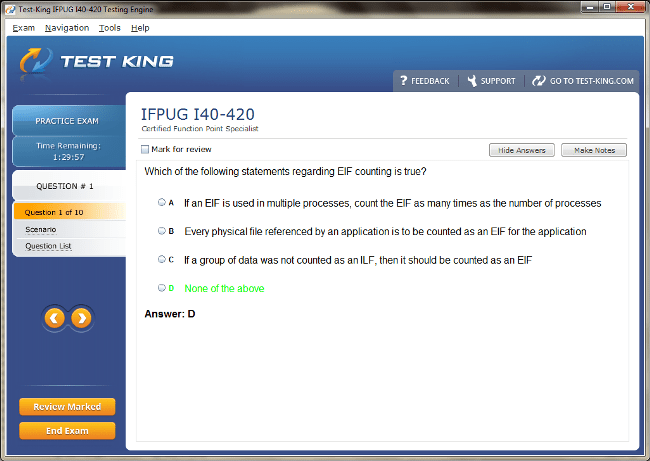
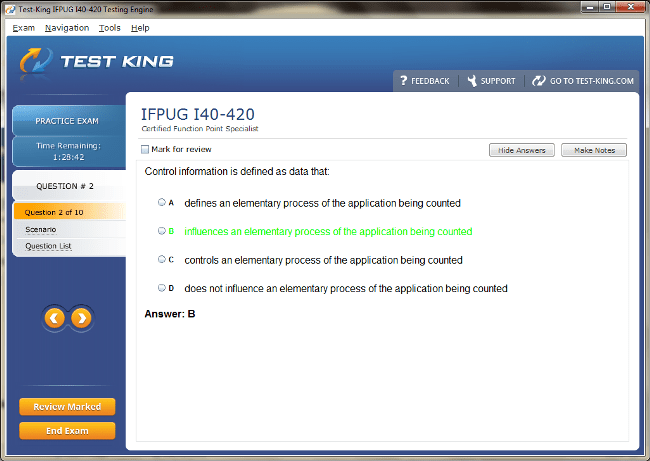
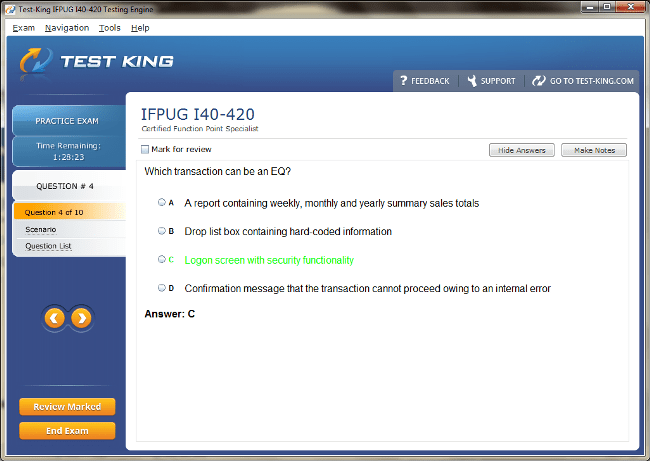
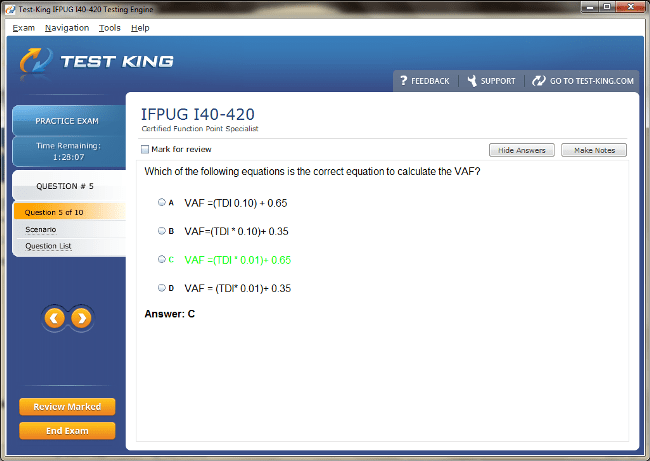
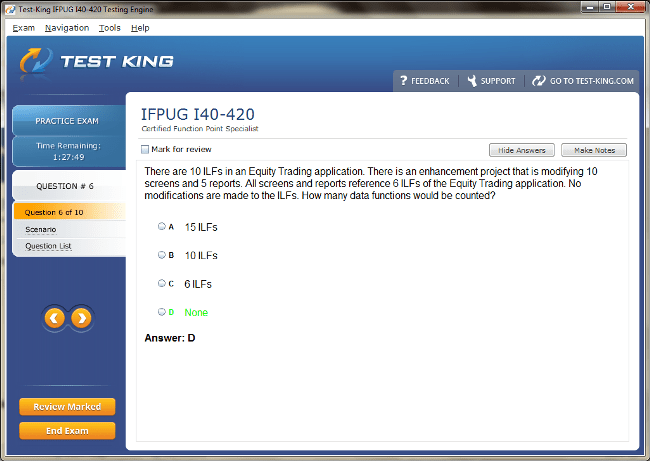
I40-420 Exam Product Screenshots
Frequently Asked Questions
How can I get the products after purchase?
All products are available for download immediately from your Member's Area. Once you have made the payment, you will be transferred to Member's Area where you can login and download the products you have purchased to your computer.
How long can I use my product? Will it be valid forever?
Test-King products have a validity of 90 days from the date of purchase. This means that any updates to the products, including but not limited to new questions, or updates and changes by our editing team, will be automatically downloaded on to computer to make sure that you get latest exam prep materials during those 90 days.
Can I renew my product if when it's expired?
Yes, when the 90 days of your product validity are over, you have the option of renewing your expired products with a 30% discount. This can be done in your Member's Area.
Please note that you will not be able to use the product after it has expired if you don't renew it.
How often are the questions updated?
We always try to provide the latest pool of questions, Updates in the questions depend on the changes in actual pool of questions by different vendors. As soon as we know about the change in the exam question pool we try our best to update the products as fast as possible.
How many computers I can download Test-King software on?
You can download the Test-King products on the maximum number of 2 (two) computers or devices. If you need to use the software on more than two machines, you can purchase this option separately. Please email support@test-king.com if you need to use more than 5 (five) computers.
What is a PDF Version?
PDF Version is a pdf document of Questions & Answers product. The document file has standart .pdf format, which can be easily read by any pdf reader application like Adobe Acrobat Reader, Foxit Reader, OpenOffice, Google Docs and many others.
Can I purchase PDF Version without the Testing Engine?
PDF Version cannot be purchased separately. It is only available as an add-on to main Question & Answer Testing Engine product.
What operating systems are supported by your Testing Engine software?
Our testing engine is supported by Windows. Andriod and IOS software is currently under development.
Understanding Function Point Analysis I40-420 : A Core Component of the Certified Function Point Specialist Exam
Function Point Analysis represents a methodical approach to quantifying software functionality, developed to provide consistency and clarity in evaluating the size and complexity of software applications. Emerging in the early 1970s, this methodology was devised to address the prevalent difficulties in software measurement, which often relied heavily on subjective judgment or simple lines-of-code metrics. Unlike approaches that focus solely on coding intricacies, Function Point Analysis emphasizes user interactions and the tangible value delivered to stakeholders, creating a metric that transcends programming languages or technology platforms. This focus on functionality rather than technical implementation allows organizations to estimate effort, cost, and duration with heightened precision.
Introduction to Function Point Analysis
The primary premise of Function Point Analysis revolves around measuring functional components of software. These components, which include data elements, external inputs, outputs, inquiries, internal files, and interfaces, are assessed for complexity. Each element contributes to a numerical score that reflects the functional size of the application. By systematically analyzing these components, analysts can achieve an objective measure that supports planning, estimation, benchmarking, and performance evaluation. The meticulous nature of this assessment ensures that even the subtlest aspects of system functionality are accounted for, providing a comprehensive perspective on software projects.
Function Point Analysis plays a pivotal role in professional certification, particularly within the framework provided by the International Function Point Users Group. The Certified Function Point Specialist credential signifies mastery over the principles and practical applications of this methodology. Candidates are evaluated on their ability to identify, classify, and assess functional components accurately, as well as their aptitude in converting these assessments into meaningful data for project management. The certification emphasizes both conceptual understanding and practical execution, ensuring that certified professionals possess the competence to apply function point counting in real-world environments.
Historical Context and Evolution
The genesis of Function Point Analysis can be traced to the necessity for standardized software measurement techniques. Early approaches in the computing industry often suffered from inconsistencies, where similar projects would receive vastly different estimates depending on the evaluator. This disparity undermined project planning, budgeting, and resource allocation. Function Point Analysis emerged as a solution by introducing a repeatable, quantitative method for evaluating software functionality, emphasizing the perspective of the end-user rather than the programmer.
Over the decades, Function Point Analysis has evolved through refinements and formalization under professional bodies. These refinements include detailed classification systems for functional components, adjusted weighting factors based on empirical studies, and guidelines for consistent application across diverse software systems. The continued evolution has allowed the methodology to remain relevant in contemporary software development, accommodating changes in technology, programming paradigms, and organizational practices while maintaining the core objective of providing reliable functional metrics.
Fundamental Concepts
Function Point Analysis revolves around the identification and classification of several fundamental elements. External inputs represent processes where data enters the system, typically including forms, transactions, or user commands. External outputs encompass data or information produced by the system in response to input or processing, which may include reports, screens, or files transmitted externally. External inquiries are combinations of input and output that allow users to retrieve specific information without updating internal data. Internal logical files are repositories of data maintained by the system, while external interface files are data stores managed by other systems but utilized within the project being measured. Each component is evaluated based on complexity, which considers factors such as data fields, relationships, and processing requirements, contributing to a cumulative functional size metric.
An essential aspect of Function Point Analysis lies in its weighting mechanism. Complexity weights are assigned to each functional component, reflecting the relative effort required to implement, maintain, or modify it. This approach acknowledges that not all inputs or outputs are equivalent in scope or difficulty. By integrating these weights into the counting process, analysts derive a standardized numeric representation of functionality. This quantified metric enables project managers to perform estimation, resource allocation, and productivity evaluation with a more precise understanding of the system’s demands.
Methodology of Counting Function Points
Counting function points involves a systematic and structured methodology. Initially, the analyst delineates the boundary of the software system, identifying the scope of the application under evaluation. This delineation ensures that only relevant functionality is included, avoiding overestimation or underestimation. The analyst then identifies each functional component, classifying it according to the categories of inputs, outputs, inquiries, internal files, or interfaces. Each component is examined for complexity, and an appropriate weight is assigned. The aggregation of these weighted components produces the unadjusted function point count.
Following the initial count, adjustment factors may be applied to account for system characteristics that influence effort, such as data communications, performance requirements, and transaction rates. These adjustment factors ensure that the metric reflects both functional size and the contextual challenges inherent in implementation. The final function point count represents a comprehensive and objective assessment of software functionality, enabling reliable comparisons across projects and systems.
Practical Relevance in Software Projects
The utility of Function Point Analysis extends beyond theoretical measurement. In practice, the methodology aids project managers in estimation, resource planning, and productivity assessment. By providing an objective measure of functional size, it facilitates the allocation of development effort, budgeting, and scheduling. Additionally, function point metrics support benchmarking activities, allowing organizations to compare productivity across teams, projects, or industry standards. This empirical basis reduces reliance on intuition, enhances predictability, and fosters accountability in software delivery.
Function Point Analysis also enhances communication between technical and non-technical stakeholders. By translating complex system functionality into a standardized numeric measure, analysts bridge the gap between business requirements and technical implementation. Stakeholders can comprehend the scope and complexity of projects, facilitating informed decision-making and effective prioritization. This communicative function is particularly valuable in large organizations where cross-functional coordination is essential for successful project outcomes.
Integration with Modern Development Practices
Despite its origins in traditional software engineering, Function Point Analysis remains relevant in contemporary development paradigms, including agile and iterative methodologies. While agile practices emphasize incremental delivery and rapid adaptation, function point metrics provide a stabilizing framework for measuring progress, forecasting effort, and evaluating productivity. Certified Function Point Specialists are trained to integrate these measurements seamlessly within iterative cycles, ensuring that functional assessment remains accurate and meaningful even as requirements evolve dynamically. The universality of function point methodology enables organizations to maintain consistency in measurement, regardless of development approach or technological platform.
Function Point Analysis also intersects with organizational performance management, particularly in evaluating productivity and efficiency. By correlating functional size with resource expenditure, organizations can assess cost-effectiveness, identify areas of inefficiency, and implement targeted process improvements. Certified professionals often leverage these insights to advise management, contribute to strategic planning, and support continuous improvement initiatives. The analytical rigor embedded in function point counting cultivates a culture of empirical assessment, promoting data-driven decisions and systematic project oversight.
Role in Certification and Professional Competence
The Certified Function Point Specialist credential represents recognition of expertise in applying function point methodology accurately and consistently. Examination for this credential assesses both theoretical understanding and practical skills, requiring candidates to demonstrate proficiency in identifying functional components, applying complexity weights, and deriving function point counts. Candidates must also exhibit familiarity with adjustment factors, system boundaries, and real-world application scenarios. The certification underscores a professional’s ability to translate abstract requirements into quantifiable data, enabling reliable estimation, performance analysis, and resource planning.
Attaining certification not only validates technical proficiency but also signals commitment to methodological rigor and analytical excellence. Certified specialists are equipped to contribute meaningfully to project planning, estimation, and performance evaluation, serving as key resources within technology organizations. Their expertise ensures that software projects are assessed objectively, facilitating accountability, consistency, and informed decision-making. Beyond the immediate project context, certified professionals often influence organizational standards, helping to institutionalize best practices in software measurement.
Enhancing Analytical and Strategic Thinking
Engagement with Function Point Analysis nurtures analytical thinking and strategic foresight. Practitioners develop the capacity to scrutinize software functionality systematically, identify nuanced distinctions in complexity, and anticipate implications for development effort. This analytical training extends beyond mere counting, cultivating skills in estimation, resource management, and decision-making under uncertainty. Certified specialists are thus well-positioned to advise stakeholders, optimize resource allocation, and enhance overall project efficiency. The interplay between detailed measurement and strategic application exemplifies the dual value of function point methodology: it is simultaneously a precise metric and a lens through which to interpret software development challenges.
Rare Considerations and Nuances
Function Point Analysis encompasses subtle nuances that extend beyond basic counting. For instance, the treatment of complex interfaces, embedded business rules, and cross-system dependencies requires careful judgment to ensure that function point counts remain accurate. Analysts must exercise discernment in identifying functional boundaries, assessing data relationships, and interpreting transaction complexity. These rarefied considerations distinguish expert practitioners from novices, reflecting the depth of comprehension required to achieve mastery. Certified professionals are trained to navigate these intricacies, applying guidelines judiciously while maintaining adherence to standardized counting principles.
Additionally, function point methodology is adaptable to various organizational contexts, including legacy systems, enterprise-scale applications, and contemporary web-based platforms. Its versatility allows organizations to maintain consistent measurement practices across heterogeneous systems, enabling historical comparison, trend analysis, and benchmarking. This adaptability underscores the enduring relevance of Function Point Analysis, highlighting its capacity to evolve alongside technological and procedural advancements.
Understanding the Building Blocks of Function Point Analysis
Function Point Analysis provides a structured methodology for measuring software functionality, and its effectiveness depends on a deep comprehension of its core components. Each component represents a unique facet of system functionality, reflecting the interactions between users and the software. The Certified Function Point Specialist credential emphasizes not only the recognition of these components but also the discernment needed to evaluate their complexity and significance in practical scenarios. This knowledge allows professionals to quantify software in a manner that is consistent, reproducible, and applicable across a wide range of projects.
The primary building blocks of Function Point Analysis include external inputs, external outputs, external inquiries, internal logical files, and external interface files. These elements collectively provide a comprehensive framework for assessing functional size. External inputs encompass any user-driven data or commands entering the system, including forms, screens, and transactions, which initiate processing activities. Each input is evaluated for complexity based on the number of data fields, the relationships among them, and the intricacy of the underlying processing logic. Understanding these nuances enables analysts to discern the functional impact of seemingly simple operations, which is critical for precise measurement and accurate function point counts.
External outputs represent information that the system produces in response to processing or user requests. These outputs may take the form of reports, notifications, data transmissions, or visual displays. The complexity of an output is determined by factors such as the quantity of data elements, the nature of calculations performed, and the integration of multiple data sources. Recognizing the subtleties of external outputs is essential for professionals aiming to provide reliable assessments, as superficial evaluation can lead to underestimation or overestimation of functional size.
External inquiries are distinctive components that combine elements of input and output to facilitate the retrieval of information without affecting internal data. These inquiries are frequently encountered in interactive systems where users seek specific information or reports without triggering modifications to files or data repositories. The evaluation of inquiries requires attention to both the number of data elements involved and the logical complexity of the request, ensuring that the functional contribution is properly accounted for in the overall measurement. Certified specialists develop expertise in identifying these nuanced interactions, which often differentiate expert-level analysis from cursory assessments.
Internal logical files represent collections of data maintained within the system, serving as repositories for information used across various processes. Each internal logical file is assessed based on the number of unique data elements it contains and the complexity of its structure, including relationships between fields and dependencies within the data model. The accurate identification and evaluation of these files are fundamental to Function Point Analysis, as they encapsulate the persistent information that supports the functionality of the system. Analysts must be vigilant in discerning subtle differences between similar files, recognizing when separate repositories contribute distinct functional value.
External interface files are data structures maintained by other systems but accessed or utilized by the system under evaluation. These files are integral to understanding cross-system interactions, data dependencies, and the flow of information between disparate applications. Evaluating the complexity of external interface files requires consideration of the number of data elements, the intricacy of access protocols, and the extent of integration needed to retrieve or manipulate the data. Certified specialists develop the skill to assess these components with precision, ensuring that external dependencies are accurately represented in the functional size measurement.
Evaluating Complexity in Function Point Components
Complexity evaluation is a central aspect of Function Point Analysis, as it determines the weighting applied to each component in the calculation of functional size. The complexity of a component is influenced by multiple factors, including the number of data fields, the degree of interconnection between data elements, the intricacy of processing logic, and the potential for variability in execution. For external inputs, analysts consider how many fields are entered, the relationships among them, and whether the process triggers updates in other files or systems. Outputs are assessed similarly, taking into account the scope of calculations, formatting requirements, and data aggregation. Inquiries, by their nature, require careful evaluation of retrieval logic and the extent of information provided to the user.
Internal logical files are particularly sensitive to complexity considerations. A file containing numerous data elements with intricate relationships will carry a higher weight than a simple, flat file, reflecting the greater effort required to develop, maintain, and understand the system. Similarly, external interface files demand rigorous evaluation to account for dependencies and integration complexities that may impact project timelines and resource requirements. Certified Function Point Specialists are trained to apply standardized rules for complexity assessment, ensuring that function point counts remain consistent and defensible across diverse projects.
Complexity evaluation is not solely a mechanical process; it necessitates judgment and experience. Analysts must interpret guidelines in the context of real-world systems, making nuanced decisions that account for variations in functionality, user expectations, and implementation constraints. The ability to balance objective measurement with informed discretion distinguishes proficient practitioners from those with superficial understanding, underscoring the depth of knowledge required to achieve certification and to apply Function Point Analysis effectively in professional settings.
Functional Transactions and Data Elements
A critical dimension of Function Point Analysis lies in understanding the interplay between functional transactions and data elements. Transactions, including external inputs, outputs, and inquiries, represent discrete interactions that contribute to the functional behavior of the system. Each transaction interacts with data elements stored in internal logical files or accessed through external interface files, creating a network of dependencies that must be carefully analyzed. The number of data elements associated with a transaction, along with the complexity of their relationships, directly influences the assigned function point value.
Data elements, often overlooked in superficial assessments, carry significant weight in the evaluation process. They constitute the smallest units of meaningful information processed by the system, including fields, attributes, or variables that define the structure of inputs, outputs, and files. Analysts must meticulously identify each unique data element, ensuring that redundancies or overlaps are accounted for to prevent inflation or deflation of the functional size. The relationship between transactions and data elements forms the backbone of function point methodology, serving as the foundation for objective measurement and reliable project estimation.
System Boundaries and Scope Definition
Defining the boundary of the software system under evaluation is an essential prerequisite for accurate Function Point Analysis. The system boundary delineates which functionality is included in the measurement and which resides outside the scope, providing clarity for analysts and stakeholders alike. An imprecise boundary can result in inconsistent function point counts, undermining the reliability of estimates and subsequent project planning. Certified specialists are trained to establish boundaries based on user interactions, functional responsibilities, and data ownership, ensuring that the scope of measurement reflects the true extent of the system’s operational footprint.
Boundaries are particularly important when evaluating external interface files, cross-system interactions, or distributed applications. Analysts must determine whether data retrieved from other systems constitutes part of the functional size, taking into account access complexity, usage frequency, and dependency impact. Proper boundary definition supports consistent application of function point methodology, facilitating comparisons across projects and maintaining the integrity of measurement results.
Adjustment Factors and Environmental Considerations
While the unadjusted function point count provides a baseline measure of functional size, adjustment factors are applied to account for environmental and system characteristics that influence development effort. These factors include considerations such as performance requirements, transaction rates, data communications, and operational complexity. Adjustments ensure that the functional size metric reflects both inherent functionality and contextual challenges, enabling more accurate estimation and planning.
Certified Function Point Specialists develop proficiency in identifying relevant adjustment factors and applying them judiciously. The process requires careful judgment, as excessive or insufficient adjustment can distort the functional measurement and compromise project predictions. Analysts must weigh the impact of environmental conditions, user expectations, and technical constraints, integrating these insights into the final function point count to produce a comprehensive, actionable metric.
Practical Examples and Application Scenarios
To illustrate the significance of components in Function Point Analysis, consider a business application managing customer orders. External inputs include order entry screens where users submit order details, while external outputs comprise confirmation messages, invoices, and sales reports. Inquiries allow users to track order status without modifying the underlying database. Internal logical files include customer records, product catalogs, and order history, whereas external interface files might involve integration with third-party payment processing systems. Each component is evaluated for complexity, with weights assigned according to the number of data elements, relationships, and processing requirements. Aggregating these values produces a function point count that quantifies the software’s functional size, supporting estimation, resource allocation, and performance assessment.
Another scenario involves a human resources management system. External inputs encompass employee onboarding forms, leave requests, and performance evaluations. Outputs include payroll summaries, benefit reports, and compliance notifications. Inquiries allow staff to retrieve attendance records or performance metrics. Internal logical files store employee profiles, salary records, and departmental structures, while external interface files connect with tax authorities or benefits providers. By systematically analyzing these components, certified specialists derive function point counts that accurately reflect the system’s functional footprint, providing objective metrics for project planning and benchmarking.
Significance for Certification and Professional Expertise
A nuanced understanding of the components of Function Point Analysis is central to achieving the Certified Function Point Specialist credential. The examination evaluates the candidate’s ability to recognize, classify, and assess each component accurately, ensuring proficiency in both theoretical knowledge and practical application. Mastery of components, complexity evaluation, data elements, system boundaries, and adjustment factors equips professionals to provide reliable software measurement, support project management, and enhance organizational decision-making.
Proficiency in component analysis fosters analytical rigor, enabling specialists to identify subtle functional distinctions, anticipate development effort, and optimize resource allocation. The expertise gained through study and practice not only prepares candidates for certification but also strengthens their capacity to contribute strategically to software projects. Organizations benefit from certified professionals who can apply function point methodology consistently, providing empirical insights that support estimation, performance evaluation, and process improvement.
Nuanced Considerations in Component Analysis
Function Point Analysis requires attention to nuanced scenarios, such as applications with complex transactions, cross-system dependencies, or highly dynamic data structures. Analysts must exercise discernment when categorizing components, ensuring that functional contributions are neither overlooked nor double-counted. Rare situations, such as conditional outputs or multifaceted inquiries, demand careful evaluation to determine their functional significance. Certified specialists cultivate this expertise through rigorous study, practical exercises, and exposure to diverse software environments, developing the judgment necessary to navigate complex measurement challenges effectively.
The interplay between components also influences functional assessment. Transactions often interact with multiple data elements, files, or interfaces, creating a web of dependencies that must be captured accurately. Understanding these interactions ensures that function point counts reflect the true functional impact of each transaction and data element, providing a precise and actionable measure for estimation and project management.
Methodology and Steps in Function Point Counting
Function Point Analysis relies on a meticulous counting process designed to quantify software functionality in a standardized and reproducible manner. The Certified Function Point Specialist credential emphasizes mastery of this methodology, ensuring that professionals can measure software systems with precision and consistency. The counting process begins with defining the system boundary, which establishes the limits of functionality to be included in the measurement. A clearly delineated boundary prevents the inclusion of extraneous elements while ensuring that all relevant functionality is captured. Analysts consider user interactions, data ownership, and system responsibilities when determining the boundary, which forms the foundation for accurate counting.
After establishing the boundary, the next step involves identifying and classifying all functional components within the system. These components include external inputs, external outputs, external inquiries, internal logical files, and external interface files. Each component is examined to determine its complexity based on factors such as the number of data elements, interrelationships, and processing intricacy. External inputs encompass data or commands entered by users to initiate system operations, whereas external outputs represent information produced for user consumption. External inquiries facilitate information retrieval without affecting internal data, while internal logical files store information maintained by the system. External interface files contain data accessed from other systems, reflecting cross-system dependencies.
Each functional component is then assigned a weight according to its complexity. Complexity weights categorize components as simple, average, or complex, reflecting the relative effort required to implement, maintain, or manipulate them. The weighting system accounts for variations in data elements, processing logic, and interrelationships, producing a standardized metric that captures functional size accurately. Analysts rely on detailed guidelines to ensure consistency in assigning weights, integrating both quantitative and qualitative factors to derive an unadjusted function point count.
The unadjusted function point count serves as a baseline measurement of functional size, aggregating the weighted values of all identified components. This initial total represents the core functionality of the system without consideration of environmental or technical factors that may affect implementation. Analysts carefully verify the inclusion of all relevant components and confirm that duplicate counting has been avoided, as these factors are critical for producing reliable results. Accurate aggregation of components is essential for subsequent steps in the counting process, forming the foundation for meaningful estimation and project planning.
Adjustment Factors and Environmental Complexity
Following the calculation of the unadjusted function point count, adjustment factors are applied to reflect the system’s environmental characteristics. These factors, often referred to as value adjustment factors, account for influences such as performance requirements, data communications, operational complexity, and transaction rates. The application of adjustment factors ensures that the functional size metric aligns with the practical realities of system development, providing a measure that incorporates both intrinsic functionality and contextual challenges. Certified Function Point Specialists are trained to evaluate these factors judiciously, recognizing when adjustments are necessary and applying them consistently across diverse systems.
Adjustment factors encompass a range of considerations that influence implementation effort. Performance requirements may include response time expectations, throughput demands, or processing efficiency. Data communication considerations involve the complexity of exchanging information with other systems, including protocols, transmission methods, and error handling. Operational complexity addresses factors such as workflow variability, user interaction intricacies, and business rules embedded within the system. Transaction rates quantify the frequency of interactions and processing activities, reflecting the intensity of system usage. By integrating these elements into the counting process, analysts produce an adjusted function point count that represents a holistic view of functional size.
The adjusted function point count is derived by multiplying the unadjusted count by a factor calculated from the sum of the adjustment considerations. This calculation produces a final measure that is both standardized and context-sensitive, providing project managers and stakeholders with an actionable metric for estimation, planning, and performance evaluation. Certified specialists recognize that the reliability of the function point count depends on careful application of adjustment factors, as overestimation or underestimation can distort project forecasts and compromise resource allocation.
Practical Steps for Accurate Counting
Accurate function point counting requires a systematic approach to each stage of the methodology. Analysts begin with comprehensive documentation review, examining requirement specifications, system diagrams, data models, and user manuals to identify functional components and their characteristics. Interviews with stakeholders, end-users, and technical staff provide additional insights into system behavior, transaction flows, and data interactions. Observing the system in operation further enhances understanding, allowing analysts to validate assumptions, identify edge cases, and capture nuances in functionality that may not be evident from documentation alone.
Once components are identified, classification follows a rigorous evaluation of complexity. For external inputs, analysts consider the number of fields entered, the processing logic required, and whether updates affect other files or transactions. External outputs are assessed based on the quantity of data elements, calculations performed, and integration of multiple sources. External inquiries require careful examination of retrieval logic, ensuring that the functional contribution is accurately represented. Internal logical files are evaluated for the number of unique data elements, structural complexity, and interrelationships, while external interface files are assessed for access complexity, integration effort, and dependency impact.
Throughout the counting process, analysts maintain meticulous records of decisions, assumptions, and calculations. Documentation supports reproducibility, facilitates review, and ensures transparency in the application of function point methodology. Certified specialists recognize the importance of traceability, enabling validation of counts and providing defensible metrics for project stakeholders. Meticulous record-keeping also allows for historical comparison, trend analysis, and benchmarking across systems, enhancing organizational understanding of software productivity and functional size.
Handling Ambiguities and Complex Scenarios
Function Point Analysis often involves ambiguous or complex scenarios that require judgment and discretion. Systems with conditional processing, dynamic data structures, or intricate workflow patterns pose challenges in component identification and complexity assessment. Analysts must exercise discernment in determining which elements constitute distinct functional contributions and which are variations of existing components. The treatment of embedded business rules, multi-step transactions, and cross-system interactions necessitates careful analysis to ensure accurate function point counts.
Complex scenarios also arise when multiple transactions interact with the same data elements or files. Analysts must evaluate whether these interactions represent unique functional contributions or are extensions of existing functionality. Inquiries that combine input and output with conditional updates or calculations require nuanced assessment to determine their effective weight. Certified Function Point Specialists develop expertise in navigating these intricacies, applying guidelines consistently while adapting to the unique characteristics of each system.
Quality Assurance in Function Point Counting
Maintaining quality and consistency in function point counting is essential for reliable measurement. Peer reviews, cross-checking, and validation against historical data are common practices used to ensure accuracy. Analysts may compare counts across similar systems, verify classification decisions, and review adjustment factors to identify discrepancies. Quality assurance practices mitigate the risk of subjective bias, misclassification, or oversight, enhancing confidence in the resulting function point counts.
Analytical rigor extends to sensitivity analysis, where variations in component classification or adjustment factor application are examined to assess their impact on overall functional size. By understanding how changes in assumptions or evaluations affect the function point count, analysts can refine their methodology, anticipate potential errors, and provide more robust estimates. Certified specialists integrate these practices into their professional routine, reinforcing methodological discipline and promoting consistent measurement across projects.
Practical Application and Real-World Examples
Consider a financial management system with multiple modules for account management, transaction processing, and reporting. External inputs include account creation forms, transaction entries, and user-initiated commands. External outputs comprise account statements, financial summaries, and regulatory reports. Inquiries allow users to check balances and retrieve transaction history without altering internal data. Internal logical files store customer information, transaction records, and audit logs, while external interface files enable integration with banking networks and payment gateways. Each component is evaluated for complexity, weighted appropriately, and aggregated to produce the unadjusted function point count. Adjustment factors account for high transaction rates, performance requirements, and data communication challenges, resulting in an adjusted function point count that accurately reflects the system’s functional size.
Another example involves an e-commerce platform handling product listings, orders, customer accounts, and payment processing. External inputs include product uploads, order placements, and user registrations. Outputs encompass invoices, order confirmations, and inventory reports. Inquiries allow users to track orders and search for products. Internal logical files store product catalogs, user profiles, and transaction history, while external interface files integrate with payment processors, shipping services, and analytics platforms. Function point counting captures each component, evaluates complexity, and applies adjustment factors for high-volume transactions, multi-channel interactions, and performance expectations. This process produces a reliable functional size metric for project estimation and planning.
Certification Relevance and Professional Expertise
Mastery of the function point counting process is critical for the Certified Function Point Specialist credential. Candidates must demonstrate proficiency in defining system boundaries, identifying and classifying components, evaluating complexity, applying adjustment factors, and producing reproducible counts. The examination emphasizes both theoretical understanding and practical application, ensuring that certified professionals can perform accurate assessments in diverse software environments. Expertise in counting methodology enhances professional credibility, enabling analysts to provide actionable metrics that support estimation, resource planning, and performance evaluation.
Certified specialists develop analytical acumen, methodological discipline, and attention to detail through rigorous study and practical application. They are equipped to handle complex systems, ambiguous scenarios, and cross-functional dependencies with confidence. Mastery of the counting process reinforces their ability to bridge the gap between software functionality and organizational objectives, providing reliable insights for project management, benchmarking, and strategic decision-making.
Nuances in Counting Adjustments and Environmental Factors
Adjustment factors often require nuanced judgment, particularly in systems with exceptional performance requirements or complex operational environments. Analysts must evaluate the relative impact of each factor, consider potential interactions among them, and apply adjustments consistently. Rare scenarios, such as systems with dynamic workloads, distributed processing, or multi-tier architectures, demand careful consideration to ensure that functional size reflects both inherent functionality and environmental complexity. Certified specialists are trained to recognize these subtleties, producing function point counts that are precise, defensible, and contextually relevant.
Environmental considerations extend to organizational practices, system constraints, and user expectations. Analysts account for high-volume transaction processing, real-time reporting requirements, and integration with multiple external systems. By incorporating these factors into the counting process, function point methodology provides a comprehensive measure of software functionality, supporting accurate estimation, resource allocation, and project planning. The ability to navigate these nuances distinguishes experienced practitioners, reflecting a level of expertise that is essential for certification and professional application.
Leveraging Function Point Analysis for Project Estimation
Function Point Analysis serves as a cornerstone for estimating the effort, cost, and duration of software projects, providing a standardized and reproducible measure of functionality. By quantifying software based on user interactions, data elements, and functional components, project managers gain a reliable metric that transcends coding languages or technology platforms. Certified Function Point Specialists are trained to apply these techniques rigorously, ensuring that estimation reflects both the intrinsic functionality of the system and the environmental considerations affecting implementation. This dual perspective allows organizations to anticipate resource needs, optimize timelines, and allocate personnel effectively.
Project estimation begins with identifying all functional components within the system, including external inputs, external outputs, external inquiries, internal logical files, and external interface files. Each component is evaluated for complexity, with weights assigned according to standardized guidelines. Aggregating these weighted values produces the unadjusted function point count, which provides a foundational measure of functional size. Adjustment factors are then applied to account for environmental variables such as performance requirements, operational complexity, transaction volume, and integration challenges. The resulting adjusted function point count serves as a robust basis for estimating development effort and scheduling activities.
Function Point Analysis enhances estimation accuracy by providing an objective framework that mitigates reliance on subjective judgment. Traditional methods often relied on intuition or historical precedent, which could vary widely between evaluators and projects. Function points introduce a systematic approach, allowing for comparability across projects, consistency in measurement, and reproducibility in results. This methodology enables project managers to forecast effort with a higher degree of precision, reducing the risk of underestimation or overcommitment and facilitating more informed decision-making.
Enhancing Resource Allocation and Workforce Planning
Accurate function point counts directly inform resource allocation and workforce planning. By understanding the functional size of a project, managers can determine the number and expertise of personnel required, the expected duration of tasks, and the sequencing of activities. Projects with higher function point counts typically demand greater development effort, additional testing cycles, and more extensive documentation. Certified Function Point Specialists interpret these metrics to provide actionable guidance on staffing levels, skill requirements, and cross-functional collaboration.
Resource allocation decisions also benefit from the granularity provided by component-level analysis. By examining individual functional inputs, outputs, and files, managers can identify areas of complexity that may require specialized expertise or additional quality assurance measures. This targeted approach ensures that critical components receive adequate attention, mitigating the risk of bottlenecks, delays, or errors in project execution. Function Point Analysis thus serves as a strategic tool for aligning human resources with the functional demands of the system.
Benchmarking and Productivity Measurement
Organizations often leverage function point metrics for benchmarking and evaluating productivity. By comparing function point counts across projects, teams, or business units, managers can identify variations in efficiency, assess the impact of methodologies, and establish performance baselines. Productivity can be measured by correlating function points with development effort, providing insights into output per unit of effort. This empirical approach supports continuous improvement initiatives, enabling organizations to optimize processes, refine estimation practices, and enhance overall software delivery performance.
Benchmarking also facilitates industry comparisons, allowing organizations to evaluate their performance against established standards. Function points provide a common language for comparison, eliminating ambiguity and enabling meaningful analysis. Certified Function Point Specialists play a pivotal role in interpreting these metrics, advising management on performance trends, and recommending strategies to enhance efficiency and effectiveness.
Supporting Cost Estimation and Budgeting
Function Point Analysis underpins cost estimation by translating functional size into quantifiable effort and resource requirements. By assigning labor rates, infrastructure costs, and overheads to the adjusted function point count, organizations can generate accurate project budgets. This systematic approach reduces the risk of cost overruns and enhances financial planning, providing stakeholders with confidence in resource allocation and expenditure projections. Certified specialists ensure that estimates incorporate both the functional demands of the system and the environmental factors that influence implementation, producing budgets that reflect the true scope of work.
Cost estimation using function points also supports strategic decision-making. Organizations can evaluate the financial implications of design choices, prioritize features, and allocate resources to maximize return on investment. By linking functional size to cost, managers gain a transparent and defendable rationale for budgeting decisions, aligning financial planning with project objectives and organizational priorities.
Facilitating Risk Assessment and Management
Function Point Analysis contributes to risk assessment by providing a detailed understanding of system complexity and functional dependencies. High function point counts or components with elevated complexity indicate areas of potential risk, such as increased likelihood of defects, delays, or resource strain. Certified Function Point Specialists analyze these metrics to identify critical points in the system, enabling proactive risk mitigation through targeted testing, redundancy planning, or contingency measures. By quantifying risk in functional terms, organizations can make informed decisions, allocate resources to high-risk areas, and enhance overall project resilience.
Risk management is further supported by historical function point data, which allows organizations to compare similar projects and anticipate challenges based on empirical evidence. Patterns of complexity, resource consumption, or defect incidence can be analyzed to refine planning, adjust timelines, and implement process improvements. Function points thus serve as both a predictive and diagnostic tool, enhancing the organization’s capacity to manage uncertainty and achieve project objectives.
Enhancing Communication Among Stakeholders
Function Point Analysis provides a common language for communication between technical and non-technical stakeholders. By translating complex system behavior into a standardized metric, analysts bridge the gap between business requirements and software implementation. Stakeholders can comprehend project scope, anticipate resource needs, and evaluate timelines without delving into technical minutiae. Certified Function Point Specialists facilitate this communication, presenting function point data in a manner that is intelligible, actionable, and relevant to decision-making.
The clarity afforded by function point metrics supports collaborative planning and prioritization. Business leaders can assess the relative importance of features, allocate funding accordingly, and make informed trade-offs between scope, time, and cost. Development teams benefit from a clear understanding of functional expectations, reducing ambiguity and aligning efforts with organizational goals. By serving as a unifying metric, function points foster transparency, accountability, and alignment across the project lifecycle.
Estimation in Agile and Iterative Development
Although Function Point Analysis originated in traditional software engineering methodologies, its principles are equally applicable in agile and iterative development environments. In such contexts, function points provide a stable measure of functional size that complements incremental delivery. By evaluating the functional contribution of individual features, analysts can estimate effort for each iteration, track progress, and forecast completion of remaining work. Certified specialists integrate function point methodology with agile practices, ensuring that metrics remain relevant despite changing requirements or evolving backlogs.
Agile estimation benefits from the granularity of component-level analysis. User stories, features, and tasks can be mapped to function points, enabling teams to evaluate relative effort and prioritize work effectively. Historical function point data provides insights into velocity, productivity, and iteration planning, supporting continuous improvement and informed decision-making. The integration of function points with agile methodologies enhances predictability, mitigates risk, and aligns functional measurement with iterative development practices.
Examples of Function Point Application
Consider a hospital management system incorporating patient records, appointment scheduling, billing, and laboratory integration. External inputs include patient registration forms, appointment requests, and lab test entries. Outputs include billing statements, diagnostic reports, and notifications. Inquiries allow staff to retrieve patient history or check appointment availability. Internal logical files store patient data, medical histories, billing records, and lab results, while external interface files integrate with external laboratories, insurance providers, and governmental health databases. Function Point Analysis evaluates each component, assigns complexity weights, aggregates unadjusted counts, and applies adjustment factors to produce a reliable functional size metric. This metric informs resource allocation, estimation of development effort, risk assessment, and project planning.
A second example involves an online learning platform managing courses, user accounts, assessments, and content delivery. External inputs include course creation forms, student submissions, and registration processes. Outputs encompass grade reports, certificates, and progress summaries. Inquiries allow instructors and students to access learning materials and performance data. Internal logical files include course databases, user profiles, and assessment records, while external interface files integrate with payment gateways and third-party content providers. Function Point Analysis quantifies the functional size, guiding effort estimation, workforce planning, and timeline scheduling, while providing management with clear and actionable metrics for decision-making.
Supporting Strategic Decision-Making
Function Point Analysis extends beyond operational estimation to strategic planning. By providing a quantitative measure of software functionality, organizations can evaluate the feasibility of projects, prioritize initiatives, and allocate resources in alignment with business objectives. Certified Function Point Specialists interpret function point metrics to advise executives on project scope, potential ROI, and resource requirements. The ability to translate functional assessment into strategic guidance enhances organizational decision-making and supports long-term planning.
Strategic applications also include portfolio management, where function points are used to compare the functional size, complexity, and resource demands of multiple projects. This facilitates informed prioritization, balancing high-value initiatives against capacity constraints and risk exposure. Historical function point data provides a basis for evaluating trends, improving estimation accuracy, and optimizing resource utilization across the enterprise.
Nuances in Applying Function Points Practically
While function points provide a robust framework, practical application requires attention to nuance. Analysts must account for edge cases, conditional processing, complex transactions, and cross-system dependencies. The classification of components, evaluation of complexity, and determination of adjustment factors necessitate discernment and experience. Certified Function Point Specialists develop the expertise to navigate these intricacies, ensuring that function point counts accurately reflect functional size, support reliable estimation, and inform decision-making effectively.
Practical application also demands continuous monitoring and refinement. As projects evolve, requirements may change, additional features may be introduced, or environmental factors may shift. Analysts must update function point counts accordingly, maintaining an accurate and actionable representation of functional size. This iterative approach supports dynamic estimation, facilitates adaptive planning, and ensures that function points remain a reliable metric throughout the software lifecycle.
Understanding Challenges in Function Point Analysis
Function Point Analysis, while providing a standardized methodology for quantifying software functionality, presents several challenges that can impact accuracy and reliability if not properly addressed. Certified Function Point Specialists encounter situations that require meticulous judgment, analytical acuity, and extensive familiarity with both theoretical principles and practical application. One of the primary challenges involves accurately defining the system boundary, which delineates which functionalities are included in the measurement and which reside outside the system. Ambiguity in boundary definition can result in either underestimation or overestimation of functional size, affecting project estimation, resource allocation, and overall planning.
Another significant challenge arises in the identification and classification of functional components. External inputs, outputs, inquiries, internal logical files, and external interface files may not always be clearly distinguishable, particularly in complex or legacy systems. Analysts must exercise discernment to determine the distinct functional contribution of each component, avoiding duplication or omission. Complexity assessment further complicates this process, as multiple factors—such as the number of data elements, interrelationships, processing intricacy, and environmental considerations—must be evaluated to assign appropriate weights. Subtle variations in system design, workflow, or user interaction can influence complexity perception, necessitating careful analysis.
Environmental factors, including performance requirements, transaction rates, operational conditions, and data communications, add additional layers of complexity. Analysts must integrate these factors into function point calculations through adjustment factors, ensuring that the final metric reflects real-world implementation challenges. Misjudgment in applying these factors can distort the functional size, leading to erroneous estimation, resource misallocation, and flawed decision-making. Certified specialists must balance empirical measurement with contextual interpretation, maintaining methodological rigor while accounting for system-specific nuances.
Common Mistakes in Counting Functional Components
Several recurring mistakes can undermine the integrity of Function Point Analysis. One of the most frequent errors involves misclassifying components. External inquiries may be mistaken for outputs, or internal logical files may be confused with external interface files, resulting in inflated or deflated counts. Analysts must rely on precise definitions and careful examination of system behavior to correctly categorize each component. Incomplete documentation, inconsistent system design, or unclear user requirements can exacerbate this challenge, requiring supplementary investigation and stakeholder consultation.
Another common mistake involves double counting, where a single functional element is inadvertently included multiple times due to its presence in different modules, reports, or transactions. Double counting artificially inflates functional size and leads to overestimation of effort and cost. Analysts mitigate this risk by maintaining detailed records of counted components, ensuring traceability, and reviewing interdependencies among functional elements. Peer review and cross-validation with historical data further reduce the likelihood of duplication and enhance confidence in the final count.
Underestimation of complexity is also prevalent. Analysts may classify a transaction, output, or file as simple when underlying data relationships, processing logic, or interdependencies render it more intricate. This oversight results in a lower function point value than warranted, potentially causing resource shortages, project delays, or insufficient quality assurance. Certified Function Point Specialists address this issue by applying standardized complexity guidelines, considering all dimensions of interaction, and exercising judgment in nuanced scenarios.
Challenges with Adjustment Factors and Environmental Considerations
Adjustment factors introduce their own set of challenges. Analysts may fail to account for critical environmental elements such as performance expectations, high-volume transactions, or intricate data communications. Overlooking these factors can lead to a function point count that inadequately reflects the effort required to implement the system. Conversely, excessive adjustments may exaggerate functional size, producing unrealistic estimates. The nuanced application of adjustment factors demands experience, understanding of the system context, and familiarity with empirical evidence from similar projects.
Environmental considerations often intersect with functional complexity in subtle ways. Systems with dynamic workflows, conditional processing, or multi-tier architectures require careful judgment to determine the appropriate influence of environmental factors on overall function points. Analysts must integrate these insights while maintaining consistency with standardized guidelines, ensuring that adjusted function point counts are both accurate and defensible. Certified specialists are trained to navigate these intricacies, combining methodological discipline with practical intuition to produce reliable metrics.
Maintaining Accuracy through Verification and Quality Assurance
Mitigating challenges and mistakes in Function Point Analysis requires rigorous verification and quality assurance processes. Analysts often conduct peer reviews, cross-check counts with historical data, and validate assumptions to ensure accuracy. Reviewing component classifications, complexity assignments, and adjustment factor applications helps identify discrepancies and correct errors before finalizing the function point count. Traceability and documentation are essential, allowing analysts to justify decisions, provide transparency to stakeholders, and enable reproducibility for future audits or benchmarking activities.
Sensitivity analysis is another tool used to maintain accuracy. By exploring how variations in component classification or adjustment factors affect the total function point count, analysts can assess the robustness of their measurements and identify areas of potential risk. This analytical approach enhances methodological rigor, fosters critical thinking, and reduces the likelihood of significant estimation errors. Certified Function Point Specialists integrate these practices into their routine workflow, reinforcing discipline and ensuring that functional measurements support reliable project planning.
Dealing with Ambiguous or Complex Systems
Systems with ambiguous functionality, overlapping modules, or intricate interdependencies present unique challenges for Function Point Analysis. Analysts must exercise judgment to determine what constitutes a distinct functional component and how complex interactions contribute to overall size. Conditional processing, dynamic data structures, and embedded business rules require careful evaluation to ensure that functional contributions are neither overlooked nor misrepresented. Certified specialists develop expertise in interpreting such systems, applying guidelines consistently while adapting to the unique characteristics of each environment.
Complex systems often involve multiple layers of functionality, with transactions interacting across internal and external files. Analysts must evaluate the relationships among these components, identify dependencies, and accurately reflect their influence on functional size. Failure to recognize subtle interactions can result in incomplete measurement, underestimation of effort, or misallocation of resources. By cultivating analytical acumen and maintaining methodological rigor, specialists navigate these challenges effectively.
Addressing Challenges in Legacy and Distributed Systems
Legacy systems and distributed architectures introduce additional complexities. Documentation may be outdated, incomplete, or inconsistent, complicating component identification and complexity assessment. External interface files may span multiple platforms, requiring careful evaluation of access protocols, data relationships, and integration effort. Analysts must reconcile discrepancies between intended functionality and current system behavior, ensuring that function point counts reflect actual operational characteristics. Certified Function Point Specialists apply rigorous investigative techniques, including stakeholder interviews, observation, and cross-referencing of system artifacts, to overcome these obstacles.
Distributed systems further complicate adjustment factor evaluation. High-volume transactions, concurrent user interactions, and real-time processing demands affect performance and operational considerations. Analysts must account for these factors when calculating adjusted function point counts, balancing empirical evidence with theoretical principles. Attention to these nuances ensures that functional measurements remain accurate, relevant, and actionable for project estimation and planning.
Strategies to Prevent Errors and Ensure Reliability
Several strategies can reduce errors and enhance the reliability of Function Point Analysis. Meticulous documentation of components, complexity evaluations, and adjustment factor applications establishes traceability and supports reproducibility. Peer reviews and cross-validation with historical data provide additional verification, helping identify misclassifications, double counting, or overlooked environmental factors. Sensitivity analysis and scenario testing further reinforce accuracy, enabling analysts to assess the impact of variations and refine methodology.
Certified specialists are trained to adopt a disciplined, methodical approach, integrating analytical rigor with practical intuition. Regular calibration against known benchmarks, engagement with complex case studies, and continuous professional development ensure that function point counting remains accurate and defensible. By adhering to standardized guidelines while exercising judgment in nuanced scenarios, analysts maintain methodological integrity and provide stakeholders with reliable metrics for estimation, planning, and decision-making.
Practical Examples of Challenges and Error Prevention
Consider a financial reporting system with multiple modules for transactions, audits, and compliance. Analysts must distinguish between similar outputs, avoid double counting, and evaluate complex interactions among internal files and external interface files. Adjustment factors must account for high-volume transaction processing and stringent performance requirements. Peer review and sensitivity analysis are applied to verify accuracy, ensuring that the final function point count reflects actual functionality and effort.
A healthcare management system presents another example, with overlapping modules for patient records, appointments, and billing. Ambiguities in component classification, conditional processing in transaction workflows, and integration with external laboratory systems necessitate careful evaluation. Analysts meticulously identify inputs, outputs, inquiries, and internal files, apply adjustment factors for high-performance demands, and validate their counts through documentation review and stakeholder consultation. Certified specialists ensure that function point counts are accurate, reproducible, and actionable for resource allocation, risk assessment, and project planning.
Enhancing Professional Expertise Through Challenges
Engaging with the challenges inherent in Function Point Analysis fosters professional growth and expertise. Analysts develop critical thinking, analytical rigor, and methodological discipline, enabling them to navigate complex systems, ambiguous requirements, and nuanced scenarios. Certified specialists cultivate a balance of empirical measurement and contextual judgment, equipping them to produce accurate function point counts that support project estimation, planning, and strategic decision-making. The ability to identify potential errors, apply corrective measures, and maintain methodological integrity distinguishes proficient practitioners and enhances their value within organizations.
Effective Approaches to Master Function Point Analysis for Certification
The Certified Function Point Specialist exam represents a rigorous assessment of both theoretical understanding and practical application of Function Point Analysis. Successful candidates demonstrate mastery of functional components, complexity evaluation, adjustment factors, and practical counting methodology. Effective preparation begins with a thorough comprehension of foundational principles, ensuring that the candidate can accurately identify and classify external inputs, external outputs, external inquiries, internal logical files, and external interface files. These core components form the bedrock of the methodology and are central to the analytical processes tested in the examination.
Understanding the nuances of complexity evaluation is essential. Candidates must be able to distinguish between simple, average, and complex components, considering data elements, interrelationships, and processing intricacy. Equally important is the application of adjustment factors to account for environmental variables such as performance requirements, transaction volume, operational complexity, and data communications. Mastery of these topics allows candidates to produce accurate unadjusted and adjusted function point counts, reflecting both the intrinsic functional size of a system and the contextual implementation challenges. Familiarity with real-world examples and case studies reinforces this understanding, providing practical insight into the application of theoretical concepts.
A structured study approach emphasizes sequential learning, beginning with conceptual comprehension and progressing to hands-on counting exercises. Candidates are encouraged to analyze documentation from sample systems, identify functional components, and apply standardized guidelines to assign complexity weights. Practical exercises simulate real-world scenarios, enabling candidates to refine judgment, recognize subtle distinctions, and navigate ambiguous situations. This experiential learning cultivates analytical acumen, methodological rigor, and the confidence necessary to handle diverse system environments encountered during the examination.
Strategies for Handling Exam Questions
The examination often presents scenarios requiring identification, classification, and evaluation of functional components, followed by calculation of unadjusted and adjusted function point counts. Candidates benefit from a disciplined approach to these questions, beginning with careful analysis of system boundaries to determine which functionalities fall within scope. Subsequently, each functional component is identified, categorized, and assessed for complexity. Attention to detail is critical, as subtle differences in inputs, outputs, or data relationships can influence the assigned weights and overall function point count.
Adjustment factors require thoughtful consideration, as exam questions frequently incorporate environmental variables affecting performance, operational context, or integration demands. Candidates must systematically evaluate each factor, determine its impact, and apply it consistently to produce an adjusted function point count. By maintaining a structured approach, documenting assumptions, and cross-checking calculations, candidates reduce the likelihood of errors and increase accuracy. The ability to interpret scenario nuances, apply guidelines rigorously, and integrate contextual factors is a distinguishing feature of proficient examinees.
Time management is another crucial strategy. Candidates should allocate sufficient time to read, analyze, and process each question, ensuring that all components are evaluated and all adjustment factors considered. Avoiding hasty judgments and maintaining methodological discipline under time constraints are essential for achieving accurate and defensible results. Practicing with sample questions and timed exercises builds both speed and confidence, preparing candidates to perform effectively under examination conditions.
Practical Exercises and Case Studies
Engaging with practical exercises and case studies enhances understanding and exam readiness. Candidates analyze examples of business applications, web-based platforms, or enterprise systems, identifying functional components and calculating function points. Exercises often involve complex interactions, conditional processing, or cross-system dependencies, providing realistic challenges similar to those encountered on the examination. By practicing these scenarios, candidates refine analytical judgment, enhance precision, and develop strategies for addressing ambiguous or multifaceted questions.
Case studies also provide insight into adjustment factors and environmental considerations. For instance, evaluating a financial management system with high-volume transaction processing, stringent performance requirements, and multiple external interfaces challenges candidates to apply adjustment factors appropriately. Similarly, analyzing a healthcare management system with overlapping modules, conditional workflows, and legacy integrations requires careful complexity assessment and meticulous documentation. These exercises cultivate a nuanced understanding of methodology, enabling candidates to handle diverse scenarios confidently and accurately.
Common Pitfalls and How to Avoid Them
Several common pitfalls can undermine examination performance. Misclassification of components is a frequent issue, where external inquiries are mistaken for outputs or internal logical files confused with external interface files. Candidates should reinforce their understanding of definitions and practice meticulous identification, ensuring that each component is correctly categorized. Double counting is another potential error, particularly when similar transactions or reports appear in multiple modules. Maintaining detailed records of identified components and reviewing interdependencies mitigates this risk.
Underestimation of complexity also occurs when candidates fail to account for intricate data relationships, processing logic, or embedded business rules. Applying standardized complexity guidelines and considering all dimensions of interaction enhances accuracy. Similarly, misapplication of adjustment factors, either through omission or excessive weighting, can distort functional size. Candidates should carefully evaluate environmental considerations, ensure consistent application, and verify results against unadjusted counts to confirm plausibility. Certified specialists develop strategies to anticipate and address these pitfalls through structured practice, peer review, and analytical reflection.
Integration of Function Point Analysis with Professional Experience
While theoretical knowledge forms the foundation for examination success, integrating practical experience enhances understanding and performance. Candidates who have engaged with real-world projects, conducted function point counts, or participated in estimation exercises possess an intuitive grasp of methodology and its nuances. Exposure to diverse systems, varying complexity levels, and environmental factors cultivates analytical discernment and judgment, enabling candidates to navigate complex scenarios effectively.
Experience also provides insight into common adjustment factors, recurring patterns in component complexity, and practical challenges in system boundary delineation. Candidates who bridge theoretical study with practical application develop confidence, precision, and adaptability, essential traits for both examination success and professional certification. Practicing with real systems and historical data strengthens analytical rigor, ensuring that candidates can apply guidelines consistently while adapting to unique system characteristics.
Time Management and Study Planning
Effective study planning is critical for comprehensive exam preparation. Candidates should allocate time for foundational study, practical exercises, review of case studies, and timed mock examinations. Sequential learning, beginning with conceptual understanding and progressing to applied counting, reinforces knowledge retention and analytical skill development. Periodic self-assessment through practice questions helps identify areas requiring further study, guiding focused revision and consolidation.
Time management during study sessions mirrors examination discipline. Candidates benefit from structuring study periods around specific objectives, such as component classification, complexity evaluation, or adjustment factor application. Incorporating reflection and review ensures that mistakes are analyzed, corrected, and internalized, enhancing learning outcomes. Consistent and disciplined study habits foster confidence, reduce examination anxiety, and improve overall performance.
Analytical Thinking and Decision-Making
Certified Function Point Specialists develop analytical thinking and decision-making skills that are essential for both the examination and professional practice. The ability to dissect functional components, evaluate complexity, and apply adjustment factors systematically requires critical reasoning and structured analysis. Candidates practice these skills through scenario evaluation, problem-solving exercises, and examination simulations, cultivating precision, consistency, and confidence.
Analytical thinking also extends to interpreting ambiguous or multifaceted scenarios. Candidates learn to identify relevant factors, differentiate between critical and peripheral elements, and apply judgment when guidelines are not explicit. This skill set not only supports examination success but also enhances professional competence, enabling certified specialists to provide accurate, actionable, and defensible function point assessments in diverse organizational contexts.
Leveraging Resources and Study Aids
Preparation for the Certified Function Point Specialist exam is enhanced through the use of study aids, reference materials, and professional guidance. Recommended resources include official guidelines, sample questions, practical exercises, and case studies. Engaging with peers, mentors, or professional forums provides opportunities for discussion, clarification of concepts, and exposure to varied scenarios. Candidates who combine theoretical study with collaborative learning and experiential practice develop a comprehensive understanding of methodology and strengthen their readiness for examination challenges.
Regular review of guidelines, procedural steps, and definitions reinforces precision and reduces the risk of errors. Documenting practice exercises, summarizing key principles, and creating personal reference materials supports efficient revision and long-term retention. Certified specialists emphasize the importance of integrating structured study, practical exercises, and reflective learning to ensure a thorough and confident approach to the examination.
Exam Day Strategies
On examination day, a calm and systematic approach enhances performance. Candidates should carefully read each scenario, delineate system boundaries, identify components, evaluate complexity, and apply adjustment factors methodically. Documentation of assumptions, step-by-step calculation, and verification against logical expectations reduces errors and ensures defensibility of results. Time management is critical, allocating sufficient attention to complex questions while maintaining pace for completion of all tasks. Confidence, precision, and methodological discipline are reinforced by prior preparation, practical experience, and familiarity with the examination format.
Candidates are encouraged to review final counts, validate component classifications, and confirm adjustment factor application before submission. Maintaining a clear, organized approach mitigates oversight and ensures that function point counts accurately reflect the functional size of the system. The ability to integrate analytical rigor, practical judgment, and methodical calculation under time constraints is a hallmark of successful examination performance.
Conclusion
Preparation for the Certified Function Point Specialist exam requires a blend of theoretical understanding, practical application, and disciplined study. Mastery of functional components, complexity evaluation, adjustment factors, and practical counting methodology forms the foundation of success. Engaging with case studies, practical exercises, and real-world scenarios cultivates analytical acumen and methodological rigor, enabling candidates to navigate complex systems with confidence. Awareness of common pitfalls, attention to detail, and systematic verification ensure accuracy and reliability. By integrating structured study, hands-on practice, reflective learning, and examination strategies, candidates position themselves for success while developing the professional expertise necessary for effective application of Function Point Analysis in diverse organizational contexts. The journey to certification not only validates competence but also enhances analytical, estimation, and decision-making skills that are invaluable for career advancement in software measurement and project management.