

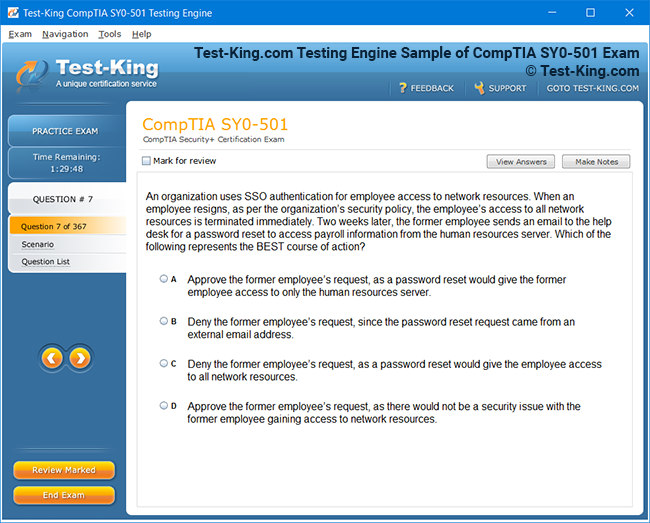
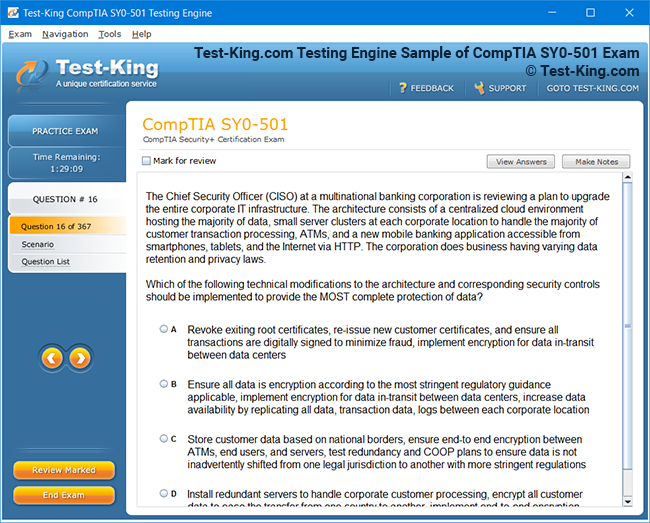
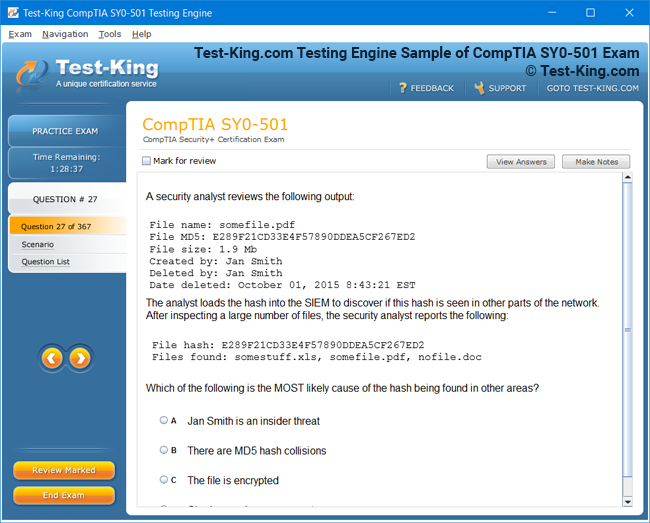
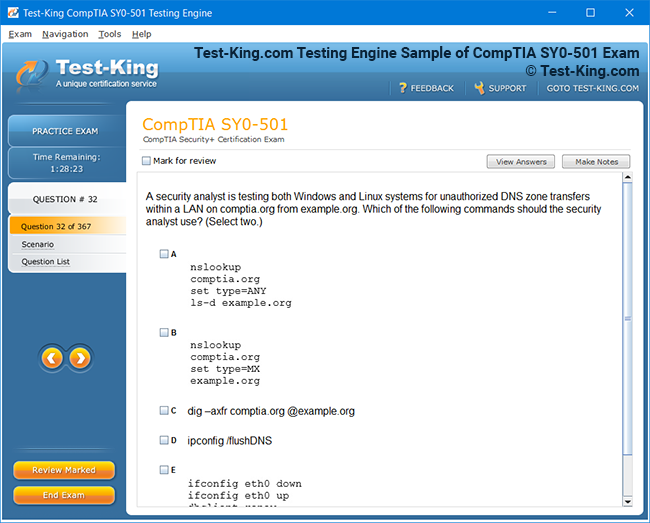
Product Screenshots
Frequently Asked Questions
How can I get the products after purchase?
All products are available for download immediately from your Member's Area. Once you have made the payment, you will be transferred to Member's Area where you can login and download the products you have purchased to your computer.
How long can I use my product? Will it be valid forever?
Test-King products have a validity of 90 days from the date of purchase. This means that any updates to the products, including but not limited to new questions, or updates and changes by our editing team, will be automatically downloaded on to computer to make sure that you get latest exam prep materials during those 90 days.
Can I renew my product if when it's expired?
Yes, when the 90 days of your product validity are over, you have the option of renewing your expired products with a 30% discount. This can be done in your Member's Area.
Please note that you will not be able to use the product after it has expired if you don't renew it.
How often are the questions updated?
We always try to provide the latest pool of questions, Updates in the questions depend on the changes in actual pool of questions by different vendors. As soon as we know about the change in the exam question pool we try our best to update the products as fast as possible.
How many computers I can download Test-King software on?
You can download the Test-King products on the maximum number of 2 (two) computers or devices. If you need to use the software on more than two machines, you can purchase this option separately. Please email support@test-king.com if you need to use more than 5 (five) computers.
What is a PDF Version?
PDF Version is a pdf document of Questions & Answers product. The document file has standart .pdf format, which can be easily read by any pdf reader application like Adobe Acrobat Reader, Foxit Reader, OpenOffice, Google Docs and many others.
Can I purchase PDF Version without the Testing Engine?
PDF Version cannot be purchased separately. It is only available as an add-on to main Question & Answer Testing Engine product.
What operating systems are supported by your Testing Engine software?
Our testing engine is supported by Windows. Andriod and IOS software is currently under development.
Top WGU University Exams
Mastering Secure Software Design: How to Prepare for WGU’s KEO1 Exam
Secure software design is an indispensable facet of modern software engineering, where the objective transcends functional correctness and extends into safeguarding data integrity, confidentiality, and availability. The WGU KEO1 exam emphasizes these principles, assessing candidates not only on theoretical knowledge but also on practical comprehension of applying security within the software development lifecycle. Understanding the foundations requires immersing oneself in both the philosophical and pragmatic dimensions of security, blending principles of resilience, robustness, and anticipatory threat mitigation.
Foundations and Key Concepts of Secure Software Design
At its core, secure software design relies upon the meticulous orchestration of design principles that prevent vulnerabilities from manifesting. The concept of least privilege is paramount, advocating that each module, process, or user operates with the minimal set of permissions necessary to perform its functions. This principle significantly reduces the attack surface, curtailing opportunities for unauthorized access or privilege escalation. Complementary to this is the notion of defense in depth, a layered security strategy that incorporates multiple overlapping controls to ensure that a single compromised element does not precipitate systemic failure.
Another foundational aspect is the integration of threat modeling early in the design process. Threat modeling is the analytical exercise of anticipating potential security risks, assessing their likelihood and potential impact, and devising mitigation strategies prior to implementation. By considering diverse threat vectors, including insider threats, malicious actors, and environmental hazards, software designers cultivate a proactive mindset that aligns closely with the objectives of the WGU KEO1 curriculum.
The concept of secure defaults is equally vital. Software should, by default, adopt the most restrictive and protective configuration unless explicitly altered by an authorized user. Default passwords, open ports, or permissive access rights are frequent sources of vulnerabilities, and understanding how to configure defaults judiciously reflects an advanced comprehension of security hygiene. Candidates preparing for the exam should focus on understanding how these defaults interact with broader system architectures and user behaviors.
Secure software design also emphasizes input validation and output encoding. These techniques are essential for mitigating injection attacks, which remain some of the most prevalent threats to web-based and enterprise applications. By rigorously validating all incoming data against expected formats, length, type, and range, designers prevent unintended operations or code execution. Output encoding ensures that any data rendered to a user interface is presented safely, neutralizing potentially malicious scripts embedded in content streams. These practices, while technical in nature, embody a philosophical commitment to anticipating the unpredictable and designing systems resilient to misuse.
An often-overlooked dimension is error handling and logging. Properly designed error handling mechanisms not only prevent system crashes but also obscure sensitive information that could be exploited by attackers. Logging, when implemented thoughtfully, serves as both a forensic resource and an operational insight tool. It allows administrators to trace anomalous behavior, detect intrusion attempts, and verify compliance with security standards. In the context of the WGU KEO1 exam, candidates must appreciate how these practices intertwine with both system reliability and security assurance.
The principle of separation of duties underpins secure software design from an operational perspective. By delineating responsibilities across distinct modules or personnel, organizations reduce the likelihood of collusive breaches and systemic exploitation. This concept extends into secure coding practices, where individual components perform only designated tasks, ensuring that a flaw in one module does not cascade into larger failures. Understanding this principle aligns directly with exam objectives, which often assess comprehension of designing for resiliency rather than merely reacting to vulnerabilities.
Software security is not solely a technical concern; it is also a sociotechnical phenomenon. User behavior, organizational culture, and operational policies all influence the effectiveness of security measures. Candidates preparing for the WGU KEO1 exam should cultivate a holistic understanding that encompasses policy enforcement, secure user interaction, and education, recognizing that even the most rigorously engineered system is susceptible to compromise if human factors are ignored. Incorporating principles from cognitive ergonomics and social engineering awareness enriches the security mindset, allowing designers to anticipate and mitigate threats beyond code-level vulnerabilities.
Modern secure software design also demands fluency in cryptographic principles. Encryption ensures that sensitive data remains protected both at rest and in transit. Candidates must understand symmetric and asymmetric encryption, hashing algorithms, digital signatures, and key management strategies. Equally important is recognizing the limitations and potential vulnerabilities of cryptographic systems, including side-channel attacks, improper key storage, and algorithmic obsolescence. Knowledge in this area reflects a deep-seated appreciation for the complexity of security, which is central to the WGU KEO1 examination framework.
The software development lifecycle (SDLC) provides the structural backdrop against which secure design principles are applied. From requirements gathering to maintenance, security must be integrated seamlessly, rather than bolted on as an afterthought. This includes threat assessments during planning, secure coding practices during development, rigorous testing and validation, and ongoing monitoring and patching during deployment and maintenance. Candidates should understand how each stage of the SDLC contributes to the overarching security posture, ensuring that vulnerabilities are identified and mitigated as early as possible.
Design patterns form another critical component of secure software design. Patterns such as the singleton for controlled instantiation, factory methods for controlled object creation, and proxy patterns for access control, when applied with security considerations, enhance both the robustness and maintainability of software. The ability to recognize, implement, and evaluate design patterns within a security-conscious framework is frequently tested on the WGU KEO1 exam, emphasizing the interplay between design elegance and resilience against attacks.
Understanding vulnerabilities themselves is crucial. Categories such as buffer overflows, cross-site scripting, SQL injection, race conditions, and improper authentication are commonly referenced in both study materials and real-world case studies. Candidates benefit from exploring these vulnerabilities not merely as isolated defects but as manifestations of underlying design flaws or inadequate operational controls. An analytical approach that traces the root cause of vulnerabilities, assesses their potential impact, and formulates preventive strategies is more valuable than rote memorization, fostering a deeper mastery that is rewarded on the KEO1 assessment.
Security testing techniques, including static and dynamic analysis, penetration testing, and code review, are indispensable for verifying design efficacy. Static analysis inspects source code for known vulnerability patterns, providing early detection without executing the program. Dynamic testing observes the behavior of running applications under controlled conditions, identifying runtime issues and emergent weaknesses. Penetration testing simulates attacker behavior to expose vulnerabilities from an adversarial perspective, offering insights that traditional testing methods may overlook. Collectively, these techniques reinforce a feedback loop in which design decisions are continuously evaluated and improved.
An emergent area of importance is secure integration within distributed systems and cloud environments. As software increasingly relies on microservices, APIs, and cloud infrastructure, designers must consider authentication, authorization, data flow, and potential points of failure across interconnected components. Threats such as API abuse, misconfigured cloud storage, and token leakage require nuanced understanding and vigilant design. Candidates should develop the ability to envision complex interaction diagrams and identify security touchpoints, preparing them for questions and scenarios presented in the WGU KEO1 exam.
The human-computer interaction dimension also influences secure software design. User interfaces must communicate security states effectively, guiding users to adopt safe practices without inducing fatigue or frustration. Techniques such as progressive disclosure, contextual warnings, and error prevention mechanisms cultivate an environment where security and usability coexist harmoniously. Designing for clarity, predictability, and informed consent reflects the intersection of cognitive science and security engineering, a domain increasingly appreciated in certification examinations.
Compliance and regulatory considerations are integral to the broader context of secure software design. Standards such as ISO/IEC 27001, NIST frameworks, GDPR, and HIPAA provide both legal and operational guidelines for safeguarding information. Understanding these frameworks enables candidates to design software that meets external requirements while maintaining internal security objectives. Moreover, familiarity with regulatory environments demonstrates an awareness that security does not operate in isolation but is embedded within societal, legal, and organizational ecosystems.
In practical preparation for the WGU KEO1 exam, it is beneficial to engage with case studies and historical breach analyses. Studying real-world incidents, from misconfigured cloud services to exploited zero-day vulnerabilities, offers insights into how theoretical principles manifest in practice. This approach encourages analytical reasoning, allowing candidates to anticipate weaknesses, formulate mitigations, and articulate security rationale clearly—skills that are consistently evaluated in the certification process.
Exam-oriented strategies include synthesizing knowledge from multiple domains, such as network security, operating systems, application architecture, and human factors. Candidates should practice scenario-based problem solving, where they assess a design, identify potential vulnerabilities, propose mitigations, and justify their approach. These exercises cultivate a mindset of anticipatory defense, preparing individuals for the complex, multifaceted questions that characterize the WGU KEO1 assessment.
A nuanced understanding of secure lifecycle management, encompassing patch management, vulnerability scanning, and continuous monitoring, is indispensable. Modern software systems are dynamic, evolving entities, and security must be sustained throughout operational lifespan. Recognizing how updates, configuration changes, and user behavior impact the security posture allows designers to implement strategies that maintain resilience over time, rather than treating security as a static attribute.
Finally, cultivating a security-conscious mindset is central to mastering secure software design. Beyond memorizing principles and practices, candidates should internalize a philosophy of vigilance, critical thinking, and ethical responsibility. This mindset manifests in anticipatory threat assessment, meticulous design review, and rigorous adherence to standards, aligning perfectly with the WGU KEO1 examination objectives. By embracing this holistic approach, candidates position themselves not merely to pass an exam but to excel as security-oriented software engineers capable of designing robust, resilient, and trustworthy systems.
Advanced Threat Modeling and Secure Design Patterns
Understanding the intricacies of secure software design extends beyond foundational principles into the realm of advanced threat modeling and the strategic application of design patterns to mitigate risk. The WGU KEO1 exam assesses candidates on their ability to analyze complex systems, anticipate adversarial strategies, and implement controls that preemptively reduce vulnerabilities. Threat modeling, at its essence, is a meticulous process that enables designers to envisage potential attacks, classify them according to likelihood and impact, and devise countermeasures that are both pragmatic and sustainable within the operational ecosystem.
A critical first step in this analytical endeavor is identifying assets, which are the elements of a system that require protection. Assets encompass data repositories, authentication mechanisms, configuration files, network endpoints, and user credentials. Recognizing the value of each asset within the broader system architecture allows designers to prioritize security measures, ensuring that high-value targets are fortified against both opportunistic and sophisticated attacks. This prioritization aligns closely with the evaluative lens of the WGU KEO1 examination, which often emphasizes strategic reasoning alongside technical proficiency.
Equally important is the identification of potential adversaries and their capabilities. Attackers may range from opportunistic individuals seeking financial gain to state-sponsored entities employing advanced persistent threats. Understanding the spectrum of adversarial intent informs the selection of controls, from simple input validation to the implementation of multi-layered cryptographic schemes. Security professionals must appreciate that a single defensive mechanism is rarely sufficient; robust software design necessitates a composite approach that interweaves preventive, detective, and corrective controls throughout the system architecture.
Data flow analysis is another indispensable element of threat modeling. By mapping the trajectory of information through various components, designers can identify where data may be exposed, manipulated, or exfiltrated. This analytical framework facilitates the anticipation of injection attacks, unauthorized access, and privilege escalation. Moreover, data flow diagrams enable the visualization of interaction points, elucidating where encryption, access controls, and authentication checks are most effectively applied. Candidates preparing for the WGU KEO1 exam benefit from practicing this analytical skill, as it enhances the capacity to reason about security holistically.
Secure design patterns serve as a critical mechanism to operationalize the insights gained from threat modeling. Patterns such as the proxy pattern provide controlled access to resources, allowing for monitoring and validation of requests before granting permissions. The decorator pattern can encapsulate additional security functionality without altering the underlying core logic, thereby maintaining both modularity and security compliance. The observer pattern allows systems to react dynamically to security events, propagating alerts or initiating countermeasures when suspicious activity is detected. Mastery of these patterns requires an understanding not only of their implementation mechanics but also of the security rationale underpinning their adoption.
The principle of fail-safe defaults remains central to secure design, particularly when integrated into design patterns. Systems should default to the most restrictive state, only granting expanded access when explicitly authorized and verified. This approach reduces the attack surface and diminishes the likelihood of inadvertent privilege escalation. Within pattern implementation, this may manifest as default-deny rules in access control proxies, encapsulated validation routines in decorators, or alert thresholds in observer constructs, each contributing to a resilient and anticipatory security posture.
Another vital concept is the minimization of attack surfaces. This principle advocates for the reduction of potential entry points, interfaces, and functionalities that may be exploited. Techniques include restricting exposed APIs, isolating critical functions within secure modules, and eliminating unnecessary services. Candidates must comprehend the balance between functionality and security, recognizing that each additional interface introduces both utility and potential vulnerability. The WGU KEO1 exam often tests the ability to reason about these trade-offs, emphasizing practical judgment alongside theoretical knowledge.
Security-centric architecture also incorporates the principle of compartmentalization. By segmenting system components into discrete, loosely coupled modules, failures in one area are less likely to propagate, mitigating the risk of widespread compromise. Compartmentalization extends to data storage, process execution, and network segmentation, ensuring that even if a breach occurs, its scope remains limited. This approach requires careful planning and a deep understanding of interdependencies within software systems, reflecting the nuanced analytical requirements of the certification.
Understanding common vulnerability types is essential for contextualizing threat modeling and design pattern application. Buffer overflows, race conditions, cross-site scripting, SQL injections, and authentication bypasses represent not only technical challenges but also symptoms of deeper design flaws. Candidates must develop the capacity to analyze why such vulnerabilities emerge, tracing them to inadequate input validation, improper state management, or insufficient access control. This analytical reasoning is critical for demonstrating mastery in the WGU KEO1 framework, where understanding causality is valued over rote identification.
Risk assessment techniques complement threat modeling by quantifying potential impact and probability. Methods such as qualitative ranking, quantitative scoring, and hybrid approaches enable designers to prioritize mitigations and allocate resources effectively. For example, an application handling financial transactions may assign high risk to unauthorized access attempts, prompting the implementation of multifactor authentication, transaction monitoring, and strict session management. By synthesizing threat modeling insights with risk assessment, candidates can craft defensible design strategies that reflect both efficiency and security rigor.
Authentication and authorization strategies form a core component of secure software design. Authentication mechanisms verify the identity of users or systems, employing methods such as password verification, biometric recognition, and token-based validation. Authorization determines what authenticated entities are permitted to do, enforcing rules that align with least privilege principles. Advanced techniques, including role-based access control, attribute-based access control, and policy-driven frameworks, allow for fine-grained permissions that minimize exposure. Understanding these mechanisms and their correct application is integral to succeeding in the WGU KEO1 exam.
The integration of cryptographic principles within design patterns enhances security by ensuring the confidentiality and integrity of data. Symmetric and asymmetric encryption schemes, hashing algorithms, digital signatures, and secure key management practices safeguard information both at rest and in transit. Designers must also remain vigilant regarding potential cryptographic vulnerabilities, including weak key generation, improper storage, and deprecated algorithms. The examination evaluates not only knowledge of these techniques but also the ability to reason about their application within broader architectural contexts.
Secure error handling and logging mechanisms provide both operational resilience and forensic capability. Error handling should prevent the disclosure of sensitive information, while logging should capture sufficient detail to enable investigation without exposing vulnerabilities. These mechanisms must be integrated thoughtfully, maintaining the balance between security, usability, and system performance. In the context of design patterns, this may involve encapsulating logging routines within observers, incorporating validation feedback into decorators, or centralizing error handling through controlled proxies, illustrating the interplay between design and security.
An emergent topic in modern secure design is the secure orchestration of distributed systems. Microservices, cloud-based services, and interconnected APIs necessitate a heightened awareness of authentication, authorization, data flow, and operational controls. Threats such as token interception, misconfigured permissions, and API abuse require nuanced, anticipatory design solutions. Candidates must be able to evaluate complex topologies, identifying potential weaknesses and implementing mitigations that encompass both software and infrastructural considerations. This capability reflects the holistic analytical demands emphasized in the WGU KEO1 exam.
Human factors remain a pivotal consideration in secure design. User interfaces, interaction paradigms, and error messaging must guide secure behavior without inducing cognitive overload or frustration. Progressive disclosure, contextual warnings, and clear feedback mechanisms encourage informed user decisions, reducing the likelihood of inadvertent compromise. Integrating these considerations into design patterns ensures that security is not merely a technical artifact but an intrinsic component of the overall user experience.
Continuous monitoring and secure lifecycle management reinforce the resilience of software systems. Regular vulnerability scanning, patch deployment, and configuration auditing ensure that security controls remain effective as software evolves. This dynamic approach requires designers to anticipate change, implement monitoring hooks, and maintain visibility into system behavior. Within design patterns, this may involve observer-based event tracking, modular update routines, and encapsulated validation mechanisms that sustain security without disrupting functionality.
Compliance and regulatory frameworks also inform secure software design. Standards such as ISO/IEC 27001, NIST frameworks, GDPR, and HIPAA provide both legal and operational guidelines that shape architectural decisions. Understanding the intersection of these regulations with technical design ensures that systems are defensible, auditable, and aligned with organizational obligations. Candidates benefit from examining case studies where compliance failures led to breaches, reinforcing the importance of integrating regulatory awareness with technical acumen.
Scenario-based preparation is an effective strategy for mastering advanced secure design concepts. By evaluating hypothetical systems, identifying potential vulnerabilities, and proposing mitigations, candidates develop critical reasoning and practical judgment. These exercises simulate the types of analytical challenges presented in the WGU KEO1 exam, encouraging the application of theory to real-world contexts. Engaging with diverse scenarios enhances adaptability, preparing candidates to respond to both anticipated and unforeseen threats with confidence and precision.
The intersection of threat modeling, secure design patterns, risk assessment, and operational awareness constitutes the essence of advanced secure software design. Candidates must synthesize knowledge from multiple domains, applying principles in a coherent, anticipatory, and pragmatic manner. Mastery of these concepts equips designers to create resilient systems capable of withstanding both technical attacks and human-induced vulnerabilities. Through diligent study, scenario practice, and analytical reasoning, candidates position themselves for success in the WGU KEO1 exam, cultivating expertise that extends beyond certification into professional excellence.
Secure Coding Practices, Vulnerability Mitigation, and Testing Methodologies
Secure software design extends into the realm of meticulous coding practices, strategic vulnerability mitigation, and rigorous testing methodologies. The WGU KEO1 exam evaluates candidates on their proficiency in creating resilient code, anticipating potential exploit vectors, and employing systematic approaches to verify security. Coding securely requires a deliberate mindset, where developers anticipate the unpredictable, enforce constraints at multiple levels, and ensure that system behavior aligns with both functional and security requirements. Each line of code is a potential conduit for attack, and mastery involves embedding security principles seamlessly throughout the development lifecycle.
Input validation constitutes the cornerstone of secure coding practices. Every piece of data entering the system—whether from user interfaces, APIs, or inter-service communication—must be scrutinized rigorously. Validation includes type checking, length constraints, range verification, pattern enforcement, and context-specific sanitization. Failing to validate inputs exposes software to injection attacks, buffer overflows, and logic bypasses. Advanced secure coding emphasizes not only correctness but also anticipatory design, where even unexpected or malformed inputs are treated as potential threats and handled with precision to preserve both integrity and availability.
Output encoding complements input validation, serving as a defensive layer that neutralizes malicious content before it interacts with other system components or reaches end users. This practice is essential in web applications where dynamic content may contain scripts or commands intended for exploitation. Encoding ensures that characters are interpreted as data rather than executable instructions, mitigating cross-site scripting and similar attack vectors. Candidates preparing for the WGU KEO1 exam must comprehend the relationship between input validation and output encoding, understanding them as synergistic mechanisms within a holistic defensive framework.
Authentication mechanisms must be implemented with both rigor and foresight. Simple password-based authentication, while common, requires additional safeguards such as salting, hashing, and iteration to resist brute-force attacks. Multi-factor authentication introduces an additional layer of security, demanding knowledge or possession factors alongside traditional credentials. Secure coding entails implementing these mechanisms without exposing sensitive data, ensuring that tokens, session identifiers, and cryptographic keys are generated, stored, and transmitted securely. Mastery of authentication protocols, including their failure modes, is a recurrent theme in WGU KEO1 preparation.
Authorization is closely intertwined with authentication but operates on the principle of least privilege. Users and processes should access only those resources necessary for their function, and access controls must be enforceable, auditable, and resistant to circumvention. Role-based access control and attribute-based access control are common methodologies that allow fine-grained permissions aligned with organizational policies. Secure coding involves embedding these controls in a manner that is resilient to escalation attacks and consistent with the overarching architectural principles.
Error handling and exception management serve a dual purpose in secure coding. On one hand, they prevent system crashes and maintain operational stability. On the other, they must be designed to avoid revealing sensitive information that could aid an attacker. Informative logging should provide sufficient detail for troubleshooting while omitting credentials, system paths, or internal logic that could be exploited. Advanced secure software design requires a balance, where error handling reinforces resilience without compromising confidentiality or integrity.
Secure session management is another critical dimension. Sessions represent the continuity of interaction between user and system, and improper handling exposes vulnerabilities such as session fixation, hijacking, and replay attacks. Secure coding mandates unique session identifiers, timeout mechanisms, encryption, and controlled invalidation. Maintaining session integrity across distributed systems, while challenging, is a hallmark of robust design and a frequent point of evaluation in certification assessments like the WGU KEO1 exam.
Vulnerability mitigation extends beyond coding into proactive architectural and design considerations. Buffer overflows, race conditions, insecure deserialization, and improper resource management are symptomatic of deeper design flaws. Effective mitigation includes adopting defensive programming techniques, enforcing boundaries, and utilizing safe libraries and constructs that reduce the likelihood of exploitable conditions. Candidates must appreciate that security is an emergent property of design and implementation, not merely an afterthought applied post-development.
Testing methodologies are indispensable for validating secure design and coding practices. Static analysis tools inspect source code for known vulnerability patterns, enabling early detection of flaws before execution. Dynamic analysis evaluates the runtime behavior of applications under controlled conditions, exposing operational vulnerabilities and race conditions that static checks may overlook. Penetration testing simulates adversarial attacks, allowing designers to observe the system’s resilience and response mechanisms. Mastery of these testing modalities enhances both practical and theoretical understanding, directly supporting preparation for the WGU KEO1 exam.
Unit testing, integration testing, and system testing all play a role in secure software validation. Unit tests verify the correctness of individual components, ensuring that they enforce expected constraints and handle edge cases appropriately. Integration tests assess the interaction between modules, confirming that interfaces maintain security invariants and that data flow adheres to specified policies. System-level testing examines the holistic behavior, evaluating the application under realistic operational conditions and adversarial scenarios. Secure design encourages embedding security checks within all layers of testing, creating a comprehensive assurance strategy.
Fuzz testing provides a unique perspective in vulnerability discovery. By generating a wide range of unexpected or malformed inputs, fuzz testing exposes unanticipated system behavior, memory corruption, or processing anomalies. This technique is particularly valuable for detecting corner-case vulnerabilities that deterministic testing may miss. Candidates preparing for the WGU KEO1 exam should understand the methodology, benefits, and limitations of fuzzing, recognizing its role in a diversified testing regimen.
Code review is another vital practice in secure software development. Peer review of code allows multiple perspectives to identify potential weaknesses, logical errors, and non-compliance with secure coding standards. Manual review is complemented by automated tools that flag common patterns indicative of vulnerabilities, such as improper input handling, unsafe memory operations, or insufficient error handling. A disciplined code review culture reinforces secure practices, fosters knowledge sharing, and creates a feedback loop for continuous improvement.
Patch management and dependency monitoring are essential for maintaining security over time. Software rarely exists in isolation; libraries, frameworks, and external modules may contain vulnerabilities that compromise the system if unpatched. Secure design incorporates strategies for monitoring updates, assessing impact, and deploying fixes without disrupting operational continuity. Candidates must understand the importance of timely updates, dependency vetting, and maintaining an inventory of components to mitigate potential exposure.
Threat modeling complements coding and testing by contextualizing vulnerabilities within the broader system architecture. By understanding how components interact, where sensitive data resides, and which processes are exposed, designers can prioritize coding and testing efforts. Threat models inform the selection of secure design patterns, input validation strategies, authentication mechanisms, and error handling protocols. Integrating these elements ensures that vulnerabilities are addressed not in isolation but within the comprehensive ecosystem of the application.
Security metrics provide insights into the efficacy of coding practices and testing methodologies. Metrics may include defect density, vulnerability discovery rates, remediation times, and code coverage of security-critical paths. Monitoring these indicators over time allows teams to evaluate the effectiveness of practices, identify areas requiring additional focus, and justify design decisions to stakeholders. Candidates for the WGU KEO1 exam benefit from understanding how quantitative evaluation complements qualitative judgment in secure software design.
Emergent technologies, such as containerization and cloud orchestration, introduce new challenges in coding and testing. Containers encapsulate software in isolated environments, which enhances consistency but requires attention to image security, orchestration policies, and inter-container communication. Secure coding within these environments demands awareness of shared resources, API security, and privilege limitations. Testing must adapt to dynamic, ephemeral systems, emphasizing automated and continuous security validation strategies that reflect the modern operational landscape.
Cryptographic considerations permeate coding and testing activities. Implementing secure encryption, digital signatures, and key management within application logic requires precision and awareness of potential pitfalls. Candidates must understand algorithm selection, entropy generation, key lifecycle management, and potential side-channel vulnerabilities. Testing cryptographic implementations involves verifying correctness, assessing performance, and ensuring that implementations conform to established standards, reinforcing the holistic integration of security throughout the software lifecycle.
Human factors remain critical, even within coding and testing domains. Developers must internalize secure coding principles, avoid complacency, and remain vigilant for subtle logic flaws that could compromise security. Testing must simulate realistic user behavior, anticipating mistakes, misconfigurations, and attempts at circumvention. Educating development teams, fostering secure coding cultures, and embedding security awareness into routine practices complement technical measures, creating a more resilient overall system.
Compliance frameworks intersect with coding and testing considerations. Regulations such as GDPR, HIPAA, and PCI DSS impose specific requirements on data handling, access controls, and auditing. Secure coding ensures that software adheres to these mandates, while testing verifies compliance in operational contexts. Understanding the interplay between regulatory obligations and technical implementation is essential for candidates preparing for the WGU KEO1 exam, emphasizing that security is both a technical and organizational responsibility.
Scenario-based exercises enhance comprehension of coding, testing, and vulnerability mitigation. By examining hypothetical applications, identifying potential flaws, and proposing corrective strategies, candidates develop critical thinking and applied knowledge. These exercises simulate exam conditions, requiring synthesis of secure coding principles, threat modeling insights, and testing methodologies. Engaging in diverse scenarios strengthens adaptability, preparing candidates to address complex, unforeseen challenges effectively.
The intersection of coding rigor, vulnerability anticipation, and structured testing constitutes the essence of practical secure software design. Candidates must internalize these principles, integrating them seamlessly into both individual components and overarching system architectures. Mastery reflects not only technical skill but also analytical reasoning, foresight, and a disciplined approach to software craftsmanship. By combining these dimensions, designers create resilient, robust, and trustworthy systems aligned with the objectives and expectations of the WGU KEO1 examination.
Secure Architecture, Incident Response, and Monitoring Strategies
Secure software design is not solely defined by coding practices or vulnerability mitigation; it is equally shaped by architectural foresight, effective incident response planning, and continuous monitoring. The WGU KEO1 exam evaluates candidates on their comprehension of designing resilient systems capable of withstanding multifaceted threats, detecting anomalous behavior, and responding effectively to incidents. Secure architecture encompasses both the macro-level design of components and micro-level interactions, emphasizing isolation, redundancy, and controlled communication pathways.
A foundational principle of secure architecture is the separation of concerns. By partitioning responsibilities across distinct modules, processes, or services, designers reduce the probability of a single point of failure leading to systemic compromise. This principle manifests in techniques such as microservices, where functionality is isolated into independent services that communicate through controlled interfaces, or layered architectures, where presentation, business logic, and data layers are distinct and protected. This compartmentalization not only facilitates maintainability but also constrains potential attack vectors, ensuring that a breach in one module does not cascade throughout the system.
Redundancy and resilience are essential elements of robust architecture. Systems designed with redundant components, failover mechanisms, and replicated data stores maintain availability even when facing hardware failures, network disruptions, or targeted attacks. Such resilience is integral to secure software design, as it mitigates the impact of adverse events and aligns with high-availability requirements. The WGU KEO1 exam emphasizes the importance of understanding how architectural decisions influence both security and operational continuity.
Network segmentation further enhances secure architecture. By isolating critical components and enforcing controlled communication channels, designers limit the lateral movement of attackers within a system. Segmentation reduces the attack surface, ensuring that unauthorized access in one segment does not compromise the entire infrastructure. Candidates must understand both logical and physical segmentation strategies, including virtual private networks, firewalls, access control lists, and container isolation, all of which contribute to a comprehensive defense-in-depth approach.
Threat modeling within architectural design is a proactive mechanism for anticipating attacks. By identifying high-value assets, potential adversaries, and possible attack vectors, designers can implement targeted controls that reduce risk. Techniques such as data flow analysis, attack trees, and misuse case analysis allow candidates to visualize interactions, prioritize mitigation efforts, and embed security at every level. Integrating these methodologies into design decisions cultivates a mindset of anticipatory defense, a key competency assessed by the WGU KEO1 examination.
Incident response planning is a critical complement to secure architecture. Despite rigorous design and testing, breaches and system anomalies may occur. Establishing a formalized response plan ensures that incidents are addressed systematically, minimizing operational disruption and data loss. Effective incident response involves identification, containment, eradication, recovery, and post-incident analysis. Each stage requires predefined roles, communication channels, and documentation procedures, reflecting both operational and strategic preparedness.
Identification begins with detecting anomalous behavior that may indicate compromise. Monitoring mechanisms, including intrusion detection systems, application logs, and network analytics, provide the foundation for timely recognition. By establishing baselines for normal activity, systems can flag deviations that warrant investigation. Candidates must understand the indicators of compromise, such as unusual authentication patterns, unexpected data transfers, and abnormal resource consumption, recognizing that early detection significantly enhances the effectiveness of the response.
Containment focuses on limiting the scope and impact of incidents. Architectural measures such as network segmentation, access controls, and isolated processing environments facilitate rapid containment by restricting adversarial movement. In practice, containment may involve revoking compromised credentials, quarantining affected systems, or redirecting traffic to secure environments. Understanding these strategies enables candidates to articulate effective mitigation approaches during the WGU KEO1 exam, emphasizing both technical and procedural considerations.
Eradication involves removing the root cause of the incident, whether it is malicious code, unauthorized access, or compromised configuration. Secure software design anticipates such interventions by embedding mechanisms that allow safe remediation without further exposing the system. Techniques include controlled patching, secure configuration rollback, and validated removal of malware or unauthorized components. Mastery of these processes reflects an advanced comprehension of both system behavior and security imperatives.
Recovery ensures that systems return to normal operation without residual vulnerabilities. Architectural design plays a vital role by enabling redundancy, backups, and modular restoration. Secure software design incorporates checkpointing, versioning, and audit trails, allowing administrators to restore functionality while verifying integrity. Recovery plans must also account for continuity of service, ensuring that dependent systems and external interactions are maintained or gracefully degraded during restoration.
Post-incident analysis completes the cycle by extracting lessons, identifying gaps, and improving preventive measures. Documentation of events, root causes, and corrective actions informs future architectural decisions, coding practices, and monitoring strategies. This reflective process embodies a learning mindset, where incidents are leveraged to enhance resilience and anticipate future threats. Candidates preparing for the WGU KEO1 exam are expected to understand how incident analysis informs both operational security and design evolution.
Continuous monitoring is an indispensable practice for maintaining secure systems over time. Monitoring encompasses real-time surveillance of system activity, periodic audits, and automated alerts for anomalous behavior. Effective monitoring balances granularity with performance, capturing sufficient detail to detect potential threats without overwhelming resources. Techniques include log aggregation, metric analysis, anomaly detection algorithms, and pattern recognition. Mastery of monitoring concepts enables candidates to design systems that are both observable and resilient.
Logging provides a historical record essential for both operational oversight and forensic investigation. Logs should capture authentication events, configuration changes, data access, and system anomalies, while avoiding the inclusion of sensitive information such as passwords or cryptographic keys. Advanced design incorporates structured logging, consistent timestamps, and secure storage, facilitating analysis and correlation across systems. Understanding logging best practices is crucial for demonstrating preparedness for the WGU KEO1 examination.
Alerting complements monitoring by providing actionable notifications when defined thresholds or anomalous patterns are detected. Alerts may be triggered by unusual access attempts, data exfiltration signatures, or deviations from expected performance metrics. Designing effective alerting mechanisms requires consideration of thresholds, escalation procedures, and response workflows. Candidates must appreciate that excessive alerts lead to fatigue, whereas insufficient alerts may result in undetected compromise. Balancing sensitivity and specificity is an essential skill in secure software design.
Metrics and dashboards enable administrators to interpret monitoring data efficiently. Visualizing trends, anomalies, and system health provides operational insight and supports proactive decision-making. Metrics may include authentication failures, failed input validation attempts, network traffic patterns, or error rates in critical modules. Integrating these indicators with architectural awareness ensures that monitoring informs both immediate response and strategic design improvements.
Redundancy in monitoring systems ensures continuous visibility even in the event of component failure. Distributed monitoring, failover sensors, and replication of log data prevent gaps in observation that could otherwise be exploited. This approach reinforces both the resilience of the system and the reliability of incident detection, emphasizing the importance of planning for contingencies as part of secure software design.
Security orchestration automates incident response workflows, integrating detection, analysis, and mitigation across components. Automation reduces reaction time, enforces consistent procedures, and minimizes human error. Examples include automated revocation of compromised sessions, dynamic firewall adjustments, and real-time quarantine of affected services. Candidates should understand the principles of orchestration and its relationship to architectural design and monitoring practices, recognizing its role in elevating both efficiency and security assurance.
Integration of external threat intelligence enhances monitoring and response strategies. By leveraging feeds on emerging vulnerabilities, malware signatures, and attack campaigns, designers can anticipate threats and preemptively adjust system behavior. Incorporating intelligence into both automated and manual processes ensures that architecture remains adaptive, responsive, and aligned with the evolving threat landscape.
Secure architecture also encompasses data integrity measures. Mechanisms such as checksums, digital signatures, and hash functions verify that data has not been tampered with during storage or transit. Coupled with monitoring, these mechanisms provide immediate detection of unauthorized modifications, supporting both operational trust and compliance requirements. Candidates preparing for the WGU KEO1 exam must recognize the interplay between design, monitoring, and integrity verification in safeguarding sensitive information.
Human factors influence monitoring and incident response efficacy. Analysts interpreting alerts must be trained to discern genuine threats from false positives, maintain situational awareness, and execute predefined response procedures. User behavior can also trigger monitoring alerts, and interfaces should be designed to facilitate secure interactions without overwhelming operators. Integrating human-centric design with technical monitoring ensures that systems are both effective and usable under operational stress.
Regulatory compliance intersects with incident response and monitoring strategies. Frameworks such as GDPR, HIPAA, and NIST provide guidelines for breach notification, audit logging, and security incident handling. Designing architecture and monitoring systems that align with these frameworks ensures legal compliance, reduces liability, and demonstrates organizational diligence. Understanding these obligations and their operational implications is essential for candidates preparing for the WGU KEO1 exam.
Scenario-based exercises reinforce comprehension of secure architecture, incident response, and monitoring practices. By analyzing hypothetical breaches, designing response workflows, and evaluating monitoring coverage, candidates develop practical reasoning and applied knowledge. These exercises simulate real-world conditions, requiring the synthesis of architectural foresight, coding practices, threat modeling, and operational vigilance. Engagement with diverse scenarios strengthens analytical skills and adaptability, key competencies for success in the WGU KEO1 examination.
The integration of secure architecture, proactive incident response planning, and continuous monitoring forms a cohesive strategy for resilient software systems. Candidates must appreciate that these elements are interdependent: architecture defines the structural foundation, monitoring provides visibility, and incident response ensures operational continuity when anomalies occur. Mastery of this triad equips designers to anticipate, detect, and mitigate threats in a structured and effective manner, reflecting the advanced analytical expectations of the WGU KEO1 exam.
Cloud Security, API Security, and Secure Integration Practices
As software ecosystems evolve, cloud security, API security, and secure integration practices have emerged as critical components of secure software design. The WGU KEO1 exam evaluates candidates on their understanding of these domains, emphasizing how distributed systems, interdependent services, and cloud-hosted applications introduce unique vulnerabilities that must be mitigated through architectural foresight, secure coding, and operational vigilance.
Cloud security extends beyond traditional network and host-level protections, encompassing data confidentiality, availability, integrity, and compliance within elastic, multi-tenant environments. Designing secure applications in the cloud requires a deep understanding of shared responsibility models, where cloud service providers safeguard infrastructure, while developers and organizations are accountable for application logic, configuration, and data management. Candidates must be familiar with the delineation of responsibilities and how design decisions influence overall risk exposure.
Data protection in cloud environments demands meticulous attention to encryption, access control, and isolation. Encryption should be applied both at rest and in transit, using contemporary algorithms with robust key management practices. Access control mechanisms must enforce least privilege and be consistently applied across multiple services and user roles. Isolation techniques, including virtual private clouds, containerization, and tenant segregation, mitigate lateral movement risks, ensuring that breaches in one domain do not compromise unrelated resources. Secure software design considers these mechanisms integral rather than supplemental.
Identity and access management plays a pivotal role in cloud security. The proliferation of microservices, serverless functions, and API endpoints necessitates strict control over who or what can interact with resources. Implementing federated identity systems, role-based access control, and temporary credentials reduces the risk of persistent unauthorized access. Candidates preparing for the WGU KEO1 exam must understand how to design, enforce, and audit these mechanisms to maintain a consistent security posture across cloud-hosted applications.
API security is increasingly relevant due to the central role of APIs in modern software integration. APIs expose application functionality and data to both internal and external consumers, creating a potential attack surface if not properly secured. Authentication, authorization, and input validation are fundamental to protecting APIs. Authentication ensures that only verified entities can access resources, while authorization enforces role or attribute-based constraints. Input validation prevents malicious data from compromising the backend, emphasizing the synergy between secure coding practices and integration security.
Rate limiting and throttling mechanisms protect APIs from denial-of-service attacks and excessive resource consumption. By controlling request frequency, designers can mitigate abuse while maintaining legitimate service access. Additionally, logging and monitoring API activity provide visibility into usage patterns, anomalous behavior, and potential attacks. Understanding these protective measures, alongside encryption of API payloads and secure token management, is crucial for candidates seeking proficiency in secure software design for the WGU KEO1 examination.
Integration security extends to third-party services, libraries, and frameworks. Incorporating external components introduces both functionality and risk, as vulnerabilities in dependencies can propagate into the system. Secure design practices include vetting external libraries, monitoring for updates and security advisories, and isolating third-party functionality to limit potential exposure. Automation tools for dependency scanning and vulnerability management complement architectural safeguards, ensuring that integrations do not compromise overall system resilience.
Microservices architectures require special attention in secure integration. Each service communicates over defined interfaces, often through APIs, messaging queues, or service meshes. Designing secure communication pathways, authenticating service requests, and encrypting inter-service traffic prevent both interception and unauthorized manipulation. Candidates must understand patterns such as mutual TLS, token-based authentication, and message signing, recognizing how they collectively strengthen system integrity while supporting distributed scalability.
Data consistency and integrity are paramount in integration scenarios. Distributed systems face challenges such as eventual consistency, replication delays, and asynchronous processing, which can be exploited by attackers or lead to inadvertent data corruption. Designing mechanisms to detect, correct, and log inconsistencies ensures reliability and reinforces trustworthiness. Cryptographic signatures, checksums, and transactional controls are often employed to maintain integrity, and secure software design integrates these elements seamlessly within operational workflows.
Monitoring and auditing in cloud and integrated environments provide the foundation for both detection and compliance. Real-time monitoring of authentication events, API calls, network traffic, and system performance allows for rapid detection of anomalies. Audit trails maintain a historical record of interactions, configuration changes, and data access, supporting forensic investigations and regulatory reporting. Candidates should be proficient in interpreting these data streams and designing systems that generate actionable insights without overwhelming operational resources.
Configuration management is a critical aspect of secure integration. Misconfigured cloud instances, improperly exposed endpoints, and excessive permissions are frequent sources of vulnerabilities. Implementing automated configuration checks, policy enforcement, and secure defaults mitigates the risk of human error. Candidates preparing for the WGU KEO1 exam must recognize that secure software design encompasses proactive measures to prevent misconfiguration, alongside reactive incident handling strategies.
Incident response in cloud and integrated systems requires consideration of multi-tenancy, shared infrastructure, and distributed service dependencies. Containment strategies may involve isolating compromised services, revoking access tokens, and redirecting traffic to unaffected components. Recovery plans must account for interdependent systems, ensuring that restoration efforts do not propagate further risk. Secure design anticipates these contingencies, embedding both automation and manual controls to facilitate efficient and safe response.
DevSecOps practices integrate security into continuous integration and continuous deployment workflows, aligning with cloud and integration security principles. Automated testing, static analysis, vulnerability scanning, and policy enforcement during build and deployment pipelines ensure that security is evaluated at every stage. Candidates must understand how to implement these practices to maintain security consistency, reduce human error, and support scalable, resilient operations.
Container security is a specialized consideration within cloud environments. Containers encapsulate applications and their dependencies, enabling rapid deployment and portability. However, they also introduce unique risks, such as image vulnerabilities, insecure orchestration configurations, and inter-container communication weaknesses. Secure design requires vetting container images, minimizing privileged access, applying namespace isolation, and monitoring container runtime behavior. These measures ensure that containers contribute to resilience rather than serving as vectors for compromise.
Network security in integrated environments encompasses both perimeter and internal protections. Firewalls, virtual networks, and network access controls define boundaries and restrict unauthorized communication. Encryption of data in transit, combined with secure routing and segmentation, mitigates interception and tampering risks. Candidates must understand the implications of network design choices, such as public versus private endpoints, virtual networking strategies, and secure API gateways, recognizing how these decisions interact with both architecture and operational monitoring.
Data lifecycle management in cloud and integration contexts ensures that sensitive information is protected throughout creation, storage, transmission, use, and deletion. Implementing encryption, access policies, and secure deletion protocols prevents unauthorized exposure and meets regulatory obligations. Secure design also incorporates backup strategies, disaster recovery planning, and redundancy to maintain availability and integrity, reflecting the comprehensive scope of responsibilities assessed by the WGU KEO1 exam.
Emergent threats, such as supply chain attacks, demand heightened vigilance in integration practices. Compromised dependencies, third-party services, or development tools can introduce vulnerabilities that propagate unnoticed. Secure software design incorporates verification mechanisms, automated alerts for suspicious activity, and isolation of high-risk components to mitigate these threats. Candidates should cultivate a mindset of anticipatory defense, recognizing that integration introduces both efficiency and potential exposure.
Human factors remain critical in cloud and integration security. Developers, administrators, and operators must be trained to understand secure practices, avoid inadvertent misconfigurations, and respond effectively to incidents. User behavior, interface design, and access patterns influence security posture, reinforcing the importance of combining technical controls with education and awareness. The WGU KEO1 exam emphasizes understanding the intersection of technical and human considerations in resilient software design.
Logging, monitoring, and alerting in cloud-integrated systems enable visibility into complex, distributed environments. Aggregating logs from multiple services, correlating events, and applying anomaly detection techniques provide actionable insights into both operational performance and potential security incidents. Candidates must be familiar with interpreting these signals and designing systems that produce meaningful, actionable alerts without overwhelming administrators, ensuring that monitoring complements both security and usability objectives.
Regulatory compliance remains intertwined with cloud and integration practices. Standards such as PCI DSS, HIPAA, GDPR, and SOC 2 impose requirements for data protection, access control, and monitoring. Secure design must incorporate mechanisms to meet these obligations while maintaining operational efficiency. Candidates should understand how compliance influences architectural choices, integration strategies, and monitoring practices, demonstrating both technical knowledge and awareness of broader operational contexts.
Scenario-based exercises provide practical preparation for cloud and integration security. By analyzing hypothetical architectures, identifying vulnerabilities, and proposing mitigations, candidates develop critical reasoning and applied knowledge. These exercises simulate the multifaceted challenges assessed in the WGU KEO1 exam, requiring synthesis of secure coding, architecture, monitoring, and human factors. Engaging in diverse scenarios enhances analytical flexibility, preparing candidates for dynamic, real-world conditions.
The integration of cloud security, API security, and secure system integration practices represents a comprehensive approach to designing resilient, trustworthy software. Candidates must synthesize architectural foresight, secure coding practices, monitoring strategies, and operational awareness to achieve holistic security. Mastery of these domains equips designers to anticipate threats, protect critical assets, and maintain system integrity, reflecting the advanced competencies evaluated in the WGU KEO1 examination.
Emerging Technologies, Advanced Defense Strategies, and Professional Preparedness
The evolution of software systems, accelerated by emerging technologies and interconnected environments, necessitates advanced approaches to secure software design. The WGU KEO1 exam assesses candidates not only on foundational principles but also on their capacity to anticipate threats, integrate novel technologies safely, and cultivate professional practices that sustain resilience. Emerging technologies, such as artificial intelligence, blockchain, and serverless computing, introduce both unprecedented functionality and novel vulnerabilities, demanding sophisticated defensive strategies.
Artificial intelligence and machine learning applications enhance software functionality but require careful consideration in secure design. Data pipelines feeding AI models can be manipulated, introducing bias, poisoning datasets, or exfiltrating sensitive information. Candidates must understand how to implement validation, access controls, and secure storage in AI workflows. Additionally, model outputs must be monitored for anomalies, ensuring that adversarial inputs do not lead to unanticipated system behaviors. Integrating security into AI design reflects an anticipatory mindset, preparing designers for the complex challenges assessed by the WGU KEO1 examination.
Blockchain technologies, while inherently tamper-resistant, still demand careful integration. Smart contracts, decentralized applications, and distributed ledgers present unique attack surfaces. Vulnerabilities may arise from coding errors, consensus manipulation, or key mismanagement. Secure software design in this context involves rigorous code review, formal verification of contract logic, and robust key management practices. Understanding the trade-offs between transparency, immutability, and confidentiality is essential, as these principles influence architectural choices, system resilience, and compliance with regulatory frameworks.
Serverless computing introduces challenges associated with ephemeral execution environments, stateless services, and dynamic resource allocation. While serverless architectures reduce infrastructure management overhead, they also complicate identity and access management, monitoring, and secure configuration. Candidates must be proficient in enforcing least privilege, securing event triggers, and monitoring execution flows to mitigate potential vulnerabilities. The dynamic nature of serverless systems underscores the importance of continuous security evaluation and adaptive design, aligning with the expectations of the WGU KEO1 exam.
Advanced defense strategies build upon traditional principles such as least privilege, defense in depth, and secure defaults. Adaptive security, which evolves in response to threat intelligence and observed system behavior, represents a sophisticated approach. By leveraging anomaly detection, automated response mechanisms, and predictive analytics, systems can anticipate and counteract attacks dynamically. Candidates should understand how to design such adaptive mechanisms, incorporating monitoring, logging, and orchestration to create resilient systems that respond intelligently to evolving threats.
Zero trust architecture is an extension of these strategies, emphasizing continuous verification and the assumption that both internal and external networks may be compromised. Authentication, authorization, and encryption are enforced for every interaction, reducing reliance on perimeter defenses alone. Implementing zero trust principles requires meticulous design, secure coding, and operational rigor, ensuring that each request is verified, each resource is protected, and each anomaly is logged and analyzed. Mastery of these concepts aligns with the analytical and practical competencies evaluated in the WGU KEO1 exam.
Threat intelligence integration enhances advanced defense strategies by providing actionable insights into emerging attack vectors. By analyzing patterns, indicators, and behaviors observed in real-world environments, designers can anticipate threats and proactively implement mitigations. This intelligence can inform adaptive controls, incident response planning, and secure system integration, creating a feedback loop that continuously improves security posture. Candidates must appreciate the value of intelligence-driven design in cultivating resilient, future-proof software.
Professional preparedness encompasses both technical proficiency and operational discipline. Developing a secure mindset involves consistent application of secure coding standards, rigorous testing, diligent monitoring, and thorough documentation. Understanding regulatory requirements, industry best practices, and ethical considerations ensures that design decisions align with both legal obligations and societal expectations. Candidates preparing for the WGU KEO1 exam are expected to demonstrate this comprehensive approach, reflecting both technical competence and professional responsibility.
Scenario-based exercises remain an effective tool for mastering emerging technologies and advanced strategies. By simulating complex systems, analyzing potential vulnerabilities, and designing integrated defenses, candidates develop critical reasoning and applied knowledge. These exercises replicate real-world challenges, emphasizing the synthesis of architecture, coding practices, monitoring, incident response, and emerging technology considerations. Engaging with diverse scenarios strengthens problem-solving skills, adaptability, and anticipatory thinking, all of which are essential for success in the certification exam.
Cloud-native applications exemplify the convergence of emerging technologies and integration complexity. Containers, orchestration platforms, microservices, and API-driven communication introduce interdependent components that must be secured individually and collectively. Designing for confidentiality, integrity, and availability in these environments requires careful segmentation, robust identity management, encrypted communication, and automated monitoring. Candidates must understand the implications of dynamic scaling, multi-tenancy, and ephemeral resources, ensuring that security is embedded as an intrinsic property rather than an afterthought.
API gateways, service meshes, and authentication brokers serve as control points in integrated systems. These components regulate access, enforce policy, monitor traffic, and provide observability into complex interactions. Secure software design involves configuring these components to uphold least privilege, detect anomalous behavior, and prevent abuse. Monitoring metrics such as request latency, error rates, and authentication failures provides insight into operational health and potential threats. Understanding the design and deployment of these components is vital for candidates preparing for the WGU KEO1 exam.
Incident response planning for advanced technologies requires anticipation of novel attack vectors and operational contingencies. Automated detection and response mechanisms, event correlation, and playbooks tailored to cloud-native and AI-driven systems enable rapid containment and mitigation. Post-incident analysis must capture lessons learned, vulnerabilities exposed, and process gaps, informing both future design and operational practice. Candidates should cultivate proficiency in integrating these strategies seamlessly into software lifecycles, demonstrating a holistic understanding of security.
Secure integration practices are indispensable when combining heterogeneous technologies, such as AI models with microservices, serverless functions with APIs, and cloud storage with on-premises resources. Data validation, encryption, authentication, and monitoring must operate consistently across these boundaries. Establishing trust domains, implementing secure communication protocols, and ensuring consistent policy enforcement mitigate risk and enhance system resilience. Mastery of integration practices enables candidates to design software that maintains security while supporting flexibility, scalability, and innovation.
Human factors remain central in emerging technology environments. Developers, operators, and analysts must understand security implications, follow disciplined practices, and communicate effectively during incidents. Usability considerations influence adoption of security controls, while training and awareness reduce inadvertent misconfigurations and insider risks. Candidates must recognize that technical solutions are only effective when complemented by human diligence, a principle that underpins comprehensive secure software design.
Compliance frameworks continue to influence design and operational practices. Regulations such as GDPR, HIPAA, SOC 2, and industry-specific standards impose requirements for data protection, auditing, incident reporting, and access control. Secure software design integrates these obligations into architecture, coding practices, monitoring, and response strategies, ensuring that applications are both technically resilient and legally compliant. Understanding the interplay of regulatory frameworks with technical design is essential for candidates preparing for the WGU KEO1 exam.
Scenario-based preparation remains a core strategy for mastering complex and emerging concepts. By evaluating hypothetical implementations, identifying weaknesses, and proposing mitigations, candidates develop analytical and practical skills. Exercises that integrate AI, cloud, serverless, and blockchain technologies with traditional secure design principles simulate the challenges encountered in the real world. This approach fosters adaptive thinking, critical reasoning, and anticipatory defense, reinforcing mastery in alignment with certification objectives.
Professional preparedness includes cultivating a mindset of continuous learning. The rapid evolution of technologies and attack vectors necessitates vigilance, research, and ongoing skill enhancement. Candidates must remain current with best practices, emerging threats, regulatory changes, and innovative defensive techniques. Embedding this commitment into personal and organizational workflows ensures that secure software design evolves in parallel with technological progress, sustaining resilience over time.
Integration of emerging technologies, advanced defense strategies, and professional preparedness forms a cohesive framework for mastering secure software design. Candidates must synthesize knowledge of architecture, coding, monitoring, incident response, cloud and API security, and human factors to design systems that are resilient, adaptable, and trustworthy. Mastery of these domains aligns directly with the analytical, practical, and strategic competencies evaluated in the WGU KEO1 examination, preparing candidates to excel both academically and professionally.
Secure software design is not merely a technical endeavor but a philosophy of anticipatory defense, rigorous methodology, and ethical responsibility. By internalizing principles, applying advanced strategies, and engaging with emerging technologies, candidates cultivate expertise that extends beyond passing an exam. The synthesis of foundational knowledge, advanced practice, and professional awareness equips designers to create software systems that are robust, resilient, and responsive to both current and evolving threats, embodying the highest standards of security and reliability.
Conclusion
The journey toward mastering secure software design culminates in the integration of theoretical knowledge, practical application, and professional readiness. Candidates who approach the WGU KEO1 exam with this holistic perspective demonstrate the capacity to design, implement, and sustain secure systems across a spectrum of environments. Their expertise encompasses secure coding, vulnerability mitigation, threat modeling, monitoring, incident response, cloud and API security, emerging technologies, and professional best practices. This integrated mastery ensures both examination success and the ability to navigate real-world challenges with confidence and competence.