

Exam Code: S90.03
Exam Name: SOA Design & Architecture (S90-03A)
Certification Provider: SOA
Corresponding Certification: Certified SOA Architect
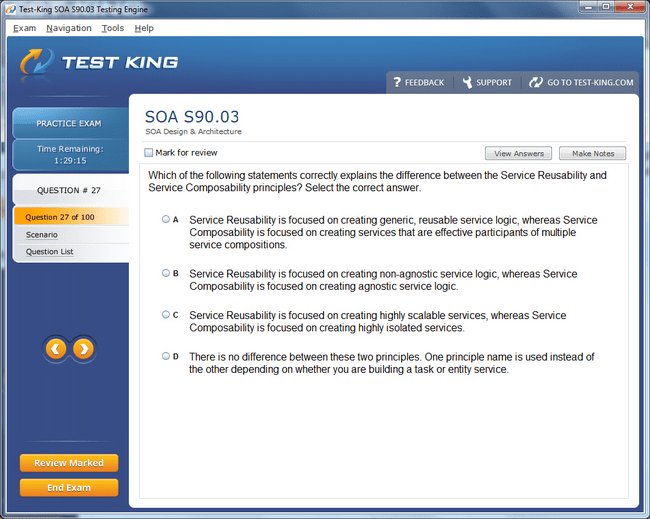
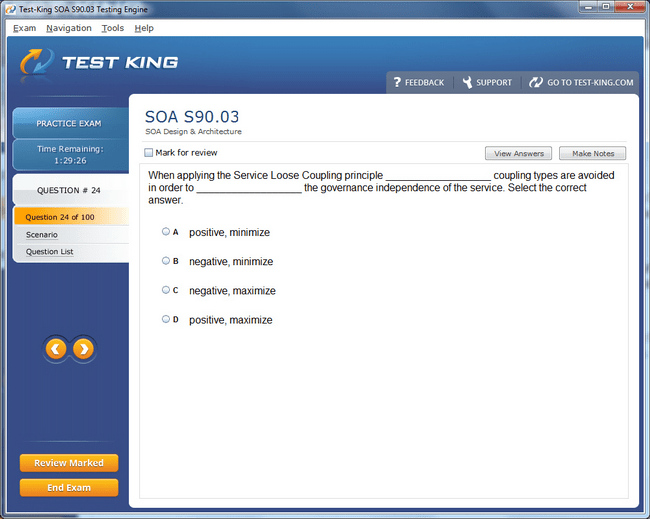
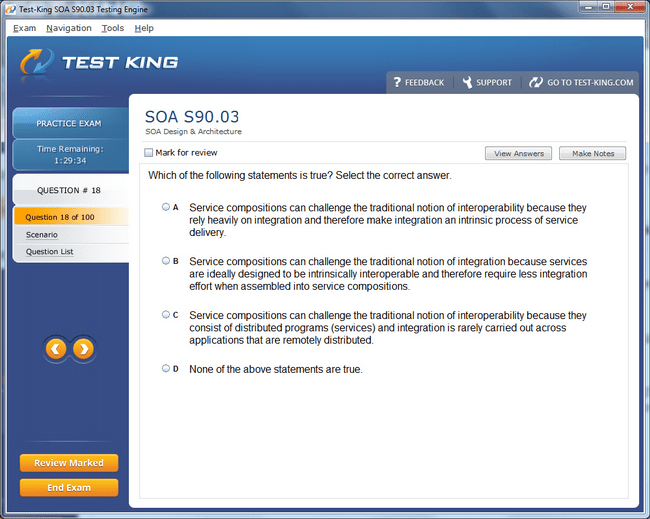
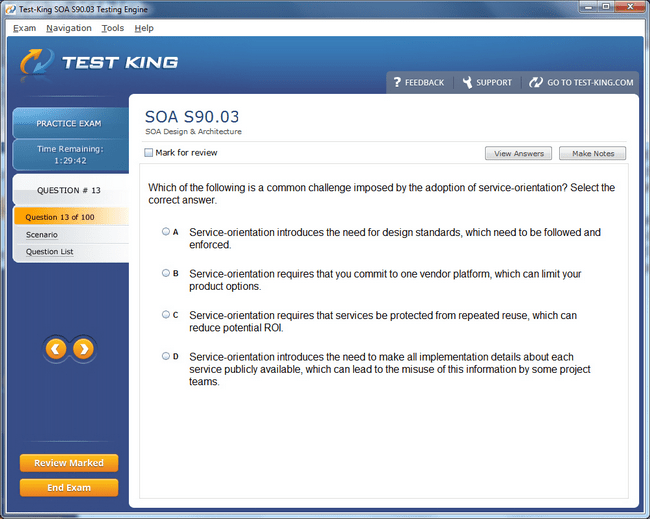
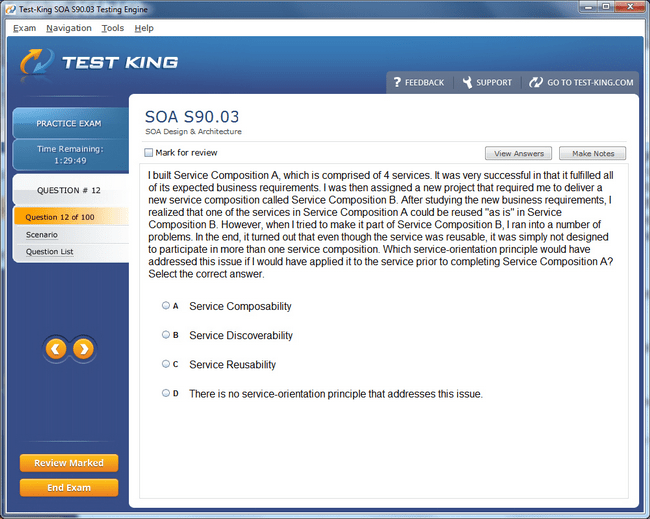
S90.03 Exam Product Screenshots
Frequently Asked Questions
How can I get the products after purchase?
All products are available for download immediately from your Member's Area. Once you have made the payment, you will be transferred to Member's Area where you can login and download the products you have purchased to your computer.
How long can I use my product? Will it be valid forever?
Test-King products have a validity of 90 days from the date of purchase. This means that any updates to the products, including but not limited to new questions, or updates and changes by our editing team, will be automatically downloaded on to computer to make sure that you get latest exam prep materials during those 90 days.
Can I renew my product if when it's expired?
Yes, when the 90 days of your product validity are over, you have the option of renewing your expired products with a 30% discount. This can be done in your Member's Area.
Please note that you will not be able to use the product after it has expired if you don't renew it.
How often are the questions updated?
We always try to provide the latest pool of questions, Updates in the questions depend on the changes in actual pool of questions by different vendors. As soon as we know about the change in the exam question pool we try our best to update the products as fast as possible.
How many computers I can download Test-King software on?
You can download the Test-King products on the maximum number of 2 (two) computers or devices. If you need to use the software on more than two machines, you can purchase this option separately. Please email support@test-king.com if you need to use more than 5 (five) computers.
What is a PDF Version?
PDF Version is a pdf document of Questions & Answers product. The document file has standart .pdf format, which can be easily read by any pdf reader application like Adobe Acrobat Reader, Foxit Reader, OpenOffice, Google Docs and many others.
Can I purchase PDF Version without the Testing Engine?
PDF Version cannot be purchased separately. It is only available as an add-on to main Question & Answer Testing Engine product.
What operating systems are supported by your Testing Engine software?
Our testing engine is supported by Windows. Andriod and IOS software is currently under development.
Understanding SOA Design Patterns for the S90.03 Exam – How to Apply Architecture Patterns Effectively
Service-Oriented Architecture, often abbreviated as SOA, is a paradigm that emphasizes the creation of loosely coupled, reusable services that can interact seamlessly within complex enterprise environments. The design patterns associated with SOA are essential for architects aiming to develop systems that are not only resilient and scalable but also maintainable over long periods. These patterns provide a lexicon and methodology that streamline the process of designing systems, ensuring interoperability across heterogeneous platforms and technologies.
Core Principles of Service-Oriented Architecture and Design Patterns
The foundational principle of SOA is the abstraction of business functionality into discrete services. These services encapsulate specific business capabilities and expose them through well-defined interfaces, allowing for maximum reusability. Understanding how these services interact, and the appropriate patterns to structure their communication, is crucial for the S90-03A exam. One must recognize that SOA is not merely a technical architecture; it represents a comprehensive approach to aligning business processes with IT infrastructure.
Design patterns in SOA serve as tried-and-true solutions to recurrent problems in architecture. For instance, the Service Façade pattern helps simplify complex service interfaces, while the Service Orchestration pattern coordinates multiple services to fulfill complex workflows. The application of these patterns ensures consistency, mitigates redundancy, and enhances the agility of enterprise applications. A practitioner who internalizes these patterns is equipped to design architectures that are both elegant and pragmatic, meeting the nuanced requirements of modern organizations.
The S90-03A exam tests a candidate’s ability to recognize these patterns and their proper application. Questions often revolve around scenarios where multiple services interact, and candidates must identify the pattern that optimally addresses the problem. Mastery of these patterns entails understanding both the structural and behavioral aspects of services, including their interactions, dependencies, and the strategies to decouple tightly bound components.
A central consideration in SOA design is the notion of granularity. Determining the right level of granularity for a service—whether coarse or fine—affects the system’s performance, maintainability, and flexibility. Fine-grained services offer reusability and flexibility but may incur higher communication overhead, whereas coarse-grained services simplify interaction at the cost of reduced modularity. Evaluating trade-offs in granularity is a recurring theme in the exam and in real-world architecture design.
Another pivotal concept is service discoverability. For a service to be genuinely reusable, it must be discoverable within the enterprise environment. Design patterns such as the Service Registry pattern address this requirement by providing a centralized repository where services can be published, cataloged, and located efficiently. This pattern fosters dynamic binding, allowing clients to invoke services at runtime without hard-coded dependencies, a capability that is increasingly crucial in adaptive enterprise systems.
Application of Fundamental SOA Design Patterns
Several design patterns form the backbone of effective SOA implementations. The Service Façade pattern, for instance, acts as a protective layer that simplifies access to underlying services, shielding clients from unnecessary complexity. This pattern is especially relevant when services have evolved over time and accumulated a heterogeneous set of operations that may be confusing to consumers. By applying a façade, architects create a unified and coherent interface, improving usability and reducing the cognitive load on developers interacting with the system.
The Service Adapter pattern addresses a different challenge: integrating legacy systems into a service-oriented ecosystem. Legacy applications often lack the interface or communication protocols expected by modern services. By introducing an adapter, architects can translate between the legacy system’s interface and the service contract, ensuring smooth interoperability. This pattern preserves existing investments while enabling modernization, a common scenario encountered in enterprises preparing for SOA adoption.
Service Orchestration and Service Choreography patterns manage complex interactions between multiple services. Orchestration centralizes control, coordinating services according to predefined business logic, often through a workflow engine. Choreography, by contrast, distributes control, allowing services to interact based on mutual agreements or event-driven protocols. Understanding the differences between these patterns is critical, as the choice affects maintainability, flexibility, and system complexity. Questions on the S90-03A exam may present scenarios where candidates must decide which approach ensures seamless collaboration between services while minimizing coupling.
The Service Proxy pattern introduces an intermediary that handles requests on behalf of clients. Proxies can add valuable functionalities such as caching, logging, and security enforcement without modifying the core service implementation. This pattern enhances scalability and responsiveness, particularly in high-traffic environments, and demonstrates an architect’s ability to foresee operational challenges before they impact performance.
Service Composition, another vital pattern, involves combining multiple services to create composite applications that fulfill broader business objectives. This pattern encourages modularity and reuse, allowing organizations to rapidly assemble new capabilities by leveraging existing services. Understanding when and how to compose services effectively is a key component of exam preparation, as it reflects both technical acumen and business-oriented thinking.
Addressing Common SOA Design Challenges
Designing robust SOA solutions entails overcoming challenges that arise from complexity, heterogeneity, and evolving requirements. One common challenge is service coupling. Excessive coupling reduces flexibility and increases the cost of change, whereas insufficient coordination can lead to fragmented processes and inconsistent data. Patterns such as Service Abstraction and Service Encapsulation are instrumental in mitigating these risks. Abstraction hides implementation details, ensuring that clients depend solely on the service contract, while encapsulation groups related functionalities together, promoting cohesion and reducing unintended side effects.
Another prevalent challenge is ensuring service reliability and fault tolerance. In distributed environments, failures are inevitable, and services must be designed to handle exceptions gracefully. Patterns like the Circuit Breaker pattern provide mechanisms to detect failures and prevent cascading errors across the system. Retry mechanisms, failover strategies, and compensation workflows further enhance robustness, ensuring that business processes continue uninterrupted despite transient faults.
Performance optimization is also a critical consideration. The application of caching, asynchronous messaging, and load-balancing patterns can dramatically improve response times and throughput. For instance, the Service Cache pattern stores frequently accessed data closer to the client, reducing the need for repeated service invocations. Similarly, asynchronous communication patterns decouple request processing from response delivery, allowing systems to handle high volumes of concurrent requests without degradation.
Security in SOA requires thoughtful attention to authentication, authorization, and data integrity. Patterns like the Secure Service Gateway provide a centralized point for enforcing security policies, including encryption, token validation, and access control. By incorporating security considerations into the design from the outset, architects ensure compliance with regulatory standards while maintaining operational efficiency.
Question and Answer Guidance for Exam Scenarios
When preparing for the S90-03A exam, candidates often encounter scenario-based questions. One common example involves a legacy order processing system that must interact with new online services. A suitable approach would involve applying the Service Adapter pattern to bridge the gap between the old and new systems, ensuring seamless communication while preserving existing functionality. In addition, implementing a Service Façade can simplify the interface presented to external clients, allowing them to submit orders without navigating the legacy system’s complexity.
Another typical scenario might require orchestrating multiple services to fulfill a customer onboarding process. Here, Service Orchestration would be appropriate, as it centralizes control and ensures that each step of the workflow executes in the correct sequence. Candidates should also consider incorporating fault-tolerance mechanisms, such as compensating transactions, to handle potential errors during multi-service interactions.
A question could also explore performance challenges in a high-traffic environment. In this case, applying the Service Cache pattern or asynchronous messaging would optimize throughput and responsiveness. Architects must evaluate the trade-offs between immediate consistency and system scalability, demonstrating nuanced understanding of performance implications. The exam may further test knowledge of monitoring and logging strategies to detect bottlenecks and ensure that services continue to meet performance expectations.
In scenarios involving security concerns, candidates might be asked to design a solution where sensitive customer data is exchanged between services. Utilizing a Secure Service Gateway pattern ensures that encryption, authentication, and authorization are consistently applied, minimizing the risk of data breaches. This pattern underscores the importance of proactive design, ensuring that security is integral rather than an afterthought.
Finally, exam questions frequently explore the concept of service reuse. A scenario might present multiple departments requiring similar reporting capabilities. Applying the principles of service granularity, discoverability, and composition allows architects to design reusable services that serve multiple business units, reducing duplication and promoting efficiency. Candidates should articulate how these patterns collectively enhance maintainability, flexibility, and long-term sustainability of enterprise systems.
Advanced Considerations for SOA Architects
Beyond fundamental patterns, advanced architects must consider evolving paradigms such as event-driven SOA, reactive systems, and microservice-influenced design. Event-driven patterns, including Event Notification and Event-Driven Aggregation, enable services to respond dynamically to changes, enhancing system responsiveness and adaptability. These patterns highlight the importance of asynchronous communication, decoupling producers from consumers while maintaining consistent state across distributed environments.
Metadata-driven design is another sophisticated approach. By annotating services with descriptive metadata, architects facilitate dynamic discovery, automated composition, and policy enforcement. Metadata serves as a semantic guide, helping systems understand how services relate, their preconditions, and their expected outcomes. This approach reduces human intervention, allowing systems to self-organize based on predefined rules and patterns.
Service versioning is a subtle yet crucial aspect of SOA design. As services evolve, maintaining backward compatibility while introducing new capabilities requires careful planning. Patterns like Contract Versioning and Adapter Versioning allow systems to accommodate changes without disrupting existing consumers. Mastery of versioning strategies is often tested in the S90-03A exam, as candidates must demonstrate foresight in managing the lifecycle of services in dynamic environments.
Architects should also appreciate the philosophical dimensions of SOA. Beyond technical implementation, SOA embodies a mindset that prioritizes modularity, decoupling, and alignment with business objectives. Applying patterns effectively requires not just memorization, but an understanding of why each pattern exists, the problem it addresses, and the broader organizational context. This holistic perspective distinguishes competent architects from merely technically proficient practitioners.
Deep Dive into Service Composition and Reusability
Service-Oriented Architecture thrives on the ability to construct modular, reusable services that can be orchestrated to fulfill complex business requirements. Service composition is an indispensable strategy in this context, allowing architects to assemble composite applications from existing services rather than building functionality from scratch. By understanding the nuances of service composition, candidates for the S90-03A exam can demonstrate mastery in designing systems that are both agile and resilient.
Composing services effectively requires careful consideration of interdependencies, data flows, and transactional boundaries. Composite services often encompass multiple atomic or coarse-grained services working in concert, and the orchestration of these services must ensure correct sequencing and reliable error handling. While orchestration centralizes control over execution, enabling predictable workflows, it is equally essential to incorporate flexibility for dynamic adaptation. This involves leveraging patterns that allow services to negotiate interactions based on changing business rules or runtime conditions.
Reusability is a pillar of effective SOA design. Services should be designed to maximize applicability across multiple business contexts, reducing redundancy and fostering efficiency. Achieving this entails abstracting common functionality into discrete, loosely coupled services that adhere to well-defined contracts. Patterns such as Service Façade and Service Adapter enhance reusability by providing uniform interfaces and bridging legacy components into modern service ecosystems. Exam scenarios frequently challenge candidates to identify where composition and reuse strategies can reduce complexity and improve maintainability.
The granularity of services plays a crucial role in the effectiveness of composition and reuse. Fine-grained services offer flexibility and granular control, allowing developers to mix and match capabilities to address specific needs. However, excessive fragmentation can lead to performance bottlenecks due to increased communication overhead. Coarse-grained services, in contrast, consolidate multiple functionalities, simplifying interactions but reducing modularity. Successful architects strike a balance, considering both operational efficiency and long-term adaptability, a concept often explored in S90-03A exam questions.
Service discoverability is intrinsically linked to reusability. Without an effective discovery mechanism, valuable services may remain underutilized. Implementing a service registry allows services to be cataloged, annotated with metadata, and located dynamically. This fosters an ecosystem where new applications can leverage existing services without extensive manual intervention. Metadata-driven patterns enhance this approach by providing descriptive information about service capabilities, preconditions, and expected outcomes, facilitating automated composition and intelligent routing.
Orchestration, Choreography, and Event-Driven Interactions
Complex enterprise systems often require coordinated interactions among multiple services. Orchestration and choreography provide two distinct approaches to managing these interactions. Orchestration centralizes control through a workflow engine, dictating the sequence of service invocations and handling exception management. This pattern is ideal when business processes demand a predictable and well-defined execution path. In contrast, choreography distributes control, allowing services to react autonomously to events based on agreed protocols. This approach supports decoupled, event-driven architectures, which are increasingly relevant in dynamic, high-volume environments.
Event-driven interactions enhance responsiveness and adaptability by allowing services to react to changes asynchronously. Patterns such as Event Notification, Event Aggregator, and Event Router enable architects to construct systems where events propagate through the architecture efficiently, triggering appropriate responses without tightly binding producers and consumers. Exam questions often present scenarios requiring candidates to choose between synchronous orchestration and asynchronous event-driven strategies, testing both technical understanding and strategic judgment.
The choice between orchestration and choreography is influenced by factors such as system complexity, performance requirements, and error-handling needs. Orchestration simplifies governance, enabling centralized monitoring and easier debugging, while choreography provides resilience and flexibility, supporting distributed decision-making. Understanding the trade-offs and applying the appropriate pattern is critical for designing robust SOA solutions that meet both functional and non-functional requirements.
Managing Service Contracts, Versioning, and Lifecycle
Service contracts define the interface and expected behavior of a service, serving as a formal agreement between providers and consumers. Effective management of contracts is essential to maintain interoperability and consistency across the enterprise. The Contract Versioning pattern allows services to evolve without disrupting existing consumers by maintaining backward-compatible versions alongside new enhancements. Similarly, Adapter Versioning facilitates integration with updated services while preserving compatibility with older consumers.
Lifecycle management of services encompasses the stages from design and implementation to deployment, monitoring, and retirement. Patterns such as Service Registry and Service Metadata support lifecycle management by cataloging services, tracking usage, and providing insights into performance and reliability. Exam questions often present scenarios where a service must evolve over time while minimizing impact on dependent applications, requiring candidates to apply lifecycle strategies thoughtfully.
Monitoring and governance are integral to lifecycle management. Patterns such as Service Monitoring, Policy Enforcement, and Governance Interceptor enable architects to track service performance, enforce compliance with business rules, and detect anomalies proactively. These mechanisms ensure that services remain reliable and aligned with organizational objectives. Candidates should understand how monitoring and governance complement design patterns, enhancing operational resilience and facilitating continuous improvement.
Handling Security, Reliability, and Fault Tolerance
Security is an omnipresent concern in SOA, encompassing authentication, authorization, encryption, and auditing. Patterns like Secure Service Gateway centralize security enforcement, ensuring that sensitive data is protected and access policies are consistently applied across services. This approach reduces the risk of breaches and simplifies compliance with regulatory requirements. Exam scenarios frequently explore how to design secure interactions between services, requiring candidates to demonstrate both conceptual understanding and practical application of security patterns.
Reliability and fault tolerance are equally critical, particularly in distributed systems where failures are inevitable. The Circuit Breaker pattern prevents cascading failures by halting requests to a malfunctioning service, while retry and failover mechanisms ensure continuity of operations. Compensating transactions allow systems to revert partial operations when errors occur, preserving data integrity. Mastery of these patterns enables architects to construct systems that maintain service levels and ensure business continuity under adverse conditions.
Performance optimization is intertwined with reliability considerations. Patterns such as Service Cache, Asynchronous Messaging, and Load Balancing improve responsiveness and throughput. Caching frequently accessed data reduces the need for repeated service invocations, while asynchronous messaging decouples request processing from response delivery, supporting high-concurrency environments. Load balancing distributes requests evenly across service instances, preventing bottlenecks and enhancing scalability.
Practical Scenarios for the S90-03A Exam
One common exam scenario involves integrating a legacy billing system with a new online payment platform. A candidate might propose applying the Service Adapter pattern to bridge the older system with modern service interfaces, ensuring interoperability without altering core functionality. Additionally, a Service Façade could be introduced to present a simplified interface to the external payment gateway, enhancing usability and shielding clients from underlying complexities.
Another scenario could focus on orchestrating a multi-step customer onboarding workflow involving verification, account creation, and notification services. The appropriate approach would involve Service Orchestration to ensure steps execute in the correct sequence, with compensating transactions in place to handle failures. Security considerations would be addressed by incorporating a Secure Service Gateway, enforcing authentication and encryption policies for sensitive customer data.
High-traffic systems often present challenges related to performance and scalability. Candidates may be asked how to optimize service interactions in a scenario where thousands of requests occur simultaneously. Applying Service Cache, asynchronous messaging, and load-balancing patterns ensures responsiveness while maintaining reliability. Additionally, metadata-driven discovery can dynamically route requests to available service instances, improving efficiency and reducing latency.
A scenario might also examine service reuse across multiple business units requiring similar reporting capabilities. By abstracting common reporting functions into reusable services and cataloging them in a service registry, organizations can avoid duplication and promote consistency. Event-driven aggregation can further enhance efficiency by consolidating data from multiple sources, allowing for timely, accurate reporting without redundant processing.
Versioning and lifecycle management scenarios are frequently included in the exam. Candidates may be asked to design a service that evolves over time without disrupting existing consumers. By employing Contract Versioning and Adapter Versioning, architects ensure backward compatibility, while monitoring patterns provide visibility into service usage, performance, and reliability. Governance policies enforce compliance with organizational standards, ensuring that the service remains aligned with business objectives throughout its lifecycle.
Advanced Patterns and Emerging Concepts
Emerging trends in SOA include event-driven architectures, reactive systems, and microservice-inspired patterns. Event-driven approaches leverage asynchronous communication, enabling systems to respond dynamically to changing conditions. Patterns such as Event Notification, Event Aggregator, and Event Router facilitate scalable and resilient interactions. These patterns highlight the importance of decoupling producers and consumers, allowing services to operate independently while maintaining consistency.
Metadata-driven design represents another advanced concept. By embedding descriptive metadata within services, architects enable dynamic discovery, automated composition, and policy enforcement. This approach reduces manual intervention, allowing systems to self-organize according to predefined rules. Metadata serves as a semantic guide, describing the capabilities, preconditions, and expected outcomes of services, supporting intelligent orchestration and adaptive behavior.
Service versioning and lifecycle management remain critical in evolving environments. As services undergo enhancements or modifications, maintaining backward compatibility ensures continuity for existing consumers. Patterns such as Contract Versioning and Adapter Versioning provide strategies for managing changes without disruption. Candidates should understand the interplay between versioning, monitoring, and governance, ensuring that services evolve in a controlled and predictable manner.
Finally, architects must adopt a holistic mindset, recognizing that effective SOA design extends beyond technical implementation. Patterns exist not merely as templates but as solutions grounded in experience and reasoning. Applying these patterns thoughtfully requires understanding the business context, evaluating trade-offs, and anticipating future requirements. Exam scenarios often test candidates’ ability to synthesize these considerations, demonstrating both conceptual depth and practical insight.
Seamless Integration and Service Interaction Patterns
In Service-Oriented Architecture, integration is the cornerstone that ensures services communicate effectively across heterogeneous systems. Designing an integrated ecosystem requires a nuanced understanding of service interaction patterns, data flow management, and protocol interoperability. Service interaction patterns such as request-response, publish-subscribe, and asynchronous messaging facilitate structured communication between services, promoting efficiency while maintaining decoupling.
Request-response interactions are the most straightforward, involving a client sending a request to a service and waiting for a response. This pattern is ideal for synchronous operations where immediate results are necessary. Publish-subscribe interactions, by contrast, decouple producers and consumers, allowing multiple services to respond to events without direct dependencies. Asynchronous messaging enhances scalability by enabling services to process requests independently, thereby reducing bottlenecks in high-volume environments. Understanding when to apply each interaction pattern is essential for effective architecture design and is a recurring theme in S90-03A exam scenarios.
Service composition often intersects with integration strategies, as composite services rely on orchestrated or choreographed interactions among multiple components. Orchestration centralizes control through a workflow engine, dictating execution sequences and handling exception management. Choreography distributes control, allowing services to interact autonomously based on predefined agreements. Candidates preparing for the exam must recognize the trade-offs: orchestration simplifies monitoring and governance, whereas choreography enhances flexibility and resilience in dynamic environments.
Adapters, facades, and proxies play critical roles in integration. The Service Adapter pattern enables legacy systems to interface seamlessly with modern service ecosystems, translating protocols and data formats. Service Façade simplifies complex or inconsistent interfaces, presenting a coherent abstraction to clients. Service Proxy introduces intermediary layers that can manage caching, logging, and security, providing enhanced operational resilience without modifying the core service logic. Each pattern contributes to a cohesive architecture that balances performance, maintainability, and flexibility.
Data consistency across integrated services is another fundamental consideration. Patterns such as Event Sourcing and Change Data Capture allow architects to track state changes across distributed systems, ensuring that services maintain synchronized views without tight coupling. Implementing these patterns minimizes the risk of data anomalies, reduces manual reconciliation efforts, and supports real-time decision-making in complex business environments.
Governance and Policy Enforcement in SOA
Governance in SOA encompasses the policies, standards, and procedures that ensure services align with organizational objectives and regulatory requirements. Effective governance establishes accountability, enhances maintainability, and mitigates risks associated with inconsistent or unauthorized service usage. Patterns such as Policy Enforcement Point, Governance Interceptor, and Service Registry are instrumental in embedding governance into the architecture.
Policy enforcement centralizes the application of rules regarding security, performance, and compliance. For instance, a Policy Enforcement Point ensures that every service invocation adheres to authentication, authorization, and encryption standards. Governance Interceptors monitor service interactions, logging activity, detecting anomalies, and triggering corrective actions when policies are violated. Service registries catalog available services, providing visibility into usage patterns, versioning, and dependencies, thereby supporting informed decision-making and lifecycle management.
Exam scenarios often present candidates with situations where multiple departments require access to shared services, necessitating consistent governance across organizational boundaries. Applying governance patterns ensures that services are consumed according to established policies, preventing misuse and promoting standardized practices. Metadata-driven governance further enhances this capability by annotating services with descriptive information, enabling automated validation, discovery, and compliance enforcement.
Service-level agreements (SLAs) are another aspect of governance that requires careful consideration. SLAs define performance, availability, and reliability expectations for services. Implementing monitoring patterns such as Service Health Check and Performance Metrics allows architects to track adherence to SLAs and detect deviations proactively. By integrating monitoring with governance mechanisms, organizations can maintain operational excellence while ensuring accountability and transparency in service delivery.
Addressing Security, Reliability, and Compliance
In the context of integration and governance, security, reliability, and compliance are inseparable concerns. Secure Service Gateways and Policy Enforcement Points ensure that sensitive data is protected throughout service interactions, while mechanisms such as encryption, token validation, and access control provide layered defense against unauthorized access. Candidates preparing for the S90-03A exam should understand how these patterns collectively establish a secure, auditable, and compliant architecture.
Reliability in integrated systems often hinges on patterns that manage fault tolerance and resilience. Circuit Breakers prevent cascading failures by detecting malfunctioning services and temporarily halting requests. Retry mechanisms and failover strategies allow systems to recover gracefully from transient errors. Compensating transactions enable distributed services to revert partial operations, preserving data integrity. Exam scenarios frequently require candidates to apply these patterns to maintain operational continuity in multi-service workflows.
Compliance extends beyond technical security measures to include adherence to regulatory and organizational policies. Patterns such as Governance Interceptor and Policy Enforcement Point facilitate automated auditing and reporting, ensuring that service interactions are traceable and conform to predefined standards. Metadata annotation further supports compliance by providing contextual information about services, including ownership, purpose, and regulatory constraints.
Practical Exam Scenarios for Integration and Governance
One typical scenario involves integrating an enterprise resource planning system with a customer relationship management platform. A candidate might recommend applying the Service Adapter pattern to bridge communication protocols, a Service Façade to simplify interfaces for external consumers, and orchestration to coordinate multi-step workflows. Governance mechanisms, including policy enforcement and monitoring, ensure that interactions comply with organizational standards while maintaining reliability and security.
Another scenario may focus on event-driven integration for real-time notifications across multiple services. Implementing Event Notification and Event Aggregator patterns enables asynchronous communication, decouples producers and consumers, and ensures timely processing of updates. Governance patterns such as Service Registry and Policy Enforcement Point ensure that event-driven services operate within defined boundaries and comply with performance and security policies.
High-volume transaction processing presents challenges related to reliability and performance. Applying Circuit Breakers, retry mechanisms, and load-balancing patterns ensures that service interactions remain robust under peak loads. Monitoring patterns provide visibility into system health, enabling proactive remediation and adherence to service-level agreements. Candidates are expected to reason about trade-offs between synchronous and asynchronous processing, latency, and resource utilization when designing solutions.
A scenario may also involve multi-department service reuse, requiring governance policies to regulate access, enforce consistency, and track usage. By applying metadata-driven governance, Service Registry, and Policy Enforcement Points, architects can ensure that services are reused effectively without violating organizational policies. Event-driven aggregation can further streamline reporting and analytics, consolidating data from multiple sources while preserving reliability and consistency.
Versioning and lifecycle management scenarios are common in the exam. Candidates may be asked to evolve a service while preserving backward compatibility for existing consumers. Contract Versioning and Adapter Versioning patterns allow services to evolve without disrupting operations. Service Registry, metadata annotation, and governance interceptors provide visibility, enforce compliance, and facilitate controlled evolution of services throughout their lifecycle.
Advanced Integration and Adaptive Architecture
Emerging approaches in SOA emphasize adaptive architectures capable of responding to changing business requirements with minimal human intervention. Metadata-driven design allows services to describe capabilities, dependencies, and expected outcomes, enabling dynamic discovery and automated composition. Event-driven patterns facilitate reactive behavior, where services respond intelligently to changes in the environment without tight coupling.
Service composition in adaptive architectures often involves orchestrating loosely coupled components while preserving flexibility and resilience. Patterns such as dynamic binding, late-binding service resolution, and runtime policy evaluation allow architects to construct systems that can adapt to unforeseen conditions, scale efficiently, and maintain compliance with governance policies. Exam questions may present candidates with scenarios requiring adaptive responses, testing their ability to integrate patterns for flexibility and operational stability.
Security and reliability in adaptive environments require continuous monitoring, automated enforcement, and proactive fault management. Secure Service Gateways, Circuit Breakers, and Governance Interceptors operate in concert to detect anomalies, enforce policies, and maintain system integrity. Metadata-driven discovery and policy evaluation allow services to negotiate capabilities and constraints dynamically, ensuring that adaptive behavior aligns with organizational objectives.
Finally, architects must balance operational demands with strategic goals. Integration, governance, and adaptive patterns are not merely technical constructs but instruments for achieving business agility, compliance, and efficiency. Mastery of these patterns equips candidates to design architectures that are not only technically robust but also responsive to evolving enterprise needs, a skillset emphasized in the S90-03A exam.
Enhancing System Performance through SOA Design Patterns
Performance optimization is a pivotal concern in Service-Oriented Architecture, as services must respond efficiently under varying workloads while maintaining reliability and consistency. Understanding which design patterns enhance performance is essential for architects preparing for the S90-03A exam. The Service Cache pattern, for instance, stores frequently accessed data closer to the client, reducing repeated service invocations and network latency. This pattern is particularly effective in scenarios where data changes infrequently but is queried extensively, enabling responsive and efficient system behavior.
Asynchronous messaging is another critical pattern for performance enhancement. By decoupling request processing from response delivery, systems can handle high volumes of concurrent requests without bottlenecks. This pattern allows services to continue processing in the background while clients proceed with other operations, enhancing throughput and reducing perceived latency. Event-driven patterns complement asynchronous messaging, allowing services to react dynamically to events, thereby avoiding the overhead associated with continuous polling or synchronous processing.
Load balancing is an additional strategy that ensures optimal utilization of resources. Distributing requests across multiple service instances prevents overload on any single node and maintains consistent response times. Architects must consider strategies such as round-robin distribution, weighted load balancing, and dynamic scaling based on traffic patterns. These mechanisms contribute to resilient, high-performance environments capable of sustaining operational demands even under peak loads.
Service granularity influences performance as well. Fine-grained services, while highly modular and reusable, may incur additional communication overhead, whereas coarse-grained services reduce interaction complexity but may limit flexibility. Optimizing granularity requires balancing modularity with operational efficiency, a nuanced consideration often tested in S90-03A exam scenarios. Candidates should be prepared to articulate the trade-offs and justify the design choices based on workload characteristics, scalability needs, and system complexity.
Fault Tolerance and Reliability Patterns
Distributed systems inherently face challenges related to network failures, service unavailability, and unexpected exceptions. Patterns that enhance fault tolerance are crucial for building resilient SOA systems. The Circuit Breaker pattern detects malfunctioning services and temporarily halts requests to prevent cascading failures. By monitoring failure rates and implementing controlled retries, this pattern preserves system stability and ensures continuity of operations.
Compensating transactions provide a mechanism to revert partial operations when failures occur in multi-service workflows. This pattern is particularly valuable in business processes requiring consistency and data integrity, allowing architects to design systems that recover gracefully from errors without manual intervention. Retry and failover strategies complement compensating transactions by automatically reattempting failed requests or redirecting them to alternate service instances.
Monitoring and logging patterns are indispensable for fault detection and proactive management. Service Health Check, Performance Metrics, and Audit Logging enable architects to observe service behavior, detect anomalies, and implement corrective actions promptly. These patterns also support governance by providing visibility into compliance with operational and regulatory standards. Exam scenarios frequently require candidates to propose combinations of fault-tolerance and monitoring patterns to ensure both resilience and transparency.
The interplay between reliability and performance requires careful attention. Overly aggressive retries can exacerbate system congestion, while insufficient fault management may lead to cascading failures. Architects must balance the trade-offs, applying patterns that maintain responsiveness while safeguarding service availability. Understanding these subtleties is crucial for the S90-03A exam, where scenario-based questions test both conceptual and practical mastery of fault tolerance strategies.
Practical Exam Scenarios for Performance and Fault Tolerance
One scenario may involve a high-traffic e-commerce platform where order processing services experience intermittent latency and occasional failures. A candidate could recommend applying the Service Cache pattern for frequently accessed product and inventory data, reducing repeated queries to backend systems. Asynchronous messaging would decouple order submission from fulfillment processing, enabling efficient handling of large volumes of requests. Circuit Breakers and retry mechanisms would protect the system from cascading failures, while monitoring patterns provide real-time insights into service health and performance.
Another scenario could focus on multi-step financial transaction processing. Compensating transactions would ensure that partially executed operations can be reversed in case of failure, preserving data integrity and customer trust. Load balancing across multiple service instances would maintain consistent throughput, while fault-tolerance patterns such as failover and retry mechanisms ensure uninterrupted service even under hardware or network disruptions. Candidates should be prepared to explain how these patterns collectively maintain operational stability while optimizing performance.
A question might explore event-driven notifications for a distributed reporting system. By implementing Event Notification and Event Aggregator patterns, services can process updates asynchronously, improving responsiveness and reducing the load on central systems. Service Cache could store recently aggregated reports, minimizing repeated processing and accelerating access for end users. Monitoring and logging patterns ensure that delays or failures in the event pipeline are detected promptly and remedied before impacting critical operations.
High-volume analytics platforms present another typical scenario. Fine-grained services may be employed for modular analysis, but communication overhead can degrade performance. Coarse-grained services combined with caching and asynchronous processing can improve throughput. Circuit Breakers, retry strategies, and dynamic load balancing ensure fault tolerance while maintaining performance under unpredictable workloads. Candidates are expected to reason about the architectural trade-offs and propose an integrated approach using multiple patterns to meet performance and reliability requirements.
Advanced Strategies for Adaptive and Resilient Architectures
Emerging concepts in SOA emphasize adaptive architectures capable of dynamically responding to fluctuating workloads and system conditions. Dynamic binding allows services to select alternative endpoints at runtime based on availability or performance metrics. Late-binding service resolution and runtime policy evaluation enable systems to adjust behavior without requiring manual reconfiguration. These strategies enhance resilience, ensure continuous operation, and improve performance under variable conditions.
Metadata-driven design complements adaptive strategies by providing rich contextual information about services. Metadata can describe capabilities, dependencies, expected outcomes, and operational constraints, facilitating automated routing, dynamic composition, and policy enforcement. Event-driven architectures leverage metadata to optimize processing, ensuring that services respond efficiently to relevant events without unnecessary overhead or tight coupling. Candidates preparing for the S90-03A exam must understand how metadata informs intelligent decision-making and operational adaptability.
Service versioning and lifecycle management remain critical considerations. When services evolve, backward compatibility must be maintained to prevent disruption for existing consumers. Contract Versioning and Adapter Versioning patterns allow services to change incrementally while preserving operational continuity. Monitoring patterns provide visibility into usage, performance, and reliability, enabling architects to manage lifecycle transitions proactively. Governance patterns ensure that adaptive behavior remains aligned with organizational policies, regulatory requirements, and operational objectives.
Security in performance-optimized and fault-tolerant architectures requires careful integration. Secure Service Gateways enforce authentication, authorization, and encryption consistently, even in high-concurrency or dynamically adaptive environments. Fault-tolerance mechanisms operate alongside security measures to ensure uninterrupted operation without compromising data integrity or compliance. Exam scenarios frequently challenge candidates to design architectures that balance performance, reliability, and security, demonstrating both conceptual understanding and practical reasoning.
Event-driven orchestration further enhances system responsiveness and resilience. By reacting to changes asynchronously, services can maintain operational continuity without tight coupling or excessive dependency on synchronous interactions. Event Routers, Event Aggregators, and Event-Driven Patterns support scalable, fault-tolerant interactions while optimizing performance. Candidates are expected to articulate how these patterns facilitate adaptive, resilient, and high-performance SOA implementations in practical scenarios.
Finally, architects must recognize that performance optimization and fault tolerance are interdependent aspects of SOA design. Achieving high throughput, low latency, and reliability requires careful selection and integration of multiple patterns, considering trade-offs between modularity, coupling, scalability, and operational complexity. Mastery of these patterns equips candidates for the S90-03A exam to design architectures that perform efficiently under stress while maintaining stability, security, and adaptability in complex enterprise environments.
Continuous Service Monitoring and Performance Insights
Monitoring is a critical component of Service-Oriented Architecture, enabling architects to ensure that services meet operational, performance, and compliance expectations. Service Health Checks, Performance Metrics, and Audit Logging are foundational mechanisms for continuous observation of system behavior. By collecting data on response times, throughput, error rates, and resource utilization, architects gain actionable insights that inform optimization and fault management strategies. Candidates preparing for the S90-03A exam should understand both the technical implementation and the strategic interpretation of monitoring data to maintain robust, reliable systems.
Advanced monitoring approaches integrate proactive anomaly detection and predictive analytics. By analyzing historical patterns, systems can anticipate potential bottlenecks, latency spikes, or service failures before they manifest. Event-driven monitoring enables immediate response to unexpected conditions, facilitating dynamic adjustment of service interactions, load distribution, and resource allocation. Such strategies enhance responsiveness and maintain operational continuity, even under fluctuating workloads or unpredictable events.
Integration of monitoring with metadata-driven design improves visibility and operational intelligence. Metadata provides contextual information about services, including their dependencies, functional capabilities, expected outcomes, and ownership. By correlating monitoring data with metadata, architects can pinpoint the source of performance degradation, understand service interrelationships, and implement targeted interventions. This holistic approach supports both technical troubleshooting and strategic governance, ensuring that monitoring contributes to both resilience and informed decision-making.
Governance Enforcement and Policy Compliance
Governance in SOA is concerned with ensuring that services operate in alignment with organizational policies, regulatory mandates, and industry best practices. Governance enforcement patterns such as Policy Enforcement Point, Governance Interceptor, and Service Registry allow architects to embed rules and controls directly into the service ecosystem. Policies can cover areas including authentication, authorization, data integrity, encryption, and auditing, ensuring that services remain compliant and secure.
Policy Enforcement Points act as gateways through which all service interactions must pass, guaranteeing adherence to security and operational standards. Governance Interceptors monitor interactions in real time, detecting deviations from prescribed policies and initiating corrective actions. Service Registries catalog available services, track usage patterns, and provide visibility into versioning and lifecycle states. Exam scenarios often challenge candidates to design governance strategies that ensure consistency, compliance, and operational transparency across diverse and distributed services.
Metadata-driven governance enhances enforcement by annotating services with detailed descriptions of their functional purpose, dependencies, constraints, and compliance requirements. By leveraging metadata, systems can automate policy checks, dynamically route requests according to compliance rules, and facilitate auditing without extensive manual intervention. Candidates preparing for the S90-03A exam are expected to demonstrate the ability to integrate governance mechanisms with operational monitoring, service composition, and orchestration strategies to create coherent and compliant architectures.
Complex Orchestration and Workflow Management
Orchestration patterns in SOA provide structured control over interactions among multiple services to execute complex business workflows. Centralized orchestration coordinates sequential and parallel processes, ensuring that dependencies are respected, exceptions are handled, and results are aggregated effectively. Workflow engines can manage conditional branching, retries, and compensating actions, allowing architects to design reliable and adaptable solutions that meet business requirements.
Event-driven orchestration enhances flexibility by allowing services to respond autonomously to specific triggers or events. Event Notification, Event Aggregator, and Event Router patterns enable asynchronous execution, decoupling service interactions while preserving the correctness of workflows. This approach reduces bottlenecks, enhances scalability, and supports distributed processing across heterogeneous environments. Candidates should understand the trade-offs between synchronous orchestration and event-driven orchestration in terms of performance, reliability, and operational complexity.
Transactional integrity is a critical consideration in complex workflows. Patterns such as Compensating Transactions and Saga allow multi-service workflows to maintain consistency even when individual steps fail. By defining rollback or compensating actions for each transactional segment, architects can ensure that partial operations do not leave the system in an inconsistent state. These patterns are especially relevant in financial, order processing, and supply chain scenarios, which are frequently tested in the S90-03A exam.
Dynamic service composition further amplifies the complexity and adaptability of orchestrated workflows. By utilizing runtime metadata, late-binding mechanisms, and policy-driven decision-making, services can be composed dynamically to respond to changing business conditions. For example, an order processing workflow could automatically select alternative payment services or shipping providers based on availability, performance, or compliance rules. Candidates must be able to articulate how orchestration patterns interact with monitoring and governance mechanisms to maintain operational stability while supporting dynamic adaptability.
Practical Exam Scenarios on Monitoring, Governance, and Orchestration
A typical scenario might involve a multi-department enterprise application where services for inventory, sales, and customer management must operate cohesively. A candidate could recommend continuous monitoring through performance metrics and audit logging to detect anomalies in real time. Governance enforcement would ensure that all services adhere to security policies, including authentication, authorization, and data encryption. Orchestration patterns would coordinate interactions among services, handling exceptions and maintaining consistency across distributed operations.
Another scenario could focus on a high-volume transaction processing environment where orders must be validated, approved, and fulfilled across multiple services. Event-driven orchestration would allow asynchronous processing of notifications and updates, while monitoring patterns detect bottlenecks or failures. Compensating transactions ensure consistency if a step fails, and governance mechanisms enforce compliance with organizational and regulatory standards. Candidates are expected to demonstrate how these patterns collectively create resilient, efficient, and compliant architectures.
A scenario might explore real-time reporting where multiple services contribute to a consolidated analytics dashboard. Event Aggregator patterns would collect data from diverse sources asynchronously, Service Cache would store frequently accessed metrics to reduce latency, and governance patterns would ensure that sensitive data is processed in accordance with security policies. Monitoring patterns track performance and detect anomalies, providing actionable insights for operational improvement. Candidates should illustrate how the integration of monitoring, governance, and orchestration patterns supports both technical and business objectives.
High-availability systems often present scenarios involving fault-tolerant orchestration. Circuit Breakers and retry mechanisms ensure that transient failures do not disrupt workflows, while dynamic service composition allows the system to route requests to available service instances. Governance enforcement maintains compliance, and metadata-driven monitoring provides visibility into system performance and interactions. Exam questions frequently require candidates to reason about trade-offs, justify pattern selection, and explain the interplay between monitoring, governance, and orchestration to achieve reliability, performance, and adaptability.
Advanced Considerations for Adaptive SOA
Adaptive architectures leverage advanced monitoring, governance, and orchestration patterns to respond dynamically to changing conditions. Predictive monitoring anticipates performance degradation or failures, triggering preemptive adjustments in load distribution or service composition. Event-driven orchestration enables workflows to react intelligently to external or internal events, maintaining business continuity without requiring manual intervention.
Metadata-driven governance ensures that adaptive changes comply with policies, maintain security, and preserve operational integrity. Services annotated with metadata describing capabilities, constraints, and compliance rules can participate in automated orchestration decisions, dynamically adjusting behavior based on current system states. Candidates preparing for the S90-03A exam must understand how these mechanisms enable architectures to be both resilient and adaptive while maintaining visibility, accountability, and compliance.
Security considerations in adaptive architectures are integral to design. Secure Service Gateways, Policy Enforcement Points, and Governance Interceptors operate in concert to ensure that dynamic adaptation does not compromise authentication, authorization, or encryption standards. Monitoring patterns continuously track service health and performance, detecting anomalies early and facilitating automated corrective actions. Exam scenarios often require candidates to design solutions where adaptability, security, and governance coexist seamlessly.
Finally, architects must balance operational agility with control. Advanced monitoring, governance, and orchestration patterns empower systems to adjust dynamically, respond to failures, and optimize performance while ensuring policy compliance. Mastery of these patterns equips candidates for the S90-03A exam to design architectures that are technically robust, operationally resilient, and strategically aligned with business objectives.
Optimizing Service Integration Across Enterprises
Integration is the linchpin of Service-Oriented Architecture, ensuring that services interact seamlessly across diverse and distributed systems. Optimizing integration requires a nuanced understanding of protocols, service interaction patterns, and data transformation techniques. Patterns such as Service Adapter, Service Proxy, and Service Façade are instrumental in bridging heterogeneous systems, translating interfaces, and simplifying complex service interactions. Architects preparing for the S90-03A exam must be adept at selecting patterns that reduce latency, enhance interoperability, and maintain system coherence.
Service adapters allow legacy systems to communicate effectively with modern service ecosystems by translating protocols and data structures. This preserves existing investments while facilitating modernization. Service proxies provide intermediary layers that can implement caching, logging, and security enforcement without altering the core service logic, enhancing operational resilience. Service façades abstract the underlying complexity of multiple services, presenting unified and simplified interfaces to clients, which improves usability and reduces cognitive load.
Efficient integration also demands careful consideration of data flow and message transformation. Patterns such as Data Mapper and Content Enricher standardize communication between services, ensuring that disparate systems can interpret and utilize exchanged data consistently. Data mapping aligns schemas between services, while enrichment adds additional contextual information necessary for downstream processing. Exam scenarios often require candidates to design integration solutions that balance efficiency, reliability, and maintainability, demonstrating an ability to harmonize multiple services into a cohesive enterprise ecosystem.
Service Reuse and Modular Architecture
Reusability is a foundational principle of SOA, promoting efficiency, consistency, and agility across enterprise applications. Services designed for reuse abstract common business functionality and adhere to well-defined contracts, enabling multiple consumers to leverage the same capabilities without redundancy. Patterns such as Service Façade, Service Composition, and Service Registry facilitate reuse by providing unified interfaces, orchestrating multiple services, and cataloging available functionality for discovery.
Determining the appropriate granularity of reusable services is critical. Fine-grained services offer flexibility, allowing components to be composed in diverse ways, but may introduce communication overhead. Coarse-grained services reduce interaction complexity but can limit compositional flexibility. Effective architects balance these trade-offs, designing services that maximize reuse while maintaining operational efficiency, a consideration frequently tested in S90-03A exam scenarios.
Metadata-driven design enhances service reuse by providing detailed contextual information about service capabilities, dependencies, and expected outcomes. This enables automated discovery, intelligent composition, and dynamic adaptation of services. By annotating services with rich metadata, organizations create ecosystems where functionality can be leveraged across departments, geographies, and applications, minimizing duplication and fostering consistency. Candidates should understand how metadata supports both technical implementation and strategic governance in reusable service architectures.
Event-driven patterns further augment reuse by decoupling service interactions and enabling dynamic responsiveness. Event Notification, Event Aggregator, and Event Router patterns allow services to subscribe to or broadcast events without creating direct dependencies, enhancing modularity and flexibility. These patterns are particularly valuable in adaptive architectures, where services must respond to evolving business conditions and operational states dynamically.
Enterprise-Level SOA Strategies and Governance
At the enterprise scale, SOA strategies must balance performance, reliability, governance, and security across heterogeneous systems. Governance enforcement patterns such as Policy Enforcement Points, Governance Interceptors, and Service Registries are critical for maintaining consistency, compliance, and operational transparency. Policies encompass security standards, performance metrics, and regulatory mandates, ensuring that services operate in alignment with organizational objectives.
Enterprise-level orchestration coordinates workflows spanning multiple departments, geographies, or systems. Orchestration patterns manage sequential and parallel execution, handle exceptions, and enforce transactional integrity. Event-driven orchestration allows services to react asynchronously to triggers, enhancing scalability and resilience. Candidates preparing for the exam must demonstrate an understanding of when to apply centralized orchestration versus distributed choreography, weighing factors such as system complexity, operational control, and adaptability.
Monitoring and performance management are integral to enterprise SOA. Service Health Checks, Performance Metrics, and Audit Logging provide visibility into operational behavior, detect anomalies, and inform optimization strategies. Metadata-driven monitoring further enriches this perspective by linking performance data to service capabilities, dependencies, and lifecycle information, enabling proactive intervention and continuous improvement. Exam scenarios often challenge candidates to propose comprehensive strategies that integrate monitoring, governance, and orchestration to maintain enterprise-wide service reliability and performance.
Practical Exam Scenarios on Integration and Reuse
A typical scenario may involve integrating multiple legacy systems across an enterprise to support a unified customer service platform. Candidates might recommend applying Service Adapter patterns to bridge protocol differences, Service Façades to simplify interfaces for end users, and Service Proxies to manage caching, logging, and security. Metadata-driven Service Registries enable discovery and reuse of existing services, promoting consistency and efficiency. Orchestration coordinates interactions among services, ensuring accurate execution of complex workflows.
Another scenario could focus on a financial services environment where multiple departments require access to shared transaction-processing capabilities. Service reuse patterns facilitate the creation of modular services that multiple teams can leverage without duplication. Event-driven architecture allows asynchronous updates and notifications, reducing coupling and improving scalability. Governance enforcement ensures that sensitive data is accessed securely and complies with regulatory requirements. Candidates should articulate how these patterns collectively optimize integration, enhance reuse, and maintain operational stability across enterprise applications.
High-volume analytics platforms present additional scenarios. Composite services aggregate data from various sources, with caching and asynchronous messaging improving performance. Event Aggregators and Event Routers coordinate asynchronous workflows, while monitoring patterns detect anomalies or performance degradation. Metadata-driven governance enforces policies across services, ensuring compliance and operational consistency. Exam questions may require candidates to reason about trade-offs between granularity, modularity, performance, and security, providing integrated solutions for complex enterprise environments.
Service lifecycle management is another common exam focus. Services must evolve without disrupting existing consumers, necessitating strategies such as Contract Versioning and Adapter Versioning. Monitoring, governance, and metadata-driven mechanisms support controlled evolution, ensuring backward compatibility, compliance, and operational continuity. Candidates should understand how lifecycle considerations interact with integration, reuse, and orchestration patterns to create sustainable, scalable enterprise architectures.
Advanced Strategies for Adaptive Enterprise SOA
Adaptive architectures allow enterprises to respond dynamically to changing business conditions, operational demands, and regulatory requirements. Metadata-driven design, dynamic service composition, and event-driven orchestration facilitate intelligent adaptation. Services annotated with detailed metadata can be discovered, composed, and executed automatically based on current conditions, reducing manual intervention and enhancing agility.
Predictive monitoring and analytics anticipate performance issues or failures, triggering automated adjustments in service routing, load balancing, or orchestration sequences. Event-driven interactions allow asynchronous responsiveness, decoupling services while preserving workflow integrity. Security and governance mechanisms operate concurrently, ensuring that dynamic adaptations do not compromise compliance or operational integrity.
Enterprise SOA strategies emphasize balancing control with flexibility. Centralized governance, orchestration, and monitoring provide oversight, while metadata-driven discovery, late-binding, and adaptive orchestration allow responsive behavior. Candidates preparing for the S90-03A exam must demonstrate the ability to integrate these mechanisms into coherent, resilient architectures capable of supporting complex business requirements at scale.
Conclusion
Mastering integration optimization, service reuse, and enterprise-level strategies is essential for designing effective SOA solutions and successfully preparing for the S90-03A exam. By understanding the interplay between integration patterns, reusable service architectures, governance enforcement, orchestration, and monitoring, architects can build systems that are robust, efficient, and adaptable. Metadata-driven design, event-driven patterns, and adaptive workflows enable enterprises to respond dynamically to evolving operational conditions while maintaining compliance, security, and performance. Candidates who internalize these principles, recognize trade-offs, and apply patterns thoughtfully are well-positioned to create sustainable, high-performing SOA architectures that meet complex business objectives.