
Exam Code: 300-635
Exam Name: Automating Cisco Data Center Solutions (DCAUTO)
Certification Provider: Cisco
Corresponding Certifications: CCNP Data Center, DevNet Professional
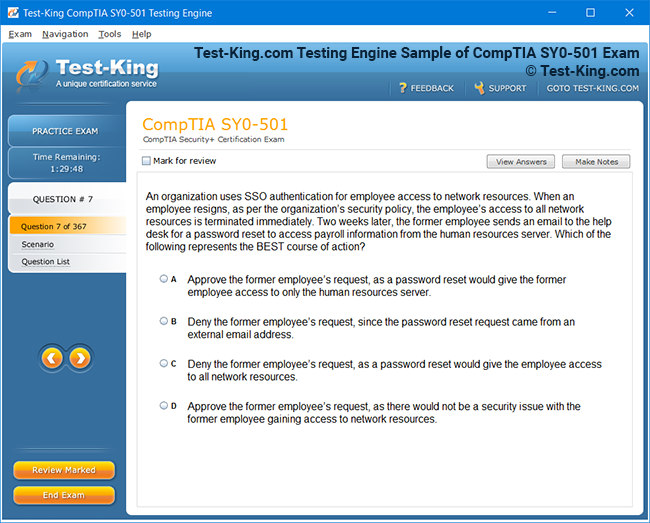
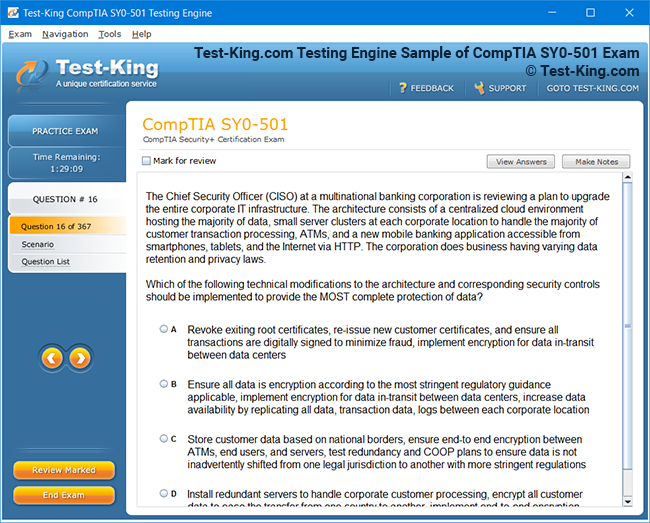
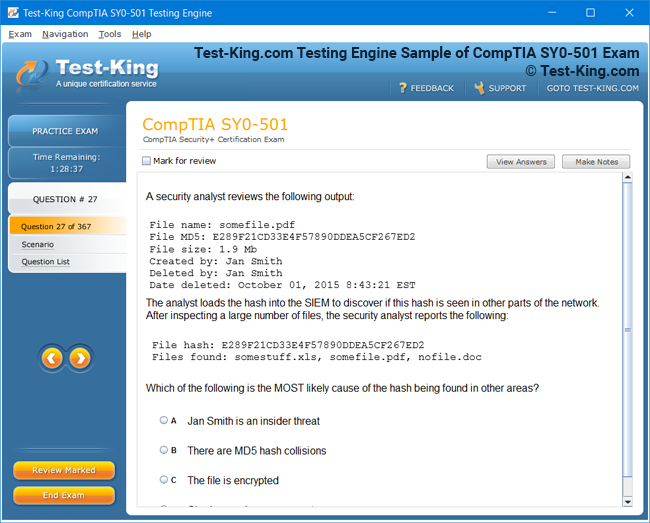
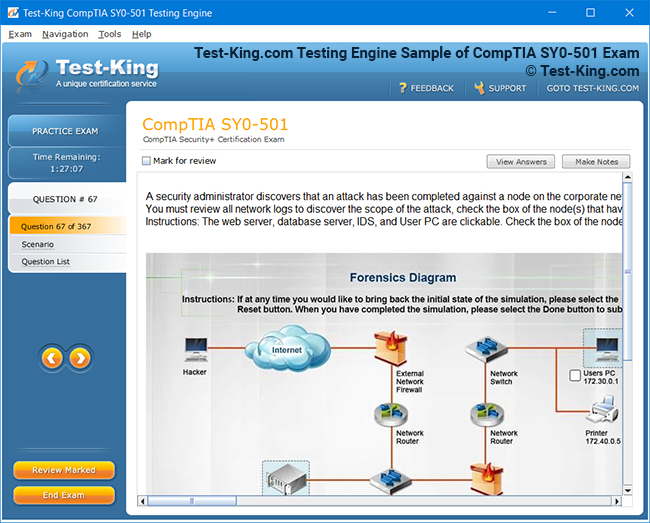
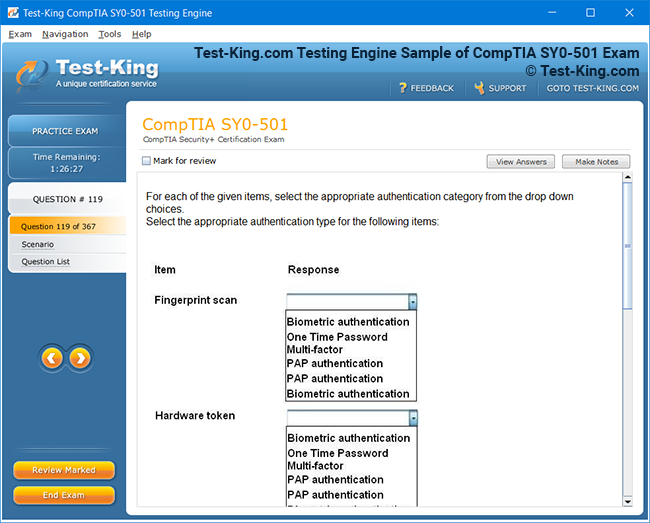
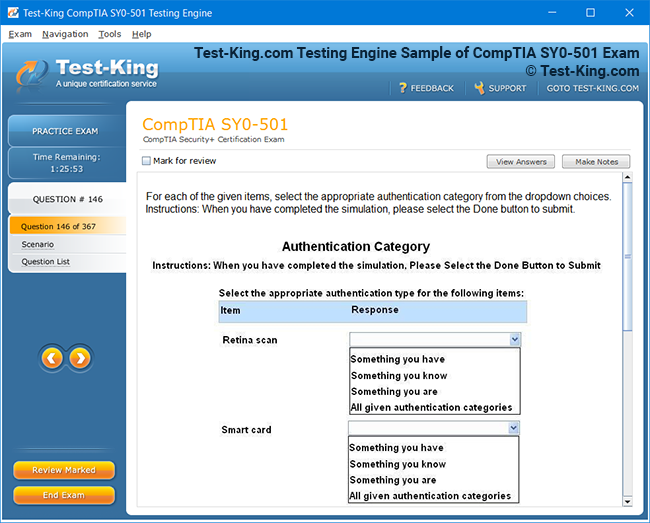
Product Screenshots
Frequently Asked Questions
How can I get the products after purchase?
All products are available for download immediately from your Member's Area. Once you have made the payment, you will be transferred to Member's Area where you can login and download the products you have purchased to your computer.
How long can I use my product? Will it be valid forever?
Test-King products have a validity of 90 days from the date of purchase. This means that any updates to the products, including but not limited to new questions, or updates and changes by our editing team, will be automatically downloaded on to computer to make sure that you get latest exam prep materials during those 90 days.
Can I renew my product if when it's expired?
Yes, when the 90 days of your product validity are over, you have the option of renewing your expired products with a 30% discount. This can be done in your Member's Area.
Please note that you will not be able to use the product after it has expired if you don't renew it.
How often are the questions updated?
We always try to provide the latest pool of questions, Updates in the questions depend on the changes in actual pool of questions by different vendors. As soon as we know about the change in the exam question pool we try our best to update the products as fast as possible.
How many computers I can download Test-King software on?
You can download the Test-King products on the maximum number of 2 (two) computers or devices. If you need to use the software on more than two machines, you can purchase this option separately. Please email support@test-king.com if you need to use more than 5 (five) computers.
What is a PDF Version?
PDF Version is a pdf document of Questions & Answers product. The document file has standart .pdf format, which can be easily read by any pdf reader application like Adobe Acrobat Reader, Foxit Reader, OpenOffice, Google Docs and many others.
Can I purchase PDF Version without the Testing Engine?
PDF Version cannot be purchased separately. It is only available as an add-on to main Question & Answer Testing Engine product.
What operating systems are supported by your Testing Engine software?
Our testing engine is supported by Windows. Andriod and IOS software is currently under development.
Top Cisco Exams
- 200-301 - Cisco Certified Network Associate (CCNA)
- 350-401 - Implementing Cisco Enterprise Network Core Technologies (ENCOR)
- 300-410 - Implementing Cisco Enterprise Advanced Routing and Services (ENARSI)
- 350-701 - Implementing and Operating Cisco Security Core Technologies
- 300-420 - Designing Cisco Enterprise Networks (ENSLD)
- 350-601 - Implementing and Operating Cisco Data Center Core Technologies (DCCOR)
- 300-715 - Implementing and Configuring Cisco Identity Services Engine (300-715 SISE)
- 300-415 - Implementing Cisco SD-WAN Solutions (ENSDWI)
- 810-110 - Cisco AI Technical Practitioner (AITECH)
- 350-801 - Implementing Cisco Collaboration Core Technologies (CLCOR)
- 300-710 - Securing Networks with Cisco Firewalls
- 500-220 - Cisco Meraki Solutions Specialist
- 350-101 - Implementing and Operating Cisco Wireless Core Technologies (WLCOR)
- 300-730 - Implementing Secure Solutions with Virtual Private Networks (SVPN 300-730)
- 400-007 - Cisco Certified Design Expert
- 350-201 - Performing Cybersecurity Using Cisco Security Technologies (CBRCOR)
- 200-901 - DevNet Associate (DEVASC)
- 350-501 - Implementing and Operating Cisco Service Provider Network Core Technologies (SPCOR)
- 200-201 - Understanding Cisco Cybersecurity Operations Fundamentals (CBROPS)
- 100-150 - Cisco Certified Support Technician (CCST) Networking
- 350-901 - Designing, Deploying, and Managing Network Automation Systems
- 820-605 - Cisco Customer Success Manager (CSM)
- 300-620 - Implementing Cisco Application Centric Infrastructure (DCACI)
- 300-435 - Automating Cisco Enterprise Solutions (ENAUTO)
- 300-640 - Implementing Cisco Data Center AI Infrastructure (DCAI)
- 300-745 - Designing Cisco Security Infrastructure
- 300-720 - Securing Email with Cisco Email Security Appliance (300-720 SESA)
- 300-510 - Implementing Cisco Service Provider Advanced Routing Solutions (SPRI)
- 100-140 - Cisco Certified Support Technician (CCST) IT Support
- 300-440 - Designing and Implementing Cloud Connectivity (ENCC)
- 300-610 - Designing Cisco Data Center Infrastructure for Traditional and AI Workloads
- 300-425 - Designing Cisco Enterprise Wireless Networks (300-425 ENWLSD)
- 800-150 - Supporting Cisco Devices for Field Technicians
- 700-805 - Cisco Renewals Manager (CRM)
- 300-220 - Conducting Threat Hunting and Defending using Cisco Technologies for Cybersecurity
- 300-815 - Implementing Cisco Advanced Call Control and Mobility Services (CLASSM)
- 300-215 - Conducting Forensic Analysis and Incident Response Using Cisco CyberOps Technologies (CBRFIR)
- 300-445 - Designing and Implementing Enterprise Network Assurance
- 100-160 - Cisco Certified Support Technician (CCST) Cybersecurity
- 300-515 - Implementing Cisco Service Provider VPN Services (SPVI)
- 500-442 - Administering Cisco Contact Center Enterprise
- 300-635 - Automating Cisco Data Center Solutions (DCAUTO)
- 300-820 - Implementing Cisco Collaboration Cloud and Edge Solutions
- 300-830 - Implementing Cisco Collaboration Cloud Customer Experience (CLCCE)
- 500-443 - Advanced Administration and Reporting of Contact Center Enterprise
- 700-750 - Cisco Small and Medium Business Engineer
- 300-725 - Securing the Web with Cisco Web Security Appliance (300-725 SWSA)
- 010-151 - Supporting Cisco Data Center System Devices (DCTECH)
- 500-470 - Cisco Enterprise Networks SDA, SDWAN and ISE Exam for System Engineers (ENSDENG)
- 300-615 - Troubleshooting Cisco Data Center Infrastructure (DCIT)
- 500-560 - Cisco Networking: On-Premise and Cloud Solutions (OCSE)
- 300-110 - Designing Cisco Wireless Networks (WLSD)
Understanding the Cisco 300-635 DCAUTO Exam and Its Significance
The Cisco 300-635 DCAUTO exam, officially titled Automating and Programming Cisco Data Center Solutions, is a concentration-level assessment within the Cisco Certified Network Professional Data Center certification track that validates a professional's ability to implement automation, programmability, and orchestration solutions across Cisco's data center product portfolio. It represents a significant evolution in how the networking industry thinks about data center operations, reflecting the broad industry shift away from manual, command-line-driven infrastructure management toward software-defined approaches where configuration, provisioning, and monitoring are handled through code, application programming interfaces, and automation platforms that can operate at a speed and scale that human operators working manually simply cannot match.
The credential earned by passing this exam sits at the intersection of two disciplines that were historically quite separate, namely network engineering and software development, and it signals to employers and clients that the certified professional is capable of operating comfortably in both domains simultaneously. Data centers have grown too complex, too large, and too dynamic for manual management to remain viable as a long-term operational model, and organizations that have recognized this reality are actively seeking professionals who can build and maintain the automation frameworks that allow their infrastructure to be managed programmatically. The DCAUTO credential provides a recognized and independently validated signal of this capability that hiring managers and technical leaders can rely upon when making staffing decisions for their data center automation teams.
Exam Format and Scoring
The Cisco 300-635 DCAUTO exam is a ninety-minute assessment that presents candidates with between fifty-five and sixty-five questions covering the full breadth of the published exam topics across data center automation domains. The question formats include multiple-choice single-answer and multiple-answer questions, drag-and-drop exercises where candidates arrange configuration components or workflow steps into correct sequences, and scenario-based questions that present code snippets, API responses, or infrastructure diagrams and ask candidates to identify correct interpretations, locate errors, or select appropriate solutions for described automation requirements. This variety of question formats ensures that the exam tests multiple dimensions of the candidate's knowledge rather than rewarding only one type of recall or reasoning.
The exam is administered through Pearson VUE at authorized testing centers and through the online proctored delivery option that Cisco offers for candidates who prefer to test from their own location under remote supervision. Like other professional-level Cisco examinations, the 300-635 does not have its specific passing score published, though scores are reported on the three hundred to one thousand point scale standard across Cisco certification assessments. Candidates who do not achieve a passing score on their initial attempt must observe a fifteen calendar day waiting period before reattempting, and candidates who accumulate three unsuccessful attempts within twelve months face an additional twelve month waiting period before further attempts are permitted. These policies reflect the professional standard the credential is intended to represent and discourage the repeated testing approach that undermines the integrity of certification programs.
Programmability Foundation Requirements
Before engaging meaningfully with the specific automation tools and platforms covered in the DCAUTO exam, candidates must have a solid foundation in programming and programmability concepts that are prerequisites for everything the exam covers at a more specialized level. Python is the dominant programming language in network automation and is the language around which the DCAUTO curriculum is organized, and candidates who arrive at the exam without genuine Python proficiency will struggle with questions that present code snippets and ask whether they correctly accomplish a described automation task, contain errors that must be identified, or could be improved through alternative approaches. Python knowledge at the level required includes data types, control flow, functions, modules, file handling, error handling, and the use of external libraries that are commonly applied in network automation contexts.
Data formats are equally important as programming language knowledge because virtually all modern automation systems exchange information in structured text formats that code must parse, generate, and manipulate. JSON is the most pervasive data format in API-based automation and appears throughout the DCAUTO curriculum in the context of REST API responses, configuration payloads, and automation tool outputs. YAML is widely used for configuration files and playbooks in tools like Ansible and is the format in which human-readable automation definitions are typically expressed. XML remains relevant in network automation contexts because many network management protocols including NETCONF use it as their data encoding, and candidates must understand how to work with XML documents in Python using appropriate parsing libraries. Understanding the structural characteristics of each format and knowing when each is appropriate is foundational knowledge that the exam builds upon throughout its more specialized topics.
APIs and REST Principles
Application programming interfaces are the technical mechanism through which automation code communicates with infrastructure systems, retrieves state information, and applies configuration changes, and a thorough understanding of REST API principles is one of the most important knowledge areas in the entire DCAUTO curriculum. REST, which stands for Representational State Transfer, is an architectural style for distributed systems that uses standard HTTP methods to perform operations on resources identified by URLs, and virtually every modern Cisco data center product exposes some form of REST API that automation code can use to interact with the system programmatically rather than through a command-line interface or graphical console.
The HTTP methods used in REST APIs each carry specific semantic meaning that automation developers must understand correctly. GET requests retrieve information about a resource without modifying it, POST requests create new resources or trigger actions, PUT requests replace an existing resource with a new representation, PATCH requests modify specific attributes of an existing resource without replacing it entirely, and DELETE requests remove resources. HTTP status codes communicate the outcome of API calls, and candidates must recognize the meaning of common status codes including 200 for success, 201 for successful creation, 400 for bad request indicating a client-side error, 401 for unauthorized indicating an authentication failure, 403 for forbidden indicating an authorization failure, 404 for not found, and 500 for internal server error indicating a problem on the server side. Authentication mechanisms including basic authentication and token-based authentication using OAuth or platform-specific token systems are also examined because interacting with real APIs always requires some form of authentication.
Cisco ACI Automation Topics
Cisco Application Centric Infrastructure is the software-defined networking solution for data center environments that replaces traditional VLAN-based network segmentation with a policy-driven model where network behavior is defined in terms of application requirements rather than physical topology. The DCAUTO exam covers ACI automation extensively because ACI is one of the most widely deployed Cisco data center technologies and because its rich API surface makes it particularly well-suited to programmatic management. The ACI REST API, which exposes the entire ACI object model through a hierarchical URL structure, is the primary interface through which automation code interacts with an ACI fabric, and candidates must understand how to construct API calls that read and write ACI configuration objects.
The ACI object model organizes all configuration concepts into a hierarchical tree of managed objects, each of which has a distinguished name that encodes its position in the hierarchy and a set of properties that define its configuration. Tenants, application profiles, endpoint groups, bridge domains, virtual routing and forwarding instances, contracts, and filters are the primary building blocks of ACI policy configuration, and candidates must understand both what each object type represents and how they relate to one another within the object model hierarchy. The Cobra SDK, which is Cisco's Python SDK for ACI, and the ACI Toolkit, which provides a higher-level abstraction on top of the raw REST API, are both covered in the exam as alternatives to direct REST API interaction that simplify common automation tasks while sacrificing some of the flexibility available through the raw API.
Cisco DCNM and NDFC Automation
Cisco Data Center Network Manager and its successor Nexus Dashboard Fabric Controller are the management and automation platforms for Cisco NX-OS based data center fabrics, providing centralized visibility, configuration management, and automation capabilities across large-scale Nexus switch deployments. The DCAUTO exam covers the REST APIs exposed by these platforms because they represent the primary programmatic interface for automating tasks across NX-OS fabrics that are managed through DCNM or NDFC rather than through direct device-level access. Candidates must understand the authentication workflow for these APIs, the structure of the API endpoints available for different management functions, and how to interpret the responses returned by API calls in order to build automation that can reliably accomplish configuration and monitoring tasks across the managed fabric.
Fabric management automation through these platforms includes tasks like deploying new switch configurations, creating and modifying virtual extensible LAN networks, managing border gateway protocol configurations for VXLAN fabrics, and collecting telemetry data about fabric health and performance. The exam tests whether candidates understand how these automation scenarios map to specific API calls and how the responses from those calls should be processed to confirm successful execution or to identify and respond to failures. Understanding the relationship between the platform-level API and the underlying device configuration that the platform manages is important context that helps candidates reason through complex automation scenarios rather than simply memorizing individual API endpoint behaviors.
NX-OS Programmability Features
Cisco NX-OS, the operating system running on Nexus series data center switches, has extensive programmability features built directly into the operating system that allow automation to interact with individual devices independently of any centralized management platform. The NX-OS REST API, which exposes device configuration and state through HTTP-accessible endpoints following the same managed object model used by ACI but applied to individual switch configuration, is one of the primary programmability interfaces that the DCAUTO exam covers for device-level automation. Candidates must understand how to authenticate to the NX-OS REST API, navigate its object model to find the configuration and state data relevant to automation tasks, and construct the payloads needed to modify configuration through API calls.
Guest shell is a programmability feature that provides a Linux container environment running directly on a Nexus switch where Python scripts and other automation tools can execute with direct access to the switch's management plane. This capability allows automation code to run on the switch itself rather than on an external server, enabling use cases like event-driven automation where the switch directly responds to detected conditions by executing scripts that gather additional information or make configuration adjustments. The Bash shell access available through NX-OS, the execution of Python scripts using the NX-OS embedded Python interpreter, and the use of the Nexus-specific Python libraries that provide direct access to NX-OS APIs from within scripts running on the device are all topics that appear in the exam because they represent important capabilities for device-level automation that differ from the external API access model used in most other automation scenarios.
Ansible for Data Center Automation
Ansible is an open-source automation platform that has achieved widespread adoption in network and data center automation due to its agentless architecture, human-readable playbook format, and extensive library of modules for interacting with network devices and cloud platforms. The DCAUTO exam covers Ansible extensively because it is one of the most practically important automation tools that data center engineers encounter in real environments, and because Cisco has invested in developing Ansible module collections specifically for ACI, NX-OS, and other Cisco data center products that make Ansible a natural choice for Cisco-centric automation projects.
Ansible playbooks are written in YAML and consist of one or more plays that each specify a set of hosts to target and a sequence of tasks to execute against those hosts. Tasks invoke Ansible modules that perform specific automation actions, and the Cisco-specific modules for ACI and NX-OS accept parameters that correspond to the configuration attributes of the objects being managed. Variables, conditionals, loops, and handlers are Ansible constructs that give playbooks the flexibility to handle diverse infrastructure configurations and respond appropriately to different conditions encountered during execution. Inventory files define the hosts that playbooks target and can include host-specific and group-specific variables that customize playbook behavior for different devices. The exam tests candidates on all of these constructs through scenario questions that present playbook excerpts and ask candidates to identify what the playbook accomplishes, locate errors that would prevent correct execution, or determine what output or configuration change would result from a given playbook run.
Terraform Infrastructure Automation
Terraform, developed by HashiCorp, is an infrastructure as code tool that allows infrastructure to be defined in declarative configuration files and managed through a lifecycle of planning, applying, and destroying infrastructure changes in a consistent and repeatable way. The DCAUTO exam covers Terraform in the context of data center automation because it has become a widely used tool for managing infrastructure across cloud and on-premises environments, and because Cisco and its ecosystem partners have developed Terraform providers that allow ACI and other Cisco data center products to be managed through Terraform alongside the cloud infrastructure that Terraform was originally designed to manage.
Terraform configuration files use the HashiCorp Configuration Language, a declarative language where resources representing infrastructure objects are defined with their desired state rather than the procedural steps needed to reach that state. The Terraform workflow of writing configuration, running terraform init to initialize the working directory and download required providers, running terraform plan to preview what changes Terraform will make to bring the actual state in line with the desired state, and running terraform apply to execute those changes is a sequence that the exam expects candidates to understand and be able to apply to data center automation scenarios. State management, which is how Terraform tracks the correspondence between the resources defined in configuration files and the actual infrastructure objects they represent, is a conceptual area that the exam addresses because understanding state is essential for reasoning about how Terraform behaves when configuration changes are made to resources that have already been deployed.
Model Driven Programmability
Model-driven programmability represents a standards-based approach to network automation that uses formal data models to define the structure of configuration and state information, enabling automation tools to interact with network devices in a self-describing, vendor-neutral way that reduces the brittleness of automation built against device-specific CLI output formats. YANG is the data modeling language used to define these models, and candidates must understand its basic syntax and structure because YANG models define the schema that NETCONF and RESTCONF operations operate against. Understanding a YANG model helps automation developers know what configuration parameters exist, what their valid values are, how they relate to one another, and what state information the device can report.
NETCONF is a network management protocol that uses XML-encoded RPCs to retrieve and modify device configuration through a session-oriented connection, and it is one of the primary model-driven management interfaces available on NX-OS and other Cisco platforms. The NETCONF operations including get-config for retrieving configuration, edit-config for modifying configuration, get for retrieving operational state, lock and unlock for preventing concurrent modification, and commit for activating candidate configuration changes are all examined because they represent the building blocks of NETCONF-based automation. RESTCONF is an HTTP-based alternative to NETCONF that exposes the same YANG-modeled data through REST API conventions, making it more accessible to developers who are more familiar with REST API interaction than with NETCONF's XML-RPC model. The exam covers both protocols and tests candidates on their specific capabilities and appropriate use cases.
Continuous Integration and Testing
The application of software development practices to network automation, including version control, automated testing, and continuous integration pipelines, is a topic area that the DCAUTO exam addresses because these practices are increasingly recognized as essential for managing automation code at the scale and reliability level that production data center environments require. Git is the version control system most widely used for network automation code, and candidates must understand the basic Git workflow of initializing repositories, staging and committing changes, creating and merging branches, and pushing and pulling changes to and from remote repositories hosted on platforms like GitHub, GitLab, or Bitbucket.
Automated testing for network automation code encompasses multiple levels of testing that serve different purposes in a continuous integration pipeline. Unit tests validate individual functions and modules in isolation to ensure they produce correct outputs for given inputs, integration tests verify that automation code interacts correctly with the systems it is designed to manage, and end-to-end tests confirm that complete automation workflows produce the intended infrastructure outcomes from start to finish. Python's unittest and pytest frameworks are commonly used for writing and running automated tests for network automation code, and the exam tests candidates on the principles of test-driven development and how automated testing fits into a continuous integration workflow where code changes are automatically tested before being merged into the main codebase and deployed to production automation environments.
Docker and Containerization Basics
Containerization technology has become an important component of the data center automation landscape both as a deployment mechanism for automation tools and as a subject of automation itself, and the DCAUTO exam covers the fundamental concepts and operations of Docker container technology that are most relevant to data center automation practitioners. Containers provide isolated, reproducible execution environments that ensure automation code runs consistently regardless of differences in the underlying host system, solving the common problem where automation that works correctly in a development environment fails in production due to differences in installed libraries, Python versions, or system configuration.
Docker images define the contents of a container environment including the base operating system layer, installed software packages, configuration files, and the automation code itself, and Docker containers are running instances of those images. Building custom Docker images using Dockerfiles, which specify the sequence of commands used to construct the image layer by layer, is a skill the exam covers because data center automation practitioners frequently need to package their automation code and its dependencies into container images for consistent deployment. Running containers with appropriate network and volume configurations, managing container lifecycle through start, stop, and remove operations, and using Docker Compose to define and run multi-container applications that represent more complex automation environments are also covered in the exam to the extent that they are relevant to data center automation use cases.
Study Approach and Lab Practice
Preparing successfully for the Cisco 300-635 DCAUTO exam requires a preparation strategy that balances conceptual learning with hands-on coding and automation practice in a way that builds genuine capability rather than superficial familiarity with exam topics. The conceptual side of preparation is well-served by Cisco's official learning resources including the DCAUTO exam preparation course available through Cisco's learning platform, which provides structured coverage of all exam domains with explanations that connect the topics to real automation use cases. Supplementing this official content with Python programming practice, REST API interaction exercises using tools like Postman or the Python requests library, and study of the specific API documentation for ACI and NX-OS builds the practical skills that the exam's scenario-based questions directly test.
Hands-on lab practice is particularly important for the DCAUTO exam because so much of what it tests is the ability to read and reason about actual code, API responses, and automation tool configurations rather than abstract networking concepts that can be learned through reading alone. Cisco's DevNet platform provides sandbox environments that give candidates free access to ACI and NX-OS infrastructure for practicing automation against real systems without requiring physical hardware, and the DevNet learning labs provide structured exercises specifically designed to build the automation skills the exam covers. Candidates who invest significant time in these sandbox environments writing Python scripts, building Ansible playbooks, constructing Terraform configurations, and exploring NETCONF and RESTCONF interactions will develop the hands-on intuition that distinguishes candidates who genuinely understand automation from those who have only studied about it.
Career Pathways This Certification Opens
The Cisco 300-635 DCAUTO certification opens career pathways that reflect the growing industry demand for professionals who combine deep data center knowledge with genuine software automation skills. Network automation engineer, data center architect, infrastructure as code developer, cloud engineer, and DevOps engineer roles all benefit from the combination of Cisco data center platform expertise and automation capability that the DCAUTO credential validates. These roles consistently rank among the higher-compensated positions in the technology infrastructure space, reflecting the genuine scarcity of professionals who have developed strong skills in both the networking and the software development domains that the DCAUTO credential bridges.
Beyond immediate job placement and compensation impact, the DCAUTO credential positions professionals favorably for the continuing evolution of data center infrastructure toward increasingly software-defined and cloud-integrated architectures. The automation skills validated by the exam, including API interaction, infrastructure as code, model-driven programmability, and continuous integration practices, are skills that transfer across platforms and products as the specific tools evolve over time. A professional who genuinely understands REST APIs, YANG models, and infrastructure as code principles will adapt more readily to new automation platforms and new Cisco product generations than one whose skills are tied to the specific CLI syntax of current product versions, making the DCAUTO credential an investment in long-term career adaptability as well as immediate professional recognition.
Conclusion
The Cisco 300-635 DCAUTO exam and the credential it confers represent one of the most forward-looking and professionally significant certification investments available to data center networking professionals at this stage of the technology industry's evolution. The automation and programmability skills it validates are not niche specializations relevant only to a small subset of data center roles but are increasingly central competencies that organizations expect from any senior data center professional regardless of their primary area of responsibility. As data center infrastructure continues to grow in scale and complexity, and as the pace of change accelerates driven by cloud integration, containerization, and software-defined networking, the ability to manage infrastructure programmatically rather than manually transitions from a differentiating advantage to a baseline requirement for professional effectiveness.
What makes the DCAUTO credential particularly valuable as a career investment is the depth and specificity of what it requires candidates to demonstrate. Passing the exam requires genuine proficiency across Python programming, REST API interaction, platform-specific automation for ACI and NX-OS, multiple automation tools including Ansible and Terraform, model-driven programmability with NETCONF and RESTCONF, and software development practices including version control and automated testing. This breadth ensures that certified professionals have a comprehensive automation skill set rather than narrow expertise in a single tool, making them valuable contributors across the range of automation challenges that real data center environments present rather than being specialists in only one aspect of the automation landscape.
For professionals currently working in data center networking who have not yet engaged seriously with automation and programmability, the DCAUTO exam preparation process itself delivers substantial value regardless of the credential outcome. The process of learning Python, building automation scripts against real ACI and NX-OS APIs in DevNet sandbox environments, writing and running Ansible playbooks, and working through NETCONF and RESTCONF interactions develops capabilities that will make a professional more effective in their current role immediately, not just more competitive for future roles after they have earned the certification. Organizations that invest in developing DCAUTO-level automation skills among their data center engineering teams consistently find that those investments pay returns through faster provisioning, reduced configuration errors, improved consistency across the infrastructure, and the ability to respond to changing business requirements at a speed that manual management cannot approach. The 300-635 DCAUTO exam is the certification industry's recognition of these capabilities, and the professionals who earn it are well-positioned for the data center engineering careers that the next decade of infrastructure evolution will demand.