Exam Code: 010-151
Exam Name: Supporting Cisco Data Center System Devices (DCTECH)
Certification Provider: Cisco
Corresponding Certification: CCT Data Center
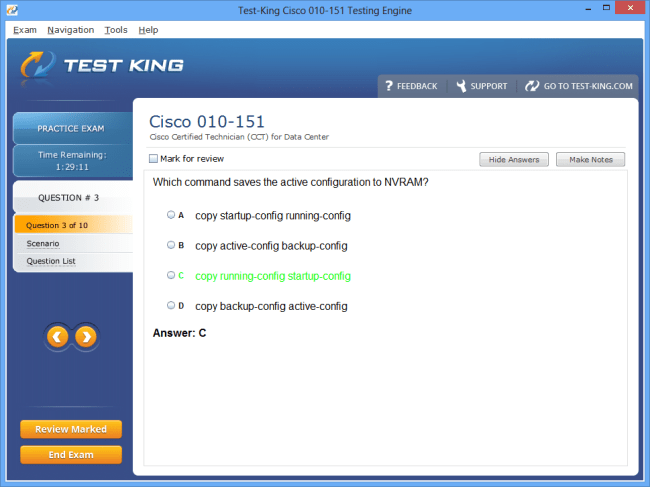
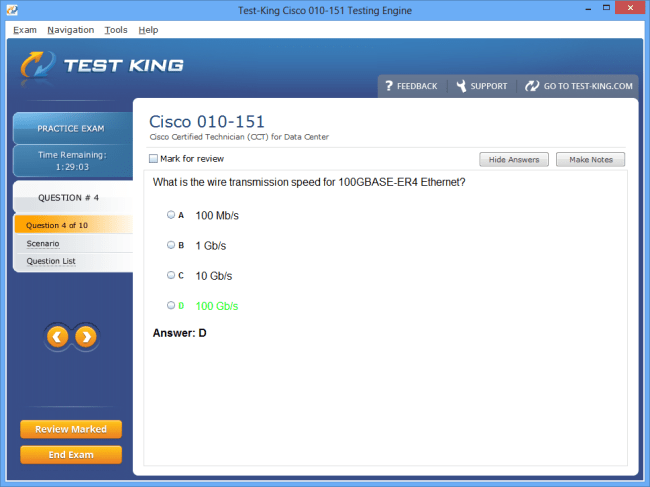
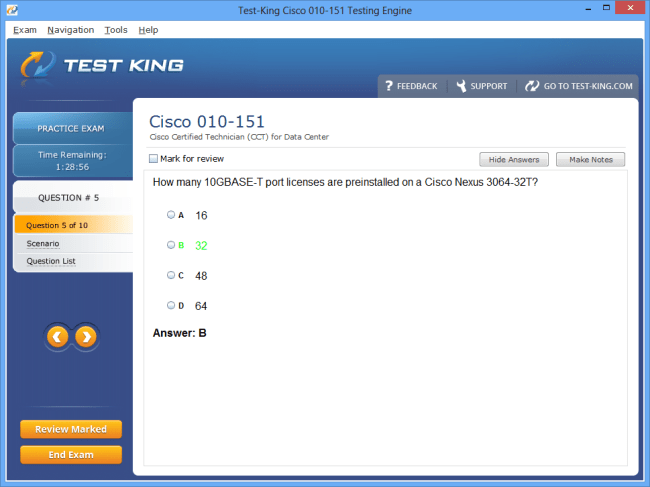
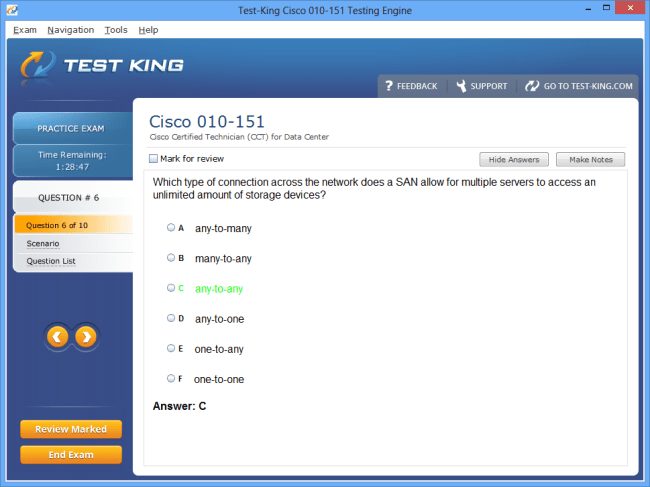
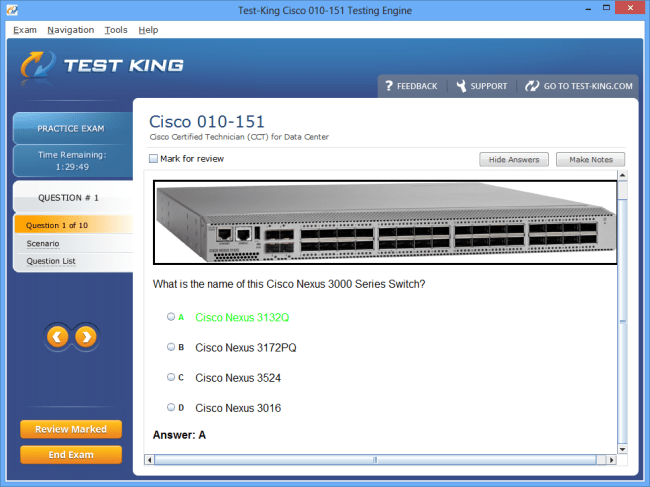
010-151 Exam Product Screenshots
Frequently Asked Questions
How can I get the products after purchase?
All products are available for download immediately from your Member's Area. Once you have made the payment, you will be transferred to Member's Area where you can login and download the products you have purchased to your computer.
How long can I use my product? Will it be valid forever?
Test-King products have a validity of 90 days from the date of purchase. This means that any updates to the products, including but not limited to new questions, or updates and changes by our editing team, will be automatically downloaded on to computer to make sure that you get latest exam prep materials during those 90 days.
Can I renew my product if when it's expired?
Yes, when the 90 days of your product validity are over, you have the option of renewing your expired products with a 30% discount. This can be done in your Member's Area.
Please note that you will not be able to use the product after it has expired if you don't renew it.
How often are the questions updated?
We always try to provide the latest pool of questions, Updates in the questions depend on the changes in actual pool of questions by different vendors. As soon as we know about the change in the exam question pool we try our best to update the products as fast as possible.
How many computers I can download Test-King software on?
You can download the Test-King products on the maximum number of 2 (two) computers or devices. If you need to use the software on more than two machines, you can purchase this option separately. Please email support@test-king.com if you need to use more than 5 (five) computers.
What is a PDF Version?
PDF Version is a pdf document of Questions & Answers product. The document file has standart .pdf format, which can be easily read by any pdf reader application like Adobe Acrobat Reader, Foxit Reader, OpenOffice, Google Docs and many others.
Can I purchase PDF Version without the Testing Engine?
PDF Version cannot be purchased separately. It is only available as an add-on to main Question & Answer Testing Engine product.
What operating systems are supported by your Testing Engine software?
Our testing engine is supported by Windows. Andriod and IOS software is currently under development.
Top Cisco Exams
- 200-301 - Cisco Certified Network Associate (CCNA)
- 350-401 - Implementing Cisco Enterprise Network Core Technologies (ENCOR)
- 350-701 - Implementing and Operating Cisco Security Core Technologies
- 300-410 - Implementing Cisco Enterprise Advanced Routing and Services (ENARSI)
- 300-715 - Implementing and Configuring Cisco Identity Services Engine (300-715 SISE)
- 350-601 - Implementing and Operating Cisco Data Center Core Technologies (DCCOR)
- 300-415 - Implementing Cisco SD-WAN Solutions (ENSDWI)
- 300-420 - Designing Cisco Enterprise Networks (ENSLD)
- 300-425 - Designing Cisco Enterprise Wireless Networks (300-425 ENWLSD)
- 350-801 - Implementing Cisco Collaboration Core Technologies (CLCOR)
- 350-501 - Implementing and Operating Cisco Service Provider Network Core Technologies (SPCOR)
- 300-710 - Securing Networks with Cisco Firewalls
- 400-007 - Cisco Certified Design Expert
- 200-901 - DevNet Associate (DEVASC)
- 200-201 - Understanding Cisco Cybersecurity Operations Fundamentals (CBROPS)
- 300-430 - Implementing Cisco Enterprise Wireless Networks (300-430 ENWLSI)
- 300-620 - Implementing Cisco Application Centric Infrastructure (DCACI)
- 820-605 - Cisco Customer Success Manager (CSM)
- 500-220 - Cisco Meraki Solutions Specialist
- 300-730 - Implementing Secure Solutions with Virtual Private Networks (SVPN 300-730)
- 350-201 - Performing CyberOps Using Core Security Technologies (CBRCOR)
- 350-901 - Developing Applications using Cisco Core Platforms and APIs (DEVCOR)
- 300-435 - Automating Cisco Enterprise Solutions (ENAUTO)
- 100-150 - Cisco Certified Support Technician (CCST) Networking
- 300-815 - Implementing Cisco Advanced Call Control and Mobility Services (CLASSM)
- 300-820 - Implementing Cisco Collaboration Cloud and Edge Solutions
- 300-510 - Implementing Cisco Service Provider Advanced Routing Solutions (SPRI)
- 300-610 - Designing Cisco Data Center Infrastructure for Traditional and AI Workloads
- 300-440 - Designing and Implementing Cloud Connectivity (ENCC)
- 300-445 - Designing and Implementing Enterprise Network Assurance
- 300-735 - Automating Cisco Security Solutions (SAUTO)
- 300-720 - Securing Email with Cisco Email Security Appliance (300-720 SESA)
- 700-805 - Cisco Renewals Manager (CRM)
- 300-745 - Designing Cisco Security Infrastructure
- 300-515 - Implementing Cisco Service Provider VPN Services (SPVI)
- 300-810 - Implementing Cisco Collaboration Applications (CLICA)
- 300-535 - Automating Cisco Service Provider Solutions (SPAUTO)
- 300-725 - Securing the Web with Cisco Web Security Appliance (300-725 SWSA)
- 300-615 - Troubleshooting Cisco Data Center Infrastructure (DCIT)
- 100-490 - Cisco Certified Technician Routing & Switching (RSTECH)
- 300-215 - Conducting Forensic Analysis and Incident Response Using Cisco CyberOps Technologies (CBRFIR)
- 300-835 - Automating Cisco Collaboration Solutions (CLAUTO)
- 500-442 - Administering Cisco Contact Center Enterprise
- 300-635 - Automating Cisco Data Center Solutions (DCAUTO)
- 100-140 - Cisco Certified Support Technician (CCST) IT Support
- 500-470 - Cisco Enterprise Networks SDA, SDWAN and ISE Exam for System Engineers (ENSDENG)
- 300-630 - Implementing Cisco Application Centric Infrastructure - Advanced
- 500-444 - Cisco Contact Center Enterprise Implementation and Troubleshooting (CCEIT)
- 700-750 - Cisco Small and Medium Business Engineer
- 700-240 - Cisco Environmental Sustainability Overview
- 700-245 - Environmental Sustainability Practice-Building
- 800-150 - Supporting Cisco Devices for Field Technicians
Mastering Cisco 010-151 DCTECH Exam Preparation: Comprehensive Insights for Data Center Technicians
Data center technology has become the backbone of modern IT infrastructure, and professionals who can manage these environments are in high demand. The Cisco 010-151 DCTECH exam provides a pathway for technicians to demonstrate their expertise in managing servers, storage, and networking components in enterprise data centers. Preparing effectively for this exam requires a balance between theoretical knowledge and practical experience to ensure real-world readiness.
Many candidates find that starting with guidance on structured exam preparation enhances their chances of success. Understanding how to get exam ready CCNA practice tips provides useful strategies for time management, topic focus, and practice exercises that are relevant even for Cisco data center exams. Integrating such approaches into a study routine can significantly improve understanding and retention.
Adding structured preparation early in the learning process allows candidates to identify weak areas and allocate sufficient time to practice labs, review protocols, and simulate network troubleshooting scenarios. This proactive approach builds confidence, reduces exam anxiety, and ensures that concepts are internalized rather than memorized. In addition, combining this guidance with peer discussion and iterative practice can reinforce learning, enabling candidates to bridge the gap between theory and practical application efficiently.
Understanding the Cisco 010-151 DCTECH Exam
The 010-151 DCTECH exam is designed to test practical skills, including installing, configuring, and maintaining Cisco data center equipment. Candidates must be proficient in areas such as Unified Computing System (UCS) management, network protocols, and storage solutions. The exam emphasizes real-world scenarios, meaning that candidates not only need to memorize concepts but also understand how to apply them in operational environments.
Investing in continuous skill development can accelerate preparation. The strategic use of Cisco learning credits allows candidates to access courses and labs that mirror actual data center configurations, making practice more effective. These credits provide flexibility for hands-on learning and help ensure that preparation is aligned with current Cisco technologies.
Regular engagement with guided learning programs ensures that candidates remain up-to-date with the latest system configurations, protocols, and troubleshooting techniques. Learning credits can also provide access to instructor-led labs and simulations that replicate real-world data center challenges. By actively applying these skills in controlled scenarios, candidates not only reinforce their knowledge but also gain insights into potential operational pitfalls, ensuring they are fully prepared for both the exam and on-the-job responsibilities.
Why the DCTECH Certification Matters
Obtaining the 010-151 DCTECH certification validates practical skills that are crucial for data center operations. Certified technicians can demonstrate competency in installing and managing servers, troubleshooting network and storage issues, and maintaining data center infrastructure. These skills are valuable for employers looking to ensure high availability and operational efficiency.
Candidates often begin their journey by getting started with Cisco Packet Tracer, a tool that simulates network configurations and helps visualize data flow across devices. Using such simulation tools can improve comprehension of networking fundamentals, making subsequent hands-on practice in a lab environment more effective.
Simulation tools also allow candidates to experiment with complex network topologies without risk, helping them understand the behavior of servers, switches, and storage devices under different conditions. Mastery of such tools can significantly reduce trial-and-error in physical labs and improve troubleshooting skills. Furthermore, using simulation in combination with study guides helps bridge theoretical knowledge with practical application, ensuring candidates are fully prepared for the operational demands of a Cisco data center.
Core Exam Domains
The DCTECH exam covers multiple domains, including data center infrastructure, networking, storage networking, troubleshooting, and UCS management. Each domain requires both theoretical understanding and practical skills to ensure effective management of real-world data center scenarios.
When deciding which certifications to pursue first, candidates may compare options to identify the best fit. A comparison of CCNA and DevNet certifications highlights differences in focus areas, exam structure, and career impact, which can help guide the preparation path for technicians aiming for data center roles.
Understanding the relevance of foundational certifications allows candidates to sequence their learning efficiently. For instance, a strong grasp of CCNA concepts before diving into DCTECH ensures that networking fundamentals, such as VLANs, IP addressing, and switching, are solid. This layered approach minimizes knowledge gaps and ensures that advanced topics in UCS management and storage networking are easier to master, ultimately improving both exam performance and on-the-job competency.
Data Center Infrastructure
Understanding servers and their integration into the data center is critical. Candidates must know how to install, configure, and maintain blade servers, rack servers, and associated hardware. Proper configuration ensures optimal performance and reliability.
For those beginning their networking journey, it’s useful to recognize that the CCNA is the best starting point for foundational knowledge. Even though DCTECH focuses on data center operations, CCNA concepts such as IP addressing, VLANs, and routing form the backbone of technical understanding necessary for advanced Cisco certifications.
Building a solid foundation in infrastructure also allows candidates to better understand scalability and redundancy concepts, which are critical for enterprise-level deployments. Knowing how to integrate servers with storage and networking components minimizes downtime and ensures efficient resource allocation. This understanding is essential not only for the exam but also for ensuring reliable and high-performing data center operations in professional settings.
Networking Fundamentals
Networking forms the backbone of every data center. Candidates should be proficient in LAN and VLAN configuration, IP addressing, and the basic routing and switching protocols used in Cisco environments.
Parallel learning in cloud technologies can also enhance networking insight. An official study guide for AWS Developer Associate certification provides concepts that overlap with network and server management, such as virtual networking, load balancing, and connectivity considerations. Bridging these concepts helps candidates understand how on-premises and cloud data centers operate in tandem.
Expanding networking knowledge into cloud environments improves adaptability and problem-solving skills. Cloud-based simulations allow candidates to understand distributed architectures, network latency issues, and interconnectivity between multiple data centers. This perspective enhances their ability to troubleshoot hybrid setups and ensures that exam preparation translates effectively into managing contemporary enterprise infrastructure.
Storage Networking
Data storage knowledge is essential for effective data center management. Candidates need to understand SAN and NAS implementations, Fibre Channel and iSCSI protocols, and troubleshooting storage access and performance issues.
Incorporating cloud storage knowledge can enhance understanding of modern infrastructure. An introduction to AWS Elastic Beanstalk explains how cloud resources are provisioned and managed, offering perspective on how storage allocation, scaling, and networking considerations affect application performance in distributed environments.
Knowledge of cloud storage architecture can also help candidates anticipate potential bottlenecks and design more efficient storage networks. Learning to optimize storage access patterns, configure redundancy, and ensure high availability improves readiness for both the exam and practical responsibilities in enterprise environments. This combination of on-premises and cloud understanding creates a more versatile and competent technician.
Hardware Troubleshooting
Technicians must diagnose and resolve hardware issues with servers, storage arrays, and networking devices. Identifying faulty components quickly minimizes downtime and ensures continuity of services.
Developing familiarity with broader cloud systems also helps in understanding troubleshooting principles. A comprehensive guide to becoming an AWS Cloud Practitioner reinforces best practices for monitoring, configuration, and operational oversight, which parallels problem-solving methods in traditional data center environments.
Applying structured troubleshooting techniques learned in cloud environments allows technicians to approach physical hardware issues more methodically. By documenting problem-solving steps, understanding root causes, and applying preventive measures, candidates develop a more analytical mindset. This methodical approach not only improves exam readiness but also prepares candidates for real-world scenarios where rapid, accurate solutions are required.
UCS Management
Cisco UCS Manager is central to configuring and managing servers in a data center. Candidates must master policies, templates, resource pools, and firmware management to maintain efficient operations.
Advanced certifications can further elevate understanding of these concepts. Introducing the AWS SAP Specialty certification exam highlights integration of enterprise applications with infrastructure, reinforcing the importance of proper configuration, resource allocation, and system monitoring for operational efficiency.
Hands-on UCS management practice helps candidates understand the relationship between hardware and software layers. Learning to implement service profiles, configure pools, and monitor system health ensures efficient resource utilization. This experience is invaluable for both passing the exam and performing effectively in enterprise environments, where managing multiple servers and applications is routine.
Exam Preparation and Strategy
A systematic approach to preparation is critical. Combining study guides, hands-on labs, practice exams, and collaborative learning can maximize retention and skill application. Time management, focus on weak areas, and periodic review ensure readiness.
Candidates should remain aware of updates and changes in both Cisco and cloud platforms. Reviewing AWS exam and certification revisions June 2021 edition highlights the importance of keeping up with current practices, ensuring that knowledge remains aligned with evolving technologies and exam objectives.
By maintaining a structured schedule and balancing hands-on practice with conceptual study, candidates can optimize preparation time. Iterative review of lab exercises, simulations, and exam-style questions strengthens retention, ensures confidence, and reduces stress. Awareness of industry changes and exam updates ensures that candidates are not caught off guard by content revisions, further increasing the likelihood of success.
Modular Design Concepts
Understanding relationships between system components can clarify technical challenges. For instance, learning the differences between Java composition vs aggregation concepts provides insights into modular design, which is applicable when configuring interconnected servers and storage systems. Recognizing these patterns improves system organization and troubleshooting effectiveness.
In addition, focusing on the principles of modular system design encourages technicians to think critically about how each server and network component interacts. Applying these concepts in labs reduces misconfigurations, helps maintain proper hierarchy in UCS setups, and improves the ability to diagnose issues quickly. By simulating realistic environments, candidates also develop a stronger understanding of system dependencies and operational workflows, which are essential skills for both the exam and professional data center operations.
Lab Environment Setup
Creating a realistic lab environment is a key step in preparation. Candidates should aim to replicate data center conditions using either physical equipment or virtual simulations. Setting up servers, switches, and storage devices in a controlled environment allows experimentation with configurations and understanding the impact of network changes.
While configuring the lab, monitoring performance metrics is essential. Updated guide 10 must know indicators for smarter trading demonstrates how monitoring key indicators ensures efficiency, which parallels data center operations where system health metrics help identify bottlenecks, enabling technicians to optimize server and network performance effectively.
Extending the lab setup to include multiple racks or virtualized networks allows candidates to explore load balancing, failover mechanisms, and resource prioritization. This not only deepens technical understanding but also mirrors challenges encountered in enterprise environments, helping candidates anticipate and mitigate potential operational issues before they arise in real-world scenarios. Consistent lab practice builds familiarity, reduces mistakes, and reinforces troubleshooting strategies.
Configuring Network Components
Technicians must master VLAN setup, IP addressing, and routing protocols in a simulated environment before attempting the exam. These configurations ensure that data flows efficiently between servers, storage, and external networks. Understanding how packets move and how devices interact provides a foundation for troubleshooting complex issues.
In programming practice, determining conditions within strings can mirror troubleshooting logic. How to check if a substring exists in a Python string illustrates logical checks that are similar to verifying network configurations or system states, helping candidates approach problem-solving systematically in lab environments.
Extending this analogy, consistently applying step-by-step validation techniques helps technicians identify network misconfigurations, detect duplicate IPs, and resolve routing conflicts. By practicing these checks in labs, candidates learn to systematically isolate problems, test hypotheses, and implement corrective actions efficiently. These logical troubleshooting skills also reinforce exam readiness, allowing candidates to approach scenario-based questions with confidence and precision.
Managing Data Storage
Storage networking is another critical skill. Configuring SANs, NAS, Fibre Channel, and iSCSI storage ensures reliable data access and high availability. Labs should focus on connecting servers to storage arrays and testing data flows to identify potential points of failure.
Understanding the treatment of unstructured or external data can enhance these exercises. Managing external and unstructured data in the data warehouse shows strategies for organizing complex datasets, which parallels how technicians manage diverse storage types in a data center, ensuring consistent access and optimal performance across multiple storage environments.
Incorporating redundancy strategies, replication, and snapshot configurations within storage labs also helps candidates understand disaster recovery planning. Practicing scenarios like sudden storage failure or corrupted files teaches rapid response techniques and the importance of consistent monitoring. These exercises reinforce operational readiness, improve problem-solving speed, and prepare candidates for high-pressure situations that could arise both in the exam and real-world data centers.
Monitoring and Visualization
Monitoring tools help candidates identify network or server issues early in the lab setup. Visual dashboards provide insights into traffic flows, resource usage, and potential bottlenecks, allowing proactive adjustments and troubleshooting.
Using advanced visualization strategies can enhance monitoring. The best data visualization tools in 2025 key features emphasize clarity and actionable insights, which is crucial in a data center context where technicians must quickly interpret system metrics and make informed decisions to maintain uptime and performance.
By integrating real-time monitoring into lab exercises, candidates gain experience interpreting logs, identifying anomalies, and correlating events across servers and storage. Developing the habit of using visualization dashboards improves situational awareness, enhances decision-making skills, and ensures that issues are resolved before impacting service delivery, which mirrors real-world responsibilities in professional data centers.
Field Service Simulation
Technicians should simulate real-life maintenance scenarios, such as replacing faulty blades or configuring additional server racks. Practicing these operations in a lab environment builds confidence and reduces errors during live deployments.
Field service certifications can complement these exercises. The MB-240 certification guide Microsoft Dynamics 365 Field Service highlights structured approaches to managing service tasks efficiently, reinforcing the importance of systematic procedures and attention to detail when performing hardware or software updates in a complex infrastructure.
Simulating unexpected failures or urgent maintenance requests in lab exercises further prepares candidates for unpredictable challenges. Practicing careful documentation, prioritization, and recovery procedures ensures that technicians can maintain high service levels under pressure. These skills translate directly to both exam scenarios and professional environments, where effective field service can prevent costly downtime.
Cloud Integration Practices
Modern data centers often interact with cloud services, making it valuable to understand cloud configuration alongside on-premises equipment. Candidates should practice integrating lab servers with cloud simulations, testing hybrid workloads, and managing connections securely.
Preparation for cloud-related exams can reinforce these skills. The ultimate guide to preparing for the Microsoft Azure AZ-305 exam explains architecture planning and resource allocation in Azure, which helps candidates conceptualize how hybrid networks operate and ensures that their lab practice mirrors real enterprise deployments.
Practicing cloud integration also familiarizes candidates with latency, bandwidth considerations, and security configurations. Understanding how on-premises infrastructure communicates with cloud services improves troubleshooting and prepares candidates to design solutions that meet both performance and compliance requirements. This broader understanding ensures readiness for modern hybrid data centers.
Analyzing Exam Difficulty
Understanding the challenge level of the exam helps candidates allocate study time efficiently. Identifying domains that are historically difficult or require extensive hands-on practice ensures focused preparation.
Microsoft exams provide parallels in difficulty assessment. Understanding the challenge level of the PL-300 exam illustrates how structured evaluation of exam topics can improve study strategies, emphasizing the importance of practice, review, and repeated exposure to problem types similar to what candidates will face in DCTECH.
Analyzing difficulty also encourages candidates to track their progress using checklists and self-assessment. By prioritizing complex scenarios and dedicating more time to challenging modules, candidates can improve weak areas, increase efficiency in labs, and develop the confidence necessary to tackle scenario-based questions during the exam successfully.
Practice Exams and Validation
Regular testing is essential for validating knowledge and improving confidence. Candidates should take simulated exams under timed conditions to gauge readiness, identify weak points, and refine time management skills.
Accessing free practice material can accelerate learning. Free practice questions for Microsoft 365 Administrator exam MS-102 demonstrates the value of repeated testing in a controlled environment, which mirrors how hands-on practice in labs allows technicians to iteratively refine troubleshooting techniques and configuration strategies.
Beyond testing, reviewing results and analyzing mistakes in detail ensures that candidates learn from errors rather than repeating them. Documenting problem areas and practicing corrective actions in the lab reinforces learning. This iterative cycle of practice and review ensures readiness for both the exam and real-world data center responsibilities.
Developing Advanced Skills
After mastering basic configurations and troubleshooting, technicians can practice advanced scenarios such as multi-server deployment, failover strategies, and automated monitoring scripts. These exercises help prepare for real-world responsibilities and complex exam questions.
Learning development concepts in cloud environments can reinforce these skills. Your complete guide to becoming a Microsoft Azure Developer emphasizes building scalable applications and managing infrastructure programmatically, offering insights into automation and orchestration that are increasingly relevant in data center management.
Advanced labs also teach candidates to implement disaster recovery strategies, load balancing, and redundant network configurations. These exercises develop critical thinking, improve resource management skills, and prepare technicians for scenarios that are likely to appear on the exam or in professional data center roles. Proficiency in these areas strengthens both technical expertise and confidence.
Advanced Troubleshooting and Hybrid Networking
Mastery of advanced troubleshooting is crucial for Cisco 010-151 DCTECH exam candidates. While hands-on lab exercises teach basic configuration and monitoring, understanding complex problem-solving and system optimization is key to excelling. Technicians must be comfortable diagnosing connectivity issues, storage failures, and UCS misconfigurations while ensuring minimal downtime and operational continuity.
Candidates can also benefit from understanding broader networking specializations. The AWS Certified Advanced Networking Specialty certification highlights how cloud-based networking concepts intersect with data center operations, giving technicians additional context for multi-environment troubleshooting and reinforcing the importance of structured network management strategies.
Expanding troubleshooting skills to cover cloud and hybrid environments helps technicians anticipate performance bottlenecks, latency issues, and configuration conflicts. This broader perspective allows for proactive problem-solving in complex systems, reducing downtime and improving efficiency, which mirrors the type of scenarios encountered in the DCTECH exam and professional data center roles.
Diagnostic Tools and Techniques
Using diagnostic tools effectively is essential for data center operations. Candidates should learn to leverage logging utilities, monitoring dashboards, and packet analyzers to identify and resolve network, storage, and server issues in real time.
Understanding how automation can aid diagnostics enhances proficiency. The AWS Certified Alexa Skill Builder Specialty illustrates automated workflows and triggers in cloud systems, which parallels how automated monitoring and alerting can streamline identification of performance anomalies in a Cisco data center environment.
Developing a methodical approach to diagnostics ensures that technicians systematically isolate issues without creating additional problems. By simulating failures and practicing root cause analysis in labs, candidates learn to apply structured thinking, which improves response time during both exams and real-world operations. Combining automation with manual monitoring creates a robust troubleshooting framework that is highly valued in enterprise environments.
Leveraging Vendor Preparation Materials
Effective exam preparation requires curated materials. Candidates benefit from guides, labs, and practice tests that reflect real-world scenarios and current exam content. Engaging with multiple formats, including simulations, manuals, and study guides, ensures that all learning styles are addressed.
The vendor test prep platform provides structured content that aligns with certification objectives, helping candidates identify areas requiring additional focus. By using these materials, learners can reinforce their knowledge while familiarizing themselves with the types of questions and problem-solving approaches expected in the exam environment.
In addition, integrating vendor-prepared exercises into hands-on labs enhances retention and builds confidence. Candidates gain practical exposure to system configurations, network monitoring, and hardware troubleshooting, creating a comprehensive understanding that reduces anxiety and increases readiness for both exam and job responsibilities.
Storage and File System Expertise
Managing file systems and storage subsystems is a key component of the DCTECH exam. Technicians must understand RAID configurations, volume management, and disk performance optimization to ensure data reliability and speed.
Advanced certifications can complement these skills. The HFCP certification emphasizes file system management and storage operations, providing additional context for configuring and troubleshooting large-scale storage networks. Understanding how storage hierarchies interact with server workloads is critical for efficient data center operations.
Hands-on practice in creating, modifying, and troubleshooting file systems improves efficiency in data retrieval, backup, and replication processes. Candidates who develop deep storage knowledge can identify potential points of failure before they affect operations, enhancing system resilience and ensuring uptime, which is essential both for exam success and professional practice.
Networking Proficiency
Advanced networking knowledge remains foundational for DCTECH candidates. Beyond basic VLANs and IP addressing, technicians must understand routing protocols, switch optimization, and inter-device communication for seamless connectivity.
Regional and specialized networking certifications provide deeper insight. The KCNA certification offers foundational knowledge that strengthens understanding of networking principles applicable in Cisco data centers. Knowledge gained from such certifications can inform configuration best practices and troubleshooting strategies, improving operational efficiency.
Developing strong networking skills enables candidates to design fault-tolerant architectures, identify bottlenecks, and implement redundancy measures. This comprehensive understanding supports high availability and prepares candidates to solve complex scenarios during the exam, where multiple network elements may fail simultaneously or interact in unexpected ways.
Linux and Open Source Management
Managing Linux-based systems is increasingly important in data centers. Candidates must be proficient with server configuration, user management, permissions, and security practices.
The LFCA certification provides guidance on Linux fundamentals, offering insights into command-line management and system administration techniques relevant to data center operations. Understanding Linux complements UCS management and storage tasks, where many servers run on open-source platforms.
By practicing Linux commands, scripting, and configuration management in a lab environment, candidates improve efficiency in tasks such as automated backups, monitoring, and service deployment. This experience is invaluable for the exam and real-world responsibilities, where Linux proficiency ensures reliable and secure operations across multiple server environments.
Advanced System Administration
Beyond Linux basics, candidates must manage full server lifecycles, including virtualization, patching, and service orchestration. UCS management tools often integrate these tasks, making hands-on experience critical.
The LFCS certification emphasizes real-world administration skills, providing candidates with exposure to server maintenance, troubleshooting, and optimization techniques. Gaining practical experience with these operations reduces errors and improves confidence when handling complex system tasks in a data center.
Advanced administration also includes understanding dependencies between software, hardware, and network configurations. Candidates who master these interactions can anticipate failures, optimize resource allocation, and implement automated solutions to reduce operational overhead. This depth of knowledge strengthens exam performance and professional capability.
Cybersecurity Awareness
Technicians must be aware of cybersecurity principles, including access controls, monitoring for threats, and incident response. Protecting data center assets is critical in today’s threat landscape.
The CyberSec First Responder certification illustrates practical methods for identifying, reporting, and mitigating security incidents. Understanding these practices prepares candidates to handle security-related challenges in labs and production environments, ensuring systems remain secure and compliant with organizational policies.
Integrating security practices into everyday lab exercises helps candidates understand the impact of misconfigurations, open ports, and weak credentials. This hands-on security mindset complements troubleshooting skills, creating a well-rounded technician capable of both maintaining performance and safeguarding sensitive infrastructure.
Specialized Systems Knowledge
Candidates should also be familiar with less common platforms and technologies that may appear in enterprise environments. This includes BSD-based systems, DevOps tools, and specialized deployment workflows.
The BSD Specialist certification highlights administration of BSD systems, which are still used in certain enterprise or legacy environments. Learning these platforms broadens technical flexibility, enabling technicians to handle diverse system landscapes effectively.
Practical exposure to BSD systems, combined with knowledge of mainstream Linux and Windows environments, ensures candidates are prepared for any scenario. This versatility is beneficial in both the exam and professional settings, allowing technicians to adapt quickly to unfamiliar systems while maintaining operational standards.
Automation and DevOps Practices
Automation improves operational efficiency and reduces human error. Candidates should practice creating scripts, configuring automated monitoring, and deploying standardized server templates using DevOps principles.
The DevOps Tool Engineer certification illustrates practical integration of automation tools and processes. Understanding DevOps workflows allows candidates to manage server deployments, updates, and monitoring systematically, reducing configuration drift and improving uptime.
Integrating DevOps into lab practice ensures that technicians can deploy and manage infrastructure consistently and efficiently. These skills also reinforce troubleshooting capabilities, as automated monitoring alerts provide early warnings of potential issues, allowing proactive intervention in both exam simulations and real-world environments.
Data Center Security and Advanced Networking
Security and advanced networking are critical in data center environments. The Cisco 010-151 DCTECH exam emphasizes hands-on knowledge of server infrastructure, storage networks, and network security, making it essential for candidates to understand both hardware and software operational practices. Advanced troubleshooting, security monitoring, and hybrid network management are integral components for maintaining reliable and secure data center operations.
To strengthen these skills, candidates can reference specialized exams like FCSS LED AR 7-6, which emphasizes secure LED configurations and alert monitoring strategies in enterprise networks. Understanding these protocols helps technicians manage system alerts efficiently and ensures rapid response to critical events, reflecting real-world operational requirements.
Focusing on alert and log management not only improves security awareness but also enhances system reliability. Technicians who proactively monitor alerts can prevent downtime, detect intrusions, and maintain high availability. Incorporating these practices into lab simulations ensures that candidates gain both practical and conceptual understanding, preparing them for both exam scenarios and professional responsibilities.
Network Threat Identification
Detecting and mitigating threats is essential for data center operations. Candidates should understand intrusion detection systems, firewall configurations, and event logging to ensure systems remain secure.
Exams like FCSS NST SE 7-4 highlight network security fundamentals, teaching candidates to identify suspicious activity and implement preemptive controls. These principles directly relate to Cisco DCTECH, where technicians must monitor data flow, detect anomalies, and ensure network integrity under operational stress.
Practical exercises in threat identification teach candidates to respond to both internal and external risks. Using lab environments to simulate attacks or misconfigurations improves troubleshooting skills and promotes a structured approach to incident response. This proactive methodology ensures candidates are confident in maintaining secure data centers and excelling in the exam’s scenario-based questions.
Secure Device Configuration
Ensuring that devices are securely configured is a critical responsibility of data center technicians. Configurations should prevent unauthorized access, enable monitoring, and comply with operational policies.
The FCSS NST SE 7-6 exam provides guidance on secure device setup, including firewall rules, authentication measures, and access controls. Candidates can apply these principles in their labs to replicate secure operational environments, improving both practical knowledge and exam readiness.
Practicing secure configurations ensures that candidates understand potential vulnerabilities and the steps required to mitigate them. By systematically applying security settings in lab simulations, technicians reinforce good practices, gain confidence in handling complex equipment, and develop a mindset focused on operational resilience and data protection.
SASE Implementation and Management
Secure Access Service Edge (SASE) is increasingly used in hybrid environments. Candidates must understand how SASE integrates with existing data center operations, ensuring secure connectivity for remote users and cloud applications.
Exams like FCSS SASE AD 23 emphasize policy configuration and secure access management. Understanding these practices is valuable for Cisco DCTECH candidates who are tasked with managing both on-premises and cloud connectivity efficiently, balancing security and performance.
By practicing SASE deployment in labs, technicians learn to configure policies, monitor traffic, and enforce security measures consistently. These exercises improve troubleshooting capabilities, as understanding traffic flows and authentication mechanisms is crucial when managing hybrid enterprise networks and preparing for scenario-based exam questions.
SASE Policy Optimization
Optimizing SASE policies ensures efficient data flow while maintaining security. Candidates should practice configuring access rules, quality of service, and threat detection across multiple endpoints.
The FCSS SASE AD 24 exam highlights techniques for monitoring and refining policy configurations to meet performance and security objectives. Integrating these practices into lab exercises mirrors real-world tasks where technicians balance connectivity needs with operational risk.
Refining SASE policies requires careful testing and observation of network behavior. Practicing these scenarios helps candidates develop a mindset for continuous improvement, ensuring that configurations remain effective under different load conditions. This approach strengthens exam performance and professional readiness for managing dynamic network environments.
Advanced SASE Scenarios
Complex SASE scenarios include hybrid deployments with multiple cloud providers and dynamic user access requirements. Candidates must be able to implement scalable, secure solutions that maintain compliance and minimize latency.
The FCSS SASE AD 25 exam demonstrates best practices for advanced configuration, including traffic segmentation, secure routing, and automated threat mitigation. Applying these concepts in labs enhances problem-solving skills and helps candidates anticipate potential network conflicts or security gaps.
By simulating advanced scenarios, technicians gain insight into real operational challenges. Practicing load balancing, policy prioritization, and endpoint monitoring ensures that candidates are prepared to manage complex enterprise environments efficiently, enhancing both exam readiness and practical expertise.
SD-WAN Architecture
Software-Defined Wide Area Network (SD-WAN) is increasingly used to optimize data traffic across multiple locations. Candidates must understand deployment strategies, routing mechanisms, and monitoring practices to ensure network efficiency.
The FCSS SDW AR 7-4 exam highlights SD-WAN configuration and performance monitoring techniques. Understanding these principles allows candidates to design optimized routing strategies and troubleshoot potential latency or connectivity issues in multi-site deployments, aligning closely with DCTECH operational requirements.
Practicing SD-WAN in lab environments teaches candidates to analyze traffic flows, configure overlay networks, and implement failover strategies. These exercises develop critical thinking skills and prepare candidates to manage enterprise-scale networks with high availability, both for exam scenarios and professional operations.
SD-WAN Troubleshooting
Identifying and resolving SD-WAN issues is a critical skill. Candidates must detect misconfigurations, connectivity failures, and performance bottlenecks while maintaining operational continuity.
The FCSS SDW AR 7-6 exam emphasizes practical troubleshooting techniques, including log analysis and monitoring metrics. Applying these methods in labs helps candidates gain confidence in diagnosing problems and implementing corrective actions efficiently.
Simulating SD-WAN failures in lab setups allows technicians to practice problem isolation, resource reallocation, and automated recovery. These exercises strengthen logical reasoning, reduce error rates, and improve exam performance while reinforcing professional skills for managing resilient and reliable data center networks.
SOC Analysis Skills
Data center technicians must understand the principles of Security Operations Center (SOC) monitoring and analysis. Detecting anomalies, analyzing alerts, and responding appropriately are essential skills.
The FCSS SOC AN 7-4 exam illustrates monitoring methodologies and threat assessment techniques. Practicing these skills enables candidates to manage security alerts, identify potential intrusions, and maintain operational integrity in data centers, which directly complements DCTECH objectives.
Hands-on exercises in SOC analysis help technicians interpret alerts, correlate events, and implement remediation procedures quickly. Developing this expertise ensures that candidates are prepared for exam scenarios involving security incidents and equips them with professional skills necessary for enterprise data center security operations.
Firewall and Threat Management
Managing firewalls and network security is essential for preventing unauthorized access and mitigating threats. Candidates should practice configuring rules, monitoring logs, and implementing secure access policies.
The NSE4 FGT 6-4 exam focuses on firewall management, security policies, and threat mitigation techniques. Applying these methods in lab exercises ensures that candidates can protect data center resources while maintaining performance and compliance.
By simulating potential attacks or misconfigurations, technicians learn to apply structured security responses. This practice enhances troubleshooting skills, reduces risk exposure, and ensures that both exam scenarios and professional operations can be handled effectively, maintaining the integrity and reliability of enterprise data centers.
Advanced Fortinet Security for DCTECH
For advanced Cisco 010-151 DCTECH exam preparation, understanding enterprise security appliances and Fortinet technologies is essential. Candidates must be comfortable with firewall policies, endpoint protection, and management tools while ensuring data center integrity and network performance. Mastery of these advanced systems builds confidence for both the exam and professional responsibilities.
Fortinet certifications provide a structured learning path. The NSE4 FGT 7-0 exam emphasizes advanced firewall configuration, VPN management, and security policies. Understanding these systems in depth allows technicians to handle complex traffic flows and security scenarios, ensuring a robust enterprise network environment and exam readiness.
Expanding knowledge in Fortinet technologies also prepares candidates for troubleshooting distributed networks. Simulated lab exercises can focus on policy enforcement, VPN tunnels, and system logs, which enhance problem-solving skills and strengthen the ability to manage high-traffic environments efficiently.
Advanced Firewall Administration
Effective firewall administration is critical for data center security. Candidates should practice configuring rules, monitoring events, and enforcing compliance with organizational policies.
The NSE4 FGT AD 7-6 exam highlights best practices for advanced firewall deployment, including high-availability clusters and traffic shaping. Lab practice simulating these configurations allows candidates to experience operational challenges and learn effective mitigation strategies while preparing for scenario-based exam questions.
Hands-on exercises also teach candidates how to identify misconfigurations, prevent unauthorized access, and ensure consistent uptime. These skills are directly applicable to both exam scenarios and enterprise environments, where firewall integrity is critical for secure and reliable network operations.
Endpoint Detection and Response
Data center technicians must understand endpoint monitoring and threat detection to prevent security breaches. EDR systems provide visibility into endpoint activity and facilitate proactive threat mitigation.
The NSE5 EDR 5-0 exam demonstrates endpoint protection strategies, incident investigation, and automated response. Candidates can use lab environments to simulate attacks, analyze alerts, and implement corrective measures, reinforcing practical skills essential for exam readiness and operational security.
Practicing endpoint monitoring ensures that candidates can quickly detect anomalies, respond to potential compromises, and maintain high system availability. Understanding these processes also improves decision-making and strengthens confidence in managing enterprise security infrastructures.
Fortinet Access Zones
Configuring access zones and security policies is essential to segregate traffic and protect sensitive resources. Candidates should understand how to map user groups, devices, and servers into appropriate security zones.
The NSE5 FAZ 6-4 exam focuses on FortiAnalyzer deployment and policy-based monitoring, which enhances visibility into security events across multiple access zones. Implementing these practices in labs teaches candidates to optimize policy placement and minimize risk exposure.
Understanding access zone design improves overall security posture by reducing lateral movement risks and ensuring that critical systems remain isolated from potential threats. Candidates gain hands-on experience in policy creation, logging, and auditing, which mirrors operational realities in enterprise data centers.
FortiAnalyzer Advanced Reporting
Generating actionable reports is vital for enterprise security management. Candidates must learn how to configure dashboards, generate alerts, and produce comprehensive security summaries for analysis.
The NSE5 FAZ 7-0 exam emphasizes advanced reporting techniques and real-time monitoring. Practicing these functions in lab exercises allows candidates to interpret system performance, identify recurring issues, and improve overall network security management.
Advanced reporting also helps technicians track trends, measure policy effectiveness, and provide documentation for compliance audits. This capability reinforces analytical thinking, improves preventive maintenance, and equips candidates to respond efficiently to operational incidents, enhancing exam readiness and professional competency.
FortiAnalyzer Policy Tuning
Optimizing security policies ensures both protection and performance. Candidates should learn how to adjust rules, prioritize traffic, and balance security enforcement across high-traffic networks.
The NSE5 FAZ 7-2 exam highlights policy tuning, anomaly detection, and system optimization strategies. Applying these concepts in lab environments improves candidates’ ability to maintain secure yet efficient networks, while providing practical insight into real-world traffic management.
Practicing policy adjustments also develops troubleshooting skills, enabling candidates to identify potential bottlenecks, misconfigurations, or conflicts before they affect operational performance. This hands-on approach builds confidence and ensures candidates can handle complex configurations during exams and professional tasks.
FortiCloud Traffic Analysis
Analyzing traffic data across multiple devices is critical for proactive threat detection and performance optimization. Candidates must understand log aggregation, anomaly detection, and alert prioritization.
The NSE5 FCT 7-0 exam demonstrates techniques for traffic correlation and identifying security threats in complex enterprise networks. Practicing these techniques in lab simulations enables candidates to interpret patterns, investigate incidents, and respond effectively to potential vulnerabilities.
Traffic analysis exercises teach candidates to detect unusual behavior, plan mitigation strategies, and optimize network throughput. These skills directly translate to both exam performance and enterprise-level security operations, ensuring a proactive approach to system management.
FortiManager Centralized Control
Managing multiple devices efficiently requires centralized administration. FortiManager provides configuration, policy deployment, and monitoring across large networks.
The NSE5 FMG 6-4 exam covers multi-device management, device grouping, and centralized logging. Lab exercises simulating these configurations teach candidates to manage distributed networks effectively, reduce configuration drift, and enforce consistent security policies across environments.
Centralized control also improves operational efficiency by streamlining updates, automating backups, and reducing manual error. Candidates who practice with FortiManager gain skills essential for enterprise-scale management and scenario-based exam questions requiring coordination across multiple systems.
FortiManager Advanced Deployment
Deploying complex network infrastructures involves coordinated device and policy management. Candidates must learn to implement automation, backup strategies, and hierarchical configuration management.
The NSE5 FMG 7-2 exam emphasizes advanced deployment strategies, automation scripting, and monitoring large-scale networks. Practicing these tasks in labs helps candidates refine operational processes and prepare for real-world network challenges while reinforcing exam objectives.
Understanding deployment workflows ensures technicians can efficiently provision devices, manage policy propagation, and maintain high network availability. This skillset is crucial for both the exam and professional responsibilities in enterprise data center environments.
FortiSIEM and Security Orchestration
Implementing Security Information and Event Management (SIEM) solutions ensures coordinated monitoring and incident response across complex infrastructures. Candidates should practice event correlation, alert management, and automated response workflows.
The NSE5 FSM 5-2 exam demonstrates SIEM deployment and orchestration capabilities. Lab exercises applying these practices allow candidates to proactively detect threats, correlate incidents, and improve overall security operations while preparing for advanced scenario questions in the DCTECH exam.
By simulating alert scenarios, technicians gain experience in prioritizing incidents, coordinating responses, and analyzing security metrics. This hands-on approach enhances analytical skills, operational readiness, and exam preparedness while ensuring that enterprise networks remain secure and resilient.
Conclusion
Mastering the Cisco 010-151 DCTECH exam requires a comprehensive approach that balances theoretical knowledge with practical application. Candidates must develop a strong foundation in data center operations, understanding server infrastructure, storage management, networking, and security principles. While memorizing concepts is useful, hands-on practice in lab environments is essential for translating theory into actionable skills. Engaging with simulated scenarios, configuring network devices, and troubleshooting storage and server issues cultivates the technical confidence required to address real-world challenges effectively.
In addition to foundational skills, advanced troubleshooting and system optimization play a critical role in exam readiness and professional competence. Technicians must be adept at analyzing network traffic, diagnosing misconfigurations, and implementing corrective measures in complex environments. Structured problem-solving techniques, combined with iterative lab practice, allow candidates to identify root causes efficiently and develop reliable solutions. This approach ensures that exam preparation aligns with operational realities, equipping technicians to manage enterprise data centers with minimal disruption.
Data center security is another cornerstone of preparation. Technicians need to understand firewall management, endpoint protection, and policy enforcement to safeguard sensitive data. Implementing robust monitoring, log analysis, and threat mitigation strategies ensures that networks remain secure and resilient against potential vulnerabilities. Practicing these skills in controlled environments reinforces critical thinking and develops a proactive mindset, enabling technicians to anticipate issues and respond swiftly. Security competence also builds confidence in both exam scenarios and real-world operations, where timely intervention can prevent downtime and data loss.
Modern data center management increasingly involves hybrid networks and cloud integration. Technicians must understand how on-premises infrastructure interacts with cloud services, manage secure connectivity, and optimize resource allocation. Skills such as traffic analysis, SASE configuration, and automated monitoring enhance operational efficiency and allow for seamless communication across distributed systems. Exposure to cloud and hybrid network scenarios strengthens both exam performance and practical readiness, as candidates learn to design scalable, secure, and highly available environments.
Finally, enterprise-level management and automation are critical for sustaining complex data center operations. Centralized administration, policy orchestration, and automation tools enable technicians to maintain consistency across multiple devices, reduce human error, and optimize performance. Mastery of these advanced tools allows candidates to handle high-demand environments efficiently, manage system updates, and enforce security policies at scale. Continuous lab practice, coupled with exposure to real-world deployment challenges, reinforces technical proficiency and decision-making skills.