

Exam Code: 4A0-114
Exam Name: Nokia Border Gateway Protocol Fundamentals for Services
Certification Provider: Nokia
Corresponding Certification: Nokia NRS II
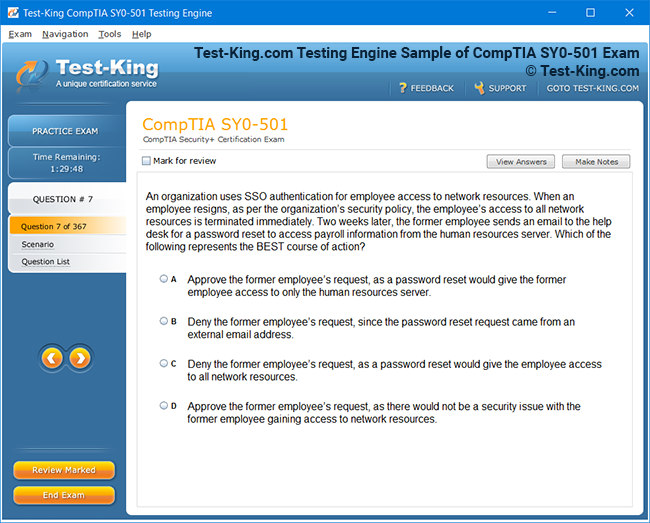
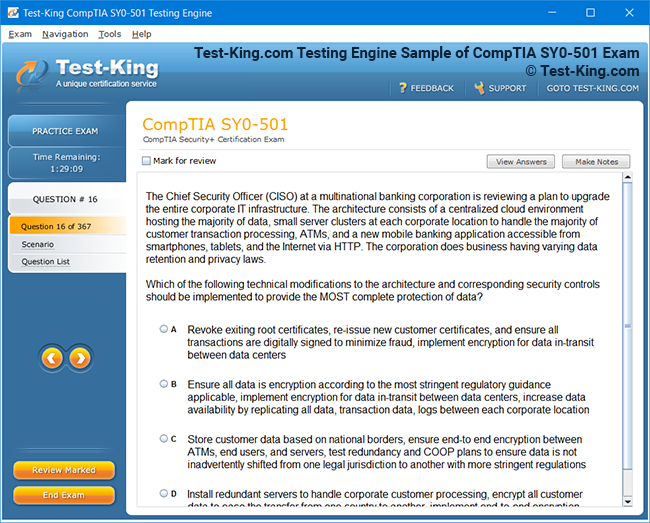
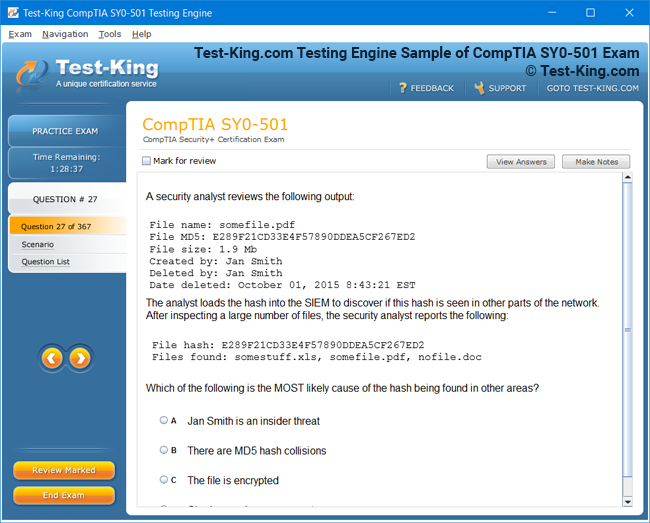
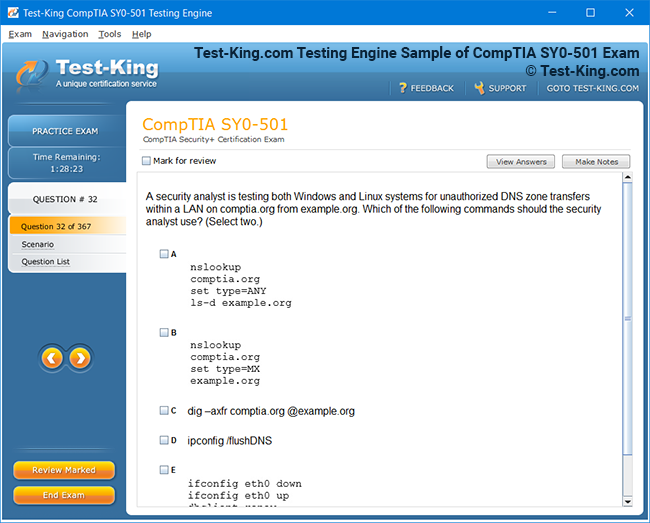
Product Screenshots
Frequently Asked Questions
How can I get the products after purchase?
All products are available for download immediately from your Member's Area. Once you have made the payment, you will be transferred to Member's Area where you can login and download the products you have purchased to your computer.
How long can I use my product? Will it be valid forever?
Test-King products have a validity of 90 days from the date of purchase. This means that any updates to the products, including but not limited to new questions, or updates and changes by our editing team, will be automatically downloaded on to computer to make sure that you get latest exam prep materials during those 90 days.
Can I renew my product if when it's expired?
Yes, when the 90 days of your product validity are over, you have the option of renewing your expired products with a 30% discount. This can be done in your Member's Area.
Please note that you will not be able to use the product after it has expired if you don't renew it.
How often are the questions updated?
We always try to provide the latest pool of questions, Updates in the questions depend on the changes in actual pool of questions by different vendors. As soon as we know about the change in the exam question pool we try our best to update the products as fast as possible.
How many computers I can download Test-King software on?
You can download the Test-King products on the maximum number of 2 (two) computers or devices. If you need to use the software on more than two machines, you can purchase this option separately. Please email support@test-king.com if you need to use more than 5 (five) computers.
What is a PDF Version?
PDF Version is a pdf document of Questions & Answers product. The document file has standart .pdf format, which can be easily read by any pdf reader application like Adobe Acrobat Reader, Foxit Reader, OpenOffice, Google Docs and many others.
Can I purchase PDF Version without the Testing Engine?
PDF Version cannot be purchased separately. It is only available as an add-on to main Question & Answer Testing Engine product.
What operating systems are supported by your Testing Engine software?
Our testing engine is supported by Windows. Andriod and IOS software is currently under development.
Top Nokia Exams
- 4A0-100 - Nokia IP Networks and Services Fundamentals
- 4A0-D01 - Nokia Data Center Fabric Fundamentals
- 4A0-C03 - Nokia NRS II Composite: IS-IS version
- 4A0-112 - Nokia IS-IS Routing Protocol
- 4A0-104 - Nokia Services Architecture
- 4A0-107 - Nokia Quality of Service
- 4A0-116 - Nokia Segment Routing
- 4A0-D03 - Nokia SR Linux EVPN and Data Center Interconnect
- 4A0-103 - Nokia Multiprotocol Label Switching
- 4A0-114 - Nokia Border Gateway Protocol Fundamentals for Services
- 4A0-AI1 - Nokia NSP IP Network Automation Professional Composite Exam
- 4A0-205 - Nokia Optical Networking Fundamentals
- 4A0-115 - Nokia Ethernet Virtual Private Network Services
Top Study Tips to Pass the Nokia 4A0-114 BGP Fundamentals Exam on Your First Attempt
The Nokia 4A0-114 examination, formally recognized as the Border Gateway Protocol Fundamentals for Services assessment, represents a specialized component within the Nokia Service Routing Certification framework. This exam serves as a critical juncture for network professionals aspiring to validate their technical acumen in dynamic routing, inter-domain connectivity, and the operational intricacies of BGP within service provider infrastructures. Unlike generic networking certifications that focus on theoretical abstraction, this Nokia credential demands a nuanced understanding of service-oriented architectures, routing policy construction, and the orchestration of scalable IP networks.
Understanding the Nature of the Nokia 4A0-114 Certification and Its Intellectual Demands
BGP, as the predominant exterior gateway protocol in global routing, forms the intellectual core of this examination. The candidate must demonstrate mastery over path vector principles, route advertisement policies, loop prevention mechanisms, and the pragmatic configuration of BGP sessions within diverse network topologies. The Nokia 4A0-114 exam not only evaluates knowledge of command syntaxes and protocol parameters but also examines the candidate’s cognitive ability to integrate theoretical foundations with operational execution in real-world service networks. To pass on the first attempt requires a strategic synthesis of conceptual learning, hands-on practice, and mental acuity for troubleshooting logical routing anomalies.
Developing a Methodical Study Framework for BGP Mastery
A deliberate and organized approach is indispensable for anyone endeavoring to pass the Nokia 4A0-114 exam successfully. The study journey should begin with an analytical assessment of the exam blueprint provided by Nokia. This outline offers clarity regarding the weightage of various topics, including BGP session establishment, route selection algorithms, community and attribute manipulation, and convergence analysis. By interpreting the blueprint as a navigational map, the learner can allocate appropriate time to each domain based on its complexity and their individual proficiency.
The optimal preparation approach involves establishing a study chronology anchored on comprehension rather than rote memorization. Begin with a deep immersion into foundational routing principles such as autonomous system structures, TCP session management, and the fundamentals of IPv4 and IPv6 addressing. These topics form the intellectual substratum upon which the BGP architecture is constructed. Subsequently, advance toward BGP-specific constructs such as neighbor relationships, finite state transitions, and route reflectors. This gradual progression ensures conceptual continuity and minimizes cognitive overload.
Pragmatic practice is equally vital. While theoretical reading solidifies understanding, configuring BGP sessions within a simulated or virtualized Nokia Service Router environment strengthens procedural familiarity. Tools like network simulators and Nokia’s own virtual service routers allow for safe experimentation with route advertisements, filtering policies, and attribute propagation. During these exercises, documenting every configuration, observation, and anomaly helps reinforce recall and develops analytical depth. Maintaining a personal study log of experiments allows for retrospective review, which becomes crucial during the final revision stage.
Cultivating Conceptual Depth Beyond Surface-Level Understanding
To excel in the Nokia 4A0-114 examination, superficial comprehension is insufficient. The exam challenges candidates to reason through multi-layered routing scenarios that require mental modeling of packet flows across domains. Hence, the learner must cultivate a profound grasp of BGP’s operational logic. Understanding the path selection process, for instance, necessitates more than memorizing the sequence of attributes; it requires discerning the rationale behind each attribute’s priority in determining the optimal path. Parameters such as weight, local preference, AS_PATH length, origin type, and MED must be internalized as functional instruments of routing policy rather than isolated terms.
Furthermore, one must explore the subtleties of BGP scalability and stability. The concept of route reflectors and confederations addresses the need for hierarchical structuring within large autonomous systems. Grasping why such mechanisms exist and how they influence routing decision-making enhances one’s ability to design resilient networks. Similarly, the phenomenon of route flapping and the utilization of route dampening techniques highlight the equilibrium between responsiveness and stability that BGP administrators must maintain.
Engaging with technical whitepapers, Nokia documentation, and Internet Engineering Task Force (IETF) Request for Comments (RFCs) related to BGP fosters a scholarly perspective. For example, RFC 4271, which specifies the BGP-4 protocol, can serve as a primary academic reference. Reading such documents enriches vocabulary, exposes nuanced protocol behavior, and nurtures analytical maturity. Even if certain sections appear esoteric, the act of interpreting their implications refines one’s interpretive capability, a quality often tested in advanced certification scenarios.
Integrating Theoretical Learning with Real-World Application
Knowledge of BGP must transcend textbook familiarity to manifest in real-world problem-solving. The Nokia 4A0-114 exam evaluates not just recollection of facts but also the candidate’s aptitude for practical reasoning. Thus, the integration of theory and practice should be deliberate. Whenever studying a new concept, it is advisable to contextualize it within an operational narrative. For example, when learning about route redistribution between different routing protocols, envision a multi-protocol environment in which BGP exchanges information with OSPF or IS-IS. Conceptualizing such interactions solidifies understanding and assists in diagnosing potential issues that might arise during the exam’s scenario-based questions.
Virtual laboratories should be used to reproduce complex topologies, experimenting with eBGP and iBGP relationships, route filtering with prefix lists, and attribute manipulation using route maps. Simulated route advertisements allow observation of changes in routing tables as different policies are applied. Through these exercises, the learner internalizes the cause-and-effect relationships governing BGP behavior. This form of kinesthetic learning enhances retention and fosters intuitive recall under exam conditions.
Moreover, real-world exposure can be gained through professional forums, Nokia technical communities, and peer study groups. Discussing case studies or analyzing routing incidents reported in operator networks deepens the learner’s pragmatic insight. Often, a single detailed discussion about a BGP peering misconfiguration can illuminate more than hours of solitary reading. Sharing interpretations with others forces the mind to articulate concepts clearly, thereby reinforcing mastery.
Refining Analytical and Diagnostic Skills for Exam Scenarios
An essential dimension of excelling in the Nokia 4A0-114 certification lies in developing the analytical prowess to interpret and troubleshoot routing anomalies. Many exam questions are crafted to test the candidate’s ability to identify the root cause of a given network condition. The examinee may be presented with routing tables, AS path outputs, or policy excerpts and asked to deduce why a particular route is preferred or suppressed. Success in such scenarios relies on cognitive agility and the ability to connect abstract theoretical knowledge with observable behavior.
A powerful strategy for enhancing diagnostic ability involves adopting the mindset of a network investigator. Whenever something unexpected occurs in a lab setup—such as a missing route, a persistent BGP session in the idle state, or asymmetric routing—resist the urge to reset configurations. Instead, analyze meticulously. Examine neighbor states, verify TCP connectivity, inspect applied policies, and cross-reference AS_PATH attributes. This disciplined habit not only builds patience but also trains the intellect to process multifactorial variables systematically. When similar logic-based questions appear on the exam, the mind responds reflexively with structured reasoning.
Equally important is understanding the Nokia-specific implementation of BGP. Although BGP fundamentals are standardized, vendor-specific syntax and operational behaviors vary subtly. Familiarity with Nokia Service Router Operating System (SR OS) terminology, command conventions, and hierarchical configuration model is indispensable. Practicing show commands, examining outputs, and interpreting Nokia-style routing logs prepare the candidate for both the practical and theoretical portions of the test. This attention to vendor-specific nuances differentiates a prepared candidate from one who relies solely on generic networking knowledge.
Establishing Psychological Readiness and Study Discipline
Mastering the technical content is only one facet of success in the Nokia 4A0-114 exam. Psychological readiness and disciplined study behavior are equally influential. The human mind, when fatigued or overwhelmed, retains information less efficiently. Therefore, constructing a structured daily regimen that balances learning intensity with cognitive rest is essential. A disciplined approach entails defining fixed study intervals, prioritizing comprehension goals, and integrating periodic reviews to consolidate memory.
Cognitive science suggests that knowledge retention is enhanced through spaced repetition and interleaved learning. Applying these methods to BGP study means revisiting critical concepts such as route selection, neighbor establishment, and policy control at measured intervals rather than cramming them in a single sitting. This repetition should be active rather than passive; for example, instead of rereading notes, one might attempt to reconstruct a configuration from memory or explain a routing scenario aloud. This process engages retrieval pathways in the brain, thereby reinforcing long-term memory.
Another indispensable element is psychological balance. The Nokia 4A0-114 exam can induce anxiety due to its technical density and reputation for rigor. Managing this anxiety requires developing mental equanimity through proper rest, nutrition, and mindfulness. Short breaks during study sessions, light physical exercise, and breathing techniques can prevent mental saturation. Moreover, maintaining a confident yet humble attitude sustains motivation. Recognizing that mastery of BGP is an intellectual journey, not a mechanical task, transforms preparation into a meaningful endeavor rather than an ordeal.
An often-overlooked but potent motivator is visualization. Envisioning oneself as a proficient network architect capable of designing and troubleshooting inter-domain routing infrastructures instills a sense of purpose. This internal visualization aligns motivation with the technical pursuit, fostering consistency. When the mind believes in eventual mastery, perseverance becomes natural, and the entire preparation process acquires coherence.
Finally, practice examinations play a pivotal role in mental conditioning. Mock tests replicate the structure, timing, and difficulty of the real Nokia 4A0-114 exam. Engaging with such assessments under timed conditions familiarizes the candidate with pacing, reduces exam-day stress, and highlights areas requiring further study. Reviewing performance after each mock test provides critical feedback for refining strategies. When done consistently, this iterative process transforms apprehension into confidence.
Advancing Analytical Competence and Strategic Study Practices
Mastering the Nokia 4A0-114 certification requires transcending the initial comprehension of BGP fundamentals and evolving toward an advanced analytical command of the protocol’s operational mechanics. At this stage of preparation, the learner’s intellectual objective must shift from simple recognition of BGP processes to the development of synthetic reasoning that integrates theoretical constructs with network pragmatics. The Border Gateway Protocol, in its essence, is a delicate orchestration of path vector logic, policy-driven decisions, and systemic scalability. The ability to mentally simulate how BGP behaves under variant configurations distinguishes an accomplished examinee from an average one.
To internalize such a multidimensional subject, one must adopt a dual-pronged approach combining immersive conceptual study with pragmatic experimentation. Reading official Nokia technical guides, configuration manuals, and whitepapers allows the mind to absorb authoritative perspectives. However, the retention of abstract material increases exponentially when these concepts are physically reenacted within a controlled virtual environment. This synthesis of observation and experimentation transforms raw data into personal comprehension. It allows the learner to visualize BGP state transitions, trace route advertisements, and witness how path selection evolves dynamically in response to network events.
The most formidable candidates are those who cultivate a cognitive rhythm of questioning and validating. Each concept in BGP, such as the manipulation of attributes like local preference, MED, and AS_PATH, must be examined from both a theoretical and operational angle. Instead of merely memorizing their order in the selection process, the learner should challenge their own understanding by envisioning specific topologies where altering one attribute leads to observable consequences. This introspective engagement ignites the analytical faculties necessary to interpret intricate routing behaviors that the Nokia 4A0-114 exam often presents.
The candidate should also integrate historical awareness into their learning process. BGP’s evolution, from its inception as a rudimentary path vector protocol to its current sophistication in service provider ecosystems, reveals the rationale behind its architectural choices. Understanding why features such as route reflectors or confederations emerged enhances conceptual clarity and contextualizes their modern application. This comprehension deepens intellectual confidence and renders the learner capable of articulating not just how BGP functions but why it functions in specific ways within Nokia’s service routing environments.
The process of study must be treated as an iterative refinement rather than a linear trajectory. After each reading session, reviewing the acquired knowledge through self-interrogation helps solidify retention. The mind should constantly oscillate between abstraction and practice. For example, after studying route filtering principles, configure real or simulated filters and observe how routes are accepted or denied based on defined criteria. Writing down interpretations after every lab exercise serves as an invaluable self-assessment tool. It also creates a personalized knowledge archive that can be revisited during final revision.
The acquisition of deep technical insight necessitates continuous engagement with authentic materials. Learners are encouraged to reference Nokia’s official technical documentation alongside open-source literature describing BGP’s operation across diverse platforms. Although Nokia’s Service Router Operating System possesses its own syntax and operational paradigms, its adherence to universal protocol standards ensures that the principles of BGP remain consistent across implementations. This dual familiarity not only reinforces the conceptual backbone but also prepares the learner to interpret scenario-based questions from multiple viewpoints, an ability frequently tested in the Nokia 4A0-114 examination.
Furthermore, adopting an academic mindset toward study adds depth to preparation. Candidates should not limit themselves to practical manuals alone but should explore scholarly expositions on routing theory, convergence models, and Internet routing architectures. Such academic reading cultivates a more profound and philosophical comprehension of networking behavior. The candidate begins to perceive BGP not merely as a technical mechanism but as a linguistic system of inter-domain communication. This intellectual shift enhances pattern recognition and logical reasoning, both essential during the evaluation.
The practice of deliberate repetition under varying conditions is another key to mastery. Reconfiguring BGP under slightly modified topologies, experimenting with attribute weights, and simulating policy conflicts refine intuitive adaptability. This process teaches the learner how subtle configuration changes can produce divergent routing outcomes. Such understanding will prove invaluable when confronting challenging questions that describe multi-autonomous system environments or complex redistribution scenarios. Each simulated experiment becomes a microcosm of conceptual reinforcement, anchoring theoretical knowledge in experiential memory.
In developing exam readiness, time discipline must be exercised rigorously. The study timetable should be divided into thematic intervals that prioritize topics based on conceptual density and frequency of occurrence in the Nokia 4A0-114 blueprint. High-weight domains such as BGP session establishment, routing policies, and route selection algorithms should be granted extended contemplation. However, minor topics, including route dampening and scaling mechanisms, should not be neglected; they often appear in subtle, integrative question forms that reward comprehensive understanding. The learner should adopt a cyclic revision strategy wherein each concept is revisited at least thrice before the examination day—first for understanding, second for retention, and third for fluency.
Mental fluency in technical vocabulary contributes significantly to confidence. The ability to articulate complex ideas without hesitation reflects mastery. Candidates should train themselves to explain BGP processes in articulate prose, describing phenomena like best-path determination or loop prevention in precise language. This linguistic fluency mirrors conceptual command and aids in processing complex question statements during the exam. Occasionally, one may even rehearse verbal explanations aloud, converting theoretical abstraction into communicative clarity, which strengthens both cognitive retention and technical articulation.
Practical exposure to network anomalies forms another indispensable layer of preparation. The candidate should deliberately induce errors within lab environments—misconfigured neighbor relationships, route advertisement loops, or policy mismatches—and attempt to identify and rectify them. This problem-based learning approach sharpens deductive reasoning and familiarizes the learner with diagnostic methods. When such anomalies are encountered in real exam questions, the individual’s mind will respond with composed analytical precision rather than anxiety. Each troubleshooting exercise reinforces resilience and nurtures a scientific temperament necessary for handling uncertainty under examination pressure.
The role of mental conditioning cannot be overstated in this intellectual pursuit. The human brain, when trained under consistent environmental patterns, develops cognitive endurance. Designating a fixed time each day for study conditions the mind to enter a state of heightened concentration at predictable intervals. Coupled with this, maintaining an organized workspace free from digital distractions amplifies efficiency. Keeping reference materials, notes, and practice outputs systematically arranged prevents unnecessary cognitive clutter. The goal is to cultivate an academic atmosphere of order and clarity that mirrors the structured logic of BGP itself.
As the candidate progresses, interaction with peer communities can provide both reinforcement and challenge. Engaging in professional discussion forums, technical webinars, or Nokia’s own learning platforms allows one to encounter diverse interpretations of similar concepts. Discussing BGP design dilemmas or policy implementations exposes the learner to alternative reasoning frameworks. Such intellectual exchange widens analytical horizons and inoculates the candidate against conceptual rigidity. In addition, explaining concepts to others deepens personal mastery by forcing the mind to distill complex mechanisms into coherent narratives.
One must also develop the habit of correlating BGP theory with global Internet realities. Observing real-world routing events, such as prefix hijacking incidents or global route leaks, helps contextualize the importance of BGP security and stability mechanisms. The learner gains an appreciation for how the theoretical attributes studied in textbooks directly influence the integrity of the global Internet infrastructure. Incorporating this awareness into study sessions transforms abstract learning into tangible significance, reinforcing the relevance of the Nokia 4A0-114 certification in a professional setting.
As examination day approaches, revision strategies must emphasize integration rather than mere review. The candidate should attempt to connect isolated concepts into holistic frameworks. For example, when revisiting route reflectors, also recall how they interact with cluster IDs, route aggregation, and peering redundancy. Creating mental associations between these interconnected ideas ensures that recall during the exam becomes automatic and multidimensional. This kind of conceptual synthesis is what differentiates surface-level learners from genuine practitioners of network science.
Mock examinations continue to serve as indispensable calibration instruments. Taking them under simulated conditions—timed sessions, restricted references, and continuous focus—acclimates the mind to exam pressure. After each mock test, analyzing every mistake in depth reveals the thought processes that led to errors. This metacognitive exercise allows the learner to refine judgment, adjust reasoning pathways, and internalize efficient problem-solving patterns. Over time, this self-observation evolves into a refined analytical instinct, enabling precise and confident performance in the Nokia 4A0-114 exam.
Equally important is managing the emotional dimension of preparation. Long study durations and complex material can occasionally lead to mental fatigue or self-doubt. The candidate must consciously cultivate resilience through balanced routines. Intervals of rest, moderate exercise, and occasional disengagement from study material rejuvenate cognitive energy. The brain consolidates learned information more effectively when allowed to oscillate between intense concentration and relaxation. Viewing the learning process as an intellectual journey rather than an obstacle fosters enthusiasm, which in turn sustains perseverance.
At this advanced stage of preparation, the learner should perceive themselves not simply as a test-taker but as an emerging network architect capable of designing robust inter-domain infrastructures. This identity-based perspective fuels intrinsic motivation. Each study session becomes an act of professional evolution rather than exam compliance. Understanding that the Nokia 4A0-114 certification represents mastery over one of the most foundational technologies in modern Internet routing imbues the preparation with purpose. Such intrinsic motivation transcends external pressure, replacing anxiety with intellectual fulfillment.
To ensure lasting mastery, one must also refine cognitive flexibility. BGP-related scenarios in the Nokia examination may be framed using varied terminologies or atypical configurations. The candidate should train their mind to recognize underlying principles even when surface details differ. For example, a question may present a unique scenario involving route aggregation with complex community tagging. Rather than being disoriented by unfamiliar phrasing, a flexible thinker identifies the core logic of attribute propagation and policy control. This mental adaptability can only be achieved through diversified practice—exposing oneself to a variety of configuration contexts and problem statements during study.
Another subtle yet effective study technique involves interleaved review, in which different but related topics are studied in alternating sequences. Rather than dedicating entire days to one domain, alternating between route policies, neighbor configurations, and path selection processes stimulates cross-referential understanding. The human brain, when faced with interleaved content, develops the ability to distinguish and integrate concepts more efficiently. This training enhances recall during multi-faceted questions that require analyzing relationships between several aspects of BGP simultaneously.
Language precision remains an indispensable asset throughout the preparation. Developing a sophisticated lexicon that mirrors the academic tone of Nokia’s own documentation enables the learner to interpret exam questions with accuracy. Misunderstanding a single term in a technically phrased question can lead to incorrect conclusions. Therefore, consistent reading of professional literature sharpens semantic sensitivity. The candidate learns to discern the exact implications of phrases such as route redistribution, path vector propagation, or route dampening, which recur frequently in the Nokia 4A0-114 assessment.
It is also beneficial to reconstruct one’s understanding periodically by narrating the entire BGP operation process in a sequential manner, from neighbor discovery to route advertisement and selection. This narrative approach transforms static facts into a coherent mental storyline. When the brain perceives information as part of a connected narrative, recall becomes faster and more resilient under pressure. Repeating this process weekly can significantly improve structural memory and holistic comprehension of the protocol’s architecture.
At this juncture, attention should also be directed toward recognizing the implicit logic of Nokia’s certification philosophy. The company’s examination methodology rewards clarity of reasoning and conceptual synthesis rather than mechanical memorization. Every question is designed to test understanding through application. This recognition should inform study priorities: invest time in mastering relationships and dependencies rather than isolated details. Viewing each topic as an interconnected system rather than a standalone entity aligns perfectly with the Nokia 4A0-114 exam’s evaluative framework.
Lastly, a sophisticated candidate approaches the study material with intellectual humility. The vastness of networking theory ensures that complete omniscience is unattainable, but precision within defined domains is achievable. Embracing this perspective prevents cognitive fatigue and fosters curiosity. When an unfamiliar concept arises during study, instead of perceiving it as an obstacle, treat it as an invitation to expand intellectual boundaries. This mindset converts potential frustration into progressive curiosity. The learner remains dynamically engaged, continuously refining their understanding of BGP’s intricate architecture and its operational symphony within service provider networks.
Mastering Deep Protocol Comprehension and Strategic Interpretation for the Nokia 4A0-114 Examination
The moment an aspirant transitions from basic understanding to mastery in the Nokia 4A0-114 BGP Fundamentals for Services examination marks a transformation in cognitive orientation. It is no longer about remembering definitions or following procedural templates; rather, it becomes an intellectual engagement with the intrinsic logic governing the Border Gateway Protocol and its pervasive presence in service provider networks. To prepare efficiently for this examination, one must cultivate a profound sense of protocol awareness—an ability to envision BGP’s operational life within the dynamic ecosystem of interconnected autonomous systems.
The essence of BGP lies in its deterministic yet flexible method of routing control, enabling large-scale Internet stability through meticulous policy design. For the candidate seeking success in the Nokia 4A0-114 exam, understanding this dichotomy between determinism and adaptability is crucial. The exam’s architecture deliberately tests the depth of analytical discernment, often through nuanced scenarios where multiple theoretically valid solutions coexist, but only one aligns with protocol logic and policy hierarchy. This requires a mature sense of prioritization, mental clarity, and unwavering familiarity with attribute behavior.
A strategic learner begins by internalizing the anatomy of BGP path selection. Each decision within the routing process stems from ordered evaluation criteria—beginning with highest weight, followed by local preference, originating route, AS_PATH, origin type, and MED, before reaching more abstract tie-breakers such as router IDs or neighbor priorities. Yet, memorizing these in isolation yields little advantage; comprehension emerges only when one perceives how these attributes interact hierarchically. For example, a local preference might override path length under specific conditions, altering the trajectory of route propagation. Recognizing these subtleties ensures that theoretical knowledge becomes practical wisdom applicable in both real-world and exam contexts.
A distinguishing characteristic of the Nokia 4A0-114 evaluation is its emphasis on contextual adaptability. Candidates encounter questions that simulate scenarios in which multiple BGP routers must sustain harmony while negotiating policies with external peers. Such problems often involve subtle manipulations of route maps, prefix advertisements, or community tags. The key to navigating these complexities lies in mastering the philosophical underpinnings of routing control rather than memorizing command patterns. One must approach each question as a narrative of cause and effect, visualizing how each configuration decision reshapes the network’s equilibrium. This interpretive mindset allows the candidate to analyze without anxiety, identifying the rationale behind each route’s acceptance or suppression.
An efficient way to consolidate this analytical capacity is through iterative simulation. Constructing virtual topologies that imitate real service provider architectures enables the learner to explore the protocol’s multifaceted behavior under varying conditions. Within these environments, one should deliberately create controlled disturbances—establishing redundant sessions, altering AS_PATHs, or applying diverse policy filters—to observe resultant behavior. Each observed variation contributes to a cumulative intuition, an internalized sense of how BGP’s attributes dance with each other in pursuit of optimal routing. This intuitive understanding is indispensable for excelling in the Nokia 4A0-114 certification, where comprehension of interaction supersedes recall of configuration.
Another intellectual skill that must be cultivated is logical deconstruction. When presented with a scenario, the examinee should dissect it by identifying layers: the physical topology, the logical relationships among autonomous systems, and the intended policy outcomes. By segmenting the problem in this manner, one can trace causality from misconfiguration to symptom. The mind becomes accustomed to thinking hierarchically, mirroring how BGP itself operates through ordered processes. Over time, this disciplined mental practice nurtures analytical grace—a quiet precision that emerges when interpreting complex network behaviors.
Equally essential is an appreciation for the philosophy of scalability embedded within BGP. In immense provider networks, the challenge is not only to establish communication but to maintain efficiency as the system expands. Mechanisms such as route reflectors and confederations exist to mitigate the exponential growth of iBGP sessions. To truly understand these concepts, one must transcend surface definitions and contemplate their architectural rationale. For instance, a route reflector reduces the necessity for full mesh peering, but introduces potential path visibility trade-offs. Comprehending such design trade-offs helps the learner interpret exam scenarios that test critical thinking beyond configuration syntax.
A candidate who immerses themselves in the historical and technical evolution of BGP acquires a rare form of insight. Reading about its transformation from early implementations to the sophisticated service-aware variant deployed in Nokia infrastructures contextualizes each feature’s significance. The introduction of attributes like communities or extended communities was not arbitrary but driven by operational necessity. Understanding this lineage of innovation empowers the learner to answer conceptual questions with authority. The Nokia 4A0-114 exam often rewards this depth, as it assumes candidates can link technical detail to architectural purpose.
In preparation, one must also refine their approach to documentation analysis. Exam questions frequently mirror the style and structure of Nokia’s official configuration and troubleshooting guides. Becoming fluent in that documentation language is akin to learning a dialect; familiarity with its phrasing enhances one’s ability to interpret questions correctly. Misreading a single term can lead to flawed reasoning, so reading Nokia materials daily strengthens linguistic precision. Each time an unfamiliar term appears, the learner should pause, infer its context, and confirm its exact meaning within the technical lexicon. This precision builds interpretive confidence under exam pressure.
Beyond textual comprehension, the learner must also nurture a disciplined practice of mental simulation. Visualization, a technique employed by elite engineers, involves constructing an internal image of network behavior without the aid of software. The candidate envisions routers exchanging updates, policies shaping traffic paths, and decisions evolving through attribute comparisons. This imaginative rehearsal is not mere abstraction—it activates neural patterns that reinforce memory. When encountered with complex diagrams during the exam, the mind already possesses a repertoire of internal templates to reference, accelerating comprehension and solution derivation.
One cannot ignore the psychological aspect of mastering such a vast topic. Extended study periods often erode enthusiasm, yet sustaining motivation is crucial for achieving proficiency. Setting intrinsic goals—such as becoming capable of explaining BGP architecture to others or diagnosing a complex routing inconsistency—maintains intellectual vitality. A mind that studies for mastery rather than mere certification sustains endurance more effectively. Moreover, aligning study with genuine curiosity transforms preparation into exploration, replacing anxiety with fascination.
Time optimization remains an indispensable pillar of success. Given the expansive breadth of the Nokia 4A0-114 syllabus, a learner must balance depth with breadth. Allocating specific durations for each conceptual theme prevents the fatigue of disproportionate study. Employing the Pomodoro or cyclic review methods maintains focus and memory consolidation. Intermittent review sessions in which one revisits older material while learning new topics reinforce neural connections. The brain thrives on association; revisiting prior concepts while assimilating new ones strengthens both.
As the learner’s proficiency advances, self-evaluation through introspection becomes indispensable. Keeping a reflective log after each study session encourages meta-cognition—the art of thinking about thinking. Writing down what was learned, what remains unclear, and how the concept interacts with others reveals intellectual blind spots early. This reflective exercise transforms passive learning into active engagement. Over weeks, the log evolves into a personalized repository of insight, capturing the trajectory of cognitive growth. When revisited near the examination date, it becomes a distilled compendium of one’s intellectual journey, far more valuable than generic notes.
Equally significant is learning to interpret configuration anomalies as pedagogical opportunities. When an expected routing outcome fails to materialize in a virtual lab, instead of resetting configurations impulsively, the learner should analyze meticulously. This forensic mindset—examining logs, verifying neighbor states, and tracing attribute propagation—mirrors the analytical expectation of the Nokia 4A0-114 exam. The learner must embrace the discomfort of ambiguity, for it is within uncertainty that true understanding germinates. Each resolved anomaly fortifies diagnostic intuition and reinforces protocol comprehension.
Moreover, attention should be devoted to BGP’s intricate interplay with other routing protocols such as OSPF and IS-IS. The Nokia 4A0-114 curriculum implicitly expects candidates to appreciate these relationships, as real service networks rarely rely on a single protocol. Understanding how redistribution affects route consistency and stability enables one to answer integrative questions involving protocol coexistence. This knowledge, though advanced, grants a holistic grasp of network dynamics, positioning the learner as a well-rounded architect rather than a mere protocol specialist.
While technical aptitude forms the foundation, the rhythm of preparation is sustained by disciplined routine. Establishing a daily ritual of concentrated study at consistent hours trains the brain to enter states of heightened focus automatically. The environmental consistency—same desk, lighting, and silence—acts as a cue for concentration. Over time, this habit reduces resistance and enhances absorption. Consistency transforms sporadic effort into cumulative expertise, which is precisely the attribute Nokia’s examination design seeks to identify.
Intellectual resilience must accompany this discipline. It is natural to encounter moments of stagnation where progress seems imperceptible. In such intervals, the learner must remember that cognitive consolidation often occurs beneath conscious awareness. Concepts absorbed during earlier sessions may resurface suddenly, integrated into a coherent whole. Maintaining composure during these lulls prevents burnout and sustains forward motion. The process of mastering BGP mirrors the protocol itself—gradual, consistent, and convergent.
Another vital competency is synthetical reading. The candidate should learn to extract patterns and principles from diverse sources, connecting them into a unified framework. Nokia documentation, academic research, and operational case studies each offer unique perspectives. By synthesizing them, the learner constructs a multidimensional understanding that transcends any single resource. This intellectual synthesis reflects the very essence of networking—disparate nodes harmonized through structured communication.
Practical exposure remains indispensable. Although real hardware environments may not always be accessible, virtualization platforms replicate functionality sufficiently for advanced experimentation. Engaging with such tools enables exploration of topics like route aggregation, flap dampening, or peer group optimization. Through repeated experimentation, these concepts transition from abstract definitions to intuitive truths. The learner begins to anticipate outcomes instinctively, a skill that translates directly into efficiency during timed examinations.
Communication proficiency complements technical mastery. During preparation, explaining BGP operations to peers or even to oneself aloud fortifies understanding. Articulating complex ideas in coherent language forces mental organization of concepts, revealing gaps that passive reading might obscure. This pedagogical self-dialogue cultivates analytical precision and linguistic fluency simultaneously, preparing the learner to comprehend and respond accurately to the nuanced phrasing of Nokia’s question sets.
Mental equilibrium is another pillar of preparation. The intellectual rigor demanded by the Nokia 4A0-114 exam necessitates periods of cognitive rest. Engaging in brief physical exercise, mindfulness, or quiet reflection revitalizes neural activity and enhances concentration. Fatigue blurs analytical precision, whereas a rested mind interprets data with clarity. A sustainable study rhythm, oscillating between intense focus and strategic rest, ensures consistent cognitive performance throughout the preparation timeline.
As mastery deepens, the candidate must also cultivate an ethical awareness of network stability. Understanding BGP’s power to influence vast Internet segments instills a sense of professional responsibility. Nokia’s certification does not merely attest to technical prowess; it implicitly endorses one’s capability to manage critical routing infrastructures ethically. Reflecting upon this responsibility enriches motivation and contextualizes the importance of the certification beyond career advancement—it becomes a commitment to maintaining the integrity of digital communication.
At higher levels of comprehension, the learner should immerse in comparative analysis, studying how BGP implementations vary across different vendors while maintaining fundamental consistency. Recognizing these variations enhances interpretive dexterity. A question that describes unfamiliar syntax can then be deciphered through conceptual equivalence. Such comparative insight also broadens professional versatility, aligning with Nokia’s vision of producing engineers capable of navigating heterogeneous networking ecosystems.
The culmination of advanced preparation involves the fusion of all prior learning dimensions—conceptual, practical, analytical, linguistic, and psychological—into seamless competence. When faced with a complex problem, the experienced candidate does not panic or rely on guesswork. Instead, they methodically reconstruct the network’s logical structure, interpret attribute interplay, and derive conclusions rooted in empirical reasoning. This synthesis of intellect and composure exemplifies the standard expected from professionals holding the Nokia 4A0-114 certification.
To reach that level of readiness, one must continually refine self-assessment mechanisms. Periodic testing without external references measures not just recall but reasoning endurance. Timing each response cultivates exam-time discipline. Afterward, reviewing both correct and incorrect responses provides valuable insight into reasoning patterns. Over time, this process shapes intellectual reflexes, enabling instantaneous recognition of subtle cues embedded within complex question narratives.
Ultimately, the journey toward excellence in the Nokia 4A0-114 BGP Fundamentals exam is a convergence of art and science—the art of disciplined thought and the science of structured communication. The learner who integrates curiosity with consistency, precision with perseverance, and analysis with introspection becomes not just an exam passer but an architect of digital interconnectivity. This synthesis of technical mastery and reflective understanding embodies the true spirit of the certification and lays the foundation for a lifelong career in high-level network engineering.
Refining Advanced BGP Policy Understanding and Cognitive Strategy for the Nokia 4A0-114 Examination
At the higher echelon of preparation for the Nokia 4A0-114 certification, the learner’s perspective must evolve from procedural comprehension toward conceptual orchestration. This stage demands not only understanding of how the Border Gateway Protocol functions but also why it behaves as it does in response to diverse operational stimuli. The ability to interpret and influence the protocol’s decision-making processes through deliberate policy construction forms the intellectual nucleus of mastery. Those aspiring to excel in the Nokia 4A0-114 BGP Fundamentals for Services examination must immerse themselves in the nuanced art of policy design, attribute manipulation, and inter-domain coordination, viewing each as an extension of network philosophy rather than isolated configuration acts.
To comprehend the profundity of BGP policy, one must first internalize its fundamental purpose: control over routing behavior across autonomous systems while maintaining global stability. The protocol’s architecture allows operators to project local intentions onto the larger Internet without compromising interconnectivity. This balance between autonomy and collaboration encapsulates BGP’s genius. Every routing policy configured within a Nokia environment thus represents a dialogue between local optimization and collective coherence. The candidate preparing for the Nokia 4A0-114 exam must perceive this not as a mechanical process but as a negotiation of intent translated into structured attributes.
Within this intellectual framework, the principle of attribute hierarchy assumes immense importance. Attributes such as weight, local preference, origin type, AS_PATH, and Multi-Exit Discriminator do not function as mere parameters; they constitute a logical cascade through which BGP evaluates routes. The learner must develop a cognitive habit of visualizing this sequence dynamically. When a route enters the system, the protocol examines each attribute in succession, comparing numerical values, policy rules, and peer relationships until the optimal path emerges. This ordered reasoning should become second nature, as many exam questions subtly test understanding of attribute precedence through descriptive scenarios.
Another indispensable element of study involves community and extended community attributes. These constructs enable policy abstraction and collective route management across multiple devices. To master them, one must first grasp the notion that communities serve as semantic labels, not simple numerical tags. Each community conveys meaning—a policy instruction, a filtering criterion, or a propagation boundary. For instance, a service provider might assign a community to routes destined for specific regions, allowing downstream routers to process them consistently. The aspirant must study these concepts until they can mentally map how a single community designation ripples through an entire network topology, influencing advertisements, filters, and redistribution points.
The Nokia 4A0-114 exam is renowned for assessing this depth of comprehension through complex multi-domain narratives. Candidates may encounter questions describing route exchanges between several autonomous systems with intertwined policies. Here, success depends on one’s ability to deconstruct the problem, identifying the influence of each attribute, filter, and peering relationship. This analytical deconstruction requires not only knowledge but the disciplined thought process of a network designer—someone capable of predicting the emergent behavior of an interconnected routing ecosystem.
To reinforce such cognitive dexterity, the learner should engage in iterative policy modeling. Using virtualized Nokia Service Routers, construct topologies with varying BGP relationships, implementing diverse import and export policies. By adjusting attribute combinations, observe how path selections evolve. Each experiment deepens one’s intuition, transforming abstract knowledge into reflexive understanding. Through consistent experimentation, patterns become apparent: the significance of local preference within intra-domain routing, the subtle effects of MED between external peers, and the hierarchical dominance of weight when all else is equal. These experiential revelations anchor knowledge more securely than mere reading could achieve.
The intellectual process should also include comparative evaluation. Investigating how different service providers implement similar BGP policies illuminates the flexibility of design principles. While Nokia’s Service Router Operating System provides a specific syntactic environment, the underlying logic remains universal. By examining case studies of inter-provider peering agreements, the learner gains insight into how theoretical constructs materialize in the operational world. Such cross-contextual learning not only enriches preparation for the Nokia 4A0-114 exam but also cultivates professional acumen that extends beyond certification boundaries.
In parallel with technical mastery, the learner must refine interpretive acuity. Exam questions often present information indirectly, embedding crucial hints within narrative details. A phrase describing route advertisement behavior or peer directionality may conceal essential clues about policy interaction. Developing sensitivity to linguistic cues in technical text is, therefore, a crucial skill. Reading comprehension becomes an analytical tool; every clause is dissected for implicit meaning. The candidate who practices this form of interpretive literacy consistently will navigate Nokia’s complex question designs with precision.
Deep familiarity with routing convergence also contributes to exam excellence. BGP’s design prioritizes stability over immediacy, which introduces temporal dynamics to route propagation. Understanding how timers, hold intervals, and update mechanisms interplay allows the learner to reason about convergence time under various network conditions. Such reasoning frequently appears in exam scenarios requiring deduction of sequence timing or policy propagation delay. To internalize these concepts, one should simulate convergence behavior under controlled disturbances, analyzing logs and sequence messages to trace how routes stabilize. This experiential familiarity ensures that during the exam, temporal reasoning is intuitive rather than speculative.
No less vital is the comprehension of BGP scalability mechanisms. Within expansive service provider infrastructures, the number of iBGP sessions can escalate dramatically. Techniques such as route reflection and confederation exist precisely to mitigate this complexity. Understanding not only their operational mechanisms but their design philosophy is essential. A route reflector, for instance, introduces hierarchy into the otherwise flat iBGP structure. However, this introduces potential path visibility compromises, which the candidate must recognize and mitigate conceptually. Grasping such trade-offs demonstrates maturity of thought—an attribute highly valued in the Nokia 4A0-114 examination.
A holistic preparation strategy requires the learner to merge theoretical study with active retrospection. After each major topic, pause to articulate its conceptual essence in personal terms. Explaining, even silently, how BGP policies influence traffic direction or why certain attributes supersede others crystallizes understanding. This articulation process functions as cognitive reinforcement, translating passive awareness into intellectual ownership. When facing the exam’s analytical questions, these self-constructed explanations resurface naturally, guiding logical reasoning with confidence.
In the pursuit of excellence, the disciplined scholar should maintain a mental continuum connecting study topics rather than treating them as discrete entities. Every BGP mechanism—whether route advertisement, loop prevention, or policy application—belongs to a greater systemic choreography. Recognizing these interrelations transforms preparation from memorization into comprehension. When reviewing a concept such as route aggregation, for instance, simultaneously recall its influence on AS_PATH, next-hop resolution, and policy inheritance. Such associative thinking accelerates recall and enhances the ability to synthesize answers rapidly during the timed examination.
To refine analytical depth further, practice the art of reverse reasoning. Instead of merely predicting the outcome of a given configuration, start from a routing result and deduce the potential configuration that produced it. This inversion of logic compels the learner to internalize causality in both directions. The Nokia 4A0-114 exam often includes interpretive questions where one must infer unseen configurations from described outcomes. Those who have trained their minds through reverse reasoning will find these questions intuitive rather than intimidating.
Equally integral to preparation is the cultivation of mental endurance. The Nokia 4A0-114 assessment demands sustained concentration across intricate technical narratives. Training the brain to maintain focus over extended intervals is therefore crucial. Engage in long study sessions where concentration is tested, and periodically simulate exam conditions by analyzing case-based problems for extended durations. Such conditioning ensures that mental acuity remains sharp throughout the actual test, preventing the fatigue that can distort reasoning under pressure.
Parallel to mental endurance is emotional composure. Anxiety, if unchecked, can impair analytical clarity. The candidate should approach preparation with a sense of calm purpose rather than anxious urgency. Developing consistent study routines and mindfulness practices can stabilize cognitive rhythm. When the mind operates within a state of poised focus, information synthesis becomes fluid, and comprehension deepens effortlessly. This psychological equilibrium mirrors the operational stability of BGP itself—a reminder that intellectual and emotional stability coexist as prerequisites for mastery.
It is equally beneficial to study network anomalies as opportunities for discovery. In virtualized labs, intentionally introduce misconfigurations—incorrect AS numbers, mismatched neighbor statements, or conflicting policies—and then diagnose their effects. Each anomaly compels a deeper engagement with diagnostic tools and log interpretation. Through repeated exposure to error conditions, the learner’s diagnostic instincts sharpen. The examination may present subtle inconsistencies disguised within textual descriptions; familiarity with real-world anomalies equips the candidate to detect them swiftly.
In addition to technical exercises, the learner should study theoretical expositions on routing philosophy. Reading materials that explore the abstract principles of distributed decision-making, control theory, and network equilibrium fosters intellectual versatility. It allows one to perceive BGP not merely as a collection of commands but as a self-organizing system embodying mathematical order and logical negotiation. This philosophical comprehension enriches both exam performance and long-term professional maturity, anchoring technical expertise within conceptual understanding.
Effective preparation also necessitates disciplined revision cycles. Revisiting previously studied material at strategic intervals strengthens memory retention through spaced repetition. However, repetition should not be passive rereading. Instead, engage with the content in new ways each time—summarize from memory, create mental analogies, or reconstruct conceptual hierarchies. This dynamic revisitation prevents cognitive stagnation and ensures that knowledge remains adaptable. The Nokia 4A0-114 exam, which demands fluid reasoning, rewards learners whose understanding remains flexible rather than rigid.
An often-overlooked dimension of study is the ability to interpret routing phenomena within real Internet contexts. Observing global routing tables, analyzing BGP update patterns, and reading case studies of large-scale routing incidents reveal the tangible impact of theoretical constructs. For example, investigating a real-world route leak can illustrate how policy misconfiguration disrupts connectivity. By bridging textbook principles with real incidents, the learner internalizes both the technical and ethical implications of network operations, fostering a profound respect for precision and responsibility.
Language mastery also remains essential. The candidate must become fluent in the terminological idiom used by Nokia documentation and industry literature. Every term—whether route reflector, confederation, or attribute propagation—carries layered meaning. Developing a keen sensitivity to these linguistic nuances ensures accurate interpretation of exam questions and efficient communication of ideas in professional discourse. Reading aloud or paraphrasing technical definitions reinforces both comprehension and articulation, training the intellect to process dense information swiftly and accurately.
As expertise matures, the candidate should also cultivate a conceptual metaphor for BGP’s behavior. One might envision the protocol as an orchestra in which routers act as musicians performing in synchrony according to predefined yet adaptive rules. Each attribute becomes an instrument influencing the harmony of routing decisions. This imaginative framework transforms abstract mechanics into tangible mental imagery, facilitating recall through associative reasoning. The more vividly one conceptualizes the protocol, the more naturally its logic will emerge during analytical problem-solving.
When nearing the examination date, refinement shifts from accumulation to consolidation. The learner should revisit all notes, not to relearn but to connect. Each topic must link seamlessly to the next, forming an intellectual continuum that mirrors the interconnected nature of BGP domains. Visualizing this continuum as a living system—routes breathing through updates, attributes negotiating preferences, and policies sculpting flows—turns revision into comprehension reinforcement. During the actual examination, this holistic perception allows rapid contextualization of each question, enabling precise and confident responses.
Ultimately, this level of preparation transforms the learner into a network thinker capable of perceiving architecture as an evolving dialogue rather than static design. The Nokia 4A0-114 certification thus becomes not merely a credential but a testament to intellectual craftsmanship. Those who approach the subject with curiosity, discipline, and philosophical depth find that their understanding transcends the examination itself. Their grasp of BGP matures into an enduring competence—one that harmonizes analytical precision with creative problem-solving, ensuring success not only in the Nokia 4A0-114 exam but throughout their professional odyssey in the realm of advanced network engineering.
Building Technical Fluency, Simulation Realism, and Exam Intelligence for BGP Excellence
At this level of preparation for the Nokia 4A0-114 BGP Fundamentals for Services examination, the learner must transition from theoretical literacy to applied fluency. The challenge now extends beyond comprehension; it demands transformation of abstract knowledge into instinctive reasoning and reflexive configuration logic. The essence of mastery lies in the ability to simulate real-world environments mentally and technically, predicting the emergent behaviors of the Border Gateway Protocol under multifarious conditions. Achieving this synthesis of intuition and precision requires methodical discipline, meticulous observation, and deliberate cognitive expansion.
To construct such fluency, immersion in Nokia’s Service Router Operating System is imperative. Each command, hierarchy, and policy syntax must become second nature. The candidate must evolve from recalling commands to perceiving the structural philosophy that governs them. Nokia’s configuration paradigm is rooted in clarity, modularity, and deterministic control, mirroring the operational realities of large-scale networks. The aspirant must practice constructing BGP sessions, manipulating attributes, and designing policy frameworks repeatedly until the distinction between conceptualization and execution dissolves. When the candidate can, without hesitation, foresee the consequences of each configuration line, the boundary between theoretical understanding and operational capability is effectively erased.
The journey toward mastery benefits immensely from high-fidelity simulation. Establishing a virtual lab environment that replicates the scale and complexity of service provider architectures serves as a crucible for applied learning. Within such simulations, the learner can instantiate multiple autonomous systems, configure eBGP and iBGP sessions, and design route reflector topologies with authenticity. The purpose of these exercises transcends rote repetition; it lies in observing protocol dynamics as they unfold in real time. Watching routing tables populate, attributes propagate, and policies interact under various conditions imparts an experiential dimension to understanding that static reading can never replicate.
Each lab iteration should be approached as an experiment in protocol behavior. By modifying attributes such as local preference or MED, one can observe the recalibration of route selection processes. Introducing policy filters or community-based manipulations reveals the cascading influence of localized decisions on global routing outcomes. In this sense, every simulation becomes a living manifestation of BGP theory. The learner’s task is to observe these manifestations with scholarly attentiveness, deducing causality, tracing dependencies, and identifying subtle interrelationships. Over time, this iterative engagement cultivates a form of operational clairvoyance—the ability to anticipate routing behavior intuitively, even before verification.
Another dimension of simulation excellence involves deliberate exposure to imperfection. Instead of merely constructing flawless configurations, one should intentionally introduce anomalies and conflicts. Misconfigured AS numbers, incorrect neighbor relationships, and misapplied policies create opportunities for investigative reasoning. The act of diagnosing these self-imposed issues sharpens analytical precision and develops fault isolation intuition. When faced with exam scenarios describing ambiguous routing phenomena, the learner who has repeatedly confronted and resolved misconfigurations will recognize patterns instinctively. This cultivated pattern recognition is among the most valuable assets during the Nokia 4A0-114 examination, where time constraints often preclude methodical analysis.
While technical exercises fortify procedural competence, intellectual reinforcement arises from reflection. After each lab exercise, document the sequence of configurations, outcomes, and interpretations in an analytical journal. This practice transforms transient experiences into durable insights. By revisiting these records, the learner identifies recurring principles and refines mental models of BGP’s internal logic. Over time, these models become compact cognitive structures, allowing rapid comprehension of even intricate network topologies. The exam’s complex scenario questions often depend on such structured internalization—where the mind, equipped with a rich library of conceptual blueprints, can parse elaborate descriptions efficiently and accurately.
A further refinement strategy involves simulating environmental diversity. BGP’s behavior varies subtly across network architectures—data center fabrics, enterprise backbones, and inter-provider exchanges. Constructing scenarios that mimic these diverse contexts allows the learner to appreciate BGP’s versatility. For example, in a data center context, BGP may be used for internal leaf-spine communication with minimal policy complexity, whereas in a service provider context, it orchestrates elaborate multi-domain policies controlling traffic symmetry and redundancy. Understanding these contextual distinctions not only strengthens technical comprehension but also enhances interpretive flexibility during the Nokia 4A0-114 exam.
Within this broader exploration, emphasis should also be placed on route optimization. Beyond the basic selection process, the candidate should study the art of engineering traffic flow through deliberate attribute manipulation. Adjusting local preference to favor specific paths, leveraging AS_PATH prepending to influence inbound traffic, and deploying conditional advertisements to control reachability are not merely configuration tasks but strategic instruments of network design. When internalized, these techniques form a mental repertoire of optimization mechanisms that can be invoked instantly in both exam scenarios and professional practice.
In parallel with technical development, it is vital to cultivate exam intelligence—the skill of navigating complex question structures efficiently. The Nokia 4A0-114 exam is characterized by questions that blend narrative description with technical inference. Often, crucial details are interwoven subtly within textual phrasing. The examinee must therefore practice discerning relevant data amidst narrative complexity. Reading comprehension exercises should be adapted to technical contexts, where the candidate trains to identify cause-and-effect relationships hidden within descriptions of routing outcomes. This analytical reading ability ensures that during the exam, no detail escapes recognition, and each piece of information is interpreted in the light of BGP principles.
Cognitive preparation extends into time management strategy. The Nokia 4A0-114 examination is not merely a test of knowledge but of mental discipline under time pressure. Developing the capacity to think both swiftly and accurately demands simulation of timed conditions during practice. Engaging in mock tests with strict adherence to exam timing enables the learner to calibrate pacing, ensuring adequate time allocation per question. Furthermore, reviewing performance after each mock test provides empirical feedback—highlighting domains of weakness, habitual errors, and areas demanding further study. Through repeated cycles of timed simulation and analysis, exam performance becomes an expression of trained reflex rather than uncertain deliberation.
Another indispensable factor in advanced preparation is mental stamina. The sustained concentration required for the Nokia 4A0-114 exam can be taxing. To counter this, learners should gradually extend their study and practice sessions, training the mind to maintain alertness for prolonged periods. Engaging in long-form study promotes endurance, while intermittent rest prevents cognitive depletion. Balanced nutrition, hydration, and controlled breathing exercises contribute to sustained attentiveness. When the brain functions at optimal metabolic stability, comprehension and recall improve significantly. This physiological harmony directly influences performance during extended exam sessions where precision must persist from beginning to end.
Equally crucial is the cultivation of strategic awareness. The learner should internalize the distinction between fundamental and peripheral topics within the Nokia 4A0-114 curriculum. Certain concepts—BGP attributes, session states, route reflectors, and filtering mechanisms—carry disproportionate significance. Allocating study time in proportion to these conceptual hierarchies ensures efficiency. Yet this prioritization must remain flexible; if a previously minor topic, such as BGP synchronization or route dampening, resurfaces across mock exams, it must be reclassified as critical. The art of adaptive prioritization mirrors the dynamic nature of network optimization itself.
In parallel, it is beneficial to develop a philosophy of intellectual humility. Overconfidence often leads to oversight. A scholar approaching the Nokia 4A0-114 certification should maintain a state of cautious confidence—acknowledging mastery while remaining alert to possible gaps. Revisiting even well-understood topics periodically reaffirms knowledge integrity. This humility fosters curiosity, which in turn sustains engagement. When learning becomes an act of exploration rather than obligation, comprehension deepens naturally.
The learner’s internal environment plays a decisive role as well. The physical and psychological setting in which study occurs influences cognitive absorption. A quiet, organized space minimizes distraction and promotes mental clarity. Ambient conditions such as lighting, posture, and ergonomics subtly affect concentration quality. Integrating these environmental optimizations into the preparation routine transforms study sessions from mere information absorption into moments of focused immersion. The candidate who studies in a well-curated environment often finds that ideas interconnect more coherently and remain accessible during high-stakes recall.
Beyond the immediate technical syllabus, the aspirant should engage with intellectual materials that contextualize BGP within the broader landscape of Internet architecture. Exploring the interrelation of BGP with other control plane protocols, understanding its role in global route distribution, and analyzing its interaction with security frameworks like Resource Public Key Infrastructure broaden perspective. Such macro-level comprehension enriches micro-level reasoning during the Nokia 4A0-114 exam, allowing the candidate to perceive individual mechanisms as components of an interdependent system.
To further enhance long-term retention, apply the technique of reflective association. Every new concept learned should be linked to an existing mental construct. For instance, when studying route redistribution, associate it with the concept of linguistic translation—each protocol speaking its native syntax, requiring a mediator to ensure semantic alignment. These analogical connections strengthen neural encoding, making recall faster and more resilient under exam stress. The richer the web of associations, the more stable the memory becomes.
Communication also aids retention. Teaching or discussing BGP concepts with peers reinforces one’s understanding by transforming internalized knowledge into articulate explanation. When one must verbalize an idea, ambiguities become evident and are corrected through dialogue. Peer collaboration, whether through study groups or technical forums, exposes the learner to diverse reasoning approaches, enhancing interpretive versatility. Moreover, such exchanges simulate the collaborative dynamics of professional networking environments, aligning certification study with career practice.
In the later stages of preparation, mental simulation should become as prominent as technical simulation. The candidate should visualize entire exam scenarios, imagining the cognitive sequence of reading, analyzing, and resolving complex routing problems. By rehearsing these mental procedures repeatedly, neural efficiency increases, reducing hesitation during the actual examination. Visualization also serves as a psychological anchor, replacing anxiety with familiarity. When the mind perceives the exam setting as a known terrain rather than an unknown challenge, performance aligns with practiced precision.
Attention must also be given to interpretive accuracy. Misreading a single term can distort an entire reasoning chain. The learner should train in linguistic precision—carefully parsing conditional phrasing, technical modifiers, and scope-defining expressions in questions. For instance, the difference between “routes learned from an external peer” and “routes advertised to an external peer” may completely invert logical analysis. Through deliberate reading practice, such distinctions become second nature.
Another strategy involves periodic intellectual detachment. Occasionally stepping away from study material allows subconscious processing of complex concepts. During these intervals, the brain integrates fragmented understanding into coherent wholes. Activities such as walking, meditating, or engaging with unrelated intellectual pursuits stimulate cross-cognitive synthesis. When study resumes, comprehension often feels more fluid and integrative. Recognizing the value of rest as an active learning process distinguishes the disciplined scholar from the fatigued memorizer.
In the final preparatory days, the emphasis should shift toward refinement of mental composure and synthesis of knowledge. Summarize each major BGP domain—session establishment, policy application, scalability design, and convergence logic—in concise mental narratives. These narratives act as mental frameworks through which the mind organizes complex details. The learner who can recite the conceptual storyline of BGP from neighbor discovery to route propagation possesses not only knowledge but narrative comprehension—a form of understanding that is resilient, interconnected, and easily retrievable.
The path toward passing the Nokia 4A0-114 exam on the first attempt thus becomes a journey of transformation. Through immersive simulation, reflective practice, intellectual humility, and disciplined consistency, the candidate evolves into a practitioner whose understanding transcends memorization. The Border Gateway Protocol, once perceived as a complex mechanism, reveals itself as a logical organism—one that responds predictably to structure, reasoning, and intentional design. Those who internalize this truth find that success in the Nokia 4A0-114 examination is not a feat of chance but a natural outcome of cultivated mastery, analytical grace, and unwavering mental clarity.
Integrating Knowledge, Real-World Intellect, and Reflective Precision in Nokia BGP Mastery
The advanced stage of preparation for the Nokia 4A0-114 BGP Fundamentals for Services certification transcends technical proficiency and enters the domain of integrative cognition. At this point, the learner’s task is not merely to demonstrate procedural expertise but to synthesize an entire body of knowledge into coherent, intuitive reasoning. The Border Gateway Protocol, being the cornerstone of inter-domain routing, represents one of the most intellectually complex yet elegantly structured systems within networking. To succeed in this examination and to function effectively in professional practice thereafter, the candidate must develop an equilibrium between theoretical comprehension, operational fluency, and reflective intelligence.
True mastery emerges when the mind begins to perceive patterns instead of discrete facts. In the context of the Nokia 4A0-114 certification, every topic—from session establishment to route reflection—exists not as an isolated principle but as part of an interconnected lattice. Recognizing this interdependence enables efficient recall, analytical adaptability, and precise reasoning during the examination. The learner must develop an almost architectural awareness of BGP’s ecosystem, visualizing how each mechanism influences network stability, scalability, and policy enforcement. This mental visualization transforms knowledge from static data into dynamic understanding—a shift that defines expert-level cognition.
In practical terms, achieving such comprehension requires both continuity and variability in study practice. Continuity ensures that learning remains cumulative; variability ensures resilience against cognitive rigidity. A practical approach involves revisiting fundamental concepts like path vector logic, attribute hierarchy, and route advertisement, but in different contexts each time. For instance, understanding AS_PATH manipulation can be explored from the perspective of outbound policy control in one study session and inbound optimization in another. Each recontextualization broadens conceptual horizons, solidifying memory through associative reasoning.
At the operational level, the candidate should integrate all prior simulation exercises into a unified virtual topology. Instead of small isolated labs, construct a network that mirrors the complexity of a multi-domain service provider environment. Within this topology, configure BGP across numerous routers, incorporating route reflectors, confederations, and policy hierarchies. This holistic simulation not only consolidates individual technical skills but also reproduces the interdependent nature of real-world routing systems. Observing how routing behavior evolves across such a topology provides a panoramic view of protocol dynamics—an insight invaluable both for the Nokia 4A0-114 exam and professional implementation.
While technical integration is fundamental, cognitive refinement must accompany it. The learner should cultivate mental fluidity—the capacity to navigate from abstract reasoning to precise configuration-level detail seamlessly. For instance, when analyzing a question describing route advertisement anomalies, one must simultaneously recall BGP’s theoretical operation and the exact sequence of commands necessary to investigate or resolve the issue within Nokia’s Service Router Operating System. Developing this dual-layer reasoning requires iterative alternation between conceptual and procedural study. Each theoretical review should be complemented by practical application, reinforcing the mutual reinforcement of knowing and doing.
A sophisticated level of understanding also demands deep engagement with routing anomalies and their philosophical implications. The Border Gateway Protocol, being inherently decentralized, reflects the complexity of autonomous decision-making in distributed systems. When routes conflict, oscillate, or loop, the network reveals the tension between autonomy and cooperation—a microcosm of systemic balance. By reflecting on these patterns, the learner not only gains technical proficiency but develops the intellectual curiosity that underpins sustained expertise. Reading academic papers, technical reports, and historical analyses of BGP incidents sharpens interpretive perception, enabling one to understand the protocol as both an engineering construct and an evolving organism of the global Internet.
Another indispensable aspect of advanced preparation involves scenario inversion. Instead of merely solving presented problems, imagine alternative network states and hypothesize potential outcomes. For example, if a particular route reflector were removed, how would the topology’s routing dynamics alter? What if an external peer began advertising suboptimal routes with differing MED values? Such speculative inquiry strengthens the mind’s capacity for predictive reasoning—a skill directly assessed in the Nokia 4A0-114 examination. The ability to foresee implications before they occur differentiates mechanical learners from strategic thinkers.
Parallel to intellectual integration, the candidate should engage in disciplined meta-cognition—the reflective process of evaluating one’s own understanding. After studying a complex topic such as route redistribution between BGP and OSPF, pause to analyze what conceptual gaps remain. Ask whether the logic behind redistribution rules is fully internalized or whether it remains dependent on memorized syntax. This self-questioning process identifies weaknesses early, allowing corrective focus before the exam. Over time, meta-cognition becomes habitual, transforming the learning process into a self-correcting system of intellectual evolution.
In preparing for the Nokia 4A0-114 certification, attention must also be given to error pattern recognition. Repeated practice inevitably reveals recurring mistakes—perhaps misinterpreting AS_PATH behavior, overlooking next-hop modification, or confusing local preference precedence. Instead of viewing these as failures, catalog them systematically. Each repeated error exposes a cognitive blind spot, which, once recognized, can be deliberately corrected. Developing an awareness of one’s habitual errors is equivalent to network monitoring: both involve continuous feedback, analysis, and optimization.
Time allocation during study and examination preparation must be treated with strategic precision. The learner should structure study sessions to balance intensity and recuperation. Long, unbroken sessions may foster temporary immersion but risk mental fatigue. More effective are structured cycles of focused engagement followed by short intervals of mental rest. During these intervals, light physical movement or mindful breathing can rejuvenate cognitive energy. The neurological benefits of such balanced routines are well documented—they enhance memory consolidation, focus retention, and problem-solving agility.
Exam rehearsal must evolve from simple question practice to environment simulation. Recreate the temporal constraints, psychological tension, and analytical depth of the actual Nokia 4A0-114 assessment. Use a quiet room, set an exact time limit, and approach each mock test as if it were final. Afterward, perform an exhaustive review—not merely of incorrect answers but of the reasoning process behind each decision. Identify whether errors arose from conceptual misunderstanding, misreading, or overconfidence. This reflective deconstruction of reasoning patterns fortifies analytical discipline and heightens awareness during the actual examination.
In the intellectual domain, it is essential to refine interpretive elasticity. BGP-related questions often employ complex syntax or multi-step logical dependencies. The candidate should develop the ability to mentally simplify these into clear cause-effect frameworks without losing precision. When faced with a convoluted problem description, the trained mind isolates variables—identifying the source autonomous system, the influencing attribute, and the affected routes—then reconstructs the situation in simplified mental architecture. This mental compression allows rapid comprehension of intricate scenarios and prevents cognitive overload during timed analysis.
It is equally vital to master the interpretive nuance of Nokia documentation and official study materials. The phrasing used in technical documents, though precise, often demands a refined linguistic sensitivity. Subtle differences in terms like redistribution versus advertisement, reflection versus propagation, or origination versus injection can alter entire meanings. Developing this sensitivity ensures that the candidate interprets both study materials and exam questions with linguistic accuracy, avoiding the interpretive errors that arise from semantic assumptions.
To further enhance knowledge integration, the candidate should explore the relationship between BGP and adjacent technologies. Although the Nokia 4A0-114 exam focuses on the Border Gateway Protocol, understanding its interplay with MPLS, VPN architectures, and traffic engineering mechanisms enriches contextual comprehension. Such cross-technology literacy not only strengthens conceptual depth but also equips the learner to anticipate real-world dependencies. In professional practice, no protocol operates in isolation; therefore, holistic awareness aligns academic preparation with operational authenticity.
On the psychological front, equilibrium must be maintained between ambition and composure. The intellectual rigor of the Nokia 4A0-114 certification can induce anxiety if approached with imbalance. Cultivating mindfulness through steady breathing, visualization, and positive reinforcement can stabilize focus. Visualization, in particular, serves as a powerful cognitive instrument: imagine walking through the exam confidently, reading questions with clarity, and selecting answers with assurance. Repeated visualization embeds a sense of calm competence in the subconscious, which manifests as controlled poise during the real assessment.
Nutrition, sleep, and environmental conditions are often neglected yet profoundly influence cognitive efficiency. The brain’s capacity for concentration, recall, and logic is directly correlated with its physiological state. Maintaining consistent sleep cycles, hydrating adequately, and consuming balanced nutrition sustain neural stability. In the days preceding the Nokia 4A0-114 examination, avoid overexertion; prioritize restorative sleep over extended last-minute cramming. A rested, alert mind processes information more swiftly and detects patterns with heightened acuity.
Intellectual integrity should also be a guiding principle throughout preparation. Avoid the temptation of shortcuts or unreliable study materials. Authentic mastery derives from grappling with complexity, not evading it. Engage with Nokia’s official documentation, credible academic sources, and verified training resources. By aligning with authoritative material, the candidate not only prepares for the exam but also builds a foundation of credibility and professional authenticity.
In the days immediately preceding the test, transition from acquisition to consolidation. Review conceptual frameworks rather than granular details. Visualize the logical flow of BGP: neighbor establishment through TCP sessions, exchange of open and keepalive messages, advertisement of prefixes, evaluation of attributes, and final route selection. Rehearse this sequence mentally until it becomes a cognitive rhythm. This holistic review strengthens recall coherence, enabling the candidate to reconstruct detailed reasoning under examination pressure.
Moreover, mental preparation should extend to emotional adaptability. Unexpectedly difficult questions or ambiguous phrasing may appear in the exam. The disciplined mind responds not with frustration but with analytical patience. When confronted with uncertainty, pause, breathe, and dissect the question incrementally. Often, the answer reveals itself through methodical reasoning rather than impulsive reaction. Cultivating this composure differentiates the poised professional from the anxious test-taker.
As an additional refinement, practice the art of conceptual storytelling. Construct mental narratives that trace the journey of a packet through an inter-domain topology—how it enters, how BGP advertises its path, how attributes influence selection, and how the network stabilizes after updates. This narrative technique transforms abstract data into temporal flow, making recall intuitive. The mind remembers stories more effectively than disjointed information, and by framing BGP processes as interconnected stories, the learner enhances both understanding and retention.
Conclusion
The pursuit of success in the Nokia 4A0-114 BGP Fundamentals for Services certification ultimately reflects more than technical competence; it embodies the discipline, precision, and intellectual curiosity that define true network professionals. Through methodical study, immersive simulation, reflective introspection, and psychological composure, the candidate transforms from a learner into an architect of inter-domain reasoning. Mastery of the Border Gateway Protocol is not achieved through memorization but through the cultivation of structural intuition—an ability to perceive logic, anticipate consequence, and harmonize complexity.
Those who approach their preparation as an art as much as a science discover that success becomes inevitable. The Nokia 4A0-114 exam, demanding though it is, becomes an affirmation of one’s clarity, patience, and intellectual maturity. Each concept, once opaque, now resonates with meaning; each policy, once mechanical, becomes a deliberate expression of design intelligence. In achieving this mastery, the candidate not only passes an exam but earns an enduring credential of understanding—one that transcends certification and becomes a lifelong testament to disciplined thought, technical artistry, and the relentless pursuit of excellence in the vast and evolving domain of network engineering.