

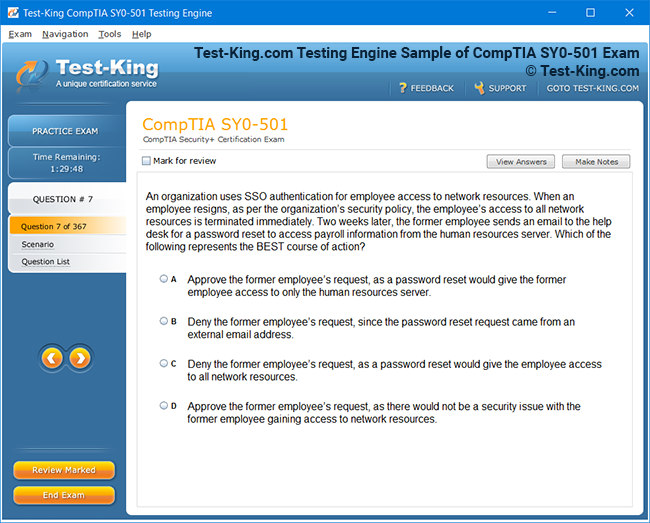
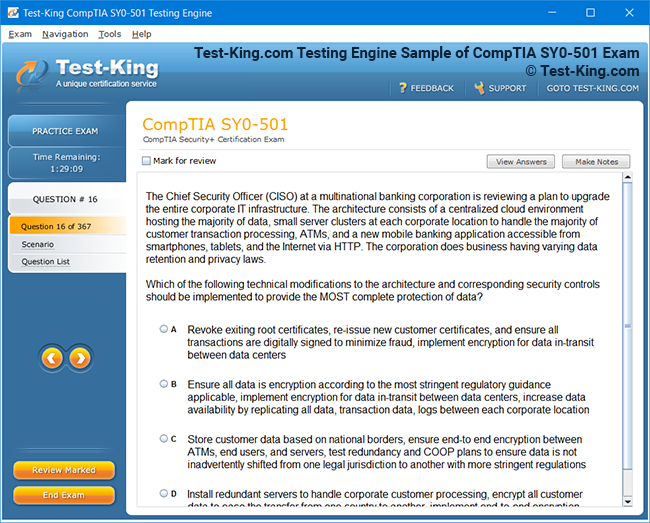
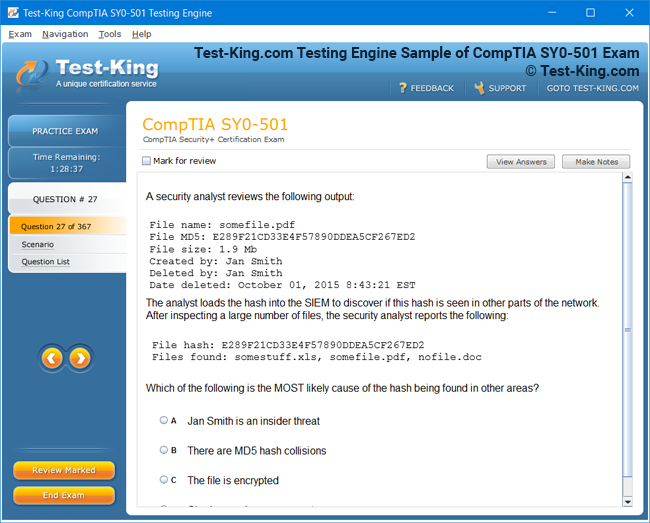
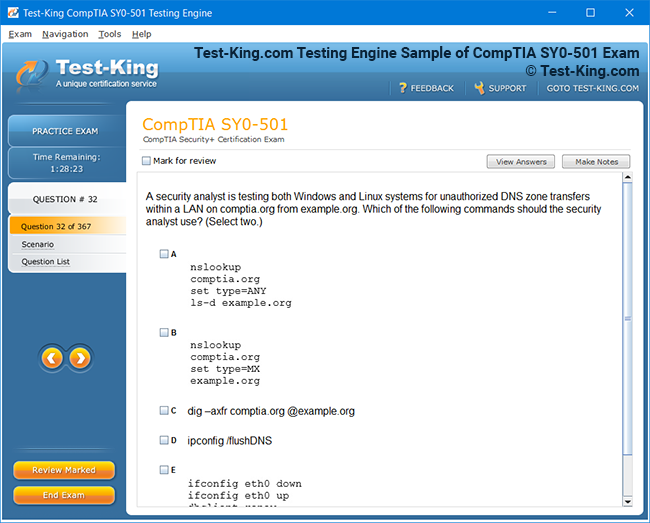
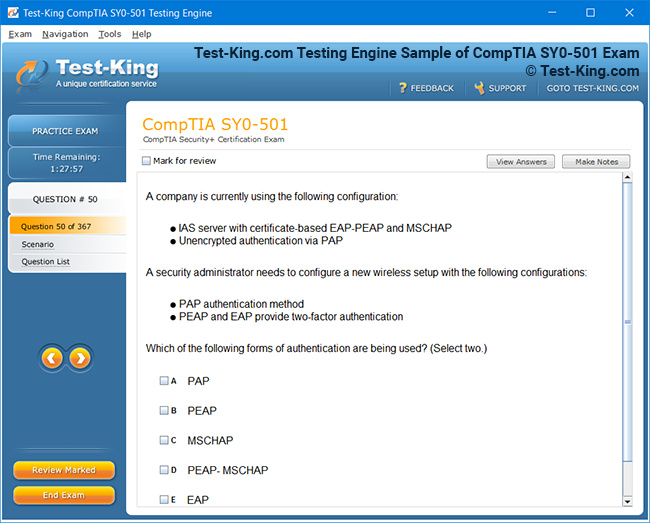
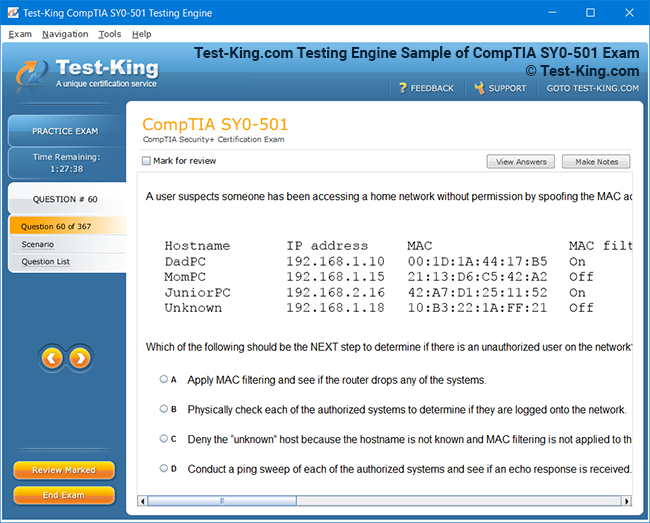
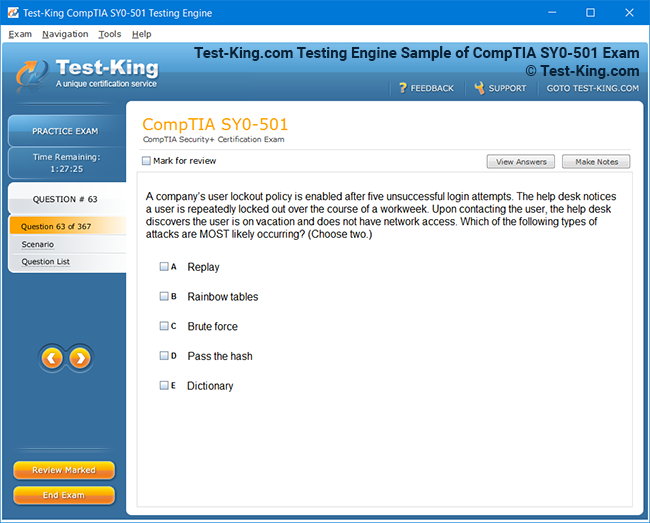
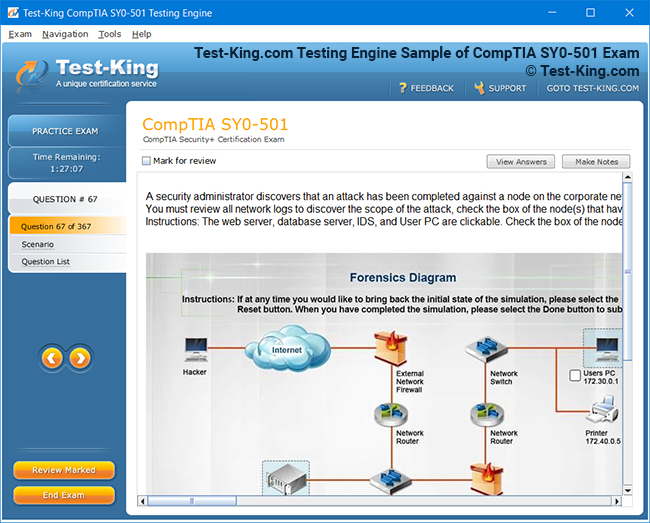
Product Screenshots
Frequently Asked Questions
How can I get the products after purchase?
All products are available for download immediately from your Member's Area. Once you have made the payment, you will be transferred to Member's Area where you can login and download the products you have purchased to your computer.
How long can I use my product? Will it be valid forever?
Test-King products have a validity of 90 days from the date of purchase. This means that any updates to the products, including but not limited to new questions, or updates and changes by our editing team, will be automatically downloaded on to computer to make sure that you get latest exam prep materials during those 90 days.
Can I renew my product if when it's expired?
Yes, when the 90 days of your product validity are over, you have the option of renewing your expired products with a 30% discount. This can be done in your Member's Area.
Please note that you will not be able to use the product after it has expired if you don't renew it.
How often are the questions updated?
We always try to provide the latest pool of questions, Updates in the questions depend on the changes in actual pool of questions by different vendors. As soon as we know about the change in the exam question pool we try our best to update the products as fast as possible.
How many computers I can download Test-King software on?
You can download the Test-King products on the maximum number of 2 (two) computers or devices. If you need to use the software on more than two machines, you can purchase this option separately. Please email support@test-king.com if you need to use more than 5 (five) computers.
What is a PDF Version?
PDF Version is a pdf document of Questions & Answers product. The document file has standart .pdf format, which can be easily read by any pdf reader application like Adobe Acrobat Reader, Foxit Reader, OpenOffice, Google Docs and many others.
Can I purchase PDF Version without the Testing Engine?
PDF Version cannot be purchased separately. It is only available as an add-on to main Question & Answer Testing Engine product.
What operating systems are supported by your Testing Engine software?
Our testing engine is supported by Windows. Andriod and IOS software is currently under development.
Top Nokia Exams
- 4A0-D01 - Nokia Data Center Fabric Fundamentals
- 4A0-C03 - Nokia NRS II Composite: IS-IS version
- 4A0-100 - Nokia IP Networks and Services Fundamentals
- 4A0-112 - Nokia IS-IS Routing Protocol
- 4A0-107 - Nokia Quality of Service
- 4A0-116 - Nokia Segment Routing
- 4A0-104 - Nokia Services Architecture
- 4A0-114 - Nokia Border Gateway Protocol Fundamentals for Services
- 4A0-AI1 - Nokia NSP IP Network Automation Professional Composite Exam
- 4A0-205 - Nokia Optical Networking Fundamentals
- 4A0-115 - Nokia Ethernet Virtual Private Network Services
- 4A0-D03 - Nokia SR Linux EVPN and Data Center Interconnect
- 4A0-103 - Nokia Multiprotocol Label Switching
Comprehensive Guide to the 4A0-M05 Nokia Cloud Packet Core Exam
The Nokia Cloud Packet Core is a sophisticated network solution that serves as the backbone of modern mobile communications, particularly in 5G and LTE environments. Candidates preparing for the 4A0-M05 exam must develop a profound understanding of its architecture, operational principles, and configuration nuances. At the core of this network lies the separation of control and user plane functions, which allows for high scalability and flexibility in cloud environments. The exam evaluates not only theoretical knowledge but also practical skills in configuring and troubleshooting core network elements.
Understanding the Fundamentals of Nokia Cloud Packet Core
In recent years, the evolution of mobile networks has necessitated a move from traditional hardware-based architectures to cloud-native implementations. This transformation has enhanced efficiency, enabling dynamic allocation of resources and rapid deployment of network functions. The Nokia Cloud Packet Core embodies these principles, integrating key components such as the User Plane Function (UPF), Access and Mobility Management Function (AMF), and Session Management Function (SMF). Each of these elements plays a pivotal role in maintaining seamless connectivity and ensuring optimal performance for end-users.
Understanding the signaling processes within the core network is crucial. The interaction between the control plane and user plane dictates the flow of data, from session initiation to termination. Candidates should be able to explain how signaling messages are exchanged and how network functions coordinate to handle mobility events, quality of service adjustments, and session handovers. The 4A0-M05 exam requires a solid grasp of these mechanisms, emphasizing both the theoretical frameworks and real-world application scenarios.
Key Technologies and Protocols
The exam emphasizes familiarity with a range of technologies that underpin the Nokia Cloud Packet Core. For instance, IP Multimedia Subsystem (IMS) integration, policy control mechanisms, and network slicing are integral to modern deployments. Network slicing, in particular, allows operators to partition the same physical network into multiple virtual networks, each tailored for specific service requirements. Candidates should understand how slices are instantiated, monitored, and managed within the cloud environment.
Additionally, comprehension of protocols such as GTP, Diameter, and SCTP is essential. These protocols enable communication between core network elements and facilitate subscriber authentication, mobility management, and session continuity. Candidates may encounter scenarios in which they must describe the sequence of messages exchanged between the AMF, SMF, and UPF or troubleshoot issues arising from signaling anomalies. Mastery of these protocols, therefore, is critical not only for passing the exam but also for ensuring operational excellence in professional deployments.
The deployment models of the Nokia Cloud Packet Core are also a focal point. Whether configured as a centralized, distributed, or hybrid model, each approach offers distinct advantages and challenges. Centralized architectures simplify management but may introduce latency for remote users, whereas distributed deployments enhance performance at the edge but require sophisticated orchestration. Candidates are expected to articulate the trade-offs between these models and provide reasoning for choosing a particular configuration based on network requirements.
Practical Configuration and Management
Hands-on expertise is indispensable for the 4A0-M05 exam. Candidates must demonstrate proficiency in configuring network functions, managing sessions, and monitoring system performance. Practical exercises often include setting up UPF nodes, defining session parameters, and implementing policy rules that control traffic flows. An in-depth understanding of cloud orchestration tools is also vital, as these platforms automate deployment and scaling of network functions, thereby reducing operational complexity.
Troubleshooting constitutes a significant portion of the exam content. Candidates should be capable of identifying and resolving issues related to session establishment, mobility events, and service continuity. For instance, if a subscriber experiences interrupted connectivity during a handover, a proficient engineer must trace the problem to misconfigurations in the AMF or SMF, or examine policy control discrepancies. The exam tests the ability to apply methodical problem-solving approaches, combining diagnostic commands, monitoring tools, and an understanding of signaling flows to restore service efficiently.
Monitoring and performance optimization are equally emphasized. Nokia Cloud Packet Core offers extensive metrics for assessing throughput, latency, and resource utilization. Candidates must be able to interpret these metrics to fine-tune network functions, ensuring that service-level agreements are met. Moreover, understanding the implications of scaling resources up or down in response to fluctuating traffic loads is crucial. This ensures not only optimal performance but also cost efficiency in cloud-based network environments.
Security and Compliance Considerations
Security forms an integral component of the 4A0-M05 exam. The cloud packet core must adhere to rigorous standards to protect subscriber data and prevent unauthorized access. Candidates should understand authentication mechanisms, encryption protocols, and firewall configurations that safeguard the network. Knowledge of threat detection and mitigation strategies, such as intrusion prevention systems and anomaly detection, is also tested.
In addition to security, regulatory compliance is a critical area. Network operators must ensure that their deployments meet regional and international standards for data privacy, lawful interception, and emergency services. Candidates are expected to articulate how Nokia Cloud Packet Core supports compliance through audit logs, policy enforcement, and secure interfaces. An understanding of these frameworks allows engineers to design and manage networks that are both resilient and legally compliant, reflecting the holistic approach demanded by modern telecommunications environments.
Exam Preparation Strategies
Preparing for the 4A0-M05 exam requires a structured approach. Candidates are advised to begin with a thorough review of the official Nokia documentation, which provides insights into network architecture, protocol flows, and configuration guidelines. Complementary materials, including white papers, online labs, and simulation environments, offer practical experience and reinforce theoretical knowledge.
Time management during preparation is crucial. Establishing a study schedule that balances reading, practice exercises, and review sessions ensures comprehensive coverage of the exam objectives. Practicing with scenario-based questions that mimic real-world troubleshooting challenges sharpens problem-solving skills and builds confidence. Understanding common pitfalls, such as misinterpreting signaling flows or misconfiguring session parameters, can prevent costly mistakes on the exam.
Collaborative learning is another valuable strategy. Engaging with peers, participating in forums, and discussing complex scenarios fosters deeper understanding. Real-world examples of Nokia Cloud Packet Core deployments, such as handling high-density urban traffic or managing mobility across regions, provide context that enhances retention and practical application. Candidates who integrate theoretical study with hands-on experience tend to perform better and retain knowledge longer.
Emerging Trends and Future Considerations
The telecommunications landscape is rapidly evolving, and Nokia Cloud Packet Core remains at the forefront of innovation. Concepts such as network automation, AI-driven optimization, and edge computing are increasingly relevant. Candidates should be aware of how these trends influence network design, resource allocation, and service delivery. Anticipating future challenges, such as supporting ultra-reliable low-latency communications or massive IoT deployments, enables engineers to remain agile and effective.
Understanding the implications of cloud-native principles, including microservices architecture and containerization, is essential. These technologies allow network functions to be deployed independently, scaled dynamically, and updated without service disruption. For the 4A0-M05 exam, candidates must be able to explain the advantages of these approaches and illustrate how they contribute to network efficiency, resilience, and rapid innovation.
In summary, mastering the Nokia Cloud Packet Core requires a blend of theoretical understanding, practical expertise, and awareness of emerging technologies. The 4A0-M05 exam evaluates a candidate's ability to navigate this complex ecosystem, from configuring network functions to ensuring performance, security, and compliance. Through diligent study, hands-on practice, and engagement with evolving trends, aspiring professionals can approach the exam with confidence and competence, fully prepared to excel in the dynamic world of cloud-based mobile networking.
Advanced Configuration and Troubleshooting in Nokia Cloud Packet Core
For candidates aiming to excel in the 4A0-M05 exam, a profound comprehension of advanced configuration and troubleshooting within the Nokia Cloud Packet Core environment is indispensable. The cloud packet core represents a convergence of multiple network functions, each responsible for handling sessions, mobility, and policy enforcement in a cohesive yet distributed architecture. Mastery over the orchestration and management of these functions requires not only familiarity with standard deployment practices but also an ability to diagnose anomalies in real time and implement corrective measures efficiently.
The intricacies of session management constitute a critical area of focus. Understanding how the Session Management Function interacts with the Access and Mobility Management Function, the Policy Control Function, and the User Plane Function is vital. In practical scenarios, engineers encounter issues such as session establishment failures, incorrect policy application, or user plane congestion. Candidates should be able to describe the sequence of interactions during session creation, modification, and release, and explain how each function contributes to maintaining seamless connectivity. For instance, if a subscriber experiences inconsistent quality of service, a systematic analysis may reveal misalignment between policy enforcement in the Policy Control Function and routing configurations in the User Plane Function.
Mobility management is another complex domain tested in the exam. The cloud packet core facilitates seamless handovers as subscribers move across different cells or regions. Candidates must understand how signaling messages coordinate to transfer sessions without disruption, including procedures for interworking between LTE and 5G networks. Advanced troubleshooting requires examining event triggers such as handover preparation failures, incorrect tunnel configurations, or subscriber context mismatches. Being able to trace these issues through signaling logs, network telemetry, and orchestration dashboards demonstrates both practical proficiency and exam readiness.
Policy and charging control represents an additional layer of complexity. The Policy Control Function governs rules that determine bandwidth allocation, service prioritization, and traffic shaping for individual subscribers. Candidates must grasp how to configure these rules, monitor their enforcement, and adjust them dynamically in response to network load or service requirements. For example, during periods of high traffic, the system may need to prioritize latency-sensitive applications such as voice or streaming while regulating less critical data flows. Understanding the interplay between session management, policy enforcement, and user plane routing is crucial for achieving optimal performance.
Deployment models and architecture choices directly influence configuration and troubleshooting strategies. Centralized deployments provide simplified control but may introduce latency in geographically dispersed networks. Distributed deployments enhance performance at the network edge but require sophisticated orchestration to maintain coherence between control and user plane functions. Hybrid models combine these approaches to balance efficiency and performance. Candidates should be able to articulate the advantages and limitations of each deployment model, describe the impact on resource allocation, and illustrate how specific configurations affect session continuity, latency, and throughput.
Security considerations are intertwined with advanced configuration. The Nokia Cloud Packet Core implements multiple layers of protection, including authentication, encryption, and network segmentation. Candidates must understand how to configure secure interfaces, enforce access control policies, and monitor potential vulnerabilities. For instance, misconfigured authentication parameters can result in unauthorized access or service disruption. Exam scenarios may include identifying configuration gaps that compromise security and applying remedial measures, such as adjusting encryption profiles, updating access control lists, or validating subscriber credentials.
Monitoring and performance optimization extend beyond basic metrics to encompass predictive and proactive strategies. Candidates must interpret detailed telemetry, identify trends indicative of congestion or service degradation, and implement corrective actions before user experience is affected. For example, a sudden surge in traffic on specific UPF nodes may require dynamic scaling, session redistribution, or reallocation of policy enforcement rules. Understanding the orchestration mechanisms that automate these adjustments allows engineers to maintain high reliability while minimizing manual intervention.
Integration with external systems is another dimension that candidates must comprehend. The cloud packet core often interfaces with OSS/BSS platforms, IMS infrastructure, and network analytics solutions. Candidates should be able to explain how these integrations support subscriber management, billing, service delivery, and reporting. Advanced exam questions may present scenarios in which misalignment between the core network and external systems leads to session errors, incorrect charging, or delayed provisioning. Demonstrating the ability to trace and resolve such issues illustrates a deep understanding of the holistic network ecosystem.
Candidates are also expected to be conversant with emerging automation and orchestration tools. Cloud-native principles, including microservices and containerized deployments, enable independent scaling and rapid updates of network functions. Understanding how these tools interact with orchestration platforms, policy engines, and monitoring systems is crucial. Exam scenarios may involve adjusting configurations in a containerized environment, troubleshooting resource allocation conflicts, or validating the orchestration of interdependent network functions. Proficiency in these areas ensures candidates are prepared for both the exam and real-world operational challenges.
Troubleshooting exercises often simulate real operational issues. For instance, if a user experiences intermittent service during peak hours, an engineer must trace the problem through user plane logs, session management events, and policy enforcement anomalies. Similarly, issues such as signaling congestion, dropped handovers, or incorrect subscriber context require methodical analysis. Candidates must be able to describe the steps to identify root causes, apply corrective configurations, and validate resolution through monitoring and testing. These scenarios reinforce both technical competence and analytical reasoning.
Understanding the implications of network slicing is essential. Slices allow multiple virtual networks to coexist on the same physical infrastructure, each tailored to specific service requirements such as low latency, high throughput, or massive connectivity. Candidates must grasp how slices are instantiated, monitored, and managed, and how they interact with policy and session management functions. Troubleshooting slice-related issues often involves examining resource allocation, user plane isolation, and cross-slice interference, ensuring that each slice maintains the intended service quality.
Candidates should also be familiar with automation-driven fault detection and recovery. The Nokia Cloud Packet Core supports automated alerts, self-healing mechanisms, and dynamic reallocation of network functions in response to failures. Understanding how to interpret these alerts, correlate them with operational events, and implement corrective actions is crucial. Exam questions may present scenarios where automated recovery has partially succeeded, requiring candidates to manually adjust configurations or intervene in orchestration workflows to fully restore service.
Performance tuning remains a central competency. Candidates must be able to adjust routing policies, allocate resources efficiently, and optimize signaling paths to reduce latency and maximize throughput. Advanced exam scenarios may involve balancing load across multiple UPF nodes, fine-tuning session parameters for high-density user environments, or optimizing mobility handling for fast-moving subscribers. Mastery of these techniques reflects both exam readiness and operational excellence.
Finally, candidates must understand the evolving landscape of cloud-based mobile networking. Edge computing, AI-assisted optimization, and 5G advanced features increasingly impact how the cloud packet core operates. Being able to articulate these developments, explain their effect on network configuration, and anticipate potential operational challenges demonstrates forward-looking expertise. The exam not only tests current knowledge but also evaluates the candidate's ability to adapt to emerging technologies and maintain excellence in a rapidly evolving environment.
Hands-On Implementation and Scenario-Based Insights in Nokia Cloud Packet Core
Proficiency in practical scenarios is a cornerstone of the 4A0-M05 Nokia Cloud Packet Core exam, as candidates are required to demonstrate not only conceptual understanding but also operational competence. The cloud packet core embodies a complex amalgamation of control and user plane functions that collectively sustain mobile connectivity. Understanding the orchestration of these functions in real-world environments is crucial for both exam preparation and professional practice.
Practical implementation begins with configuring core network functions such as the Session Management Function, Access and Mobility Management Function, and User Plane Function. Each function carries distinct responsibilities: the session management function orchestrates subscriber sessions, the mobility function handles user movement and continuity, and the user plane function ensures efficient data transfer. Candidates must grasp the interdependencies among these functions, particularly how signaling messages traverse between them to establish, modify, and terminate sessions. In troubleshooting scenarios, misconfigurations in any of these elements can result in session failures, handover interruptions, or policy enforcement discrepancies, making systematic analysis indispensable.
Scenario-based exercises often include subscriber mobility across heterogeneous networks. For instance, when a subscriber transitions from an LTE cell to a 5G cell, the AMF must coordinate handover procedures while the SMF adjusts session parameters accordingly. Understanding the nuances of these procedures, including tunnel setup, context transfer, and latency minimization, is critical. Candidates should be able to explain the sequence of signaling events, identify potential failure points, and implement corrective configurations to maintain uninterrupted connectivity.
Policy enforcement scenarios are also prevalent in practical exercises. The Policy Control Function defines rules for bandwidth allocation, traffic prioritization, and service-specific treatment. Candidates may encounter situations where policy misalignment leads to suboptimal service delivery, such as throttled video streams or delayed voice packets. Troubleshooting these issues requires tracing policy decisions through logs, correlating subscriber activity with network metrics, and adjusting enforcement rules to restore expected service levels. A thorough understanding of the interplay between session management, policy control, and user plane routing ensures that candidates can resolve such challenges efficiently.
High-density subscriber environments introduce additional complexity. As multiple users simultaneously access the network, engineers must manage congestion, allocate resources dynamically, and ensure fairness among subscribers. The Nokia Cloud Packet Core supports mechanisms for load balancing across UPF nodes, dynamic scaling of resources, and prioritization based on service type. Candidates should be able to describe how these mechanisms operate, how to configure them effectively, and how to monitor their impact on network performance. Exam scenarios may simulate congestion events, requiring candidates to implement real-time adjustments to maintain service quality.
Troubleshooting signaling and data plane issues is an essential skill. For instance, session establishment failures can arise from incorrect tunnel configuration, misaligned subscriber context, or communication errors between control and user plane functions. Candidates must demonstrate the ability to analyze signaling traces, identify the root cause, and apply appropriate corrective measures. Similarly, anomalies in the user plane, such as packet loss, latency spikes, or routing inconsistencies, require examination of forwarding rules, interface configurations, and traffic monitoring metrics. Mastery of these tasks ensures candidates are well-prepared for scenario-based questions on the exam.
Security-focused scenarios are another critical component. The cloud packet core incorporates multiple layers of protection, including subscriber authentication, data encryption, and access control. Candidates may face exercises in which unauthorized access attempts, misconfigured encryption profiles, or policy enforcement lapses disrupt services. The ability to diagnose these issues, reconfigure security parameters, and validate system integrity demonstrates both operational proficiency and readiness for the exam. Moreover, understanding compliance requirements for lawful interception, privacy protection, and emergency services enhances the ability to design and maintain secure network operations.
Automation and orchestration form the backbone of modern cloud packet core management. Candidates are expected to understand how orchestration platforms deploy, scale, and monitor network functions. Practical exercises may involve adjusting resources in response to dynamic traffic patterns, verifying orchestration workflows, or intervening when automated processes partially fail. Knowledge of microservices architecture, containerized deployments, and cloud-native principles allows candidates to optimize operations while minimizing manual intervention. Understanding these principles is critical for exam scenarios that simulate high-demand or fault conditions requiring rapid, coordinated responses.
Network slicing introduces specialized practical considerations. Slices create multiple virtual networks on shared physical infrastructure, each tailored for specific service requirements. Candidates may encounter scenarios where slice configuration errors cause interference, service degradation, or subscriber isolation failures. Addressing these issues requires analyzing resource allocation, validating slice policies, and ensuring user plane separation while maintaining adherence to performance objectives. The ability to troubleshoot and optimize slices reflects advanced understanding of cloud packet core capabilities and is often tested in scenario-based questions.
Monitoring and performance evaluation are integral to hands-on practice. The cloud packet core provides extensive metrics for throughput, latency, session establishment time, and resource utilization. Candidates should be able to interpret these metrics, detect anomalies, and implement adjustments to enhance service delivery. For example, detecting bottlenecks in UPF nodes or identifying signaling delays in mobility management allows engineers to proactively address performance issues. Scenario-based exercises may simulate sudden traffic surges, requiring candidates to implement load balancing, adjust policy enforcement, or reconfigure session parameters to maintain service continuity.
Integration with external systems further expands the practical landscape. The cloud packet core interacts with OSS/BSS platforms, IMS infrastructure, and network analytics solutions. Candidates may face scenarios where misalignments between these systems and core network functions lead to session errors, billing inconsistencies, or delayed provisioning. Understanding how to trace, diagnose, and resolve such issues is essential for exam success. The ability to coordinate between multiple systems and ensure coherent operations underpins both professional competence and certification readiness.
Emerging technologies such as AI-driven network optimization and edge computing introduce additional layers of practical complexity. Candidates should understand how predictive analytics can anticipate congestion, how automated adjustments can prevent service degradation, and how edge deployments affect latency-sensitive applications. Scenario-based exercises may involve configuring edge nodes, validating AI-assisted policies, or integrating predictive monitoring with orchestration workflows. Mastery of these tasks demonstrates the ability to apply theoretical knowledge in real-world cloud packet core operations.
Practical proficiency also extends to subscriber lifecycle management. Engineers must handle onboarding, policy assignment, session initiation, mobility events, and service termination. Candidates should be able to navigate complex scenarios where subscriber data mismatches, session conflicts, or policy misconfigurations occur. Diagnosing these issues requires familiarity with subscriber context management, signaling interactions, and policy enforcement mechanisms. Scenario exercises test the candidate’s ability to maintain continuity, security, and quality of service throughout the subscriber experience.
Resource optimization remains a critical aspect of hands-on practice. The Nokia Cloud Packet Core supports dynamic allocation of compute, memory, and network resources across multiple functions. Candidates may be required to simulate high-traffic conditions, adjust resource allocation policies, and observe the impact on session throughput, latency, and user experience. Understanding how to balance efficiency with performance ensures that network functions operate optimally under varying load conditions and prepares candidates for exam questions that focus on real-time operational adjustments.
Finally, mastering logging and diagnostic tools is essential. Candidates should be able to interpret logs from control and user plane functions, correlate events across multiple network elements, and identify patterns that indicate configuration errors or service disruptions. Hands-on exercises may include tracing packet flows, analyzing signaling sequences, or validating policy enforcement against subscriber activity. Competence in these tasks enables candidates to diagnose complex issues efficiently, reflecting the depth of expertise expected in the 4A0-M05 exam.
Optimizing Network Functions and Cloud Deployments
Orchestration and automation are central to mastering the Nokia Cloud Packet Core environment, and candidates preparing for the 4A0-M05 exam must understand how these mechanisms enhance operational efficiency, reliability, and scalability. In modern mobile networks, the separation of control and user plane functions enables cloud-native deployments, allowing each network function to scale independently based on demand. This architectural approach facilitates rapid deployment of services, dynamic resource allocation, and resilient operations.
Orchestration platforms manage the lifecycle of network functions, from instantiation to decommissioning. Candidates must grasp how orchestration interacts with compute, storage, and network resources to deploy the Access and Mobility Management Function, Session Management Function, User Plane Function, and Policy Control Function. Each deployment requires configuration parameters, such as IP addresses, session limits, and routing policies, to ensure seamless operation. Misconfigurations can propagate errors across multiple functions, impacting session continuity, policy enforcement, or subscriber mobility. Understanding the orchestration workflow and its integration with cloud infrastructure is essential for exam readiness.
Automation extends beyond deployment to include self-healing, scaling, and monitoring. The Nokia Cloud Packet Core supports automated scaling of network functions in response to traffic fluctuations. Candidates may encounter scenarios in which UPF nodes are dynamically added or removed based on subscriber load, or SMF instances are reallocated to optimize session handling. Mastery of automation principles ensures that network functions maintain high performance while minimizing manual intervention, which is a crucial competency evaluated in the 4A0-M05 exam.
Monitoring tools provide continuous insight into network health. Candidates must understand how to leverage telemetry data, performance metrics, and alerting mechanisms to identify potential issues before they impact service quality. For example, analyzing throughput, latency, and packet loss patterns can reveal bottlenecks in user plane nodes or signaling delays in control plane functions. Automation can then trigger remedial actions, such as reallocating resources, adjusting session policies, or rerouting traffic, demonstrating the synergy between monitoring and automated operations.
Integration with external platforms such as OSS/BSS systems, IMS, and analytics solutions adds complexity to orchestration and automation tasks. Candidates must be able to explain how these integrations support subscriber management, billing, and service analytics. Misalignments between the cloud packet core and external systems can lead to session errors, delayed provisioning, or incorrect policy enforcement. Practical knowledge of coordinating multiple systems ensures that engineers can troubleshoot end-to-end issues, which is often emphasized in scenario-based exam questions.
Network slicing introduces unique orchestration challenges. Each slice represents a virtual network tailored to specific service requirements, such as low latency for ultra-reliable communications or high throughput for media streaming. Candidates must understand how orchestration platforms instantiate slices, allocate resources, and monitor performance while maintaining isolation between slices. Scenario-based exercises may include misconfigured slices that impact user experience, requiring candidates to adjust allocation policies, verify slice separation, and optimize performance. Mastery of slicing orchestration reflects a deep understanding of the cloud packet core’s capabilities.
Policy-driven automation is another critical area. The Policy Control Function dictates bandwidth allocation, traffic prioritization, and service-specific rules. Candidates should be able to describe how policies are applied across multiple network functions, how they interact with session management and user plane routing, and how automated adjustments respond to dynamic network conditions. Exam scenarios may involve adjusting policies in real-time to accommodate high-demand applications, ensuring service continuity while maintaining compliance and security standards.
Security automation enhances the resilience of the cloud packet core. Automated mechanisms can detect anomalies, enforce access control, and trigger remediation in case of unauthorized attempts. Candidates must be able to configure these mechanisms, monitor alerts, and intervene when automated responses are insufficient. For example, if a misconfigured authentication policy allows unauthorized access, the engineer must identify the root cause, apply corrective settings, and validate system integrity. Understanding security automation is vital for demonstrating operational proficiency during the exam.
Edge computing integration adds another dimension to orchestration and automation. Candidates should understand how deploying User Plane Functions or other network elements closer to end-users reduces latency and optimizes performance. Automation ensures that resources at the edge are efficiently allocated, scaled dynamically, and monitored continuously. Scenario-based exercises may simulate high-density edge traffic or mobility events, requiring candidates to validate routing, manage session continuity, and optimize performance in distributed environments.
Troubleshooting automated workflows is a frequent exam focus. Candidates may face scenarios in which orchestration partially fails, resource allocation conflicts occur, or automated scaling does not maintain service levels. Diagnosing these issues requires understanding the orchestration logic, interpreting system logs, and manually intervening to restore coherence. Practical mastery of these troubleshooting techniques ensures that candidates can maintain service reliability, respond to faults promptly, and optimize operational efficiency.
Cloud-native principles, such as containerized deployments and microservices architecture, underpin modern automation strategies. Candidates should understand how each network function can be deployed as a microservice, updated independently, and scaled according to load. Scenario exercises may require adjusting container orchestration parameters, validating interdependencies, or resolving conflicts between multiple microservices. Mastery of these principles enhances both exam readiness and professional expertise in cloud packet core operations.
Resource optimization through orchestration and automation is paramount. Candidates must balance performance, cost, and scalability by allocating compute, storage, and network resources dynamically. For example, a sudden surge in video traffic may require reallocating UPF resources, adjusting policy enforcement, and monitoring latency metrics to ensure quality of service. Scenario-based exercises test the ability to implement these optimizations in real-time, demonstrating both technical proficiency and strategic thinking.
Monitoring automated processes involves correlating events across multiple network functions. Candidates should be able to interpret logs from session management, mobility management, user plane, and policy control functions to identify issues that automated systems may not fully resolve. This includes detecting configuration inconsistencies, resource exhaustion, or policy conflicts. Understanding how to validate automated actions against operational objectives ensures that network functions continue to operate seamlessly even under dynamic conditions.
Emerging trends such as AI-assisted orchestration introduce predictive capabilities into network management. Candidates should understand how analytics can anticipate congestion, optimize resource allocation, and recommend adjustments to policy enforcement. Scenario exercises may involve evaluating AI-driven recommendations, validating predicted outcomes, and implementing changes that enhance overall network performance. Mastery of these concepts demonstrates forward-looking expertise and aligns with the evolving expectations of the 4A0-M05 exam.
Automation also supports compliance with regulatory and operational standards. Candidates must understand how orchestration ensures lawful interception, data privacy, and adherence to service-level agreements. Scenario-based exercises may require validating automated workflows against compliance requirements, adjusting configurations to address deficiencies, and documenting operational procedures. This dimension emphasizes the holistic nature of automation in cloud packet core management, bridging technical proficiency with governance and oversight responsibilities.
Finally, candidates should appreciate the symbiotic relationship between orchestration, automation, and operational efficiency. Orchestration coordinates the deployment, scaling, and monitoring of network functions, while automation ensures responsiveness, fault resilience, and optimization. Practical scenarios may combine high-demand traffic, security challenges, slice management, and edge deployment considerations, requiring a comprehensive understanding of how these elements interact. Mastery of orchestration and automation not only enhances exam performance but also equips engineers to manage the dynamic, complex, and evolving environment of Nokia Cloud Packet Core networks.
Practical Skills and Operational Mastery in Nokia Cloud Packet Core
Troubleshooting, performance optimization, and subscriber management are fundamental competencies evaluated in the 4A0-M05 Nokia Cloud Packet Core exam. Candidates must demonstrate the ability to diagnose complex issues, enhance network efficiency, and maintain seamless subscriber experiences within the cloud-native architecture. These skills integrate theoretical knowledge with practical operational expertise, encompassing all dimensions of control plane, user plane, policy enforcement, and orchestration.
Troubleshooting begins with the identification of root causes affecting session establishment, mobility, and data flow. The cloud packet core operates through interdependent functions: the Session Management Function orchestrates session parameters, the Access and Mobility Management Function ensures continuous connectivity, and the User Plane Function handles data transport. Candidates must understand the signaling sequences that connect these functions and be able to analyze anomalies when sessions fail or experience degradation. For example, if subscribers encounter interrupted service during handovers, engineers must trace signaling messages, validate tunnel configurations, and adjust session or mobility parameters to restore connectivity.
Misconfigurations in policy enforcement are another frequent cause of network issues. The Policy Control Function governs traffic prioritization, bandwidth allocation, and quality of service. Candidates should be able to detect inconsistencies between intended policy rules and actual network behavior, and apply corrective actions to restore optimal service delivery. Scenario-based exercises may present cases where latency-sensitive applications are throttled or high-volume traffic exceeds allocated resources. Identifying the interplay between session management, policy enforcement, and user plane routing is critical for resolving these challenges effectively.
High-density traffic conditions test the ability to optimize performance under stress. In congested environments, UPF nodes may become overloaded, leading to latency spikes, packet loss, or reduced throughput. Candidates must demonstrate how to implement load balancing strategies, dynamically scale network functions, and monitor performance metrics to maintain seamless operation. This includes reallocating resources across distributed or edge nodes, adjusting routing policies, and ensuring fair allocation among multiple subscribers. Mastery of these techniques reflects the practical operational competence expected in the exam.
Monitoring tools are essential for proactive network management. Candidates must interpret telemetry data, signaling logs, and performance metrics to anticipate potential failures. For instance, sustained increases in session setup time or recurring handover failures may indicate misaligned configurations or insufficient resource allocation. Automation can address some of these issues, but engineers must also know how to manually intervene to restore stability. Understanding the synergy between monitoring, troubleshooting, and automation ensures that networks remain resilient, scalable, and responsive to dynamic conditions.
Subscriber management forms a critical component of operational proficiency. Engineers must handle onboarding, session initiation, mobility events, policy application, and service termination while ensuring consistent quality and security. Candidates should be familiar with subscriber context management, including authentication, policy assignment, and session history. Scenario-based exercises may present cases where multiple subscribers experience simultaneous service interruptions, requiring prioritization, root cause analysis, and corrective adjustments. Maintaining continuity and compliance across all subscriber interactions is essential for both exam performance and real-world network operations.
Mobility management scenarios often involve heterogeneous network environments. Candidates must understand how sessions are maintained as subscribers move between LTE and 5G cells, including the handover procedures, context transfers, and policy continuity. Troubleshooting mobility issues requires analyzing signaling flows, detecting mismatched subscriber context, and adjusting routing or session parameters. Effective mobility management ensures uninterrupted connectivity, adherence to quality of service standards, and optimal resource utilization across the network.
Policy enforcement extends to dynamic service adjustments based on real-time conditions. The cloud packet core allows policies to be applied automatically based on traffic load, subscriber profile, or service requirements. Candidates should understand how to configure policy rules, monitor enforcement, and adjust parameters to optimize performance. For example, during peak usage periods, latency-sensitive applications may need higher priority, while non-critical data flows are temporarily throttled. Mastery of policy dynamics ensures that service-level objectives are met consistently and efficiently.
Edge deployments introduce additional considerations for troubleshooting and performance optimization. Candidates must comprehend how User Plane Functions or other network elements deployed closer to subscribers reduce latency and enhance throughput. High-density edge traffic, mobility events, and distributed resource allocation present unique challenges. Engineers must monitor edge nodes, validate session continuity, and optimize traffic flows while ensuring that orchestration and automation mechanisms maintain system coherence. Scenario-based exercises often test the ability to manage these distributed environments effectively.
Security management is closely intertwined with troubleshooting and subscriber operations. The cloud packet core incorporates multiple layers of protection, including authentication, encryption, and access control. Candidates may encounter scenarios where security misconfigurations lead to unauthorized access, session disruption, or policy enforcement failures. Troubleshooting these issues involves identifying configuration gaps, validating subscriber credentials, and implementing remediation measures. Ensuring secure operations while maintaining service quality is a critical skill evaluated in the exam.
Network slicing adds complexity to subscriber and performance management. Each slice represents a virtual network with specific performance requirements. Candidates must understand how slices are provisioned, monitored, and optimized. Issues such as resource contention, slice interference, or policy misalignment may require adjustments to ensure service isolation and quality. Scenario exercises may include verifying slice performance, reallocating resources, or troubleshooting cross-slice impacts. Mastery of slice management reflects advanced understanding of cloud packet core capabilities.
Automation supports proactive troubleshooting and optimization. Alerts, self-healing mechanisms, and dynamic resource scaling reduce manual intervention but require careful configuration and validation. Candidates should understand how automated responses interact with orchestration workflows, how to interpret alerts, and when manual adjustment is necessary. Scenario-based questions may involve partial automation failures, requiring candidates to restore service and maintain continuity while validating system integrity.
Performance tuning involves evaluating throughput, latency, and resource utilization to optimize subscriber experience. Candidates must understand how to adjust session parameters, redistribute traffic, and scale resources dynamically. High-density scenarios, mobility events, or burst traffic require rapid decision-making and precise configuration to prevent degradation. Effective performance tuning ensures service-level objectives are consistently achieved while maintaining efficient use of cloud resources.
Troubleshooting complex interactions between network functions is a common challenge. Candidates must be able to analyze signaling sequences, correlate events across multiple functions, and detect root causes of service anomalies. For example, an intermittent session drop may originate from misaligned session parameters in SMF, conflicting routing rules in UPF, or policy enforcement discrepancies in PCF. The ability to diagnose and resolve these multifaceted issues demonstrates comprehensive operational proficiency.
Integration with external systems, such as OSS/BSS platforms, IMS, and analytics tools, is critical for subscriber management and performance optimization. Candidates must understand how these integrations impact session management, billing, and service analytics. Scenario exercises may involve resolving discrepancies between core network data and external systems, validating subscriber policies, or troubleshooting provisioning delays. Mastery of these interactions ensures seamless operations across the entire ecosystem.
Resource allocation is fundamental to maintaining high performance. Candidates should understand how to allocate compute, storage, and network resources dynamically in response to varying traffic patterns, mobility events, and slice requirements. Scenario-based exercises may simulate traffic surges, requiring immediate adjustments to prevent congestion, optimize throughput, and maintain quality of service. This demonstrates the candidate’s ability to manage complex operational environments efficiently.
Logging and diagnostics are indispensable for both troubleshooting and performance optimization. Candidates must interpret logs from multiple functions, correlate events across the control and user planes, and detect patterns indicative of configuration errors, resource contention, or policy violations. Scenario exercises may include tracing signaling flows, validating session continuity, or analyzing subscriber behavior to identify root causes and implement corrective actions. Mastery of these tools is critical for operational success and exam readiness.
Finally, candidates should be aware of emerging trends affecting troubleshooting, optimization, and subscriber management. AI-assisted predictive analytics, edge computing deployments, and cloud-native microservices architectures influence how network functions operate and interact. Candidates must understand how these trends impact session continuity, resource allocation, and policy enforcement. Scenario exercises may simulate predictive adjustments, automated resource scaling, or edge-based mobility events, requiring candidates to validate performance, maintain continuity, and optimize subscriber experiences.
Exam Preparation, Advanced Configuration, and Future-Proofing Skills in Nokia Cloud Packet Core
Preparation for the 4A0-M05 Nokia Cloud Packet Core exam demands a multifaceted approach that combines theoretical understanding, practical experience, and awareness of emerging trends in cloud-native mobile networks. Candidates must develop proficiency across network orchestration, automation, troubleshooting, performance optimization, and subscriber management. Mastery of these competencies ensures the ability to navigate complex operational scenarios, a requirement emphasized in both exam content and professional practice.
Strategic preparation begins with a comprehensive review of official Nokia documentation, which details the architecture, protocols, deployment models, and configuration guidelines for the cloud packet core. Understanding the interdependencies between the Access and Mobility Management Function, Session Management Function, User Plane Function, and Policy Control Function is crucial. Candidates should be able to describe signaling flows, session establishment sequences, mobility procedures, and policy enforcement mechanisms with precision. Awareness of these relationships underpins the ability to diagnose anomalies, optimize performance, and maintain service continuity.
Hands-on practice is indispensable for exam readiness. Candidates should engage with simulation environments, virtual labs, or cloud-native deployments to configure network functions, manage sessions, and implement policy rules. Scenario-based exercises may include establishing multiple subscriber sessions, handling mobility events, enforcing complex policy sets, or dynamically allocating resources across distributed or edge nodes. Experiencing these scenarios enhances both problem-solving abilities and operational confidence.
Troubleshooting forms a central component of exam evaluation. Candidates must identify and resolve issues such as session failures, signaling anomalies, mobility disruptions, policy misalignments, or resource contention. For example, a subscriber experiencing intermittent connectivity may require analysis of session parameters in the SMF, tunnel configuration in the UPF, and policy enforcement rules in the PCF. Mastery of diagnostic tools, log interpretation, and root cause analysis techniques is critical for addressing these multifaceted challenges efficiently.
Performance optimization is equally emphasized. Candidates should understand how to balance latency, throughput, and resource utilization while maintaining quality of service. High-density traffic environments, bursty applications, and edge deployments require dynamic adjustments to UPF allocation, policy enforcement, and orchestration workflows. Scenario-based exercises may involve real-time load balancing, resource scaling, or fine-tuning session parameters to prevent congestion, optimize signaling paths, and ensure consistent user experiences.
Automation and orchestration are pivotal in managing cloud-native networks. Candidates must be familiar with automated scaling, self-healing mechanisms, and monitoring tools that maintain seamless operations. Understanding how orchestration platforms deploy and coordinate network functions, as well as how automation responds to dynamic traffic conditions, is vital. Scenario-based exercises may simulate partial automation failures, resource conflicts, or orchestration anomalies, requiring candidates to intervene manually, validate system integrity, and restore continuity. These skills reflect both exam readiness and operational competence.
Security and compliance are integral to cloud packet core management. Candidates must grasp authentication mechanisms, encryption protocols, and access control configurations. Practical scenarios may include addressing unauthorized access, misconfigured security policies, or compliance verification for lawful interception and data privacy. Ensuring that network functions adhere to regulatory standards while maintaining optimal performance demonstrates the holistic expertise expected in the exam.
Network slicing introduces specialized operational and exam considerations. Candidates should understand how virtual networks are instantiated on shared infrastructure, how resources are allocated per slice, and how policy enforcement ensures isolation and performance adherence. Scenario exercises may involve troubleshooting slice-related issues, optimizing slice resource allocation, or validating service continuity across multiple slices. Mastery of slicing principles underscores advanced knowledge of the cloud packet core’s capabilities.
Edge computing and distributed deployments present additional challenges. Candidates must understand how deploying network functions closer to subscribers reduces latency, improves throughput, and supports high-demand services. Scenario-based exercises may simulate mobility events, high-density edge traffic, or resource constraints, requiring candidates to validate routing, adjust session management, and optimize performance. Awareness of edge deployments is essential for exam scenarios focused on distributed and dynamic network environments.
Integration with external platforms, such as OSS/BSS systems, IMS infrastructure, and analytics solutions, is critical for comprehensive network management. Candidates must understand how these systems interact with the cloud packet core, supporting subscriber management, billing, service analytics, and policy enforcement. Scenario-based exercises may involve resolving discrepancies, validating provisioning workflows, or troubleshooting data alignment issues. Mastery of these integrations ensures seamless operations across the end-to-end network ecosystem.
Candidates should also develop effective study strategies to maximize exam performance. Allocating time to both theoretical review and practical exercises ensures balanced preparedness. Scenario-based practice reinforces the ability to apply knowledge under realistic conditions, while reviewing signaling flows, protocol interactions, and orchestration processes strengthens conceptual understanding. Collaborative learning, discussions with peers, and reviewing case studies of real-world deployments enhance retention and deepen comprehension.
Understanding emerging trends in mobile networking enhances both exam readiness and professional foresight. Concepts such as AI-driven optimization, predictive analytics, ultra-reliable low-latency communications, massive IoT connectivity, and cloud-native microservices architecture shape the evolution of the Nokia Cloud Packet Core. Candidates should anticipate how these innovations influence session management, policy enforcement, orchestration, and subscriber experiences. Scenario exercises may simulate predictive resource adjustments, AI-assisted policy enforcement, or edge-centric mobility management, reinforcing adaptability to evolving technologies.
Preparing for the 4A0-M05 exam also involves mastering scenario analysis and problem-solving methodologies. Candidates should develop systematic approaches to diagnosing failures, evaluating performance metrics, and implementing corrective actions. This includes correlating events across control and user plane functions, validating policy enforcement, and monitoring orchestration workflows. Proficiency in these methodologies ensures candidates can address complex operational challenges with confidence and precision.
Simulation of real-world operational challenges enhances practical readiness. Candidates may encounter scenarios such as simultaneous mobility events, high-traffic surges, partial automation failures, slice interference, or security breaches. Addressing these challenges requires a combination of diagnostic skills, policy adjustment, orchestration management, and resource optimization. Engaging with diverse scenario simulations builds resilience, adaptability, and critical thinking, which are essential for both the exam and professional practice.
Logging and diagnostic analysis remain indispensable skills. Candidates should interpret logs from multiple network functions, identify anomalies, correlate events, and trace root causes of service disruptions. Scenario exercises may include packet flow tracing, signaling sequence analysis, policy validation, and resource contention resolution. Mastery of logging and diagnostics ensures operational transparency, supports proactive problem-solving, and strengthens exam performance.
Resource management and optimization continue to be central. Candidates must allocate compute, storage, and network resources efficiently, balancing performance with operational cost and quality of service. Dynamic scaling, load balancing, and policy prioritization are key tools for maintaining network stability under varying traffic conditions. Scenario-based exercises simulate these adjustments, demonstrating practical expertise and alignment with exam expectations.
Finally, integrating all these competencies prepares candidates for successful performance on the 4A0-M05 exam and for professional excellence in cloud packet core environments. By combining theoretical knowledge, practical application, scenario-based problem-solving, orchestration and automation proficiency, security awareness, and emerging technology insights, candidates develop a holistic skill set. This comprehensive preparation ensures readiness to navigate complex network operations, troubleshoot effectively, optimize performance, and manage subscribers efficiently.
Conclusion
The 4A0-M05 Nokia Cloud Packet Core exam evaluates a candidate’s ability to operate, manage, and optimize modern cloud-native mobile networks. Success requires mastery across multiple domains, including orchestration, automation, troubleshooting, performance optimization, policy enforcement, mobility management, security, slicing, edge deployments, and integration with external systems. Strategic study, hands-on practice, scenario simulations, and awareness of emerging trends equip candidates with the skills necessary not only to excel on the exam but also to thrive in professional environments. By developing a deep understanding of the Nokia Cloud Packet Core architecture and its operational intricacies, candidates position themselves as competent, forward-thinking engineers capable of delivering resilient, efficient, and high-performance network solutions.