

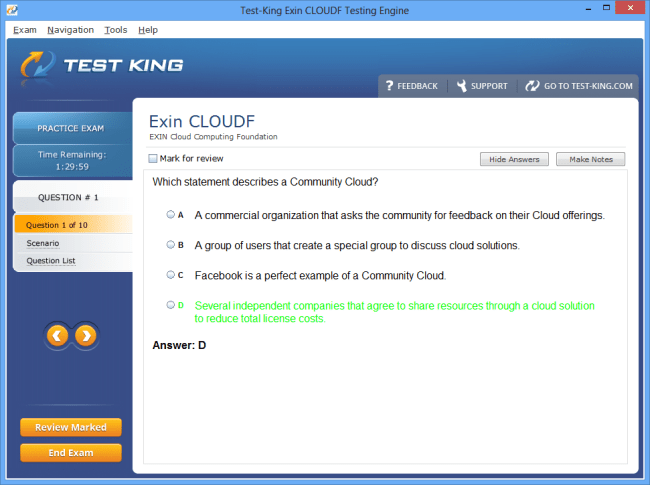
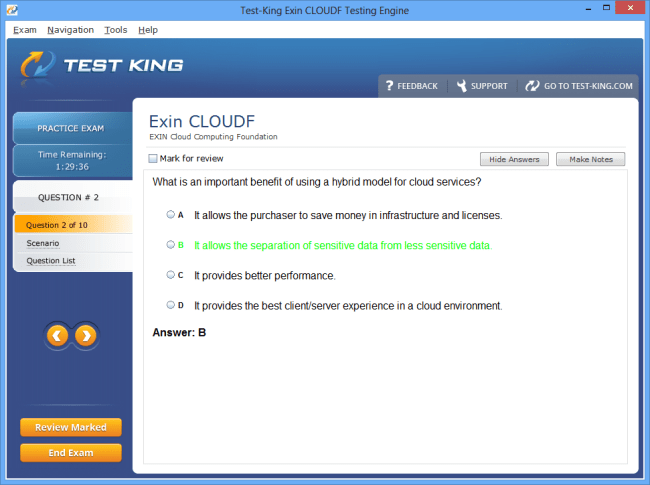
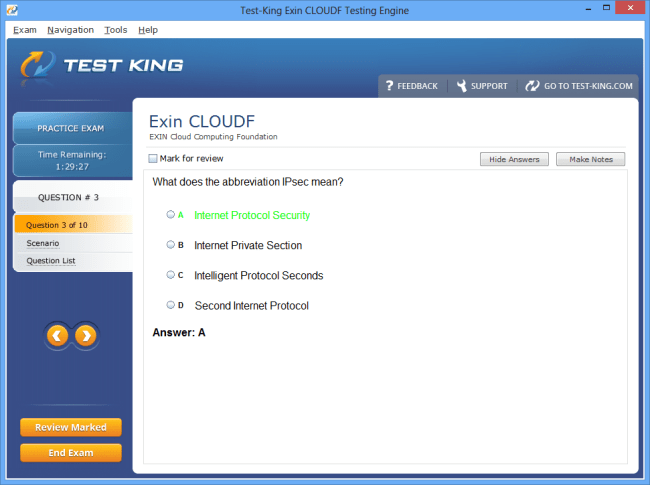
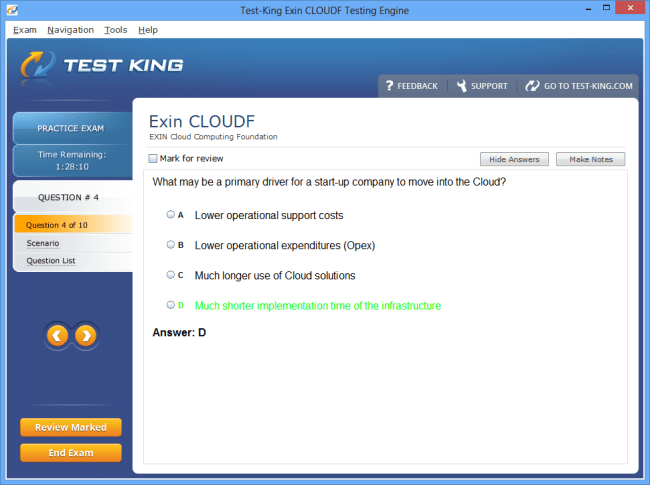
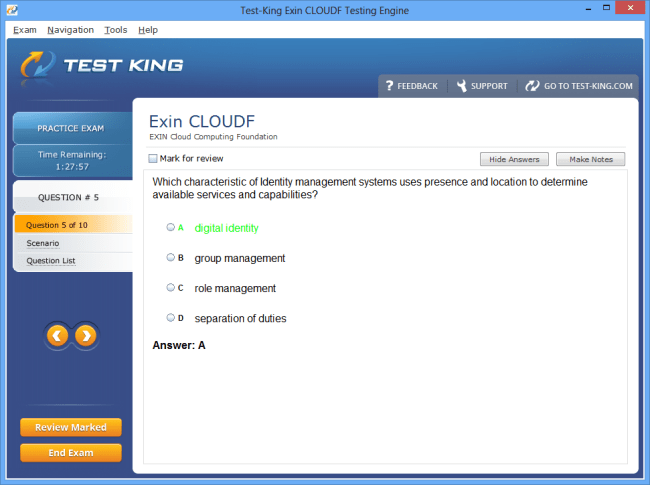
CLOUDF Exam Product Screenshots
Frequently Asked Questions
How can I get the products after purchase?
All products are available for download immediately from your Member's Area. Once you have made the payment, you will be transferred to Member's Area where you can login and download the products you have purchased to your computer.
How long can I use my product? Will it be valid forever?
Test-King products have a validity of 90 days from the date of purchase. This means that any updates to the products, including but not limited to new questions, or updates and changes by our editing team, will be automatically downloaded on to computer to make sure that you get latest exam prep materials during those 90 days.
Can I renew my product if when it's expired?
Yes, when the 90 days of your product validity are over, you have the option of renewing your expired products with a 30% discount. This can be done in your Member's Area.
Please note that you will not be able to use the product after it has expired if you don't renew it.
How often are the questions updated?
We always try to provide the latest pool of questions, Updates in the questions depend on the changes in actual pool of questions by different vendors. As soon as we know about the change in the exam question pool we try our best to update the products as fast as possible.
How many computers I can download Test-King software on?
You can download the Test-King products on the maximum number of 2 (two) computers or devices. If you need to use the software on more than two machines, you can purchase this option separately. Please email support@test-king.com if you need to use more than 5 (five) computers.
What is a PDF Version?
PDF Version is a pdf document of Questions & Answers product. The document file has standart .pdf format, which can be easily read by any pdf reader application like Adobe Acrobat Reader, Foxit Reader, OpenOffice, Google Docs and many others.
Can I purchase PDF Version without the Testing Engine?
PDF Version cannot be purchased separately. It is only available as an add-on to main Question & Answer Testing Engine product.
What operating systems are supported by your Testing Engine software?
Our testing engine is supported by Windows. Andriod and IOS software is currently under development.
Top Exin Exams
Breaking Down the CLOUDF (EX0-116) Exam Domains: What Every Candidate Must Know
The EXIN Cloud Computing Foundation certification, recognized by its exam code CLOUDF (EX0-116), stands as a cornerstone credential for professionals aspiring to master the essential tenets of cloud technology. This qualification does not merely test theoretical awareness; it seeks to evaluate a candidate’s grasp of the intricate ecosystem that defines cloud computing—an environment where elasticity, scalability, and shared resources form the fabric of modern digital operations. Understanding these principles requires more than rote memorization; it demands a conceptual vision that aligns technical functionality with business imperatives.
Understanding Cloud Computing Principles and Concepts
At its essence, cloud computing represents the delivery of computing services—servers, storage, databases, networking, analytics, and software—over the internet. This paradigm replaces the conventional model of on-premises infrastructure, offering flexibility and economic efficiency. In this model, users access shared resources dynamically, paying only for what they consume. The concept of resource pooling ensures that computing power can be allocated and reallocated seamlessly according to demand. The EXIN Cloud Computing Foundation exam explores this idea meticulously, expecting candidates to articulate how virtualization technologies underpin such dynamic allocation.
Virtualization serves as the linchpin of the cloud environment. Through hypervisors, physical hardware is divided into multiple virtual machines, each functioning independently yet sharing the same physical host. This segmentation optimizes resource utilization and simplifies maintenance. The abstraction layer created by virtualization not only isolates workloads but also provides fault tolerance, ensuring that the failure of one virtual machine does not compromise others. Candidates studying for the CLOUDF (EX0-116) certification must internalize how virtualization extends beyond servers to include network and storage virtualization, leading to the fully abstracted environments often termed as software-defined data centers.
Another pivotal principle explored in the exam is the concept of elasticity and scalability. Elasticity refers to the capability of a system to automatically adjust resource allocation to meet fluctuating demands, while scalability indicates the ability to grow infrastructure to accommodate future expansion. In cloud computing, these attributes are not luxuries but fundamental requirements. For instance, an e-commerce application might experience unpredictable traffic spikes during promotional campaigns. Through cloud elasticity, resources can be automatically scaled up to ensure uninterrupted service and later scaled down to reduce costs once demand subsides. The CLOUDF (EX0-116) syllabus expects candidates to comprehend this dynamic and recognize the cost-optimization strategies that such automation enables.
A closely related concept is measured service, which ensures that resource usage is transparently monitored and billed according to actual consumption. This feature has profound business implications. It introduces accountability and cost predictability, which are indispensable for enterprises seeking to manage budgets efficiently. Within the EXIN Cloud Computing Foundation curriculum, this principle is emphasized as a defining characteristic distinguishing genuine cloud services from traditional outsourcing. The notion of “pay-as-you-go” transforms how organizations perceive infrastructure investment, shifting from capital expenditure to operational expenditure models.
Service orientation also forms a core element of cloud principles. In this context, computing resources are treated as services that can be provisioned, configured, and managed independently. Each service is designed to deliver a specific functionality—be it storage, processing, or software access—and is made available via standardized interfaces. This modularity enables interoperability and fosters innovation, as organizations can combine services from multiple providers to create hybrid architectures tailored to their needs. Understanding how these service interfaces operate and interact is a key learning outcome of the CLOUDF (EX0-116) exam.
An additional component that candidates must appreciate is multitenancy, a characteristic that allows multiple customers to share the same application or infrastructure while maintaining isolation of their data and operations. This efficiency model drives the economic advantage of cloud solutions. However, it also raises questions of security, data segregation, and compliance—topics that the exam later examines in greater detail. Recognizing the delicate balance between shared efficiency and individual privacy is vital for anyone aspiring to demonstrate expertise in cloud architecture.
Beyond the technical attributes, the philosophical underpinnings of cloud computing are equally crucial. Cloud computing is not merely a technological transformation but also a paradigm shift in how organizations conceptualize IT services. Traditional IT departments operated as cost centers focused on infrastructure maintenance, but in the cloud era, they evolve into enablers of innovation. The EXIN Cloud Computing Foundation framework encourages candidates to perceive the cloud as a catalyst for agility and digital transformation. Businesses leverage cloud capabilities to shorten product development cycles, enter new markets rapidly, and respond to customer needs with unprecedented flexibility.
From a management perspective, understanding the shared responsibility model is indispensable. In this model, responsibilities for security, maintenance, and compliance are distributed between the cloud provider and the customer. For instance, while the provider ensures the security of the underlying infrastructure, the customer must safeguard data and configure access controls appropriately. Misunderstanding this division often leads to vulnerabilities. The CLOUDF (EX0-116) exam tests whether candidates can delineate these responsibilities clearly and apply them to real-world scenarios.
Another principle integral to cloud computing is automation. Automation reduces human intervention in repetitive processes, ensuring consistency and speed. It plays a critical role in provisioning resources, deploying applications, and maintaining system health. Through orchestration tools, complex workflows can be executed seamlessly, ensuring that interdependent components interact without friction. Understanding automation as a driver of efficiency and resilience helps candidates appreciate its central role in modern cloud operations.
Equally important is the concept of resource abstraction. Cloud computing conceals the complexities of hardware management, allowing users to focus on functionality rather than infrastructure. This abstraction is achieved through APIs and management interfaces that provide intuitive control over complex systems. The CLOUDF (EX0-116) exam expects candidates to grasp how abstraction supports interoperability, enhances portability, and simplifies integration between diverse environments.
Interoperability, another essential aspect, ensures that applications and data can move fluidly between different cloud environments and providers. It prevents vendor lock-in, an issue that organizations often face when adopting proprietary technologies. The EXIN Cloud Computing Foundation syllabus underscores the importance of open standards and APIs in achieving interoperability. Candidates must understand how standardization efforts—such as the use of RESTful APIs or open virtualization formats—facilitate compatibility and flexibility across platforms.
The principle of availability and reliability is also central to the CLOUDF (EX0-116) framework. Availability ensures that cloud services remain accessible when required, while reliability guarantees consistent performance over time. Cloud providers achieve these qualities through redundancy, load balancing, and geographically distributed data centers. Candidates are expected to comprehend how service-level agreements (SLAs) formalize these commitments, specifying uptime guarantees and response times. Mastery of these details allows professionals to evaluate providers objectively and align service contracts with organizational needs.
Security, though treated as a dedicated area in the broader exam, is also intertwined with foundational principles. At its core, cloud computing introduces shared infrastructures, which demand heightened awareness of identity management, encryption, and compliance. The principle of least privilege, whereby users are granted only the access necessary to perform their roles, exemplifies the proactive approach that cloud environments necessitate. Encryption ensures that even if unauthorized access occurs, data remains unintelligible. Candidates preparing for the EXIN Cloud Computing Foundation exam should interpret these mechanisms as integral components of trust-building within cloud ecosystems.
Sustainability has recently emerged as a principle with growing prominence. Cloud data centers, while resource-intensive, can achieve higher energy efficiency compared to dispersed on-premises infrastructure. Through load balancing and resource sharing, clouds can optimize energy consumption, reduce hardware waste, and support corporate sustainability goals. This environmental perspective aligns technological innovation with ecological responsibility, a theme increasingly reflected in modern certification frameworks.
Understanding service management within the cloud context also forms a critical part of the CLOUDF (EX0-116) knowledge domain. Traditional IT service management frameworks, such as ITIL, are reinterpreted to accommodate the dynamic and distributed nature of cloud environments. Candidates must be able to translate concepts like incident management, change management, and capacity planning into the cloud paradigm, where agility and automation redefine operational practices.
Disaster recovery and business continuity principles are closely linked to cloud reliability. The cloud enables replication of data and applications across multiple geographical regions, ensuring that service disruptions in one area do not cripple operations. This concept, often termed resilience, is crucial in demonstrating how the cloud supports organizational endurance in the face of unforeseen events. The EXIN Cloud Computing Foundation exam emphasizes an understanding of how replication, failover mechanisms, and backup strategies contribute to achieving high availability.
The principle of cost efficiency, while often perceived as a business concern, has deep technical implications. Candidates must comprehend how optimization techniques such as instance resizing, resource scheduling, and reserved capacity purchasing influence expenditure. These mechanisms demonstrate how the cloud democratizes access to enterprise-grade infrastructure by aligning cost with actual usage. The CLOUDF (EX0-116) curriculum positions cost transparency as a fundamental attribute of cloud governance.
In addition to these principles, understanding the evolution of cloud computing provides contextual depth. The transition from mainframe computing to client-server models, and eventually to distributed cloud environments, illustrates a continuum of technological abstraction and decentralization. This historical awareness enriches a candidate’s comprehension of why cloud computing has become the de facto model for modern IT. The EXIN Cloud Computing Foundation exam rewards such contextual understanding, as it reflects an ability to link current trends with their foundational antecedents.
Furthermore, the cultural dimension of cloud adoption is worth noting. Cloud transformation is not merely a technical migration but a reconfiguration of organizational behavior. It necessitates a shift toward DevOps methodologies, continuous integration, and collaborative governance. These approaches dissolve traditional silos between development and operations, fostering a culture of agility and shared accountability. The CLOUDF (EX0-116) exam acknowledges that successful cloud strategies depend as much on human adaptation as on technical proficiency.
An often-underestimated aspect of cloud principles is data management. In cloud environments, data is not confined to physical boundaries. Candidates must understand how concepts such as data sovereignty, residency, and lifecycle management influence compliance and design decisions. Cloud providers may host data across multiple jurisdictions, each subject to distinct legal frameworks. The EXIN Cloud Computing Foundation syllabus requires awareness of these nuances to ensure that cloud strategies adhere to regulatory obligations.
Equally significant is the principle of accessibility. Cloud services are designed to be ubiquitously accessible through diverse devices and networks. This universality transforms user experience and promotes inclusivity. However, it also introduces challenges related to latency, connectivity, and device diversity. Understanding how cloud architectures mitigate these limitations—through content delivery networks, edge computing, and caching—is essential for demonstrating mastery in the CLOUDF (EX0-116) exam.
From a technological standpoint, the cloud operates on the foundation of distributed systems. Data and applications are dispersed across multiple nodes, yet they function cohesively as a unified entity. This distributed nature enhances fault tolerance and load distribution. Candidates must grasp how orchestration and synchronization maintain consistency across such complex infrastructures. The EXIN Cloud Computing Foundation certification evaluates the ability to conceptualize this distributed logic in practical scenarios.
The economic principle of utility computing underlies the entire cloud model. Just as electricity is consumed on demand without concern for its generation, computing resources are accessed as needed, abstracted from the underlying complexity. This analogy encapsulates the ethos of cloud computing: simplicity in consumption, sophistication in delivery. The CLOUDF (EX0-116) exam often tests comprehension of this analogy to ensure that candidates appreciate both the technological and economic essence of the cloud.
Integration is another cornerstone principle that candidates must internalize. Organizations rarely operate in isolation; they use a mosaic of systems that must interact harmoniously. Cloud computing facilitates this integration through standardized APIs and middleware services. Mastery of how these integrations occur—particularly across hybrid and multi-cloud environments—is central to passing the EXIN Cloud Computing Foundation exam.
Finally, the concept of innovation enablement encapsulates the overarching promise of the cloud. By abstracting complexity and providing on-demand scalability, the cloud empowers businesses to experiment, iterate, and innovate without prohibitive costs. This agility accelerates digital transformation and fosters a culture of experimentation. For candidates pursuing the CLOUDF (EX0-116) credential, understanding this relationship between technology and innovation distinguishes surface-level comprehension from true expertise.
Through the lens of these foundational principles, cloud computing emerges not merely as a set of technologies but as an ecosystem of ideas, practices, and disciplines. The EXIN Cloud Computing Foundation (EX0-116) certification serves as a testament to one’s ability to navigate this ecosystem with precision and foresight. Grasping these principles provides the intellectual scaffolding upon which deeper knowledge—such as deployment models, service frameworks, and security mechanisms—will later be constructed. The CLOUDF (EX0-116) examination, therefore, is not a test of memory but an evaluation of conceptual fluency, where candidates must demonstrate an ability to interrelate technological abstractions with real-world applications and strategic outcomes.
Understanding Cloud Service Models in the EXIN Cloud Computing Foundation
The EXIN Cloud Computing Foundation certification, known by its examination code CLOUDF (EX0-116), immerses candidates in the conceptual and operational structures that define the modern digital ecosystem. Among its most significant learning domains lies the comprehension of cloud service models—Infrastructure as a Service, Platform as a Service, and Software as a Service. These models embody the stratification of cloud computing, illustrating how resources, platforms, and applications are provisioned and consumed. Each model represents a distinctive layer of abstraction, control, and responsibility between the provider and the consumer. Understanding them holistically is indispensable for both exam success and professional competency in cloud governance, management, and deployment.
In the architecture of cloud computing, Infrastructure as a Service (IaaS) forms the foundational layer. It delivers virtualized computing resources—such as servers, networks, and storage—over the internet. Instead of investing in physical data centers, organizations can rent virtual infrastructure on demand. This flexibility underpins one of the defining virtues of cloud computing: scalability. IaaS enables enterprises to scale up or down according to operational requirements, without the encumbrances of hardware maintenance or procurement delays. The CLOUDF (EX0-116) exam examines the candidate’s ability to discern how virtualization technologies and resource pooling create the elasticity that defines IaaS.
Under this model, the provider assumes responsibility for managing the underlying physical infrastructure, while the customer retains control over operating systems, storage configurations, deployed applications, and network components such as firewalls or virtual private networks. This arrangement grants a high degree of flexibility but also demands technical proficiency. For instance, configuring virtual machines, managing load balancers, and implementing data redundancy are tasks often delegated to the consumer. The EXIN Cloud Computing Foundation framework emphasizes that this shared responsibility model delineates the boundary between provider-managed and user-managed components.
The advantages of IaaS are both technical and strategic. From a cost perspective, it converts capital expenditure into operational expenditure, allowing businesses to avoid substantial upfront investments. From a technical perspective, it enhances agility—resources can be provisioned within minutes, and workloads can be replicated across multiple regions to ensure availability. It also facilitates disaster recovery by allowing snapshots and backups of entire virtual environments. For organizations transitioning from traditional infrastructure, IaaS serves as the most familiar entry point into the cloud, blending control with flexibility.
However, the model is not devoid of challenges. Effective management of virtual environments demands expertise in configuration, security hardening, and performance monitoring. Without proper oversight, costs can escalate unexpectedly due to inefficient resource allocation. The CLOUDF (EX0-116) exam often evaluates whether candidates understand such nuances—how governance policies, automation tools, and utilization metrics contribute to sustainable and efficient IaaS operations.
Building upon IaaS, the next layer—Platform as a Service (PaaS)—abstracts much of the infrastructure complexity, offering an environment where developers can build, test, and deploy applications without managing servers or operating systems. This model introduces an intermediary layer that harmonizes development and deployment. The platform provides runtime environments, databases, middleware, and frameworks necessary for application creation. For instance, developers can focus purely on writing code while the platform handles load balancing, scaling, and patch management automatically.
The EXIN Cloud Computing Foundation certification underscores that PaaS is particularly advantageous for organizations seeking rapid innovation cycles. By alleviating the burden of infrastructure management, it accelerates development pipelines and supports methodologies like continuous integration and continuous deployment. This model aligns with the modern DevOps culture, where collaboration between development and operations teams is paramount. Through automation and orchestration, PaaS platforms facilitate agile workflows, ensuring that applications move seamlessly from conception to production.
One of the hallmarks of PaaS lies in its support for multi-language and multi-framework development environments. Developers are not confined to a single technology stack; instead, they can select from various programming languages, frameworks, and runtime engines. This flexibility nurtures creativity and expedites innovation. The CLOUDF (EX0-116) syllabus often references this diversity as a key differentiator between PaaS and traditional hosting environments, where configuration rigidity often stifles development velocity.
In addition to simplifying application development, PaaS introduces built-in scalability. Applications hosted on such platforms automatically adapt to fluctuating demand. This auto-scaling capability is achieved through intelligent load distribution mechanisms that monitor performance metrics and adjust resource allocation in real time. Candidates preparing for the EXIN Cloud Computing Foundation exam must grasp how this dynamic orchestration optimizes performance and cost simultaneously, aligning with the broader cloud principle of elasticity.
Another significant feature of PaaS is its ability to foster collaboration. Since platforms are accessed via web interfaces, distributed teams can work simultaneously on shared projects, managing code repositories, testing frameworks, and deployment pipelines collaboratively. This fosters an ecosystem of synergy, where geography no longer constrains innovation. The CLOUDF (EX0-116) framework recognizes this as one of the defining advantages of cloud-native development environments.
However, PaaS also introduces considerations regarding vendor dependency and customization limitations. Because the underlying environment is managed by the provider, customers have restricted control over runtime configurations. Moreover, migrating applications developed on one PaaS provider to another may involve complexities due to proprietary APIs or platform-specific features. The EXIN Cloud Computing Foundation exam requires candidates to appreciate these trade-offs, as they influence long-term strategic decisions and governance frameworks.
At the highest abstraction layer lies Software as a Service (SaaS), the most consumer-facing model of cloud delivery. It represents the culmination of the cloud computing paradigm, where entire software applications are delivered over the internet, accessible through browsers or lightweight clients. Users neither install nor manage the software locally; the provider handles everything—from infrastructure and middleware to updates and security patches. SaaS transforms software consumption into a utility, accessible on demand and billed according to usage or subscription terms.
For candidates pursuing the CLOUDF (EX0-116) certification, understanding SaaS means comprehending how this model revolutionizes user experience, maintenance, and cost management. Applications such as email platforms, office suites, customer relationship management systems, and enterprise resource planning solutions exemplify SaaS adoption. Organizations leverage these tools to enhance productivity without the administrative overhead associated with traditional software deployment.
From a business perspective, SaaS enables unprecedented scalability and accessibility. Teams distributed across continents can collaborate in real time, accessing the same application environment from diverse devices. Updates are seamless, requiring no user intervention. This continuous delivery mechanism ensures that users always interact with the latest version, integrating new functionalities and security improvements effortlessly. The EXIN Cloud Computing Foundation exam often highlights such operational efficiencies as key benefits of SaaS adoption.
SaaS also redefines data management. Since data is hosted in the provider’s environment, issues of storage, backup, and recovery are managed centrally. However, this introduces questions of trust and compliance. Candidates must understand the implications of storing sensitive data in shared environments and the mechanisms providers employ to ensure confidentiality, integrity, and availability. Encryption, access control, and identity management are integral to maintaining security within SaaS models. The CLOUDF (EX0-116) syllabus interlinks these considerations with broader discussions of cloud governance and regulatory adherence.
An essential distinction between the service models lies in the degree of control and responsibility allocated to the customer. In IaaS, the customer manages operating systems and applications, while in PaaS, control narrows to application configuration and code. In SaaS, user responsibilities are largely confined to configuration preferences and data management. This gradation illustrates the continuum of abstraction across the service models, an understanding of which is central to succeeding in the EXIN Cloud Computing Foundation exam.
The economics of service models also merit analysis. IaaS tends to favor organizations requiring custom infrastructure configurations, whereas PaaS appeals to developers seeking streamlined deployment environments. SaaS, on the other hand, is ideal for end-users desiring ready-to-use software. Understanding these distinctions allows candidates to align business objectives with technological strategies—a core competency evaluated in the CLOUDF (EX0-116) certification.
Beyond functional differences, the interplay between the service models forms the architecture of cloud ecosystems. Many enterprises adopt hybrid configurations, utilizing IaaS for hosting bespoke applications, PaaS for development and testing, and SaaS for productivity tools. This layered strategy enhances operational efficiency while maintaining flexibility. The EXIN Cloud Computing Foundation exam expects candidates to comprehend how these models coexist symbiotically within enterprise frameworks.
The evolution of these models also mirrors the broader trajectory of cloud technology. Initially, IaaS dominated as organizations sought to virtualize infrastructure and reduce capital costs. Over time, the emphasis shifted toward PaaS as agility and innovation became paramount. Today, SaaS represents the apex of convenience, empowering users to focus entirely on outcomes rather than systems. The CLOUDF (EX0-116) exam encourages candidates to interpret these transitions as reflections of evolving business and technological priorities.
Another critical concept related to service models is customization. IaaS offers maximal flexibility, allowing users to configure virtual machines and network topologies. PaaS provides moderate customization through application configurations and frameworks, while SaaS generally limits customization to interface adjustments or workflow parameters. Recognizing these boundaries helps organizations determine which model best aligns with their operational needs and resource capabilities.
Integration plays an equally significant role across all three models. Modern enterprises seldom rely on a single provider; they interconnect services across multiple platforms. For example, a SaaS-based CRM may draw data from an IaaS-hosted database or integrate with a PaaS analytics engine. Understanding how APIs and middleware facilitate such integrations is a vital skill assessed by the EXIN Cloud Computing Foundation exam.
Security considerations differ across service models as well. In IaaS, customers bear significant responsibility for securing operating systems, applications, and data. In PaaS, the provider assumes control over runtime and infrastructure security, while customers focus on application-level controls. In SaaS, most security measures are managed by the provider, though users must still ensure proper data handling and access management. This layered responsibility model is central to understanding risk mitigation in cloud environments and is emphasized within the CLOUDF (EX0-116) syllabus.
Performance management further differentiates these models. In IaaS, users can tune performance parameters by adjusting resource allocations. PaaS abstracts this control, relying on the provider’s optimization mechanisms. SaaS eliminates performance tuning at the user level, offering standardized performance across the user base. Understanding these distinctions assists candidates in appreciating how abstraction affects control and efficiency.
The operational management approach also varies. In IaaS, automation tools like orchestration engines are employed to manage complex infrastructures. PaaS automates deployment pipelines, and SaaS automates updates and patching. These automation levels correspond directly with the degree of abstraction offered by each model. The EXIN Cloud Computing Foundation exam expects candidates to interpret how automation transforms operations management across these environments.
The influence of service models extends into the realm of compliance. For organizations operating under stringent regulations—such as healthcare or finance—the choice of service model affects data residency, access control, and auditability. IaaS provides granular control for custom compliance implementations, PaaS offers standardized frameworks, and SaaS depends heavily on provider certifications. Candidates must demonstrate awareness of how compliance obligations influence service model selection and cloud governance strategy.
The dynamic interplay between these service models has given rise to hybrid innovations. Concepts such as Function as a Service (FaaS) and Backend as a Service (BaaS) extend traditional definitions, offering even greater abstraction and modularity. These emerging paradigms reflect the ongoing evolution of cloud computing, emphasizing automation, scalability, and event-driven architectures. The CLOUDF (EX0-116) certification encourages awareness of these developments to ensure candidates remain conversant with contemporary trends.
From an organizational standpoint, the adoption of service models necessitates a cultural transformation. The shift from hardware ownership to service consumption demands a new mindset focused on agility, collaboration, and continuous improvement. Understanding this transformation prepares candidates to not only pass the exam but also navigate real-world cloud adoption initiatives with insight and adaptability.
Ultimately, the study of cloud service models within the EXIN Cloud Computing Foundation curriculum equips professionals with the analytical acumen to assess technological architectures, optimize resource allocation, and drive strategic innovation. The CLOUDF (EX0-116) exam challenges candidates to integrate conceptual understanding with practical foresight—to perceive not just what these models are, but why they matter in shaping the digital landscapes of the future.
Understanding Cloud Deployment Models in the EXIN Cloud Computing Foundation
The EXIN Cloud Computing Foundation certification, identified by the exam code CLOUDF (EX0-116), explores not only the conceptual foundations of cloud computing but also the various ways cloud infrastructures are deployed and integrated within organizations. A crucial domain of this certification is the understanding of cloud deployment models, which represent the structural approaches through which cloud services are made available. These models—public, private, hybrid, and community—determine how data, applications, and resources are managed, shared, and secured. Each deployment model has its unique architectural design, operational dynamics, governance responsibilities, and strategic implications. Mastering these models is fundamental for professionals seeking to navigate the evolving landscape of cloud ecosystems, as it helps them align technical design with organizational priorities, compliance requirements, and economic constraints.
At its core, a deployment model defines the ownership, control, and accessibility of cloud resources. It dictates who manages the infrastructure, where the resources are physically located, and how users interact with the environment. Understanding these variables enables candidates of the CLOUDF (EX0-116) certification to appreciate why certain models suit specific business contexts. The EXIN Cloud Computing Foundation curriculum emphasizes that no single deployment model is universally superior; each serves a distinctive purpose and is influenced by a constellation of factors such as scalability demands, security posture, regulatory landscape, and operational maturity.
The public cloud is perhaps the most recognizable of the deployment models and represents the democratization of computing power. In this model, cloud resources are owned and managed by third-party providers and delivered over the internet to multiple customers, known as tenants. These resources—computing power, storage, and networking—are shared among users while maintaining logical isolation to protect data integrity. Public cloud environments are highly elastic, allowing organizations to scale resources dynamically based on workload fluctuations. The EXIN Cloud Computing Foundation framework identifies this as a hallmark of operational agility and cost optimization. By leveraging economies of scale, public cloud providers offer on-demand resources at competitive rates, enabling even small enterprises to access advanced infrastructure that would otherwise be cost-prohibitive.
The CLOUDF (EX0-116) exam expects candidates to understand the characteristics that make public clouds advantageous for particular use cases. For instance, they are ideal for variable workloads such as web hosting, development environments, and data analytics. Their scalability ensures that organizations can respond instantly to demand surges without long procurement cycles. Furthermore, the pay-per-use model converts large capital investments into predictable operational expenses. However, the exam also demands awareness of the inherent trade-offs. While public clouds offer convenience and flexibility, they raise concerns regarding data privacy, compliance, and latency. Because data may be stored across multiple geographic regions, organizations must ensure compliance with jurisdictional data protection laws. Candidates must therefore be capable of articulating how governance frameworks and encryption techniques mitigate these risks.
In contrast, the private cloud deployment model represents exclusivity and control. Here, cloud infrastructure is dedicated to a single organization and can be hosted either on-premises or by a third-party provider. This model offers heightened customization and governance capabilities. Enterprises that handle sensitive data—such as financial institutions, defense organizations, or healthcare providers—often favor private clouds for their enhanced security and compliance assurances. The EXIN Cloud Computing Foundation curriculum highlights that private clouds retain many of the advantages of cloud computing—virtualization, scalability, and automation—while providing isolation from external entities.
The CLOUDF (EX0-116) certification examines the intricate architecture of private clouds, where resource allocation and access management are tailored according to internal policies. Because infrastructure ownership remains within the organization’s control, administrators can configure hardware, network parameters, and security protocols with precision. This autonomy supports granular compliance with regulatory frameworks and enables organizations to design their infrastructure according to specific performance or availability requirements. However, private clouds demand significant investment in hardware and technical expertise, a factor that distinguishes them from their public counterparts. Candidates must recognize that the operational burden of maintenance, upgrades, and capacity planning rests with the organization, making private clouds more suitable for enterprises with stable workloads and long-term computing needs.
While the public and private models stand as two poles of the cloud spectrum, modern organizations increasingly adopt the hybrid cloud, an integrative approach that combines the strengths of both. The hybrid model allows data and applications to move seamlessly between private and public environments. This interoperability supports workload flexibility—sensitive data can remain in the private environment for compliance, while less critical applications leverage the scalability of the public cloud. The EXIN Cloud Computing Foundation syllabus underscores this model as the epitome of strategic agility. It enables organizations to balance performance, cost, and governance without compromising on innovation or control.
In practice, hybrid cloud architectures often employ orchestration tools to manage workload distribution across environments. For example, a financial institution might process confidential transactions in its private cloud while performing data analytics in a public environment. The CLOUDF (EX0-116) exam assesses whether candidates can comprehend the technological underpinnings of such configurations, including secure networking, interoperability standards, and identity federation. These mechanisms ensure that applications communicate across environments without compromising data integrity or user experience.
A central benefit of the hybrid model is its ability to support disaster recovery and business continuity strategies. By replicating data and applications across different environments, organizations ensure resilience against system failures or regional disruptions. When local infrastructure experiences downtime, workloads can automatically shift to public environments, maintaining operational continuity. Candidates pursuing the EXIN Cloud Computing Foundation certification must demonstrate an understanding of how hybrid strategies reduce single points of failure while optimizing resource utilization.
Despite its advantages, the hybrid model introduces complexity in management and governance. Coordinating policies, ensuring consistent security configurations, and maintaining synchronized updates across environments can be challenging. This complexity necessitates robust orchestration frameworks and clear delineation of responsibilities. The CLOUDF (EX0-116) syllabus emphasizes that successful hybrid deployment relies not only on technology but also on disciplined process management and coherent governance strategies.
The community cloud is another significant deployment model within the EXIN Cloud Computing Foundation framework. It represents a collaborative environment where infrastructure is shared among several organizations with common goals, policies, or compliance requirements. These organizations may belong to the same industry or consortium—such as universities, research institutions, or government agencies—and benefit from shared resources while maintaining a degree of privacy and governance. The CLOUDF (EX0-116) exam evaluates how well candidates can identify scenarios in which community clouds are advantageous. For example, research organizations may share computing resources for large-scale data processing while adhering to collective data security standards.
Community clouds blend characteristics of both private and public models. They are more cost-efficient than private clouds because expenses are distributed among multiple participants, yet they retain greater control and customization than public clouds. This equilibrium makes them ideal for sectors where collaboration and regulatory compliance intersect. The EXIN Cloud Computing Foundation emphasizes that managing such shared environments requires trust and governance mechanisms to ensure fairness and adherence to mutual agreements.
Understanding deployment models also entails analyzing their economic implications. Public clouds offer the greatest cost efficiency for dynamic workloads due to their pay-per-use pricing, while private clouds require higher upfront investment but provide better long-term predictability. Hybrid and community clouds occupy intermediary positions, offering varying blends of control, scalability, and expenditure management. Candidates of the CLOUDF (EX0-116) certification must therefore evaluate these models not only from a technical perspective but also through the lens of financial stewardship. Cost optimization, resource utilization, and return on investment form part of the holistic assessment expected by the EXIN framework.
Another critical dimension involves data governance. Deployment models influence where data resides, who controls it, and how it is protected. In public clouds, governance is distributed between the provider and consumer under the shared responsibility model, whereas private and community clouds allow organizations to enforce bespoke compliance mechanisms. Hybrid models require sophisticated policies to manage data movement between environments, ensuring adherence to jurisdictional regulations. The CLOUDF (EX0-116) exam tests whether candidates understand how governance principles, such as accountability, transparency, and integrity, are applied across these varied environments.
Security remains a recurrent theme across all deployment models. Public clouds rely heavily on provider-managed controls, with encryption, identity management, and intrusion detection forming the backbone of protection. Private clouds grant organizations direct oversight, enabling customized firewalls, network segmentation, and monitoring solutions. Hybrid environments demand federated security frameworks that unify authentication and authorization processes across boundaries. Community clouds depend on mutual trust and collective governance. The EXIN Cloud Computing Foundation curriculum requires candidates to comprehend not only the mechanisms themselves but also the strategic implications of adopting different security architectures depending on the deployment choice.
Interoperability is another dimension of deployment that the CLOUDF (EX0-116) certification explores. As organizations increasingly embrace multi-cloud strategies, ensuring seamless interaction between diverse platforms becomes vital. Open standards, application programming interfaces (APIs), and data portability frameworks are instrumental in achieving interoperability. Without them, organizations risk vendor lock-in, limiting their flexibility and bargaining power. Candidates must understand how standardization fosters innovation while reducing operational constraints.
From an operational standpoint, deployment models influence performance optimization. Public clouds provide globally distributed infrastructures that minimize latency through content delivery networks and regional availability zones. Private clouds, being locally hosted, offer superior control over latency but may lack global redundancy. Hybrid configurations can balance these attributes, ensuring both localized performance and global resilience. Community clouds, meanwhile, depend on the collective infrastructure’s geographical distribution and configuration. The EXIN Cloud Computing Foundation exam expects candidates to evaluate performance trade-offs and design strategies that align with specific workload characteristics.
Another significant factor is compliance alignment. Certain industries are governed by stringent data protection regulations that dictate where and how data may be stored or processed. Public clouds may pose compliance challenges if data resides in foreign jurisdictions, whereas private and community models offer more predictable control. Hybrid deployments can mitigate these risks by confining sensitive data to private environments while utilizing public infrastructure for non-sensitive workloads. The CLOUDF (EX0-116) framework underscores the necessity of aligning deployment strategy with compliance requirements, emphasizing that regulatory adherence is a continuous process rather than a one-time configuration.
The evolution of deployment models reflects the maturation of cloud computing itself. Early adopters gravitated toward private clouds due to security apprehensions. As public cloud providers enhanced their compliance and security measures, hybrid models emerged as the preferred approach for balancing control and agility. Today, the trend toward multi-cloud strategies—where organizations leverage services from multiple providers—illustrates the pursuit of resilience, flexibility, and innovation. Candidates pursuing the EXIN Cloud Computing Foundation certification must not only recognize these evolutionary patterns but also understand the market forces, technological innovations, and governance trends that shape them.
In the broader context of enterprise transformation, deployment models play a decisive role in determining digital maturity. Adopting the right model requires an assessment of existing infrastructure, business objectives, risk tolerance, and cultural readiness. Organizations that treat cloud adoption as a purely technical initiative often overlook its strategic dimensions. The EXIN Cloud Computing Foundation emphasizes that deployment decisions should align with holistic business strategies, encompassing innovation, agility, and sustainability goals.
Sustainability itself has emerged as a differentiating factor in deployment model selection. Public cloud providers, due to their scale, can achieve higher energy efficiency and invest in renewable energy infrastructure. Private and community clouds, while smaller in scope, can incorporate green computing practices through resource optimization and virtualization. Hybrid environments offer opportunities to shift workloads dynamically to energy-efficient regions or data centers. Understanding how deployment strategies intersect with environmental responsibility adds a modern dimension to the CLOUDF (EX0-116) exam’s relevance.
Ultimately, the domain of cloud deployment models in the EXIN Cloud Computing Foundation certification illustrates that technological decisions are intertwined with governance, economics, and ethics. Public, private, hybrid, and community models each represent unique constellations of benefits and trade-offs. Mastery of these models equips professionals to design cloud ecosystems that are not only technically sound but also strategically aligned with organizational aspirations. The CLOUDF (EX0-116) exam assesses a candidate’s ability to interpret these models not in isolation but as interdependent components of a cohesive digital infrastructure. Understanding this interplay prepares individuals to architect and manage environments that are secure, compliant, efficient, and future-oriented—an essential competence in an era where cloud computing underpins nearly every dimension of technological innovation.
Cloud Security and Compliance in the EXIN Cloud Computing Foundation
Within the framework of the EXIN Cloud Computing Foundation certification, identified by exam code CLOUDF (EX0-116), the domain of cloud security and compliance occupies an indispensable position. Security is the cornerstone of trust in cloud ecosystems, and compliance ensures that the technological infrastructure adheres to laws, regulations, and ethical standards. Together, these elements form the bedrock upon which reliable cloud architectures are constructed. As organizations migrate from traditional infrastructure to virtualized environments, the protection of data, applications, and identities becomes both an operational imperative and a moral responsibility. The CLOUDF (EX0-116) certification demands that candidates demonstrate not only technical proficiency in cloud security mechanisms but also a nuanced understanding of governance frameworks, risk management principles, and compliance protocols that safeguard digital environments.
In the realm of cloud computing, security operates under a distributed model, where responsibility is shared between the service provider and the consumer. This paradigm, often referred to as the shared responsibility model, delineates who manages which aspect of the security architecture. Cloud providers typically secure the underlying physical infrastructure—data centers, hardware, and network components—while consumers are responsible for securing their data, configurations, and user access. The EXIN Cloud Computing Foundation curriculum emphasizes that misunderstanding this division often leads to vulnerabilities. Hence, candidates must be capable of articulating how responsibilities shift across different service models, such as Infrastructure as a Service, Platform as a Service, and Software as a Service. Each model alters the scope of control and accountability, requiring tailored governance strategies.
One of the most fundamental dimensions of cloud security is data protection. Data in cloud environments exists in three primary states: at rest, in transit, and in use. Each state requires distinct safeguards. When data is at rest—stored on cloud servers—it must be shielded through encryption mechanisms and strict access controls. When data is in transit, moving across networks, secure communication protocols such as Transport Layer Security (TLS) and Virtual Private Networks (VPNs) preserve confidentiality and integrity. Data in use, processed by virtual machines or applications, presents unique challenges since it must remain accessible to authorized operations while remaining inaccessible to malicious actors. Candidates preparing for the CLOUDF (EX0-116) exam must demonstrate awareness of how encryption, tokenization, and secure key management systems collectively defend data across these states.
Another crucial aspect is identity and access management (IAM), which governs who can access what within a cloud environment. IAM serves as the gatekeeper of cloud security, ensuring that only legitimate users can interact with specific resources. In cloud computing, IAM systems often employ principles such as least privilege, role-based access control, and multi-factor authentication. The EXIN Cloud Computing Foundation exam assesses whether candidates can explain how these mechanisms prevent unauthorized access and limit the damage caused by compromised credentials. A well-designed IAM strategy establishes fine-grained control over user permissions, ensuring that employees, contractors, and third-party integrations operate within defined boundaries.
The notion of authentication and authorization underpins IAM frameworks. Authentication verifies identity—confirming that users are who they claim to be—while authorization determines what resources they can access. In cloud environments, authentication may involve credentials, digital certificates, or biometric verification, while authorization policies define permissible operations. The CLOUDF (EX0-116) certification also explores federated identity management, where credentials from one trusted domain are recognized across multiple platforms, facilitating seamless access without repeated logins. This capability becomes vital for hybrid and multi-cloud architectures, where users must traverse different systems without compromising security.
Security in the cloud is further reinforced through network segmentation and isolation. Multi-tenancy—the shared use of resources among multiple customers—poses inherent risks if isolation mechanisms are weak. Network segmentation ensures that each tenant operates within an isolated virtual network, preventing unauthorized lateral movement of data or malicious traffic. Firewalls, intrusion detection systems, and virtual private clouds contribute to this protective boundary. The EXIN Cloud Computing Foundation exam requires candidates to understand how such measures fortify data confidentiality and preserve service integrity in shared environments.
Threat detection and incident response form another pillar of the CLOUDF (EX0-116) exam’s security domain. Cloud environments are dynamic, and so are the threats targeting them. Continuous monitoring through automated tools detects anomalies, unauthorized access, or performance irregularities. Once threats are identified, incident response mechanisms must activate swiftly to contain damage, restore services, and prevent recurrence. Candidates must comprehend how organizations establish incident response teams, define escalation procedures, and conduct root-cause analyses. These processes not only mitigate harm but also enhance resilience by transforming each incident into a learning opportunity.
The EXIN Cloud Computing Foundation curriculum also delves into compliance frameworks—structured sets of rules and standards that ensure organizations meet regulatory and ethical obligations. Compliance is not merely about avoiding penalties; it is about cultivating trust among customers, partners, and regulators. In the context of cloud computing, compliance encompasses international and regional regulations such as the General Data Protection Regulation (GDPR), Health Insurance Portability and Accountability Act (HIPAA), and Payment Card Industry Data Security Standard (PCI DSS). Each framework specifies how organizations should handle personal data, safeguard confidentiality, and report breaches. The CLOUDF (EX0-116) exam expects candidates to know how compliance requirements influence architectural decisions, contractual agreements, and operational practices within cloud ecosystems.
A recurring theme in the exam is data sovereignty, the concept that data is subject to the laws of the country in which it is stored. This principle complicates cloud deployments because data may reside in multiple jurisdictions, each governed by distinct regulatory regimes. For instance, an organization based in one country might store customer information on servers located in another, potentially triggering conflicts between privacy laws. The EXIN Cloud Computing Foundation curriculum underscores that understanding where data physically resides is critical for maintaining compliance. Consequently, organizations must work closely with cloud providers to ensure data location transparency and adherence to jurisdictional obligations.
To safeguard data integrity and confidentiality, cloud providers often undergo third-party audits and certifications. These assessments, conducted by independent bodies, validate that providers adhere to recognized standards such as ISO/IEC 27001 for information security management or SOC 2 for service organization controls. Candidates pursuing the CLOUDF (EX0-116) certification should recognize that such certifications do not absolve consumers of responsibility. Instead, they serve as assurance mechanisms, signaling that a provider maintains mature security practices. Customers must still implement complementary controls within their scope of responsibility.
A nuanced understanding of risk management is essential for anyone preparing for the EXIN Cloud Computing Foundation exam. Risk management involves identifying, evaluating, and mitigating threats that could compromise data confidentiality, integrity, or availability. In cloud contexts, risks might stem from technological vulnerabilities, insider threats, or third-party dependencies. The CLOUDF (EX0-116) framework emphasizes proactive risk management, where organizations continuously assess exposure levels and implement controls that reduce potential impacts. Tools such as risk registers, vulnerability assessments, and penetration testing aid in quantifying risks and prioritizing responses.
Another dimension of cloud security is data lifecycle management, encompassing the creation, storage, usage, sharing, archiving, and destruction of data. Each stage introduces specific risks. For instance, inadequate deletion of obsolete data may lead to unauthorized recovery, while poor archiving practices may impede compliance audits. The EXIN Cloud Computing Foundation curriculum insists that organizations implement lifecycle policies that enforce secure disposal, maintain retention schedules, and ensure data traceability. Such rigor ensures that security persists across the entire data continuum.
Encryption management deserves particular attention within the CLOUDF (EX0-116) exam. Encryption converts readable information into an unreadable form using cryptographic keys, protecting data from unauthorized access. Effective encryption management extends beyond algorithm selection; it includes key generation, distribution, rotation, and revocation. Candidates must grasp how encryption underpins data confidentiality both within and across cloud environments. Moreover, the choice between customer-managed and provider-managed encryption keys influences control levels, accountability, and auditability.
An often-overlooked yet vital element of cloud security is physical protection. Despite the abstract nature of cloud computing, physical infrastructure underpins every service. Data centers must therefore be fortified with redundant power supplies, environmental controls, and restricted access. The EXIN Cloud Computing Foundation emphasizes that physical safeguards—such as biometric entry systems, video surveillance, and fire suppression—complement digital defenses, ensuring holistic protection. Candidates should understand that while users rarely interact directly with these physical layers, their effectiveness profoundly influences service reliability and data safety.
Security automation represents an emerging paradigm in cloud environments. As workloads scale and evolve, manual intervention becomes insufficient. Automation tools continuously scan configurations, detect misconfigurations, and enforce compliance policies. For instance, automated patch management ensures that software vulnerabilities are addressed swiftly, minimizing exposure. The CLOUDF (EX0-116) certification underscores that automation enhances consistency and reduces human error, thereby strengthening organizational resilience.
The exam also explores the concept of governance in cloud computing, which integrates policy-making, monitoring, and accountability. Governance frameworks define how security and compliance objectives align with business goals. They establish roles, responsibilities, and reporting structures that ensure continuous oversight. Effective governance transforms security from a reactive function into a strategic enabler. The EXIN Cloud Computing Foundation curriculum encourages candidates to appreciate how governance bridges the gap between technological measures and organizational ethics.
Business continuity and disaster recovery are inseparable from cloud security. Unexpected disruptions—ranging from cyberattacks to natural disasters—can cripple operations if recovery mechanisms are weak. Cloud platforms often provide built-in redundancy through data replication, failover clusters, and geographically distributed backups. Candidates must understand how organizations craft disaster recovery plans that specify recovery time objectives (RTO) and recovery point objectives (RPO). These metrics quantify how quickly systems must resume operations and how much data loss is acceptable. The CLOUDF (EX0-116) exam assesses knowledge of designing resilient architectures that can withstand failures without compromising service availability.
An increasingly prominent dimension of the CLOUDF (EX0-116) exam is privacy engineering, which merges technical design with ethical responsibility. Privacy engineering ensures that data protection principles are embedded within systems from inception—a concept known as “privacy by design.” This approach requires developers and architects to integrate privacy-enhancing technologies and minimize data collection. The EXIN Cloud Computing Foundation emphasizes that ethical stewardship of data transcends compliance; it reflects an organization’s commitment to respecting individual rights. Candidates must recognize how this philosophy shapes modern security frameworks.
Auditability and transparency are also integral to maintaining trust in cloud operations. Organizations must maintain verifiable records of data access, system changes, and policy enforcement. Logging and monitoring tools generate evidence that supports investigations, compliance reporting, and accountability reviews. The CLOUDF (EX0-116) certification underscores that transparency fosters confidence between providers and customers. It also deters malicious behavior by ensuring every action leaves a traceable footprint.
Vendor management represents another crucial factor in cloud compliance. Since many organizations depend on third-party providers, ensuring that vendors adhere to equivalent or superior security standards is essential. Service Level Agreements (SLAs) formalize these expectations, specifying uptime guarantees, incident response timelines, and data protection responsibilities. The EXIN Cloud Computing Foundation framework teaches candidates how to evaluate SLA terms, negotiate realistic expectations, and establish mechanisms for continuous monitoring.
The domain of application security within the cloud extends beyond infrastructure defenses. Applications deployed in cloud environments must be resilient to common vulnerabilities such as injection attacks, cross-site scripting, and misconfigurations. Secure software development practices, including code reviews and security testing, are vital to maintaining application integrity. The CLOUDF (EX0-116) certification highlights that integrating security throughout the development lifecycle—often termed DevSecOps—ensures that protection evolves in parallel with innovation.
Finally, ethical responsibility in cloud computing security forms an underlying theme of the EXIN Cloud Computing Foundation syllabus. As custodians of digital assets, cloud professionals must act with integrity, discretion, and accountability. Ethical behavior extends beyond legal compliance; it encompasses transparency, fairness, and respect for user autonomy. Candidates must appreciate that technology serves humanity and that security frameworks must prioritize societal welfare alongside organizational success.
Through its comprehensive coverage of security and compliance, the CLOUDF (EX0-116) certification cultivates professionals capable of navigating the intricate interplay between technology, governance, and ethics. It instills a mindset that views security not as an obstacle but as an enabler of trust and innovation. Understanding these principles allows candidates to approach cloud computing as a disciplined art—one that harmonizes technical precision with moral responsibility, ensuring that the digital future remains secure, compliant, and worthy of confidence.
Cloud Governance, Risk, and Management in the EXIN Cloud Computing Foundation
In the EXIN Cloud Computing Foundation certification, denoted by the exam code CLOUDF (EX0-116), the domain of cloud governance, risk, and management forms a vital cornerstone that binds the operational, strategic, and ethical dimensions of cloud computing into a coherent framework. Governance in the cloud context extends far beyond technical administration—it embodies the structured orchestration of policies, processes, and decision-making mechanisms that ensure the cloud ecosystem functions in alignment with organizational objectives and regulatory obligations. Candidates preparing for this certification must cultivate an intricate understanding of how governance harmonizes innovation with accountability, risk management with agility, and operational excellence with compliance.
Cloud governance begins with the establishment of clear strategic direction and oversight. Organizations transitioning to cloud environments must define policies that articulate the purpose, scope, and guiding principles of cloud adoption. These policies form the scaffolding upon which all subsequent decisions are built, dictating how services are procured, deployed, and maintained. The CLOUDF (EX0-116) exam expects candidates to recognize that governance is not an isolated administrative task—it is a continuous, cyclical process encompassing planning, execution, evaluation, and improvement. This dynamic ensures that the organization remains adaptable in a rapidly evolving technological landscape while maintaining adherence to its mission and values.
Central to cloud governance is the concept of accountability. Governance frameworks assign responsibility for decision-making and oversight across different levels of the organization. Roles must be delineated with precision to avoid ambiguity. For instance, executive leaders provide strategic direction, IT managers oversee operational implementation, and compliance officers ensure adherence to legal frameworks. The EXIN Cloud Computing Foundation syllabus underscores that accountability fosters transparency, mitigates miscommunication, and strengthens stakeholder trust. A well-governed cloud ecosystem is one where every participant understands their duties, the scope of their authority, and the metrics by which performance is assessed.
A critical element of governance within the CLOUDF (EX0-116) framework is policy management. Policies serve as the rulebook for cloud operations, encompassing aspects such as data handling, access control, service procurement, and cost management. Effective policy design requires alignment between business goals and technical realities. Policies must be explicit enough to guide behavior but flexible enough to accommodate evolving technologies and threats. Candidates must understand how policy enforcement mechanisms—such as automated compliance checks and audit trails—translate abstract governance principles into operational reality.
Another significant area of focus is risk management, which constitutes the foundation of prudent governance. In cloud computing, risk is multifaceted, encompassing technological vulnerabilities, contractual ambiguities, regulatory noncompliance, and human error. The EXIN Cloud Computing Foundation exam challenges candidates to identify, assess, and mitigate these risks through a structured methodology. Risk identification involves systematically recognizing potential threats—such as data breaches, service outages, or vendor insolvency—that could disrupt operations. Risk assessment evaluates the likelihood and impact of each threat, while mitigation strategies reduce exposure through preventive and corrective measures.
Risk management in cloud computing relies heavily on proactive vigilance. This entails continuous monitoring of systems, periodic security audits, and regular reassessment of threat landscapes. The CLOUDF (EX0-116) certification stresses that risk is not static; it evolves alongside technological innovation and adversarial tactics. For instance, as organizations adopt multi-cloud strategies, risks related to interoperability, data portability, and shadow IT intensify. Candidates must demonstrate an understanding of how organizations employ frameworks such as ISO 31000 or NIST Risk Management to structure their approach. These frameworks enable systematic evaluation, ensuring that risk decisions are based on quantifiable metrics rather than conjecture.
Within governance, compliance management intertwines closely with risk mitigation. Cloud environments must conform to numerous legal and regulatory obligations that vary across industries and jurisdictions. Compliance ensures that data processing, storage, and transfer activities respect privacy rights and meet industry standards. The EXIN Cloud Computing Foundation curriculum places emphasis on the need for organizations to integrate compliance requirements into governance policies rather than treating them as afterthoughts. Automation tools that perform compliance audits and generate reports play an essential role in maintaining ongoing conformity.
Vendor management is another indispensable pillar of governance. Because cloud computing inherently involves third-party providers, the relationship between client and vendor must be governed by well-defined contractual agreements. These contracts, often formalized through Service Level Agreements (SLAs), outline performance metrics, uptime guarantees, data ownership rights, and responsibilities in the event of breaches or failures. The CLOUDF (EX0-116) exam assesses a candidate’s ability to interpret and evaluate SLA clauses to ensure they align with organizational needs. A robust governance framework includes vendor performance reviews, third-party audits, and escalation procedures that hold providers accountable to their commitments.
Governance also encompasses financial stewardship in cloud adoption. Cloud computing’s utility-based pricing model introduces both flexibility and complexity into financial management. Without proper oversight, organizations may fall victim to “cloud sprawl,” where unmanaged resources inflate costs. The EXIN Cloud Computing Foundation exam highlights that effective financial governance involves budget forecasting, cost monitoring, and optimization strategies such as rightsizing or automated resource deallocation. Candidates must grasp the economic principles underpinning cloud operations, including the distinction between capital and operational expenditures and how financial transparency supports sustainable decision-making.
Change management forms another vital component within the governance landscape. Cloud environments evolve continuously, introducing new features, updates, and integrations. Without structured change management, such evolution can lead to instability, security vulnerabilities, or compliance lapses. The CLOUDF (EX0-116) certification emphasizes that change must be controlled through formalized procedures encompassing risk assessment, approval workflows, communication protocols, and post-implementation reviews. Candidates must understand how automated orchestration tools and version control systems facilitate smooth transitions while preserving system integrity.
An often-overlooked yet profoundly significant dimension of governance is data governance—the discipline of managing the availability, usability, consistency, and security of data throughout its lifecycle. In cloud contexts, data governance ensures that information is accurate, protected, and aligned with organizational ethics. The EXIN Cloud Computing Foundation exam encourages candidates to appreciate how metadata management, classification systems, and data lineage tracking strengthen organizational intelligence. Strong data governance fosters transparency, improves decision quality, and underpins regulatory compliance.
Cloud governance frameworks also address performance management—the continuous evaluation of system behavior against predefined objectives. Performance metrics, or Key Performance Indicators (KPIs), measure factors such as uptime, latency, resource utilization, and user satisfaction. Governance processes establish thresholds and escalation mechanisms when deviations occur. Candidates preparing for the CLOUDF (EX0-116) certification must understand how monitoring dashboards and analytical tools provide real-time insights that enable data-driven governance decisions.
A modern extension of governance in the CLOUDF (EX0-116) context is cloud service orchestration. As organizations utilize multiple cloud providers, orchestration ensures seamless coordination between services. Governance mechanisms dictate how resources are provisioned, monitored, and optimized across heterogeneous environments. Candidates must understand how orchestration tools automate policy enforcement, maintain compliance across providers, and mitigate risks related to inconsistency.
Within governance, the concept of responsible innovation has gained prominence. This principle mandates that organizations pursue technological advancement without compromising ethical standards or societal welfare. The EXIN Cloud Computing Foundation emphasizes that governance frameworks must integrate ethical considerations, ensuring that automation, artificial intelligence, and data analytics serve humanity rather than exploit it. Candidates must be able to articulate how ethics intertwines with cloud governance, particularly in areas such as data privacy, algorithmic transparency, and environmental sustainability.
Risk management also extends to business continuity and resilience planning. Organizations must anticipate disruptions—ranging from cyberattacks to natural disasters—and design systems capable of withstanding and recovering from them. Governance policies define disaster recovery strategies, assign responsibilities, and outline testing procedures. The CLOUDF (EX0-116) certification underscores that resilience is achieved not merely through technological redundancy but through strategic foresight and disciplined preparation. Candidates must comprehend the interplay between governance structures and resilience objectives.
Another integral element of governance involves audit and accountability mechanisms. Regular audits validate that policies are implemented correctly, risks are managed effectively, and compliance obligations are fulfilled. Internal audits provide self-assessment, while external audits offer impartial validation. The EXIN Cloud Computing Foundation curriculum highlights that audits are not punitive exercises; rather, they serve as instruments for continuous improvement. Transparency derived from audits enhances trust among stakeholders, regulators, and customers alike.
The cultural dimension of governance is equally important. Successful governance frameworks depend on cultivating a culture of accountability, ethics, and awareness across the organization. Training programs, awareness campaigns, and leadership commitment embed governance principles into everyday operations. The CLOUDF (EX0-116) exam evaluates whether candidates recognize that governance is as much about human behavior as it is about technology. Without cultural alignment, even the most sophisticated governance structures may falter.
Governance in cloud computing also requires interoperability and standardization. Organizations often deploy hybrid or multi-cloud architectures where disparate systems must work in harmony. Governance ensures that open standards, standardized APIs, and portable data formats are adopted to avoid vendor lock-in. The EXIN Cloud Computing Foundation emphasizes that standardization not only enhances flexibility but also simplifies compliance and auditing. Candidates must appreciate how governance frameworks drive technical compatibility, thereby ensuring operational agility and long-term sustainability.
An essential subset of governance and risk management involves security governance, which aligns security objectives with business strategy. Security governance defines roles, policies, and processes that ensure protection mechanisms are consistent with organizational goals. It provides a structured approach to monitoring security performance and responding to emerging threats. The CLOUDF (EX0-116) certification expects candidates to understand how security governance integrates risk management with regulatory compliance, forming a cohesive defense strategy.
Another critical aspect is stakeholder engagement and communication. Governance thrives on inclusivity, where stakeholders—from executives to end-users—are informed participants in decision-making. Regular communication channels, feedback loops, and reporting mechanisms ensure that governance remains responsive and transparent. The EXIN Cloud Computing Foundation underscores that communication mitigates misunderstanding and fosters a shared sense of purpose across departments. Candidates must recognize that successful governance is collaborative rather than hierarchical.
Within governance, performance optimization serves as both a managerial and technical objective. Resource utilization must align with business priorities to maximize efficiency. Cloud management tools analyze consumption patterns and generate recommendations for optimization. The CLOUDF (EX0-116) exam explores how governance frameworks balance performance metrics with sustainability and financial efficiency, creating a holistic model of operational excellence.
Risk management in the EXIN Cloud Computing Foundation context extends to legal and contractual risks. Misinterpretation of contractual clauses, lack of clarity around data ownership, or inadequate liability terms can expose organizations to significant hazards. Candidates must be able to identify how governance frameworks enforce legal rigor in contract negotiation and management. This includes verifying that exit strategies and data retrieval procedures are clearly defined to prevent dependency on a single provider.
An evolving area of governance involves environmental stewardship within cloud computing. With data centers consuming vast amounts of energy, sustainability has become a governance priority. The CLOUDF (EX0-116) exam acknowledges that governance frameworks must incorporate green computing initiatives, such as energy-efficient architectures and carbon footprint monitoring. Candidates should understand that environmental governance aligns technological advancement with planetary responsibility.
In the grand architecture of cloud governance, metrics and continuous improvement play a decisive role. Governance is not static—it matures through iterative assessment and enhancement. Key Performance Indicators, audit outcomes, and incident reports feed into governance reviews, prompting policy adjustments. The EXIN Cloud Computing Foundation stresses that continuous improvement transforms governance from a compliance obligation into a living, adaptive process that evolves alongside organizational needs.
Ultimately, the domain of governance, risk, and management within the CLOUDF (EX0-116) certification portrays cloud computing as an ecosystem of interdependent responsibilities, decisions, and ethical imperatives. Governance ensures order, risk management safeguards continuity, and management orchestrates efficiency. Mastery of these disciplines allows professionals to transform cloud environments into structured, accountable, and future-ready systems that balance innovation with integrity. The EXIN Cloud Computing Foundation equips candidates with the intellectual and moral acuity to navigate this equilibrium—ensuring that governance transcends bureaucracy to become the embodiment of disciplined technological stewardship.
Cloud Business Case and Implementation Strategy
Understanding the cloud business case and implementation strategy is a pivotal domain in the EXIN Cloud Computing Foundation (EX0-116) certification. It helps professionals comprehend how cloud computing aligns with organizational goals, operational efficiency, and long-term innovation. This area connects technological adoption with strategic value, demanding an analytical and forward-looking perspective from every candidate. The foundation of this concept lies in how enterprises justify, plan, and execute their transition to cloud infrastructures in a sustainable and beneficial manner. A well-prepared candidate must therefore recognize both the tangible and intangible components of cloud adoption while understanding how they interrelate with broader business models.
At its core, developing a business case for cloud computing involves identifying the motivation behind cloud transformation. Organizations often pursue cloud adoption to gain elasticity, scalability, and cost optimization. However, the reasoning extends beyond financial considerations. Modern enterprises must also evaluate how cloud computing fosters innovation, accelerates product delivery, and enhances service quality. For example, an enterprise can leverage a hybrid cloud to reduce operational silos, while another may adopt a multi-cloud approach to improve redundancy and compliance. These diverse motivations require a meticulous understanding of both organizational goals and cloud capabilities. The EXIN Cloud Computing Foundation exam expects professionals to interpret such dynamics with precision and insight.
A business case begins with a needs assessment. This involves determining the current challenges faced by an organization’s IT infrastructure and aligning them with potential cloud benefits. For instance, issues such as underutilized hardware, rising maintenance costs, or limited agility in scaling applications may justify a transition to cloud environments. Candidates must be able to identify these inefficiencies and translate them into measurable justifications. Cost-effectiveness is often one of the first considerations. Traditional data centers involve significant capital expenditure for hardware, facilities, and energy consumption. Cloud computing shifts this model toward operational expenditure, where organizations pay only for the resources they consume. This transition not only minimizes upfront costs but also enhances budget predictability, which is particularly advantageous for startups and growing enterprises.
However, cost savings alone are not sufficient for a comprehensive business case. Decision-makers must evaluate the broader organizational impact of cloud migration. Factors such as productivity improvement, faster deployment cycles, and improved collaboration tools play a crucial role. For example, migrating development environments to the cloud can enable global teams to work concurrently with unified tools, shortening time-to-market for software releases. Similarly, integrating cloud-based analytics platforms allows enterprises to derive insights faster and make more informed business decisions. The cloud thus becomes an enabler of digital transformation, bridging the gap between technological capability and strategic growth.
Risk management forms another vital element in the business case. The move to cloud computing introduces new considerations such as data privacy, compliance obligations, and dependency on third-party providers. Candidates should demonstrate awareness of how organizations mitigate these risks through vendor due diligence, legal agreements, encryption mechanisms, and redundancy strategies. Understanding the shared responsibility model is crucial: while cloud service providers ensure infrastructure security, clients remain responsible for securing their data and applications. A sound business case must address these risk dimensions explicitly, demonstrating that the organization has both technical and governance frameworks in place.
When building a justification for cloud adoption, it is also important to evaluate performance metrics. Key indicators may include uptime, scalability, flexibility, and resilience. For instance, an organization can compare expected performance improvements after cloud migration with current benchmarks. Quantifiable benefits, such as reduced downtime or faster response times, provide concrete evidence of the value that cloud computing brings. In some cases, qualitative factors like user satisfaction or improved agility may also be highlighted. These elements strengthen the persuasiveness of the business case, ensuring that decision-makers can appreciate both measurable and intangible benefits.
Once a business case has been developed, attention shifts to the implementation strategy. This is where planning, execution, and governance converge to make the theoretical benefits of cloud computing a reality. Implementation begins with selecting the right deployment model—public, private, hybrid, or community—based on the organization’s specific requirements. Each model presents its own trade-offs. Public clouds offer flexibility and cost efficiency but may raise compliance concerns. Private clouds deliver greater control but demand higher management effort. Hybrid and community clouds combine these characteristics, offering a balanced approach for organizations with diverse needs. Understanding these nuances is essential for professionals preparing for the EXIN Cloud Computing Foundation exam, as they reflect the decision-making complexity found in real-world environments.
The next step involves establishing a migration roadmap. This roadmap outlines which applications, services, or processes will move to the cloud and in what order. Many organizations adopt a phased approach, starting with non-critical workloads to test the environment before migrating mission-critical systems. This incremental strategy allows IT teams to identify potential challenges early, adjust configurations, and ensure stability. The migration plan should also include data migration strategies, network architecture design, and integration with existing systems. Data synchronization, backup solutions, and connectivity options between on-premises and cloud environments must be carefully planned to avoid disruptions.
Stakeholder involvement is another indispensable aspect of a successful implementation. Cloud transformation affects multiple departments, including IT, finance, operations, and human resources. Gaining executive buy-in ensures that sufficient resources and support are available throughout the project. Equally, communication with end-users helps in managing expectations and promoting adoption. For instance, training programs and change management initiatives prepare employees for new workflows and tools. A candidate studying for the EXIN Cloud Computing Foundation exam should be able to describe how effective stakeholder engagement mitigates resistance and accelerates the realization of cloud benefits.
From a governance perspective, the implementation strategy should incorporate monitoring and management mechanisms. Continuous assessment of cloud performance, cost utilization, and compliance adherence ensures long-term sustainability. Tools that provide visibility into cloud environments, such as monitoring dashboards and automated alerts, help organizations maintain control over distributed resources. Moreover, governance policies define access control, identity management, and audit procedures to maintain data integrity. Without robust governance, even the most technically successful cloud implementations can falter due to lack of oversight or misaligned objectives.
Vendor selection is also critical to the implementation strategy. Organizations must evaluate cloud service providers not only based on pricing but also on reliability, scalability, customer support, and compliance certifications. Service Level Agreements (SLAs) play a vital role in defining the expected performance standards and responsibilities of both parties. A candidate must understand how to interpret SLA clauses related to uptime, response time, and remediation procedures. This knowledge ensures that organizations enter into vendor relationships that align with their operational priorities and risk tolerance.
Another significant consideration during implementation is interoperability. In a multi-cloud or hybrid environment, systems from different vendors must communicate seamlessly. Ensuring interoperability prevents vendor lock-in and allows organizations to adapt to evolving business demands. Standards-based architectures and open APIs facilitate this flexibility. Additionally, automation tools like orchestration platforms enable efficient management of complex environments by automating repetitive tasks and resource provisioning.
Training and skill development are integral to the success of cloud adoption. Cloud environments introduce new tools, paradigms, and security models that IT teams must understand thoroughly. Ongoing education programs help staff acquire the competencies necessary to manage cloud infrastructure effectively. This continuous learning approach reflects the dynamic nature of cloud technology, where frequent innovations necessitate adaptability.
The financial aspect of cloud implementation cannot be overlooked. Cloud economics differ from traditional IT budgeting. Instead of one-time investments, organizations face recurring costs based on consumption. Budgeting models must therefore accommodate variable expenses, forecasting usage trends, and preventing overspending. Implementing cost management tools that track and optimize resource usage ensures financial discipline. Furthermore, aligning financial objectives with operational goals reinforces accountability and transparency across departments.
Regulatory and compliance considerations are another cornerstone of implementation strategy. Different regions and industries impose varying data protection and privacy laws. Organizations operating globally must ensure compliance with frameworks such as GDPR, HIPAA, or ISO standards. Cloud providers often offer compliance certifications, but ultimate accountability remains with the client. Establishing legal agreements, defining data residency requirements, and performing regular audits are necessary to maintain compliance integrity.
Performance optimization forms the final phase of implementation. Once systems are operational in the cloud, continuous improvement processes ensure they deliver optimal value. This includes fine-tuning resource allocation, upgrading configurations, and enhancing automation. Regular performance assessments and feedback loops allow organizations to respond swiftly to emerging needs or inefficiencies. Over time, such iterative refinement transforms cloud adoption into a living ecosystem that evolves with the organization.
Developing a cloud business case and implementation strategy is therefore a multifaceted endeavor that intertwines technology, finance, governance, and human behavior. The EXIN Cloud Computing Foundation (EX0-116) certification emphasizes this holistic perspective, enabling professionals to approach cloud adoption not as a mere technical upgrade but as an organizational transformation. A candidate who masters this domain understands how to translate business ambitions into cloud-enabled realities, fostering both agility and sustainability.
Conclusion
In mastering the domain of cloud business case and implementation strategy within the CLOUDF (EX0-116) exam, candidates gain a profound appreciation for the synergy between technological progress and strategic foresight. The creation of a business case requires a deep comprehension of financial justification, risk mitigation, and performance enhancement, all tied to measurable outcomes. Implementation, in turn, translates these theoretical principles into concrete actions that shape the enterprise’s future trajectory. By understanding governance, stakeholder management, vendor alignment, and continuous optimization, professionals are equipped to guide their organizations through successful cloud transformations. This alignment of business acumen with cloud proficiency embodies the essence of the EXIN Cloud Computing Foundation certification—bridging innovation with practicality in an ever-evolving digital landscape.