
Exam Code: LookML Developer
Exam Name: LookML Developer
Certification Provider: Google
Corresponding Certification: LookML Developer
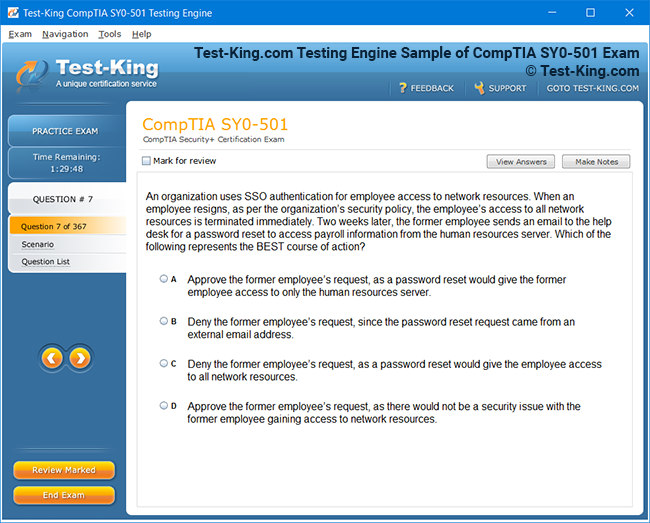
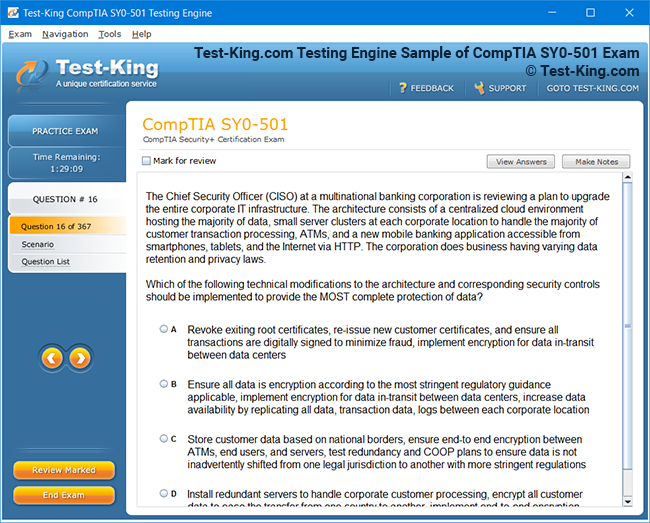
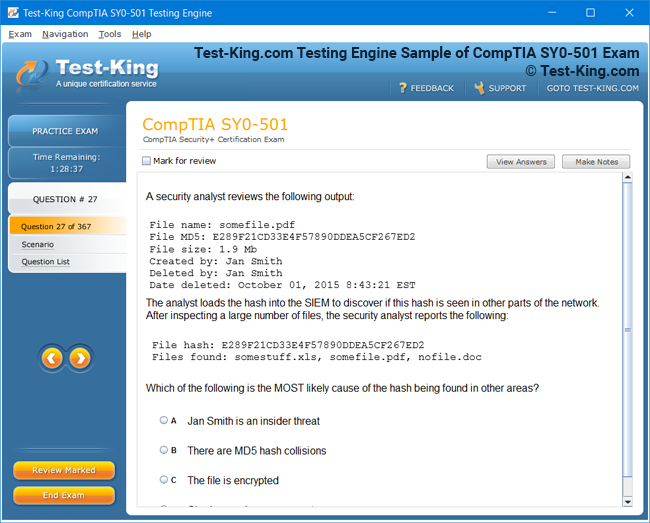
Product Screenshots
Frequently Asked Questions
How can I get the products after purchase?
All products are available for download immediately from your Member's Area. Once you have made the payment, you will be transferred to Member's Area where you can login and download the products you have purchased to your computer.
How long can I use my product? Will it be valid forever?
Test-King products have a validity of 90 days from the date of purchase. This means that any updates to the products, including but not limited to new questions, or updates and changes by our editing team, will be automatically downloaded on to computer to make sure that you get latest exam prep materials during those 90 days.
Can I renew my product if when it's expired?
Yes, when the 90 days of your product validity are over, you have the option of renewing your expired products with a 30% discount. This can be done in your Member's Area.
Please note that you will not be able to use the product after it has expired if you don't renew it.
How often are the questions updated?
We always try to provide the latest pool of questions, Updates in the questions depend on the changes in actual pool of questions by different vendors. As soon as we know about the change in the exam question pool we try our best to update the products as fast as possible.
How many computers I can download Test-King software on?
You can download the Test-King products on the maximum number of 2 (two) computers or devices. If you need to use the software on more than two machines, you can purchase this option separately. Please email support@test-king.com if you need to use more than 5 (five) computers.
What is a PDF Version?
PDF Version is a pdf document of Questions & Answers product. The document file has standart .pdf format, which can be easily read by any pdf reader application like Adobe Acrobat Reader, Foxit Reader, OpenOffice, Google Docs and many others.
Can I purchase PDF Version without the Testing Engine?
PDF Version cannot be purchased separately. It is only available as an add-on to main Question & Answer Testing Engine product.
What operating systems are supported by your Testing Engine software?
Our testing engine is supported by Windows. Andriod and IOS software is currently under development.
Top Google Exams
- Professional Cloud Architect - Google Cloud Certified - Professional Cloud Architect
- Professional Data Engineer - Professional Data Engineer on Google Cloud Platform
- Generative AI Leader
- Professional Machine Learning Engineer
- Associate Cloud Engineer
- Professional Security Operations Engineer
- Professional Cloud Security Engineer
- Professional Cloud Network Engineer
- Professional Cloud DevOps Engineer
- Professional Cloud Database Engineer
- Associate Google Workspace Administrator
- Cloud Digital Leader
- Professional Cloud Developer
- Associate Data Practitioner - Google Cloud Certified - Associate Data Practitioner
- Professional ChromeOS Administrator
- Professional Google Workspace Administrator
Comprehensive Overview of the LookML Developer Exam: Structure, Format, and Key Objectives
The LookML Developer Exam stands as a defining measure of a professional’s command over Looker’s modeling language and their capacity to transform raw data into insightful, structured, and reusable analytics models. Within the vast expanse of data analytics and business intelligence, LookML serves as the language that enables scalability, consistency, and governance of data definitions across an organization. To excel in the exam, candidates must internalize not only the technical underpinnings of LookML but also its conceptual alignment with Looker’s philosophy of semantic data modeling.
Understanding the LookML Developer Exam and Its Intrinsic Framework
At its foundation, the LookML Developer Exam evaluates one’s dexterity in constructing data models that accurately mirror the relationships within business datasets. It demands a profound grasp of LookML syntax, project configuration, model architecture, explores, joins, views, fields, and parameterization. The exam also probes a candidate’s ability to troubleshoot and optimize models for performance and maintainability. Every element of the test reflects the broader objective of Looker’s modeling framework: to enable teams to interpret complex data landscapes in a consistent, reliable, and intuitive manner.
LookML, as a language, differs markedly from conventional SQL scripting. Instead of directly querying data, it defines reusable abstractions that describe how data should be structured and accessed. The LookML Developer Exam, therefore, places significant emphasis on understanding these abstractions — such as how to define relationships between tables, how to use measures and dimensions appropriately, and how to ensure that end users can explore data without encountering redundancy or ambiguity.
The structure of the exam mirrors real-world development tasks within Looker. Candidates are not merely tested on rote memorization but on their ability to apply concepts dynamically. Each domain of the exam corresponds to a crucial element of LookML practice: understanding model architecture, managing explores, defining joins correctly, configuring persistent derived tables, applying LookML project files effectively, and enforcing naming conventions that ensure model clarity. The synthesis of these domains constructs the intellectual architecture of the assessment.
Beyond its technical demands, the LookML Developer Exam also evaluates cognitive precision — the ability to discern the most appropriate modeling techniques for various analytical contexts. A proficient LookML developer must think like both a data architect and a business strategist, weaving together disparate data sources into a coherent analytical tapestry. This dual focus on syntax accuracy and conceptual fluency forms the nucleus of the exam’s design.
The exam format typically consists of multiple-choice questions that require candidates to interpret LookML snippets, analyze relationships between objects, or predict the behavior of models given certain configurations. However, since the language of LookML is logical rather than procedural, success in the exam depends on understanding structural intent — why a particular model is designed a certain way — rather than memorizing commands. Many questions are scenario-based, meaning they present candidates with hypothetical business problems and ask them to choose the optimal modeling solution.
Each question is intended to measure an applicant’s capacity to synthesize information from multiple areas of LookML. For example, a single question might combine knowledge of joins, explores, and derived tables, thereby assessing how well the candidate can navigate complex interdependencies within a model. This integrative assessment approach ensures that certified developers are capable of not only implementing isolated components but also constructing comprehensive analytical systems that function seamlessly within Looker’s environment.
The underlying philosophy of the LookML Developer Exam is rooted in Looker’s core principle of data democratization. Rather than allowing data interpretation to remain confined to a small cadre of technical experts, Looker encourages a broader participation by creating well-structured, self-service data models. The LookML developer’s role, therefore, is to act as the custodian of data logic — ensuring that users can explore and derive insights without inadvertently misrepresenting the underlying datasets. The exam seeks to validate this competency by testing a candidate’s understanding of how data transformations and relationships influence user experiences in the Looker interface.
From a structural perspective, the exam’s framework is divided into conceptual zones that parallel real-world LookML workflows. The first domain typically focuses on foundational knowledge, including the purpose of LookML, model organization, and the connection between Looker and data warehouses. This area establishes the philosophical and architectural grounding for more advanced topics. The subsequent zone explores the intricacies of defining views, dimensions, and measures — the core building blocks of LookML. Here, candidates must demonstrate their ability to represent quantitative and qualitative attributes in a way that preserves analytical integrity.
The next conceptual layer evaluates one’s expertise in joins and explores. Joins are pivotal in LookML because they define the relational architecture between different datasets. The exam challenges candidates to understand how to configure join relationships, manage key collisions, handle fanout issues, and maintain data granularity. Likewise, explores function as the user-facing gateway to these relationships. Understanding how to configure explores effectively ensures that end users can navigate data intuitively.
Another critical portion of the LookML Developer Exam examines the candidate’s ability to work with derived tables, both persistent and ephemeral. Derived tables are instrumental in scenarios where transformations must occur before visualization. A competent LookML developer must know when to use persistent derived tables for performance optimization and when ephemeral derived tables are sufficient. The exam assesses not only technical implementation but also judgment — the discernment required to choose efficient solutions in varying contexts.
An additional segment emphasizes LookML project management and version control. In Looker, LookML projects are modular entities that contain models, views, and other configuration files. Understanding how to organize these files, maintain Git integration, and implement change control processes is vital to ensuring long-term model stability. The LookML Developer Exam evaluates familiarity with project-level best practices, including branch management, commit strategies, and debugging methods within the development environment.
Syntax comprehension forms another pillar of the assessment. While LookML is designed to be intuitive, it still requires meticulous attention to structural syntax. The exam expects candidates to identify syntax errors, correct invalid field references, and distinguish between acceptable and non-acceptable parameter configurations. This requires not just memorization but an internalized sense of logical coherence — the ability to see how different LookML elements fit together like the interlocking pieces of a conceptual puzzle.
Beyond syntax, the exam also tests knowledge of LookML’s parameter hierarchy. Candidates must understand how LookML parameters cascade and interact across models and views. Misunderstanding this hierarchy often leads to model conflicts, redundant calculations, or inaccessible fields. By assessing comprehension of parameter precedence, the exam ensures that developers are equipped to design robust and scalable data systems.
Performance optimization also features prominently within the exam’s structure. Efficient LookML models must balance precision and speed. Candidates are assessed on their ability to design models that minimize redundant queries, leverage caching mechanisms effectively, and optimize data joins. This requires an understanding of both Looker’s execution architecture and the underlying database’s behavior. Through scenario-based questioning, the exam determines whether candidates can make informed trade-offs between computational efficiency and analytical depth.
Security configuration and access control are additional areas of focus. Looker provides mechanisms to restrict data access based on user roles and permissions. The LookML Developer Exam examines how developers implement access filters, manage user attributes, and safeguard sensitive data while maintaining functional flexibility. Misconfigured permissions can lead to data leakage or analytical inconsistencies; hence, mastering these aspects is a crucial requirement for certification.
The evaluative structure of the exam reflects Looker’s belief that a developer’s proficiency cannot be gauged by technical fluency alone. Conceptual clarity, semantic discipline, and architectural foresight are equally essential. Each question is carefully designed to probe how deeply the candidate comprehends the logical interrelationships between data structures, rather than how many commands they can recall from memory.
Moreover, the exam underscores the collaborative nature of data modeling. A LookML developer rarely works in isolation. Their output influences analysts, data engineers, and business stakeholders. Consequently, the certification assesses not only one’s technical accuracy but also one’s ability to construct models that are legible and maintainable by others. Proper naming conventions, documentation clarity, and adherence to best practices are viewed as markers of professional maturity.
The exam also explores the integration between LookML and Looker’s visualization layer. Developers must understand how LookML objects surface in the Looker interface, how they influence dashboards, and how data actions are defined. This understanding bridges the gap between backend modeling and user-facing analytics, ensuring that developers can anticipate how design choices will affect the interpretability of data visualizations.
An often-overlooked dimension of the LookML Developer Exam is its implicit emphasis on analytical reasoning. Candidates are evaluated not just as technicians but as problem solvers who can deduce the most efficient modeling approach for complex business questions. This demands an appreciation for relational logic, normalization principles, and the cognitive rhythm of data exploration.
From a structural standpoint, the exam usually lasts about two hours and consists of numerous carefully weighted questions. Scoring reflects both accuracy and comprehension depth. Each question carries a specific weight based on its complexity and conceptual scope. The candidate must achieve a minimum passing score to earn certification, thereby demonstrating readiness to contribute to data modeling projects within real enterprise environments.
Preparation for the LookML Developer Exam involves a deliberate combination of study, experimentation, and applied practice. Candidates often begin by immersing themselves in the conceptual foundations of Looker and LookML, followed by hands-on model development within a sandbox environment. Familiarity with Looker’s documentation, project workflow, and version control integration becomes indispensable. Yet, the most successful candidates are those who go beyond the technical tutorials and engage in reflective learning — understanding not just how to configure LookML but why certain patterns are considered optimal.
In its essence, the LookML Developer Exam is less a test of memorization and more a test of comprehension — an assessment of whether the developer can internalize Looker’s modeling philosophy and translate it into robust, scalable architectures. It rewards conceptual lucidity, analytical acumen, and creative problem-solving. By mastering these elements, candidates not only secure certification but also elevate their ability to design data systems that empower organizations to make enlightened, data-driven decisions.
The intellectual rigor of the LookML Developer Exam reflects the complexity of modern data ecosystems. In a world saturated with information, the ability to structure and interpret data coherently is a prized skill. LookML developers serve as the architects of this coherence, creating frameworks that render data comprehensible to both machines and humans. The exam, in evaluating such skills, acts as a gateway to professional excellence in data modeling and business intelligence.
The exam’s objectives converge around a singular aim: ensuring that certified developers possess the capacity to transform data ambiguity into analytical clarity. Each domain, each question, and each concept contributes to the cultivation of that capability. A candidate who understands the symbiotic relationship between LookML syntax, semantic modeling, and business context will find themselves uniquely equipped to meet the challenges posed by this assessment.
Ultimately, the LookML Developer Exam’s structure and format reflect Looker’s devotion to precision, elegance, and interpretability. Its content demands a fusion of logic and creativity, of mathematical discipline and conceptual foresight. To approach this exam successfully, one must treat LookML not merely as a language but as a medium of analytical expression — a way of translating organizational data into narratives that inform, enlighten, and inspire informed action.
In-Depth Exploration of LookML Concepts, Exam Domains, and Analytical Proficiency
The LookML Developer Exam embodies a meticulous evaluation of both theoretical comprehension and applied technical expertise within Looker’s data modeling environment. It is not an ordinary certification; rather, it is a rigorous assessment designed to validate a developer’s ability to translate raw, unstructured data into an intelligible analytical framework through LookML’s semantic architecture. At its essence, this examination measures a candidate’s intellectual capacity to orchestrate data with logical precision, maintaining balance between performance optimization and analytical fidelity.
Understanding the depth of LookML requires more than surface familiarity with syntax or interface. It involves an internalization of Looker’s modeling philosophy, where each layer of abstraction serves a distinct functional and conceptual purpose. The exam reflects this philosophy, structuring its evaluation around interdependent domains that collectively form the scaffolding of proficient LookML development. These domains, though diverse, converge upon the universal goal of ensuring that the certified professional can design scalable, comprehensible, and efficient data systems aligned with business objectives.
At the core of the LookML Developer Exam lies an assessment of the candidate’s mastery over the foundational building blocks of LookML. Views, explores, models, and projects constitute the essential pillars of this structure. The exam probes one’s capacity to distinguish between these elements and understand how they interrelate. Views define the logic of data transformation and serve as the representation of database tables or derived datasets. Measures, dimensions, and filters within views enable specific interpretations of quantitative and qualitative data. Models then act as orchestrators, linking multiple views together and defining the relationships between them. Explores, on the other hand, bridge these models to the analytical interface, serving as the access points through which end users navigate data.
The exam requires candidates to conceptualize this layered ecosystem as a unified entity. It assesses whether the developer understands how an adjustment at one level—such as modifying a dimension definition or a join type—can cascade through the entire model, affecting the accuracy and interpretability of downstream analytics. This understanding differentiates a seasoned LookML practitioner from a novice who merely manipulates syntax without grasping the broader analytical implications.
Each conceptual domain in the LookML Developer Exam interlocks with another, demanding a comprehensive understanding of data flow and logical hierarchy. One domain focuses on LookML project management. Within this area, the candidate must demonstrate fluency in organizing project directories, managing files, and ensuring structural coherence across models. LookML projects, in essence, represent modular systems that encapsulate both logic and documentation. The exam evaluates a developer’s ability to maintain these systems effectively, employing structured naming conventions and hierarchical organization that ensures clarity and long-term maintainability.
Another significant domain emphasizes explores and joins. This domain is particularly critical because it tests the candidate’s proficiency in defining relationships between datasets. Looker’s modeling approach is predicated upon a star-schema-like logic, where explores act as hubs, connecting multiple views through joins. The developer must decide the appropriate join type—whether inner, left, or full—and understand the implications of each. The exam challenges the candidate to recognize how incorrect join configurations can cause data duplication or exclusion, leading to analytical distortions.
The complexity deepens when dealing with measures and dimensions. The LookML Developer Exam expects the candidate to demonstrate an intuitive grasp of these constructs. Measures represent aggregated data, such as totals, averages, or counts, while dimensions represent descriptive or categorical information. The exam tests whether a candidate knows how to define these appropriately, avoiding redundancy and ensuring consistency across multiple views. It also evaluates how effectively the developer uses parameters and filters to create flexible, dynamic fields that adapt to user interactions.
A crucial aspect of LookML’s logic is its abstraction of SQL queries. LookML is not merely a translation layer; it is a declarative modeling language that defines relationships and logic once, allowing them to be reused across the analytics environment. This abstraction enables consistent definitions of metrics and dimensions throughout the organization. The exam assesses a candidate’s understanding of how LookML translates these abstractions into efficient SQL queries under the hood, ensuring both accuracy and performance optimization.
Performance and scalability considerations occupy another domain within the exam. Candidates are evaluated on their understanding of persistent derived tables (PDTs), caching mechanisms, and database efficiency. Derived tables allow developers to precompute complex transformations, reducing the computational burden during query execution. The exam measures whether candidates can discern when to employ PDTs versus ephemeral derived tables and how to configure them effectively within models. A nuanced understanding of performance tuning ensures that the resulting Looker environment remains responsive and reliable, even when processing large data volumes.
Syntax precision forms a continuous thread throughout the exam. While LookML’s syntax is elegant and human-readable, it demands meticulous adherence to structure and parameter logic. The exam challenges candidates to identify and rectify common syntactical missteps, such as incorrect field references or misplaced parameter definitions. Understanding how LookML interprets these configurations is essential, as even minor errors can cause substantial functional disruptions in data exploration.
Beyond technical correctness, the exam evaluates semantic coherence — the intellectual discipline of defining fields and relationships in a manner that conveys meaning transparently. Semantic clarity ensures that business users can interpret metrics accurately without requiring technical intervention. This attribute underscores the central purpose of LookML: bridging the cognitive gap between raw data and decision-making insight.
One of the most intellectually stimulating aspects of the LookML Developer Exam lies in its focus on access control and security modeling. Candidates must comprehend how LookML enforces data governance through access filters, user attributes, and model-level permissions. The exam investigates whether a developer can design models that restrict sensitive data exposure while maintaining analytical freedom. This delicate balance between restriction and accessibility exemplifies the sophistication of LookML’s design and the depth of understanding required to achieve certification.
Data validation and testing mechanisms form another dimension of the exam’s evaluation. Candidates are assessed on their ability to verify data accuracy and ensure logical consistency across multiple models. LookML’s testing features, such as assertions and validation commands, play a crucial role in maintaining data integrity. The exam may present scenarios where certain data anomalies or mismatches occur, requiring the developer to identify the underlying cause and propose the appropriate corrective configuration.
The LookML Developer Exam also explores version control integration through Git. Since Looker uses Git for project management, the exam evaluates whether candidates understand branching, committing, merging, and version reconciliation within Looker’s integrated development environment. Maintaining a disciplined version control workflow is essential for collaborative development, preventing conflicting changes, and preserving historical traceability.
A domain that often demands intricate reasoning is LookML project deployment and model governance. Candidates must demonstrate understanding of how models transition from development to production environments. The exam tests familiarity with deploying model changes safely, managing production branches, and maintaining synchronization between local and remote repositories. A certified LookML developer must ensure that all modifications are tested, validated, and documented before being made available to end users.
An additional evaluative theme revolves around the optimization of user experience. The exam investigates whether candidates understand how LookML modeling choices affect the usability of the Looker front-end. For instance, the organization of explores, the naming of fields, and the definition of hierarchies all influence how users interact with data. The developer must be capable of designing intuitive models that foster smooth navigation and logical exploration.
The LookML Developer Exam also places attention on extending analytical functionality through LookML parameters. Parameters allow developers to create adaptable logic that adjusts to user input. Candidates must recognize appropriate use cases for parameters, understand how they differ from filters, and know how to employ them to create dynamic calculations or conditional logic. Proper parameterization exemplifies the elegance of LookML — the ability to encode flexibility within structure.
Another critical component of the exam is understanding LookML’s relationship with external databases. Looker connects to data warehouses through defined connections, and LookML models rely on these connections for data access. The exam evaluates whether the developer understands how data source configurations impact model design. It also examines how to ensure compatibility between LookML structures and varying SQL dialects supported by different databases.
Throughout all its domains, the LookML Developer Exam demands both analytical rigor and architectural foresight. It challenges candidates to think beyond the immediate syntax of LookML and to engage in systemic reasoning — to perceive the broader network of relationships that underpin data logic. For example, a candidate might encounter a scenario where a misconfigured join inflates record counts. Rather than simply correcting the join type, the exam expects the candidate to understand the conceptual flaw behind the error — the misalignment of data granularity.
This level of examination requires intellectual maturity and composure. The test is timed, which means candidates must balance depth of thought with efficiency of execution. Time management becomes as critical as knowledge itself. Questions often blend conceptual depth with practical application, requiring the candidate to move seamlessly from abstract reasoning to concrete configuration analysis.
The LookML Developer Exam also tests understanding of Looker’s visualization implications. Although the exam centers on data modeling, it implicitly assesses whether the developer understands how LookML models feed dashboards, looks, and visual elements. The exam seeks to ensure that developers can anticipate the downstream effects of their modeling choices, guaranteeing that data presented to users remains consistent and interpretable.
Another nuanced dimension of the exam is its emphasis on reusability. LookML encourages developers to write modular, reusable logic that can be leveraged across multiple projects. The exam tests whether candidates know how to define reusable sets, templates, and extensions within the LookML ecosystem. This modular approach not only reduces redundancy but also fortifies data governance by ensuring that every metric definition originates from a single, authoritative source.
Interwoven throughout the exam’s structure is the idea of analytical integrity. Each question challenges the candidate to think critically about how model design choices influence analytical outcomes. The test measures not only whether a developer can construct a functional model but also whether that model upholds the principles of clarity, consistency, and accountability that underpin effective business intelligence.
Another evaluative aspect focuses on error troubleshooting and debugging. The exam presents scenarios involving broken model references, invalid joins, or incorrect parameter usage. The candidate must identify the cause of the issue and propose a viable resolution. This domain tests both diagnostic acuity and systematic reasoning, attributes essential to real-world LookML development.
To prepare for such a demanding examination, a developer must cultivate a disciplined study routine that integrates conceptual study, hands-on experimentation, and reflective analysis. While familiarity with Looker’s documentation provides the foundational vocabulary, true mastery arises from iterative practice — building models, deconstructing them, and understanding why certain configurations yield specific outcomes.
The LookML Developer Exam’s structure ensures that those who achieve certification have not merely learned a language but have internalized a method of thinking about data. LookML, when used with skill and insight, becomes more than a technical tool; it becomes a medium for constructing meaning from complexity. Each aspect of the exam — from syntax precision to model architecture — is a reflection of this higher cognitive aspiration.
Those who navigate the exam successfully emerge not only as technical specialists but as architects of comprehension within their organizations. They possess the rare capacity to weave structure from chaos, logic from uncertainty, and insight from the invisible patterns of data. In this way, the LookML Developer Exam is both an assessment and a rite of passage — an intellectual crucible through which a developer’s craftsmanship is refined, authenticated, and recognized as the mark of analytical excellence.
Advanced Perspectives on LookML Optimization, Data Modeling Proficiency, and Analytical Problem-Solving
The LookML Developer Exam is a meticulous exploration into the intellectual and technical craftsmanship that defines a skilled data modeler within the Looker ecosystem. It is not merely a test of one’s familiarity with syntax or interface navigation; it is a holistic evaluation of conceptual fluency, architectural foresight, and analytical discernment. Every aspect of the exam reflects Looker’s underlying ethos—that data modeling must transcend mechanical query generation and evolve into a refined practice of semantic articulation and scalable design. To excel in this rigorous evaluation, one must delve deep into the philosophical and technical intricacies of LookML optimization, relational logic, and problem-solving frameworks that sustain the language’s elegance and efficacy.
At the heart of the exam lies the candidate’s ability to perceive LookML as both a language of logic and a structure of meaning. LookML is constructed not to replicate SQL but to abstract and formalize it. This abstraction forms the nucleus of its power, allowing analysts and developers to maintain consistency in how business metrics are defined and consumed. The LookML Developer Exam gauges whether the candidate has internalized this conceptual symmetry—whether they can translate business concepts into coherent model logic while preserving the nuances of performance, accessibility, and maintainability.
Optimization within LookML development is a recurring theme across the exam’s domains. Candidates are expected to demonstrate an understanding of how to design models that are not only functionally correct but also computationally efficient. Efficiency in Looker modeling arises from prudent decisions regarding joins, persistent derived tables, and field definitions. Excessive joins, redundant calculations, and inefficient query paths can severely hinder performance. The exam challenges developers to discern when to pre-aggregate data, when to rely on caching, and how to structure derived tables to balance speed and accuracy.
Derived tables, both persistent and ephemeral, represent one of the most intellectually demanding aspects of LookML development. They embody the principle of transformation encapsulation—transforming data once and reusing it efficiently across multiple explorations. The LookML Developer Exam evaluates whether the developer understands when to materialize derived tables for performance gains and when to keep them ephemeral for flexibility. It examines a candidate’s awareness of dependencies, update intervals, and the trade-offs between computational cost and model agility.
Closely related to derived table design is the discipline of join optimization. Joins define the very topology of LookML models, determining how data entities interact. Poorly structured joins can create fanout issues, duplicate records, or misrepresent aggregated results. The exam tests whether a candidate can identify and prevent these pitfalls. It demands comprehension of cardinality, key integrity, and referential logic. More importantly, it assesses whether the developer can anticipate how join decisions influence data granularity and analytical output.
Granularity itself is a central conceptual challenge. A LookML developer must recognize the level of detail at which data should be modeled and aggregated. The LookML Developer Exam uses scenario-based questions to test this sensitivity. For instance, a candidate may need to determine whether to define a measure at the transaction level or the customer level, understanding how this decision propagates through explores and visualizations. This requires intellectual dexterity—the ability to balance precision with interpretability.
In the realm of field definitions, the exam delves deeply into the semantics of measures, dimensions, and filters. Candidates must demonstrate not only technical correctness but also conceptual elegance in defining fields that capture business meaning accurately. Measures quantify relationships—summing revenue, counting transactions, calculating averages—while dimensions categorize and contextualize them. A misdefined measure or an ambiguous dimension can distort analysis and lead to misinformed conclusions. The exam, therefore, evaluates whether candidates can define these elements with linguistic and logical clarity, ensuring that every field within a model communicates a coherent semantic purpose.
Another sophisticated aspect of the LookML Developer Exam revolves around project architecture and modularization. LookML projects are designed to be scalable ecosystems of interdependent models and views. The exam assesses the candidate’s ability to structure these projects coherently—organizing files logically, using includes efficiently, and maintaining separation between reusable components and project-specific configurations. Proper modularization ensures that models can evolve without introducing fragility or redundancy. It reflects a developer’s capacity for long-term design thinking, an attribute that distinguishes mastery from mere familiarity.
Version control, too, is integral to this architectural awareness. The LookML Developer Exam examines a candidate’s competence with Git integration, branching strategies, and collaborative workflows. Since Looker embeds Git directly within its development environment, a certified developer must understand how to manage concurrent updates, resolve conflicts, and maintain version integrity. These skills demonstrate not only technical fluency but also professionalism in maintaining stable production models amid continuous iteration.
In parallel, the exam scrutinizes the candidate’s grasp of LookML syntax and error diagnostics. Syntax in LookML, though relatively intuitive, demands precision. A misplaced parameter, an undefined field reference, or an incorrectly indented statement can disrupt the entire model’s functionality. The LookML Developer Exam uses questions that simulate such errors, requiring candidates to identify their cause and recommend corrective measures. This evaluation dimension goes beyond rote memorization; it tests diagnostic intuition—the ability to interpret error messages, trace dependency paths, and restore logical consistency under time constraints.
Another intellectual pillar of the exam lies in the candidate’s understanding of LookML’s parameter inheritance and override mechanisms. Parameters in LookML can cascade across different levels of model hierarchy, affecting how data is queried and presented. Misunderstanding this cascading behavior often leads to inconsistent outputs. The exam measures whether candidates comprehend how LookML resolves conflicting definitions, how default parameters function, and how overrides can be strategically applied to refine behavior. This hierarchy represents one of the subtler complexities of LookML, requiring careful reasoning rather than mechanical recall.
Access control mechanisms form another prominent domain of assessment. LookML developers must safeguard data integrity by implementing precise access filters and user attributes. The exam challenges candidates to design models that respect organizational security protocols while maintaining analytical flexibility. They must know how to restrict access to sensitive fields, filter data by user context, and ensure that row-level security operates seamlessly within the Looker environment. This dimension of the exam reveals whether the developer appreciates the ethical and procedural responsibilities of data governance, beyond mere technical implementation.
Performance optimization in LookML models extends beyond query tuning; it involves holistic orchestration of caching strategies, derived table management, and query pipeline efficiency. The exam assesses whether candidates understand Looker’s internal query caching mechanism and how to utilize persistent derived tables to precompute expensive operations. A well-optimized model is one that minimizes computational overhead while maximizing interpretive responsiveness. The exam scenarios often present complex data environments where candidates must determine which optimizations would yield the greatest performance benefit without sacrificing data accuracy.
Another profound area of exploration involves LookML’s integration with database dialects. Looker supports a range of SQL dialects, and the exam evaluates whether the developer understands how dialect differences can affect model design. Candidates must recognize when certain functions, joins, or aggregation behaviors differ across dialects and how to maintain compatibility. This competence ensures that a developer’s models are portable and adaptable across multiple data warehouse architectures.
A LookML developer’s analytical craftsmanship also lies in their capacity to translate business narratives into data models. The LookML Developer Exam tests this translation ability by presenting scenario-based problems that mimic real organizational needs. Candidates might be asked to design a model that measures customer engagement or revenue trends across regions. The exam evaluates whether they can extract the essential metrics, define appropriate joins, and create fields that allow intuitive exploration. This dimension tests not just technical acumen but interpretive creativity—the ability to perceive data as a story waiting to be structured and told.
Error resolution and model debugging feature prominently within the exam’s format. Candidates are presented with models exhibiting logical or performance anomalies and are expected to identify root causes. Such problems require methodical reasoning—isolating variables, examining relationships, and verifying assumptions. The LookML Developer Exam assesses whether candidates can adopt this analytical mindset, diagnosing errors systematically rather than through trial and error.
Documentation and maintainability are subtle yet vital areas that the exam emphasizes. A LookML model is not static; it evolves as organizational needs shift. Proper documentation ensures that future developers can understand the rationale behind each field and join. The exam evaluates whether candidates appreciate the importance of annotating their code and maintaining legibility. This skill, though often overlooked, determines the long-term sustainability of data projects.
Furthermore, the LookML Developer Exam indirectly evaluates a developer’s empathy for the end user—the analysts and business professionals who interact with Looker’s front-end. By modeling data coherently and labeling fields intuitively, developers enhance the accessibility of data insights. The exam tests whether candidates understand how their modeling decisions influence the usability of dashboards, explores, and visualizations. It examines whether they can foresee how users will interpret data relationships and design accordingly.
Collaboration within Looker’s ecosystem is another implicit theme embedded in the exam’s structure. Data modeling is rarely a solitary pursuit; it involves coordination between engineers, analysts, and business strategists. The LookML Developer Exam evaluates whether candidates possess the conceptual awareness to align technical precision with business relevance. This involves understanding stakeholder requirements, maintaining consistent metric definitions, and promoting cross-functional coherence.
An additional layer of complexity arises from the need to manage dependencies within LookML projects. Since models and views often depend on one another, an alteration in one file can propagate across multiple contexts. The exam assesses whether candidates can manage these dependencies responsibly—testing models incrementally, validating changes, and ensuring that upstream modifications do not destabilize downstream functionalities. This aspect of the exam requires both attentiveness and architectural prudence.
The LookML Developer Exam also appraises candidates on their ability to handle complex data transformations through LookML features like derived fields and calculated metrics. These capabilities allow developers to encode analytical logic directly within models, enabling consistency across analyses. The exam tests whether candidates can construct these expressions thoughtfully—ensuring that calculations remain accurate, comprehensible, and performant.
A subtle yet profound aspect of the exam lies in its emphasis on data literacy. LookML developers are expected to possess not just technical proficiency but also a deep understanding of data behavior. They must interpret statistical patterns, comprehend aggregation implications, and anticipate anomalies. The exam’s questions, therefore, often blend technical design with analytical reasoning, ensuring that certification holders can engage data not merely as coders but as interpreters of meaning.
In addition, the exam challenges candidates to exhibit adaptability. LookML, like any modeling language, evolves with the analytical landscape. Developers must remain agile in adopting new conventions, integrating emerging features, and rethinking traditional structures. The LookML Developer Exam subtly measures this intellectual flexibility by presenting unfamiliar contexts that require conceptual generalization rather than rote recall.
Another domain of scrutiny lies in LookML’s data governance capabilities. Developers are expected to design models that uphold consistency across departments. The exam assesses whether the candidate understands the principles of centralized metric definition, data lineage tracing, and model standardization. By evaluating these aspects, the exam ensures that certified professionals can maintain the integrity and reliability of organizational analytics ecosystems.
The LookML Developer Exam, in its totality, functions as a mirror reflecting both the cognitive and technical dimensions of a developer’s capability. Its design is deliberately intricate, intertwining abstract reasoning with tangible application. Candidates are not judged merely on their ability to construct correct answers but on their ability to think structurally, diagnose logically, and communicate clearly through model design.
A certified LookML developer, as validated through this exam, emerges as a steward of data clarity—one who can architect systems that illuminate insights rather than obscure them. The journey toward mastering the LookML Developer Exam, therefore, is not only a technical endeavor but an intellectual cultivation of discernment, rigor, and creative synthesis. The exam’s structure compels candidates to perceive data not as a static resource but as an evolving language of truth, shaped through the disciplined art of modeling and optimization.
Deep Exploration of Analytical Competence and LookML Functionality
The LookML Developer Exam stands as an intricate evaluation of an individual’s grasp of data modeling, analytics design, and the capability to structure data within Looker’s semantic framework. This certification goes beyond a mere verification of syntax knowledge; it is an exploration of one’s analytical intelligence, comprehension of business logic, and ability to translate data into insightful visual interpretations. In this intricate web of queries and scenario-based assessments, the candidate is measured not just for technical dexterity but for cognitive precision and interpretative acumen. The exam represents a fundamental bridge between technical fluency and analytical storytelling, two dimensions that define a proficient LookML professional.
The LookML Developer Exam involves a detailed evaluation of how data architects and analysts build robust data structures. A candidate must comprehend the principles of LookML’s modeling language, which underpins the Looker environment. Within this framework, the participant demonstrates proficiency in defining dimensions, measures, joins, views, and explores while ensuring the integrity and efficiency of data relationships. What distinguishes an exceptional candidate is not simply memorizing configurations, but the artistry of constructing cohesive models that mirror business realities. Every LookML entity—from a basic view to a complex derived table—embodies logic, hierarchy, and structured thought.
Understanding the exam structure is pivotal. It is formatted around realistic data modeling scenarios where the participant must demonstrate an adept understanding of Looker’s ecosystem. The format integrates conceptual questions with practical reasoning, allowing candidates to exhibit their ability to manage LookML syntax, create accurate field references, optimize performance, and implement data governance strategies. The exam’s duration requires careful pacing, as it tests the ability to manage time alongside analytical reasoning. Each question is engineered to test multiple competencies simultaneously, such as understanding the Looker development lifecycle, maintaining repository synchronization, or configuring advanced LookML constructs.
At its essence, the exam emphasizes how data definitions become the scaffolding of business intelligence. The LookML layer connects abstract data structures with business logic, enabling enterprises to create unified dashboards and self-service analytics. During the exam, candidates encounter challenges where they must conceptualize data hierarchies and relationships. They might need to evaluate joins between datasets, optimize aggregate performance, or troubleshoot issues where field mismatches occur. The candidate’s response must not only show a correct technical implementation but also demonstrate an understanding of the implications on the end-user’s analytical experience.
In the realm of preparation, mastery of Looker’s architectural environment becomes indispensable. The Looker IDE, which serves as the central hub for developing and managing LookML projects, becomes the candidate’s testing ground for practice. Familiarity with the IDE’s functionality, such as version control integration, content validation, and model testing, allows candidates to operate efficiently. The LookML Developer Exam’s nature necessitates the candidate to not only understand these tools but to wield them intuitively. When a candidate builds a project, they must ensure consistency across models, avoid redundancy, and apply naming conventions that preserve clarity and scalability.
Understanding the nuances of data relationships becomes another key domain of this evaluation. Within LookML, joins determine how datasets communicate. A misconfigured join can lead to duplications, inaccuracies, or performance degradation. Thus, the exam often assesses how well a candidate discerns between join types and their implications. It requires fluency in identifying the correct logic to associate views, whether through one-to-one or one-to-many relationships, and how those joins affect the end-user’s query results. The capacity to diagnose such relationships within the Looker ecosystem illustrates an advanced level of expertise—one that blends theoretical comprehension with applied analytical judgment.
Candidates must also be proficient in the intricate design of measures and dimensions. These foundational components translate raw data into digestible metrics and attributes. A measure may encapsulate a calculated field or an aggregated function that influences how data is displayed in a dashboard. Dimensions, on the other hand, provide context and granularity. A sophisticated candidate understands not only how to define these entities syntactically but also when to apply them strategically. During the exam, one’s understanding of how measures interact with Looker’s exploration layer becomes crucial, as poorly defined metrics can lead to misinterpretation of business outcomes.
Beyond modeling, the LookML Developer Exam tests the participant’s ability to uphold data governance principles. This dimension of the assessment focuses on ensuring security, consistency, and access control. A candidate must understand how LookML structures can encapsulate permissions, restrict exposure to sensitive fields, and maintain adherence to organizational policies. The ability to implement such governance measures within Looker demonstrates not only technical expertise but also ethical responsibility. This awareness underscores the candidate’s maturity in managing real-world data ecosystems.
Performance optimization remains an unspoken yet vital element throughout the evaluation. The LookML Developer Exam inherently rewards those who understand the balance between expressiveness and efficiency. Looker models, when poorly designed, can create latency and redundant processing. Therefore, the exam may present subtle challenges that test one’s understanding of model efficiency—whether it involves optimizing SQL derived tables, minimizing unnecessary joins, or implementing persistent derived tables strategically. Mastery in this area reflects a deeper awareness of how LookML translates into backend execution and query performance, an understanding critical for any professional dealing with large-scale analytical infrastructures.
The LookML Developer Exam also underscores the need for version control awareness. The integration between Looker and Git is a defining characteristic of Looker’s development environment. Candidates must know how to synchronize projects, manage branches, and resolve conflicts within the Looker IDE. These practices are not merely procedural; they encapsulate the discipline of collaborative development, ensuring that analytical models evolve coherently without jeopardizing production stability. The exam often places the candidate in hypothetical scenarios where they must determine the correct process to revert changes or handle repository discrepancies, requiring both technical familiarity and procedural prudence.
Moreover, the exam aims to gauge one’s understanding of LookML’s error diagnostics and validation features. Within Looker, validation serves as the safeguard against structural and logical flaws in the model. Candidates must interpret validation errors, troubleshoot dependencies, and correct inconsistencies that emerge during model compilation. This dimension of the exam reinforces a key attribute of professional developers: the capacity to diagnose and resolve issues methodically. The ability to interpret system feedback accurately distinguishes an experienced LookML professional from one who merely follows instructions.
An often-overlooked dimension of the LookML Developer Exam is the examination of reusable components and modular design. The test expects participants to understand the utility of extends, refinements, and reusable snippets that improve model maintainability. Such constructs ensure that models remain scalable, allowing teams to integrate new business logic without rewriting core elements. The candidate’s awareness of reusability principles speaks volumes about their long-term thinking, organizational clarity, and architectural foresight. In Looker’s collaborative ecosystem, modularity is not optional; it is essential for sustainable growth.
As candidates progress through the exam, they encounter complex scenarios involving data hierarchy interpretation and visualization implications. Understanding how fields propagate from models to explores, and ultimately to dashboards, is indispensable. Each configuration has downstream effects—altering a measure may affect visualizations, user permissions, or drill-path navigation. Hence, the LookML Developer Exam tests an individual’s foresight in anticipating these cascading effects. It demands not just the construction of models but the orchestration of a coherent data narrative.
Another integral element of the LookML Developer Exam revolves around Looker’s content management ecosystem. Candidates are assessed on their familiarity with dashboards, looks, and explores, including how they relate to LookML-defined datasets. The test may probe an understanding of LookML dashboards versus user-created dashboards, and how governance is maintained across both. A skilled candidate knows how to align content with model definitions, ensuring consistency between backend configurations and frontend delivery. This aspect tests the confluence of design thinking, data literacy, and user empathy—attributes that shape a competent data developer into an insightful analyst.
Security, too, is a critical cornerstone of the LookML Developer Exam. Candidates must comprehend the implementation of access filters, user attributes, and row-level security. These concepts ensure that users see only the data they are authorized to access. The test’s structure challenges examinees to think holistically about security—not merely as a technical requirement, but as a philosophical stance toward ethical data stewardship. Implementing these principles demands meticulous attention to how LookML expressions interact with user contexts. A misstep can compromise confidentiality, which in real-world applications could have significant repercussions.
As one delves deeper into the LookML Developer Exam’s intricacies, it becomes apparent that it is as much about conceptual synthesis as it is about technical knowledge. The exam expects candidates to merge analytical reasoning, database comprehension, and semantic modeling within a unified mental framework. It is designed to ensure that those who earn the certification possess not only skill but also discernment—the ability to make judicious decisions under analytical uncertainty.
Equally critical is the understanding of how LookML integrates within the broader analytics ecosystem. The exam indirectly evaluates one’s familiarity with data warehousing concepts, SQL fundamentals, and the relationship between Looker and external databases. The ability to translate LookML constructs into efficient query logic requires an understanding of how data pipelines, indexes, and aggregations interact in real time. This intersection of data modeling and database optimization reveals the multidimensional scope of the certification.
Ultimately, the LookML Developer Exam symbolizes a convergence of logic, precision, and creative data design. Every concept tested—whether joins, measures, or derived tables—reflects the symphony of how structured thought transforms raw data into intelligible patterns. The candidate who internalizes this relationship not only passes the exam but becomes capable of shaping analytical infrastructures that elevate decision-making within organizations.
Thus, this certification stands as a milestone for those who aspire to merge analytical philosophy with technical execution. It requires not only preparation but also introspection—a recognition that the mastery of LookML is not confined to its syntax, but extends to an understanding of how data, context, and logic intertwine to form meaningful insight. Through this evaluative experience, the LookML Developer Exam emerges as both a test of skill and a reflection of one’s analytical identity, bridging the intellectual and technical realms of modern data craftsmanship.
Intricacies of Conceptual Mastery and Advanced Analytical Design
The LookML Developer Exam embodies a synthesis of analytical dexterity, structural precision, and an understanding of how data is transformed into coherent insight within Looker’s ecosystem. It is not an ordinary test of memorization; rather, it is an intricate exploration of a developer’s ability to interpret, organize, and operationalize data models. The exam delves into the intricacies of LookML, a language that encapsulates logic, syntax, and design principles that govern how organizations interact with their data. Within the scope of this evaluation, every candidate is expected to display an understanding that surpasses simple commands and extends into the realm of analytical architecture.
To excel in this certification, one must first appreciate the intellectual foundation upon which LookML is constructed. The Looker framework, built to facilitate data democratization, relies on a semantic layer that translates raw database content into business-friendly representations. The LookML Developer Exam is designed to assess a developer’s comprehension of this transformation process—from abstract database schemas to accessible and structured analytical models. Candidates are expected to demonstrate their capability in creating coherent dimensions, measures, explores, and joins that collectively shape a stable analytical environment.
A candidate entering this evaluative space must first internalize the philosophy of LookML. Unlike traditional query-writing methods, LookML functions as a modeling language, emphasizing reusability, structure, and collaboration. Each model and view acts as a conduit that connects the backend database with the end-user experience. Within the exam, one is often presented with hypothetical modeling challenges that demand an understanding of how to balance modularity and performance. It requires foresight to design data models that not only answer the current analytical requirements but can also adapt to future data complexities.
The LookML Developer Exam’s structure reflects the natural flow of data modeling. It examines knowledge across multiple domains such as model construction, syntax understanding, data governance, performance optimization, and collaboration. Each domain intersects with the others, reflecting how the LookML ecosystem functions in real environments. For example, a question testing joins may simultaneously require knowledge of relationships, query optimization, and measure aggregation. Thus, success in this exam is not dependent on rote knowledge of commands but on a holistic comprehension of how each LookML component interacts with the rest of the data ecosystem.
Performance within the LookML Developer Exam depends significantly on one’s ability to visualize data relationships. Candidates must understand how Looker’s explores operate as gateways between users and the data models. An explore, in essence, defines how users can query and visualize data. It consolidates dimensions and measures drawn from multiple views. The exam may present scenarios where one must decide which joins are essential, which relationships should be limited, or how to prevent data duplication. These decisions require both technical understanding and strategic foresight because incorrect configurations can distort analytical outputs or degrade query efficiency.
A defining quality of this exam is its focus on data governance and accuracy. Data governance in Looker refers to the structured control of data exposure, ensuring consistency and security across analytical layers. Within the LookML Developer Exam, governance-related questions often test one’s ability to apply access filters, implement user attributes, or maintain strict data hierarchies. The purpose is to ensure that only authorized users can view specific data segments, maintaining compliance and protecting sensitive information. Beyond security, governance extends to ensuring that every analytical metric is derived from a single source of truth. A proficient LookML developer guarantees that definitions remain uniform across all dashboards, eradicating the risks of conflicting calculations.
Candidates must also display fluency in LookML syntax and its conventions. Although the exam does not assess coding proficiency in a traditional sense, it evaluates one’s capacity to interpret and construct LookML structures correctly. This requires understanding how parameters, dimensions, and measures interconnect to represent meaningful business entities. For example, defining a measure might involve summing revenue or calculating averages, but what matters most is the semantic coherence—how that measure aligns with the overall analytical context. Thus, the test evaluates not just the correctness of definitions but the clarity and elegance of their logic.
A recurrent theme in the LookML Developer Exam is the mastery of model validation and error diagnosis. Looker provides a validation mechanism that alerts developers to inconsistencies or logical flaws within a model. During the exam, candidates may encounter situations where validation errors need to be interpreted. The test, therefore, evaluates analytical reasoning: one must deduce the source of the issue, whether it lies in a misreferenced field, a circular dependency, or an incorrect join. Effective problem-solving here reflects not just knowledge but intuition—an ability to navigate ambiguity within complex models.
An area of substantial emphasis is version control through Git integration. Within Looker’s development environment, version control ensures that model changes remain traceable and reversible. Candidates must be adept at handling repository configurations, branching strategies, and synchronization procedures. The exam may introduce scenarios involving merge conflicts, requiring participants to determine appropriate resolutions without compromising the project’s stability. This component highlights the collaborative essence of LookML development, where teams must work cohesively on evolving data models while preserving consistency and accountability.
The LookML Developer Exam also extends into the domain of data performance optimization. Looker operates as an intermediary between data warehouses and analytical users; therefore, inefficiencies in modeling can cascade into sluggish queries or redundant processing. Candidates must understand how to design models that minimize computational overhead. The test assesses knowledge of aggregate awareness, persistent derived tables, and query reduction techniques. Efficiency in LookML design translates directly into faster dashboards and better user experiences, making this knowledge essential for professional competence.
The conceptual sophistication of the LookML Developer Exam also lies in its attention to modular design principles. LookML promotes reusability through constructs like extensions and refinements, allowing developers to build models that are adaptable and maintainable. Candidates are expected to show proficiency in structuring projects that can evolve without structural collapse. The test evaluates whether the developer can recognize opportunities to abstract logic into shared files or apply refinements that enhance existing views without duplication. The essence of modularity within LookML lies in its architectural philosophy: simplifying the complex by building reusable frameworks that maintain coherence across projects.
Understanding LookML’s semantic layer is a cornerstone of the exam. This layer acts as a bridge between the physical data warehouse and the business-oriented analytical interface. Candidates must be capable of designing models that capture both the technical and conceptual meanings of data fields. For example, a dimension representing “customer age” must be grounded in a proper database reference but also contextualized for business usage. The LookML Developer Exam tests whether candidates can navigate this delicate balance—bridging technical infrastructure with conceptual clarity.
The LookML Developer Exam frequently incorporates situational questions designed to test contextual reasoning. These scenarios replicate real-world challenges such as maintaining model consistency across departments, resolving conflicts between analytical definitions, or scaling data models for expanding datasets. The purpose of such questions is to measure adaptability—the ability to extend technical principles into evolving business contexts. Candidates who exhibit resilience in problem-solving and creative design are more likely to succeed because they demonstrate not only mastery of LookML’s syntax but also fluency in analytical philosophy.
Another layer of sophistication within this certification lies in content management. The LookML Developer Exam may explore the relationship between LookML models and Looker dashboards. Candidates must comprehend how LookML configurations translate into front-end elements. Understanding how LookML dashboards differ from user-created ones, and how to align them with organizational structures, forms part of the evaluation. This tests a candidate’s awareness of how backend design influences user experiences and ensures that analytical content remains consistent, accessible, and accurate.
An important dimension often examined is Looker’s approach to data security. Candidates must illustrate their knowledge of security frameworks, such as implementing row-level restrictions or applying conditional access through user attributes. This portion of the exam highlights the importance of ethical responsibility in data handling. A LookML developer’s role extends beyond constructing models; it includes safeguarding data integrity and ensuring compliance with corporate and legal standards. Understanding the ramifications of poor data governance—such as breaches, unauthorized access, or analytical distortions—forms an integral part of the evaluative framework.
In the broader analytical landscape, the LookML Developer Exam situates itself as a gateway for those seeking to transform data into structured intelligence. It expects participants to integrate principles from database theory, data warehousing, and business intelligence into a single coherent mindset. Candidates who appreciate this interconnectedness are able to construct models that transcend surface-level functionality. They create systems where logic, clarity, and performance converge, resulting in analytical frameworks that endure under real-world demands.
The exam’s emphasis on analytical storytelling deserves attention. LookML is not only about constructing data models—it is also about facilitating interpretation. Through carefully defined fields, hierarchies, and relationships, developers shape how users perceive and engage with data. This narrative responsibility becomes implicit in the exam’s structure. Candidates must show an understanding of how technical choices influence interpretative outcomes. The LookML Developer Exam thus becomes an assessment of one’s ability to translate data architecture into coherent insight—a balance of logic and artistry.
Another element interwoven throughout the assessment is the necessity of consistency in naming conventions and organizational clarity. Proper naming within LookML models is not merely a cosmetic consideration; it contributes to long-term maintainability and transparency. The exam evaluates whether the candidate’s conceptual frameworks adhere to these conventions, reinforcing the importance of creating environments where future developers can understand and expand upon existing work without confusion.
Candidates must also exhibit mastery of Looker’s testing framework. Testing validates whether LookML models produce expected results. During the exam, hypothetical scenarios might involve failed tests or inconsistent outputs, requiring candidates to interpret underlying causes. This emphasizes the scientific rigor embedded within LookML development—each metric must be empirically verifiable, ensuring that analytical results are both accurate and reproducible.
The LookML Developer Exam culminates in assessing a candidate’s ability to synthesize all these dimensions—data modeling, governance, optimization, collaboration, and semantic clarity—into a unified comprehension of analytical design. It mirrors real-life data development, where challenges rarely appear in isolation. Instead, each decision influences multiple aspects of the analytical system. The certification, therefore, serves not just as a credential but as a reflection of professional maturity in navigating complexity.
In its entirety, this evaluation redefines what it means to be proficient in LookML. It moves beyond the realm of syntax and delves into the philosophy of data craftsmanship. The candidate who succeeds demonstrates not only technical ability but also intellectual depth—a capacity to perceive data as both a structural and conceptual entity. The LookML Developer Exam thus becomes a measure of both intelligence and integrity, evaluating how individuals structure truth from numbers, balance precision with flexibility, and elevate the analytical practice into a discipline of insight and coherence.
The Convergence of Analytical Proficiency and Conceptual Clarity
The LookML Developer Exam represents a pinnacle of analytical understanding, data modeling precision, and technical artistry. It serves as a rigorous evaluation of a professional’s capacity to construct, manage, and interpret LookML models that align with business intelligence goals. At its core, this certification reflects not only one’s technical dexterity but also one’s intellectual discipline—the ability to conceptualize abstract data systems and transform them into coherent analytical environments. Every candidate who embarks on this journey must approach it with a profound sense of curiosity and structure, as the exam intricately measures both cognitive reasoning and practical application.
To comprehend the true depth of the LookML Developer Exam, one must first recognize that it is far more than a test of language syntax or platform familiarity. It is a comprehensive examination of how a developer interprets business requirements, translates them into data models, and ensures that the integrity of information is preserved across every analytical layer. The LookML framework is engineered to unify disparate datasets into a singular, structured analytical entity. The exam challenges the candidate’s understanding of this framework—demanding that they know how to build scalable, reusable, and optimized models that can withstand the complexities of modern data environments.
Within the fabric of this certification lies an intricate blend of theoretical understanding and hands-on problem-solving. The LookML Developer Exam requires an applicant to showcase fluency in data modeling principles such as the creation of views, measures, and dimensions. These components are the building blocks of Looker’s semantic layer, where raw data from multiple sources is translated into business-ready representations. The questions are designed to evaluate how well a candidate can define relationships between datasets, implement joins accurately, and ensure that every query executed through Looker retrieves correct and efficient results. The structure of the exam ensures that success cannot be achieved through memorization but through conceptual mastery and interpretative intelligence.
The examination delves deep into data architecture. It requires candidates to grasp how LookML models define and control the way end-users interact with data. A developer’s ability to manage model files, define explores, and link views cohesively determines how effectively Looker translates data into insights. The exam tests one’s skill in constructing these components while maintaining data normalization, security, and performance. For example, candidates may be asked to identify the best strategy for optimizing query efficiency or to troubleshoot why certain fields yield inconsistent results. Each problem presented reflects a real-world scenario, mirroring the complexities a LookML developer encounters in a dynamic enterprise environment.
Equally vital to the exam’s framework is an emphasis on Looker’s data governance mechanisms. LookML does not merely define data models—it structures the boundaries of access, ensuring confidentiality and consistency across teams. Within the exam, candidates must exhibit comprehension of access filters, user attributes, and data permission hierarchies. These concepts determine who can view what data and under what circumstances. The LookML Developer Exam evaluates not only the technical implementation of these features but also the philosophical understanding of why they are crucial. Governance represents the ethical backbone of analytics—ensuring that insight generation does not compromise data integrity or privacy.
Version control, another central domain of this certification, reflects the collaborative dimension of data development. Within Looker, integration with Git ensures that multiple developers can work concurrently on the same project without overwriting each other’s progress. The exam requires familiarity with branching, merging, and resolving conflicts within the Looker IDE. Candidates must understand how to maintain project coherence and traceability, especially in enterprise settings where changes to models can have far-reaching effects on dashboards and reports. The capacity to navigate these challenges symbolizes a developer’s maturity in maintaining analytical consistency and control.
Moreover, the LookML Developer Exam intricately assesses one’s capacity for performance optimization. Looker operates as an intermediary between data warehouses and visualization layers, meaning that the efficiency of LookML models directly affects system responsiveness. Candidates are tested on their understanding of how to design models that reduce redundancy, improve query performance, and optimize data retrieval. The exam might explore topics such as persistent derived tables, aggregate awareness, and efficient join structures. A successful candidate knows that performance tuning in Looker is not about shortcuts but about structural foresight—designing models that scale without sacrificing clarity or accuracy.
The semantic layer of LookML represents one of the most intellectually demanding areas of this exam. Here, candidates must demonstrate how to bridge the gap between technical and business logic. Each dimension and measure defined within LookML is not merely a data field—it is a conceptual expression of a business truth. For instance, defining a measure that represents total revenue requires more than mathematical correctness; it demands contextual alignment with business definitions of revenue. The LookML Developer Exam, therefore, tests whether candidates can interpret the philosophical underpinnings of data modeling, ensuring that technical representations never drift from business realities.
Validation and testing form another integral component of the assessment. Within the Looker IDE, validation ensures that all model definitions are logically consistent and executable. The exam may present scenarios involving validation errors, requiring candidates to analyze the problem’s origin. This aspect tests diagnostic reasoning—a skill that differentiates competent developers from exceptional ones. Candidates must interpret validation feedback, identify misconfigurations, and apply corrective logic without disrupting other dependencies. The LookML Developer Exam thus demands not just reactive correction but proactive understanding—anticipating potential failures before they occur.
A recurring theme within the exam is modularity and reusability. LookML encourages developers to design projects that minimize duplication by creating reusable components. Concepts such as refinements, extensions, and reusable snippets ensure that logic can be shared across multiple models and views. The exam often evaluates a candidate’s understanding of these constructs by presenting complex architectural scenarios. The ability to apply modular design principles reveals not only technical proficiency but also architectural elegance—the art of designing data structures that are both efficient and adaptable.
Beyond the syntactical and architectural knowledge, the LookML Developer Exam also probes one’s understanding of Looker’s content hierarchy—how data models, explores, dashboards, and looks interact. Candidates must grasp how LookML-driven dashboards differ from user-generated dashboards, how content governance is maintained, and how performance tuning extends from model design into the visualization layer. The connection between backend design and user experience forms a crucial element of the test. A developer must realize that every configuration choice made in LookML influences how users perceive and interact with data.
Security plays an inseparable role in the LookML Developer Exam. Candidates are required to demonstrate how LookML handles user-based restrictions and row-level security. Access filters ensure that users only see data relevant to their permissions, while user attributes personalize data exposure. The exam examines not only the ability to implement these configurations correctly but also the awareness of their implications. A LookML developer must appreciate that data security is not simply a technical safeguard—it is a moral obligation, ensuring that analytical integrity aligns with privacy standards and organizational trust.
The LookML Developer Exam’s holistic nature means it examines multiple layers of data understanding simultaneously. A question on joins, for example, may also test comprehension of data normalization, query efficiency, and aggregation logic. Similarly, a task related to defining measures could encompass understanding SQL relationships, data granularity, and semantic accuracy. This multidimensional testing approach ensures that certified developers possess the intellectual flexibility to operate effectively in diverse analytical landscapes.
Equally significant is the emphasis on analytical storytelling. LookML developers are not just modelers; they are curators of insight. Every field they define and every join they configure ultimately contributes to the narrative of data. The exam recognizes this narrative dimension by challenging candidates to think beyond the mechanics of modeling. They must visualize how end-users interact with their models—how an executive might interpret a dashboard or how an analyst might drill into an explore. The certification, therefore, measures empathy as much as logic, rewarding those who design with clarity, accessibility, and interpretability in mind.
The philosophical essence of the LookML Developer Exam lies in its unification of structure and creativity. While the modeling language enforces precision and order, the true mastery of LookML emerges when a developer wields it as a tool of expression. The candidate who understands how to simplify complexity through logical abstraction demonstrates not only technical expertise but intellectual artistry. LookML is a bridge between rigid data structures and the fluidity of human interpretation, and the exam assesses the ability to maintain equilibrium between these two forces.
Preparation for this certification demands immersion in Looker’s environment. Candidates must engage deeply with its IDE, explore sample projects, and practice constructing models that simulate business scenarios. However, true readiness transcends technical rehearsal. It requires an intuitive sense of how data behaves—how relationships, hierarchies, and dependencies evolve across contexts. A candidate who internalizes these relationships develops the kind of insight that allows them to not only pass the exam but to excel as a data architect.
The LookML Developer Exam also serves as a mirror of professional discipline. Its structure rewards those who approach analytical work with patience, structure, and intellectual humility. The language of LookML may appear simple, but beneath its surface lies a complex orchestration of logic and governance. Candidates who succeed understand that the exam’s rigor is a reflection of the responsibilities entrusted to LookML developers. Their work influences organizational decision-making, data accuracy, and the reliability of insights upon which strategic actions are based.
Finally, the LookML Developer Exam transcends its immediate scope as a certification. It acts as a gateway into a broader discipline of analytical design. Those who achieve proficiency through this exam are better positioned to lead in environments where data modeling, visualization, and governance converge. They become architects of intelligence, capable of designing frameworks that empower enterprises to interpret their data with precision and confidence.
Conclusion
The LookML Developer Exam encapsulates the intricate balance between analytical rigor and conceptual fluency. It is not simply a test of technical aptitude, but a reflection of how individuals perceive, structure, and convey meaning through data. Its emphasis on modeling, governance, optimization, and collaboration underscores a holistic philosophy—where technical design serves the larger purpose of clarity and truth in analytics.
A certified LookML developer emerges from this process not only with enhanced technical competence but with a sharpened analytical consciousness. They embody the rare synthesis of precision and imagination, understanding that every model they build is not merely a configuration but a story—an architectural expression of insight. In mastering this certification, one cultivates an enduring ability to think systematically, design elegantly, and communicate analytically. Thus, the LookML Developer Exam stands as both a professional milestone and a philosophical journey, illuminating the profound artistry hidden within the science of data modeling.