

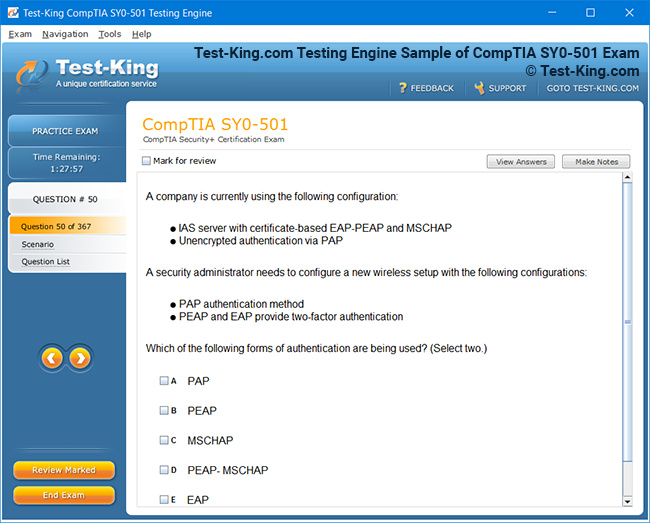
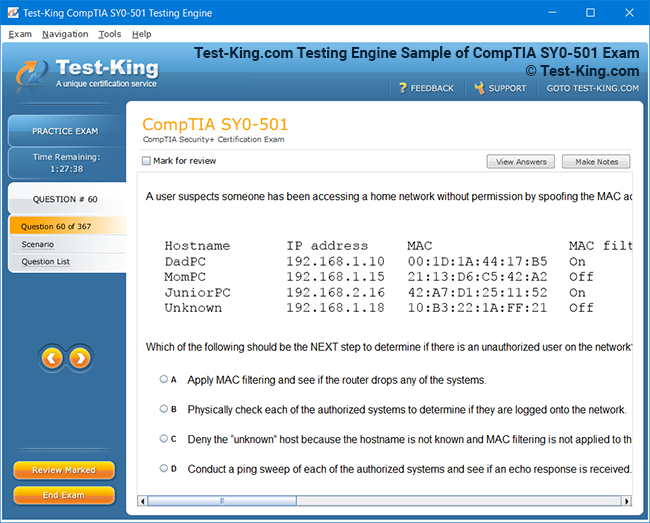
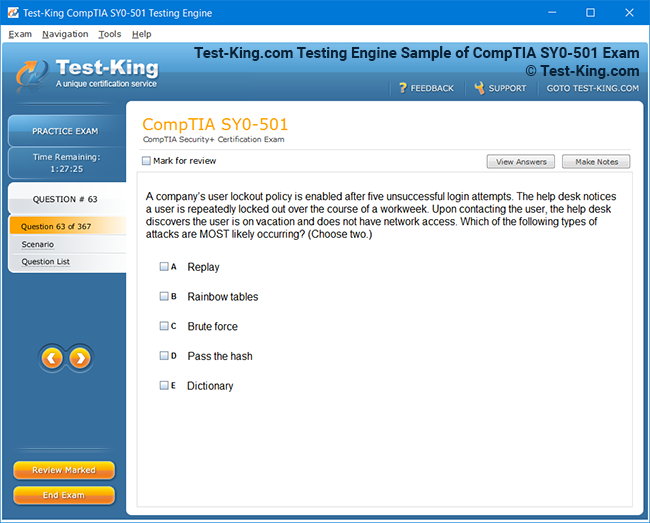
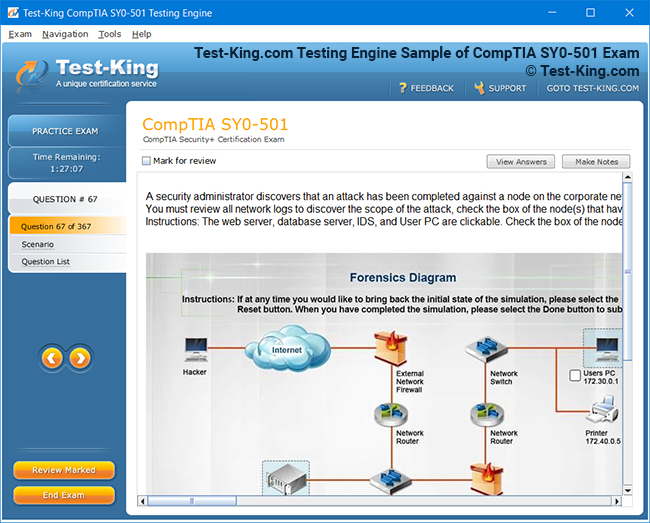
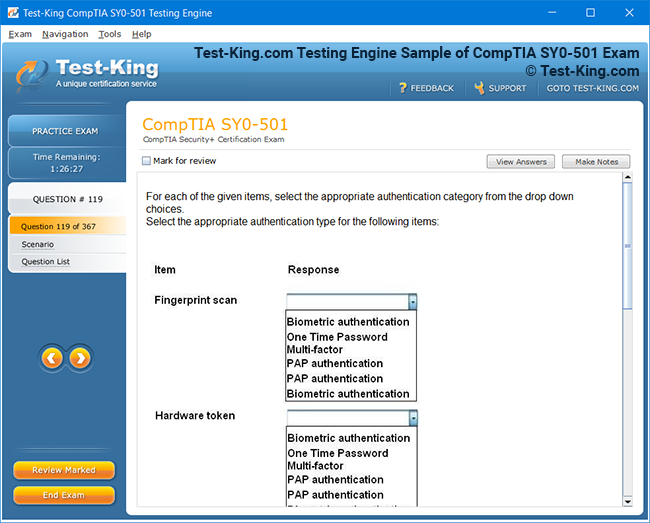
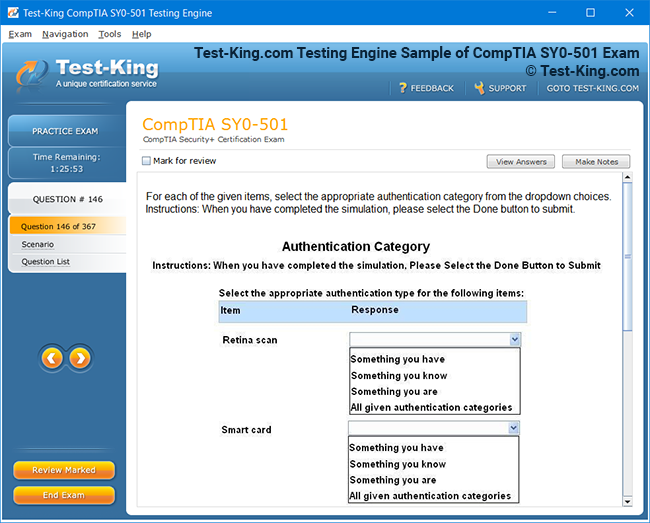
Product Screenshots
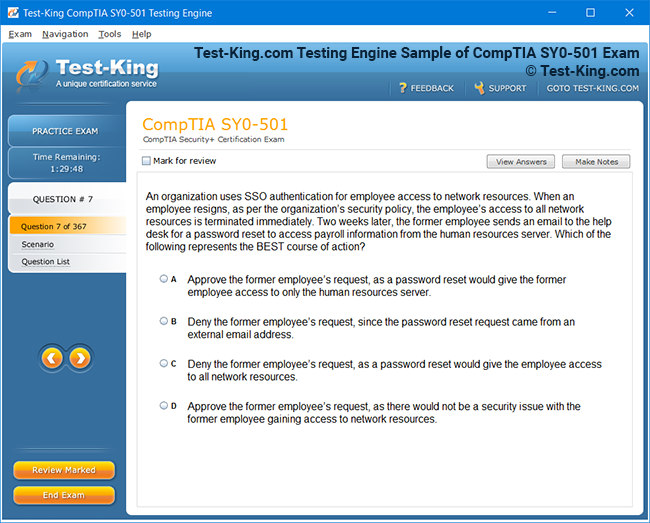
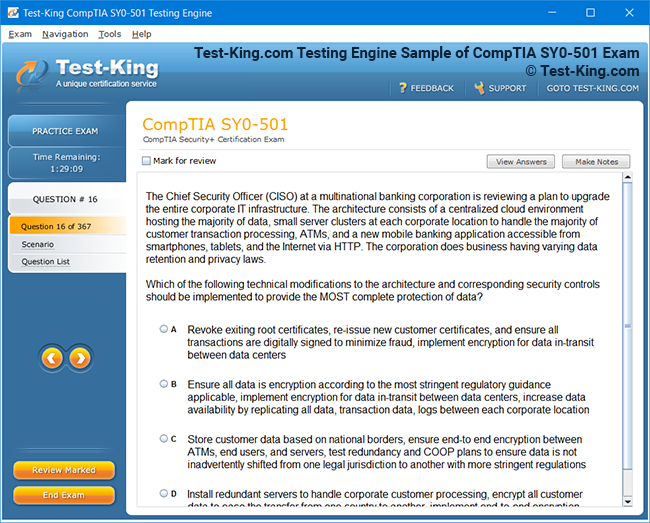
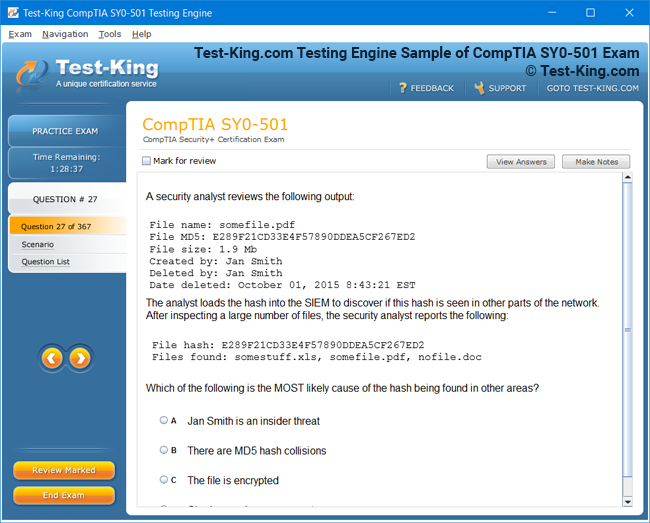
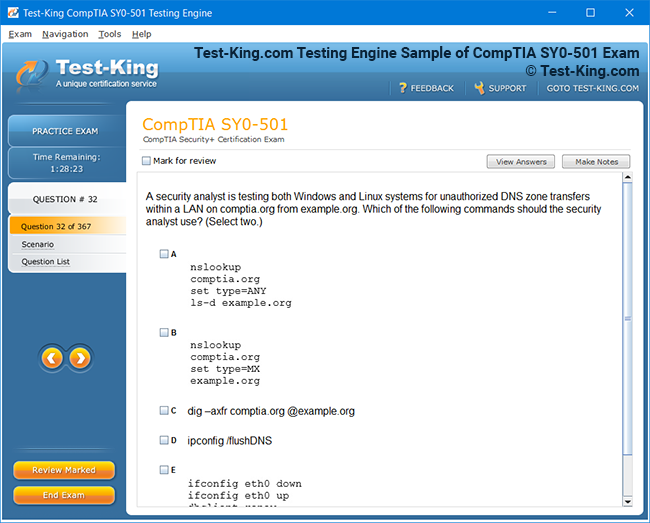
Frequently Asked Questions
How can I get the products after purchase?
All products are available for download immediately from your Member's Area. Once you have made the payment, you will be transferred to Member's Area where you can login and download the products you have purchased to your computer.
How long can I use my product? Will it be valid forever?
Test-King products have a validity of 90 days from the date of purchase. This means that any updates to the products, including but not limited to new questions, or updates and changes by our editing team, will be automatically downloaded on to computer to make sure that you get latest exam prep materials during those 90 days.
Can I renew my product if when it's expired?
Yes, when the 90 days of your product validity are over, you have the option of renewing your expired products with a 30% discount. This can be done in your Member's Area.
Please note that you will not be able to use the product after it has expired if you don't renew it.
How often are the questions updated?
We always try to provide the latest pool of questions, Updates in the questions depend on the changes in actual pool of questions by different vendors. As soon as we know about the change in the exam question pool we try our best to update the products as fast as possible.
How many computers I can download Test-King software on?
You can download the Test-King products on the maximum number of 2 (two) computers or devices. If you need to use the software on more than two machines, you can purchase this option separately. Please email support@test-king.com if you need to use more than 5 (five) computers.
What is a PDF Version?
PDF Version is a pdf document of Questions & Answers product. The document file has standart .pdf format, which can be easily read by any pdf reader application like Adobe Acrobat Reader, Foxit Reader, OpenOffice, Google Docs and many others.
Can I purchase PDF Version without the Testing Engine?
PDF Version cannot be purchased separately. It is only available as an add-on to main Question & Answer Testing Engine product.
What operating systems are supported by your Testing Engine software?
Our testing engine is supported by Windows. Andriod and IOS software is currently under development.
Top The Open Group Exams
OGA-031 : Top Study Tips and Resources for the ArchiMate 3 Part 1 Exam
Embarking on the journey to achieve the ArchiMate 3 Part 1 certification requires a nuanced comprehension of the framework and its practical applications within enterprise architecture. The ArchiMate 3 specification, governed by The Open Group, provides a uniform language for describing, analyzing, and visualizing architecture across business domains. This certification validates foundational knowledge, ensuring that candidates can interpret and model enterprise architectures effectively. It is not merely about memorizing concepts but about cultivating the cognitive agility to apply the framework in real-world scenarios, which often involves complex interrelations between business processes, applications, and technology infrastructure.
Understanding the Essence of ArchiMate 3 and Its Certification
Understanding the interdependencies among these layers is pivotal. The framework emphasizes three primary domains: the business layer, which outlines services, processes, and organizational functions; the application layer, where software and system interactions are mapped; and the technology layer, which details the underlying infrastructure supporting applications and processes. Mastery of these layers, along with comprehension of cross-cutting aspects such as motivation elements and implementation mechanisms, equips candidates to navigate the exam with clarity and confidence.
Crafting an Efficient Study Routine
Effective preparation demands a disciplined study routine that balances theory, visualization, and application. Start by allocating fixed intervals of time each day, ensuring cognitive retention through repetition and active engagement. Many aspirants find that the Pomodoro technique—short bursts of concentrated study followed by brief rest periods—enhances focus while preventing mental fatigue. During each interval, emphasize both comprehension and recollection, gradually increasing the complexity of the material as proficiency develops.
A critical aspect of preparation is the strategic sequencing of topics. Begin with foundational concepts, such as core elements, relationships, and viewpoints, before advancing to more intricate subjects like architecture analysis and cross-layer dependencies. While reviewing, integrate mnemonic devices and mind maps to solidify memory retention. For example, visualizing the connections between business services and application components through layered diagrams can make abstract concepts more tangible and less formidable during the exam.
Leveraging Study Resources and Materials
The availability and judicious use of study resources can significantly influence exam performance. Official documentation from The Open Group remains the cornerstone of preparation. The ArchiMate 3 specification document is comprehensive, delineating core elements, relationships, viewpoints, and extensions. Reading and internalizing this document forms the bedrock of knowledge, as exam questions often draw from nuanced aspects of the specification. Supplement this with practical guides, tutorial videos, and interactive online platforms that simulate real-world scenarios.
Practice examinations serve a dual purpose: assessing current understanding and acclimatizing the candidate to the exam format. Through repeated engagement with sample questions, aspirants can identify gaps in knowledge and reinforce weaker areas. Importantly, after attempting each question, reviewing the rationale behind correct and incorrect answers deepens comprehension and enhances analytical skills. Some advanced resources also include scenario-based exercises, which mimic complex enterprise architecture problems, thereby fostering the application of theoretical knowledge in practical contexts.
Techniques for Retaining Complex Concepts
ArchiMate 3 encompasses intricate relationships and layered constructs that can be challenging to memorize. To retain these effectively, adopt a multi-sensory approach to learning. Engage visual, auditory, and kinesthetic modalities by combining reading with diagrammatic representation, verbal explanation, and physical notation. For instance, drawing the interconnections between business, application, and technology layers while explaining them aloud reinforces neural pathways, making recall during the exam more fluid.
Another technique involves contextualizing abstract concepts within real-world enterprise scenarios. Imagine a multinational organization seeking to optimize its supply chain; mapping business processes to application support and technology infrastructure not only aids in understanding the functional dependencies but also creates narrative anchors for memory retention. Analogies, metaphorical thinking, and case study analysis enrich cognitive assimilation, transforming rote memorization into applied intelligence.
Understanding Exam Format and Question Types
Familiarity with the exam structure is essential for minimizing surprises and optimizing performance. The ArchiMate 3 Part 1 exam typically features a blend of multiple-choice and scenario-based questions, emphasizing both theoretical knowledge and practical application. Questions may present a scenario describing organizational processes, requiring the candidate to identify appropriate relationships, viewpoints, or elements within the framework. This approach assesses not just recall but analytical reasoning and architectural insight.
Time management is another critical factor. Allocating sufficient time to dissect each question ensures accuracy without undue haste. Reading the scenario thoroughly, identifying key components, and cross-referencing with mental models of ArchiMate layers enhances the probability of correct responses. Practicing under timed conditions cultivates both speed and precision, reducing cognitive pressure during the actual exam.
Incorporating Collaborative Learning
Learning in isolation can limit perspective, whereas collaborative study enriches understanding through shared knowledge and debate. Engage with study groups or online communities focused on ArchiMate 3 certification. Discussing complex scenarios, clarifying ambiguous concepts, and challenging each other with mock questions stimulate deeper comprehension. Peer explanations often reveal nuances that solitary study might overlook, providing alternative cognitive pathways to the same conceptual destination.
Furthermore, mentors or certified practitioners can offer invaluable insights, highlighting common pitfalls, effective study strategies, and subtle distinctions within the framework. Interaction with experienced architects fosters critical thinking and exposes candidates to the practical relevance of the specification, enhancing both confidence and competence.
Balancing Theory with Practical Application
While conceptual understanding forms the foundation, practical application solidifies knowledge. Use modeling tools to construct enterprise architecture diagrams based on sample scenarios. Experiment with depicting business processes, application components, and technology infrastructure, exploring how various elements interrelate and influence one another. This hands-on approach transforms abstract theory into tangible comprehension, preparing candidates for scenario-based questions that require more than superficial recall.
Practical exercises also cultivate an intuitive grasp of viewpoints and their purposes. By visualizing how different stakeholders perceive enterprise architecture, candidates learn to tailor models for clarity and relevance, a skill directly tested in the certification exam. Iterative practice, accompanied by critical reflection, bridges the gap between textbook knowledge and applied expertise.
Cultivating Cognitive Resilience and Focus
Exam preparation is as much a mental endeavor as it is an academic one. Cultivating cognitive resilience ensures that candidates remain focused, confident, and composed throughout the preparation journey. Techniques such as mindfulness meditation, deliberate breathing exercises, and short physical activity breaks improve concentration and reduce stress. Regular review intervals, spaced repetition, and periodic self-assessment sustain mental agility, allowing for more efficient assimilation of complex concepts.
It is equally important to maintain a growth-oriented mindset. Mistakes and misunderstandings during practice sessions should be regarded as opportunities for learning rather than setbacks. Adopting an inquisitive attitude, where each challenge becomes a puzzle to solve, fosters engagement and reduces cognitive fatigue, ensuring that study sessions remain productive and insightful.
Navigating Motivation and Accountability
Sustaining motivation over an extended study period is often challenging. Establishing clear goals, maintaining a visible progress tracker, and rewarding milestones achieved can enhance persistence and commitment. Writing reflective summaries of learned concepts or teaching them to a peer can reinforce both understanding and motivation. Accountability partners or study groups can provide external reinforcement, ensuring that study objectives are met consistently and conscientiously.
The journey to ArchiMate 3 Part 1 certification demands a synthesis of discipline, strategic planning, and intellectual curiosity. By balancing structured study routines, resource utilization, collaborative learning, and cognitive resilience, candidates cultivate a robust knowledge foundation. The integration of theoretical comprehension with practical application equips aspirants not only to excel in the OGA-031 examination but also to apply the framework effectively in professional enterprise architecture contexts.
Deepening Conceptual Understanding of ArchiMate 3
Achieving mastery of the ArchiMate 3 framework involves more than rote memorization of elements or relationships. It requires cultivating a mental lattice where business processes, applications, and technology infrastructure are interwoven with clarity and coherence. ArchiMate 3, governed by The Open Group, is a powerful tool for enterprise architects, providing a consistent notation to visualize complex organizational structures. The certification validates the ability to model, interpret, and analyze architecture in a manner that resonates with both technical and non-technical stakeholders.
Candidates must comprehend the layers and their interactions in depth. The business layer delineates services, roles, and processes, while the application layer illustrates the systems and software enabling those processes. The technology layer captures the infrastructure underpinning both application and business functions. Additionally, understanding motivation elements, such as goals and principles, provides context for why architectural choices exist. Implementation and migration elements clarify the transition from current to target architecture, adding another dimension to candidate comprehension.
Strategic Approaches to Exam Preparation
Preparation for the exam benefits from a structured yet flexible strategy that blends intensive study with reflective analysis. Begin by mapping out a study plan that allocates sufficient time for each domain, progressively advancing from fundamental topics to intricate interdependencies. Incorporating iterative review ensures that early concepts are reinforced alongside more advanced topics, facilitating both retention and application. Visual aids, such as layered diagrams, enhance comprehension by converting abstract relationships into tangible mental constructs.
Integrating scenario-based practice into preparation is highly effective. Candidates can simulate real-world enterprise challenges, mapping processes to application support and technology infrastructure. This approach fosters analytical reasoning, requiring aspirants to consider constraints, dependencies, and stakeholder perspectives. Scenario exercises enhance both conceptual understanding and the ability to apply ArchiMate constructs under exam conditions.
Effective Use of Study Resources
Selecting the right study materials can accelerate learning and fortify understanding. Official documentation from The Open Group remains indispensable, providing precise definitions, comprehensive element descriptions, and examples of viewpoints. Supplementing this core resource with practical guides, tutorial videos, and interactive platforms offers diverse perspectives, catering to different learning styles. Regular engagement with multiple resources ensures a well-rounded grasp of concepts, reduces the likelihood of knowledge gaps, and cultivates confidence in exam readiness.
Practice questions and mock exams are particularly valuable. They provide insight into the types of scenarios presented in the actual test and allow candidates to measure their understanding in a controlled environment. Reviewing each question carefully, reflecting on the rationale behind answers, and analyzing errors deepens comprehension. This continuous feedback loop promotes cognitive assimilation and reinforces critical thinking, which is vital for interpreting complex scenarios during the exam.
Techniques for Memorization and Cognitive Retention
Retaining the intricate details of ArchiMate 3 requires a multi-modal approach to learning. Visual, auditory, and kinesthetic strategies can be employed simultaneously to strengthen memory pathways. For instance, creating diagrams while verbalizing relationships between elements engages multiple cognitive channels, enhancing retention. Analogies and metaphorical thinking help in internalizing abstract relationships; imagining an organization’s application landscape as a series of interconnected ecosystems makes it easier to grasp cross-layer interactions.
Another approach involves creating mental narratives around the elements. Consider a multinational corporation optimizing its operations: business services facilitate core processes, applications support these processes, and technology underpins the entire structure. Constructing such stories contextualizes theoretical concepts, transforming them into memorable cognitive anchors. Spaced repetition and periodic self-quizzing further consolidate this knowledge, allowing for long-term retention and quick recall during the exam.
Navigating Exam Question Types
The ArchiMate 3 Part 1 exam presents a combination of multiple-choice questions and scenario-based challenges that test both theoretical understanding and practical application. Candidates may encounter a description of organizational processes or systems and must identify the appropriate elements, relationships, or viewpoints. This demands careful reading, analytical reasoning, and application of mental models. Effective preparation requires familiarity with the question formats, practicing interpretation of scenarios, and understanding how different elements interconnect within the framework.
Time management plays a crucial role in handling exam questions efficiently. Allocating adequate time to read, analyze, and map scenarios prevents errors caused by haste. Candidates should approach each question systematically, first identifying key elements, then evaluating relationships, and finally confirming consistency with ArchiMate principles. Practicing under timed conditions fosters confidence and helps cultivate an instinctive approach to solving questions with precision.
Collaborative Learning and Peer Engagement
Interaction with peers or mentors adds a valuable dimension to preparation. Discussing complex scenarios, sharing interpretations, and challenging one another with questions enhances comprehension. Collaborative learning fosters critical thinking and exposes candidates to alternative viewpoints, highlighting nuances that may be overlooked in solitary study. Mentorship from certified practitioners offers practical insights, guidance on common pitfalls, and strategic advice for navigating the exam effectively.
Engaging in forums or study groups also provides moral support, accountability, and motivation. Exchange of resources, discussion of scenario exercises, and collaborative problem-solving enrich the learning experience. Peer interactions can uncover subtle distinctions between similar elements or viewpoints, clarifying ambiguities that are often tested in the exam.
Integrating Practical Exercises with Theory
Practical application solidifies theoretical understanding, transforming abstract concepts into tangible knowledge. Modeling exercises, such as mapping business processes to application components and technology infrastructure, develop both proficiency and confidence. Engaging with modeling tools enables candidates to visualize interdependencies, understand viewpoints from stakeholder perspectives, and test hypothetical scenarios. This approach ensures readiness for scenario-based questions and fosters a deeper comprehension of how the framework operates in real-world contexts.
Repeated practice, coupled with critical reflection, enhances both accuracy and intuition. By constructing, analyzing, and refining models, candidates internalize patterns and relationships within the framework. This active engagement allows for faster and more precise recall during the exam and strengthens the ability to tackle unfamiliar or complex scenarios effectively.
Cognitive Strategies for Focus and Resilience
Exam preparation is an intellectual endeavor that requires mental stamina and resilience. Maintaining focus during prolonged study sessions can be facilitated through mindfulness practices, short physical exercises, and structured breaks. Cognitive resilience ensures that candidates can absorb and process complex information efficiently, reducing the impact of fatigue or stress. Structured repetition, combined with self-assessment, fosters adaptability, helping learners tackle questions from multiple angles and retain nuanced details.
A growth-oriented mindset is equally crucial. Viewing errors as learning opportunities encourages perseverance and reinforces understanding. By cultivating curiosity and embracing challenges, candidates engage more deeply with material, transforming difficult concepts into comprehensible constructs. Maintaining motivation and confidence throughout the preparation journey ensures consistent progress and strengthens overall exam readiness.
Motivation, Accountability, and Sustained Progress
Sustaining long-term motivation requires clearly defined goals, measurable milestones, and periodic reflection. Documenting progress, rewarding achievements, and establishing accountability mechanisms, such as study partners or mentors, reinforce commitment and consistency. Teaching concepts to peers or summarizing knowledge in personal notes enhances both understanding and motivation, reinforcing cognitive pathways necessary for recall during the exam.
Exam preparation for ArchiMate 3 Part 1 encompasses strategic study routines, effective resource utilization, cognitive resilience, and practical application. By integrating collaborative learning, scenario-based exercises, and reflective practice, candidates cultivate a holistic understanding of enterprise architecture. This approach not only prepares aspirants to excel in the OGA-031 examination but also equips them with the analytical and modeling skills required for professional practice in complex organizational environments.
Exploring the Layers of ArchiMate 3
The ArchiMate 3 framework, established by The Open Group, presents a multi-dimensional approach to enterprise architecture, providing a lingua franca for architects and stakeholders alike. A comprehensive understanding begins with the business layer, where services, roles, processes, and organizational functions form the scaffolding of enterprise operations. Candidates must not only recognize these elements but also understand how they influence applications and technology. The interconnectivity between layers is fundamental, as decisions at the business level cascade into application and technological configurations.
The application layer illuminates the systems and software enabling the business processes, often revealing intricate interdependencies. Candidates are expected to discern how data, functions, and applications interact and contribute to business objectives. The technology layer completes the triad, depicting infrastructure elements such as networks, servers, and devices that underpin both business and application layers. Motivation and implementation elements add depth, explaining the rationale behind architectural decisions and the pathway to their realization. Internalizing these constructs is essential for navigating scenario-based questions on the OGA-031 exam.
Creating an Immersive Study Environment
Effective exam preparation extends beyond content mastery; it involves crafting an environment conducive to focus, comprehension, and retention. A designated study space free from distractions promotes sustained engagement. Ambient conditions such as lighting, ergonomics, and minimal interruptions contribute to cognitive clarity. Incorporating elements like whiteboards or digital modeling tools allows candidates to externalize complex interrelationships, reinforcing comprehension and memory.
Time management within this environment is paramount. Dividing study intervals into concentrated sessions followed by restorative breaks maintains attention span and prevents cognitive fatigue. During active intervals, candidates should alternate between reading, visualization, and applied exercises to stimulate multiple cognitive pathways. The integration of reflective pauses enables consolidation of knowledge, allowing abstract concepts to crystallize into memorable cognitive constructs.
Integrating Scenario-Based Learning
Scenario-based learning is indispensable for internalizing ArchiMate 3 concepts. Constructing hypothetical organizational cases, mapping processes, applications, and technological components, cultivates analytical reasoning and applied knowledge. For example, envision a multinational enterprise seeking to optimize its customer service operations. Mapping customer-facing processes to supporting applications and infrastructure clarifies interdependencies, highlights potential inefficiencies, and demonstrates the utility of the framework in practical contexts.
Repeated engagement with such scenarios nurtures the ability to dissect questions methodically, identify relevant elements, and establish correct relationships. Candidates develop an intuitive sense for how viewpoints serve stakeholders’ needs, preparing them for the type of questions encountered in the OGA-031 exam. Visualizing scenarios from multiple perspectives reinforces memory and enhances interpretative accuracy.
Leveraging Diverse Study Materials
The judicious selection of study resources is critical. The official ArchiMate 3 specification document remains the cornerstone, providing precise definitions, structural overviews, and exemplars of viewpoints and relationships. Complementing this with practical guides, online tutorials, and interactive platforms ensures exposure to diverse representations of the same concepts. Engaging with varied materials accommodates different learning styles and deepens conceptual understanding.
Mock examinations play a pivotal role in assessing readiness and acclimating candidates to the exam’s structure. They highlight strengths and weaknesses, providing actionable insights for focused review. After attempting questions, reviewing the rationale behind answers consolidates comprehension and develops critical thinking. Continuous feedback loops between study, practice, and reflection enhance cognitive assimilation and build confidence.
Memorization Strategies for Complex Relationships
The intricacy of ArchiMate 3 relationships demands effective memorization strategies. Multi-sensory engagement—combining visualization, auditory reinforcement, and kinesthetic practice—stimulates multiple neural pathways. Drawing diagrams while verbalizing the interactions between layers, creating narrative analogies, or explaining concepts aloud strengthens memory retention.
Constructing real-world analogies, such as likening business services to organs in a living system, applications to the nervous system transmitting signals, and technology to the skeletal framework supporting structure, allows abstract concepts to anchor in memory. Spaced repetition, active recall, and self-testing complement these techniques, enhancing long-term retention and quick retrieval during the exam.
Understanding Viewpoints and Stakeholder Perspectives
A critical aspect of ArchiMate 3 preparation involves mastering viewpoints. Viewpoints serve as lenses through which architects and stakeholders perceive enterprise architecture, ensuring clarity and relevance. Candidates must comprehend the intent behind each viewpoint and how it highlights specific concerns, whether operational, strategic, or technical. The ability to select the appropriate viewpoint for a given scenario is often tested in scenario-based questions, emphasizing practical application over rote memorization.
Through exercises in viewpoint analysis, candidates learn to identify which stakeholders prioritize which elements, and how communication can be optimized. For instance, business executives may focus on capabilities and processes, while technical teams examine infrastructure dependencies. Understanding these nuances allows candidates to construct accurate, stakeholder-relevant models.
Enhancing Analytical Thinking Through Practice
Analytical thinking is central to both preparation and exam success. Breaking down complex scenarios into smaller, manageable elements and examining interrelationships sharpens reasoning skills. Candidates should approach problems methodically, first identifying the core business process, then mapping relevant applications and technological components. This methodical decomposition aligns with the framework’s layered approach and reduces cognitive overload.
Repeated application of this technique across diverse scenarios cultivates pattern recognition, enabling faster, more accurate analysis. By internalizing recurring structures and relationships, candidates develop an instinctive ability to navigate unfamiliar questions with confidence.
Time Management and Exam Tactics
Efficient time management during preparation and exam execution is crucial. Allocate sufficient intervals for reading and comprehension, followed by active problem-solving exercises. During the exam, candidates should first survey the questions, prioritizing those aligned with their strengths to secure early confidence. Scenario-based questions often require a more deliberate pace, as careful interpretation of relationships and dependencies is essential. Practicing under timed conditions familiarizes candidates with pressure, reducing anxiety and enhancing accuracy.
Strategically approaching questions involves recognizing cues, differentiating between primary and secondary elements, and validating relationships against framework principles. Candidates who integrate time-conscious practice with conceptual clarity are better equipped to navigate the exam without compromising precision.
Collaborative Learning and Mentorship
Engaging with peers, mentors, or professional communities provides invaluable insight. Discussion of complex scenarios and exchange of interpretations reveal subtle distinctions that may be overlooked in solitary study. Mentorship offers guidance on pitfalls, effective preparation strategies, and practical applications of the framework, bridging the gap between theoretical knowledge and real-world relevance.
Active participation in collaborative exercises, such as group modeling sessions or scenario discussions, promotes deeper understanding and reinforces learning. Diverse perspectives illuminate alternative approaches to the same problem, enriching the candidate’s toolkit for analyzing questions and constructing accurate models.
Sustaining Motivation and Cognitive Resilience
The prolonged preparation journey for ArchiMate 3 Part 1 demands sustained motivation and mental resilience. Structuring study plans with clear goals, measurable milestones, and periodic reflections fosters perseverance. Incorporating short physical activities, mindfulness practices, and restorative breaks enhances focus and cognitive endurance.
Maintaining a growth-oriented mindset encourages learning from mistakes, viewing challenges as opportunities to deepen understanding. Candidates who cultivate curiosity, curiosity-driven exploration, and analytical rigor approach the framework not as a set of rules to memorize but as a living system to engage with, fostering both competence and confidence.
Integrating Practical Exercises and Knowledge Application
Hands-on practice consolidates theoretical understanding. Candidates are encouraged to construct comprehensive models of hypothetical enterprises, mapping processes to applications and technology infrastructure, experimenting with viewpoints, and analyzing interdependencies. This immersive approach transforms abstract principles into tangible comprehension, directly enhancing performance in scenario-based questions.
Iterative refinement of models, followed by reflective evaluation, enables candidates to identify weaknesses, optimize modeling strategies, and internalize patterns. This iterative methodology nurtures both speed and accuracy, equipping candidates with the practical skills required for professional enterprise architecture work and the ArchiMate 3 Part 1 exam.
Cognitive Techniques for Mastery
Advanced cognitive techniques, such as elaborative interrogation, self-explanation, and distributed practice, further augment retention and understanding. Candidates should routinely question the purpose behind each element, relationship, and viewpoint, articulating their reasoning in personal notes or peer discussions. By explaining concepts in their own words, learners reinforce neural pathways and deepen comprehension.
Distributed practice, where study sessions are spread over time with regular revisiting of material, strengthens long-term retention and prevents knowledge decay. Integrating reflective practice with active modeling exercises ensures that understanding is both theoretical and applicable.
Resource Optimization and Study Efficiency
Optimizing the use of resources enhances study efficiency. Candidates should prioritize official specifications, authoritative guides, and interactive platforms, ensuring that learning materials are comprehensive, accurate, and aligned with exam objectives. Supplementary resources, such as case studies, scenario simulations, and expert commentaries, provide depth, enrich understanding, and expose candidates to a wide spectrum of practical applications.
Structured engagement with these resources, combined with regular self-assessment, creates a balanced study regimen that maximizes knowledge retention, analytical ability, and readiness for the exam.
Practical Insights and Real-World Application
Linking exam preparation to real-world enterprise architecture practice reinforces relevance and aids retention. Observing and analyzing organizational processes, applications, and technology infrastructure in professional settings allows candidates to draw parallels with theoretical concepts. Such exposure provides context for the relationships between layers, clarifies viewpoints’ purpose, and illustrates practical implications of architectural decisions.
By bridging theory with practice, candidates internalize patterns, develop intuitive understanding, and cultivate professional skills that extend beyond the OGA-031 exam. This holistic approach ensures that preparation is not just exam-oriented but also career-enhancing.
Mastering the Conceptual Framework of ArchiMate 3
Achieving proficiency in the ArchiMate 3 framework necessitates a deep understanding of its conceptual architecture, as articulated by The Open Group. This framework provides a structured language to model enterprise architecture, offering clarity across business, application, and technology layers. Each layer is not an isolated domain but an interdependent system where decisions at one level reverberate through others. The business layer focuses on services, processes, and organizational roles, forming the backbone of enterprise operations. Understanding how these elements influence applications and infrastructure is critical for both modeling and analysis.
The application layer captures the software systems and their interactions, emphasizing how data flows and processes are enabled. Technology, in turn, describes the underlying infrastructure that supports both applications and business functions. Motivation elements, such as principles, goals, and requirements, provide context for architectural decisions, while implementation and migration elements map the transition from current to target architecture. Internalizing these elements and their relationships enables candidates to navigate the exam with confidence and precision.
Structured Study Plans and Cognitive Discipline
Effective preparation is rooted in structured study plans and disciplined cognitive engagement. Candidates benefit from allocating focused study intervals interspersed with restorative breaks to prevent cognitive fatigue. Techniques such as the Pomodoro method, where short bursts of concentration are followed by brief pauses, help maintain mental acuity. Within these intervals, alternating between reading, visualization, and practical exercises stimulates multiple neural pathways, reinforcing comprehension.
Organizing topics sequentially, from foundational elements to complex interdependencies, allows gradual cognitive layering. For example, initial study may focus on core elements, relationships, and viewpoints, followed by advanced topics like cross-layer analysis and scenario interpretation. Using mind maps or layered diagrams to visualize interconnections between business services, applications, and technology infrastructure reinforces memory retention and deepens conceptual understanding.
Scenario-Based Exercises for Practical Insight
Scenario-based exercises are indispensable for transforming theoretical knowledge into applied expertise. By constructing hypothetical organizational models, candidates can explore the interplay between business processes, applications, and technology. For instance, envisioning a multinational corporation optimizing its logistics operations allows candidates to map supply chain processes to supporting applications and underlying infrastructure. This approach fosters analytical reasoning and prepares aspirants for scenario-driven questions in the OGA-031 exam.
Repetition with diverse scenarios cultivates intuitive understanding of relationships and viewpoints. By analyzing multiple perspectives—such as business executives concerned with processes versus technical teams focused on infrastructure—candidates learn to tailor models for clarity and relevance. Immersive scenario exercises enhance cognitive assimilation, making abstract principles more tangible and memorable.
Leveraging Diverse Study Resources
Effective exam preparation relies on judicious use of resources. The official ArchiMate 3 specification document from The Open Group provides the definitive descriptions of elements, relationships, and viewpoints. Complementing this with practical guides, tutorials, interactive platforms, and discussion forums ensures exposure to multiple perspectives and reinforces understanding. Diverse resources cater to different learning styles and enhance cognitive flexibility, helping candidates internalize complex concepts more efficiently.
Practice exams are particularly valuable for gauging readiness and familiarizing candidates with question formats. They highlight strengths and weaknesses, allowing targeted revision. Reflecting on rationale behind correct and incorrect answers consolidates comprehension and fosters critical thinking. Integrating study materials with applied exercises, feedback, and reflective practice forms a robust preparation ecosystem, enhancing both knowledge and confidence.
Memorization and Cognitive Techniques
The intricate relationships within ArchiMate 3 require advanced memorization techniques. Multi-modal learning, combining visual diagrams, auditory explanation, and kinesthetic practice, strengthens retention. Drawing relationships while verbalizing them, or teaching concepts to peers, reinforces neural pathways. Analogies can simplify abstraction: for instance, business services as organs, applications as the nervous system, and technology as the structural skeleton of an organization provide memorable cognitive anchors.
Spaced repetition, active recall, and self-testing complement these strategies. Revisiting concepts periodically ensures long-term retention, while scenario practice bridges theoretical understanding with practical application. Constructing mental narratives around organizational processes contextualizes knowledge, transforming memorization into applied cognition.
Understanding Viewpoints and Stakeholder Needs
Viewpoints serve as interpretative lenses through which architects communicate complex structures to stakeholders. Mastery involves recognizing the purpose behind each viewpoint and identifying which elements are highlighted for specific audiences. For instance, executives may prioritize capabilities and outcomes, while operational teams focus on processes and dependencies. Developing the ability to select and apply appropriate viewpoints is critical for both scenario interpretation and modeling exercises in the exam.
Candidates should practice constructing viewpoint-driven models, analyzing stakeholder concerns, and tailoring representations for clarity. Immersive exercises enable an understanding of nuances, such as how a single element may be depicted differently depending on the viewpoint. This ability to navigate perspectives enhances both comprehension and exam performance.
Analytical Thinking and Problem Decomposition
Analytical thinking is central to excelling in the ArchiMate 3 exam. Candidates must learn to decompose complex scenarios into discrete, manageable elements, analyzing relationships and dependencies systematically. Identifying core business processes, mapping supporting applications, and connecting infrastructure elements facilitates clarity and precision. This decomposition mirrors the layered approach of ArchiMate 3, ensuring structured and efficient problem-solving.
Repeated practice with varied scenarios develops pattern recognition, enabling candidates to quickly identify applicable elements and relationships. By internalizing common structures, candidates gain agility in handling unfamiliar or intricate questions, enhancing both speed and accuracy under exam conditions.
Time Management and Exam Strategy
Efficient time management is essential both during preparation and the exam itself. Candidates should allocate sufficient time for reading, comprehension, and scenario analysis during practice. In the exam, beginning with questions aligned to strengths establishes confidence and momentum. Scenario-based questions demand careful attention to interdependencies, relationships, and viewpoints, necessitating deliberate pacing.
Timed practice sessions acclimate candidates to the pressure of the exam environment, reducing anxiety and promoting accuracy. Strategic question analysis—identifying key elements, distinguishing primary and secondary relationships, and validating against ArchiMate principles—ensures that responses are both precise and well-considered.
Collaborative Learning and Peer Interaction
Engaging in collaborative learning amplifies comprehension and exposes candidates to diverse perspectives. Discussing scenarios with peers or mentors elucidates subtle distinctions and alternative interpretations. Mentorship offers practical guidance, highlighting pitfalls, effective strategies, and real-world applications of the framework, bridging the gap between theoretical knowledge and practical insight.
Peer interaction, through group modeling exercises or scenario analysis, reinforces learning, enhances critical thinking, and provides motivation. Exposure to different viewpoints and reasoning styles expands cognitive flexibility, preparing candidates for multifaceted scenario-based questions in the exam.
Cognitive Resilience and Sustained Motivation
Maintaining focus and motivation throughout extended preparation is critical. Structured study plans with defined goals, milestones, and progress tracking reinforce discipline. Incorporating mindfulness practices, physical activity, and restorative breaks supports cognitive resilience, enhancing attention and processing capacity.
A growth-oriented mindset transforms mistakes into opportunities for learning, encouraging persistence and deeper engagement with material. Curiosity-driven exploration fosters intellectual agility, enabling candidates to approach complex relationships and scenarios as challenges to be mastered rather than obstacles to be memorized.
Applied Exercises and Real-World Modeling
Practical application of ArchiMate 3 principles reinforces theoretical comprehension. Candidates should construct models of hypothetical or observed organizations, mapping business processes to supporting applications and technology infrastructure. Experimenting with viewpoints and interdependencies enhances insight into the framework’s versatility and utility.
Iterative refinement of models, followed by reflective evaluation, enables identification of errors, optimization of representation, and internalization of patterns. This iterative approach not only solidifies exam readiness but also cultivates professional skills in enterprise architecture, ensuring that knowledge is both practical and sustainable.
Advanced Cognitive Techniques
Advanced strategies such as elaborative interrogation, self-explanation, and distributed practice elevate understanding. Questioning the purpose behind each element, relationship, and viewpoint promotes deeper insight, while explaining concepts in one’s own words strengthens retention. Distributed practice, where study sessions are spaced over time with regular review, ensures long-term memory consolidation and reduces cognitive decay.
Integration of reflective practice, applied exercises, and scenario analysis ensures that candidates develop both conceptual understanding and applied competence. These strategies enhance problem-solving agility and prepare aspirants to navigate complex scenarios with precision.
Optimizing Study Efficiency
Resource optimization improves study efficacy. Prioritizing authoritative materials, including official specifications, practical guides, and interactive tools, ensures accuracy and alignment with exam objectives. Supplementary materials, such as case studies and expert commentaries, provide depth, expose candidates to diverse interpretations, and enrich understanding.
Structured engagement with these resources, combined with consistent self-assessment and reflective practice, creates a holistic preparation framework. This approach enhances knowledge retention, analytical ability, and practical skill, equipping candidates for both the OGA-031 exam and professional enterprise architecture challenges.
Bridging Theory and Practice
Linking preparation to real-world enterprise architecture practice reinforces learning and contextual understanding. Observing organizational processes, applications, and infrastructure enables candidates to connect theoretical concepts with tangible scenarios. Mapping workflows, identifying dependencies, and analyzing stakeholder viewpoints fosters a comprehensive understanding of architectural design.
Practical exposure cultivates intuition and pattern recognition, enhancing both exam performance and professional expertise. Candidates internalize relationships, comprehend the purpose of viewpoints, and appreciate the implications of architectural decisions, ensuring that preparation is deeply relevant and applicable.
Deepening Understanding of Layered Architecture
The ArchiMate 3 framework, offered by The Open Group, provides a lucid language for modeling enterprise architecture across business, application, and technology layers. Each layer represents a distinct perspective yet interacts seamlessly with the others. The business layer encapsulates processes, roles, and services that collectively form organizational functionality. Understanding how these services translate into application support and technological infrastructure is pivotal. Motivation elements, such as goals, requirements, and principles, frame the rationale for architectural choices and guide modeling decisions.
The application layer highlights system interactions and software functionalities that facilitate business operations. Candidates should examine how data flows, functional dependencies, and system integrations shape outcomes. The technology layer underpins the architecture, detailing servers, networks, and hardware infrastructure that enable both application and business processes. Internalizing the interdependencies among layers allows candidates to approach complex scenarios analytically, a skill central to achieving certification.
Effective Study Planning and Cognitive Optimization
Structured study planning is crucial for mastering ArchiMate 3 concepts. Creating a schedule that balances focused study intervals with restorative breaks maximizes retention and prevents mental fatigue. Techniques such as spaced repetition and the Pomodoro method optimize cognitive performance. Alternating between reading, visualization, and applied modeling exercises ensures multi-modal engagement, stimulating various neural pathways and reinforcing memory.
Candidates benefit from sequencing study topics in a progressive manner. Foundational elements, relationships, and viewpoints should precede complex topics such as cross-layer analysis and scenario interpretation. Mind maps and visual diagrams allow the mapping of dependencies between business, application, and technology layers, promoting comprehension and facilitating long-term retention.
Scenario-Based Learning for Applied Knowledge
Applying ArchiMate 3 principles to realistic scenarios is critical for deep comprehension. Constructing hypothetical enterprise cases enables candidates to analyze process flows, application support, and infrastructure dependencies. For instance, visualizing a global retail operation with supply chain optimizations allows aspirants to map logistics processes to relevant applications and underlying technology, fostering analytical reasoning and practical insight.
Repetition with varied scenarios cultivates flexibility in thinking. Candidates learn to adjust models according to stakeholder perspectives, such as executives emphasizing processes and outcomes, versus technical teams prioritizing system dependencies. This immersive approach improves both cognitive retention and performance on scenario-driven questions in the OGA-031 exam.
Utilizing Comprehensive Resources
Optimal preparation demands the integration of diverse study resources. The official ArchiMate 3 specification provides definitive definitions, structural relationships, and viewpoint examples. Complementing it with practical guides, interactive tutorials, and discussion forums ensures exposure to multiple perspectives and reinforces understanding. Mock exams and practice questions evaluate comprehension, highlight knowledge gaps, and provide familiarity with question types.
Reflective study is vital. After attempting a question, reviewing the rationale behind both correct and incorrect answers strengthens cognitive pathways, enhances analytical reasoning, and refines understanding of complex relationships. Combining resources with scenario exercises, self-assessment, and reflective review forms a holistic preparation strategy.
Advanced Memorization Techniques
The complexity of ArchiMate 3 relationships necessitates sophisticated memorization strategies. Multi-sensory engagement—such as diagrammatic representation, verbal explanation, and kinesthetic practice—facilitates retention. Constructing analogies, for example, viewing business services as organs, applications as the nervous system, and technology as the structural skeleton, converts abstract concepts into memorable cognitive anchors.
Spaced repetition and active recall ensure knowledge consolidation. Narrative techniques, where organizational operations are imagined as interconnected ecosystems, provide context and improve retention. Self-testing and mental walkthroughs of complex scenarios prepare candidates for applied exam questions, linking theory directly to practical application.
Mastering Viewpoints and Stakeholder Communication
Understanding viewpoints is crucial for articulating architecture effectively. Viewpoints provide tailored perspectives to different stakeholders, highlighting relevant elements and relationships. Business leaders may focus on processes and capabilities, while technical teams emphasize infrastructure and data flows. Candidates should practice constructing viewpoint-driven models, tailoring representation for clarity, and ensuring relevance to intended audiences.
Immersive exercises in stakeholder modeling develop cognitive flexibility. Evaluating multiple viewpoints of a scenario enhances comprehension, reinforces memory, and sharpens problem-solving capabilities. Mastery of viewpoints ensures that aspirants can approach scenario-based questions with confidence, addressing both explicit and implicit requirements.
Analytical Reasoning and Decomposition
Analytical reasoning is essential for dissecting complex architectural problems. Candidates benefit from breaking down scenarios into discrete components: identifying business processes, mapping supporting applications, and connecting technology elements. This systematic decomposition mirrors the layered structure of ArchiMate 3, enabling clarity and precision in modeling and analysis.
Repeated exposure to diverse scenarios cultivates pattern recognition. Candidates internalize recurring structures and relationships, improving their ability to quickly identify relevant elements in unfamiliar contexts. This approach fosters efficiency and accuracy under exam conditions.
Time Management and Exam Strategy
Strategic time allocation enhances performance during preparation and examination. Practicing timed exercises allows candidates to gauge pacing and develop a comfortable rhythm for both multiple-choice and scenario-based questions. Prioritizing questions based on familiarity builds confidence and momentum.
During the exam, careful reading, identification of key components, and verification against framework principles ensures precise responses. Scenario-based questions, which often include layered interdependencies, require deliberate analytical thinking and structured response strategies. Regular timed practice minimizes cognitive pressure, allowing for focused and accurate performance.
Collaborative Study and Mentorship
Peer collaboration and mentorship provide valuable insight and perspective. Discussing scenarios and problem-solving approaches reveals subtle distinctions that may be overlooked in solo study. Mentors provide guidance on common pitfalls, effective preparation strategies, and real-world applications of the framework.
Group exercises, where participants collectively construct models or analyze scenarios, reinforce understanding and enhance cognitive engagement. Exposure to diverse interpretations and reasoning strengthens adaptability and problem-solving skills, which are critical for both the exam and professional practice.
Cognitive Resilience and Motivation
Sustained motivation and mental resilience are essential throughout extended preparation periods. Structured study plans, clear milestones, and measurable objectives foster perseverance. Cognitive endurance is further supported through mindfulness exercises, short physical activities, and restorative breaks, enhancing focus and processing efficiency.
A growth-oriented mindset transforms mistakes into learning opportunities, promoting persistence and deeper engagement with material. Candidates who cultivate curiosity and analytical rigor approach complex scenarios as challenges to be mastered, fostering competence and confidence.
Applied Modeling Exercises
Practical application consolidates theoretical understanding. Candidates should model complete enterprise scenarios, mapping processes to supporting applications and underlying technology infrastructure. Engaging with multiple viewpoints and interdependencies enhances comprehension and prepares candidates for scenario-driven questions.
Iterative refinement of models, coupled with reflective evaluation, allows candidates to identify weaknesses, optimize representations, and internalize patterns. This methodology develops speed, accuracy, and applied expertise, equipping candidates for both exam success and real-world enterprise architecture practice.
Advanced Cognitive and Memory Techniques
Elaborative interrogation, self-explanation, and distributed practice deepen retention and understanding. Candidates benefit from articulating the purpose behind elements, relationships, and viewpoints, explaining concepts in their own words, and practicing retrieval over spaced intervals. Integrating reflective practice with modeling exercises enhances comprehension, analytical ability, and practical skill application.
Optimizing Resource Utilization
Efficient use of study materials enhances productivity. Candidates should prioritize official specifications, authoritative guides, and interactive tools, complemented by case studies and expert commentary. Structured engagement with these resources ensures accurate knowledge, breadth of understanding, and alignment with exam objectives.
Combining resource study with scenario practice, self-assessment, and reflective review creates a cohesive preparation strategy. Candidates develop a holistic understanding of the framework, balancing conceptual knowledge with applied expertise, ensuring readiness for both exam challenges and professional architectural responsibilities.
Bridging Knowledge with Real-World Application
Applying learned principles in real-world contexts reinforces comprehension and retention. Observing organizational operations, analyzing system dependencies, and mapping processes to applications and infrastructure provides practical insights. Candidates internalize the purpose of viewpoints, relationships, and motivation elements, cultivating a deep and functional understanding of enterprise architecture.
Engaging with professional environments fosters intuition, pattern recognition, and adaptive thinking. This integration of theory and practice ensures that preparation is both exam-oriented and career-enhancing, providing a sustainable foundation for long-term professional success.
Conclusion
Achieving success in the ArchiMate 3 Part 1 exam requires a multifaceted approach that combines conceptual understanding, practical application, and cognitive resilience. Candidates must master the layered framework, understand stakeholder viewpoints, and develop analytical reasoning to navigate complex scenarios effectively. Strategic study planning, scenario-based learning, diverse resource utilization, and collaborative engagement reinforce knowledge and enhance retention. By integrating advanced memory techniques, iterative modeling exercises, and real-world practice, aspirants cultivate the skills necessary to excel in the OGA-031 exam while establishing a strong foundation for professional enterprise architecture practice. Sustained motivation, cognitive endurance, and reflective practice transform preparation into a meaningful, career-enriching journey, ensuring competence, confidence, and success.