

Product Screenshots
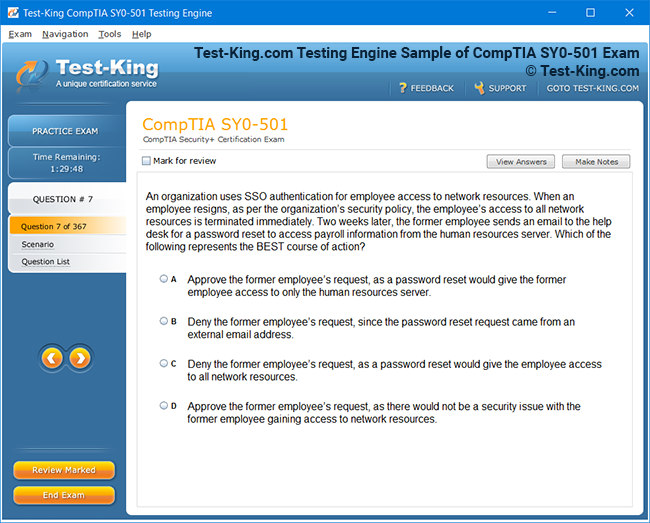
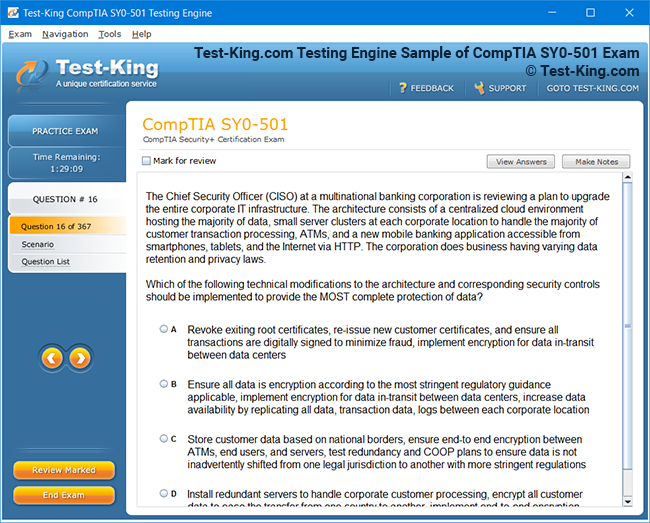
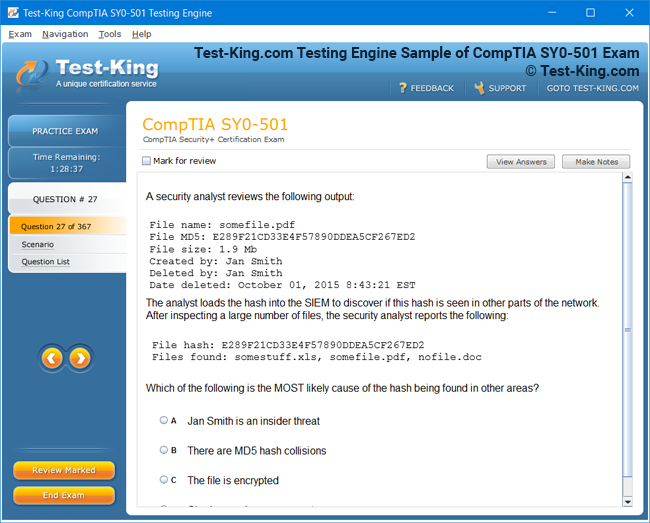
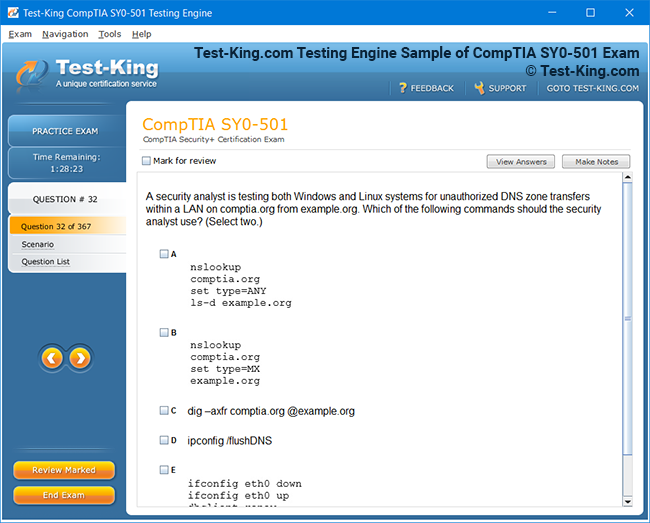
Frequently Asked Questions
How can I get the products after purchase?
All products are available for download immediately from your Member's Area. Once you have made the payment, you will be transferred to Member's Area where you can login and download the products you have purchased to your computer.
How long can I use my product? Will it be valid forever?
Test-King products have a validity of 90 days from the date of purchase. This means that any updates to the products, including but not limited to new questions, or updates and changes by our editing team, will be automatically downloaded on to computer to make sure that you get latest exam prep materials during those 90 days.
Can I renew my product if when it's expired?
Yes, when the 90 days of your product validity are over, you have the option of renewing your expired products with a 30% discount. This can be done in your Member's Area.
Please note that you will not be able to use the product after it has expired if you don't renew it.
How often are the questions updated?
We always try to provide the latest pool of questions, Updates in the questions depend on the changes in actual pool of questions by different vendors. As soon as we know about the change in the exam question pool we try our best to update the products as fast as possible.
How many computers I can download Test-King software on?
You can download the Test-King products on the maximum number of 2 (two) computers or devices. If you need to use the software on more than two machines, you can purchase this option separately. Please email support@test-king.com if you need to use more than 5 (five) computers.
What is a PDF Version?
PDF Version is a pdf document of Questions & Answers product. The document file has standart .pdf format, which can be easily read by any pdf reader application like Adobe Acrobat Reader, Foxit Reader, OpenOffice, Google Docs and many others.
Can I purchase PDF Version without the Testing Engine?
PDF Version cannot be purchased separately. It is only available as an add-on to main Question & Answer Testing Engine product.
What operating systems are supported by your Testing Engine software?
Our testing engine is supported by Windows. Andriod and IOS software is currently under development.
Top The Open Group Exams
Comprehensive Guide to Passing the ArchiMate 3 Part 2 Exam (OGA-032)
The ArchiMate 3 Part 2 exam, formally recognized as OGA-032, represents a pivotal milestone for enterprise architects and professionals aiming to demonstrate mastery in modeling complex organizational architectures. The examination not only assesses technical proficiency but also evaluates a candidate’s ability to apply conceptual knowledge in practical scenarios, blending theory with pragmatic reasoning. At its core, the examination emphasizes understanding the multifaceted relationships among strategy, business, application, and technology layers, while ensuring alignment with overarching enterprise objectives.
Understanding the Foundations and Strategic Approach
Embarking on preparation necessitates a strategic approach that is both systematic and reflective. Candidates must cultivate a nuanced understanding of the ArchiMate framework, particularly its extension to business motivation models, strategy implementation, and capability-based planning. In the context of enterprise architecture, these concepts are not merely theoretical constructs but practical tools that enable architects to visualize interdependencies, identify redundancies, and craft coherent roadmaps for organizational transformation.
Key Concepts and Terminology
Grasping the lexicon of ArchiMate is indispensable for success in the exam. The framework introduces a rich vocabulary encompassing elements, relationships, viewpoints, and layers. Business layers encapsulate processes, functions, services, and roles, while application layers model data, components, and system interactions. Technology layers delve into infrastructure, nodes, devices, and network components. Beyond these conventional constructs, ArchiMate 3 extends to strategy, motivation, and implementation layers, capturing the intent, goals, and transformation initiatives that propel enterprise evolution.
One frequently underappreciated aspect of preparation is the subtlety of relationship types. Relationships such as composition, aggregation, specialization, and association delineate how architectural elements interact and influence one another. Understanding these relationships is essential, as examination scenarios often involve complex diagrams requiring interpretation and application. A candidate’s ability to discern nuanced dependencies, anticipate impacts, and propose coherent modifications reflects a deep comprehension of enterprise architecture dynamics.
Equally important is the mastery of viewpoints, which dictate how architectural information is presented to different stakeholders. For instance, the motivation viewpoint communicates goals and requirements to executives, while the process viewpoint emphasizes operational workflows for managers. Recognizing which viewpoint to employ in a given scenario enhances clarity, ensures relevance, and demonstrates practical command over architectural communication.
Strategic Preparation and Study Techniques
Achieving proficiency in ArchiMate 3 Part 2 requires more than rote memorization; it demands cognitive assimilation of concepts and their interconnections. A deliberate and iterative study regimen proves effective. Candidates should commence with a thorough review of foundational concepts, revisiting definitions, core principles, and primary relationships. Subsequent stages should involve scenario-based exercises, translating textual descriptions into structured diagrams and verifying accuracy against ArchiMate specifications.
A recommended strategy is to contextualize learning through realistic examples. For instance, when examining a business function such as order fulfillment, one can map associated applications, data flows, and technological dependencies. This not only reinforces understanding of individual elements but also illuminates the broader ecosystem, facilitating the identification of inefficiencies, redundancies, and potential enhancements. The capacity to interpret complex organizational scenarios and render them into coherent architectural representations is often the differentiating factor between average and exceptional candidates.
Additionally, candidates should cultivate familiarity with common pitfalls. Misinterpreting relationship types, overlooking intermediate layers, or confusing viewpoints can lead to errors in diagrammatic exercises and scenario analyses. Regularly reviewing practice questions, evaluating rationale behind correct answers, and reflecting on errors ensures progressive refinement of understanding. The emphasis should be on internalizing principles rather than merely memorizing solutions.
Applying Knowledge Through Scenario Analysis
Scenario-based exercises are central to the OGA-032 exam. Consider an organization seeking to integrate a new customer relationship management system. The scenario requires identification of impacted business processes, affected application components, and infrastructure implications. By systematically mapping goals, drivers, and outcomes, candidates demonstrate their ability to navigate complexity while ensuring alignment with strategic objectives. Such exercises also reinforce comprehension of the often-subtle distinctions between active structure elements, behavior elements, and passive structure elements, which underpin accurate architectural modeling.
Another illustrative example involves capability-based planning. Suppose an enterprise intends to enhance operational agility. Candidates must model capabilities, map supporting applications and services, and anticipate technological constraints. The emphasis lies in connecting abstract strategic intents to tangible operational architectures, reflecting a holistic grasp of ArchiMate principles. Engaging in these exercises repeatedly enhances mental agility, enabling candidates to approach novel questions with confidence and clarity.
Enhancing Diagram Interpretation Skills
The ability to interpret and manipulate diagrams is crucial. Candidates should practice reading complex models featuring multiple layers, interwoven relationships, and diverse viewpoints. Key strategies include systematically identifying the type of elements, discerning primary and secondary relationships, and tracing flows across layers. Engaging in exercises that involve redesigning flawed diagrams or proposing optimizations sharpens analytical reasoning and reinforces conceptual comprehension.
An effective technique is mental rehearsal: visualizing interactions and predicting outcomes prior to diagram completion. This approach encourages anticipatory thinking, reduces cognitive overload during the exam, and fosters precision in modeling exercises. Furthermore, documenting thought processes in narrative form can transform abstract reasoning into concrete explanations, enhancing both clarity and retention.
Mastering Motivation and Strategy Elements
The ArchiMate 3 Part 2 exam places significant emphasis on motivation and strategy elements. Candidates must understand concepts such as goals, objectives, requirements, assessments, and principles. These elements are interconnected, forming a lattice through which organizational intent manifests in operational execution. A goal might inform specific requirements, which in turn shape capabilities and processes. Understanding this cascade is vital for accurately modeling enterprise transformations and anticipating the ramifications of architectural decisions.
For instance, in modeling a digital transformation initiative, one must identify strategic drivers, capture relevant assessments, define principles guiding technology adoption, and ensure alignment with business capabilities. Such exercises reinforce the integration of motivation and strategy concepts with application and technology layers, reflecting the comprehensive thinking required for successful exam performance.
Practice Questions as Narrative Learning
Instead of traditional question-and-answer formats, practice can be reframed into narrative exercises. For example, consider a scenario where a retail organization aims to optimize inventory management. A candidate would describe how inventory processes interact with procurement applications, which data objects are essential, how technological nodes support transaction processing, and how strategic objectives such as cost reduction influence design decisions. This approach converts discrete questions into a cohesive narrative, reinforcing understanding while simulating real-world application.
Similarly, when tasked with evaluating alternative architectural designs, candidates can describe decision-making rationale, trade-offs, and expected outcomes in narrative form. Such exercises encourage critical thinking, highlight dependencies, and strengthen the ability to articulate architectural reasoning—skills directly applicable to both the exam and professional practice.
Leveraging Resources and Study Materials
Successful preparation is augmented by judicious use of resources. Official documentation, including the ArchiMate 3 specification, serves as the authoritative reference. Complementing this with study guides, video tutorials, and scenario-based exercises enhances comprehension. Engaging with community forums and discussion groups provides exposure to diverse perspectives, common pitfalls, and practical tips, fostering both knowledge consolidation and confidence.
Equally valuable are mock exams and timed exercises. These simulate the cognitive and temporal pressures of the real examination, allowing candidates to identify areas of weakness, refine time management, and develop strategies for efficient navigation of complex diagrams and scenario analyses. By iteratively practicing and reflecting, candidates build the mental stamina and conceptual clarity necessary for exam success.
Integrating Rare and Specialized Concepts
To excel, candidates should familiarize themselves with nuanced concepts that are less commonly emphasized yet frequently tested. Examples include the distinction between active and passive structure elements in composite behaviors, the subtleties of influence relationships in motivation modeling, and the application of outcome and plateau constructs in implementation and migration planning. Recognizing these advanced concepts allows candidates to address challenging questions with precision and insight, elevating performance beyond superficial understanding.
Moreover, integrating unusual or seldom-discussed scenarios—such as modeling multi-national organizational structures, accounting for regulatory constraints, or mapping emergent capabilities in agile environments—enhances analytical dexterity. This exposure fosters a deeper appreciation of the framework’s versatility and equips candidates with the intellectual agility needed to tackle novel or complex examination prompts.
Cognitive Strategies for Retention
Effective preparation is underpinned by cognitive strategies that enhance retention and understanding. Techniques such as spaced repetition, active recall, and interleaved practice strengthen memory consolidation. Translating abstract concepts into self-generated diagrams or explanatory narratives engages multiple cognitive pathways, improving comprehension and recall. Analogical reasoning, wherein candidates relate new concepts to familiar organizational scenarios, further reinforces learning and facilitates the application of knowledge in dynamic contexts.
Equally important is metacognition: regularly evaluating understanding, identifying gaps, and adjusting study approaches accordingly. By cultivating awareness of one’s cognitive processes, candidates can prioritize high-impact areas, allocate time efficiently, and approach complex problems with deliberate strategy rather than reliance on intuition alone.
Developing Exam-Day Readiness
In addition to knowledge mastery, practical exam-day readiness is essential. Candidates should familiarize themselves with the exam format, timing, and typical question types. Practicing under timed conditions, simulating complex scenarios, and rehearsing diagrammatic exercises ensures both confidence and efficiency. Mental preparation, including stress management and visualization of success, complements technical readiness and reduces anxiety during the examination.
Cultivating resilience and adaptability is also crucial. The exam may present unexpected scenarios or diagrams that require swift interpretation and decision-making. By training to approach ambiguity with structured reasoning, candidates enhance their ability to maintain composure, apply principles accurately, and demonstrate holistic understanding under pressure.
Advanced Concepts, Practical Modeling, and Exam Strategies
The ArchiMate 3 Part 2 exam demands not only a theoretical understanding but also a sophisticated ability to translate architectural concepts into actionable models. Candidates are expected to navigate the labyrinthine interplay between strategy, motivation, business processes, applications, and technology layers, demonstrating fluency in both abstraction and practical application. Mastery involves cultivating an awareness of subtleties, such as the differences between alignment and aggregation, or the impact of indirect relationships on enterprise architecture coherence.
Deepening Understanding of Layers and Relationships
A critical element of preparation is the granular comprehension of ArchiMate layers. The business layer encapsulates roles, actors, processes, and services, mapping organizational behavior into structured representations. The application layer focuses on information flows, system components, and service orchestration, linking technology with functional execution. Technology layers describe the underpinning infrastructure, including nodes, devices, and system services. Beyond these conventional layers, ArchiMate 3 introduces motivation and strategy elements, which serve as the connective tissue between high-level goals and operational execution.
Understanding relationships is equally essential. Composition, aggregation, specialization, assignment, realization, and influence relationships govern how elements interact, and their accurate interpretation is a common challenge. For example, the distinction between triggering and flow relationships often manifests in subtle diagrammatic differences, yet these distinctions can significantly alter architectural interpretation. Candidates who internalize these nuances develop a keener ability to model dependencies, forecast ripple effects, and propose coherent modifications in real-world scenarios.
The influence of passive structure elements should not be underestimated. Data objects, artifacts, and informational elements often serve as conduits or mediators in complex flows, linking processes and applications. Their presence or absence can redefine the integrity of a model, emphasizing the necessity of comprehensive analysis when translating textual scenarios into diagrams.
Motivation, Goals, and Strategic Alignment
One of the more abstract but frequently tested areas involves motivation modeling. Candidates are expected to understand how goals, objectives, requirements, assessments, and principles interrelate to shape organizational intent. For example, a goal to enhance customer experience may influence multiple requirements, including process redesign, application enhancement, and technology upgrades. Recognizing these interdependencies allows for the creation of robust and realistic architectural models that not only reflect intent but also anticipate operational constraints.
When preparing for exam scenarios, it is beneficial to visualize motivation elements as a lattice where strategic drivers cascade into capabilities and processes. This mental model aids in mapping the influence of principles on specific behaviors and ensures that proposed changes align with overarching enterprise strategy. Rarely discussed but valuable concepts include plateau and gap analysis, which allow candidates to model transformations over time, tracking progress and identifying discontinuities between current and target states.
Translating Questions into Practical Narratives
Exam questions are often presented as scenarios, requiring candidates to translate descriptive text into structured models. Consider a hypothetical organization introducing an integrated procurement system. Rather than focusing on individual questions, a candidate can narrate the scenario: the procurement processes interact with supplier management applications, supported by database systems and network infrastructure. Goals include efficiency, cost reduction, and compliance, influencing both application selection and process redesign. This narrative approach facilitates a deeper understanding of architectural coherence, enabling the candidate to address multi-layered questions with confidence.
Another scenario might involve enhancing operational agility within a manufacturing enterprise. The candidate would identify capabilities such as supply chain coordination, quality assurance, and production scheduling. Each capability is linked to processes, applications, and supporting infrastructure. Additionally, strategic drivers such as market responsiveness, cost efficiency, and regulatory adherence influence design decisions. By converting scenario prompts into cohesive narratives, candidates internalize complex interdependencies and develop the analytical agility required for the exam.
Diagrammatic Reasoning and Visualization
Proficiency in interpreting and creating diagrams is a core competency. Candidates should practice reading complex representations that integrate multiple layers, diverse relationships, and numerous viewpoints. A systematic approach involves identifying elements by type, discerning primary and secondary relationships, and tracing flows across layers. Visualization aids in anticipating outcomes, detecting inconsistencies, and ensuring alignment with strategic objectives.
Mental rehearsal is particularly effective. Imagining the flow of information, responsibilities, and dependencies prior to drawing diagrams strengthens cognitive mapping, reduces errors, and accelerates response time during the exam. Furthermore, articulating reasoning in narrative form reinforces comprehension, allowing candidates to not only produce diagrams but also explain their structure and purpose.
Scenario-Based Problem Solving
Capability-based planning is frequently tested. For instance, if an enterprise seeks to expand digital services, candidates must map capabilities, processes, and applications while considering technological constraints and strategic objectives. The modeling of outcomes, assessments, and transformation initiatives enables the architect to anticipate challenges and propose actionable solutions. Such exercises highlight the interplay between motivation elements, business processes, and technological components, underscoring the holistic thinking demanded by the examination.
Risk assessment and impact analysis are also integral. A candidate evaluating system integration must consider dependencies between applications, potential points of failure, and mitigation strategies. By articulating these considerations in a narrative that links strategic intent with operational execution, candidates demonstrate comprehensive understanding and readiness for complex, multi-layered questions.
Mastery of Viewpoints and Stakeholder Communication
Viewpoints in ArchiMate 3 facilitate the presentation of architectural models to diverse stakeholders. The motivation viewpoint emphasizes goals and objectives for executives, while process or application viewpoints provide detailed representations for managers and technical staff. Candidates should practice selecting appropriate viewpoints for given scenarios, ensuring clarity, relevance, and alignment with stakeholder needs. Misalignment between viewpoint and audience can result in misinterpretation, a common pitfall for unprepared candidates.
Advanced scenarios may require synthesis of multiple viewpoints, integrating strategic, process, and technological perspectives into a coherent representation. Such exercises reinforce the importance of communication and the ability to translate abstract architectural concepts into actionable insights for decision-makers.
Integrating Rare Concepts for Competitive Advantage
Beyond conventional topics, the examination often rewards candidates who can demonstrate familiarity with less-discussed concepts. Examples include nested behaviors, where composite processes or applications encapsulate multiple subordinate elements, and the nuanced use of influence relationships in motivation modeling. Understanding these subtleties allows candidates to model intricate dependencies accurately and to anticipate potential consequences of design decisions.
Scenario exercises might involve multi-national organizations, regulatory constraints, or emergent capabilities in agile environments. Candidates who practice such advanced applications develop cognitive flexibility, enabling them to respond to novel or complex prompts with precision and confidence. The integration of plateau modeling, gap analysis, and transformation planning further enriches preparedness, providing a framework for temporal reasoning and long-term strategic alignment.
Cognitive Strategies for Exam Readiness
Effective preparation is supported by cognitive techniques such as spaced repetition, active recall, and interleaved practice. Translating concepts into self-generated diagrams or explanatory narratives engages multiple cognitive pathways, enhancing retention and comprehension. Analogical reasoning, where candidates relate abstract concepts to familiar organizational scenarios, further strengthens understanding and facilitates real-world application.
Metacognitive practices, including self-assessment and reflective review, allow candidates to identify gaps in understanding and to adjust study strategies accordingly. Awareness of cognitive strengths and weaknesses informs efficient allocation of study time, ensuring that high-impact topics receive appropriate attention.
Exam-Day Techniques and Mental Preparedness
Beyond technical knowledge, candidates must cultivate readiness for the unique pressures of exam day. Familiarity with the format, timing, and typical question types is essential. Simulated exams under timed conditions develop endurance, sharpen focus, and enhance confidence. Stress management techniques, such as controlled breathing, visualization of successful performance, and structured mental rehearsal, complement technical preparedness, reducing anxiety and fostering clarity of thought.
Adaptability and resilience are also critical. The exam may present unexpected scenarios requiring rapid analysis and decision-making. By cultivating structured reasoning, narrative problem-solving, and flexible thinking, candidates can navigate ambiguity with confidence, applying principles accurately under time constraints and demonstrating holistic understanding of the ArchiMate framework.
Practice Through Narrative and Reflection
Transforming practice questions into narrative exercises encourages deep comprehension. For instance, when evaluating alternative architectural solutions, candidates can describe decision-making rationales, trade-offs, and anticipated outcomes in paragraph form. This approach reinforces critical thinking, elucidates interdependencies, and fosters the ability to articulate architectural reasoning.
Narrative reflection also allows candidates to integrate learning across multiple layers and viewpoints, connecting motivation elements, business processes, applications, and technology in coherent models. Repetition of this practice builds cognitive fluency, ensuring that candidates can approach unfamiliar scenarios with agility and precision.
Leveraging Comprehensive Resources
Preparation benefits from a diverse range of study materials. The ArchiMate 3 specification provides authoritative guidance, while supplemental resources such as study guides, tutorials, and community discussions offer practical insights and alternative perspectives. Exposure to varied approaches to modeling, scenario analysis, and problem-solving enhances understanding and reinforces mastery.
Engagement with mock exams and timed exercises simulates the pressures of real examination conditions, allowing candidates to refine time management, identify weaknesses, and practice efficient navigation of complex scenarios. Iterative learning through review, reflection, and adjustment ensures progressive improvement and builds the confidence necessary for success.
Advanced Techniques for Modeling, Scenario Analysis, and Strategic Application
The ArchiMate 3 Part 2 exam requires candidates to demonstrate a sophisticated ability to model complex enterprise architectures and to translate theoretical understanding into practical solutions. Mastery extends beyond mere recognition of elements or relationships; it encompasses the ability to synthesize multi-layered models, evaluate the impact of strategic decisions, and communicate architectural insights effectively. Developing such proficiency demands a combination of conceptual clarity, analytical rigor, and cognitive dexterity.
Understanding Multi-Layered Modeling
A fundamental aspect of the examination is the comprehension of how ArchiMate layers interrelate. The business layer defines roles, processes, services, and functions, providing a map of organizational behavior. The application layer captures information flows, system components, and service orchestration, bridging organizational functions with supporting technology. The technology layer addresses infrastructure, including nodes, devices, and networks, which underpin applications and processes. ArchiMate 3 further extends modeling to strategy and motivation layers, which link organizational objectives, drivers, and requirements to operational implementation.
Relationships between elements are equally critical. Candidates must understand composition, aggregation, assignment, realization, specialization, and influence relationships. The distinction between triggering and flow relationships, for instance, may appear subtle in diagrams but has profound implications for understanding dependencies and interactions. Awareness of these nuances enables candidates to interpret scenarios accurately and to anticipate potential consequences of architectural decisions.
Passive structure elements, such as data objects and artifacts, also play a crucial role. These elements often mediate flows between processes and applications, providing the informational scaffolding necessary for coherent operation. Recognizing their function within complex models ensures that diagrams capture the integrity of enterprise architecture accurately.
Scenario Analysis and Narrative Modeling
The examination frequently presents scenarios that require candidates to convert textual descriptions into structured models. Consider a company implementing a centralized human resources management system. Instead of responding to discrete questions, a candidate can construct a narrative: HR processes such as recruitment, payroll, and performance management interact with applications designed to manage employee data, supported by databases and networked infrastructure. Strategic drivers, including regulatory compliance, efficiency, and employee satisfaction, shape requirements, guiding the architecture’s design.
Another scenario might involve enhancing supply chain responsiveness. The candidate would identify capabilities such as inventory management, procurement coordination, and logistics tracking, linking each capability to processes, applications, and technology infrastructure. Strategic objectives such as reducing lead times and improving accuracy influence both operational design and technology selection. By framing scenarios as narratives, candidates internalize complex interdependencies and develop the analytical acuity necessary for the exam.
Mastery of Motivation Elements
Understanding motivation elements is essential for connecting organizational intent to practical implementation. Goals, objectives, requirements, assessments, and principles form a lattice through which strategy influences operations. For instance, a goal to improve customer satisfaction may generate requirements for enhanced service delivery, impacting both application systems and business processes. Recognizing these cascading effects allows candidates to model organizational behavior comprehensively.
Rare but valuable elements such as outcomes, assessments, and gaps provide additional insight. Candidates who can model transformation initiatives over time, using plateaus and gaps to track progression, demonstrate advanced understanding. This temporal perspective is particularly useful when modeling phased initiatives or long-term strategic projects, highlighting the importance of foresight in enterprise architecture.
Diagram Interpretation and Visualization
Proficiency in diagrammatic reasoning is central to success. Candidates should practice interpreting diagrams that integrate multiple layers, complex relationships, and varied viewpoints. A systematic approach involves identifying element types, tracing relationships, and understanding flows across layers. Visualizing information and anticipating outcomes prior to diagram construction strengthens comprehension and accuracy.
Mental rehearsal, or the visualization of processes and flows in one’s mind before drawing, reduces cognitive load and increases precision during the exam. Additionally, explaining diagrams in narrative form reinforces understanding, allowing candidates to articulate both structure and rationale effectively.
Integrating Capability-Based Planning
Capability-based planning is a recurring theme in advanced scenarios. For example, when modeling a digital transformation initiative, candidates must identify organizational capabilities, link them to supporting applications, and consider technological constraints. Strategic drivers such as operational agility, market responsiveness, or regulatory compliance inform design decisions. By integrating motivation, business, application, and technology layers, candidates demonstrate holistic understanding of enterprise architecture principles.
Impact analysis is a related skill. Evaluating dependencies between processes, applications, and infrastructure allows candidates to anticipate risks, identify bottlenecks, and propose mitigations. Transforming scenario prompts into structured narratives enables effective reasoning, demonstrating the ability to navigate complexity and maintain alignment with strategic objectives.
Advanced Viewpoints and Stakeholder Communication
Viewpoints are critical for communicating architecture to different stakeholders. The motivation viewpoint conveys strategic objectives to executives, while process and application viewpoints provide operational details to managers and technical teams. Selecting the appropriate viewpoint for a scenario enhances clarity and relevance, reducing the risk of misinterpretation.
Advanced scenarios often require synthesis of multiple viewpoints. For instance, integrating motivation, process, and technology viewpoints into a unified diagram illustrates both strategic intent and operational execution. Mastery of viewpoint selection and synthesis allows candidates to present coherent, actionable models that address diverse stakeholder needs.
Incorporating Rare and Specialized Concepts
Candidates who familiarize themselves with less-emphasized concepts gain a competitive advantage. Examples include nested behaviors, where composite processes encapsulate multiple subordinate elements, and nuanced influence relationships in motivation modeling. Understanding these subtleties enables accurate modeling of complex dependencies and ensures that proposed architectures reflect real-world constraints.
Scenarios may also involve multi-national organizations, regulatory requirements, or emergent capabilities in agile contexts. Practicing such exercises fosters cognitive flexibility, allowing candidates to respond to novel prompts with confidence. Plateaus, gaps, and transformation roadmaps provide additional tools for modeling temporal progression and strategic alignment, enhancing the depth of preparation.
Cognitive Strategies for Knowledge Retention
Effective preparation relies on cognitive strategies that enhance comprehension and retention. Techniques such as spaced repetition, active recall, and interleaved practice improve memory consolidation. Translating abstract concepts into self-generated diagrams or narrative explanations engages multiple cognitive pathways, deepening understanding and facilitating practical application.
Analogical reasoning, where new concepts are related to familiar organizational scenarios, strengthens comprehension and promotes real-world applicability. Metacognition, or the awareness of one’s cognitive processes, allows candidates to identify gaps, monitor progress, and adjust study strategies. Such practices ensure that preparation is efficient, targeted, and adaptive to evolving understanding.
Exam-Day Readiness and Mental Acuity
Technical mastery must be complemented by readiness for the pressures of exam day. Familiarity with the format, timing, and question types is essential. Simulated exams under timed conditions build endurance, sharpen focus, and enhance confidence. Stress management techniques, including controlled breathing, visualization, and structured rehearsal, support mental clarity and resilience.
Candidates must also cultivate adaptability. The exam may present unfamiliar scenarios requiring rapid analysis and decision-making. Structured reasoning, narrative problem-solving, and flexible thinking enable candidates to navigate ambiguity effectively. This combination of preparation, cognitive strategy, and adaptability fosters the holistic understanding necessary to succeed.
Narrative Practice and Reflection
Reframing practice questions into narrative exercises reinforces understanding. For instance, when evaluating alternative designs, candidates can describe rationale, trade-offs, and projected outcomes in a cohesive paragraph. This approach highlights interdependencies, strengthens critical thinking, and develops the ability to articulate architectural reasoning clearly.
Narrative reflection also integrates learning across layers and viewpoints, connecting motivation, business, application, and technology elements. Repetition of narrative exercises builds fluency, ensuring that candidates can approach complex or unfamiliar scenarios with confidence and precision.
Leveraging Resources for Comprehensive Preparation
Preparation benefits from a diverse array of resources. The ArchiMate 3 specification serves as the primary reference, providing authoritative guidance on definitions, relationships, and modeling conventions. Supplementary materials, including study guides, video tutorials, and community discussions, provide practical insights, alternative perspectives, and scenario-based learning opportunities.
Mock exams and timed exercises simulate real examination conditions, allowing candidates to refine time management, identify weaknesses, and practice efficient navigation of multi-layered scenarios. Iterative review, reflection, and adjustment consolidate knowledge, reinforce mastery, and build confidence in preparation for the OGA-032 examination.
Integration of Strategic Thinking and Practical Application
Ultimately, the exam evaluates the ability to connect strategic intent with operational execution. Candidates must understand how goals, objectives, and principles influence capabilities, processes, and technology infrastructure. Scenario exercises often require modeling transformations over time, incorporating motivation elements, business and application layers, and supporting infrastructure. By integrating strategic thinking with practical application, candidates demonstrate holistic understanding and readiness to tackle complex architectural challenges.
Practical Applications, Transformation Modeling, and Analytical Mastery
The ArchiMate 3 Part 2 exam challenges candidates to bridge conceptual knowledge with practical application, demonstrating both analytical precision and strategic insight. Preparation requires understanding how organizational goals, processes, applications, and technology layers interconnect, and the ability to interpret complex scenarios with clarity. Candidates must develop skills in transformation modeling, scenario analysis, and diagrammatic reasoning while integrating rare or nuanced concepts to achieve a superior grasp of enterprise architecture.
Transformation Modeling and Strategic Alignment
Central to success is the ability to model organizational transformation over time. Transformation modeling involves representing the evolution of capabilities, processes, applications, and infrastructure in response to strategic objectives. For instance, when an enterprise aims to enhance digital services, candidates must identify impacted capabilities, map relevant business processes, and align applications and technology components to strategic goals. Transformation plateaus and gaps highlight progression stages and areas requiring intervention, allowing for effective planning and visualization of phased initiatives.
Understanding how motivation elements, such as drivers, goals, and principles, influence operational layers is crucial. A strategic driver like market responsiveness affects business processes, application functionality, and infrastructure allocation. Candidates should practice narrative exercises in which they describe these interconnections, translating abstract concepts into coherent models. Such exercises develop the cognitive agility necessary to interpret multifaceted scenarios in the examination.
Advanced Scenario Analysis
Scenarios in the exam often integrate multiple layers and viewpoints. Consider a scenario in which a multinational organization seeks to consolidate its supply chain operations. The candidate would identify capabilities such as procurement coordination, inventory management, and logistics optimization, linking these to processes, supporting applications, and infrastructure nodes. Strategic objectives, such as cost reduction, efficiency, and regulatory compliance, shape modeling decisions. By framing scenarios as narratives, candidates can visualize interdependencies, anticipate ripple effects, and design coherent architectures.
Another scenario might involve a digital transformation initiative requiring integration of customer relationship management and enterprise resource planning systems. Candidates would examine how business processes interact with applications, which data objects are central to operations, and how infrastructure supports these systems. By articulating the rationale for design decisions, including trade-offs and potential risks, candidates demonstrate an advanced understanding of both conceptual principles and practical application.
Diagrammatic Reasoning and Interpretation
Mastery of diagrammatic reasoning is indispensable. Candidates must interpret complex diagrams integrating multiple layers, diverse relationships, and varied viewpoints. A systematic approach involves identifying elements by type, tracing relationships, and analyzing flows. Visualization techniques, such as mentally rehearsing processes and interactions before drawing diagrams, enhance accuracy and efficiency. Articulating reasoning in narrative form consolidates understanding, reinforcing both structural comprehension and the ability to communicate architectural decisions clearly.
Subtle distinctions in relationships, such as the difference between triggering and flow relationships or the use of influence relationships in motivation modeling, often appear in diagrammatic exercises. Candidates who internalize these nuances can interpret scenarios more effectively, anticipate consequences of design changes, and propose solutions with precision. Passive structure elements, such as data objects and artifacts, also play critical roles in ensuring integrity across interconnected layers.
Motivation, Goals, and Requirements
The examination frequently tests the ability to integrate motivation elements into architectural models. Goals, objectives, requirements, assessments, and principles form a lattice linking organizational intent to operational execution. For example, a goal to enhance operational efficiency might generate requirements for process optimization, application upgrades, and infrastructure improvements. Understanding these cascading effects enables candidates to create robust models that accurately reflect organizational priorities and constraints.
Rare but important concepts, such as outcomes, gaps, and transformation plateaus, enrich modeling capabilities. Candidates should practice applying these concepts to phased initiatives, tracking progression, and identifying areas of misalignment. Temporal reasoning, facilitated by plateaus and gaps, enhances strategic modeling and ensures that architectural recommendations are both actionable and coherent over time.
Capability-Based Planning
Capability-based planning is a central focus in scenario analysis. Candidates must identify organizational capabilities, link them to supporting processes and applications, and consider technological constraints. Strategic drivers, such as operational agility, cost reduction, or market expansion, inform decisions and highlight dependencies. Candidates should practice constructing narratives that describe the interconnections between capabilities, processes, applications, and infrastructure, integrating both motivation and strategic layers.
Impact assessment is integral to capability planning. Understanding how changes in one layer, such as application enhancement, affect other layers allows candidates to anticipate challenges and propose mitigation strategies. Narrative exercises, in which candidates describe dependencies, trade-offs, and expected outcomes, reinforce analytical reasoning and facilitate mastery of complex, multi-layered questions.
Stakeholder Viewpoints and Communication
Viewpoints are essential for communicating architectural models effectively. Motivation viewpoints convey strategic objectives to executives, while process and application viewpoints provide operational details to managers and technical staff. Candidates should practice selecting appropriate viewpoints for scenarios, ensuring clarity, relevance, and stakeholder alignment.
Advanced scenarios often require synthesis of multiple viewpoints. For example, integrating motivation, process, and technology viewpoints into a unified model demonstrates both strategic insight and operational understanding. Mastery of viewpoint selection, synthesis, and communication allows candidates to present actionable, coherent architectures to diverse stakeholders.
Integrating Rare and Nuanced Concepts
Candidates who engage with less-emphasized or nuanced concepts gain an advantage. Examples include nested behaviors, where complex processes encapsulate subordinate processes, and subtle influence relationships in motivation modeling. Understanding these elements allows candidates to model intricate dependencies accurately and anticipate unintended consequences.
Scenarios may involve regulatory constraints, emergent capabilities in agile environments, or multi-national organizational structures. Practicing these advanced scenarios fosters cognitive flexibility, enabling candidates to address novel or complex prompts with confidence. Transformation roadmaps, plateaus, and gaps provide additional tools for modeling temporal progression and strategic alignment, enhancing the depth of preparation.
Cognitive Strategies for Effective Learning
Cognitive strategies play a crucial role in preparation. Techniques such as spaced repetition, active recall, and interleaved practice strengthen memory retention and comprehension. Translating concepts into self-generated diagrams or narrative explanations engages multiple cognitive pathways, enhancing practical understanding and problem-solving abilities.
Analogical reasoning, where candidates relate new concepts to familiar organizational contexts, strengthens comprehension and promotes real-world application. Metacognitive practices, including reflective review and self-assessment, allow candidates to identify gaps, monitor progress, and adjust study strategies. Awareness of cognitive strengths and weaknesses ensures targeted, efficient preparation.
Exam-Day Readiness
In addition to conceptual and practical mastery, candidates must cultivate readiness for the pressures of exam day. Familiarity with the format, timing, and typical question types is essential. Simulated exams under timed conditions develop endurance, sharpen focus, and enhance confidence. Stress management techniques, such as controlled breathing, visualization, and structured mental rehearsal, support clarity of thought and resilience.
Candidates must also cultivate adaptability and flexibility. The exam may present unfamiliar scenarios requiring rapid analysis and decisive action. Structured reasoning, narrative problem-solving, and mental agility enable candidates to navigate ambiguity, apply principles accurately, and demonstrate holistic understanding.
Narrative Practice for Deeper Understanding
Reframing practice questions as narrative exercises promotes deep comprehension. For instance, when evaluating architectural alternatives, candidates can describe decision-making rationale, trade-offs, and anticipated outcomes in cohesive paragraphs. This approach highlights interdependencies, strengthens critical thinking, and develops the ability to articulate architectural reasoning effectively.
Narrative reflection also integrates learning across layers and viewpoints, connecting motivation, business, application, and technology elements. Repetition of narrative exercises builds fluency, ensuring candidates can approach complex or unfamiliar scenarios with precision and confidence.
Leveraging Resources for Holistic Preparation
A diverse range of resources enhances preparation. The ArchiMate 3 specification provides authoritative guidance on elements, relationships, and modeling conventions. Supplementary materials, such as study guides, tutorials, and community discussions, provide practical insights and alternative perspectives, reinforcing understanding.
Mock exams and timed exercises simulate examination conditions, allowing candidates to refine time management, identify gaps, and practice navigating multi-layered scenarios efficiently. Iterative review, reflection, and adjustment consolidate knowledge, strengthen mastery, and build confidence for the OGA-032 exam.
Integration of Analytical, Strategic, and Practical Skills
The examination evaluates the ability to integrate strategy with operational execution. Candidates must connect motivation elements, business processes, applications, and technology infrastructure into coherent models that reflect organizational objectives. Scenario exercises frequently require modeling transformations over time, incorporating goals, outcomes, plateaus, and gaps. By synthesizing analytical reasoning, strategic insight, and practical application, candidates demonstrate the holistic comprehension necessary for success.
Mastery of Advanced Modeling, Scenario Integration, and Strategic Insight
The ArchiMate 3 Part 2 exam evaluates a candidate’s ability to merge conceptual knowledge with practical enterprise architecture application. Success requires the capacity to interpret complex organizational structures, map business processes, align applications and technology, and integrate motivation and strategy elements into coherent, actionable models. Mastery extends to transformation modeling, scenario analysis, diagrammatic reasoning, stakeholder communication, and cognitive strategies for retention and mental agility.
Advanced Transformation Modeling and Multi-Layered Integration
Transformation modeling requires understanding the temporal evolution of organizational capabilities, processes, applications, and infrastructure. For instance, when an enterprise seeks to implement an integrated digital platform, candidates must trace the impact on operational processes, map capabilities such as service delivery and customer interaction, and ensure that technology infrastructure aligns with strategic objectives. Plateaus and gaps are utilized to visualize stages of transformation, highlighting progress, bottlenecks, and areas requiring intervention.
Motivation elements form the linchpin of strategic alignment. Goals, objectives, principles, and assessments cascade through the organization, shaping processes, applications, and technological deployment. For example, a strategic objective to improve operational efficiency generates requirements for process automation, application enhancements, and optimized infrastructure utilization. Rarely discussed but essential elements, such as outcomes, gaps, and transformation plateaus, allow candidates to model long-term strategic evolution accurately.
Scenario-Based Reasoning and Narrative Modeling
Candidates are frequently presented with complex scenarios requiring multi-layered analysis. Consider an organization aiming to optimize supply chain management. The candidate must identify relevant capabilities, such as procurement coordination and inventory oversight, and map them to associated business processes. Applications supporting these processes, including ERP and logistics systems, must be aligned with technology infrastructure comprising servers, networks, and cloud-based solutions. Strategic drivers, such as cost reduction, agility, and regulatory compliance, guide decisions. Framing the scenario as a narrative allows candidates to internalize dependencies and articulate architectural solutions effectively.
A similar scenario involves digital transformation initiatives where customer relationship management and enterprise resource planning systems must be integrated. Candidates translate text descriptions into structured narratives by identifying impacted processes, linking them to supporting applications, and analyzing the infrastructure required. Incorporating strategic objectives such as market responsiveness or improved service quality ensures comprehensive modeling and accurate reflection of organizational intent.
Diagrammatic Interpretation and Visualization
Proficiency in diagrammatic reasoning is critical. Candidates must interpret multi-layered diagrams that integrate diverse elements and relationships, including active and passive structure elements. Systematic approaches include identifying element types, tracing relationships, analyzing flows, and visualizing dependencies. Mental rehearsal, where processes and interactions are imagined prior to diagram construction, reduces cognitive overload and improves accuracy. Explaining diagrams in narrative form strengthens understanding and enhances communication of architectural reasoning.
Subtle distinctions in relationships often differentiate strong candidates from average performers. For example, differentiating between triggering and flow relationships or correctly interpreting influence relationships in motivation modeling can significantly affect the outcome of scenario analysis. Passive structure elements, including data objects and artifacts, serve as critical connectors within complex systems, maintaining the coherence of multi-layered models.
Motivation, Goals, Requirements, and Strategic Drivers
The exam emphasizes integrating motivation elements with operational models. Candidates must demonstrate how goals, objectives, requirements, principles, and assessments interrelate to influence processes, applications, and infrastructure. For instance, a goal to enhance customer satisfaction may generate requirements for faster service delivery, optimized applications, and resilient infrastructure. Narrative exercises that trace these linkages develop analytical reasoning and prepare candidates for complex scenario questions.
Rare concepts, such as outcomes, gaps, and transformation plateaus, enhance modeling sophistication. These elements allow candidates to project organizational evolution over time, identify misalignments, and refine strategic approaches. Integrating these advanced elements into narrative exercises develops the capacity to anticipate challenges and propose actionable solutions, a hallmark of proficiency in enterprise architecture modeling.
Capability-Based Planning and Risk Assessment
Capability-based planning forms a core competency in scenario analysis. Candidates must identify organizational capabilities, link them to supporting processes and applications, and assess technological constraints. Strategic drivers, such as agility, efficiency, and scalability, influence design choices and highlight dependencies. Narrative exercises detailing interconnections between capabilities, processes, applications, and infrastructure strengthen understanding and facilitate holistic modeling.
Risk assessment and impact analysis are integral to capability-based planning. Candidates evaluate the effects of changes within one layer on other layers, identifying potential bottlenecks, points of failure, or redundancies. By translating these analyses into narratives, candidates cultivate structured thinking and the ability to address complex, multi-layered questions with precision.
Stakeholder Viewpoints and Communication
Effective communication to stakeholders is essential. Motivation viewpoints convey goals and strategic priorities to executives, while process and application viewpoints provide operational clarity to managers and technical teams. Candidates should practice selecting appropriate viewpoints for scenarios, ensuring relevance, clarity, and alignment with stakeholder expectations.
Advanced exercises often require the integration of multiple viewpoints, combining motivation, process, application, and technology perspectives. Such synthesis demonstrates strategic insight, operational understanding, and the ability to present cohesive models that are actionable and comprehensible to diverse audiences.
Rare Concepts and Nuanced Modeling Techniques
Candidates who engage with nuanced concepts gain a competitive edge. Nested behaviors, where complex processes encapsulate subordinate processes, and subtle influence relationships in motivation modeling, are frequently tested in complex scenarios. Understanding these concepts ensures accurate modeling of dependencies and the ability to predict outcomes.
Other rare topics include emergent capabilities in agile environments, regulatory compliance mapping, and modeling multi-national organizational structures. Practicing such advanced exercises builds cognitive flexibility, enabling candidates to approach novel prompts with confidence. Transformation roadmaps, plateaus, and gap analysis provide additional mechanisms for temporal modeling and strategic alignment, enhancing depth of understanding.
Cognitive Strategies and Knowledge Retention
Cognitive techniques are pivotal for effective preparation. Spaced repetition, active recall, and interleaved practice strengthen memory and comprehension. Translating abstract concepts into self-generated diagrams or narrative explanations engages multiple cognitive pathways, improving retention and facilitating practical application.
Analogical reasoning, which relates unfamiliar concepts to known organizational contexts, reinforces comprehension and real-world applicability. Metacognition, including self-assessment and reflective review, allows candidates to identify gaps, monitor progress, and adjust study strategies. Awareness of cognitive strengths and weaknesses ensures targeted and efficient preparation.
Exam-Day Strategies and Mental Agility
Technical proficiency must be complemented by exam-day preparedness. Familiarity with format, timing, and question types is essential. Simulated exams under timed conditions develop endurance, sharpen focus, and enhance confidence. Stress management techniques, such as controlled breathing, visualization, and structured rehearsal, support mental clarity and resilience.
Adaptability is critical. Exam scenarios may be unfamiliar or ambiguous, requiring rapid analysis and decision-making. Structured reasoning, narrative problem-solving, and cognitive flexibility enable candidates to respond effectively, apply principles accurately, and demonstrate holistic understanding of ArchiMate principles.
Narrative Exercises for Deep Learning
Reframing practice questions into narrative exercises strengthens comprehension. For example, when comparing alternative architectural solutions, candidates can describe rationale, trade-offs, and anticipated outcomes in cohesive paragraphs. This approach highlights dependencies, fosters critical thinking, and develops the ability to articulate architectural reasoning with clarity and precision.
Narrative reflection also integrates learning across layers and viewpoints, connecting motivation, business, application, and technology elements. Repetition of such exercises develops fluency, ensuring that candidates can approach complex or unfamiliar scenarios with confidence and accuracy.
Leveraging Resources for Comprehensive Preparation
Preparation is enhanced by a diverse range of resources. The ArchiMate 3 specification provides authoritative guidance on elements, relationships, and modeling conventions. Supplementary resources, including study guides, video tutorials, and discussion forums, offer practical insights, alternative perspectives, and scenario-based learning opportunities.
Mock exams and timed exercises simulate real-world conditions, allowing candidates to refine time management, identify gaps, and practice navigating multi-layered scenarios efficiently. Iterative review, reflection, and adaptation consolidate knowledge, reinforce mastery, and build confidence for the OGA-032 examination.
Integration of Analytical, Strategic, and Practical Expertise
Ultimately, success in the ArchiMate 3 Part 2 exam requires integration of analytical, strategic, and practical skills. Candidates must connect motivation elements, business processes, applications, and technology infrastructure into coherent models that reflect organizational objectives. Scenario exercises frequently involve modeling transformations over time, incorporating goals, outcomes, plateaus, and gaps. The ability to synthesize these dimensions demonstrates holistic understanding, cognitive dexterity, and readiness to address complex enterprise architecture challenges.
Conclusion
Preparation for the ArchiMate 3 Part 2 exam demands more than memorization; it requires the ability to synthesize knowledge, analyze complex scenarios, and model organizational transformations with precision and foresight. Mastery of multi-layered modeling, motivation elements, capability-based planning, viewpoints, rare concepts, and scenario analysis forms the foundation of success. Cognitive strategies, narrative exercises, and exam-day readiness enhance retention, understanding, and performance under pressure.
Candidates who integrate strategic thinking with practical application, communicate effectively with stakeholders, and apply nuanced modeling techniques demonstrate the comprehensive expertise required to pass the OGA-032 exam. Through systematic preparation, narrative reasoning, and iterative practice, aspirants can achieve confidence, competence, and excellence in enterprise architecture modeling.