

Exam Code: SPLK-2001
Exam Name: Splunk Certified Developer
Certification Provider: Splunk
Corresponding Certification: Splunk Certified Developer
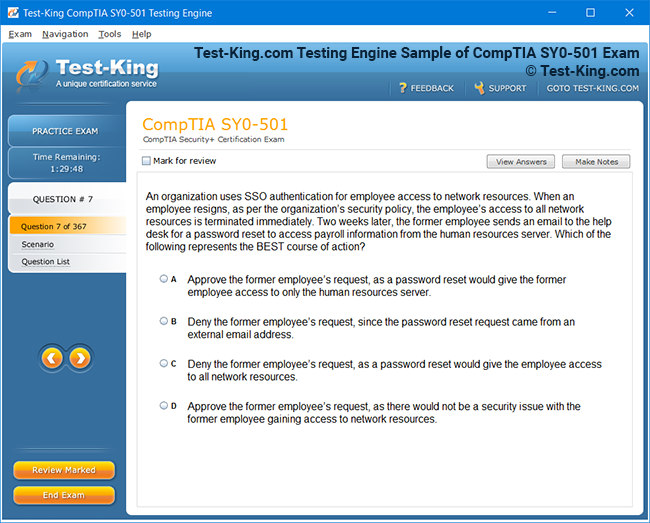
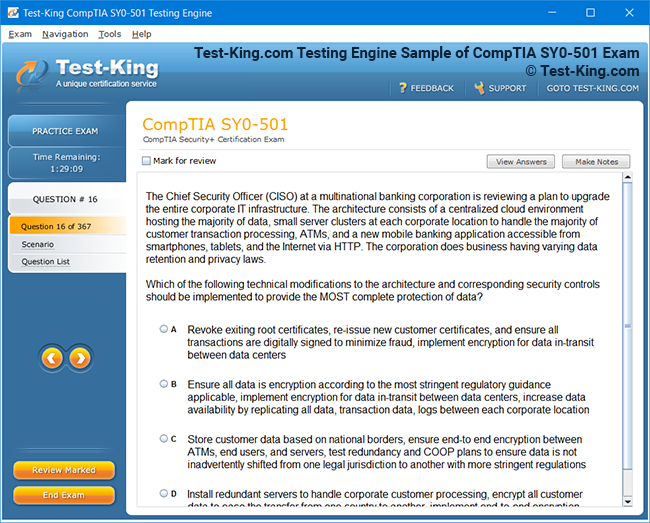
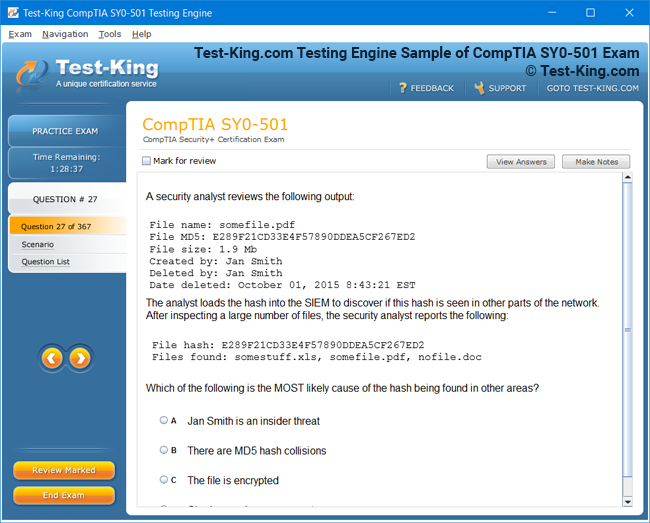
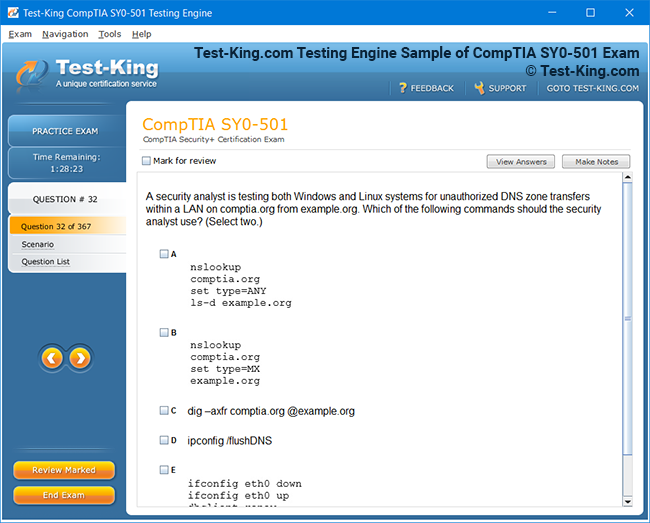
Product Screenshots
Frequently Asked Questions
How can I get the products after purchase?
All products are available for download immediately from your Member's Area. Once you have made the payment, you will be transferred to Member's Area where you can login and download the products you have purchased to your computer.
How long can I use my product? Will it be valid forever?
Test-King products have a validity of 90 days from the date of purchase. This means that any updates to the products, including but not limited to new questions, or updates and changes by our editing team, will be automatically downloaded on to computer to make sure that you get latest exam prep materials during those 90 days.
Can I renew my product if when it's expired?
Yes, when the 90 days of your product validity are over, you have the option of renewing your expired products with a 30% discount. This can be done in your Member's Area.
Please note that you will not be able to use the product after it has expired if you don't renew it.
How often are the questions updated?
We always try to provide the latest pool of questions, Updates in the questions depend on the changes in actual pool of questions by different vendors. As soon as we know about the change in the exam question pool we try our best to update the products as fast as possible.
How many computers I can download Test-King software on?
You can download the Test-King products on the maximum number of 2 (two) computers or devices. If you need to use the software on more than two machines, you can purchase this option separately. Please email support@test-king.com if you need to use more than 5 (five) computers.
What is a PDF Version?
PDF Version is a pdf document of Questions & Answers product. The document file has standart .pdf format, which can be easily read by any pdf reader application like Adobe Acrobat Reader, Foxit Reader, OpenOffice, Google Docs and many others.
Can I purchase PDF Version without the Testing Engine?
PDF Version cannot be purchased separately. It is only available as an add-on to main Question & Answer Testing Engine product.
What operating systems are supported by your Testing Engine software?
Our testing engine is supported by Windows. Andriod and IOS software is currently under development.
Top Splunk Exams
- SPLK-1003 - Splunk Enterprise Certified Admin
- SPLK-3003 - Splunk Core Certified Consultant
- SPLK-1002 - Splunk Core Certified Power User
- SPLK-2002 - Splunk Enterprise Certified Architect
- SPLK-1005 - Splunk Cloud Certified Admin
- SPLK-1001 - Splunk Core Certified User
- SPLK-5001 - Splunk Certified Cybersecurity Defense Analyst
- SPLK-5003 - Splunk Certified Cybersecurity Defense Architect
- SPLK-1004 - Splunk Core Certified Advanced Power User
- SPLK-3001 - Splunk Enterprise Security Certified Admin
- SPLK-4001 - Splunk O11y Cloud Certified Metrics User
- SPLK-5002 - Splunk Certified Cybersecurity Defense Engineer
- SPLK-2003 - Splunk SOAR Certified Automation Developer
- SPLK-3002 - Splunk IT Service Intelligence Certified Admin
SPLK-2001 : Practical Tips and Tricks for Passing the Splunk Certified Developer Exam
The Splunk Certified Developer exam, recognized under the code SPLK-2001, is a definitive credential for professionals seeking to validate their ability to create and optimize Splunk solutions. Unlike general knowledge tests, this exam measures practical acumen in developing searches, dashboards, and reports, along with the ability to manage data inputs and understand Splunk's internal architecture. Those preparing for it must be proficient in using Splunk’s query language efficiently and crafting solutions that can process complex datasets. Success in this certification not only reflects a mastery of Splunk development but also demonstrates a professional's ability to translate data insights into actionable strategies, which is increasingly valuable in modern enterprises where data-driven decision-making is paramount.
Understanding the Splunk Certified Developer Exam and Its Importance
Exam takers often wonder about the weight of each topic within the SPLK-2001 assessment. Understanding the distribution of knowledge areas is essential for efficient preparation. The exam predominantly evaluates the creation of searches, knowledge objects, and dashboards, followed by a strong emphasis on using macros, event types, and workflow actions. Additionally, the candidate is expected to demonstrate an understanding of pivot reports and visualizations, reflecting real-world scenarios where Splunk is leveraged to monitor system behavior, detect anomalies, or analyze operational trends. Familiarity with Splunk’s configuration files and understanding how to tailor them to organizational needs is also critical.
Preparing for the Exam: Foundational Approaches
Before attempting the SPLK-2001 exam, candidates should immerse themselves in a hands-on learning environment. Installing and configuring a personal Splunk instance, either on a virtual machine or cloud environment, offers invaluable experiential learning. This environment allows aspiring developers to experiment with ingesting diverse datasets, building queries, and designing dashboards without the fear of disrupting production systems. Moreover, integrating uncommon data types, such as syslog from niche network devices or JSON logs from less commonly used applications, provides exposure to scenarios that might appear in the exam.
Many candidates underestimate the significance of structured practice. One effective approach is to create a study timetable that alternates between reviewing Splunk documentation and applying those concepts in practical exercises. For example, after studying the intricacies of transaction commands or lookup tables, immediately implementing them in test datasets reinforces both understanding and retention. Another strategy involves simulating real-world problems, such as detecting patterns in log anomalies or correlating disparate events across multiple sources. By approaching the exam content through this lens, candidates move beyond rote memorization and develop problem-solving skills that are directly relevant to the exam and professional environments.
Optimizing Searches and Knowledge Objects
One of the most frequently tested skills in the SPLK-2001 exam involves crafting searches that are both efficient and scalable. A common mistake among candidates is writing verbose queries that achieve the desired results but are suboptimal in performance. Understanding how to leverage Splunk’s indexing and search acceleration features can significantly reduce search times, particularly when dealing with voluminous datasets. Additionally, the use of calculated fields, event types, and tags ensures that searches are not only faster but also reusable, which is a key consideration in enterprise-level Splunk deployments.
Knowledge objects are another pivotal topic for the exam. These objects include saved searches, macros, lookups, and workflow actions that enhance data analysis capabilities. Candidates should focus on comprehending when and how to employ these objects efficiently. For instance, macros allow the reuse of complex search fragments, promoting consistency and reducing errors in repetitive queries. Lookups, on the other hand, facilitate enriching raw event data with external information, such as user roles or geographic identifiers, which can be critical for analytics. Familiarity with these tools empowers candidates to build dynamic and contextually rich dashboards, a skill that is frequently evaluated in practical scenarios during the exam.
Designing Dashboards and Visualizations
The ability to design intuitive dashboards is central to the SPLK-2001 exam. Dashboards transform raw data into actionable insights by displaying critical metrics, trends, and anomalies in a visually digestible manner. When preparing for this aspect of the exam, candidates should focus not only on the mechanics of adding panels and charts but also on understanding visualization theory and user experience principles. For example, selecting appropriate chart types for various datasets—like line charts for trends over time, bar charts for categorical comparisons, or single value panels for KPIs—enhances readability and decision-making.
Candidates are often queried on dynamic dashboards, where user input can modify displayed data in real-time. Developing proficiency with tokens, drilldowns, and input controls is essential. This knowledge allows the creation of interactive experiences, where end users can filter data, navigate between reports, or trigger searches directly from the dashboard interface. Such interactivity is not only valuable in practice but also represents a nuanced skill that distinguishes adept Splunk developers from novices. Preparing for these scenarios with hands-on exercises that simulate user interaction can substantially increase confidence during the exam.
Handling Data Inputs and Field Extraction
A crucial component of the SPLK-2001 exam focuses on ingesting and normalizing diverse datasets. Candidates must understand the nuances of adding data inputs from various sources, such as log files, APIs, or streaming telemetry. More than just ingesting data, they should be adept at configuring source types, managing timestamps, and creating field extractions that facilitate meaningful analysis. The challenge often lies in working with unstructured or semi-structured data, where automated field extractions may fail, requiring manual intervention or the use of advanced extraction techniques.
Regular expressions play a significant role in field extraction, allowing precise parsing of raw events into structured formats. While regex can be intricate and sometimes daunting, a clear understanding of its logic helps in designing scalable extraction rules. Candidates should practice creating multiple extractions on test datasets, simulating the complexity they might encounter in real-world applications. Additionally, knowledge of calculated fields and lookups enriches event data further, enabling more sophisticated analysis, which is often evaluated through scenario-based questions in the exam.
Leveraging Advanced Features and Best Practices
Beyond foundational skills, the SPLK-2001 exam also tests candidates on advanced features and best practices that demonstrate proficiency. For instance, understanding workflow actions and event correlation allows developers to create responsive analytics solutions that trigger alerts or link related events dynamically. Knowledge of workflow automation, including using saved searches to populate dashboards or trigger notifications, showcases an ability to integrate Splunk into broader operational processes.
Candidates are also expected to demonstrate a grasp of search optimization strategies, such as using summary indexing or report acceleration, to enhance performance on large-scale data environments. Applying these techniques in practice not only prepares candidates for the exam but also mirrors the real-world expectations of Splunk developers tasked with supporting mission-critical systems. Moreover, attention to naming conventions, documentation of knowledge objects, and adherence to deployment best practices signal a level of professionalism that the certification aims to recognize.
Exam-Day Strategies and Mindset
Approaching the SPLK-2001 exam requires not just technical skill but also strategic thinking and composure. Candidates often benefit from familiarizing themselves with the exam format and time constraints, enabling them to pace their responses effectively. A methodical approach, tackling familiar topics first and allocating extra time to complex scenario-based questions, helps manage stress and maximizes performance. Maintaining a calm mindset, supported by extensive preparation and hands-on practice, is often the differentiator between passing and struggling candidates.
Additionally, it is wise to engage in reflective review sessions before the exam, revisiting challenging topics, and mentally simulating practical scenarios that could appear in the test. This approach reinforces knowledge retention and builds an intuitive understanding of problem-solving within Splunk environments. Developing confidence in one’s ability to navigate searches, dashboards, and data management tasks ultimately ensures that the candidate is prepared to demonstrate expertise without hesitation, which is the ultimate objective of the SPLK-2001 examination.
Deepening Knowledge of Splunk Searches and Queries
The Splunk Certified Developer exam, recognized under the code SPLK-2001, requires not only foundational knowledge but also an intricate understanding of Splunk searches and query construction. Successful candidates are those who can navigate through vast datasets with precision, extracting meaningful insights while maintaining efficiency. At its core, the exam tests the ability to construct searches that are optimized for performance, adaptable to diverse data types, and capable of delivering actionable information in a comprehensible manner. Beyond merely writing queries, candidates must understand how indexing, time constraints, and event types affect search results, particularly when handling high-volume, time-sensitive data streams.
One common challenge is balancing search complexity with performance. Inefficient searches can bog down systems and delay insights, which is why mastering Splunk’s commands and search functions is crucial. Candidates should focus on understanding how to filter and transform raw events, utilize subsearches judiciously, and create reusable patterns that enhance query scalability. Additionally, advanced concepts such as statistical aggregations, time series comparisons, and trend identification often appear in scenario-based questions. Practicing these concepts in a test environment helps developers recognize the subtleties of event correlation and anomaly detection, ensuring they can apply knowledge to real-world situations.
Understanding Knowledge Objects and Their Utility
Knowledge objects in Splunk, including saved searches, macros, lookups, and event types, represent a foundational skill for the SPLK-2001 examination. These objects are not only critical for building efficient workflows but also for maintaining consistency and facilitating collaboration in enterprise environments. A deep comprehension of how each knowledge object functions allows candidates to design searches and dashboards that are modular, reusable, and maintainable. For instance, lookups provide a mechanism to enrich raw event data with external sources, adding context that is indispensable for analytical precision.
Candidates are also expected to understand the intricacies of macros, which encapsulate recurring search logic into reusable fragments. When used judiciously, macros reduce redundancy, promote standardization, and improve overall system performance. Event types, on the other hand, categorize similar patterns of events, enabling effective filtering and reporting. By practicing with these objects in a hands-on environment, candidates develop a sense of how to interconnect multiple knowledge objects, producing scalable solutions that can adapt to complex operational datasets. Scenario-based exercises often test this capability, emphasizing real-world problem-solving rather than theoretical knowledge alone.
Designing Interactive Dashboards for Data Insights
A pivotal skill evaluated in the SPLK-2001 exam is the creation of dashboards that translate intricate data into digestible and actionable insights. Dashboards serve as the visual interface for end-users, and candidates must demonstrate an ability to design layouts that balance aesthetics, clarity, and functionality. This involves selecting appropriate visualization types based on data characteristics, configuring panels to highlight key metrics, and incorporating interactivity through filters, inputs, and drilldowns. For instance, single value panels are ideal for displaying critical KPIs, while line and area charts provide temporal trend analysis. Candidates who understand the principles of human perception, cognitive load, and visual hierarchy are better equipped to create dashboards that are intuitive and actionable.
Interactive dashboards present a particular challenge, as they require developers to configure input controls, dynamic filters, and tokens that can modify displayed data in real time. Mastery of these features enables users to explore datasets according to their needs, pivoting between views and uncovering patterns without altering the underlying queries. Practicing with dynamic dashboards is crucial, as the exam often assesses a candidate’s ability to construct responsive visualizations that handle user interaction gracefully. Realistic simulations, including drilldowns that navigate to related searches or trigger alerts, cultivate both confidence and competence in this domain.
Managing Data Inputs and Event Processing
The SPLK-2001 exam places substantial emphasis on the candidate’s ability to manage data ingestion and field extraction across varied sources. Understanding how to configure data inputs, whether from flat files, APIs, syslogs, or specialized telemetry streams, is a prerequisite for effective Splunk development. Candidates must also grasp the nuances of source type definitions, timestamp parsing, and event breaking, ensuring that data is structured appropriately for downstream analysis. The capacity to handle heterogeneous and unstructured datasets is often tested, as modern operational environments rarely provide clean or uniform logs.
Field extraction, a frequently challenging topic, requires a combination of analytical skill and technical precision. Candidates should practice applying regular expressions and other extraction techniques to capture meaningful fields from complex event structures. Calculated fields and lookups further enhance data richness, allowing additional context to be associated with raw events. By creating test datasets with irregular patterns or unusual formats, candidates gain practical experience that mirrors the challenges posed in the exam. This hands-on familiarity ensures readiness when faced with scenario-based questions requiring sophisticated event processing and enrichment.
Leveraging Advanced Analytics and Transforming Insights
Beyond core searching and dashboarding, the SPLK-2001 exam evaluates advanced analytic skills that enable candidates to derive actionable intelligence from raw datasets. This includes applying statistical functions, evaluating time-series data, and performing event correlation to detect patterns or anomalies. Proficiency in these areas allows developers to construct solutions that anticipate operational issues, monitor trends proactively, and support strategic decision-making. Candidates should explore complex examples, such as identifying unusual spikes in network traffic or correlating disparate events across multiple servers, to build a repertoire of analytical approaches.
Workflow automation is another key competency, as it demonstrates a candidate’s ability to integrate Splunk into broader operational processes. Using saved searches to trigger alerts, populate dashboards, or initiate scripted actions exemplifies practical application of knowledge. Candidates who understand the strategic deployment of these features, including the optimization of searches for efficiency and resource conservation, exhibit the kind of expertise that the certification is designed to recognize. Developing habits such as documenting knowledge objects, adhering to naming conventions, and standardizing search logic further signals professionalism and prepares candidates for enterprise-level responsibilities.
Search Optimization and Performance Considerations
A nuanced understanding of search optimization is critical for the SPLK-2001 examination. Searches that function correctly but inefficiently can undermine system performance, particularly in environments with massive event volumes. Candidates should practice constructing queries that minimize resource consumption while maintaining accuracy, leveraging techniques such as search acceleration, summary indexing, and judicious use of subsearches. Understanding how indexing, event time ranges, and data partitioning affect search speed provides a competitive advantage in both exam performance and real-world application.
Performance-oriented design also encompasses the strategic use of knowledge objects. Saved searches and macros, when employed thoughtfully, can reduce repetition and enhance maintainability. Event types and tags further refine search focus, improving retrieval speed and usability. Candidates who internalize these principles develop an intuitive sense of how to balance query complexity with operational efficiency. Regularly testing searches against large-scale datasets in practice environments reinforces these skills, ensuring that they are second nature during the exam.
Best Practices for Splunk Development
Beyond individual technical skills, the SPLK-2001 exam evaluates candidates on their adherence to best practices, which underpin scalable and maintainable solutions. Clear naming conventions for knowledge objects, structured documentation, and consistent workflow design are integral to professional Splunk development. Candidates should cultivate habits such as maintaining reusable query fragments, organizing dashboards logically, and documenting field extractions for future reference. These practices not only facilitate exam success but also mirror the expectations of enterprise environments where multiple developers may interact with the same datasets and solutions.
An often-overlooked aspect is understanding the operational implications of Splunk design choices. For example, frequent or complex searches may strain system resources, while poorly structured dashboards can confuse end-users. Candidates who anticipate these challenges and design with efficiency, clarity, and sustainability in mind demonstrate the level of maturity and foresight that the SPLK-2001 certification seeks to validate. Engaging in practical exercises that simulate operational challenges, such as troubleshooting delayed searches or resolving conflicting knowledge objects, further prepares candidates for both the exam and real-world application.
Mindset and Strategic Preparation
Approaching the SPLK-2001 exam successfully requires a disciplined and methodical mindset. Candidates benefit from creating structured study plans that balance theoretical knowledge with extensive hands-on practice. Immersing oneself in realistic scenarios, such as troubleshooting multi-source log data or designing dashboards for specific operational requirements, fosters analytical agility. Additionally, familiarizing oneself with the exam’s time constraints, question formats, and scenario types allows for strategic pacing during the test, ensuring that complex tasks are approached methodically rather than rushed.
Confidence is built through repetition and reflection. Reviewing challenging topics, revisiting problem-solving exercises, and mentally simulating exam scenarios consolidates knowledge and promotes intuitive understanding. Maintaining composure and focus under timed conditions ensures that candidates can apply their skills effectively, navigating searches, knowledge objects, dashboards, and data inputs with assurance. The combination of technical mastery, strategic preparation, and disciplined mindset ultimately equips candidates to meet the rigorous demands of the SPLK-2001 certification.
Mastering Complex Searches and SPL Techniques
Achieving success in the Splunk Certified Developer exam, identified as SPLK-2001, demands a profound understanding of search logic and the intricacies of Splunk Processing Language. The exam evaluates not only the ability to write functional queries but also the capacity to optimize them for large and complex datasets. Candidates are expected to understand the nuances of search behavior, such as event ordering, time range specifications, and the performance implications of various commands. Mastery of subsearches, joins, and statistical transformations distinguishes proficient developers from those who rely solely on basic commands.
An often overlooked aspect is the strategic use of conditional logic and evaluation functions within searches. The SPLK-2001 examination frequently presents scenarios where candidates must filter and manipulate event data based on multiple criteria. Developing fluency in these constructs allows developers to extract insights efficiently while minimizing computational overhead. Practicing with diverse datasets, including logs with inconsistent formatting, nested structures, or uncommon timestamp configurations, prepares candidates for the practical challenges they may encounter. Such experiential learning reinforces both technical skill and analytical reasoning.
Harnessing Knowledge Objects for Efficiency
Knowledge objects serve as the backbone of reusable and maintainable Splunk solutions. Saved searches, macros, lookups, workflow actions, and event types allow developers to standardize operations, enrich data context, and streamline analytical processes. For the SPLK-2001 exam, candidates must demonstrate not only familiarity with these objects but also an understanding of when and how to deploy them to maximize efficiency. For instance, lookups facilitate the augmentation of event data with external datasets, enabling more insightful analysis, while macros consolidate recurring search patterns, reducing redundancy and errors.
Event types play a pivotal role in categorizing events that share common characteristics. Their proper utilization allows for consistent reporting, efficient filtering, and enhanced dashboard functionality. Candidates should focus on linking multiple knowledge objects in practical exercises, simulating enterprise scenarios where searches, dashboards, and reports interconnect. This interconnectedness mirrors real-world requirements, where operational analytics depend on both structured and dynamic data. Mastery of these relationships ensures that candidates can design robust solutions that are scalable and adaptable.
Creating Intuitive Dashboards and Visualizations
A hallmark of proficient Splunk developers is the ability to convert complex datasets into accessible and actionable visual representations. The SPLK-2001 exam assesses candidates on their skill in crafting dashboards that are both informative and user-centric. Effective dashboards employ visualization strategies that align with the nature of the data and the objectives of the end-user. Line charts reveal temporal patterns, bar and column charts facilitate categorical comparisons, and single-value indicators highlight critical metrics. Understanding visual hierarchy, cognitive load, and color theory further enhances the interpretability and impact of dashboards.
Dynamic and interactive dashboards are a frequent focus of the exam. Developers are required to configure inputs, filters, and drilldowns, enabling end-users to manipulate views, explore datasets, and access detailed information seamlessly. This interactivity requires a nuanced understanding of tokens, event-triggered actions, and panel dependencies. Practicing with scenarios that simulate real-world analytical needs—such as monitoring operational anomalies, correlating user behavior, or tracking system performance—enhances both the depth and applicability of skills. Candidates who develop dashboards that balance functionality with clarity demonstrate the level of proficiency the exam seeks to validate.
Managing Diverse Data Inputs
Ingesting and normalizing diverse datasets is a core competency for the SPLK-2001 exam. Candidates must be adept at configuring data inputs from myriad sources, including log files, APIs, telemetry streams, and less conventional formats. Equally important is the capacity to define source types, parse timestamps, and manage event boundaries to ensure that data is structured correctly for analysis. Handling irregular or unstructured datasets, which often contain missing values, nested structures, or inconsistent formatting, is an essential skill that reflects the complexity of real-world environments.
Field extraction forms the foundation of meaningful analysis. Candidates should practice extracting fields using advanced techniques, including regular expressions and calculated fields, to convert raw events into structured and contextually enriched datasets. Lookups further enhance event data, allowing additional attributes to be associated with records for deeper insights. Simulating challenging data ingestion scenarios in practice environments equips candidates with the problem-solving agility necessary for the exam. Experiential familiarity with these processes ensures confidence when confronted with scenario-based questions requiring precision and analytical dexterity.
Advanced Analytics and Data Correlation
The SPLK-2001 exam evaluates the ability to apply advanced analytics to derive actionable insights. Candidates must be proficient in statistical functions, temporal trend analysis, event correlation, and anomaly detection. Such capabilities enable developers to identify patterns that are not immediately apparent, anticipate operational issues, and support strategic decision-making. Working with complex examples, such as correlating multi-source logs to detect security breaches or analyzing irregular spikes in operational metrics, cultivates analytical acumen and prepares candidates for practical problem-solving scenarios.
Workflow automation, facilitated by saved searches and knowledge objects, demonstrates a developer’s ability to integrate Splunk into operational processes effectively. Creating automated workflows that trigger alerts, populate dashboards, or initiate downstream actions reflects a professional level of competency. Exam preparation should include exercises where searches are optimized for performance and accuracy while integrated into broader automated processes. This approach reinforces both technical expertise and strategic thinking, qualities that distinguish candidates capable of delivering high-value solutions.
Search Optimization and Resource Efficiency
Optimizing searches for efficiency is a nuanced skill that significantly impacts both exam performance and real-world application. Searches must be designed to deliver results swiftly while conserving system resources, particularly when dealing with high-volume datasets. Candidates should practice techniques such as search acceleration, summary indexing, and judicious use of subsearches to minimize computational strain. Understanding how indexing strategies, event time constraints, and data segmentation influence search speed is essential for achieving performance goals.
Knowledge objects contribute significantly to optimization. Reusing macros and saved searches reduces redundancy, while properly categorizing events with types and tags improves search focus and usability. Regular practice against large datasets ensures candidates develop an intuitive sense of balancing complexity with efficiency. This skill is critical for SPLK-2001 candidates, as scenario-based questions often test not only the correctness of queries but also their operational sustainability and responsiveness under realistic conditions.
Professional Practices in Splunk Development
Proficiency in Splunk development extends beyond technical skill to include adherence to professional practices that ensure maintainable, scalable, and comprehensible solutions. Candidates are expected to follow structured naming conventions, document knowledge objects thoroughly, and maintain consistency across searches, dashboards, and reports. These practices facilitate collaboration, reduce errors, and enhance the interpretability of complex solutions. Developing a habit of systematic organization in a hands-on environment cultivates habits that resonate with the expectations of enterprise deployments.
Operational awareness is another dimension of professional competency. Developers must anticipate the impact of search frequency, query complexity, and dashboard design on system performance. Scenario-based exercises, such as simulating delayed searches or resolving conflicts among overlapping knowledge objects, provide experiential learning that reinforces these considerations. Candidates who integrate operational foresight with technical mastery demonstrate readiness not only for the SPLK-2001 exam but also for real-world responsibilities where efficiency, clarity, and reliability are paramount.
Exam Strategies and Cognitive Preparedness
Preparation for the SPLK-2001 examination is as much about cognitive readiness as it is about technical knowledge. Candidates benefit from structured study routines that blend theoretical learning with extensive hands-on practice. Engaging with realistic scenarios—ranging from multi-source log correlation to interactive dashboard creation—enhances analytical agility and reinforces learning retention. Familiarity with the exam format, question styles, and time constraints allows candidates to manage pacing effectively, ensuring that complex tasks are approached methodically rather than hastily.
Building confidence through repetition, review, and mental simulation is essential. Revisiting challenging topics, performing reflective exercises, and visualizing practical applications consolidate understanding and foster intuitive problem-solving. Maintaining composure during the exam, supported by disciplined preparation, enables candidates to navigate searches, knowledge objects, dashboards, and data inputs with assurance. This holistic approach to preparation ensures that candidates demonstrate both technical proficiency and strategic acumen, qualities central to achieving success in the SPLK-2001 examination.
Enhancing Proficiency in SPL Queries and Search Optimization
The SPLK-2001 examination evaluates candidates on their ability to manipulate and refine Splunk searches with precision and efficiency. Success requires a deep understanding of the Splunk Processing Language, not merely for basic data retrieval but for constructing queries that maximize performance while handling complex datasets. The exam often challenges developers to optimize searches for speed, accuracy, and scalability, requiring awareness of indexing, event ordering, and time-range constraints. Beyond mechanical command usage, mastery involves understanding how different functions interact and the implications of search design on both system resources and data integrity.
Many candidates encounter difficulties when applying statistical functions and conditional logic to real-world scenarios. The exam frequently presents multifaceted problems, such as identifying anomalies across multiple systems or correlating events from diverse sources, which necessitate advanced search techniques. Practicing with datasets that include irregular timestamps, nested structures, or inconsistent field formats strengthens analytical intuition and prepares developers for the nuanced challenges they may face during testing. Developing fluency in these advanced search techniques ensures that candidates can address both straightforward and intricate scenarios with confidence.
Utilizing Knowledge Objects for Scalable Solutions
Knowledge objects, including saved searches, macros, lookups, event types, and workflow actions, form the foundation of efficient and reusable Splunk implementations. The SPLK-2001 exam emphasizes the candidate's capacity to use these objects not only correctly but strategically, integrating them to construct scalable and maintainable solutions. Macros, for instance, encapsulate recurring search fragments, allowing for consistent and error-resistant workflows. Lookups enrich raw event data with external contextual information, enhancing analytical depth and providing actionable insights that would otherwise remain obscured.
Event types serve as an organizational framework, categorizing events with shared characteristics to facilitate efficient filtering and reporting. Workflow actions enable dynamic interaction with events, such as linking dashboards or triggering secondary searches, enhancing responsiveness in operational scenarios. Practicing the integration of multiple knowledge objects in realistic environments cultivates an understanding of interdependencies and best practices, ensuring that candidates can design robust solutions capable of adapting to complex enterprise requirements. Such exercises prepare candidates for the practical applications of these objects in both the exam and real-world operational contexts.
Designing Effective Dashboards and Visual Analytics
The ability to transform raw data into compelling visual narratives is a central competency evaluated in the SPLK-2001 examination. Dashboards are the primary interface through which users engage with insights, and candidates are expected to demonstrate proficiency in designing layouts that are both functional and intuitive. Understanding visualization principles, including the appropriate selection of chart types, the use of color, and the organization of panels, enhances the interpretability of data and supports informed decision-making. Line charts, bar graphs, area charts, and single-value panels each serve distinct purposes, and selecting the correct visualization for each dataset is essential for clarity and impact.
Interactivity is another critical aspect, with dashboards often requiring dynamic inputs, filters, and drilldowns. Candidates must be adept at configuring tokens, input controls, and panel dependencies to allow end-users to explore data from multiple perspectives without compromising system performance. Engaging with scenarios that simulate operational monitoring, anomaly detection, and multi-source correlation strengthens the candidate’s capacity to deliver dashboards that are both insightful and user-centric. Practical experience in creating dashboards that respond dynamically to user interaction ensures readiness for the types of questions encountered in the SPLK-2001 exam.
Ingesting and Normalizing Diverse Data Sources
Handling heterogeneous data inputs is a significant focus of the SPLK-2001 exam. Candidates are required to demonstrate competence in ingesting data from various sources, including flat files, APIs, telemetry streams, and system logs. Proper configuration of source types, timestamp recognition, and event boundaries is essential to ensure data integrity and analytical accuracy. The capacity to manage unstructured or semi-structured datasets, which often contain irregular formatting or incomplete fields, is particularly relevant, reflecting the complexity of real-world operational environments.
Field extraction is integral to making ingested data analytically useful. Techniques such as regular expressions, calculated fields, and lookups enable developers to transform raw events into structured datasets enriched with contextual information. Practicing these techniques with diverse and challenging datasets equips candidates with the ability to address complex scenarios during the exam. Exposure to unusual data patterns and edge cases fosters adaptability, ensuring that candidates can manage real-world operational data with precision and insight.
Applying Advanced Analytics and Event Correlation
Beyond fundamental search and dashboarding skills, the SPLK-2001 examination assesses a candidate’s ability to conduct advanced analytics and correlate events effectively. Statistical functions, time-series analysis, and pattern recognition are central to detecting anomalies and deriving actionable insights. Candidates must be able to analyze complex data interactions, such as identifying unusual activity across multiple systems, predicting operational trends, or detecting emergent issues in real time. Engaging with such scenarios in practice enhances analytical reasoning and fosters a strategic approach to problem-solving.
Workflow automation exemplifies the practical application of advanced analytics in operational contexts. Saved searches, when configured to trigger alerts or populate dashboards automatically, demonstrate the ability to integrate analytical insights into business processes. Understanding the balance between analytical depth and system efficiency is essential, as complex queries can strain resources if not optimized. Candidates who practice optimizing workflows while maintaining accuracy develop the agility to tackle scenario-based questions with both technical proficiency and operational foresight.
Optimizing Performance and System Efficiency
Efficient search construction and resource management are critical elements of the SPLK-2001 examination. Searches must deliver accurate results promptly while minimizing the impact on system performance, particularly in high-volume environments. Candidates should practice techniques such as search acceleration, summary indexing, and strategic use of subsearches to achieve these objectives. Understanding how indexing strategies, event segmentation, and time-range specifications affect performance ensures that candidates can design queries that are both effective and sustainable.
Knowledge objects contribute significantly to operational efficiency. Reusable macros and saved searches reduce redundancy and improve maintainability, while event types and tags provide focus and structure to searches, enhancing clarity and speed. Practicing these optimization techniques with complex datasets allows candidates to develop an intuitive sense of balancing search complexity with performance considerations. Mastery of these principles ensures that candidates can respond adeptly to scenario-based questions that test both technical skill and operational efficiency.
Professional Practices and Deployment Readiness
Competence in Splunk development extends beyond technical skill to include professional practices that support maintainable, scalable, and collaborative solutions. Structured naming conventions, thorough documentation of knowledge objects, and consistent organizational practices ensure that searches, dashboards, and reports are accessible and interpretable by other developers and stakeholders. Engaging in disciplined practices during preparation familiarizes candidates with enterprise-level expectations and reinforces habits that enhance both exam performance and practical application.
Operational awareness complements technical proficiency. Candidates should anticipate the consequences of search design, query frequency, and dashboard complexity on system performance. Practical exercises that simulate troubleshooting delayed searches, resolving conflicts among knowledge objects, or handling high-volume data ingestion cultivate a holistic understanding of operational considerations. Such experiential learning ensures that candidates can integrate technical expertise with strategic foresight, aligning with the expectations of both the SPLK-2001 examination and real-world professional environments.
Cognitive Preparedness and Exam Strategy
Success in the SPLK-2001 examination is grounded not only in technical mastery but also in strategic cognitive preparedness. Structured study plans that alternate between theoretical learning and practical application foster comprehensive understanding and skill retention. Engaging with realistic scenarios—ranging from multi-source data correlation to interactive dashboard creation—enhances analytical agility and prepares candidates for scenario-based questions. Familiarity with the exam format, time constraints, and question styles allows candidates to manage pacing effectively, ensuring that complex tasks are approached methodically.
Confidence emerges from repetition, reflective practice, and mental rehearsal. Revisiting challenging topics, simulating practical applications, and reviewing problem-solving approaches consolidate knowledge and cultivate intuitive understanding. Maintaining composure and focus during the examination, supported by extensive preparation and hands-on practice, allows candidates to navigate searches, dashboards, knowledge objects, and data inputs with assurance. This comprehensive approach equips candidates with both the technical proficiency and strategic insight necessary to excel in the SPLK-2001 assessment.
Advancing Expertise in SPL Queries and Search Design
The SPLK-2001 examination requires candidates to demonstrate sophisticated command over Splunk searches, emphasizing both functionality and efficiency. Proficiency involves understanding how Splunk Processing Language executes queries, how event ordering and indexing influence results, and how to optimize searches for large-scale, high-velocity datasets. Candidates must be capable of crafting searches that are not only accurate but also resource-efficient, particularly when confronted with operational data that is voluminous and multifaceted. Mastery involves recognizing the interplay between commands, understanding how subsearches can impact performance, and leveraging statistical transformations to extract meaningful insights.
Complex queries often present candidates with challenges that require conditional logic and dynamic evaluation. In preparation, it is advantageous to experiment with datasets containing inconsistent timestamps, nested fields, or irregular formatting, as these simulate real-world scenarios. Such practice strengthens analytical reasoning and reinforces the ability to develop scalable solutions under time constraints. Familiarity with advanced SPL functions, including event correlation, anomaly detection, and multi-stage filtering, ensures that candidates can approach both straightforward and intricate scenarios with confidence and precision.
Utilizing Knowledge Objects for Operational Efficiency
Knowledge objects, including saved searches, macros, lookups, event types, and workflow actions, form the cornerstone of scalable Splunk development. Candidates preparing for the SPLK-2001 exam are expected to understand not only how to create these objects but also how to deploy them strategically to maximize efficiency. Macros encapsulate repetitive search logic into reusable fragments, streamlining development and minimizing errors. Lookups enhance raw event data by integrating external contextual information, adding analytical depth that enables more sophisticated interpretations of system behavior.
Event types provide a structural framework, classifying events with shared attributes for consistent filtering and reporting, while workflow actions introduce interactivity, enabling dashboards to respond dynamically to user input. Practicing with multiple knowledge objects in an integrated environment helps candidates understand dependencies, improve maintainability, and anticipate potential challenges in enterprise-level deployments. This comprehensive approach ensures readiness for scenario-based questions that test practical problem-solving, as well as the creation of reusable, efficient, and robust solutions.
Crafting Intuitive Dashboards and Visual Insights
Effective dashboard design is a critical aspect of the SPLK-2001 examination, as it demonstrates a candidate’s ability to convert complex datasets into actionable insights. Dashboards function as the interface between analytical data and decision-makers, requiring careful consideration of layout, visualization type, and user experience. Line charts, bar charts, area charts, and single-value panels each serve distinct purposes, enabling developers to highlight temporal trends, categorical comparisons, or critical metrics succinctly. Candidates should cultivate a nuanced understanding of visual hierarchy, cognitive load, and color selection to maximize clarity and usability.
Interactivity is an essential component, encompassing dynamic inputs, filters, and drilldowns. Developers must be adept at using tokens, input controls, and panel dependencies to allow end-users to explore datasets from multiple perspectives. Practicing with realistic operational scenarios, such as system monitoring, multi-source log correlation, or anomaly detection, equips candidates to design dashboards that are both insightful and user-centric. Building confidence in interactive dashboard creation ensures that candidates can respond effectively to practical challenges posed in the SPLK-2001 examination.
Managing Diverse Data Inputs and Event Normalization
The ingestion and normalization of heterogeneous datasets are vital competencies for the SPLK-2001 examination. Candidates must be skilled in configuring data inputs from diverse sources, including flat files, APIs, system logs, and telemetry streams. Proper source type definition, timestamp parsing, and event boundary management are crucial to maintaining data integrity and enabling accurate analysis. The ability to handle unstructured or semi-structured data, which may contain incomplete fields or irregular formatting, reflects the complexity encountered in operational environments and is frequently tested in scenario-based questions.
Field extraction transforms raw events into structured, analyzable information. Techniques such as regular expressions, calculated fields, and lookups allow developers to enrich data with contextual attributes, facilitating deeper insights. Practicing extraction with challenging datasets, including irregular or nested structures, enhances problem-solving skills and prepares candidates for real-world applications. By simulating complex ingestion and normalization scenarios, candidates develop the adaptability necessary to address unexpected data anomalies and ensure analytical precision.
Implementing Advanced Analytics and Event Correlation
Advanced analytics and event correlation are central to the SPLK-2001 examination, as they demonstrate the candidate’s ability to derive actionable intelligence from complex datasets. Statistical functions, trend analysis, and pattern recognition enable developers to detect anomalies, predict operational behavior, and identify underlying system issues. Preparing with diverse datasets, such as multi-source logs, security alerts, or operational telemetry, allows candidates to practice correlating events, uncovering subtle patterns, and extracting meaningful insights in a realistic context.
Workflow automation represents the practical application of analytics in operational scenarios. Saved searches can trigger alerts, populate dashboards, or initiate subsequent analytical processes, integrating insights directly into business operations. Candidates should develop an understanding of the balance between query complexity, system performance, and operational utility, ensuring that solutions are both effective and sustainable. Experiential practice with automated workflows enhances confidence and demonstrates the strategic thinking expected of a proficient Splunk developer.
Optimizing Searches for Performance and Resource Efficiency
Search optimization is a nuanced skill essential for both the SPLK-2001 exam and real-world Splunk deployment. Efficient searches deliver accurate results while minimizing computational overhead, particularly when working with high-volume data. Candidates should practice techniques such as search acceleration, summary indexing, and strategic use of subsearches to improve performance without compromising analytical rigor. Understanding the impact of indexing strategies, event segmentation, and temporal constraints ensures that searches are both effective and sustainable.
Knowledge objects significantly contribute to search efficiency. Reusable macros and saved searches reduce redundancy and improve maintainability, while event types and tags provide clarity and focus, enhancing search usability. Candidates should practice applying optimization techniques to large and complex datasets, fostering an intuitive understanding of balancing performance with query complexity. Mastery of these principles prepares candidates for scenario-based questions that assess both technical skill and operational judgment.
Professional Practices in Splunk Development
Proficiency in Splunk development extends beyond technical capability to encompass professional practices that promote maintainable, scalable, and collaborative solutions. Structured naming conventions, comprehensive documentation of knowledge objects, and consistent organization of searches, dashboards, and reports facilitate collaboration and reduce the likelihood of errors. Developing these practices during preparation instills habits that align with enterprise expectations and enhance both exam readiness and practical application.
Operational awareness complements technical proficiency. Candidates must anticipate the impact of search frequency, query complexity, and dashboard design on system performance. Hands-on exercises simulating high-volume data ingestion, troubleshooting delayed searches, and resolving conflicts among knowledge objects cultivate holistic understanding. By integrating technical mastery with operational foresight, candidates demonstrate the capability to design solutions that are both robust and efficient, reflecting the level of expertise recognized by the SPLK-2001 examination.
Exam Readiness and Cognitive Strategy
Success in the SPLK-2001 exam requires strategic preparation, balancing technical skill with cognitive readiness. Structured study plans that combine theoretical review with hands-on practice enhance knowledge retention and analytical agility. Engaging with realistic scenarios—such as multi-source log correlation, interactive dashboards, and automated workflows—prepares candidates for the exam’s scenario-based questions. Familiarity with time constraints, question formats, and practical challenges enables methodical pacing, reducing errors and stress during testing.
Confidence develops through repetition, reflective review, and mental simulation of practical scenarios. Revisiting difficult topics, practicing complex data manipulations, and reviewing problem-solving approaches consolidate knowledge and foster intuitive understanding. Maintaining focus and composure during the examination, supported by disciplined preparation, allows candidates to navigate searches, knowledge objects, dashboards, and data inputs with proficiency. This comprehensive approach equips candidates to meet the rigorous demands of the SPLK-2001 exam, demonstrating both technical expertise and operational acumen.
Mastery of SPL Queries and Advanced Search Techniques
The SPLK-2001 examination requires candidates to demonstrate comprehensive expertise in constructing and refining Splunk searches. Mastery goes beyond the mere ability to retrieve data, demanding efficiency, precision, and adaptability when managing high-volume, complex datasets. Candidates must understand how Splunk Processing Language interprets commands, how event ordering and time ranges affect search outcomes, and how to optimize searches to minimize computational load. Advanced skills include employing conditional logic, statistical transformations, and subsearches judiciously, ensuring both accuracy and system efficiency.
Developers often face scenarios that require sophisticated problem-solving, such as correlating events across multiple systems, detecting anomalies, or identifying operational trends hidden within noisy data streams. Practicing with diverse datasets that contain irregular timestamps, nested fields, or non-standard formats fosters analytical dexterity and prepares candidates for the nuanced challenges presented in the exam. Immersing oneself in these complex scenarios enables a candidate to anticipate complications, streamline queries, and execute solutions with both speed and precision.
Leveraging Knowledge Objects for Scalable Analytics
Knowledge objects, including macros, saved searches, lookups, workflow actions, and event types, are critical to efficient Splunk development. The SPLK-2001 exam assesses a candidate’s ability to not only create these objects but also implement them in a strategic manner to ensure scalability and maintainability. Macros consolidate repetitive search logic, facilitating consistency across queries, while lookups enrich raw event data with external context, enhancing analytical depth. Event types categorize recurring patterns, promoting efficient filtering and accurate reporting, and workflow actions introduce interactivity, allowing dynamic navigation within dashboards and searches.
Hands-on practice with these objects in integrated scenarios helps candidates understand dependencies, optimize reuse, and anticipate operational challenges. By simulating real-world conditions, such as complex multi-source log analysis or automated alerting workflows, candidates gain experience in designing resilient, modular solutions. This experiential approach ensures readiness for scenario-based questions and underscores the ability to construct Splunk solutions that are robust, maintainable, and operationally efficient.
Crafting Intuitive Dashboards and Interactive Visualizations
A central aspect of the SPLK-2001 exam is the ability to translate raw data into insightful visual representations through dashboards. These dashboards serve as the interface between data and decision-makers, necessitating careful design consideration. Candidates are evaluated on their ability to select appropriate chart types for varying data, arrange panels for readability, and employ visual hierarchy to communicate insights effectively. Line charts highlight temporal patterns, bar charts facilitate categorical comparisons, area charts illustrate cumulative trends, and single-value panels emphasize key performance indicators. An understanding of cognitive load and color theory enhances dashboard usability and decision-making impact.
Interactive dashboards require advanced proficiency in configuring tokens, filters, and drilldowns. Candidates must ensure that dashboards respond dynamically to user input, allowing exploration of datasets without compromising performance. Practical exercises involving operational monitoring, anomaly detection, or multi-system correlation reinforce skills in creating dashboards that are both functional and engaging. Developing this capability enables candidates to craft visualizations that are not only visually compelling but also analytically potent, demonstrating the level of expertise required for the SPLK-2001 certification.
Managing Diverse Data Inputs and Event Normalization
Handling heterogeneous data inputs is a critical skill for SPLK-2001 candidates. They must be adept at ingesting data from multiple sources, including APIs, telemetry streams, system logs, and flat files, while ensuring proper source type configuration and timestamp recognition. Accurate event parsing and boundary definition are essential for creating datasets that support meaningful analysis. Candidates must also navigate the challenges of unstructured or semi-structured data, which frequently contain irregular fields, missing values, or nested structures, reflecting the complex environments encountered in operational contexts.
Field extraction is a vital component in converting raw events into structured datasets. Techniques such as regular expressions, calculated fields, and lookups allow developers to enrich data with contextual attributes, creating actionable intelligence. Practicing with complex and irregular datasets hones the ability to anticipate anomalies, address inconsistencies, and maintain analytical accuracy. These skills prepare candidates to manage data ingestion challenges effectively during the examination and in real-world Splunk deployments, ensuring the reliability and utility of their analytical outputs.
Advanced Analytics and Event Correlation
The SPLK-2001 exam evaluates candidates on their capacity to implement advanced analytics and correlate events across multiple data streams. Statistical analysis, trend detection, anomaly identification, and pattern recognition are central to deriving actionable insights. Candidates must be proficient in combining diverse datasets to detect operational irregularities, predict emerging trends, and identify potential system failures. Hands-on practice with complex scenarios, such as multi-source log aggregation or performance anomaly detection, strengthens analytical acumen and cultivates strategic problem-solving abilities.
Workflow automation integrates these analytics into operational processes. Saved searches can be configured to trigger alerts, populate dashboards, or initiate further automated procedures, demonstrating the practical application of analytic results. Candidates must balance query complexity with system performance to ensure sustainable solutions. Experiential familiarity with workflow creation, optimization, and troubleshooting prepares candidates to implement end-to-end solutions efficiently and to respond to scenario-based challenges within the SPLK-2001 exam framework.
Search Optimization and Operational Efficiency
Efficient search construction is crucial for both exam success and practical deployment. The SPLK-2001 exam tests candidates’ ability to produce searches that deliver accurate results with minimal system strain. Techniques such as search acceleration, summary indexing, and judicious subsearch usage are essential for optimizing performance. Candidates must understand how indexing strategies, time constraints, and event segmentation affect execution speed and resource consumption. Practicing with large datasets ensures that efficiency considerations become intuitive, allowing developers to construct high-performing searches under realistic operational conditions.
Knowledge objects contribute to operational efficiency by reducing redundancy and enhancing maintainability. Macros, saved searches, and properly defined event types streamline repetitive tasks, while tags provide clarity and structure, improving search focus and usability. Candidates who integrate optimization techniques into practical exercises develop an instinctive understanding of balancing complexity and performance. This proficiency ensures readiness for scenario-based questions that evaluate both technical capability and operational judgment, key elements of the SPLK-2001 certification.
Professional Practices and Enterprise Readiness
Splunk development extends beyond technical execution to include professional practices that promote maintainable, scalable, and collaborative solutions. Structured naming conventions, thorough documentation, and consistent organization of searches, dashboards, and reports facilitate team collaboration and reduce errors. Candidates who cultivate these practices during preparation demonstrate professionalism and operational foresight, aligning with enterprise expectations. Simulation exercises, including multi-developer environments and large-scale data management, reinforce these habits and enhance readiness for both the SPLK-2001 exam and real-world responsibilities.
Operational awareness complements technical mastery. Candidates should anticipate the impact of search frequency, dashboard complexity, and workflow automation on system performance. Simulating high-volume data ingestion, troubleshooting delayed searches, and resolving conflicts among knowledge objects develops a holistic understanding of operational challenges. Integrating technical skill with strategic foresight ensures candidates can deliver solutions that are robust, efficient, and maintainable in enterprise environments.
Cognitive Strategy and Exam Preparation
Effective preparation for the SPLK-2001 exam involves both technical study and cognitive strategy. Candidates benefit from structured routines that blend theory with extensive hands-on practice. Working with realistic scenarios, such as multi-source log correlation, interactive dashboards, and automated workflows, fosters analytical agility and readiness for scenario-based questions. Familiarity with time constraints, question formats, and practical challenges enables candidates to pace themselves methodically during the exam, reducing errors and enhancing performance.
Confidence is developed through repetition, reflective review, and mental simulation. Revisiting difficult topics, practicing complex queries, and reviewing problem-solving approaches consolidate knowledge and foster intuitive understanding. Maintaining focus and composure during testing allows candidates to navigate searches, knowledge objects, dashboards, and data inputs effectively. This holistic approach combines technical mastery with cognitive preparedness, ensuring candidates are equipped to demonstrate both expertise and strategic insight in the SPLK-2001 examination.
Conclusion
Achieving the Splunk Certified Developer certification requires a combination of technical proficiency, strategic thinking, and disciplined preparation. Mastery of searches, knowledge objects, dashboards, data ingestion, advanced analytics, and optimization techniques is essential to navigate the SPLK-2001 exam successfully. Equally important is the adoption of professional practices and cognitive strategies that enhance efficiency, maintainability, and operational readiness. By immersing oneself in hands-on exercises, simulating real-world scenarios, and consistently reviewing challenging concepts, candidates cultivate the expertise and confidence necessary to excel. The SPLK-2001 certification ultimately signifies a developer’s ability to translate complex data into actionable insights, demonstrating both technical acumen and strategic value in dynamic operational environments.