

Exam Code: SPLK-2003
Exam Name: Splunk SOAR Certified Automation Developer
Certification Provider: Splunk
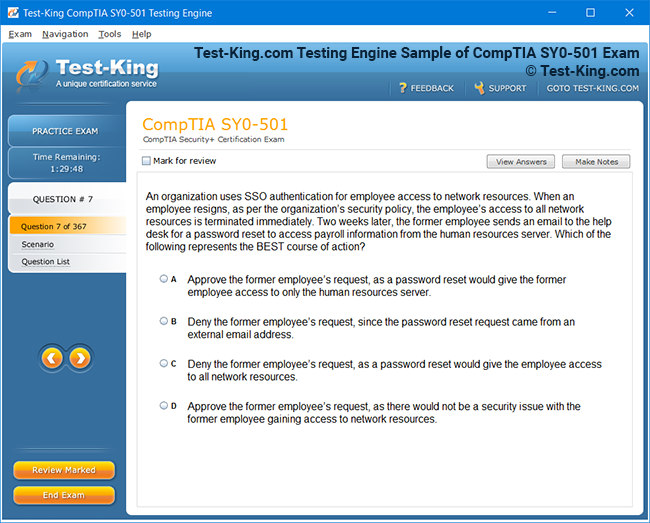
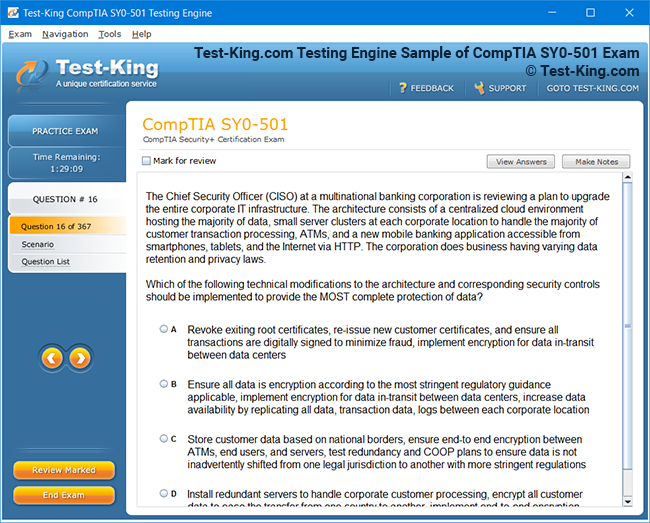
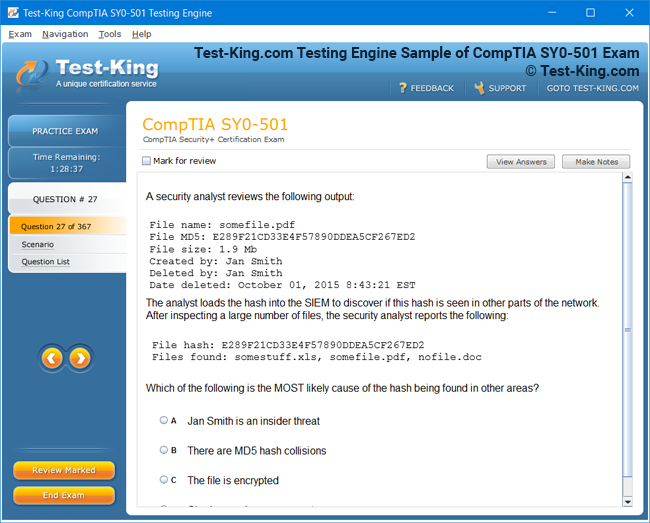
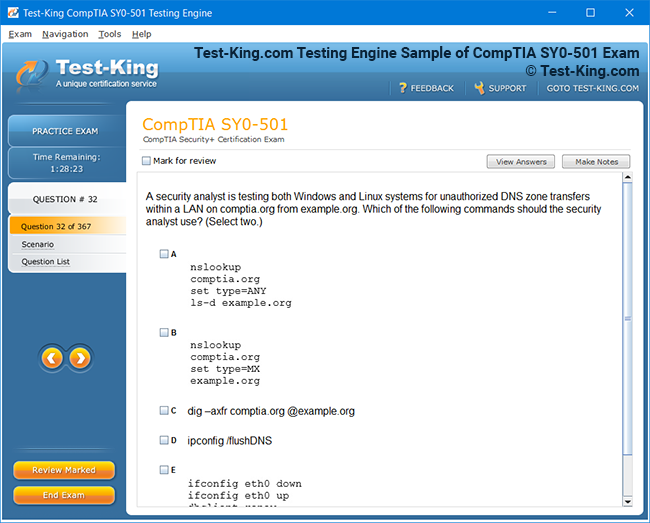
Product Screenshots
Frequently Asked Questions
How can I get the products after purchase?
All products are available for download immediately from your Member's Area. Once you have made the payment, you will be transferred to Member's Area where you can login and download the products you have purchased to your computer.
How long can I use my product? Will it be valid forever?
Test-King products have a validity of 90 days from the date of purchase. This means that any updates to the products, including but not limited to new questions, or updates and changes by our editing team, will be automatically downloaded on to computer to make sure that you get latest exam prep materials during those 90 days.
Can I renew my product if when it's expired?
Yes, when the 90 days of your product validity are over, you have the option of renewing your expired products with a 30% discount. This can be done in your Member's Area.
Please note that you will not be able to use the product after it has expired if you don't renew it.
How often are the questions updated?
We always try to provide the latest pool of questions, Updates in the questions depend on the changes in actual pool of questions by different vendors. As soon as we know about the change in the exam question pool we try our best to update the products as fast as possible.
How many computers I can download Test-King software on?
You can download the Test-King products on the maximum number of 2 (two) computers or devices. If you need to use the software on more than two machines, you can purchase this option separately. Please email support@test-king.com if you need to use more than 5 (five) computers.
What is a PDF Version?
PDF Version is a pdf document of Questions & Answers product. The document file has standart .pdf format, which can be easily read by any pdf reader application like Adobe Acrobat Reader, Foxit Reader, OpenOffice, Google Docs and many others.
Can I purchase PDF Version without the Testing Engine?
PDF Version cannot be purchased separately. It is only available as an add-on to main Question & Answer Testing Engine product.
What operating systems are supported by your Testing Engine software?
Our testing engine is supported by Windows. Andriod and IOS software is currently under development.
Top Splunk Exams
- SPLK-1003 - Splunk Enterprise Certified Admin
- SPLK-3003 - Splunk Core Certified Consultant
- SPLK-1002 - Splunk Core Certified Power User
- SPLK-2002 - Splunk Enterprise Certified Architect
- SPLK-1005 - Splunk Cloud Certified Admin
- SPLK-5001 - Splunk Certified Cybersecurity Defense Analyst
- SPLK-1001 - Splunk Core Certified User
- SPLK-5003 - Splunk Certified Cybersecurity Defense Architect
- SPLK-1004 - Splunk Core Certified Advanced Power User
- SPLK-5002 - Splunk Certified Cybersecurity Defense Engineer
- SPLK-3001 - Splunk Enterprise Security Certified Admin
- SPLK-4001 - Splunk O11y Cloud Certified Metrics User
- SPLK-2003 - Splunk SOAR Certified Automation Developer
- SPLK-3002 - Splunk IT Service Intelligence Certified Admin
Comprehensive Guide to the SPLK-2003 Exam: What to Expect as a Splunk SOAR Certified Automation Developer
The landscape of cybersecurity operations has evolved rapidly, compelling organizations to adopt orchestration and automation tools to manage incident response more efficiently. Splunk SOAR is at the forefront of this revolution, providing security operations teams with the capability to automate repetitive tasks, orchestrate complex workflows, and consolidate diverse security technologies into a cohesive system. Aspiring Splunk SOAR Certified Automation Developers must cultivate a profound understanding of the platform’s core functionalities, automation logic, and integration mechanisms to excel in the SPLK-2003 exam.
Understanding Splunk SOAR and Its Relevance in Automation Development
At its essence, Splunk SOAR enables the creation of playbooks, which are structured sequences of automated actions triggered in response to security events. Each playbook can integrate with multiple third-party tools, perform conditional checks, and facilitate decision-making processes without manual intervention. Understanding the mechanics of playbooks, their triggers, and the interplay between automated actions and human inputs is paramount for candidates aiming to demonstrate expertise in SOAR automation.
Structure and Objectives of the SPLK-2003 Exam
The SPLK-2003 exam is designed to rigorously assess an individual’s capability to develop, configure, and manage automation workflows within the Splunk SOAR environment. Unlike theoretical assessments, this exam emphasizes practical application, requiring candidates to translate conceptual knowledge into functional playbooks and integrations. Test-takers are expected to demonstrate proficiency in designing playbooks that respond accurately to complex security scenarios while adhering to best practices in automation and orchestration.
A notable objective of the exam is evaluating the candidate’s ability to perform incident triage using automated workflows. This involves the orchestration of alerts, enrichment of contextual data, and initiation of appropriate containment actions. Automation developers must understand how to configure connectors, manage API integrations, and sequence actions within playbooks to achieve optimal efficiency. Additionally, the exam assesses knowledge of Splunk SOAR’s architecture, including the roles of servers, workers, and event processors in ensuring seamless operation of automated tasks.
Core Skills and Competencies
Candidates preparing for the SPLK-2003 exam must develop a multifaceted skill set encompassing both technical and analytical proficiencies. Key competencies include the ability to craft modular playbooks capable of executing conditional logic, loops, and branching sequences. Mastery of asset management within Splunk SOAR, including credential handling, server configurations, and connector deployment, is also crucial.
Understanding the various data types and operational objects within the platform is essential for accurate automation. For example, incidents, artifacts, and containers are foundational elements in Splunk SOAR, each with distinct attributes and roles in the orchestration process. Candidates must be adept at manipulating these objects to ensure automated workflows respond correctly to varying scenarios. Furthermore, proficiency in debugging and testing playbooks is critical, as errors in automated processes can propagate rapidly and disrupt security operations if not identified and rectified.
Playbook Design and Automation Logic
The creation of effective playbooks is a cornerstone of Splunk SOAR automation development. Playbooks are structured as sequential or conditional workflows that respond to security alerts by executing predefined actions. Each action within a playbook may involve querying external systems, initiating containment measures, or escalating incidents to human analysts based on defined thresholds.
Automation developers must consider not only the functional requirements but also operational efficiency and reliability. This entails designing workflows that minimize redundant actions, incorporate error handling, and maintain auditability. For instance, a playbook designed to respond to phishing incidents might first validate the email source, check threat intelligence feeds, extract attachments for analysis, and finally initiate automated blocking of malicious domains. Understanding how to modularize such actions allows for reuse across different playbooks, increasing maintainability and scalability of the automation infrastructure.
Conditional logic is another critical aspect of playbook design. Developers must implement branching based on data attributes or event characteristics, ensuring that automated responses align with organizational policies and compliance requirements. Loops and iterative actions enable repeated operations on multiple artifacts or containers, enhancing the flexibility of automated workflows. In addition, proper error handling ensures that failed actions are logged, reported, and, when possible, retried or escalated to human operators.
Integrations and Connectors
A Splunk SOAR Certified Automation Developer must possess a comprehensive understanding of connectors, which facilitate interaction with third-party security tools, IT systems, and data sources. Connectors serve as the bridge between Splunk SOAR playbooks and external platforms, enabling actions such as alert retrieval, threat enrichment, and automated containment. Candidates must know how to configure connectors, authenticate securely, and validate connectivity to ensure uninterrupted workflow execution.
The exam evaluates proficiency in designing playbooks that leverage multiple connectors simultaneously, orchestrating complex cross-system responses. This includes integrating SIEMs, endpoint detection platforms, firewalls, threat intelligence feeds, and cloud services. Developers must be capable of mapping data fields accurately across systems, normalizing incoming information, and applying transformations where necessary to maintain consistency and reliability in automation processes.
In addition to technical configuration, candidates are expected to understand best practices in connector usage, including rate limiting, error handling, and prioritization of actions. For instance, excessive API calls without consideration of rate limits could result in connector failures or throttling by the integrated system, which would compromise the reliability of automated workflows.
Incident Management and Response Automation
A fundamental objective of the SPLK-2003 exam is assessing a candidate’s ability to automate incident response effectively. This involves not only creating playbooks that perform technical containment but also ensuring that incidents are enriched with contextual information to inform decision-making. Developers must automate enrichment processes, such as IP reputation checks, domain verification, malware analysis, and user activity correlation.
Automated incident escalation is another critical aspect. Playbooks should define thresholds or conditions that trigger notifications to human analysts or activate more sophisticated response procedures. By leveraging containers and artifacts within Splunk SOAR, developers can ensure that each incident is tracked, actions are logged, and remediation steps are documented for compliance and auditing purposes.
The ability to design workflows that balance automation with human oversight is essential. Overly aggressive automation may inadvertently disrupt business processes or lead to false positives, while insufficient automation can burden analysts with repetitive tasks. Candidates must demonstrate judgment in designing playbooks that optimize response speed without compromising accuracy.
Exam Preparation Strategies
Successful preparation for the SPLK-2003 exam requires a combination of theoretical understanding, hands-on practice, and familiarity with the exam environment. Candidates should start by reviewing the official exam blueprint to understand the weighting of objectives, including playbook development, connector configuration, and incident response automation. A methodical approach to studying each objective ensures comprehensive coverage of the skills required.
Practical exercises play a pivotal role in preparation. Setting up a lab environment to simulate real-world scenarios allows candidates to test playbooks, integrate connectors, and observe the behavior of automated workflows. This experiential learning reinforces conceptual knowledge, improves troubleshooting skills, and builds confidence in executing complex automation tasks.
Familiarity with Splunk SOAR’s interface, configuration options, and debugging tools is also vital. Candidates should practice navigating the platform efficiently, monitoring logs, analyzing execution errors, and optimizing playbooks for performance and reliability. Reviewing sample playbooks and studying common use cases can provide insight into best practices and typical exam scenarios.
Another key preparation strategy is understanding the types of problems presented in the exam. While the assessment emphasizes practical implementation, candidates may encounter scenario-based questions requiring logical reasoning, workflow design, and prioritization of actions. By practicing problem-solving under exam-like conditions, candidates can develop the analytical skills necessary to approach unfamiliar scenarios confidently.
Advanced Concepts in Automation Development
Beyond the foundational skills, candidates are expected to understand advanced concepts that enhance the robustness and sophistication of automation workflows. This includes knowledge of modular playbook design, reusable sub-playbooks, and the orchestration of multi-step incident responses across heterogeneous environments.
Candidates must also be familiar with data normalization, ensuring that information from disparate sources is converted into consistent formats for processing. This is critical for accurate decision-making and maintaining the integrity of automated workflows. Error handling strategies, such as defining fallback actions and notifications, further strengthen the reliability of automated responses.
Scalability considerations are equally important. Playbooks should be designed to handle high volumes of incidents without degradation of performance. Candidates should understand how Splunk SOAR manages concurrent execution of actions, resource allocation, and workload distribution to ensure that automation remains efficient under heavy operational loads.
Navigating the Complexities of Playbook Customization and Optimization
A crucial aspect of mastering the SPLK-2003 exam lies in the candidate’s ability to develop, customize, and optimize playbooks that adapt to diverse organizational requirements. Playbooks are not static constructs; they require thoughtful architecture to handle variations in incident types, environmental constraints, and integration endpoints. Each automated sequence must be crafted to respond accurately to alerts while minimizing unnecessary repetition or redundant actions. Understanding the nuanced behavior of actions, conditional triggers, and loops allows developers to create highly adaptable automation workflows capable of addressing both routine and exceptional scenarios.
Customization begins with an intimate comprehension of Splunk SOAR’s available actions and their parameters. Actions may range from simple queries to complex orchestration tasks that involve multiple systems simultaneously. By leveraging these actions thoughtfully, developers can construct playbooks that execute conditional logic based on incident severity, source credibility, or contextual data gathered during enrichment processes. For example, a malware containment workflow might first isolate a suspicious endpoint, scan it for indicators of compromise, and then notify the security team only if anomalies persist beyond a defined threshold.
Optimization is equally critical, as inefficient playbooks can introduce delays, consume excessive system resources, or generate false positives that distract analysts. Developers are expected to streamline workflows by minimizing repetitive actions, employing sub-playbooks for reusable logic, and ensuring error handling mechanisms are embedded throughout. Error handling may involve retry strategies, alert notifications, or rerouting incidents to human analysts, ensuring uninterrupted security operations even in the face of unexpected failures.
Advanced Incident Enrichment and Contextual Analysis
In-depth incident enrichment is a central pillar of the SPLK-2003 exam objectives. Effective automation relies not only on executing actions but also on providing comprehensive contextual information that informs decision-making. Splunk SOAR facilitates the collection and correlation of diverse data points from endpoints, network devices, threat intelligence sources, and external APIs. Developers must design workflows that aggregate this information, normalize it for consistency, and present it in actionable formats for analysts or subsequent automated processes.
Contextual analysis involves transforming raw alerts into enriched incidents with sufficient detail to determine appropriate responses. For instance, a phishing alert may contain only a sender address and subject line, but through automated enrichment, the playbook can identify the associated IP reputation, analyze attachments for malware, cross-reference threat intelligence feeds, and track historical activity related to the sender. This level of automation not only accelerates response times but also reduces the likelihood of human error and enhances overall security posture.
Candidates must demonstrate proficiency in configuring enrichment actions across multiple connectors and ensuring that data flows seamlessly between playbooks and external systems. Handling complex datasets, implementing conditional enrichment, and prioritizing relevant information are essential skills that reflect advanced competency in automation development.
Integration Strategies and Multi-System Orchestration
The ability to integrate Splunk SOAR with an array of third-party tools is fundamental for achieving full orchestration capabilities. Automation developers must not only configure connectors but also understand the intricacies of multi-system workflows that span SIEMs, endpoint detection platforms, firewalls, cloud services, and threat intelligence feeds. Exam scenarios often test the candidate’s aptitude for orchestrating responses that rely on accurate data transfer, field mapping, and synchronized execution across disparate platforms.
Successful orchestration demands consideration of data formats, field normalization, and timing of actions to prevent conflicts or inefficiencies. For example, a playbook designed to quarantine a malicious IP may first query a threat intelligence feed, then check endpoint activity, and finally update firewall rules while logging all actions for auditing purposes. Each step must be carefully sequenced to avoid race conditions, incomplete actions, or unintended disruptions to normal business operations.
Developers are expected to employ modular approaches to orchestration, creating sub-playbooks that encapsulate repeated logic or shared functions. These sub-playbooks enhance maintainability, reduce errors, and allow for rapid adaptation when organizational priorities or threat landscapes shift. Proficiency in designing and testing these workflows under realistic conditions is a distinguishing factor for candidates seeking to excel in the SPLK-2003 exam.
Handling Complex Conditional Logic in Automation Workflows
Conditional logic forms the backbone of sophisticated automation within Splunk SOAR. Developers must implement branching structures, loops, and iterative operations to accommodate varying incident types and contextual information. The SPLK-2003 exam evaluates the candidate’s capacity to employ logic gates effectively, ensuring that actions are executed only under appropriate conditions.
For instance, a playbook may be designed to escalate critical alerts to human analysts while automatically resolving low-severity incidents without intervention. Conditional statements can evaluate attributes such as alert severity, source reliability, or prior incident history, directing the playbook along different execution paths accordingly. Iterative loops allow repeated processing of artifacts within a container, ensuring that every piece of evidence is analyzed comprehensively.
Implementing effective conditional logic requires awareness of potential pitfalls, including infinite loops, conflicting conditions, or unintended action sequences. Candidates must demonstrate strategies for testing and validating playbooks, using debug tools, logging, and simulation environments to verify that automation behaves as intended under a variety of scenarios.
Debugging, Monitoring, and Performance Tuning
Developers aspiring to achieve SPLK-2003 certification must be adept at debugging and monitoring automation workflows to ensure operational reliability. Playbooks, by their nature, may encounter unforeseen circumstances or input variations that require careful analysis and adjustment. Splunk SOAR provides logging, execution traces, and real-time monitoring tools that allow developers to identify bottlenecks, failed actions, or unexpected behavior.
Performance tuning involves evaluating the efficiency of playbooks and optimizing them for speed, resource consumption, and concurrency. Developers must understand how Splunk SOAR handles parallel execution of actions, workload distribution across workers, and resource allocation to prevent degradation under heavy operational loads. Proper tuning enhances responsiveness, minimizes system overhead, and ensures that automated workflows scale effectively as the organization’s security demands grow.
Exam preparation should include extensive practice with debugging tools, simulating errors, and applying corrective measures. This hands-on experience builds familiarity with real-world challenges and equips candidates with the problem-solving skills required to manage complex automated environments.
Best Practices in Security Automation and Governance
Beyond technical proficiency, candidates must appreciate the importance of governance and compliance in automated workflows. The SPLK-2003 exam emphasizes the need for automation that aligns with organizational policies, regulatory requirements, and operational standards. Developers must design playbooks that maintain audit trails, document actions, and ensure that sensitive data is handled securely throughout the orchestration process.
Security automation best practices include implementing role-based access controls, encrypting credentials, validating connector configurations, and regularly reviewing and updating playbooks to address emerging threats. Governance also encompasses ensuring that automation complements human decision-making rather than supplanting it entirely, striking a balance that maximizes efficiency while minimizing risk.
Candidates should internalize these principles, demonstrating the ability to produce automation that is robust, maintainable, and compliant with organizational standards. Understanding these governance considerations is crucial not only for passing the SPLK-2003 exam but also for succeeding as a professional automation developer in operational environments.
Exam Preparation and Practical Experience
Achieving success in the SPLK-2003 exam requires a deliberate combination of study, practical experience, and familiarity with exam-like scenarios. Candidates are encouraged to establish lab environments that mimic realistic operational conditions, allowing for iterative testing of playbooks, connectors, and automation sequences. These environments serve as sandboxes where developers can safely explore complex workflows, validate logic, and experiment with advanced features without impacting production systems.
Studying official documentation, reviewing sample playbooks, and understanding common automation patterns are critical for reinforcing conceptual knowledge. Scenario-based practice helps candidates develop the analytical reasoning needed to tackle unfamiliar situations on the exam. In addition, focusing on time management, workflow validation, and error handling strategies ensures that candidates can navigate the practical challenges of the assessment efficiently.
Hands-on experience solidifies theoretical understanding, enabling candidates to approach the SPLK-2003 exam with confidence. The integration of knowledge, practical skill, and problem-solving ability is the hallmark of a proficient Splunk SOAR Certified Automation Developer, capable of designing workflows that enhance operational efficiency and strengthen cybersecurity defenses.
Continuous Learning and Staying Current
Automation development within Splunk SOAR is an evolving discipline, shaped by emerging threats, new integrations, and updates to the platform itself. Aspiring automation developers must cultivate a mindset of continuous learning, staying abreast of changes in connectors, playbook capabilities, and best practices in security orchestration.
Regularly engaging with community forums, attending webinars, and experimenting with new features ensures that skills remain current and relevant. This ongoing commitment to learning not only supports exam preparation but also underpins long-term success in professional practice. Candidates who embrace this ethos of continuous improvement are better equipped to handle complex incidents, integrate innovative technologies, and optimize automated workflows in dynamic environments.
Proficiency in Playbook Architecture and Modular Design
Excelling in the SPLK-2003 exam requires a deep understanding of playbook architecture and the principles of modular design within Splunk SOAR. Playbooks serve as the backbone of automated incident response, and their structure determines efficiency, reliability, and scalability. Developers must approach playbook creation with a mindset that balances clarity, flexibility, and maintainability. Modular playbooks, composed of reusable sub-playbooks and actions, allow automation logic to be segmented into discrete functional units. This modularity reduces redundancy, simplifies troubleshooting, and enables rapid adaptation to evolving security requirements.
Candidates must demonstrate the ability to design complex workflows that incorporate conditional branches, loops, and iterative operations. Each playbook should accommodate variations in incident types, threat severity, and organizational policies. For example, a playbook responding to ransomware incidents may include actions to isolate affected endpoints, notify stakeholders, back up critical data, and coordinate with external threat intelligence feeds. By implementing modular sub-playbooks for repetitive tasks such as endpoint isolation or alert enrichment, developers can streamline workflows and enhance maintainability.
Understanding the interplay between parent playbooks and sub-playbooks is essential. Developers should ensure that data flows seamlessly between modules, with appropriate handling of inputs, outputs, and errors. Proper modular design facilitates testing, debugging, and continuous improvement, enabling automation to evolve alongside organizational needs and emerging threats.
Advanced Workflow Orchestration and Multi-System Integration
An SPLK-2003 candidate must be adept at orchestrating workflows that span multiple systems and integrate a variety of security tools. Effective orchestration requires not only technical proficiency in configuring connectors but also strategic planning to sequence actions correctly, manage dependencies, and ensure data integrity.
Integration with third-party platforms such as SIEMs, endpoint detection solutions, cloud services, and threat intelligence feeds is central to automation success. Developers must understand field mapping, data normalization, and API rate limitations to prevent conflicts or failures. For instance, a playbook may query an external threat intelligence feed for malicious indicators, cross-reference findings with endpoint telemetry, and update firewall rules accordingly. Each step must be carefully synchronized to avoid delays or unintended consequences.
Multi-system orchestration also demands attention to error handling and fallback strategies. Failed actions should trigger alerts, retries, or escalation to human analysts as appropriate. Exam scenarios may require candidates to design workflows that maintain operational continuity even in the presence of partial failures, ensuring that automation enhances rather than disrupts incident response processes.
Enhancing Incident Response Through Automation
The SPLK-2003 exam places significant emphasis on the candidate’s ability to automate comprehensive incident response workflows. Automation developers must ensure that incidents are not only resolved efficiently but also enriched with actionable contextual information.
Incident enrichment involves gathering additional data from internal and external sources to provide a holistic understanding of the threat landscape. Automated workflows may collect information such as IP reputation, malware hashes, user activity history, and domain analysis. This enriched data enables analysts to make informed decisions, prioritize responses, and implement containment measures with precision.
Automated containment is equally important. Playbooks may include actions such as isolating endpoints, blocking malicious domains, terminating suspicious processes, or quarantining files. Conditional logic ensures that these actions are executed appropriately based on severity, confidence scores, and organizational policies. Effective automation reduces response times, minimizes human error, and strengthens overall security posture.
Data Management and Artifact Handling
A critical competency for SPLK-2003 candidates is proficient handling of data objects, artifacts, and containers within Splunk SOAR. Artifacts represent individual pieces of information related to an incident, while containers aggregate artifacts into cohesive units for automated processing. Developers must manipulate these objects efficiently to ensure accurate execution of workflows.
Managing artifacts involves parsing data, extracting relevant attributes, and applying transformations where necessary. For example, a phishing email artifact may include sender information, subject lines, and attachment hashes. Automated workflows can extract this data, query threat intelligence sources, and perform analysis to determine appropriate remediation actions. Containers serve as the organizational framework, enabling multiple artifacts to be processed collectively and maintaining a coherent record of all automated actions and decisions.
Proper data management also includes implementing error handling and validation procedures. Artifacts or containers that fail processing should trigger notifications or fallback actions, preventing workflow disruptions and ensuring consistent automation performance. Exam scenarios often assess candidates’ ability to handle complex datasets while maintaining accuracy, consistency, and auditability.
Debugging Techniques and Workflow Optimization
Proficiency in debugging and optimizing playbooks is essential for success in the SPLK-2003 exam. Developers must identify, diagnose, and resolve issues that arise during workflow execution, ensuring reliability and efficiency. Splunk SOAR provides robust logging, execution traces, and monitoring tools that allow developers to pinpoint failed actions, data inconsistencies, or logical errors.
Effective debugging strategies include stepwise execution of playbooks, analyzing logs for anomalies, and employing conditional breakpoints to isolate problematic actions. Candidates should be able to test workflows under various scenarios, simulating edge cases and unexpected inputs to verify that automation responds correctly.
Workflow optimization involves improving execution speed, minimizing resource consumption, and reducing unnecessary actions. Developers should evaluate parallel processing capabilities, manage concurrency, and ensure that high-volume incidents do not degrade system performance. Optimization also includes refining playbook logic, consolidating repetitive actions, and employing sub-playbooks for reusable sequences. These practices enhance efficiency, maintainability, and scalability of automation workflows.
Security Governance and Compliance Considerations
Automation development within Splunk SOAR must align with organizational policies, regulatory requirements, and security best practices. SPLK-2003 candidates are expected to demonstrate awareness of governance principles, ensuring that automated workflows maintain auditability, data integrity, and compliance.
Role-based access controls, encrypted credentials, and proper connector configuration are essential for maintaining secure automation. Playbooks should incorporate logging and documentation mechanisms to record actions, decisions, and outcomes. This ensures transparency and facilitates auditing for internal or external regulatory reviews.
Governance also involves balancing automation with human oversight. Developers must design workflows that complement human decision-making, escalating critical incidents while automating repetitive or low-risk tasks. This equilibrium enhances operational efficiency without compromising security or compliance.
Leveraging Threat Intelligence in Automation Workflows
Integration of threat intelligence is a critical skill for SPLK-2003 candidates, enabling automation workflows to respond proactively to emerging threats. Automated enrichment using threat intelligence feeds allows playbooks to identify malicious indicators, correlate incidents, and prioritize response actions.
Developers must configure connectors to query threat intelligence sources effectively, normalize incoming data, and incorporate results into decision-making logic. For example, a workflow might automatically block access to domains identified as malicious, flag suspicious IP addresses, or escalate high-confidence threats to analysts. By leveraging intelligence dynamically, automation developers enhance the responsiveness and accuracy of incident response processes.
Understanding the limitations and reliability of threat intelligence sources is also important. Candidates should implement validation, error handling, and fallback strategies to ensure that automation actions remain effective even if external data is incomplete, delayed, or inconsistent.
Hands-On Practice and Exam Readiness
Practical experience is indispensable for mastering the SPLK-2003 exam. Candidates should establish lab environments that simulate realistic operational scenarios, allowing iterative testing of playbooks, connectors, and workflows. This hands-on practice helps identify potential issues, refine automation logic, and develop confidence in executing complex sequences.
Familiarity with common playbook patterns, scenario-based exercises, and debugging techniques strengthens both technical competence and problem-solving abilities. Time management and workflow verification are key components of exam preparation, ensuring that candidates can complete tasks efficiently and accurately under assessment conditions.
Developers should also study sample incidents and automation strategies, analyzing the reasoning behind action sequences, conditional logic, and escalation procedures. This analytical approach reinforces understanding of both the theoretical and practical dimensions of automation development, equipping candidates with the knowledge and skills required to excel in the SPLK-2003 exam.
Continuous Skill Enhancement and Platform Familiarity
Splunk SOAR is a dynamic platform, continually evolving with new features, integrations, and enhancements. Aspiring automation developers must maintain a mindset of continuous learning, staying updated on platform updates, connector enhancements, and emerging automation techniques.
Engaging with community resources, participating in discussions, exploring new capabilities, and experimenting with advanced features are effective strategies for sustaining skill development. This ongoing practice ensures that candidates remain proficient in handling complex workflows, integrating diverse tools, and optimizing automation for performance and reliability.
Long-term proficiency in Splunk SOAR not only supports exam success but also cultivates the expertise necessary to thrive in operational environments where efficient, reliable, and secure automation is paramount.
Designing Robust Playbooks for Real-World Security Scenarios
Achieving mastery in the SPLK-2003 exam requires a comprehensive understanding of playbook design principles tailored to real-world security challenges. Playbooks are the structural foundation of Splunk SOAR automation, dictating the sequence, logic, and efficacy of incident responses. Candidates must create playbooks that are resilient, adaptive, and capable of handling diverse operational scenarios, ranging from routine alerts to complex multi-system attacks.
The design process begins with a clear definition of objectives and expected outcomes. Each playbook must account for incident classification, enrichment strategies, automated containment, and escalation protocols. Developers should prioritize modularity, creating sub-playbooks to encapsulate reusable sequences, such as endpoint isolation, alert enrichment, or communication with external threat intelligence feeds. Modular design not only enhances maintainability but also allows rapid adaptation to evolving threats without overhauling entire workflows.
Attention to detail in playbook architecture is critical. Developers must implement conditional logic, loops, and iterative operations to ensure accurate response execution. For example, a ransomware containment playbook may involve verifying the scope of infection, isolating affected endpoints, notifying the security team, backing up critical data, and initiating eradication procedures. Conditional checks ensure that each step is executed only when appropriate, reducing the risk of false positives and operational disruptions.
Automation Strategies for Complex Incident Response
Automation extends beyond the execution of routine tasks; it is a strategic tool for enhancing response accuracy, speed, and efficiency. SPLK-2003 candidates are expected to demonstrate proficiency in orchestrating sophisticated workflows that integrate multiple data sources, tools, and decision points.
Incident enrichment plays a pivotal role in this process. Playbooks must gather and correlate information from endpoints, SIEM systems, threat intelligence feeds, cloud services, and network devices. This enrichment enables informed decision-making, allowing automated actions to be tailored to incident severity, contextual data, and organizational policies. For instance, a phishing incident workflow may automatically extract email metadata, query threat intelligence databases, check historical activity, and flag suspicious attachments for sandbox analysis.
Effective automation also requires prioritization and conditional execution. Playbooks should distinguish between low-risk alerts, which can be resolved automatically, and high-risk incidents that require human intervention. This balance ensures that analysts are freed from repetitive tasks while retaining oversight over critical security events. The SPLK-2003 exam evaluates the ability to design such nuanced workflows that enhance operational efficiency without compromising accuracy or security.
Integrating Multiple Systems and Connectors
A distinguishing feature of advanced Splunk SOAR automation is the seamless integration of multiple systems through connectors. Connectors facilitate communication between Splunk SOAR and third-party platforms, enabling actions such as data retrieval, alert enrichment, and automated containment. Candidates must demonstrate expertise in configuring connectors, mapping fields, normalizing data, and handling API limitations.
Integration extends to a broad ecosystem of tools, including endpoint detection and response platforms, firewalls, cloud services, threat intelligence feeds, and SIEMs. Multi-system orchestration requires precise sequencing of actions, ensuring that dependencies are respected and data integrity is maintained. For example, a malware investigation playbook may retrieve endpoint data, cross-reference IP addresses with threat intelligence, quarantine compromised systems, and log the entire process for audit purposes. Each step must execute reliably, even under heavy workload conditions, highlighting the candidate’s skill in designing resilient workflows.
Error handling is a critical component of integration. Failed connector actions must trigger fallback mechanisms, retries, or escalation to human analysts. Candidates should demonstrate proficiency in configuring robust error handling strategies that maintain continuity and reliability in automated incident response processes.
Managing Artifacts and Containers Effectively
Artifacts and containers are core elements within Splunk SOAR, representing individual data points and grouped incidents, respectively. Competent automation developers must manipulate these objects efficiently to ensure accurate execution of workflows. Artifacts may include IP addresses, email addresses, file hashes, or other relevant data points, while containers aggregate artifacts into cohesive units for processing.
Effective artifact handling involves parsing data, extracting attributes, performing transformations, and feeding results into subsequent actions. For example, a suspicious email artifact might be enriched with sender reputation, historical interaction data, and attachment analysis results. Containers enable the orchestration of multiple artifacts, maintaining a coherent incident record and ensuring that all automated actions are traceable and auditable.
Error handling and validation of artifacts and containers are also essential. Failed or incomplete processing should trigger notifications or alternative actions to prevent workflow disruption. Exam scenarios often test the candidate’s ability to handle complex datasets while maintaining integrity, accuracy, and operational reliability.
Debugging, Monitoring, and Performance Optimization
SPLK-2003 candidates must demonstrate competence in debugging, monitoring, and optimizing automated workflows. Playbooks may encounter unforeseen conditions, variations in input data, or integration failures that require careful analysis and correction. Splunk SOAR provides comprehensive logging, execution traces, and monitoring tools that allow developers to identify and address issues effectively.
Debugging strategies include stepwise execution, log analysis, and conditional breakpoints to isolate problem areas. Testing workflows under a variety of scenarios, including edge cases and unexpected inputs, ensures that automation performs reliably. Candidates must also be adept at tuning workflows for performance, managing concurrency, optimizing resource consumption, and ensuring that high-volume incidents do not degrade system efficiency.
Optimization further encompasses refining playbook logic, consolidating redundant actions, and employing sub-playbooks for reusable sequences. These practices enhance maintainability, scalability, and operational reliability, ensuring that automation contributes to a robust security posture.
Security Governance and Compliance in Automation
A critical aspect of advanced automation development is adherence to governance, compliance, and security best practices. SPLK-2003 candidates are expected to design workflows that maintain auditability, data integrity, and alignment with organizational policies.
Role-based access control, encrypted credential management, and secure connector configuration are fundamental to maintaining secure automation. Playbooks must log actions and decisions comprehensively, ensuring transparency and facilitating audits. Developers should balance automation with human oversight, escalating critical incidents while automating routine or low-risk tasks to enhance efficiency without compromising security or compliance.
Understanding governance also involves incorporating fail-safes, fallback mechanisms, and validation checks. Automation should complement operational policies, supporting compliance with regulations such as data privacy, cybersecurity standards, and internal operational guidelines. These practices reinforce both the efficacy and legitimacy of automated workflows within organizational security operations.
Leveraging Threat Intelligence for Proactive Automation
Integration of threat intelligence is essential for enhancing the responsiveness and accuracy of automated workflows. Playbooks should incorporate intelligence feeds to identify malicious indicators, correlate incidents, and prioritize response actions dynamically.
Automation developers must configure connectors to query intelligence sources effectively, normalize incoming data, and apply results to workflow logic. For example, IP addresses flagged as malicious may trigger automatic isolation of endpoints, blocking of domains, or escalation to analysts for further investigation. Candidates must also consider the reliability, timeliness, and scope of threat intelligence, ensuring that automation remains effective even if external data is incomplete, delayed, or inconsistent.
Leveraging intelligence in this manner allows organizations to respond proactively to emerging threats, reducing dwell time and mitigating potential damage. The SPLK-2003 exam assesses the candidate’s ability to integrate intelligence seamlessly into playbooks, demonstrating both strategic and technical proficiency.
Hands-On Practice and Exam Preparation
Practical experience is indispensable for achieving mastery of the SPLK-2003 exam. Candidates should establish lab environments that replicate realistic operational scenarios, allowing iterative testing of playbooks, connectors, and automation sequences. Hands-on practice helps identify potential issues, refine workflows, and build confidence in executing complex automation processes.
Scenario-based exercises strengthen analytical reasoning, problem-solving skills, and familiarity with exam conditions. Developers should practice designing workflows for diverse incidents, debugging execution errors, and optimizing performance under varying conditions. Familiarity with common playbook patterns, connector configurations, and enrichment strategies enhances both efficiency and accuracy.
Time management, workflow validation, and methodical testing are key components of effective preparation. By simulating real-world incidents and reviewing outcomes, candidates develop the judgment and technical competence necessary to perform reliably under exam conditions.
Continuous Learning and Skill Advancement
Splunk SOAR is a dynamic platform, continually evolving with new features, integrations, and capabilities. Advanced automation developers must adopt a mindset of continuous learning, staying current with platform updates, connector enhancements, and emerging automation methodologies.
Engaging with community resources, experimenting with advanced features, attending webinars, and analyzing new use cases are effective strategies for ongoing skill development. Continuous learning ensures that automation developers remain proficient in handling complex workflows, integrating diverse tools, and optimizing incident response.
Long-term mastery of Splunk SOAR supports both professional growth and sustained excellence in operational environments. Developers who embrace continuous skill advancement are better equipped to design resilient workflows, respond proactively to threats, and maintain operational efficiency at scale.
Advanced Playbook Engineering and Automation Strategy
Success in the SPLK-2003 exam demands mastery of playbook engineering, emphasizing strategic design, adaptability, and resilience. Playbooks constitute the structural backbone of Splunk SOAR automation, guiding responses to incidents with precision and consistency. Candidates must develop workflows that are not only functional but also modular and scalable, capable of responding to varied threats and operational complexities.
Developers must embrace modular playbook design, creating reusable sub-playbooks that encapsulate common actions such as artifact enrichment, endpoint isolation, or alert routing. This modularity reduces redundancy, facilitates maintenance, and allows rapid adaptation to evolving organizational and threat landscapes. In practice, a ransomware response playbook may deploy sub-playbooks for detecting affected systems, isolating endpoints, backing up critical files, and notifying relevant stakeholders. Conditional branches within these workflows ensure appropriate actions are executed based on incident severity and contextual data.
Effective playbook engineering requires a comprehensive understanding of available actions, connectors, and integration points. Developers must sequence actions logically, ensuring that dependencies are respected and redundant operations are minimized. Loops, iterations, and conditional statements are implemented to process multiple artifacts efficiently while maintaining accuracy and auditability. Exam scenarios test the ability to create robust, reliable workflows capable of handling high volumes of incidents without compromising operational integrity.
Multi-System Orchestration and Connector Utilization
A fundamental competency for SPLK-2003 candidates is orchestrating workflows that span multiple security platforms and IT systems. Connectors enable communication between Splunk SOAR and third-party tools, facilitating automated actions such as alert enrichment, containment, and remediation. Candidates must demonstrate expertise in configuring connectors, authenticating securely, mapping data fields, and managing API limitations.
Integration extends across a diverse ecosystem, including SIEM platforms, endpoint detection solutions, cloud services, threat intelligence feeds, and network devices. Orchestration requires careful sequencing of actions to maintain data integrity, prevent conflicts, and ensure reliable execution. For instance, a malware investigation workflow may retrieve endpoint telemetry, cross-reference threat intelligence, update firewall policies, and log each step for auditing purposes. Synchronization of these actions is critical to avoid delays, errors, or operational disruptions.
Error handling strategies are equally important. Failed connector actions should trigger retries, alternative workflows, or escalation to human analysts. Candidates must design automation that maintains operational continuity despite partial failures, reflecting real-world conditions and advanced competency in Splunk SOAR automation development.
Contextual Incident Enrichment and Data Correlation
Incident enrichment is a cornerstone of effective automation. Splunk SOAR enables developers to aggregate and correlate data from multiple sources, transforming raw alerts into actionable incidents. Candidates must design workflows that gather information from endpoints, network devices, SIEMs, threat intelligence feeds, and cloud services to provide a comprehensive context for decision-making.
Automated enrichment may include evaluating IP reputation, analyzing malware signatures, inspecting email headers, or correlating user activity with historical behavior. This contextual data informs subsequent actions, ensuring that containment measures and escalation decisions are accurate and timely. For example, a suspicious email workflow may extract sender details, query external threat intelligence, analyze attachments, and escalate high-confidence threats to analysts for immediate action.
Candidates must also ensure that enrichment actions are conditional, prioritized, and efficiently integrated into the playbook. Handling multiple artifacts within containers, normalizing data, and maintaining audit trails are essential skills that demonstrate advanced understanding of automated incident response.
Artifact and Container Management
Efficient handling of artifacts and containers is vital for SPLK-2003 success. Artifacts represent individual data points relevant to an incident, while containers aggregate multiple artifacts into cohesive units for automated processing. Developers must manipulate these objects accurately to ensure workflows execute as intended.
Artifact management involves parsing, transforming, and validating data before subsequent actions are executed. For example, a phishing email artifact may include sender information, IP addresses, and attachment hashes. Automated workflows can extract this data, cross-reference threat intelligence, and determine appropriate remediation actions. Containers enable the orchestration of multiple artifacts, maintaining coherent records of automated actions, enhancing traceability, and supporting audit requirements.
Proper error handling and validation are essential. If an artifact fails processing or contains incomplete data, the playbook should trigger fallback mechanisms, notifications, or escalation to human analysts. This ensures that automated workflows remain reliable and consistent under varied operational conditions.
Debugging, Monitoring, and Workflow Optimization
Proficiency in debugging and optimizing playbooks is a critical skill for candidates. Playbooks may encounter unexpected inputs, integration errors, or conditional conflicts that require detailed analysis and correction. Splunk SOAR provides logging, execution traces, and monitoring tools that facilitate identification of failed actions and operational bottlenecks.
Debugging strategies include stepwise execution, reviewing logs, and employing conditional breakpoints to isolate issues. Candidates should test workflows under realistic conditions, including edge cases and unexpected data, to validate performance and reliability. Optimization involves refining logic, reducing redundancy, managing concurrency, and ensuring high-volume incidents are processed efficiently without compromising speed or accuracy.
Performance tuning extends to resource allocation, parallel execution of actions, and sub-playbook utilization. By optimizing workflows, developers enhance maintainability, scalability, and operational efficiency, ensuring automated responses remain effective in high-pressure environments.
Security Governance and Compliance in Automation
Governance, compliance, and operational security are central to advanced Splunk SOAR automation. SPLK-2003 candidates must design workflows that maintain auditability, data integrity, and alignment with organizational policies.
Role-based access control, credential encryption, and secure connector management are essential to protect sensitive data and prevent unauthorized actions. Playbooks should log all actions, decisions, and outcomes to provide transparency and support regulatory audits. Automation must complement human oversight, ensuring critical incidents are escalated while routine tasks are handled automatically, balancing efficiency and security.
Fail-safes, validation mechanisms, and error reporting reinforce governance. Candidates are evaluated on their ability to produce reliable, auditable, and compliant automated workflows that adhere to industry best practices and organizational standards.
Threat Intelligence Integration and Proactive Automation
Incorporating threat intelligence into automation workflows enhances responsiveness and accuracy. Playbooks should leverage threat intelligence feeds to identify malicious indicators, correlate incidents, and prioritize response actions dynamically.
Developers must configure connectors to query threat intelligence sources, normalize incoming data, and integrate results into decision-making logic. For example, indicators such as malicious IP addresses or domains may trigger automatic blocking, endpoint isolation, or escalation to analysts. Candidates must also consider the reliability, timeliness, and coverage of intelligence sources, implementing fallback and validation strategies to ensure consistent workflow effectiveness.
Dynamic integration of threat intelligence enables proactive responses to emerging threats, reducing dwell time and limiting potential impact. The SPLK-2003 exam evaluates the candidate’s ability to design automation that leverages intelligence efficiently and strategically.
Practical Experience and Hands-On Preparation
Hands-on experience is indispensable for SPLK-2003 success. Candidates should establish realistic lab environments to test playbooks, connectors, and workflows iteratively. This experiential approach allows identification of issues, refinement of automation logic, and development of confidence in executing complex sequences.
Scenario-based exercises strengthen analytical thinking and problem-solving skills. Candidates should practice designing workflows for diverse incidents, testing error handling, and optimizing performance. Familiarity with common playbook patterns, enrichment processes, and connector configurations enhances both efficiency and accuracy.
Time management and methodical testing are key to exam readiness. Simulating realistic incidents and reviewing workflow outcomes equips candidates with the judgment and technical proficiency required to perform reliably under exam conditions.
Continuous Learning and Platform Mastery
Splunk SOAR is an evolving platform, with frequent updates, new connectors, and emerging automation capabilities. Advanced automation developers must adopt continuous learning strategies, staying current with platform enhancements, new best practices, and innovative automation methodologies.
Engagement with community resources, experimentation with advanced features, and analysis of novel use cases contribute to ongoing skill development. Maintaining proficiency in playbook engineering, multi-system orchestration, and incident response ensures candidates remain capable of handling complex operational environments effectively.
Long-term mastery supports not only exam success but also professional advancement, enabling developers to design resilient workflows, respond proactively to threats, and maintain operational efficiency at scale.
Advanced Playbook Design and Strategic Automation
Achieving proficiency in the SPLK-2003 exam requires a comprehensive understanding of playbook design and strategic automation. Playbooks are the fundamental constructs within Splunk SOAR, dictating how incidents are managed, enriched, and resolved. Candidates must develop workflows that are not only technically sound but also modular, resilient, and adaptable to evolving security threats and operational complexities.
Modular playbooks are essential for efficiency and maintainability. By creating sub-playbooks that encapsulate recurring sequences such as artifact enrichment, endpoint isolation, alert routing, or notification procedures, developers reduce redundancy and simplify troubleshooting. A ransomware mitigation workflow, for instance, may include sub-playbooks for isolating endpoints, analyzing affected files, notifying security teams, and coordinating threat intelligence updates. Conditional branching ensures that these actions are executed only under appropriate circumstances, optimizing resource utilization and minimizing operational risk.
Proficiency also demands mastery of available actions, connector configurations, and sequencing. Developers must understand the interplay of loops, conditional logic, and iterative operations to manage multiple artifacts efficiently. Exam scenarios often assess the ability to construct reliable, scalable workflows capable of handling large volumes of incidents without compromising system performance or accuracy.
Multi-System Orchestration and Integration Expertise
Advanced candidates demonstrate skill in orchestrating workflows across multiple security platforms and IT systems. Connectors facilitate seamless communication between Splunk SOAR and third-party solutions, enabling automated execution of complex actions, such as querying SIEMs, enriching alerts, updating endpoints, or interacting with cloud services. Expertise in configuring connectors, field mapping, and API management is essential to ensure accuracy, reliability, and compliance.
Orchestration across diverse systems requires precise sequencing and dependency management. For example, a malware investigation workflow might retrieve endpoint telemetry, correlate IP addresses with threat intelligence, quarantine compromised systems, update firewall rules, and document all actions for audit purposes. Ensuring that each step executes correctly, without race conditions or delays, is a hallmark of advanced automation competency.
Candidates must also implement robust error handling strategies. Failed connector actions should trigger retries, alternative paths, or escalation to human analysts, maintaining operational continuity despite partial failures. This capability is critical for sustaining automated incident response in dynamic and high-pressure environments.
Incident Enrichment and Contextual Analysis
Enrichment of incidents is a cornerstone of effective automation. Playbooks transform raw alerts into actionable incidents by aggregating, normalizing, and correlating data from multiple sources, including endpoints, SIEMs, cloud platforms, network devices, and threat intelligence feeds.
Automated enrichment may involve evaluating IP reputation, analyzing malware hashes, parsing email headers, and assessing user behavior patterns. This contextual information informs subsequent automated actions, ensuring containment, escalation, and remediation are appropriate and timely. For example, a phishing alert workflow may extract sender details, query intelligence feeds, inspect attachments, and escalate high-risk threats to analysts. Conditional enrichment, based on incident severity or confidence levels, ensures efficiency and accuracy while avoiding unnecessary actions.
Effective artifact and container management is integral to this process. Artifacts represent individual data points, while containers group artifacts into cohesive units for automated processing. Proper handling, parsing, validation, and error management of these objects ensures reliable and auditable workflows.
Debugging, Monitoring, and Optimization
Candidates must exhibit expertise in debugging, monitoring, and optimizing playbooks. Automated workflows may encounter unexpected inputs, failed actions, or logic conflicts that require detailed analysis. Splunk SOAR provides robust logging, execution traces, and monitoring tools to identify and resolve such issues effectively.
Debugging involves stepwise execution, log examination, and conditional breakpoints to isolate problems. Testing workflows under diverse scenarios, including edge cases, verifies reliability and performance. Optimization focuses on refining logic, reducing redundant actions, managing concurrency, and ensuring efficient processing of high-volume incidents. Resource allocation, parallel execution, and sub-playbook utilization are essential strategies to maintain performance and scalability in complex operational environments.
Workflow optimization also enhances maintainability. By streamlining repetitive actions, employing modular sub-playbooks, and implementing effective error handling, developers ensure long-term reliability and adaptability of automated responses.
Security Governance, Compliance, and Operational Best Practices
A key component of SPLK-2003 competency is adherence to governance, compliance, and security best practices. Playbooks must maintain auditability, data integrity, and alignment with organizational policies. Role-based access controls, secure credential management, and connector configuration safeguards prevent unauthorized actions and data exposure.
Automation should complement human oversight by escalating critical incidents while resolving routine alerts automatically. Fail-safes, validation checks, and logging mechanisms enhance reliability and transparency, supporting regulatory compliance and organizational governance. By integrating these principles into playbook design, candidates demonstrate their ability to deliver secure, auditable, and operationally effective automation workflows.
Leveraging Threat Intelligence for Proactive Automation
Integration of threat intelligence into automated workflows is a defining skill for advanced candidates. Intelligence feeds allow playbooks to identify emerging threats, correlate incidents, and prioritize responses dynamically.
Developers must configure connectors to query intelligence sources, normalize incoming data, and integrate results into decision-making logic. Automated actions may include blocking malicious domains, isolating affected endpoints, or escalating critical threats to analysts. Candidates should also implement strategies to account for limitations in intelligence data, such as delays, inconsistencies, or incomplete information, ensuring workflows remain accurate and effective.
Proactive threat intelligence integration enhances organizational security posture, reducing response times, mitigating potential damage, and enabling informed decision-making during incident response.
Practical Experience and Exam Preparation
Hands-on practice is critical for SPLK-2003 success. Candidates should establish realistic lab environments to test playbooks, connectors, and automation sequences iteratively. This approach allows identification of workflow issues, refinement of automation logic, and development of confidence in executing complex sequences.
Scenario-based exercises enhance problem-solving, analytical reasoning, and familiarity with real-world operational challenges. Practice should include designing workflows for diverse incident types, testing error handling, optimizing performance, and validating conditional logic. Time management, systematic testing, and scenario simulations prepare candidates for the exam’s practical and theoretical challenges.
Familiarity with common playbook patterns, connector configurations, enrichment processes, and orchestration strategies strengthens both technical proficiency and strategic insight. By combining theoretical knowledge with practical application, candidates develop the expertise necessary to succeed in SPLK-2003 and in professional automation roles.
Continuous Learning and Advanced Skill Development
Splunk SOAR is an evolving platform, with regular updates, new connectors, and enhanced automation capabilities. Advanced automation developers must adopt a mindset of continuous learning, staying current with platform advancements, emerging best practices, and innovative automation strategies.
Engagement with community resources, experimentation with advanced features, attending webinars, and analyzing novel use cases are essential for skill retention and growth. Continuous learning ensures developers can design resilient workflows, respond proactively to threats, and maintain operational efficiency in complex and dynamic environments. Mastery of Splunk SOAR automation is not static; it requires ongoing adaptation to evolving organizational and cybersecurity landscapes.
Conclusion
Mastering the SPLK-2003 exam requires more than technical proficiency; it demands strategic thinking, analytical acumen, and a commitment to continuous improvement. Candidates must demonstrate expertise in advanced playbook design, multi-system orchestration, incident enrichment, artifact and container management, and robust error handling. Proficiency in integrating threat intelligence, adhering to governance standards, and optimizing workflow performance is equally critical.
Practical experience, scenario-based practice, and ongoing engagement with Splunk SOAR’s evolving platform are essential for exam readiness and professional excellence. By developing modular, resilient, and adaptive playbooks, candidates not only prepare for certification success but also cultivate the capabilities to excel as Splunk SOAR Certified Automation Developers. Mastery of these skills ensures that automated workflows enhance organizational security, streamline incident response, and maintain operational continuity in increasingly complex cyber environments.