

Exam Code: C1000-018
Exam Name: IBM QRadar SIEM V7.3.2 Fundamental Analysis
Certification Provider: IBM
Corresponding Certification: IBM Certified Associate Analyst - IBM QRadar SIEM V7.3.2
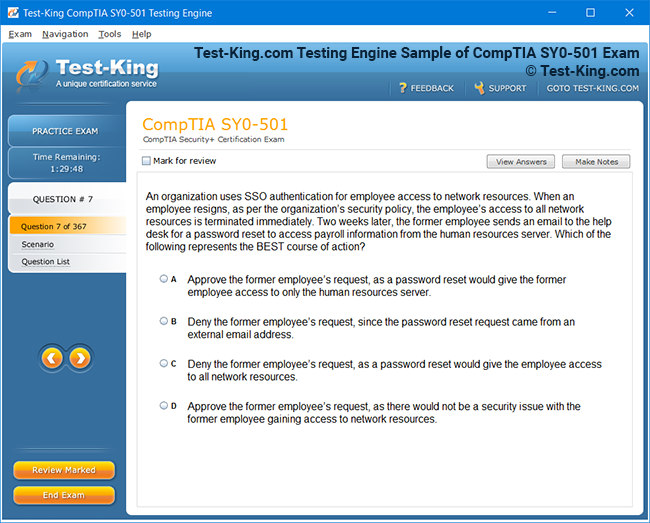
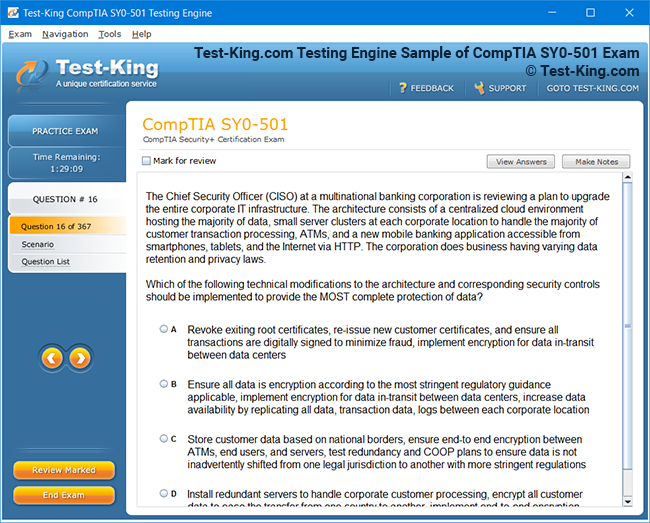
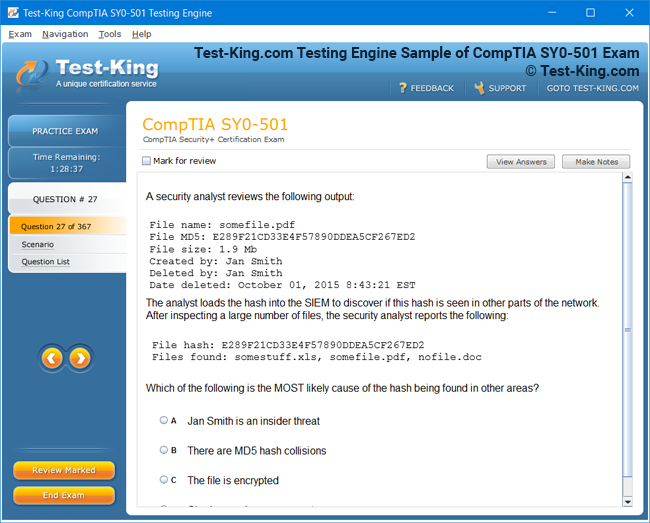
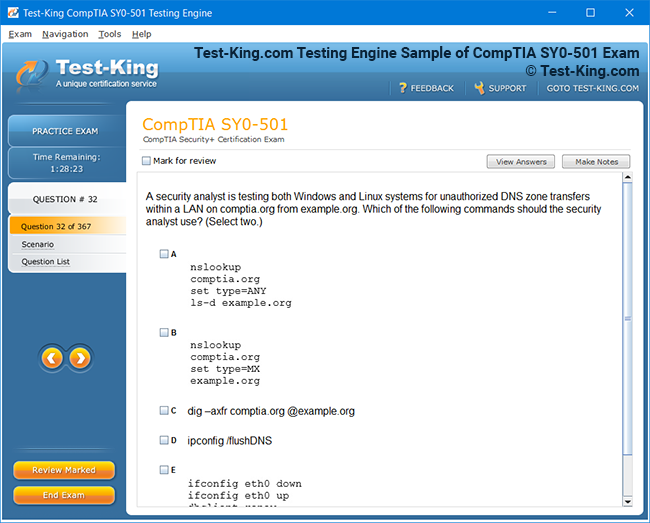
Product Screenshots
Frequently Asked Questions
How can I get the products after purchase?
All products are available for download immediately from your Member's Area. Once you have made the payment, you will be transferred to Member's Area where you can login and download the products you have purchased to your computer.
How long can I use my product? Will it be valid forever?
Test-King products have a validity of 90 days from the date of purchase. This means that any updates to the products, including but not limited to new questions, or updates and changes by our editing team, will be automatically downloaded on to computer to make sure that you get latest exam prep materials during those 90 days.
Can I renew my product if when it's expired?
Yes, when the 90 days of your product validity are over, you have the option of renewing your expired products with a 30% discount. This can be done in your Member's Area.
Please note that you will not be able to use the product after it has expired if you don't renew it.
How often are the questions updated?
We always try to provide the latest pool of questions, Updates in the questions depend on the changes in actual pool of questions by different vendors. As soon as we know about the change in the exam question pool we try our best to update the products as fast as possible.
How many computers I can download Test-King software on?
You can download the Test-King products on the maximum number of 2 (two) computers or devices. If you need to use the software on more than two machines, you can purchase this option separately. Please email support@test-king.com if you need to use more than 5 (five) computers.
What is a PDF Version?
PDF Version is a pdf document of Questions & Answers product. The document file has standart .pdf format, which can be easily read by any pdf reader application like Adobe Acrobat Reader, Foxit Reader, OpenOffice, Google Docs and many others.
Can I purchase PDF Version without the Testing Engine?
PDF Version cannot be purchased separately. It is only available as an add-on to main Question & Answer Testing Engine product.
What operating systems are supported by your Testing Engine software?
Our testing engine is supported by Windows. Andriod and IOS software is currently under development.
Top IBM Exams
- C1000-183 - IBM Maximo Manage v9.0 Functional Deployment - Professional
- S2000-025 - IBM AIX v7.3 Administrator Specialty
- C1000-004 - IBM Curam SPM V7.X Application Developer
- C1000-156 - QRadar SIEM V7.5 Administration
- C1000-138 - IBM API Connect v10.0.3 Solution Implementation
- C1000-200 - IBM MQ v9.4 Administrator - Professional
- C1000-174 - IBM WebSphere Application Server Network Deployment v9.0.5 Administrator
How to Prepare for the IBM C1000-018 Exam: Expert Strategies and Study Tips
Preparing for the IBM C1000-018 exam, focused on IBM QRadar SIEM V7.3.2 Fundamental Analysis, demands a meticulous and structured approach. This certification is widely recognized among cybersecurity professionals, particularly those aspiring to excel in security information and event management. The exam evaluates a candidate’s ability to analyze, interpret, and respond to security events within the QRadar environment, making it crucial to cultivate both theoretical understanding and practical acumen.
The journey begins with grasping the foundational elements of IBM QRadar SIEM. Candidates must familiarize themselves with the architecture, deployment modes, and data collection mechanisms. QRadar SIEM operates as a centralized platform that aggregates security data from diverse sources, including network devices, servers, and applications. Understanding how log sources are classified, normalized, and correlated is indispensable. The ability to navigate through the interface efficiently, configure offense rules, and interpret real-time dashboards sets the stage for higher-level proficiency.
Mastering IBM QRadar SIEM V7.3.2 for Certification Success
One of the most pivotal strategies for preparing involves hands-on practice within a lab environment. Realistic simulations of network traffic, security events, and threat scenarios enable candidates to consolidate their knowledge. The ability to generate synthetic events, analyze flows, and review offense patterns reinforces the theoretical concepts acquired through study materials. Many successful candidates report that iterative engagement with QRadar’s Event and Flow processing mechanisms builds a profound comprehension that mere reading cannot achieve. This practice also extends to mastering the creation and customization of rules, understanding log source extensions, and applying filters for precise data analysis.
In addition to practical exposure, a rigorous review of official documentation and learning resources is paramount. IBM provides comprehensive manuals detailing system configuration, data parsing, and event correlation. Candidates are advised to meticulously study the architecture of QRadar, including components such as the Event Processor, Flow Processor, and Console. Understanding how these components interact and how events traverse through the system is critical for the exam. Advanced topics such as reference sets, custom properties, and offense strategies require deliberate attention, as they are often the areas where candidates encounter difficulty.
Strategic planning of study time enhances retention and comprehension. Establishing a study schedule that balances conceptual learning with hands-on exercises is highly recommended. For instance, dedicating initial weeks to understanding the platform’s architecture, followed by focused exercises on log source configuration and offense rule creation, yields optimal results. Integrating regular review sessions to reinforce previously learned concepts prevents knowledge attrition. Leveraging practice exams and scenario-based assessments can further solidify understanding, revealing gaps that require targeted remediation.
Another crucial facet of preparation is understanding event correlation and offense management. QRadar SIEM’s core strength lies in its ability to correlate diverse events to identify potential security threats. Candidates should develop proficiency in configuring correlation rules, analyzing offenses, and tuning the system to reduce false positives while enhancing threat detection. This requires a nuanced understanding of network protocols, log formats, and the logical relationships between disparate events. Practical exercises in simulating security incidents, reviewing offenses, and adjusting rule priorities contribute significantly to exam readiness.
A nuanced understanding of troubleshooting within the QRadar environment is also essential. Candidates should be capable of diagnosing data ingestion issues, resolving log source errors, and interpreting system notifications. Mastery of diagnostic tools within the platform, including system monitoring utilities, event and flow traces, and performance dashboards, empowers candidates to handle unexpected scenarios confidently. Developing a troubleshooting mindset is particularly valuable for questions that assess practical problem-solving skills, a key component of the C1000-018 exam.
In addition to technical mastery, cultivating a strategic mindset toward exam-taking is advisable. Familiarity with the exam format, question types, and time management strategies can markedly improve performance. Candidates should anticipate questions that combine theoretical knowledge with practical application, requiring analytical reasoning and systematic problem-solving. Regular practice under timed conditions helps to simulate the examination environment, reducing anxiety and enhancing accuracy.
Continuous exposure to evolving cybersecurity trends and threats is another asset in preparation. While the exam primarily focuses on QRadar’s functionality, understanding the broader cybersecurity landscape, including common attack vectors, threat intelligence utilization, and incident response methodologies, enriches comprehension. Candidates who integrate these contextual insights with platform-specific knowledge demonstrate superior analytical capability and adaptability, qualities highly valued in professional practice.
Networking with peers and leveraging community resources can also accelerate readiness. Online forums, discussion groups, and user communities offer valuable insights into common challenges, innovative solutions, and best practices. Sharing experiences and engaging in collaborative problem-solving not only enhances understanding but also introduces perspectives that may not be covered in formal documentation. Mentorship from certified professionals can provide nuanced guidance and strategic advice, particularly regarding exam preparation and practical application of concepts.
Time management during preparation is critical. Allocating sufficient time to each domain of the exam, ensuring balanced coverage of foundational topics and advanced configurations, prevents superficial understanding. Candidates should focus on areas where they demonstrate weakness, while continuously reinforcing strengths. Utilizing adaptive study techniques, such as spaced repetition and active recall, can enhance long-term retention and facilitate mastery of complex concepts. These cognitive strategies transform passive learning into active engagement, a decisive factor in exam success.
Finally, the psychological component of preparation should not be underestimated. Maintaining motivation, managing stress, and fostering resilience are integral to sustained study efforts. Establishing achievable goals, tracking progress, and celebrating milestones contribute to a positive and productive preparation journey. Candidates who combine disciplined study routines with mental preparedness are better positioned to navigate the challenges of the IBM C1000-018 exam and achieve certification.
Deep Learning Approaches for IBM QRadar SIEM V7.3.2 Mastery
Preparation for the IBM C1000-018 examination is not merely a matter of memorization; it is an intellectual journey into the architecture, analytical mechanisms, and operational frameworks of IBM QRadar SIEM V7.3.2. To triumph in this endeavor, aspirants must internalize the platform’s core principles, develop an analytical temperament, and apply adaptive learning strategies that blend theory with authentic technical experience. This examination is intentionally designed to measure not only conceptual cognition but also practical dexterity—requiring candidates to exhibit proficiency in real-world security event analysis, rule management, and system optimization. The most successful candidates treat preparation as an immersive process that mirrors the professional realities of a security analyst operating in a high-stakes enterprise environment.
The foundation of effective preparation begins with an unshakable understanding of the QRadar SIEM ecosystem. One must grasp the rationale behind each component’s existence and its interaction within the broader security infrastructure. IBM QRadar operates as an intelligent sentinel, aggregating, normalizing, and analyzing logs from multifarious network elements, devices, and applications. To command the tool, an aspirant must understand how it transforms raw event data into actionable insights. Each log source contributes unique contextual details, and their correlation produces patterns that signify possible intrusions or anomalies. Grasping this correlation mechanism, which forms the intellectual backbone of QRadar, is indispensable.
In-depth study should begin with the architecture of QRadar itself. The platform’s components—such as the Event Collector, Event Processor, Flow Processor, and Console—work in harmony to deliver a holistic view of an organization’s security posture. Understanding how data traverses from ingestion to analysis enables a candidate to perceive the subtleties of data normalization, indexing, and correlation. A critical point of study involves how QRadar uses its Ariel database to store and retrieve events, and how searches within the system operate across distributed environments. This architectural literacy is not purely academic—it directly influences one’s ability to troubleshoot, configure, and optimize the environment efficiently during both the examination and real-world tasks.
Another essential preparation element revolves around offenses and correlation rules. QRadar’s offense engine identifies threats by analyzing event relationships and generating alerts. A thorough comprehension of correlation rule logic is paramount; candidates must know how to configure, refine, and manage these rules to minimize false positives while maximizing detection fidelity. The art of crafting effective correlation rules lies in balancing sensitivity with specificity—too broad a rule results in alert fatigue, while too narrow a configuration risks missing genuine threats. Understanding this equilibrium is an art form that distinguishes a seasoned analyst from a novice.
Aspirants should immerse themselves in practical exercises within a controlled lab environment. Installing a QRadar Community Edition or accessing an enterprise simulation platform allows one to observe event ingestion in real time, craft rules, and analyze offenses generated from simulated attacks. Such experiential learning embeds knowledge deeper than rote reading ever could. This hands-on exposure helps candidates internalize operational workflows, including investigating offenses, drilling into event details, and interpreting dashboard metrics. Candidates who engage with QRadar in this tactile manner develop instinctive fluency in navigation, filtering, and cross-referencing data—a proficiency that the examination subtly measures through scenario-based questioning.
Equally crucial to preparation is an appreciation of the analytics layer embedded within QRadar. The platform’s anomaly detection capabilities, reference sets, and behavioral baselines contribute significantly to proactive threat identification. Candidates should learn how reference sets store dynamic data and are used within rules to detect recurring threat indicators. A sound understanding of custom properties—variables extracted from logs for specialized correlation—is also pivotal. Many exam questions test comprehension of these advanced functionalities, demanding an awareness of how to extract, classify, and manipulate data beyond the superficial interface level.
The conceptual depth of QRadar requires candidates to not only recognize components but also appreciate their interplay with broader cybersecurity paradigms. Understanding event correlation without an appreciation of network behavior, log structures, or intrusion patterns limits one’s analytical capacity. Thus, aspirants should also study network fundamentals, such as port behaviors, protocol communication, and data flow sequencing, which influence how QRadar interprets and correlates data. Recognizing normal versus anomalous traffic patterns underpins the logic behind many rule configurations, and this holistic understanding often differentiates high-scoring candidates.
Beyond the technical substance, preparation for the IBM C1000-018 demands a disciplined study methodology. The most effective learners establish an evolving study roadmap, progressively moving from foundational topics toward complex analytical functions. It is beneficial to allocate consistent blocks of time daily to studying specific domains, integrating theoretical reading with interactive experimentation. The human brain retains information most effectively when engagement alternates between conceptual input and kinesthetic reinforcement, hence the emphasis on lab work following documentation review. Periodic self-assessment through mock tests is essential, as it fosters exam familiarity and highlights weak zones requiring targeted revision.
Exam strategy itself deserves deliberate cultivation. Understanding how IBM structures its assessments helps candidates manage time and cognition effectively. The C1000-018 exam typically challenges candidates with situational questions, where multiple correct answers appear plausible but only one aligns with IBM’s operational framework or best practice. The ability to discern subtle linguistic cues, interpret scenario context, and eliminate distractors relies on both technical understanding and critical reasoning. Reading each question meticulously, identifying the objective, and mapping it to QRadar functionalities are skills honed through consistent practice. Developing this precision helps minimize errors arising from assumption or haste.
Comprehending the diagnostic features of QRadar is another indispensable aspect of readiness. Candidates should be adept at recognizing and resolving issues related to log source connectivity, data ingestion failures, and rule misfires. Practical troubleshooting exercises—such as diagnosing why a log source stops reporting or identifying latency within the flow processor—prepare one for real-life and exam scenarios alike. QRadar’s internal logs, notifications, and system health dashboards offer the necessary insights to identify anomalies, making familiarity with them a non-negotiable skill.
Candidates should not overlook the importance of mastering the QRadar interface. Navigating the dashboard, filtering event views, interpreting graphs, and generating reports are fundamental skills. These capabilities, though seemingly straightforward, hold immense weight during the exam because they reflect day-to-day proficiency expected from a certified analyst. Knowing how to search for specific events using Ariel Query Language, configure saved searches, or visualize offense trends enables the aspirant to respond accurately to scenario-based questions that test operational efficiency.
A balanced preparation also requires engaging with the theoretical underpinnings of security event management. Candidates must internalize concepts like normalization, categorization, and correlation. Normalization ensures diverse log formats from multiple vendors are translated into a consistent schema, allowing QRadar to analyze them uniformly. Categorization enables grouping events by functional or behavioral similarity, while correlation interlinks distinct activities to identify broader security incidents. Understanding how these principles integrate within QRadar provides conceptual clarity that reflects directly in exam performance.
An often-overlooked component of preparation is the psychological aspect of sustained study. The path to certification can be mentally exhausting, especially given the density of technical detail and the analytical rigor demanded. Candidates should cultivate resilience through balanced study routines that include rest, recreation, and reflective thinking. Maintaining mental agility is as crucial as technical proficiency, for cognitive fatigue often undermines exam performance more than knowledge deficiency. Visualizing success, setting incremental goals, and monitoring progress instill confidence and maintain momentum throughout the preparation period.
The modern cybersecurity landscape is evolving, and IBM QRadar SIEM V7.3.2 sits at the heart of this transformation. Candidates preparing for the C1000-018 must, therefore, align their learning with real-world application scenarios. Familiarity with threat intelligence integration, vulnerability management, and incident response workflows enhances contextual comprehension. QRadar’s interoperability with external systems such as ticketing platforms and threat feeds exemplifies how SIEM tools function within larger ecosystems. Understanding these integrations contributes not only to exam success but also to professional readiness for operational environments.
Peer collaboration amplifies preparation efficacy. Engaging with professional communities, study groups, or online discussion forums allows aspirants to exchange insights, clarify ambiguities, and learn from others’ experiences. The collective wisdom of these networks often reveals subtleties overlooked in solitary study. Moreover, discussing technical concepts reinforces understanding by forcing one to articulate reasoning clearly—a process that deepens cognitive retention. Seeking mentorship from experienced QRadar administrators or certified professionals can also provide invaluable strategic direction.
Time allocation across topics must be both strategic and adaptive. The C1000-018 exam covers a wide spectrum, from architecture and data flows to rule tuning and troubleshooting. An aspirant should allocate more time to complex domains such as correlation logic and offense management while maintaining steady revision of foundational topics. Revisiting earlier material periodically ensures knowledge consolidation. Avoiding the trap of overemphasis on familiar areas prevents imbalance, a common pitfall among candidates who subconsciously gravitate toward their comfort zones.
Technological updates and evolving QRadar functionalities warrant constant vigilance. IBM frequently enhances the platform with new analytical capabilities, interface improvements, and integration features. Keeping abreast of release notes, whitepapers, and knowledge center updates ensures that candidates’ understanding remains aligned with current system behavior. This awareness also mitigates the risk of encountering unfamiliar terminology or deprecated functions during the exam.
Ultimately, the synthesis of technical competence, analytical sharpness, and psychological endurance defines successful preparation. The C1000-018 exam rewards not mere recollection but the ability to apply QRadar knowledge dynamically to complex security challenges. Each study session, each practical exercise, and each moment of reflection builds toward this holistic mastery. Those who approach the journey with persistence, curiosity, and methodical discipline find themselves not only well-prepared for certification but also equipped for excellence in cybersecurity operations where IBM QRadar SIEM continues to play an instrumental role.
Advanced Techniques for IBM QRadar SIEM V7.3.2 Proficiency
Achieving mastery in IBM QRadar SIEM V7.3.2 and securing success in the C1000-018 examination requires an advanced, methodical approach that integrates technical understanding, analytical reasoning, and immersive practice. The examination is crafted to evaluate the depth of knowledge in the fundamental analysis of QRadar, as well as the capacity to implement these concepts in operational environments. Aspirants must recognize that the certification transcends rote memorization; it demands a holistic grasp of the system, its configuration, data ingestion processes, correlation mechanics, and the subtleties of offense management. Preparing effectively entails cultivating both a strategic mindset and practical proficiency that mirrors real-world scenarios in enterprise security operations.
A crucial starting point in this advanced preparation involves an intricate understanding of log sources and data normalization. IBM QRadar SIEM collects logs from an extensive array of devices, applications, and network components, each producing distinct log formats and structures. Understanding how QRadar interprets, normalizes, and categorizes these logs is pivotal. Candidates must become adept at identifying how log sources are classified, which events are considered critical, and how QRadar transforms raw data into structured insights. Mastery of this process enables candidates to configure systems for optimal data collection and to anticipate the outcomes of log ingestion, a skill that proves invaluable during the examination.
Proficiency in correlation rules is equally essential. QRadar’s correlation engine is the analytical heart of the platform, linking discrete events to construct meaningful offense scenarios. Candidates must be able to create, refine, and manage rules that efficiently detect potential security threats while minimizing false positives. Understanding the logic behind event grouping, rule priorities, and threshold configuration is critical. In practice, this involves considering how multiple low-level events, when correlated, signify a higher-level security incident. Analytical thinking in this context allows candidates to identify subtle patterns within voluminous data sets, a competency directly assessed by the examination.
Immersive practice within a simulated or live QRadar environment is indispensable for reinforcing theoretical knowledge. Setting up a lab environment, whether using QRadar Community Edition or virtualized enterprise simulations, enables hands-on interaction with offenses, rules, and dashboards. Candidates benefit from generating synthetic events, examining flow data, and observing how offenses propagate through the system. This experiential learning not only solidifies comprehension but also develops operational intuition, allowing aspirants to navigate the platform efficiently. Repeated engagement with these activities cultivates familiarity with investigative workflows, dashboard interpretation, and the creation of custom searches—skills that are frequently tested in scenario-based questions.
Advanced knowledge of offense management enhances preparation considerably. QRadar offenses are more than alerts; they are curated representations of potential threats that require contextual interpretation and strategic response. Candidates must understand offense lifecycles, how to analyze root causes, and the methods for tuning offense rules to balance sensitivity and specificity. Techniques for filtering, prioritizing, and escalating offenses are essential, as they allow for a disciplined response to security incidents. By engaging with offense analysis in practice environments, candidates learn to distinguish between routine network anomalies and genuine threats, cultivating a mindset of investigative precision that aligns with the expectations of the examination.
Understanding QRadar’s internal database and search capabilities is another cornerstone of preparation. The Ariel database, at the core of QRadar’s data storage system, provides advanced search functionality that allows analysts to retrieve events efficiently. Mastery of querying techniques, event filtering, and search optimization is crucial for both exam readiness and real-world effectiveness. Candidates should practice creating searches that combine multiple criteria, applying time constraints, and generating reports that summarize critical security incidents. This capability not only facilitates accurate offense analysis but also reinforces understanding of how QRadar processes and organizes data internally.
Troubleshooting skills form a critical dimension of examination readiness. Candidates must be prepared to identify and resolve issues related to log source connectivity, data ingestion failures, and system performance bottlenecks. QRadar provides diagnostic tools that monitor system health, event flow, and processing efficiency. Becoming proficient in interpreting system notifications, analyzing error logs, and taking corrective measures ensures candidates can respond to complex scenarios with confidence. Practicing troubleshooting within a lab environment helps internalize problem-solving workflows, making them instinctive under exam conditions.
The configuration and utilization of reference sets are vital components of advanced study. Reference sets store dynamic data and facilitate complex correlation rules, enhancing QRadar’s analytical depth. Candidates should understand how to define reference sets, populate them with relevant data, and integrate them within correlation logic to detect sophisticated threats. Custom properties, another advanced feature, allow analysts to extract and manipulate specific information from events, enabling highly tailored detection strategies. Mastery of these tools differentiates candidates with a superficial understanding from those with the capacity to apply QRadar creatively and effectively.
A comprehensive understanding of network fundamentals complements QRadar expertise. Security event analysis is inseparable from knowledge of network protocols, port behaviors, and traffic patterns. Candidates should be able to identify how anomalies manifest within log data and how specific network behaviors influence event interpretation. Recognizing the difference between legitimate network activity and suspicious behavior is integral to constructing effective correlation rules and interpreting offenses. This contextual awareness enhances analytical acumen and equips candidates to respond dynamically to exam questions that simulate realistic security environments.
Time management and strategic study planning are essential for optimizing preparation. Candidates should construct a balanced study regimen that interleaves theoretical review with practical exercises. Foundational topics, such as system architecture and log source configuration, should be consolidated before advancing to complex functions like offense tuning, custom properties, and reference sets. Regular self-assessment through mock tests and scenario exercises is imperative, as it reinforces retention and highlights areas requiring focused remediation. Candidates who adopt adaptive learning strategies, revisiting challenging concepts periodically, enhance long-term retention and build the confidence necessary for successful performance.
Engagement with community resources amplifies preparation efficiency. Professional forums, discussion groups, and online communities provide insight into common challenges, troubleshooting strategies, and practical tips. Peer collaboration exposes candidates to diverse approaches and solutions, fostering deeper understanding. Mentorship from certified professionals offers guidance on exam navigation, scenario analysis, and practical application of advanced functionalities. Candidates who actively seek these resources benefit from a multi-dimensional perspective that extends beyond formal documentation and study guides.
Exam-taking strategies should be practiced in parallel with technical preparation. Familiarity with question formats, scenario-based assessments, and time allocation ensures candidates approach the examination with confidence. Understanding that questions often integrate multiple concepts simultaneously is critical. Candidates should practice analytical reasoning to distinguish correct solutions among plausible alternatives, applying their QRadar knowledge with precision. Rehearsing under timed conditions reduces cognitive strain, enhances focus, and simulates the pressures of the testing environment, allowing aspirants to execute their skills effectively.
Psychological preparedness is equally important. Sustained study requires resilience, concentration, and motivation. Candidates should maintain a balanced approach, incorporating rest periods, reflective practice, and incremental goal-setting to prevent fatigue and ensure consistent performance. Cultivating a mindset of perseverance transforms challenging concepts into attainable milestones, reinforcing the aspirant’s confidence in their abilities. Mental fortitude, when combined with technical mastery, is often the differentiator between successful candidates and those who struggle under examination conditions.
Integrating broader cybersecurity knowledge strengthens the contextual application of QRadar skills. Candidates should remain conversant with contemporary threat landscapes, attack vectors, and incident response strategies. Understanding how QRadar SIEM integrates with threat intelligence feeds, vulnerability management tools, and enterprise security workflows enhances analytical reasoning. This broader awareness allows candidates to interpret scenarios more effectively and construct correlation rules that reflect realistic operational priorities, a competency that is highly valued in the examination and professional practice.
The synergy between hands-on practice, architectural understanding, and analytical reasoning forms the foundation for advanced mastery. Continuous engagement with real-world scenarios, whether simulated or observed through community examples, allows candidates to refine investigative skills and operational intuition. An iterative cycle of observation, analysis, and application deepens comprehension, transforming theoretical knowledge into instinctive operational capability. This approach not only prepares candidates for the technical demands of the C1000-018 exam but also cultivates professional expertise that extends into daily cybersecurity operations.
Continuous adaptation to QRadar’s evolving functionalities is essential. IBM periodically enhances the platform, introducing new features, analytical tools, and interface improvements. Candidates should maintain familiarity with these updates to ensure their understanding reflects the latest system capabilities. Being conversant with contemporary features and functionalities allows aspirants to respond effectively to examination questions and enhances professional versatility. This ongoing engagement fosters a proactive learning mindset, encouraging continuous improvement beyond the confines of exam preparation.
Ultimately, excelling in the IBM C1000-018 exam demands a multidimensional preparation strategy. Technical acumen, analytical precision, immersive practice, and psychological resilience converge to equip candidates for success. By combining rigorous study, hands-on engagement, and reflective learning, aspirants develop the capabilities necessary to navigate complex scenarios, interpret correlated events, and apply QRadar SIEM functionalities with sophistication. The preparation process cultivates not only the ability to pass the examination but also the competencies required to perform at a high level in professional cybersecurity operations, where IBM QRadar remains an indispensable analytical tool.
Mastery of Operational Workflows and Advanced Analytics in IBM QRadar SIEM V7.3.2
Preparing for the IBM C1000-018 examination demands more than superficial familiarity with IBM QRadar SIEM V7.3.2; it requires a comprehensive understanding of operational workflows, advanced analytics, and investigative strategies that form the backbone of effective security management. Candidates must appreciate that the exam evaluates their ability to not only recognize system components but also to interpret complex data, implement correlation rules, and respond to security offenses with analytical rigor. Success is rooted in a synthesis of theoretical knowledge, practical experimentation, and strategic application, creating a proficiency that mirrors the demands of professional cybersecurity operations.
A fundamental focus of preparation should be understanding QRadar’s event and flow processing mechanisms. Each component within the platform plays a distinctive role: event collectors gather data, processors normalize and index it, and the console enables detailed visualization and management. Candidates must internalize how events traverse this architecture, how they are categorized and correlated, and how actionable insights emerge from seemingly disparate data points. Mastery of these workflows allows aspirants to anticipate system behavior, troubleshoot anomalies, and optimize configuration settings, ensuring they can navigate the examination with confidence and precision.
Advanced study should emphasize the configuration and management of offenses. In QRadar, offenses represent synthesized alerts derived from correlated events, indicating potential security threats. Candidates must understand the logic behind offense generation, the parameters that influence offense creation, and the analytical processes required to investigate each incident. Effective offense management involves discerning between routine network activity and genuine security threats, configuring thresholds to reduce false positives, and applying systematic investigative methodologies. Practical exercises simulating realistic threat scenarios solidify this understanding, fostering intuitive recognition of patterns that are central to exam success.
Proficiency in correlation rules is critical. QRadar’s correlation engine identifies patterns across multiple events, producing meaningful insights that inform security response. Candidates should practice crafting rules that balance sensitivity and specificity, tuning them to detect subtle anomalies without overwhelming analysts with unnecessary alerts. Understanding how to leverage reference sets, custom properties, and event categorization within these rules is paramount. These advanced capabilities enable the detection of sophisticated threats, enhancing both exam performance and real-world operational effectiveness.
A significant aspect of preparation involves mastering the Ariel database and its search functionalities. The database underpins QRadar’s ability to store, retrieve, and analyze voluminous event data efficiently. Candidates should become adept at constructing queries, applying filters, and optimizing searches to extract precise information from extensive datasets. This skill is essential for both investigative analysis and answering scenario-based questions in the exam, which often require applying query logic to interpret complex security events. Familiarity with these capabilities reinforces an aspirant’s ability to perform rapid, accurate, and insightful analyses.
Effective troubleshooting forms an integral component of advanced preparation. Candidates should cultivate the ability to diagnose and resolve issues related to log source connectivity, data ingestion anomalies, and processing latency. QRadar provides an array of diagnostic tools and system logs that enable analysts to identify root causes of operational irregularities. Practicing troubleshooting within controlled environments ensures candidates develop systematic problem-solving skills, allowing them to address unexpected challenges both in the exam and in professional settings. This aptitude reflects an advanced understanding of the platform’s operational intricacies.
Understanding reference sets and custom properties enhances analytical sophistication. Reference sets act as dynamic data repositories, facilitating complex correlation logic, while custom properties allow for precise extraction and categorization of event attributes. Candidates must learn to define, populate, and integrate these elements within rules, enabling the detection of subtle or evolving threats. This capability exemplifies the advanced analytical functions of QRadar, demonstrating a candidate’s capacity to apply knowledge creatively and effectively. Familiarity with these tools is frequently tested through scenario-based examination questions that require nuanced interpretation and application.
A holistic approach to preparation includes comprehension of QRadar’s dashboards and visualization capabilities. Dashboards provide an operational snapshot, enabling rapid identification of trends, anomalies, and system performance metrics. Candidates should practice configuring dashboards, customizing widgets, and interpreting visualizations to support investigative workflows. Understanding how to translate raw data into actionable insights through graphical representation is essential for both operational proficiency and exam readiness. Effective use of dashboards reinforces situational awareness, allowing candidates to manage offenses and events efficiently.
Integration with broader cybersecurity frameworks is another vital consideration. QRadar does not operate in isolation; it functions within a larger ecosystem that includes threat intelligence feeds, vulnerability management tools, and incident response workflows. Candidates should understand how QRadar integrates with these systems, enabling contextual analysis and more accurate threat identification. Knowledge of these interdependencies enhances the ability to interpret security events comprehensively, allowing aspirants to apply analytical reasoning that reflects professional best practices.
Strategic preparation involves disciplined time management and iterative learning. Candidates should allocate consistent study intervals to both conceptual learning and hands-on experimentation, gradually advancing from foundational topics such as system architecture and log source configuration to advanced functions including offense tuning, custom properties, and reference sets. Periodic self-assessment through practice exams and scenario-based exercises is essential for reinforcing retention and identifying areas requiring further attention. Employing adaptive learning techniques, such as spaced repetition and active recall, enhances long-term retention and develops a cognitive framework for complex problem-solving.
Engaging with peer networks and professional communities can significantly augment preparation. Collaboration with other aspirants or certified professionals provides exposure to diverse problem-solving approaches, practical insights, and nuanced operational strategies. Online forums, discussion groups, and mentorship programs serve as valuable resources for clarifying doubts, sharing best practices, and obtaining guidance on advanced functionalities. This collaborative approach not only deepens understanding but also fosters analytical versatility, enhancing both exam performance and practical proficiency in security operations.
Exam strategy is as crucial as technical mastery. Candidates should familiarize themselves with the types of questions commonly presented, including scenario-based questions that require application of multiple concepts simultaneously. Developing the ability to read questions carefully, interpret contextual clues, and eliminate distractors is vital for achieving high performance. Practicing under timed conditions familiarizes aspirants with exam pressures, improving focus, decision-making, and accuracy. This strategic alignment between preparation and execution maximizes the potential for success.
Psychological preparation plays a complementary role in achieving mastery. Sustained engagement with complex material can induce cognitive fatigue; therefore, maintaining motivation, managing stress, and cultivating resilience are essential. Candidates should structure study routines that balance intensive learning with restorative practices, allowing for reflection, problem-solving, and consolidation of knowledge. Maintaining a positive and disciplined mindset enhances cognitive agility, enabling aspirants to apply advanced analytical reasoning effectively during examination scenarios.
Understanding the dynamic nature of threats and QRadar’s response mechanisms enriches the preparation process. Candidates should study contemporary attack vectors, emerging threat patterns, and advanced persistent threats to contextualize QRadar’s analytical capabilities. Familiarity with threat intelligence integration, vulnerability assessment, and incident response workflows allows aspirants to interpret complex events accurately, construct effective correlation rules, and respond to scenarios in a manner aligned with real-world operational requirements. This contextual expertise is essential for demonstrating comprehensive understanding in the examination.
Hands-on practice should simulate realistic operational scenarios. Candidates benefit from creating synthetic events, generating offenses, analyzing flows, and tuning rules to respond to diverse threat conditions. This experiential learning embeds knowledge deeply, transforming theoretical understanding into operational fluency. Candidates should iterate through investigative workflows, testing hypotheses, refining rules, and validating outcomes to cultivate intuitive expertise. Repeated engagement with practical exercises ensures aspirants can navigate QRadar confidently, making informed decisions under the examination’s evaluative conditions.
Maintaining awareness of system updates and enhancements is critical. IBM periodically introduces new features, analytical tools, and integrations that augment QRadar’s capabilities. Candidates should remain conversant with these developments to ensure their preparation reflects the most current functionality. Awareness of evolving tools, features, and methodologies supports both exam readiness and professional competency, enabling aspirants to apply QRadar effectively within dynamic security environments.
Ultimately, advanced preparation for the IBM C1000-018 examination involves integrating technical expertise, analytical insight, hands-on experience, and strategic foresight. Candidates who engage rigorously with QRadar’s architecture, operational workflows, correlation mechanisms, and investigative methodologies cultivate a level of proficiency that positions them for both examination success and professional excellence. By synthesizing these elements with disciplined study practices, adaptive learning, and situational awareness, aspirants develop the cognitive and operational dexterity required to excel in the realm of security information and event management, reflecting the depth and breadth of IBM QRadar SIEM V7.3.2 functionality.
Optimizing Analytical Skills and Real-World Application in IBM QRadar SIEM V7.3.2
Achieving proficiency in IBM QRadar SIEM V7.3.2 and excelling in the C1000-018 examination demands a comprehensive approach that synthesizes analytical skills, operational understanding, and practical experience. Preparation is not simply about familiarizing oneself with the interface or memorizing concepts; it is about cultivating the ability to interpret complex security data, design correlation logic, and respond effectively to offenses. Candidates must approach study with a methodical mindset, integrating theoretical knowledge with immersive practice to develop the cognitive and operational dexterity expected from a professional security analyst.
A central focus of preparation involves mastering the mechanisms of log source configuration and data normalization. IBM QRadar SIEM ingests data from a multitude of devices, applications, and network elements, each with its own format and structure. Understanding how the system normalizes these disparate logs, categorizes events, and applies rules to produce actionable intelligence is foundational. Candidates must learn to identify the nuances of log parsing, including the extraction of key attributes and the interpretation of custom properties. This foundational competence ensures that data flowing into QRadar can be analyzed accurately, forming the basis for offense generation and correlation rule application.
Advanced understanding of correlation rules is indispensable. QRadar’s correlation engine synthesizes events to detect patterns indicative of security threats. Candidates must cultivate the ability to create and fine-tune rules that balance sensitivity and specificity, ensuring that true positives are highlighted without overwhelming analysts with false alerts. Mastery of reference sets, event grouping, and threshold configuration enhances the system’s capacity to detect subtle or evolving threats. Engaging in hands-on exercises to simulate complex attack scenarios strengthens analytical reasoning and reinforces understanding of how multiple low-level events interact to produce high-level offense alerts.
Practical experience in lab environments is essential for internalizing these advanced concepts. Candidates benefit from experimenting with offense creation, rule tuning, event flow analysis, and dashboard interpretation. Working with synthetic or historical datasets allows aspirants to observe how offenses propagate, how correlation rules trigger, and how events are prioritized within the system. This experiential engagement reinforces theoretical understanding and develops instinctive proficiency in operational workflows, a critical aspect of success in both the examination and professional practice.
Understanding offenses and their management forms another critical area of focus. In QRadar, offenses represent synthesized alerts derived from correlated events and require contextual analysis to determine their relevance. Candidates should learn to investigate offenses systematically, identifying root causes, analyzing event patterns, and applying rule modifications to improve detection accuracy. Developing a disciplined investigative approach enables analysts to distinguish between normal network anomalies and genuine threats, enhancing operational efficiency and ensuring that scenario-based questions in the exam can be approached with confidence.
A deep comprehension of the Ariel database and search functionalities further augments preparation. QRadar relies on the database to store, index, and retrieve voluminous security event data efficiently. Candidates must practice constructing complex searches, applying filters, and generating insightful reports. The ability to extract meaningful information from extensive datasets is essential for investigative analysis and scenario interpretation. Familiarity with search optimization techniques, event filtering, and reporting workflows ensures candidates can navigate the examination with analytical precision, reflecting both theoretical knowledge and practical skill.
Troubleshooting remains an indispensable competency for aspirants. Candidates should develop the ability to identify and resolve issues related to log source connectivity, data ingestion errors, and processing delays. QRadar provides diagnostic tools that monitor system performance and event flows, enabling analysts to detect anomalies quickly. Practicing troubleshooting in a controlled environment allows candidates to internalize systematic problem-solving strategies, ensuring they can respond confidently to both examination scenarios and real-world operational challenges. This capability exemplifies the practical application of advanced QRadar knowledge.
Reference sets and custom properties represent sophisticated analytical features that must be thoroughly understood. Reference sets allow dynamic data storage that enhances correlation logic, while custom properties facilitate the extraction of targeted information from events. Candidates should practice creating, populating, and integrating these features within rules, enabling the detection of complex threats. Mastery of these tools not only demonstrates technical expertise but also illustrates a candidate’s ability to apply QRadar creatively, a quality often tested through scenario-based examination questions.
Proficiency in dashboards and visualization techniques is equally important. Dashboards provide operational insight, presenting real-time and historical data in a format conducive to rapid interpretation. Candidates should practice configuring dashboards, customizing widgets, and interpreting visualizations to support investigative workflows. Translating raw data into actionable intelligence through graphical representation enhances situational awareness and strengthens analytical reasoning, enabling candidates to respond effectively to both exam questions and professional challenges.
Integration with broader cybersecurity frameworks enhances preparation quality. QRadar operates within a larger ecosystem, integrating with threat intelligence feeds, vulnerability management platforms, and incident response tools. Candidates should understand how these integrations augment analytical capability and inform operational decision-making. Familiarity with external data sources, security policies, and organizational workflows ensures candidates can contextualize event data effectively, enhancing their ability to construct accurate correlation rules and investigate offenses within realistic operational scenarios.
Time management and iterative study practices are crucial for optimizing preparation. Candidates should allocate consistent study intervals to reinforce foundational knowledge while gradually advancing to complex functionalities such as custom properties, reference sets, and advanced correlation rules. Periodic self-assessment through mock examinations and scenario exercises identifies gaps in understanding and enables targeted remediation. Employing adaptive learning strategies, such as spaced repetition and active recall, strengthens long-term retention and prepares candidates for the analytical demands of the examination.
Engaging with peer networks and professional communities provides an additional layer of preparation. Collaboration with other aspirants or certified professionals offers exposure to diverse problem-solving approaches, practical tips, and insights into operational best practices. Online forums, discussion boards, and mentorship programs serve as invaluable resources for clarifying uncertainties and refining analytical methodologies. Participating in these communities not only deepens understanding but also cultivates critical thinking skills, essential for addressing the multifaceted scenarios presented in the examination.
Strategic exam-taking techniques complement technical preparation. Candidates should familiarize themselves with the types of questions, including scenario-based items that require the simultaneous application of multiple concepts. Reading questions meticulously, interpreting contextual clues, and methodically eliminating distractors are key strategies for achieving high scores. Practicing under timed conditions simulates examination pressures, enhancing focus, decision-making, and the ability to apply QRadar knowledge efficiently. Developing these strategies ensures candidates approach the examination with confidence and analytical clarity.
Psychological resilience and cognitive readiness are integral to sustained preparation. Engaging deeply with complex material over extended periods can be mentally taxing. Candidates should incorporate structured breaks, reflective practice, and restorative activities into study routines to maintain concentration and motivation. Cultivating a positive mindset, setting incremental goals, and tracking progress reinforces confidence and endurance. These psychological strategies enable candidates to maintain performance under examination conditions and respond effectively to challenging scenarios.
Awareness of contemporary cybersecurity threats and trends enriches QRadar proficiency. Candidates should study common attack vectors, emerging threat patterns, and advanced persistent threats to contextualize QRadar’s analytical capabilities. Understanding threat intelligence integration, incident response workflows, and vulnerability management strategies allows aspirants to interpret complex events accurately and construct sophisticated correlation rules. This broader contextual knowledge enhances both examination performance and professional competence, enabling analysts to respond dynamically to evolving security landscapes.
Hands-on practice should consistently simulate realistic operational environments. Candidates should generate synthetic events, analyze offenses, refine rules, and monitor flows to experience the full breadth of QRadar functionalities. Iterative engagement with investigative workflows develops operational intuition and reinforces analytical reasoning. This approach ensures aspirants can apply their knowledge fluidly under examination conditions and within professional security operations, bridging the gap between theoretical understanding and practical expertise.
Maintaining familiarity with system updates and enhancements is essential. IBM periodically introduces new features, analytical tools, and integrations that expand QRadar’s capabilities. Candidates should remain current with these developments to ensure their preparation aligns with contemporary functionality. This awareness enhances examination readiness and supports professional versatility, enabling aspirants to leverage advanced capabilities effectively in operational settings.
Ultimately, excelling in the IBM C1000-018 examination requires a synthesis of technical knowledge, analytical reasoning, immersive practice, and psychological preparedness. Candidates who integrate rigorous study routines with hands-on experimentation, scenario analysis, and adaptive learning strategies develop the expertise necessary to navigate complex QRadar functionalities, respond to offenses accurately, and apply correlation logic with precision. This multidimensional approach equips aspirants for examination success and positions them as proficient security analysts capable of leveraging IBM QRadar SIEM V7.3.2 to its fullest potential.
Integrating Mastery, Analytics, and Strategic Readiness in IBM QRadar SIEM V7.3.2
Achieving success in the IBM C1000-018 examination is the culmination of dedicated preparation, immersive practice, and strategic mastery of IBM QRadar SIEM V7.3.2. The examination assesses not only theoretical understanding but also practical skills, analytical reasoning, and the ability to navigate complex operational workflows. Candidates must approach their preparation with a holistic mindset, recognizing that proficiency involves the interplay of technical knowledge, hands-on experience, investigative acumen, and adaptive problem-solving. By integrating these elements, aspirants cultivate the dexterity required to excel both in the examination and within professional cybersecurity environments.
A foundational focus in advanced preparation is the orchestration of log sources and the processes of data normalization. IBM QRadar SIEM ingests a wide array of event and flow data from diverse network devices, applications, and security platforms, each producing logs with varying structures and semantics. Understanding how QRadar normalizes, categorizes, and indexes these logs is essential. Candidates must grasp the nuances of extracting custom properties, interpreting event attributes, and mapping disparate log formats into coherent datasets. This proficiency enables analysts to ensure that the data entering the system is accurately represented, providing a reliable basis for correlation, offense generation, and investigative workflows.
Equally critical is mastery of correlation rules and their operational impact. QRadar’s correlation engine identifies patterns and relationships across events, producing offenses that highlight potential threats. Candidates must develop the ability to construct, refine, and optimize these rules, balancing the need to detect significant anomalies with the avoidance of false positives. Reference sets, event thresholds, and grouping logic provide advanced capabilities for fine-tuning detection strategies. Hands-on practice with these elements enables aspirants to anticipate the behavior of the correlation engine, interpret offense outcomes, and apply corrective adjustments efficiently, skills that are pivotal for examination scenarios.
Practical engagement with QRadar in a simulated or live environment significantly reinforces conceptual understanding. Candidates benefit from generating synthetic events, analyzing offense creation, tuning rules, and observing data flow patterns. This experiential approach develops operational intuition, allowing analysts to navigate dashboards, interpret search results, and conduct investigative workflows seamlessly. By repeatedly interacting with the platform, aspirants cultivate a nuanced understanding of offense prioritization, data correlation, and event analysis, forming the basis for confident performance in scenario-based examination questions.
Offense management remains a cornerstone of advanced proficiency. QRadar synthesizes correlated events into offenses that require careful evaluation and contextual analysis. Candidates should practice systematic investigation techniques, including tracing offense root causes, identifying contributing events, and applying rule modifications to refine detection accuracy. Mastery of offense management enables analysts to discern genuine threats from benign anomalies, enhancing both operational efficiency and examination performance. Practical exercises in offense investigation cultivate the analytical discipline necessary to interpret complex data accurately.
Understanding the Ariel database and its search capabilities enhances operational effectiveness. QRadar relies on the database to store, index, and retrieve vast quantities of event and flow data efficiently. Candidates must become adept at constructing searches that combine multiple criteria, applying filters, and generating actionable reports. This proficiency allows analysts to extract precise insights from extensive datasets, supporting both investigative workflows and scenario-based examination tasks. Mastery of search techniques ensures that candidates can approach questions with analytical rigor and accuracy.
Troubleshooting is an indispensable component of preparation. Candidates must develop skills to diagnose and resolve issues related to log source connectivity, ingestion delays, and processing anomalies. QRadar’s diagnostic tools, system notifications, and health dashboards provide the necessary insights to identify and correct operational irregularities. Practicing systematic troubleshooting in controlled environments ensures that aspirants can respond effectively to both examination scenarios and real-world challenges, demonstrating an advanced level of technical competence.
Reference sets and custom properties represent sophisticated functionalities that enhance QRadar’s analytical power. Reference sets allow dynamic data storage for complex correlation rules, while custom properties enable precise extraction of critical event attributes. Candidates should practice defining, populating, and integrating these elements within rules, enabling the detection of subtle or evolving threats. Mastery of these capabilities reflects the analytical depth expected of certified professionals and is frequently assessed through scenario-based questions that require nuanced interpretation.
Dashboards and visualization techniques are essential for interpreting data and monitoring system activity. QRadar’s dashboards provide an operational overview, facilitating rapid detection of anomalies and trends. Candidates should become proficient in configuring dashboards, customizing widgets, and interpreting graphical data to support investigative decision-making. The ability to translate raw data into actionable intelligence enhances situational awareness and reinforces analytical reasoning, equipping candidates to respond confidently in examination simulations.
Integration with broader cybersecurity frameworks further strengthens preparation. QRadar operates within complex environments, collaborating with threat intelligence platforms, vulnerability management tools, and incident response systems. Understanding these integrations enables candidates to contextualize events accurately, construct effective correlation logic, and analyze offenses within operational realities. This holistic understanding ensures that aspirants can interpret security events in relation to broader organizational objectives, reflecting the competencies assessed in the C1000-018 examination.
Time management and iterative learning are critical for preparation optimization. Candidates should balance theoretical study with practical exercises, progressing from foundational topics such as system architecture and log configuration to advanced capabilities including offense tuning, custom properties, and reference set utilization. Regular self-assessment through practice tests and scenario exercises highlights knowledge gaps and guides targeted remediation. Adaptive learning strategies, including spaced repetition and active engagement, enhance retention and prepare candidates for the analytical rigor of the examination.
Collaboration and engagement with professional communities augment individual preparation. Peer interaction, discussion forums, and mentorship programs provide exposure to diverse problem-solving strategies, practical insights, and operational best practices. Candidates benefit from clarifying uncertainties, exploring alternative methodologies, and observing real-world applications of QRadar features. This collaborative approach fosters critical thinking, reinforces knowledge, and equips aspirants with a multidimensional perspective that enhances performance in scenario-based examination questions.
Strategic exam-taking techniques complement technical mastery. Candidates must familiarize themselves with question formats, scenario-based assessments, and the nuances of IBM’s evaluation criteria. Reading questions carefully, interpreting context, and systematically eliminating incorrect options are essential skills. Practicing under timed conditions simulates the pressures of the examination, sharpening focus, decision-making, and the ability to apply QRadar knowledge effectively. By aligning preparation with examination strategy, candidates can maximize performance and minimize cognitive errors.
Psychological resilience is a critical element of sustained study. Engaging with complex material over extended periods can be mentally taxing. Candidates should implement structured routines, integrating study sessions with rest, reflection, and restorative practices to maintain focus and motivation. Setting incremental goals, tracking progress, and reinforcing positive reinforcement enhances cognitive endurance and confidence. This psychological preparation ensures that candidates maintain performance under the high-pressure environment of the examination.
Awareness of evolving threats and QRadar functionalities enriches preparation. Candidates should study contemporary attack vectors, advanced persistent threats, and emerging security trends to contextualize analytical practices. Familiarity with threat intelligence, incident response workflows, and vulnerability assessment enables aspirants to interpret complex events accurately and apply sophisticated correlation rules. Keeping abreast of IBM QRadar updates ensures that candidates’ understanding aligns with current capabilities, enhancing both examination readiness and professional efficacy.
Hands-on practice should continuously simulate realistic operational scenarios. Candidates benefit from generating synthetic events, monitoring offenses, refining rules, and analyzing flows to experience the full breadth of QRadar’s functionalities. Iterative engagement with investigative workflows develops operational intuition and reinforces analytical reasoning. This immersive approach bridges theoretical knowledge and practical expertise, preparing candidates to respond effectively to both examination questions and professional challenges.
Ultimately, achieving mastery for the IBM C1000-018 examination requires the integration of technical proficiency, analytical insight, immersive practice, and strategic study. Candidates who engage rigorously with QRadar’s architecture, offense management, correlation rules, dashboards, and investigative methodologies cultivate the depth of understanding necessary to excel. Through disciplined preparation, adaptive learning, and experiential engagement, aspirants develop the cognitive and operational capabilities to interpret complex data, respond to offenses accurately, and apply QRadar SIEM V7.3.2 functionality with professional excellence.
Preparation for the C1000-018 examination represents more than the attainment of certification; it reflects the development of a sophisticated analytical mindset and operational capability in cybersecurity. By harmonizing theoretical understanding, practical experience, strategic problem-solving, and psychological readiness, candidates position themselves for success. The knowledge and skills acquired extend beyond examination performance, equipping professionals to contribute effectively to enterprise security operations, leveraging IBM QRadar SIEM as a critical tool for threat detection, investigation, and response.
Conclusion
In a disciplined, holistic, and immersive preparation strategy is paramount for candidates seeking success in the IBM C1000-018 examination. By integrating comprehensive study of QRadar SIEM’s architecture, operational workflows, correlation logic, offense management, investigative techniques, and advanced analytics, aspirants develop the expertise required to excel. Supplementing theoretical knowledge with hands-on practice, scenario analysis, adaptive learning, and strategic examination techniques ensures readiness for the nuanced challenges of the examination. Psychological resilience, continuous engagement with evolving threats, and familiarity with system enhancements complete the preparation framework, ultimately enabling candidates to achieve certification while cultivating professional excellence in cybersecurity operations.