

Exam Code: H13-341
Exam Name: Huawei Certified internetwork Expert - Transmission
Certification Provider: Huawei
Corresponding Certification: HCIP-Transmission
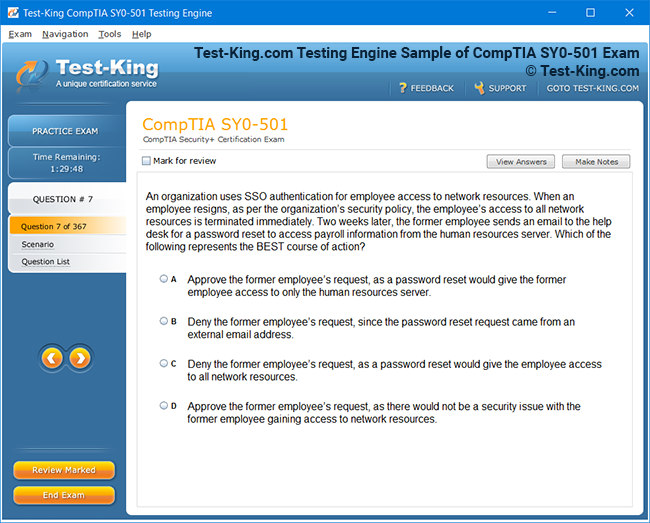
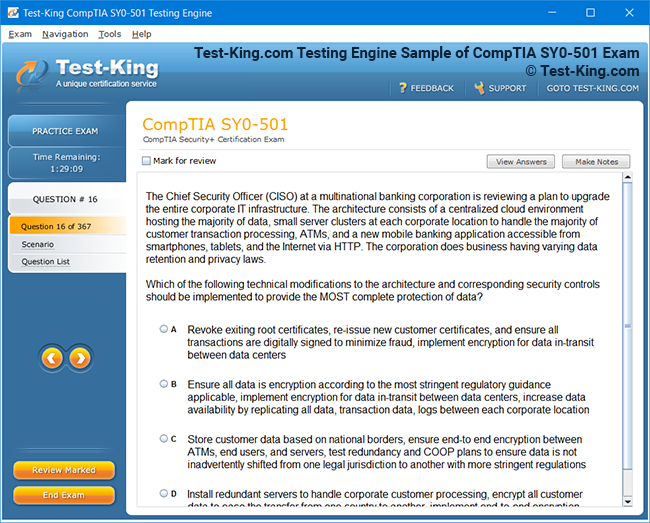
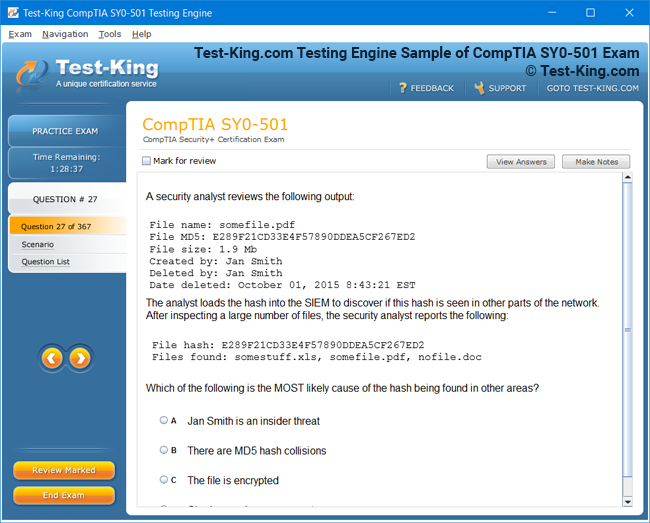
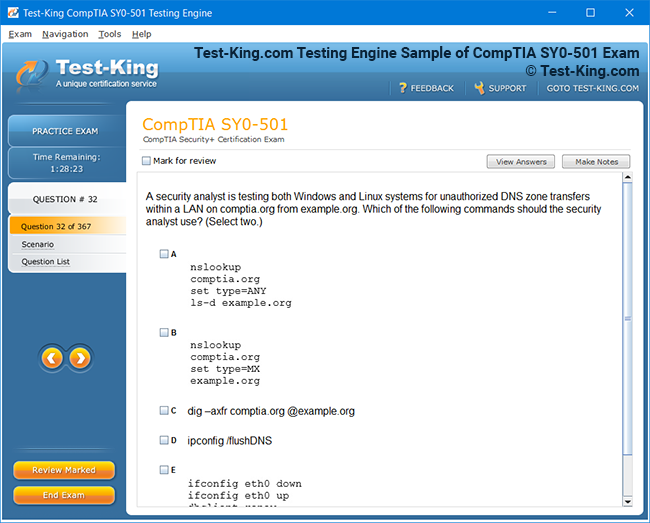
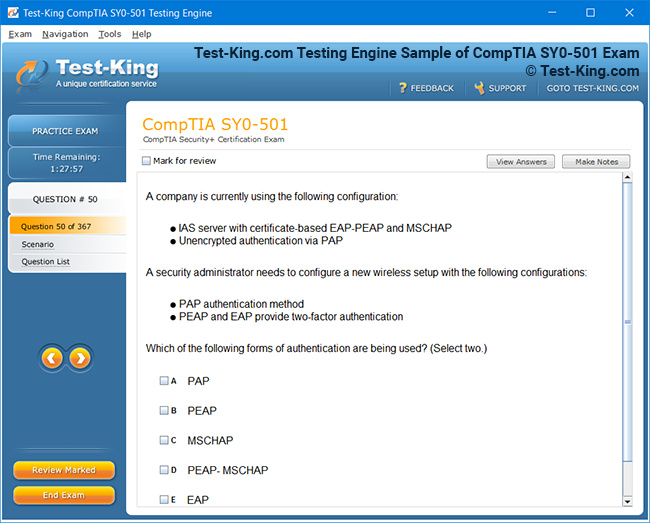
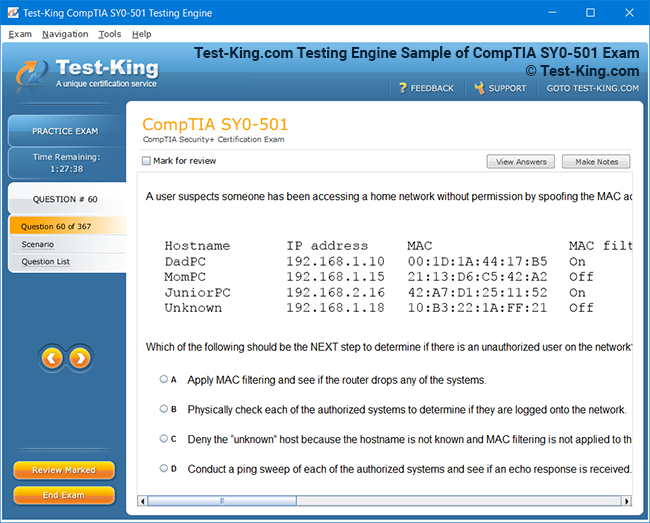
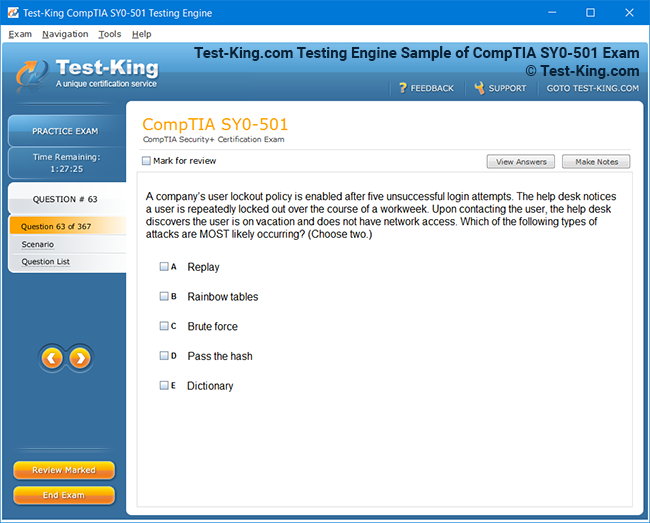
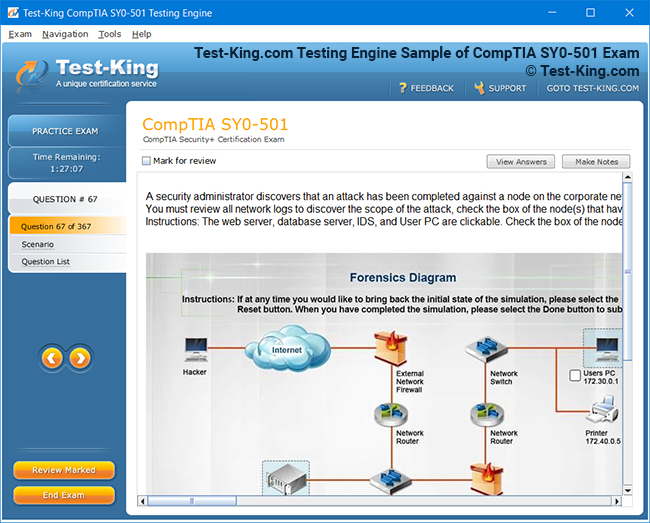
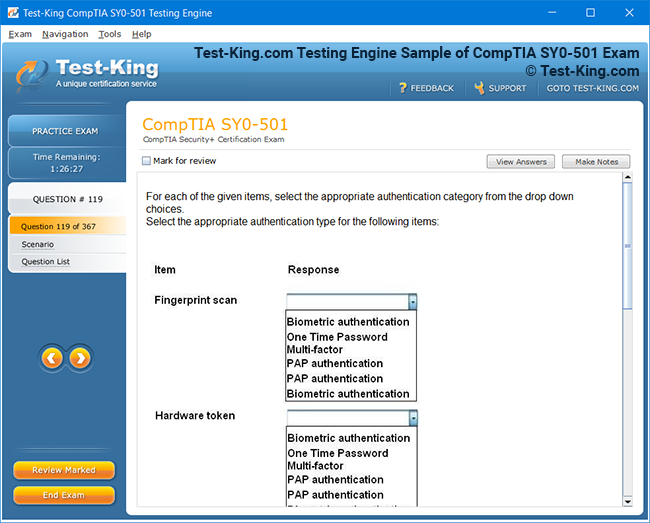
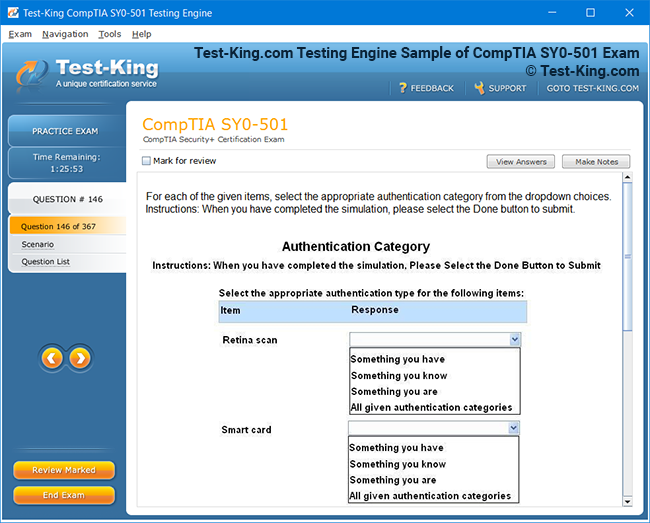
Product Screenshots
Frequently Asked Questions
How can I get the products after purchase?
All products are available for download immediately from your Member's Area. Once you have made the payment, you will be transferred to Member's Area where you can login and download the products you have purchased to your computer.
How long can I use my product? Will it be valid forever?
Test-King products have a validity of 90 days from the date of purchase. This means that any updates to the products, including but not limited to new questions, or updates and changes by our editing team, will be automatically downloaded on to computer to make sure that you get latest exam prep materials during those 90 days.
Can I renew my product if when it's expired?
Yes, when the 90 days of your product validity are over, you have the option of renewing your expired products with a 30% discount. This can be done in your Member's Area.
Please note that you will not be able to use the product after it has expired if you don't renew it.
How often are the questions updated?
We always try to provide the latest pool of questions, Updates in the questions depend on the changes in actual pool of questions by different vendors. As soon as we know about the change in the exam question pool we try our best to update the products as fast as possible.
How many computers I can download Test-King software on?
You can download the Test-King products on the maximum number of 2 (two) computers or devices. If you need to use the software on more than two machines, you can purchase this option separately. Please email support@test-king.com if you need to use more than 5 (five) computers.
What is a PDF Version?
PDF Version is a pdf document of Questions & Answers product. The document file has standart .pdf format, which can be easily read by any pdf reader application like Adobe Acrobat Reader, Foxit Reader, OpenOffice, Google Docs and many others.
Can I purchase PDF Version without the Testing Engine?
PDF Version cannot be purchased separately. It is only available as an add-on to main Question & Answer Testing Engine product.
What operating systems are supported by your Testing Engine software?
Our testing engine is supported by Windows. Andriod and IOS software is currently under development.
Top Huawei Exams
- H12-821 - HCIP-Datacom-Core Technology V1.0
- H12-811_V2.0 - HCIA-Datacom V2.0
- H12-811 - HCIA-Datacom V1.0
- H13-611 - HCIA-Storage
- H13-624_V5.5 - HCIP-Storage V5.5
- H19-301 - Huawei Certified Pre-sales Associate-IP Network(Datacom)-ENU
- H19-308 - HCSA-Presales-Storage V4.0
- H12-831 - HCIP-Datacom-Advanced Routing & Switching Technology
- H19-338_V3.0 - HCSP-Presales-Storage V3.0
- H19-101_V6.0 - HCSA-Sales-IP Network V6.0
- H19-401_V2.0 - HCSP-Presales-Campus Network Planning and Design V2.0
- H13-624 - HCIP-Storage V5.0
- H12-891 - HCIE-Datacom
- H35-210_V2.5 - HCIA-Access V2.5
- H12-711_V4.0 - HCIA-Security V4.0
- H13-629 - HCIE-Storage
- H12-323_V2.0 - HCIP-WLAN V2.0
- H13-821_V3.5 - HCIP-Cloud Service Solutions Architect V3.5
- H12-351 - HCIE-WLAN (Written) V1.0
- H35-651_V1.0 - HCIP-5G-Core V1.0
- H19-110_V2.0 - HCSA-Sales-Storage V2.0
- H11-851 - HCNA-VC (Huawei Certified Network Associate - Video Conference)
- H12-841_V1.5 - HCIP-Datacom-Campus Network Planning and Deployment V1.5
- H19-461_V1.0 - HCSP-Presales-Transmission V1.0
- H13-811_V2.2 - HCIA-Cloud Service V2.2
H13-341: Step-by-Step Preparation Plan for the Huawei Certified Internetwork Expert Exam
The Huawei Certified Internetwork Expert - Transmission exam, designated by the code H13-341, stands as a rigorous assessment designed for networking professionals aiming to demonstrate exceptional proficiency in transmission technologies, optical networking, and sophisticated network design principles. This examination is not merely an evaluation of rote memorization; it demands analytical reasoning, practical application, and a comprehensive grasp of Huawei’s network infrastructure methodologies. Candidates seeking to excel in this certification must immerse themselves in a multidimensional study regimen that encompasses theoretical constructs, practical lab exercises, and scenario-based problem solving.
Understanding the Huawei Certified Internetwork Expert Transmission Exam
The H13-341 exam evaluates several critical domains. These include the architecture of optical transport networks, multiplexing and switching technologies, the intricacies of wavelength division multiplexing, and the configuration of high-speed transmission systems. Each topic area requires mastery over not only the foundational principles but also the nuances of practical deployment. Understanding these technologies in isolation is insufficient; a successful candidate must recognize how these elements integrate into complex network topologies and real-world operational environments.
Core Knowledge Areas for Mastery
The foundational domain of the Huawei Certified Internetwork Expert Transmission exam encompasses optical network architecture, which forms the backbone of high-capacity communication infrastructures. Candidates must comprehend the functionality of synchronous digital hierarchy, time division multiplexing, and optical transport network layers. Furthermore, expertise in the principles of optical signal transmission, including attenuation, dispersion, and non-linear effects, is crucial. A thorough understanding of these physical layer characteristics allows candidates to anticipate performance bottlenecks and devise mitigation strategies with precision.
In addition to optical fundamentals, the examination emphasizes network planning and design. Candidates are expected to articulate methodologies for traffic engineering, wavelength assignment, and path computation within a dense wavelength division multiplexing environment. The evaluation also covers redundancy strategies, survivability mechanisms, and the implementation of protection switching protocols to maintain network resilience. These concepts often appear as scenario-based questions, requiring candidates to apply analytical reasoning to optimize network performance under diverse operational constraints.
Another critical area involves equipment and protocol comprehension. Candidates must demonstrate knowledge of Huawei-specific transmission devices, including optical cross-connects, multi-service provisioning platforms, and high-speed routers. Understanding the interoperability between these devices and the configuration of management protocols such as GMPLS and OTN control plane protocols is imperative. Mastery over these components enables candidates to troubleshoot complex network anomalies, ensuring seamless data transport across multifaceted infrastructures.
Effective Study Techniques and Resource Utilization
Achieving proficiency in the Huawei Certified Internetwork Expert Transmission examination requires a strategic blend of theoretical study and hands-on practice. Initiating preparation with an exhaustive review of Huawei’s official documentation and recommended learning paths ensures that candidates are familiar with both the breadth and depth of required knowledge. Detailed study guides provide structured explanations of optical network concepts, transmission system design, and equipment configuration, while offering illustrative examples that translate abstract theory into practical understanding.
Incorporating laboratory exercises into the preparation plan is equally indispensable. Practical engagement with network simulators or physical testbeds allows candidates to configure optical circuits, establish protection schemes, and validate wavelength assignment strategies. This experiential learning cultivates an intuitive understanding of transmission technologies, reinforcing concepts that might otherwise remain abstract in textual study. Additionally, repeated exposure to troubleshooting exercises builds the candidate’s analytical agility, enabling rapid diagnosis and resolution of network issues, a skill that is extensively evaluated in the examination.
Another effective technique involves collaborative learning and peer discussion. Engaging with professional forums, study groups, or mentorship arrangements provides exposure to diverse problem-solving approaches and alternative network design strategies. Candidates benefit from analyzing real-world case studies, where operational decisions hinge on balancing cost, redundancy, and performance objectives. These discussions often illuminate subtle aspects of transmission engineering that formal documentation may only briefly mention, fostering a more holistic comprehension of the field.
Integrating Knowledge Through Scenario-Based Practice
The Huawei Certified Internetwork Expert Transmission examination heavily incorporates scenario-based questions that simulate real-world network challenges. These scenarios require candidates to integrate multiple knowledge domains, from optical signal behavior to equipment configuration and traffic engineering. For instance, a candidate may be asked to design a high-capacity transport route between geographically dispersed data centers, optimizing wavelength allocation while ensuring network resiliency. Success in such tasks demands not only technical knowledge but also strategic foresight, including the anticipation of potential failures and the implementation of redundant paths.
To navigate these scenarios effectively, candidates should adopt a problem-solving mindset, systematically analyzing each requirement and constraint. Techniques such as flow mapping, capacity forecasting, and failure impact assessment are instrumental in constructing viable network designs. By consistently practicing scenario-based exercises, candidates cultivate an adaptive reasoning capability that transcends rote memorization, allowing them to respond confidently to novel questions during the examination.
Optimizing Time and Knowledge Retention
Preparation for the Huawei Certified Internetwork Expert Transmission exam is not solely about content mastery; it also involves the optimization of study schedules and cognitive endurance. Developing a structured timetable that allocates focused periods to theory, practical exercises, and review sessions enhances retention and reduces cognitive fatigue. Incorporating spaced repetition and interleaved practice, where concepts are revisited at strategically spaced intervals, significantly improves long-term memory consolidation, a crucial factor when confronting a comprehensive exam.
Furthermore, reflective practice serves as a powerful tool for internalizing complex concepts. Candidates should routinely self-assess their understanding by attempting mock examinations and evaluating performance critically. Identifying areas of weakness allows for targeted study, ensuring that no domain is neglected. This iterative approach, combining assessment, reflection, and targeted reinforcement, builds a resilient foundation that prepares candidates for both the predictable and unpredictable elements of the Huawei H13-341 examination.
Mental Preparedness and Professional Mindset
Equally important to technical preparation is the cultivation of a professional mindset. Candidates undertaking the Huawei Certified Internetwork Expert Transmission examination are expected to demonstrate not only technical acumen but also logical clarity, composure under pressure, and ethical judgment. Developing strategies to manage stress, maintain focus, and approach each question analytically can significantly influence performance. Techniques such as mental rehearsal, visualization of network scenarios, and strategic pacing during practice sessions foster a calm and focused approach, allowing candidates to navigate complex questions with confidence.
Additionally, understanding the broader context of network engineering enriches preparation. Recognizing trends in optical networking, emerging technologies, and industry best practices provides perspective that informs both exam performance and practical application. Candidates who contextualize their knowledge within real-world operational environments are better equipped to interpret scenario-based questions accurately and devise solutions that are both technically sound and pragmatically viable.
Enhancing Conceptual Mastery in Optical Transmission Technologies
To excel in the Huawei Certified Internetwork Expert Transmission examination, it is crucial to move beyond surface-level comprehension and cultivate profound conceptual mastery of optical transmission technologies. Candidates must explore the underlying principles of light propagation, understanding how wavelength, polarization, and nonlinear optical effects influence signal integrity across diverse network topologies. Attenuation, chromatic dispersion, and polarization mode dispersion are not merely theoretical concepts but practical challenges that network engineers encounter in high-speed transmission networks. A sophisticated grasp of these phenomena allows candidates to anticipate signal degradation, optimize channel allocation, and apply appropriate compensation techniques.
Multiplexing technologies are central to this examination. Dense wavelength division multiplexing, coarse wavelength division multiplexing, and optical time-division multiplexing each offer distinct advantages and require nuanced understanding. Candidates should focus on how these methods enable efficient bandwidth utilization, reduce latency, and enhance network scalability. Real-world scenarios often require an integrated application of multiplexing strategies, where wavelength assignment, channel spacing, and optical amplification must be balanced to achieve optimal performance. Engaging with these concepts analytically prepares candidates for scenario-based questions that test both technical knowledge and problem-solving ingenuity.
Deep Dive into Network Planning and Traffic Engineering
Network planning and traffic engineering form the backbone of the Huawei H13-341 exam. Effective network design requires meticulous attention to detail, including the mapping of logical and physical topologies, evaluation of traffic patterns, and projection of capacity requirements. Candidates must understand not only how to plan for current demands but also how to forecast future growth, ensuring that networks remain robust and scalable over time. Concepts such as traffic grooming, dynamic bandwidth allocation, and quality of service differentiation are frequently tested in scenario-based questions.
Redundancy strategies and protection mechanisms are equally vital. Optical networks rely on diverse techniques, including 1+1 protection, shared backup paths, and automatic protection switching, to ensure continuity during failures. Candidates should internalize the principles of survivability design, understanding how to balance cost, complexity, and reliability. Scenario questions often present hypothetical failures in high-capacity links or optical nodes, requiring candidates to determine the most effective protection strategy to maintain service continuity while minimizing resource consumption.
Equipment Familiarity and Configuration Expertise
A thorough understanding of Huawei-specific transmission devices is indispensable for examination success. Candidates should familiarize themselves with optical cross-connects, multi-service provisioning platforms, and high-capacity routers, exploring both their functional characteristics and operational configurations. Mastery over management protocols, including GMPLS and OTN control plane protocols, is crucial. Candidates need to comprehend how these protocols facilitate resource allocation, path computation, and network automation, providing both operational efficiency and resilience.
Practical experience with configuration exercises significantly enhances retention and understanding. By simulating real-world scenarios, candidates can practice setting up optical circuits, configuring protection mechanisms, and validating wavelength assignments. This hands-on approach solidifies theoretical knowledge, transforming abstract principles into actionable skills. Additionally, repeated engagement with equipment scenarios enhances analytical flexibility, preparing candidates to address complex questions that integrate multiple domains, such as combining optical transport principles with traffic engineering considerations.
Scenario-Based Learning and Problem Solving
The Huawei Certified Internetwork Expert Transmission examination emphasizes scenario-based problem solving. Questions often simulate operational challenges where candidates must analyze a network scenario, identify constraints, and propose solutions that optimize performance, reliability, and scalability. For example, a scenario may present a geographically distributed network requiring high-speed interconnects, constrained by limited optical channels and the need for protection mechanisms. Candidates must synthesize knowledge of optical signal behavior, multiplexing strategies, and equipment configuration to generate effective solutions.
Developing a systematic approach to these scenarios is advantageous. Candidates should evaluate each scenario by mapping network topologies, assessing resource availability, and identifying potential failure points. Analytical techniques such as path computation, traffic simulation, and bottleneck analysis provide structured methods for generating robust solutions. Scenario-based practice not only reinforces technical knowledge but also cultivates adaptive reasoning, enabling candidates to respond effectively to novel challenges presented during the examination.
Optimization of Study Schedule and Cognitive Retention
A structured and efficient study schedule is instrumental for successful preparation. Candidates should allocate dedicated intervals for theoretical review, hands-on lab practice, and scenario-based exercises. Spaced repetition enhances long-term retention, ensuring that complex concepts such as optical signal propagation, multiplexing technologies, and protection mechanisms remain accessible during examination conditions. Interleaving topics, where different domains are studied in rotation, encourages cognitive flexibility, enabling candidates to integrate knowledge across domains when confronted with multifaceted questions.
Reflective practice further enhances understanding. By reviewing practice scenarios and mock examinations, candidates can identify areas of weakness, adjust study strategies, and reinforce knowledge in targeted domains. Reflecting on mistakes, understanding their root causes, and integrating corrective strategies cultivates a resilient learning approach. This method ensures that candidates not only memorize procedures but also internalize principles, enabling the application of knowledge in diverse, unpredictable situations.
Cultivating Analytical and Professional Mindset
Success in the Huawei H13-341 examination is as much about mindset as technical knowledge. Candidates must develop the capacity to approach questions analytically, manage stress under timed conditions, and maintain focus throughout the examination. Mental preparedness techniques such as visualization of network configurations, rehearsal of scenario-based problem solving, and strategic pacing during practice exercises enhance cognitive performance. These approaches help candidates navigate complex questions with clarity, precision, and confidence.
Understanding broader trends in network engineering enriches preparation. Knowledge of emerging optical technologies, industry best practices, and real-world operational challenges provides context that informs analytical reasoning. Candidates who integrate this awareness with technical expertise demonstrate a professional mindset, capable of devising solutions that are not only correct but operationally viable. This holistic perspective is often reflected in scenario-based questions, where evaluators seek candidates who can synthesize multiple knowledge domains to deliver optimized, pragmatic solutions.
In-Depth Understanding of Optical Network Layers
A profound understanding of optical network layers is paramount for success in the Huawei Certified Internetwork Expert Transmission examination. Candidates must explore the intricacies of the optical transport network, delving into both the physical and logical layers that govern high-speed data transmission. The physical layer encompasses fiber types, signal attenuation, dispersion, and the behavior of optical amplifiers, while the logical layer addresses the arrangement of paths, wavelength routing, and the implementation of control protocols. Recognizing how these layers interconnect provides the analytical foundation for designing resilient and efficient networks.
Candidates should focus on signal propagation characteristics, including nonlinear effects, four-wave mixing, and polarization mode dispersion, as these factors directly influence network performance. Optical amplification techniques, such as erbium-doped fiber amplifiers and Raman amplification, must also be thoroughly understood, including their influence on signal-to-noise ratio and channel stability. By integrating these elements into practical scenarios, candidates gain the capacity to predict network behavior, identify potential bottlenecks, and implement solutions that optimize throughput and reliability.
Advanced Multiplexing and Switching Strategies
Multiplexing remains a central theme in the Huawei H13-341 examination. Beyond basic dense wavelength division multiplexing, candidates must comprehend advanced strategies that enhance spectral efficiency, reduce latency, and accommodate high-capacity traffic demands. Time-division multiplexing, optical packet switching, and hybrid multiplexing techniques require detailed analysis, particularly in complex topologies where multiple factors, including wavelength contention, path redundancy, and node survivability, must be balanced.
Switching technologies are equally critical. Optical cross-connects, reconfigurable add-drop multiplexers, and integrated multi-service platforms enable dynamic traffic rerouting, resource allocation, and fault recovery. Candidates must not only understand device functionality but also the practical application of switching strategies to maintain network continuity. Scenario-based questions often challenge candidates to implement switching architectures that meet strict performance criteria while adhering to cost and resource constraints, necessitating an integrated approach that combines theoretical knowledge with practical insight.
Network Planning Under Operational Constraints
Effective network planning is a sophisticated exercise that involves evaluating traffic patterns, predicting future capacity requirements, and optimizing topological arrangements. Candidates are expected to design networks that balance efficiency, resilience, and scalability. Techniques such as traffic grooming, bandwidth forecasting, and path computation are essential for managing high-capacity optical channels. Real-world planning often involves trade-offs between performance optimization and resource utilization, and candidates must develop strategies to achieve both objectives simultaneously.
Protection and redundancy mechanisms are integral to this planning. Candidates should become adept at designing resilient architectures using techniques like 1+1 protection, shared backup paths, and fast reroute strategies. Scenario-based questions frequently present simulated failures or high-load conditions, requiring candidates to implement solutions that sustain service continuity and minimize packet loss. By repeatedly practicing these scenarios, candidates cultivate the ability to anticipate network challenges and respond with well-reasoned, technically sound solutions.
Practical Exercises for Skill Reinforcement
Hands-on practice is essential for internalizing theoretical concepts. Candidates should engage in exercises that involve configuring optical circuits, setting up protection mechanisms, and performing traffic simulations. Practical experimentation reinforces understanding of complex topics, such as wavelength assignment, optical signal behavior, and dynamic resource allocation. Repeated engagement with these exercises cultivates procedural fluency and develops an intuitive sense of network behavior, which is critical when confronted with scenario-based questions in the examination.
Additionally, practicing troubleshooting exercises is invaluable. Candidates should analyze network anomalies, identify root causes, and implement corrective measures. Common scenarios include signal degradation, channel interference, or equipment misconfiguration. These exercises not only enhance technical proficiency but also develop problem-solving agility, allowing candidates to address unexpected challenges with confidence and precision.
Scenario-Based Analytical Techniques
Scenario-based questions dominate the Huawei Certified Internetwork Expert Transmission exam. Candidates are presented with complex, real-world network challenges that require the integration of multiple knowledge domains. For example, a scenario may involve optimizing a high-capacity optical backbone connecting multiple metropolitan areas, with constraints on wavelength allocation, protection paths, and latency requirements. Candidates must evaluate network topologies, predict traffic behavior, and apply advanced multiplexing and switching strategies to meet stringent performance criteria.
Developing a systematic analytical approach is essential. Candidates should begin by mapping the network, identifying constraints and resources, and simulating potential failures. Techniques such as path computation, capacity analysis, and failure impact assessment provide a structured framework for generating solutions. Scenario-based practice enhances cognitive flexibility, allowing candidates to adapt their reasoning to novel situations, synthesize knowledge across domains, and propose solutions that are both technically robust and operationally feasible.
Optimizing Study Techniques and Cognitive Retention
Achieving mastery requires an effective study strategy that balances depth and breadth. Candidates should employ spaced repetition to reinforce complex concepts over time, ensuring retention of topics such as optical signal propagation, network design, and equipment configuration. Interleaving different domains, such as combining theoretical study with practical exercises, strengthens cognitive connections and enhances problem-solving capability. Reflective practice, where candidates review performance on mock scenarios and identify areas for improvement, further consolidates understanding and builds adaptive expertise.
Developing mental endurance and focus is also critical. Candidates should cultivate strategies to manage stress, maintain attention during extended examination periods, and approach each question methodically. Techniques such as mental visualization of network configurations, rehearsal of scenario-based problem solving, and strategic pacing during practice sessions support cognitive resilience. This mental preparation complements technical knowledge, equipping candidates with the clarity and confidence required to navigate complex questions under time constraints.
Professional Mindset and Industry Awareness
Candidates preparing for the Huawei Certified Internetwork Expert Transmission examination benefit from adopting a professional mindset that integrates technical expertise with strategic reasoning. Understanding emerging trends in optical networking, industry best practices, and operational challenges provides context that informs decision-making. Candidates who approach network design and troubleshooting with this holistic perspective are better equipped to interpret complex scenario-based questions and deliver solutions that are both effective and practical.
Ethical and strategic considerations also play a role. Candidates must recognize the importance of operational reliability, resource optimization, and adherence to organizational standards when proposing network solutions. This professional orientation enhances both examination performance and real-world applicability, fostering a mindset that values precision, foresight, and responsible decision-making in high-stakes network engineering contexts.
Profound Understanding of Optical Transmission Principles
Achieving mastery in the Huawei Certified Internetwork Expert Transmission examination demands a thorough comprehension of optical transmission principles. Candidates must explore the subtle interplay between light propagation and network performance, including the impact of attenuation, chromatic and polarization mode dispersion, and nonlinear optical phenomena on signal fidelity. A nuanced understanding of these factors allows network engineers to anticipate degradation, implement compensation techniques, and design networks that maintain high throughput even under complex operating conditions. The examination often evaluates candidates’ ability to apply these concepts analytically, requiring the synthesis of physical principles with practical network design considerations.
Optical amplification and regeneration form a critical component of high-speed networks. Candidates must understand the operational characteristics of erbium-doped fiber amplifiers, Raman amplifiers, and dispersion compensation modules, including their influence on optical signal-to-noise ratios, channel crosstalk, and overall network efficiency. Integrating these technologies into practical design scenarios enhances candidates’ ability to optimize network performance while maintaining operational stability, a skill frequently tested through scenario-based questions.
Advanced Techniques in Multiplexing and Wavelength Management
Multiplexing is central to the examination, and candidates are expected to demonstrate proficiency with both fundamental and advanced methods. Dense wavelength division multiplexing, coarse wavelength division multiplexing, and optical time-division multiplexing each present distinct challenges in bandwidth utilization, latency reduction, and network scalability. Effective mastery requires analyzing how multiplexing strategies interact with optical impairments, channel spacing, and amplifier configurations to optimize the utilization of available fiber infrastructure.
Wavelength management is another key focus. Candidates should understand channel assignment algorithms, wavelength continuity constraints, and spectrum optimization strategies. Scenario-based questions often require candidates to design wavelength allocation schemes that maximize network capacity, minimize interference, and accommodate future expansion. Practicing these scenarios builds the ability to balance technical trade-offs with operational feasibility, preparing candidates to tackle complex problems that integrate multiple optical and network design domains.
Network Design and Traffic Engineering
In-depth knowledge of network planning and traffic engineering is essential. Candidates must be able to forecast traffic patterns, optimize topological arrangements, and allocate resources efficiently across high-capacity networks. Techniques such as traffic grooming, path computation, and bandwidth reservation are crucial for ensuring that data flows seamlessly even during peak demand periods. Scenario-based questions frequently simulate network congestion, requiring candidates to identify bottlenecks, propose rerouting strategies, and implement load-balancing mechanisms that maintain service quality without excessive resource consumption.
Redundancy and protection strategies are integral to this aspect of preparation. Candidates should be proficient in designing networks with 1+1 protection, shared backup paths, and fast reroute mechanisms to guarantee survivability under failure conditions. Simulated failures in high-capacity links, node outages, or optical channel degradation are common in examination scenarios, challenging candidates to apply both theoretical knowledge and practical experience to maintain uninterrupted service while optimizing network efficiency.
Hands-On Practical Exercises
Engaging in practical exercises is indispensable for solidifying theoretical knowledge. Candidates are encouraged to simulate optical circuits, configure protection paths, and conduct traffic simulations in controlled environments. These exercises reinforce the understanding of wavelength allocation, signal degradation, and protection mechanisms while developing procedural fluency. Repetition fosters both technical skill and intuitive comprehension, enabling candidates to respond efficiently to complex, multi-faceted questions.
Troubleshooting exercises complement configuration practice. Candidates analyze network anomalies, identify the root causes of performance issues, and implement corrective measures. Scenarios such as unexpected signal attenuation, channel crosstalk, or misconfigured equipment provide realistic challenges that enhance problem-solving agility. This combination of theoretical understanding and hands-on practice ensures candidates are well-prepared to navigate the dynamic and intricate questions presented during the Huawei H13-341 examination.
Scenario-Based Analytical Reasoning
Scenario-based analysis is a cornerstone of the examination. Candidates are presented with comprehensive network challenges that require integrating multiple technical domains. For instance, a scenario might involve optimizing a high-capacity optical backbone connecting metropolitan areas, balancing wavelength assignment, protection paths, and latency constraints while ensuring network resilience. Success requires mapping the network, identifying operational constraints, simulating failure conditions, and proposing robust solutions.
Structured analytical approaches improve performance in these scenarios. Techniques such as path computation, capacity planning, failure impact analysis, and iterative optimization enable candidates to systematically evaluate each challenge and derive technically sound solutions. Regular practice with scenario-based exercises enhances cognitive flexibility, allowing candidates to synthesize knowledge across domains and apply it effectively under timed examination conditions.
Optimizing Study Techniques and Cognitive Performance
Maximizing cognitive retention and efficiency is critical for success. Candidates should employ spaced repetition to reinforce complex concepts over time, interleaving study topics to strengthen connections between different knowledge domains. Combining theoretical study, practical exercises, and scenario analysis encourages holistic understanding and problem-solving proficiency. Reflective practice, where candidates review performance on mock scenarios and identify areas for improvement, supports continuous refinement of skills and knowledge.
Mental preparedness also plays a pivotal role. Strategies such as visualization of network topologies, rehearsal of scenario-based problem solving, and time management during practice sessions foster focus, composure, and confidence. Developing mental resilience ensures candidates can navigate complex, multi-layered questions efficiently, reducing errors caused by stress or cognitive overload.
Professional Insight and Industry Perspective
Beyond technical mastery, candidates benefit from cultivating a professional mindset and awareness of industry trends. Understanding emerging optical networking technologies, operational best practices, and practical deployment challenges enriches analytical reasoning and enhances the application of knowledge to scenario-based problems. Candidates who integrate operational, strategic, and technical perspectives are better positioned to devise solutions that are both effective and pragmatically viable.
Ethical considerations and operational responsibility are equally significant. Designing networks that optimize performance while adhering to organizational standards, safety protocols, and resource efficiency reflects a professional approach valued in both the examination and real-world environments. Integrating these insights with technical expertise ensures candidates can propose solutions that balance innovation, reliability, and operational practicality.
Mastering Optical Signal Propagation and Impairments
Success in the Huawei Certified Internetwork Expert Transmission examination requires a deep understanding of optical signal propagation and the variety of impairments that can affect high-speed networks. Candidates must explore attenuation, chromatic and polarization mode dispersion, nonlinear effects, and four-wave mixing. Understanding these phenomena allows network engineers to anticipate performance degradation, implement compensation techniques, and ensure reliable data transport across long distances. These concepts are frequently evaluated through scenario-based questions that test the candidate's ability to apply theoretical principles to real-world network challenges.
Candidates should focus on the relationship between optical signal characteristics and network performance. For instance, the impact of fiber type, amplification, and wavelength on signal integrity must be understood in detail. By analyzing practical scenarios, such as extended backbone networks or high-capacity metro ring topologies, candidates learn to optimize optical channel allocation and implement mechanisms to mitigate impairments, ensuring a balance between performance, reliability, and efficiency.
Advanced Multiplexing and Switching Concepts
Multiplexing strategies are critical for managing bandwidth in modern optical networks. Candidates are expected to demonstrate expertise in dense wavelength division multiplexing, coarse wavelength division multiplexing, optical time-division multiplexing, and hybrid multiplexing configurations. Advanced knowledge of these technologies includes understanding channel spacing, spectral efficiency, and the interaction between multiplexing techniques and optical impairments. Scenario-based examination questions often present challenges where candidates must design multiplexed networks to maximize capacity while maintaining resilience under varying operational constraints.
Switching technologies complement multiplexing in optimizing network performance. Candidates should understand the functions of optical cross-connects, reconfigurable add-drop multiplexers, and multi-service platforms, particularly their role in dynamic resource allocation and fault recovery. Scenarios may require the implementation of switching architectures that support traffic rerouting, bandwidth reservation, and protection mechanisms, testing the candidate’s ability to integrate multiple technologies into a coherent, high-performance network design.
Comprehensive Network Planning and Traffic Optimization
A thorough grasp of network planning and traffic engineering is indispensable. Candidates must be adept at predicting traffic patterns, estimating capacity requirements, and designing topologies that balance efficiency and redundancy. Techniques such as traffic grooming, load balancing, and path computation are crucial for maintaining seamless data flows, especially under peak loads. Scenario-based questions frequently simulate congested networks, requiring candidates to identify bottlenecks, propose optimal routing strategies, and ensure high service quality without unnecessary resource consumption.
Redundancy and survivability are integral to advanced planning. Candidates must be proficient in designing networks with 1+1 protection, shared backup paths, and fast reroute mechanisms to ensure continuity during failures. Simulated network disruptions, such as fiber cuts, equipment malfunctions, or sudden traffic spikes, test the candidate’s ability to apply theoretical knowledge and practical skills to maintain reliable operation, optimize resource usage, and minimize latency or packet loss.
Hands-On Configuration and Simulation Exercises
Practical exercises are essential for reinforcing theoretical knowledge. Candidates should engage in activities that involve configuring optical circuits, establishing protection mechanisms, and simulating traffic flows. These exercises help candidates internalize concepts such as wavelength allocation, optical signal propagation, and path computation. By repeatedly performing configuration and troubleshooting tasks, candidates develop procedural fluency and intuitive problem-solving skills that are critical for addressing complex scenario-based questions.
Troubleshooting exercises should simulate realistic network anomalies. Candidates might be required to identify the causes of signal degradation, misconfigured equipment, or traffic congestion and implement corrective measures. These practical experiences not only enhance technical competency but also cultivate the ability to think critically and adaptively under examination conditions, where time-efficient and accurate problem resolution is paramount.
Scenario-Based Analytical Techniques
Scenario-based analysis dominates the Huawei H13-341 examination. Candidates are often presented with complex network challenges that integrate multiple domains, requiring the application of optical transmission principles, equipment knowledge, traffic engineering, and fault management. For example, a scenario may describe a high-capacity optical backbone connecting multiple data centers, with constraints on wavelength availability, protection mechanisms, and latency requirements. Candidates must analyze these conditions, simulate potential failures, and propose solutions that optimize performance, resilience, and scalability.
Developing a structured analytical approach is critical. Candidates should evaluate scenarios by mapping network topologies, assessing resource constraints, simulating failure impacts, and applying iterative optimization techniques. Practicing these exercises repeatedly enhances cognitive flexibility, enabling candidates to synthesize knowledge across domains and generate solutions that are both technically robust and operationally feasible, even under high-pressure examination conditions.
Optimizing Study Schedules and Knowledge Retention
Maximizing study efficiency and long-term retention is crucial for candidates preparing for the Huawei Certified Internetwork Expert Transmission exam. Employing spaced repetition and interleaving study topics ensures that complex concepts, such as optical impairments, multiplexing strategies, and protection mechanisms, are deeply ingrained in memory. Integrating theoretical study with hands-on exercises and scenario analysis fosters a holistic understanding, promoting adaptive problem-solving skills that are essential for examination success.
Reflective practice is another critical tool. By reviewing performance in mock examinations and scenario-based exercises, candidates can identify weaknesses, refine strategies, and strengthen understanding in specific areas. This iterative process ensures that knowledge is not only memorized but also internalized, allowing candidates to apply concepts fluidly in varied and unpredictable examination scenarios.
Conclusion
Equally important to technical preparation is mental readiness and professional awareness. Candidates must cultivate focus, composure, and analytical clarity to navigate the intensive examination. Techniques such as mental visualization of network designs, rehearsal of problem-solving approaches, and effective time management during practice sessions help maintain performance under pressure. Mental resilience allows candidates to address complex, multi-layered questions with confidence and precision.
Awareness of industry trends and operational best practices enhances candidates’ ability to integrate technical knowledge with practical insight. Understanding emerging optical networking technologies, operational efficiency strategies, and reliability standards provides a broader context for decision-making in scenario-based questions. Candidates who approach problems with a professional mindset, balancing technical accuracy with operational feasibility, are better equipped to deliver solutions that reflect both expertise and practical wisdom.