

Exam Code: HPE6-A79
Exam Name: Aruba Certified Mobility Expert Written Exam
Certification Provider: HP
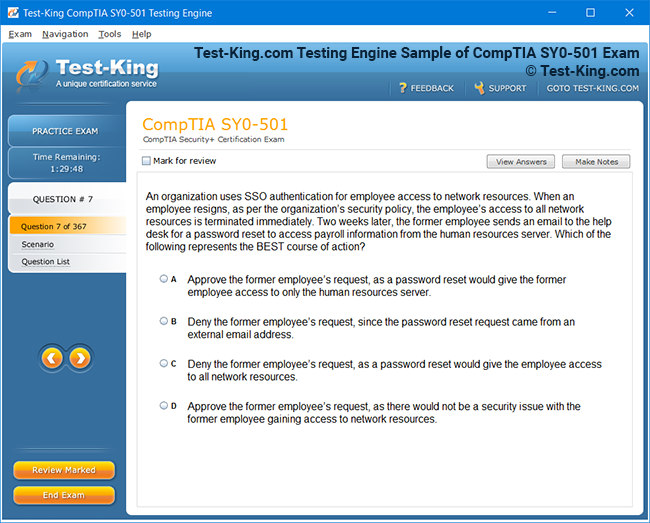
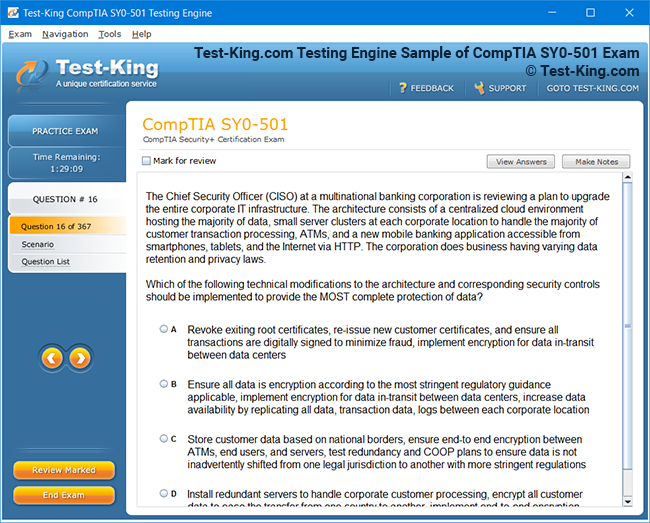
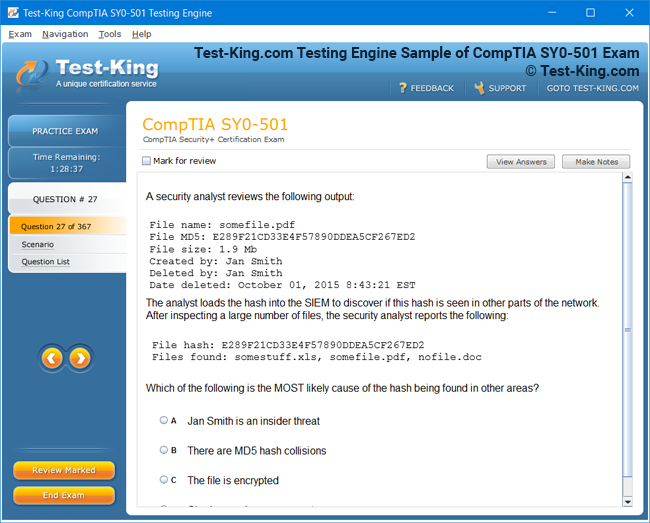
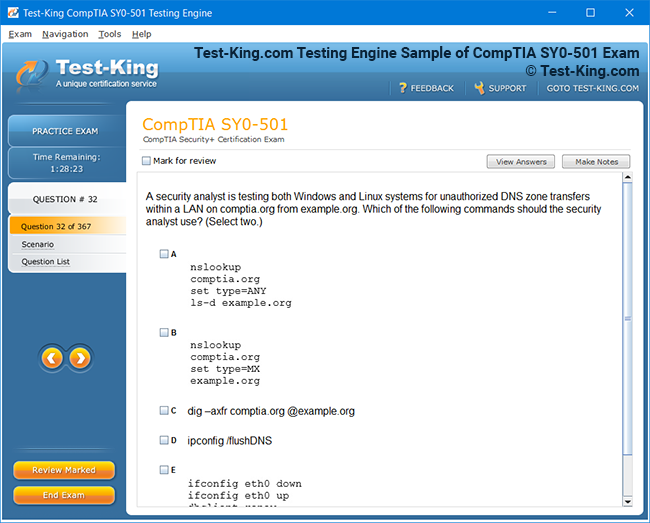
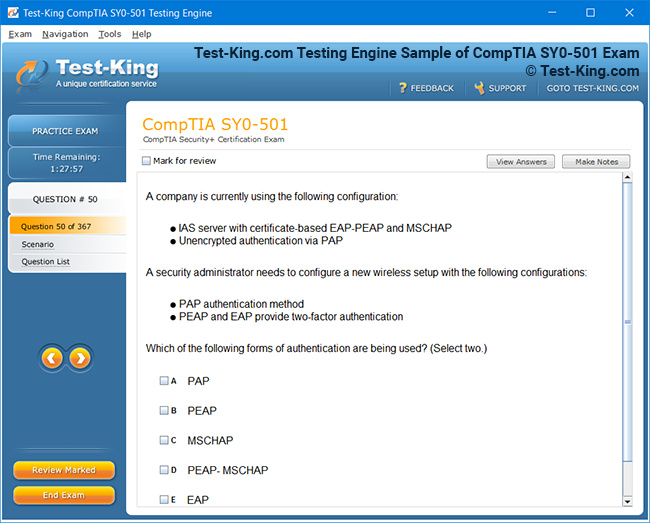
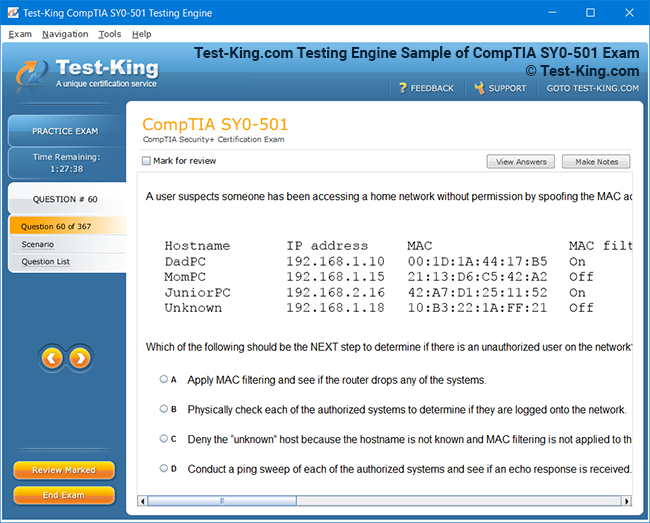
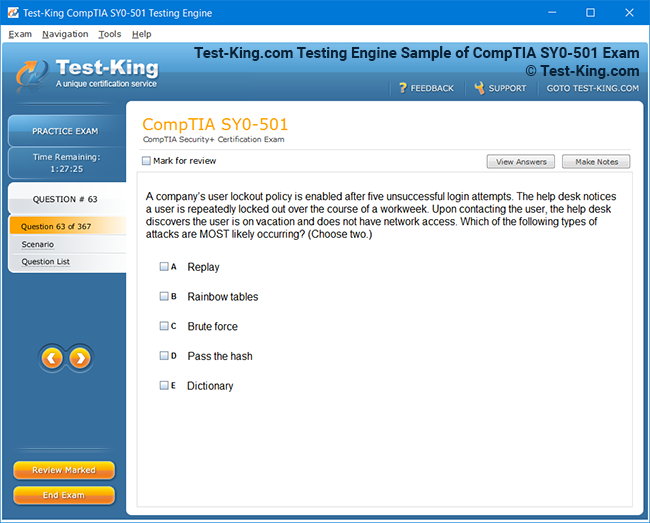
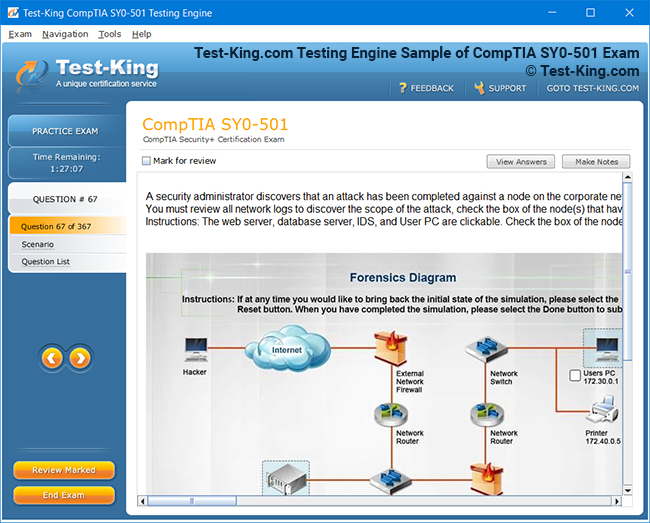
Product Screenshots
Frequently Asked Questions
How can I get the products after purchase?
All products are available for download immediately from your Member's Area. Once you have made the payment, you will be transferred to Member's Area where you can login and download the products you have purchased to your computer.
How long can I use my product? Will it be valid forever?
Test-King products have a validity of 90 days from the date of purchase. This means that any updates to the products, including but not limited to new questions, or updates and changes by our editing team, will be automatically downloaded on to computer to make sure that you get latest exam prep materials during those 90 days.
Can I renew my product if when it's expired?
Yes, when the 90 days of your product validity are over, you have the option of renewing your expired products with a 30% discount. This can be done in your Member's Area.
Please note that you will not be able to use the product after it has expired if you don't renew it.
How often are the questions updated?
We always try to provide the latest pool of questions, Updates in the questions depend on the changes in actual pool of questions by different vendors. As soon as we know about the change in the exam question pool we try our best to update the products as fast as possible.
How many computers I can download Test-King software on?
You can download the Test-King products on the maximum number of 2 (two) computers or devices. If you need to use the software on more than two machines, you can purchase this option separately. Please email support@test-king.com if you need to use more than 5 (five) computers.
What is a PDF Version?
PDF Version is a pdf document of Questions & Answers product. The document file has standart .pdf format, which can be easily read by any pdf reader application like Adobe Acrobat Reader, Foxit Reader, OpenOffice, Google Docs and many others.
Can I purchase PDF Version without the Testing Engine?
PDF Version cannot be purchased separately. It is only available as an add-on to main Question & Answer Testing Engine product.
What operating systems are supported by your Testing Engine software?
Our testing engine is supported by Windows. Andriod and IOS software is currently under development.
Top HP Exams
- HPE7-A01 - HPE Network Campus Access Professional
- HPE7-A08 - HPE Network Switching Professional
- HPE6-A85 - HPE Network Campus Access Associate
- HPE6-A86 - HPE Network Switching Associate
- HPE7-A11 - HPE Network Campus Access Professional Architect
- HPE0-V27 - HPE Edge-to-Cloud Solutions
- HPE0-J83 - HPE Storage Integrator Solutions
- HPE6-A90 - HPE Networking Central
- HPE7-J02 - Advanced HPE Storage Integrator Solutions
- HPE0-S59 - HPE Compute Solutions
- HPE0-J82 - HPE Storage Architect
- HPE7-A02 - Aruba Certified Network Security Professional
- HPE6-A88 - HPE Networking ClearPass
- HPE7-V01 - Advanced HPE Edge-to-Cloud Solutions
- HPE7-A10 - HPE Network Security Expert
- HPE7-S01 - Advanced HPE Compute Architect
- HPE7-A12 - HPE Network Data Center Professional Architect
- HPE7-A06 - HPE Aruba Networking Certified Expert - Campus Access Switching
- HPE7-S02 - Advanced HPE Compute Integrator Solutions
- HPE6-A68 - Aruba Certified ClearPass Professional (ACCP) V6.7
- HPE0-V25 - HPE Hybrid Cloud Solutions
- HPE2-T37 - Using HPE OneView
- HPE7-A07 - HPE Campus Access Mobility Expert
- HPE6-A78 - HPE Network Security Associate
Key Topics and Concepts Covered in the HPE6-A79 Exam
The Aruba Certified Mobility Expert Written Exam assesses a candidate’s deep comprehension of wireless networking, particularly in enterprise environments. A foundational area is understanding the architecture and deployment strategies of Aruba networks. Modern enterprises demand scalable, secure, and high-performance wireless infrastructure, which Aruba provides through integrated solutions encompassing controllers, access points, and cloud-based management platforms. Grasping the distinctions between controller-based, controllerless, and cloud-managed deployments is crucial. Controller-based deployments centralize policy management and enable sophisticated roaming capabilities, while controllerless architectures, often leveraging Instant Access Points, allow for distributed decision-making without the dependency on a central controller. Cloud-managed deployments facilitate orchestration across multiple sites and simplify configuration, monitoring, and policy enforcement through intuitive dashboards.
Understanding Aruba Mobility Architecture and Deployment Strategies
Designing an optimal Aruba network requires careful attention to site surveys, RF planning, and channel assignments. Candidates should understand how to calculate coverage areas, anticipate interference sources, and implement strategies such as band steering, load balancing, and airtime fairness. Knowledge of spectrum analysis tools and Aruba’s AirWave or Central platforms is essential for monitoring network performance, ensuring high availability, and troubleshooting issues in real time. Deployment strategies often integrate redundant uplinks, dynamic VLAN assignment, and quality of service (QoS) policies to maintain uninterrupted performance in high-density environments.
Wireless Protocols, Standards, and Security Mechanisms
A critical component of the exam revolves around wireless protocols and security mechanisms. Familiarity with IEEE 802.11 standards, including 802.11a/b/g/n/ac/ax, is indispensable. Understanding the nuances of each standard, such as maximum throughput, channel width, and modulation techniques, enables a candidate to design networks that meet both performance and scalability requirements. In addition to the physical and MAC layers, candidates must be proficient in wireless encryption protocols such as WPA3, WPA2-Enterprise, and legacy WEP. Aruba networks implement robust authentication mechanisms, including 802.1X with RADIUS integration, enabling role-based access control and dynamic VLAN assignment.
The intricacies of security extend to intrusion detection and prevention, rogue AP mitigation, and wireless policy enforcement. Aruba’s solutions include built-in capabilities for detecting anomalous traffic, mitigating potential threats, and isolating untrusted devices. Candidates should also be conversant with certificate-based authentication, pre-shared keys, and the deployment of secure guest networks to segregate visitor traffic from corporate resources. Understanding the interaction between wireless LAN controllers and security enforcement modules ensures a holistic approach to protecting sensitive enterprise data.
Advanced Mobility Concepts and Client Roaming
Enterprise mobility requires seamless connectivity as users move throughout physical spaces. The exam emphasizes the ability to configure and troubleshoot roaming, which depends on sophisticated algorithms to manage client handoffs between access points. Aruba implements both Layer 2 and Layer 3 roaming strategies to maintain persistent sessions for voice, video, and data applications. Knowledge of key parameters such as RSSI thresholds, client load, and AP capacity is vital for optimizing roaming performance.
The concept of client onboarding, including initial authentication, IP assignment, and policy enforcement, forms another core area. Candidates should understand the lifecycle of a wireless client within an Aruba environment, from detection and association to mobility and disassociation. Techniques such as fast roaming, PMK caching, and Opportunistic Key Caching (OKC) reduce latency during handoffs, which is critical for latency-sensitive applications like VoIP or real-time collaboration tools. Monitoring client behavior using Aruba’s network management tools allows administrators to proactively address coverage gaps and potential disruptions.
Network Services and Integration with Wired Infrastructure
The exam evaluates knowledge of integrating Aruba mobility solutions with existing wired infrastructure. Candidates must understand VLAN design, IP addressing schemes, and DHCP integration to ensure consistent policy enforcement and traffic segregation. Additionally, understanding how Aruba switches interact with wireless controllers and access points is necessary for maintaining end-to-end connectivity and optimizing traffic flows.
Dynamic Host Configuration Protocol (DHCP), Domain Name System (DNS), and multicast traffic handling are all essential for seamless application delivery across wireless networks. Aruba’s solutions provide mechanisms for managing QoS, prioritizing traffic based on application types, and supporting mission-critical workloads in converged environments. Integration with third-party security appliances, such as firewalls and intrusion prevention systems, further reinforces enterprise-grade protection and operational resilience.
Network Monitoring, Analytics, and Troubleshooting
Proficiency in monitoring and troubleshooting Aruba networks is a central theme. Candidates are expected to demonstrate expertise in using network management and analytics platforms to identify performance bottlenecks, detect misconfigurations, and optimize resource allocation. Tools such as Aruba Central provide real-time visibility into network health, device performance, and client behavior, enabling administrators to make data-driven decisions.
Troubleshooting scenarios often involve interpreting RF interference patterns, identifying rogue devices, or resolving authentication failures. Understanding common wireless issues, such as co-channel interference, overlapping channels, and signal attenuation due to physical obstacles, equips candidates to implement corrective measures. Logs, alerts, and historical data from Aruba controllers and APs assist in pinpointing the root cause of network disruptions, while proactive monitoring ensures that potential issues are mitigated before affecting users.
Policy Management, Access Control, and Role-Based Networking
Aruba emphasizes the importance of granular policy management and access control in enterprise mobility environments. Candidates must be able to configure and enforce role-based access policies that determine which devices, users, or applications can access specific resources. This involves integrating identity sources such as Active Directory or LDAP, configuring authentication methods, and defining dynamic access privileges.
Role-based networking ensures that different categories of users—employees, guests, and contractors—receive appropriate levels of access without compromising security. Advanced features, such as device fingerprinting and contextual awareness, allow the network to adapt policies based on device type, location, and behavior. Knowledge of firewall rules, VLAN assignments, and traffic shaping contributes to building a resilient, secure, and high-performing network environment.
Wireless LAN Optimization and Performance Enhancement
Optimizing wireless LAN performance is another core focus. Candidates must understand mechanisms for load balancing, airtime management, and interference mitigation. Aruba implements sophisticated algorithms to manage channel selection, power levels, and client distribution across access points, ensuring equitable resource allocation in high-density deployments.
Performance tuning also involves analyzing application traffic, identifying bandwidth-intensive workflows, and configuring QoS policies to prioritize critical services. Wireless LAN optimization is a continuous process, requiring ongoing monitoring and fine-tuning to accommodate evolving user patterns and environmental changes. Candidates should be adept at interpreting RF metrics, client statistics, and throughput measurements to maintain optimal network performance.
High Availability, Redundancy, and Disaster Recovery
Ensuring network continuity in enterprise environments requires designing for high availability and redundancy. Candidates should be familiar with failover mechanisms for controllers, APs, and core network components. Aruba networks support redundancy through features such as controller clustering, virtual gateways, and resilient uplinks. Understanding the configuration of backup and failover paths ensures that services remain operational during hardware or software failures.
Disaster recovery planning extends beyond hardware redundancy, encompassing configuration backups, centralized management, and rapid restoration of services. Candidates must appreciate the importance of maintaining updated network documentation, recovery procedures, and failover testing protocols to minimize downtime and maintain business continuity.
Integration with Cloud and IoT Ecosystems
Modern enterprise networks increasingly interface with cloud services and Internet of Things (IoT) devices. Aruba solutions support seamless integration with cloud-based management platforms and IoT devices, enabling administrators to manage diverse device types, apply policies, and monitor performance. Candidates must understand protocols such as MQTT, CoAP, and REST APIs, as well as security considerations for IoT deployments, including device authentication, segmentation, and traffic encryption.
Cloud integration also allows for centralized analytics, remote troubleshooting, and scalable policy enforcement across multiple geographic locations. Understanding these capabilities enables candidates to design networks that are not only robust and secure but also adaptable to emerging technologies and future business requirements.
Enterprise Network Design and Architecture Principles
Designing an enterprise network with Aruba solutions demands meticulous attention to scalability, reliability, and adaptability. Candidates are expected to understand hierarchical network designs, which typically consist of access, distribution, and core layers. Each layer has distinct responsibilities, with access points connecting end devices, distribution aggregating traffic, and core layers managing high-speed interconnectivity. In Aruba environments, wireless access points integrate seamlessly with these layers, facilitating robust connectivity while enforcing security and policy management.
Effective design requires evaluating site-specific characteristics such as building materials, user density, and interference sources. Conducting thorough wireless surveys is crucial for determining optimal access point placement, antenna orientation, and power levels. Advanced deployment techniques include adaptive RF management, which dynamically adjusts channels and transmit power to mitigate interference while ensuring uniform coverage. Candidates must understand how these mechanisms enhance both capacity and reliability, particularly in environments with high client density or complex architectural layouts.
IP Addressing, VLANs, and Subnetting
A comprehensive understanding of IP addressing schemes, VLAN assignment, and subnetting is indispensable for the Aruba Certified Mobility Expert examination. Candidates should be able to design hierarchical addressing plans that accommodate network growth and ensure efficient routing. VLAN segmentation allows for traffic isolation, enabling differentiated policies for user groups, devices, or applications. Aruba’s controller-based or cloud-managed systems facilitate dynamic VLAN assignment based on user roles, authentication outcomes, and device types, providing granular access control while maintaining streamlined network management.
Subnetting principles are vital for optimizing IP address utilization, reducing broadcast domains, and enhancing network security. Candidates must be familiar with calculating subnet masks, determining host ranges, and implementing hierarchical addressing structures to support multiple sites. Integration with DHCP servers ensures that devices receive appropriate IP configurations dynamically, while maintaining consistent network policies across wired and wireless domains.
Wireless Security and Threat Mitigation
Ensuring robust security in wireless networks is paramount. Candidates are expected to demonstrate proficiency in configuring encryption protocols such as WPA3 and enterprise-level authentication mechanisms including 802.1X. Aruba networks implement certificate-based authentication, pre-shared keys, and secure guest onboarding processes, providing a multi-layered defense against unauthorized access. Knowledge of identity-based policies enables administrators to control access according to user credentials, device type, and security posture.
Threat mitigation extends to rogue access point detection, intrusion prevention, and anomaly monitoring. Aruba solutions employ advanced algorithms to identify unauthorized devices and suspicious behavior, alert administrators, and isolate threats to prevent compromise of sensitive data. Understanding the interaction between wireless clients, controllers, and security appliances is critical for maintaining network integrity while ensuring seamless connectivity.
High-Density Deployments and Capacity Planning
High-density environments such as auditoriums, stadiums, and large office complexes present unique challenges for wireless networking. Candidates must understand techniques for optimizing coverage, capacity, and client performance. Strategies include deploying additional access points, implementing band steering, and utilizing airtime fairness to distribute traffic evenly among clients. Advanced features such as adaptive radio management automatically adjust transmit power and channel selection to prevent co-channel interference and maximize spectral efficiency.
Capacity planning requires predictive analysis of user behavior, application requirements, and device proliferation. Monitoring tools provide insight into client distribution, bandwidth consumption, and RF conditions, enabling proactive adjustments to maintain performance. Aruba platforms integrate sophisticated analytics, helping administrators anticipate congestion points and implement measures that prevent degradation of service in real time.
Troubleshooting Connectivity and Performance Issues
Proficiency in troubleshooting is a core aspect of the HPE6-A79 exam. Candidates should be able to identify and resolve connectivity disruptions, performance bottlenecks, and authentication failures. Common causes include signal attenuation, interference from neighboring networks, misconfigured VLANs, and authentication server issues. Troubleshooting begins with systematic observation of client behavior, signal strength measurements, and log analysis to isolate the underlying cause.
Aruba’s diagnostic tools, such as spectrum analyzers and real-time dashboards, provide granular visibility into network health. Administrators can monitor RF patterns, client associations, and throughput metrics to pinpoint anomalies. Implementing corrective actions such as adjusting power levels, reassigning channels, or updating firmware ensures optimal performance and maintains user satisfaction. Candidates should also understand advanced troubleshooting techniques including packet capture analysis, wireless sniffer integration, and contextual problem-solving strategies.
Application Traffic Management and Quality of Service
Enterprise networks support a diverse range of applications, each with unique performance requirements. Candidates must understand how to configure Quality of Service policies to prioritize critical traffic such as voice, video conferencing, and mission-critical applications over less sensitive data streams. Aruba solutions provide mechanisms for classifying traffic based on user roles, application type, or device category, ensuring that latency-sensitive services receive preferential treatment.
Traffic shaping and rate limiting are essential tools for maintaining consistent performance in congested networks. By dynamically adjusting bandwidth allocation, administrators can prevent individual users or applications from monopolizing resources. Integration with wired infrastructure and controllers ensures that QoS policies are enforced end-to-end, providing predictable performance and a seamless user experience.
Cloud Integration, Monitoring, and Analytics
Modern enterprises increasingly rely on cloud-based management for scalability, centralized policy enforcement, and analytics. Aruba Central enables administrators to monitor network performance, track client behavior, and configure devices remotely. Cloud integration simplifies firmware updates, configuration changes, and security policy implementation across multiple sites, reducing operational complexity while enhancing network resilience.
Analytics play a critical role in proactive network management. By examining historical data, administrators can identify trends in client behavior, detect recurring interference patterns, and forecast capacity requirements. Predictive insights allow for preemptive adjustments, ensuring that network performance remains robust even as demand fluctuates. Candidates must be adept at interpreting metrics such as throughput, packet loss, and latency to make informed decisions.
Integration with IoT and Emerging Technologies
The proliferation of Internet of Things devices introduces both opportunities and challenges in enterprise mobility. Candidates should understand how to integrate diverse device types into Aruba networks while maintaining security and performance. Contextual awareness allows the network to adapt policies based on device characteristics, location, and usage patterns. Protocols such as MQTT and CoAP facilitate communication with IoT endpoints, while Aruba solutions provide segmentation and traffic prioritization to prevent disruptions to critical services.
Emerging technologies such as augmented reality, real-time collaboration tools, and high-definition streaming place additional demands on wireless infrastructure. Candidates must be able to anticipate these requirements, design networks capable of supporting them, and implement features such as advanced load balancing, dynamic RF adjustment, and fast roaming to deliver consistent performance.
Regulatory Compliance and Best Practices
Enterprise networks must comply with regulatory standards and industry best practices. Candidates are expected to demonstrate knowledge of frequency regulations, power limits, and safety standards that govern wireless deployments. Adhering to these regulations ensures legal compliance, reduces interference with other services, and promotes safe operation in public and private spaces.
Best practices extend beyond regulatory requirements to include structured documentation, change management processes, and continuous training for administrators. Implementing standardized configurations, maintaining detailed network diagrams, and performing regular audits ensures operational consistency and facilitates rapid troubleshooting. Aruba solutions provide tools for automated reporting, configuration backup, and policy validation, enabling administrators to maintain high operational standards.
Advanced Mobility and Roaming Optimization
Seamless mobility remains a core consideration for enterprise networks. Candidates must understand mechanisms for fast client handoffs, persistent session maintenance, and load-aware roaming. Aruba implements features such as PMK caching, Opportunistic Key Caching, and fast roaming protocols to reduce latency and packet loss during transitions between access points. Monitoring client connectivity, signal strength, and roaming patterns enables administrators to fine-tune configurations for optimal performance.
Advanced mobility also involves managing multiple overlapping networks, each with unique SSIDs, security policies, and user populations. Candidates should be capable of coordinating these networks to prevent interference, maintain isolation between user groups, and ensure equitable resource allocation. Tools for visualizing RF coverage, client density, and throughput provide actionable insights for optimizing roaming experiences across large or complex deployments.
Wireless Network Design and Enterprise Implementation Strategies
Designing high-performance wireless networks for enterprise environments requires an intricate understanding of both architecture and operational nuances. Candidates preparing for the HPE6-A79 Aruba Certified Mobility Expert Written Exam must be adept at planning networks that balance coverage, capacity, and security. Modern wireless solutions integrate access points, controllers, switches, and cloud management to ensure seamless connectivity across sprawling office campuses, high-density venues, and branch sites. Determining the correct placement of access points involves careful site surveys that evaluate signal propagation, building materials, interference sources, and user density. Proper RF planning ensures uniform coverage while avoiding dead zones and co-channel interference, which can degrade user experience.
Scalable deployment strategies include controller-based and controllerless architectures. Controller-based networks centralize management, simplify policy enforcement, and facilitate advanced features such as seamless roaming, rogue detection, and load balancing. Controllerless architectures, often powered by Aruba Instant Access Points, decentralize decision-making, allowing distributed management without dependence on a central controller. Cloud-managed networks offer flexibility in monitoring multiple sites, streamlining configuration, and providing centralized analytics. Candidates should understand when each approach is appropriate based on network size, operational complexity, and business requirements.
IP Architecture, VLAN Segmentation, and Routing Integration
An essential aspect of enterprise wireless deployment is integration with IP addressing schemes, VLANs, and routing infrastructure. Candidates should be proficient in designing subnet hierarchies, calculating address ranges, and implementing VLAN segmentation to isolate traffic and enforce policies. Dynamic VLAN assignment, often facilitated by role-based access control, ensures that users and devices receive appropriate network privileges automatically upon authentication. Integration with DHCP servers guarantees seamless IP assignment, while advanced routing strategies support inter-VLAN communication, redundancy, and optimal traffic flow.
Aruba networks leverage controller and cloud capabilities to enforce policy-based routing and intelligent traffic steering. Candidates are expected to understand the interplay between wired and wireless domains, ensuring end-to-end connectivity for diverse applications. Multicast traffic management, QoS prioritization, and traffic shaping play pivotal roles in maintaining application performance, particularly in high-density or latency-sensitive environments such as VoIP or video conferencing.
Security Protocols, Authentication, and Threat Mitigation
Wireless security is a central pillar of enterprise networking, and candidates must demonstrate expertise in robust authentication and encryption mechanisms. Aruba solutions employ WPA3, WPA2-Enterprise, and certificate-based authentication to secure client connections. Integrating identity sources such as Active Directory or LDAP enables role-based access control, dynamically assigning policies based on user credentials, device type, or location. Secure guest access solutions allow visitors to connect without compromising enterprise resources, with automated isolation and limited privileges.
Threat mitigation encompasses rogue AP detection, intrusion prevention, and continuous monitoring for anomalous behavior. Aruba platforms utilize advanced algorithms to identify suspicious activity, alert administrators, and isolate potential threats. Candidates should be able to explain the full lifecycle of wireless security management, from initial authentication to policy enforcement, while addressing potential vulnerabilities introduced by new devices or changing environmental conditions.
Mobility, Roaming, and Client Optimization
Seamless client mobility is critical in enterprise environments. Understanding roaming behavior, handoff mechanisms, and client load distribution is essential for maintaining uninterrupted connectivity. Aruba networks implement both Layer 2 and Layer 3 roaming strategies, ensuring persistent sessions for applications sensitive to latency, such as real-time collaboration tools and video streaming. Fast roaming techniques, including PMK caching and Opportunistic Key Caching, reduce handoff delays and enhance the user experience.
Monitoring client distribution, RSSI levels, and throughput patterns allows administrators to identify coverage gaps, overloaded access points, and potential interference sources. By analyzing these metrics, network operators can proactively adjust access point placement, power levels, and channel allocation, creating a harmonious environment where clients experience optimal performance without disruption.
High-Density and Challenging Environments
Deployments in high-density environments present unique challenges that require meticulous planning and advanced optimization strategies. Stadiums, convention centers, and large office spaces may host hundreds or thousands of simultaneous clients, each with varying bandwidth requirements. Load balancing, airtime fairness, and band steering are critical to distributing traffic efficiently across access points. Adaptive RF management automatically adjusts channel width and transmit power to minimize co-channel interference and maintain spectral efficiency.
Candidates must also consider environmental factors such as reflective surfaces, interference from neighboring networks, and obstacles that attenuate signals. Continuous monitoring and fine-tuning of RF parameters, client associations, and throughput ensure that even in the densest settings, users maintain a high-quality experience.
Quality of Service, Traffic Prioritization, and Application Awareness
Enterprise networks support a diverse mix of applications, each with specific latency, jitter, and bandwidth requirements. Configuring Quality of Service policies ensures that mission-critical applications such as voice, video conferencing, and real-time collaboration receive priority over less sensitive traffic. Aruba solutions classify traffic by user role, device type, or application category, dynamically enforcing policies across wired and wireless domains.
Traffic shaping, rate limiting, and policy-based routing contribute to predictable network performance. By prioritizing bandwidth for latency-sensitive applications, administrators can prevent performance degradation during peak usage periods. Integration with monitoring and analytics tools allows operators to visualize traffic patterns, identify bottlenecks, and implement adjustments to maintain optimal service levels.
Cloud Management, Analytics, and Predictive Optimization
Cloud-based management has become integral to modern enterprise networking. Aruba Central provides administrators with centralized visibility, configuration capabilities, and analytical insights for multiple sites. Real-time monitoring, historical data analysis, and predictive modeling enable proactive adjustments to improve performance, mitigate potential issues, and forecast capacity needs. Candidates should understand how to interpret metrics such as client association patterns, signal strength, throughput, and packet loss to make informed network decisions.
Cloud integration simplifies firmware updates, policy deployment, and network troubleshooting. Administrators can remotely configure access points, enforce consistent policies, and respond to emerging issues quickly. The combination of centralized control and predictive analytics allows organizations to maintain high availability, optimize resource allocation, and deliver a superior user experience across diverse locations.
Internet of Things Integration and Emerging Technologies
The proliferation of IoT devices and emerging technologies introduces new complexities into enterprise wireless networks. Candidates must understand how to integrate diverse endpoints, including sensors, cameras, and industrial devices, while maintaining security and performance. Contextual awareness, device profiling, and network segmentation ensure that IoT traffic does not interfere with critical applications or compromise sensitive data.
Protocols such as MQTT and CoAP facilitate communication between IoT devices and the network infrastructure. Aruba solutions provide mechanisms for segmenting, prioritizing, and monitoring these devices, ensuring predictable performance and adherence to security policies. Emerging technologies like augmented reality, artificial intelligence applications, and immersive collaboration tools demand careful planning to accommodate high bandwidth and low latency requirements, challenging administrators to balance innovation with stability.
Troubleshooting, Diagnostics, and Problem Resolution
Proficiency in troubleshooting and diagnostics is a critical requirement for the HPE6-A79 exam. Candidates should be capable of systematically identifying and resolving network issues, including connectivity failures, authentication errors, and performance degradation. Key troubleshooting steps include evaluating client signal strength, assessing RF interference, reviewing configuration settings, and analyzing logs from access points and controllers.
Aruba platforms provide comprehensive diagnostic tools for monitoring network health, capturing packet data, and analyzing performance trends. Administrators can identify the root cause of issues, implement corrective actions, and validate improvements in real time. Understanding how to leverage these tools effectively ensures continuous availability, optimized performance, and minimal disruption to users.
Redundancy, High Availability, and Resilient Network Design
Enterprise networks must be resilient to ensure uninterrupted operation. Candidates should be familiar with strategies for redundancy and high availability, including controller clustering, redundant uplinks, and failover mechanisms for access points. Network design should incorporate multiple paths for traffic, minimizing single points of failure and ensuring continuity during hardware or software disruptions.
Disaster recovery planning extends beyond physical redundancy, including configuration backups, policy replication, and automated failover processes. Aruba solutions support centralized configuration management and rapid recovery, enabling administrators to restore services quickly and maintain operational continuity. Candidates must understand how to implement these mechanisms to create a reliable, robust network capable of withstanding unforeseen challenges.
Enterprise Wireless Network Management and Optimization
Managing enterprise wireless networks requires a sophisticated blend of technical knowledge, analytical reasoning, and practical insight. Candidates preparing for the HPE6-A79 Aruba Certified Mobility Expert Written Exam are expected to understand the full lifecycle of wireless network operations, from initial deployment and configuration to ongoing monitoring, optimization, and troubleshooting. Effective management ensures that users experience consistent performance while minimizing downtime and mitigating security risks. Aruba solutions provide integrated management platforms that facilitate centralized monitoring, configuration, and analytics across multiple sites, simplifying operational complexity and improving overall network efficiency.
Optimization begins with an understanding of RF propagation, client distribution, and interference mitigation. Administrators must continuously evaluate access point placement, power levels, and channel allocation to achieve balanced coverage and capacity. High-density areas demand careful planning, incorporating load balancing, band steering, and airtime fairness to ensure equitable distribution of wireless resources. Adaptive RF management automatically adjusts parameters in response to changing environmental conditions, helping to maintain optimal network performance.
Access Control, Authentication, and Role-Based Policies
Enterprise wireless networks rely on robust authentication mechanisms and granular access control to protect sensitive data. Candidates should be proficient in configuring 802.1X authentication with RADIUS integration, certificate-based authentication, and pre-shared key mechanisms. Aruba solutions enable role-based access policies that assign network privileges dynamically based on user identity, device type, or location. Guests, contractors, and internal employees can each receive different levels of access without compromising the integrity of the network.
Role-based policies extend beyond simple access control, allowing administrators to implement traffic prioritization, VLAN segmentation, and security restrictions. Contextual awareness features enhance policy enforcement by analyzing client behavior, device posture, and environmental factors. This dynamic approach ensures that only authorized users and devices can access enterprise resources while providing a seamless experience for legitimate clients.
Wireless Security Protocols and Threat Prevention
Securing wireless networks requires a comprehensive understanding of encryption, authentication, and intrusion prevention. Aruba solutions employ advanced protocols such as WPA3 and enterprise-grade encryption standards to protect data in transit. Candidates must understand how to implement secure guest onboarding, segment IoT devices, and enforce compliance policies. Authentication processes, coupled with dynamic VLAN assignment, ensure that clients receive appropriate privileges while maintaining strict security boundaries.
Threat detection and mitigation are critical components of wireless security. Aruba platforms incorporate anomaly detection, rogue AP identification, and intrusion prevention mechanisms to safeguard the network. Administrators can monitor for unusual patterns, isolate suspicious devices, and apply automated remediation to prevent compromise. Candidates should be able to articulate strategies for integrating wireless security with broader enterprise defense measures, including firewalls, intrusion prevention systems, and endpoint protection.
High-Density Network Design and Performance Management
High-density deployments introduce challenges such as channel congestion, interference, and uneven client distribution. Candidates must understand strategies for mitigating these issues, including access point density planning, channel reuse, and power control. Aruba solutions leverage features like adaptive radio management and load balancing to optimize spectrum usage and maintain equitable performance across all clients.
Monitoring client associations, signal strength, and throughput provides insight into network health and enables proactive adjustments. Administrators can use analytics tools to detect hotspots, identify congestion, and fine-tune RF parameters. Band steering directs dual-band clients to less congested frequencies, while airtime fairness ensures that individual devices do not monopolize network resources. These techniques collectively enhance reliability and user experience in environments with heavy wireless traffic.
Quality of Service and Application Prioritization
Enterprise networks carry a wide variety of applications, each with distinct performance requirements. Configuring Quality of Service policies is essential to ensure that critical applications such as voice, video, and real-time collaboration receive priority over less sensitive traffic. Aruba solutions allow for granular traffic classification based on user role, device type, and application, dynamically enforcing policies to maintain predictable performance.
Traffic shaping and rate limiting prevent bandwidth-intensive applications from degrading the experience for other clients. By monitoring traffic patterns and applying intelligent prioritization, administrators can ensure consistent performance even under peak load conditions. Integration with wired infrastructure and controllers reinforces end-to-end QoS, delivering seamless service across the entire network.
Cloud-Based Management and Analytics
Cloud management platforms have revolutionized wireless network operations, enabling centralized configuration, monitoring, and troubleshooting. Aruba Central provides visibility across multiple sites, allowing administrators to track performance, client behavior, and network health in real time. Historical data analysis and predictive modeling enable proactive adjustments, capacity planning, and early detection of potential issues.
Remote management simplifies firmware updates, configuration changes, and policy deployment. Administrators can respond quickly to emerging problems, enforce consistent settings, and monitor compliance without physically accessing each site. Predictive analytics highlight trends in client density, application usage, and signal quality, empowering operators to optimize network performance before users experience degradation.
Internet of Things Integration and Device Management
The proliferation of IoT devices introduces new considerations for network design and management. Candidates must understand how to integrate these devices securely, enforce segmentation policies, and prioritize critical traffic. Aruba solutions provide contextual awareness and device profiling, enabling administrators to identify device types, apply appropriate policies, and monitor traffic for anomalies.
IoT communication protocols such as MQTT and CoAP facilitate integration with enterprise networks, allowing devices to transmit data efficiently. Proper segmentation ensures that IoT traffic does not compromise the performance of critical applications or create security vulnerabilities. Candidates should be able to articulate strategies for maintaining visibility, security, and performance in increasingly complex environments populated with a multitude of connected devices.
Troubleshooting Methodologies and Problem Resolution
Troubleshooting wireless networks involves systematic analysis of client behavior, RF conditions, configuration settings, and performance metrics. Candidates must be adept at identifying the root cause of connectivity issues, authentication failures, and performance bottlenecks. Aruba provides diagnostic tools that capture real-time data, analyze packet flows, and visualize RF patterns, enabling administrators to pinpoint and resolve issues efficiently.
Common challenges include interference from neighboring networks, signal attenuation due to physical obstacles, misconfigured VLANs, and DHCP or DNS issues. By combining analytical reasoning with Aruba’s diagnostic capabilities, administrators can implement corrective actions such as adjusting power levels, reassigning channels, or modifying policy rules to restore optimal network performance.
Redundancy, High Availability, and Disaster Preparedness
Enterprise networks must maintain continuous operation despite hardware failures, software issues, or environmental disruptions. Candidates should understand strategies for ensuring redundancy and high availability, including controller clustering, redundant uplinks, and failover mechanisms for access points. Aruba solutions support automatic switchover and failback processes, minimizing downtime and maintaining service continuity.
Disaster preparedness extends to maintaining configuration backups, replicating policies, and implementing automated recovery procedures. Administrators can rapidly restore operations, reducing the impact of unforeseen events on users and business operations. Knowledge of these strategies enables candidates to design networks that are both resilient and operationally robust.
Advanced Roaming and Mobility Optimization
Seamless mobility is a critical requirement for enterprise wireless networks. Candidates must understand mechanisms for fast roaming, persistent session maintenance, and load-aware client distribution. Aruba supports advanced handoff protocols that minimize latency and prevent packet loss during client transitions between access points.
Monitoring client movement patterns, signal strength, and session persistence enables administrators to fine-tune roaming thresholds, adjust power levels, and optimize channel assignments. By employing predictive and reactive strategies, wireless networks can provide uninterrupted service to mobile users, ensuring high-quality experiences for applications sensitive to latency and jitter.
Enterprise Wireless Performance and Optimization Techniques
Optimizing wireless network performance in enterprise environments requires an advanced understanding of both the underlying technology and the dynamic behaviors of users and devices. Candidates preparing for the HPE6-A79 Aruba Certified Mobility Expert Written Exam must be able to design and maintain networks that provide consistent coverage, high throughput, and minimal latency. Effective network performance begins with strategic placement of access points, proper RF calibration, and thorough site surveys that identify sources of interference, signal attenuation, and coverage gaps. Considerations such as building materials, room layout, and user density significantly influence signal propagation and capacity planning.
Advanced deployment strategies include dynamic RF management, which continuously adjusts channel selection, transmit power, and frequency allocation in response to environmental changes and client behavior. These adjustments minimize co-channel interference, improve spectral efficiency, and ensure equitable resource distribution among clients. Understanding the nuances of access point clustering, spectrum analysis, and adaptive power control enables administrators to maintain high-quality connectivity even in complex environments.
IP Addressing, VLANs, and Network Segmentation
A critical component of enterprise wireless design involves implementing hierarchical IP addressing, VLAN segmentation, and network isolation. Candidates must understand how to design scalable addressing schemes, calculate subnet allocations, and apply VLANs to enforce security and traffic management policies. Aruba solutions support dynamic VLAN assignment, allowing devices to receive appropriate network privileges based on user role, authentication status, or device type. Integration with DHCP servers ensures seamless IP allocation, while hierarchical addressing supports efficient routing, reduces broadcast domains, and enhances overall network performance.
Segmentation strategies extend to separating corporate traffic from guest networks, IoT devices, and critical applications. By creating logical boundaries, administrators can enforce security policies, prevent unauthorized access, and maintain optimal performance for high-priority traffic. Proper segmentation also facilitates troubleshooting and simplifies monitoring, enabling administrators to isolate issues and respond efficiently.
Wireless Security, Authentication, and Access Control
Securing enterprise wireless networks is a fundamental requirement for candidates. Aruba solutions utilize advanced encryption protocols such as WPA3 and certificate-based authentication, combined with 802.1X frameworks, to ensure that only authorized users and devices access network resources. Role-based access policies provide granular control over user privileges, enabling differentiated access for employees, guests, and contractors. Contextual awareness enhances security by analyzing device type, location, and behavioral patterns to dynamically enforce policies.
Threat mitigation extends to detecting rogue access points, monitoring for anomalies, and preventing unauthorized access. Aruba platforms provide continuous monitoring, automated alerts, and isolation mechanisms to safeguard network integrity. Administrators must also consider integration with broader security infrastructure, including firewalls, intrusion prevention systems, and endpoint protection, to create a cohesive defense against evolving threats.
High-Density Deployment Strategies and Load Balancing
High-density environments, such as auditoriums, stadiums, and large campuses, pose unique challenges to wireless network performance. Candidates must understand methods for distributing client load, managing spectrum usage, and mitigating interference. Features such as band steering guide dual-band clients to less congested channels, while airtime fairness ensures equitable access to network resources. Adaptive RF management automatically adjusts power and channel assignments, optimizing performance even under heavy client demand.
Monitoring client behavior, association patterns, and throughput allows administrators to proactively identify congestion points and adjust configurations. Effective load balancing prevents individual access points from becoming overwhelmed, maintaining consistent performance across the network. Understanding these strategies is crucial for providing seamless connectivity in environments with fluctuating user densities and high traffic volumes.
Quality of Service and Application Prioritization
Enterprise networks support diverse applications with varying requirements for latency, bandwidth, and reliability. Configuring Quality of Service policies ensures that critical applications, such as voice, video conferencing, and real-time collaboration tools, receive priority over less sensitive traffic. Aruba solutions allow traffic classification based on user role, device type, and application category, dynamically enforcing policies to maintain predictable performance.
Traffic shaping, rate limiting, and end-to-end QoS enforcement prevent bandwidth-intensive applications from degrading overall network experience. Monitoring application performance and user behavior provides insight into usage patterns, enabling administrators to adjust policies proactively. By maintaining consistent performance for mission-critical services, organizations can ensure productivity and user satisfaction in enterprise wireless environments.
Cloud-Based Management and Predictive Analytics
Cloud management platforms have transformed wireless network operations, offering centralized visibility, configuration, and analytics capabilities. Aruba Central enables administrators to monitor performance metrics, track client behavior, and manage devices remotely across multiple sites. Historical data analysis and predictive modeling allow proactive adjustments, capacity planning, and early identification of potential performance issues.
Remote management simplifies configuration deployment, firmware updates, and policy enforcement. Administrators can respond to changing conditions quickly, maintain consistent settings across all devices, and ensure compliance with organizational standards. Predictive insights into client density, signal quality, and application usage enable operators to optimize network resources and anticipate performance bottlenecks before they affect users.
Internet of Things Integration and Device Segmentation
The rapid adoption of IoT devices introduces additional considerations for enterprise wireless networks. Candidates must understand how to integrate diverse devices securely while maintaining network performance and compliance. Aruba solutions employ contextual awareness and device profiling, allowing administrators to classify devices, enforce segmentation policies, and monitor traffic patterns. This ensures that IoT devices operate without disrupting mission-critical applications or creating security vulnerabilities.
Protocols such as MQTT and CoAP facilitate communication between IoT devices and the enterprise network, while segmentation isolates traffic based on device type, user role, or application priority. Monitoring and analytics tools provide visibility into device behavior, enabling proactive management and policy enforcement. Candidates must be capable of designing networks that accommodate the proliferation of IoT devices without compromising security or performance.
Troubleshooting Connectivity and Performance Challenges
Proficiency in troubleshooting is a vital component of the HPE6-A79 exam. Candidates should be able to systematically analyze and resolve connectivity issues, authentication failures, and performance degradation. Common causes include interference, misconfigured VLANs, DHCP or DNS errors, and hardware malfunctions. Aruba platforms offer diagnostic tools that capture real-time data, visualize RF conditions, and analyze client behavior to facilitate problem resolution.
Administrators can identify anomalies, implement corrective measures, and verify improvements using monitoring dashboards and analytics. Techniques include adjusting power levels, reassigning channels, modifying policy configurations, and validating client associations. A structured troubleshooting methodology ensures efficient resolution while minimizing downtime and maintaining user satisfaction.
Redundancy, High Availability, and Disaster Recovery
Enterprise wireless networks must remain operational under diverse conditions, including hardware failures, software issues, or environmental disruptions. Candidates should understand strategies for ensuring redundancy and high availability, such as controller clustering, redundant uplinks, and access point failover mechanisms. Aruba solutions support automated failover processes and rapid restoration of services, minimizing disruption to users.
Disaster recovery planning encompasses configuration backups, policy replication, and automated recovery workflows. Administrators can quickly restore operations after unforeseen events, maintaining business continuity and network reliability. Understanding these strategies equips candidates to design resilient networks capable of sustaining performance even under adverse conditions.
Advanced Mobility and Roaming Optimization
Seamless mobility is essential for enterprise networks supporting mobile clients and real-time applications. Candidates must understand fast roaming techniques, session persistence, and load-aware handoffs. Aruba implements mechanisms that minimize latency, prevent packet loss, and maintain uninterrupted service during client transitions between access points.
Monitoring roaming behavior, signal strength, and session continuity allows administrators to fine-tune handoff thresholds, adjust power levels, and optimize channel assignments. By employing predictive strategies, networks can deliver consistent performance to mobile users while accommodating high-density and complex deployment environments. Advanced mobility planning ensures that latency-sensitive applications, such as VoIP and video collaboration, operate without interruption.
Enterprise Mobility Planning and Deployment
Planning and deploying enterprise wireless networks demands a deep comprehension of both technical intricacies and operational requirements. Candidates preparing for the HPE6-A79 Aruba Certified Mobility Expert Written Exam must be capable of designing networks that provide high-performance connectivity, robust security, and seamless mobility for users and devices across complex environments. Deployment begins with comprehensive site surveys, evaluating factors such as building materials, user density, interference sources, and device distribution. Proper RF planning ensures uniform coverage, minimizes dead zones, and mitigates co-channel interference, thereby creating a resilient foundation for enterprise connectivity.
Dynamic deployment strategies leverage controller-based, controllerless, and cloud-managed architectures to address diverse operational needs. Controller-based networks centralize policy enforcement, simplify roaming, and enable sophisticated features such as rogue detection and load balancing. Controllerless networks, often employing Aruba Instant Access Points, allow decentralized decision-making, providing scalability and operational flexibility. Cloud-managed networks offer centralized oversight across multiple sites, simplifying configuration, monitoring, and analytics while supporting predictive adjustments to maintain optimal performance.
IP Addressing, VLAN Design, and Traffic Segmentation
Robust IP addressing, VLAN segmentation, and traffic management are essential for enterprise-grade wireless networks. Candidates should understand hierarchical IP addressing schemes, subnetting strategies, and scalable VLAN design to support multiple sites and user populations. VLAN segmentation enables logical separation of traffic, ensuring security, policy enforcement, and efficient utilization of network resources. Aruba solutions allow dynamic VLAN assignment based on authentication, role, and device type, automating policy enforcement while maintaining security boundaries.
Integration with DHCP servers facilitates seamless IP allocation, while routing strategies provide efficient inter-VLAN communication and optimal traffic flow. Segmentation extends to guest networks, IoT devices, and mission-critical applications, preventing unauthorized access and preserving performance for high-priority services. Understanding these mechanisms equips candidates to design networks that balance security, scalability, and operational efficiency.
Wireless Security and Threat Management
Securing enterprise wireless networks is fundamental to maintaining operational integrity. Candidates must demonstrate proficiency in configuring encryption protocols such as WPA3, certificate-based authentication, and 802.1X frameworks. Aruba networks provide granular, role-based access control that adapts to user identity, device type, and contextual factors such as location and behavior. Guest access, contractor connectivity, and IoT segmentation are implemented without compromising the security of core enterprise resources.
Threat mitigation strategies include rogue access point detection, intrusion prevention, and continuous anomaly monitoring. Aruba solutions offer automated alerts, isolation mechanisms, and policy enforcement to respond to emerging threats. Candidates must also understand integration with broader security infrastructure, including firewalls, intrusion prevention systems, and endpoint protection, ensuring a multi-layered defense against vulnerabilities.
High-Density Network Strategies and Performance Optimization
Enterprise environments with high user density, such as auditoriums, campuses, and convention centers, require careful design to maintain performance. Candidates must be proficient in techniques such as load balancing, band steering, airtime fairness, and adaptive RF management. These strategies distribute client associations, optimize spectrum utilization, and reduce the likelihood of congestion, ensuring consistent connectivity for all users.
Monitoring tools provide insight into client behavior, signal strength, and throughput, allowing administrators to identify hotspots and implement proactive adjustments. Access point clustering, dynamic channel allocation, and power tuning contribute to resilient network performance even under heavy traffic conditions. Understanding these optimization strategies is essential for designing networks capable of supporting large-scale deployments and variable user densities.
Quality of Service and Application Prioritization
Enterprise networks support diverse applications with varying latency, bandwidth, and reliability requirements. Configuring Quality of Service policies ensures that critical applications such as voice, video conferencing, and real-time collaboration tools receive priority over less sensitive traffic. Aruba solutions enable traffic classification based on user role, application type, and device category, dynamically enforcing policies to maintain predictable performance.
Traffic shaping and rate limiting prevent individual devices or applications from monopolizing network resources. Continuous monitoring of application performance and user patterns allows administrators to adjust QoS policies proactively. End-to-end enforcement across wired and wireless infrastructure ensures that critical applications function seamlessly, enhancing productivity and user satisfaction.
Cloud-Based Management and Predictive Analytics
Cloud management platforms have become indispensable for enterprise wireless operations. Aruba Central provides centralized oversight for configuration, monitoring, and analytics across multiple locations. Real-time visibility, historical trend analysis, and predictive modeling enable proactive optimization, capacity planning, and early identification of potential performance issues. Administrators can implement remote configuration changes, deploy firmware updates, and enforce policies consistently, improving operational efficiency.
Predictive analytics allow for anticipatory adjustments in access point placement, power settings, and channel selection, minimizing performance degradation before it affects end users. Insights into client density, traffic patterns, and application utilization enable administrators to allocate resources dynamically, maintaining optimal performance and scalability.
Internet of Things Integration and Advanced Device Management
The proliferation of IoT devices introduces new challenges in enterprise wireless networks. Candidates must understand strategies for integrating diverse devices while maintaining security and performance. Aruba solutions utilize contextual awareness and device profiling, allowing administrators to classify devices, segment traffic, and monitor behavior. Protocols such as MQTT and CoAP facilitate communication between IoT devices and the network infrastructure, ensuring efficient and secure data transmission.
Segmentation and prioritization prevent IoT devices from impacting mission-critical applications. Monitoring and analytics provide visibility into device behavior, enabling proactive policy enforcement and troubleshooting. Candidates must be able to manage increasingly complex environments with numerous connected devices while maintaining network integrity, security, and performance.
Troubleshooting, Diagnostics, and Problem Resolution
Troubleshooting enterprise wireless networks requires systematic analysis of client behavior, RF conditions, configuration settings, and performance metrics. Candidates should be adept at identifying the root cause of connectivity issues, authentication failures, or performance bottlenecks. Aruba platforms provide diagnostic tools that capture real-time data, visualize RF conditions, and analyze traffic patterns, enabling efficient problem resolution.
Common challenges include signal attenuation, interference, VLAN misconfigurations, DHCP or DNS errors, and hardware faults. Administrators can leverage monitoring dashboards, logs, and analytics to implement corrective actions, adjust configurations, and validate improvements. Structured troubleshooting methodologies ensure minimal disruption and consistent user experience.
Redundancy, High Availability, and Disaster Preparedness
Maintaining continuous operation in enterprise networks requires robust redundancy and high availability strategies. Candidates must understand controller clustering, redundant uplinks, access point failover, and automated recovery mechanisms. Aruba solutions support seamless failover and rapid restoration, minimizing downtime and maintaining service continuity.
Disaster preparedness involves configuration backups, policy replication, and automated recovery workflows. Administrators can quickly restore operations after hardware failures, software issues, or environmental disruptions. Knowledge of these strategies enables candidates to design networks that are resilient, reliable, and capable of sustaining performance under diverse conditions.
Advanced Mobility, Roaming, and Client Experience
Seamless mobility is critical for enterprise users who rely on real-time collaboration tools, video conferencing, and other latency-sensitive applications. Candidates must understand fast roaming protocols, session persistence, and load-aware handoffs. Aruba supports advanced handoff mechanisms that minimize latency and prevent packet loss during transitions between access points.
Monitoring client roaming behavior, signal strength, and session continuity allows administrators to fine-tune roaming thresholds, power levels, and channel assignments. Predictive strategies ensure uninterrupted connectivity and consistent user experience, even in environments with high density or complex layouts.
Conclusion
The HPE6-A79 Aruba Certified Mobility Expert Written Exam evaluates a candidate’s ability to design, deploy, secure, and optimize enterprise wireless networks. Mastery of architecture planning, IP addressing, VLAN segmentation, security protocols, mobility optimization, cloud management, IoT integration, and troubleshooting is essential for success. Candidates who develop a deep understanding of these principles and gain practical experience with Aruba solutions are equipped to manage complex enterprise networks effectively. The combination of strategic planning, technical proficiency, and operational insight ensures networks deliver high performance, reliability, and security, meeting the evolving demands of modern organizations. Success in this exam not only validates technical competence but also opens opportunities for career advancement in the domain of enterprise mobility and wireless networking.