

Exam Code: NCP-US v6.5
Exam Name: Nutanix Certified Professional - Unified Storage
Certification Provider: Nutanix
Corresponding Certification: NCP-US
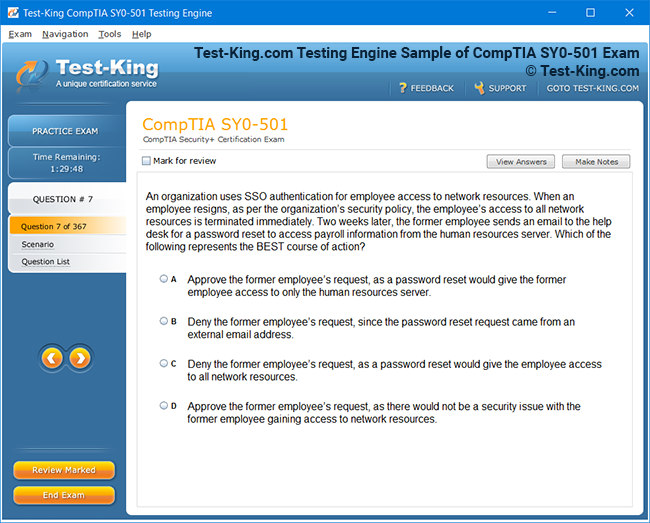
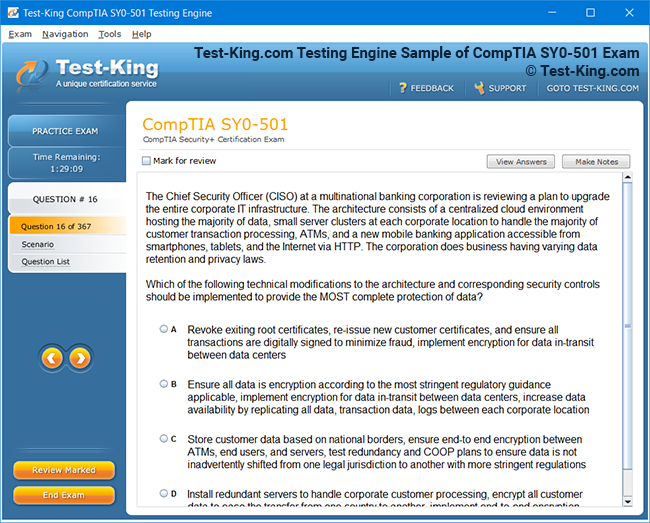
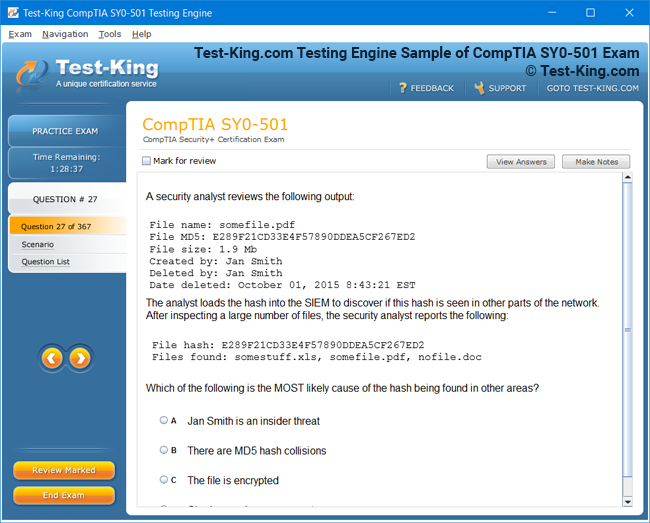
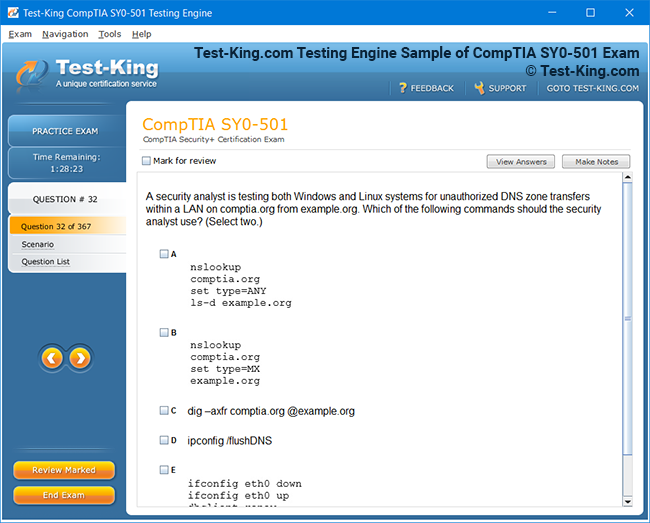
Product Screenshots
Frequently Asked Questions
How can I get the products after purchase?
All products are available for download immediately from your Member's Area. Once you have made the payment, you will be transferred to Member's Area where you can login and download the products you have purchased to your computer.
How long can I use my product? Will it be valid forever?
Test-King products have a validity of 90 days from the date of purchase. This means that any updates to the products, including but not limited to new questions, or updates and changes by our editing team, will be automatically downloaded on to computer to make sure that you get latest exam prep materials during those 90 days.
Can I renew my product if when it's expired?
Yes, when the 90 days of your product validity are over, you have the option of renewing your expired products with a 30% discount. This can be done in your Member's Area.
Please note that you will not be able to use the product after it has expired if you don't renew it.
How often are the questions updated?
We always try to provide the latest pool of questions, Updates in the questions depend on the changes in actual pool of questions by different vendors. As soon as we know about the change in the exam question pool we try our best to update the products as fast as possible.
How many computers I can download Test-King software on?
You can download the Test-King products on the maximum number of 2 (two) computers or devices. If you need to use the software on more than two machines, you can purchase this option separately. Please email support@test-king.com if you need to use more than 5 (five) computers.
What is a PDF Version?
PDF Version is a pdf document of Questions & Answers product. The document file has standart .pdf format, which can be easily read by any pdf reader application like Adobe Acrobat Reader, Foxit Reader, OpenOffice, Google Docs and many others.
Can I purchase PDF Version without the Testing Engine?
PDF Version cannot be purchased separately. It is only available as an add-on to main Question & Answer Testing Engine product.
What operating systems are supported by your Testing Engine software?
Our testing engine is supported by Windows. Andriod and IOS software is currently under development.
Top Nutanix Exams
- NCP-MCI v7.5 - Nutanix Certified Professional - Multicloud Infrastructure v7.5
- NCP-MCI v6.10 - Nutanix Certified Professional - Multicloud Infrastructure v6.10
- NCA v6.10 - Nutanix Certified Associate v6.10
- NCP-CN v6.10 - Nutanix Certified Professional - Cloud Native v6.10
- NCP-MCA v6.10 - Nutanix Certified Professional - Multicloud Automation v6.10
- NCA - Nutanix Certified Associate
- NCP-CI-AWS v6.7 - Nutanix Certified Professional - Cloud Integration - AWS v6.7
Comprehensive Guide to the Nutanix Certified Professional - Unified Storage (NCP-US v6.5) Exam
The Nutanix Certified Professional - Unified Storage (NCP-US v6.5) certification represents an advanced understanding of enterprise-level storage solutions within Nutanix ecosystems. It validates one’s expertise in designing, configuring, managing, and troubleshooting unified storage environments that are resilient, scalable, and optimized for performance. Unified storage, in this context, integrates block, file, and object storage within a single platform, delivering agility and consistency across hybrid cloud infrastructures. Candidates pursuing this credential must comprehend both the architectural nuances and operational mechanics that drive a converged storage environment.
Understanding Nutanix Unified Storage and Certification Essentials
Nutanix’s unified storage leverages a distributed architecture that ensures data redundancy and high availability. This architecture abstracts the underlying hardware and consolidates storage into a virtualized layer that is both resilient and elastic. Professionals preparing for this examination should internalize concepts such as data locality, storage tiers, replication strategies, and the interplay between storage controllers and hypervisors. A profound understanding of these components allows administrators to optimize workloads and implement performance policies that reduce latency while maintaining robust data protection.
The examination assesses candidates on multiple facets, including storage provisioning, network integration, performance monitoring, data migration, disaster recovery, and troubleshooting. An intricate understanding of these domains is crucial, as the test evaluates not only theoretical knowledge but also practical problem-solving skills in real-world scenarios. Candidates often encounter questions regarding the configuration of storage containers, setting quality-of-service parameters, optimizing snapshots and clones, and managing deduplication and compression strategies. These elements collectively test the aspirant’s capacity to ensure operational excellence in Nutanix environments.
Storage Architecture and Data Distribution
At the heart of Nutanix unified storage lies a distributed data fabric that orchestrates data placement, replication, and recovery seamlessly across multiple nodes. Data distribution is guided by algorithms that balance performance with resilience, ensuring that storage workloads do not become bottlenecked on specific nodes. This fabric eliminates single points of failure and introduces a harmonious blend of redundancy and efficiency. Understanding how this distribution functions is imperative for any professional seeking the NCP-US v6.5 certification.
The system employs multiple layers of storage tiers to optimize performance and capacity. Flash-based tiers handle high-frequency input/output operations, providing low-latency access to hot data, while capacity tiers accommodate less frequently accessed information. Administrators must be able to configure these tiers based on workload characteristics, taking into account factors such as read/write intensity, block sizes, and application sensitivity. The exam frequently probes candidates on identifying optimal tiering strategies to balance cost, performance, and storage longevity.
Replication in Nutanix environments operates on synchronous and asynchronous paradigms, depending on the criticality of data and the desired recovery objectives. Synchronous replication guarantees immediate duplication across nodes or clusters, ensuring zero data loss but requiring higher bandwidth. Asynchronous replication, conversely, introduces a temporal lag, suitable for geographically distant sites or disaster recovery scenarios where some latency is tolerable. Test-takers are expected to understand the configuration, monitoring, and troubleshooting of both replication types, alongside an awareness of recovery point objectives and recovery time objectives.
Provisioning and Storage Management
Storage provisioning within Nutanix is highly granular, allowing administrators to define storage containers that align with application requirements. Containers encapsulate storage resources, enabling efficient allocation, policy enforcement, and performance management. Candidates are often asked to demonstrate knowledge of creating, resizing, and deleting containers, along with assigning appropriate access privileges and replication policies. Additionally, understanding how to apply quality-of-service controls ensures that critical workloads maintain performance even in multitenant environments.
Snapshots and clones represent another essential facet of unified storage management. Snapshots provide point-in-time copies of data, facilitating rapid recovery in the event of corruption or accidental deletion. Clones, by contrast, create writable copies of data without duplicating the entire dataset, conserving storage space. NCP-US v6.5 aspirants should grasp the implications of snapshot frequency, retention policies, and the performance impact of excessive snapshot chains. Efficient management of snapshots and clones underpins both operational efficiency and disaster recovery preparedness.
Deduplication, compression, and data compaction are integral to optimizing storage utilization. Deduplication removes redundant data blocks, compression reduces the physical footprint of stored data, and compaction reorganizes storage structures to enhance efficiency. These processes require a nuanced understanding, as aggressive deduplication or compression may impact system performance or complicate backup operations. The exam tests familiarity with enabling, configuring, and monitoring these features, alongside recognizing scenarios where their application is advantageous or detrimental.
Network Integration and Storage Connectivity
Unified storage cannot function in isolation; it relies on robust network integration to facilitate data access across multiple nodes, clusters, and client endpoints. Nutanix environments often employ both Ethernet and Fibre Channel connectivity, with configurations tailored to latency-sensitive or bandwidth-intensive applications. Candidates must understand the principles of network segmentation, VLAN configuration, multipathing, and failover strategies. Exam questions may present scenarios requiring identification of bottlenecks, misconfigurations, or suboptimal routing, emphasizing the need for a holistic grasp of both storage and network dynamics.
Access protocols such as NFS, SMB, and iSCSI are commonly employed within unified storage systems. Professionals must be proficient in enabling, configuring, and securing these protocols, ensuring compatibility with diverse client operating systems and applications. Knowledge of authentication mechanisms, permissions, and network security best practices is essential, as misconfigurations could expose critical data to unauthorized access. The NCP-US v6.5 exam evaluates both procedural and conceptual understanding of these connectivity mechanisms.
Monitoring and Performance Optimization
A core competency for Nutanix storage professionals involves continuous monitoring and performance tuning. The platform provides metrics on IOPS, latency, throughput, capacity utilization, and error rates. Candidates should understand how to interpret these metrics, identify performance anomalies, and apply remedial measures. Effective monitoring extends to cluster health, node status, disk usage, and network performance, requiring a multidimensional perspective. Knowledge of alerting mechanisms, logging frameworks, and historical trend analysis is vital for proactive maintenance.
Optimizing performance often involves balancing workload distribution, tuning caching policies, and configuring storage tiers intelligently. Candidates must be capable of diagnosing hot spots, mitigating contention, and leveraging features such as data locality to reduce cross-node traffic. The examination assesses both analytical reasoning and hands-on troubleshooting skills, ensuring professionals can maintain consistent and predictable storage performance under variable workloads.
Troubleshooting and Problem Resolution
Troubleshooting is an indispensable skill within the unified storage domain. Candidates may encounter hypothetical scenarios involving degraded nodes, replication failures, access issues, or suboptimal performance. The ability to systematically identify root causes, apply corrective measures, and validate resolution is critical. Understanding the interaction between storage components, hypervisors, and applications enables professionals to distinguish between hardware faults, configuration errors, and environmental limitations.
For example, when a storage container fails to mount on a host, the issue could stem from network misconfiguration, authentication errors, or container corruption. Exam questions may ask candidates to delineate the stepwise diagnostic process, from verifying connectivity and permissions to examining logs and performing recovery procedures. Mastery of these troubleshooting methodologies reflects real-world skills essential for maintaining operational continuity in enterprise environments.
Real-World Scenarios and Applications
Beyond theoretical knowledge, the NCP-US v6.5 certification emphasizes practical application. Candidates must be adept at translating principles into effective solutions that optimize storage performance, enhance resilience, and align with organizational objectives. Use cases may include provisioning storage for virtual desktops, implementing disaster recovery across geographies, managing multi-tenant environments, and optimizing storage for high-performance applications. Understanding these scenarios ensures professionals can navigate the complex interplay between storage technology and business requirements.
By integrating these concepts with practical exercises, candidates develop the analytical acuity necessary to tackle nuanced questions in the exam. The examination framework blends multiple-choice questions with scenario-based problem solving, emphasizing decision-making under constraints and prioritization of resources. Successful candidates demonstrate not only knowledge but judgment, foresight, and adaptability in their approach to unified storage management.
Advanced Configuration and Operational Practices
Success in the Nutanix Certified Professional - Unified Storage (NCP-US v6.5) examination necessitates more than theoretical understanding; it demands an adept grasp of advanced configuration and operational procedures that underpin high-performing unified storage environments. Candidates are expected to exhibit proficiency in orchestrating complex storage deployments, integrating them with hybrid cloud infrastructures, and optimizing for both reliability and efficiency. Unified storage in Nutanix leverages a distributed, hyperconverged architecture, uniting block, file, and object storage while ensuring data consistency and resiliency. Mastery of the underlying principles facilitates seamless administration and troubleshooting in dynamic enterprise settings.
One of the pivotal concepts is storage container optimization. Storage containers serve as virtualized constructs that abstract physical resources while providing granular control over allocation, replication, and policy enforcement. Administrators must understand how to configure containers to match workload demands, ensuring that storage allocation aligns with performance requirements and cost considerations. The examination evaluates knowledge of resizing containers, assigning replication policies, and applying quality-of-service controls to prevent performance degradation under fluctuating workloads.
Data Protection and Replication Techniques
Effective data protection is foundational to Nutanix unified storage, and the NCP-US v6.5 exam emphasizes understanding replication mechanisms, snapshots, and disaster recovery strategies. Replication in Nutanix can be synchronous or asynchronous, each offering distinct advantages depending on latency tolerance and recovery objectives. Synchronous replication ensures immediate duplication of data across nodes, minimizing risk of data loss, whereas asynchronous replication introduces slight temporal delay, facilitating geographic redundancy without saturating network bandwidth. Candidates are expected to comprehend the operational implications of these modes and identify optimal scenarios for their deployment.
Snapshots provide efficient point-in-time copies, allowing administrators to revert data quickly in case of corruption or accidental deletion. Clones extend this functionality by enabling writable copies without duplicating the entire dataset, preserving storage capacity while supporting test, development, or analytic operations. Knowledge of snapshot scheduling, retention policies, and the performance impact of deep snapshot chains is critical for ensuring that storage resources remain performant and resilient.
Deduplication, compression, and compaction are integral for maximizing storage efficiency. Deduplication removes redundant data blocks, compression reduces the physical footprint of stored information, and compaction reorganizes storage layouts to improve data access speeds. Administrators must exercise prudence when applying these technologies, as excessive or misconfigured settings can negatively affect performance or complicate backup and restore operations. The exam evaluates the ability to implement these optimizations thoughtfully while considering workload characteristics and enterprise objectives.
Storage Networking and Connectivity
Unified storage in Nutanix environments depends on sophisticated network integration to facilitate access across nodes, clusters, and client endpoints. Network design considerations include bandwidth allocation, latency minimization, and redundancy. Ethernet and Fibre Channel protocols are commonly employed, with multipathing and failover mechanisms ensuring continuous connectivity even during hardware or network failures. Candidates should be proficient in identifying potential bottlenecks, configuring VLANs for segmentation, and optimizing network throughput for storage-intensive applications.
NFS, SMB, and iSCSI protocols form the primary access interfaces in unified storage configurations. Knowledge of enabling, configuring, and securing these protocols is paramount. Misconfigurations can lead to access issues or security vulnerabilities, making it essential for administrators to verify permissions, authentication methods, and network policies. The examination assesses understanding of the nuances between these protocols, their applicability to different operating systems and applications, and best practices for maintaining secure and reliable connectivity.
Monitoring, Metrics, and Performance Tuning
Monitoring and performance management are critical responsibilities for Nutanix unified storage administrators. The platform provides metrics such as input/output operations per second, latency, throughput, disk utilization, and error rates. Candidates must interpret these metrics to identify trends, detect anomalies, and implement corrective actions. Monitoring extends to cluster health, node availability, and network status, requiring a multidimensional perspective that correlates storage, compute, and network performance.
Performance optimization may involve tuning caching policies, adjusting storage tier allocations, and leveraging data locality to reduce inter-node traffic. Administrators are expected to balance workload distribution, prevent hot spots, and mitigate contention between applications. Scenario-based examination questions often require identifying causes of latency, suboptimal throughput, or resource contention and applying methodical solutions to restore equilibrium. Mastery of these principles ensures that the unified storage environment delivers predictable, high-performance service even under demanding workloads.
Troubleshooting and Incident Resolution
Proficiency in troubleshooting is essential for achieving NCP-US v6.5 certification. Administrators must be capable of diagnosing and resolving issues ranging from degraded nodes to replication failures or misconfigured access policies. Understanding the interdependencies between storage components, hypervisors, and applications is crucial for identifying root causes efficiently. The examination often presents realistic scenarios requiring methodical analysis and structured problem resolution.
For instance, when a storage container fails to provision on a host, the underlying problem could involve network misconfiguration, authentication errors, or cluster-level resource contention. Candidates should be able to describe a logical sequence of steps to isolate the issue, validate the resolution, and implement preventive measures. Emphasis is placed on real-world applicability, including the ability to anticipate potential bottlenecks or points of failure before they impact production workloads.
Security, Compliance, and Governance
Unified storage solutions must also comply with enterprise security standards and regulatory requirements. Nutanix administrators are expected to understand access control mechanisms, encryption policies, and audit logging capabilities. Authentication methods, role-based access controls, and secure network configurations collectively ensure that sensitive data remains protected against unauthorized access. The examination evaluates knowledge of configuring security policies that adhere to corporate governance standards while maintaining operational efficiency.
Data retention policies, encryption at rest, and secure replication are additional considerations that intertwine with compliance mandates. Administrators must balance accessibility, performance, and security, ensuring that storage systems satisfy both operational and regulatory obligations. Mastery of these domains is essential for demonstrating the comprehensive skill set expected of a Nutanix Certified Professional in unified storage environments.
Practical Applications and Real-World Scenarios
The NCP-US v6.5 exam emphasizes practical application of knowledge, requiring candidates to navigate realistic enterprise scenarios. Administrators may encounter situations involving provisioning storage for virtual desktop infrastructure, implementing disaster recovery across multiple sites, or optimizing multi-tenant storage environments. Decisions must account for performance, resiliency, cost efficiency, and compliance, demonstrating a holistic understanding of the technology in operational contexts.
Candidates must translate theoretical knowledge into actionable strategies, applying advanced features of Nutanix storage to meet organizational objectives. Scenario-based questions often combine elements of storage configuration, replication, monitoring, and security, challenging candidates to employ both technical acumen and analytical reasoning. This approach ensures that certified professionals possess the practical skills needed to manage complex, high-performance storage environments effectively.
Integration, Automation, and Advanced Operational Strategies
Achieving the Nutanix Certified Professional - Unified Storage (NCP-US v6.5) credential requires a nuanced understanding of not only storage architecture but also the intricacies of integration, automation, and operational efficiency in contemporary enterprise environments. Unified storage within Nutanix ecosystems serves as a convergent platform that unites block, file, and object storage while ensuring high availability and resilience across hyperconverged infrastructures. Mastery of these elements allows professionals to architect solutions that are scalable, robust, and responsive to dynamic workloads.
Integration extends beyond merely connecting storage nodes to hosts or clusters. It encompasses aligning storage resources with virtualization platforms, cloud environments, and business applications. Administrators must understand how storage interacts with hypervisors, orchestrators, and management frameworks to ensure optimal performance and consistency. The exam often probes the candidate’s ability to design integration pathways that reduce latency, balance workloads, and enable seamless data mobility across environments. This includes leveraging protocols such as NFS, SMB, and iSCSI while ensuring authentication, access controls, and encryption policies are rigorously enforced.
Automation is another pivotal concept for modern storage management. Nutanix unified storage supports various automation mechanisms that streamline provisioning, policy enforcement, and performance optimization. Administrators are expected to demonstrate proficiency in using orchestration tools, scripts, and templates to reduce manual intervention, minimize errors, and accelerate deployment cycles. Candidates must grasp how automation integrates with monitoring systems, enabling proactive adjustments to storage allocations, replication schedules, and tiering policies based on real-time usage metrics.
Performance Tuning and Resource Optimization
Unified storage performance hinges on the careful orchestration of multiple resources, including storage tiers, caching mechanisms, and data placement strategies. Nutanix environments employ flash-based tiers for high-frequency I/O operations and capacity tiers for less frequently accessed data, allowing administrators to balance cost and performance efficiently. Candidates must understand how to tune these tiers, ensuring that hot data resides on low-latency storage while archival or infrequently accessed data is stored cost-effectively.
Caching policies play a crucial role in optimizing throughput and reducing latency. Administrators must discern when to enable read or write caching, configure cache allocation, and monitor hit rates to avoid bottlenecks. Effective use of caching requires an appreciation of workload characteristics, including sequential versus random I/O, block sizes, and access frequency. The exam may present scenarios requiring candidates to adjust cache policies to address performance anomalies or to optimize high-demand applications without impacting overall system equilibrium.
Resource optimization extends to managing deduplication, compression, and data compaction. Deduplication eliminates redundant data blocks, compression reduces storage footprints, and compaction reorganizes storage layouts to improve access efficiency. Understanding the operational impact of these features is crucial, as excessive or misconfigured optimization can degrade performance, interfere with replication, or complicate recovery processes. Professionals must apply these techniques judiciously to maintain a balance between efficiency and reliability.
Monitoring, Analytics, and Predictive Maintenance
Monitoring storage environments goes beyond observing static metrics; it involves interpreting dynamic data patterns to anticipate issues and optimize system performance. Nutanix platforms provide detailed metrics on latency, throughput, IOPS, capacity utilization, and error rates. Administrators must interpret these indicators to identify trends, detect anomalies, and preempt potential bottlenecks. Scenario-based examination questions often focus on evaluating a candidate’s capacity to analyze metrics, correlate them with application behavior, and implement corrective or preventive measures.
Analytics-driven insights facilitate predictive maintenance, allowing administrators to identify nodes or components at risk of failure before they impact operations. Knowledge of historical trend analysis, alert configuration, and health dashboards is critical. Candidates should be able to explain how predictive analytics can inform capacity planning, workload balancing, and replication scheduling, ensuring uninterrupted service delivery. Understanding these principles demonstrates a holistic grasp of storage management that transcends reactive troubleshooting.
Troubleshooting Complex Failures
Troubleshooting in advanced unified storage environments requires systematic reasoning, technical acumen, and familiarity with the interactions between storage nodes, networking components, and virtualization layers. Candidates are expected to identify the root causes of issues ranging from replication failures to performance degradation, access anomalies, or configuration conflicts. The examination frequently presents intricate scenarios that combine multiple variables, requiring logical analysis and structured resolution.
For instance, when a cluster experiences sporadic latency spikes, the underlying cause may involve misconfigured caching, network contention, or uneven data distribution. Professionals must delineate a stepwise approach to isolate the contributing factors, verify system logs, adjust configurations, and validate the resolution. The ability to address such multi-faceted issues is essential for maintaining operational continuity and underscores the practical competencies assessed by the certification.
Data Protection, Backup, and Disaster Recovery
Data protection strategies form a cornerstone of unified storage management. Nutanix environments support comprehensive snapshot, cloning, and replication capabilities that ensure data integrity and rapid recovery in adverse events. Snapshots provide instantaneous, point-in-time copies of data, facilitating recovery from accidental deletion or corruption. Clones extend this functionality by creating writable duplicates without consuming excessive storage capacity, suitable for testing, development, or reporting workflows.
Replication strategies are nuanced, balancing performance, latency, and resilience. Synchronous replication guarantees zero data loss by immediately duplicating data across nodes or clusters, while asynchronous replication introduces latency to accommodate geographically dispersed sites. Professionals must understand how to configure replication schedules, monitor replication health, and align these strategies with organizational recovery objectives. Exam questions frequently test the ability to design disaster recovery plans that integrate replication, snapshots, and container-level policies to safeguard critical data.
Security, Compliance, and Governance Practices
Security and compliance are non-negotiable aspects of unified storage management. Administrators must implement role-based access controls, encryption at rest, and network security measures to protect sensitive data. Knowledge of authentication protocols, secure access policies, and audit logging is critical to prevent unauthorized access and ensure adherence to enterprise governance standards. The NCP-US v6.5 examination assesses familiarity with these security mechanisms and the ability to implement them in alignment with organizational policies.
Compliance extends to data retention, replication, and audit readiness. Administrators should understand regulatory requirements that impact storage architecture, such as retention periods, data encryption mandates, and reporting obligations. Integrating compliance considerations into everyday operational practices demonstrates an advanced understanding of the responsibilities inherent in managing enterprise-grade storage systems. Candidates must be able to articulate strategies for harmonizing security, compliance, and operational efficiency.
Real-World Applications and Scenario-Based Knowledge
The examination emphasizes practical, scenario-based knowledge. Candidates are presented with complex challenges that mirror real-world operational environments, requiring them to apply advanced storage principles to achieve desired outcomes. Scenarios may involve optimizing storage for high-performance applications, deploying disaster recovery across multiple geographies, or managing multi-tenant storage infrastructures. Understanding how to translate technical knowledge into actionable strategies is critical.
For example, provisioning storage for a virtual desktop infrastructure may necessitate precise tuning of storage tiers, caching policies, and access controls to ensure responsiveness and reliability. Similarly, replicating critical databases across clusters requires configuring synchronous or asynchronous replication, monitoring health metrics, and verifying recovery readiness. The ability to navigate these scenarios demonstrates both technical proficiency and strategic foresight, qualities that the certification seeks to validate.
Advanced Troubleshooting, Scaling, and Multi-Cluster Management
Attaining mastery of the Nutanix Certified Professional - Unified Storage (NCP-US v6.5) demands a profound understanding of troubleshooting complex environments, scaling strategies, and management of multi-cluster architectures. Unified storage within Nutanix consolidates block, file, and object storage into a resilient and elastic infrastructure that accommodates enterprise workloads with high efficiency. Professionals preparing for the certification are expected to demonstrate not only operational competence but also the strategic foresight required to manage dynamic environments where performance, reliability, and scalability converge.
Troubleshooting Degraded Nodes and Cluster Anomalies
A core responsibility of a Nutanix storage administrator is diagnosing and resolving issues that arise within storage nodes or clusters. Nodes may experience performance degradation, failed replication, or misaligned resources, often manifesting as latency spikes, reduced throughput, or access anomalies. Effective troubleshooting involves correlating metrics from storage, networking, and virtualization layers to isolate root causes and implement corrective measures. For instance, if a node exhibits sporadic I/O delays, the administrator must evaluate caching efficiency, data locality, network connectivity, and storage tier utilization to determine whether the anomaly is hardware-induced, configuration-related, or workload-specific.
Advanced troubleshooting extends to replication and disaster recovery mechanisms. Synchronous replication failures may indicate bandwidth limitations, configuration inconsistencies, or node health issues, while asynchronous replication anomalies could stem from delayed write operations or resource contention. Professionals must articulate methodical diagnostic processes, including log analysis, performance metrics evaluation, and stepwise validation of remediation steps, ensuring operational continuity while minimizing risk to data integrity.
Scaling Storage Environments and Optimizing Resource Allocation
Scalability is intrinsic to Nutanix unified storage, enabling organizations to expand infrastructure without disrupting ongoing operations. Administrators must understand how to scale clusters both vertically and horizontally, adding storage capacity, compute resources, or nodes in a manner that preserves balance and performance. Vertical scaling involves enhancing existing node capabilities, such as increasing memory, CPU, or storage devices, while horizontal scaling entails adding additional nodes to distribute workloads and enhance redundancy.
Resource allocation strategies are critical to maintaining equilibrium within scaled environments. Storage containers must be sized and provisioned according to workload demand, while storage tiers should be aligned with access frequency and performance expectations. Deduplication, compression, and compaction techniques must be carefully applied, balancing efficiency with the potential performance trade-offs inherent in these operations. Candidates are expected to demonstrate the ability to forecast capacity requirements, prevent contention, and ensure sustained service levels across growing infrastructures.
Multi-Cluster Management and Cross-Site Operations
In enterprises with geographically dispersed operations, managing multiple clusters is a common requirement. Nutanix provides mechanisms to orchestrate replication, monitoring, and administrative tasks across clusters, ensuring consistency, high availability, and centralized governance. Administrators must be adept at configuring inter-cluster replication, aligning container policies, and monitoring health metrics to ensure coherent operation across sites. Multi-cluster management also encompasses disaster recovery, workload migration, and balancing storage loads to prevent bottlenecks and optimize resource utilization.
When migrating workloads or replicating data across clusters, synchronization and network considerations are paramount. Candidates should understand the implications of synchronous versus asynchronous replication in multi-site contexts, including latency impacts, bandwidth consumption, and recovery objectives. The examination may present scenarios requiring administrators to design a multi-cluster topology that maximizes resiliency, minimizes downtime, and efficiently distributes workloads while maintaining compliance with organizational policies.
Monitoring, Analytics, and Predictive Diagnostics
Advanced monitoring techniques are essential in complex Nutanix environments. Administrators rely on detailed analytics to detect anomalies, forecast capacity needs, and optimize performance proactively. Metrics such as IOPS, latency, throughput, disk utilization, and node availability must be interpreted holistically to identify trends and preempt operational challenges. Predictive diagnostics leverage historical data to anticipate potential failures, enabling preemptive maintenance and resource adjustments that mitigate risk before critical issues arise.
Monitoring extends beyond individual nodes to encompass clusters, storage containers, and network pathways. Candidates must be capable of interpreting integrated dashboards, configuring alerts, and utilizing trend analysis to make informed decisions. Scenario-based questions often challenge professionals to correlate diverse data points to uncover subtle performance issues, demonstrating both analytical acumen and practical troubleshooting skill.
Security, Compliance, and Governance Across Scaled Environments
As storage infrastructures scale and span multiple sites, maintaining security, compliance, and governance becomes increasingly complex. Administrators must ensure that access controls, encryption policies, and audit logging are consistently applied across all nodes and clusters. Role-based access management, secure authentication, and network segmentation are critical to preventing unauthorized access while maintaining operational efficiency.
Compliance considerations include adherence to data retention policies, regulatory mandates, and internal governance standards. Multi-cluster environments necessitate uniform policy enforcement to avoid discrepancies that could compromise security or regulatory compliance. Professionals must demonstrate proficiency in harmonizing security, operational efficiency, and compliance, reflecting the sophisticated responsibilities expected of certified administrators.
Performance Tuning for High-Demand Workloads
High-demand workloads, such as virtual desktop infrastructure, analytics platforms, or transactional databases, require meticulous performance tuning within unified storage environments. Administrators must optimize caching, storage tiering, and data locality to ensure minimal latency and consistent throughput. Balancing performance across multiple containers and clusters necessitates an understanding of workload patterns, I/O characteristics, and resource contention.
The examination evaluates candidates on their ability to apply these tuning practices to real-world scenarios, ensuring that critical applications maintain responsiveness under peak load conditions. Professionals must consider the trade-offs inherent in optimization strategies, balancing efficiency, reliability, and cost-effectiveness to achieve sustainable performance across enterprise workloads.
Disaster Recovery Planning and Execution
Disaster recovery is integral to unified storage management, particularly in multi-cluster or geographically dispersed environments. Administrators must design recovery strategies that align with recovery time objectives and recovery point objectives, ensuring that critical data and applications can be restored swiftly in the event of a failure. Replication schedules, snapshot policies, and container-level configurations must be harmonized to provide comprehensive protection.
Candidates are expected to understand both synchronous and asynchronous replication paradigms, evaluating their applicability based on latency tolerance, bandwidth constraints, and criticality of data. Scenario-based questions may involve configuring cross-site replication, verifying failover mechanisms, or orchestrating recovery drills, demonstrating both technical skill and operational foresight.
Real-World Operational Challenges
Enterprise storage environments often present multifaceted challenges that require both technical proficiency and strategic judgment. Administrators may face resource contention, network limitations, regulatory compliance pressures, or performance degradation during peak operations. NCP-US v6.5 candidates must demonstrate the ability to integrate knowledge of storage architecture, replication strategies, monitoring analytics, and security practices to address these challenges effectively.
For example, ensuring optimal performance for a high-transaction database across multiple clusters may necessitate careful container provisioning, strategic replication configuration, and continuous performance monitoring. Similarly, disaster recovery planning for critical workloads involves coordinating snapshot schedules, replication pathways, and validation processes across sites. The ability to navigate these scenarios illustrates the practical and analytical competencies that the certification seeks to validate.
Automation, Orchestration, and Operational Excellence
The Nutanix Certified Professional - Unified Storage (NCP-US v6.5) credential signifies advanced proficiency in managing, optimizing, and securing converged storage environments. Unified storage within Nutanix ecosystems is designed to consolidate block, file, and object storage while maintaining resilience, high availability, and seamless scalability. Candidates pursuing this certification must demonstrate both theoretical understanding and practical expertise in orchestrating workflows, automating repetitive operations, and maintaining operational excellence across complex infrastructures.
Automation in unified storage environments reduces manual intervention, increases consistency, and mitigates human error. Nutanix supports various automation mechanisms including workflow orchestration, policy-based provisioning, and dynamic resource allocation. Administrators must be adept at designing templates and scripts that enforce consistent configuration across storage containers, clusters, and nodes, while integrating monitoring tools to enable proactive adjustments. Understanding these mechanisms ensures that storage environments remain agile, responsive, and aligned with enterprise objectives, even under fluctuating workloads.
Orchestration of Storage Workflows
Orchestration is pivotal in aligning storage, compute, and network resources to optimize performance and operational efficiency. Nutanix unified storage facilitates coordinated management of provisioning, replication, monitoring, and recovery workflows. Professionals must comprehend how to sequence tasks, define dependencies, and enforce policies to achieve predictable outcomes. The examination evaluates the ability to implement orchestration for scenarios such as automated provisioning of containers, dynamic tiering adjustments, or replication scheduling across clusters.
For example, in a deployment where multiple virtual desktop infrastructure environments share a cluster, orchestration ensures that each environment receives appropriate storage resources without disrupting others. Administrators must understand how to prioritize workloads, prevent resource contention, and optimize cache allocation and storage tier usage. Scenario-based questions test candidates’ abilities to plan, implement, and monitor orchestration solutions that maintain equilibrium between performance, capacity, and reliability.
Performance Monitoring and Analytical Acumen
Effective performance management requires not only monitoring metrics but also interpreting them to uncover latent issues and optimize resource utilization. Nutanix provides detailed analytics for throughput, latency, IOPS, disk usage, and node health. Administrators must correlate these metrics across storage containers, clusters, and network pathways to identify anomalies, predict trends, and implement corrective measures. Predictive analytics allows for proactive capacity planning, helping to prevent bottlenecks and maintain consistent service delivery.
Candidates should be capable of integrating monitoring data into decision-making processes, applying both quantitative and qualitative insights. For instance, high latency on a storage container may be traced to cache exhaustion, tier misalignment, or network congestion. Understanding the interrelationship of these factors and their impact on overall performance is critical. The examination challenges candidates to demonstrate analytical acumen and methodical problem-solving in realistic operational scenarios.
Resource Optimization Strategies
Resource optimization extends beyond simple provisioning. Administrators must balance storage capacity, performance, and efficiency while managing deduplication, compression, and compaction processes. Deduplication eliminates redundant data, compression reduces storage footprint, and compaction reorganizes stored data to enhance access efficiency. These processes must be applied judiciously, as overly aggressive optimization can impact performance or interfere with replication and backup operations.
Storage tiering is another essential consideration. Flash-based tiers provide low-latency access for high-frequency operations, while capacity tiers handle less frequently accessed data. Administrators must monitor data movement between tiers, ensuring that hot data resides on high-performance media and cold data is stored cost-effectively. Understanding workload characteristics, access patterns, and performance sensitivity is crucial for making tiering decisions that support operational excellence.
Multi-Cluster Coordination and Replication Strategies
Managing multiple clusters requires coordination of replication, container policies, and disaster recovery protocols. Administrators must ensure data consistency, high availability, and optimal performance across sites. Synchronous replication guarantees zero data loss, while asynchronous replication provides geographic redundancy with controlled latency. Candidates are expected to understand configuration nuances, monitor replication health, and adjust schedules to meet recovery point and recovery time objectives.
Replication strategies must be harmonized with operational requirements, including bandwidth limitations, workload criticality, and disaster recovery plans. For example, replicating a high-volume transactional database across distant clusters may necessitate asynchronous replication combined with snapshot policies to maintain both performance and data integrity. Scenario-based examination questions evaluate the candidate’s ability to design, implement, and troubleshoot replication workflows in multi-cluster contexts.
Security, Compliance, and Governance in Advanced Environments
Security and compliance are integral to unified storage management, particularly when managing multiple clusters or multi-tenant environments. Administrators must implement role-based access controls, encryption at rest, and network segmentation to safeguard sensitive data. Knowledge of authentication protocols, secure replication, and audit logging is essential to prevent unauthorized access and meet regulatory requirements.
Compliance mandates often dictate retention periods, encryption standards, and reporting requirements. In scaled environments, maintaining uniform policies across clusters is vital to ensure governance and regulatory adherence. Professionals must demonstrate the ability to integrate security, compliance, and operational efficiency, creating a storage environment that is both secure and reliable. The exam evaluates the capacity to apply these principles in realistic scenarios that mirror enterprise operations.
Troubleshooting Advanced Operational Issues
Complex storage environments inevitably encounter operational anomalies, requiring systematic troubleshooting and analytical reasoning. Professionals must diagnose performance degradation, replication failures, misconfigured access controls, and resource contention. Effective troubleshooting relies on correlating metrics from storage, networking, and virtualization layers to isolate root causes and apply corrective actions.
For instance, if a high-priority container experiences intermittent latency spikes, the administrator must assess caching policies, storage tiering, network pathways, and node health. Understanding interdependencies allows professionals to pinpoint issues accurately and restore equilibrium. The examination emphasizes practical problem-solving skills, challenging candidates to resolve multifaceted operational scenarios efficiently.
Real-World Applications and Scenario-Based Knowledge
Candidates are expected to translate theoretical knowledge into practical strategies for enterprise environments. Scenarios may involve provisioning storage for high-performance analytics, implementing disaster recovery across multiple clusters, or managing multi-tenant infrastructures. Administrators must balance performance, reliability, cost, and compliance while applying advanced features such as automation, orchestration, and predictive analytics.
For example, ensuring optimal performance for virtual desktop infrastructure deployments may require careful container sizing, dynamic tiering, and orchestration of caching and replication workflows. Similarly, disaster recovery planning may necessitate configuring cross-cluster replication, validating failover processes, and monitoring metrics to ensure readiness. Mastery of these real-world applications demonstrates the practical and strategic acumen that the certification seeks to validate.
Advanced Integration, Optimization, and Real-World Deployment
The Nutanix Certified Professional - Unified Storage (NCP-US v6.5) certification represents mastery in managing, optimizing, and securing converged storage environments that unify block, file, and object storage. Candidates pursuing this credential must exhibit not only theoretical knowledge but also practical acumen in architecting, orchestrating, and troubleshooting complex storage infrastructures. In modern enterprises, unified storage forms the backbone of virtualized workloads, hybrid cloud integration, and disaster recovery strategies, making a comprehensive understanding of operational principles indispensable.
Integration of storage with compute and networking layers is central to maintaining seamless performance. Administrators must understand how storage interacts with hypervisors, orchestration platforms, and enterprise applications. Protocols such as NFS, SMB, and iSCSI are integral to access, and configuring them correctly ensures consistent performance while maintaining security and compliance standards. Network segmentation, multipathing, and failover mechanisms are crucial in guaranteeing high availability, while monitoring ensures early detection of anomalies. The exam tests the ability to manage these integrations effectively, reflecting real-world enterprise expectations.
Automation and Orchestration of Storage Workflows
Automation in unified storage reduces operational complexity, enforces consistency, and accelerates deployment cycles. Nutanix provides mechanisms for automating provisioning, applying policies, and adjusting performance parameters dynamically based on workload metrics. Administrators are expected to create workflows that orchestrate tasks such as container provisioning, replication scheduling, and tiering adjustments without manual intervention. Scenario-based questions frequently assess the candidate’s ability to implement automation strategies that maintain performance equilibrium, optimize resource utilization, and minimize operational risk.
Orchestration enhances operational efficiency by coordinating storage, compute, and network tasks. Professionals must understand dependencies, sequence execution, and monitor outcomes to achieve predictable performance. For instance, orchestrating provisioning for multiple high-demand virtual desktop environments requires prioritization, allocation of cache resources, and alignment with storage tiers to avoid contention. Understanding how orchestration supports both agility and resilience is crucial for managing enterprise environments effectively.
Performance Monitoring, Analytics, and Predictive Management
Monitoring extends beyond basic metrics, requiring administrators to interpret performance data, correlate trends, and anticipate potential issues. Nutanix unified storage provides detailed analytics on latency, throughput, IOPS, disk usage, and node health. Predictive management uses historical patterns to forecast resource utilization and prevent bottlenecks before they impact production workloads. Candidates must demonstrate the ability to analyze data, identify anomalies, and apply proactive measures to maintain performance consistency across clusters and storage containers.
For example, latency spikes in a storage container might be traced to cache exhaustion, suboptimal tiering, or network congestion. Understanding the interplay between these factors allows administrators to apply remedies systematically, restoring equilibrium and sustaining workload performance. Predictive maintenance strategies are critical for reducing downtime, optimizing resource allocation, and ensuring that high-priority workloads remain uninterrupted.
Resource Optimization and Tiering Strategies
Optimizing storage resources involves a combination of deduplication, compression, compaction, and tiering strategies. Deduplication eliminates redundant blocks, compression reduces storage footprint, and compaction reorganizes data for more efficient access. These processes must be balanced carefully to avoid adverse effects on performance, replication, and backup operations. Candidates are expected to understand the operational impact of these features, making informed decisions based on workload characteristics and enterprise requirements.
Storage tiering is fundamental to maintaining performance while controlling costs. Flash-based tiers handle high-frequency operations, while capacity tiers store infrequently accessed data. Administrators must monitor data placement, adjust tier assignments, and ensure that hot data remains accessible with minimal latency. Scenario-based examination questions often involve optimizing tiering for specific workloads, demonstrating both analytical reasoning and practical expertise in resource allocation.
Multi-Cluster Management and Replication
Large-scale deployments frequently involve multiple clusters across geographically dispersed locations. Administrators must manage replication, synchronization, and consistency across these clusters to ensure high availability and disaster recovery readiness. Synchronous replication guarantees zero data loss but demands higher bandwidth, while asynchronous replication provides geographic redundancy with controlled latency. Candidates are expected to understand replication configurations, monitor health, and adjust schedules to align with recovery objectives.
Multi-cluster coordination requires careful attention to container policies, workload distribution, and operational monitoring. For example, replicating a high-volume transactional database may involve configuring asynchronous replication between distant clusters while ensuring local snapshots and caching strategies maintain performance. Scenario-based questions assess the ability to manage these complexities efficiently, balancing resiliency, bandwidth constraints, and operational efficiency.
Security, Compliance, and Governance Practices
Security and compliance are indispensable in enterprise storage environments. Administrators must implement role-based access controls, enforce encryption at rest, secure replication channels, and maintain audit logs. Understanding authentication mechanisms, network segmentation, and access policies is essential to prevent unauthorized data access and ensure adherence to corporate governance standards.
Compliance considerations include retention periods, encryption mandates, and regulatory reporting. Professionals must harmonize these requirements with operational efficiency, ensuring that security and governance do not impede performance. The NCP-US v6.5 examination evaluates both conceptual understanding and practical implementation of security and compliance measures, reflecting the responsibilities of administrators in real-world enterprise deployments.
Troubleshooting and Operational Problem-Solving
Troubleshooting complex storage environments requires structured analysis, technical expertise, and familiarity with interdependencies between storage, networking, and virtualization layers. Candidates must identify root causes of performance degradation, replication failures, access anomalies, or misconfigured containers. Understanding these interactions allows administrators to implement effective remedies while minimizing disruption to production workloads.
For instance, intermittent latency in a storage container could result from cache misconfiguration, storage tier misalignment, or network congestion. Professionals must evaluate metrics, logs, and system behavior to pinpoint issues and apply corrective actions. Scenario-based examination questions frequently test the ability to apply analytical reasoning and practical expertise to resolve multifaceted operational challenges.
Real-World Application and Deployment Strategies
The certification emphasizes translating theoretical knowledge into real-world deployment strategies. Candidates must be adept at designing storage architectures for high-performance applications, implementing disaster recovery protocols across multiple clusters, and managing multi-tenant environments. Decisions must consider performance, resiliency, cost-effectiveness, and compliance, reflecting the complex requirements of modern enterprise storage.
For example, deploying storage for virtual desktop infrastructure entails precise container provisioning, dynamic caching, and tier optimization to maintain responsiveness. Disaster recovery planning may involve orchestrating cross-cluster replication, verifying failover mechanisms, and monitoring performance metrics to ensure readiness. Mastery of these practical scenarios demonstrates both technical acumen and strategic foresight, which the certification seeks to validate.
Conclusion
The Nutanix Certified Professional - Unified Storage (NCP-US v6.5) credential represents comprehensive expertise in managing converged storage environments that unify block, file, and object storage while maintaining resilience, performance, and scalability. Candidates must demonstrate proficiency in automation, orchestration, performance optimization, multi-cluster management, security, compliance, and troubleshooting. Real-world scenario knowledge is critical, as professionals must apply theoretical concepts to operational challenges across enterprise infrastructures.
Achieving this certification validates the ability to implement advanced storage solutions, maintain operational equilibrium, and ensure the integrity and availability of critical workloads. Professionals equipped with these skills are well-positioned to navigate the complexities of modern enterprise storage, providing value through strategic decision-making, operational efficiency, and adherence to best practices in unified storage management.