
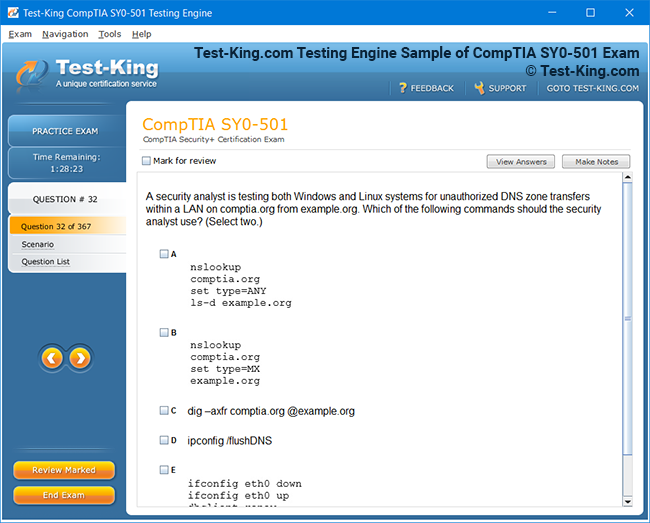
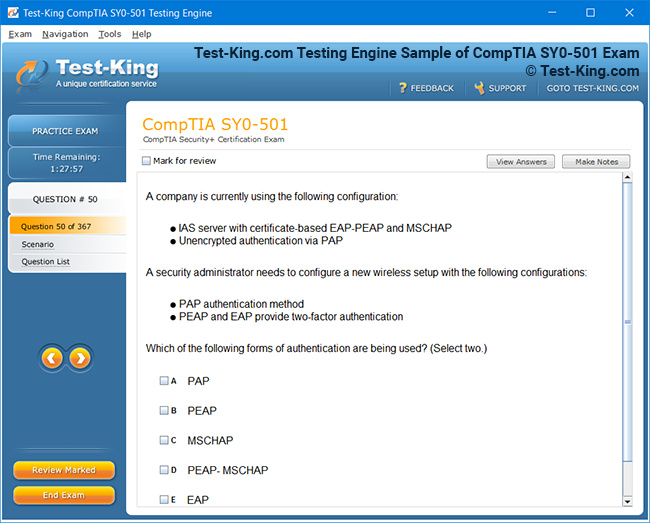
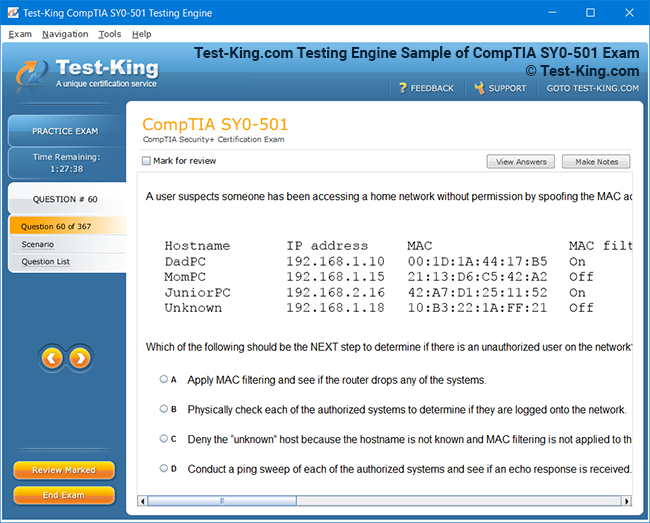
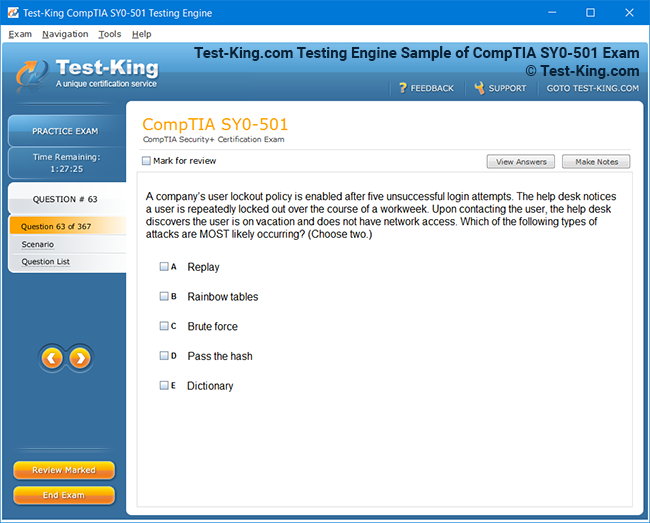
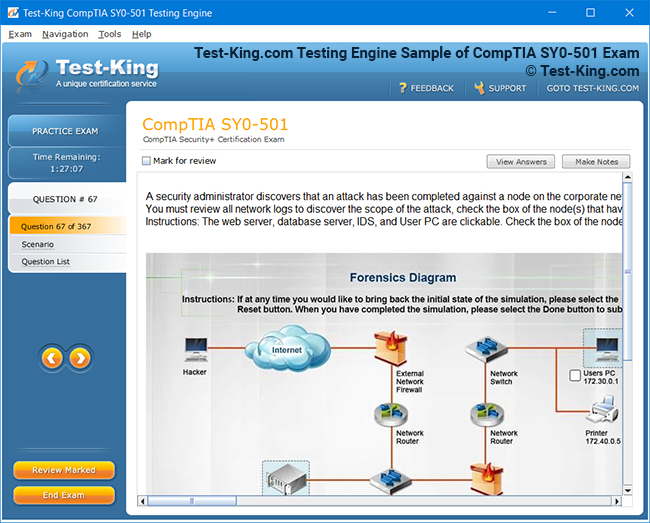
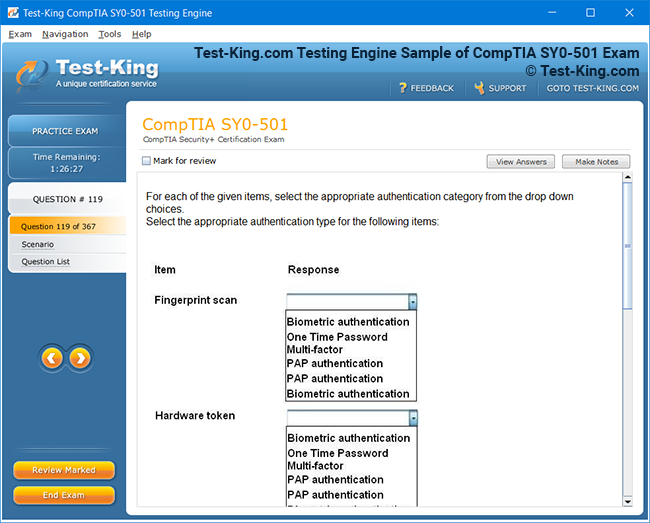
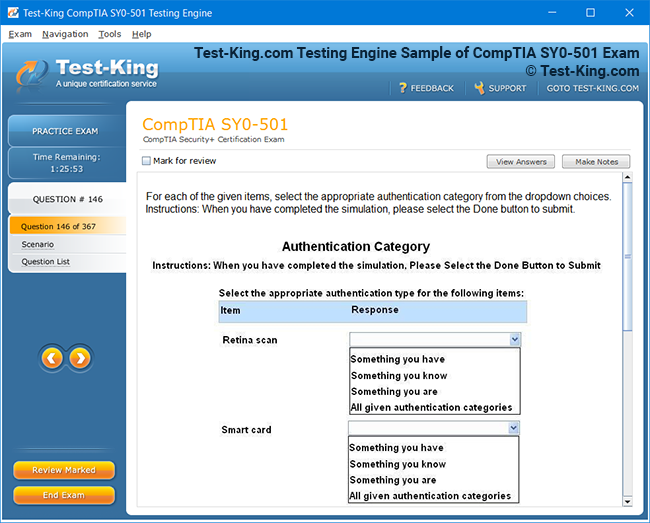
Product Screenshots
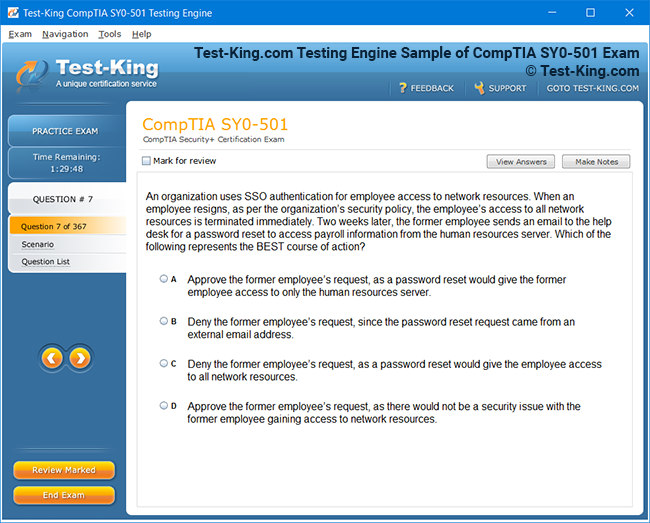
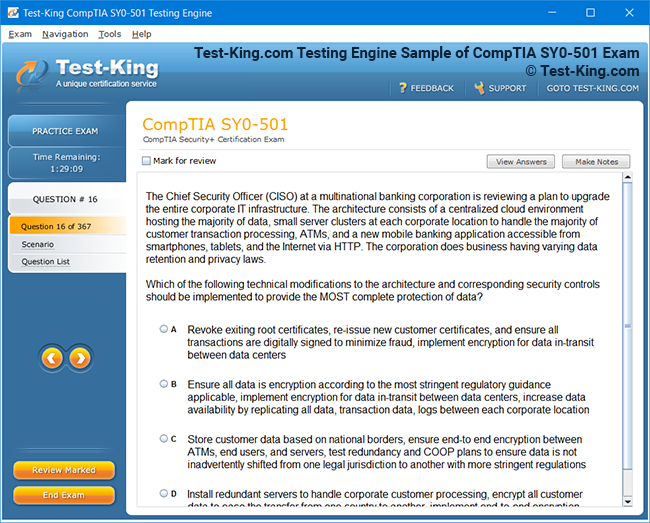
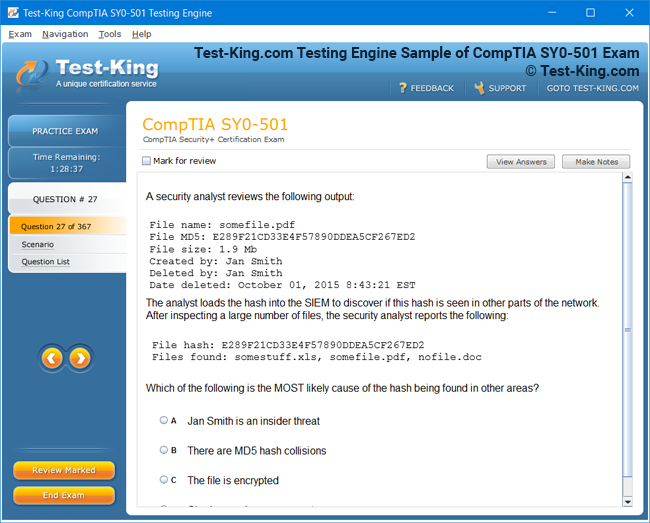
Frequently Asked Questions
How can I get the products after purchase?
All products are available for download immediately from your Member's Area. Once you have made the payment, you will be transferred to Member's Area where you can login and download the products you have purchased to your computer.
How long can I use my product? Will it be valid forever?
Test-King products have a validity of 90 days from the date of purchase. This means that any updates to the products, including but not limited to new questions, or updates and changes by our editing team, will be automatically downloaded on to computer to make sure that you get latest exam prep materials during those 90 days.
Can I renew my product if when it's expired?
Yes, when the 90 days of your product validity are over, you have the option of renewing your expired products with a 30% discount. This can be done in your Member's Area.
Please note that you will not be able to use the product after it has expired if you don't renew it.
How often are the questions updated?
We always try to provide the latest pool of questions, Updates in the questions depend on the changes in actual pool of questions by different vendors. As soon as we know about the change in the exam question pool we try our best to update the products as fast as possible.
How many computers I can download Test-King software on?
You can download the Test-King products on the maximum number of 2 (two) computers or devices. If you need to use the software on more than two machines, you can purchase this option separately. Please email support@test-king.com if you need to use more than 5 (five) computers.
What is a PDF Version?
PDF Version is a pdf document of Questions & Answers product. The document file has standart .pdf format, which can be easily read by any pdf reader application like Adobe Acrobat Reader, Foxit Reader, OpenOffice, Google Docs and many others.
Can I purchase PDF Version without the Testing Engine?
PDF Version cannot be purchased separately. It is only available as an add-on to main Question & Answer Testing Engine product.
What operating systems are supported by your Testing Engine software?
Our testing engine is supported by Windows. Andriod and IOS software is currently under development.
Top The Open Group Exams
- OGEA-103 - TOGAF Enterprise Architecture Combined Part 1 and Part 2
- OGEA-101 - TOGAF Enterprise Architecture Part 1
- OGA-031 - ArchiMate 3 Part 1
- OG0-093 - TOGAF 9 Combined Part 1 and Part 2
- OGEA-102 - TOGAF Enterprise Architecture Part 2
- OG0-092 - TOGAF 9 Part 2
- OG0-091 - TOGAF 9 Part 1
- OGA-032 - ArchiMate 3 Part 2
- OGEA-10B - TOGAF Enterprise Architecture Bridge
Ultimate Guide to Passing the OG0-061 IT4IT Part 1 Exam: Tips, Topics, and Study Plan
The OG0-061 IT4IT Part 1 exam offered by The Open Group is a fundamental certification for professionals seeking to comprehend the intricacies of managing the complete IT value chain. This exam serves as a cornerstone for those wishing to establish credibility in IT service management and enterprise architecture. The examination not only evaluates one's theoretical understanding but also tests practical knowledge of the IT4IT Reference Architecture, which offers a structured approach to managing the business of IT. For aspirants, it is essential to grasp the interconnectedness of IT activities, from strategy through design, transition, operations, and continual improvement, since the exam questions frequently assess the understanding of workflows, governance, and service lifecycle management.
Understanding the IT4IT Part 1 Exam and Its Importance
Many individuals often wonder what the main focus areas are when preparing for this certification. The IT4IT Part 1 exam emphasizes foundational knowledge of the IT4IT Reference Architecture, including the key functional components, value streams, and data objects. A common query from candidates is whether it is sufficient to memorize definitions. However, the exam favors comprehension and application over rote learning. For instance, understanding how the Strategy to Portfolio value stream integrates with project and service management practices, or how the Requirement to Deploy stream ensures seamless service delivery, is far more valuable than mere recognition of terminology.
A frequently asked question among candidates is how the exam is structured and what types of questions one might encounter. The OG0-061 is typically comprised of multiple-choice questions, scenario-based queries, and situational analysis that challenge the aspirant’s ability to reason through real-world IT management problems. The questions are designed to ensure that candidates can connect concepts across the four primary IT4IT value streams and apply the reference model to practical examples. This approach ensures that certified professionals possess a holistic understanding rather than fragmented knowledge, fostering an aptitude for aligning IT operations with business strategy.
Another area that many aspirants struggle with is the distinction between IT4IT and other IT frameworks such as ITIL or COBIT. While ITIL focuses predominantly on service management processes, IT4IT provides a broader architectural lens encompassing the entire IT landscape. Candidates often ask for clarification on how these frameworks interact. The simplest way to understand this is to consider IT4IT as a blueprint for managing IT as a value-generating entity, whereas ITIL offers detailed guidance on executing service management processes within that blueprint. Therefore, familiarity with ITIL processes can complement IT4IT knowledge but cannot substitute the need to understand the reference architecture.
When it comes to study strategy, candidates frequently inquire about the most effective way to organize their preparation. Successful aspirants often recommend a combination of studying the official IT4IT Foundation study guide, engaging with scenario-based practice questions, and forming discussion groups to dissect case studies. This multi-pronged approach allows for reinforcement of knowledge while promoting the ability to apply concepts in practical contexts. Additionally, understanding the interdependencies between value streams, such as how Change and Deployment activities impact Service Operations, is crucial. These insights often appear in questions designed to test reasoning rather than memorization.
An additional challenge candidates face involves understanding the various functional components described in the IT4IT Reference Architecture. Questions often focus on components such as the Service Portfolio, Project Portfolio, and Knowledge Repository. Aspirants frequently ask how to differentiate between these elements and their practical applications. The Service Portfolio, for instance, captures all IT services offered, including planned and retired services, providing a comprehensive view of the IT service lifecycle. The Project Portfolio monitors ongoing and planned projects, ensuring alignment with strategic objectives, while the Knowledge Repository centralizes information to support decision-making and operational efficiency. Understanding these distinctions enables candidates to navigate scenario-based questions with confidence.
Candidates also express curiosity about the significance of data objects within IT4IT. Data objects represent critical information exchanged across value streams and functional components. A common question is whether memorization of these objects is essential. While some familiarity is necessary, it is more important to comprehend how these objects interact to enable smooth workflows. For example, a Requirement data object captured in the Strategy to Portfolio value stream flows seamlessly into the Requirement to Deploy stream, ensuring accurate translation into actionable deployment plans. Recognizing these flows equips candidates with a mental model for tackling complex exam questions that involve process interconnectivity.
Many aspirants ponder the role of governance and measurement within IT4IT. Exam questions often explore how governance ensures alignment with organizational objectives and how performance metrics track the effectiveness of IT operations. Governance within IT4IT encompasses policies, standards, and practices that guide decision-making across value streams. Metrics, on the other hand, provide quantitative and qualitative insights into the efficiency of processes, the quality of delivered services, and the alignment with business expectations. Understanding the interplay between governance and metrics is vital, as it allows candidates to anticipate questions requiring application of these concepts to case scenarios.
Another area that generates frequent questions involves the practical implementation of IT4IT principles in an organizational context. Aspirants often ask for guidance on how to visualize the application of value streams and functional components in real-life IT departments. The most effective approach is to study case studies or simulation exercises, which reveal how strategic planning, project execution, and service operations are integrated within the IT4IT framework. By conceptualizing these real-world applications, candidates can approach situational questions with a problem-solving mindset, demonstrating an understanding that extends beyond textbook definitions.
Time management during preparation is a question that arises repeatedly among exam candidates. Many ask how to divide their study hours between theoretical concepts, scenario-based practice, and self-assessment. Experts recommend dedicating roughly half of the preparation time to understanding core concepts and interdependencies, while the remaining time should be spent on practice exercises and mock examinations. The rationale is to cultivate the ability to recognize patterns, interpret scenarios, and apply theoretical knowledge in simulated real-world contexts. This balanced approach reduces anxiety during the actual exam and enhances confidence in answering complex questions efficiently.
Candidates also inquire about the best way to retain the nuanced terminology used in IT4IT, such as value streams, functional components, and data objects. While some aspirants rely solely on flashcards or rote repetition, the most effective method involves contextual learning. By associating terms with scenarios and practical examples, candidates internalize concepts more effectively. For example, linking the Service Portfolio component with a hypothetical enterprise project allows aspirants to visualize how services are cataloged, managed, and retired. Such cognitive anchoring reinforces understanding and prepares candidates for questions that require applied reasoning.
A frequent concern is how to deal with scenario-based questions that combine multiple IT4IT concepts. Candidates often worry that these questions are too intricate or ambiguous. The key is to approach them systematically: first, identify the value stream involved, next, recognize the functional components implicated, and finally, trace the flow of relevant data objects. This structured approach simplifies complex scenarios and enables candidates to respond with precision. Many top-performing candidates report that practicing this method on sample questions significantly improves both speed and accuracy during the actual exam.
Some aspirants also seek clarification on the recommended study resources beyond the official guide. Apart from the IT4IT Foundation materials, additional resources include community forums, webinars hosted by certified professionals, and reference case studies. These sources provide nuanced perspectives and real-world examples that enrich understanding. For instance, webinars often highlight practical challenges in aligning IT initiatives with business outcomes, while forums offer insights into commonly misunderstood concepts or tricky exam questions. Leveraging these resources creates a robust study ecosystem that addresses both theoretical and applied learning.
A recurring question involves understanding the alignment between IT4IT and business strategy. Candidates are often curious about how IT decisions translate into business value. IT4IT emphasizes that each value stream should generate measurable value aligned with organizational objectives. For example, the Requirement to Deploy value stream ensures that business needs are translated into deliverables efficiently and accurately, minimizing delays and resource wastage. Understanding this alignment equips candidates to answer questions that require assessing the strategic impact of IT operations and service delivery initiatives, a common scenario in the OG0-061 exam.
Many candidates also question the relevance of IT4IT for professionals outside traditional IT roles. While primarily aimed at IT practitioners, IT4IT principles are increasingly applicable to business analysts, project managers, and enterprise architects. The framework promotes holistic understanding and cross-functional collaboration, which are valuable skills in today’s interconnected organizations. By appreciating how IT4IT integrates strategy, development, deployment, and operations, professionals in diverse roles can better comprehend organizational dynamics and contribute to value creation. This versatility often comes up in exam questions framed around cross-functional scenarios.
Another challenge often raised concerns understanding the continuous improvement aspect of IT4IT. Candidates ask how the framework supports iterative enhancement of IT processes. IT4IT incorporates feedback loops and performance monitoring to ensure services evolve in line with organizational needs. This continuous improvement mindset is essential, as it reinforces the ability to adapt workflows and optimize value streams over time. In exam scenarios, candidates may be asked to identify opportunities for process enhancement or to propose adjustments based on operational metrics, testing both conceptual knowledge and practical reasoning skills.
Exam candidates frequently inquire about strategies for effective retention of interconnected concepts. The OG0-061 exam often tests the understanding of relationships between value streams, functional components, and data objects. Aspirants are advised to create mental maps linking these elements and simulating their interactions through hypothetical projects. For instance, tracing a Requirement data object from the Strategy to Portfolio value stream through Requirement to Deploy and onto Operations helps internalize process flow. This cognitive mapping allows for efficient recall during complex, multi-faceted exam questions and promotes confident problem-solving.
A question that arises often involves the time allocation during the exam itself. Candidates are concerned with managing the duration and pacing of multiple-choice and scenario-based questions. The recommended approach is to quickly assess questions for familiarity, allocate initial time to easier items, and then revisit complex scenarios. This prevents time pressure from compromising performance and ensures that even challenging questions are approached methodically. Familiarity with the exam structure, reinforced through mock tests, is critical in executing this strategy effectively.
Finally, candidates frequently ask about the long-term benefits of attaining IT4IT Part 1 certification. Beyond immediate validation of knowledge, the certification demonstrates a professional’s ability to understand and manage IT as a strategic asset. Certified individuals gain credibility in the field, better career prospects, and enhanced ability to participate in organizational decision-making. Questions related to career growth may not appear directly in the exam but provide motivation for diligent preparation and reinforce the real-world relevance of the framework.
Mastering Value Streams, Functional Components, and Data Objects
The OG0-061 IT4IT Part 1 exam emphasizes understanding value streams, functional components, and data objects within the IT4IT Reference Architecture. Many candidates inquire about the nuances of each value stream and how they interconnect. The Strategy to Portfolio value stream, for instance, is often discussed as the blueprint for aligning IT initiatives with business objectives. It orchestrates decisions regarding service investment, project prioritization, and portfolio management. Understanding how this value stream interacts with subsequent streams, particularly Requirement to Deploy, is crucial because it ensures that business needs are translated into deliverable IT solutions efficiently.
A common question among aspirants is how the Requirement to Deploy value stream facilitates continuous delivery and minimizes deployment risks. This value stream manages the complete flow from requirements elicitation to deployment, including testing, validation, and release coordination. Questions often emphasize scenarios where inadequate translation of requirements can result in failed deployments or misaligned services. Candidates are encouraged to visualize the lifecycle of a requirement data object as it moves through functional components such as the Project Portfolio, Service Portfolio, and Knowledge Repository. This mental mapping allows aspirants to understand dependencies and anticipate outcomes, which is a frequent theme in scenario-based questions.
Another recurring concern is comprehending the Request to Fulfill value stream, which manages service requests and operational fulfillment. Candidates often ask how this stream differs from Requirement to Deploy. The distinction lies in its focus: Request to Fulfill handles the execution of user-initiated service requests, incident resolution, and day-to-day operational activities. The stream ensures that IT services remain responsive, reliable, and aligned with service-level expectations. For the exam, understanding the flow of data objects such as Request, Service Instance, and Configuration Item is vital, because these objects facilitate traceability, accountability, and operational efficiency, all of which are commonly tested in scenario questions.
The Shift to Run value stream often generates curiosity among candidates who are trying to discern its purpose within the IT4IT architecture. This stream oversees the transition from development or project completion to operational stability. Aspirants often ask how it supports service reliability. Essentially, Shift to Run ensures that newly deployed services or changes integrate seamlessly into operations, with minimal disruption. Functional components such as the Change and Release Management module are central to this stream, and exam questions often focus on evaluating a candidate’s understanding of how these components interact to maintain service continuity.
Many candidates express uncertainty regarding functional components themselves and how they fit into the overall framework. Key components include the Service Portfolio, which catalogs all IT services; the Project Portfolio, which tracks ongoing and planned initiatives; the Knowledge Repository, which centralizes information for decision-making; and the Service Registry, which ensures accurate service configuration and discoverability. Aspirants frequently ask for guidance on differentiating these components in exam scenarios. The Service Portfolio reflects what IT provides, the Project Portfolio illustrates how services are delivered, and the Knowledge Repository ensures that institutional knowledge supports all decision-making. Recognizing the interplay among these components allows candidates to answer complex questions that simulate real-world IT challenges.
Data objects also feature prominently in the OG0-061 exam. Candidates often inquire about the significance of objects such as Requirement, Service Request, and Change Record. Data objects represent the essential information flowing through value streams, and the exam frequently tests comprehension of how these objects interact. For example, a Requirement object captured during strategic planning flows through the Requirement to Deploy stream, transforming into actionable project tasks and ultimately into a deployed service instance. Questions may present scenarios where incorrect handling of data objects results in delays or service failure, making it critical for candidates to grasp both the purpose and lifecycle of these artifacts.
Scenario-based questions often focus on governance and measurement practices. Candidates typically ask how IT4IT ensures alignment with organizational objectives. Governance within IT4IT encompasses standards, policies, and practices that direct value streams and functional components, while measurement mechanisms assess efficiency, quality, and alignment with business goals. Aspirants are frequently presented with questions where they must analyze a situation, identify governance lapses, and suggest improvements. This type of evaluation tests both theoretical knowledge and practical reasoning skills, making comprehension of governance and measurement indispensable.
A common query involves the integration of IT4IT with other frameworks such as ITIL or COBIT. While ITIL focuses on service management processes, IT4IT offers an architectural perspective that spans the entire IT value chain. Candidates often ask whether IT4IT knowledge alone is sufficient. While IT4IT provides the structural blueprint for managing IT as a value-generating entity, familiarity with ITIL processes, particularly incident, problem, and change management, enhances one’s ability to contextualize and apply concepts effectively. Exam scenarios often present hybrid situations requiring candidates to reconcile IT4IT architecture with operational process execution.
Many aspirants also seek advice on practical study techniques for mastering value streams and functional components. Experts recommend a combination of conceptual study, scenario analysis, and repetitive mental mapping of data object flows. Visualizing the journey of a Requirement from inception to deployment, or tracing a Change Record through Shift to Run activities, can significantly improve retention and problem-solving ability. Candidates are encouraged to simulate real-world situations in their minds, such as deploying a new service to a production environment, and consider all functional components and value streams involved. This cognitive rehearsal is particularly useful when encountering multi-layered exam questions.
Time management during preparation is another area that often prompts questions. Candidates wonder how to balance study of theoretical principles with scenario practice. The recommended approach is to allocate initial hours to understanding each value stream, its functional components, and associated data objects. Subsequent hours should focus on scenario exercises, where concepts are applied to practical questions, reinforcing both comprehension and analytical thinking. Mock exams can further sharpen timing and prioritization skills, allowing candidates to approach the OG0-061 exam with confidence and strategic pacing.
A frequently asked question concerns how to internalize the relationships among value streams. Candidates are sometimes overwhelmed by the apparent complexity of the IT4IT architecture. The key is to adopt a systems-thinking perspective. Each value stream is interdependent, and changes in one stream often cascade to others. For example, a delay in the Requirement to Deploy value stream can affect Shift to Run activities, potentially impacting service reliability. Understanding these dependencies allows candidates to approach scenario questions holistically, considering not only immediate effects but also downstream impacts.
Another recurring inquiry pertains to the practical significance of continuous improvement within IT4IT. Candidates ask how the framework facilitates iterative enhancement of IT operations. Feedback loops embedded in each value stream provide opportunities to identify inefficiencies, optimize processes, and adjust resource allocation. Scenario questions may present candidates with operational performance data, requiring analysis to determine potential process improvements. Understanding how continuous improvement is embedded across value streams and functional components is crucial for both exam success and real-world application.
Many aspirants are curious about the best way to tackle complex scenario questions that integrate multiple value streams. The recommended approach is to first identify the primary value stream involved, then consider the relevant functional components, and finally trace the associated data objects. This structured methodology simplifies problem-solving and enhances accuracy in answering questions. Practicing this approach with multiple scenarios strengthens analytical skills, making candidates more adept at interpreting intricate exam questions and selecting the most appropriate response.
Questions about real-world applicability often arise as candidates try to contextualize IT4IT knowledge. While the exam evaluates theoretical understanding, practical application is essential. Professionals often encounter questions related to optimizing service delivery, managing portfolios, or improving operational efficiency. By studying case studies and reflecting on hypothetical scenarios, aspirants can bridge the gap between theory and practice. Understanding how IT4IT principles manifest in organizational settings reinforces comprehension and equips candidates to respond effectively to applied exam questions.
A notable concern for candidates is distinguishing among the myriad of data objects and understanding their interactions. The Requirement, Change Record, Service Request, and Service Instance are frequently highlighted. Each serves a distinct purpose yet interacts fluidly across value streams. Misinterpretation of these relationships often leads to incorrect answers in scenario-based questions. To address this, aspirants are encouraged to trace each object’s lifecycle and understand its role in enabling smooth IT operations, from strategy through deployment to operational continuity.
Many candidates ask about the relationship between IT4IT and business outcomes. The framework emphasizes that IT activities should generate tangible value and support organizational objectives. Scenario questions often test the ability to assess whether IT initiatives are aligned with strategic goals. For instance, evaluating a portfolio of projects to ensure optimal investment in services that deliver measurable business value reflects this principle. Understanding this connection enhances both exam performance and real-world competence, as certified professionals are equipped to integrate IT management with business priorities effectively.
Candidates also frequently inquire about resource optimization within IT4IT. Efficient use of resources, including human, technological, and financial assets, is a recurring theme. Questions may require candidates to analyze allocation strategies, identify bottlenecks, or propose improvements. Grasping these concepts is essential because IT4IT not only addresses process execution but also emphasizes strategic resource management, enabling IT organizations to deliver maximum value while minimizing waste and inefficiencies.
Understanding governance mechanisms within IT4IT is another area that generates many queries. Governance is embedded across value streams to ensure adherence to policies, alignment with strategic objectives, and consistent performance measurement. Candidates often face scenario questions where they must identify governance gaps, propose corrective actions, or evaluate compliance with standards. Mastery of these concepts ensures candidates can answer such questions with both precision and insight.
Candidates frequently ask how to effectively synthesize all these concepts for exam readiness. Combining comprehension of value streams, functional components, and data objects with scenario practice is key. Aspirants are advised to build cognitive frameworks that interlink concepts, visualize workflows, and anticipate interdependencies. Mental rehearsals, self-assessments, and regular reviews reinforce retention and enhance problem-solving agility. This integrated preparation strategy not only improves exam performance but also equips professionals with skills applicable to complex IT environments.
In-Depth Strategies for Exam Preparation and Conceptual Mastery
The OG0-061 IT4IT Part 1 exam demands not only memorization but also the ability to synthesize complex concepts into practical understanding. Many candidates wonder how to approach the preparation efficiently. The cornerstone of effective study lies in comprehending the interrelationship between value streams, functional components, and data objects. The Strategy to Portfolio value stream, often highlighted in study guides, orchestrates the alignment of IT investments with business imperatives. Aspirants frequently inquire how to internalize the strategic decisions involved. One approach is to visualize hypothetical projects and consider how prioritization and resource allocation decisions influence both short-term deliverables and long-term organizational objectives.
Candidates often question the significance of the Requirement to Deploy value stream in ensuring successful service delivery. This stream governs the transformation of requirements into deployable services, incorporating stages such as planning, development, validation, and deployment. A common area of confusion is differentiating it from the Request to Fulfill stream. The key distinction is that Requirement to Deploy focuses on creating and delivering new services, while Request to Fulfill manages operational fulfillment of user-initiated requests. Exam scenarios frequently test an aspirant’s ability to trace the journey of a requirement data object through various functional components, including the Project Portfolio, Service Portfolio, and Knowledge Repository. Visualizing this flow helps in understanding potential points of failure or inefficiency.
Many aspirants also ask about the Request to Fulfill value stream and its role in operational efficiency. This stream ensures that service requests, incidents, and routine tasks are executed consistently and in alignment with service levels. Understanding how data objects such as Service Instance, Request, and Configuration Item interact is vital for answering scenario-based questions. For instance, recognizing how a Service Instance created during deployment influences subsequent operational requests allows candidates to anticipate the consequences of changes or disruptions. Scenario questions often present a cascading problem, requiring careful tracking of object interactions across the value stream.
The Shift to Run value stream is another topic that generates considerable curiosity. Candidates often inquire how this stream supports operational continuity after deployment. Essentially, Shift to Run ensures that changes introduced by Requirement to Deploy are integrated smoothly into operational environments. Functional components like Change and Release Management are central here, and candidates are frequently asked to analyze scenarios where improper transition may jeopardize service stability. Understanding the mechanisms for monitoring, validating, and controlling changes is crucial to mastering the exam content.
Functional components themselves present frequent questions. The Service Portfolio, Project Portfolio, Knowledge Repository, and Service Registry form the backbone of IT4IT operations. Candidates often struggle with distinguishing their roles in practical applications. The Service Portfolio represents the entirety of IT services offered, including planned, active, and retired services. The Project Portfolio manages active projects and ensures alignment with strategic objectives. The Knowledge Repository consolidates information that supports decision-making and operational efficiency. Meanwhile, the Service Registry ensures accurate service identification and facilitates discovery. Understanding these components enables candidates to navigate multi-layered scenarios where inter-component interactions influence outcomes.
Data objects are central to exam questions, and many aspirants inquire about their practical relevance. Objects such as Requirement, Change Record, Service Request, and Service Instance track the lifecycle of services and facilitate operational control. Candidates are often asked to trace these objects through multiple value streams and functional components. For example, a Change Record originating in Requirement to Deploy may pass through Shift to Run before affecting operational fulfillment, and its accurate handling is critical to maintaining service quality. Grasping these interactions allows candidates to respond to complex scenario-based questions with clarity.
Governance and measurement are recurring themes in exam preparation. Candidates frequently ask how IT4IT ensures organizational alignment. Governance involves policies, standards, and procedures that guide decision-making across all value streams. Measurement mechanisms provide feedback on efficiency, quality, and alignment with business goals. Scenario questions may present situations where lapses in governance or inaccurate metrics lead to service degradation. Understanding the interplay between governance and measurement enables candidates to recommend corrective actions or identify risks in given scenarios.
A common area of concern involves differentiating IT4IT from frameworks such as ITIL and COBIT. While ITIL emphasizes detailed service management practices, IT4IT offers a holistic architecture encompassing the entire IT value chain. Candidates often ask whether IT4IT knowledge alone is sufficient for practical application. While IT4IT provides structural oversight, understanding ITIL processes, particularly in incident, change, and problem management, can enhance practical application. Exam scenarios may require candidates to reconcile architectural perspectives with operational execution, making familiarity with both frameworks advantageous.
Many aspirants seek guidance on conceptual retention techniques. Memorization alone is insufficient; candidates must develop a cognitive model linking value streams, functional components, and data objects. One effective approach is to simulate a deployment scenario in the mind, tracking the movement of requirement objects through functional components and value streams. This practice not only reinforces understanding but also prepares candidates for questions requiring problem-solving across multiple streams. Visualization, coupled with repeated scenario exercises, helps internalize interdependencies and reduces uncertainty during the exam.
Time management is another frequently discussed topic among aspirants. They often ask how to allocate preparation hours effectively between theory and practice. The recommended approach is to dedicate initial periods to understanding each value stream, functional component, and data object thoroughly. Subsequent hours should be spent applying these concepts in scenario-based exercises and mock exams. Practicing under timed conditions helps candidates develop pacing strategies, reducing anxiety and increasing confidence during the actual exam.
Candidates often inquire about methods to tackle multi-layered scenario questions. The key strategy is structured analysis: identify the primary value stream involved, recognize the functional components impacted, and trace the relevant data objects. Many successful aspirants report that this systematic approach simplifies seemingly complex questions, allowing them to respond accurately and efficiently. Cognitive mapping of scenarios also aids in visualizing cascading effects across streams, which is essential when questions involve multiple interrelated elements.
Questions about real-world applicability are common. Aspirants often wonder how theoretical IT4IT knowledge translates into practical outcomes. The framework encourages professionals to align IT activities with business objectives, optimize resource utilization, and ensure operational excellence. Scenario-based questions often test candidates’ ability to evaluate alignment, identify inefficiencies, or propose improvements. Studying case studies and reflecting on hypothetical enterprise challenges can enhance both comprehension and problem-solving skills, equipping candidates to handle practical scenarios effectively.
Data object lifecycle understanding is frequently queried. Candidates often ask how objects such as Requirement, Change Record, Service Request, and Service Instance interact. Each object serves a distinct role, yet their interactions form the backbone of IT4IT operations. For example, a Requirement object flowing through Requirement to Deploy may generate a Service Instance in Shift to Run, which in turn may trigger Request to Fulfill actions. Misinterpretation of these relationships can lead to incorrect answers, making thorough understanding indispensable.
Many aspirants ask about the strategic significance of IT4IT in organizational performance. The framework emphasizes value generation through efficient IT operations. Scenario questions may require candidates to assess whether IT initiatives are delivering measurable business benefits. For instance, evaluating project investments or resource allocation decisions to optimize service delivery demonstrates alignment with organizational goals. Recognizing the broader implications of IT4IT principles enhances both exam performance and practical proficiency.
Resource management is another common inquiry. Candidates often question how IT4IT facilitates optimal allocation of technological, human, and financial assets. Effective use of resources ensures that services are delivered efficiently and cost-effectively. Scenario-based questions may involve analyzing resource distribution, identifying bottlenecks, or suggesting adjustments. Understanding how each value stream contributes to resource optimization is crucial for both exam and real-world applications.
Governance and compliance are recurring areas of curiosity. Aspirants frequently ask how IT4IT ensures adherence to standards and alignment with business objectives. Scenario questions may require candidates to detect gaps in compliance, suggest corrective measures, or evaluate governance effectiveness. Mastery of governance principles, alongside measurement and feedback mechanisms, enables candidates to respond accurately to questions testing both conceptual knowledge and analytical reasoning.
Candidates often inquire about effective integration of study techniques to master all concepts. Combining theoretical comprehension, scenario analysis, and mental simulation is essential. Building a cognitive map linking value streams, functional components, and data objects enhances retention and problem-solving capacity. Regular self-assessment, timed mock exams, and scenario visualization reinforce learning and improve confidence, equipping candidates to navigate the OG0-061 exam with precision and strategic clarity.
Many aspirants question how to prepare for the diverse question types. The exam includes multiple-choice, scenario-based, and applied reasoning questions. Familiarity with different question formats helps candidates approach each type methodically. Practicing past questions, analyzing patterns, and simulating exam conditions contribute to improved accuracy and time management, reducing stress and ensuring readiness for unexpected or complex scenarios.
Candidates also ask about continuous improvement principles embedded in IT4IT. Feedback loops within value streams allow organizations to refine processes, optimize performance, and enhance service quality. Scenario questions may present performance metrics or operational challenges, requiring candidates to recommend adjustments or improvements. Understanding continuous improvement reinforces both conceptual knowledge and practical application, reflecting the dynamic nature of modern IT management.
Many aspirants wonder how to handle questions involving interdependencies between value streams. Recognizing that changes or delays in one stream can affect others is critical. For example, a delay in Requirement to Deploy can impact Shift to Run activities, creating cascading operational issues. Scenario-based questions often test this understanding, requiring candidates to analyze chain reactions and propose mitigating actions. Visualization and mental simulation of interdependencies provide a strong foundation for tackling such complex queries.
Candidates frequently ask how to contextualize IT4IT knowledge for practical use. Beyond theoretical understanding, the framework enables professionals to optimize workflows, manage portfolios, and enhance operational efficiency. Analyzing hypothetical scenarios, simulating deployments, and evaluating resource allocations can help aspirants bridge the gap between exam preparation and real-world applicability, ensuring that learning is both deep and actionable.
Advanced Understanding of IT4IT Concepts, Value Streams, and Exam Readiness
The OG0-061 IT4IT Part 1 exam demands a nuanced understanding of IT management frameworks and the ability to apply theoretical concepts to practical scenarios. Many candidates wonder how to approach the preparation process in a way that ensures both retention and analytical skill. The Strategy to Portfolio value stream is often highlighted as foundational because it orchestrates strategic alignment of IT initiatives with organizational goals. Candidates frequently ask how to internalize the strategic decision-making process. One effective method is to visualize enterprise projects, evaluating how prioritization, budgeting, and resource allocation decisions influence both short-term deliverables and long-term business objectives. By considering hypothetical situations, aspirants can develop a mental framework for evaluating portfolio decisions in exam scenarios.
A recurring question involves the Requirement to Deploy value stream and its critical function in transforming business requirements into deployable services. This stream encompasses stages from initial requirement elicitation to deployment, including planning, development, testing, and release management. Candidates often express uncertainty about distinguishing it from Request to Fulfill. The main differentiation lies in purpose: Requirement to Deploy focuses on creating new services or products, while Request to Fulfill governs operational requests and routine service delivery. Scenario-based questions often require aspirants to track a Requirement data object as it flows through functional components such as the Project Portfolio, Service Portfolio, and Knowledge Repository, emphasizing comprehension of both process and dependency.
Many candidates seek clarity on the Request to Fulfill value stream and its role in ensuring operational excellence. This stream handles the execution of service requests, incidents, and routine operational tasks. Understanding the flow of data objects like Service Instance, Request, and Configuration Item is essential because these objects facilitate accountability, traceability, and operational efficiency. For example, recognizing how a deployed Service Instance influences subsequent operational requests allows candidates to anticipate potential challenges and answer scenario questions effectively. Examiners often test aspirants on these interactions, making a thorough grasp of object relationships indispensable.
The Shift to Run value stream frequently generates questions regarding its role in maintaining service stability post-deployment. Candidates often inquire how this stream mitigates operational risk. Essentially, Shift to Run ensures that changes delivered through Requirement to Deploy are integrated smoothly into ongoing operations, maintaining service reliability. Functional components like Change and Release Management are central to this process, and exam questions may involve scenarios where improper transitions lead to service disruption. Understanding the mechanisms for monitoring, validation, and control is vital for candidates aiming to respond accurately to situational questions.
Functional components themselves are often a source of confusion among aspirants. The Service Portfolio, Project Portfolio, Knowledge Repository, and Service Registry constitute the structural backbone of IT4IT operations. Candidates frequently ask how to differentiate these components in practical scenarios. The Service Portfolio catalogs all IT services, encompassing planned, active, and retired offerings. The Project Portfolio tracks ongoing projects, ensuring alignment with strategic priorities. The Knowledge Repository centralizes information for informed decision-making, while the Service Registry ensures accurate service identification and facilitates discovery. Mastery of these distinctions allows candidates to address multi-layered scenario questions that assess both analytical and conceptual understanding.
Data objects are another crucial element of exam preparation. Candidates often inquire about their practical relevance. Objects such as Requirement, Change Record, Service Request, and Service Instance track the lifecycle of services and enable operational control. For instance, a Requirement captured during strategic planning flows through Requirement to Deploy, ultimately resulting in a Service Instance in Shift to Run. Understanding these flows is critical, as scenario questions frequently present challenges related to mismanagement or improper sequencing of data objects. Comprehensive knowledge of object interactions equips candidates to handle complex queries with precision.
Governance and measurement are topics that many aspirants seek to understand in depth. Questions often focus on how IT4IT ensures alignment with business objectives and maintains operational efficiency. Governance mechanisms encompass policies, standards, and practices guiding decision-making across value streams, while measurement provides insights into effectiveness, efficiency, and alignment with strategic goals. Candidates may encounter scenarios where lapses in governance or incorrect metrics have led to operational issues. Being able to analyze these situations and recommend corrective actions is a recurring focus of exam questions.
Candidates frequently ask about differentiating IT4IT from frameworks like ITIL or COBIT. While ITIL emphasizes process-level service management, IT4IT provides a comprehensive architectural view of the IT value chain. Aspirants often wonder whether knowledge of ITIL is necessary. Understanding ITIL can complement IT4IT by providing practical context for incident, problem, and change management processes. Exam scenarios may present hybrid situations requiring candidates to reconcile IT4IT architecture with operational execution, highlighting the importance of cross-framework familiarity.
Conceptual retention techniques are another common area of inquiry. Many candidates struggle to retain the relationships among value streams, functional components, and data objects. Effective strategies involve mental simulation of scenarios, tracing data objects through value streams, and repeatedly visualizing process flows. For instance, mapping a Requirement through Requirement to Deploy into a Service Instance in Shift to Run, followed by operational actions in Request to Fulfill, reinforces comprehension and prepares aspirants for multi-layered scenario questions.
Time management during preparation and during the exam is a topic of constant concern. Candidates often ask how to balance study between theory and scenario practice. A recommended approach is to allocate initial focus to understanding each value stream, functional component, and associated data objects, followed by extensive practice using scenario exercises and mock exams. Timed practice helps candidates develop pacing strategies, reduces anxiety, and improves accuracy when handling complex exam questions.
Handling multi-layered scenario questions is another frequent concern. The key is systematic analysis: identify the primary value stream, recognize the functional components affected, and trace the relevant data objects. This structured method simplifies complex questions, enabling aspirants to provide accurate answers efficiently. Practicing this approach with varied scenarios strengthens analytical abilities and improves confidence during the exam.
Real-world applicability of IT4IT concepts is a recurring question among candidates. While the exam is theoretical, scenario questions often mirror practical organizational challenges. The framework emphasizes aligning IT activities with business objectives, optimizing resources, and ensuring operational effectiveness. Exam scenarios may ask candidates to evaluate the impact of project prioritization, deployment strategies, or resource allocation decisions, making comprehension of practical implications essential.
Data object lifecycle comprehension is critical. Candidates frequently ask about the interactions among Requirement, Change Record, Service Request, and Service Instance. Each object serves a specific purpose but their interplay ensures seamless IT operations. For example, a Change Record triggered by a deployed Requirement can affect Service Instances in operational fulfillment. Misinterpretation of these interactions often leads to incorrect scenario responses, underscoring the need for deep understanding.
The strategic significance of IT4IT is often queried. Candidates are interested in how the framework drives measurable business outcomes. Scenario questions may require evaluating whether IT initiatives are delivering organizational value. For instance, analyzing the effectiveness of portfolio investments or deployment strategies in achieving business objectives tests both conceptual and applied knowledge. Understanding this alignment strengthens exam readiness and practical competence.
Resource management is another area of inquiry. Candidates often ask how IT4IT ensures optimal utilization of human, technological, and financial resources. Efficient allocation supports service delivery and minimizes operational risk. Exam scenarios may involve identifying resource bottlenecks, analyzing workload distribution, or recommending improvements. Understanding the role of value streams in resource optimization is essential for answering these questions effectively.
Governance and compliance are consistently tested. Candidates often ask how IT4IT ensures adherence to policies and standards while maintaining alignment with business objectives. Scenario questions may present situations requiring identification of compliance gaps, evaluation of governance effectiveness, or suggestion of corrective measures. Mastery of these principles is vital for demonstrating both conceptual understanding and analytical capability.
Integration of study techniques is frequently discussed among candidates. Combining theoretical study with scenario analysis, mental visualization, and mock exams helps internalize complex relationships. Cognitive mapping of value streams, functional components, and data objects enhances retention and improves problem-solving efficiency. Regular self-assessment and scenario rehearsal strengthen confidence and exam preparedness, allowing candidates to approach the OG0-061 exam strategically.
Candidates often inquire about question format preparation. The exam includes multiple-choice, scenario-based, and applied reasoning questions. Familiarity with each type allows methodical approaches and reduces time pressure. Practicing past questions and analyzing trends improve accuracy and comprehension. Mock exams under timed conditions enhance readiness for unexpected or complex scenarios.
Continuous improvement is another frequently asked topic. IT4IT incorporates feedback loops across value streams to identify inefficiencies, optimize processes, and improve service quality. Scenario questions may present performance metrics requiring candidates to recommend enhancements or adjustments. Understanding continuous improvement ensures aspirants can analyze dynamic situations and propose practical solutions.
Interdependencies among value streams are a common area of focus. Candidates often ask how delays or changes in one stream impact others. For example, a delay in Requirement to Deploy can influence Shift to Run operations, affecting service reliability. Scenario questions may require identifying cascading effects and recommending mitigations. Visualization and mental rehearsal of these dependencies strengthen problem-solving capabilities.
Practical contextualization of IT4IT knowledge is essential. Candidates frequently ask how to translate framework principles into real-world outcomes. Understanding portfolio management, deployment strategies, operational fulfillment, and resource allocation allows aspirants to bridge theory and application. Analyzing hypothetical scenarios and evaluating potential solutions reinforce conceptual understanding while enhancing practical insight.
Practical Approaches to Mastering IT4IT Architecture, Value Streams, and Exam Scenarios
The OG0-061 IT4IT Part 1 exam requires candidates to integrate theoretical knowledge with practical reasoning. Many aspirants ask how to develop a study approach that balances comprehension of IT4IT architecture with application to scenario-based questions. The Strategy to Portfolio value stream serves as a fundamental starting point, orchestrating strategic alignment of IT initiatives with organizational objectives. Candidates often inquire how to internalize decision-making processes within this stream. A valuable method is to simulate hypothetical business cases, analyzing how prioritization, budgeting, and resource allocation impact both immediate deliverables and long-term goals. This approach fosters a cognitive model for portfolio evaluation, which is frequently tested in situational exam questions.
A common area of curiosity involves the Requirement to Deploy value stream, which governs the conversion of requirements into deployable services. Aspirants frequently ask how to differentiate this stream from Request to Fulfill. Requirement to Deploy focuses on developing new services, encompassing planning, design, testing, and deployment, whereas Request to Fulfill manages operational execution of service requests. Exam questions often present scenarios requiring tracking a Requirement data object through functional components such as the Project Portfolio, Service Portfolio, and Knowledge Repository. Understanding the trajectory of these objects is essential for answering complex situational queries and anticipating potential operational challenges.
Many candidates express interest in the Request to Fulfill value stream and its role in sustaining operational efficiency. This stream ensures that service requests, incidents, and routine tasks are executed reliably and within defined service levels. Data objects such as Service Instance, Request, and Configuration Item are central to operational flow. For example, a Service Instance created during deployment influences subsequent operational requests, and scenario-based questions often test the candidate’s ability to trace these interactions accurately. Mastery of these object flows enhances understanding of cascading operational impacts and improves problem-solving during exam scenarios.
The Shift to Run value stream frequently generates questions regarding its function in maintaining service stability after deployment. Candidates often ask how this stream mitigates operational risks. Essentially, Shift to Run ensures that newly deployed services integrate seamlessly into existing operations, maintaining continuity and reliability. Functional components such as Change and Release Management are central to this process. Exam scenarios may present situations where improper transition results in service disruption, requiring candidates to analyze the impact and recommend corrective actions. A thorough understanding of monitoring, validation, and control mechanisms is crucial to mastering such questions.
Functional components often generate curiosity among aspirants. The Service Portfolio, Project Portfolio, Knowledge Repository, and Service Registry form the backbone of IT4IT operations. Many candidates ask how to differentiate these elements in practical situations. The Service Portfolio catalogs all IT services, including planned, active, and retired offerings. The Project Portfolio tracks active projects and ensures alignment with strategic objectives. The Knowledge Repository consolidates information to support decision-making and operational efficiency, while the Service Registry ensures accurate identification and discoverability of services. Understanding these distinctions allows candidates to address questions that involve multi-component interactions and cross-stream dependencies.
Data objects are pivotal in exam preparation. Candidates frequently ask about the practical importance of objects such as Requirement, Change Record, Service Request, and Service Instance. These objects facilitate traceability and operational control. For example, a Requirement originating in Strategy to Portfolio flows through Requirement to Deploy, resulting in a Service Instance in Shift to Run, which may then trigger Request to Fulfill actions. Scenario questions often present disruptions or mismanaged flows, testing the candidate’s ability to understand interactions and propose corrective measures. Mastery of data object flows is critical for both accuracy and efficiency in handling complex exam queries.
Governance and measurement are recurring areas of inquiry. Aspirants often ask how IT4IT ensures alignment with business goals while maintaining operational efficiency. Governance encompasses standards, policies, and procedures guiding decisions across value streams, while measurement mechanisms evaluate process effectiveness, quality, and alignment with strategic objectives. Scenario-based questions may present lapses in governance or inaccurate metrics, requiring candidates to analyze root causes and propose remediation. Understanding the interplay of governance and measurement enables candidates to approach such questions methodically and with confidence.
Candidates often inquire about differentiating IT4IT from frameworks such as ITIL or COBIT. While ITIL provides detailed process guidance, IT4IT delivers a holistic architectural perspective covering the entire IT value chain. Many aspirants wonder whether knowledge of ITIL is necessary for exam success. Understanding ITIL processes can complement IT4IT knowledge, particularly in incident, problem, and change management scenarios. Exam questions may present hybrid situations where candidates need to reconcile IT4IT’s architectural approach with practical operational execution, highlighting the importance of cross-framework familiarity.
Retention techniques for complex concepts are another frequent topic. Many candidates struggle to internalize relationships among value streams, functional components, and data objects. Effective strategies include mental simulation of processes, tracing data objects through value streams, and repeatedly visualizing process flows. For instance, tracking a Requirement through Requirement to Deploy, resulting in a Service Instance in Shift to Run, and then observing its impact on Request to Fulfill operations reinforces understanding and prepares candidates for scenario-based questions with multiple interdependencies.
Time management during preparation and during the exam is often queried. Candidates frequently ask how to allocate hours between theory study and practical scenario exercises. The recommended strategy is to dedicate initial study periods to understanding the fundamentals of value streams, functional components, and data object interactions. Subsequent hours should focus on scenario exercises, mock exams, and timed practice. Practicing under timed conditions improves pacing, reduces exam anxiety, and ensures candidates can handle complex questions efficiently.
Handling multi-layered scenario questions is another frequent concern. The key strategy is structured analysis: identify the primary value stream, determine the functional components involved, and trace the relevant data objects. Many top-performing candidates report that this approach simplifies complex scenarios and improves accuracy. Mental mapping of interactions across streams strengthens problem-solving capabilities and enhances confidence during the exam.
Real-world applicability of IT4IT principles is frequently questioned. While the exam is theoretical, scenario questions often simulate practical organizational challenges. IT4IT encourages alignment of IT operations with business objectives, optimization of resources, and assurance of operational excellence. Scenario questions may ask candidates to evaluate the impact of portfolio decisions, deployment strategies, or resource allocations, making understanding practical implications essential for both exam performance and professional competence.
Understanding the lifecycle and interactions of data objects is critical. Candidates often ask how Requirement, Change Record, Service Request, and Service Instance interact within value streams. Each object serves a unique purpose, yet their interactions underpin operational efficiency. For instance, a Change Record triggered by a deployed Requirement can influence Service Instances and subsequent operational actions. Misinterpretation of these interactions can result in incorrect scenario responses, underscoring the importance of mastery for exam success.
Candidates frequently ask about the strategic significance of IT4IT. The framework emphasizes that IT initiatives must generate measurable business value. Scenario questions may require analysis of whether projects or service deliveries achieve organizational objectives. Evaluating portfolio decisions or resource allocation effectiveness reflects this principle. Understanding strategic implications strengthens both exam performance and the ability to apply IT4IT concepts in real-world settings.
Resource management is another area of concern. Candidates often inquire how IT4IT ensures optimal utilization of human, technological, and financial assets. Effective resource allocation underpins efficient service delivery and operational continuity. Exam scenarios may present bottlenecks or misallocation issues, requiring candidates to propose adjustments. Comprehension of value streams’ roles in resource management is essential for analyzing complex situations and recommending solutions.
Governance and compliance are consistently tested topics. Candidates frequently ask how IT4IT maintains adherence to policies and standards while ensuring alignment with business objectives. Scenario questions may present compliance gaps or governance deficiencies, requiring identification and corrective action. Understanding the interconnection between governance, measurement, and value streams allows candidates to respond effectively to such questions.
Integration of study techniques is a recurrent topic. Candidates often inquire about combining theoretical study with practical exercises. Cognitive mapping, scenario visualization, mock exams, and repeated self-assessment improve comprehension and problem-solving. By simulating real-world IT operations and tracing interactions across value streams, functional components, and data objects, candidates internalize complex concepts and develop confidence in handling scenario-based exam questions.
Understanding continuous improvement within IT4IT is another frequently asked question. Feedback loops within value streams allow organizations to identify inefficiencies, optimize processes, and enhance service quality. Exam scenarios may present metrics or operational challenges, requiring candidates to recommend improvements. Mastery of continuous improvement principles is essential for both accurate scenario analysis and practical application in real-world IT management.
Many candidates inquire about interdependencies among value streams. Recognizing how delays or disruptions in one stream affect others is critical. For example, a delay in Requirement to Deploy can impact Shift to Run activities and operational fulfillment. Scenario questions may require identifying cascading effects and proposing mitigation strategies. Mental simulation of interdependencies strengthens analytical skills and prepares candidates for complex exam scenarios.
Practical contextualization of IT4IT knowledge is vital. Candidates often ask how to translate framework principles into actionable strategies. Understanding portfolio management, deployment processes, operational fulfillment, and resource allocation allows aspirants to bridge theory and practice. Evaluating hypothetical scenarios, considering cascading impacts, and proposing effective solutions reinforce conceptual understanding while enhancing real-world competence.
Advanced Techniques for Exam Mastery, Practical Application, and IT4IT Proficiency
The OG0-061 IT4IT Part 1 exam is designed to assess a professional’s comprehension of IT4IT principles, value streams, functional components, and the practical application of the reference architecture. Many candidates ask how to prepare effectively for questions that integrate multiple concepts, and the answer lies in understanding the interconnectivity between strategic planning, deployment, operational fulfillment, and continuous improvement. The Strategy to Portfolio value stream is frequently emphasized in study guides because it establishes the foundation for IT investment and alignment with business objectives. Aspirants often wonder how to internalize the strategic decision-making process within this value stream. A highly effective technique is to simulate enterprise-level initiatives, analyzing how prioritization, risk assessment, and resource allocation decisions impact both immediate outcomes and long-term organizational goals. This mental exercise not only reinforces understanding but also prepares candidates to tackle scenario-based questions that test holistic reasoning.
The Requirement to Deploy value stream often generates questions about its role in translating business requirements into deployable services. Candidates frequently ask how to differentiate this stream from Request to Fulfill, and the distinction is critical. Requirement to Deploy encompasses planning, design, testing, and deployment of new services, whereas Request to Fulfill ensures operational execution and maintenance of existing services. Scenario-based questions often require aspirants to trace a Requirement data object through functional components such as the Project Portfolio, Service Portfolio, and Knowledge Repository, highlighting how decisions in one stream influence subsequent processes. Visualization of these flows allows candidates to identify potential bottlenecks and improve analytical accuracy.
Many candidates express curiosity about the Request to Fulfill value stream and its operational significance. This stream ensures the efficient handling of service requests, incidents, and routine IT operations. Data objects such as Service Instance, Request, and Configuration Item are pivotal in maintaining traceability and operational efficiency. For instance, a Service Instance generated during deployment influences subsequent operational requests. Scenario-based questions often assess the candidate’s ability to track these objects and determine the ramifications of process disruptions. Mastery of these object flows is crucial for addressing complex exam scenarios and understanding the dependencies that govern service continuity.
The Shift to Run value stream also frequently generates inquiries about its purpose in maintaining stability after deployment. Candidates often ask how this stream mitigates risks associated with service transition. Shift to Run ensures that changes introduced during Requirement to Deploy integrate seamlessly into existing operations, preserving service reliability. Functional components like Change and Release Management are central to this stream, and exam scenarios may test the candidate’s ability to analyze transition failures and recommend corrective measures. A comprehensive understanding of monitoring, validation, and control mechanisms is essential for mastering questions involving operational resilience.
Functional components remain a critical area for candidates. The Service Portfolio, Project Portfolio, Knowledge Repository, and Service Registry form the structural backbone of IT4IT operations. Aspirants often inquire how to differentiate these components in practical applications. The Service Portfolio captures all IT services, including planned, active, and retired offerings. The Project Portfolio tracks active initiatives, ensuring strategic alignment. The Knowledge Repository consolidates information to support decision-making and operational efficiency, while the Service Registry guarantees accurate identification and discoverability of services. Understanding these components enables candidates to respond effectively to questions that involve interrelated operational scenarios.
Data objects are another frequently examined concept. Candidates often ask how Requirement, Change Record, Service Request, and Service Instance contribute to operational flow. These objects facilitate traceability and accountability. For example, a Requirement generated during strategic planning flows through Requirement to Deploy, creating a Service Instance in Shift to Run, which subsequently triggers actions in Request to Fulfill. Scenario questions may present complications such as mismanaged flows or incomplete transitions, requiring candidates to analyze root causes and recommend corrective actions. Mastery of object lifecycles enhances the candidate’s ability to respond accurately to complex questions.
Governance and measurement are areas that often prompt questions. Candidates frequently ask how IT4IT ensures organizational alignment and operational efficiency. Governance comprises standards, policies, and procedures guiding decisions across value streams, while measurement mechanisms provide insight into process effectiveness, quality, and strategic alignment. Scenario questions may present lapses in governance or inaccurate metrics, challenging candidates to identify underlying issues and recommend corrective measures. Understanding the interplay between governance and measurement is indispensable for accurate analysis and problem-solving in exam scenarios.
Differentiating IT4IT from other frameworks like ITIL or COBIT is another common inquiry. While ITIL provides process-level guidance, IT4IT offers a holistic architectural perspective spanning the entire IT value chain. Candidates often ask whether ITIL knowledge is necessary. While IT4IT provides structural understanding, familiarity with ITIL processes, particularly incident, problem, and change management, can enrich comprehension and improve scenario analysis. Exam scenarios may present situations where candidates must reconcile architectural principles with operational practices, highlighting the practical advantage of cross-framework knowledge.
Retention strategies for complex concepts are frequently discussed. Many aspirants struggle to internalize the interactions among value streams, functional components, and data objects. Effective techniques include mental simulation of workflows, tracing data objects through streams, and repeatedly visualizing operational scenarios. For example, tracking a Requirement through Requirement to Deploy into a Service Instance in Shift to Run and observing its subsequent effects on Request to Fulfill operations strengthens understanding. This cognitive rehearsal enhances problem-solving skills and prepares candidates for multi-layered scenario questions.
Time management, both in preparation and during the exam, is another frequent topic. Candidates often ask how to allocate study time between theoretical understanding and practical application. The recommended approach is to initially focus on mastering value streams, functional components, and data object interactions, then allocate time for scenario practice and mock exams. Timed exercises enhance pacing skills, reduce anxiety, and improve efficiency in handling complex questions. Many successful candidates report that this approach significantly boosts confidence and performance during the OG0-061 exam.
Handling multi-layered scenario questions is a consistent concern. The recommended strategy is systematic analysis: first identify the primary value stream, then recognize relevant functional components, and finally trace associated data objects. Practicing this methodology across a variety of scenarios allows candidates to navigate complex questions efficiently and with accuracy. Cognitive mapping of interactions between streams and objects enhances analytical reasoning and reduces the risk of oversight in scenarios with cascading effects.
Candidates often ask about real-world application of IT4IT principles. While the exam is theoretical, scenario questions often mirror practical organizational challenges. IT4IT promotes alignment of IT operations with business objectives, optimized resource utilization, and operational excellence. Questions may involve assessing the impact of portfolio decisions, deployment strategies, or resource allocation on business outcomes. Studying case studies and simulating enterprise scenarios strengthens understanding and ensures aspirants can apply theoretical concepts in practical contexts.
Understanding the lifecycle of data objects is essential. Candidates frequently ask how Requirement, Change Record, Service Request, and Service Instance interact across streams. Each object serves a specific purpose, but their interplay maintains operational efficiency. For example, a Change Record generated by a Requirement can influence multiple Service Instances, impacting subsequent operational actions. Misinterpretation of these flows often results in incorrect scenario responses, emphasizing the importance of thorough mastery for exam readiness.
The strategic significance of IT4IT is another topic of interest. The framework emphasizes measurable business value, and scenario questions often require evaluating whether IT initiatives contribute effectively to organizational objectives. Candidates may be asked to assess portfolio investments, resource allocations, or service delivery outcomes. Understanding this strategic perspective enhances both exam performance and professional capability, ensuring certified individuals can integrate IT operations with business strategy effectively.
Resource management is a frequent point of inquiry. Candidates often ask how IT4IT ensures optimal utilization of technological, human, and financial assets. Efficient allocation supports service delivery and minimizes operational risk. Exam scenarios may involve analyzing bottlenecks, redistributing workloads, or recommending adjustments. Grasping the role of value streams in resource optimization is crucial for both accurate scenario analysis and real-world application.
Governance and compliance are consistently tested. Candidates frequently ask how IT4IT maintains adherence to policies and standards while aligning with strategic objectives. Scenario questions may present compliance gaps or governance deficiencies, requiring candidates to identify and address issues. Understanding governance principles, measurement systems, and their interactions with value streams ensures aspirants can respond effectively to complex scenarios and demonstrate analytical insight.
Integration of study techniques is another area of interest. Candidates often inquire about combining theoretical study with practical scenario exercises. Cognitive mapping, visualization of workflows, mock exams, and repeated self-assessment enhance comprehension and retention. Simulating real-world IT operations and tracing interactions across value streams, functional components, and data objects fosters confidence and prepares candidates for complex scenario-based questions.
Continuous improvement is frequently queried. IT4IT incorporates feedback loops across value streams to identify inefficiencies, optimize processes, and enhance service quality. Scenario questions may present performance metrics or operational challenges, requiring candidates to propose improvements. Mastery of continuous improvement principles equips candidates with analytical skills and practical insight, enabling them to evaluate and enhance IT operations effectively.
Interdependencies among value streams are a common area of focus. Candidates often ask how delays or disruptions in one stream affect others. For instance, a delay in Requirement to Deploy can influence Shift to Run operations and operational fulfillment. Scenario questions may require candidates to identify cascading effects and suggest mitigation strategies. Visualization and cognitive rehearsal of these interdependencies strengthen problem-solving skills and ensure preparedness for multi-layered exam questions.
Practical contextualization of IT4IT knowledge is vital. Candidates often ask how to translate framework principles into actionable strategies. Understanding portfolio management, deployment processes, operational fulfillment, and resource allocation allows aspirants to bridge theory and practice. Evaluating hypothetical scenarios, considering cascading impacts, and proposing effective solutions reinforce conceptual understanding while enhancing real-world competence.
Conclusion
Successfully passing the OG0-061 IT4IT Part 1 exam requires an integrated understanding of value streams, functional components, and data objects, combined with practical application skills. By mastering strategic alignment, deployment processes, operational fulfillment, and continuous improvement, candidates develop the analytical capabilities needed to navigate complex scenarios. Cognitive mapping, scenario simulation, and structured practice reinforce conceptual retention and problem-solving ability. Understanding governance, measurement, and resource optimization ensures aspirants can respond effectively to exam questions while also preparing them for real-world IT management challenges. Integrating theoretical knowledge with practical application, and maintaining a focus on interdependencies and continuous improvement, ultimately equips candidates to not only pass the OG0-061 exam but also excel as proficient IT4IT practitioners capable of delivering measurable organizational value.