

Exam Code: P_C4HCD_1905
Exam Name: SAP Certified Development Professional - SAP Commerce Cloud 1905 Developer
Certification Provider: SAP
Corresponding Certification: SAP Development Professional
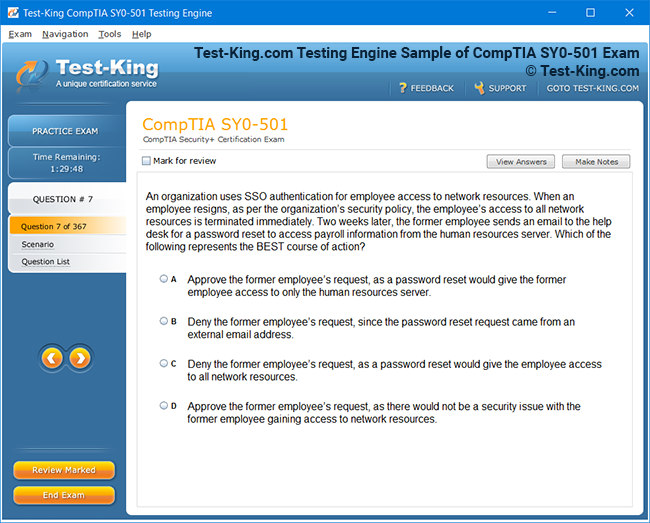
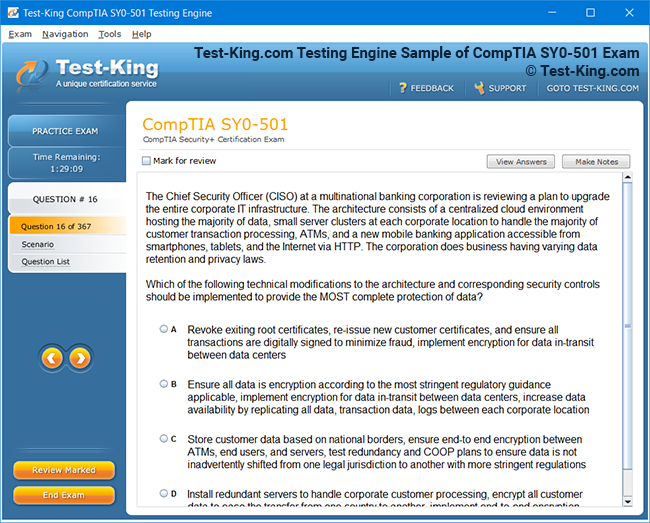
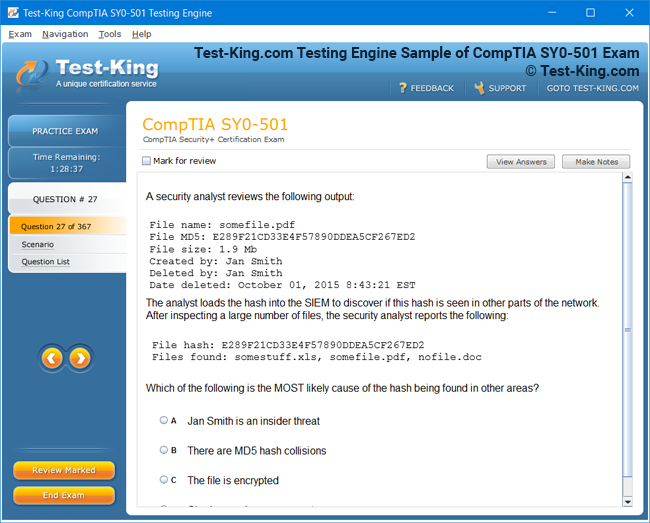
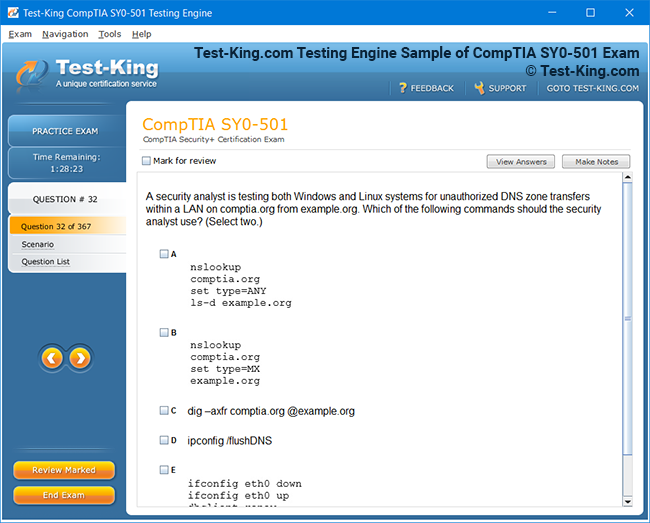
Product Screenshots
Frequently Asked Questions
How can I get the products after purchase?
All products are available for download immediately from your Member's Area. Once you have made the payment, you will be transferred to Member's Area where you can login and download the products you have purchased to your computer.
How long can I use my product? Will it be valid forever?
Test-King products have a validity of 90 days from the date of purchase. This means that any updates to the products, including but not limited to new questions, or updates and changes by our editing team, will be automatically downloaded on to computer to make sure that you get latest exam prep materials during those 90 days.
Can I renew my product if when it's expired?
Yes, when the 90 days of your product validity are over, you have the option of renewing your expired products with a 30% discount. This can be done in your Member's Area.
Please note that you will not be able to use the product after it has expired if you don't renew it.
How often are the questions updated?
We always try to provide the latest pool of questions, Updates in the questions depend on the changes in actual pool of questions by different vendors. As soon as we know about the change in the exam question pool we try our best to update the products as fast as possible.
How many computers I can download Test-King software on?
You can download the Test-King products on the maximum number of 2 (two) computers or devices. If you need to use the software on more than two machines, you can purchase this option separately. Please email support@test-king.com if you need to use more than 5 (five) computers.
What is a PDF Version?
PDF Version is a pdf document of Questions & Answers product. The document file has standart .pdf format, which can be easily read by any pdf reader application like Adobe Acrobat Reader, Foxit Reader, OpenOffice, Google Docs and many others.
Can I purchase PDF Version without the Testing Engine?
PDF Version cannot be purchased separately. It is only available as an add-on to main Question & Answer Testing Engine product.
What operating systems are supported by your Testing Engine software?
Our testing engine is supported by Windows. Andriod and IOS software is currently under development.
Top SAP Exams
P_C4HCD_1905 : Customization Strategies in SAP Commerce Cloud- Foundations of Customization in SAP Commerce Cloud
Customization in SAP Commerce Cloud calls for a thorough understanding of how the platform is structured, how data flows through its core layers, and how extensions shape the system’s behavior. Developers are expected to approach customization not as a task of mere modification, but as a disciplined craft of extending the platform without disturbing its underlying stability. The platform provides a modular environment that encourages layered enhancements instead of direct alteration, so that functionality remains maintainable even as needs evolve. This approach protects projects from turning into complex structures that are difficult to sustain or enhance. The purpose of customization is not only to meet functional demands but to do so in a way that maintains clarity, consistency, and architectural hygiene.
Understanding the Core Landscape of Customization for SAP Commerce Cloud Developers
A major foundation of customization begins with understanding how SAP Commerce Cloud adopts an extension-based architecture. Each element of functionality is packaged into an extension, which acts as a structured piece of the entire environment. When a developer needs to introduce new behavior or adapt existing logic, the correct approach is to create new extensions or adjust configurations rather than rewriting core platform code. This creates a hierarchy where original platform logic remains untouched, and enhancements are layered on top. This method ensures upgrades and patches can be applied in the future without the danger of conflicts or overwritten logic. Developing this habit early prevents long-term complications and avoids what is sometimes called architectural erosion, where a system loses its original structure and becomes overly complex.
Inside the customization landscape, one of the central concepts is the use of data models and item types. In SAP Commerce Cloud, nearly all stored information is defined within item types. These item types define how data is structured, how it relates to other data, and how it behaves when used in business processes. Customizing item types allows the developer to introduce new entity types or extend existing ones when business requirements evolve. For instance, a business may want to store additional attributes for products, customers, or orders. By modifying item type definitions, the platform can reflect these needs in a way that integrates into its existing persistence layer. The platform’s persistence is designed to automatically adapt to item type changes, provided the developer follows correct modeling practices. This results in a robust system that accommodates new functionality while keeping data integrity intact.
Customization must also consider the service layer, which acts as the business logic center of the platform. The service layer is responsible for orchestrating processes, retrieving data, enforcing business rules, and interacting with persistence mechanisms. Developers who aim to modify or extend behavior typically introduce new services, intercept existing actions, or create alternative business workflows. The platform encourages the use of layered logic so that business processes are structured in a coherent manner. When modifications are necessary, developers are guided to override behaviors using extension mechanics rather than rewriting existing service logic. This approach preserves clarity and prevents overlapping logic that causes confusion and defects. Maintaining a well-defined service layer is crucial because it acts as the central nervous system of the platform.
Another central aspect of customization involves the platform services that handle common operations such as searching, indexing, data transformation, and configuration management. Rather than creating duplicate logic, developers are expected to leverage these platform services. Because SAP Commerce Cloud is built to handle commerce-specific challenges at scale, its platform services provide specialized functionality that has been optimized for typical commerce use cases. When developers fail to use these services and instead replicate similar capabilities, unnecessary complexity begins to accumulate, and performance can degrade. Therefore, learning these platform services early fosters efficiency and prevents redundancy.
Customization is also dependent on a stable development environment. Developers must ensure that their workspaces are not only configured correctly but aligned with the environment used by the rest of the team. Inconsistent development setups lead to differences in how extensions behave, how services are loaded, or how models are updated. To avoid fragmentation, teams usually adopt standard development environment setups backed by dependency management, environment provisioning, and version control conventions. This prevents one developer’s environment from becoming incompatible with another’s and ensures that all enhancements can be reliably deployed. When environments differ too greatly, integration conflicts become frequent and debugging consumes a disproportionate amount of time.
When customizing SAP Commerce Cloud, one must also understand the customization lifecycle. Customization is not performed only during the initial build; rather, it continues throughout the life of the platform. As business needs change, new workflows must be introduced, product lines evolve, customer expectations shift, and integration requirements grow. Because of this ongoing change, good customization must be sustainable. A sustainable approach limits complexity, avoids deep internal modifications, and uses abstraction wherever possible. Developers who approach customization with short-term thinking often create rigid systems that are difficult to adapt. The goal is to keep customization fluid without compromising stability.
There is also a critical human factor in customization: knowledge alignment across the team. When one developer adds a feature or modifies business logic, it must be understood by others who will later maintain or expand it. Clear documentation helps avoid the scenario where only the original developer understands how something works. Documentation, however, should not be excessive or cluttered. It should be precise, structured, and focused on explaining relationships, high-level logic flow, and reasoning for key decisions. Without proper knowledge sharing, even well-structured systems can become opaque and fragile when project members change.
Another vital element is the handling of data migration. When item types evolve or new entities are created, existing data may need to be transitioned. Successful customization includes planning how such changes will impact current data stores. A methodical data migration approach ensures that no inconsistencies, orphaned records, or integrity gaps appear. Failing to account for data transitions can lead to disruptions that impact storefront functionality, ordering processes, or customer experience. Therefore, every structural enhancement must be accompanied by deliberate migration planning, testing, and verification.
Customization must also operate with performance awareness. SAP Commerce Cloud supports large-scale transactional systems with potentially millions of product records and active users. A customization may appear logically correct but may not perform efficiently at scale. Performance-conscious developers analyze how their custom changes affect database queries, caching behavior, search index usage, and business process execution. Careful evaluation prevents the emergence of performance bottlenecks that degrade user experience during peak activity. In this context, efficiency is not a luxury; it is a necessity tied to operational viability.
Maintaining stability during customization requires a disciplined testing strategy. Automated testing suites that verify critical workflows ensure that enhancements do not disrupt unrelated functionality. Testing must examine not only expected usage but edge scenarios and high-load environments. A well-tested enhancement can be relied on during production deployment, while poor testing exposes the platform to unpredictable behavior. Organizations often establish continuous integration pipelines to automatically test enhancements upon every modification. This ensures early detection of regressions and accelerates feedback cycles.
Over time, customization creates a distinctive identity for each implementation of SAP Commerce Cloud. Two organizations using the same base platform will diverge significantly due to their unique product offerings, customer behavior models, pricing strategies, and operational workflows. Customization enables this individuality while preserving the reliability and structure of the underlying platform. The goal is to strike a balance where the platform supports business uniqueness without discarding its foundational stability. This equilibrium is achieved by respecting architectural principles and applying enhancements in a measured and deliberate manner.
Developers must remain aware that customization exists within a broader enterprise ecosystem. SAP Commerce Cloud often interacts with enterprise resource planning systems, product information management repositories, payment gateways, logistics systems, and analytical platforms. When customizing, the developer must consider how new logic interacts with external systems. If an enhancement requires new data to be synchronized or new transactional events to be emitted, the integration approach must be clearly defined. Integration is not an afterthought; it is intrinsic to commerce operations. An enhancement that works locally but does not integrate cleanly causes systemic inefficiencies.
This broader awareness also extends to security. Every customization must protect sensitive information and uphold established access controls. Enhancing access control logic, modifying identity fields, or extending user models must be done in alignment with established authentication frameworks. Security is not simply a feature; it is a principle that applies to every customization decision. A breach or misalignment in authentication or authorization can expose critical data, compromise customer trust, and risk compliance violations. Responsible customization maintains security as a governing mindset, not a later step.
Customization in SAP Commerce Cloud also benefits from iterative refinement. Developers rarely build the perfect solution in the first attempt. Instead, enhancements evolve as requirements become clearer and feedback is collected. Iterative customization encourages ongoing reflection and improvement. The platform provides enough flexibility to accommodate this evolutionary growth while maintaining foundational structure. A mindset of continual refinement keeps the system resilient and adaptable.
In essence, effective customization in SAP Commerce Cloud rests on an understanding of architecture, data structure, business logic layers, platform services, development environment alignment, documentation practices, migration strategies, performance awareness, testing discipline, integration strategy, and security governance. Each factor acts like a pillar that supports the stability and integrity of customized functionality. When these foundations are observed, customization becomes not an act of altering the platform, but an act of extending it in a manner that reinforces clarity, durability, and scalability. This level of craftsmanship distinguishes sustainable enhancement from expedient modification, and it transforms customization into a strategic and enduring advantage.
Understanding Extension Layering and Modular Development for Sustainable Enhancements
Mastering customization in SAP Commerce Cloud requires a deliberate and perceptive understanding of how extensions function as the backbone of the platform’s development ecosystem. The extension architecture is not merely a convenience; it is a structured philosophy designed to ensure that the system remains adaptable, maintainable, and resistant to deterioration caused by haphazard modification. Extensions provide a controlled environment in which developers can introduce enhancements, refine behaviors, or alter logic without disrupting the platform’s integrity. To work effectively, one must grasp the intricate equilibrium between platform core, custom enhancements, and the interplay among dependent modules.
Extensions in SAP Commerce Cloud function as discrete units of functionality that encapsulate models, logic, resources, workflows, and configuration. Each extension carries its own identity and interacts with others through well-defined conventions. This modular approach prevents direct interference with the underlying platform code, enabling teams to upgrade versions, replace components, and add new capabilities without rebuilding the system from the foundation. This separation of concerns forms a strong architectural baseline where every customization exists in a clear place, easily traceable, understandable, and manageable.
A central responsibility of the developer is determining when to create new extensions, when to modify existing ones, and how to structure customization layers to avoid conflict or confusion. One of the most common mistakes is introducing modifications directly to platform-provided extensions. This not only exposes the system to upgrade failures but also creates ambiguity about where logic originates. The correct strategy is to extend or overlay functionality through custom extensions that explicitly declare their dependencies and intentions. This reinforces clarity while enabling reversible, controlled change management. When enhancements are layered thoughtfully, developers maintain a lineage of customization that remains intelligible even as the platform evolves.
Extension layering requires deliberate naming conventions and dependency structuring. A typical approach involves using base extensions for model enhancements, dedicated business logic extensions for the orchestration of service layers, and specialized interface or storefront extensions for presentation behavior. This hierarchical pattern encourages separation of roles. When each extension serves a distinct purpose, developers avoid the common pitfall of blending unrelated responsibilities. This separation also supports collaborative development by reducing merge conflicts, minimizing misunderstandings, and ensuring that modifications remain logically contained.
Model customization is frequently achieved through extending item types defined within existing platform extensions. This allows the system to incorporate new data entities or revise existing structures to meet evolving business demands. For example, a retail organization may require a specialized attribute in its product model to reflect sourcing details or sustainability ratings. Extending the model through a custom extension ensures that the added attribute is seamlessly incorporated into platform persistence processes, indexing behaviors, and operational flows. The platform is designed to adapt to such structural modifications provided they are executed with respect to consistency, relational integrity, and efficient structure.
However, powerful customization requires more than the mechanical extension of data models. Developers must also understand how the platform handles service orchestration. The service layer acts as the operational core, mediating interactions between data models, business rules, and user-facing components. When modifying behavior at the service layer, the developer should prioritize graceful extension rather than abrupt replacement. One effective technique involves wrapping existing service logic, adding new decision points, or injecting new rules without eradicating the functionality inherited from the platform. This refined approach ensures that the system retains expected behavior even while embracing new capabilities. It also decreases the likelihood of regressions or hidden side effects.
Another significant dimension of mastering extension-based development lies in configuration management. Configuration defines how processes execute, how services interact, and how behaviors are activated in runtime environments. Proper configuration layering ensures that platform defaults remain intact while custom configurations are applied only where necessary. This avoids overwhelming the system with excessive overrides or ambiguous values that become difficult to trace. A clean configuration strategy allows developers and administrators to understand exactly how behaviors are being influenced, across environments ranging from development to production.
There is also an important interplay between customization and platform update cycles. SAP Commerce Cloud evolves continually, introducing new enhancements, performance improvements, and architectural refinements. When developers adhere to extension-based customization practices, upgrades can be applied with minimal friction. But when core logic is modified directly, upgrade efforts become laborious and error-prone. By respecting extension boundaries and avoiding core rewrites, organizations preserve agility and reduce operational risk. Thus, extension mastery is not simply a technical preference; it supports long-term operational resilience.
In addition to structural considerations, modular development requires disciplined documentation. Each extension should carry clear explanations of its purpose, scope of functionality, dependencies, and modification history. Without reasonable documentation, even well-designed customization layers become difficult to understand as projects grow or team members change. Documentation need not be verbose; brevity and clarity hold more value than sheer volume. What truly matters is that any developer encountering an extension for the first time should understand its role without deciphering an enigma of hidden logic.
Alongside documentation, naming consistency plays a quiet but influential role in sustainable development. Meaningful naming conventions create ease of navigation and reduce cognitive overhead. For instance, choosing clear identifiers for service implementations, model attributes, or interaction flows lends familiarity and predictability. Too commonly, systems become cluttered with arbitrary names that reflect momentary thought rather than lasting clarity. Naming must serve as an instrument of organizational coherence rather than a hurried afterthought.
The dynamics between model customization, business logic enhancement, and configuration management are interdependent. Mastery involves understanding how modifications in one area influence the behavior of another. A change to item attributes may impact indexing performance. A refinement to service logic may alter caching behavior. A modification to configuration may affect transaction boundaries or concurrency patterns. Developers must cultivate intuition rooted in experience, foresight, and structural awareness. Customization demands both creativity and discipline, where each enhancement is carefully reasoned rather than impulsively applied.
The storefront layer adds another dimension to modular development. Storefront extensions determine how product information, pricing, promotions, and user interactions appear to customers. Customizing storefront behavior requires thoughtful alignment with the business logic layer to ensure consistency between what customers see and how the system processes transactions. A storefront modification that introduces a new interaction must be linked to service processes that handle the logic behind that interaction. If the storefront is modified without a clear synchronization with the business logic layer, inconsistencies emerge that may confuse customers, increase support issues, or weaken transactional reliability.
Indexing and search behaviors also intersect with customization strategies. Efficient product discovery and catalog navigation are central to commerce operations. When extending models, developers must consider how new attributes influence search indexing, filtering, and ranking. Search indexes must remain optimized to deliver rapid results even when catalog volume becomes substantial. If indexing logic is not updated to account for new structures, customers may be unable to discover products that exist in the system. Thus, enhancements to indexing behavior must be approached with careful tuning and validation.
Testing is indispensable for maintaining stability across layered extensions. Every customization introduced must be subjected to testing that considers both primary workflows and unexpected edge scenarios. Testing should validate interoperability across extensions, ensuring that new logic harmonizes with existing components. Since the platform is often used in high-volume transactional environments, load testing also becomes essential. Enhanced functionality must continue to perform reliably during intense usage spikes. Without sustained testing discipline, the platform’s behavior may become inconsistent over time, degrading user trust and operational dependability.
Maintaining modular clarity also involves evaluating where customization should end. Not every business request requires modifying the system. Certain requests may be better fulfilled through administrative configuration, workflow adjustments, or process realignment. Developers who understand the breadth of built-in capabilities reduce the risk of unnecessary customization. The strongest customization strategy is one that balances flexibility with restraint. Excessive customization introduces complexity without proportional value, whereas thoughtful customization enhances business capability without undermining system integrity.
Mastery of extensions in SAP Commerce Cloud is therefore an architectural mindset. It involves acknowledging the structured layer hierarchy, respecting platform boundaries, planning enhancements carefully, documenting intentions clearly, maintaining naming consistency, testing thoroughly, and evaluating change impact holistically. When practiced with care, modular development transforms customization from a risky endeavor into an elegant craft. It allows organizations to evolve digital commerce capabilities confidently while preserving the essential coherence and stability that underpin robust enterprise systems.
Advanced Customization Techniques for SAP Commerce Cloud
In the complex and multifaceted world of SAP Commerce Cloud, mastering customization is an art that blends technical prowess with strategic insight. Developers often face scenarios where the default configurations do not suffice to meet intricate business requirements. To navigate these situations, one must comprehend the nuances of extension layering, service orchestration, and adaptive frameworks that underpin SAP Commerce Cloud. A pivotal concept in customization is understanding how the platform’s modular architecture facilitates the separation of concerns, allowing developers to tailor functionalities without disrupting core operations. This involves creating bespoke extensions, integrating third-party APIs, and configuring the system to support dynamic business rules that evolve with market demands.
Developers frequently utilize flexible service layers to implement customization without directly modifying the core. This approach ensures system stability and eases future upgrades. Service abstraction provides a pathway to insert custom logic while preserving the integrity of the standard commerce processes. Leveraging interceptors and event-driven mechanisms, developers can inject additional behaviors into existing workflows. For instance, an interceptor can validate data before it is persisted, ensuring compliance with specific business rules. Event-driven customizations allow asynchronous processing, which enhances system responsiveness and scalability, especially under high-traffic scenarios.
Understanding the data modeling and type system is crucial when customizing SAP Commerce Cloud. Developers must carefully design item types, attributes, and relations to reflect complex business domains. Properly extending existing types or creating entirely new ones ensures that data is accurately captured and consistently propagated across the platform. The type system also dictates how flexible search queries operate, affecting both performance and data retrieval accuracy. Developers often combine these data structures with dynamic attributes and computed fields to create a highly responsive and context-aware experience for end users.
Workflow orchestration plays an essential role in aligning customized functionalities with business processes. SAP Commerce Cloud provides mechanisms to define and manage workflows that are not only process-driven but also adaptable. Developers can extend these workflows to include additional approval stages, automated notifications, and conditional branching based on real-time data. This flexibility allows enterprises to model complex operational logic, reducing manual interventions and enhancing the overall efficiency of commerce operations. Custom workflows also improve traceability, enabling stakeholders to monitor transaction lifecycles and ensure compliance with regulatory standards.
Front-end customization is another crucial dimension in delivering a tailored user experience. Developers can modify templates, widgets, and page layouts to align with brand identity and user expectations. Leveraging the SmartEdit framework, content authors can interact with customized components seamlessly, without requiring deep technical knowledge. This separation of concerns empowers marketing teams to manage content dynamically while developers focus on maintaining robust and scalable functionalities. Additionally, front-end customizations often involve optimizing performance by minimizing redundant scripts and streamlining rendering processes, which contributes to faster load times and improved user satisfaction.
Integration strategies are indispensable when extending SAP Commerce Cloud functionalities. Developers frequently need to connect the platform with external systems such as ERP, CRM, payment gateways, and analytics tools. Adopting a robust integration framework that supports RESTful and SOAP web services, message queues, and batch processes ensures that data flows smoothly between systems. Effective integration also requires implementing error handling, logging, and retry mechanisms to safeguard transactional integrity and maintain consistent user experiences. Customizing the integration layer allows developers to map complex business logic onto external systems while preserving the cohesion of the commerce ecosystem.
Security considerations are paramount when implementing customizations. Developers must ensure that all custom logic adheres to security best practices, including input validation, authorization checks, and data encryption. SAP Commerce Cloud provides role-based access control mechanisms, allowing developers to assign permissions to customized functionalities appropriately. Incorporating secure coding standards into customization practices mitigates the risk of vulnerabilities that could compromise sensitive customer or transactional data. Additionally, auditing custom code for compliance with regulatory frameworks such as GDPR or PCI DSS enhances trust and reliability in the deployed solutions.
Performance optimization is another critical aspect when customizing SAP Commerce Cloud. Developers should profile custom components to identify bottlenecks and optimize resource utilization. Techniques such as caching, lazy loading, and asynchronous processing reduce the computational overhead and improve response times. Moreover, understanding the impact of customizations on database queries, session management, and network latency allows developers to implement targeted improvements that maintain high throughput under variable load conditions. Performance-conscious customization ensures that the platform scales efficiently and continues to deliver seamless experiences to customers.
Testing and quality assurance are indispensable in the lifecycle of customizations. Developers must design comprehensive test scenarios that cover functional, integration, and performance aspects of customized components. Automated testing frameworks provided by SAP Commerce Cloud facilitate regression testing and continuous integration, ensuring that new customizations do not inadvertently break existing functionalities. In addition to unit and integration tests, user acceptance testing is crucial for verifying that customized workflows and interfaces meet stakeholder expectations. A disciplined testing strategy reduces post-deployment issues and accelerates delivery timelines.
Documentation and maintainability are essential for sustaining long-term customizations. Developers should produce clear and detailed documentation that captures the rationale behind each customization, configuration details, and operational dependencies. Well-documented customizations simplify troubleshooting, onboarding of new developers, and future upgrades. Furthermore, adhering to modular design principles ensures that custom components are loosely coupled and easily replaceable, minimizing the impact of changes on the overall system. Maintainable customizations enable organizations to adapt swiftly to evolving business landscapes without incurring excessive technical debt.
Change management is intrinsically linked to effective customization practices. Developers must coordinate with business stakeholders to ensure that customizations align with strategic goals and operational priorities. Implementing a structured deployment strategy that includes staging environments, version control, and rollback mechanisms mitigates the risk of service disruption. By establishing a robust change management process, developers can introduce new features and enhancements in a controlled and predictable manner, fostering confidence among users and business leaders.
Monitoring and analytics complement customization by providing insights into system performance and user behavior. Developers can instrument custom components to capture metrics, logs, and event data that inform optimization efforts. Analytics-driven customization enables proactive identification of potential issues and refinement of user interactions. This continuous feedback loop ensures that the commerce platform evolves in tandem with customer needs and market trends, reinforcing its competitive advantage.
In conclusion, advanced customization in SAP Commerce Cloud requires a holistic approach that integrates technical acumen, strategic insight, and meticulous attention to detail. Developers must navigate a labyrinth of configuration options, extension layers, and integration points to deliver solutions that are robust, scalable, and aligned with business objectives. Mastery of customization strategies enhances the ability to create differentiated commerce experiences, empowering enterprises to thrive in a rapidly evolving digital marketplace.
Elevating Custom Development Practices in SAP Commerce Cloud
Customization within SAP Commerce Cloud demands a blend of architectural insight, technical dexterity, and strategic foresight. Developers often confront scenarios where default functionalities fall short of fulfilling intricate business requirements. To address these needs, it becomes imperative to leverage the platform’s modular structure, extension mechanisms, and service orchestration capabilities. At the core of this customization approach lies the principle of maintaining separation between standard processes and bespoke implementations, ensuring system integrity and future upgradeability. Crafting well-designed extensions and integrating external services allows for adaptive and highly responsive commerce solutions.
An essential strategy is to utilize the service layer effectively for introducing custom logic. By abstracting business operations through services, developers can implement enhancements without altering the underlying core. This practice ensures maintainability and prevents potential conflicts during platform upgrades. Event-driven customization and interceptors offer additional flexibility. Interceptors can pre-process or validate data before it persists, safeguarding business rules, while event-driven processes enable asynchronous operations that enhance system responsiveness, especially in high-load environments.
Understanding SAP Commerce Cloud’s data model is crucial for sophisticated customization. Developers must design item types, attributes, and relations to mirror complex organizational domains accurately. Extending existing types or creating new structures allows for precise data capture and consistent propagation across the platform. These data constructs directly influence search performance, retrieval efficiency, and transactional integrity. Utilizing computed attributes and dynamic properties further refines the system’s ability to deliver contextual and adaptive user experiences.
Workflow customization remains central to aligning technical implementations with business processes. SAP Commerce Cloud provides a versatile workflow framework that developers can extend to meet specific operational needs. Custom workflows might include automated approvals, notifications, and conditional branching informed by real-time data. Such tailored workflows reduce manual intervention, increase operational efficiency, and improve traceability, allowing stakeholders to monitor processes comprehensively. Incorporating business logic within workflow steps ensures that processes remain robust, flexible, and auditable.
Front-end customization is another pillar of advanced development practices. Developers can tailor page layouts, components, and templates to reflect brand identity and optimize user experience. The SmartEdit framework enables content managers to interact with these custom components seamlessly, bridging the gap between technical development and marketing needs. This synergy allows for real-time content adjustments while maintaining system stability. Front-end optimizations, including performance tuning, script reduction, and efficient rendering, are critical to providing a fluid and responsive interface for end users.
Integrating SAP Commerce Cloud with external systems is a common requirement in sophisticated customizations. Developers must design integration frameworks that support various protocols including REST, SOAP, message queues, and batch processes. Effective integration ensures smooth data synchronization, transactional consistency, and seamless user interactions across multiple systems. Error handling, logging, and retry mechanisms are crucial to maintain reliability and operational continuity. Custom integration layers allow the encapsulation of complex business logic while preserving the coherence of the commerce ecosystem.
Security considerations are inseparable from customization efforts. Developers must ensure that all bespoke implementations adhere to robust security practices. Input validation, role-based access controls, and encryption of sensitive data are foundational measures. SAP Commerce Cloud’s security framework facilitates granular permission assignment, enabling secure access to custom functionalities. Auditing customizations for compliance with regulatory standards such as GDPR or PCI DSS reinforces trust and minimizes potential vulnerabilities, safeguarding both enterprise and customer data.
Performance optimization should be integrated into every customization effort. Profiling custom components to identify inefficiencies and adopting techniques like caching, lazy loading, and asynchronous processing help maintain high system throughput. Developers must also consider the impact of customizations on database queries, session management, and network performance to prevent bottlenecks. Optimized customizations contribute to faster response times, improved user satisfaction, and the scalability of the commerce platform under fluctuating traffic loads.
Testing and validation are critical for reliable customizations. Developers should implement comprehensive test scenarios encompassing functional, integration, and performance aspects. Automated testing frameworks within SAP Commerce Cloud enable regression testing and continuous integration, ensuring that new enhancements do not disrupt existing functionalities. User acceptance testing ensures that workflows and interfaces meet stakeholder expectations. A rigorous testing strategy mitigates post-deployment issues, facilitating a smoother delivery pipeline and sustained system reliability.
Documentation and maintainability are key to long-term success in customization. Clear documentation of design decisions, configuration settings, and dependencies ensures that future developers can manage, extend, or troubleshoot customizations effectively. Modular design principles aid in creating loosely coupled components, allowing changes to be implemented with minimal disruption. Maintainable customizations reduce technical debt, improve operational agility, and enable organizations to adapt to evolving market conditions seamlessly.
Change management is integral to any customization initiative. Developers must coordinate closely with business stakeholders to align enhancements with strategic objectives. Implementing structured deployment practices, including staging environments, version control, and rollback procedures, minimizes the risk of operational disruptions. Such disciplined change management ensures that customizations are introduced predictably, maintaining stability and fostering confidence among end users and decision-makers.
Monitoring and analytics complement the development of customizations by providing actionable insights. Instrumenting custom components to capture metrics, logs, and events allows developers to assess performance, identify inefficiencies, and refine processes. Analytics-driven customization enables proactive improvements, ensuring that the commerce platform evolves in alignment with user behavior and emerging business needs. Continuous monitoring strengthens system resilience and enhances the adaptability of commerce solutions to fluctuating market demands.
Advanced custom development in SAP Commerce Cloud demands a nuanced understanding of architecture, data models, workflows, integration, and security. By combining these elements with strategic foresight and meticulous planning, developers can deliver bespoke solutions that are scalable, maintainable, and aligned with organizational objectives. Mastering these customization strategies allows enterprises to differentiate themselves in a competitive digital commerce landscape, ensuring that technology solutions not only support but actively enhance business outcomes.
Refining Development and Integration Practices in SAP Commerce Cloud
In the evolving landscape of SAP Commerce Cloud, achieving effective customization requires a synthesis of technical acumen, architectural foresight, and strategic alignment with business objectives. Developers are often tasked with adapting the platform to support intricate workflows, personalized experiences, and complex integrations, all while preserving the integrity and scalability of the system. Customization extends beyond mere configuration; it involves designing robust extensions, orchestrating services, and implementing adaptive processes that anticipate both present and future business needs.
One of the foremost considerations in customization is leveraging the modular architecture of SAP Commerce Cloud. This architecture allows developers to extend functionalities through well-defined extensions, ensuring that core operations remain intact while providing the flexibility to introduce bespoke business logic. Extensions can encapsulate complex rules, workflows, and integrations, enabling developers to create modular, reusable components that enhance maintainability and simplify system upgrades. By strategically layering extensions, developers can isolate custom behaviors from standard processes, mitigating risks associated with platform updates.
Service abstraction plays a pivotal role in implementing advanced customization. Utilizing the service layer enables developers to inject custom business logic without modifying the underlying core processes, maintaining system stability. Event-driven programming and interceptors further augment customization strategies. Interceptors can validate or transform data during transactions, while event-driven mechanisms facilitate asynchronous operations, allowing processes to execute efficiently under heavy load. Together, these approaches empower developers to implement sophisticated logic that responds dynamically to business requirements and user interactions.
Data modeling within SAP Commerce Cloud is foundational for effective customization. Developers must design item types, attributes, and relationships that accurately represent complex business entities. Extending existing types or creating new ones ensures data consistency and supports advanced search capabilities, analytics, and reporting. Dynamic attributes and computed fields allow for flexible and context-aware solutions, enhancing the platform’s ability to deliver personalized experiences. Thoughtful data modeling not only ensures accurate data representation but also optimizes performance by minimizing redundant queries and streamlining retrieval operations.
Workflow customization enables alignment between technical solutions and business operations. SAP Commerce Cloud provides a robust workflow framework that can be extended to accommodate unique business processes. Developers can introduce conditional branching, automated approvals, notifications, and task assignments based on real-time data. Customized workflows reduce manual intervention, enhance process traceability, and improve operational efficiency. Integrating business rules directly into workflows ensures that the platform consistently enforces compliance and operational standards across diverse transactions.
Front-end customization remains a critical component in delivering compelling commerce experiences. Developers can modify page templates, components, and widget structures to meet specific branding and usability requirements. Utilizing the SmartEdit framework, content managers can manage dynamic content and interact with custom components seamlessly, bridging the gap between development and marketing operations. Front-end performance optimization, including script minimization, lazy loading, and streamlined rendering, contributes to faster page loads and smoother user interactions, enhancing customer satisfaction and engagement.
Integration strategies are vital when extending SAP Commerce Cloud beyond its native capabilities. Developers often connect the platform with ERP, CRM, analytics, and payment systems, requiring robust and flexible integration frameworks. Using RESTful and SOAP web services, message queues, and batch processing enables reliable data exchange and ensures transactional consistency. Effective integration design includes error handling, logging, and retry mechanisms, safeguarding operational continuity. By encapsulating complex logic in integration layers, developers can maintain coherence between SAP Commerce Cloud and external systems while providing tailored business processes.
Security is a non-negotiable aspect of any customization effort. Developers must implement comprehensive security measures, including input validation, role-based access controls, and data encryption. SAP Commerce Cloud provides mechanisms for granular permission assignment, ensuring secure access to custom functionalities. Compliance with regulatory frameworks such as GDPR and PCI DSS is critical, and auditing customizations for adherence reinforces trust and minimizes vulnerability risks. Secure development practices protect both enterprise assets and sensitive customer information, ensuring a reliable and compliant commerce environment.
Performance considerations must be embedded within the customization lifecycle. Developers should analyze the impact of custom components on system performance, including database interactions, session management, and network latency. Techniques such as caching, asynchronous processing, and efficient query design enhance throughput and reduce response times. Profiling tools and performance monitoring enable proactive identification of bottlenecks, ensuring that the platform can handle increased load without degradation. Performance-conscious customization guarantees scalable and responsive commerce experiences, even under peak demand.
Testing and quality assurance are integral to maintaining reliable and resilient customizations. Comprehensive testing strategies encompass functional, integration, and performance testing, ensuring that new implementations coexist harmoniously with existing functionalities. Automated testing and continuous integration pipelines facilitate regression testing, enabling rapid deployment without compromising system stability. User acceptance testing ensures that workflows, interfaces, and custom behaviors align with business expectations, minimizing post-deployment issues and reinforcing stakeholder confidence in the system’s reliability.
Documentation and maintainability are essential for sustainable development practices. Developers should document the rationale, configuration details, dependencies, and operational considerations of all customizations. Clear documentation simplifies troubleshooting, onboarding of new developers, and future enhancements. Modular and loosely coupled design principles enable flexibility, allowing components to be modified or replaced with minimal disruption. Maintainable customizations reduce technical debt, accelerate future development, and support ongoing business agility, ensuring the platform evolves alongside organizational needs.
Change management practices are fundamental when implementing customizations. Coordinating with stakeholders ensures that modifications align with strategic priorities and operational goals. Structured deployment processes, including staging, version control, and rollback strategies, reduce the risk of service interruptions. Well-managed changes foster confidence among users and stakeholders, ensuring that enhancements are introduced predictably and efficiently. Integrating monitoring and analytics allows developers to track the performance of custom components, identify opportunities for optimization, and refine processes based on real-time insights.
Conclusion
In mastering customization in SAP Commerce Cloud requires a holistic approach that encompasses architectural understanding, service orchestration, data modeling, workflow design, integration strategies, security, performance optimization, and maintainability. By adopting these advanced practices, developers can deliver scalable, resilient, and adaptable commerce solutions that cater to complex business requirements. Thoughtful customization not only enhances operational efficiency but also enables enterprises to provide differentiated, personalized, and high-performance experiences, ensuring sustained competitive advantage in the digital commerce landscape.