

Exam Code: 2V0-13.24
Exam Name: VMware Cloud Foundation 5.2 Architect
Certification Provider: VMware
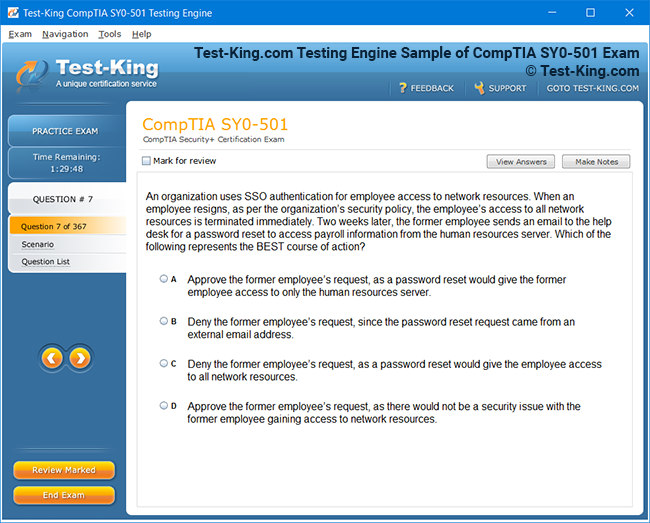
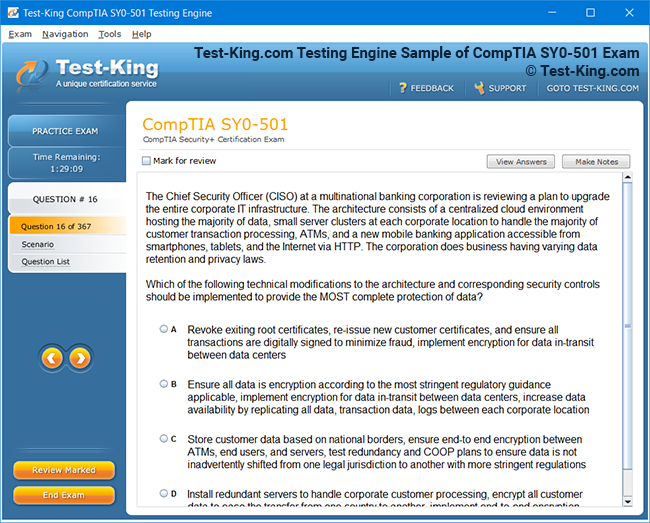
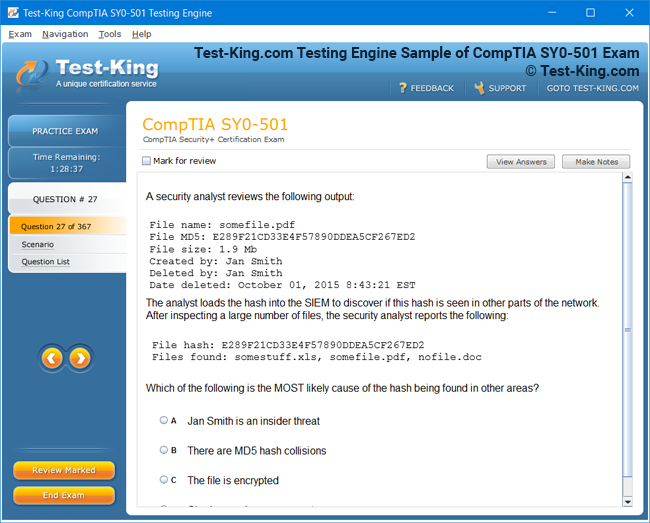
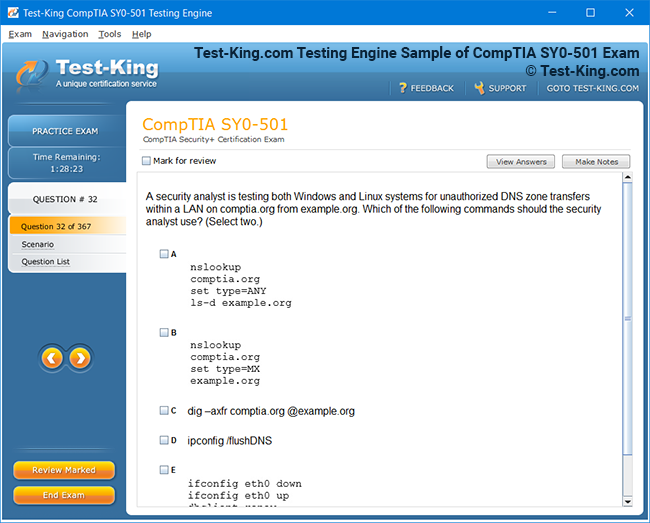
Product Screenshots
Frequently Asked Questions
How can I get the products after purchase?
All products are available for download immediately from your Member's Area. Once you have made the payment, you will be transferred to Member's Area where you can login and download the products you have purchased to your computer.
How long can I use my product? Will it be valid forever?
Test-King products have a validity of 90 days from the date of purchase. This means that any updates to the products, including but not limited to new questions, or updates and changes by our editing team, will be automatically downloaded on to computer to make sure that you get latest exam prep materials during those 90 days.
Can I renew my product if when it's expired?
Yes, when the 90 days of your product validity are over, you have the option of renewing your expired products with a 30% discount. This can be done in your Member's Area.
Please note that you will not be able to use the product after it has expired if you don't renew it.
How often are the questions updated?
We always try to provide the latest pool of questions, Updates in the questions depend on the changes in actual pool of questions by different vendors. As soon as we know about the change in the exam question pool we try our best to update the products as fast as possible.
How many computers I can download Test-King software on?
You can download the Test-King products on the maximum number of 2 (two) computers or devices. If you need to use the software on more than two machines, you can purchase this option separately. Please email support@test-king.com if you need to use more than 5 (five) computers.
What is a PDF Version?
PDF Version is a pdf document of Questions & Answers product. The document file has standart .pdf format, which can be easily read by any pdf reader application like Adobe Acrobat Reader, Foxit Reader, OpenOffice, Google Docs and many others.
Can I purchase PDF Version without the Testing Engine?
PDF Version cannot be purchased separately. It is only available as an add-on to main Question & Answer Testing Engine product.
What operating systems are supported by your Testing Engine software?
Our testing engine is supported by Windows. Andriod and IOS software is currently under development.
Top VMware Exams
- 2V0-17.25 - VMware Cloud Foundation 9.0 Administrator
- 2V0-13.25 - VMware Cloud Foundation 9.0 Architect
- 3V0-25.25 - Advanced VMware Cloud Foundation 9.0 Networking
- 2V0-16.25 - VMware vSphere Foundation 9.0 Administrator
- 3V0-21.25 - Advanced VMware Cloud Foundation 9.0 Automation
- 3V0-24.25 - VMware Certified Advanced Professional - VMware Cloud Foundation VKS
- 2V0-21.23 - VMware vSphere 8.x Professional
- 2V0-15.25 - VMware Cloud Foundation 9.0 Support
- 2V0-41.24 - VMware NSX 4.X Professional V2
- 3V0-11.26 - VMware Certified Advanced Professional - VMware Cloud Foundation 9 Administrator
- 2V0-72.22 - Professional Develop VMware Spring
- 2V0-51.23 - VMware Horizon 8.x Professional
- 2V0-11.25 - VMware Cloud Foundation 5.2 Administrator
- 3V0-32.23 - Cloud Management and Automation Advanced Design
Common Challenges in the 2V0-13.24 Exam and How to Overcome Them
One of the foremost challenges candidates encounter in the 2V0-13.24 exam is grappling with the intricate architectural principles that VMware Cloud Foundation encompasses. The exam is designed to probe not only theoretical knowledge but also practical understanding of how compute, storage, and network resources interoperate in a hybrid cloud ecosystem. Many aspirants underestimate the depth of integration required between vSphere, vSAN, NSX-T, and SDDC Manager. This underestimation can lead to errors in scenario-based questions where architects must devise deployment strategies or troubleshoot multifaceted problems. To navigate these complexities, it is essential to cultivate a conceptual framework that links each component’s role in maintaining seamless cloud operations. Engaging in hands-on labs and immersive simulations enables candidates to experience the dynamic interplay of cloud constructs, thereby mitigating conceptual ambiguity. Using visual mapping techniques to represent relationships between layers of virtualization, storage policies, and networking segments can also enhance comprehension and retention.
Navigating Complex Concepts in VMware Cloud Foundation
Another nuanced hurdle lies in understanding the lifecycle management and automated operations within VMware Cloud Foundation. Candidates often struggle to internalize the automation workflows orchestrated by SDDC Manager, particularly when dealing with cluster expansions, patching, and firmware upgrades. Errors occur frequently when aspirants attempt to memorize procedural steps without understanding the underlying logic or impact of each operation. A more efficacious approach involves analyzing real-world case studies where SDDC Manager orchestrates tasks and anticipating potential failure points. By examining logs, system alerts, and operational outputs in a controlled lab, one develops an intuitive grasp of how lifecycle management affects resource availability, compliance, and system resiliency.
Time Management and Exam Strategy
Time allocation constitutes another critical obstacle for many candidates attempting the 2V0-13.24 certification. The exam’s breadth encompasses a diverse array of domains, and aspirants often spend disproportionate time on unfamiliar or daunting questions while neglecting easier or higher-weighted areas. This imbalance can precipitate incomplete responses and elevated stress levels. A strategic approach involves pre-emptive time budgeting, wherein candidates segment the total examination duration according to domain weight and complexity. Practicing under timed conditions helps internalize a rhythm, fostering efficient reading comprehension, and rapid yet precise decision-making. Moreover, cultivating the skill of flagging ambiguous questions for later review ensures that no single query monopolizes valuable minutes.
Another subtle impediment is overreliance on rote memorization at the expense of critical thinking. VMware Cloud Foundation demands architects not only to recall configurations but to apply reasoning in real-world scenarios. Misinterpretation of a scenario due to superficial memorization can yield incorrect answers despite familiarity with the underlying content. To overcome this, candidates should simulate architectural planning exercises, analyzing requirements, constraints, and potential risks before selecting a solution. This exercise promotes a mindset attuned to the evaluative nature of the exam, enhancing both accuracy and confidence.
Common Misconceptions and Knowledge Gaps
Several misconceptions frequently hinder exam performance. One prevalent fallacy is the assumption that storage and network domains operate independently within VMware Cloud Foundation. In reality, vSAN policies, NSX-T overlays, and network segments exert significant influence over application deployment and performance. Candidates who fail to appreciate these interdependencies often misjudge scenarios involving workload balancing or high availability. Addressing this gap requires dedicated exploration of cross-domain interactions and evaluating the cascading effects of configuration changes. Documenting these interactions in visual schemas or flowcharts aids in reinforcing an integrated mental model.
Similarly, understanding security constructs within VMware Cloud Foundation poses challenges. Many aspirants underestimate the importance of NSX-T distributed firewall rules, micro-segmentation, and role-based access control within multi-cloud deployments. Errors often emerge when candidates attempt to generalize security principles from prior experience without adapting them to VMware’s specific implementations. To mitigate this, it is beneficial to examine security operations from an administrative viewpoint, identifying how access control, encryption, and policy enforcement collectively safeguard workloads. Engaging in scenario-driven exercises where misconfigurations are introduced intentionally can cultivate the analytical skills necessary to detect vulnerabilities and propose corrective measures swiftly.
Leveraging Hands-On Experience
Practical exposure represents one of the most effective tools to surmount exam challenges. Aspirants frequently face difficulty in translating conceptual understanding into applied knowledge, particularly when confronted with complex deployment scenarios or troubleshooting tasks. Establishing a home lab environment or leveraging cloud-based simulation platforms allows candidates to execute tasks such as creating management domains, configuring workload domains, and deploying NSX-T networking overlays. This immersion reinforces procedural knowledge, highlights potential pitfalls, and solidifies familiarity with the user interface and command line operations. Additionally, documenting each step and outcome cultivates reflective learning, enabling candidates to review and refine approaches before encountering similar problems under exam conditions.
Hands-on exercises also enhance the ability to interpret logs and error messages, a skill that is often underestimated but crucial for success. When candidates practice identifying inconsistencies in cluster health, misaligned network policies, or storage constraints, they develop an intuitive diagnostic ability. This proficiency proves invaluable when encountering complex scenario-based questions that require evaluating multiple failure points simultaneously. Moreover, the practice of troubleshooting fosters confidence, reducing cognitive load during the timed examination and diminishing the likelihood of second-guessing or overcomplicating responses.
Mental Resilience and Stress Management
Beyond technical knowledge, psychological preparedness plays a pivotal role in overcoming the challenges of the 2V0-13.24 exam. Anxiety, time pressure, and cognitive fatigue can impair decision-making, leading to careless mistakes even in well-understood domains. Many candidates underestimate the impact of mental resilience on performance, focusing exclusively on content mastery while neglecting strategies for sustained concentration. Techniques such as deliberate breathing, mindfulness exercises, and periodic mental breaks during preparation cultivate focus and reduce stress-induced errors. Simulating exam conditions, including strict timing and a quiet environment, acclimatizes aspirants to the pressures they will face, enabling them to maintain clarity and composure during the actual test.
In addition, developing a reflective mindset after practice attempts allows candidates to analyze errors objectively, distinguishing between knowledge gaps and stress-related mistakes. Recording recurring challenges and addressing them systematically fosters continuous improvement. This iterative approach, combining technical reinforcement with psychological fortification, enhances both accuracy and efficiency during the examination.
Integrating Study Materials Effectively
The breadth of content covered by the 2V0-13.24 exam can overwhelm even seasoned professionals if study resources are not integrated systematically. Candidates often scatter their focus across multiple books, blogs, and online forums, leading to fragmented understanding. To overcome this, it is advisable to curate a primary set of authoritative materials, supplemented by lab exercises and scenario analyses. Structuring study time around topic clusters, where related concepts are learned in conjunction, reinforces interconnected understanding and mitigates compartmentalized memorization. This method also allows aspirants to identify weak points early and address them before they manifest as errors in practice questions or simulated exams.
Another challenge is the tendency to rely solely on passive reading or observation. Active learning techniques, including teaching concepts to peers, verbalizing solutions, and drafting architecture diagrams, enhance retention and conceptual clarity. Incorporating these strategies ensures that candidates engage multiple cognitive pathways, solidifying both theoretical knowledge and practical application. Frequent self-assessment using practice questions that simulate exam complexity allows for iterative refinement, instilling confidence and exposing areas requiring deeper exploration.
Understanding Infrastructure Integration Challenges
A predominant challenge in the 2V0-13.24 exam arises from the intricate integration of VMware Cloud Foundation components, where compute, storage, and networking layers must function in precise harmony. Candidates often falter when asked to devise deployment strategies that encompass multiple workload domains, each with distinct vSAN policies, NSX-T overlays, and virtual networking requirements. Misjudging the dependencies among these components can lead to flawed architectural decisions in scenario-based questions. To address this, aspirants should engage in systematic exploration of integration points, observing how configuration adjustments in one domain propagate effects across others. Mapping these interactions visually, through diagrams or flow sketches, strengthens comprehension and creates a cognitive reference framework that eases recall during examination.
Practical familiarity with lifecycle management operations presents another hurdle. Candidates frequently struggle with tasks such as orchestrating cluster expansions, applying patches, or configuring firmware updates, especially under time pressure. Missteps often occur when aspirants attempt to memorize sequences without understanding the underlying logic or system interdependencies. A superior approach involves performing these operations in controlled lab environments, analyzing the resulting system state changes, and observing error behaviors. This experiential learning not only reinforces procedural understanding but cultivates intuition about potential pitfalls, which proves invaluable during complex scenario-based questions.
Time Allocation and Cognitive Efficiency
Time management continues to pose significant difficulty for many aspirants, as the exam encompasses a wide spectrum of domains, each demanding distinct cognitive approaches. Candidates sometimes linger excessively on challenging questions while bypassing simpler ones, resulting in incomplete coverage. Establishing a disciplined rhythm, guided by pre-allocated time budgets corresponding to domain weightings, can prevent such pitfalls. Practicing under timed conditions, simulating the pace and pressure of the actual examination, trains candidates to make rapid yet precise judgments. Additionally, the strategy of flagging ambiguous or intricate questions for later review ensures no single query monopolizes cognitive resources, maintaining both efficiency and accuracy.
A subtle yet impactful obstacle is overreliance on memorization without fostering analytical reasoning. VMware Cloud Foundation questions often test application of knowledge in context rather than mere recall. Candidates who fail to synthesize principles into actionable strategies risk misinterpreting scenario-based queries. This can be mitigated by engaging in architectural problem-solving exercises, where one evaluates constraints, dependencies, and potential risks before selecting solutions. Such practice nurtures a mindset aligned with the evaluative nature of the exam, improving precision and reducing the likelihood of second-guessing.
Common Missteps in Conceptual Understanding
Several recurring missteps impede performance in the 2V0-13.24 exam. One frequent misconception is treating storage and network layers as isolated entities, when in practice, they are tightly intertwined. Decisions concerning vSAN configuration or NSX-T segment design influence workload distribution, performance, and high-availability considerations. Candidates who overlook these interconnections often misjudge scenarios requiring holistic evaluation of resource domains. Addressing this challenge entails immersive exploration of interdependencies and documenting their cascading effects. Creating reference schemas or conceptual maps enhances the mental model, enabling faster reasoning when confronted with integrated problem statements.
Security comprehension also constitutes a challenging domain. Many aspirants underestimate the specificity of VMware’s implementations, assuming generalized security knowledge is sufficient. Distributed firewall rules, micro-segmentation, and role-based access controls operate differently than conventional models, and misunderstanding these nuances can lead to incorrect answers. To surmount this obstacle, candidates should engage in practical exercises simulating access violations, policy misconfigurations, and vulnerability remediation. Experiential learning reinforces security logic, preparing candidates to identify flaws, evaluate risk, and propose effective remedies during scenario-based evaluation.
Enhancing Hands-On Skills
Practical application is crucial for surmounting the obstacles inherent in the 2V0-13.24 exam. Many candidates struggle to translate theoretical knowledge into operational competence, especially when faced with deployment or troubleshooting tasks in real-world scenarios. Establishing a lab environment, either locally or in cloud-based simulators, allows aspirants to practice creating management domains, configuring workload clusters, deploying NSX-T overlays, and managing storage policies. This immersive practice reinforces procedural fluency, illuminates potential pitfalls, and develops confidence in navigating the VMware Cloud Foundation interface.
Engaging in troubleshooting exercises significantly improves analytical ability. Candidates benefit from intentionally introducing configuration errors or simulating node failures, analyzing system responses, and formulating remediation strategies. This hands-on approach trains aspirants to quickly identify the root causes of issues, evaluate cascading impacts, and implement corrective measures. Over time, this nurtures a diagnostic intuition that is critical for handling complex scenario questions efficiently. The ability to anticipate system behavior under diverse conditions distinguishes proficient candidates and enhances overall exam performance.
Mental Stamina and Exam Readiness
The cognitive demands of the 2V0-13.24 exam extend beyond technical acumen, requiring sustained mental stamina. Candidates frequently encounter fatigue, stress, or anxiety during prolonged test sessions, which can compromise decision-making and lead to avoidable errors. Developing mental resilience through mindfulness, structured breaks, and deliberate focus exercises ensures that cognitive clarity is maintained. Simulating exam conditions in practice attempts, including strict time constraints and quiet environments, acclimates candidates to the pressure of the real test, reducing stress-induced mistakes.
Reflective practice complements mental preparedness. After each practice attempt, reviewing incorrect answers and analyzing the root causes—whether conceptual misunderstanding, procedural lapse, or stress-induced oversight—facilitates targeted improvement. Systematically addressing these areas through iterative practice ensures continual growth, reinforcing both knowledge depth and confidence. Integrating technical refinement with psychological readiness forms a dual-layered preparation strategy, equipping candidates to navigate the demanding terrain of VMware Cloud Foundation evaluations effectively.
Optimizing Study Approaches
Many aspirants struggle to structure study material effectively, leading to scattered focus and fragmented understanding. VMware Cloud Foundation encompasses broad domains, and indiscriminate engagement with disparate resources can create confusion. To optimize preparation, candidates should curate authoritative materials, including VMware documentation, practice labs, and case studies, integrating them into a coherent learning plan. Organizing study around thematic clusters, where related concepts are learned collectively, reinforces interconnections and reduces compartmentalized memorization.
Active learning techniques enhance knowledge retention and application. Verbalizing concepts, teaching peers, or diagramming architectural designs stimulates multiple cognitive pathways, ensuring that comprehension extends beyond superficial reading. Regular self-assessment through practice questions or mock scenarios gauges understanding and highlights areas requiring deeper focus. Repeated cycles of study, practice, reflection, and refinement foster mastery, instilling both competence and confidence essential for navigating complex exam questions.
Avoiding Overconfidence and Assumptive Thinking
Another challenge lies in overconfidence and reliance on assumptions based on prior VMware experience. While previous exposure to virtualization platforms provides a foundation, VMware Cloud Foundation introduces nuances in policy orchestration, automation, and lifecycle management. Candidates who assume familiarity will suffice often overlook subtle distinctions, resulting in errors. To counteract this, aspirants should approach preparation with a mindset of inquisitive rigor, verifying assumptions against authoritative documentation and hands-on validation. This disciplined scrutiny minimizes mistakes and reinforces accurate understanding of platform-specific behaviors.
Additionally, aspirants benefit from cultivating a habit of scenario-based reasoning. Many exam questions present multi-layered problems requiring evaluation of interdependent factors. Practicing scenario analysis, predicting outcomes, and articulating reasoning promotes a methodical thought process. By internalizing this approach, candidates become adept at evaluating complex situations quickly, selecting optimal solutions, and avoiding common pitfalls caused by superficial interpretation.
Strengthening Analytical Thinking
Analytical thinking is paramount in addressing the 2V0-13.24 exam’s more sophisticated queries. Candidates frequently struggle when questions involve multiple constraints, such as network throughput, storage capacity, and workload availability. Isolated memorization of component capabilities is insufficient; aspirants must synthesize data, anticipate system interactions, and reason logically about potential outcomes. Developing this skill involves systematic exercises in which multiple variables are manipulated to observe effects, encouraging holistic understanding. By internalizing these patterns, candidates gain an intuitive grasp of cause-and-effect relationships, enhancing both speed and accuracy in decision-making.
Engaging in collaborative study environments can also enhance analytical acuity. Discussing scenario solutions with peers, debating alternative approaches, and reviewing diverse perspectives fosters flexibility in reasoning. Exposure to multiple problem-solving strategies equips candidates with a repertoire of approaches, ensuring adaptability when confronted with novel or ambiguous exam questions. This diversity of experience bolsters confidence and reduces the likelihood of cognitive rigidity, a common source of errors under pressure.
Emphasizing Documentation and Note-Taking
Effective documentation and note-taking serve as valuable tools in consolidating understanding and reinforcing retention. Candidates who maintain structured notes on configuration workflows, system interactions, and troubleshooting steps create a personal reference that can be reviewed rapidly before practice attempts or the examination itself. Summarizing key insights in one’s own words, rather than copying verbatim, engages critical thinking and strengthens memory. Incorporating diagrams, flowcharts, and mnemonic devices further aids in internalizing complex relationships between compute, storage, and networking components.
Regular review of documented insights also promotes pattern recognition. Candidates can identify recurring challenges, anticipate likely exam scenarios, and refine mental models accordingly. This proactive engagement reduces cognitive load during the test and minimizes errors caused by incomplete or fragmented recollection. Over time, disciplined documentation transforms into an indispensable asset for mastering the nuanced intricacies of VMware Cloud Foundation.
Addressing Multi-Domain Integration Challenges
A significant hurdle for aspirants in the 2V0-13.24 exam stems from the complex integration of compute, storage, and network layers within VMware Cloud Foundation. Questions often demand architects to anticipate the ramifications of changes in one domain on others, particularly when designing workload domains or modifying vSAN policies. Misjudging these interdependencies can lead to flawed architectural decisions in scenario-based queries. To navigate these intricacies, candidates benefit from constructing comprehensive mental models that map the relationships among vSphere clusters, NSX-T overlays, and SDDC Manager workflows. This approach encourages a holistic perspective, allowing for rapid evaluation of potential consequences during the exam.
The intricacies of lifecycle management further complicate preparation. Candidates frequently encounter questions requiring patch management, cluster expansion, and firmware upgrades. Attempting to memorize sequences without understanding their operational logic often results in errors. Hands-on engagement is critical; creating lab environments where lifecycle tasks are executed and observed cultivates a deep, intuitive comprehension. Understanding how SDDC Manager orchestrates automation, tracks dependencies, and handles error conditions fosters the ability to anticipate real-world complications and effectively address them during the examination.
Strategic Time Management
Time allocation represents a pervasive challenge in the 2V0-13.24 exam. Candidates frequently spend disproportionate effort on complex questions, leaving simpler, higher-weighted queries incomplete. Developing a disciplined approach, such as allocating time based on domain weight and question complexity, optimizes cognitive resources. Simulated practice under timed conditions reinforces pacing, promoting swift and accurate judgment. The habit of flagging ambiguous questions for subsequent review ensures that attention is balanced across all domains, reducing the likelihood of incomplete responses.
Another nuanced obstacle is reliance on rote memorization over analytical reasoning. VMware Cloud Foundation questions often test the application of principles within complex scenarios rather than simple recall. Candidates who lack the ability to synthesize conceptual knowledge into actionable solutions may misinterpret scenario-based questions. To overcome this, aspirants should engage in exercises that require evaluating constraints, dependencies, and potential risks before formulating solutions. This method cultivates a mindset suited to the evaluative nature of the exam, enhancing both accuracy and confidence.
Overcoming Misconceptions and Knowledge Gaps
Common misconceptions impede many candidates. One widespread fallacy is treating storage and networking as independent entities. In reality, NSX-T configurations, vSAN policies, and virtual networking design profoundly affect workload deployment and performance. Misunderstanding these interdependencies can lead to flawed answers in scenario-based questions. Addressing this challenge involves dedicated exploration of cross-domain interactions, documenting cascading effects, and creating visual schemas for reference. Reinforcing understanding through repeated practice ensures accurate conceptualization under examination conditions.
Security is another domain where candidates often encounter difficulty. Distributed firewall rules, micro-segmentation, and role-based access control in VMware Cloud Foundation differ from generalized security concepts. Misinterpreting these nuances can result in incorrect solutions. Practical exercises that simulate policy misconfigurations, unauthorized access attempts, and remediation strategies reinforce comprehension. By experiencing the impact of errors in a controlled environment, candidates develop the analytical acuity necessary to detect vulnerabilities and formulate corrective actions during the examination.
Enhancing Practical Proficiency
Hands-on experience remains a decisive factor in overcoming the 2V0-13.24 exam’s challenges. Many aspirants struggle to translate theoretical understanding into practical execution, particularly when deploying workload domains or troubleshooting multi-layered configurations. Establishing a lab environment, either on-premises or in cloud simulators, allows for experimentation with management domain creation, NSX-T overlay deployment, and storage policy application. This practice solidifies procedural knowledge, exposes potential pitfalls, and fosters confidence in navigating complex tasks.
Troubleshooting exercises enhance analytical skills significantly. Introducing deliberate misconfigurations, simulating node failures, and analyzing system responses cultivate the ability to identify root causes efficiently. This iterative practice develops diagnostic intuition, enabling rapid evaluation of scenarios under examination conditions. Familiarity with logs, error messages, and system alerts strengthens problem-solving capacity and reduces time lost on unfamiliar scenarios, ensuring higher accuracy during the test.
Maintaining Cognitive Resilience
The psychological demands of the 2V0-13.24 exam are substantial, as prolonged focus and pressure can impair judgment. Stress, fatigue, and anxiety contribute to mistakes even among knowledgeable candidates. Cultivating cognitive resilience through mindfulness techniques, structured breaks, and deliberate focus exercises mitigates these risks. Practicing under conditions that mimic the exam environment, including timing constraints and isolation, acclimatizes aspirants to stress, enabling sustained clarity and precise decision-making.
Reflective practice is equally crucial. Post-practice review allows candidates to analyze mistakes, differentiating between conceptual misunderstandings and stress-induced errors. Documenting recurring challenges and addressing them systematically fosters continuous improvement. This iterative process strengthens both technical knowledge and mental fortitude, forming a comprehensive preparation strategy that addresses the exam’s dual demands of cognitive acuity and conceptual mastery.
Optimizing Study Methodologies
Many aspirants face difficulties in structuring study resources effectively. The vast breadth of VMware Cloud Foundation content can overwhelm candidates if resources are approached indiscriminately. Curating authoritative materials, including VMware documentation, hands-on labs, and case studies, and integrating them into a cohesive study framework ensures focused learning. Organizing content by thematic clusters, where related concepts are learned together, reinforces interconnected understanding and prevents compartmentalized knowledge.
Active engagement strategies enhance comprehension and retention. Articulating concepts aloud, teaching peers, and diagramming workflows activate multiple cognitive pathways, solidifying both theoretical knowledge and practical application. Regular self-assessment through mock scenarios or practice questions allows candidates to gauge understanding and identify areas requiring further exploration. Iterative cycles of study, practical application, and reflection cultivate mastery, instilling both competence and confidence essential for navigating complex exam challenges.
Avoiding Assumptive Thinking and Overconfidence
Overconfidence and assumption-based reasoning frequently hinder candidates. Prior VMware experience provides a foundation, but VMware Cloud Foundation introduces nuances in automation, policy orchestration, and lifecycle management. Assuming familiarity will suffice can lead to critical mistakes. Approaching preparation with inquisitive rigor, validating assumptions against authoritative documentation and practical exercises, reduces the risk of errors. Maintaining a mindset of continual inquiry ensures accurate understanding of platform-specific behaviors.
Scenario-based reasoning also mitigates mistakes from assumptive thinking. Complex questions often involve multiple interdependent constraints, such as workload balancing, network throughput, and storage utilization. Practicing evaluation of scenarios, predicting outcomes, and articulating reasoning enhances methodical thought processes. Internalizing this approach enables candidates to efficiently navigate intricate problem statements and avoid errors stemming from superficial interpretation.
Strengthening Analytical Reasoning
Analytical reasoning is paramount for excelling in the 2V0-13.24 exam. Candidates often struggle when evaluating multi-variable scenarios that include compute, storage, and networking constraints simultaneously. Isolated memorization is inadequate; synthesis of information, anticipation of system interactions, and logical deduction are essential. Systematic exercises manipulating multiple variables to observe effects promote holistic comprehension and pattern recognition. This process cultivates intuition, enabling faster, more accurate decision-making under exam conditions.
Collaborative study enhances analytical capacity. Engaging with peers to discuss scenarios, compare solutions, and review alternative approaches broadens perspective and reinforces flexible reasoning. Exposure to multiple problem-solving methods equips candidates with diverse strategies, fostering adaptability when encountering ambiguous or unprecedented exam questions. Such versatility is crucial for navigating complex, multi-domain scenarios efficiently and accurately.
Leveraging Documentation and Structured Notes
Documenting study findings, configurations, and troubleshooting steps significantly enhances exam readiness. Candidates who maintain structured notes on workflows, system interactions, and scenario outcomes create a personal reference for rapid review. Summarizing insights in one’s own language, rather than copying text verbatim, strengthens comprehension. Incorporating diagrams, flowcharts, and mnemonic techniques further solidifies understanding of complex interactions between VMware Cloud Foundation components.
Regular review of documented insights fosters pattern recognition, enabling anticipation of recurring scenario types and rapid evaluation during the exam. This practice reduces cognitive load and minimizes errors caused by fragmented recall. Structured documentation also supports reflective learning, providing a foundation for analyzing mistakes, reinforcing correct methodologies, and cultivating the analytical agility necessary for effective performance in multi-layered architectural challenges.
Understanding Architectural Complexity and Interdependencies
A major challenge in the 2V0-13.24 exam is comprehending the intricate interdependencies within VMware Cloud Foundation, where compute, storage, and networking domains are tightly coupled. Candidates frequently misjudge how modifications in one layer can ripple across the system, affecting performance, availability, and compliance. Questions often present scenario-based problems requiring architects to evaluate multiple variables simultaneously, such as balancing storage policies against NSX-T network overlays while maintaining workload availability. To navigate these complexities, aspirants benefit from developing comprehensive mental models that illustrate the relationships among vSphere clusters, vSAN configurations, NSX-T overlays, and SDDC Manager orchestrations. Mapping these interactions through diagrams or flowcharts reinforces understanding and enables quick evaluation during exam conditions.
Lifecycle management is another source of difficulty, especially when questions involve patching, cluster expansions, or firmware updates. Candidates who memorize procedural sequences without grasping underlying dependencies often commit errors. Hands-on practice in lab environments is essential for developing intuitive comprehension. Performing lifecycle tasks and observing system responses, including error behaviors and rollback scenarios, builds confidence and ensures aspirants can anticipate challenges during the exam. Understanding the automated orchestration of SDDC Manager and its impact on resource domains provides a strategic advantage when addressing scenario-driven questions.
Effective Time Management and Prioritization
Time management is a persistent challenge in the 2V0-13.24 exam. The breadth of content, spanning architecture, networking, storage, security, and automation, requires disciplined allocation of time to ensure comprehensive coverage. Candidates often linger on complex or unfamiliar questions, neglecting simpler, higher-weighted items. A structured approach involves pre-allocating time according to domain complexity and practicing under timed conditions to internalize an efficient rhythm. Flagging intricate questions for later review prevents cognitive bottlenecks, ensuring that time is distributed optimally across all queries. Developing this disciplined pacing strategy enhances both accuracy and confidence.
Overreliance on rote memorization presents an additional obstacle. Many questions demand application of knowledge to real-world scenarios rather than simple recall. Candidates who attempt to answer based on memorized steps may misinterpret the requirements, resulting in avoidable mistakes. Engaging in scenario-based problem solving, where constraints and dependencies are analyzed before solutions are formulated, fosters analytical reasoning. This approach aligns with the evaluative nature of the exam and allows aspirants to respond accurately and efficiently under pressure.
Addressing Misconceptions and Knowledge Gaps
Misconceptions frequently hinder candidates in the 2V0-13.24 exam. A common error is perceiving storage and networking as separate domains. In reality, NSX-T configurations and vSAN policies are deeply interconnected, influencing workload deployment, performance, and resiliency. Candidates who fail to recognize these relationships may provide flawed solutions in scenario-based questions. Resolving this requires immersive exploration of interdependencies and documenting the cascading effects of configuration changes. Visual schemas and structured notes help in reinforcing an integrated understanding that can be recalled rapidly during the exam.
Security presents another area of challenge. Distributed firewall rules, micro-segmentation, and role-based access control are implemented differently within VMware Cloud Foundation than in generalized IT environments. Candidates who generalize security concepts without adapting them to the platform frequently make errors. Practical exercises that simulate misconfigurations, access violations, and policy remediation develop analytical skills and reinforce security principles. Experiencing the impact of incorrect configurations in a controlled setting sharpens judgment, preparing candidates to identify vulnerabilities and propose effective solutions in exam scenarios.
Cultivating Hands-On Proficiency
Practical experience is crucial for overcoming obstacles in the 2V0-13.24 exam. Many aspirants struggle to convert theoretical knowledge into actionable skills, especially when designing workload domains or troubleshooting multi-layered configurations. Establishing a lab environment, either physically or through cloud-based simulators, allows candidates to practice creating management domains, deploying NSX-T overlays, applying vSAN storage policies, and managing automation workflows. This immersive practice solidifies procedural knowledge, exposes potential pitfalls, and builds confidence in handling complex tasks.
Troubleshooting exercises are particularly valuable. Introducing intentional misconfigurations, simulating node failures, and analyzing system responses develop the ability to identify root causes efficiently. This hands-on approach strengthens diagnostic intuition and reduces the time required to solve complex scenario-based questions. Familiarity with logs, alerts, and error messages ensures that aspirants can rapidly interpret problems and implement corrective measures during the exam.
Maintaining Cognitive Resilience
The 2V0-13.24 exam is as demanding psychologically as it is technically. Candidates often experience fatigue, stress, or anxiety, which can impair decision-making and result in avoidable errors. Cultivating cognitive resilience through mindfulness, structured breaks, and focus exercises is essential. Practicing under exam-like conditions, including timing constraints and quiet isolation, acclimates candidates to the pressure they will face, enabling sustained concentration and precision.
Reflective practice complements mental preparation. Reviewing incorrect answers after practice attempts allows candidates to distinguish between knowledge gaps and stress-induced mistakes. Documenting recurring challenges and systematically addressing them fosters continuous improvement. This iterative approach strengthens both technical understanding and mental fortitude, providing the dual-layered preparation necessary to navigate complex architectural and operational scenarios successfully.
Optimizing Study Strategies
Many candidates struggle with structuring study resources effectively, leading to scattered focus and incomplete understanding. VMware Cloud Foundation spans multiple domains, and indiscriminate use of resources can overwhelm aspirants. Curating authoritative materials, including VMware documentation, lab exercises, and case studies, and integrating them into a coherent study plan ensures focused preparation. Organizing study by thematic clusters, where related concepts are learned together, reinforces interconnections and reduces compartmentalized memorization.
Active learning techniques improve comprehension and retention. Articulating concepts aloud, teaching peers, and diagramming workflows activate multiple cognitive pathways, solidifying theoretical and practical understanding. Regular self-assessment through practice questions or mock scenarios highlights areas requiring further focus. Iterative cycles of study, practice, and reflection cultivate mastery, instilling both competence and confidence essential for addressing scenario-based questions accurately and efficiently.
Avoiding Overconfidence and Assumptive Reasoning
Overconfidence and reliance on assumptions are common pitfalls. Prior experience with virtualization provides a foundation, but VMware Cloud Foundation introduces unique nuances in policy orchestration, automation, and lifecycle management. Candidates who assume familiarity is sufficient risk errors. Approaching preparation with rigorous inquiry and validating assumptions through documentation and hands-on practice reduces mistakes. Maintaining a mindset of continual questioning ensures accurate comprehension of platform-specific behaviors.
Scenario-based reasoning further mitigates errors stemming from assumptive thinking. Complex questions often involve multiple interdependent constraints, such as workload balancing, network throughput, and storage availability. Practicing scenario evaluation, predicting outcomes, and articulating reasoning encourages methodical problem-solving. Internalizing this approach equips candidates to navigate intricate situations efficiently, reducing errors caused by superficial interpretation.
Strengthening Analytical Acumen
Analytical reasoning is essential for excelling in the 2V0-13.24 exam. Candidates often face multi-variable scenarios where compute, storage, and networking constraints must be considered simultaneously. Memorization alone is insufficient; synthesis of information, anticipation of system interactions, and logical deduction are required. Systematic exercises manipulating variables to observe effects foster holistic comprehension and pattern recognition, cultivating intuitive decision-making that enhances speed and accuracy under timed conditions.
Collaborative engagement enhances analytical capacity. Discussing scenarios with peers, comparing solutions, and reviewing alternative approaches broadens perspective and reinforces flexible reasoning. Exposure to multiple problem-solving strategies equips candidates with adaptable tools for navigating ambiguous or novel questions. This versatility is critical for efficiently solving complex, integrated architectural scenarios while maintaining accuracy and confidence.
Leveraging Structured Notes and Documentation
Structured note-taking and documentation are vital for exam readiness. Candidates who maintain organized records of configuration procedures, workflows, and troubleshooting steps create a personal reference for rapid review. Summarizing concepts in their own words, rather than verbatim, reinforces comprehension. Incorporating diagrams, flowcharts, and mnemonic devices further strengthens understanding of complex interactions among VMware Cloud Foundation components.
Regular review of structured notes promotes pattern recognition, enabling anticipation of recurring scenario types and efficient problem-solving during the exam. This disciplined approach reduces cognitive load, minimizes errors from fragmented recollection, and reinforces both technical and analytical skills necessary for success in high-stakes architectural evaluations.
Navigating Architectural Intricacies in VMware Cloud Foundation
A central challenge in the 2V0-13.24 exam is mastering the complex architecture of VMware Cloud Foundation, where compute, storage, and networking components are deeply interdependent. Candidates frequently struggle with evaluating the cascading effects of configuration changes across multiple domains. Questions often present multi-layered scenarios requiring architects to design solutions that consider workload domains, vSAN policies, NSX-T overlays, and lifecycle automation simultaneously. Misunderstanding these interconnections can result in flawed solutions. Developing detailed mental models that map these relationships helps in visualizing dependencies and predicting outcomes during exam situations. Sketching workflow diagrams or interaction flows reinforces comprehension, enabling rapid decision-making under timed conditions.
Lifecycle management introduces another layer of complexity. Tasks such as orchestrating cluster expansions, patching, or upgrading firmware require understanding not only the procedural steps but also the operational logic and system dependencies. Memorization without practical application often leads to mistakes. Hands-on engagement in lab environments, where lifecycle activities are executed and their outcomes observed, cultivates a deep, intuitive understanding. Observing automated processes, error behaviors, and rollback sequences enhances readiness for scenario-based questions and increases confidence in handling complex operational scenarios.
Time Management and Cognitive Efficiency
Efficient allocation of time is a persistent challenge in the 2V0-13.24 exam. The exam spans a wide breadth of domains, and candidates frequently overcommit to complex questions, leaving simpler, higher-value items incomplete. Establishing a disciplined approach, allocating time according to question complexity and domain weighting, prevents cognitive bottlenecks. Timed practice exams reinforce pacing, training candidates to balance speed and accuracy. Flagging difficult or ambiguous questions for review ensures that attention is evenly distributed, maximizing overall performance. Maintaining a consistent rhythm enhances both precision and confidence during the examination.
Overreliance on rote memorization is another subtle pitfall. Many exam questions require application of knowledge rather than recall. Candidates who attempt to answer based solely on memorized steps may misinterpret scenario requirements, resulting in errors. Engaging in scenario-driven exercises that involve evaluating constraints, assessing risks, and formulating solutions cultivates analytical reasoning. This approach aligns with the exam’s evaluative nature and strengthens the ability to respond correctly to complex problems under time pressure.
Addressing Knowledge Gaps and Misconceptions
Several common misconceptions impede candidate performance. One is perceiving storage and networking as separate domains, whereas NSX-T overlays and vSAN configurations are closely linked, affecting workload deployment, performance, and availability. Candidates who overlook these dependencies may select incorrect solutions in integrated scenario-based questions. Exploring cross-domain interactions, documenting cascading effects, and creating reference diagrams reinforces a holistic understanding. Repeated exposure to complex interactions strengthens recall and enhances problem-solving efficiency.
Security understanding is another challenge. VMware Cloud Foundation implements distributed firewall rules, micro-segmentation, and role-based access control differently than traditional IT environments. Candidates who generalize security knowledge without considering platform-specific nuances often make mistakes. Engaging in practical exercises that simulate policy misconfigurations, access violations, and remediation strategies develops critical thinking skills. Experiencing the consequences of errors in a controlled setting builds intuition, enabling candidates to identify and correct security vulnerabilities quickly during the exam.
Hands-On Application and Practical Fluency
Practical proficiency is essential for success in the 2V0-13.24 exam. Translating theoretical knowledge into actionable skills can be challenging, particularly when deploying multi-layered configurations or troubleshooting complex scenarios. Establishing a lab environment, whether local or cloud-based, allows aspirants to practice creating management domains, deploying NSX-T overlays, applying vSAN policies, and orchestrating automation workflows. Immersive practice enhances procedural knowledge, exposes potential pitfalls, and builds confidence in navigating sophisticated tasks.
Troubleshooting exercises significantly enhance analytical skills. Introducing misconfigurations, simulating node failures, and analyzing system responses cultivates the ability to diagnose problems efficiently. This iterative practice develops diagnostic intuition, enabling rapid evaluation of complex scenarios during the exam. Familiarity with logs, system alerts, and error messages strengthens problem-solving ability and reduces time lost on unfamiliar issues, ensuring higher accuracy under pressure.
Mental Resilience and Exam Preparedness
The psychological demands of the 2V0-13.24 exam are substantial. Prolonged focus, stress, and cognitive fatigue can impair judgment and lead to avoidable mistakes. Cultivating mental resilience through mindfulness techniques, structured breaks, and deliberate focus exercises ensures sustained clarity and precision. Simulating exam conditions, including strict timing and isolation, helps candidates acclimate to stress, enabling calm and confident decision-making.
Reflective practice is equally vital. Reviewing incorrect answers after practice attempts allows candidates to distinguish between knowledge gaps and stress-induced errors. Recording recurring challenges and addressing them systematically fosters continuous improvement. This iterative process strengthens both technical understanding and mental fortitude, equipping candidates to handle complex architectural and operational scenarios effectively.
Optimized Study Techniques
Many aspirants struggle to structure study materials effectively, resulting in fragmented understanding. VMware Cloud Foundation spans multiple domains, and indiscriminate use of resources can overwhelm candidates. Curating authoritative resources such as VMware documentation, lab exercises, and real-world case studies and integrating them into a coherent study plan ensures focused learning. Organizing study by thematic clusters, where related concepts are learned together, reinforces interconnections and minimizes compartmentalized memorization.
Active engagement strategies enhance retention. Explaining concepts aloud, teaching peers, and diagramming workflows stimulate multiple cognitive pathways, solidifying theoretical and practical knowledge. Self-assessment through practice questions and scenario simulations allows candidates to gauge understanding and identify weak areas. Iterative cycles of study, practice, reflection, and refinement cultivate mastery, instilling both competence and confidence necessary for precise and efficient problem-solving.
Avoiding Assumptions and Overconfidence
Overconfidence and assumption-based reasoning are common pitfalls. Prior experience with virtualization provides a foundation, but VMware Cloud Foundation introduces unique complexities in policy orchestration, automation, and lifecycle management. Candidates who rely on assumptions without validation risk errors. Approaching preparation with meticulous inquiry, cross-checking assumptions against authoritative documentation and hands-on practice, reduces mistakes. A mindset of continual curiosity ensures accurate understanding of platform-specific behavior.
Scenario-based reasoning mitigates errors from assumptive thinking. Complex questions often involve interdependent constraints, such as workload balancing, network throughput, and storage capacity. Practicing scenario evaluation, anticipating outcomes, and articulating reasoning fosters methodical decision-making. Internalizing this approach allows candidates to navigate multi-layered situations efficiently, reducing mistakes caused by superficial interpretation.
Strengthening Analytical Thinking
Analytical reasoning is a critical skill for the 2V0-13.24 exam. Candidates frequently encounter scenarios with multiple variables affecting compute, storage, and networking. Memorization alone is insufficient; aspirants must synthesize information, anticipate interactions, and reason logically. Systematic exercises manipulating multiple factors to observe consequences cultivate pattern recognition and holistic comprehension. This process builds intuition, enabling fast and accurate decision-making under timed conditions.
Collaborative study enhances analytical ability. Discussing scenarios, comparing solutions, and reviewing alternative approaches broadens perspective and reinforces flexible thinking. Exposure to diverse problem-solving strategies equips candidates with adaptable tools for ambiguous or unfamiliar questions. This versatility is crucial for efficiently solving complex, multi-domain scenarios while maintaining accuracy and confidence.
Conclusion
Maintaining structured notes and documentation significantly supports exam readiness. Candidates who organize records of workflows, configuration steps, and troubleshooting procedures create a valuable personal reference. Summarizing information in one’s own words enhances comprehension, while diagrams and flowcharts strengthen understanding of complex interdependencies. Regular review of documented insights promotes pattern recognition, enabling candidates to anticipate recurring scenario types and solve problems efficiently. This disciplined approach minimizes errors due to fragmented recall and reinforces both technical and analytical skills necessary for navigating challenging architectural scenarios.