

Exam Code: 2V0-32.24
Exam Name: VMware Cloud Operations 8.x Professional
Certification Provider: VMware
Product Screenshots
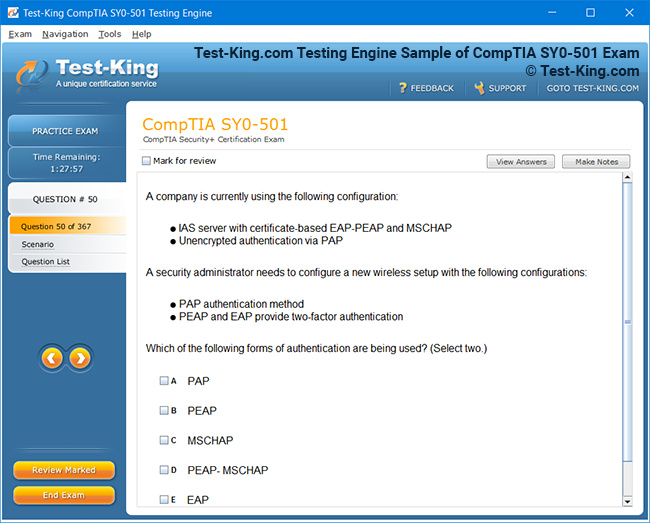
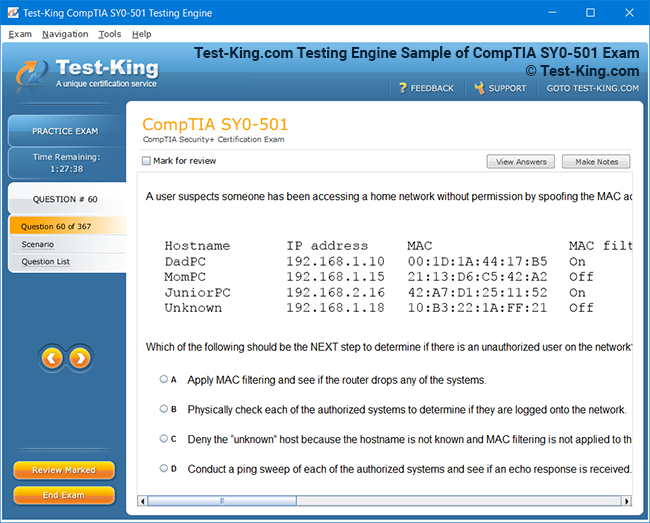
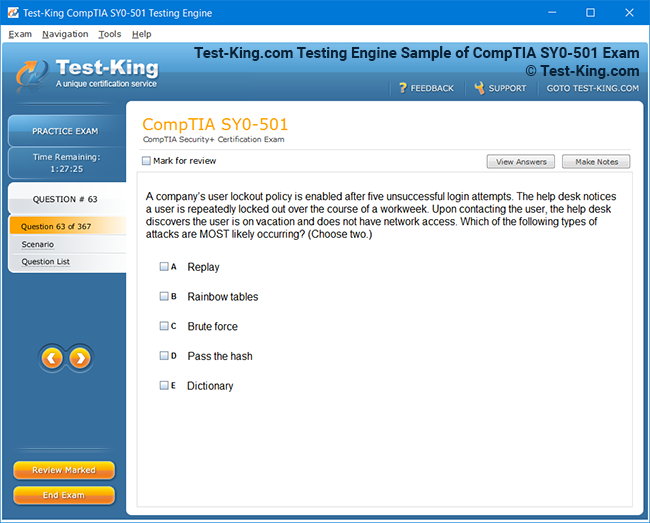
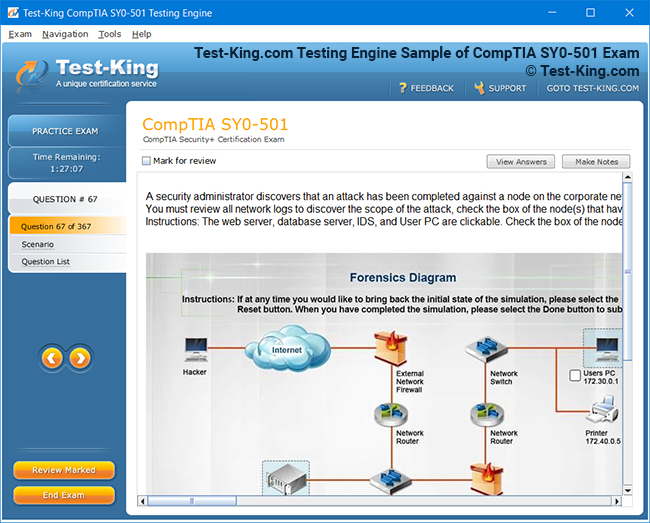
Frequently Asked Questions
How can I get the products after purchase?
All products are available for download immediately from your Member's Area. Once you have made the payment, you will be transferred to Member's Area where you can login and download the products you have purchased to your computer.
How long can I use my product? Will it be valid forever?
Test-King products have a validity of 90 days from the date of purchase. This means that any updates to the products, including but not limited to new questions, or updates and changes by our editing team, will be automatically downloaded on to computer to make sure that you get latest exam prep materials during those 90 days.
Can I renew my product if when it's expired?
Yes, when the 90 days of your product validity are over, you have the option of renewing your expired products with a 30% discount. This can be done in your Member's Area.
Please note that you will not be able to use the product after it has expired if you don't renew it.
How often are the questions updated?
We always try to provide the latest pool of questions, Updates in the questions depend on the changes in actual pool of questions by different vendors. As soon as we know about the change in the exam question pool we try our best to update the products as fast as possible.
How many computers I can download Test-King software on?
You can download the Test-King products on the maximum number of 2 (two) computers or devices. If you need to use the software on more than two machines, you can purchase this option separately. Please email support@test-king.com if you need to use more than 5 (five) computers.
What is a PDF Version?
PDF Version is a pdf document of Questions & Answers product. The document file has standart .pdf format, which can be easily read by any pdf reader application like Adobe Acrobat Reader, Foxit Reader, OpenOffice, Google Docs and many others.
Can I purchase PDF Version without the Testing Engine?
PDF Version cannot be purchased separately. It is only available as an add-on to main Question & Answer Testing Engine product.
What operating systems are supported by your Testing Engine software?
Our testing engine is supported by Windows. Andriod and IOS software is currently under development.
Top VMware Exams
- 2V0-17.25 - VMware Cloud Foundation 9.0 Administrator
- 2V0-13.25 - VMware Cloud Foundation 9.0 Architect
- 3V0-25.25 - Advanced VMware Cloud Foundation 9.0 Networking
- 2V0-16.25 - VMware vSphere Foundation 9.0 Administrator
- 3V0-21.25 - Advanced VMware Cloud Foundation 9.0 Automation
- 3V0-24.25 - VMware Certified Advanced Professional - VMware Cloud Foundation VKS
- 2V0-21.23 - VMware vSphere 8.x Professional
- 2V0-15.25 - VMware Cloud Foundation 9.0 Support
- 3V0-11.26 - VMware Certified Advanced Professional - VMware Cloud Foundation 9 Administrator
- 2V0-41.24 - VMware NSX 4.X Professional V2
- 2V0-72.22 - Professional Develop VMware Spring
- 2V0-51.23 - VMware Horizon 8.x Professional
- 2V0-11.25 - VMware Cloud Foundation 5.2 Administrator
- 3V0-32.23 - Cloud Management and Automation Advanced Design
Top Tips to Prepare for the VMware Cloud Operations 8.x Professional (2V0-32.24) Exam
Preparing for the VMware Cloud Operations 8.x Professional examination, officially recognized as Exam Code 2V0-32.24, requires more than just theoretical knowledge. It demands a profound grasp of VMware’s multifaceted ecosystem, a meticulous understanding of cloud operations architecture, and the ability to synthesize conceptual insights with pragmatic applications. This certification is part of VMware’s well-structured credentialing pathway, designed to validate a professional’s expertise in managing and optimizing VMware Cloud environments across hybrid and multi-cloud infrastructures. Those aspiring to earn this certification often come from diverse technical backgrounds—system administrators, cloud engineers, virtualization specialists, and infrastructure architects—all seeking to refine their capabilities and substantiate their proficiency through this globally recognized exam.
Understanding the VMware Cloud Operations 8.x Professional (2V0-32.24) Exam in Depth
The 2V0-32.24 exam evaluates the candidate’s competency in deploying, configuring, and operating VMware Cloud solutions, particularly focusing on the VMware Cloud Operations 8.x suite. It measures one’s adeptness in navigating the operational dimensions of VMware environments, such as workload management, performance tuning, resource optimization, and automation workflows. Candidates must exhibit their understanding of VMware Aria Operations, formerly known as vRealize Operations, as well as associated tools like VMware Cloud Foundation, Aria Suite Lifecycle, and VMware vSphere. Each of these components forms a cohesive framework enabling organizations to manage cloud environments with agility, consistency, and scalability.
Unlike many entry-level certifications, the VMware Cloud Operations 8.x Professional exam situates itself at an intermediate to advanced level. It assumes familiarity with foundational VMware concepts while requiring analytical agility to handle scenario-based questions that emulate real-world challenges. The exam includes multiple-choice and multiple-select questions, where one must carefully assess operational issues, interpret performance data, and choose the most effective resolution strategies. The challenge lies not in rote memorization but in discerning patterns of efficiency and implementing the best operational methodologies VMware advocates.
Preparation begins by internalizing the exam’s blueprint, which VMware periodically updates to align with evolving technologies. The blueprint delineates domains and subtopics, emphasizing areas like configuring and managing VMware Aria Operations, integrating VMware Cloud services, troubleshooting operational workflows, and analyzing capacity and performance data. To gain mastery over these subjects, candidates must cultivate both conceptual clarity and experiential fluency. This means simulating operations in a hands-on environment, understanding dependencies among VMware components, and learning how to optimize resource consumption across virtualized infrastructures.
The VMware 2V0-32.24 exam extends beyond simple product familiarity; it explores the philosophy of cloud operations. VMware’s operational model promotes automation, intelligence-driven insights, and cross-cloud visibility, which together constitute the nucleus of efficient modern cloud management. Understanding how VMware Aria Operations collects metrics, aggregates performance indicators, and delivers prescriptive analytics is essential for success. It’s not enough to know where features reside; one must comprehend why they exist and how to leverage them for operational excellence.
In the preparatory journey, candidates should immerse themselves in VMware’s official documentation, hands-on labs, and community forums. The VMware Hands-on Labs (HOL) platform, for instance, offers interactive simulations where one can explore real-world use cases without requiring local infrastructure. This experiential exposure provides invaluable practice in configuring alerts, dashboards, policies, and capacity models within the VMware Cloud Operations suite. Such exercises help in cementing practical understanding, which proves indispensable when confronting scenario-based questions during the examination.
Moreover, a nuanced understanding of VMware’s terminology and architecture fosters deeper comprehension. Terms like super metrics, object relationships, and symptom definitions carry specific operational meanings that guide analytical reasoning within the platform. Recognizing how data flows between managed objects and how predictive analytics interpret performance trends can elevate one’s operational dexterity. A meticulous reading of VMware’s design principles—covering scalability, resilience, and cost optimization—helps candidates anticipate the kind of analytical reasoning the exam demands.
An often-overlooked dimension of preparation is the psychological readiness for the examination. The VMware 2V0-32.24 test is time-bound, and each question requires deliberate yet swift reasoning. One must cultivate a composed cognitive rhythm, balancing technical recall with interpretive analysis. It’s advisable to practice with timed mock exams to simulate real conditions. This sharpens focus, nurtures familiarity with the exam’s pacing, and mitigates cognitive fatigue. Furthermore, it enables the test taker to identify weak areas early, ensuring targeted revision instead of scattered study efforts.
The core of effective preparation lies in balancing theory with tangible experience. While reading documentation builds conceptual grounding, direct engagement with VMware Cloud Operations 8.x fortifies intuition. Working with VMware Aria Operations allows one to experiment with policies, thresholds, and analytics in a way that theoretical study cannot replicate. For instance, configuring an alert definition or interpreting a capacity trend graph deepens comprehension of system behavior. This type of immersive learning makes it easier to recall operational workflows during the exam because the learner associates each function with an experiential anchor rather than an abstract concept.
Equally vital is the comprehension of integration points across VMware’s ecosystem. VMware Cloud Operations does not function in isolation; it communicates with multiple platforms and services. Understanding how VMware Aria Operations interacts with VMware Aria Automation, Aria Suite Lifecycle, and public cloud connectors is crucial for a holistic grasp. The exam often evaluates one’s ability to troubleshoot integration discrepancies, analyze synchronization issues, and optimize data collection. Knowledge of APIs, collector groups, and endpoint configurations becomes a powerful advantage in handling these topics efficiently.
The VMware Cloud Operations 8.x Professional certification also encompasses a deep appreciation of automation and orchestration principles. Automation in VMware environments is achieved through workflows, blueprints, and policy-driven actions that ensure consistent performance and reduced manual intervention. Grasping the philosophy behind these automation mechanisms—why they matter, when to apply them, and how to monitor them—is central to mastering the subject matter. Candidates who internalize automation logic can navigate complex operational scenarios with composure and precision.
It is equally important to familiarize oneself with monitoring and alerting strategies. VMware Cloud Operations platforms are built upon proactive detection mechanisms that identify potential bottlenecks before they escalate. Understanding how to configure and interpret health scores, anomalies, and predictive capacity indicators allows professionals to preempt issues and maintain system equilibrium. This knowledge demonstrates operational foresight, a quality VMware highly values and implicitly tests within its certification framework.
Another crucial area to explore is performance optimization. VMware environments thrive on efficient resource allocation, workload balancing, and proactive capacity planning. Candidates must know how to interpret performance data, identify contention, and make informed decisions about scaling and resource adjustments. The ability to read performance dashboards and correlate metrics to underlying causes showcases a level of expertise aligned with VMware’s professional expectations. Performance optimization is not merely about resolving slowdowns but about cultivating systemic harmony where every resource operates at its optimal potential.
Candidates should not underestimate the role of documentation in preparation. VMware’s official guides, release notes, and technical whitepapers are replete with intricate details that often find their way into exam scenarios. These documents also highlight best practices, limitations, and advanced configurations that shape the operational landscape of VMware Cloud. Reading them attentively enriches technical vocabulary and strengthens analytical acuity. It also helps candidates understand VMware’s design intentions, which often illuminate the rationale behind exam questions.
Community engagement serves as another invaluable dimension of preparation. The VMware community is vast and intellectually vibrant, offering an abundance of shared experiences, problem-solving discussions, and unofficial study tips. Engaging in forums, user groups, or social platforms dedicated to VMware can expose candidates to nuanced insights not readily available in formal materials. Sometimes, a practitioner’s anecdote about troubleshooting a specific integration can illuminate a conceptual blind spot far more effectively than repetitive studying.
The cognitive diversity of learning resources is also beneficial. Some learners absorb knowledge more efficiently through visual means, while others prefer textual depth. Mixing instructional videos, webinars, podcasts, and practice labs creates a rich cognitive tapestry that reinforces retention. VMware itself offers training courses through VMware Learning, such as “VMware Cloud Operations: Install, Configure, Manage,” which aligns perfectly with the 2V0-32.24 exam blueprint. Enrolling in such official courses ensures alignment with VMware’s intended learning outcomes.
One of the most strategic ways to prepare is by dissecting use cases and real-world scenarios. Since VMware’s exam structure favors applied understanding, reviewing case studies on enterprise cloud operations can yield profound insights. For instance, exploring how multinational corporations manage hybrid workloads or leverage predictive analytics to optimize capacity gives tangible context to theoretical constructs. This contextual understanding allows candidates to approach exam scenarios with realism and analytical finesse.
As candidates navigate through study materials, maintaining a structured schedule is indispensable. The complexity of VMware Cloud Operations 8.x demands disciplined learning over time rather than sporadic study sessions. Setting incremental milestones for each topic—such as completing specific modules, practicing labs, or reviewing integration scenarios—keeps progress measurable and consistent. Tracking this progression instills a sense of accomplishment and mitigates cognitive overwhelm as the exam date approaches.
A critical component of VMware Cloud Operations expertise is the comprehension of data analysis mechanisms within VMware Aria Operations. This tool’s analytic prowess stems from its ability to assimilate voluminous data from distributed environments and transform it into actionable intelligence. Understanding how metrics are collected, aggregated, and visualized empowers candidates to interpret patterns accurately. This analytical capability mirrors real operational roles, where professionals must continuously monitor the health and efficiency of cloud infrastructures.
When approaching the exam, it is wise to develop an interpretive reading strategy. VMware’s questions often embed subtle qualifiers or contextual hints that alter the intended meaning. Reading attentively ensures that one captures these nuances. Many candidates falter not due to lack of knowledge but due to misinterpretation of wording. Training oneself to identify key operational clues within the question text improves accuracy and reduces guesswork. Developing this interpretive precision requires habitual practice with sample questions and thoughtful reflection on reasoning errors.
Time management during the exam cannot be overstated. Each question must be approached with deliberate pacing—long enough to ensure comprehension but brief enough to sustain momentum. Candidates should resist the urge to linger excessively on a single challenging question, as this can disrupt flow. Instead, marking difficult questions for review and advancing through the easier ones first ensures efficient utilization of the allotted time. This strategy aligns with the rhythm of high-stakes testing and cultivates calmness under pressure.
An integral dimension of VMware Cloud Operations 8.x proficiency is understanding the interconnectedness between cloud governance, security, and compliance. VMware environments must align with organizational governance models, ensuring data integrity and regulatory adherence. Familiarity with how VMware Cloud Operations integrates with identity management systems, audit mechanisms, and access controls enhances a candidate’s comprehension of secure operational design. The exam may assess knowledge of these intersections through scenario-based inquiries where governance decisions influence operational outcomes.
Furthermore, understanding the transition from traditional infrastructure management to cloud-centric operations adds depth to one’s perspective. VMware Cloud Operations epitomizes this evolution by abstracting complexity and promoting automation. Recognizing this paradigm shift allows candidates to appreciate the rationale behind VMware’s operational philosophy—why automation supersedes manual oversight and how artificial intelligence augments administrative efficiency. This broader comprehension transforms exam preparation from a rote endeavor into an intellectual exploration of modern cloud architecture.
Studying consistently over a defined timeline enhances retention. Spaced repetition, where concepts are revisited periodically, fortifies memory consolidation. For VMware 2V0-32.24 aspirants, revisiting complex topics like capacity analytics, alert configuration, and policy management multiple times ensures conceptual stability. Each revisit should aim for deeper insight rather than superficial review. Over time, these cumulative reinforcements create mental dexterity that proves invaluable in responding to intricate exam questions.
It’s beneficial to simulate operational anomalies in a practice environment. By intentionally creating situations such as resource contention or configuration misalignment within a lab, one can practice troubleshooting methodologies similar to those expected in the exam. This type of deliberate experimentation not only reinforces technical understanding but also sharpens diagnostic reasoning. It mirrors the real-world essence of VMware Cloud Operations—anticipating, identifying, and resolving operational irregularities efficiently.
The language of VMware documentation and exam content can be dense, interwoven with technical idioms and platform-specific expressions. Candidates should familiarize themselves with this lexicon early in their preparation to avoid misinterpretation later. Phrases such as “object hierarchy,” “composite metric,” or “policy inheritance” carry precise operational meanings that shape exam questions. Understanding this vocabulary cultivates linguistic fluency in VMware’s technical dialect, making comprehension smoother and more intuitive during the exam.
Lastly, maintaining mental and physical equilibrium throughout the preparation journey contributes significantly to performance. Long study sessions can induce cognitive fatigue, diminishing comprehension and recall. Incorporating short breaks, adequate rest, and balanced nutrition enhances cognitive vitality. Regular exercise and mindfulness practices can further improve focus and resilience under stress. The goal is to approach the VMware Cloud Operations 8.x Professional exam not merely as a test of knowledge but as an endeavor of endurance and composure.
By internalizing the architecture, principles, and operational philosophy of VMware Cloud Operations 8.x, candidates position themselves advantageously to navigate the challenges of the 2V0-32.24 certification. Each aspect of preparation—from mastering the toolsets to cultivating analytical discipline—contributes to a holistic readiness that transcends mere memorization. The journey demands diligence, curiosity, and adaptability, qualities that resonate deeply with VMware’s vision of empowering professionals to manage the complexities of modern cloud ecosystems with precision and confidence.
Building a Strategic Study Framework for the VMware Cloud Operations 8.x Professional (2V0-32.24) Certification
Preparing strategically for the VMware Cloud Operations 8.x Professional examination demands a delicate equilibrium between conceptual understanding, experiential learning, and cognitive endurance. The exam code 2V0-32.24 embodies VMware’s evolving vision of professional competence in hybrid cloud administration and automation-driven operations. The certification validates a practitioner’s ability to configure, monitor, and optimize VMware Cloud environments using the VMware Aria Operations platform and other pivotal elements within the VMware Cloud suite. This learning endeavor is not merely an academic pursuit; it’s a professional metamorphosis that transforms a practitioner’s comprehension of distributed cloud infrastructures into a dynamic, operational intellect capable of sustaining enterprise-grade environments.
A foundational principle of any effective preparation strategy is architectural clarity. Before diving into exam domains or sample questions, it’s essential to grasp the topological framework of VMware Cloud Operations 8.x. The ecosystem is expansive, integrating multiple layers of functionality—virtual machine orchestration, automated remediation, capacity analytics, cost governance, and performance optimization. Understanding how these layers interact creates a cognitive map that guides study priorities. For example, recognizing that VMware Aria Operations is both a monitoring and analytic nucleus clarifies its role as the central nervous system of VMware’s operational model. Similarly, realizing that VMware Cloud Foundation establishes the foundational substrate upon which operations are managed provides directional focus when studying integration topics.
Each element of VMware’s Cloud Operations architecture has its own operational identity. VMware Aria Operations specializes in metric collection, predictive analytics, and capacity modeling. VMware Aria Automation focuses on provisioning and lifecycle management. VMware Aria Suite Lifecycle coordinates upgrades, patching, and configuration synchronization. Knowing how to articulate these relationships enables candidates to reason through exam questions that blend multiple services. When a scenario presents a performance anomaly across a hybrid cloud cluster, the test taker should instinctively consider data ingestion pipelines, collector groups, and policy thresholds rather than perceiving the problem in isolation. This systemic reasoning forms the intellectual backbone of high-scoring candidates.
Time allocation in the study framework must mirror the weight of topics in the official blueprint. VMware’s published domains provide a valuable compass for determining where to invest the majority of study hours. Although VMware may revise weightings periodically, topics like configuration of VMware Aria Operations, capacity and performance management, troubleshooting, and integration tend to carry significant emphasis. Devoting proportional time ensures coverage without cognitive imbalance. However, beyond time distribution, the quality of study engagement matters more profoundly. Deep engagement with practical labs, documentation cross-referencing, and scenario dissection produces an indelible comprehension far superior to cursory reading.
A successful candidate adopts an iterative approach to learning. Instead of consuming topics linearly, the learner should continuously loop back to previously studied material, viewing it through the lens of newly acquired understanding. This cyclical reinforcement gradually transforms fragmented knowledge into an interconnected web of insights. For instance, revisiting resource optimization after mastering automation workflows reveals how operational policies influence efficiency. Revisiting integration concepts after exploring alerting mechanisms illuminates how data synchrony affects predictive accuracy. Such iterative learning aligns naturally with VMware’s systemic approach to cloud operations, where every component interrelates within an orchestrated continuum.
Another indispensable component of preparation is experiential familiarity. VMware’s Hands-on Labs provide an exceptional avenue to cultivate this. Within these virtual environments, candidates can deploy clusters, manipulate configurations, and explore dashboards without jeopardizing production resources. The tactile experience of interacting with VMware Aria Operations enhances retention and accelerates intuition. When a learner configures an alert, sets thresholds, and observes the impact of policy changes, the knowledge transcends theory—it becomes kinesthetic. This embodied learning ensures that, during the exam, each question evokes a memory of an actual interaction rather than abstract recollection.
Conceptual clarity must also extend to VMware’s operational philosophy. VMware Cloud Operations 8.x promotes autonomous intelligence, policy-driven governance, and predictive awareness. The exam inherently tests one’s alignment with these tenets. Questions rarely ask for rote definitions; instead, they probe how a professional would respond under real operational conditions. This design philosophy expects candidates to think like cloud operators who orchestrate rather than merely administer. Hence, preparation must involve interpreting operational logic rather than memorizing procedural steps. A candidate who understands why a capacity anomaly occurs or why a policy inheritance affects a sub-object’s performance demonstrates mastery at a conceptual depth VMware values highly.
Resource curation forms the scaffolding of effective study planning. Official VMware training modules, community blogs, and whitepapers constitute the primary repository of accurate information. However, an insightful learner transcends conventional resources, exploring less obvious sources such as conference recordings, partner documentation, and technical deep dives authored by VMware engineers. These materials often contain nuanced explanations of architectural rationale and operational best practices. For instance, a community-authored analysis of super metrics can clarify relationships between dependent objects better than terse documentation paragraphs. Such intellectual exploration adds rare depth and linguistic diversity to one’s comprehension.
The VMware 2V0-32.24 certification also evaluates analytical reasoning—the ability to translate complex telemetry data into meaningful operational insights. This analytical agility requires practice with performance dashboards and troubleshooting exercises. Understanding how to interpret time series data, correlate metric deviations, and pinpoint causality fosters diagnostic confidence. It’s advisable to practice these analyses with sample datasets or live lab environments. Observing metric fluctuations when workloads intensify or policies change creates experiential familiarity with system behavior, a quality that VMware’s scenario-based questions inherently reward.
Another crucial pillar of preparation lies in automation literacy. Automation is not an ancillary feature of VMware Cloud Operations—it is its essence. Candidates must understand how policies, workflows, and alert-triggered actions converge to form a self-regulating ecosystem. Comprehending the nuances of policy scope, trigger conditions, and remediation actions enables candidates to visualize operational continuity. Automation knowledge also intersects with capacity and cost optimization since automated decisions often determine resource reallocation. This integrated awareness illustrates how automation transforms reactive management into proactive orchestration.
Beyond technical aptitude, VMware expects professionals to embody architectural thinking. This implies perceiving operations not as isolated incidents but as patterns within a living system. Architectural thinking involves foresight—anticipating how configuration choices cascade through dependent components. For instance, adjusting a memory threshold in one policy may influence the overall risk score across multiple clusters. Recognizing such ripple effects requires panoramic awareness of VMware’s operational topology. Cultivating this systems-oriented perspective distinguishes proficient candidates from those who rely purely on procedural familiarity.
Language precision also plays a subtle yet powerful role. The VMware Cloud Operations lexicon is distinct, infused with proprietary terms and subtle semantic differences. Mastering this linguistic framework facilitates accurate interpretation of exam questions. For example, the difference between “symptom,” “alert definition,” and “recommendation” might appear trivial but carries operational weight. Misunderstanding these terms can lead to misinterpretation. Therefore, reading VMware’s documentation aloud or paraphrasing definitions during study sessions can reinforce linguistic fluency and reduce semantic confusion during the actual test.
A refined study plan must incorporate diagnostic checkpoints. These checkpoints function as self-assessment milestones to evaluate progress and identify knowledge gaps. Using VMware’s sample questions, third-party practice exams, or peer discussions can reveal areas requiring further attention. However, one must approach practice tests judiciously. The goal is not to memorize answers but to decode reasoning patterns. Analyzing why an answer is correct and how alternatives deviate builds analytical elasticity. Over time, this reflective evaluation nurtures adaptive intelligence—the capacity to infer correct solutions to unfamiliar scenarios during the actual exam.
The psychological architecture of preparation is as important as technical content. Extended study sessions can erode focus and motivation. Structuring study intervals through cognitive rhythm—alternating deep concentration with brief restorative breaks—enhances memory consolidation. Techniques such as the Pomodoro method or segmented revision cycles promote sustained mental agility. Additionally, maintaining an organized study environment, free from digital clutter, fosters mental serenity. When the mind associates the study space with clarity, learning becomes an immersive and tranquil experience rather than an obligation.
Engaging with the VMware community contributes profoundly to cognitive enrichment. Discussion forums, virtual meetups, and social learning spaces host invaluable exchanges of experiential wisdom. Interacting with peers who have already passed the 2V0-32.24 exam can yield strategic insights into exam temperament, topic emphasis, and cognitive pitfalls. Moreover, sharing one’s own interpretations of complex concepts reinforces understanding through articulation. The social dimension of learning transforms solitary study into a dynamic dialogue, allowing perspectives to broaden and ideas to cross-pollinate.
One of the more subtle skills required for this certification is interpretive reading. VMware’s exam designers craft questions with layered intent, often embedding contextual nuances that modify meaning. A surface-level reading may lead to misjudgment, but a discerning reader identifies cues hidden in phrasing. To cultivate this acuity, practice analyzing questions from multiple perspectives—ask what the examiner might be testing conceptually rather than what the question superficially demands. This metacognitive technique nurtures adaptability and precision, qualities indispensable for navigating VMware’s analytical question style.
In addition to textual learning, visual cognition enhances conceptual retention. Drawing diagrams of VMware’s operational architecture—depicting relationships between clusters, collectors, and policies—imprints mental imagery that aids recall. Visualization also assists in grasping abstract ideas like data propagation or dependency mapping. While diagrams should not appear in the exam itself, constructing them during study creates cognitive scaffolding. Over time, such mental models simplify complex interrelations, allowing candidates to retrieve information swiftly under pressure.
The integration dimension of VMware Cloud Operations deserves particular attention. Many operational challenges stem from misconfigurations or synchronization delays between interconnected services. Understanding how VMware Aria Operations interacts with VMware Cloud Foundation, vCenter, and external APIs equips candidates with diagnostic insight. Study sessions should explore connection workflows, credential requirements, and data collection nuances. Recognizing the sequence of integration steps enables rapid fault isolation, an ability VMware examiners subtly test through situational questions.
A comprehensive preparation plan also incorporates version awareness. VMware’s product ecosystem evolves rapidly, and subtle version differences can affect functionality and interface design. Keeping abreast of the latest VMware Cloud Operations 8.x updates, release notes, and deprecated features prevents confusion during the exam. Candidates should periodically revisit official VMware pages to verify that their knowledge reflects the most recent platform iteration. This vigilance ensures alignment with current operational realities and demonstrates professional diligence.
Practical experimentation should extend beyond guided labs. Setting up a personal test environment, even if limited in resources, allows freedom to experiment with unconventional configurations. This sandbox exploration cultivates innovation and problem-solving agility. For example, testing how altering policy inheritance affects dependent alert thresholds or observing metric propagation after integration reconfiguration nurtures experiential insight. These self-directed experiments transform the learner from a passive recipient of information into an active investigator of operational dynamics.
Reading VMware’s whitepapers and design guides provides theoretical reinforcement for these hands-on experiences. Whitepapers often delve into conceptual underpinnings such as capacity modeling algorithms, predictive analytics architecture, or best practices for scaling. Integrating this theoretical understanding with empirical experience bridges the gap between conceptual abstraction and pragmatic application. The synthesis of these dimensions yields a holistic comprehension capable of addressing both technical and analytical facets of exam questions.
Equally significant is cultivating error literacy—the ability to learn constructively from mistakes. Each incorrect answer in a practice test reveals an opportunity to recalibrate understanding. Instead of memorizing the correct choice, one should dissect the cognitive path that led to the error. Was the misstep due to conceptual misunderstanding, semantic misinterpretation, or simple oversight? This introspection builds metacognitive resilience, ensuring that future errors of the same nature are less likely. Over time, this reflective refinement enhances confidence and accuracy.
When navigating vast study materials, prioritization becomes essential. Not every piece of documentation warrants equal attention. Candidates must discern between core operational topics and peripheral knowledge. Focusing on VMware Aria Operations configuration, capacity analysis, troubleshooting, and integration yields higher returns than expending effort on tangential details. However, selective reading should never become narrow reading; understanding the ecosystem’s breadth maintains contextual awareness. The art lies in striking equilibrium between depth and breadth, ensuring both mastery and perspective.
Scheduling mock exams at regular intervals provides empirical benchmarks of readiness. These simulations reveal not only knowledge proficiency but also stamina and composure. The VMware 2V0-32.24 exam demands sustained concentration over a fixed duration, so acclimating to this rhythm beforehand reduces anxiety. During mock sessions, emulate actual testing conditions—time limits, minimal interruptions, and sequential answering. Post-exam analysis should focus on pattern recognition rather than score obsession. Identifying recurring weak topics guides subsequent study refinements with surgical precision.
An often-neglected aspect of preparation is documentation annotation. Highlighting key phrases, summarizing complex paragraphs in the margins, and rephrasing concepts in personal language fosters deeper assimilation. Annotation converts passive reading into active engagement. It stimulates critical thinking as the learner continually interacts with the text. Additionally, compiling a personalized glossary of VMware terminologies ensures that essential vocabulary remains accessible for quick revision closer to the exam date.
Candidates must also familiarize themselves with VMware’s troubleshooting methodology. VMware Aria Operations adopts a structured diagnostic logic built on symptom definition, root cause identification, and remediation recommendation. Understanding how the system correlates events and ranks anomalies aids comprehension of exam questions centered around problem-solving. Practicing with real or simulated alerts, tracing their causal lineage, and verifying resolution outcomes cultivates this analytical pattern recognition. Troubleshooting, at its core, is an exercise in deductive reasoning, and mastering it solidifies one’s standing as an adept operator.
Emotional discipline constitutes a silent but decisive factor in exam success. High-stakes certification exams often provoke performance anxiety, which can impair recall. Developing mental fortitude through mindfulness or breathing techniques stabilizes concentration during test conditions. Visualization practices—imagining oneself progressing smoothly through the exam—can prime the mind for composure. This psychological rehearsal transforms apprehension into anticipation, channeling nervous energy into productive focus.
Throughout the preparation journey, cultivating curiosity ensures that motivation remains vibrant. Viewing each topic not as an obligation but as an opportunity to uncover operational elegance transforms the process into intellectual adventure. The VMware Cloud Operations ecosystem embodies intricate sophistication—automation loops, predictive models, and architectural harmony—that reward curiosity with discovery. When learning becomes exploration, endurance naturally follows, sustaining enthusiasm even through dense technical material.
Documenting one’s learning trajectory provides both motivation and clarity. Maintaining a learning journal or digital log of topics covered, insights gained, and challenges encountered tracks evolution over time. Reviewing earlier entries can reveal how understanding has matured, reinforcing confidence. It also serves as a repository of distilled knowledge for final revision, condensing months of effort into a concise and personalized reference.
Candidates should also develop multi-dimensional reasoning. VMware’s operational questions often demand synthesis across topics—linking performance data with automation logic or integration anomalies with configuration drift. Practicing this cross-domain reasoning hones adaptability. For instance, correlating an increase in latency with a recent policy update demonstrates integrated thinking. This capacity to interweave diverse threads of knowledge mirrors real-world operational intelligence and aligns perfectly with VMware’s evaluative ethos.
Finally, one must internalize VMware’s ethos of continual optimization. Cloud operations thrive on perpetual refinement, where each analysis leads to adjustment and each adjustment leads to new insight. Viewing preparation through this same lens turns studying into an evolving process. Each study session becomes an iteration of optimization, fine-tuning comprehension, strategy, and discipline. This mindset not only prepares candidates for the exam but also conditions them for success as professionals entrusted with maintaining efficiency in complex, living cloud ecosystems.
By orchestrating an intelligent study framework rooted in iteration, experimentation, and reflection, aspirants of the VMware Cloud Operations 8.x Professional certification can ascend from mere learners to operational virtuosos. The exam code 2V0-32.24 is more than an assessment—it is an initiation into VMware’s philosophy of intelligent cloud management, where mastery is measured not by memorization but by the graceful application of knowledge under real-world constraints. The learner who adopts this holistic approach evolves into a practitioner who not only passes the certification but embodies its principles through technical fluency and strategic foresight.
Mastering Analytical Thinking and Operational Depth for VMware Cloud Operations 8.x Professional (2V0-32.24)
The journey toward mastering the VMware Cloud Operations 8.x Professional certification, recognized by exam code 2V0-32.24, requires a sophisticated fusion of analytical sharpness, operational fluency, and strategic perseverance. The test itself is designed not merely to assess rote memorization but to examine the candidate’s comprehension of operational orchestration within VMware’s complex cloud environment. It expects individuals to demonstrate their capacity for diagnostic reasoning, systemic analysis, and adaptive problem-solving across multiple interdependent components of VMware Cloud Operations. To achieve success, aspirants must cultivate a rare equilibrium between theoretical mastery and experiential acuity—an equilibrium that allows them to traverse the boundaries between abstract design principles and real-time operational execution.
At its foundation, VMware Cloud Operations 8.x represents the culmination of VMware’s philosophy of intelligent automation and predictive governance. The platform embodies a confluence of analytics, automation, and integration that sustains cloud infrastructure with minimal manual intervention. To truly understand this ethos, candidates must familiarize themselves not only with VMware Aria Operations as a monitoring and optimization platform but also with the interconnected fabric of VMware Cloud Foundation, Aria Automation, and other supporting technologies. Mastery arises from perceiving these tools not as isolated modules but as interdependent entities within an intricate operational symphony.
Analytical thinking forms the nucleus of VMware’s operational logic. In the context of the 2V0-32.24 examination, this means the ability to interpret performance metrics, identify patterns of degradation, and infer probable causes from data correlations. VMware Aria Operations is engineered to provide data-driven insight, transforming raw telemetry into actionable intelligence. A proficient candidate must comprehend how this transformation occurs—the data ingestion processes, the analytic algorithms that govern capacity forecasting, and the mechanisms that trigger alerts based on deviation thresholds. Understanding these components cultivates the intuition necessary to respond effectively when confronted with scenario-based exam questions that simulate real operational dilemmas.
Deep within VMware’s operational model lies the principle of metric-driven decision-making. Every object within VMware Aria Operations—be it a cluster, host, or virtual machine—generates continuous streams of performance metrics. These data points, when aggregated and normalized, reveal patterns that indicate efficiency or inefficiency. The test challenges candidates to interpret such patterns under varying operational contexts. For instance, an apparent decline in CPU performance might not signify hardware inefficiency but could result from policy misconfiguration or an imbalance in workload distribution. The ability to distinguish between symptomatic data and root cause constitutes a hallmark of operational intelligence that VMware’s certification endeavors to validate.
Beyond analytics, the VMware Cloud Operations 8.x Professional exam expects familiarity with the operational lifecycle of cloud systems. This encompasses the processes of deployment, configuration, optimization, and troubleshooting. Deployment knowledge involves understanding how to install and configure VMware Aria Operations components within both on-premises and hybrid environments. Candidates must grasp the intricacies of node architecture, cluster formation, and certificate management. Configuration extends beyond initial setup to include fine-tuning policies, customizing dashboards, and defining data collection parameters. Optimization focuses on capacity planning, workload balancing, and automation alignment, ensuring that resources are utilized judiciously across multi-cloud architectures. Troubleshooting then closes the loop by demanding the diagnostic acuity to identify and rectify anomalies before they impact performance continuity.
An effective preparatory approach involves iterative immersion into each of these operational domains. A learner who experiments with policy customization will intuitively understand how alert thresholds influence performance visibility. Similarly, someone who routinely evaluates capacity models within the VMware Aria Operations interface will naturally grasp the metrics that define predictive analytics. The goal is not to memorize procedural steps but to internalize the operational rationale underlying every configuration choice. This method cultivates adaptive mastery—an ability to respond to unexpected variations in system behavior with informed precision.
Another critical component of preparation is the understanding of automation workflows. VMware Cloud Operations 8.x thrives on automation as the engine of operational efficiency. Policies and workflows serve as the governing constructs that dictate how the system responds to fluctuating workloads, capacity constraints, or performance anomalies. Familiarity with creating, managing, and auditing these automation constructs prepares candidates to think like VMware architects rather than passive operators. In practice, this means comprehending the relationships between triggers, conditions, and actions, and appreciating how these relationships contribute to the autonomous resilience of the cloud environment.
The VMware 2V0-32.24 certification also tests one’s proficiency in integrating VMware Cloud Operations with external data sources and tools. Integration is an indispensable facet of real-world cloud management, as organizations rarely operate within a single-vendor ecosystem. Understanding how VMware Aria Operations interfaces with VMware vCenter, Aria Suite Lifecycle, and third-party data collectors fosters a panoramic operational view. Exam questions frequently present scenarios where integration misalignments or synchronization delays create data inconsistencies. The adept candidate identifies such anomalies swiftly by tracing data lineage and verifying communication pathways. Knowledge of endpoint configuration, collector groups, and authentication protocols becomes essential in these contexts.
Equally important is the comprehension of capacity and cost governance within VMware Cloud Operations. The platform’s analytic models enable administrators to forecast resource consumption, anticipate future needs, and align expenditure with utilization. A professional who masters this aspect can articulate the delicate interplay between performance optimization and financial efficiency. Understanding how to interpret capacity analytics dashboards, perform cost optimization assessments, and set operational policies that balance performance with expenditure demonstrates both technical competence and strategic awareness.
Preparing for this examination also requires an appreciation of VMware’s design philosophy, which harmonizes automation with human oversight. VMware Cloud Operations 8.x does not advocate complete relinquishment of control to machines but rather promotes a symbiosis where automation amplifies human decision-making. Recognizing when to intervene manually and when to allow automated processes to proceed is part of the operational wisdom tested in the certification. Candidates should, therefore, develop the discernment to distinguish between anomalies that demand immediate attention and those that the system can autonomously rectify.
In the process of preparation, it becomes indispensable to understand the diagnostic ecosystem within VMware Aria Operations. The platform’s alerting mechanism functions through hierarchical symptom definitions, where conditions detected across multiple objects may culminate in composite alerts. Understanding how these hierarchies function allows candidates to infer the significance of alerts and to determine which symptoms merit immediate remediation. The exam frequently evaluates the candidate’s ability to interpret such multi-layered alert structures, emphasizing the importance of conceptual clarity in understanding how alerts propagate across object relationships.
When studying the operational dashboards within VMware Aria Operations, learners must approach them not as visual displays but as dynamic analytical instruments. Each widget, metric, and visualization encapsulates a layer of operational intelligence. Understanding how to configure custom dashboards, filter data streams, and interpret time-based patterns allows candidates to transform visual information into actionable strategy. The platform’s ability to correlate performance indicators across multiple objects—such as hosts, clusters, and data centers—creates a tapestry of interdependencies that reflect the real-world complexity of cloud infrastructure. Developing fluency in reading this tapestry becomes critical in deciphering scenario-based questions.
Troubleshooting within VMware environments requires a unique mindset—one rooted in logical progression and probabilistic reasoning. Unlike linear problem-solving, where cause and effect are direct, troubleshooting cloud operations often involves recursive inquiry. A candidate must consider multiple hypotheses simultaneously, evaluating how symptoms interact across layers of abstraction. This approach aligns with VMware’s troubleshooting methodology, which encourages identifying patterns of correlation before isolating specific root causes. To prepare effectively, learners should practice analyzing historical metrics, correlating anomalies, and tracing propagation paths through the VMware Aria Operations interface.
Furthermore, VMware Cloud Operations 8.x integrates predictive modeling to anticipate potential resource constraints before they manifest. Understanding how predictive analytics function within the platform equips candidates to preemptively address operational bottlenecks. This predictive intelligence relies on statistical baselines and deviation thresholds, which the system continuously refines based on historical performance. Candidates should familiarize themselves with how these models operate, including how to adjust or interpret them within the context of capacity planning. The ability to anticipate future performance deviations rather than react to them epitomizes the professional maturity VMware expects from certified practitioners.
An additional layer of competence tested in the 2V0-32.24 exam involves governance and compliance. Cloud environments operate within regulatory frameworks that require strict adherence to security and operational standards. VMware Cloud Operations integrates with governance policies to ensure compliance through automated reporting, configuration tracking, and audit trails. Candidates should understand how to configure compliance views, interpret policy adherence reports, and align operational configurations with governance mandates. This knowledge demonstrates both technical rigor and organizational acumen, bridging the gap between operational management and strategic accountability.
The art of preparing for such an exam extends beyond mastering tools; it requires developing a reflective mindset. Reflection transforms raw information into insight by encouraging the learner to question how and why certain mechanisms exist. When a candidate pauses to consider why VMware designed a particular automation workflow or why performance metrics behave cyclically under specific conditions, they deepen their conceptual ownership of the material. This reflective engagement cultivates analytical intuition, enabling professionals to reason through unfamiliar scenarios during the exam with composure and intellectual agility.
Equally important is the recognition of VMware’s emphasis on efficiency through consolidation. Cloud operations aim to eliminate redundancy and streamline performance. In studying for the 2V0-32.24 certification, learners must identify how VMware’s architecture facilitates this efficiency—through resource pooling, distributed workloads, and automation-driven scaling. Understanding these efficiency paradigms provides insight into VMware’s architectural philosophy and helps candidates discern the operational rationale behind exam scenarios involving scalability or workload optimization.
Studying documentation and whitepapers from VMware should not be a mechanical task but an interpretive exercise. Each document embodies VMware’s accumulated expertise, distilled into operational doctrine. Reading with interpretive curiosity—asking what principle or philosophy underpins each recommendation—transforms study from memorization to assimilation. For instance, a whitepaper on capacity optimization does more than explain configuration steps; it illustrates VMware’s approach to sustainability, predictive planning, and adaptive governance. By internalizing these philosophical dimensions, candidates acquire a holistic comprehension that transcends procedural familiarity.
In addition to technical mastery, success in this exam demands psychological equilibrium. Prolonged preparation can generate mental fatigue, diminishing focus and enthusiasm. Maintaining balance through mindfulness, physical movement, and deliberate rest enhances cognitive receptivity. Cognitive research underscores that a rested mind synthesizes complex ideas more effectively than an overstrained one. Thus, integrating brief meditative intervals into study routines preserves mental clarity and fosters sustained motivation. This equilibrium ensures that candidates approach the exam with lucidity rather than exhaustion.
One of the subtler aspects of preparation involves linguistic precision in VMware’s lexicon. The exam often distinguishes between closely related terms, each carrying distinct operational connotations. A nuanced understanding of terminology such as “policy scope,” “metric group,” and “composite alert” can be decisive in multiple-choice questions. To enhance linguistic familiarity, learners should immerse themselves in VMware’s documentation style, emulating its precise phrasing during revision. This technique ingrains conceptual associations that assist in recognizing correct answers during the test.
Engaging with the VMware learning community also amplifies preparation. Conversations with practitioners who operate real VMware Cloud environments expose learners to scenarios that extend beyond textbook examples. Community engagement fosters cross-pollination of insights, where one professional’s troubleshooting challenge becomes another’s learning opportunity. Discussion forums, webinars, and study groups serve as intellectual catalysts that sharpen interpretive agility and contextual understanding. By articulating concepts to others, learners reinforce their own comprehension while assimilating fresh perspectives.
The VMware Cloud Operations 8.x Professional exam also tests adaptability—the ability to apply known principles to unknown situations. Real cloud environments are fluid, constantly evolving with updates, integrations, and performance dynamics. The exam mirrors this fluidity by presenting hypothetical operational anomalies that lack straightforward answers. The discerning candidate synthesizes knowledge from multiple domains—automation, analytics, capacity, and governance—to deduce the most plausible resolution. Practicing this synthesis through scenario simulations enhances adaptive intelligence, the highest form of professional competency VMware seeks to certify.
Moreover, effective preparation involves cultivating visual and spatial cognition. VMware’s operations interface is rich in dashboards and topology maps that depict the relational geometry of cloud entities. Visualizing how these components interconnect fosters intuitive understanding of dependencies and data flows. Candidates should mentally reconstruct these relationships while studying, imagining how metrics traverse from one object to another. This visualization reinforces retention and accelerates interpretation during the exam when time is limited.
To sustain progress across an extended preparation timeline, learners should adopt a reflective revision cycle. Each week, revisiting prior topics with fresh perspective solidifies long-term retention. Instead of re-reading material passively, candidates should engage in active recall—summarizing concepts from memory, explaining them aloud, or mapping them conceptually. This cognitive technique strengthens neural consolidation, converting fragile memory traces into durable knowledge networks. Over time, these reinforced networks form the cognitive infrastructure that supports confident exam performance.
The nature of VMware’s certification questions rewards depth rather than superficial familiarity. Answers often hinge on recognizing subtle dependencies or operational nuances that only experience or thoughtful study reveals. To prepare effectively, learners must focus less on breadth of memorization and more on relational comprehension—how configurations influence performance, how automation policies interact with capacity models, and how governance frameworks shape operational behavior. Cultivating this relational mindset ensures that understanding extends beyond isolated facts into integrated operational reasoning.
Finally, embracing curiosity as a guiding principle transforms preparation into intellectual artistry. The VMware Cloud Operations 8.x ecosystem is an intricate microcosm of modern digital infrastructure—interwoven with logic, automation, and adaptive intelligence. Approaching each concept with inquisitive fascination transforms the act of studying into an exploration of technological elegance. When curiosity animates learning, perseverance becomes effortless, comprehension deepens naturally, and mastery evolves as an organic consequence of genuine engagement. The aspirant who nurtures this disposition transcends the role of examinee and steps into the identity of a true VMware professional, attuned to the rhythm of innovation and the subtle harmonies of operational intelligence.
Building Operational Resilience and Strategic Mastery for VMware Cloud Operations 8.x Professional (2V0-32.24)
The pathway toward mastering the VMware Cloud Operations 8.x Professional certification, identified through the exam code 2V0-32.24, demands more than technical proficiency—it requires the construction of an inner architecture of resilience, interpretive acumen, and strategic foresight. VMware designed this certification not simply to measure a candidate’s familiarity with commands or configurations, but to evaluate how deftly one can weave conceptual knowledge into real operational strategy. The examination, therefore, becomes a reflection of an individual’s capacity to integrate technology with critical reasoning and procedural intuition. The aspirant must transcend the mechanical dimension of study and cultivate a perception that perceives VMware Cloud Operations as a living ecosystem rather than a static configuration set.
This intellectual transformation begins with recognizing that the VMware Cloud Operations 8.x environment represents a dynamic organism composed of interdependent layers—data collection, analytic computation, policy automation, and system remediation. Each layer operates in harmony with the others, and any disturbance reverberates through the system. Thus, understanding one layer without contextualizing it within the larger fabric limits operational insight. To truly prepare for the 2V0-32.24 exam, a learner must interpret how these layers synchronize to maintain stability across multi-cloud architectures, where workloads shift fluidly between public and private domains.
Within this ecosystem, VMware Aria Operations occupies a pivotal position as both a monitoring engine and an intelligence core. It processes vast swathes of telemetry, translating them into metrics that narrate the performance and health of infrastructure components. The candidate who masters this translation process acquires the ability to interpret the subtle language of metrics—understanding how fluctuations in latency, throughput, and utilization hint at deeper systemic conditions. This sensitivity to operational nuance is precisely what the exam aims to elicit. By grasping how data metamorphoses into insight, the learner develops a cognitive dexterity that aligns with VMware’s design philosophy.
Operational resilience, the backbone of VMware Cloud Operations, rests on the principle of proactive observability. Instead of reacting to anomalies after they manifest, the system—and the professional managing it—must anticipate disturbances before they escalate. This anticipatory competence stems from predictive analytics, a discipline that VMware has embedded deeply into its Cloud Operations suite. Candidates preparing for the 2V0-32.24 examination must, therefore, understand how predictive models are constructed, how baselines evolve over time, and how capacity forecasting influences policy decisions. When confronted with exam scenarios that simulate resource saturation or performance degradation, the ability to interpret predictive indicators becomes the distinguishing attribute of mastery.
Furthermore, the VMware Cloud Operations 8.x Professional certification tests an individual’s command over automation governance. Automation, in the VMware lexicon, is not merely a convenience but a philosophy of sustainable efficiency. Policies and workflows serve as the arteries through which automation circulates intelligence throughout the infrastructure. Candidates must comprehend how to orchestrate automation rules that respond adaptively to varying workloads, energy consumption thresholds, and cost parameters. They should also grasp how automation interacts with manual oversight—when to permit autonomy and when to impose human intervention. VMware’s automation is an intelligent servant, not a master; understanding this balance distinguishes the proficient professional from the unseasoned technician.
In preparing for this exam, one must develop a multidimensional understanding of cloud lifecycle management. This encompasses provisioning, optimization, decommissioning, and capacity reclamation. Each phase involves distinct operational behaviors that interlock with analytic oversight. For instance, provisioning must account for predictive capacity forecasts to avoid under- or over-allocation. Optimization requires continuous refinement of policies based on evolving workloads. Decommissioning, though seemingly procedural, influences cost governance and compliance metrics. Capacity reclamation ensures that idle resources are returned to the pool for reallocation, maintaining efficiency equilibrium. A holistic grasp of these lifecycle behaviors enables the learner to navigate exam questions that test comprehension of VMware’s operational continuum.
A deeper layer of preparation involves the study of interoperability between VMware Cloud Operations 8.x and other components of VMware’s cloud portfolio. The ecosystem’s elegance lies in its integration capabilities, enabling seamless communication between VMware Aria Operations, VMware Aria Automation, VMware vCenter, and Aria Suite Lifecycle. Candidates must understand the mechanisms of data exchange—API endpoints, authentication protocols, and data collector configurations. Exam scenarios often revolve around misconfigurations in these integrations, testing whether candidates can diagnose synchronization failures or metric discrepancies. By internalizing the logic of interconnectivity, a learner acquires the mental elasticity necessary to troubleshoot complex hybrid environments.
Another aspect that cannot be neglected is cost optimization. VMware Cloud Operations 8.x Professional certification evaluates the candidate’s ability to align operational efficiency with fiscal prudence. Cost governance is not a peripheral concern but an intrinsic dimension of performance management. Understanding cost visibility dashboards, chargeback models, and resource utilization analytics equips professionals to strike the equilibrium between performance enhancement and expenditure restraint. The exam frequently includes conceptual challenges that assess whether the candidate can interpret capacity analytics in relation to budgetary goals, making this intersection between technology and finance a critical domain of study.
The cognitive preparation for such a multifaceted exam requires immersion in practical simulation. Engaging with VMware’s hands-on labs or replicating scenarios within a controlled virtual environment transforms abstract understanding into tangible skill. When one observes a policy misfire or an alert cascade within a simulated cluster, the lessons become embodied rather than theoretical. This embodied learning is indispensable for tackling scenario-based exam questions that require diagnostic agility rather than memorized responses. The learner who internalizes the cause-and-effect relationships through practice naturally develops the intuition that the exam seeks to measure.
Conceptually, VMware’s operational paradigm can be perceived as a choreography of feedback loops. Metrics feed analytics, analytics generate insights, insights inform automation, and automation alters system behavior, which in turn produces new metrics. To study VMware Cloud Operations effectively, candidates must trace this cyclical dance until it becomes instinctive. They must perceive how each feedback loop sustains equilibrium within the ecosystem. Questions in the 2V0-32.24 exam often probe this understanding indirectly by presenting partial information, requiring the test-taker to infer the unseen component of the loop. Hence, the learner must train to think circularly rather than linearly.
Troubleshooting within VMware Cloud Operations necessitates both forensic precision and creative inference. Unlike deterministic systems where causes and effects align in predictable order, cloud operations behave probabilistically. Performance degradation might stem from misaligned thresholds, data ingestion latency, or even external dependencies. A successful candidate learns to construct mental hypotheses and test them against metrics and topology insights. VMware’s interface provides visual and textual cues that, when interpreted correctly, narrate the underlying story of dysfunction. Exam scenarios are crafted to emulate such narrative reasoning; therefore, the learner must become fluent in reading operational stories encoded within system behavior.
An often overlooked yet vital component of preparation involves governance comprehension. Modern enterprises operate under a matrix of compliance regulations that influence operational architecture. VMware Cloud Operations facilitates adherence to these frameworks through policy enforcement and auditability. The professional must know how to configure compliance dashboards, generate audit reports, and correlate operational metrics with policy adherence. Beyond memorizing procedures, the candidate must internalize why governance matters—how it safeguards organizational trust, ensures accountability, and fortifies infrastructure integrity. This philosophical comprehension enriches technical study, imbuing it with ethical dimension.
As candidates deepen their study, they should develop sensitivity toward VMware’s terminological precision. Every term in VMware documentation carries deliberate nuance. Words such as object, adapter, super metric, or symptom definition are not interchangeable abstractions but specific conceptual instruments. Misinterpreting one term can unravel the logic of an entire configuration. Hence, careful reading of official VMware guides, coupled with note-taking that captures conceptual essence rather than verbatim text, becomes a powerful discipline. Through this method, the learner builds an internal lexicon that enhances both comprehension and recall during the exam.
While the exam assesses knowledge, it simultaneously rewards reasoning. VMware’s evaluators design questions that invite the examinee to extrapolate from foundational principles. For example, a question about performance anomalies in a cluster may not reference a specific metric directly but may describe a behavioral symptom, prompting inference. The prepared professional responds not by recalling memorized definitions but by reconstructing the system’s logic mentally. This capacity for reconstruction arises only from genuine understanding nurtured through deliberate practice. The study process, therefore, must emphasize conceptual reconstruction over repetition.
Visualization techniques further strengthen comprehension. VMware Cloud Operations 8.x environments can be imagined as multi-dimensional topologies, where each virtual component connects to others through invisible threads of data and policy. Visualizing these interconnections—how a datastore supports virtual machines, how clusters aggregate hosts, how alerts propagate across dependencies—engrains structural understanding. This mental mapping technique proves invaluable during the exam, where visual memory often aids in interpreting textual scenarios. Developing spatial cognition alongside verbal reasoning transforms study into a multi-sensory experience, amplifying retention.
To achieve profound preparation, candidates should also reflect on the philosophical undercurrent of VMware’s architecture. At its heart lies the belief that technology should evolve toward self-regulation. VMware Cloud Operations embodies this belief through continuous adaptation—systems that observe, learn, and adjust. Preparing for the 2V0-32.24 exam thus becomes an exercise in aligning one’s cognitive habits with this adaptive philosophy. The professional must learn to think in patterns, perceive feedback, and value balance. These habits mirror the operational intelligence that VMware designs into its platforms. The more a candidate internalizes these mental models, the more intuitively they respond to exam challenges.
Moreover, time management during preparation plays a decisive role. Given the vastness of VMware’s operational landscape, it is easy to disperse effort without direction. A disciplined study itinerary—allocating specific durations for analytics, automation, integration, and governance—prevents cognitive diffusion. Within each study interval, learners should apply the method of deliberate practice: identifying weak areas, confronting them through targeted problem-solving, and verifying understanding through self-explanation. Over time, this structured discipline transforms fragmented learning into cohesive mastery.
Emotional equilibrium equally influences performance. The VMware Cloud Operations 8.x Professional exam tests not only cognition but composure. Scenario questions are intentionally complex, crafted to elicit uncertainty. Candidates who cultivate calmness interpret such ambiguity as an intellectual challenge rather than a psychological threat. Mindful breathing, focused attention, and balanced rest cycles sustain mental stamina during both preparation and examination. In this sense, emotional intelligence becomes an auxiliary skill—quiet yet crucial—to the attainment of certification.
Beyond self-study, engaging with VMware’s broader educational ecosystem enriches preparation. Webinars, community discussions, and official training modules expose learners to perspectives cultivated by industry practitioners. Real-world anecdotes provide pragmatic context to theoretical principles, bridging the gap between study and practice. Such engagement also keeps learners attuned to evolving trends within VMware Cloud Operations, ensuring that their knowledge remains contemporaneous. This dynamic interaction with the community transforms preparation from solitary endeavor into collective apprenticeship.
An advanced learner should also examine performance baselines and anomaly detection logic within VMware Aria Operations. Understanding how baselines adapt dynamically based on historical data provides deep insight into system intelligence. Candidates who comprehend baseline drift and seasonality effects can interpret performance graphs with sophistication. Exam questions that describe cyclical anomalies often hinge on recognizing whether deviations are legitimate concerns or expected behavioral patterns. Thus, sensitivity to the rhythm of system data becomes an intellectual instrument during the test.
In studying for this certification, reflection upon architecture scalability proves essential. As organizations expand, workloads proliferate and operational complexities intensify. VMware Cloud Operations 8.x addresses this through distributed node architectures and scalable analytics. A candidate must know how clusters expand, how data is balanced across nodes, and how resilience persists during scaling. This knowledge extends beyond passing the exam; it shapes the professional’s ability to design infrastructures that evolve gracefully under pressure.
Throughout this preparation, intellectual humility remains a vital companion. The VMware ecosystem, intricate and continuously evolving, can never be fully mastered—only understood progressively. Acknowledging this truth transforms anxiety into curiosity. Instead of fearing unknown questions, the candidate approaches them as opportunities for discovery. This humble curiosity nurtures cognitive openness, a state that facilitates deeper learning and more nuanced reasoning. It is in this spirit of exploration that true VMware professionals emerge.
Finally, the study journey should culminate in synthesis—the integration of analytics, automation, governance, and human discernment into a singular mental model. VMware Cloud Operations 8.x represents the convergence of these disciplines into one harmonious framework. When the learner perceives how each element contributes to systemic equilibrium, they transcend compartmentalized study and embody holistic understanding. This synthesis manifests in the exam as swift recognition of patterns, confident interpretation of scenarios, and articulate selection of optimal responses. More importantly, it endows the professional with an enduring capacity to navigate the evolving landscapes of cloud operations with sagacity and grace.
Deepening Technical Fluency and Strategic Insight for VMware Cloud Operations 8.x Professional (2V0-32.24)
To ascend toward mastery of the VMware Cloud Operations 8.x Professional certification, marked by exam code 2V0-32.24, one must delve into the deeper strata of technical awareness, conceptual cohesion, and strategic intellect. At this level, preparation transforms from mechanical absorption into contemplative synthesis, where each element of VMware’s ecosystem becomes part of an integrated whole. The candidate must not only comprehend operational principles but internalize the ethos behind them—the philosophy of self-optimizing, data-driven cloud infrastructure that VMware seeks to propagate. The path to certification thus becomes both an intellectual odyssey and a professional refinement.
At its essence, the VMware Cloud Operations 8.x environment serves as a convergence of intelligent automation, predictive analysis, and dynamic orchestration. The examination measures whether candidates can harmonize these three dimensions into a coherent understanding that extends beyond interface familiarity. Within the vast topology of VMware Aria Operations, every object and metric possesses meaning that contributes to the operational narrative of the system. Recognizing that these metrics are not arbitrary data points but indicators of infrastructural vitality is crucial. They form the syntax of a technical language through which VMware communicates the state of its operational universe. The skilled candidate must learn to interpret this language with fluency, identifying patterns, inferring causes, and envisioning systemic interrelations invisible to the untrained eye.
An essential area of mastery involves understanding data ingestion and transformation. VMware Cloud Operations depends on its capacity to collect performance telemetry from heterogeneous sources—hosts, clusters, storage entities, and applications—and convert that influx into actionable intelligence. Each collection cycle involves normalization, correlation, and computation processes that refine raw data into meaningful analytics. When studying for the 2V0-32.24 examination, a learner must appreciate how these mechanisms function, how adapters are configured, and how data accuracy influences analytic outcomes. The examination’s scenario-based questions often pivot upon such details, evaluating whether the candidate can diagnose anomalies that stem not from malfunctioning resources but from misaligned data sources or collection intervals.
The fabric of VMware Cloud Operations 8.x is woven from policies—those intricate logical constructs that dictate the behavior of automation and governance. Policies embody the codified intelligence that guides the system’s responses to fluctuating workloads and capacity constraints. They represent VMware’s belief in declarative management, where administrators articulate desired states rather than execute repetitive tasks. To prepare thoroughly, one must explore how policies operate, how they interact with alert definitions, and how inheritance structures influence their scope. Misunderstanding policy hierarchy is a common pitfall, both in the field and in the examination. Thus, fluency in this area becomes a decisive differentiator between superficial familiarity and genuine mastery.
Beyond configuration lies the sphere of optimization. VMware Cloud Operations 8.x promotes continuous optimization as a core tenet of efficient cloud management. Optimization encompasses right-sizing workloads, balancing clusters, forecasting capacity demands, and ensuring cost alignment. For the 2V0-32.24 exam, the candidate must demonstrate the ability to interpret optimization recommendations and the rationale behind them. This involves understanding the interplay between performance headroom and cost efficiency, as well as the implications of deferred optimization on long-term stability. It also requires the discernment to determine when automation should implement recommendations autonomously and when manual validation remains prudent. This capacity for judgment—balancing algorithmic confidence with human oversight—is emblematic of the professional maturity VMware seeks to endorse through its certification.
Troubleshooting remains a central pillar of VMware’s operational ethos. In the complex landscape of multi-cloud environments, anomalies rarely announce themselves with obvious symptoms. Instead, they reveal subtle ripples across performance metrics, topology dependencies, and event timelines. To prepare effectively, candidates must cultivate investigative reasoning—an ability to follow these ripples to their origin. VMware Aria Operations provides multifaceted diagnostic instruments, from alert hierarchies to dependency maps. However, the tool’s effectiveness depends on the user’s interpretive precision. The learner should practice tracing alerts through object relationships, correlating metric anomalies with topology disruptions, and verifying hypotheses through historical data analysis. This methodical investigation mirrors the reasoning VMware expects during exam scenarios that present ambiguous operational narratives.
Equally critical is the comprehension of capacity analytics, one of VMware Aria Operations’ most powerful capabilities. Capacity analytics transform the discipline of resource management from reactive administration into predictive stewardship. Candidates must understand how the platform calculates remaining capacity, headroom, and time remaining metrics based on dynamic baselines. They must interpret these forecasts within operational context—recognizing that capacity predictions are probabilistic, not absolute. A seasoned candidate discerns when to trust predictive models and when to adjust them in response to unusual workloads or environmental volatility. The exam’s situational questions often demand this judgmental sensitivity, where technical understanding must harmonize with contextual awareness.
In preparing for this examination, one must also refine comprehension of VMware’s object relationships and inventory hierarchy. Within VMware Aria Operations, every virtual machine, host, and cluster exists within a relational topology that defines data inheritance, alert propagation, and policy enforcement. Understanding these relationships ensures that candidates can predict the systemic consequences of configuration changes. For instance, a policy modification applied at the cluster level cascades differently than one applied at the host or object level. Questions in the 2V0-32.24 certification frequently assess whether examinees can anticipate such relational effects, testing both technical accuracy and conceptual foresight.
Interoperability continues to be an indispensable dimension of VMware’s ecosystem. The VMware Cloud Operations 8.x suite is rarely deployed in isolation. It integrates with VMware Aria Automation for workload provisioning, vCenter for virtualization management, and Aria Suite Lifecycle for environment orchestration. Candidates must appreciate how these integrations function, how authentication occurs between systems, and how data consistency is maintained. Synchronization issues between these platforms can manifest as analytic discrepancies or configuration drift, phenomena that appear in both real environments and exam scenarios. Hence, a comprehensive preparation approach includes not only theoretical study but practical engagement with these integrations, allowing the learner to internalize how systems converse through APIs and service endpoints.
An often underemphasized but profoundly influential aspect of preparation is comprehension of alert management philosophy. VMware Aria Operations does not view alerts merely as warnings but as manifestations of system intelligence. Each alert arises from symptom definitions, conditions, and thresholds that together form an interpretive narrative about system health. Understanding how composite alerts aggregate multiple symptoms provides insight into VMware’s approach to systemic awareness. Candidates who can deconstruct alerts logically—identifying primary causes within a cascade of correlated conditions—exhibit the analytical discipline that the 2V0-32.24 examination endeavors to evaluate.
Furthermore, VMware’s approach to automation introduces the concept of operational empathy—the idea that automation should augment human capability rather than replace it. Preparing for the exam requires exploring this philosophical dimension. Automation in VMware Cloud Operations 8.x is designed to enhance precision, consistency, and speed, but it also presupposes informed governance. Misconfigured automation can amplify inefficiency rather than reduce it. Therefore, a professional preparing for the certification must learn to interpret automation outputs critically, validating that system actions align with intended operational goals. This reflective skepticism mirrors VMware’s belief that the most effective administrators are those who maintain both trust and vigilance toward automation.
As preparation deepens, the candidate should also explore cost governance and financial visibility within VMware Cloud Operations. The platform’s ability to correlate performance with cost provides organizations with strategic insight into expenditure optimization. Candidates must comprehend how cost drivers are calculated, how resource allocation influences financial metrics, and how optimization recommendations can be evaluated through a fiscal lens. The exam occasionally tests whether learners can interpret cost-based dashboards and deduce relationships between operational efficiency and financial sustainability. Understanding these intersections equips professionals to articulate value beyond technical performance—to demonstrate how cloud operations contribute to business prudence.
In the context of the VMware 2V0-32.24 certification, understanding distributed architecture is indispensable. VMware Aria Operations employs clustering to distribute workload processing, enhance fault tolerance, and scale analytics across environments. Candidates should study how nodes interact within a cluster, how load balancing functions, and how failover processes preserve continuity. They must also understand the implications of scaling decisions—how adding or removing nodes influences data retention, computational efficiency, and resilience. Such architectural comprehension allows the examinee to interpret scenario questions that explore system design or performance degradation under scaling conditions.
Preparation for this examination must also involve an appreciation of time-based analytics. VMware Cloud Operations 8.x captures data across temporal dimensions, allowing administrators to analyze performance trends, seasonality patterns, and anomaly trajectories. The ability to interpret historical data against predictive baselines becomes an intellectual art. A candidate must learn to perceive temporal rhythm within operational behavior—to discern whether observed deviations signify emerging issues or transient fluctuations. Such temporal literacy enriches both diagnostic reasoning and strategic forecasting, aligning the professional’s mindset with VMware’s time-conscious analytic framework.
A further dimension of readiness arises from understanding user and role-based access control within VMware Cloud Operations. Governance is as much about limiting access as it is about enabling control. Candidates should familiarize themselves with how permissions are structured, how roles define operational visibility, and how secure access integrates with organizational compliance. These topics often appear in exam questions that evaluate not only technical setup but administrative prudence. Knowing when to grant, restrict, or delegate access embodies the balance between empowerment and responsibility central to VMware’s operational philosophy.
Throughout preparation, candidates must cultivate the discipline of reflective iteration. After studying each topic, they should revisit it periodically, reinterpreting it in light of subsequent knowledge. This recursive learning reinforces conceptual networks, transforming isolated insights into cohesive understanding. It also mirrors VMware’s own iterative processes of continuous improvement, where analytics refine themselves through feedback. The aspirant who studies in cycles rather than sequences assimilates knowledge at a deeper cognitive level, preparing for an examination that prizes integration over recollection.
Equally significant is the practice of verbalization. Articulating concepts aloud—explaining automation logic, capacity modeling, or alert propagation to oneself or peers—solidifies comprehension through linguistic encoding. The act of expressing technical reasoning in coherent language forces precision of thought and exposes conceptual gaps. This method transforms passive study into active mastery and reflects VMware’s expectation that certified professionals communicate complex operational strategies with clarity and authority.
To sustain intellectual vigor during preparation, learners must engage their curiosity rather than suppress it. VMware’s architecture is an ecosystem of elegant interdependencies, and exploring its nuances can become an intrinsically rewarding endeavor. Curiosity converts effort into fascination, transforming long study sessions into explorations of design beauty and systemic coherence. The learner who studies not from obligation but from fascination acquires not only certification but intellectual enrichment—a lasting resource that extends beyond the exam itself.
Finally, preparing for the VMware Cloud Operations 8.x Professional certification involves aligning one’s thinking with VMware’s vision of the future. The company envisions cloud operations evolving toward autonomous optimization, where human insight complements artificial intelligence. The certification, therefore, represents more than validation of current skill—it is an initiation into this evolving paradigm. The aspirant who embraces this vision, understanding VMware Cloud Operations not as a static toolset but as a living organism of continuous learning, becomes part of that evolution. This perspective imbues preparation with purpose and transforms examination success into a natural expression of alignment with the architecture’s philosophy.
Advancing Cloud Intelligence and Attaining Conceptual Maturity for VMware Cloud Operations 8.x Professional (2V0-32.24)
Attaining mastery in the VMware Cloud Operations 8.x Professional certification, identified through exam code 2V0-32.24, requires an aspirant to transcend from a position of technical familiarity to one of conceptual maturity and visionary comprehension. At this level of professional cultivation, the candidate no longer studies simply to recall procedural configurations but rather to internalize the architectural logic and operational ethics that underlie VMware’s ecosystem. The exam, by design, becomes an intellectual crucible—a test of not only skill but adaptability, foresight, and the ability to articulate equilibrium between automation and governance. The journey toward mastery thus converges technical study with philosophical refinement, uniting precision with discernment.
VMware Cloud Operations 8.x embodies a vision of intelligent cloud stewardship, one that integrates analytics, automation, and optimization into a seamless operational continuum. It reflects VMware’s evolutionary stance that cloud management must be both scientific and artistic, combining metric-based logic with strategic orchestration. The examination assesses whether the candidate can embody this duality—comprehending the numerical subtleties of performance analytics while appreciating the abstract symmetry of system design. Every question within the 2V0-32.24 certification becomes a window into VMware’s operational philosophy, where performance is not merely managed but harmonized.
Central to this understanding is the discipline of operational analytics. VMware Aria Operations, as the analytical nucleus of Cloud Operations 8.x, transforms data from disparate entities into a cohesive narrative of system behavior. To master this dimension, the learner must develop a sophisticated literacy in interpreting these narratives. Performance graphs, capacity forecasts, and anomaly detections each tell a story—a story of utilization, pressure, equilibrium, or imbalance. The ability to read this language fluently forms the intellectual substratum of VMware expertise. The candidate must move beyond numerical interpretation toward inferential reasoning, discerning causality and pattern symmetry across temporal dimensions.
Understanding the predictive architecture of VMware Cloud Operations 8.x is equally essential. The system’s predictive algorithms analyze historical baselines, infer trends, and simulate future outcomes. Preparing for the exam requires comprehending not only how predictions are generated but how they should be contextualized. A forecast that indicates impending capacity shortage, for instance, must be evaluated within the operational cadence of the environment—considering workload seasonality, business cycles, and user behavior. This interpretive maturity distinguishes a practitioner from a mere operator, and it mirrors the evaluative challenges embedded within the 2V0-32.24 exam.
The examination also evaluates automation acumen—the understanding that automation is not blind execution but a dialogue between intention and implementation. VMware Cloud Operations 8.x allows administrators to articulate governance policies that direct automated responses, ensuring that system behavior aligns with organizational intent. A candidate must understand how to configure, monitor, and audit these automation workflows, perceiving them not as mechanical routines but as adaptive organisms. During preparation, one should explore how conditions, triggers, and actions interlace to create dynamic feedback loops that sustain operational health. The learner must appreciate that automation embodies both control and creativity—control through codified logic and creativity through the capacity to design self-sustaining patterns.
Operational governance emerges as another cardinal pillar within VMware’s philosophy. Governance defines the parameters within which automation and analytics operate, ensuring alignment with compliance mandates and corporate ethics. A professional preparing for the 2V0-32.24 certification must grasp the architecture of governance policies, understanding how they influence configuration standards, user permissions, and reporting fidelity. Mastery here involves not only configuring compliance views but interpreting their implications—recognizing how governance frameworks cultivate transparency and prevent configuration drift. VMware’s governance ethos is deeply intertwined with accountability, and the exam assesses whether candidates comprehend this intersection between technical precision and ethical responsibility.
Another integral domain is integration fluency. VMware Cloud Operations 8.x operates within a complex technological ecosystem that includes VMware Aria Automation, vCenter, and other orchestration platforms. Integration ensures that operational intelligence flows uninterrupted across domains, fostering unity of insight. The examination frequently introduces scenarios involving misaligned data synchronization, API configuration, or authentication inconsistencies. A learner must understand how integration pathways function—how data collectors relay information, how endpoints authenticate securely, and how synchronization intervals influence analytic timeliness. Such understanding demands both technical accuracy and systems thinking, an ability to visualize how information traverses the lattice of interconnected services.
To reach higher proficiency, candidates must also internalize the dynamics of capacity optimization and cost intelligence. VMware’s capacity analytics extend beyond resource allocation to encompass fiscal stewardship. Understanding how to interpret efficiency scores, cost reports, and workload optimization recommendations is indispensable. The professional must perceive cost not as an external metric but as an operational variable intertwined with performance and sustainability. VMware Cloud Operations 8.x encourages this synthesis by presenting capacity and cost as dual expressions of efficiency—the technical and the financial. A candidate who masters this synthesis displays an evolved grasp of cloud economics, capable of aligning system health with enterprise value.
Troubleshooting remains the crucible through which theoretical understanding is tested against reality. VMware’s troubleshooting methodology emphasizes pattern recognition, correlation mapping, and inferential reasoning. The learner must develop the habit of tracing anomalies through their systemic lineage—examining how a single metric deviation can cascade through clusters, storage entities, and virtual machines. VMware Aria Operations provides diagnostic clarity through alert hierarchies and dependency visualizations, but the discerning professional interprets these tools as instruments of inquiry, not substitutes for reasoning. The exam mirrors this expectation through scenario-based questions that require the examinee to isolate causes, evaluate alternatives, and infer resolution pathways with composure and logic.
An additional layer of sophistication arises in comprehending the cognitive symbiosis between automation and human oversight. VMware’s architecture assumes that technology should augment human intellect, not eclipse it. Thus, candidates preparing for the exam must understand when manual intervention becomes prudent, even in automated environments. This discernment—knowing when to trust algorithmic decision-making and when to exercise human judgment—defines the hallmark of operational mastery. The 2V0-32.24 exam probes this awareness through nuanced questions that require ethical and strategic reasoning rather than purely technical recall.
An effective preparation regimen incorporates deliberate experimentation. Establishing a simulated VMware environment enables learners to witness theoretical concepts manifest as tangible phenomena. Observing metric fluctuations during workload spikes, configuring policies and witnessing automated responses, or intentionally inducing misconfigurations to test troubleshooting reasoning deepens comprehension beyond the textual. This experiential learning activates procedural memory, allowing knowledge to emerge intuitively during examination conditions. It also reinforces VMware’s principle that mastery emerges not from repetition but from interaction—an ongoing conversation between learner and system.
The study process should be rhythmically structured yet intellectually flexible. VMware’s certification breadth requires sustained focus without cognitive exhaustion. Segmenting study sessions by conceptual domain—analytics, automation, governance, integration, optimization—creates a scaffold for progressive comprehension. However, within this structure, the learner must retain intellectual agility, allowing curiosity to dictate exploration. This blend of structure and spontaneity mirrors the operational balance VMware systems themselves embody—governed by logic, yet adaptive to change.
Throughout preparation, precision of terminology remains paramount. VMware’s documentation employs a lexicon of technical exactitude. Words such as super metric, adapter, or symptom definition hold specialized meanings, each representing a conceptual instrument within the orchestral composition of Cloud Operations 8.x. Misinterpretation of these terms leads to misalignment of understanding. Therefore, reading official guides attentively, reflecting upon contextual nuances, and maintaining a glossary of self-interpreted definitions become invaluable habits. The exam’s subtle phrasing often depends on this linguistic precision, rewarding those who can decode VMware’s vocabulary with discernment.
Visualization complements linguistic comprehension. VMware environments, inherently spatial, lend themselves to mental mapping. Visualizing data flow between clusters, hosts, and virtual machines fosters a geometric understanding of dependencies. Visual imagination transforms abstract logic into sensory cognition, making relationships between entities palpable. During the exam, this mental imagery aids rapid interpretation of scenario descriptions, translating textual cues into visual simulations within the mind’s eye. The professional who cultivates this visualization capability navigates complex questions with intuitive clarity.
As preparation progresses, candidates should develop an interpretive intimacy with VMware dashboards. These interfaces are not passive displays but living representations of system intelligence. Each chart, widget, and indicator encapsulates a layer of operational narrative. The learner must study how to manipulate these dashboards, adjust parameters, and derive correlations. VMware’s design emphasizes insight accessibility—the ability to see at a glance what the system intends to communicate. Developing sensitivity to this communicative intent converts dashboards into cognitive extensions of the administrator’s perception, merging human and machine intelligence in symbiotic understanding.
In parallel, it becomes essential to understand scalability principles. VMware Cloud Operations 8.x scales through distributed architecture, enabling analytic capacity to expand without performance compromise. Candidates should explore how node configurations influence computational efficiency, how data retention strategies affect storage consumption, and how scaling ensures continuity during environmental expansion. These architectural principles resonate through the exam’s advanced questions, which assess whether the candidate can apply design reasoning to evolving infrastructure challenges. Comprehension of scalability not only enhances examination performance but also prepares the professional to design resilient cloud ecosystems in real-world practice.
Equally important is cultivating interpretive patience—the ability to dwell within complexity without succumbing to haste. VMware’s operational landscapes, rich in interdependencies, rarely yield instant answers. The 2V0-32.24 exam reflects this complexity by presenting scenarios that require layered reasoning. The patient candidate dissects information progressively, following chains of causality until clarity emerges. This reflective pace contrasts with superficial speed and exemplifies VMware’s ideal of thoughtful administration. In preparation, practicing deliberate analysis—pausing to interpret before answering—builds cognitive stamina and prevents impulsive errors.
The journey toward certification also demands attention to cognitive wellness. Sustained technical study can strain mental equilibrium. Incorporating rest intervals, physical motion, and contemplative breaks revitalizes concentration. Just as VMware Cloud Operations balances workload distribution to prevent resource exhaustion, the learner must balance effort and recovery. This self-regulation preserves clarity, ensuring that knowledge is retained with lucidity rather than fatigue. Such mindfulness extends beyond exam preparation, reflecting the same sustainability VMware designs into its operational frameworks.
Finally, the preparation should culminate in synthesis—the merging of analytics, automation, governance, scalability, and human discernment into one cohesive worldview. When these elements coalesce, the candidate transcends the role of technician and assumes the identity of strategist. VMware Cloud Operations 8.x is not merely a platform but an embodiment of intelligent balance, where data becomes wisdom and automation becomes artistry. Understanding this synthesis enables professionals to engage with technology not as mere tools but as collaborative partners in innovation.
Conclusion
Mastering the VMware Cloud Operations 8.x Professional certification through the 2V0-32.24 examination represents more than the attainment of a credential—it symbolizes the cultivation of an operational intellect attuned to the rhythm of intelligent infrastructure. Success arises not from memorization but from metamorphosis, a transformation of thought where technical comprehension evolves into systemic awareness. The learner who approaches VMware’s architecture as a living organism, perceiving patterns, feedback loops, and relational symmetries, becomes capable of more than passing an exam—they embody the ethos of adaptive cloud stewardship.
Through persistent exploration of analytics, automation, and governance, candidates learn to interpret technology not as an inert mechanism but as a dynamic language of equilibrium. They become fluent in the dialogue between data and decision, automation and intention, efficiency and sustainability. This fluency, once achieved, extends beyond VMware itself; it becomes a universal cognitive asset, applicable to every domain where intelligence converges with infrastructure. Thus, the VMware Cloud Operations 8.x Professional certification does not merely validate capability—it affirms evolution. It signifies that the professional has entered the vanguard of modern cloud operations, where logic harmonizes with foresight, and technology, guided by human wisdom, sustains the digital cosmos with elegance and precision.