

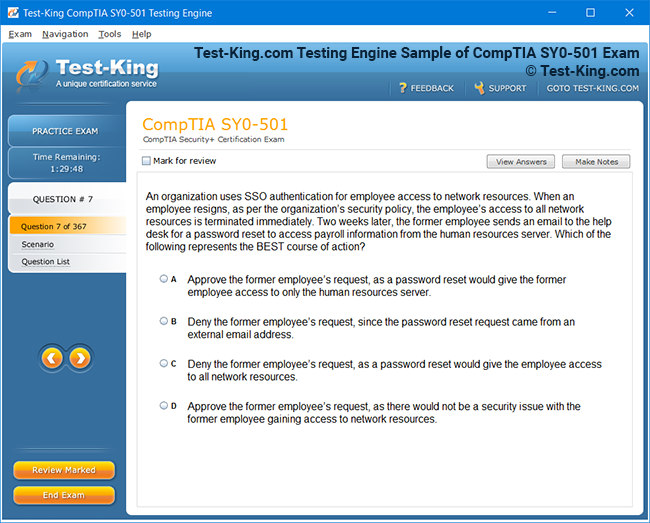
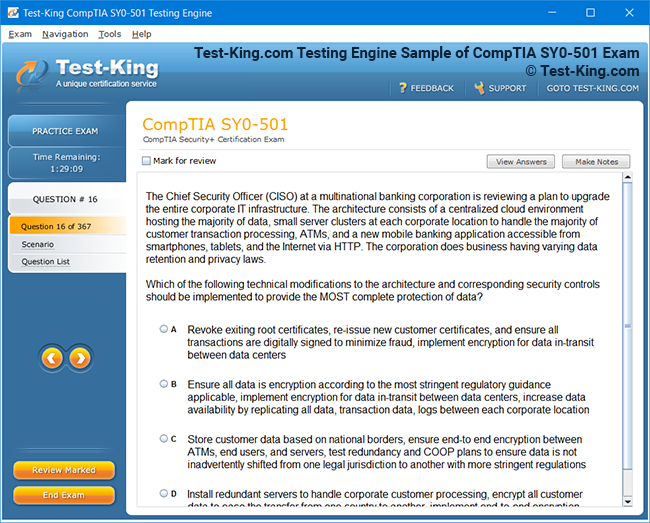
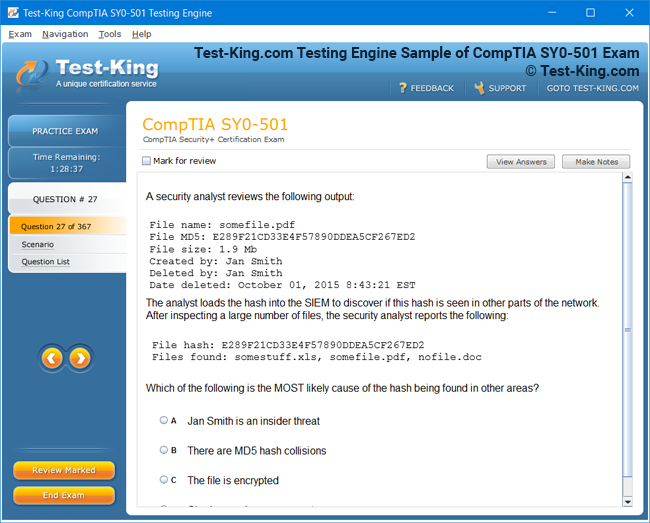
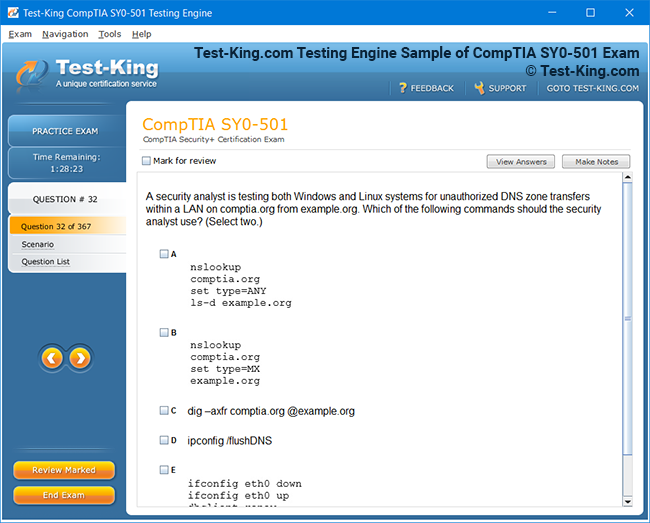
Product Screenshots
Frequently Asked Questions
How can I get the products after purchase?
All products are available for download immediately from your Member's Area. Once you have made the payment, you will be transferred to Member's Area where you can login and download the products you have purchased to your computer.
How long can I use my product? Will it be valid forever?
Test-King products have a validity of 90 days from the date of purchase. This means that any updates to the products, including but not limited to new questions, or updates and changes by our editing team, will be automatically downloaded on to computer to make sure that you get latest exam prep materials during those 90 days.
Can I renew my product if when it's expired?
Yes, when the 90 days of your product validity are over, you have the option of renewing your expired products with a 30% discount. This can be done in your Member's Area.
Please note that you will not be able to use the product after it has expired if you don't renew it.
How often are the questions updated?
We always try to provide the latest pool of questions, Updates in the questions depend on the changes in actual pool of questions by different vendors. As soon as we know about the change in the exam question pool we try our best to update the products as fast as possible.
How many computers I can download Test-King software on?
You can download the Test-King products on the maximum number of 2 (two) computers or devices. If you need to use the software on more than two machines, you can purchase this option separately. Please email support@test-king.com if you need to use more than 5 (five) computers.
What is a PDF Version?
PDF Version is a pdf document of Questions & Answers product. The document file has standart .pdf format, which can be easily read by any pdf reader application like Adobe Acrobat Reader, Foxit Reader, OpenOffice, Google Docs and many others.
Can I purchase PDF Version without the Testing Engine?
PDF Version cannot be purchased separately. It is only available as an add-on to main Question & Answer Testing Engine product.
What operating systems are supported by your Testing Engine software?
Our testing engine is supported by Windows. Andriod and IOS software is currently under development.
Top VMware Exams
- 2V0-17.25 - VMware Cloud Foundation 9.0 Administrator
- 2V0-13.25 - VMware Cloud Foundation 9.0 Architect
- 3V0-25.25 - Advanced VMware Cloud Foundation 9.0 Networking
- 3V0-21.25 - Advanced VMware Cloud Foundation 9.0 Automation
- 2V0-16.25 - VMware vSphere Foundation 9.0 Administrator
- 2V0-21.23 - VMware vSphere 8.x Professional
- 3V0-24.25 - VMware Certified Advanced Professional - VMware Cloud Foundation VKS
- 2V0-15.25 - VMware Cloud Foundation 9.0 Support
- 2V0-41.24 - VMware NSX 4.X Professional V2
- 2V0-72.22 - Professional Develop VMware Spring
- 2V0-51.23 - VMware Horizon 8.x Professional
- 2V0-11.25 - VMware Cloud Foundation 5.2 Administrator
- 3V0-32.23 - Cloud Management and Automation Advanced Design
VMware NSX 4.x Professional 2V0-41.23: Skills, Domains, and Exam Overview
The VMware NSX 4.x Professional 2V0-41.23 certification has emerged as a fundamental credential for networking and virtualization professionals who aspire to validate their expertise in managing and securing modern virtual networks. As enterprises continue to migrate toward software-defined infrastructures, the significance of VMware’s NSX platform has intensified remarkably. The NSX technology epitomizes the paradigm shift from traditional hardware-driven networks to agile, policy-based, and software-centric architectures that empower data centers to operate with greater autonomy, scalability, and resilience. This examination encapsulates the essence of mastering such a transformation by testing an individual’s capability to configure, implement, and maintain VMware NSX 4.x environments with precision and comprehension.
Understanding the Essence of VMware NSX 4.x Professional Certification
At its core, this certification is not merely a validation of technical familiarity; it symbolizes a deeper understanding of network virtualization philosophy. VMware NSX 4.x transcends the conventional concepts of physical switching and routing by virtualizing the entire network stack, creating logical constructs that emulate physical topologies with unmatched flexibility. Through the 2V0-41.23 examination, VMware evaluates how well a professional can translate these logical architectures into real-world operational efficiency, ensuring security segmentation, automation readiness, and interoperability with other VMware technologies such as vSphere, vCenter, and vRealize Suite.
Over the past decade, VMware has continually refined its certification structure to mirror the evolving technological ecosystem. The NSX 4.x Professional credential sits strategically between associate-level foundational certifications and advanced design-oriented expert tracks. It serves as a pivotal qualification for engineers seeking to specialize in network virtualization or transition from traditional network operations toward cloud-native environments. The 2V0-41.23 exam thus acts as a threshold for mastery in VMware’s networking domain, encompassing both conceptual understanding and applied expertise.
From an organizational standpoint, the demand for professionals adept in NSX 4.x has surged in tandem with the global adoption of software-defined data centers. Enterprises now seek engineers who can build multi-cloud connectivity, design secure microsegmented networks, and manage hybrid workloads without dependency on hardware limitations. The NSX Professional certification, particularly the 2V0-41.23 exam, ensures that certified individuals possess the analytical aptitude to design resilient infrastructures, the technical dexterity to deploy complex policies, and the foresight to align virtual networking strategies with business imperatives.
The VMware NSX 4.x Professional examination reflects VMware’s endeavor to measure not only memorization but comprehension, interpretation, and strategic application. Candidates who undertake this challenge must demonstrate fluency in configuring NSX components such as transport zones, logical routers, distributed firewalls, and gateway firewalls. They are also expected to comprehend the integration dynamics between NSX and other VMware components, such as the vSphere networking layer, the vCenter Server, and VMware’s security ecosystem. The overarching goal is to ascertain whether a candidate can craft seamless virtual network solutions that uphold performance, security, and manageability in dynamic data center topologies.
One of the most intriguing aspects of VMware NSX is its ability to abstract networking functions from physical infrastructure. This decoupling allows administrators to orchestrate connectivity, security, and automation policies across clouds, data centers, and edge environments with exceptional agility. By mastering NSX 4.x, professionals gain a strategic advantage in environments that prioritize scalability and automation. The 2V0-41.23 certification, therefore, validates a comprehensive spectrum of abilities — from foundational network virtualization knowledge to advanced troubleshooting of overlay and underlay issues.
The certification’s relevance is further accentuated by VMware’s relentless innovation cycle. NSX 4.x introduces refinements in security enforcement, multi-tenancy, and automation compared to previous releases. These advancements compel professionals to stay attuned to the latest architectural blueprints and best practices. Achieving the NSX Professional 2V0-41.23 certification signifies that an individual has attained both theoretical insight and hands-on capability aligned with VMware’s most recent technical standards.
Beyond technicality, the VMware NSX 4.x Professional exam serves as a hallmark of credibility. Within the competitive realm of IT infrastructure, holding this certification reflects dedication, discipline, and a command of modern network design philosophies. It distinguishes engineers who understand that virtualization extends beyond compute into the intricate fabric of network intelligence, where each packet’s journey can be dynamically controlled, segmented, and secured. As organizations evolve toward containerization, microservices, and hybrid deployments, such expertise becomes indispensable for sustaining agility and minimizing vulnerabilities.
The knowledge areas encompassed by the 2V0-41.23 exam span various layers of understanding. It begins with conceptual awareness — comprehending how NSX virtualizes networks, isolates tenants, and streamlines policy management. It progresses toward implementation — configuring transport nodes, deploying distributed switches, and applying firewall policies. The culmination lies in optimization and troubleshooting — diagnosing flow inconsistencies, fine-tuning routing behavior, and ensuring seamless integration across data center domains. This holistic progression ensures that candidates not only memorize commands or interfaces but internalize the logic governing NSX’s operation.
The 2V0-41.23 examination is designed with real-world applicability in mind. It mirrors challenges that engineers encounter in live environments, compelling them to interpret complex scenarios and derive logical solutions under constrained conditions. For instance, candidates may need to reason through scenarios involving overlapping subnets, asymmetric routing, or dynamic workload migrations. This practical orientation transforms the examination from an academic evaluation into a reflection of genuine operational expertise.
As one delves into the preparatory journey for VMware NSX 4.x Professional, understanding the framework of the certification path becomes crucial. VMware certifications are structured progressively, enabling professionals to build knowledge incrementally. The NSX 4.x Professional certification occupies an essential midpoint, where foundational understanding evolves into hands-on proficiency. This balance ensures that successful candidates can not only comprehend but also administer, configure, and optimize NSX deployments with confidence. The certification also serves as a precursor for those aspiring toward advanced credentials like VMware Certified Advanced Professional (VCAP) in network virtualization.
In the ecosystem of virtualized networking, the VMware NSX 4.x Professional 2V0-41.23 certification functions as a symbol of adaptability. Network engineers, traditionally confined to physical configurations and hardware troubleshooting, must now embrace a mindset attuned to abstraction and automation. NSX empowers them to treat network constructs as dynamic entities, programmable and adaptable to workloads’ fluctuating demands. By mastering these skills, professionals align themselves with the next epoch of IT evolution, where agility, programmability, and intent-based networking converge.
The conceptual backbone of NSX 4.x revolves around logical networking constructs. These constructs include virtual switches that provide Layer 2 connectivity, logical routers that facilitate dynamic routing across logical segments, and distributed firewalls that enforce microsegmentation policies at the virtual NIC level. Understanding these abstractions forms the foundation upon which NSX’s functionality rests. The 2V0-41.23 exam meticulously examines this comprehension, ensuring candidates can articulate and implement these concepts effectively.
Furthermore, the NSX 4.x platform’s security mechanisms distinguish it from traditional architectures. Through distributed firewalls and service-defined policies, administrators can enforce granular control over east-west traffic — a domain often neglected in legacy networks. The certification assesses the ability to design and implement such controls, ensuring that workloads remain insulated from lateral threats. This represents not merely a technological skill but a strategic competency that elevates the overall cybersecurity posture of virtualized environments.
Automation constitutes another cornerstone of NSX 4.x’s philosophy. Modern infrastructures demand responsiveness that manual configuration simply cannot achieve. VMware’s integration of automation frameworks within NSX allows administrators to deploy consistent policies, streamline provisioning, and maintain compliance with organizational standards. Candidates pursuing the 2V0-41.23 certification must demonstrate understanding of these mechanisms, as well as familiarity with tools and APIs that facilitate programmable network operations.
Equally vital is the comprehension of NSX’s interoperability with multi-cloud and hybrid architectures. As enterprises distribute workloads across public clouds, on-premises data centers, and edge environments, ensuring coherent connectivity and consistent security becomes a formidable challenge. VMware NSX 4.x addresses this complexity through federation and policy-based management, enabling unified visibility and control. The certification verifies that professionals can architect solutions that transcend physical boundaries and maintain operational continuity across diverse ecosystems.
From a career perspective, obtaining the VMware NSX 4.x Professional 2V0-41.23 certification represents a transformative milestone. It enhances professional credibility and amplifies career trajectories toward roles such as virtualization specialist, network architect, cloud infrastructure engineer, and security consultant. Beyond tangible recognition, it instills a mindset that aligns with future-oriented networking paradigms, where adaptability and foresight are as vital as technical knowledge.
The examination’s underlying philosophy emphasizes not rote memorization but interpretive acumen. VMware’s question design encourages analytical reasoning, requiring candidates to evaluate network states, predict outcomes, and determine optimal configurations. This approach reflects VMware’s recognition that real-world networking seldom follows scripted scenarios; instead, it demands adaptive problem-solving informed by conceptual clarity. Consequently, success in the 2V0-41.23 exam arises not from mechanical study but from immersive understanding and experiential learning.
As virtualization technologies mature, the boundary between networking, security, and compute continues to blur. VMware NSX epitomizes this convergence, integrating seamlessly with VMware’s broader ecosystem to deliver unified management and automation. The NSX 4.x Professional certification thus demands interdisciplinary fluency — familiarity with hypervisors, storage networks, and orchestration tools. This multidimensional requirement ensures that certified individuals possess a panoramic view of modern data center architectures.
The path to mastering NSX 4.x involves both conceptual and experiential learning. Hands-on practice within simulated environments plays a crucial role in reinforcing theoretical insights. By interacting with NSX Manager, configuring transport nodes, and implementing distributed firewalls, learners cultivate intuitive understanding that transcends textbook learning. The certification indirectly promotes such experiential growth by emphasizing configuration accuracy and situational analysis.
Another significant dimension of VMware NSX 4.x Professional expertise lies in troubleshooting. Virtualized networks, while offering flexibility, introduce new layers of abstraction that can complicate fault isolation. The certification expects candidates to possess the diagnostic acumen to interpret logs, trace packet flows, and identify root causes within both overlay and underlay networks. This ability distinguishes true experts from surface-level administrators, transforming them into indispensable assets in enterprise environments.
In today’s hyperconnected digital landscape, organizations cannot afford latency, misconfiguration, or security loopholes. VMware NSX 4.x offers a solution framework that addresses these challenges holistically, weaving automation, segmentation, and visibility into a coherent strategy. The professionals who hold the 2V0-41.23 certification embody this philosophy, serving as custodians of network reliability and agility. They are the architects of virtual domains where workloads can traverse seamlessly, policies remain consistent, and threats are mitigated proactively.
The VMware NSX 4.x Professional exam also mirrors the industry’s broader trajectory toward intent-based networking. In such paradigms, administrators define desired outcomes rather than manual configurations. NSX’s policy-driven model aligns with this ideology, where the intent governs the operational behavior of the network. Candidates are expected to comprehend this shift deeply, recognizing how declarative management differs from imperative configuration. This intellectual flexibility forms an essential trait for professionals navigating the rapidly evolving networking landscape.
Moreover, the certification underscores VMware’s commitment to interoperability and openness. NSX 4.x integrates with numerous third-party systems, ranging from public cloud providers to security vendors and automation frameworks. Professionals who achieve the 2V0-41.23 credential must appreciate the architectural principles that enable such integrations, ensuring that their designs remain modular and adaptable. This understanding reflects an awareness of technological interdependence that defines modern enterprise infrastructure.
In essence, the VMware NSX 4.x Professional 2V0-41.23 certification embodies more than a mere academic achievement; it represents the culmination of discipline, curiosity, and technological adaptability. It signifies mastery of a domain where networks evolve dynamically, policies self-adjust, and automation orchestrates complex interactions with minimal human intervention. Through this examination, VMware reaffirms its vision of a networked future that transcends physicality — where innovation flourishes in abstraction, and engineers sculpt connectivity as deftly as software developers craft code.
The journey toward achieving VMware NSX 4.x Professional expertise demands both intellectual rigor and practical dedication. It calls upon professionals to perceive networks not as static infrastructures but as living ecosystems capable of growth and self-adjustment. By aligning technical mastery with conceptual understanding, candidates not only prepare for certification success but also equip themselves to drive innovation in the digital infrastructure realm.
Through its intricate domains and diverse competencies, the VMware 2V0-41.23 exam functions as a bridge connecting traditional networking paradigms with contemporary virtualization ideologies. It tests the candidate’s ability to harmonize logic, automation, and design into a unified operational framework. In mastering these disciplines, professionals become catalysts of digital transformation, guiding organizations toward agile, secure, and intelligent networked futures.
Exploring the Architectural and Operational Dynamics of VMware NSX 4.x
The foundation of the VMware NSX 4.x Professional 2V0-41.23 certification rests upon an intricate understanding of NSX’s core principles, its underlying architecture, and the operational intricacies that define its ecosystem. To comprehend this multifaceted technology, one must first visualize how VMware NSX redefines network operations through abstraction, automation, and policy-driven control. VMware NSX 4.x functions as the linchpin of network virtualization within modern data centers, enabling administrators to construct logical network components independent of the physical infrastructure beneath them. This separation of control and data planes allows for flexibility that traditional networking could scarcely achieve.
At the heart of NSX lies the concept of logical networking, where virtual switches and routers replicate the behavior of their physical counterparts, but with the fluidity of software-defined constructs. The NSX Manager serves as the central orchestrator, overseeing the configuration, deployment, and monitoring of all networking and security components within the environment. It operates as both a management plane and a policy engine, translating high-level intent into low-level configurations applied consistently across distributed systems. Understanding this architecture is fundamental for candidates of the 2V0-41.23 exam, as it sets the stage for mastering the more advanced elements of VMware NSX 4.x Professional.
The NSX architecture is organized into three distinct planes: management, control, and data. The management plane houses the NSX Manager and provides the interface through which administrators interact with the system. The control plane facilitates communication between various components, propagating routing and policy information across transport nodes. The data plane, meanwhile, handles the actual movement of packets within the virtual network, leveraging kernel-level modules embedded in ESXi hosts. By comprehending this tripartite structure, professionals can better appreciate how NSX ensures scalability, reliability, and fault tolerance across diverse environments.
Logical switching represents one of the most essential components of NSX 4.x. It creates isolated broadcast domains within a virtualized infrastructure, enabling virtual machines to communicate seamlessly over logical networks that mimic physical Layer 2 segments. Each logical switch is backed by a transport zone, which defines the span of its connectivity across the virtual environment. Unlike physical switches limited by hardware constraints, these logical constructs can extend across multiple clusters and data centers, supporting workloads that move dynamically through vMotion or cross-cloud migration. This flexibility underscores VMware’s vision of a boundaryless network environment, where agility supersedes rigidity.
Routing in VMware NSX 4.x operates through two primary mechanisms: distributed and centralized routing. The distributed router resides at the hypervisor level, ensuring that traffic between virtual machines on the same host is routed locally without traversing external gateways. This minimizes latency and conserves bandwidth. Centralized routing, on the other hand, is managed by tier-0 gateways that connect the virtualized domain to the external physical network. These tiered routers work in harmony to maintain efficient traffic flow both within and beyond the NSX environment. Professionals pursuing the NSX 4.x Professional 2V0-41.23 certification must demonstrate fluency in configuring, troubleshooting, and optimizing these routing elements.
Security represents another cornerstone of VMware NSX 4.x’s architecture. In traditional environments, security policies are enforced at perimeter firewalls, leaving east-west traffic within the data center largely unmonitored. NSX redefines this paradigm through microsegmentation, a methodology that applies granular firewall rules directly at the virtual network interface card level. This enables administrators to isolate workloads, enforce application-specific policies, and mitigate lateral movement in case of breaches. The distributed firewall, a hallmark of NSX, operates at kernel speed and applies policies across thousands of workloads simultaneously, without performance degradation. Understanding this principle is critical for mastering the 2V0-41.23 exam, as it embodies the very ethos of software-defined security.
The microsegmentation model in NSX 4.x extends beyond simple rule application. It leverages dynamic security groups and tags, allowing for policies to follow workloads automatically as they move across clusters or data centers. This dynamic association ensures that security remains consistent even in fluid environments where workloads are ephemeral. Administrators can define policies based on attributes such as operating system, application type, or network segment, creating a highly adaptable security framework. This capability aligns with VMware’s broader philosophy of intrinsic security, wherein protection is woven into the network fabric itself rather than applied as an afterthought.
Another dimension of NSX 4.x is its load balancing capability, which distributes application traffic across multiple servers to ensure reliability and performance. The integrated load balancer supports both Layer 4 and Layer 7 services, enabling sophisticated traffic management strategies such as SSL termination, health monitoring, and session persistence. For organizations hosting high-availability applications, these capabilities are invaluable, ensuring consistent user experiences even under variable network conditions. From an examination perspective, candidates must understand the conceptual principles behind these operations and the configuration parameters that govern them.
Automation in VMware NSX 4.x transforms network management from a reactive process into a proactive discipline. Through policy-driven orchestration, administrators can define desired outcomes that the system enforces automatically. Integration with VMware Aria, vRealize Automation, and third-party automation tools allows NSX to fit seamlessly into larger DevOps ecosystems. This approach aligns with modern infrastructure practices, where speed, consistency, and reproducibility outweigh manual intervention. The 2V0-41.23 exam evaluates one’s comprehension of these integrations, ensuring that certified professionals can architect automated, self-regulating network systems.
A pivotal aspect of NSX 4.x lies in its handling of overlay and underlay networks. The overlay provides the logical connectivity framework, encapsulating packets using tunneling protocols such as Geneve, while the underlay provides the physical transport medium. Understanding how these two layers interact is crucial for diagnosing performance issues and ensuring efficient traffic delivery. Professionals must grasp how encapsulation affects MTU settings, latency, and overall throughput, as these factors play a decisive role in network optimization. The certification demands a nuanced understanding of this interplay, as it underpins nearly every NSX operation.
Troubleshooting within NSX 4.x environments necessitates both analytical precision and systemic understanding. Common tasks include validating control plane connectivity, inspecting logical routing paths, and analyzing distributed firewall logs. VMware provides integrated tools such as Traceflow and Port Connection utilities to aid administrators in pinpointing anomalies. Mastery of these diagnostic techniques signifies readiness for real-world network challenges, where the ability to identify and resolve issues swiftly determines operational stability.
One of the most transformative features introduced in NSX 4.x is the concept of federation, which enables consistent networking and security policies across multiple NSX deployments. This capability is particularly valuable for enterprises managing geographically distributed data centers or multi-cloud environments. Federation simplifies policy administration, allowing a central management domain to propagate configurations globally while maintaining local autonomy. For professionals pursuing certification, understanding how federation harmonizes global intent with local enforcement is imperative, as it epitomizes NSX’s scalability ethos.
Equally important is the comprehension of transport nodes and profiles. Each transport node represents an entity—either a hypervisor host or an edge appliance—that participates in the NSX overlay network. Transport node profiles streamline the deployment process by defining templates for N-VDS configurations, uplink mappings, and transport zone assignments. Candidates must internalize how these constructs contribute to network consistency and efficiency, particularly in large-scale implementations where manual configuration would be untenable.
The NSX Edge node plays a vital role in bridging the logical and physical realms. It provides north-south connectivity, handles routing between virtual and external networks, and supports services like NAT, VPN, and load balancing. Its design ensures redundancy through high-availability configurations, guaranteeing uninterrupted service continuity. Understanding edge node deployment models, placement strategies, and failover mechanisms forms a critical component of the knowledge base required for the 2V0-41.23 certification.
In practical deployment scenarios, administrators must also consider the interaction between NSX and VMware vSphere environments. Since NSX is tightly coupled with vCenter Server, synchronization between inventory objects, clusters, and hosts is essential for accurate policy enforcement. The NSX Manager leverages the vCenter API to maintain consistency, ensuring that virtual machines are correctly associated with their respective networking constructs. Professionals must comprehend how these integrations operate, as misalignment can lead to policy misapplication or degraded performance.
Monitoring and visibility within NSX 4.x are accomplished through a combination of built-in analytics and external integrations. The NSX Intelligence component offers deep inspection capabilities, correlating flow data with security policies to highlight anomalies or potential risks. Additionally, integration with VMware Aria Operations for Networks enhances visibility into both overlay and underlay topologies. This holistic view empowers administrators to anticipate bottlenecks, optimize resource allocation, and maintain compliance with organizational standards. The 2V0-41.23 exam evaluates the candidate’s ability to interpret these insights and apply them effectively in maintaining operational excellence.
One cannot discuss VMware NSX without acknowledging its impact on data center economics. By abstracting network functions from hardware, organizations reduce dependency on proprietary appliances, fostering cost efficiency and architectural agility. The shift toward software-defined networking diminishes capital expenditure while amplifying operational flexibility. Certified NSX professionals thus become catalysts of financial and technical transformation, enabling enterprises to achieve elasticity without compromising governance or security.
As enterprises embrace hybrid cloud models, VMware NSX 4.x becomes instrumental in maintaining policy consistency across disparate environments. Through integrations with VMware Cloud Foundation and public cloud extensions, administrators can extend NSX’s capabilities beyond on-premises data centers. This continuity ensures that workloads migrating between clouds retain identical networking and security postures, minimizing the complexity associated with multi-environment governance. Mastery of this paradigm positions NSX-certified professionals at the forefront of hybrid cloud innovation, where interoperability and resilience define success.
The cognitive shift required to master NSX 4.x lies in perceiving the network as a programmable entity. Traditional networking demanded procedural configurations, where each change was executed manually through device-level interfaces. NSX, by contrast, embraces declarative intent. Administrators articulate what the network should achieve—such as isolation, redundancy, or segmentation—and the system automatically enforces those directives. This philosophical transformation demands a mindset attuned to abstraction, automation, and systemic coherence.
A profound understanding of policy hierarchy is also indispensable. VMware NSX 4.x employs a structured approach to policy application, where precedence and inheritance dictate behavior. Global policies may override local rules, while specific objects can carry contextual exceptions. Recognizing how these hierarchies interact prevents conflicts and ensures predictable outcomes. Professionals preparing for the certification must be able to conceptualize these relationships intuitively, translating abstract rules into operational logic.
The distributed nature of NSX introduces new paradigms in performance optimization. Because packet forwarding occurs at the hypervisor kernel level, latency is minimized, and throughput is enhanced. However, this distribution also introduces complexity in synchronization across hosts. Understanding how NSX maintains consistency through control plane mechanisms—such as the Central Control Cluster—becomes essential for ensuring deterministic behavior across distributed environments. Candidates who internalize these principles develop the analytical capacity required to diagnose synchronization delays or policy discrepancies.
In the realm of disaster recovery and high availability, NSX 4.x provides resilience through its multi-tiered architecture. Redundant NSX Managers, clustered control plane nodes, and paired edge appliances ensure continuity even in the event of component failures. The platform’s ability to recover state information and reestablish connectivity autonomously epitomizes its design maturity. Mastery of these fault-tolerance mechanisms represents both an academic requirement for the exam and a practical competency in enterprise operations.
The broader implication of mastering VMware NSX 4.x extends beyond technical proficiency. It cultivates a holistic perspective on how virtualized networking integrates with security, automation, and orchestration domains. Professionals who achieve this depth of understanding become enablers of digital transformation, capable of bridging silos between network, compute, and cloud teams. The NSX 4.x Professional 2V0-41.23 certification thus symbolizes not only expertise but also adaptability—a trait indispensable in the volatile landscape of modern IT infrastructure.
As organizations continue to modernize their infrastructures, the role of NSX in enabling consistent, policy-driven, and automated network control becomes increasingly indispensable. The VMware NSX 4.x Professional 2V0-41.23 certification serves as a benchmark for verifying an individual’s ability to design, deploy, and sustain such environments. Through its emphasis on logical networking, microsegmentation, automation, and federation, the certification encapsulates the very essence of network virtualization mastery. It embodies VMware’s commitment to fostering a generation of professionals who can navigate complexity with dexterity, ensuring that the digital architectures of tomorrow remain agile, secure, and resilient.
Comprehensive Exploration of the VMware NSX 4.x Professional Certification Framework
The VMware NSX 4.x Professional 2V0-41.23 certification stands as a rigorous and intellectually demanding assessment meticulously crafted to validate the knowledge and applied skillset of professionals operating within virtualized network environments. The structure of this examination, its intricate blueprint, and the delineation of its major domains together encapsulate the comprehensive spectrum of competencies necessary to administer, secure, and optimize VMware NSX 4.x deployments. For individuals aspiring to advance within the realm of software-defined networking, the understanding of this examination’s framework serves as both a compass and a foundation for strategic preparation.
The essence of the VMware NSX 4.x Professional examination lies not merely in assessing familiarity with interface options or procedural workflows, but in determining whether a professional can navigate the conceptual depth of network virtualization. VMware has constructed this exam with acute precision, ensuring that it reflects real-world complexities rather than hypothetical abstraction. It measures both intellectual comprehension and operational agility—the ability to interpret dynamic network behaviors, respond to anomalies, and design resilient architectures that sustain performance under diverse workloads.
The 2V0-41.23 exam is a professional-level certification within the VMware network virtualization track, positioned to bridge foundational proficiency and advanced architectural expertise. It tests an extensive range of skills that encompass configuration, management, and troubleshooting of NSX 4.x environments. Candidates are evaluated across multiple domains, each designed to mirror authentic operational contexts. These domains collectively simulate the lifecycle of a software-defined network—from design and deployment through governance, automation, and maintenance.
To begin with, the exam structure itself is characterized by its scenario-driven approach. VMware ensures that the assessment emphasizes applied cognition rather than rote recall. Each question is conceived to evoke analytical reasoning, requiring candidates to interpret context and deduce solutions that align with best practices. The distribution of questions across domains is balanced to ensure equitable representation of all critical NSX 4.x competencies. The duration of the examination offers sufficient time to reflect upon complex scenarios, but the real challenge lies in the interpretive acumen demanded by its case-based nature.
The blueprint of the 2V0-41.23 certification encompasses several core domains, each corresponding to essential functional layers of the NSX 4.x ecosystem. The first major domain revolves around architectural comprehension. Professionals are expected to demonstrate an unambiguous understanding of NSX’s layered structure—management, control, and data planes—and their respective roles within a virtualized network. The exam evaluates how effectively one can differentiate between these planes, identify dependencies, and ensure coherence among them. For instance, understanding how control plane communications propagate routing information to transport nodes forms an indispensable component of this domain.
The second domain examines the deployment and configuration of logical networking components. Here, candidates must demonstrate fluency in creating transport zones, configuring logical switches, deploying routers, and establishing connectivity between virtualized workloads. The exam may present contextualized scenarios that require decisions regarding the optimal routing configuration, selection of gateway types, or determination of segment span across clusters. This domain reinforces VMware’s emphasis on practical applicability—professionals must not only know what to configure but why a particular configuration best serves the environment’s requirements.
Security and microsegmentation represent another substantial domain within the 2V0-41.23 blueprint. VMware NSX 4.x revolutionizes traditional security by decentralizing enforcement mechanisms, embedding them directly into the hypervisor layer. The exam assesses one’s ability to design and implement distributed firewalls, dynamic security groups, and context-aware policies. Candidates must exhibit understanding of how to protect east-west traffic, establish workload isolation, and define policies based on user identity, network context, or application attributes. Furthermore, the blueprint expects professionals to demonstrate awareness of how NSX integrates with VMware’s broader security ecosystem, including integrations with identity frameworks and threat analytics engines.
A fourth domain within the exam focuses on automation and operations. Modern network architectures depend heavily on policy-driven orchestration and automated enforcement. The NSX 4.x platform integrates natively with various automation frameworks and provides APIs for extensibility. This domain evaluates an individual’s ability to utilize NSX automation capabilities for provisioning, configuration synchronization, and compliance enforcement. Candidates are expected to understand how automation contributes to scalability and how deviations from policy intent can be detected and remedied.
Another major domain centers around monitoring and troubleshooting. VMware recognizes that network reliability depends not solely on design but on the capacity to detect and resolve issues swiftly. This domain examines an individual’s ability to analyze control plane connectivity, inspect logical routing states, validate firewall rule application, and diagnose overlay network issues. Mastery of diagnostic utilities, such as Traceflow, packet capture tools, and operational dashboards, is critical for this domain. The exam may pose questions that emulate real operational challenges, demanding precise interpretation of network symptoms and judicious identification of root causes.
Operational governance forms yet another integral part of the NSX 4.x Professional blueprint. This area focuses on lifecycle management, policy consistency, and version control. Professionals are assessed on their understanding of NSX upgrades, backup strategies, and high-availability configurations. They must comprehend the procedural nuances of maintaining cluster stability, synchronizing manager nodes, and preserving configuration integrity during transitions. In this domain, VMware measures not only the technical grasp of lifecycle processes but also the foresight to mitigate disruption through planning and automation.
The NSX Edge and gateway services also constitute a focal point of the 2V0-41.23 exam. This domain encompasses north-south traffic management, routing, load balancing, NAT, and VPN services. Professionals must display aptitude in architecting edge deployments that maintain redundancy and performance equilibrium. The exam blueprint expects candidates to internalize concepts of edge node clustering, high availability, and service chaining. It also assesses one’s capacity to balance between centralized and distributed routing to achieve optimal performance within hybrid environments.
A unique characteristic of the VMware NSX 4.x Professional certification lies in its adaptive design, which evolves alongside technological advancements. VMware periodically revises its blueprints to align with software updates and industry trends. As NSX transitions into newer releases, features such as federated management, distributed IDS/IPS, and Kubernetes integration gain prominence. The exam, therefore, assesses awareness of not just legacy constructs but also the modernized components that define NSX’s contemporary relevance. Professionals must stay abreast of these evolutions to maintain proficiency in an ever-transforming networking landscape.
Beyond domain-specific knowledge, the exam blueprint emphasizes cross-domain synthesis. Candidates are frequently confronted with scenarios that require integration of multiple concepts—combining security and routing decisions, aligning automation with lifecycle management, or troubleshooting performance bottlenecks that span the overlay and underlay layers. This multidimensional testing approach ensures that certified individuals can think holistically, perceiving the virtual network as an interconnected ecosystem rather than discrete functional silos.
The scoring mechanism of the VMware NSX 4.x Professional examination reinforces fairness and precision. Each question carries a predefined weight based on complexity, with scenario-based queries typically holding greater significance than factual inquiries. The passing threshold represents a composite evaluation of conceptual understanding, analytical interpretation, and applied reasoning. This methodology ensures that certification reflects genuine expertise rather than superficial acquaintance. For candidates, this means that meticulous comprehension of principles outweighs memorization of procedural steps.
The exam’s digital format enhances accessibility while preserving rigor. Candidates typically undertake the assessment through proctored online sessions or designated testing centers. The interface is intuitive, featuring case narratives, diagrams, and contextual prompts that mirror real administrative consoles. VMware’s objective is to simulate authentic operational conditions within an examination framework, compelling candidates to make decisions that mirror real-world judgment. This immersive design differentiates VMware’s certifications from conventional multiple-choice evaluations, as it privileges cognition over recall.
Preparation for the 2V0-41.23 exam necessitates alignment with the official VMware exam guide, which delineates each blueprint domain in detailed textual form. The guide functions as both a syllabus and a diagnostic map, allowing learners to identify strengths and deficiencies. Each domain is accompanied by explicit objectives that articulate what a candidate must understand and demonstrate. For example, within the logical networking domain, objectives might include comprehension of segment creation, transport node configuration, and routing policy propagation. By interpreting these textual objectives rather than treating them as static lists, learners internalize the rationale underlying each competency.
VMware’s pedagogical philosophy also manifests in the way domains interlace. Security, for instance, cannot be mastered without understanding logical networking, as the enforcement of microsegmentation presupposes segment awareness. Similarly, automation builds upon configuration knowledge and policy governance. The blueprint’s interconnectedness thus mirrors the operational interdependence of NSX components, ensuring that certification holders are equipped with systemic intelligence rather than isolated expertise.
The time allocation within the exam demands strategic pacing. While each question is designed to be completed within a few minutes, some scenario-based questions require extended reasoning. Candidates must cultivate efficiency not through haste but through familiarity—knowing where to focus analytical effort and when to rely on instinctive understanding. The exam’s structure rewards those who can synthesize information quickly while maintaining conceptual precision. This equilibrium of speed and depth represents the hallmark of professional maturity in virtualized networking.
Another dimension embedded within the exam blueprint pertains to version-specific knowledge. VMware NSX 4.x introduces features and modifications that distinguish it from earlier iterations. The certification assesses awareness of these innovations—enhancements in distributed services, modifications to the manager interface, or improvements in policy application mechanisms. Professionals must recognize how these changes influence design decisions and operational strategies. For example, the advent of NSX Federation reshapes approaches to multi-site management, while refined load-balancing capabilities influence application delivery design. Awareness of such distinctions marks the difference between cursory knowledge and refined mastery.
The exam blueprint also underscores VMware’s emphasis on compliance and governance frameworks. As enterprises contend with stringent regulatory demands, network virtualization must facilitate traceability, auditing, and data protection. The certification therefore examines understanding of NSX’s role in achieving compliance, particularly through mechanisms such as role-based access control, logging, and flow visibility. This domain integrates both technical and ethical dimensions, acknowledging that governance is as much about accountability as it is about control.
Equally significant is the domain focusing on integration with the broader VMware ecosystem. NSX does not operate in isolation; it forms part of a comprehensive suite that includes vSphere, Aria Operations, and vRealize Automation. The 2V0-41.23 exam expects candidates to understand these integrations intuitively—how NSX leverages vCenter inventory data, how automation workflows interface through APIs, and how visibility tools contribute to network insight. This domain reinforces the notion that effective NSX management requires holistic awareness of the VMware infrastructure continuum.
To navigate the complexity of the exam, professionals must cultivate a study methodology anchored in both theoretical review and experiential learning. VMware’s recommended resources include online labs, documentation, and guided courses that simulate real administrative tasks. Hands-on engagement with NSX Manager, distributed firewalls, and logical routers cultivates an instinctive familiarity that written material alone cannot provide. Candidates who immerse themselves in such experiential learning develop the cognitive dexterity required to decode the subtle nuances embedded in exam scenarios.
The blueprint’s final domain pertains to operational resilience and disaster recovery. VMware NSX 4.x integrates redundancy mechanisms across its components, from manager clusters to edge appliances. The exam evaluates understanding of these redundancies and how they sustain service continuity. Professionals must know how to plan, deploy, and validate high-availability topologies, ensuring minimal downtime during failures or maintenance events. Moreover, comprehension of backup strategies, snapshot management, and configuration replication demonstrates a professional’s readiness for real-world contingencies.
Each domain within the NSX 4.x Professional certification encapsulates a fragment of the broader vision that VMware seeks to instill—a vision of networks as dynamic, programmable entities guided by intent rather than static configuration. The blueprint, therefore, serves not only as an exam guide but as a reflection of VMware’s technological philosophy. Professionals who internalize its structure transcend the examination itself, developing the capacity to architect environments that are agile, secure, and resilient.
The VMware NSX 4.x Professional 2V0-41.23 examination, through its multidimensional blueprint, represents more than an evaluative tool; it stands as a distillation of VMware’s architectural ethos. By traversing domains that encompass architecture, security, automation, troubleshooting, and governance, candidates are shaped into practitioners capable of navigating complexity with discernment. Their mastery signifies alignment with a new era of network intelligence, where agility, automation, and abstraction converge to redefine the boundaries of connectivity in the modern digital realm.
Deep Analysis of Real-World Deployment, Automation, and Security Execution in VMware NSX 4.x
Achieving mastery in VMware NSX 4.x Professional requires not only theoretical understanding but the acquisition of advanced practical capabilities that define a professional’s ability to design, deploy, and sustain complex network virtualizations. The VMware NSX 4.x Professional 2V0-41.23 certification is structured to evaluate these refined competencies by assessing real-world implementation and optimization strategies within software-defined infrastructures. The intricate configuration of logical components, advanced security enforcement, automation integration, and cross-platform orchestration collectively form the foundation of this professional expertise.
VMware NSX 4.x functions as the nucleus of network virtualization, transforming static data centers into programmable and adaptable ecosystems. Its architecture thrives on abstraction, enabling administrators to construct intricate network topologies detached from the constraints of physical infrastructure. In practical implementation, this autonomy translates to an environment where virtual networks can be provisioned in moments, workloads migrate seamlessly, and security policies adapt dynamically to contextual changes. The real-world application of NSX, therefore, is not confined to the virtual lab; it extends to enterprise landscapes where agility, scalability, and security must coexist without compromise.
One of the defining characteristics of advanced VMware NSX 4.x implementation is the orchestration of logical networking. Professionals must possess the capability to configure transport nodes that define connectivity domains, assign them to appropriate transport zones, and bind them with overlay or VLAN-backed segments according to workload needs. Each logical switch operates as a distributed construct, ensuring that communication between workloads within the same broadcast domain remains efficient and devoid of unnecessary traversal through physical devices. Understanding the fluid dynamics of these logical entities is crucial in preventing network fragmentation and ensuring optimal data path performance.
Routing within NSX 4.x represents a sophisticated interplay between distributed and centralized logic. The distributed router, embedded at the hypervisor level, performs east-west traffic routing locally, thus minimizing latency. Tier-0 gateways function as central routers for north-south traffic, bridging virtual networks to external infrastructures. An advanced practitioner must understand how to balance workloads across these layers, ensuring routing consistency and fault tolerance. In multi-tiered designs, the synchronization of routing tables between distributed and centralized routers ensures seamless propagation of network information, mitigating risks of asymmetric paths or suboptimal forwarding.
Security forms the most critical pillar of VMware NSX 4.x’s real-world deployment, and mastering it demands profound familiarity with microsegmentation principles. Unlike legacy architectures that rely on perimeter firewalls, NSX embeds security policies at the virtual interface level, protecting workloads from lateral intrusion. This granular enforcement is facilitated through distributed firewalls, which act as an omnipresent shield governing every packet within the virtual domain. The practical execution of such security requires not only technical configuration but also an understanding of contextual risk. A professional must be capable of classifying workloads, defining security groups, and crafting adaptive policies that respond automatically to environmental shifts.
Microsegmentation’s true efficacy lies in its dynamic nature. Security tags and context profiles allow workloads to inherit policies based on metadata rather than static placement. For instance, when a virtual machine is assigned an application tag, NSX automatically associates the corresponding policy without manual intervention. This automation of policy enforcement reduces human error and strengthens consistency across evolving infrastructures. Professionals must demonstrate the capability to conceptualize and implement such policies while considering both operational efficiency and security compliance.
The distributed firewall also integrates with advanced security services, allowing traffic redirection to third-party systems for deeper inspection. Integration with intrusion detection systems, next-generation firewalls, and threat analytics engines ensures multi-layered defense. Professionals implementing these integrations must understand the nuances of service insertion and service chaining. These processes dictate how traffic is redirected through inspection engines before reaching its destination. Proper configuration ensures that security is enforced without causing bottlenecks or latency degradation.
Load balancing in VMware NSX 4.x represents another crucial practical domain that demands precision. The NSX load balancer operates at both transport and application layers, distributing client requests across multiple backend servers. It supports advanced features such as SSL offloading, session persistence, and application health monitoring. Implementing these features requires comprehension of protocol behaviors, certificate management, and session control mechanisms. In production environments, misconfiguration of load balancers can result in service disruptions, hence professionals must possess the acuity to configure them for resilience and equitable distribution of traffic.
Automation underpins the evolution of modern virtual networks, and VMware NSX 4.x provides extensive automation capabilities to streamline operations. Through its native APIs and integration with orchestration platforms like VMware Aria Automation and vRealize Suite, NSX enables the translation of intent into executable configurations. This automation ensures consistency and scalability, particularly in environments where workloads are provisioned dynamically. Professionals must master the art of translating high-level intent into structured policies, ensuring that automation reflects operational objectives without compromising governance.
The practical implementation of automation also extends to network provisioning and compliance. For instance, using NSX’s policy-driven model, administrators can define templates that automatically instantiate network segments, apply firewall rules, and assign routing gateways whenever a new workload is deployed. This eliminates manual configuration and enforces uniformity across the infrastructure. Professionals preparing for the VMware NSX 4.x Professional 2V0-41.23 certification must be able to design and execute such automation frameworks that mirror enterprise governance policies.
Monitoring and observability in VMware NSX 4.x play a crucial role in sustaining operational stability. The NSX Manager provides a centralized interface that visualizes network topologies, policy applications, and security events in real time. In advanced deployments, professionals extend this visibility through integration with VMware Aria Operations for Networks, which provides deep analytical insights into both overlay and underlay behaviors. Effective use of these tools requires understanding data flow visualization, performance metrics interpretation, and anomaly detection. The ability to correlate metrics with network behavior ensures proactive management, preventing potential disruptions before they materialize.
Troubleshooting within NSX 4.x environments demands analytical acuity and a methodical approach. Issues often arise from misaligned configurations, control plane failures, or overlay connectivity anomalies. Professionals must be adept at using utilities such as Traceflow and port connection checks to trace packet paths and identify points of failure. Beyond tool usage, the skill lies in interpreting outcomes—understanding whether a dropped packet indicates a firewall misrule, an MTU mismatch, or a routing inconsistency. This diagnostic dexterity separates proficient practitioners from those who rely solely on prescriptive workflows.
In enterprise-grade deployments, NSX Edge plays a pivotal role by connecting the virtualized environment to external networks. Implementing Edge nodes demands comprehension of high-availability configurations, redundancy models, and service clustering. An engineer must understand how to deploy multiple Edge nodes, distribute service responsibilities, and configure failover mechanisms to ensure continuity. These deployments often interface with physical routers and switches, necessitating synchronization between virtual routing protocols and physical network peers. The ability to harmonize these interactions is critical for ensuring a seamless hybrid environment.
Federation within NSX 4.x extends the platform’s capabilities across multiple data centers or cloud instances. It allows administrators to create a unified policy framework that transcends geographical boundaries. Implementing federation involves establishing global managers and local managers, ensuring that configurations propagate consistently across sites. Professionals must understand the synchronization mechanisms that sustain policy coherence and the failover strategies that preserve control plane integrity. The challenge lies in managing latency, version compatibility, and global policy precedence, which demand meticulous planning and execution.
Another advanced domain involves integrating NSX 4.x with containerized and cloud-native environments. The rise of Kubernetes and distributed applications necessitates adaptable networking solutions that align with microservice architectures. VMware’s Container Networking Interface for NSX allows seamless communication between pods, virtual machines, and external services. Professionals must comprehend how network policies, ingress controllers, and distributed firewalls extend into these environments. The configuration of namespaces, load balancers, and security contexts must be handled with precision to ensure that the agility of containers does not compromise network governance.
A critical dimension of NSX 4.x implementation is maintaining operational compliance and governance. In dynamic infrastructures, regulatory frameworks require continuous adherence to defined security and connectivity standards. NSX simplifies this through policy-based control and audit-ready logging. Professionals must be able to craft architectures that inherently comply with standards such as ISO, SOC, or GDPR by enforcing segmentation, role-based access control, and traceability. This integration of compliance into architecture design reflects a shift from reactive auditing to proactive governance.
Performance optimization constitutes another vital aspect of advanced NSX 4.x administration. Network virtualization introduces encapsulation overheads and control plane dependencies that can influence throughput. Professionals must understand how to calibrate MTU settings, optimize routing paths, and balance overlay and underlay interactions to achieve maximal efficiency. Implementing distributed routing reduces traversal, while fine-tuning firewall rule orders enhances packet processing. Advanced practitioners must interpret performance analytics to continually refine configurations for efficiency and scalability.
Disaster recovery strategies within NSX 4.x ensure continuity amidst unforeseen failures. Implementing robust recovery involves synchronizing configurations, maintaining backup policies, and automating redeployment processes. Professionals must plan for redundancy not only in the NSX Manager cluster but across edge nodes and control plane components. Familiarity with recovery workflows ensures that network services remain available even during systemic failures or site outages. The ability to restore configurations, validate synchronization, and reestablish overlay connectivity under pressure exemplifies operational resilience.
In multi-cloud environments, NSX 4.x delivers consistency by extending its fabric into public cloud infrastructures. Integration with VMware Cloud on AWS, Azure VMware Solution, or Google Cloud VMware Engine allows uniform policy enforcement across hybrid deployments. Professionals implementing such solutions must understand cloud interconnectivity, routing propagation, and identity federation. Mastery of these integrations allows enterprises to retain governance while exploiting the elasticity of public clouds. The capability to manage hybrid connectivity through NSX underscores a professional’s ability to operate at the forefront of network virtualization.
Advanced practitioners also engage in design optimization by implementing intent-based networking within NSX. This model transforms administrative workflows by allowing professionals to define network outcomes rather than configurations. NSX interprets these intents through its policy engine, automatically generating necessary configurations. Implementing such paradigms demands comprehension of declarative logic and dependency hierarchies. It represents the evolution of networking from procedural to cognitive management, where the network responds autonomously to defined intents.
Another sophisticated aspect of NSX deployment is service continuity during maintenance or upgrades. Professionals must orchestrate rolling upgrades that minimize disruption while preserving service availability. This involves upgrading one manager node at a time, validating compatibility across control plane components, and ensuring configuration backups prior to version transitions. The precision required in such operations reflects the maturity expected of VMware NSX 4.x Professional certified individuals.
Equally essential is the proficiency in integrating NSX 4.x with external monitoring and orchestration systems. Through RESTful APIs and event-driven architectures, NSX interacts with security information and event management platforms, ticketing systems, and analytics engines. Professionals must grasp how to construct integrations that enable bidirectional data exchange, allowing NSX to both inform and respond to events from external systems. This synergy amplifies visibility, responsiveness, and automation efficiency within the broader IT ecosystem.
Within enterprise data centers, scalability remains a recurring challenge. VMware NSX 4.x addresses this through hierarchical design patterns that distribute control responsibilities and minimize contention. Professionals must design environments that maintain elasticity without overwhelming management clusters. Proper segmentation of logical components, appropriate use of transport zones, and balanced deployment of Edge nodes ensure sustained performance as the environment grows. Understanding these scaling principles transforms theoretical design into sustainable operation.
Advanced implementation of NSX also encompasses customized policy tuning for application-centric networking. Professionals must align network design with application requirements, ensuring that latency-sensitive workloads receive prioritized routing and bandwidth allocation. NSX’s Quality of Service features allow the classification and prioritization of traffic types. Implementing these controls demands a deep understanding of application behaviors, latency tolerances, and dependency chains. By harmonizing network design with application dynamics, professionals enhance both user experience and infrastructure efficiency.
The evolution of artificial intelligence and machine learning within VMware’s ecosystem also influences NSX operations. Integration with intelligent analytics platforms allows automated detection of anomalies, predictive scaling, and adaptive policy modification. Professionals must understand how telemetry data from NSX components feed into these analytics engines, shaping self-optimizing networks. This convergence of automation and intelligence reflects the broader trajectory of digital infrastructure—toward networks that not only function autonomously but evolve intuitively.
The VMware NSX 4.x Professional 2V0-41.23 certification recognizes individuals capable of translating theory into operational mastery. Advanced skills encompass the synthesis of security, automation, monitoring, and performance optimization into a cohesive operational philosophy. In real-world environments, professionals must make decisions balancing security rigor with agility, performance with redundancy, and automation with human oversight. Their role extends beyond configuration; it embodies strategic orchestration of digital ecosystems where every virtual connection, policy, and automation sequence contributes to a unified, resilient infrastructure.
Through mastery of advanced VMware NSX 4.x implementation, professionals attain not only technical authority but an architectural mindset that aligns with VMware’s vision of intent-driven, policy-based, and automation-centric networking. This confluence of dexterity and discernment empowers them to sculpt infrastructures that are not merely virtualized but intelligently adaptive, capable of evolving with the accelerating pace of technological innovation.
In-Depth Framework for Mastering VMware NSX 4.x Professional Certification
The VMware NSX 4.x Professional 2V0-41.23 certification represents one of the most intricate and esteemed professional-level examinations within the realm of network virtualization. It validates the competence of individuals capable of designing, deploying, and sustaining the VMware NSX 4.x platform with precision, dexterity, and architectural understanding. To succeed in such a sophisticated certification, a methodical and strategic preparation plan is indispensable. It demands more than casual study—it requires immersion, comprehension, and iterative reinforcement of technical principles through deliberate practice. This exploration illuminates the roadmap for aspirants, guiding them through the layers of preparation that culminate in mastery of the NSX 4.x Professional discipline.
Preparing for the 2V0-41.23 examination begins with internalizing its structure, which is based on the VMware NSX 4.x Professional blueprint. The blueprint delineates specific domains and objectives that define the competencies expected of a certified professional. These domains encompass areas such as architecture, deployment, configuration, security, automation, troubleshooting, and operational governance. An aspirant must read the blueprint meticulously, translating each objective into tangible learning goals. The initial step in preparation is to transform these objectives from abstract statements into experiential knowledge—by performing the tasks they describe within a controlled lab environment.
Understanding the exam objectives in depth is crucial because VMware’s examination style is not confined to direct questioning; rather, it challenges candidates to apply their understanding to contextualized scenarios. A single question might integrate multiple objectives—requiring the candidate to analyze architectural dependencies, interpret system behaviors, and select the optimal resolution. Therefore, studying each topic in isolation is insufficient; the candidate must cultivate interconnected awareness, understanding how components interact across domains such as networking, security, and automation.
A pragmatic preparation strategy begins with the establishment of a structured timeline. A disciplined approach often spans several weeks or months depending on the individual’s prior experience with NSX environments. The preparation timeline should allocate time for theoretical study, practical implementation, revision, and mock assessments. Early stages should prioritize conceptual understanding, followed by lab-based experimentation, and later refined through scenario analysis and simulation exams. Each stage reinforces the previous one, ensuring layered and cumulative comprehension rather than fragmented memorization.
The theoretical foundation forms the intellectual bedrock of VMware NSX proficiency. Candidates must immerse themselves in the official VMware documentation, which serves as the most authoritative source of information. The NSX 4.x Administration Guide, Installation Guide, and Security Configuration Guide provide an encyclopedic understanding of each subsystem’s behavior and configuration methodology. Reading documentation demands patience and persistence, yet it yields nuanced understanding often absent from third-party resources. It is beneficial to annotate documentation while studying—highlighting interdependencies between features, clarifying procedural prerequisites, and noting version-specific differences.
Alongside documentation, official VMware training courses play an instrumental role in preparation. The “VMware NSX 4.x Install, Configure, Manage” course provides a structured exploration of key concepts under the supervision of certified instructors. These courses offer guided lab sessions that simulate real-world scenarios, allowing participants to observe cause-and-effect relationships between configurations. For many candidates, this formal training becomes the turning point that transforms theoretical curiosity into confident application. Additionally, advanced courses such as “VMware NSX Advanced Security” or “Troubleshooting and Operations” provide deeper insight into specialized domains that are often tested in complex exam questions.
Hands-on practice remains the single most powerful determinant of success in the 2V0-41.23 examination. VMware’s NSX 4.x environment can be deployed within a virtualized lab using VMware Workstation, Fusion, or ESXi-based setups. Constructing a personal lab cultivates a tactile understanding of the platform’s mechanics. Candidates should practice installing NSX Manager, configuring transport nodes, creating overlay networks, establishing routing hierarchies, and applying distributed firewall policies. Each exercise reinforces familiarity with the interface, workflow logic, and troubleshooting process. Repetition transforms abstract commands into muscle memory, enabling quick and accurate responses during exam scenarios.
Lab exercises should evolve in complexity as preparation progresses. Initial experiments might focus on basic connectivity and logical switching. Gradually, the candidate should advance to more sophisticated configurations, such as tiered routing, distributed load balancing, and microsegmentation. Experimentation with service insertion and third-party integrations enhances adaptability. By deliberately breaking configurations and restoring them, the candidate gains insight into system behavior during faults, thereby strengthening diagnostic intuition.
Another essential component of preparation is the creation of a personalized study guide. While VMware provides a structured blueprint, personalizing it allows the candidate to align learning with individual strengths and weaknesses. The study guide should map each blueprint objective to its corresponding documentation section, lab exercise, and review notes. This cross-referencing strategy enables efficient revision and fosters comprehension through contextual association. Candidates should regularly review this guide, updating it as they encounter new insights or discover misconceptions.
Practice examinations constitute the next pivotal element of preparation. They serve not merely as evaluative instruments but as diagnostic tools that illuminate gaps in understanding. Many candidates mistakenly treat mock exams as predictors of success; however, their true value lies in revealing cognitive blind spots and reinforcing time management discipline. Practicing under timed conditions helps simulate exam pressure, training the candidate’s mind to maintain composure and focus. Each incorrect response presents an opportunity for deeper exploration, prompting the learner to return to documentation or labs for clarification.
Time management during the actual exam mirrors strategic discipline during preparation. The 2V0-41.23 examination comprises scenario-based questions that require analytical thinking. Candidates must learn to allocate their time judiciously—avoiding overanalysis on difficult questions while ensuring thoughtful evaluation of each scenario. Developing this rhythm during practice ensures efficient navigation through the exam’s complexities without succumbing to cognitive fatigue.
Community engagement enhances the depth and breadth of preparation. Online VMware forums, professional study groups, and community-led workshops provide invaluable exposure to diverse perspectives. Participating in discussions allows candidates to encounter alternative approaches to similar challenges, broadening analytical flexibility. Often, subtle insights shared by peers—such as differences in routing behavior or nuances in API interaction—illuminate aspects of the platform overlooked during solitary study. The collaborative exchange of knowledge strengthens conceptual clarity while nurturing the adaptability essential for professional problem-solving.
Candidates should also maintain alignment with VMware’s evolving technological landscape. The NSX 4.x platform undergoes continuous enhancement, introducing new features and deprecating older components. Awareness of version-specific modifications ensures that study efforts remain relevant to the exam’s focus. Regularly reviewing VMware’s release notes and product updates helps candidates understand the rationale behind design changes, enabling them to interpret exam questions in contemporary contexts rather than relying on outdated assumptions.
A balanced approach to studying demands integration of multiple learning modalities. Reading documentation provides theoretical depth, but visualization aids such as topology diagrams enhance spatial reasoning. Drawing network layouts and labeling components help internalize traffic flow and dependency hierarchies. Similarly, auditory learners benefit from listening to webinars or recorded lectures that discuss NSX architecture and deployment practices. Blending these methods ensures that learning transcends rote memorization, engaging cognitive diversity for better retention.
Consistency forms the cornerstone of any effective preparation strategy. Sporadic study yields fragmented understanding, whereas daily engagement—even in brief sessions—promotes progressive consolidation. Establishing a fixed study schedule ensures that each domain receives adequate attention. Allocating specific time slots for theoretical review, lab practice, and recap sessions prevents neglect of critical areas. Candidates should also incorporate rest periods into their schedule to maintain cognitive vitality and prevent burnout.
Another profound dimension of preparation involves developing troubleshooting intuition. VMware NSX 4.x environments often exhibit intricate interdependencies where a single misconfiguration can cascade through multiple layers. Candidates should practice interpreting system logs, analyzing event notifications, and correlating symptoms with root causes. By cultivating this diagnostic acumen, professionals not only enhance their exam readiness but also acquire practical expertise indispensable for real-world administration.
An effective technique for reinforcing comprehension is self-explanation. After configuring or troubleshooting a feature, candidates should verbally articulate the process, rationale, and expected outcomes. This technique transforms passive understanding into active mastery. It exposes gaps in reasoning that may otherwise remain concealed, prompting deeper exploration of underlying principles. Similarly, teaching concepts to peers or study partners consolidates retention and refines the ability to express technical logic with clarity.
Mental preparation plays a subtle yet pivotal role in examination performance. The complexity of VMware’s professional certifications demands mental endurance and emotional equilibrium. Candidates should cultivate habits that promote concentration and resilience—such as structured rest, hydration, and mindfulness exercises. Familiarity with exam logistics—such as time constraints, interface navigation, and question format—reduces anxiety and enhances confidence. Entering the examination with a composed and strategic mindset often differentiates successful candidates from those overwhelmed by cognitive pressure.
Documenting progress throughout preparation provides measurable indicators of readiness. Maintaining a learning journal where daily topics, achievements, and challenges are recorded fosters accountability. Reviewing earlier entries reveals the progression of comprehension, reinforcing motivation. It also aids in identifying recurring weaknesses, allowing targeted reinforcement before the exam. This reflective practice transforms preparation from mechanical study into intellectual evolution.
Another overlooked aspect of effective preparation lies in aligning conceptual study with business context. VMware NSX 4.x is not merely a technical platform; it is a business enabler that supports agility, security, and operational efficiency. Candidates who contextualize their study within organizational needs gain a deeper appreciation of design decisions. Understanding why enterprises adopt microsegmentation, automation, or hybrid connectivity deepens conceptual resonance and enhances one’s ability to apply theoretical principles to practical environments.
Candidates should also leverage VMware Hands-on Labs, which provide preconfigured NSX 4.x environments accessible through browsers. These labs simulate realistic deployment scenarios and allow experimentation without personal infrastructure investment. Each exercise is structured to reinforce key competencies assessed in the exam. Engaging with these labs consistently helps candidates experience diverse architectures, accelerating their adaptability.
In parallel, video tutorials and technical deep dives available through VMware Learning and third-party platforms can reinforce comprehension. Visual demonstrations of concepts such as tiered routing, distributed firewall rules, or edge high availability solidify theoretical understanding through practical visualization. However, reliance on videos alone is insufficient; the learner must translate observation into execution through independent lab replication.
Self-assessment remains an essential checkpoint in the preparation journey. Candidates should periodically evaluate their readiness by attempting sample questions and analyzing not only their accuracy but also their reasoning process. If an answer is correct but the reasoning is uncertain, it indicates fragile understanding. The objective is not merely to arrive at the right answer but to comprehend the underlying logic that governs it. Over time, this reflective practice transforms surface familiarity into deep conceptual ownership.
Adopting a modular study rhythm improves retention efficiency. Each study cycle should begin with a brief review of previously covered topics, followed by exploration of new material, and conclude with a practical exercise or summary reflection. This cyclical reinforcement strengthens neural associations and ensures long-term memory consolidation. By returning to earlier topics regularly, candidates prevent knowledge attrition and maintain balanced mastery across domains.
Preparing for the VMware NSX 4.x Professional 2V0-41.23 examination is as much about mindset as it is about knowledge. A disciplined yet flexible approach empowers the learner to navigate complexity with patience. The objective is to transform study into skill—to cultivate a natural fluency in interpreting NSX environments, diagnosing anomalies, and optimizing performance. The journey toward certification mirrors the evolution of professional maturity, where knowledge is not merely accumulated but assimilated into instinctive proficiency.
Through methodical study, consistent practice, and reflective reinforcement, candidates gradually internalize the conceptual depth of VMware NSX 4.x. Their preparation transforms from procedural review into intellectual synthesis, aligning cognition with execution. By the time they approach the 2V0-41.23 examination, their comprehension should extend beyond memorized configurations toward an intuitive understanding of network behavior, security logic, and operational coherence. It is this convergence of precision, patience, and perseverance that ultimately defines mastery within the VMware NSX 4.x Professional realm.
Comprehensive Exploration of Professional Growth and Industry Impact of VMware NSX 4.x Professional
Earning the VMware NSX 4.x Professional 2V0-41.23 certification represents a transformative juncture in an individual’s professional evolution. It not only signifies mastery over network virtualization principles but also distinguishes the professional as a specialist capable of orchestrating the sophisticated architecture that modern enterprises demand. As industries accelerate their migration toward software-defined infrastructures, the demand for individuals who possess deep proficiency in VMware NSX 4.x has grown exponentially. This certification, therefore, serves as both a testament to technical expertise and a gateway to multidimensional career progression within the digital networking realm.
In today’s hyperconnected landscape, organizations strive to achieve agility, scalability, and security across hybrid environments. VMware NSX 4.x enables this transformation by abstracting the network layer from underlying hardware, allowing virtualized workloads to communicate seamlessly across data centers and clouds. Professionals certified in NSX 4.x are entrusted with the responsibility of designing and managing this dynamic connectivity. They become the architects of virtual infrastructure, shaping how enterprises implement microsegmentation, automate operations, and safeguard east-west traffic within data centers. The significance of the VMware NSX 4.x Professional 2V0-41.23 certification lies not only in validating one’s technical capability but also in aligning that capability with strategic business objectives.
Upon earning this certification, professionals gain access to a broad range of opportunities that transcend traditional networking roles. Organizations today are actively transitioning from static architectures to intent-driven, policy-based frameworks. This paradigm shift has elevated the role of network engineers into that of network virtualization specialists, automation architects, and security strategists. The VMware NSX 4.x Professional credential positions individuals at the intersection of these evolving disciplines, allowing them to serve as enablers of innovation rather than mere administrators of infrastructure.
One of the most immediate career benefits of obtaining this certification is enhanced credibility. Employers recognize VMware’s certifications as a gold standard for validating virtualization and cloud expertise. A professional who holds the NSX 4.x Professional credential demonstrates both a rigorous understanding of virtual networking concepts and the capacity to apply them in complex enterprise ecosystems. This recognition often translates into increased professional trust, greater responsibility, and access to high-impact projects that define organizational transformation.
In terms of professional roles, the VMware NSX 4.x Professional certification opens pathways into multiple specializations. Network virtualization engineers, for instance, leverage NSX to design and maintain logical topologies that support modern workloads. Their responsibilities include configuring overlay networks, managing routing, and implementing distributed security policies. Security engineers use their NSX knowledge to design microsegmentation strategies, ensuring granular protection against lateral movement of threats. Cloud infrastructure architects integrate NSX across hybrid and multi-cloud environments, enabling consistent network and security policies across on-premises and cloud deployments.
Automation specialists also benefit significantly from this certification. VMware NSX 4.x integrates seamlessly with orchestration tools and automation frameworks that streamline network provisioning and policy enforcement. Certified professionals can architect workflows that automatically deploy network services based on defined intents, thus reducing operational overhead and minimizing configuration drift. This competency aligns perfectly with enterprise demands for agility, where network operations must adapt instantly to changing workloads and business priorities.
From an organizational perspective, VMware NSX 4.x professionals play a pivotal role in enhancing operational efficiency. They help enterprises transition from fragmented manual configurations to centralized policy-driven governance. By automating repetitive tasks, integrating NSX with VMware Aria or vRealize, and utilizing APIs for extensibility, these professionals help organizations achieve predictable, scalable, and secure operations. Their expertise translates into reduced downtime, faster deployment cycles, and optimized resource utilization—all of which contribute to tangible business value.
The global demand for VMware NSX expertise continues to surge across industries. Cloud service providers, financial institutions, healthcare organizations, and technology enterprises are adopting network virtualization to enhance agility and security. Each of these sectors values professionals capable of orchestrating distributed networks with minimal risk and maximum adaptability. The 2V0-41.23 certification thus positions individuals as indispensable assets in both enterprise and consulting environments.
Within the employment market, VMware-certified professionals often command competitive compensation. The demand-supply disparity for individuals proficient in NSX 4.x has elevated the average remuneration levels across geographies. Employers are willing to offer lucrative packages for professionals who can seamlessly integrate network virtualization into broader cloud and DevSecOps strategies. Beyond monetary incentives, the certification also brings intangible rewards—such as the opportunity to work on cutting-edge technologies, lead transformative initiatives, and influence architectural decisions that shape the future of enterprise infrastructure.
In professional hierarchies, certified individuals often advance more rapidly than their peers. The certification demonstrates not just technical knowledge but also commitment to continuous learning and professional excellence. Many organizations prioritize certified individuals for leadership roles in network architecture, security, and automation teams. These professionals are viewed as mentors and technical authorities capable of guiding teams through complex deployments and troubleshooting scenarios. Their strategic insight extends beyond configuration tasks toward aligning infrastructure with business innovation goals.
The VMware NSX 4.x Professional credential also acts as a springboard toward advanced certifications within the VMware ecosystem. After earning the professional-level credential, individuals may progress toward VMware Certified Advanced Professional (VCAP) or VMware Certified Design Expert (VCDX) certifications. These higher credentials recognize architectural mastery and leadership capability. The journey from the 2V0-41.23 certification to these advanced levels strengthens both the technical and strategic dimensions of a professional’s career, culminating in roles that shape enterprise-level network strategies.
Beyond corporate employment, this certification empowers professionals to explore consultancy and entrepreneurial avenues. Many enterprises seek external specialists to design or optimize NSX environments during modernization projects. Certified consultants provide advisory services that encompass architecture design, policy modeling, and performance optimization. Their expertise is also sought in audits, compliance assessments, and security hardening initiatives. In independent consulting roles, VMware NSX 4.x professionals enjoy autonomy, intellectual diversity, and the opportunity to engage with varied industries and technologies.
The certification also enhances cross-disciplinary collaboration. As enterprises evolve toward hybrid architectures integrating network virtualization with storage, compute, and cloud services, professionals who understand NSX serve as vital links between disparate teams. Their insight bridges traditional network engineers, cloud architects, and cybersecurity analysts. This integrative capacity fosters smoother communication and accelerates project implementation, strengthening their strategic influence within organizations.
From a broader industry standpoint, the VMware NSX 4.x Professional certification contributes to advancing global digital transformation. As organizations shift toward software-defined architectures, certified professionals drive the implementation of resilient, automated, and secure network infrastructures. Their expertise underpins initiatives such as zero-trust networking, workload mobility, and multi-cloud integration. Each certified individual contributes to raising the overall competency level within the IT ecosystem, promoting innovation and operational sophistication.
Furthermore, this certification nurtures analytical and problem-solving skills that extend beyond networking. The NSX 4.x environment challenges professionals to think systemically—to understand dependencies, anticipate risks, and design self-healing infrastructures. These cognitive abilities transcend technology and become valuable leadership traits applicable across disciplines. The professional mindset cultivated through NSX certification emphasizes precision, foresight, and adaptability—qualities essential for success in an era defined by volatility and innovation.
Another distinct advantage lies in professional networking and community participation. VMware fosters an active community of certified professionals who share insights, best practices, and technical innovations. Membership in this ecosystem enhances visibility, facilitates collaboration, and opens doors to opportunities across global enterprises. Certified professionals frequently engage in technical forums, contribute to open-source projects, and present at industry conferences—thereby reinforcing their reputation as thought leaders in network virtualization.
The certification also plays a role in personal development by fostering resilience and intellectual curiosity. The process of mastering VMware NSX 4.x demands continuous learning and iterative experimentation. This disciplined pursuit instills a mindset of lifelong learning, which is indispensable in an industry where technologies evolve rapidly. Certified individuals often extend their expertise into adjacent domains such as Kubernetes networking, cloud-native security, or artificial intelligence-driven automation. The VMware NSX foundation provides them with the conceptual agility to adapt seamlessly to emerging paradigms.
In organizational hierarchies, VMware NSX 4.x professionals often ascend to roles with strategic responsibility. Titles such as Network Virtualization Architect, Cloud Security Manager, Infrastructure Automation Lead, and DevSecOps Engineer reflect the multi-dimensional nature of the expertise they bring. These roles require not just technical acuity but also strategic insight—balancing innovation with compliance, agility with stability, and performance with sustainability. The certification, therefore, becomes a credential that signifies readiness to lead digital evolution rather than simply maintain existing systems.
The growing emphasis on cybersecurity further enhances the value of VMware NSX 4.x expertise. As threats become increasingly sophisticated, organizations demand security architectures embedded directly within network fabrics. The NSX platform’s distributed security model aligns perfectly with this philosophy, and certified professionals are uniquely equipped to operationalize it. Their ability to implement microsegmentation, context-aware policies, and identity-based controls transforms them into custodians of digital trust within their organizations.
Moreover, as enterprises pursue sustainability in IT operations, network virtualization contributes to reducing hardware dependency and optimizing energy consumption. VMware NSX 4.x professionals indirectly support these sustainability initiatives by designing networks that minimize physical infrastructure requirements while maximizing resource efficiency. Their role thus extends beyond technical delivery into environmental and corporate responsibility dimensions, aligning technology with ecological consciousness.
In addition to corporate and technical growth, certified professionals often experience enhanced academic and intellectual opportunities. Many contribute to research and publications within the virtualization domain, documenting best practices and emerging methodologies. This scholarly contribution reinforces their authority while advancing collective knowledge in the field. Several universities and professional bodies also recognize VMware certifications as part of postgraduate curricula or continuing education programs, expanding the professional’s academic recognition.
For aspiring leaders, the VMware NSX 4.x Professional certification serves as a foundation for strategic influence. Understanding the intricacies of network virtualization enables them to make informed decisions about digital transformation, investment prioritization, and risk mitigation. Their ability to translate complex technical realities into business narratives positions them as indispensable advisors to executive leadership. This convergence of technical and strategic literacy marks the hallmark of modern IT leadership.
The certification’s global relevance ensures mobility across geographic and industrial boundaries. Professionals certified in VMware NSX 4.x are sought after across continents due to the platform’s ubiquity in multinational enterprises. The universality of VMware’s ecosystem means that certified individuals can transition seamlessly between industries such as finance, healthcare, telecommunications, and government. This global portability enhances career flexibility and resilience in dynamic labor markets.
The enduring value of this certification is further amplified by VMware’s reputation as a pioneer in virtualization technology. As enterprises continue to evolve toward digital-first operations, VMware’s technologies remain integral to infrastructure modernization. Consequently, professionals aligned with VMware’s certification pathways remain future-ready, equipped with skills that retain relevance amid continuous technological evolution.
Conclusion
The VMware NSX 4.x Professional 2V0-41.23 certification transcends the confines of a technical credential; it embodies a professional identity anchored in mastery, adaptability, and innovation. For individuals, it represents an ascension into a realm of advanced network virtualization where technical expertise converges with strategic acumen. For organizations, it ensures the presence of professionals capable of transforming infrastructure into a responsive, intelligent, and secure digital fabric.
The career benefits that accompany this certification are multifaceted—ranging from enhanced employability and remuneration to opportunities for leadership, consultancy, and global mobility. It empowers professionals to redefine their roles within the digital ecosystem, transitioning from administrators of connectivity to architects of transformation. As technology continues to evolve, the principles of VMware NSX 4.x remain foundational to the vision of software-defined networking and secure digital enterprise architecture.
In essence, earning the VMware NSX 4.x Professional 2V0-41.23 certification is not merely an achievement but an initiation into an elite community of visionaries who shape the contours of modern networking. It is a symbol of intellectual perseverance, technical mastery, and strategic foresight—qualities that will continue to define professional excellence in the evolving narrative of digital infrastructure.