
Exam Code: Certified Tableau CRM and Einstein Discovery Consultant
Exam Name: Certified Tableau CRM and Einstein Discovery Consultant
Certification Provider: Salesforce
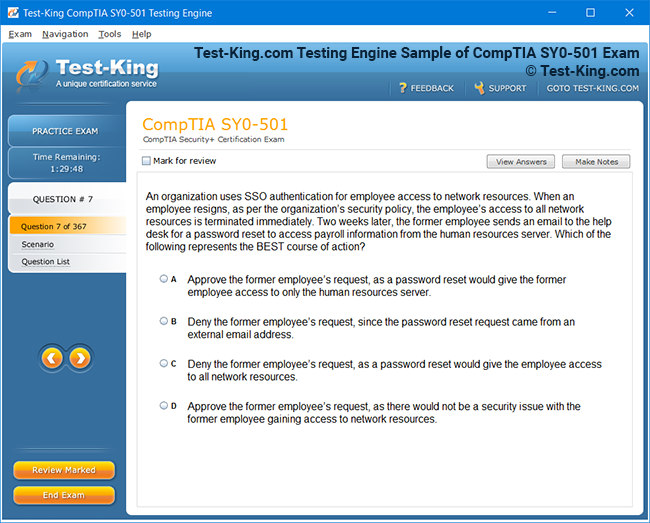
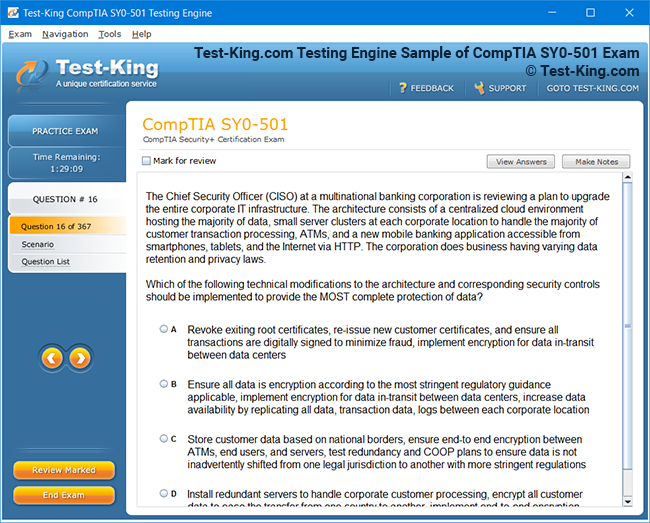
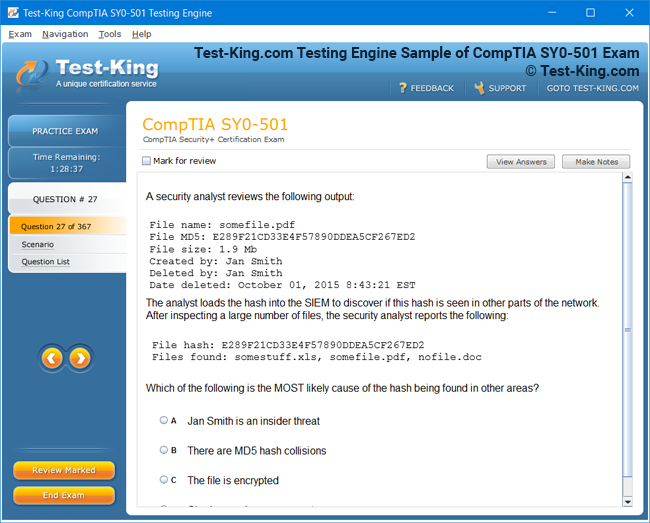
Product Screenshots
Frequently Asked Questions
How can I get the products after purchase?
All products are available for download immediately from your Member's Area. Once you have made the payment, you will be transferred to Member's Area where you can login and download the products you have purchased to your computer.
How long can I use my product? Will it be valid forever?
Test-King products have a validity of 90 days from the date of purchase. This means that any updates to the products, including but not limited to new questions, or updates and changes by our editing team, will be automatically downloaded on to computer to make sure that you get latest exam prep materials during those 90 days.
Can I renew my product if when it's expired?
Yes, when the 90 days of your product validity are over, you have the option of renewing your expired products with a 30% discount. This can be done in your Member's Area.
Please note that you will not be able to use the product after it has expired if you don't renew it.
How often are the questions updated?
We always try to provide the latest pool of questions, Updates in the questions depend on the changes in actual pool of questions by different vendors. As soon as we know about the change in the exam question pool we try our best to update the products as fast as possible.
How many computers I can download Test-King software on?
You can download the Test-King products on the maximum number of 2 (two) computers or devices. If you need to use the software on more than two machines, you can purchase this option separately. Please email support@test-king.com if you need to use more than 5 (five) computers.
What is a PDF Version?
PDF Version is a pdf document of Questions & Answers product. The document file has standart .pdf format, which can be easily read by any pdf reader application like Adobe Acrobat Reader, Foxit Reader, OpenOffice, Google Docs and many others.
Can I purchase PDF Version without the Testing Engine?
PDF Version cannot be purchased separately. It is only available as an add-on to main Question & Answer Testing Engine product.
What operating systems are supported by your Testing Engine software?
Our testing engine is supported by Windows. Andriod and IOS software is currently under development.
Top Salesforce Exams
- Certified Agentforce Specialist
- ADM-201 - Administration Essentials for New Admins
- Certified Data 360 Consultant
- Certified Data Architect
- Certified Revenue Cloud Consultant
- Certified Business Analyst
- Certified Data Cloud Consultant
- Certified Sales Cloud Consultant
- Certified Service Cloud Consultant - Salesforce Certified Service Cloud Consultant
- Certified Platform Administrator II
- Certified Sharing and Visibility Architect
- Certified OmniStudio Developer
- Certified Tableau Desktop Foundations
- Certified Integration Architect
- Certified Development Lifecycle and Deployment Architect
- Certified Platform Identity and Access Management Architect
- Certified Platform App Builder
- Certified Marketing Cloud Email Specialist
- Health Cloud Accredited Professional
- Certified Platform Developer II
- Certified Tableau Consultant
- DEV-450 - Salesforce Certified Platform Developer I (SU18)
- Certified Associate
- Field Service Lightning Consultant
- Certified OmniStudio Consultant
- Certified AI Specialist
- Certified Marketing Cloud Consultant
- Public Sector Solutions Accredited Professional
- Financial Services Cloud Accredited Professional
- Certified CPQ Specialist
- Certified Tableau Server Administrator
- Certified Platform Developer
- Certified Identity and Access Management Architect
- Certified Platform Sharing and Visibility Architect
- Certified Sharing and Visibility Designer
Exam Day Tips for Certified Tableau CRM and Einstein Discovery Consultant Candidates
The Salesforce Certified Tableau CRM and Einstein Discovery Consultant certification represents far more than a digital badge on your professional profile. It is an affirmation of analytical intellect, practical experience, and the capacity to interpret data with elegance and precision. As the day of the exam approaches, the mind oscillates between anticipation and trepidation, often producing a mosaic of excitement and unease. Preparing for this test requires a synthesis of strategy, serenity, and stamina. Each element intertwines, ensuring that when the exam begins, you are not simply answering questions, but demonstrating mastery over the dynamic ecosystem of Salesforce analytics.
Preparing Mentally and Logistically for Exam Day
The first imperative for every aspirant is to understand what the certification truly embodies. This credential validates expertise in implementing, configuring, and optimizing Tableau CRM dashboards and Einstein Discovery models within the Salesforce platform. It verifies one’s ability to synthesize complex datasets, construct predictive insights, and align analytical outcomes with organizational objectives. On exam day, every scenario question, data interpretation, or case-based query is not an isolated test of memory but a reflection of how you translate theoretical understanding into actionable intelligence.
Mental readiness is the invisible scaffolding that supports every correct answer. To enter the examination hall or virtual testing environment with clarity, one must foster cognitive equilibrium days in advance. Avoid last-minute cramming; the neural fatigue it creates is detrimental to long-term recall. Instead, immerse yourself in conceptual visualization. Picture a Salesforce environment where you are configuring datasets, designing lenses, or interpreting story insights from Einstein Discovery. This mental rehearsal cultivates a sense of familiarity that alleviates anxiety and primes the brain for retrieval.
Sleep is a subtle yet profound contributor to performance. Cognitive sharpness depends on adequate rest the night before. Even if your study schedule has been intense, prioritizing seven to eight hours of restorative sleep enables synaptic connections to stabilize and ensures that logical reasoning remains intact during the test. Candidates who underestimate the physiological necessity of rest often experience cognitive fog, misread questions, or fail to interpret data relationships accurately.
Another crucial consideration is nutrition. The brain’s glucose requirements increase under cognitive load. A balanced meal containing slow-releasing carbohydrates, moderate protein, and hydration can sustain mental endurance throughout the exam. Avoid excessive caffeine; while it can temporarily heighten alertness, it also triggers dehydration and post-adrenal fatigue, which can undermine sustained focus.
Time management begins before the exam starts. Construct a timeline that includes your wake-up time, travel buffer (if testing onsite), and a preparatory ritual that centers your mind. Digital candidates should log in thirty minutes early to ensure that technical systems are functioning impeccably. Test your webcam, microphone, and internet stability. Having redundant connectivity options—a mobile hotspot or backup power source—can prevent catastrophic disruptions. Salesforce certification exams employ proctoring protocols that may disqualify candidates for technical lapses, so proactive readiness is non-negotiable.
When the exam begins, rhythm becomes your ally. The test comprises multiple-choice and scenario-based questions, many of which present complex datasets or require conceptual sequencing. Establish a mental tempo: allocate roughly one minute per question, allowing reserve time for intricate case studies. Skipping uncertain questions initially prevents cognitive bottlenecks. Mark them for review and return later with renewed clarity.
Equally important is emotional composure. The Salesforce ecosystem, with its intricate interplay of analytics, automation, and predictive modeling, demands mental flexibility. Some questions will feel alien or ambiguously phrased, testing not only knowledge but interpretive intuition. Resist the impulse to overanalyze linguistic nuance; focus on identifying the most probable solution based on fundamental Salesforce architecture principles.
The exam’s interface provides tools such as highlighting and flagging—use them judiciously. Highlighting key terms like dataset name, security context, or aggregation level helps maintain orientation when re-reading lengthy question stems. Flagging uncertain items creates a psychological safety net, allowing you to progress without feeling trapped by uncertainty.
Environmental control is another subtle determinant of focus. If testing from home, select a tranquil corner with minimal auditory interference. Inform family members or colleagues about your testing window to avoid interruptions. The Salesforce proctoring system monitors surroundings rigorously; unauthorized materials, background movement, or dual screens can invalidate your attempt. Arrange your workspace to be sparse yet functional—only your identification, computer, and permitted accessories should be visible.
Beyond physical arrangements, cultivate a mental atmosphere conducive to analytical lucidity. A brief meditation or breathing exercise before starting the exam can lower cortisol levels and sharpen concentration. Breathing deeply through the diaphragm for two minutes activates the parasympathetic nervous system, promoting calm alertness. This technique is remarkably effective for candidates who experience physiological manifestations of stress such as increased heart rate or perspiration.
During the exam, interpret each scenario not as a riddle but as a real-world case study. The Salesforce Certified Tableau CRM and Einstein Discovery Consultant exam mirrors actual client interactions—identifying data sources, managing user permissions, designing dashboards that adhere to business requirements, and employing Einstein Discovery for predictive recommendations. The more vividly you can imagine yourself within these professional contexts, the easier it becomes to select the logically coherent answer.
Occasionally, two or more answers may appear plausible. In such cases, evaluate them based on scalability, maintainability, and adherence to Salesforce best practices. Remember that Salesforce emphasizes declarative solutions over programmatic ones whenever feasible. Thus, when faced with multiple valid approaches, prioritize the option that minimizes technical debt while achieving the same analytical outcome.
Another potent strategy is pattern recognition. Many questions hinge on recurring conceptual themes—security implementation, data transformation, model interpretation, or integration with other Salesforce clouds. Recognizing these motifs accelerates comprehension and prevents overthinking.
As time advances, fatigue may creep in. Cognitive endurance is finite, so it is wise to employ micro-breaks between every fifteen to twenty questions. Close your eyes briefly, stretch your hands, or take two deep breaths. Even minimal physical resets restore oxygen flow to the brain and rejuvenate attention.
The Salesforce Certified Tableau CRM and Einstein Discovery Consultant exam not only evaluates what you know but how gracefully you handle ambiguity. Candidates who approach each challenge with intellectual humility—acknowledging that not every question has an immediately evident answer—tend to perform better. Analytical composure arises from trust in your preparation and intuitive reasoning honed through countless Trailhead exercises, implementation projects, and scenario simulations.
Beyond knowledge and temperament, technical familiarity is indispensable. Ensure you can mentally visualize the navigation of Tableau CRM features: dataset creation, recipe configuration, binding expressions, and dashboard interactions. Likewise, internalize the mechanics of Einstein Discovery—data preparation, model creation, prediction analysis, and bias detection. Even without direct platform access on exam day, mental simulation reinforces neural pathways that facilitate retrieval under pressure.
Occasionally, the test will present mathematical or statistical contexts within Einstein Discovery questions. Brush up on foundational statistics—mean, median, correlation, regression, and significance testing—since they underpin predictive analytics. Understanding these concepts qualitatively rather than memorizing formulas allows you to interpret the rationale behind Einstein’s recommendations.
When encountering long or complex questions, adopt an incremental reading method. Start by identifying the business goal within the scenario—whether it involves sales forecasting, opportunity scoring, or customer churn reduction. Then analyze what data structures or permissions are implicated. Finally, evaluate which Salesforce feature or Einstein capability fulfills the requirement with the least configuration overhead. This logical triage prevents confusion and streamlines your thought process.
The psychological aspect of performance is frequently underestimated. Confidence, when balanced with humility, can transform your cognitive landscape. Recite to yourself a quiet affirmation before the exam begins: you have studied extensively, practiced diligently, and you possess the analytical acumen necessary to excel. This mental reinforcement curbs self-doubt and promotes neural fluidity during problem-solving.
Avoid the peril of second-guessing. Once you have chosen an answer after deliberate reasoning, refrain from repeatedly altering it unless a later question provides clarifying insight. Data from numerous testing psychology studies suggests that initial instincts, when based on prior mastery, are often correct. Constant revision introduces noise into decision-making.
Onscreen timer management is another art. Salesforce exams typically allocate ample time, but perception of time scarcity can trigger anxiety. Instead of glancing at the timer obsessively, check your progress periodically—perhaps after every twenty questions. This ensures pacing without distraction.
During longer questions that involve multi-step reasoning, maintain a note of logical checkpoints in your mind. For instance, if a question involves dataset visibility issues, mentally trace the flow from dataflow configuration to row-level security and sharing rules. Sequential reasoning prevents oversight and reinforces conceptual integration.
The importance of adaptability cannot be overstated. Salesforce constantly evolves, and the exam content mirrors current platform functionality. If you encounter an unfamiliar feature or terminology, infer its function based on context and alignment with Salesforce’s overarching architecture. Logical deduction, grounded in your understanding of data management principles, often yields the correct inference even when memory fails.
Equally vital is your awareness of the testing environment’s behavioral policies. The proctor may communicate instructions before initiation; listen attentively and comply without hesitation. Keep identification documents ready and ensure your workspace meets the certification provider’s security requirements. A composed demeanor during verification sets a steady tone for the remainder of the experience.
In moments when concentration wanes, re-anchor your focus by reconnecting with the purpose behind your certification journey. This credential is not merely a professional milestone but a testament to your ability to turn raw information into wisdom that drives business transformation. Remembering this broader purpose infuses your mindset with motivation and resilience.
When the final minutes approach, allocate sufficient time to review flagged questions. Employ a tiered strategy: first revisit those where you had genuine uncertainty, then check for any inadvertent omissions. Occasionally, a simple misread word or mis-clicked option can cost valuable points. Systematic verification prevents such errors.
Finally, once you have submitted the exam, exhale deeply and allow your mind to decompress. Many candidates instinctively rush to speculate about their performance, but such reflection should be postponed until results arrive. What matters most is that you demonstrated integrity, preparation, and composure under pressure. The Salesforce Certified Tableau CRM and Einstein Discovery Consultant exam is designed to distinguish professionals who not only comprehend analytics but embody its disciplined mindset.
The pathway to success on this exam is paved with meticulous preparation, mental serenity, and technical acuity. On the appointed day, each of these dimensions converges into a singular expression of your capability. You are not simply answering questions; you are articulating the language of data-driven intelligence within the Salesforce universe. By mastering your environment, pacing, and thought process, you transform exam day from an ordeal into an affirmation of competence and self-assurance.
Navigating Analytical Precision and Decision-Making Under Pressure
The day of the Salesforce Certified Tableau CRM and Einstein Discovery Consultant examination often unfolds as a complex interplay of intellect, intuition, and endurance. The questions on the screen are more than prompts; they are gateways into the candidate’s analytical consciousness. To prevail, one must orchestrate cognition, composure, and calculation with the rhythm of practiced artistry. Success depends not solely on preparation but on the ability to maneuver through uncertainty with lucidity and poise.
Each question presents a microcosm of Salesforce’s analytical ecosystem. The Tableau CRM and Einstein Discovery certification emphasizes not only data visualization but the cognitive process of deriving insight from interwoven information. As the exam timer begins, the most valuable resource at your disposal is not time itself but the discipline with which you allocate it. Approaching each query methodically converts apprehension into control. The examination is an intellectual marathon rather than a sprint; understanding this rhythm ensures that energy and attention remain consistent from the first scenario to the last.
The opening minutes set the emotional tone for the entire experience. Before answering, breathe deliberately, adjust your posture, and allow your thoughts to settle into equilibrium. This brief interlude establishes dominance over adrenaline, which otherwise clouds reasoning. Many candidates begin by rushing into the first question, anxious to demonstrate mastery, but such haste often leads to misinterpretation. Instead, read the question stem carefully, internalize its context, and extract the core objective. Whether it involves optimizing a Tableau CRM dashboard or configuring an Einstein Discovery prediction model, every question is a reflection of applied problem-solving.
In the Salesforce analytics universe, understanding the language of data is indispensable. Terms like dataset, recipe, dataflow, lens, and dashboard represent more than technical constructs; they symbolize an entire epistemology of interpretation. Within Einstein Discovery, concepts such as story, model accuracy, predictor significance, and bias assessment embody the science of automated reasoning. On exam day, these terminologies form the lexicon of your cognitive toolkit. By instinctively recognizing their relationships, you accelerate comprehension without needing to reread complex stems.
One of the most underestimated strategies is contextual isolation. Each scenario question demands its own mental environment. Do not let residual uncertainty from a previous question infiltrate the current one. Cognitive carryover can distort judgment, creating unnecessary errors. Treat every new prompt as a discrete intellectual event, approached with fresh focus. This approach mimics the mindset of professional consultants, who evaluate each client requirement independently while maintaining overarching coherence.
As the exam progresses, the complexity of questions often intensifies. Salesforce deliberately structures its certifications to evaluate higher-order reasoning rather than rote memorization. For instance, a query may involve designing a dataflow that combines multiple datasets with differing levels of granularity. Another may test comprehension of how Einstein Discovery models handle multicollinearity or missing values. Such intricacies require layered thinking rather than impulsive recall.
When confronted with challenging questions, employ elimination as a weapon of precision. Remove obviously incorrect options first. Even when unsure, this process mathematically improves your probability of success. Beyond probability, it also compels you to articulate internally why certain answers fail to satisfy business logic or technical validity. This mental articulation strengthens analytical confidence and transforms uncertainty into structured reasoning.
Time awareness is vital, yet obsession with the timer breeds anxiety. A healthy rhythm emerges when you balance pacing with awareness. Allocate an initial scan across the entire question set, if possible, to gauge diversity and distribution. Some questions may appear deceptively simple but conceal nuanced traps, while others may seem intimidating yet resolve swiftly once the logic is uncovered. Adjust your pacing fluidly, allowing additional time for multifaceted case studies or data interpretation items.
An important psychological discipline during the Salesforce Tableau CRM and Einstein Discovery Consultant exam is cognitive resetting. Every twenty or so questions, allow yourself a fleeting moment to re-anchor your focus. Close your eyes for three seconds, inhale deeply, and remind yourself of your mastery. These brief recalibrations sustain neural clarity and protect against the gradual erosion of attention.
Within Einstein Discovery’s conceptual territory, some questions require inference rather than explicit recall. For example, you might be asked to identify the most ethical approach to interpreting predictive insights in a customer segmentation scenario. Here, the principle of responsible AI usage applies. Salesforce emphasizes transparent model communication, bias awareness, and stakeholder accountability. Thus, when multiple answers appear viable, select the one aligned with integrity, transparency, and user empowerment—values that permeate the entire Salesforce philosophy.
Occasionally, a question may introduce a hypothetical business use case where data integration between Tableau CRM and Salesforce objects becomes essential. This is where your understanding of data security, row-level access, and permission sets proves invaluable. The correct solution is usually the one that respects both data governance and performance optimization. Candidates who think holistically—balancing technical feasibility with compliance—demonstrate the analytical maturity that Salesforce seeks to certify.
As you progress deeper into the exam, the brain may experience cognitive fatigue, leading to slower comprehension. Counteract this by leveraging intrinsic motivation. Remind yourself that every question answered correctly brings you closer to validation as a Salesforce Certified Tableau CRM and Einstein Discovery Consultant, a credential that represents not only analytical expertise but a mastery of insight-driven storytelling. Visualize the practical benefits awaiting you—enhanced career mobility, recognition among peers, and access to elite Salesforce consulting opportunities. These aspirations rekindle focus and determination.
Exam performance also hinges on emotional neutrality. The human mind, under duress, tends to exaggerate both confidence and doubt. If you encounter a sequence of difficult questions, resist the temptation to catastrophize. Each question carries equal weight; one complex item cannot define the outcome. Likewise, do not become overconfident after answering a string of straightforward questions. Overconfidence induces carelessness, while despair paralyzes judgment. Balance both extremes by adhering to a calm, analytical demeanor throughout.
Reading comprehension, surprisingly, often distinguishes those who pass comfortably from those who narrowly miss. Salesforce’s question design frequently embeds subtle qualifiers like “most appropriate,” “best practice,” or “minimum configuration.” Each of these phrases shifts the interpretive lens. A technically correct answer might still be wrong if it contradicts Salesforce’s preferred declarative methodology. Therefore, attention to linguistic nuance is indispensable. Cultivate the habit of reading each question twice—first for meaning, second for implication.
In some cases, you might encounter numerical questions involving metrics or calculations related to Einstein Discovery’s performance metrics. Understanding evaluation indicators such as R-squared, mean absolute error, or confusion matrix interpretation can provide decisive advantage. Rather than memorizing formulas, internalize what these metrics signify about model fidelity and predictive trustworthiness. The exam aims to assess conceptual comprehension rather than computational proficiency, so qualitative reasoning often suffices.
A profound yet understated aspect of exam excellence lies in adaptability. Despite exhaustive preparation, unforeseen scenarios will arise—new Salesforce features, altered terminologies, or atypical problem statements. Here, your ability to infer becomes paramount. Deductive reasoning, grounded in core principles of analytics and platform architecture, allows you to extrapolate even when faced with unfamiliarity. This agility mirrors the real-world expectations of a consultant who must navigate evolving business landscapes.
Interpreting scenario-based case studies demands empathy as much as intellect. Picture yourself as the consultant engaging a client. The scenario’s narrative often contains subtle cues about the organization’s goals or constraints. By attuning yourself to these clues, you can discern which Salesforce solution best satisfies their needs. Whether the problem involves creating an optimized dashboard for executives or automating insights through Einstein Discovery, alignment with business context usually leads to the correct answer.
Another aspect of tactical success involves pacing through cognitive zones. Most candidates experience fluctuating performance levels—periods of heightened focus followed by transient dips. Recognize these waves without resistance. When your mind feels sharp, capitalize by addressing complex case studies. When fatigue arises, handle shorter factual questions to sustain momentum. This strategic alternation prevents burnout and optimizes overall efficiency.
Environmental mindfulness continues to play a role even during the test. The physical act of sitting in one posture for prolonged periods can restrict circulation and affect alertness. Subtle adjustments—rolling shoulders, straightening the spine, or stretching fingers—restore physiological balance without breaking concentration. The aim is to maintain a posture of alert serenity, where the body supports the intellect.
Your preparation journey before exam day intertwines directly with performance under examination conditions. Candidates who practiced through authentic Salesforce environments, Trailhead modules, and mock exams often report smoother transitions between conceptualization and application. Familiarity with interface aesthetics, button placements, and configuration flows transforms abstract knowledge into instinctive recognition. During the exam, this instinct reduces cognitive load, allowing the brain to allocate more bandwidth to reasoning.
Occasionally, exam content may intersect across different Salesforce domains. For example, understanding how Tableau CRM integrates with Sales Cloud, Service Cloud, or Marketing Cloud may appear as contextual prerequisites for certain questions. Being conversant with these interconnections elevates your ability to answer cross-functional scenarios accurately. The certified consultant is not a siloed specialist but an integrator who perceives the Salesforce ecosystem as a unified organism of data, automation, and intelligence.
When uncertainty persists, trust pattern familiarity derived from Salesforce best practices. For instance, Salesforce generally encourages declarative configurations, robust security, and scalable architecture. Answers that align with these principles tend to be correct more often than not. The platform’s ethos values maintainability and user empowerment; hence, whenever in doubt, prioritize solutions that reduce complexity while preserving governance.
The human brain possesses a remarkable phenomenon known as incubation, wherein unresolved problems continue to process subconsciously. When you mark a difficult question for review and move ahead, your subconscious mind often continues to analyze it in the background. Upon returning later, clarity frequently emerges effortlessly. This demonstrates the value of deferring rather than forcing resolution.
As the final minutes approach, discipline supersedes haste. It is tempting to accelerate recklessly through the last few questions, but this often leads to preventable mistakes. Maintain measured tempo until the final submission. Before clicking submit, perform a rapid yet mindful review of marked items, ensuring consistency in reasoning. Confirm that every question has been answered—unattempted items yield zero potential gain, while even a speculative choice offers possibility.
After submitting, the immediate sense of release is palpable. Yet this moment is not merely relief; it signifies culmination of a long intellectual pilgrimage. The Salesforce Certified Tableau CRM and Einstein Discovery Consultant certification represents more than knowledge of analytics tools—it symbolizes cognitive adaptability, interpretive precision, and professional dedication. Through the test, Salesforce seeks to identify individuals capable of converting data into narratives that inform strategic decision-making.
Exam day, in its totality, is a crucible that refines both technical proficiency and emotional resilience. Those who navigate it successfully demonstrate mastery not only of Salesforce technology but of themselves. The discipline required to remain calm, interpret questions accurately, and make judicious decisions under time pressure mirrors the very competencies expected of consultants in the real world. Thus, every minute spent within that testing interface becomes an enactment of the consultant mindset—meticulous, composed, and insight-driven.
The synthesis of preparation, focus, and self-regulation ultimately dictates the outcome. Knowledge alone, though necessary, cannot guarantee success without the stability of temperament. The most accomplished candidates harmonize logic with mindfulness, ensuring that their performance reflects both intellectual dexterity and inner balance. In essence, the Salesforce Tableau CRM and Einstein Discovery Consultant examination is less a test of memorized content and more an exploration of how gracefully one can apply analytical wisdom when the stakes are high.
As you emerge from the examination space, whether physical or virtual, you will realize that the real value of the journey lies in transformation. The disciplined preparation, the countless practice sessions, and the mental fortitude cultivated through this endeavor reshape how you approach every analytical challenge henceforth. The test merely formalizes what you have already become—a professional capable of perceiving data not as numbers, but as narratives imbued with meaning.
Mastering Analytical Storytelling and Predictive Insight Interpretation
The Salesforce Certified Tableau CRM and Einstein Discovery Consultant examination is not merely a test of functional understanding but a measure of one’s capability to translate intricate data into coherent narratives that inspire decision-making. The essence of this certification lies in demonstrating an analytical intellect capable of discerning patterns, interpreting predictive outcomes, and crafting visual representations that communicate intelligence with subtle precision. The exam rewards candidates who can think beyond the syntax of configuration and embody the spirit of data-driven storytelling.
On the day of the examination, this dimension of storytelling and insight interpretation becomes pivotal. Every question, especially those rooted in Einstein Discovery or Tableau CRM dashboards, challenges the candidate to connect analytics to real-world business applications. It is not about memorizing buttons or remembering steps; it is about envisioning the broader narrative—how the right analytical action influences strategy, efficiency, and customer satisfaction. In this examination landscape, precision merges with persuasion, and data transforms from static figures into persuasive dialogue.
Storytelling in the analytical context begins with comprehension of the problem space. Imagine that each exam question represents a business conversation. The client seeks an answer—perhaps a pattern in customer churn, a projection of sales outcomes, or the optimization of dashboard usability. As the certified consultant, your role is to provide clarity through analytical craftsmanship. During the test, the questions that refer to Einstein Discovery’s predictions or Tableau CRM’s data visualizations invite you to wear this hat of an interpretive consultant. Instead of simply identifying a configuration, visualize how the analytic solution you choose would influence executive decision-making in a real-world scenario.
The cognitive strength required here is interpretive empathy. Candidates must understand that data, though objective, serves human goals. For example, when confronted with a scenario question about creating an Einstein Discovery story for predicting lead conversion, the deeper inquiry is not just about which dataset to use but about ensuring the resulting insight will be comprehensible, ethical, and actionable for end users. Salesforce’s examination system prizes this empathy, rewarding those who demonstrate awareness of both technical architecture and business sensibility.
Interpreting predictive insights demands both quantitative literacy and contextual discernment. Within Einstein Discovery, prediction probabilities, model accuracy, variable importance, and bias indicators all tell parts of the story. The true mastery lies in understanding their interplay. When the exam presents options that seem statistically accurate but operationally unrealistic, the wise candidate remembers that predictive analytics must always balance precision with practicality. Data that dazzles without delivering actionable value is an analytical mirage.
As you read through complex questions involving multiple-choice scenarios on model deployment or story interpretation, visualize how each answer would manifest in an actual Salesforce organization. If a particular configuration might overcomplicate user experience or contradict the ethical principles of responsible AI, eliminate it without hesitation. Salesforce places immense emphasis on trust, transparency, and human-centric analytics. The correct answer usually reflects these values, even if the question’s language seems technically ambiguous.
The Tableau CRM and Einstein Discovery Consultant exam frequently merges quantitative logic with interpretive artistry. Tableau CRM’s dashboards serve as the stage upon which stories unfold. Einstein Discovery’s predictions act as narrators, translating data into foresight. The candidate’s task is to synchronize both—ensuring that dashboards not only display numbers but guide interpretation toward wisdom. During the exam, when you encounter a query about dashboard optimization or binding expressions, do not treat it as a sterile configuration exercise. Instead, imagine the executive audience who will interact with that dashboard. Ask yourself which configuration best enables clarity, interactivity, and actionable comprehension.
To maintain this interpretive edge, mental agility must accompany technical recall. As questions fluctuate between conceptual abstraction and functional detail, candidates often oscillate between analytical hemispheres of the brain—the logical and the creative. Cultivating equilibrium between them ensures sustained clarity throughout the test. When faced with Einstein Discovery-related questions that require reasoning through statistical or predictive logic, engage analytical precision. When transitioning to Tableau CRM visualization scenarios, engage narrative imagination. The seamless transition between these cognitive modes defines the hallmark of a skilled consultant.
One of the challenges of this examination is the simulation of real-world ambiguity. Questions are deliberately phrased to mimic client requirements that are incomplete or open-ended. Candidates who seek a single perfect answer without interpreting context may falter. Instead, interpret these scenarios as miniature consulting dialogues. The best course of action is rarely absolute—it is the one that best aligns with Salesforce’s design philosophy, business outcomes, and user accessibility. Thus, adaptability becomes your intellectual compass.
Predictive modeling in Einstein Discovery often involves subtle distinctions that the exam leverages to assess depth of understanding. Consider model validation: while two models may achieve similar accuracy scores, one might possess higher interpretability. The exam tends to favor the model that aligns with Salesforce’s emphasis on transparent, explainable AI. This undercurrent of ethical analytics pervades the test. Every question is designed to reward those who think not only as analysts but as stewards of data responsibility.
When interpreting the narratives that data tells, the ability to perceive causality rather than mere correlation is critical. Einstein Discovery highlights predictors that influence outcomes, but candidates must mentally filter these through business realism. For example, if a model indicates that lead source or account region strongly influences conversion probability, an astute consultant examines whether these correlations arise from structural biases or genuine causative trends. On exam day, questions may test this discernment subtly—by presenting answers that are statistically sound but ethically or operationally flawed. The candidate who recognizes this nuance demonstrates not only technical aptitude but professional wisdom.
As the exam proceeds, certain scenario-based questions require synthesis of Tableau CRM and Einstein Discovery components. A business case may describe executives seeking automated insights on quarterly revenue trends with embedded predictions in dashboards. Here, the key to success lies in conceptual integration—recognizing how Einstein Discovery stories can be embedded into Tableau CRM dashboards to deliver prescriptive insights directly within the user interface. The most accurate answer will often be the one that illustrates this holistic fusion of descriptive and predictive analytics.
Interpreting such integrative questions demands clarity of architecture. Salesforce’s platform thrives on modular harmony; each tool complements the other without redundancy. When evaluating possible answers, prioritize those that utilize built-in Salesforce functionality efficiently rather than introducing external complexity. The exam tests your ability to preserve system elegance while achieving analytical depth.
Communication remains a central tenet throughout this certification. Whether within the test environment or professional practice, the consultant’s value lies in their capacity to distill complexity into lucidity. During the exam, questions that allude to stakeholder reporting, storytelling enhancement, or dashboard personalization assess this communicative intelligence. Imagine yourself explaining the same concept to a non-technical executive. Which of the given answers would facilitate the clearest understanding? The one that promotes interpretive transparency is usually correct.
To perform consistently across three or more hours of intensive analysis, mental stamina is indispensable. Cognitive fatigue impairs both interpretation and retention. Thus, pacing yourself through steady breathing and hydration becomes a form of intellectual hygiene. Small, deliberate pauses between question clusters allow subconscious processing to continue in the background. Paradoxically, moments of silence often yield bursts of clarity.
Within the fabric of the Salesforce Certified Tableau CRM and Einstein Discovery Consultant exam lies an underlying test of narrative perception. Can the candidate perceive data as a story of relationships, outcomes, and possibilities? This capacity distinguishes those who merely pass from those who excel. Questions framed around business scenarios—customer churn analysis, marketing attribution, or operational forecasting—test whether you can visualize outcomes beyond the dashboard. They require seeing the ripple effects of analytical decisions on people, processes, and profits.
Another subtle yet vital competency is the ability to translate model findings into business language. Einstein Discovery might identify “Sales representative responsiveness” as the strongest predictor of deal closure. On the exam, an answer option may ask how best to communicate this finding to leadership. The correct response is never the one filled with technical jargon; it is the one that translates statistical evidence into strategic implication. Salesforce rewards clarity because clarity fosters adoption, and adoption drives value realization.
Emotional intelligence also plays an indirect but powerful role during the exam. As tension rises, emotional turbulence can cloud analytical reasoning. Maintaining equanimity transforms potential stress into concentration. Practice mindfulness techniques beforehand; they nurture mental elasticity that sustains you through unexpected difficulty. When a question perplexes you, treat it as an opportunity for exploration rather than frustration. This mindset shift prevents negativity from eroding focus.
Examining the ethics of analytics, Salesforce places distinct emphasis on data fairness and bias mitigation. In Einstein Discovery scenarios, questions may probe your understanding of responsible AI practices. Recognize that the correct approach always upholds equity and transparency. For instance, if a predictive model reveals bias toward a demographic attribute, the right answer involves investigating, communicating, and mitigating rather than ignoring the issue. Salesforce’s ecosystem thrives on trust, and this trust is embedded in the certification’s evaluative structure.
Predictive insight interpretation extends beyond numerical comprehension into philosophical awareness. The very notion of discovery implies humility before data—an acknowledgment that every pattern is provisional, shaped by context. Candidates who embody this intellectual humility are less likely to overinterpret or oversimplify results. They understand that models evolve, insights require reevaluation, and data is a living entity. The exam, in its deliberate ambiguity, mirrors this dynamism, rewarding adaptability over rigidity.
Visualization questions in the Tableau CRM context often test the subtle balance between aesthetics and utility. A visually ornate dashboard may appeal artistically but hinder clarity. Conversely, a minimalistic design that communicates efficiently aligns with Salesforce’s pragmatic ethos. The best answers reflect visual restraint guided by purpose. When interpreting such questions, consider whether the visualization enhances comprehension or distracts from it. Data visualization is storytelling through geometry; every chart, metric, and filter contributes to narrative rhythm.
The candidate’s internal dialogue during the exam becomes a silent partner in performance. Self-talk that is constructive rather than critical sustains motivation. Remind yourself periodically of your preparation journey—the practice projects, the Trailhead badges, the community discussions. These cumulative efforts form a reservoir of competence. Drawing confidence from this reservoir prevents the mind from spiraling into doubt when faced with complex analytical dilemmas.
When reading through question scenarios that involve client outcomes, practice visualization. Imagine being inside the Salesforce environment, navigating datasets, adjusting filters, or interpreting story outputs. This mental enactment transforms abstraction into tangible understanding. Candidates who mentally simulate the Salesforce interface during questions tend to interpret requirements more accurately. This method aligns with how seasoned consultants mentally rehearse solutions before implementation.
The exam’s structure demands consistency in critical thinking from beginning to end. Many candidates perform well initially but lose precision toward the latter portion due to dwindling focus. To counter this, establish micro-goals—treat every ten questions as a distinct journey of mastery. Celebrate quiet triumphs along the way. This rhythmic motivation sustains energy without fatigue.
Another essential dimension of interpretive success lies in appreciating interdependence. Tableau CRM and Einstein Discovery do not function as isolated entities but as symphonic components within Salesforce’s analytics suite. Their integration enables organizations to traverse the continuum from descriptive to prescriptive intelligence. On the exam, whenever faced with answers that integrate multiple Salesforce elements harmoniously, they usually mirror real-world best practices.
Strategic intuition—an often-overlooked faculty—plays a decisive role. Beyond logic, intuition guides rapid inference when time constrains deeper analysis. This intuition is not guesswork; it is the distilled product of prolonged engagement with patterns. Candidates who have practiced extensively develop a subconscious repository of associations between problem types and Salesforce solutions. During the exam, this reservoir often yields spontaneous recognition of correct options. Trust this intuitive resonance, but verify it through reasoning.
As the minutes wane, maintain an unwavering rhythm. Resist the psychological lure of hurried completion. Every question deserves deliberate attention. The Salesforce Tableau CRM and Einstein Discovery Consultant exam is designed to reveal consistency of judgment, not sporadic brilliance. Finishing too quickly often signifies oversight. Conversely, excessive deliberation jeopardizes timing. Balance lies in graceful pacing—steady, deliberate, composed.
Once the exam concludes, an internal silence follows—a quiet aftermath where intellect and effort converge. This silence is not emptiness but fulfillment. The journey through data interpretation, predictive reasoning, and narrative synthesis culminates in a deeper understanding of both the Salesforce platform and the analytical self. What remains is not anxiety about results but an appreciation for the rigor of the experience itself.
In this examination, success is measured not only by scores but by the awakening of analytical consciousness. To navigate its intricacies is to reaffirm the timeless principle that knowledge, when guided by purpose, becomes wisdom. Every insight interpreted, every pattern recognized, and every decision made within that digital testing environment echoes beyond the exam, shaping how you will forever approach the interplay of data and decision in the real world.
Cultivating Strategic Data Ethics and Troubleshooting Mindset During Certification Examination
The Salesforce Certified Tableau CRM and Einstein Discovery Consultant examination represents a juncture where analytical mastery converges with ethical discernment and diagnostic intellect. Every question you encounter within this demanding certification tests not merely technical fluency but the moral and methodological discipline behind each analytical action. As data increasingly becomes the lifeblood of enterprise decision-making, Salesforce entrusts its certified consultants to act as both interpreters of intelligence and custodians of integrity. Thus, on exam day, one’s capacity to reason ethically while diagnosing complex analytical puzzles stands as a distinguishing hallmark of professional maturity.
The architecture of this examination is deliberately structured to challenge candidates to think beyond procedural configurations. The Salesforce Tableau CRM and Einstein Discovery platforms embody the confluence of automation, analytics, and artificial intelligence. Their integration requires the consultant to harmonize precision with conscience, ensuring that every dataset transformation, prediction, and dashboard interpretation serves both business efficacy and ethical rectitude. Within the testing environment, this dual responsibility materializes as scenario-driven questions designed to test how adeptly you balance practicality with propriety.
At its essence, data ethics in the Salesforce ecosystem revolves around stewardship. The Tableau CRM and Einstein Discovery Consultant must handle data as a living narrative of individuals and organizations, not merely as computational input. This humanistic perspective often underpins the correct answers in exam scenarios where multiple technically feasible options exist. For instance, a question may describe a client seeking to predict employee turnover using demographic attributes. While one option might yield higher model accuracy by including sensitive fields, the ethical consultant recognizes Salesforce’s emphasis on fairness and bias mitigation. Selecting an approach that anonymizes or excludes potentially discriminatory variables demonstrates alignment with responsible AI principles.
Such judgment reflects the broader Salesforce ethos that analytics must amplify human empowerment rather than perpetuate inequity. The examination frequently embeds this philosophy implicitly within its phrasing. Candidates who internalize this value instinctively identify the answers that uphold transparency, consent, and inclusivity. Einstein Discovery’s bias detection feature embodies this ethical scaffolding, enabling consultants to surface hidden prejudices in predictive models. Understanding how to interpret and act upon these indicators is not only a test question but a professional obligation.
Simultaneously, exam day requires a robust troubleshooting mentality. Many of the more advanced questions simulate complex data or performance issues that a consultant might encounter in real-world deployments. This aspect of the test measures diagnostic acumen—the ability to dissect problems methodically, tracing symptoms to root causes. When faced with a question describing dashboard errors, misaligned metrics, or dataflow irregularities, resist the impulse to jump directly to solutions. Instead, reconstruct the analytical ecosystem in your mind. Imagine the flow of data through connectors, recipes, and security filters. Identify where inconsistencies could logically originate. Salesforce evaluates not only the final answer but the reasoning pattern behind it.
A sophisticated troubleshooting mindset begins with conceptual clarity about Tableau CRM’s architecture. Understanding the hierarchy of datasets, dataflows, and lenses allows you to visualize how transformations propagate through the system. For example, a dataflow that aggregates fields incorrectly could distort downstream dashboards. On the exam, the correct solution often involves verifying dataflow logic or ensuring field-level compatibility before attempting cosmetic fixes in dashboards. This mirrors professional best practice, where troubleshooting proceeds from data integrity outward rather than from visualization inward.
In Einstein Discovery, troubleshooting adopts a different complexion. Here, the challenge lies in diagnosing model performance anomalies. Questions may present scenarios involving low predictive accuracy, biased predictions, or misinterpretation of significance values. To navigate these, recall that Einstein Discovery models are only as reliable as the training data’s representativeness and cleanliness. The correct course of action in such exam questions frequently involves refining datasets, removing outliers, or clarifying target definitions rather than manipulating algorithmic parameters. Salesforce’s examination design rewards candidates who demonstrate an understanding that sustainable analytical quality begins with data governance, not statistical tweaking.
Moreover, analytical ethics and troubleshooting converge when addressing transparency. A consultant must be able to explain why a predictive outcome occurred and how it can be trusted. During the exam, questions may test your grasp of interpretability features such as variable importance charts or reason codes. Recognizing how to use these to foster stakeholder trust reflects maturity in responsible analytics. If multiple answer choices seem plausible, the one emphasizing explanation and accountability generally aligns with Salesforce’s guiding principles.
The psychological posture of a troubleshooter under examination pressure requires composed curiosity. Each problem is a mystery to be decoded, not a threat to be feared. Candidates who approach complex questions with investigative calm tend to maintain accuracy throughout the test. When uncertainty arises, reconstruct the context step by step—what is the business objective, what tools are involved, and where might dissonance appear? This incremental reasoning reflects the authentic diagnostic process consultants employ when supporting live Salesforce environments.
Another subtle but significant competency assessed is resilience in the face of cognitive adversity. The Salesforce Tableau CRM and Einstein Discovery Consultant examination, by its design, contains moments of deliberate ambiguity. Some questions may include distractors that appear correct until analyzed through ethical or architectural lenses. Others may present technical terminologies that challenge your recollection. In these moments, the ability to pause, breathe, and reassess logic is essential. Panic fractures reasoning, while patience restores it. An adept candidate remains tranquil amid uncertainty, treating every obstacle as an invitation to demonstrate composure.
The intertwining of data ethics and troubleshooting extends to governance. Tableau CRM’s security mechanisms—row-level access, sharing inheritance, and permission sets—are integral to both ethical compliance and system reliability. During the exam, questions might inquire about ensuring data visibility for the right audiences or preventing leakage of confidential information through improperly designed dashboards. The accurate response typically reinforces Salesforce’s least-privilege principle, ensuring that data accessibility aligns strictly with user roles. Awareness of this governance framework distinguishes a responsible consultant from a mere technician.
Time management intertwines intimately with troubleshooting during the examination. Diagnostic reasoning consumes mental bandwidth; thus, efficient pacing becomes essential. Establish a rhythm where you allot sufficient contemplation time for complex case studies without compromising progress. If a question demands excessive deliberation, mark it for review, then continue. This iterative approach prevents mental stagnation and mirrors real-world consultancy workflows, where unresolved problems are documented for later deep-dive rather than derailing ongoing analysis.
Ethical reasoning also governs data visualization decisions. Tableau CRM’s expressive dashboards can either enlighten or mislead depending on how metrics are framed. In the exam environment, you may encounter questions assessing your judgment on data presentation. For instance, which dashboard design best conveys customer satisfaction trends? The correct choice is not merely the most colorful but the most truthful—one that contextualizes data without distortion. Misrepresenting scales, excluding unfavorable metrics, or overemphasizing trivial variances violates the implicit ethical contract between analyst and stakeholder. Recognizing this moral dimension is key to answering visualization questions correctly.
Communication under pressure becomes a further evaluative layer of this certification. Though the exam is solitary and silent, each scenario demands you mentally articulate explanations for your choices. Imagine how you would justify your solution to a project sponsor or technical architect. This internal narration sharpens reasoning and ensures coherence. When answers feel intuitively right but elude verbal justification, reassess them. Salesforce favors solutions that can withstand scrutiny and articulate rationale—a reflection of its commitment to transparency and professional rigor.
As candidates progress deeper into the test, maintaining energy and emotional steadiness becomes vital. The human mind fatigues after sustained concentration, especially when parsing dense analytical material. To mitigate this, adopt micro-restorative techniques between clusters of questions. A few seconds of deep breathing, gentle neck rotation, or focused gaze away from the screen can recalibrate neural attention. This physiological maintenance parallels how consultants manage cognitive endurance during lengthy analytical engagements in professional contexts.
Troubleshooting within Einstein Discovery also includes philosophical awareness of model impermanence. No predictive insight remains eternally valid; data patterns evolve as human behavior and market dynamics shift. Questions that explore model recalibration or retraining schedules assess your appreciation of this temporal fragility. The optimal answer usually involves continuous monitoring and periodic retraining rather than static deployment. Salesforce designs such items to identify candidates who perceive analytics as an evolving dialogue rather than a fixed decree.
Moreover, candidates must demonstrate nuanced understanding of data lineage. When an Einstein Discovery model produces unexpected outcomes, tracing lineage from original source objects through transformation layers becomes paramount. In exam scenarios, the correct response often prioritizes verification of input data consistency and schema mapping. This analytical retrospection mirrors the consultant’s responsibility to ensure that predictive insights stem from authentic and coherent sources.
Within Tableau CRM, troubleshooting may extend to performance optimization. The exam may include descriptions of dashboards experiencing latency or incomplete refreshes. Recognizing the interplay between dataset size, query complexity, and visualization rendering becomes critical. The optimal solution typically involves refining queries, leveraging dataflow scheduling, or adjusting lens filters rather than superficial visual edits. Such discernment demonstrates deep operational insight into Salesforce analytics infrastructure.
The moral architecture of a Salesforce Certified Tableau CRM and Einstein Discovery Consultant also encompasses confidentiality. Exam scenarios may subtly test your understanding of compliance with data protection standards. The correct answers will always align with principles akin to GDPR or CCPA, emphasizing consent, minimization, and purpose limitation. Understanding these doctrines reinforces your ability to act as a trustworthy steward of client data.
Ethical reasoning under examination constraints also involves balancing innovation with prudence. Tableau CRM and Einstein Discovery offer immense flexibility, enabling creative configurations and custom analytical models. Yet, Salesforce’s ecosystem prizes solutions that remain sustainable and secure. When facing questions that tempt you with technically adventurous but governance-risky options, favor stability over novelty. This aligns with Salesforce’s pragmatic philosophy that true innovation harmonizes with reliability.
During the exam, intellectual elasticity becomes indispensable. Troubleshooting often requires dynamic hypothesis testing—mentally simulating outcomes for each possible configuration. Visualize cause and effect before committing to an answer. This mental modeling mirrors how consultants diagnose issues within live Salesforce environments, testing hypothetical resolutions without disrupting production data. Such cognitive experimentation enriches problem-solving accuracy while conserving time.
An additional facet of diagnostic intelligence involves empathy for end users. Effective troubleshooting extends beyond rectifying errors to understanding their impact on daily operations. On the exam, when faced with scenarios about user adoption challenges or misinterpretation of analytics, remember that the best remedy integrates technical correction with communication. The correct answer will often reflect training, documentation, or user interface refinement alongside system fixes. Salesforce’s certification framework celebrates holistic consultants who resolve both symptoms and sentiments.
In Einstein Discovery, questions concerning ethical deployment may explore model accessibility. Who should view predictive outcomes, and how should confidence scores be interpreted? The responsible consultant ensures that predictions augment human decision-making rather than replace it. Within the exam, this perspective translates into answer choices emphasizing collaboration and contextual understanding rather than blind automation. Salesforce’s philosophy anchors artificial intelligence within human oversight.
The mind of a troubleshooting consultant thrives on pattern recognition. Over the course of the exam, you will notice thematic recurrences—data integrity, visualization clarity, security enforcement, bias mitigation, and stakeholder communication. Recognizing these motifs enables you to anticipate Salesforce’s evaluative logic. Questions may change form, but their underlying values remain consistent. Mastering these recurring ethical and technical rhythms allows you to navigate the test landscape with quiet assurance.
Another domain intertwined with ethics and troubleshooting is documentation. Salesforce’s methodology upholds meticulous record-keeping of configurations, datasets, and predictive model parameters. On exam day, questions may inquire about best practices for maintaining audit trails or metadata documentation. The answer that emphasizes traceability and reproducibility is invariably preferred. Through such items, the exam reinforces that ethical analytics are inseparable from accountable record management.
Troubleshooting also benefits from strategic curiosity. When confronted with a problem, approach it with investigative enthusiasm rather than apprehension. The most skilled consultants perceive anomalies as opportunities to uncover systemic improvement. During the exam, this mindset prevents stagnation when faced with multifaceted questions. Each complex item becomes a miniature exploration of Salesforce’s analytical cosmos, inviting you to connect conceptual dots rather than memorize discrete facts.
Maintaining cognitive coherence amidst the exam’s extended duration requires both self-awareness and tactical hydration. Dehydration, even mild, impairs concentration and increases cognitive friction. Keep a bottle of water nearby if permitted, and pace intake to sustain alertness. The physical act of hydration anchors the mind within the present moment, a grounding ritual amidst the abstraction of analytics.
As you continue through the exam’s labyrinth of logic and ethics, recognize that each decision embodies a moral dimension. Every dataset manipulated, every visualization designed, every model interpreted carries implications for fairness and trust. The Salesforce Tableau CRM and Einstein Discovery Consultant credential thus symbolizes a covenant between technical proficiency and ethical mindfulness. When you select answers grounded in empathy, transparency, and accountability, you are not only maximizing exam performance but embodying the very ideals the certification seeks to propagate.
The test, in its intricate composition, mirrors the living ecosystem of Salesforce analytics—complex, interdependent, and guided by principles of clarity and respect. Those who excel are not necessarily the fastest thinkers but the most reflective, capable of balancing precision with prudence. Ethical and diagnostic excellence are not separate disciplines; they are two facets of the same analytical virtue. To troubleshoot is to care, to refine, and to restore harmony within data ecosystems. To act ethically is to ensure that the harmony thus restored serves humanity and not merely computation.
The Salesforce Certified Tableau CRM and Einstein Discovery Consultant examination demands this union of conscience and cognition. On exam day, let each question remind you that analytics, at its core, is an act of understanding—an endeavor to unveil truth while honoring those whose lives that truth illuminates. As you navigate the digital interface, choosing between seemingly similar options, your selections become declarations of integrity. And when you troubleshoot an imagined error within that virtual environment, you enact the timeless principle that mastery arises not from knowing everything but from knowing how to find the right question within the problem itself.
Mastering Analytical Foresight and Strategic Optimization During Certification Evaluation
The Salesforce Certified Tableau CRM and Einstein Discovery Consultant examination is not simply a measure of memorized knowledge but an assessment of intellectual foresight, applied intuition, and the capacity to orchestrate data-driven clarity under evaluative pressure. The candidate who steps into the testing environment must carry not only theoretical understanding but also the cultivated acumen to foresee analytical outcomes before they unfold. Foresight in this context is not about prediction in the ordinary sense but about anticipating the interconnected consequences of each configuration, transformation, and interpretation within the Tableau CRM and Einstein Discovery ecosystems. To excel, one must adopt a mindset that blends meticulous reasoning with strategic imagination.
At its deepest layer, analytical foresight within the Salesforce framework emerges from the comprehension of data lineage and transformation logic. The exam’s intricate questions often hinge upon the candidate’s ability to visualize how datasets evolve from ingestion to visualization. When presented with a scenario describing data inconsistency, the discerning consultant mentally reconstructs the dataflow, noting where transformations, joins, or augmentations might disrupt continuity. This act of mental reconstruction mirrors the work of an architect tracing structural faults within an edifice; the problem’s solution resides not at the visible surface but in the underlying design. The candidate who can foresee where a data misalignment will ripple into a predictive model or dashboard metric stands poised to identify the correct response.
Salesforce designs its Tableau CRM and Einstein Discovery assessments to reward systemic thinkers rather than procedural ones. Systemic thinkers perceive analytics as an ecosystem, not a collection of isolated tools. When a question asks how to optimize data refresh performance or reconcile model discrepancies, the systemic thinker interprets this not merely as a technical challenge but as a test of holistic awareness. The appropriate answer is seldom confined to one feature but emerges from understanding the synergy between multiple components: dataflows, security contexts, user permissions, and visualization logic.
To embody analytical foresight on exam day, candidates must approach each question as a narrative rather than a puzzle. Every scenario outlines a miniature story—an organization striving to unlock insight, a dataset laden with nuance, an outcome shaped by architectural choices. The correct solution becomes clear only when you step into that narrative and perceive the underlying motive behind the question. For instance, a prompt describing declining dashboard performance is not merely asking for a feature fix; it is prompting you to interpret the relational strain between data volume, query efficiency, and visualization rendering. Foresight allows you to preempt these causal relationships, guiding you toward sustainable resolutions rather than symptomatic patches.
Optimization, another pillar of this evaluative journey, intertwines naturally with foresight. Within the realm of Tableau CRM, optimization refers to achieving equilibrium between functionality, speed, and clarity. It is the art of refining analytical architectures so that they deliver insight swiftly without sacrificing precision. During the certification exam, optimization manifests as questions about improving dashboard responsiveness, minimizing dataflow latency, or ensuring scalability across user profiles. The adept candidate perceives that optimization is not achieved by random tinkering but through the orchestration of resources—streamlining datasets, scheduling dataflows during off-peak hours, employing efficient joins, and reducing redundant transformations.
In Einstein Discovery, optimization assumes a predictive dimension. The exam often explores how consultants enhance model accuracy and interpretability while maintaining ethical soundness. A common evaluative pattern involves determining the best strategy when a predictive model shows suboptimal performance. The foresighted consultant understands that true optimization does not equate to brute-force parameter tuning but rather to thoughtful dataset refinement—removing irrelevant variables, ensuring representative sampling, and validating data cleanliness. Salesforce’s philosophy prizes optimization through understanding rather than through mechanistic adjustment. The examination, therefore, favors answers that reinforce integrity, transparency, and long-term stability over temporary accuracy gains.
Analytical foresight also governs decision-making about visualization design. The Tableau CRM environment offers a diverse palette of components—lenses, dashboards, and apps—that can either illuminate or obscure depending on their use. During the exam, visualization questions may test your capacity to select chart types, aggregation levels, or filtering mechanisms that best communicate meaning. Foresight guides you to predict how an end user will interpret the presented data. A misaligned axis or exaggerated scale can distort perception, whereas a balanced visualization cultivates comprehension. In Salesforce’s evaluative framework, foresight means empathy for the viewer—anticipating misinterpretations before they occur and designing accordingly.
Strategic optimization extends into the domain of data governance. The Salesforce Tableau CRM and Einstein Discovery Consultant is expected to implement architectures that protect confidentiality while enabling accessibility. Exam questions concerning row-level security or dataset sharing often conceal deeper implications about ethical optimization. The correct answers reinforce Salesforce’s doctrine of least privilege—ensuring that every user sees precisely what they need and nothing more. In this sense, foresight becomes a moral faculty: the ability to preempt potential breaches before they materialize. The consultant who can forecast governance consequences exemplifies the maturity Salesforce seeks to certify.
To nurture foresight during the actual examination, mental pacing and awareness play pivotal roles. The human mind’s predictive faculties sharpen under calm focus but blur under haste. Each question deserves an initial moment of reflection before engagement. Skim the narrative, identify the objective, and visualize potential outcomes. This momentary pause triggers associative reasoning, linking the presented scenario with analogous real-world cases from study or experience. The subconscious then begins to simulate potential solutions, revealing connections invisible under rushed analysis. Candidates who cultivate this reflective rhythm often discover that foresight feels less like forced calculation and more like intuitive resonance.
Another subtle dimension of foresight is adaptability. The Salesforce ecosystem, with its constant evolution of tools and capabilities, demands consultants who can anticipate obsolescence and pivot gracefully. During the exam, some questions are designed to assess adaptability indirectly. A prompt may describe a deprecated feature or an evolving best practice, and the answer will hinge on recognizing that Salesforce’s innovation trajectory favors modern, scalable solutions over legacy methods. The insightful candidate foresees this pattern and aligns choices accordingly, reflecting both technical acuity and temporal awareness.
Optimization also encompasses human collaboration. The certified consultant operates not in isolation but as part of multidisciplinary teams where analysts, architects, and executives intersect. Exam scenarios occasionally reference cross-functional challenges—data scientists requiring model integration, marketing teams requesting custom visualizations, or IT departments enforcing compliance constraints. The candidate’s task is to determine how best to harmonize these intersecting needs within Salesforce’s analytics framework. The optimal answer typically upholds collaboration and scalability, demonstrating foresight that transcends technical silos.
Resilience in the face of uncertainty enhances analytical foresight. No matter how well-prepared a candidate is, the exam invariably introduces novel configurations or scenarios. The unprepared mind perceives novelty as threat, but the foresighted mind perceives it as an opportunity to synthesize principles. When encountering an unfamiliar term or process, recall the conceptual architecture of Salesforce analytics: data ingestion, transformation, enrichment, visualization, and prediction. By mapping the unfamiliar element onto this framework, you reconstruct understanding through relational reasoning. This method transforms uncertainty into insight, an essential faculty of the certified consultant.
Optimization within Einstein Discovery frequently intersects with ethical interpretation. The exam may test whether you understand how to present model results responsibly—explaining what a prediction means, its confidence interval, and its limitations. The foresighted consultant anticipates that end users might overinterpret probabilistic results as certainties. Therefore, optimal guidance includes communicating uncertainty transparently, emphasizing that predictive models augment rather than replace human judgment. Salesforce’s examination design intentionally rewards this interpretive prudence, distinguishing those who can wield AI with humility from those who treat it as infallible.
Data preparation—a cornerstone of Tableau CRM and Einstein Discovery—offers another domain for foresight. Exam questions often revolve around optimizing dataflows, recipes, and joins for accuracy and efficiency. A candidate with foresight perceives that every transformation decision carries downstream implications for model validity and dashboard clarity. When asked to resolve discrepancies or improve performance, the astute candidate evaluates not just immediate fixes but long-term sustainability. Should a transformation occur within the dataflow or recipe? Should data be aggregated upstream to minimize computation downstream? These are not mere technical considerations; they are exercises in temporal prediction, envisioning how present configurations influence future outcomes.
On exam day, strategic foresight also manifests in self-management. Analytical brilliance dissipates without physiological stability. Ensure you are well-rested, moderately nourished, and mentally centered before the exam begins. A fatigued mind falters in prediction, prone to impulsive choices. The candidate who approaches the test with equilibrium—steady breathing, relaxed posture, focused gaze—creates the mental conditions where foresight flourishes naturally. The mind, unburdened by anxiety, can roam through associative memory to retrieve relevant Salesforce concepts and interlink them creatively.
Optimization, though technical in essence, also possesses an aesthetic dimension. The most efficient analytical design often exhibits an elegant simplicity. Within Tableau CRM, elegant optimization might mean a dashboard that conveys multifaceted insights through minimal clutter, guiding the viewer effortlessly from data to decision. In Einstein Discovery, elegance arises when a model achieves interpretability without sacrificing accuracy. The exam implicitly rewards such aesthetic discernment. Questions that present multiple technically valid answers often conceal this aesthetic principle; the correct option is typically the one embodying simplicity, transparency, and maintainability.
The psychological landscape of the exam necessitates both foresight and restraint. Over-analysis can become as perilous as under-analysis. Some candidates, driven by perfectionism, second-guess their intuitive selections, eroding accuracy through unnecessary revision. True foresight recognizes when to stop—when an answer resonates with both logic and ethical sense. This balance between confidence and humility mirrors the disposition of seasoned consultants, who act decisively while remaining open to reconsideration when evidence demands.
Strategic optimization extends beyond exam questions into how candidates allocate cognitive resources. The Salesforce certification is timed, requiring judicious pacing. Foresight here involves predicting your own mental fatigue curve and planning accordingly. Begin with questions that stimulate confidence, thereby establishing rhythm. Reserve high-complexity scenarios for moments of peak focus. If mental weariness encroaches, shift temporarily to shorter conceptual questions to regain momentum. This orchestration of effort constitutes meta-optimization—the management of one’s cognition as one would manage a dataflow.
Foresight further encompasses recognition of pattern symmetry within the Salesforce ecosystem. Many exam questions echo similar structural logic even when their surface details vary. If a scenario involves troubleshooting, ethics, or performance, recall prior analogues encountered in practice exams or Trailhead modules. Identify the pattern, recall the governing principle, and apply it with contextual adjustment. This pattern recognition accelerates reasoning without compromising depth.
Ethical foresight, meanwhile, ensures that technical optimization aligns with human values. The Salesforce Tableau CRM and Einstein Discovery Consultant certification upholds that predictive insights must remain interpretable, equitable, and justifiable. During the exam, scenarios involving customer segmentation, sales forecasting, or risk modeling may conceal ethical dilemmas within technical language. The foresighted candidate discerns these subtleties and gravitates toward options that protect fairness and transparency. True optimization thus transcends efficiency; it safeguards dignity.
In the closing stretches of the examination, foresight manifests as reflective awareness. Candidates who periodically recalibrate their concentration sustain clarity throughout. A brief internal audit—checking posture, breathing, and screen focus—can rejuvenate attention. Each recalibration fortifies the connection between analytical cognition and physical presence, ensuring the mind remains agile until the final question.
Strategic foresight also implies post-exam orientation. Though not explicitly graded, understanding that the certification process is a lifelong continuum shapes how you approach the test. Each answer you select should reflect not only immediate correctness but professional consistency. Salesforce certifications serve as living testaments to one’s analytical philosophy. The candidate who treats every scenario as an opportunity to demonstrate craftsmanship and conscience embodies the enduring spirit of a Salesforce Certified Tableau CRM and Einstein Discovery Consultant.
Ultimately, mastering foresight and optimization within the context of this examination requires harmonizing intellect with intuition. Foresight emerges when deep comprehension fuses with imagination, enabling the consultant to visualize both the seen and unseen layers of Salesforce analytics. Optimization becomes its natural companion—the discipline of refining complexity into coherence. Together, they define the archetype of the certified professional: visionary, meticulous, and ethically anchored.
As you traverse the virtual corridors of the certification interface, each question transforms into a mirror reflecting your analytical temperament. Will you respond impulsively or reflectively? Will your reasoning anticipate systemic impact or remain confined to immediate effects? The candidates who triumph are those who think beyond the confines of the question, perceiving the invisible architecture behind each query. Salesforce’s certification designers craft their examinations not merely to assess what you know but to reveal how you think.
In this crucible of foresight and optimization, every decision you make becomes a declaration of professional ethos. When you interpret a dashboard scenario, you declare your sensitivity to perception. When you refine a dataflow, you declare your commitment to efficiency and accuracy. When you validate an Einstein Discovery model, you declare your allegiance to transparency and ethical responsibility. The Salesforce Tableau CRM and Einstein Discovery Consultant certification thus transforms exam day from a procedural challenge into a philosophical reflection on what it means to wield knowledge responsibly within the digital age.
To master foresight under exam conditions is to see the entire landscape of analytics as a living organism, dynamic and interdependent. Each dataset, metric, and visualization interacts within a larger ecosystem governed by human intention and algorithmic logic. The consultant who grasps this symbiosis navigates the exam not as a sequence of isolated tasks but as a unified symphony of reasoning. Optimization then becomes the melody—a rhythmic pursuit of clarity, simplicity, and purposeful alignment.
When the testing clock ticks toward its final moments, and the interface awaits your submission, remember that foresight is not bound to the temporal constraints of the exam. It extends beyond, shaping how you will analyze, design, and advise in the professional domain. The certification merely acknowledges what the examination reveals—that your foresight, honed through discipline and imagination, enables you to transform data into discernment and analytics into wisdom.
Attaining Interpretive Mastery and Post-Exam Reflection for Salesforce Analytical Excellence
The Salesforce Certified Tableau CRM and Einstein Discovery Consultant certification represents the culmination of both intellectual craftsmanship and interpretive insight. By the time a candidate reaches the day of examination, the preparation has transformed from rote memorization into a deep, intuitive comprehension of Salesforce’s analytical ecosystem. On this day, the interplay between clarity of perception, calm execution, and interpretive precision determines success. The final stride toward mastery lies not in frantic recall of facts, but in the serene application of wisdom — the ability to interpret data narratives, to infer patterns from complex dashboards, and to respond to multifaceted scenarios with foresight, empathy, and precision.
Interpretive mastery, in the context of this certification, transcends analytical dexterity. It is about seeing meaning where others see only metrics, recognizing context where others notice only numbers. The exam questions for the Tableau CRM and Einstein Discovery Consultant often embed nuance in their phrasing. They may describe a situation where an organization faces declining sales metrics, misaligned customer segmentation, or inconsistent dataflow results. The immediate task is not to select a quick answer but to interpret the underlying analytical logic: what business question is Salesforce prompting you to address? The candidates who excel understand that each dataset in Salesforce tells a story — one that unfolds across dashboards, models, and predictions. The exam tests whether you can decipher that story coherently, making logical connections that mirror real-world consultancy.
Interpretation in Salesforce analytics involves harmonizing three levels of understanding — the technical, the conceptual, and the human. The technical level pertains to your grasp of dataflows, recipes, joins, security contexts, and permissions. The conceptual level examines whether you understand how insights are generated from data relationships and predictive logic. The human level assesses how you ensure that these insights align with ethical principles and stakeholder comprehension. On exam day, the best answers are those that integrate these levels seamlessly. For example, when a question references dashboard misalignment or model bias, the correct answer usually acknowledges both the technical and ethical layers. It’s not only about fixing a feature but ensuring that the insights derived uphold transparency and fairness — the twin virtues of Einstein Discovery’s predictive analytics.
The examination’s design compels you to move fluidly between abstraction and application. A question might describe a scenario where a predictive model in Einstein Discovery produces inconsistent results after a dataset refresh. The candidate must interpret what that inconsistency suggests — whether it stems from altered data structures, model overfitting, or changed relationships within the dataset. Interpretation here demands diagnostic empathy, the ability to listen to what the data is communicating. The same principle applies to Tableau CRM dashboards. If metrics display unexpectedly high variances, the test challenges your interpretive logic to determine whether these variances signify data errors, seasonal shifts, or evolving business dynamics.
Salesforce analytics embodies the philosophy that interpretation precedes automation. The Tableau CRM and Einstein Discovery Consultant is trained not merely to configure but to comprehend. Each Einstein Discovery model, each Tableau CRM dashboard, operates as an interpretive medium through which data transforms into wisdom. The exam questions mirror this philosophy by embedding contextual traps that expose superficial understanding. When multiple answers appear technically correct, the right one is typically the option that reflects interpretive depth — the one that anticipates business intent, ethical implications, and scalability.
Exam composure serves as the vessel through which interpretation flows. A tranquil mind perceives patterns that anxiety obscures. Before the exam begins, adopt a few minutes of quiet reflection. Visualize yourself navigating through Salesforce datasets and dashboards with graceful clarity. Such mental rehearsal primes neural pathways for retrieval and interpretation. When confronted with dense, scenario-based questions, resist the urge to skim. Instead, read each line deliberately, allowing your mind to map relationships between the problem, the data structure, and the desired insight. Interpretation is an act of patience as much as intellect.
The interpretive consultant recognizes that every analytical problem presented in the exam, whether about data blending, security, or model optimization, originates from human need — a company’s pursuit of understanding, a manager’s demand for clarity, a team’s desire for efficiency. When you read a case study question describing a misconfigured dashboard or an inaccurate prediction, imagine yourself consulting that organization. Ask what they truly seek: more accurate data, better visualization, or actionable foresight? This empathetic lens transforms complex scenarios into relatable challenges, guiding you toward the most contextually appropriate answer.
Time management intertwines subtly with interpretive mastery. The Salesforce Tableau CRM and Einstein Discovery Consultant exam comprises questions that vary in density and cognitive load. Some are concise, testing definitions or configurations, while others are lengthy, evaluating holistic reasoning. The interpretive thinker distinguishes between these at a glance, allocating time proportionately. When a question invites analysis, grant it your full interpretive attention; when it demands recall, respond succinctly. This rhythm of alternating depth and agility allows sustained performance across the exam’s entirety.
Interpretation also requires an acute awareness of Salesforce’s design principles. Tableau CRM and Einstein Discovery embody the architecture of clarity — data visualizations are designed to simplify, not mystify; predictions are meant to empower, not replace; dashboards should elucidate, not overwhelm. The examination reflects these ideals subtly. When faced with choices about dashboard layouts, field selections, or visualization methods, favor simplicity and interpretability. A design that communicates effortlessly aligns with Salesforce’s commitment to user-centric analytics.
As the examination progresses, the candidate’s interpretive lens deepens. Early questions may test foundational understanding, but later ones often layer complexity — multi-dataset integrations, nuanced security implications, or composite modeling challenges. Here, interpretive mastery means perceiving interdependence. You must recognize how an adjustment in one component, such as a dataflow transformation, reverberates across the ecosystem. This systemic perception marks the difference between procedural competence and strategic mastery.
Within Einstein Discovery, interpretation extends beyond reading predictive outcomes. It involves contextualizing what those outcomes mean for decision-making. Suppose a question describes a model predicting high customer churn probability among specific segments. The exam’s deeper inquiry lies in whether you understand what to do with that prediction. Will you design retention strategies, refine segmentation, or reexamine data bias? The best response harmonizes predictive accuracy with actionable empathy. Salesforce expects its certified consultants to translate numerical insight into human strategy, ensuring that analytics becomes an instrument of understanding, not alienation.
Interpretive mastery also includes recognizing the limitations of data. The examination occasionally tests humility — the ability to acknowledge that certain analytical results may be inconclusive or incomplete. When presented with ambiguous outcomes, the wise consultant avoids overconfidence. The correct exam response often involves further validation, additional data collection, or stakeholder consultation. Salesforce prizes consultants who interpret uncertainty responsibly rather than impose premature certainty.
Ethical interpretation underscores every decision within Salesforce analytics. The Tableau CRM and Einstein Discovery Consultant must safeguard the principles of consent, transparency, and impartiality. During the exam, ethical scenarios might appear deceptively technical. A question could involve dataset enrichment through third-party sources, predictive modeling on sensitive attributes, or access control misconfigurations. Interpretation here requires ethical foresight. The correct choice consistently aligns with the preservation of user trust, compliance with regulations, and responsible use of AI-driven insights. Ethics and interpretation, though distinct, converge into the moral fabric of Salesforce consultancy.
Post-exam reflection begins even before the final question is submitted. Between items, a mindful consultant reflects briefly: Was my reasoning coherent? Did my answer reflect both logic and empathy? Such micro-reflections enhance consistency across responses. When the last question concludes, and the screen transitions toward submission, resist the temptation to review impulsively. Instead, revisit flagged items methodically, checking interpretive soundness rather than second-guessing intuition.
Beyond the test interface, post-exam reflection extends into professional growth. Whether the outcome yields certification or an opportunity for improvement, the experience itself becomes a mirror. It reflects how you interpret complexity, manage composure, and integrate Salesforce principles into practice. For those who succeed, the credential serves not merely as proof of competence but as validation of interpretive integrity. For those who fall short, reflection offers refinement — a chance to identify interpretive blind spots and transform them into strengths.
Interpretation is also a lifelong discipline. The Salesforce ecosystem evolves continually; new features, integrations, and predictive capabilities emerge with each release. The consultant who sustains interpretive sharpness embraces perpetual learning. Engaging with Trailhead modules, Salesforce documentation, and community discussions ensures that interpretive habits remain agile. The same composure and reflection that guided exam day continue to guide professional development.
During your certification journey, cultivate a reflective practice that transcends analytics itself. Reflect not only on dashboards and datasets but on your own cognitive processes. How do you interpret ambiguity? How do you manage mental fatigue? How do you balance precision with creativity? These introspective inquiries refine your interpretive apparatus, transforming technical skill into analytical artistry. Salesforce’s certification symbolizes this very metamorphosis — from technician to strategist, from interpreter to innovator.
As the day of examination passes, and you step away from the testing environment, interpretive mastery manifests in how you internalize the experience. Each question, each moment of uncertainty, contributes to a deeper understanding of how Salesforce analytics mirrors the human condition — structured yet unpredictable, logical yet emotional. The Tableau CRM and Einstein Discovery Consultant certification ultimately measures your ability to navigate that duality with grace.
The culmination of the certification experience thus resides not only in achievement but in awareness. The awareness that every dataset tells a story, every prediction carries consequence, and every dashboard echoes human intention. When interpretation aligns with empathy, and when composure coexists with precision, you embody the true essence of Salesforce consultancy — the art of turning data into discernment.
Conclusion
Interpretive mastery is the final synthesis of all that the Salesforce Certified Tableau CRM and Einstein Discovery Consultant examination represents. It is the moment when knowledge, ethics, intuition, and foresight intertwine into a single, lucid current of understanding. On exam day, this mastery reveals itself not through haste but through harmony — a calm mind perceiving patterns, an empathetic intellect resolving dilemmas, and a disciplined spirit navigating complexity.
The candidate who succeeds does not merely pass an exam but transcends it. They emerge as an interpreter of insight, capable of translating Salesforce analytics into meaningful narratives that guide intelligent action. They understand that Tableau CRM and Einstein Discovery are not just tools but instruments of comprehension, enabling organizations to perceive themselves with newfound clarity. The exam, in its rigor and intricacy, serves as both challenge and reflection, compelling you to balance technical acuity with ethical sensitivity.
When the digital screen fades and the examination concludes, what remains is the enduring realization that interpretation is the soul of analytics. The Salesforce Tableau CRM and Einstein Discovery Consultant stands not as a technician manipulating data, but as a guardian of truth within information. Through composure, foresight, and reflection, you ascend from preparation into purpose — proving that knowledge, when tempered by wisdom, becomes illumination.